




Abstract
The literature on the reproduction of political participation across generations has focused almost exclusively on parental effects. Yet, other family members may plausibly play an important role as well. This study explores the role of grandparents in the intergenerational transmission of the propensity to vote. Grandparental effects are theorized in terms of both social learning and status transmission. The analysis takes advantage of a unique dataset that links official turnout data for grandparents, parents, and adult grandchildren with demographic and socioeconomic information from administrative sources. Even controlling for a variety of status-related characteristics, grandchildren are significantly less likely to vote when their grandparents are non-voters. The association between grandparental turnout and the turnout of their adult grandchildren is only partly explained by the mediating effect of parental turnout. Having non-voting grandparents appears to reinforce the effect of having parents who do not vote and may even offset the effects of having parents who are both voters. These results suggest that it is time to take the role of grandparents seriously if we want to understand how political disadvantage is transmitted across generations.
Keywords
Introduction
Just as social and economic disadvantage can be passed from generation to generation, so too can political disadvantage. Brady, Schlozman, and Verba (2015) use the term “political reproduction” to denote the intergenerational transmission of unequal participation in politics. Linking political reproduction to social reproduction, they argue that parental socioeconomic disadvantage is the source of political disadvantage in the next generation (see also Schlozman, Verba, and Brady 2012; Verba, Burns, and Schlozman 2003; Verba, Schlozman, and Burns 2005). However, the transmission of social status is only one mechanism underlying the reproduction of political inequality; behavioral tendencies can also be transmitted from one generation to another. The political socialization literature has emphasized the role of social learning as a result of verbal and behavioral modeling. If parents disparage politics and are politically inactive, their children are likely to grow up to be similarly inactive as adults (Gidengil, Wass, and Valaste 2016).
Both the status transmission and political socialization streams of research have typically focused on the parent–child link. Other intergenerational pathways have been largely overlooked, despite the fact that Beck and Jennings (1975, 83) observed almost half a century ago that “socialization within the family is not simply a two-generation phenomenon.” However, their study remains one of the few to extend the study of political socialization to the grandparental generation. There are good reasons to expect that grandparents can influence the political activity of their adult grandchildren through processes of both status transmission and social learning. Drawing on the burgeoning literature on the transmission of social class and education across three generations (see, for example, Chan and Boliver 2013, 2014; Coall and Hertwig 2011; Erola and Moisio 2007; Mare 2011; Warren and Hauser 1997; for an extensive review of the literature on education, see Anderson, Sheppard, and Monden 2018) and the intergenerational transmission of smoking and other health-related outcomes (see, for example, Duarte, Escario, and Molina 2016; El-Amin et al. 2016; Escario and Wilkinson 2015; Vandewater et al. 2014; for a review, see Chambers et al. 2017), this study theorizes how political (dis)advantage can be transmitted across generations and empirically examines the association between grandparental turnout and the turnout of their adult grandchildren. In doing so, we provide the first “multigenerational view of inequality” (Mare 2011) in the field of political behavior.
The lack of attention to the role of grandparents in the process of political reproduction very likely reflects lack of access to data spanning three generations. We take advantage of a unique dataset that matches official turnout data from the 1999 and 2015 Finnish parliamentary elections with individual-level demographic and socioeconomic data assembled by Statistics Finland. Crucially, personal identification codes make it possible to match information on turnout and social background for individuals and their parents and grandparents with a very high degree of accuracy. This enables us to examine the association between grandparental voting and the turnout of their adult grandchildren while also taking account of parental turnout and status transmission across the three generations.
Voting as a Three-Generation Phenomenon
Figure 1 lays out our theoretical expectations. First, and most obviously, we expect that there is an indirect link between the turnout of grandparents and their adult grandchildren’s turnout as a result of status transmission and social learning, as well as genetic inheritance. If this was the full story, the transmission of the propensity to vote (or not) across three generations would follow a so-called Markovian process (Anderson, Sheppard, and Monden 2018; Erola and Moisio 2007; Sheppard and Monden 2018). In other words, any grandparental effect would be entirely mediated through the parents.
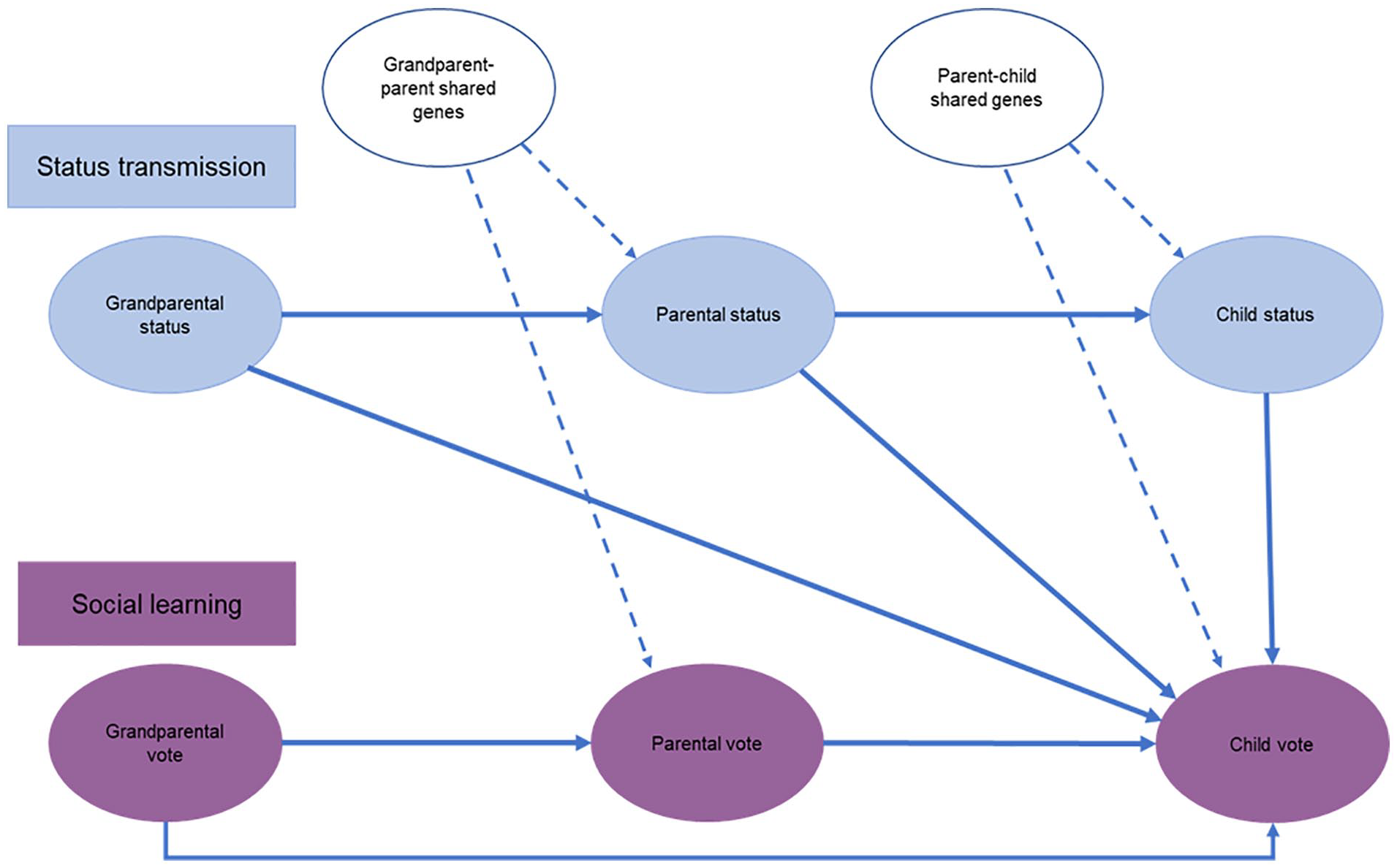
How grandparents could influence the turnout of their adult grandchildren.
One potential indirect route is via status transmission. From the perspective of status transmission theory, political reproduction is indissolubly linked to social reproduction. Verba and his colleagues (Verba, Burns, and Schlozman 2003; Verba, Schlozman, and Burns 2005) argue that parental socioeconomic status, and more particularly parental education, is the key to explaining how the propensity to participate in politics is passed from parent to child. Parents with low levels of education and income tend to have children who are similarly disadvantaged. Given that socioeconomic disadvantage translates into political disadvantage, their children are less likely to become politically active as adults. Work on the transmission of social class and educational attainment (see, for example, Chan and Boliver 2013, 2014; Coall and Hertwig 2011; Erola and Moisio 2007; Mare 2011; Warren and Hauser 1997; for an extensive review of the literature on education, see Anderson, Sheppard, and Monden 2018) suggests that this process could well extend across three generations.
The grandparent–grandchild link in voting could also occur as the result of the transmission of social learning across three generations. From the perspective of social learning theory, parents act as role models whose behavior children encode and later come to imitate (Bandura 1977). Modeling can be based on both parental behavior and verbal messages about the importance—or not—of voting (see Wass 2007). Just as parents may model their behavior on that of their own parents, so may their children learn from the parental example. In this way, the lessons imparted by grandparents get passed on from one generation to the next. In this case, the influence of grandparents on their grandchildren’s propensity to vote is mediated through parental turnout.
Genetic inheritance is another possible factor that could indirectly link grandparental turnout to the turnout of their adult children. Attempts to identify genes that might be implicated in voting have proven inconclusive (see, for example, Charney and English 2013; Deppe et al. 2013; Fowler and Dawes 2008, 2013). Nonetheless, the possibility remains, given that all behavioral traits, including correlates of voting such as altruism and personality, are partly heritable (Ebstein et al. 2010; Turkheimer, Pettersson, and Horn 2014). The same is likely to be true of the correlates of social status. However, disentangling how much of the grandparent–grandchild link reflects shared genes would require a large sample of adoptees (see Cesarini, Johannesson, and Oskarsson 2014) or genomic data. Accordingly, these links are depicted using dashed lines in Figure 1. What we can say is that any such links must necessarily be mediated through the parent(s).
So far, we have been focusing on indirect grandparent–grandchild links. More interesting from our perspective is the possibility of direct links (see Figure 1). Grandparents may be especially influential when it comes to socialization. Increased life expectancy and decreased morbidity mean that grandparents may have more years of healthy grandparenthood to share with their grandchildren (Leopold and Skopek 2015; Margolis and Wright 2017). 1 Moreover, smaller family sizes may enable grandparents to invest more time in their grandchildren (Dunifon and Bajracharya 2012). Higher rates of divorce and the rise of dual-earner families mean that grandparents often figure prominently in the lives of their grandchildren (Mare 2011; Seltzer and Yahirun 2014): fully 10 percent of American children live with a grandparent, up from 7 percent in 1992 (U.S. Census Bureau 2014) and 28 percent of American grandparents living apart from their grandchildren are providing fifty hours or more of care per year (Luo et al. 2012).
There is evidence from other fields that grandparents can pass on cultural habits and normative beliefs to their grandchildren. Just as highly educated grandparents may highlight the value of educational attainment (see, for example, Ziefle 2016), so grandparents may emphasize the importance of voting. Conversely, just as grandparents can pass on unhealthy eating habits to their grandchildren (for a review, see Chambers et al. 2017), so they may pass on the habit of not voting. Whether intentionally or unintentionally, grandparents may convey messages about the value—or not—of voting. They may highlight the desirability of voting as a matter of civic duty or for instrumental reasons, or they may instill in their grandchildren the notion that the costs of voting exceed any likely benefit. Given that older generations are more likely to vote (see Bhatti, Hansen, and Wass 2012), having grandparents who do not vote may convey a particularly strong negative message about the value of voting.
Grandparents may matter when it comes to their grandchildren’s turnout, but not because of the behavioral or verbal messages that they communicate about voting. The literature on the intergenerational transmission of social mobility suggests that grandparental effects may reflect material investments that grandparents make in their grandchildren (Erola et al. 2018). For example, grandparents may invest in their grandchildren’s human capital by helping to fund their education or they may transfer some of their material wealth to their children or grandchildren in the form of gifts or early inheritance. Infusions of cash can make it more likely that children will vote as adults, while having little or no effect on the parents’ turnout (Akee et al. 2020).
Whether as a result of social learning or status transmission, these more direct forms of grandparental influence may have additive effects on their grandchildren’s propensity to vote. In the case of status transmission, we can draw a parallel with the literature on the intergenerational transmission of social mobility: “if both the grandfather and father are farmers, this may more strongly predict that the grandchild will also become a farmer compared to a case where only the father is a farmer” (Erola and Moisio 2007, 171). Similarly, having grandparents who vote may reinforce the effects of having parents who vote, just as having non-voting grandparents may reinforce the effect of having non-voting parents, but now the presumed mechanism is social learning: grandparents may reinforce the normative family environment (Lehti and Erola 2017) by underlining the assumption that voting does—or does not—matter.
It is also possible that having non-voting grandparents will offset the effect of having parents who vote. This is especially likely if grandparents on both sides of the family are non-voters. People are apt to marry individuals who share similar traits. This could apply to voting as well: people may select their mates based on characteristics such as status or personality that are strongly correlated with the propensity to vote; they may even meet through their political activities (Gruneau 2020). However, assortative mating does not necessarily bring together partners who are both voters. When the child of non-voting parents marries a voter, there may be discontinuity in turnout between the generations. Under the influence of their voting partner, the non-voter may decide to vote. But their own children may be less likely to vote if the grandparents are non-voters and impart negative messages about voting.
Data and Method
We use a unique Finnish dataset spanning three generations. Finland offers a suitable case. Grandparents in Finland typically live quite close to their adult children. According to Hurme (2006), almost half (44%) of adult children in Finland lived within 10 km of their mother and 25 percent lived within 10 to 50 km; only 19 percent lived more than 200 km apart. The figures for fathers were 38, 25, and 22 percent, respectively. By way of comparison, 66 percent of American adults with a living parent live within less than 30 miles of the nearest parent and 42 percent have all parents living within less than 30 miles (Choi et al. 2020). Moreover, like their American counterparts (Silverstein and Marenco 2001; Swartz 2009), the majority of Finnish children have quite close relations with their grandparents. The number of respondents reporting that their children had very distant relations ranged from a mere 6 percent in the case of maternal grandmothers to 14 percent in the case of maternal grandfathers. The parents also reported being in contact with their own parents quite frequently and, like their American counterparts (Luo et al. 2012), a majority of Finnish grandparents play an active role in child care (Hurme 2006; see also Majamaa 2015).
Our dataset matches official voting records for three generations with individual-level data compiled by Statistics Finland. 2 The use of official voting records means that we avoid the problems of misreporting and over-reporting that bias self-reports of turnout (see Karp and Brockington 2005; Sciarini and Goldberg 2016; Selb and Munzert 2013) and that are magnified in studies of intergenerational transmission which depend on respondents’ reports of their parents’ or grandparents’ turnout. The use of census data also minimizes the problem of inaccurate reporting of parental or grandparental characteristics.
The turnout data come from the electoral wards that utilized electronic voting registers in the 2015 Finnish parliamentary election. Electronic voting registers were used in 402 electoral wards in 115 municipalities. These wards include 24.2 percent of eligible voters residing in Finland. Statistics Finland used personal identification codes to link information from these registers with demographic and socioeconomic data derived from other administrative registers. The same codes were used to link the data with information on grandparental and parental voting in the 1999 parliamentary election for which voting data are available for the full population, along with some demographic and socioeconomic information about the parents and grandparents. The personal identification codes allow exact matching with an extremely high degree of reliability. The data do not constitute a representative sample of the Finnish electorate, as municipalities could choose whether to employ electronic voting registers and in which electoral wards they were used in the 2015 election. According to our diagnostics, rural areas in northern Finland are somewhat overrepresented and the capital city of Helsinki is somewhat underrepresented. However, as there is no individual-level self-selection, and individuals do not generally even know what kind of register their ward uses, there should not be any significant biases in the relationships between our variables of interest. The intergenerational links were established based on biological parenthood, except in the case of adoption. 3
The key independent variable is the number of grandparents who voted in the 1999 parliamentary election. Using grandparental turnout in 1999 increases the probability that individuals had at least one grandparent alive and reduces the incidence of grandparents who are no longer voting because of ill-health or reduced mobility (Bhatti, Hansen, and Wass 2012; Mattila et al. 2013). It also enables us to capture the impact of grandparents during their grandchildren’s formative years. As we are predicting grandchildren’s turnout in the 2015 parliamentary elections based on grandparental turnout in the 1999 parliamentary elections, we can rule out possible trickle-up effects (Dahlgaard 2018; McDevitt and Chaffee 2002; Shulman and DeAndrea 2014). Because turnout data for the 1999 election cover the full population, complete data are available for all living grandparents for 204,884 individuals who had at least one grandparent alive in 1999. It is rare for studies of grandparental effects to have reliable data on all three generations. Studies typically have to rely on reports of grandparental characteristics provided by their adult children or even their sons- or daughters-in-law. The resulting measurement error may cause the grandparent–grandchild association to be underestimated (Anderson, Sheppard, and Monden 2018). It is also rare to have reliable information on all four grandparents (for an exception, see Sheppard and Monden 2018). Data are often only available for one set of grandparents or for a single grandparent.
Thirty-four percent of the sample had all four grandparents alive at the time of the 1999 parliamentary elections, 35 percent had three living grandparents, 22 percent had two living grandparents, and 9 percent had only one grandparent alive. This variation in the number of living grandparents has to be taken into account in the construction of our independent variable; otherwise, we would be conflating having non-voting grandparents with having grandparents who are simply deceased. To make the effect of grandparental turnout conditional on the number of grandparents alive, we have created a series of dummy variables. 4 These are equivalent to interacting the number of grandparents voting with the number of living grandparents, omitting impossible combinations (such as three grandparents voted but only two grandparents were alive). The proportion of the sample in each of the possible categories is shown in the appendix. We limit the sample to grandchildren who were aged forty-five or under in 2015 (202,696) because few older grandchildren (1.1%) had any grandparents alive. Turnout in our sample is 58.3 percent, compared with 70.1 percent in the general population. This reflects the fact that our sample is necessarily younger than average.
The dependent variable is turnout in the 2015 parliamentary elections, coded one for those who voted and zero for non-voters. The most important control variables are parental voting, grandparental education, 5 and both the parents’ and grandchildren’s education, social class, and income. 6 As the effects of education may not be linear and there is no consensus in the literature as to which level of education matters for political participation (Gidengil et al. 2019), education is represented by four dummy variables, corresponding to high school, associate degree, bachelor’s degree or equivalent, and graduate degree or equivalent, with junior high school as the reference category. 7 The coding of parental and grandparental education is based on the dominance principle, that is, the highest levels of education attained by any grandparent and by one or both parents, respectively. Social class is operationalized using Statistics Finland’s socioeconomic classification and is based on an individual’s current or previous occupation. It includes five classes: manual, lower non-manual, upper non-manual, self-employed (excluding agricultural occupations), and self-employed in agricultural occupations. Social class is entered as a series of dummy variables. In the case of parents who are both employed, the coding of parental social class is based on the dominance principle, that is, the social class of the higher class parent. If one or both parents are self-employed, the information from the parent with higher educational qualifications is used. Income is coded in quartiles. 8 Parental income is based on the sum of the mother’s and father’s income and is also represented by a series of dummy variables corresponding to income quartiles. Parental voting is dummy coded, depending on whether both parents voted, or one parent voted, with neither parent voted serving as the reference category. This enables us to capture the impact of (in)consistent parental cues (Bandura 1977; Gidengil, Wass, and Valaste 2016). In addition, all models control for the individual’s sex, mother tongue, marital status, and home ownership. To take account of the curvilinear effects of age (Bhatti, Hansen, and Wass 2012), the models include both age and age squared.
A control is also included for the number of grandparents alive at the time of the 2015 parliamentary elections. This is the best proxy we have for contact between grandparents and their grandchildren. Data secrecy means that we do not have access to individuals’ home addresses and thus cannot measure the actual distance between the homes of grandparents and their grandchildren. Having more grandparents alive increases the probability of close contact between grandparents and their grandchildren because it is more likely that at least one grandparent lives nearby. It also makes it more likely that relationships with at least one grandparent within the family are amicable (Sheppard and Monden 2018). Controlling for the number of grandparents alive also takes account of the possibility that simply having grandparents who are still living bestows advantages in terms of social networks and support systems.
As the dependent variable is binary, we estimate linear probability models (LPMs). We prefer LPM to logistic regression because logistic regression estimates can be biased by unobserved heterogeneity even when the omitted variables are unrelated to the independent variables (Mood 2010). This bias arises because the error variance is always fixed and does not change according to the independent variables included in the model. This problem is particularly prominent in a situation like ours where we need to compare across models to identify the direct and indirect grandparental effects. The estimates can be both downward and upward biased and the researcher has no way of telling which is the case in separate models, even when comparing two nested models (Breen, Karlson, and Holm 2018). The literature suggests that LPM and logistic regression will yield very similar results, provided that the dependent variable is not highly skewed and that the functional form is not mis-specified (Hellevik 2009; Mood 2010). In our case, there is no concern about skewness because there is no subgroup in which turnout was either extremely low or extremely high. Given that our key independent variable is represented by a series of dummy variables, possible non-linearity in not a problem, either. Nonetheless, as a robustness check, we re-estimated the models using binary logistic regression and then estimated predicted probabilities using the observed values method (Hanmer and Kalkan 2013). The resulting probabilities are almost identical to those obtained using LPM (see online appendix). A potential drawback to using LPM is that predicted probabilities may fall outside the zero to one range. 9 However, the problem of impossible predictions did not arise in our analyses.
The sample contained 90,439 siblings belonging to 40,296 different families. Robust standard errors clustered by family identification number are used to take intra-family correlation into account and avoid inflated estimates of statistical significance. Given the size of the sample, even small effects are likely to achieve conventional levels of statistical significance. Accordingly, a stricter 99 percent confidence level is used in reporting the results instead of the conventional 95 percent level confidence level. To give readers a better sense of their substantive importance, the key results are presented as predicted probabilities. The full models are available in the online appendix.
Results
The first model enables us to estimate the total effect of grandparental turnout (see the appendix for the corresponding predicted probabilities). It only controls for the number of grandparents alive in 2015 and the grandchild’s sex, age, first language, and marital status. Figure 2 shows that having grandparents who were non-voters in 1999 has much more of an effect on the grandchildren’s probability of voting than having grandparents who voted. The predicted probability of voting is only 38.3 percent when all four living grandparents were non-voters in 1999, compared with 53.6 percent when the only living grandparent stayed home on Election Day. By contrast, the predicted probabilities only range from 58.7 percent when the sole living grandparent voted to 66.0 percent when all four living grandparents voted.
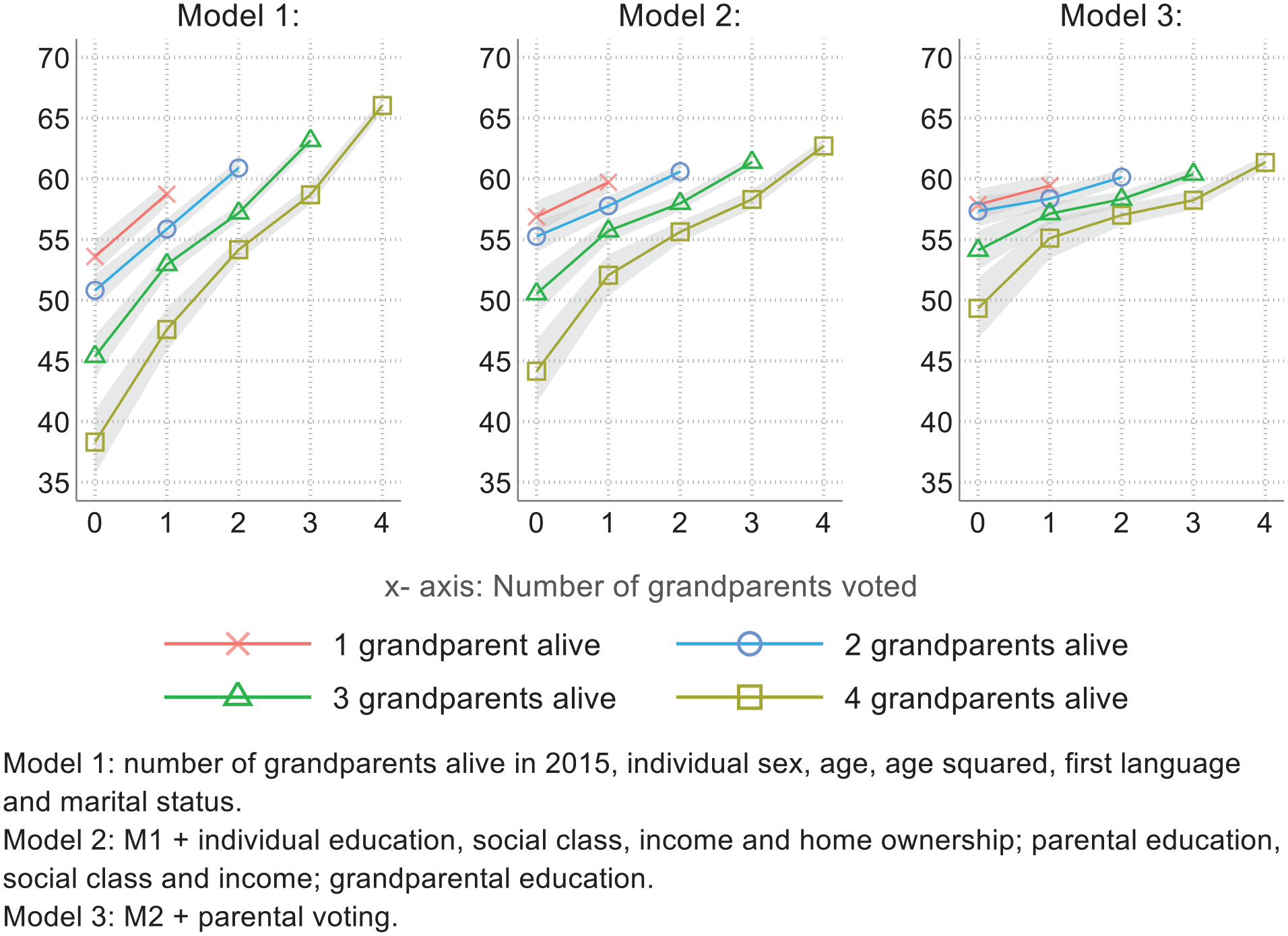
The probability of voting (%) in the 2015 parliamentary elections depending on the number of living grandparents voting in the 1999 parliamentary elections (N = 202,696).
The next two models examine the indirect effects of grandparental turnout. We predicted that any relationship between grandparental turnout and the turnout of their adult grandchildren would be partly mediated via the grandchildren’s parents as a result of status transmission and social learning across the three generations (see Figure 1). The results clearly support this expectation.
As Verba and his colleagues’ theory would predict (Verba, Burns, and Schlozman 2003; Verba, Schlozman, and Burns 2005), status transmission plays a role (see model 2 in Figure 2). Note first that the number of grandparents who were alive and all voted matters much less than it did in the initial model. The predicted probability of voting is 59.7 percent if the sole living grandparent voted versus 62.7 percent if all four grandparents voted. In other words, the difference has shrunk from 7.3 points in model 1 to 3.0 points in model 2, once indicators of status transmission are added to the model.
The number of non-voting grandparents tells a different story. Although status transmission still plays a role, it cannot explain away the observed effect of having grandparents who do not vote. The predicted turnout is 56.9 percent when the only living grandparent was a non-voter but only 44.2 percent when all four living grandparents failed to vote. Thus, the grandchild’s probability of voting decreases as the number of non-voting grandparents increases, even taking account of various possible indicators of status transmission. The observed effect of having non-voting grandparents is only partly a matter of status transmission. We can see this most clearly in the case of those whose grandparents were all alive in 1999. The predicted probability of voting drops from 62.7 percent when all four were voters to only 44.2 percent when none of the four voted. In the case of those with three living grandparents, predicted turnout ranges from 61.4 percent when all three voted to 50.5 percent when all three were non-voters. However, the differences are smaller in the case of two living grandparents (5.4 points) and a sole living grandparent (2.8 points). This reinforces the point that it is the number of non-voting grandparents that matters.
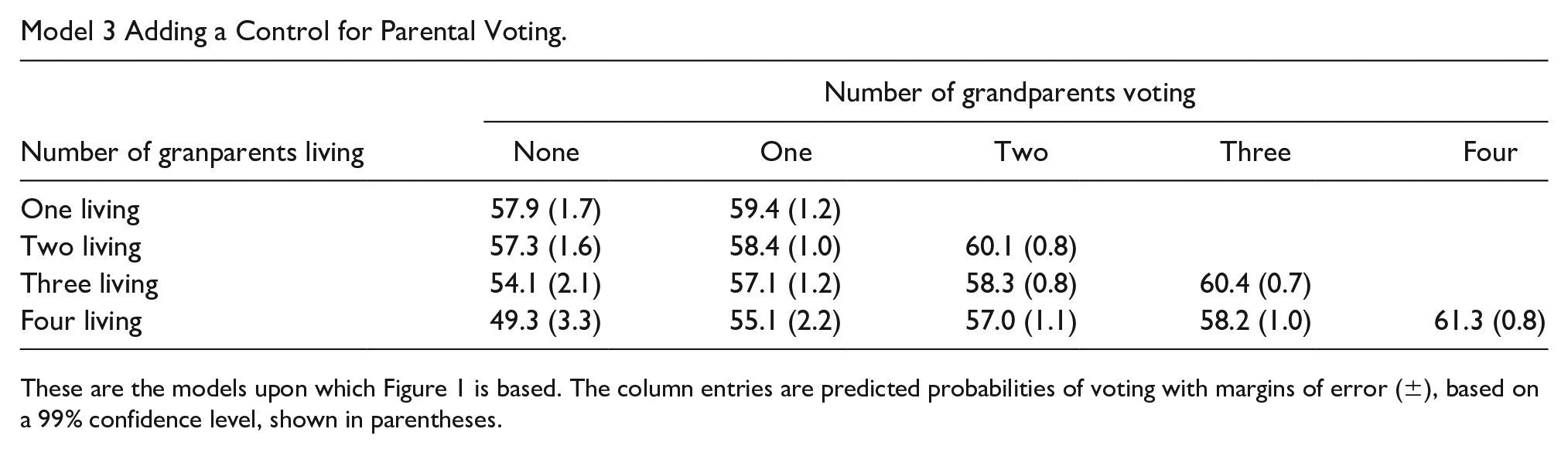
Status transmission across the three generations is clearly part of the reason for the observed association between grandparental turnout and the turnout of their adult grandchildren. Parental turnout also plays a mediating role (see model 3 in Figure 2). Once parental turnout is taken into account, whether the only living grandparent voted in 1999 or all four living grandparents voted matters even less (1.9 points) to their grandchildren’s propensity to vote (see model 3 in Figure 2). The estimated effects of having non-voting grandparents are diminished as well but remain more substantial. Even controlling for parental voting, the number of living grandparents who were non-voters in 1999 has a significant and sizable association with their grandchildren’s probability of voting. The predicted probability of voting ranges from 57.9 percent when the only living grandparent failed to vote to 49.3 percent when all four grandparents were non-voters. In other words, grandparental turnout appears to matter and not just at the margins.
This becomes apparent when we compare the effects of parental and grandparental voting based on the same model (see online appendix). Having parents who were both non-voters decreases the estimated probability of voting by 17.6 points, compared with having parents who both voted. In the case of those with four living grandparents, when all four were non-voters the probability of voting was 12.0 points lower than when all four were voters. 10 In other words, the estimated grandparental effect in this case is fully two-thirds of the estimated parental effect. The more living grandparents who were non-voters, the larger the predicted difference in turnout. 11
The next set of analyses test our expectations about additive and offsetting effects. First, we estimate the same models on the subset of individuals whose parents were non-voters in 1999 to test whether having non-voting grandparents reinforces the effect of having parents who do not vote. 12 The results are presented in Table 1. The observed effect of having non-voting parents does indeed appear to be reinforced when the grandparents do not vote. The first model suggests that having non-voting grandparents diminishes the probability that the grandchild will vote over and above the effect of having non-voting parents. The predicted probability that the grandchild will be a non-voter like their parents ranges from 36.9 percent when the only living grandparent was also a non-voter to 25.6 percent when all four grandparents were non-voters. Even when status transmission is accounted for in model 2, the number of non-voting grandparents continues to make a difference. The predicted probability of voting is 39.2 percent when the sole living grandparent stayed home but only 27.7 percent when all four grandparents were non-voters. However, when only one grandparent was still alive in 1999, there is no evidence of a reinforcement effect: on the contrary, if anything, the predicted probability of voting is higher when the grandparent was a non-voter.
The Probability of Voting in the 2015 Parliamentary Elections When Both Parents Were Non-voters, Depending on the Number of Living Grandparents Voting in the 1999 Parliamentary Elections (n = 35,361).
Model 1 Controlling for Number of Grandparents Alive in 2015, Sex, Marital Status, First Language, Age, and Age Squared.
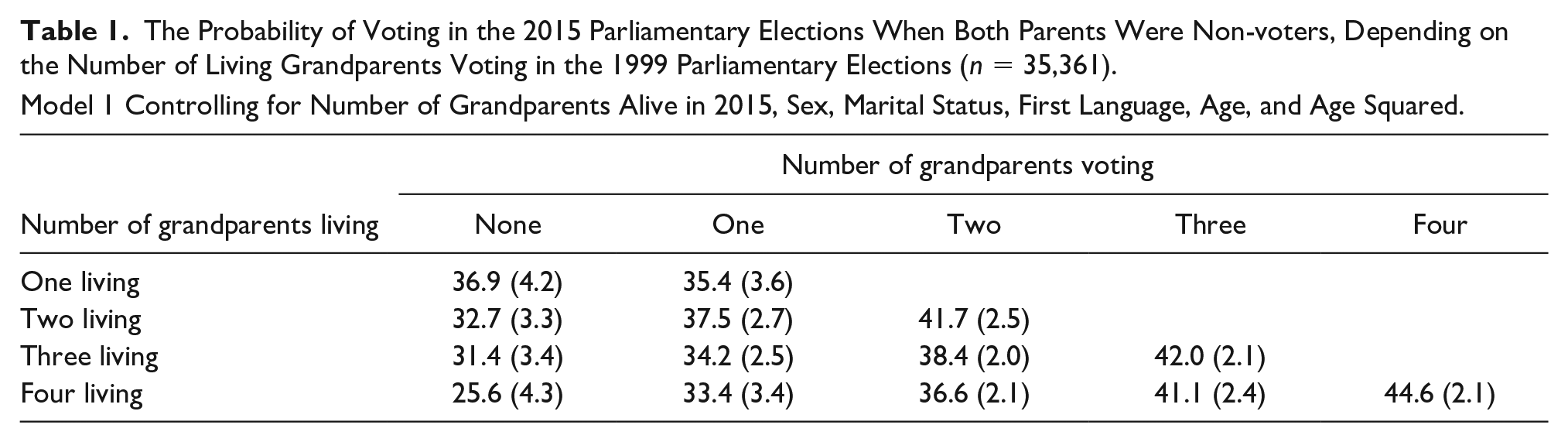
Model 2 Adding Controls for Education Income Social Class and Home Ownership; Parental Education, Income, and Social Class; and Grandparental Education.
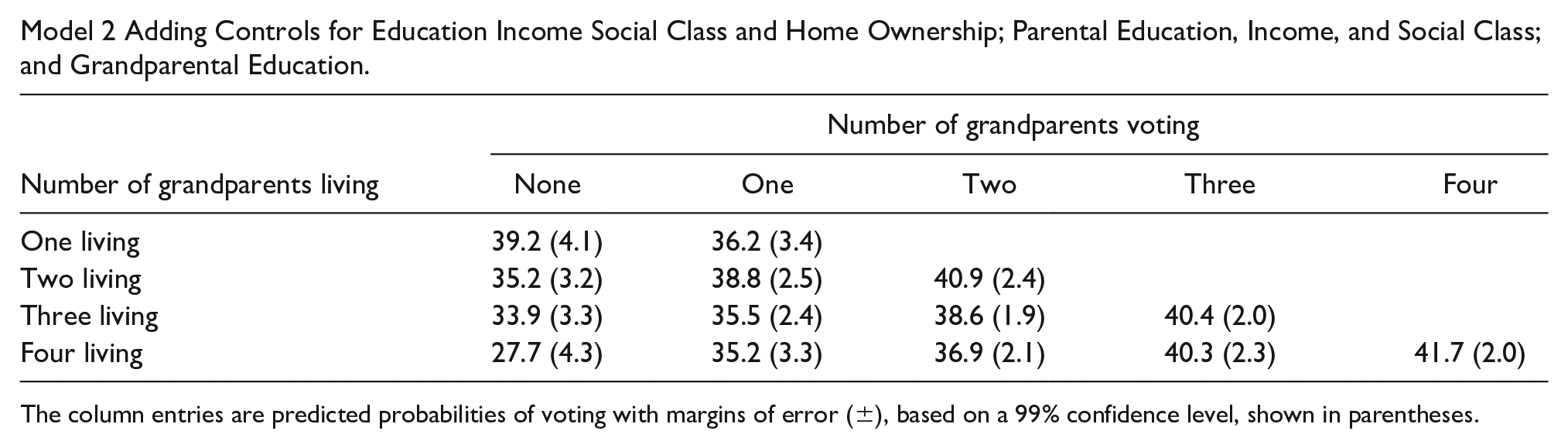
The column entries are predicted probabilities of voting with margins of error (±), based on a 99% confidence level, shown in parentheses.
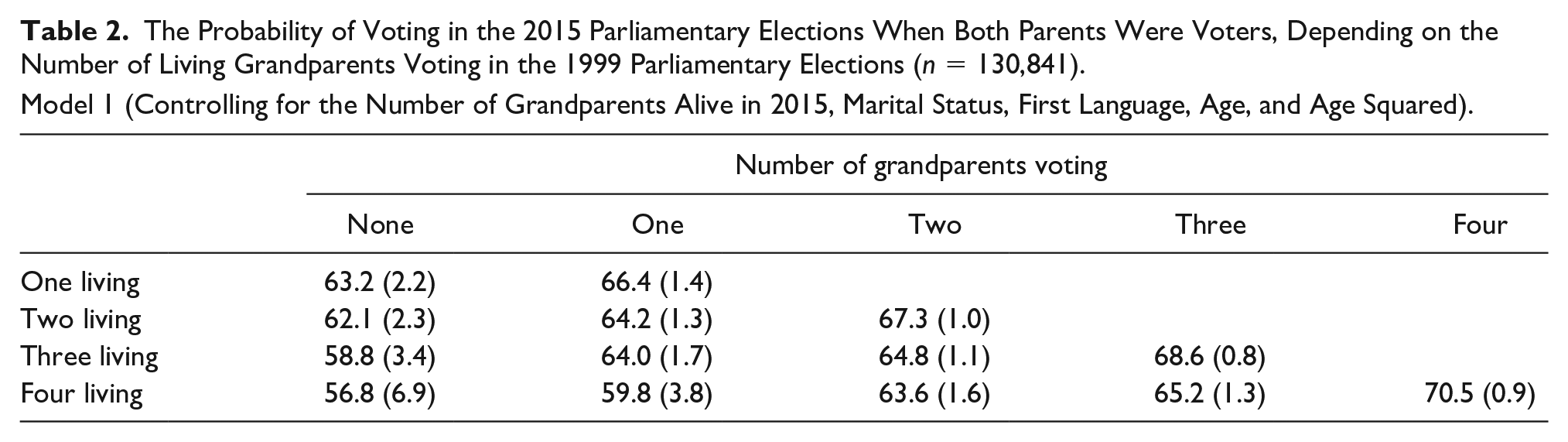
Turning to those whose parents both voted, there is little evidence that grandparents have an additive effect: once status transmission is taken into account, the predicted probabilities only range between 67.5 percent when the sole living grandparent voted and 68.6 percent when all four living grandparents turned out to vote (see Table 2). However, there is some evidence that having non-voting grandparents has an offsetting effect: individuals who had non-voting grandparents were less likely to vote, even though their parents were both voters. The more non-voting grandparents, the lower the probability of voting. The predicted probability of voting ranges from 63.2 percent when the only living grandparent was a non-voter to only 56.8 percent when all were non-voters. Once again, some of these effects are attributable to status transmission. However, the number of non-voting grandparents still appears to matter. The more non-voting grandparents, the lower the predicted turnout. The predicted probability of voting goes from 65.2 percent when the sole surviving grandparent was a non-voter to 60.7 percent when all four failed to vote. Regardless of the number of grandparents alive, there is a clear trend of decreasing turnout as fewer of them vote. In line with the argument that it is the number of non-voting grandparents that matter, we can see that the offsetting effect of having non-voting grandparents is greatest when all four grandparents were still alive in 1999. The fact that non-voting grandparents can apparently offset the effects of having parents who are both voters is strong evidence that grandparental turnout matters.
The Probability of Voting in the 2015 Parliamentary Elections When Both Parents Were Voters, Depending on the Number of Living Grandparents Voting in the 1999 Parliamentary Elections (n = 130,841).
Model 1 (Controlling for the Number of Grandparents Alive in 2015, Marital Status, First Language, Age, and Age Squared).
Model 2 (Adding Controls for Education, Income, Social Class, and Home Ownership; Parental Education, Income, and Social Class; and Grandparental Education).
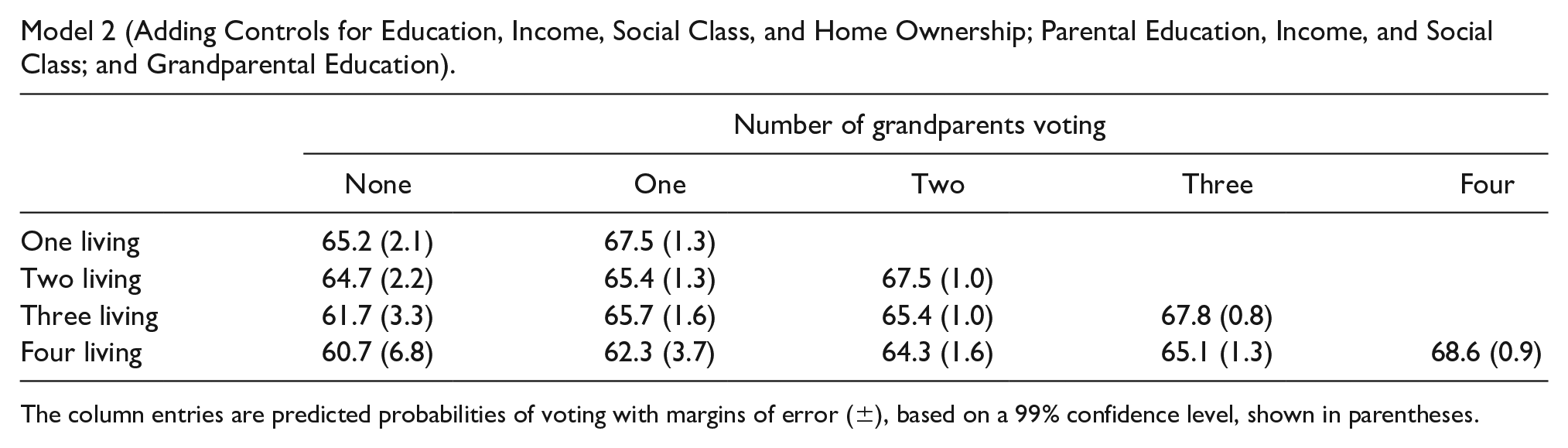
The column entries are predicted probabilities of voting with margins of error (±), based on a 99% confidence level, shown in parentheses.
Concluding Discussion
Our results suggest that it is time to take the role of grandparents seriously if we want to understand how political inequality is transmitted across generations. We have theorized the influence of grandparents in terms of both social learning and status transmission. The results confirm that the reproduction of social inequality plays a role in the reproduction of political inequality, as predicted by status transmission theory. However, even controlling for a variety of status-related characteristics, grandchildren appear to be less likely to vote if their grandparents are non-voters. The association cannot be explained away by the mediating effect of parental turnout, though it is reduced. Having non-voting grandparents seems to matter, whether or not the parents vote. The more living grandparents who were non-voters in the 1999 parliamentary elections, the less likely the grandchild was to vote in the 2015 elections. By way of comparison, it is worth noting that only forty of sixty-nine analyses included in Anderson, Sheppard, and Monden’s (2018) systematic review were able to find a direct association between the socioeconomic characteristics of grandparents and the educational outcomes of their grandchildren, once parental characteristics were controlled for.
These findings are consistent with our theoretical argument that grandparents may transmit cultural and political values and norms to their grandchildren that predispose them to vote or not to vote. In doing so, they may contribute to the family’s normative environment. This could help to explain the evidence we found of a possible reinforcing effect when the parents were both non-voters. When two or more grandparents were still alive, it was even less likely that the offspring of non-voting parents would vote if their grandparents were non-voters. There was also evidence that having non-voting grandparents may even counteract the effect of having parents who both voted.
Our data offer important advantages when it comes to studying political reproduction as a three-generation phenomenon. First, because the data on all three generations are taken from official voting records, we do not have to contend with the problems of misreporting and faulty recall that jeopardize the reliability of reports of parental and grandparental turnout. The same is true of the socioeconomic information. Accordingly, there is very little risk of measurement error in the dependent or independent variables. There is also no risk of self-selection bias. Second, we do not have to be concerned with possible trickle-up effects (Dahlgaard 2018; McDevitt and Chaffee 2002; Shulman and DeAndrea 2014). As we are using grandparental turnout in the 1999 parliamentary elections to predict the grandchild’s turnout in the 2015 parliamentary elections, it is highly unlikely that the grandchild’s behavior could have influenced the grandparents’ turnout.
Despite the advantages of the dataset, there are limitations. First, we do not have measures of the extent of contact between grandparents and their grandchildren. Using the number of grandparents still alive in 2015 is only a weak proxy. However, grandparental effects are not necessarily conditional on physical contact. For instance, how often a youth had seen each grandparent in the previous year was not a significant predictor in a study of grandparental effects on outcomes such as risky behavior, sex, and grades (Dunifon and Bajracharya 2012). Grandparents can be important role models regardless of the extent of face-to-face contact. For example, parents may comment on the fact that grandparents do not vote. Moreover, modern communication technologies mean that contact is much less dependent on physical proximity.
Second, information on grandparental voting was only available for one election. However, it seems reasonable to assume that many of the grandparents who voted in 1999 also voted in previous and subsequent elections, given evidence that voting is habit-forming (Aldrich et al. 2011; Cutts, Fieldhouse, and John 2009; Green and Shachar 2000). If anything, reliance on a single election may underestimate how much non-voting grandparents may matter. Some of the grandparents may not have been habitual non-voters: instead, they may have stayed home in 1999 because of decreased mobility or poor health.
Third, the fact that we are using administrative data limited our examination of parental characteristics that could explain the observed effect of grandparental turnout to parental education, social class and income, and parental voting. This raises the possibility that our analyses are overstating any independent impact of grandparental voting. Accordingly, the results presented here should be considered upper-bound estimates of the socializing effect of grandparental non-voting and caution is warranted in drawing any causal inferences.
As Breen (2018) emphasizes, it is important to recognize that an association between the behavior of grandparents and their grandchildren is not necessarily causal. The fact that the association is only partly mediated by parental turnout suggests that the observed effect is net of possible genetic confounding because parental turnout should capture any genetic predisposition to vote or not, except in those—relatively rare (Gilding 2005; Larmuseau, Matthijs, and Wenseleers 2016)—cases where the purported father is not, in fact, the father. However, we cannot rule out the possibility of other confounders. For example, Breen (2018) has highlighted possible confounding by neighborhood in the case of the association between the social status of grandparents and their grandchildren. A similar logic could apply to turnout, if place of residence is passed on from one generation to the next and there are neighborhood effects on turnout.
Even sounding these cautionary notes, there is enough evidence here to warrant further investigation of political reproduction across multiple generations using both survey-based and qualitative approaches. First, future studies could explore whether grandparental effects vary depending on the sex of both the grandchildren and their grandparents. Second, research is needed on the nature and frequency of communication between grandparents and their grandchildren to explore whether and how different types of contacts may condition the grandparent–grandchild link in voting. Surveys, semi-structured interviews, and focus groups could all cast light on the role of intergenerational communication and other mechanisms that underpin this link. In particular, it would be important to know what role social learning plays, as well as the relative importance of active versus verbal modeling of behavior. Third, we need to know whether our findings extend to other forms of political activity beyond voting. It could be particularly interesting to look at online activism because this negates the possible effects of physical distance but also raises the possibility of trickle-up socialization (Dahlgaard 2018). Fourth, there is a need for studies in different national contexts to see how grandparental influence varies depending on factors like parental leave, child care regimes, the prevalence of dual-earner families, and divorce rates. Fifth, future research could look beyond grandparents to explore the role of aunts and uncles, who have been found to matter in other domains (Anderson, Sheppard, and Monden 2018; Erola et al. 2018; Lehti and Erola 2017).
Finally, it is worth underlining the societal relevance of our study. It provides important insight into the process of political reproduction by highlighting the role of non-voting grandparents. Our results suggest that the accumulation of political disadvantage across generations matters. Indeed, when grandparents do not vote, the effect of having non-voting parents may be reinforced. As grandparents live longer, healthier, and more active lives and as new technologies facilitate intergenerational communication, their influence on the political socialization of their grandchildren may well grow. This highlights the importance of efforts to ensure that polling places are accessible to older citizens. It also underlines the importance of “it takes a village,” pointing to the need to strengthen the role of schools and recreational associations in political socialization to offset the effects of the intergenerational transmission of political disadvantage.
Supplemental Material
online_appendix – Supplemental material for From Generation to Generation: The Role of Grandparents in the Intergenerational Transmission of (Non-)Voting
Supplemental material, online_appendix for From Generation to Generation: The Role of Grandparents in the Intergenerational Transmission of (Non-)Voting by Elisabeth Gidengil, Hannu Lahtinen, Hanna Wass and Jani Erola in Political Research Quarterly
Footnotes
Appendix
Model 3 Adding a Control for Parental Voting.
| Number of grandparents voting | |||||
|---|---|---|---|---|---|
| Number of granparents living | None | One | Two | Three | Four |
| One living | 57.9 (1.7) | 59.4 (1.2) | |||
| Two living | 57.3 (1.6) | 58.4 (1.0) | 60.1 (0.8) | ||
| Three living | 54.1 (2.1) | 57.1 (1.2) | 58.3 (0.8) | 60.4 (0.7) | |
| Four living | 49.3 (3.3) | 55.1 (2.2) | 57.0 (1.1) | 58.2 (1.0) | 61.3 (0.8) |
These are the models upon which Figure 1 is based. The column entries are predicted probabilities of voting with margins of error (±), based on a 99% confidence level, shown in parentheses.
Declaration of Conflicting Interests
The author(s) declared no potential conflicts of interest with respect to the research, authorship, and/or publication of this article.
Funding
The author(s) disclosed receipt of the following financial support for the research, authorship, and/or publication of this article: The authors received financial support from the Academy of Finland Flagship (Grant Number 320162), Le Fonds de recherche société et culture, and the Strategic Research Council at the Academy of Finland (Grant Number 312710).

Supplemental Material
Supplemental materials for this article are available with the manuscript on the Political Research Quarterly (PRQ) website.
Notes
References
Supplementary Material
Please find the following supplemental material available below.
For Open Access articles published under a Creative Commons License, all supplemental material carries the same license as the article it is associated with.
For non-Open Access articles published, all supplemental material carries a non-exclusive license, and permission requests for re-use of supplemental material or any part of supplemental material shall be sent directly to the copyright owner as specified in the copyright notice associated with the article.
