




Abstract
How do perceived inequalities in allocation impact citizen satisfaction with state-distributed benefits in rentier societies? Resource-rich rentier regimes are widely theorized to maintain the economic and political satisfaction of subjects through wealth distribution. Yet, while qualitative research in the rentier states of the Arabian Peninsula has identified unequal distribution as a source of discontent, the relative importance of objective versus subjective factors in shaping satisfaction at the individual level has never been systematically evaluated. Here we assess the impacts of inequality on the nexus between wealth and satisfaction among citizens of the richest rentier regime in the world: the state of Qatar. Using original, nationally representative survey data, we test the effects of two separate mechanisms of unequal distribution previously identified in the literature: group-based discrimination, and variation in individual access owing to informal influence. Results show that perceptions of both group- and individual-based inequality dampen satisfaction with state-distributed benefits, irrespective of objective socioeconomic well-being. The findings demonstrate that even in the most affluent of rentier states, economic satisfaction derives not only from absolute quantities of benefits but also from subjective impressions of fairness in the distribution process.
Introduction
Authoritarian regimes dependent upon external sources of revenue—or rentier states—are widely theorized to maintain the economic and political satisfaction of their citizens through rent-funded patronage. The Persian Gulf emirate of Qatar is the richest of these rentier states, owing to immense oil and natural gas revenues: the country boasted a per-capita gross domestic product (GDP; adjusted by purchasing power parity) of nearly $120,000 in 2016, a figure that balloons to almost $700,000 per citizen when one excludes Qatar’s large population of expatriate workers (Kinninmont 2013). As a consequence, Qatar is also likely the most generous rentier state, providing its small national population of around three hundred thousand individuals with wide-ranging subsidies and direct wealth transfers. Qatar should thus be a most-likely case for the wealth-satisfaction nexus articulated both by scholars and in more popular analyses. As one BBC News correspondent quipped in 2009, “It’s wrong to say Qataris are born with a silver spoon in their mouths. It’s a gold spoon, encrusted with diamonds” (Adler 2009).
This immediate focus on the level of wealth distributed among Qatar’s citizenry, while understandable, obscures wide differences in individual economic outcomes. A 2016 survey of citizen income in five of the six oil-producing Gulf Cooperation Council (GCC) states—Bahrain, Kuwait, Oman, Qatar, and Saudi Arabia—found that Qataris had both the highest average household income as a whole but also the greatest deviation in income individually (Social and Economic Survey Research Institute 2016). Although some of this variability, in Qatar and elsewhere, can be attributed to objective differences in individual qualifications, motivation, and skill, differences in economic outcomes also stem from disparities in the processes of top-down distribution in rentier states. Unequal access may restrict the benefits that accrue to some while boosting the fortunes of others. This suggests that wealth alone may not be a sufficient condition for economic satisfaction, as beneficiaries may regard even an objectively large allocation as an unfair one in relative terms.
Indeed, qualitative work undertaken in the GCC states has identified unequal distribution as a source of economic and even political discontent, mirroring a large body of research in psychology and sociology that establishes a general dampening effect on satisfaction of perceived distributive unfairness. In the Middle East and North Africa context, two separate mechanisms have been associated with distributive inequality: first, broad group favoritism, usually occurring along descent-based lines (Okruhlik 1999); and, second, informal connections and influence that mediate individual access to resources (Buehler 2016; Cunningham and Sarayrah 1994). Although the latter phenomenon of personal intercession finds parallels worldwide, Hertog (2010, 283) argues that “the specific combination of abundant state resources and limited state capacity” of the rentier Gulf monarchies creates a particularly ubiquitous type of informal influence that permeates the structures of these societies.
Qatar’s combination of expansive welfare benefits and high variability in individual economic circumstances make it a crucial case study (Gerring 2007) to assess the effects of inequality on the nexus between wealth and satisfaction in allocative regimes. In a type of state that purposefully engages in top-down distribution of resource revenues to foster economic and ultimately political satisfaction among its citizenry, how do inequities in allocation impact the degree to which citizens feel contented with their personal share of these benefits? Is there a threshold of individual wealth beyond which unfairness ceases to matter, or does inequality exert a more systematic and thus potentially more corrosive effect? With its unrivaled patronage of citizens, Qatar represents perhaps the hardest test of the theory that distributive inequality dampens economic satisfaction in the rentier state.
In what follows, we demonstrate that the process by which economic distribution engenders economic satisfaction in these resource-rich regimes is conditioned at the individual level by subjective perceptions of fairness that extend beyond citizens’ objective socioeconomic well-being. Using original data from the first-ever nationally representative survey of citizen satisfaction with rentier benefits in Qatar, we find that perceived inequality in allocation—both between citizens on one hand and between citizens and noncitizens on the other—is associated with reduced satisfaction with state-distributed benefits across all levels of objective wealth (household income) and self-assessed social class. The results lend support for both mechanisms of unequal distribution established in the literature: group-based discrimination and mediated access via informal influence. Such findings give substance to the notion that the link between distributed oil wealth and economic satisfaction in rentier societies is more than a simple pocketbook transaction. As Qatar and other resource-dependent states seek to rein in welfare spending in a world of lower oil and gas prices, changing citizens’ impressions about the processes of allocation may become as important as material distributions themselves.
Wealth, Inequality, and Economic Satisfaction
Rentier states regularly receive significant amounts of wealth (“rents”) from external sources (e.g., tolls, hosting fees, or hydrocarbon exports) that are paid directly to the state (Mahdavy 1970). These rents reduce the need for rentier countries to tax citizens, thus fundamentally changing the state-society relationship from extraction to distribution (Delacroix 1980; Luciani 1987). This distributive relationship undergirds the so-called “rentier bargain”: the state offers welfare benefits to citizens, whose contingent economic satisfaction outweighs desire for radical transformation of the political status quo (Brynen et al. 2012; Kamrava 2013; Ross 2001, 2012).
All political systems contain inequalities both in distribution processes and outcomes. These distributional inequalities are particularly prevalent in rentier states, which have both more resources per citizen to distribute and lower state capacity relative to the size of these resources to equitably and transparently deliver these goods and services (Hertog 2010, 287). Yet the earliest articulations of the rentier state framework explicitly denied the political relevance of such inequalities. Luciani (1987, 74) asserts that the unequal distribution of benefits is not relevant for political life, because it is not a sufficient incentive to coalesce and attempt to change the political institutions. To the individual who feels his benefits are not enough, the solution of manoeuvering for personal advantage within the existing setup is always superior to seeking an alliance with others in similar conditions.
More recent iterations focus on the political weight of some individuals and groups over others. Bueno de Mesquita and colleagues (2003, 38) argue that the state’s distribution of resources must ensure the satisfaction of a “winning coalition” of essential supporters, leaving the short sticks with those who matter less for guaranteeing political stability (see also Gause 2013; Smith 2004). By this view, then, nondemocratic rentier regimes maintain their rule by distributing golden eggs to citizens (Kamrava 2013, 131; Ross 2012, 69), and it does not matter that some citizens are offered one egg while others sit on a dozen.
The dismissal of the political importance of distributional inequality has been challenged by qualitative evidence from across the Arabian Peninsula, which highlights the dissatisfaction that results when some citizens receive less than others (e.g., Okruhlik 1999, 2016; Tétreault 2013, 39, 45–46). Such cases identify two common mechanisms of distributive inequality that operate at the group and individual levels, respectively. Group-based discrimination, often tied to regime preferences for coethnics, has deleterious effects on the political orientations of those who perceive unfairness. In Saudi Arabia, Okruhlik (1999, 313) notes the “resentment” created among citizens of entire geographic regions—the Eastern Province and the southwest provinces of Asir, Najran, and Jizan—who are underserved in basic public goods such as education, health care, and infrastructure. Likewise, examining sectarian conflict in Bahrain, Gengler (2015, 106–20) demonstrates that Shi’a citizens face more difficulty in accessing basic public services, attaining public sector employment, and reaching higher professional levels within government as compared with their Sunni counterparts, engendering negative orientations toward the state.
Whereas group-based inequalities often stem from the political calculations of rentier regimes, individual-based inequalities in the region are intimately linked to informal influence: “a social arrangement of intercessions in which a more ‘connected’ person intervenes for a less ‘connected’ person to help him get a service or resource” (Buehler 2016, 1). Informal influence exists worldwide in both authoritarian and democratic contexts: it is known as blat in the post-Soviet world, jeitinho in Brazil, guanxi in China, “pulling strings” in the English-speaking world, and wasta in the Arabic-speaking world (Ledeneva 2008; Milyo 2014; Smith et al. 2012). Yet as Hertog (2010, 283) argues, informal influence is particularly “ubiquitous” in the resource-rich states of the Arabian Peninsula—indeed, “a defining feature of state-society relations.” This ubiquity owes to the sheer magnitude of rents accruing to these regimes combined with an underdeveloped state that lacks the capacity for efficient, rule-based distribution. Absent strong bureaucratic mechanisms of resource allocation, benefits tend to flow through informal channels mediated by individual relationships, begetting inequalities based on one’s degree of connectedness to primary and secondary avenues of distribution.
In Oman, for instance, Valeri (2009, 234–35) explains that the perceived need for informal influence to access benefits such as business contracts and public services has “led to increased frustration” over unconnected citizens’ exclusion from welfare distributions. Likewise in Kuwait, citizens express criticism of how oil wealth is allocated to individuals. Tétreault (2000, 52) writes that “‘service candidates,’ payoffs, and gentlemen’s agreements . . . make up the Kuwaiti equivalent of urban legends . . . explain[ing] how the deserving are cheated and the unworthy favored by an overly powerful yet seriously flawed state.”
Such distributive inequalities, whether group- or individual-based, create dissatisfaction and even enmity among those citizens who perceive that they have received an unfair share. Herb (1999, 242) observes that the very personalism of rentier benefits is a double-edged sword for regimes: The [ruling] family can selectively distribute rewards to its followers in an effort to build political loyalty, or to its opponents in an effort to buy out their opposition. Yet those who do not receive a substantial piece of the pie often know it and do not like it.
Such observations echo an extensive body of psychological and sociological research into perceived inequality and its impact on satisfaction (e.g., Easterlin 1995; Frank 1999; Gurr 1970; Sacks, Stevenson, and Wolfers 2012; Walker and Pettigrew 1984). Recipients feel a deep sense of injustice when comparing unequal gifts (Fehr and Schmidt 1999; LoBue et al. 2011), and often choose to reject disadvantageous offers, even if it means that they would lose the offered reward (Blake and McAuliffe 2011; Camerer and Thaler 1995).
This dissatisfaction documented in many rentier societies is not necessarily indicative of a desire for systematic change. Rather, Qataris and other rentier citizens are engaged in direct competition—with each other and with white-collar expatriate workers—to be “the most-favored recipients of whatever trickles down from the rulers’ coffers” (Tétreault 2000, 53). Individuals strive to position themselves at the “heart” of the distributive state to increase their chances of receiving particularistic benefits (Valeri 2009, 234). The question remains, however, whether and in what ways discontent due to perceived inequalities in opportunity and access colors feelings of satisfaction with the benefits that individuals do receive, even if substantial in absolute terms.
Mechanisms of Distribution and Inequality in Qatar
Given their control over enormous hydrocarbon-based wealth, the monarchies of the Arabian Peninsula are commonly cited as paragons of the rentier state (Gause 1994, 42–44; Ross 2012, 73). In this article, we examine the world’s richest and smallest rentier regime: the state of Qatar. Due to its wealth, Qatar is a most-likely, even crucial, case for studying economic satisfaction among rentier citizens (Eckstein 1975). Although the global downturn of oil prices has created hydrocarbon deficits and precipitated plans for radical economic transformation in neighbors such as Saudi Arabia, Qatar has more successfully maintained its fiscal equilibrium due to its dominance of the global liquefied natural gas (LNG) production and export market (Krane 2013; Ulrichsen 2014, 23–26, 31–32; Wright 2017, 154).
Combined with Qatar’s tiny citizen population, this steady influx of resource wealth has allowed the state to create, maintain, and expand one of the world’s most extensive welfare systems (Mitchell 2013). More than 90 percent of the Qatari workforce is employed in the public sector, with annual tax-free salaries ranging from $29,000 to $180,000, a sum that includes housing, social, and transportation allowances. Qataris also are promised preferential hiring in the public and private sector. Qataris have access to free public health care within the country, and can apply for medical treatment abroad, fully paid by the state. Public K–12 education is free for Qataris, and private K–12 education is subsidized with annual vouchers. Tuition is also covered for university education within the country or abroad in approved university programs, with additional benefits available to students depending on the prestige and degree level of the program. Eligible Qataris (conventionally once a male citizen is married) are entitled to a piece of land and a low-interest loan with which to build a house.
However, often obscured by Qatar’s relative wealth and generosity to citizens is that few of these welfare benefits are guaranteed. Rather, due to limited bureaucratic capacity (Mitchell and Pal 2016) and the personalization of distribution mechanisms for political ends (Herb 1999, 242; Kamrava 2009, 406; Okruhlik 1999), these benefits flow only to those who compete successfully for them. And it is this competition over individualistic benefits in rentier states that generates perceptions of unfairness, either from the outcomes of distribution or from the actual processes of distribution. First, some citizens may see unfairness in results considered unfavorable relative to those of other citizens or noncitizen residents, whether in the area of employment, land allotment, or university admission. Alternatively, feelings of inequity may also stem from individuals’ personal experience with the very processes of distribution. An application procedure that was not anonymous or transparent, or that required the assistance of an intermediary, may lead to perceptions of unequal access and the importance of informal influence.
We hypothesize that greater perceptions of unfairness in the outcomes and processes of distribution dampen satisfaction with the economic benefits offered by the rentier state, as citizens evaluate their objective economic wealth against an imagined baseline of what they could or should have obtained had the process of allocation proceeded justly. In the Qatar context, citizens must compete for benefits against two separate groups: fellow nationals, as well as the highly skilled expatriate workers who fill key professional positions in the economy and comprise a larger demographic group than citizens themselves. Inequality in the former type of competition results from disproportionate access to informal influence among some citizens, whereas in the latter case perceptions of unfairness originate in the sheer demographic weight of expatriates, their preferred educational and English language qualifications, and their resulting privileged position in many sectors of the economy.
Like other Gulf citizens, Qataris often complain from experience about the necessity of informal influence through intercession—known in Qatar and the Arab world as wasta—in accessing public benefits. Consider, for example, the case of medical treatment abroad. Citizens who require specialist services not available in the country may receive state-distributed funds for medical and nonmedical expenses, including flights and accommodation not only for the patient but also for the members of their family traveling with them (Qatar Supreme Council of Health 2011, 112). The State of Qatar spent $330 million for only two thousand individuals in 2011, or around $165,000 per case (Doha News 2012). This benefit, however, is not guaranteed. Citizens must apply to a Treatment Abroad Advisory Committee using a form that clearly lists the name of the applicant. This lack of anonymity, together with a lack of clear guidelines for prioritization of cases, has led to public demands for greater transparency (e.g., Al Raya 2012) and contributed to lower overall satisfaction with medical services among Qatari citizens relative to expatriate residents (Khaled, Shockley, and Abdul Rahim 2017).
Similar procedures govern other major distributions offered to citizens. Due to exorbitant property prices, a land entitlement is often the single greatest transfer of wealth received by a Qatari household (Stepney 2016). Eligible citizens must navigate a nontransparent application and approval process that entails a lengthy (sometimes indefinite) waiting period in which some applicants move forward more quickly than others. One citizen who had been waiting for his land allotment since the 1970s was quoted by a local Arabic newspaper as follows: There is not one person who applied to receive a piece of land who does not complain about the lack of a specific mechanism or a declared, transparent policy about land distribution. This is due to the presence of many exceptions and the interference of wasta and the favoritism in the distribution rules. (Hafez 2012)
Concerns over the process of land allocation have also been highlighted in local political cartoons (e.g., Abdulatif 2011), in call-in radio programs (e.g., Qatar Radio 2012a), and in the annual reports of local human rights organizations (e.g., Qatar National Human Rights Committee 2015).
Qataris also perceive systemic economic disparities between citizens and noncitizens. Expatriates comprise between 85 and 90 percent of Qatar’s residents, dwarfing the citizen population of only three hundred thousand. Most are blue-collar workers—laborers, service workers, and household staff—temporarily employed under a strict sponsorship system with no political rights or eligibility for most forms of welfare (Okruhlik 2011). Still, this group does benefit from state spending on health care and public infrastructure needed to accommodate their influx (Al Muftah 2016, 277). White-collar expatriates, who fill coveted positions in industry, ministries, education, and the private sector, can and do compete with Qatari citizens for both job opportunities and higher occupational positions within these organizations. Despite state-led efforts to enforce quotas for nationals, Qataris still account for less than 10 percent of the private-sector workforce. Widespread demand for specialized professional and academic training as well as English language proficiency leads many Qataris to perceive that expatriate workers enjoy an inherent advantage over citizens in both access and promotion (Al Muftah 2016, 282–86). The generally lower reservation wage of expatriates is yet another reason why an employer might prefer to hire non-Qataris.
The case of public sector employment, the most quintessential and consequential of all rentier benefits, is a useful illustration of the way that both within-group and between-group competition engenders feelings of distributional unfairness. Although the vast majority of Qataris are employed in the public sector and ostensibly benefit from preferential hiring policies (Ministry of Development, Planning, and Statistics 2015), a job is not guaranteed. Qataris who are stymied in their job searches or promotion efforts tend to blame two factors: (1) informal influence and (2) discrimination against Qataris by employers who prefer expatriate employees. First, complaints about informal influence, or wasta, dominate the local media, with allegations that hiring decisions are made disproportionately on the basis of intercessions (Abdulatif 2013; Al Jassim 2012; Al Kubaisi 2013; Al Suwaidi 2013). Abdulatif, a Qatari cartoonist for one of the major Arabic dailies, frequently depicts the need for wasta to achieve various goals. In a cartoon depicting a career fair, for instance, citizens stand in line carrying their resumes, except for one Qatari man, who carries another man—older and dressed in a manner indicating higher stature—under his arm. This man bears the label “wasta” on his clothes (Abdulatif 2012a).
Qataris also tend to view public employment as a zero-sum game with expatriates, in that a job given to an expatriate is one less available to a deserving Qatari. After a ministry cited a lack of open positions in rejecting one Qatari woman’s application, her husband complained via call-in radio, “How do they say they are full when they have expats? She is Qatari, she should have the priority!” (Qatar Radio 2012b; see also Abdulmalik 2012; Qatar Radio 2012c). Abdulatif’s political cartoons also frequently depict the job market competition between expatriate workers and Qatari citizens. In one cartoon, Abdulatif depicts two Qataris, one angry and one depressed, discussing how they were told that there were no available jobs while various expatriates—Western, Asian, and African—get off a bus and go to work in the building in front of them (Abdulatif 2012c). Citizens also perceive unfairness in the promotion process, in which expatriates are favored for high-level positions over their Qatari colleagues (Al-Saad 2011). A final Abdulatif cartoon depicts a Qatari who undergoes plastic surgery to become the Sesame Street character Bert, while his doctor assures him, “Congratulations! The plastic surgery worked . . . and now you look exactly like the Europeans! You can apply to any high-level job position . . . and 1,000 different places in Qatar will want you!” (Abdulatif 2012b).
In sum, generous benefits including employment opportunities, land parcels, and high-quality medical care abroad are indeed distributed to Qatari citizens, but these benefits, though adequate and even generous in absolute terms, may be deemed less satisfactory when individuals compare them with what they might have received had the system of allocation been fairer. As outlined here, there exist real structural inequalities in the mechanisms of allocation in Qatar that underlie popular perceptions of unfairness, yet ultimately it matters little whether these perceptions reflect personal experience, secondhand gossip, or even an entirely inaccurate view of reality. In what follows, we utilize the results of an original survey of Qatari citizens to show that such perceptions exist, and that they systematically dampen economic satisfaction independent of one’s objective material conditions or self-assessed class status. That one has personally benefited from the rentier system does not preclude the belief that the system is unjust, or the negative consequences that follow from such a belief.
Data and Method
Here we examine the proposition that perceptions of unfairness in allocation dilute satisfaction with the rentier benefits that Qataris receive, irrespective of their magnitude. To test this hypothesis, we analyze original, nationally representative survey data collected through face-to-face interviews in Arabic in January and February 2013 among 798 Qatari citizens (with a response rate of 56 percent). 1
We measure our dependent variable Satisfaction using an additive index of satisfaction with precisely defined state-distributed benefits. We employ two distinct measures of perceived inequality that correspond to the separate theoretical mechanisms considered above: one (Wasta) that gauges inequality within Qatari society, and one (Discrimination) that relates to inequality between citizens and noncitizens. Our model also includes two variables that capture objective and self-assessed socioeconomic well-being, respectively (Income and Class), as well as multiplicative interaction terms between these indicators and perceptions of inequality (Wasta × Income, Wasta × Class, Discrimination × Income, and Discrimination × Class). We control for retrospective economic perceptions (Inflation), subjective lifestyle expectations (Expectations), and respondent demographics (gender, education level, years of age, and geographic region). These variables are described in detail below.
Dependent Variable
Economic satisfaction
The survey asked citizens to rate their satisfaction with seven specific benefits they receive from the state—employment opportunities, medical care, K–12 education, university education, land allotment, retirement benefits, and marriage allowances. 2 The order of appearance of the subitems was randomized to prevent ordering effects. The distributions of the individual survey items are depicted in Figure 1. We construct our contextualized measure of satisfaction with state benefits as an equally weighted additive index combining the individual ratings of six of the seven benefits, excluding satisfaction with retirement benefits due to a lack of applicability to many respondents who have not yet reached retirement age. 3 The resulting index has a mean value of 3.18 with a standard deviation of 0.59.
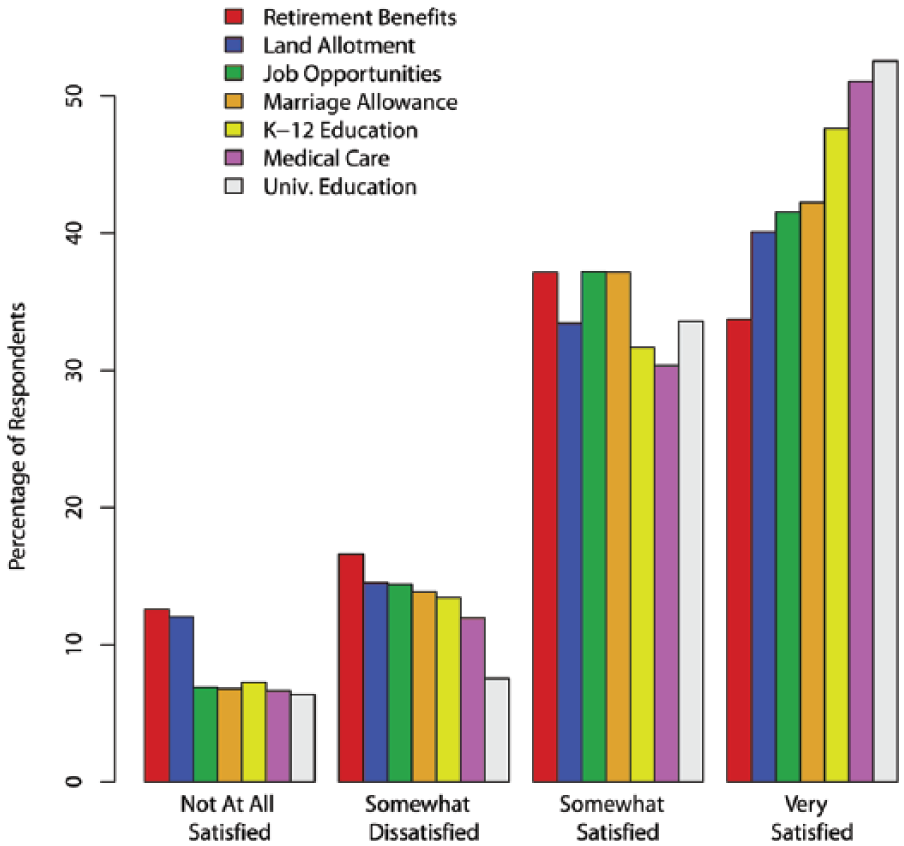
Citizen satisfaction with specific benefits.
This operationalization was meant to address several potential sources of measurement error. First, compared with a more general question about economic satisfaction in the abstract, it captures much more closely the concept of theoretical interest here, namely, Qataris’ level of satisfaction with the discrete financial benefits and subsidies they receive by virtue of being citizens of a rentier state. Second, and equally important, the more contextualized questions help avoid the problem of respondents overestimating (or less likely underestimating) their financial circumstances due to a lack of an explicit benchmark. A recent study conducted in Qatar, for instance, found that 45 percent of citizens rated the economic situation of their family as “very good” when asked out of context, compared with less than 10 percent when responses were rescaled using locally meaningful comparisons embedded in anchoring vignettes (Gengler and Mitchell 2018). Thus, by specifying very clearly the exact benefits respondents are to consider in judging their level of satisfaction, we aim to obtain a measure that enjoys greater internal validity as well as greater interpersonal comparability.
Explanatory Variables
Perceptions of inequality
We capture perceptions of distributional inequality using two separate independent variables corresponding to the distinct theoretical mechanisms outlined above. The first (Wasta) gauges perceptions of inequality within Qatari society, whereas the second (Discrimination) measures perceptions of inequality in allocation between citizens and noncitizens. We measure the first variable, Wasta, by asking respondents about the necessity of informal influence in securing public benefits over other citizens in four practical situations: gaining acceptance to university, getting a desirable public-sector position, being chosen for government-funded medical care abroad, and receiving a desirable land allocation. 4 The mean value of this Wasta variable is 2.26, with a standard deviation of 0.54, reflecting an average Qatari opinion that sees informal influence as being more necessary than not. Indeed, around 60 percent of citizens report that wasta is “absolutely essential” in all cases save for gaining university admittance.
The second independent variable, Discrimination, captures another component of inequality: the perceived unfairness in economic distribution between Qatari nationals and the majority expatriate community. It asks respondents to consider the economically consequential hiring competition between citizens and white-collar expatriates. 5 As in the case of Wasta, here Qatari respondents reveal a high level of perceived unfairness in economic allocation. A majority of citizens (53 percent) believe that a Westerner would be favored for an open private-sector position, while less than half think that a Qatari would have an advantage over a Western expat (36 percent) or that the decision would be made fairly (10 percent). This indicator is coded dichotomously, taking on a value of 1 for respondents who believe the non-Qatari would be favored, and 0 for all others. Significantly, the bivariate correlation between Wasta and Discrimination is only .17, giving empirical evidence of the conceptual difference between these two measures of inequality.
Socioeconomic well-being
We employ two explanatory variables to measure respondents’ socioeconomic well-being, one based on an objective measure of monthly household income (Income) and one self-assessed (Class). Household income is measured on a 1 to 10 scale of total monthly household income, ranging from less than ten thousand Qatari riyals (approximately $2,750) per month to sixty thousand Qatari riyals ($16,000) or above. 6 Mean household income is 6.09 on this scale with a standard deviation of 2.80. This income distribution reflects well the notion that, although Qataris are wealthy on average, still there exists substantial variation in the financial circumstances of individuals and households.
A second indicator meant to capture Qataris’ socioeconomic well-being is self-evaluated social class. 7 More than a crude substitute for an interpretable and quantifiable measure such as income, class functions here as a separate, if intangible, benefit conferred upon citizens by rentier states that may interact with perceptions of inequality. For instance, it might be the case that such perceptions dampen overall economic satisfaction only among Qataris who self-identify as members of lower social classes, whereas citizens who view themselves as socially privileged—independent of actual income—are unaffected. Approximately two-thirds (63 percent) of respondents describe themselves as belonging to the upper middle class, while 26 and 8 percent say they belong to the lower middle and lower classes, respectively. Only 3 percent of respondents claim to be part of the upper class, which in the context of Qatar is nearly synonymous with members of the ruling Al Thani family. The bivariate correlation between the Class and Income variables is only .14, demonstrating the extent to which this indicator is more than a purely economic label. Rather, it captures fixed, mostly ascriptive-based distinctions between social units such as family, tribe, and religious community (e.g., Nagy 2006) that bestow on some citizens a sense of status and importance that may or may not be reflected in material financial terms.
Interaction Terms: The Nexus between Inequality and Well-being
To examine the possibility that perceptions of inequality affect economic satisfaction only for certain categories of Qatari citizens, we create multiplicative interaction terms between our two indicators of distributional unfairness on one hand (Wasta and Discrimination) and the two measures of socioeconomic well-being (Income and Class) on the other. These terms allow for a formal test of the proposition that perceptions of economic inequality dampen satisfaction only for individuals of below average income, for instance, or of lower social status.
Control Variables
Economic perceptions
Our model includes two wider economic perceptions that are likely to explain a portion of variation in satisfaction. These economic control variables capture backward-looking perceptions of inflation 8 (Inflation) as well as subjective economic expectations (Expectations). 9 In both cases, we expect higher values to be associated with reduced satisfaction, all else equal.
Demographics
Our model also includes standard demographic controls. These controls include a dichotomous indicator Female, coded 0 for male respondents and 1 for females; a four-category Education variable (primary or below, high school graduate, technical/some college, university graduate); a continuous Age variable; and an age-squared term (Age2) to account for potential nonlinearity in the relationship between age and satisfaction. Finally, we also include governorate-level geographic controls that are not reported in the section “Findings” for the sake of brevity.
The Model
We estimate the effects of these independent and control variables on our measure of economic satisfaction using standard ordinary least squares regression. 10 To assess the stability of the main parameter estimates, and to reduce concerns over potential multicollinearity in the regressors, we begin with a model that includes only the independent variables of interest along with the four basic demographic controls (model 1). We thereafter introduce the two additional economic controls (models 2 and 3), the interactions Income × Wasta and Income × Discrimination (model 4), and finally the interactions Class × Wasta and Class × Discrimination (model 5).
Findings
Table 1 reports the results of the estimations of models 1 to 5, showing the determinants of Qataris’ satisfaction with state-distributed benefits. Notably, the parameter estimates for the control and independent variables are not sensitive to our choice of specification. Across the five models, higher individual economic expectations are associated with dampened satisfaction with state benefits, as are perceptions of higher inflation in the cost of living. The latter effect is associated with a higher level of statistical confidence.
The Determinants of Satisfaction with State Benefits, by OLS.
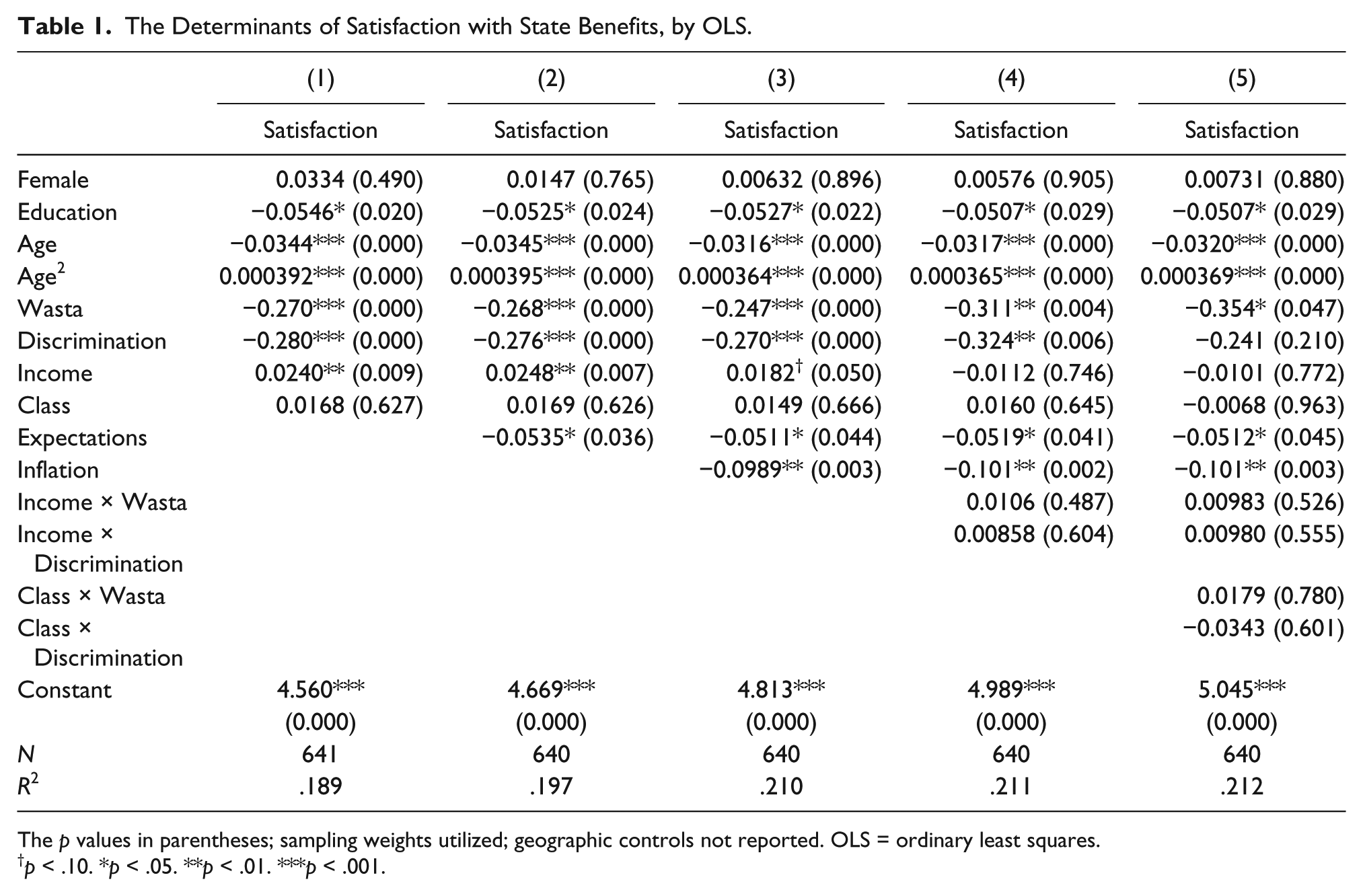
The p values in parentheses; sampling weights utilized; geographic controls not reported. OLS = ordinary least squares.
p < .10. *p < .05. **p < .01. ***p < .001.
Meanwhile, the gender control is never a significant predictor of satisfaction, education level is a consistent negative predictor, and, interestingly, the Age and Age2 variables reveal a strong but nonlinear relationship with satisfaction, with satisfaction levels at their nadir between the ages of forty and fifty. This may reflect the fact that middle-aged citizens have been most directly impacted by increased competition over state benefits. This middle generation has disproportionately shouldered the burdens of rapid economic modernization, including profound demographic change with the influx of foreigners, while the fruits of this modernization have fallen mainly to younger Qataris, who have benefited from greater access to English-based education and other state initiatives to build a modern workforce (Al Muftah 2016, 282–86). Nostalgia for the more cohesive Qatari society of the past, coupled with financial concerns as they approach the mandatory retirement age of sixty years (as per Law No. 8 of 2009, Article 159), may also help to explain the low satisfaction levels among this age group in particular.
Regarding the independent variables of most interest—perceptions of unequal distribution (Wasta and Distribution), measures of socioeconomic status (Income and Class), and their interactions—the results are also consistent across the five models. 11 The results of models 1 to 3 show that, even after controlling for demographic characteristics, socioeconomic status, and economic attitudes of respondents that might be correlated with satisfaction, perceptions of greater inequality in benefit allocation are strongly linked to lower levels of overall satisfaction with benefits. This is true both of inequality in economic distribution among citizens themselves and inequality between Qataris and non-Qataris. The high estimated coefficients and relatively small standard errors of these variables, respectively, mean that both relationships are highly unlikely to have occurred in the data by chance. In short, for two Qataris of identical household income and self-reported social class, an individual who feels that benefits are distributed unfairly has a substantially lower level of satisfaction, compared with a person who views the process by which benefits are allocated as fair.
By contrast, the effects on satisfaction of income and class are both less consistent across model specifications and statistically less certain. In the first place, social class has no impact at all on satisfaction with benefits irrespective of the variables included in the model. Household income is a relatively strong positive predictor of satisfaction in model 1 that includes only demographic controls, but when controls for economic perceptions are introduced in models 2 and 3, its substantive and statistical significance steadily decline. This is consistent with the idea that satisfaction is a function not merely of an individual’s objective resources, but also of one’s subjective impressions of what that money can (in practical view of the cost of living) and should (depending on one’s lifestyle expectations) buy.
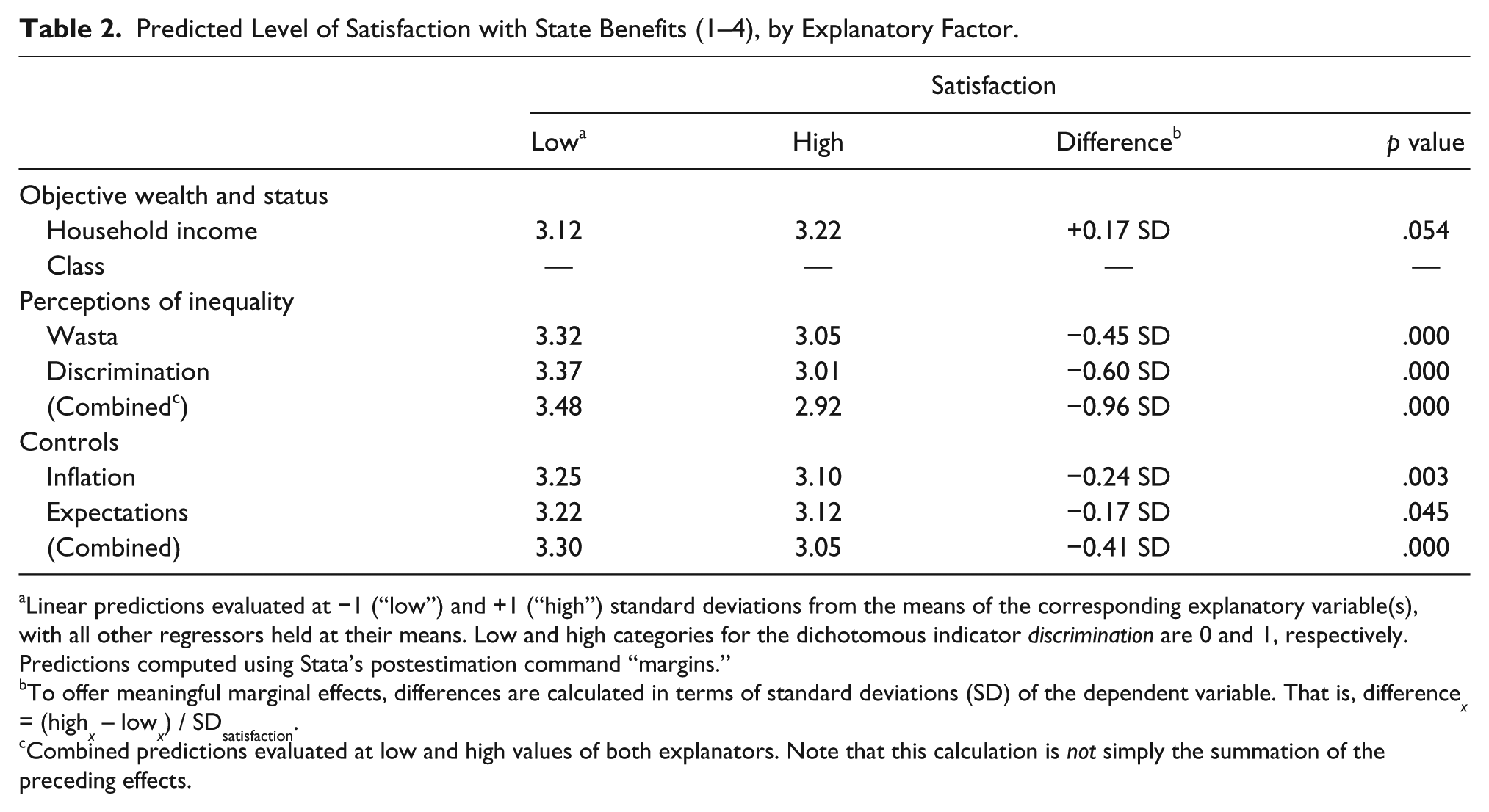
The marginal effects of these different categories of independent and control variables, based on the fully interactive model 5, are summarized in Table 2. To offer a cross-comparable and substantively meaningful interpretation of their impacts, here effects are expressed in terms of the estimated standard deviation change in the dependent variable resulting from a change in the independent variable from a “low” value to a “high” value, evaluated as a −1 to +1 standard deviation change in the independent variable. So, for instance, Satisfaction is estimated to be 3.32 on the 1 to 4 scale when perceptions of Wasta are low (1 standard deviation below the mean value), but only 3.05 when perceptions of Wasta are high (1 standard deviation above the mean). This absolute difference of −0.27 corresponds to a change equal to −0.45 standard deviations of the dependent variable Satisfaction, a difference that is significant at the p < .000 level. In this way, all of the effects are expressed on the same meaningful scale, allowing a straightforward evaluation of their relative importance in determining satisfaction.
Predicted Level of Satisfaction with State Benefits (1–4), by Explanatory Factor.
Linear predictions evaluated at −1 (“low”) and +1 (“high”) standard deviations from the means of the corresponding explanatory variable(s), with all other regressors held at their means. Low and high categories for the dichotomous indicator discrimination are 0 and 1, respectively. Predictions computed using Stata’s postestimation command “margins.”
To offer meaningful marginal effects, differences are calculated in terms of standard deviations (SD) of the dependent variable. That is, difference x = (high x – low x ) / SDsatisfaction.
Combined predictions evaluated at low and high values of both explanators. Note that this calculation is not simply the summation of the preceding effects.
Clear from Table 2 is the critical importance of nonmaterial factors in shaping Qataris’ overall satisfaction with state-distributed benefits. Indeed, objective household income, although it does augment satisfaction, exerts an effect that is both the weakest in substantive terms and least assured in statistical terms of all the regressors in the model. A change in household income from a low level to a high level is estimated to increase satisfaction by only 0.17 standard deviations, all else equal. And the p value associated with this change, .054, sits at the borderline of conventional statistical significance. By contrast, perceptions of greater inequality as measured separately by Wasta and Discrimination are associated with drops in satisfaction of −0.45 and −0.60 standard deviations, respectively. Both effects are significant at a high level of statistical confidence. Moreover, when one considers the joint impact of a simultaneous increase in both these perceptions of inequality, the effect is even more dramatic. A Qatari who perceives both a high level of unfairness among citizens and between citizens and expatriates is associated with a level of satisfaction that is almost a full standard deviation lower than a Qatari who views distribution as equitable across these two dimensions. Finally, subjective lifestyle expectations and impressions of macroeconomic conditions are also seen in Table 2 to play a role in shaping Qataris’ satisfaction with rentier benefits that is at least as strong as variation in household income.
However, it is possible that perceptions of inequality dampen satisfaction only for a relatively limited subset of citizens with certain low levels of household income or socioeconomic status. The interactions between inequality and socioeconomic status (models 4 and 5) allow us to examine these possible conditionalities. The graph in Figure 2 shows how perceptions of inequality affect satisfaction with benefits according to respondent income, based on the full model 5 results. The four regression lines correspond to four possible permutations of the Wasta and Discrimination variables: high and high, high and low, low and high, and low and low, where “high” and “low” are again evaluated as −1 and +1 standard deviations from the mean value. 12 (Note that the middle two lines largely overlap.) The shading for each line depicts the 95 percent confidence interval of the estimated relationship (coefficient).
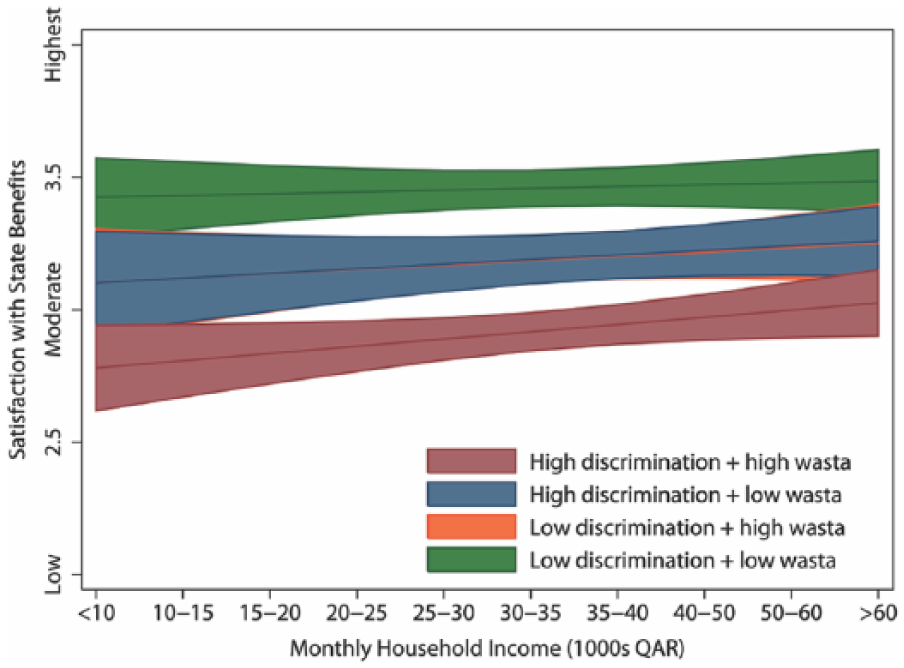
The impact of perceived inequality on satisfaction with state benefits, conditional on household income.
This visual interaction between objective economic conditions and subjective impressions of fairness in distribution communicates three main results. First and most important, perceptions of inequality in allocation dampen satisfaction with state benefits at all income levels: the 95 percent confidence bands for the high/high and low/low permutations remain far apart across the entire range of the x-axis. Although the confidence bands of the intermediate low/high and high/low combinations do overlap with the other regression lines at the extremes of the range, this is mostly due to the reduced number of cases (and thus larger standard errors) at these levels of income. Still, for all but for the very top and bottom income categories, even perceptions of one form of inequality in distribution—either among citizens or between citizens and expatriates—is enough to lower satisfaction. That these effects do not depend on income can also be gleaned from the fact that the introduction of the interaction terms in models 4 and 5 does not improve the explanatory power of the model as indicated by the reported R2 statistics.
The second key conclusion to be drawn from the illustration is how the substantive importance of perceptions of inequality, although not dependent upon income, is nevertheless conditioned by income. More specifically, as income decreases, the gap in satisfaction resulting from perceptions of inequality increases. Indeed, for Qataris of the lowest household income, predicted satisfaction with state benefits dips toward the dividing line between “moderate” satisfaction and “low” satisfaction. For citizens of the highest household income, however, satisfaction remains dampened compared with those who see a more equal distribution of benefits, but the difference is 30 percent smaller (–0.46 vs. –0.64, significant at p < .037). Thus, citizens whose personal shares of benefits are objectively low are relatively more strongly affected by views of unfairness than those who enjoy a greater share.
The final notable result depicted in Figure 2 is the conditional impact on satisfaction of income itself. More specifically, household income is a statistically significant predictor of satisfaction with state benefits only among those citizens who hold negative views regarding the prevalence of both Wasta and Discrimination (p = .052). This fact is readily visible from the flat slopes of the three uppermost regression lines, in contrast to the gradually upward-sloping bottom line. One might conclude on this basis that an equitable distribution of benefits is to some extent a substitute for actual benefits. That is, the notion that one’s share of state benefits is a fair share, even if objectively smaller than that of other citizens, mitigates dissatisfaction.
We repeat this analysis for the interactions involving the moderating variable Class. Although class membership itself was found not to be a significant predictor of satisfaction with state benefits, still it is possible that the dampening effect on satisfaction of perceived unfairness in distribution applies only to certain social strata of Qatari society. In fact, however, as in the case of household income depicted in Figure 2, the results of model 5 confirm that the gap in satisfaction owing to perceived inequality exists irrespective of class identification. This result is illustrated in Figure 3. For ease of interpretation, the confidence bands for the intermediate combinations of Wasta and Discrimination are suppressed in favor of the regression lines.
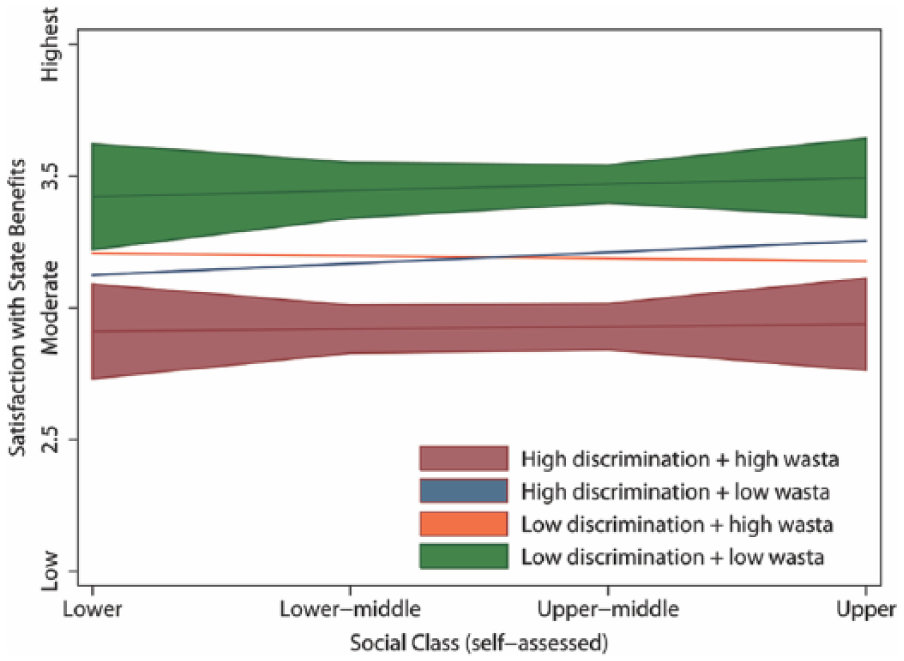
The impact of perceived inequality on satisfaction with state benefits, conditional on social class.
Thus, analysis of the survey data points to a consistent conclusion: variation in satisfaction with the discrete economic benefits received by Qataris is relatively weakly related to objective economic well-being, and not at all related to broader social class standing, but is strongly impacted by citizens’ subjective impressions about the overall fairness or unfairness of the allocation of those benefits. The most direct and theoretically compelling explanation of this result is that, when evaluating satisfaction, Qataris consider not only the absolute allocation of economic goods they have received but also the benefits that they imagine they did not receive owing to favoritism and discrimination in the processes of distribution. The impact of these perceptions of inequality is indeed conditioned by the magnitude of the finite allocation that an individual enjoys, but it is not conditional on a certain socioeconomic threshold. Qataris are mindful not only of what they have, but also of what they might have had.
Discussion: Distribution, Inequality, and the Changing Rentier State
This article began with a question: how do perceived inequalities in allocation impact satisfaction with state-distributed benefits in rentier states? Although qualitative case studies have identified unequal distribution in resource-rich regimes as a source of discontent and even organized political opposition, the relative importance of objective versus subjective factors in shaping satisfaction at the individual level had never systematically been evaluated. Here, individual-level data from Qatar, the world’s most affluent rentier economy, enabled us for the first time to directly connect citizens’ feelings of economic satisfaction to specific state-distributed benefits, and to examine how these feelings of satisfaction are conditioned by perceptions of inequality in distribution. The results of the analysis suggest that the implicit social contract presumed to operate in rentier societies is more complex than is captured by broad statements about remarkable packages of welfare benefits lavished upon citizens. Rather, the survey data tell a more nuanced story: even in the most affluent of rentier states, economic satisfaction is a function not only of absolute quantities of benefits but also of citizens’ subjective impressions about the way in which those benefits are handed out.
In this sense, perceptions of distributional unfairness are the proverbial rust on the gears of the rentier bargain. Our findings show that perceived inequality reduces satisfaction across all levels of income and class status, but that this dampening effect is attenuated among those who enjoy the very highest levels of affluence. Extreme wealth can thus help oil an otherwise creaky link between rulers and ruled. Yet the converse is also true, with the effect of perceived inequality magnified at lower levels of objective well-being. Inequality erodes economic satisfaction among all citizens, but especially among those who have the least, confirming that objective economic well-being remains an integral part of the social contract binding rentier states to subjects. In poorer rentier societies whose citizens enjoy lower absolute levels of wealth, one can hypothesize, the effects observed in Qatar may be even more pronounced and widespread.
What is more, the empirical results suggest that an equitable distribution of benefits can be a substitute for actual benefits. The relationship between income and satisfaction is strongest among citizens who perceive the greatest distributional inequality, whereas for those who view distributional processes as fair, satisfaction is less closely linked to income. The belief that one’s share of state resources is a fair share, even if objectively smaller than that of other citizens, tends to mitigate dissatisfaction. One might also formulate this conclusion from the reverse standpoint: the more a citizen perceives distribution as proceeding unjustly, the more important becomes the accumulation of personal wealth, fueling a vicious cycle of competition and potential disappointment and frustration.
These findings are especially pertinent today as rentier states seek to reinvent their economies and indeed societies in the wake of structural changes in the oil and gas market (Krane 2014). Cognizant of the unsustainability of current spending, even relatively well-positioned Gulf states such as the United Arab Emirates (UAE) and Qatar have already begun to cut back state spending and explore new sources of revenue. Facing its first budget shortfall in fifteen years in 2016 (Gengler and Lambert 2016), Qatar implemented reductions to distributions that substantively impacted the daily lives of citizens. Within a span of only a few months, the state canceled a government-funded insurance scheme that covered citizens’ use of private health care services (Khatri 2015), raised gasoline prices by between 40 and 50 percent (Kovessy 2016), and warned openly of more fundamental changes to come. The severing of diplomatic and economic ties between Qatar and its immediate neighbors (Bahrain, Saudi Arabia, and the UAE) in June 2017 has exacerbated the current economic downturn in the region, disrupting billions of dollars of trade flows between the countries (Kabbani 2017).
It is for precisely these reasons that the implications of the analysis here are so intriguing for reimagining the state-society relationship in the resource-rich states of the Arabian Peninsula. Current levels of redistribution are readily recognized as unsustainable and, as our results demonstrate, engender both satisfaction and dissatisfaction, depending on the perceived fairness of the allocation process. Yet states have another option at their disposal to maintain or possibly even boost the economic and ultimately political satisfaction of citizens: to increase the fairness and transparency of the distribution process itself. Such reform would require a dramatic shift from the personalism of current systems, in which rulers seek legitimacy through their generous benefaction of individual subjects. Indeed, an oft-repeated conclusion from qualitative studies is that rentier citizens have become accustomed to the benefits they receive and consider them a “birthright” rather than a gift (Davidson 2005, 97; see also Crystal 1995, 2; Herb 1999, 241; Okruhlik 1999, 301), calling into question the legitimating effect of these distributions over time. Our analysis makes clear the importance of nonmaterial perceptions—of fairness and equality—in determining the economic satisfaction of rentier citizens. Rulers of allocative states can address these concerns by standardizing and rationalizing their distributive mechanisms. Attention to the “real issues of corruption, power, and inequality” in rentier societies today (Okruhlik 2016, 33) may be the more sustainable path forward for these regimes. Legitimacy, in this sense, will stem from the perception of a fairer and more transparent, rather than more lucrative, state-society relationship.
Supplemental Material
Mitchell_Gengler_PRQ_Online_Appendix_online_supp_revised – Supplemental material for What Money Can’t Buy: Wealth, Inequality, and Economic Satisfaction in the Rentier State
Supplemental material, Mitchell_Gengler_PRQ_Online_Appendix_online_supp_revised for What Money Can’t Buy: Wealth, Inequality, and Economic Satisfaction in the Rentier State by Jocelyn Sage Mitchell and Justin J. Gengler in Political Research Quarterly
Supplemental Material
Mitchell_Replication_Data – Supplemental material for What Money Can’t Buy: Wealth, Inequality, and Economic Satisfaction in the Rentier State
Supplemental material, Mitchell_Replication_Data for What Money Can’t Buy: Wealth, Inequality, and Economic Satisfaction in the Rentier State by Jocelyn Sage Mitchell and Justin J. Gengler in Political Research Quarterly
Footnotes
Acknowledgements
The authors thank Jim Krane, Nick Mitchell, Paul Musgrave, Klaus Schoenbach, workshop and conference participants (at the 2014 American Political Science Association panel on “New Approaches to the Resource Curse,” the 2015 American Political Science Association Middle East and North Africa Workshop, and the Georgetown University in Qatar working group), and the anonymous reviewers for comments and suggestions.
Declaration of Conflicting Interests
The author(s) declared no potential conflicts of interest with respect to the research, authorship, and/or publication of this article.
Funding
The author(s) disclosed receipt of the following financial support for the research, authorship, and/or publication of this article: Support for the 2013 survey was provided by a grant (UREP 12-016-5-007) from the Qatar National Research Fund (a member of Qatar Foundation) and a grant (SP0023425) from Georgetown University School of Foreign Service in Qatar. The authors thank these institutions for their support and note that the statements made herein are solely the authors’ responsibility.
Notes
Supplemental Materials
Supplemental materials for this article are available with the manuscript on the Political Research Quarterly (PRQ) website.

References
Supplementary Material
Please find the following supplemental material available below.
For Open Access articles published under a Creative Commons License, all supplemental material carries the same license as the article it is associated with.
For non-Open Access articles published, all supplemental material carries a non-exclusive license, and permission requests for re-use of supplemental material or any part of supplemental material shall be sent directly to the copyright owner as specified in the copyright notice associated with the article.
