



Abstract
Using infrared thermography, we assess how a new backpack design for mountain bikers can contribute to their thermoregulation process and perceived comfort during a cycling activity in a controlled environment. We gathered qualitative and quantitative data of heat concentration areas on skin temperature and thermal comfort perception by comparing two types of backpacks: a conventional backpack and a novel backpack design. Our results show that a guaranteeing airflow due to distance between the user’s back and the backpack with a rigid backplate and an arc radius morphology improves heat dissipation and thermal comfort for mountain bikers.
Keywords
Justification and Problem Approach
During the development of certain outdoor exercise activities such as mountain biking or hiking, the human body generates a large amount of heat. For this reason, heat dissipation becomes a relevant factor for thermoregulation and thermal comfort during exercise (Gavin, 2003). Using backpacks during exercise may disturb the thermoregulation process by acting as a barrier for heat transference (Li et al., 2019) due to contact between the users’ back and backpack, therefore, affecting the user’s thermal comfort. When thermal comfort does not occur, thermal stress is generated (Itani et al., 2018). According to Purvis and Tunstall (2004), the body’s inability to dissipate heat in the form of sweat (thermal stress) may negatively affect user’s health and exercise performance. Thermal stress may even result in poor decision making, affect speed decisions and compromise the user’s attention focus (Neave et al., 2004). Consequently, it is essential to increase refrigeration through more extensive exposure to air currents (Sun et al., 2015) to ensure user’s thermal comfort during exercise.
The aim of this study was to assess thermoregulation on the back skin’s surface as well as the thermal comfort effects of a new backplate designed for mountain biking backpacks compared with a conventional backpack using infrared thermography (IT). IT is a noninvasive, low-cost and safe method, which allows for the visualization of radiation and measurement of the skin’s temperature (Korukçu & Kilic, 2009). Although many researchers have assessed thermoregulation in exercise and work garments by using IT (Dotti et al., 2016; Neves et al., 2017; Pang et al., 2011; Raccuglia et al., 2019; Yin et al., 2012; Zhao et al., 2013), studies oriented on the use of backpacks are mainly based on loading distribution, the sports biomechanics and its effect in the postures adopted by the user (Chow et al., 2005; Mackie & Legg, 2008; Wang et al., 2001). To the authors’ knowledge, there is no evidence of evaluating thermal comfort on mountain bikers using backpacks through IT. Hiking studies have assessed the effect of garments in thermoregulation mainly (Fournet & Havenith, 2017). Nonetheless, conditions such as wind speed, movement speed, and anatomic postures acquired on mountain biking differ from hiking, leading to different thermoregulation results. The findings enabled us to explore thermal imaging as a reliable method for assessing the main hot spots in user’s backs. Based on our data, we developed concepts focused on design strategies for improving heat dissipation and thermal comfort. We also provide information to designers and manufacturers of sports products who seek to optimize their designs’ thermal comfort.
Materials and Methods
Our project did not require a research and ethics committee. National regulation excuses researchers from obtaining written informed consent on studies classified as minimal risk, such as the thermographic measurement. Regardless, all participants provided written consent to participate in this study and authorized the use of their images according to “Resolution No. 008430 of the Colombian’s Ministry of Health, October 4, 1993.”
Experimental Design
Twenty males volunteered to participate in this study (mean ± SD; age = 22.25 ± 3.2 years, height = 177.0 ± 0.1 cm, mass = 70.2 ± 9.6 kg, body mass index [BMI] = 22.4 ± 2.9 kg/m2). According to Fernández-Cuevas et al. (2015), extrinsic factors such as caffeine and medicine consumption and exercise activity before participating in the test, were controlled. Also, intrinsic factors such as age, gender, body hair density, and BMI, were collected. To avoid clothing acting as a heat transfer barrier, participants were naked from the torso up. Each participant underwent two periods, a rest period and an activity period in a cycling simulation as has previously been established by Li et al. (2019). Participants rested for a 15-minute period inside the laboratory to stabilize skin temperature before the first cycling simulation. Then, the 15-minute cycling period was performed with one of the two types of backpacks selected randomly. Right after, participants were allowed 15 minutes of rest, in which they reached their initial back skin temperature. Finally, they underwent another activity period with the remaining type of backpack for 15 minutes.
Our study was performed on an area of 25 m2, with an atmospheric pressure of 560 mmHg, and the temperature of the test room remained at a constant level (20.01 ± 1.6 °C [mean ± SD]), and humidity (55% ± 0.1% [mean ± SD]). We used a Treck Xcaliber 4 mountain bike on a bike stand, with a 30 and 16 pinion configuration, and considered a consistent cadence pedaling of 70 rpm, a relatively moderate cycling speed for an average cyclist, controlled by a metronome. To simulate outdoor conditions with a moderate cycling speed we used a KWIK Cool POMAIR fan, which reaches a wind speed of 5 m/s. Both backpacks contained a 1 kg load over the cycling periods
Novel Backpack Design
We designed a new backpack to improve thermal comfort. This backpack allows airflow to run between a rigid backplate and the user’s back, thereby allowing for adequate evaporation of the transpiration. The backplate (Figure 1) has an arched shape on the upper and middle back ensuring a minimum space of 1.5 ± 0.4 cm between the backpack and the user’s back, with four diagonal channels and a vertical one that improves airflow. Also, this design has four separate support areas in which combined shape an area of about 45 cm high × 24 cm width. Only 25% of this area has a direct contact between users back and backplate.
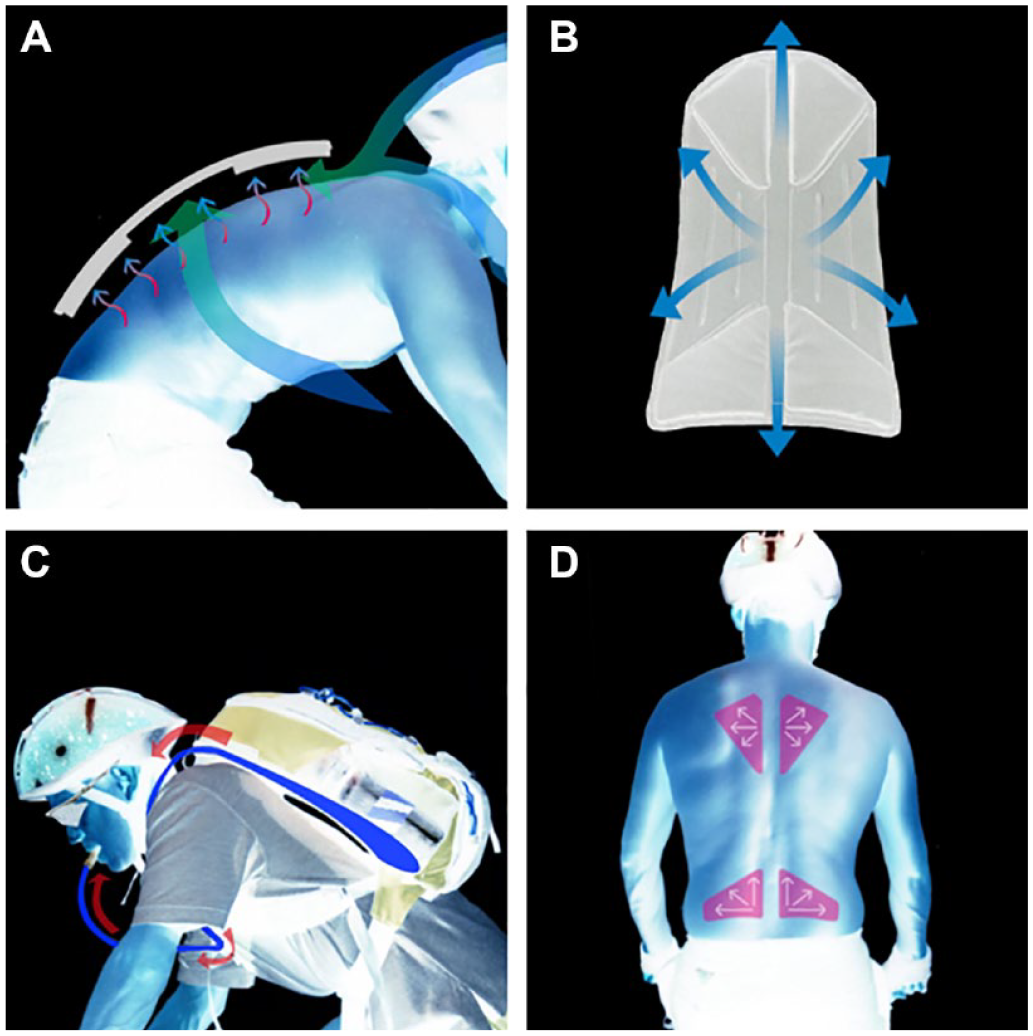
Backplate design (B2). (A) Distance between the backplate of the backpack and the back, which allows airflow to run between them to disperse heat as well as allowing sweat to evaporate. (B) Rigid structure in the form of an arc, with an anchored design that allows an increased ventilation. (C) Lateral view of the backpack and hydration system. (D) Minimization of contact points to favor evaporation through thermoregulation.
We conducted an experiment to evaluate the proposed design backpack and its ventilation effectiveness against a conventional backpack. The participants used both backpacks (see Figures 2 and 3). Backpack 1 (B1) being a conventional backpack, with a flexible backplate, compared to Backpack 2 (B2), the proposed design backpack, with a rigid arched backplate that provides four contact points to the users’ back.
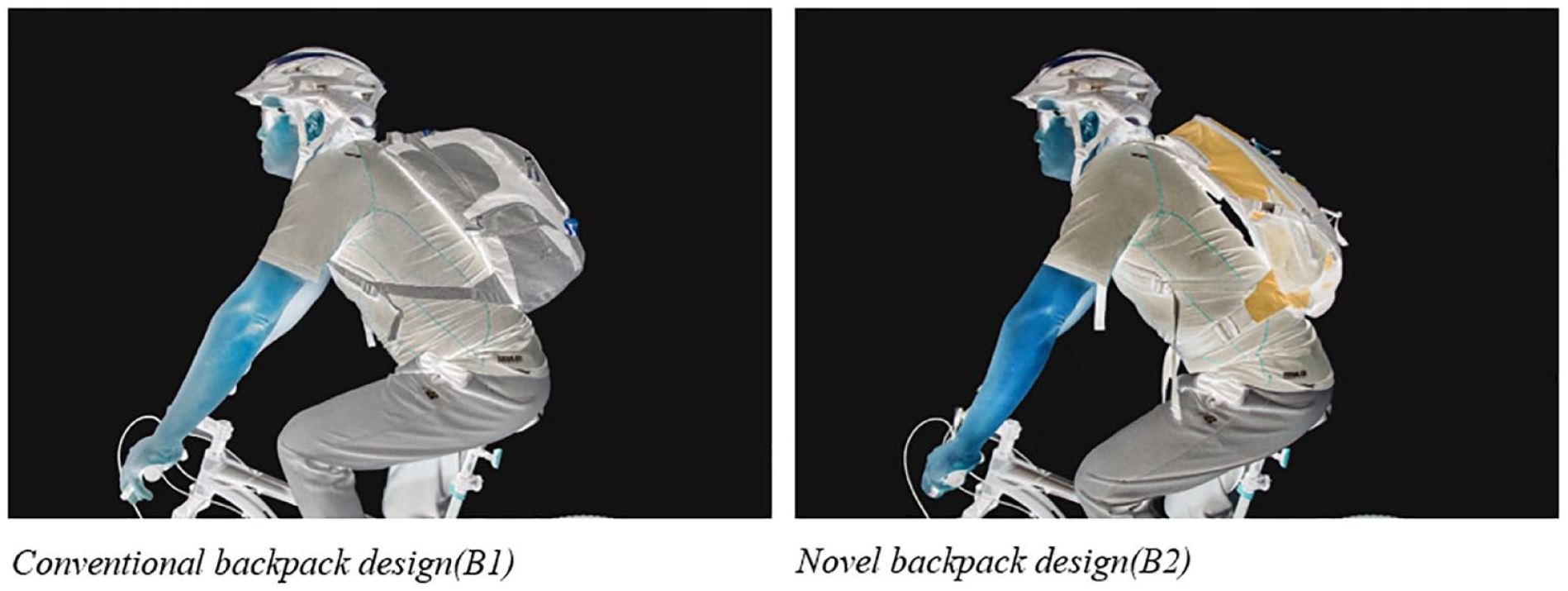
Differences between backplates in B1 and B2.
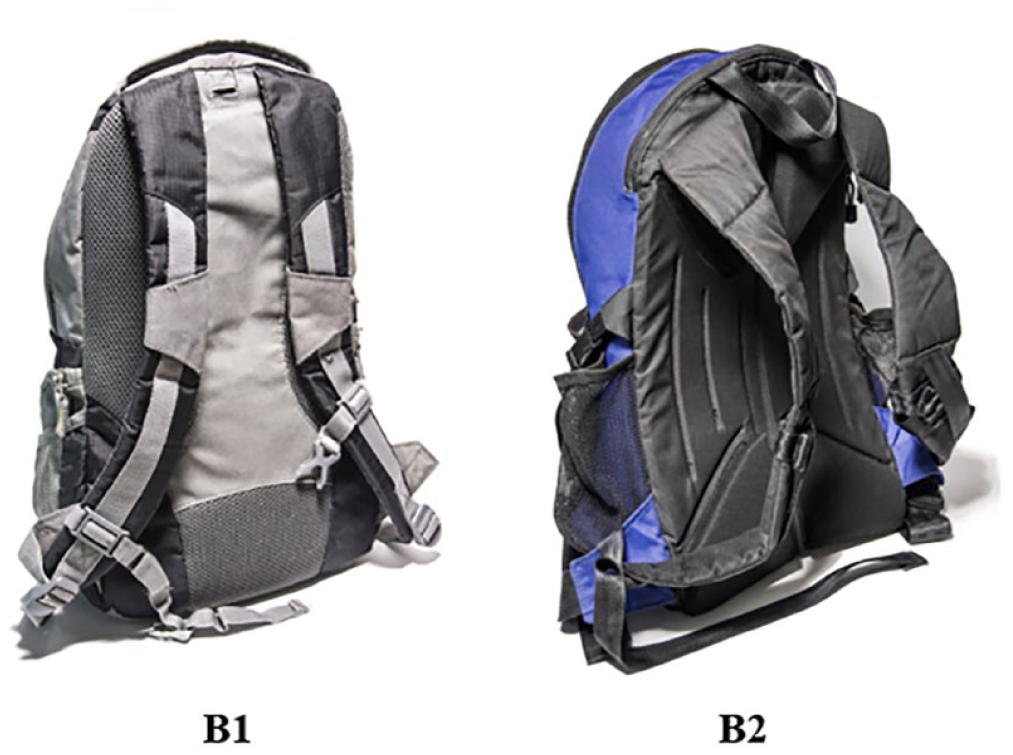
B1 conventional backpack and B2 new backpack design.
Quantitative Assessment
We used an IT FLIR E40 camera (Flir Systems, Danderyd, Sweden) with the emissivity set at 0.97–0.98 and connected to a computer running FLIR Tools software (FLIR systems, Danderyd, Sweden). The camera was mounted on a tripod at 2 m away from the subject and thermographic images were taken at four different time intervals to each subject’s back skin. A quadrilateral region of interest (ROI) was created around the subject’s dorsal and lumbar back area corresponding to the box that covered each backpack (95 × 63 pixels) (see Figure 4). The average skin temperature within this ROI was taken in each thermographic image in order to compare the difference in skin temperature (degrees Celsius) and heat distribution (pixels) for each participant.
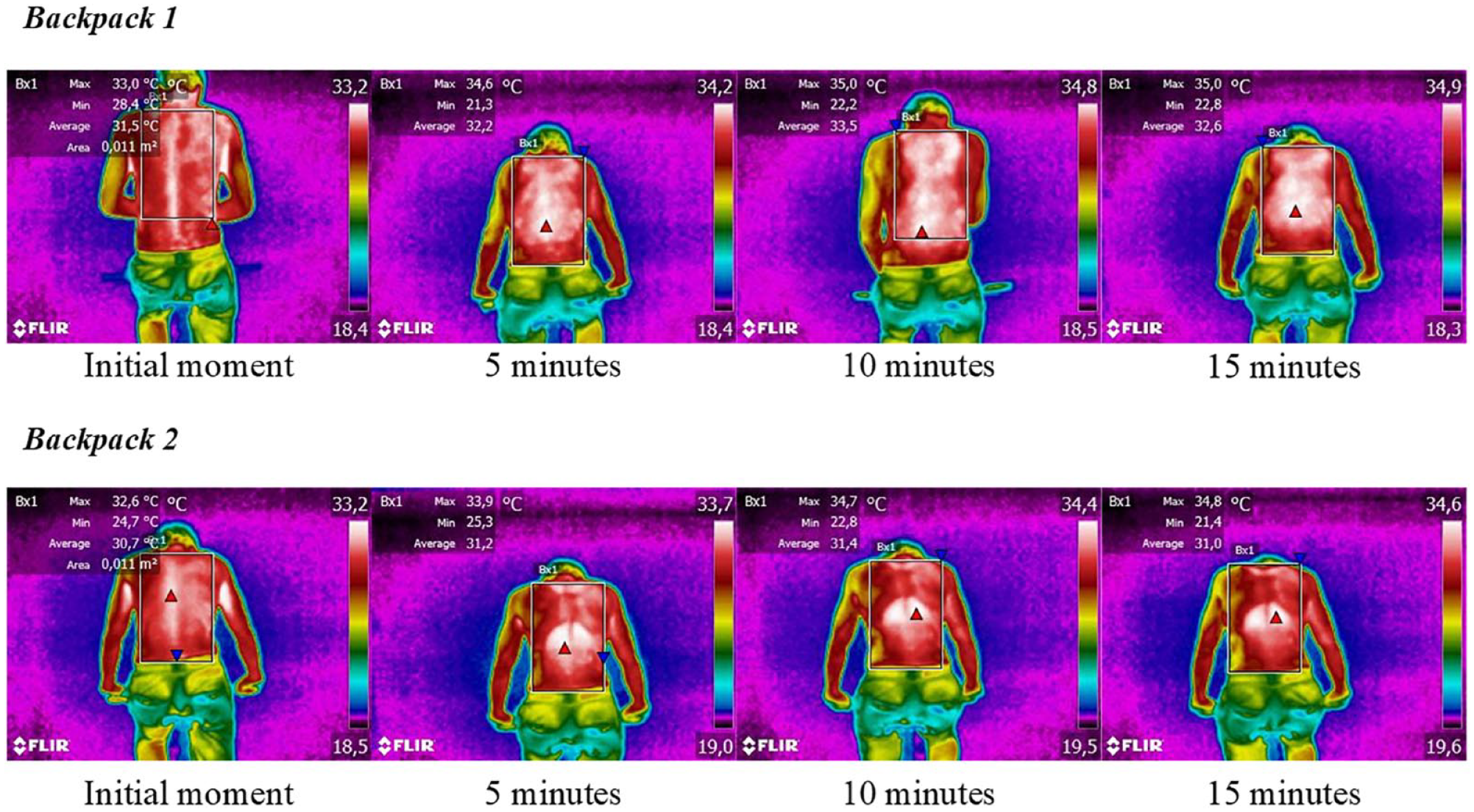
Region of interest (ROI; 95 × 63 pixels) at four time intervals after initiating exercise (0, 5, 10, and 15 minutes): example of a participant.
Qualitative Assessment
Each participant fulfilled a comfort perception questionnaire at the end of the test, comparing the two backpacks. We used a Likert-type scale (5-point) to evaluate heat concentration perception for each backpack (1 = less heat concentration and 5 = more heat concentration) and sweat perception (1 = low sweat and 5 = high sweat). Also, multiple-choice questions were conducted so participants could select the areas that generated the greatest thermal discomfort due to heat concentration. Finally, participants were asked to choose the backpack that gave them a lower perception of heat concentration and made them sweat less.
Results and Data Analysis
Temperature Differences
We assessed thermographic images by analyzing each participant’s back skin temperature averages, corresponding to the box that covered each backpack ROI (see Figure 4). We analyzed the difference between initial and final average temperatures (time = 0 and 15 minutes). To further explore how this difference behaves, we conducted a Kolmogorov-Smirnov and a Levene test. In both, we obtained a p value (p > .05), guaranteeing the normality of data and constant behavior of temperature difference over time. The temperature difference in B2 is less than B1 (see Figure 5). To examine the effects on temperature, a one-way analysis of variance (ANOVA) within-subject was performed. The ANOVA test resulted in a value of F(1, 19) = 5.699, and (p < .05), which determines that the type of backpack does influence temperature variation. Skin temperature was significantly lower with the use of novel backpack design.
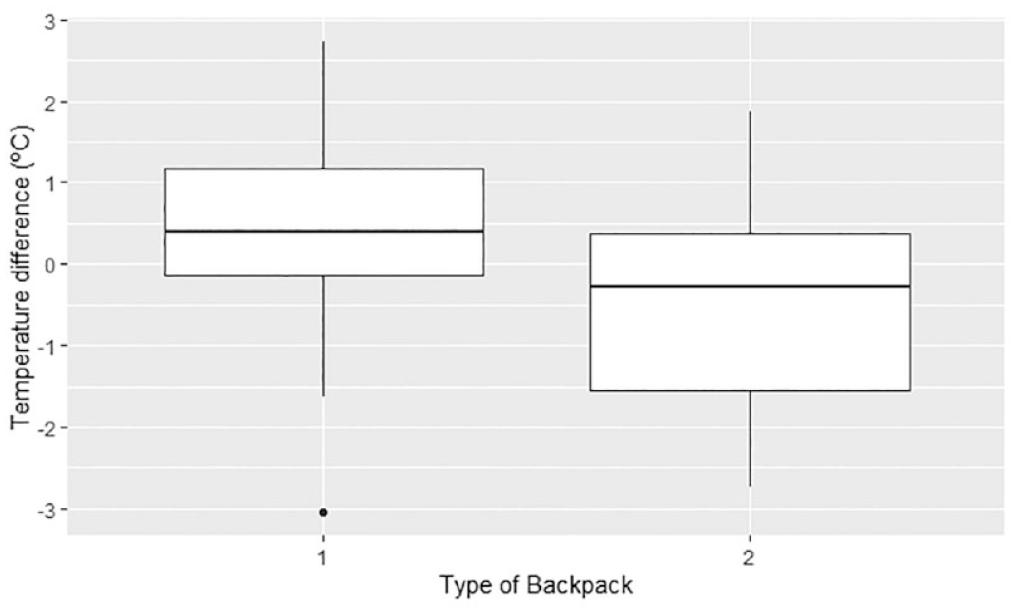
Boxplot diagram for temperature difference.
Heat Concentration Area
In the beginning, the initial average temperature of each participant was established. We measured the percentage of the area that reached a temperature higher than the initial average temperature, corresponding to the red area within the box using the “above alarm function” of the FLIR E40 (see Figure 6).
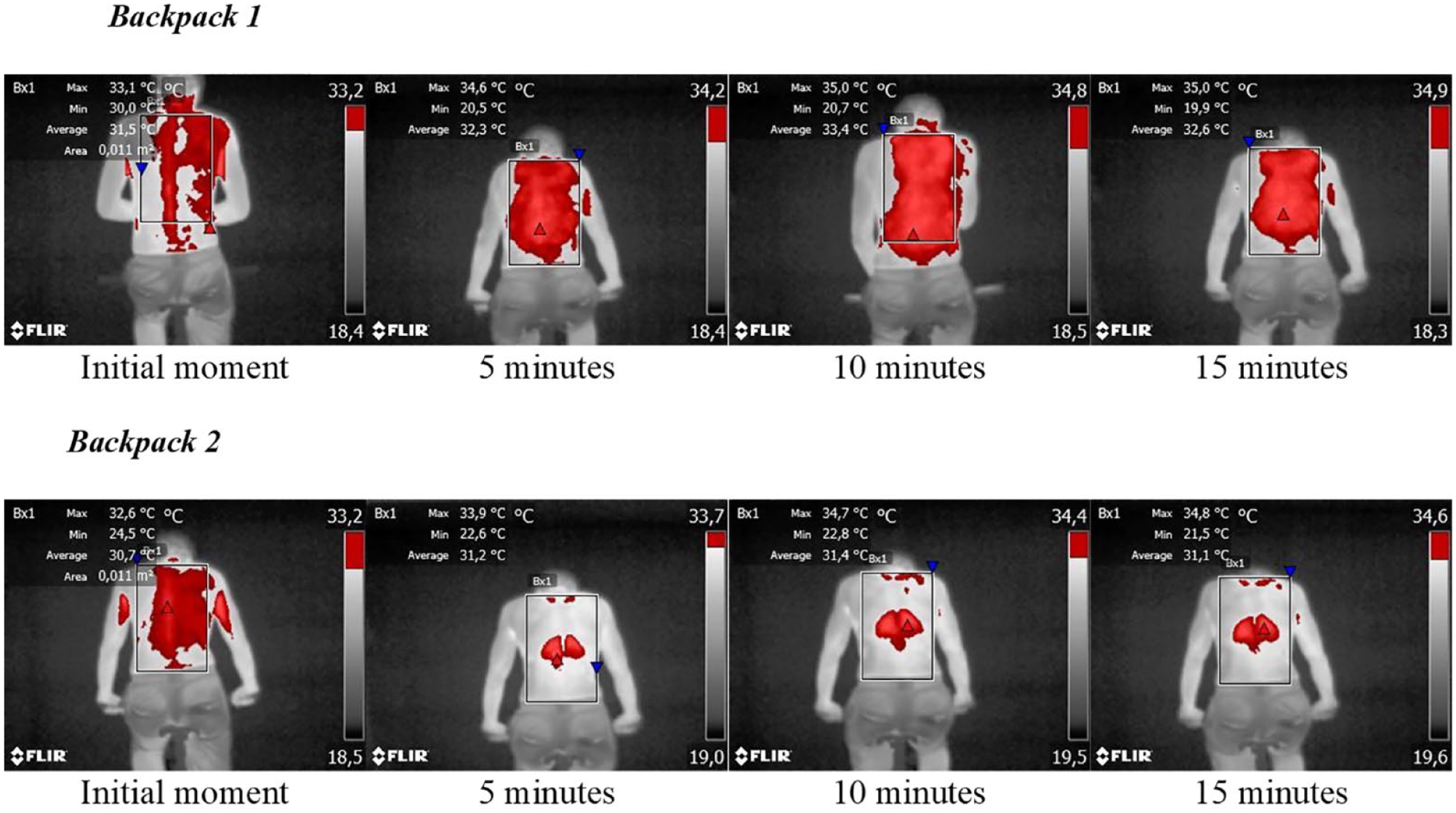
Heat concentration area: example of a participant.
We evaluated the difference in temperatures between the initial and final periods excluding measurements at five and ten minutes because steady exercise body temperature was not reach in those in between periods. We did not use covariates in our model.
To validate the ANOVA assumptions, we performed a Kolmogorov-Smirnov test once again obtaining a p value (p > .05) stating that the data resemble a normal behavior. On the other hand, to test the assumption of equality in variances a Levene test was performed having as a result a p value (p > 0.05). The descriptive graphs obtained are presented in Figure 7.
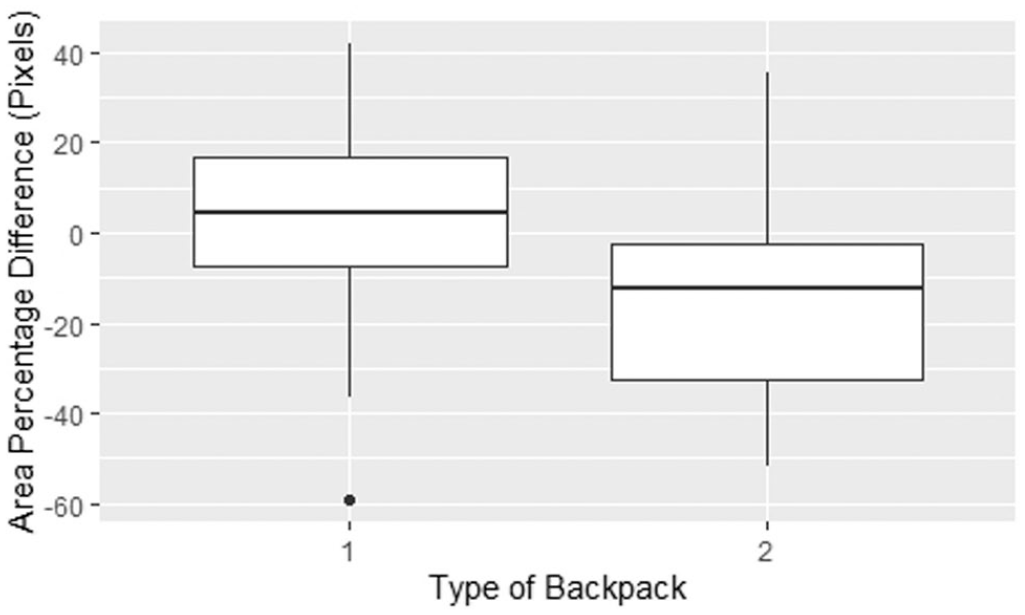
Boxplot diagram for area percentage difference.
To examine the differences between the percentage of the areas of the final period and the initial one, results showed (see Figure 7) that there was a significant difference between the area percentages found by typology of backpack, F(1, 19) = 9.733, p < .05). The percentage of the area above the initial temperature was significantly lower with the same new backpack design.
Comfort Perception
About 95% of the participants perceived less heat concentration using B2 compared with B1. We found significant differences between B1 and B2 (p < .05), using a binomial test, in which results showed that participants tended to find B2 more comfortable than B1. To measure the heat concentration perception of each backpack individually, participants were asked to score through a Likert-type scale questionnaire (1 = very low heat concentration and 5 = very high heat concentration), in which 70% scored between 4 and 5 for B1 (high heat concentration), and 75% scored between 1 and 2 for B2 (low heat perception). We used an asymptotic Wilcoxon signed-rank test to confirm whether by using the Likert-type scale, the evaluation of the average population ranges differs between paired samples, B2 being the one with the highest user rating in terms of thermal comfort levels (p < .05).
Regarding the perception of sweat, about 70% of the participants felt high sweating levels using B1 compared with B2 (p < .05). To measure sweating levels of each backpack individually, participants were asked to score through a Likert-type scale questionnaire (1 = very low sweating and 5 = very high sweating), in which 60% scored between 4 and 5 for B1 (high sweating), and 90% scored between 1 and 2 for B2 (low sweating) (p < .05). Overall, users preferred the new backpack design in both aspects: heat concentration and sweat perception. We performed a binomial test and asymptotic Wilcoxon signed-rank test to assess differences in preference between the backpacks and to assess the Likert-type scale questionnaire, respectively.
Discussion
Our results demonstrate that the novel backplate in backpack B2 significantly improves human thermoregulation mechanisms. On our heat concentration area results, the percentage of the area above the initial temperature was significantly lower, showing that the heat distribution and conduction improved, by decreasing the area of contact toward the back on the novel backplate (B2). On our temperature results, users with the backpack B2 obtained a significantly lower skin temperature, improving convection and sweat evaporation. Compared with the conventional backpack B1, the novel B2 leads to a reduction in heat concentration areas, which—according to participants’ perception—improved their thermal comfort. Our study demonstrates the importance of contemplating thermoregulation as a determining factor when designing backpacks for mountain biking because it may affect the overall user’s comfort.
Backplates should be considered when designing backpacks used for riders, especially for places where the user is exposed to high temperatures. As sweat evaporation during exercise is the most important heat loss mechanism (Wendt et al., 2007), thermoregulation can affect the safety of riders, when heat stress implications such as a heat stroke or heat exhaustion (Chang et al., 2017) may occur. Also, heat stress may interfere with the individual’s cognitive functioning, such as vigilance or monitoring (Chang et al., 2017) and could increase the risk of falling in a dynamic environment such as the one found in mountain biking.
Conclusions
Our approach demonstrates the effects of a novel backpack design on thermoregulation and the perception of thermal comfort in mountain biker’s performance. The channels designed over the backplate on B2 and reduced contact area allowed sweat evaporation and heat dissipation. Analysis of thermographic images and evaluation of thermal comfort perception confirmed that the characteristics of the new proposed design improve thermal comfort. Our findings suggest a backpack designed for this sport can guarantee better thermoregulation and improve cyclist’s performance. In conclusion, the thermoregulation process in users improves with the use of backpacks that provide a smaller area of contact in the dorsal and lumbar region, decreasing high concentrations of temperatures and increasing airflow, thus generating great thermal comfort in individuals.
Limitations and Future Studies
Our study was based essentially on assessing thermal comfort using thermographic images of the back skin temperature and participants’ perception. For future studies, we suggest exploring other aspects of backpack design that affect riding performance, such as the impact of the backpack’s aerodynamics on the drag induced by different airflow patterns. We used a metronome to control speed and cadence on participants during cycling, so we recommend for future studies to complement with measurements such as power output and heart rate using cycling ergometers and heart rate monitors. Due to skin temperature variations in women because of their hormonal cycles, only men participated in this study. Finally, the simulated wind speed can differ from real conditions, so we recommend experimenting outdoors.
Footnotes
