



Abstract
This article responds to Mark Kinzer's review of my book, Jewish Church: A Catholic Approach to Messianic Judaism. First, I discuss Kinzer on the “accurate reading” of Scripture. I highlight the preconceived opinion underlying Kinzer's exegesis of Acts 21:20–26, which ascribes to Luke the portrayal of Paul as a Torah-observant Jew. Second, I point to the fundamental ambiguity of attempts to present halakhic Torah observance as an ideal to be pursued by all Jewish disciples of Yeshua. Third, I argue that the death of Yeshua has a salvific meaning for the whole people of Israel, even as “the whole people” has a responsibility for Yeshua's death. Through repentance, this collective involvement becomes the doorway to collective salvation, thus justifying the establishment of a Jewish Church. In conclusion, I argue that the adoption of supersessionism by the whole Constantinian Church had to do with the absence of ecclesial dispositions that would have stymied an otherwise ineluctable process of gentilization in the course of the first centuries.
Keywords
As I like to say, Mark Kinzer is not only a thorough and utterly creative theologian; he is a very gracious human being. It is by no means easy for a theologian to show intellectual generosity toward those who level a degree of criticism at what one considers to be one's main contribution in one's own field. Kinzer offered a proof of this generosity when he agreed to write the foreword to my Jewish Church. 1 He demonstrates it again here with this extended review of the same book. I do not only have in mind the kind words he found to speak about it or the points of convergence between us that he duly highlighted. I am mainly thinking about his offering me a wonderful opportunity to discuss our disagreements further. With intellectual fairness and great respect, Kinzer endeavors to single out and refute what appeared to him the most questionable aspects of my interpretation of his ideas. True, the most angelic theologian can hardly resist the temptation of caricaturing the position of an opponent. Kinzer repeatedly writes that he has the impression that I was making a “strawman” of him, for which I apologize. I cannot myself escape the feeling that I am portrayed in Kinzer's review as some sort of fundamentalistic Catholic theologian who, for the sake of the argument, does not hesitate to revive a few of the worst prejudices of his ecclesial tradition against Jews. We should refrain from attaching too much importance to these simplifications. They are the inevitable side effects of our efforts to clarify the real questions that are at stake in this discussion. They are means to understand the choices that we need to make in order to advance our common cause: establishing an authentic ecclesial home for Jews who have come to recognize in Yeshua (Jesus) the Messiah of Israel. If trading a few theoretical blows is the price to pay to make some progress on this path, so be it. I as well as Kinzer know that our more than a decade-old friendship will survive them.
Unfortunately, for lack of space, I cannot respond to each point that Kinzer raises in his review with the level of depth and academic rigor that they all require. I will be satisfied with indicating lines of argumentation that could be developed, should the opportunity occur. Throughout this conversation, I want to emphasize the importance of our shared reflections of granting priority to the consideration of reality and facts—this by contrast to ideological constructs, as enchanting and mesmerizing as they might be.
Issues of Method and Acts 21:20–26
The preliminary point that Kinzer makes against my interpretation of his thinking offers an excellent opportunity to specify what I mean by the dangers of nice ideological constructs. Kinzer claims to have a method that is very different from the one he graciously ascribes to me. The first is actually presented as being as far from the second as scientific exegesis is far from the flattest, most naive form of fundamentalistic reading. The Kinzerian method consists of reading a passage of the NT in the light of the theological coherence that can be derived from the totality of an author's writings. To illustrate the contrast between his method and “mine,” he refers to the passage from the Book of Acts where James, the leader of the community in Jerusalem, asks Paul to take a vow as Nazir to demonstrate that he remains a Torah-observant Jew (Acts 21:20–26). In Kinzer's own words, it is clear from “the Lukan infancy narrative and the book of Acts” that “the family of Jesus (including James), Jesus himself, and the apostle Paul all emerge as thoroughly Torah-observant Jews, loyal to their people and its traditional way of life.” Kinzer finds the passage at hand deeply consonant with what he characterizes as an anti-Marcionite theology. Indeed, the whole idea of the passage is to demonstrate “Paul's Torah-fidelity.”
I would first like to point out an aspect that has to do with the “epistemology” of the present discussion. Neither Kinzer nor I are studying passages from the New Testament simply in order to decipher the implicit theology of their authors, as is customary in the world of Biblical exegesis. One could say that our final goal pertains to dogmatic theology: what we strive to bring to light are aspects of the one divinely inspired truth that is present in all the texts of the NT. We do so because we think that these aspects should guide the work of constituting a community in accord with the will of God. From this point of view, the ultimate criterion of a correct understanding of the divine truth contained in the passage is none other than the coherence of the passage itself. This has nothing to do with the historicity of the events or the characters that are depicted in the passage. It has everything to do with the way in which these are depicted. A reading that cannot be reconciled with the way events and characters are depicted in a passage cannot be a valid reading of the passage.
Certainly, in the passage we are focusing on, the “Torah-fidelity” of Paul—although never straightforwardly “emphasized”—would not be fundamentally called in question were the “thousands” of “Jerusalem-based Torah-zealous Jesus-followers” presented as not accusing Paul of “anything,” as Kinzer writes. But it is an indisputable fact that they are accusing Paul. This is how the passage starts, as “James and the elders,” after having praised God for all the marvels accomplished by Paul, call him out: “You see, brother, how thousands of Jews have now become believers, all of them staunch upholders of the Law; and what they have heard about you is that you instruct all Jews living among the Gentiles to break away from Moses, authorizing them not to circumcise their children or to follow the customary practices. What is to be done? A crowd is sure to gather, for they will hear that you have come” (Acts 21:20–22). It is this crowd of staunch Torah-observers that are reassured when they see Paul taking the vow of purification with a few others (21:26). And almost seven days later, it is “the whole city” that—stirred by a few zealots from Asia, indeed—“came running from all sides, seized Paul and dragged him out of the Temple” (21:30). Now why would these crowds behave in such a way if they did not think that Paul, in spite of his purification and showing in the Temple, was far less faithful to the Torah than James and the elders credited him to be? 2 The truth is that Kinzer's “scientific method” is merely destined to demonstrate the unprovable conclusion that precedes the demonstration, just as in any vicious circle worthy of its name: Paul must be Torah-observant.
I perceive the same degree of scientific rigor in the “theology” that Kinzer derives from the Lukan corpus, a theology according to which “the family of Jesus (including James), Jesus himself, and the apostle Paul” are “all” supposed to “emerge as thoroughly Torah-observant Jews, loyal to their people and its traditional way of life.” One can of course make the claim that the Gospel of Luke has only good things to say about Jews and their “traditional way of life”—on the condition that one deliberately ignores the harsh words of John the Baptist to the crowds that flocked to him (Luke 3:7–8: “Brood of vipers, who warned you to flee from the coming retribution? Produce fruit in keeping with repentance, and do not start telling yourselves, ‘We have Abraham as our father,’ because, I tell you, God can raise children for Abraham from these stones”), the wisdom telling about the replacement of the “heirs” with those coming from afar (Luke 13:22–30, 14:16–24, 17:11–19, 20:9–19), and the thrice-repeated cries of the “chief priests and the leading men and the people [laos]” (Luke 23:13) asking for Jesus to be crucified instead of Barabbas the robber (Luke 23:18–23), etc. One can interpret the mission of Paul in Acts in the same fashion, forgetting about the three times Paul contrasts the Gentile acceptance of the Good News with its rejection by Jews (Acts 13:46; 18:6; 28:28), the violent conflicts of Paul with members of the Jewish communities (Acts 17:5–7, 13, 18:5–7, 12–16, 26–28, 22:22–23, 23:12–14, 24:1–9, 25:7–8, 28:21–22), and the harsh words with which Paul scolds the latter (“Your blood be on your own heads,” Acts 18:6; quoting Isaiah 6:9: “This people's heart is torpid, their ears dulled, they have shut their eyes tight,” Acts 28:27).
We are told that Jews were at times convinced by Paul's “new message,” but there was no question this message was new, because it seemed to contradict traditional beliefs and practices. In the whole book of Acts, there are only two times when Paul is described as performing traditional mitzvot, and in both cases, these actions are explicitly connected with pressure coming from Jewish communities. The first is the vow of purification we just mentioned—an attempt at having Paul give pledges of Torah-fidelity to a crowd of staunch Torah-zealous followers who strongly question it (Acts 21:20–22). The second is when Paul has Timothy circumcised “because of the Jews who were in those parts, for they all knew that his father was a Greek” (Acts 16:3). This is not exactly strong evidence to back up the claim that Paul emerges from the Book of Acts as a “thoroughly observant Jew” against the background of Luke's univocally positive theology of Israel and unreserved appreciation for traditional Jewish life. I am confident that there are ways to disprove the idea that “Acts is by far the most anti-Jewish book in the New Testament, posing far more difficulties in the long run than the celebrated Fourth Gospel.” 3 But eliminating all the elements that stand in the way of one's exclusive hermeneutic framework does little to meet Karl Popper's criteria of scientific rigor.
Now, why does it matter so much to Kinzer to establish—despite the lack of material evidence and rational plausibility—that Luke viewed Paul as one among the zealously Torah-observant Jews who are depicted as questioning Paul's Torah-fidelity in Acts 21:20–26? Why, indeed, if not to show that Paul modeled his words and deeds on an understanding of the calling of Jewish believers that was divinely inspired? As I wrote earlier, Kinzer's goal as well as mine pertains to dogmatic theology, while Biblical exegesis is only used as a means to reach this goal. Kinzer does not tackle the content of Paul's epistles differently. Added to Kinzer's interpretation of Acts, the notion that Paul would actively promote Torah-observance among Jewish disciples of Yeshua in his epistles suggests a coherent picture of Paul as a faithful interpreter of the New Covenant. And the same thing could be said about Kinzer's reading of the Gospels, a reading according to which Jesus emerges throughout as a Torah-observant Jew. But if it is so, what is the difference between
claiming that Jewish disciples of Yeshua should be Torah-observant because Jesus and Paul are described as Torah-observant Jews in the New Testament (Lévy's exegesis), and claiming that Jewish disciples of Yeshua should be Torah-observant because the writings of the New Testament credit Jesus and Paul with the conviction that they should be so (Kinzer's exegesis).
Must not “whoever claims to remain in him [Jesus] act as he acted [καθὼς ἐκεῖνος περιεπάτησεν, καὶ αὐτὸς οὕτως περιπατεῖν]” (1 John 2:6)?
From this point of view, it is instructive to compare the syllogism that is presented in Kinzer's review as “misleading” the readers of Jewish Church (since it partakes of some naive historicism only to be found among the last theologians who did not manage to catch up with the progress of Biblical scholarship) to the “Pauline syllogism” that Kinzer himself brings forward in his Post-Missionary Messianic Judaism (72–73). The latter is derived from Paul's claim that the “circumcised” and the “uncircumcised” should each “remain in the condition” in which “[they] were called” (I Cor 7:20):
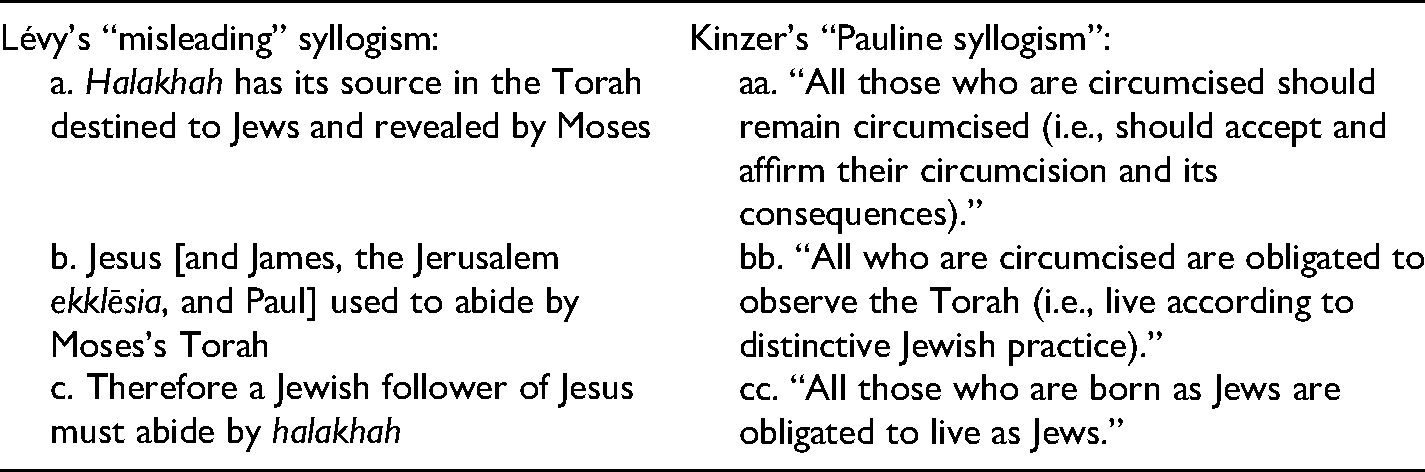
Let me ask: Is not “a” (“Halakhah has its source in the Torah destined to Jews”) the ground for “aa” (“All those who are circumcised should remain circumcised”)? Is not “bb” (“All who are circumcised are obligated to observe the Torah”) the conviction that explains “b” (Jesus and Paul “used to abide by Moses’ Torah”)? If Jesus and Paul are allegedly described as Torah-observant in the New Testament (b), it is because they had the conviction that all Jews, including themselves, “were obligated to live as Jews” (cc) or “abide by halakhah” (c). Accordingly, my “misleading” syllogism merely states the general principles that we see Kinzer apply to the notion of circumcision in his “Pauline syllogism.”
The only problem is that Kinzer's attempts to prove that Jesus and Paul are described as Torah-observant in the New Testament (so that all Jewish disciples ought to imitate them) or that they taught the necessity of Torah-observance to all their Jewish disciples (which is the reason why they were themselves Torah-observant) are not very convincing, in my opinion. At the same time, the questionable nature of these attempts is certainly not proof that the opposite opinion is true—namely, that Jesus and Paul should be understood as simply rejecting “the tradition of the elders” rooted in the Torah revealed to Moses, a tradition destined to become the embryo of rabbinic halakhah. What if this tradition remained relevant for the Jewish disciples of Yeshua? But on what grounds and to what extent? This is another point of contention between Kinzer and me.
Continuity-Model Versus Messianic-Torah Model
Regarding the manner in which Jewish followers of Yeshua should relate to rabbinic tradition, the points of disagreement between Kinzer and me do not come up very clearly in Kinzer's review. In fact, the bottom line of Kinzer's argument is that I misinterpreted his thinking, so we might appear to be much closer to each other after he provides the demonstration that the main object of my criticism was but a “strawman.” There is, however, one point on which Kinzer agrees that he disagrees with me: “Does an objective duty exist for Jewish disciples of Yeshua to observe the practices of the Torah directed specifically to the Jewish people? Lévy rightly states my affirmative response to this question. He then rejects my position, proposing instead that Jews are invited by God to embrace these practices freely as a vow-like response to a divine call.” With a few others blamed for having committed the same mistake, I characterized the language of Kinzer regarding this Torah-obligation—the duty for each individual Jew to take upon himself/herself the “yoke of the Torah”—as very close to the terminology of Orthodox Judaism. I believe I and the others who read Kinzer in this key had a few good reasons for that. It is not only the case that the Torah Kinzer refers to here is the “written Torah” revealed to Moses on Mount Sinai, the one that Jewish and Gentile followers of Yeshua can read in common. What Orthodox Jews refer to when they speak about the duty of “taking upon oneself the yoke of the Torah” are the commandments (mitzvot) of the written Torah understood according to the wonderfully rich and complex authority of the halakhic tradition (the “Oral Torah” that defines the substance of the Mishnah and the Talmud). Granting divine authority to the halakhic teaching of the rabbinic tradition, either directly (d’oraita) or indirectly, in a derivative way (d’rabbanan), as a set of obligations that apply to all Jews, is a defining feature of Orthodox Judaism. If Kinzer implies halakhic tradition when he writes about “the yoke of the Torah”—which is the whole purpose of reminding Jewish disciples of Jesus of their “Torah-obligation”—he is adopting a posture that seems to mimic the logic and terminology of Orthodox Judaism. In this manner, Kinzer can easily portray his “Jewish ekklesia” as partaking of the halakhic heart of religious Judaism, in contrast to the Gentile component of the global, “bilateral” Church that he contemplates. Now, by distancing himself from Orthodox Judaism and emphasizing the similarities between his understanding of the “yoke of the Torah” and that of the Conservative movement, Kinzer is manifestly striving to make his ideal “Jewish ekklēsia” more capable of integrating into rabbinic tradition teaching that does not relate to the written Torah in the way Orthodox Judaism does. The problem is that what is presented as a more adequate paradigm of mutual integration between the teachings of the New Testament and rabbinic tradition cannot avoid resulting in the actual disintegration of the connection between Kinzer's “Jewish ekklēsia” and the rabbinic tradition.
Let me explain. Orthodox Judaism has one great superiority over Conservative Judaism: what it means by the “yoke of the Torah” is, at least ideally, clearly defined. It is the halakhah in its entirety—period. Meanwhile, as Kinzer emphasizes in his review, the content of the “yoke of the Torah” is much more flexible in Conservative Judaism. What Orthodox Judaism views as halakhic decisions can be altered or modified in the framework of Conservative Judaism, depending on the adaptations to the modern world that its rabbinic authorities deem to be suitable. In addition, the Conservative faithful are given much more freedom to discern which mitzvot they retain as relevant for them personally, a “religious individualism” that is (officially) unthinkable in the framework of Orthodox Judaism. Nonetheless, Conservative Judaism shares the normative system of rabbinic halakhah with Orthodox Judaism; it operates within this single frame of reference. But what if the flexibility of Conservative Judaism is stretched to the extent that it intersects with a normative frame of reference that is external to that of rabbinic halakhah? Naturally, it is not the case that the teachings of the New Testament are spiritually or culturally foreign to the halakhic world, both being born on the same soil. But the former is external to the latter in the sense that the source of authority that validates the former is essentially distinct from that of the latter. “Who gave you authority to act like this (ἐν ποίᾳ ἐξουσίᾳ ταῦτα ποιεῖς)?” (Mark 11:28). The conflict of authority between Yeshua, on the one hand, and the pluriform leadership of the second-Temple Jewish world in Roman Palestine (“priests, scribes, and Pharisees,” Mark 11:27), on the other, stands at the very heart of the Gospels. There would be no New Testament or New Covenant without it, just as the rabbinic tradition would not be the one that we know if it had accepted these teachings. The question reads: What will become of the consistency—already fairly blurred within Conservative Judaism—of the “yoke of the Torah” after the ingrafting of New Testament teachings upon a halakhic tradition that has developed through the explicit dismissal of these teachings? To what extent can one still refer to the “yoke of the Torah” as a more or less defined collection of mitzvot to the observance of which every single Jewish follower of Yeshua is “obligated”? Could the “obligation” to such mitzvot even be considered to be Jewish in the sense that rabbinic Judaism gives to this term? It certainly would not be viewed as such by any rabbinic authority of any Jewish movement dismissing the messiahship of Yeshua ha-Notzri (Jesus of Nazareth). But could it even be considered as pertaining to rabbinic Judaism within a type of Judaism—i.e., “Messianic Judaism”—that would acknowledge this messiahship?
As it emerges from his works as well as from this review, Kinzer brings forward the idea of a Torah-fidelity that, while acknowledging the teachings of Yeshua as “the ultimate earthly source of halakhic authority,” would at the same time give due respect to the “wider Jewish community and its leaders for the governance of public Jewish life.” 4 This is what I called the “Torah-continuity” model in Jewish Church. The goal and task of harmonizing the two sources of authority lies at the core of this model. However, contrary to what Kinzer writes here, I never claimed that the proponents of the continuity model presented it as easy to put into practice. I argued the exact opposite. It is by no means easy to harmonize two radically distinct sources of authority. Indeed, it is a task that is almost as “excruciating” as that of “harmonizing” a circle and a square. The so-called “incident of Antioch” (Galatians 2:11–14) is a striking instance of this hardly avoidable hiatus. 5 It sees Paul corner Peter as the latter tries to shun meals taken in common with non-Jewish followers of Yeshua. Either one does not eat with non-Jews, thus complying with a stringent interpretation of the laws of Kashrut, or one eats with them for the sake of the communion that should be the rule in the Body of Christ. Eat or refrain from eating, obey the halakhah or obey the teachings of Christ in their apostolic interpretation—there is no way to do both at the same time. Either the halakhic authority of Christ is truly ultimate, so that it will in some cases overrule rabbinic halakhah, or it is not. If one does not acknowledge the supreme authority of Yeshua, one loses the possibility of being called his disciple. But if one acknowledges it, one's fundamental obligation is to the teachings of Yeshua, not to the rabbinic tradition. Of course, Jewish followers of Yeshua will always be free to comply with a number of rabbinic mitzvot—but this freedom ends wherever these mitzvot conflict with their fundamental obligation to the teachings of Yeshua. To summarize, the “yoke of the Torah” is not identical for non-Messianic Jews and for Messianic Jews; it is not so according to its content nor according to the obligation associated with this content. But if this is the case, how could there be more than a homonymy when ascribing to both the “obligation to take upon oneself the yoke of the Torah”? And if this is merely a game of words, how can Kinzer still portray his “Jewish ecclesia” as firmly anchored in Judaism as a religious tradition?
In Searching Her Own Mystery, Kinzer describes his experience of deep spiritual union with Yeshua while taking part in the Amidah prayer in the context of a mainstream synagogue (see ibid., 147–148). This is the borderline case of the “continuity-model” where Messianic worship does not need to change anything in the traditional liturgy of the Synagogue. What I argue, however, is that as soon as one goes beyond individual prayer and establishes a community of believers, faith in Yeshua must find some form of explicit expression. Lex orandi, lex credendi, as goes the age-old Catholic saying. As Kinzer writes, I had the joy to visit his congregation, Zerah Abraham, in Ann Arbor. I found a lot that deserves admiration in the congregation's attachment to the riches of traditional synagogal liturgy. At the same time, Kinzer and the members of his congregation know as well as I do that the slightest “Messianic” amendment of this tradition (not to mention the administration of what Christians call “sacraments”) is enough to dig a bottomless pit between this congregation and the wider Jewish world.
To my mind, mainstream Judaism is not to blame here for displaying short-sightedness. I would argue that it sees what Kinzer does not want to see: namely, that with these explicit references to Yeshua, the whole nature of Torah-obligation is irreversibly changed. As much as they strive to anchor themselves in rabbinic tradition, Messianic Jewish religious observance cannot help belonging to another world—that of the “Christians” they would so much like to avoid being assimilated to. This is inevitable as long as their fundamental allegiance goes to the teachings of Yeshua, something that completely or rather essentially modifies the nature of what the Jewish world identifies with “Torah-obligation.” What I called my “Messianic-Torah model” differs from Kinzer's “continuity-model” to the extent that it acknowledges this distance from the wider Jewish world and builds upon it.
According to the “Messianic-Torah model,” the connection between Jewish followers of Yeshua and the riches of the rabbinic tradition remains vital. As I repeatedly claim in Jewish Church, rabbinic Judaism transmits to Jews what Christian tradition has entirely dismissed: namely, the teachings of the Torah that apply to them corporately, as members of the Jewish nation. I have emphasized that these teachings have an ongoing relevance in the framework of the Church of Christ. However, the relation of Jewish believers to these teachings can no longer be formulated in the terminology of rabbinic Judaism, as an “obligation to take upon oneself the yoke of the Torah.” For the Jewish disciples of Yeshua, obligation relates to the teachings rooted in the authority of Yeshua whereas rabbinic mitzvot should be practiced and experienced as a sacramental kedushah, a sanctifying blessing for the Jewish followers of Yeshua as well as for the whole Body of Christ.
The Ur-Problem of Yeshua's Death and the Founding Principle of a Jewish Ekklēsia
It seems that one fairly central question has always eluded the author who theorized a bilateral Gentile-Jewish ecclesiology: namely, what justifies the existence of a Jewish ekklēsia? The fact that some Jews have come to acknowledge Jesus as God incarnate and Messiah of Israel is certainly not sufficient. If Jewishness is understood in ethnic/geographical terms, this is hardly a criterion to establish an independent ecclesial body, or else the Bourguignons, the Masai or—why not? the New Yorkers, etc., who believe in Christ, should each be entitled to have their own Church. True, the Catholic Church knows of a Church of the Assyrians, the Chaldeans, the Ukrainians, etc. But all these ecclesiae particulares are connected with a specific—although most of the time dogmatically and historically complex—apostolic legacy. From what apostolic foundation could a “Church of the Jews” claim to derive? If one points toward the “Church of James” that used to be established in Jerusalem, it is fair to ask: where is the institutional legacy, transmitted from one generation to the next, of this “Church of James”?
If Jewishness is conceived in religious terms, this is not a reason either. True, there can be no authentic Church without acknowledgment of the Torah revealed to Moses, together with the divine inspiration of the Books contained in the so-called “Old Testament.” But the converse does not hold true, and this is precisely the case for the religious identity that goes by the name of Judaism. A religious Jew observes the teachings of the Torah revealed to Moses while dismissing the teachings of the New Testament. To the best of my knowledge, membership in the Church is meant for those who accept them.
Thus, the most essential question raised by the hypothesis of a bilateral Church remains hanging in the air throughout Kinzer's works. Why should there be, überhaupt, a place for Israel qua Israel in the Church of Christ?
In Jewish Church, I argue that the answer to this question lies in the will of God to save Israel qua Israel—not individual Jews, but the whole nation of Israel—in Christ. That Jesus came to save his people is the unanimous message of all the Gospels. But where is this salvation achieved? One cannot point to any other event than the one that achieves the salvation of the whole cosmos; namely, the death of Christ on a Cross. The question reads: How does the will of God to save Israel qua Israel—Jews corporately—manifest itself in a salvific act that has relevance for each and every human being? In all the Passion narratives, one finds an emphasis on the “whole nation of Israel” (πᾶς ὁ λαός), but one does not find it where one would expect to find it. Indeed, the whole nation of Israel, with the priestly establishment and the Pharisees at the forefront, is depicted as being an accomplice in the death of Christ. This led the Fathers of the Church to separate Israel from Christ's salvation—and by the same token provided the Scriptural grounds for traditional Christian supersessionism: Israel according to the flesh being cast of out of divine salvation, a new, spiritual Israel was called to take its place, this new Israel being none other than the Church of Christ. In Jewish Church, I highlight the extreme difficulties the Fathers wrestled with when they tried to accommodate their reading of the Passion narratives to the passages proclaiming the imminent salvation of Israel in Christ. 6 I argue that what the Fathers mistook for the rejection of Israel was in reality the way God chose to save Israel in Christ. In his review, Kinzer accuses me of “whitewashing” traditional Christian supersessionism. The reality is that I endeavour to dismantle the very foundation of supersessionism by reversing the theological meaning of Israel's entanglement in the death of Yeshua. I believe that the death of Christ is an involuntary sacrifice of expiation offered by Israel on behalf of the whole nation. In this sacrifice, the Covenant between God and Israel is mysteriously renewed. I will come back to this idea.
In my opinion, the striking absence of a satisfactory legitimation of a Jewish ekklēsia in Kinzer's writings derives from what could be called Kinzer's blind spot when it comes to the theological meaningfulness of the death of Yeshua for the nation of Israel. It is not that Kinzer denies any factual or moral responsibility on the part of Jews in this death. He brings forward his own considerations on the eschatological predictions that concern the fall of Jerusalem in the gospel of Luke: “These passages imply that the events of 70 CE are a consequence of the events of 30 CE—or, more precisely, a consequence of the consistent behaviour over several generations which comes to a head with Jerusalem's rejection of its divinely-appointed king.” 7 Moral responsibility is not theological meaningfulness, though. Evil is the mechanical result of evil; it is a sad fact, but it does not necessarily convey theological meaningfulness, if by this one has in mind the plans of divine providence regarding the spiritual destiny of the nation of Israel. As is manifest in this passage and true of Kinzer's whole reflection, what bears the thrust of theological meaningfulness is not, according to him, the death of Yeshua, but the destruction of Jerusalem in 70 CE. This is the event of Jewish history around which Kinzer's reflections regarding the eschatological destiny of Israel gravitates. As he explains, the death of Yeshua is both the crime (as the culmination of many others committed against God's prophets) that explains the “punishment” of 70 and what mysteriously alleviates the latter, as the “voluntary act in which Jerusalem's future king proleptically bears the judgment that will come upon his guilty but still beloved city.” 8 All the same, I still struggle to understand how the same event can inflict and simultaneously cancel a judgment that befalls Jesus’ “guilty but still beloved city.” Be that as it may, the point is that, for Kinzer, it is the destruction of Jerusalem at the hands of the Romans, not the death of Jesus at the request of the chief priests, that requires theological deciphering. Indeed, Kinzer does just the opposite of contemplating the theological meaning of the death of Jesus; he systematically waters it down, appealing to those few New Testament scholars that support his stance. 9
While it might be true, following the opinion of A. Runesson, that the Greek term λαός (“people-nation”) designates different segments of the Jewish nation in the Gospel of Matthew, this is precisely the reason why the sudden use of the syntagm πᾶς ὁ λαός, “the whole nation” in Matthew 27:25 is so striking: the whole nation—meaning all its segments, Priests, Pharisees, commoners—takes responsibility for the death of Jesus (“Let his blood be on us and on our children!”). The change of terminology from ὄχλος (“the crowd”) to πᾶς ὁ λαός at such a decisive moment can hardly be ascribed to chance, especially taking into account the massive number of parallel uses of the phrase in the LXX where it renders the Hebrew כָּל־הָעָ֖ם. As to restricting πᾶς ὁ λαός, with A. Runesson and especially M. Konradt, to the people of Jerusalem by contrast to the “Galilean crowds,” one can only marvel at Kinzer's swift assimilation of Jerusalem to a city just like any other. Does Kinzer not rightly take his cue from the whole prophetic literature of Israel when he dwells at length on Jerusalem as the living symbol of Israel's relation to God in his Jerusalem Crucified, Jerusalem Risen?
As a matter of fact, Kinzer's dismissal of the theological relevance of the death of Jesus comes in sharp contrast with the weight that Peter and the apostles give to it when they address the Jews of Jerusalem in the immediate aftermath of the resurrection: “It was you who accused the Holy and Upright One, you who demanded that a murderer should be released to you while you killed the prince of life. God, however, raised him from the dead, and to that fact we are witnesses…Now I know, brothers, that neither you nor your leaders had any idea what you were really doing; but this was the way God carried out what he had foretold, when he said through all his prophets that his Christ would suffer. Now you must repent and turn to God, so that your sins may be wiped out” (Acts 3:14–19, NJB). This kerygma is extremely circumscribed as to its context and the identity of the addressees (“you who demanded that a murderer should be released,” etc.). At the same time, the death of Jesus has nothing of the character of a contingent particular in Peter's kerygma—it is at the core of the kerygma because it dictates a spiritual attitude that is essential to the reception of Christ's salvation: “you killed the prince of life … Now you must repent.” Is the doorway of repentance that is connected with Jewish responsibility in the death of Christ reserved for the Jews of Jerusalem that took part directly in these events? Is it conceivable that Jews who did not take part in these events would not need to walk through the exact same doorway in order to receive the salvation that the death of Yeshua conveyed to the people of God? Kinzer is quick to point out that the kerygma of Paul to the Jews of Antioch puts the blame of Yeshua's death on “those who live in Jerusalem and their rulers” who committed this act (Acts 13:27). But what Paul is asking from these Jews is to acknowledge the terrible, though not deliberate (see ibid.), transgression of “those who live in Jerusalem and their rulers” as carrying the “message of salvation” destined from all eternity to the “sons of Abraham's race” and Israel's “godfearers” (Acts 13:26).
There is no Jewish “collective responsibility” for the death of Jesus that would mysteriously pass, in the manner of Macbeth's indelible stain, from one generation to the other. This is a mythological invention of Christian antisemitism that the Vatican II declaration Nostra Aetate duly condemned (paragraph 4). But there is the lingering, although most of the time voiceless, historical memory that links Jews from all places and times to the collective transgression that took place in Jerusalem during the days of Pontius Pilate. 10 What the kerygma of Paul to the Jews of Antioch emphasizes, however, is that the acknowledgement of this collective transgression is also the very action that enables Jews of every place and time to welcome the message of salvation that God has promised to the race of Abraham from all eternity. Nobody is allowed to incriminate Jews for a transgression committed by their ancestors. But Jews themselves can freely take up this task of repentance in the name of their ancestors, knowing that this acknowledgment, as exacting as it might be, is the doorway to the salvation that is the fruit of Yeshua's voluntary sacrifice for Israel and for the world. 11 This is what I mean when I write about the double-entendre of Matthew 27:25 (“Let his blood be on us and on our children!”): through repentance and the welcoming of the “message of salvation,” the blood associated with the responsibility for an innocent's death is changed into the blood of the renewed Covenant between Israel and God.
In a footnote, Kinzer gives three reasons why the authors of the New Testament, and John in particular, could not have interpreted the death of Christ through the symbolic grid of a sacrifice in the Temple, a sacrifice performed by the priests on behalf of the whole community of Israel. I am sure Kinzer does not mean that this death is not understood as a sacrifice in the New Testament. As the author of the Epistle of the Hebrews writes, it should actually be understood as the true and definitive paradigm of all the sacrifices taking place in the Temple: “Such is the high priest that met our need … he has no need to offer sacrifices every day, as the high priests do, first for their own sins and only then for those of the people; this he did once and for all by offering himself. … The blood of goats and bulls and the ashes of a heifer, sprinkled on those who have incurred defilement, may restore their bodily purity. How much more will the blood of Christ, who offered himself…” (7:25–27 and 9:13–14, NJB). The question has more to do with the symbolic role played by the nation of Israel as represented by its sacerdotal hierarchy in the Passion narratives. Kinzer's first objection is that the killing of the victim for the sacrifice was not part of the priestly sacrifice itself; the latter consisted in an offering of the remains and especially the blood of the victim. But sacrifices (sin offerings, purification, atonement etc.) should be distinguished from the priestly offerings, which were themselves only the culminating part of these different types of sacrifices. In the Passion narratives, those who slay the victim (the Roman soldiers) are not the priests, just as in the sacrifices of the Temple. The second objection is that sacrifices cannot be performed without the awareness of those who perform it, and the third is that all murders should be considered as sacrifices if the death of Christ is one. I find a response to both objections in the mouth of Yeshua in the Gospel of John (16:2): “an hour is coming for everyone who kills you to think that he is offering service to God.” All murders are not sacrifices to God—only those that are committed in the name of God and for His glory.
The theological dimension of Yeshua's death is the heart of the New Testament and of the apostolic kerygma. It points to the cosmic salvation that this voluntary death brings about and that the Church has the mission to announce. The Jewish nation, πᾶς ὁ λαός, plays a decisive role in this death. Not allowing oneself to reflect on the theological dimension of this death and on the role that the Jewish nation played in it makes it impossible to consider the Sonderweg of the Jews toward Yeshua's salvation and, together with it, the very foundation of a Jewish ekklēsia. This is indeed the Ur-Problem of Kinzer's bilateral ecclesiology.
Justifying Supersessionism or Understanding It?
According to Kinzer, Lévy's Jewish Church should not only be criticized for its fundamentalistic exegesis and theologoumena that flirt with the worst mythologoumena of traditional Christian antisemitism. It is also said to “whitewash” the Church's traditional supersessionism. To my mind, what gives rise to this specific accusation is a series of terminological confusions. Drawing the lines where they need to be drawn should therefore be sufficient to expose it as baseless.
My definition of supersessionism does not differ from what is currently meant by this notion; namely, the claim that the Church stands now as the “true Israel,” the elect people of God, whereas the old Israel has been rejected by God due to her unbelief or her refusal to acknowledge Jesus as her true Messiah. I do not think that Kinzer accuses me of upholding such a doctrine. In Jewish Church, I show that it goes back to the exegesis of the Fathers of the Church, an exegesis that will not bear scrutiny when referred to the actual content of the texts of the New Testament. 12 If I am not mistaken, what Kinzer means by “whitewashing supersessionism” is the attempt to justify the historical process that led to the emergence of this erroneous doctrine. If the Church's supersessionist stance is the reason for her separation from Israel, as Kinzer claims, one cannot argue that the separation of Israel from the Church generated supersessionism without “whitewashing” the Church's role in promoting the latter. In the framework that Kinzer dismisses, it is the Jews who are considered responsible for the Church's “supersessionist turn.”
Let me bring forward two important distinctions that are nowhere apparent in Kinzer's portrayal—or rather fairly gross caricature—of my position.
The first distinction is between gentilization and supersessionism. By gentilization of the Church, I have always meant the ethnic-biological process already starting in the 2nd century that saw the progressive extinction of a vibrant Jewish presence in the main Church. By contrast, supersessionism is the ideological justification of this state of affairs: the Church becomes the people chosen by God instead of the Jews, since these are by definition unbelievers, and therefore cast out of God's cosmic design of salvation.
The second distinction is between schism and estrangement. By primeval schism, I have always intended the scission within Israel itself between Jewish believers in Yeshua and those who would not acknowledge Yeshua as Messiah of Israel. The Church is not born out of this schism since her origin can be traced to the apostolic group around Yeshua. But her birth and expansion go together with this schism, since Yeshua and his group immediately stirred opposition from the wider Jewish world. This opposition did not diminish after the death of Yeshua; on the contrary, it became stronger, to counter the propagation of the apostolic kerygma. Meanwhile, estrangement is the longer historical process that saw this primeval schism result in the formation of two self-contained and heterogeneous religious worlds, one of Christianity and the other of Judaism. This process of estrangement continues to this day.
Now what I argue in Jewish Church is that Jewish opposition to Yeshua and his group is the first factor that triggered the gentilization of the Church. Since on the one hand, a great number of Jews were turning down the apostolic message of salvation in Yeshua and, on the other hand, the leadership of the “saints” in Jerusalem decided to open the door of the Church to Gentiles without asking them to convert to Judaism, the gentilization of the Church seemed to have become inevitable due to the most elementary mechanisms of demography. As Paul declares to the Jews of Antioch: “Be it known therefore to you, that this salvation of God is sent to the Gentiles, and they will hear it” (Acts 28:28).
I never wrote that Jews were responsible for the “supersessionist turn” of the Church, however. This would be completely absurd since supersessionism, a theo-ideological trend that emerges in the second century with Ignatius of Antioch and Justin Martyr, implies an ecclesial context where there are no or very few Jews left in the Church, the latter being a highly suspicious quantity (see Justin's Dialogue with Trypho, chapter 47). The Jews are “the others,” a view the dissemination of which only Gentiles could be responsible for. Accordingly, supersessionism cannot be said to have caused the primeval schism, a claim that one finds under the pen of Kinzer, if one holds to the definition of this event that I gave earlier. Supersessionism surfaced as a consequence of the primordial separation-schism between Jewish believers in Yeshua and the wider Jewish world, and it did so in a context where the process of estrangement between Christianity and Judaism, as distinct religious worlds, had already begun. Of course, the spread of supersessionist theo-ideology could accelerate this spiritual and cultural process of estrangement, and it did in fact accelerate it. But in good logic, it could not have caused the schism out of which it emerged.
What is true is that the “supersessionist turn” of the Church would never have taken place had the leadership of the primitive Church found a way to preserve a vibrant Jewish presence in her midst. In this sense, the gentilization of the Church was not an “inevitable process.” Showing great and official appreciation for the life and practice of Jewish believers in Yeshua would have prevented the growth of a theo-ideology identifying the true Church with the divine election of Gentiles as a providential replacement of the Jewish nation. However, as I wrote in Jewish Church, there are no traces of rulings that would have authorized and supported a distinct Jewish biosphere within the communities of the early Church. On the contrary, from a very early stage, the overall tendency has been to promote uniform religious practices that all the faithful, Jews and Gentiles alike, would observe.
Kinzer writes that he is “baffled” as to why the “absence of formal commitment to impose a distinct Jewish practice” would necessarily lead to “a deliberate and global condemnation of any form of Jewish practice within the Church.” Meanwhile, I am baffled that such a great spirit as Kinzer finds it difficult to understand that the effort to impose common religious practices should translate into the prohibition of a distinct Jewish biosphere in the Church. What explains the proliferation between the 2nd century and the 5th of the so-called Judaizing groups (Ebionites, Nazirites, Elchazaites, etc.) outside the “Great Church,” if not the practical impossibility of establishing a Jewish biosphere within her official boundaries? Throughout the first centuries, the leadership of the Church increasingly clung to its decision to promote the unity of the Body at the cost of sacrificing what could have given birth to a distinct Judeo-Christian tradition in the Church.
This has nothing to do with a momentary lapse due to the intensity of apocalyptic expectations in the early Church. What task could have been more important and pressing for the early leadership of the Church, then exclusively composed of Jews, than preserving the connection of the Church to the legacy of Israel, had the leadership felt that this legacy was imperiled? One must keep in mind that, for those who formed this leadership, the necessity of preserving a distance between Jews and non-Jews was traditionally motivated by the idolatrous beliefs of non-Jews. If non-Jews were to accept the true religion by converting to the Good News, what was the point of preserving the distinction between Jews and Gentiles in the Church by crystallizing a diversity of practices and lifestyles? Accordingly, there is nothing more erroneous than Kinzer's claim that the “suppression of Torah-observance” should be ascribed to “the leadership of the early gentile Church” in violation of the “obligation” of “Torah fidelity” for “Jewish disciples of Jesus” that one would read in “Matthew and Luke–Acts.” It is not only that, as I showed earlier, this “obligation of Torah-fidelity” in Matthew and Luke–Acts is pure imagination as long as one identifies it with the “yoke of Torah” in its rabbinic interpretation. The renunciation of promoting a distinct Jewish biosphere actually goes back to the primeval Jewish leadership of the Church, and far from implying a deliberate violation of Torah-fidelity, it was done in a spirit of obedience to God in order to accomplish His providential design of including all nations, Jews and Gentiles alike, in the true Torah of salvation revealed in Jesus Christ. What this Jewish leadership did not and could not see as having fundamental ecclesiological relevance is what has become clear after almost 2000 years of Galut (exile/dispersion) to a number of believers in Yeshua, among whom I count Kinzer and myself: namely, that the providential meaning and value of Jewish identity goes beyond—or deeper than the content of a specific religious belief. That Gentiles and Jews can share the exact same religious belief—the one that is summarized in the Nicene Creed—does not entail that when they do so, the distinction of practice and lifestyle between the two should be abolished. Jewish identity, by being entitled to its own biosphere in the one and unique Body of Christ, is called to display a spiritual and theological richness that will benefit this entire Body. 13 That we came to this insight only in the recent years—after a 2000-year exile, an immeasurable amount of persecution and suffering caused by Christian antisemitism, the Shoah, the dramatic revision of traditional Christian views on Jews and, last but not least, the contemporary “in-praise-of-difference” type of intellectual attitude—does not mean that the truth it refers to has not been there with us from the very beginning. It simply means that it has taken Christian theology 2000 years to discover an essential aspect pertaining to the very nature—or mystery in the Catholic sense of the term—of the Church.
In conclusion, “whitewashing supersessionism” is really the least of my concerns. Supersessionism is a theo-ideological doctrine or Weltanschauung that could only see the light of day in a thoroughly gentilized Church. Jews do not carry the slightest responsibility for the rise of this theo-ideology in the Church. I am not interested in justifying what I consider a tragic ecclesiological error. I am interested in understanding the process that led to its emergence and growth. My approach is not that of a historian, but that of a theologian. I try to understand this intellectual phenomenon because my final goal is to rectify this error. I am striving to achieve exactly the same thing that Kinzer is striving to achieve: namely, to supersede supersessionism in order to make a Jewish corporate presence within the Church of Christ possible.
Asymmetry—Which One?
Kinzer's portrayal of my approach as fundamentalistic, defensive of Catholicism, and dangerously close to traditional Christian antisemitism, had to be completed with the portrayal of a vindicator of the Church's divine superiority over the rabbinic tradition. It is easy to show why this last accusation does not stand up to scrutiny any better than the previous ones. Here, Kinzer is confusing what pertains to the legitimacy of religious authority with what has to do with moral superiority.
One would not consider oneself the member of a religious body if one did not think that this body is more right—or less wrong—than others on matters of religion. This seems fairly self-evident. It is therefore normal that believers would espouse the point of view concerning other religious entities expressed by the religious entity to which they belong—a point of view that necessarily considers these other religious entities as less near to the Truth than they are themselves. The issue of the authenticity of Jesus’ messiahship draws the line between Christianity and Judaism. From a Jewish perspective, it is perfectly normal to consider that Christians are wrong regarding this fundamental belief, and vice versa. There is a perfect symmetry here.
This does not mean, however, that each of these two religions gives an identical account of the legitimacy of their respective authority. In rabbinic Judaism, authority goes back to the Torah revealed to Moses. At the same time, God gave to human beings a certain autonomy when it comes to the interpretation of the Torah. This is the wisdom of the famous conflict that opposed R. Eliezer and a few other great Tannaim (the founders of rabbinic Judaism in the 1st and 2nd centuries) regarding the purity of an oven cut into different sections (Bavli, Bava Metzia 59a:12–59b:5): “[The Torah] is not in heaven” (R. Yehoshua). God himself gave to human beings the authority to decide regarding the best interpretation of the Torah. Meanwhile, each of the ecclesial entities that compose Christianity has its own way of understanding authority. For the Catholic Church, not only is the Church a divine institution, since she has been established by Jesus Christ, fully man and fully God, but the highest examples of the Church's teachings partake of divine authority under specific conditions. One speaks of the inerrancy of Tradition (the decisions of Ecumenical Councils, for instance) as well as papal infallibility. Accordingly, there is an asymmetry between the ways rabbinic Judaism and the Catholic Church account for the legitimacy of their authority. If we compare these ways, the Catholic Church appears to consider her decisions as more directly connected to God (“directly inspired by the Holy Spirit”) than rabbinic Judaism considers its own halakhic legislation.
This asymmetry regarding the justification of authority does not imply that the Catholic Church should be held less accountable for the errors perpetrated in her name than Judaism. Indeed, the very opposite holds true: the more teaching openly relies on the authority of God, the more it should be held responsible for wrapping human errors and crimes in this divine mantle.
Let us now examine the theological imbalance in favor of the Church and at the expense of rabbinic Judaism that Kinzer blames me for.
I am criticized for not seeing the “no” to Judaism that hides in the “yes” to Jesus Christ advocated by the Catholic Church. If what Kinzer means by this “no” is the dismissal of a notion of Torah-fidelity borrowed from rabbinic Judaism, then Kinzer is right. As I explained earlier, I think that one should not obligate Jewish believers in Yeshua to Torah-fidelity in the sense of rabbinic Judaism (observance of mitzvot deriving from Torah independently of Yeshua's teachings) because this is both untenable and impossible. But if what Kinzer means by this “no” is the theo-ideology of supersessionism, he is wrong to assume that I do not hold the authorities of the Church responsible for it. There is no excuse for Christian antisemitism, and supersessionism being a sophisticated version of it, it goes directly against God's will and the ongoing validity of his Covenant with Israel.
Conversely, I am criticized for not seeing the “yes” to God and the Torah that hides in Judaism's “no” to Jesus Christ and the Church. I am sure Kinzer read Jewish Church, but he probably found it easier to forget part of its content for the sake of these elegant “asymmetries” he claims to find in my writings. What I argue is that without the Jewish “no” to the Church, no Jewish nation could have survived to this day. In the absence of regulations that would have allowed a Jewish biosphere in the Church to thrive, this Jewish presence in the Church would have disintegrated after a few generations under the demographic pressure of Gentile masses. Not only do I affirm the faithfulness of rabbinic Judaism to the Torah revealed to Moses, but I claim that the salvation granted to Israel in Yeshua has something to do with the spiritual rebirth that Judaism has experienced in the course of two thousand years of Jewish exile, and this in spite of the “no” of the Jewish nation to his messiahship.
Now if what Kinzer means by the Jewish “no” is this last “no”—the “no” to Yeshua's messiahship that resulted in his death on the Cross—it is true that I speak of a collective responsibility for the death of an innocent, even if this act was committed “in ignorance” (Acts 3:17, 1 Corinthians 2:8), as the Jews of the time thought they were getting rid of an impostor and a blasphemer. Kinzer insinuates that I am asking Jews to “repent” for this, which smacks of the darkest moments of the Spanish Inquisition. The reality is that this repentance is a spiritual act that cannot be separated from faith in Yeshua's messiahship. Only the one who believes can see here a matter for repentance on behalf of the whole nation of Israel, πᾶς ὁ λαός. As an attitude associated with conversion, repentance is not only the lot of Jews who come to this faith; it is the universal condition for the welcoming of Christ's salvation: “For God has shut up all in disobedience that He might show mercy to all” (Romans 11:32).
On the basis of these considerations, it should be clear that when it comes to moral responsibility, I see the flaws of the Church's “yes” as carrying much more moral responsibility or “weight,” to use Kinzer's terminology, than a Jewish “no” that has always been the counterpart of a “yes” to the Torah. Once again, there is no way of excusing or whitewashing the theorization of antisemitism that has found multiple expressions throughout the history of the Church. I am glad that, during the last half-century, leaders of the Catholic Church have repeatedly voiced their repentance in this regard, and I hope they will persevere in this attitude. 14 By contrast, I do not think that Jews have much to repent about when it comes to their objective treatment of Christians throughout the centuries. The only one who can abuse power is the one who has power.
What should be radically rejected, however, is Kinzer's claim that Jewish corporate presence in the Church could and should constitute some sort of middle way between the Yes-No of the Church and the No-Yes of Judaism. It simply does not make sense to state that “the Jewish and Christian traditions are both divinely authorized,” and that “they function within the Jewish and Christian worlds as resources of equal value.” It is not that the Catholic Church denies the connection of Judaism to divine Revelation, but a believer in Yeshua cannot grant the same level of authority to a tradition that affirms Yeshua's messiahship and a tradition that dismisses it. Christ is not Schroedinger's ca He cannot at the same time be and not be the God-sent Messiah of Israel. One has to decide within which of the two intrinsically coherent religious worlds one finds oneself. There is no “space in between.” As I argued earlier, what one means by “Torah-obligation” changes depending on this decision.
Naturally, as I have also said here and argued at length in Jewish Church, Messianic Jews in the broad sense of the term—meaning Jews that have come to acknowledge the messiahship of Jesus Christ—are called to cultivate a unique connection to the Jewish world and the rabbinic tradition. From this point of view, they can certainly help the Gentile Christian world to better appreciate the ongoing theological and spiritual value of Jewish identity. But in no way can Messianic Jews claim to “take their place as part of the Jewish community within its tradition of interpretation” and pretend to engage in a conversation with the Gentile part of the Church in the name of Judaism. The authorities of all the branches of Judaism are perfectly correct when they unanimously denounce this pretension as illegitimate and deceptive. In the eyes of these authorities, we, Messianic Jews, are meshumadim—those who “are destroyed.” We have accepted this “destruction,” this “being-apart-from-our-people,” in the name of Jesus Christ. We should not strive for any other type of status nor subject of pride. The symmetry that Kinzer suggests here, as some sort of “equidistant point” from both Judaism and Christianity, is a theologically dangerous illusion. From an ecclesial standpoint, the connection of Messianic Jews to the world of Christianity is not symmetrical to their connection to Judaism, whether they—we—like it or not.
Conclusion
Mark Kinzer's contribution to the ecclesiology of a corporate Jewish entity within the one, organic, and universal Body of Christ, is truly groundbreaking. I intend the expression literally. This theological soil was exceptionally hard. Over two thousand years of controversies and tragedies, it had simply petrified. Enfin Mark Kinzer vint. He took a powerful theoretical shovel and fearlessly started turning the turf upside down. Here we are, contemplating the rugged platform that came out of Kinzer's efforts. For the first time in history, building an authentically ecclesial home for Jewish believers in Yeshua has become part of the realm of possibilities. This is only the beginning of the adventure, however. Any contractor will tell you that the first thing to do after breaking the ground is to accurately delimit the terrain that will support the projected house. Truly, our undertaking is so delicate, so daring, so threatened with pitfalls at every step of the way, that we simply cannot afford these marks and delimitations on the ground to remain fuzzy and uncertain. A reading of the New Testament that, in the name of its Jewish religious and cultural matrix, continuously sweeps exegetical problems under the carpet should be seriously and critically discussed. So should a conception of a Messianic Jewish lifestyle that claims to import rabbinic Torah-obligation tel quel into the Church. So should an ecclesiology that does not see Yeshua's death and resurrection as its irreducible and unsurpassable cornerstone. So should an understanding of the historical formation of the Church that repeatedly confuses gentilization with supersessionism. Finally, the claim of Messianic Judaism to represent Jewish tradition with the Body of Christ should be treated likewise. Failing to discuss these issues adequately, that is thoroughly, will make it impossible to provide the answers Kinzer seeks regarding Jewish responsibility for the death of Christ, the Church's responsibility for supersessionism, and the shaping of an authentic Messianic Jewish lifestyle with the Body of the Messiah of Israel. We will build our house. The groundwork has just begun.