




Abstract
Teachers’ social ties to colleagues are a key conduit of instructional and classroom management resources, and social and emotional support to meet teaching challenges. We argue that special education teachers’ formal and informal collegial ties are malleable contributors to factors that undergird their burnout. Using U.S. middle schools as an example, we use social network constructs and longitudinal analyses to demonstrate the limited extent to which special educators formally assigned to interdisciplinary teams actually forge and maintain constructive ties with their assigned colleagues. Furthermore, we describe the collegial qualities of the ties that special educators do form with general educators. By investigating the naturally occurring social ties of special educators within a prevalent social organization of teachers, we can identify strategies to help administrators align the formal and informal social structure of teachers, and interventions to support the qualities of special educators that promote strong ties to general educators, thereby increasing the social integration of special education teachers.
Garwood (2023) presents a compelling case for the critical need to understand the antecedents and consequences of burnout among special education teachers. Similar to prior research on teacher burnout, he focuses on Bronfenbrenner’s (1976) ecological model of nested contexts to understand malleable factors. Although this aspect of ecological theory provides a framework for organizing proximal and distal factors, Bronfenbrenner’s theory, and systems theories more broadly, offers greater understanding of key mechanisms underlying special education teacher burnout. Specifically, systems theories such as ecological theory propose that relationships are a primary driver of adjustment for individuals within contexts (Bronfenbrenner & Evans, 2000).
In his review, Garwood (2023) recognizes the significance of special education teachers’ relationships with colleagues. He briefly summarizes literature that demonstrates that collegial, supportive relationships are important to mitigate burnout, and importantly raises the issue of their relationships not only with general educators but also with paraprofessionals. In a study of K–8 novice special education teachers not cited by Garwood (2023), Jones et al. (2013) reported that perceived support from colleagues and sense of collective responsibility for students was inversely related to teachers’ sense of commitment to teaching, and to a lesser degree to their school. Although it seems clear that supportive, collegial relationships are important to special education teachers, the current literature base is limited in its capacity to inform much more than this conclusion. Researchers have relied primarily on teachers’ ratings of the importance of support but have not directly investigated the nature of special educators’ relationships, or the extent to which and ways in which they are socially tied to other colleagues.
Special education teachers’ actual collegial ties are important to understand because they represent critical resources for these teachers. Educators use their collegial ties for social support, as well as for resources and guidance, as they work through challenging teaching situations (Moolenaar et al., 2012). Teachers experience multiple types of collegial ties that can be both formal and informal in nature. Formal ties are assigned within schools; they create recognized organizational structures, or networks, of educators that delineate roles and responsibilities of members, mutual work activities, and place teachers in proximity with colleagues who face similar teaching challenges (Bidwell & Yasumoto, 1999). Examples of formal social networks of educators are interdisciplinary teams of mathematics, science, social studies and language arts teachers serving shared students in middle schools (Hamm et al., 2021), mathematics teachers, coaches, and administrators (Berebitsky & Salloum, 2017), or high school academic departments of faculty (Bidwell & Yasumoto, 1999). Garwood (2023) calls attention to literature that implicates special education teachers’ role confusion and role ambiguity as contributors to burnout, which raises the possibility that special education teachers do not fit cleanly into the formal organizational structures of schools that would help to clarify key aspects of their work.
At the same time, teachers seek their own, voluntary, and informal relationships with colleagues. Researchers commonly focus on colleagues to whom teachers choose to turn to for advice, and the emergent networks of educators who turn to one another for advice, because advice-seeking ties and networks are believed to reflect the exchange of both support and information (Moolenaar et al., 2012). Moreover, aspects of advice-seeking ties and networks of teachers have been linked to critical outcomes for teachers, including burnout (e.g., Kim et al., 2017) and factors associated with burnout such as efficacy (e.g., Berebitsky & Salloum, 2017; Moolenaar et al., 2012). Both formal and informal collegial ties and their resultant networks are important and contribute to teachers’ beliefs and behaviors, but they are often distinct relationships. That is, administrators can assign teachers to work together, but the extent to which they build productive and supportive relationships within assigned formal networks is up to the teachers and varies widely (Frank et al., 2018).
Social network theory is used to conceptualize and measure the resources available to teachers through their social ties to colleagues (Frank et al., 2018; Moolenaar, 2012). This approach is used to make explicit the social ties reflecting interaction-based relationships that exist among educators, not simply an educator’s perception of relationships or the appearance of organizational structures. Moreover, constructs from the field of social network analysis help to understand the dynamic and structural processes associated with those ties. Strong ties among members of a network help to create a structure of support and emotional safety, and promote the exchange of resources (Valente, 1995). Tie strength can be reflected in diverse ways, but the frequency of interaction among members, and the perceived closeness to colleagues have been shown to contribute to teachers’ beliefs and changes in their practice (Coburn & Russell, 2008; Siciliano, 2016). The centrality of teachers within a network, reflecting the numbers of ties they seek or receive from colleagues within the network, signals a teacher’s opportunities to access resources and support from other educators, as well as the distribution of resources within the network as a whole.
A growing body of literature has demonstrated the value of identifying teachers’ collegial ties, and the qualities of those ties. The literature is strongly focused on general education teachers, particularly those who are early in career; and administrators, to the general neglect of special education teachers. In an exception in the literature, Stelitano et al. (2020) studied informal social ties formed among educators to discuss special education issues and students with disabilities in two high schools recognized externally for their inclusive practices. In these two high schools, special education teachers were at the core of interactions, connected to 5 to 6 times the number of colleagues about special education issues or students with disabilities than non-special education professionals. The authors note that the concentration of special education discussions with special educators could suggest that the responsibility for supporting students with disabilities was not distributed across educators, which was further supported by observational and interview data. Given that a lack of shared responsibility for students can contribute to special educators’ burnout (Garwood, 2023), Stelitano et al.’s (2020) findings provide insight into how special educators’ social ties to colleagues could underlie their burnout. Further identifying special education teachers’ actual formal and informal collegial ties and networks within the social networks of their schools, and the qualities of those ties, could help to localize sources of burnout. That is, the patterning of ties among educators reveals existing relationships that can be leveraged and relationship gaps that could be bridged. Understanding more about the nature of special education teachers’ collegial ties can also facilitate practices to alleviate sources of burnout, as these relationships are influential means through which teachers build dispositions which can buttress against burnout, such as efficacy (see Garwood, 2023).
Finally, special education teachers’ social ties and the qualities of their social ties are also relevant to Garwood’s (2023) points regarding fidelity of implementation. Garwood (2023) argues that the integrity of delivery of interventions to other educators or directly to students hinges on the affect and resources of those tasked with implementation. He makes a convincing argument from the literature that teachers who suffer from burnout and related affect are less likely to implement interventions with fidelity. Teachers’ collegial ties and networks could contribute to implementation fidelity through alleviating burnout to special education teachers. Perhaps even more directly relevant to implementation with fidelity among special educators is that knowledge about evidence-based practice and how to implement it into practice flows through social ties and networks among educators (Frank et al., 2015). Strong ties are particularly important to implementation with fidelity, as teachers are more likely to change their own behavior or adopt new practice that involves risk when they have supportive social ties (Frank et al., 2004; Valente, 1995). Special education teachers have both expertise and localized understanding of students and their schooling context, which could provide valuable support and guidance for implementation if accessed by colleagues. Special educators should be in a position to be core to the adaptation and implementation of evidence-based practice to the local classroom and school context (Weiss et al., 2023), but the nature of their ties to other educators in the school requires more study.
Our Work
As part of a larger study of teachers’ contributions to early adolescents’ adjustment to the first year of middle school (sixth grade), we have studied the formal and informal social organization of teachers within middle schools. The middle school transition year is well documented as challenging socially, academically, and behaviorally for students in general (e.g., Akos et al., 2015; Coelho et al., 2017); our own studies support this conclusion for both metropolitan and rural middle schools (e.g., Dawes et al., 2020; Farmer et al., 2010; Hamm et al., 2010) and further reveal that students with disabilities, compared with students who are not formally identified as having disabilities, maintain a lower sense of school belonging and perceive less peer acceptance during the middle school transition year, and experience the transition year as more socially and procedurally difficult (Chen et al., 2020).
For decades, schools have used interdisciplinary teaming as an organizational strategy to support students in the middle school transition. Interdisciplinary teaming as applied to middle schools refers to the grouping of core content area (i.e., mathematics, social studies, language arts, and science) general education teachers within a grade into small teams that share the same students (Arhar, 2013; McEwin & Greene, 2011). In middle schools organized into interdisciplinary teams, teachers assigned to the same team share not only students, but also planning time and teaching schedules (Erb, 1997). This formal organization of middle schools seeks to promote student success during the early adolescent developmental period by creating a small community that supports the potential for students and teachers to forge positive relationships that foster academic learning and socio-emotional adjustment (Arhar, 2013). This approach is widely used; recent national surveys of middle school principals indicate that 72% of middle schools use an interdisciplinary team structure to organize teachers and students (McEwin & Greene, 2011). The concept of interdisciplinary teams in the organization of teachers and students in middle schools is distinctly different from multidisciplinary teaming, an organizational practice that positions special education teachers as expert sources of advice among education professionals in support of students with disabilities.
In middle schools, the assignment of teachers to an interdisciplinary team creates formal collegial ties among those teachers (Bidwell & Yasumoto, 1999); those formal ties are intended to help teachers provide a coherent and supportive experience for their assigned group of students as they transition into and advance through the middle school setting (Erb, 1997). Our research on middle school teachers assigned to work together on an interdisciplinary team provides evidence that the strength of collegial ties among teachers assigned to the same team contributes to dispositions associated with teacher burnout. In studying sixth-grade teachers in 26 middle schools (Hamm et al., 2021), teachers who maintained strong ties to colleagues in their interdisciplinary teams across a school year, evidenced by greater frequency of interaction and higher ratings of interpersonal closeness, ended the school year with a greater sense of efficacy for behavior management. Moreover, a similar pattern emerged for teachers’ sense of collective efficacy for teaching their shared students. For both types of efficacy, tie strength contributed through increased trust among colleagues on the interdisciplinary team across the school year. As argued by Garwood (2023), teacher efficacy, particularly for behavior management, and collective efficacy are powerful buffers against burnout; our findings suggest that strong collegial ties within interdisciplinary teams could help to ameliorate burnout among general education teachers.
Our findings document the nature and value of formal and informal ties for middle school (sixth-grade) teachers organized into an interdisciplinary team structure, but do not necessarily capture middle school special education teachers’ experiences within the middle school organizational structure. Middle school interdisciplinary teams comprise general education students, many of whom are not yet identified for services, as well as students who have disabilities and have inclusive classroom placements (McLaughlin et al., 2013).
Given teacher concerns about classroom management (Sinclair et al., 2021), special education supports are particularly pertinent for students with or at risk for emotional/behavioral disorders. This heterogeneous group of students is characterized by difficulties maintaining relationships, problem externalizing as well as internalizing behaviors (e.g., depression and anxiety) that require a variety of individualized supports. Given that nearly one in five children have an EBD (Ringeisen et al., 2020) and that approximately 70% of these students spend a clear majority of their time in inclusive general education settings (U.S. Department of Education, Office of Special Education and Rehabilitative Services, Office of Special Education Programs, 2023), support from special educators is critical.
The extent to which special education teachers are assigned to be part of the formal interdisciplinary team structure of middle schools is unclear. And, to the extent that special education teachers are formally assigned to work with general education teachers on an interdisciplinary team, this formal assignment may not translate into a close, interpersonal relationship between special education and general education colleagues, through which teachers derive advice and support for their work and provide those resources for colleagues (Frank et al., 2018). In general, formal assignment to work together can facilitate advice-seeking ties, particularly when educators perceive that their colleagues have valuable resources to share (Coburn and Russell, 2008; Woodland & Mazur, 2019). However, results of one study (Matzen et al., 2010) suggest that the complex organization of middle schools may not include special education teachers on interdisciplinary teams, and further makes advice-seeking difficult for special education and general education teachers. This study included interviews with general educators, who lamented that they had difficulty scheduling meetings with special education teachers to plan supports for shared students and had to resort to informal conversations in hallways. Their comments suggested, further, that they sought advice from special education teachers if they knew who the special education teachers were and saw them in the hallway. General education teachers further expressed a need for support to implement accommodations and to collaborate to adapt the accommodations to their own classroom context, which suggests that they lacked social ties to special educators that could provide these resources. This study was quite limited in scope but highlights a need to understand the social organization and qualities of ties among special education teachers in middle schools.
Garwood (2023) proposed a model in which low efficacy is part of a deteriorating cascading process that results in teacher burnout and poor outcomes for students. Teachers’ relationships, a component of Garwood’s model, evolve over time, as teaching conditions change and teachers’ dispositions evolve. Longitudinal studies of how these processes evolve over time are rare; those that are longitudinal span across years. Teachers’ work conditions change every year, with a new cohort of students and often, new colleagues. In our own study of middle school interdisciplinary teams, 70% had a new teacher member at the start of the school year, which means that each year, most teachers are adjusting to and forming relationships with both new and familiar colleagues, while simultaneously adapting to a new cohort of students (Hamm et al., 2021). Moreover, we found that the qualities of teachers’ ties changed within a year. Understanding the patterning and qualities of special education teachers’ formal and advice-seeking ties across a school year is a first step toward understanding how to leverage collegial ties to prevent burnout.
To illustrate how investigating the formal and informal relational context of middle schools could contribute to understanding, as well as allow for intervention with, special education teachers’ burnout, we analyzed data gathered from surveys completed by sixth-grade teachers regarding the colleagues they turn to for advice, and from reports from school administrators regarding the team structure of their schools. We address the following questions:
Data and Method
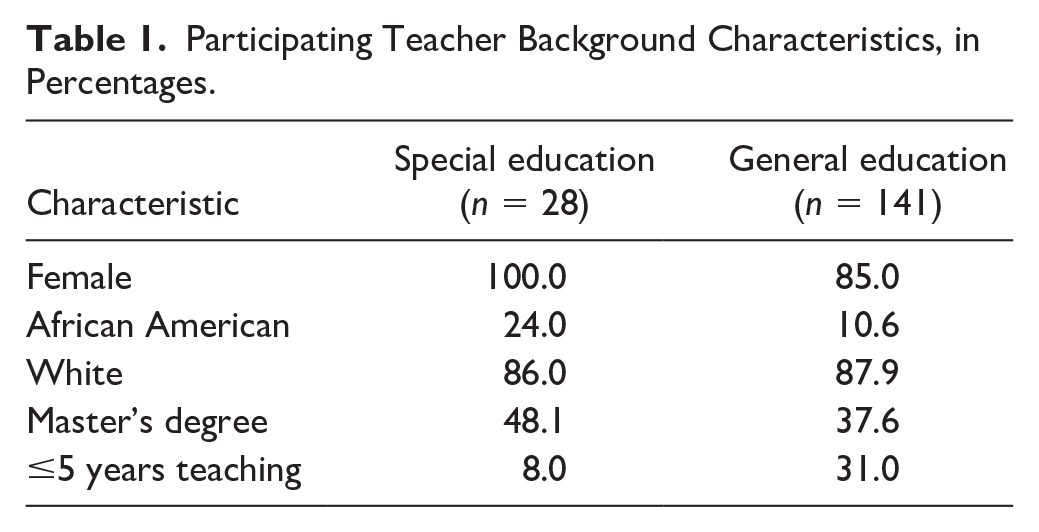
We report findings from 28 special education and 141 general education teachers in 17 schools located in the U.S. southeast. A full description of the sample from which the participating schools are taken, and the study methodology is found in Hamm et al. (2021). Demographic characteristics of the teachers whose data is analyzed for the present study is found in Table 1. The participating special education teachers were experienced educators, with nearly 70% reporting 11 or more years of teaching experience; less than 10% reported 5 or fewer years of teaching. Their general education colleagues were more varied in their teaching experience, with approximately 30% reporting fewer than 5 years of teaching experience.
Participating Teacher Background Characteristics, in Percentages.
All participating schools used an interdisciplinary team structure to organize sixth-grade teachers and students, although the numbers of teachers assigned to a team varied widely across schools (Hamm et al., 2021). The analysis focused on social networks generated initially for sixth-grade general education teachers and included educators within the team structure and those outside (e.g., special educators and administrators). Participating educators (86% of total educators invited consented) self-reported information about themselves, their interdisciplinary team affiliations, and their advice-seeking affiliations at the fall (October–November), winter (January–February), and spring (April–May) of a single school year through either a Qualtrics on-line survey software or paper-and-pencil surveys. We identified the formal, assigned interdisciplinary team structure of each school using teacher responses to the question, “Who is on your team?” We generated teacher teams based on teachers’ responses, using social-cognitive mapping procedures (Cairns et al., 1985; Leung, 1988) which reveal how members of a social network represent and think about relationships within their network. We also asked school administrators to identify the membership of teams within schools. In all cases, teachers’ nominations of teammates matched school administrators’ identification of teachers assigned to teams.
Teachers’ advice-seeking ties were identified through their responses to the question, “To whom do you turn for advice?.” Nominees who were in the school, but not part of the original sample of teachers were invited to participate and to identify their own advice-seeking ties within the school. Nominated teachers, who were not formally assigned to interdisciplinary teams (including over 20 of the participating special education teachers) became part of the advice-seeking network associated with sixth-grade general education teachers. Thus, this network may not fully include all special educators associated with the sixth grade; those who were not assigned to an interdisciplinary team or who were not identified by at least one teacher as a source of advice did not emerge as part of the sixth-grade teacher advice-seeking network.
The strength of teachers’ ties to colleagues was captured by their ratings of how frequently they interacted with each tie, and how close they were to each tie, following Coburn and Russell’s (2008) conceptualization of tie strength. Teachers rated how many times per week they talked with each nominated colleague, with response options ranging from 0 to 5 (one) to 11 to 15 (three) to 21+ (five). Teachers also rated their perceived closeness to each colleague they nominated, with response options ranging from Not at all Close (1) to Very Close (5).
Results
In this section, we provide results of descriptive and substantive analyses in support of our research questions, both at single points in time during the school year, and longitudinally. We also present and interpret graphical visualizations, to provide further insight into the nature of middle school special education teachers’ collegial ties.
Special Education Teachers Within the Formal Interdisciplinary Team Structure
To understand how special education teachers were situated within the interdisciplinary team structure used by participating schools, we simply examined the extent to which the formal structure of interdisciplinary teams of teachers included a special education teacher. In the 17 schools in this study, only five reported a special education teacher assigned formally as a member of an interdisciplinary team. One of these five schools had two special education teachers assigned to a single team. The remaining special education teachers in the sample were not formally assigned by school administrators to an interdisciplinary team of teachers and students. Thus, at least in our sample, special education teachers were not typically a part of the formal interdisciplinary team social organization of teachers.
Special Education Teachers Within the Advice-Seeking Social Structure
The formal interdisciplinary team networks of teachers are only one type of network within the school; voluntary, informal networks of teachers emerge as they form relationships with colleagues who offer support and advice for teaching (i.e., advice-seeking networks; Frank et al., 2018). We examined the extent to which special education teachers were a part of the advice-seeking network of sixth-grade teachers within the sixth grade, considering whom special education teachers named as a source of advice, and who named special education teachers as a source of advice. We also analyzed nominations that involved special education teachers within the five schools in which special education teachers were formally assigned to an interdisciplinary team, as well as across the sixth grade in all 17 schools, given that in many schools, special education teachers were not formally assigned to interdisciplinary teams of general education teachers and students.
Special Education Teachers’ Sources of Advice
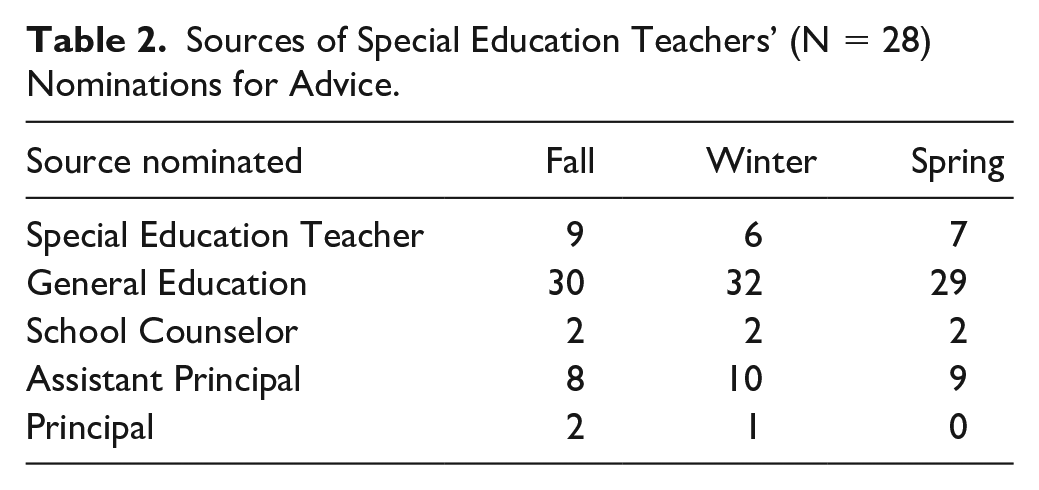
At each time point, the 28 special education teachers in the sample nominated approximately 50 colleagues within their schools (see Table 2). Not surprisingly, given the number of general educators available, the majority of nominations were to general education colleagues at any time point. Other special education teachers and assistant principals were the next most-frequently nominated colleagues. Patterns of nominations to these sources remained relatively consistent across the year.
Sources of Special Education Teachers’ (N = 28) Nominations for Advice.
Special Education Teachers as Sources of Advice
To understand special education teachers as sources of advice within the broader network of sixth-grade teachers, we focused on in-degree centrality, which is an index of how strongly tied a person is to others in the same network, through nominations received. An in-degree centrality score of 1.00 would indicate that within a network such as an interdisciplinary team of five teachers, all teachers nominated one another, and were nominated by all other teachers, as a source of information. A score of zero indicates that none of the teachers reported that they seek advice from any other member of the team.
Special Education Teachers Within Interdisciplinary Teams
As reported in Table 3, within the five teams in the schools in which a special education teacher was formally assigned to an interdisciplinary team with general education teachers, in-degree centrality was minimal for special education teachers, and only present early in the school year. By winter and again in the spring, no special educators assigned to any of the teams were viewed as a source of advice by the general education teachers assigned to the same team. So over time we see a shift in the extent to which the general education teachers are turning to their special education teammates for advice.
Within-Team In-Degree Centrality for Providing Advice (N = 5 Teams).
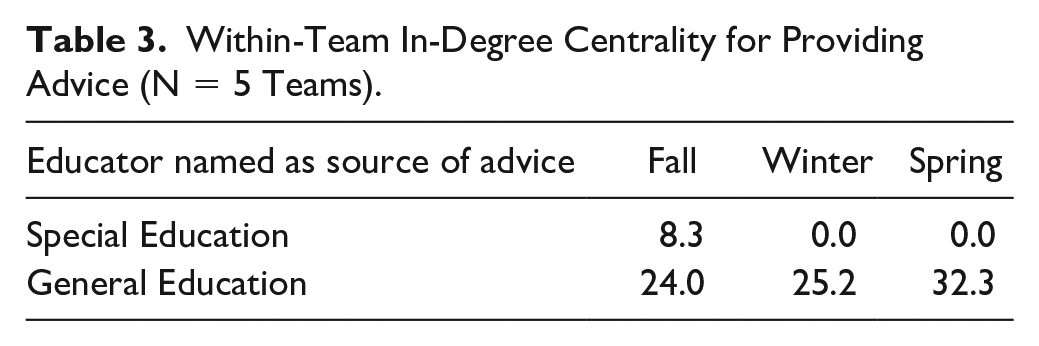
Early in the school year, special educators accounted for nearly 10% of the possible ties available within the team; as the year progressed, they were not identified by their teammates as a source of advice, nor did they nominate any of their teammates as a source of advice. In contrast, across the school year, general education teachers within the same team were associated with approximately one-quarter to one-third of all possible ties to colleagues within the team. Thus, when formally assigned to an interdisciplinary team, special educators do not appear to be an integral member, particularly as the year progressed.
Special Education Teachers Within the Grade Level
We expanded this analysis to the grade-level, including all 17 schools in the sample, to investigate the extent to which special education teachers were socially tied to any general education or special education teachers within their grade level.
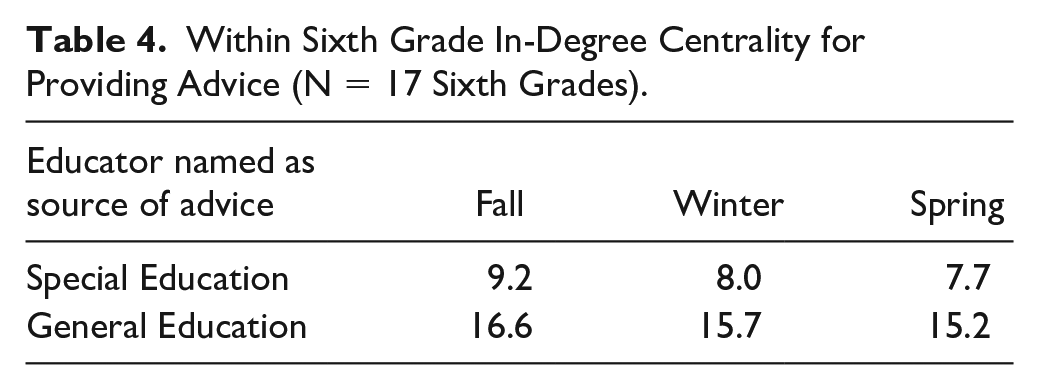
As seen in Table 4, across the entire network of sixth-grade teachers, general education teachers maintain approximately 15% to 17% of the possible nominations they could receive, and their popularity as a source of advice appears relatively stable across the school year. In comparison, special education teachers have low levels of centrality, representing less than 10% of the nominations, which suggests that they are not strongly perceived as a resource to their sixth-grade colleagues. Teachers did nominate other colleagues within the school; similar to findings from other studies, principals were particularly popular as sources of advice (Spillane & Kim, 2012) and other school personnel such as school counselors or other grade level teachers, all of whom were external to the sixth grade, received some nominations. Sixth-grade teachers have many colleagues they could nominate, but our data suggest that special education teachers were not prominent sources of advice. However, in-degree centrality of both special education and general education teachers is relatively stable across the year.
Within Sixth Grade In-Degree Centrality for Providing Advice (N = 17 Sixth Grades).
Strength of Ties Among Special Educators and General Educators
The presence of collegial ties, particularly advice-seeking ties, is important as it signifies the existence of a relationship but features of those ties—frequency of talk and closeness—are the means through which support and resources flow (Siciliano, 2016).
Tie Strength for Special Education Teachers’ Nominations
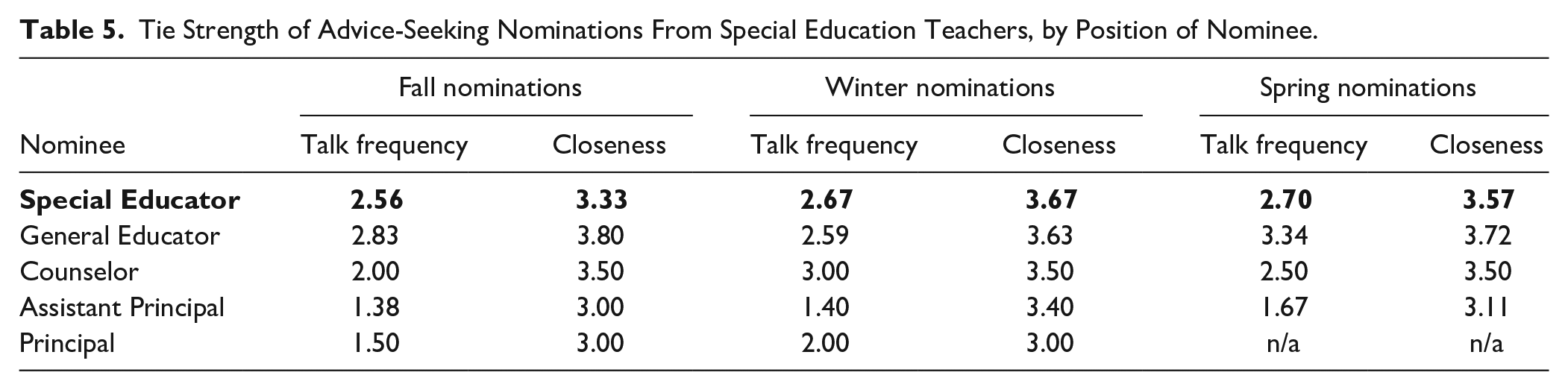
Table 5 displays the average level of tie strength (frequency of talk and perceived closeness) of nominations for advice made by the 28 special education teachers. The sample was too small to permit statistical analyses but a descriptive review of the averages suggests that special education teachers maintained a moderate level of talk to both special education and general education colleagues, with mean ratings suggesting that special education teachers talked with sources of advice who were special education and general education teachers 5 to 10 times per week, and sources of advice who were administrators and other school personal fewer than 5 times per week. Frequency of talk to any source appeared to be comparable across the school year. Special education teachers reported a moderate level of closeness to the sources of advice they nominated; these ratings were consistent across the school year.
Tie Strength of Advice-Seeking Nominations From Special Education Teachers, by Position of Nominee.
Tie Strength for General Education Teachers’ Nominations
General educators also reported their frequency of talk and closeness with colleagues they nominated for advice. We analyzed these ratings for differences by source of advice using one-way analyses of variance (ANOVA) followed by Fisher least significant difference (LSD) tests. Table 6 displays the mean values for general educators’ ratings, with significant differences denoted where present. With respect to frequency of talk, in the fall, general education teachers reported that they talked significantly more to their special education colleagues as sources of advice, as compared with any other source of advice they nominated, including other general education teachers. When general education teachers nominated special education teachers as sources of advice, they talked to those special education colleagues 11 to 15 times per week. In comparison, general education teachers reported talking to general education teacher sources of advice 5 to 10 times per week and other sources of advice fewer than 5 times per week. At winter, general education teachers’ frequency of talk remained greater, though not significantly greater, to special education teachers than to other general education colleagues, with a reported average reflecting a frequency of talk of 11 to 15 times per week, versus 5 to 10 times per week. General education teachers’ frequency of talk to special education teachers was significantly greater than the frequency of talk they reported with other school professionals they nominated as sources of advice (which averaged 5 or fewer times per week). At spring, this pattern continued, with general education teachers continuing to report that they directed a high frequency of talk, reflecting 11 to 15 times per week, to the special education teachers they nominated as sources of advice. This rating did not differ significantly from their reported frequency of talk to other general education or elective teachers but was significantly greater than the frequency of talk they reported to administrators or counselors. By spring of the school year, general education teachers’ ratings of frequency of talk to other general education teachers reflected a frequency of 11 to 15 times per week, roughly comparable to the frequency of talk they reported to special education teachers. Thus, across the year, general education teachers maintained a good deal of interaction with the special education teachers they nominated as sources of advice. Particularly early in the year, general education teachers who tapped into special education colleagues as sources of advice talked to those colleagues more frequently than they talked to any other source. Over the school year, frequency of talk to special education teachers remained high, although not significantly different from talk to other teachers.
Tie Strength of Advice-Seeking Nominations From General Education Teachers, by Position of Nominee.
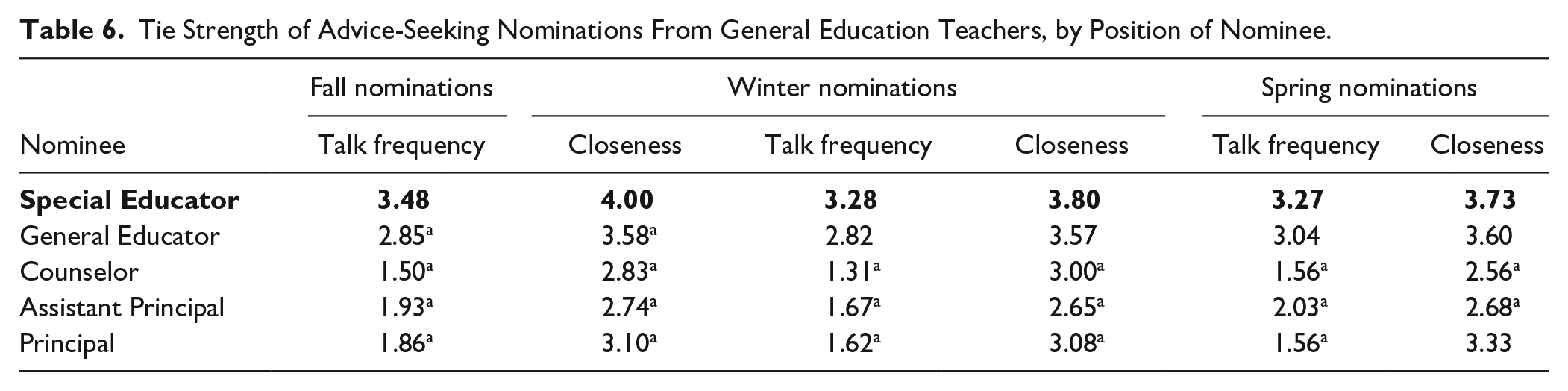
A similar pattern was evident for the level of closeness to advice-seeking ties reported by general education teachers. Special educators maintained the highest ratings of closeness compared with any source of advice sought by general education teachers. This difference is statistically significant early in the school year. At winter and spring, general education teachers’ ratings of closeness to general education and special education teachers is no longer significantly different but their rated closeness to special education and general education colleagues remains significantly greater than their closeness to other nominated sources of advice.
Ratings of quality of ties to special education teachers provides an important clarification into the nature of special educators’ integration into the social structure of the grade level. Special education teachers may receive few nominations for advice by general education teachers—but those ties constitute the strongest ties to general educators early in the school year and maintain their strength throughout the school year.
Visualizing the (Dis)Integration of Special Educators Within the Interdisciplinary Team Structure
Graphical visualizations are an important aspect of the analysis of social ties and social networks of educators, as they afford a qualitative analysis of how teachers are connected to their colleagues within the broader network. With our longitudinal data, we can visualize how those patterns evolve across the year. We present graphical visualizations of the social ties among sixth-grade special education and general education teachers across a school year, in two different schools. In both School A (see Figure 1) and School B (see Figure 2), a special education teacher has been assigned to an interdisciplinary team.
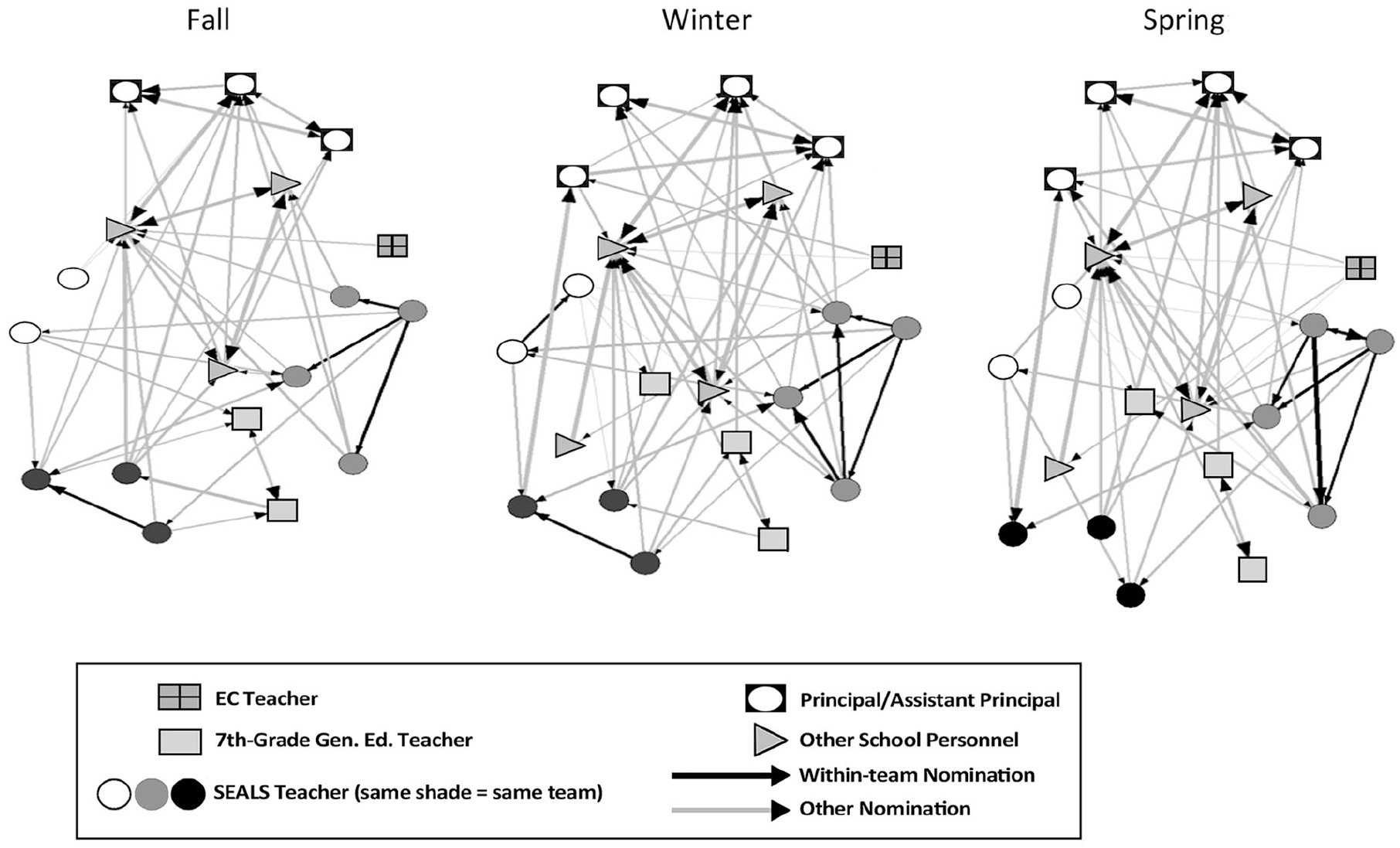
Middle School A, Sixth-Grade, Special Education Teachers.
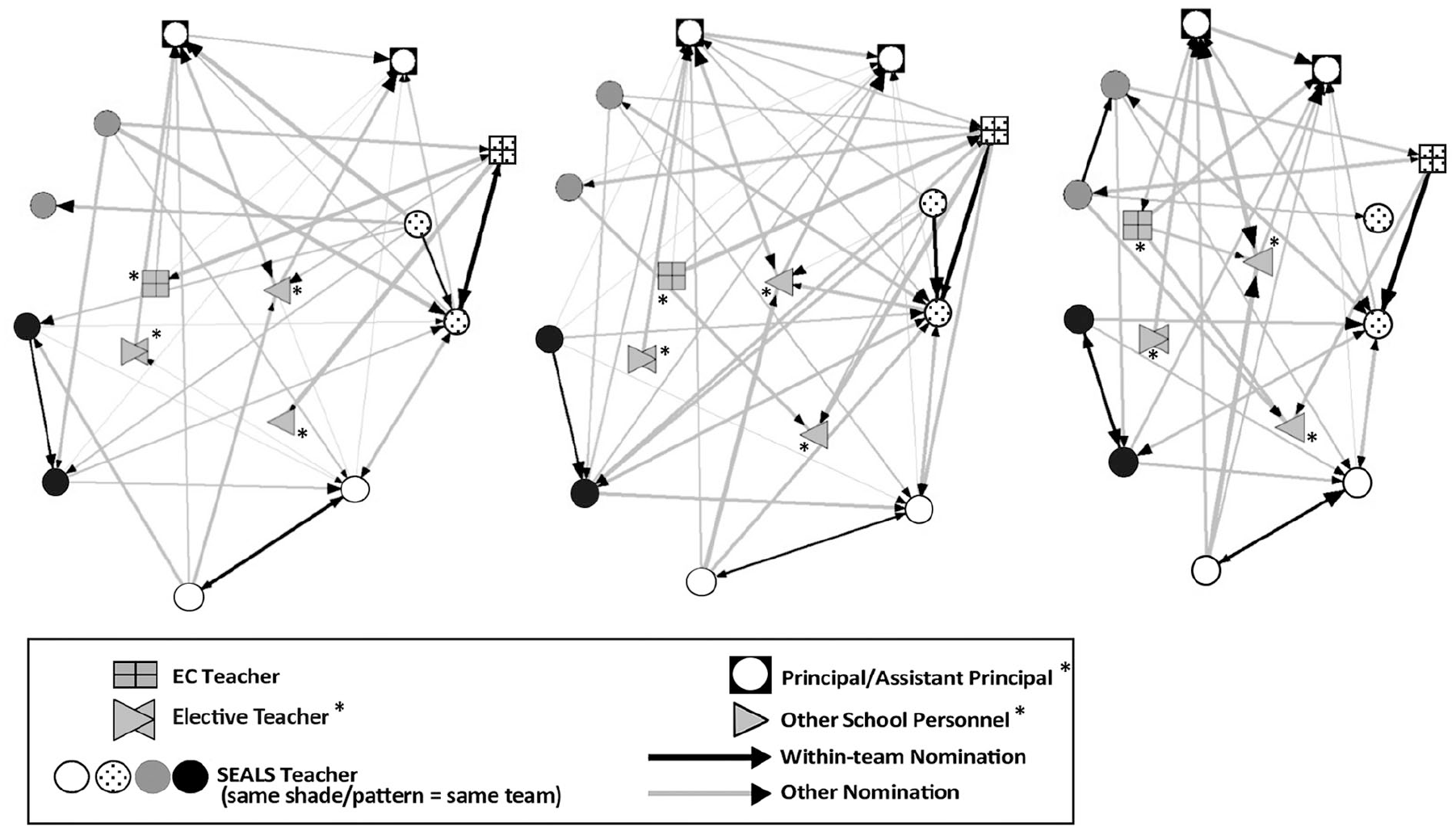
Middle School B, Sixth-Grade, One Special Education Teacher.
Each figure represents the sixth-grade teams in one school at three time points across a school year. The shapes represent individuals: Circles represent sixth-grade general education teachers and the window pane symbols are special educators. Shading or patterning within shapes represents shared team; that is, educators with the same shade and pattern within a shape are on the same team. The lines among educators show who nominated whom, with the arrow indicating the direction of the nomination. Reciprocated ties have dual-headed arrows. Lines in bold show ties within a team—that is, the teachers assigned to the same team nominated each other. Finally, the width of the line shows the closeness of the tie as reported by the teacher making the nomination, with wider lines reflecting greater closeness. The size of the arrowhead reflects the frequency of contact as reported by the teacher making the nomination; the bigger the arrowhead, the more frequently the teacher talks to their colleague. Thus, the wider the line and the larger the head, the stronger the tie.
Figure 1 presents the social network data of sixth-grade teachers’ nominations of colleagues whom they turn to for advice a single school, A, and illustrates the social isolation of special education teachers across a year, even when they are formally assigned to an interdisciplinary team. In the sixth-grade of this school, the special education teacher was formally assigned, with four general education colleagues, to the dotted team; the other interdisciplinary teams in this school included a two-teacher team (dark gray) and a five-teacher team (black) and exclusively comprised general education teachers. Focusing first on the dotted team, to which the special educator is an assigned member, the absence of bold ties connected to the special education teacher shows that this teacher doesn’t see their teammates as a source of advice, and the teammates don’t see the special educator as a source of advice. This pattern persists across the year and is reflected in the team-level centrality of zero for the special educator. It is noteworthy that the dotted team becomes somewhat more cohesive across the school year, with more nominations, including some reciprocated nominations, and larger arrowheads and wider lines, signifying a strengthening of ties within the team occurring among the general educators on the team, but to the exclusion of the special education teacher who is also on the team.
Beyond the dotted team in this school, the special education teacher identifies few colleagues as sources of advice. In the fall, they nominate only one other school professional (not a teacher) as a source of advice. At this time point, no sixth-grade educators or other members of this social network have nominated the special education teacher as a source of advice. Across the year, the special educator continues to make unreciprocated nominations of an assistant principal and the other school professional.
This pattern of isolation of the special education teacher, in spite of formal assignment to an interdisciplinary team, is representative of multiple schools in our sample. That is, for all special educators in our sample who were formally affiliated with a team, within-team centrality was zero after the first time point, reflecting an absence of ties to teammates. Moreover, the special education teacher received no nominations from other educators (i.e., beyond the team) as a source of advice, reflecting the overall low level of centrality of special education teachers within the grade level. This special education teacher is essentially isolated from the social network of educators, even the network to which she has been formally assigned.
Figure 2 shows the social network of the sixth-grade of a different school and reveals a greater, though still limited, social integration of special educators within the grade level. This school features three sixth-grade teams, each comprising two general education teachers and a fourth team comprising two general education teachers and a special education teacher. In this network of sixth-grade teachers and their sources of advice, at each time point, the dotted special education teacher maintains multiple social ties to colleagues and is nominated as a source of advice by a number of colleagues within the network. Focusing first on the dotted team, across the year, the dotted team special education teacher views a general education teammate as a source of advice; this is a strong tie in frequency and closeness, as reflected by the relative width of the line and size of the arrows. In the fall, the general education teammate also views the special education teacher as a source of advice, as reflected by the dual-headed arrow signifying a reciprocated tie, but this tie is not reciprocated at the winter and spring time points. It is noteworthy that across the year, the dotted team general education teacher nominated by the dotted team special education teacher is seen by many colleagues as a source of advice, as reflected by the many arrows directed to this teacher and the varying thicknesses of lines and magnitude of arrowhead. Even the administrators nominate this dotted team general education teacher as a source of advice. This dotted team general educator is a “key opinion leader” (Atkins et al., 2008)—an educator who is very influential within the grade-level network, both within and outside the team to which they’re assigned. Thus, the dotted team special education teacher is connected to this prominent teacher; being a source of advice to others is important but being connected to influential, well-connected colleagues opens up possibilities for resources, including support, and influence within the network (Frank et al., 2018).
Other changes in relational ties are evident and interesting for the sixth-grade special education teachers within this school. Although tied to at least one member of each team during the winter, over the year, the dotted team special educator becomes increasingly tied to teachers on the dark gray team, and the dotted special education teacher and dark gray team general education teachers evolve into an informal network that is more cohesive than the dotted team. In the fall and winter, one of the dark gray team teachers nominates the dotted team special educator. In the winter, that tie is sustained and the second dark gray team general educator also nominates the dotted team special education teacher, who reciprocates that tie, also nominating this teacher as a source of advice. The special education teacher continues to nominate the second dark gray team general education teacher in the spring, but this tie is not reciprocated. At the spring time point, the two general educators on the dark gray team also nominate each other. Across the year, the graphic visualization shows how the relationships appear to shift the influence and support of the special educator from the dotted team to the dark gray team. At times during the year, the dotted team special educator is also seen as a source of advice to one of the assistant principals. Given this teacher’s nominations and nominations received, it is possible that they serve as a bridging tie, connecting teachers across the network at different time points in the year.
The sixth-grade informal network of this school also includes a special education teacher who is in this network because they are nominated as a source of advice by the dotted team special education teacher. The other special education teacher reciprocates this tie, although the tie is not particularly strong. During winter and spring, the dotted team special education teacher drops this nomination and by spring, so does the gray special education teacher. Thus, these two special educators initially served as sources of advice to one another, but over time shifted away from each other. Overall, the special education teacher who is not tied to a sixth-grade team has limited and weak collegial ties, especially after the fall; they are not strongly connected to anyone in the school.
Implications for Practice, Research, and Policy on Burnout
These analyses of the formal and informal social ties of special education teachers in the sixth grades of 17 middle schools provide unique insight into the work life of special educators, revealing discouraging elements that may underlie or contribute directly to burnout or to factors that contribute to burnout, as well as potentially optimistic features that could be leverage points to alleviate special education teachers’ burnout. In his review, Garwood (2023) cites several studies that suggest that burnout could be reduced if special education teachers perceived a greater sense of shared responsibility for students with disabilities (Bettini et al., 2017) and greater collegiality with other educators (Billingsley et al., 2020). Though limited to two high schools, Stelitano et al. (2020) used social network analyses to demonstrate that discussions of special education issues and topics were concentrated with special education teachers rather than shared across special educators and other educators in the school. In this study, the social network analyses and graphical visualizations of the social ties of special educators in sixth grades in middle schools using interdisciplinary teaming demonstrate how disconnected special educators can be to their colleagues who also support the same students. In practice, in most schools in our sample, special education teachers were not formally a part of any interdisciplinary team of teachers and students. In the few schools in which they were assigned to a team, they were not connected to their teammates as sources of advice. One strategy for reducing special educators’ sense that they are alone in serving students with disabilities could be to formally incorporate special educators into the interdisciplinary team structure of general education teachers and students (with and without disabilities). But our findings regarding general education teachers, both in the graphic visualization and our other research (Hamm et al., 2021), suggest that this kind of organizational shift may be necessary but not sufficient to occasion social ties with qualities that promote teachers’ sense of collegiality and shared responsibility (see also Woodland & Mazur, 2019). Moreover, caution is warranted in facilitating social ties among teachers: If administrators seek to formalize ties among special education and general education teachers, it is important that the general education teachers are not themselves experiencing burnout. Results of one study indicate that not all close ties provide beneficial support: burnout is contagious and can spread from more experienced teachers to early career teachers through social ties (Kim et al., 2017).
Role ambiguity and role conflict are factors in burnout (Brunsting et al., 2014; Garwood, 2023). These are challenges that special education teachers experience as individuals, but social network analysis makes visible how special education teachers are stretched within and across the team and grade network context through both formal and informal relationships. Role ambiguity, in particular, which reflects an uncertainty of the boundaries of one’s job, could reflect conflicting experiences of being assigned to an interdisciplinary team, and sharing similar yet distinct responsibilities to the general education teachers who share the same students, while also experiencing isolation from these same teachers. At the same time that special educators are not well connected to members of their assigned team, they serve as a sporadic resource to all the teams in a school, given their specialized expertise. The potential for the social ties and networks of schools to contribute to special education teachers’ sense of role ambiguity should be explored to further understand the more fully.
A more optimistic finding is that at least in this sample of primarily sixth-grade educators, while special education teachers had few social ties, their ties were the strongest experienced by general education teachers. Special education teachers have unique and valued expertise to share with general education teachers (Matzen et al., 2010; Weiss et al., 2023); when general education teachers sought their advice, their relationships were closer and involved more frequent contact as compared with the relationships general education teachers formed with other educators. Moreover, the amount of time general educators reported talking to special educators was substantial, at 11 to 15 times per week. Regardless of the source they sought, special education teachers tended to, themselves, forge strong ties with colleagues from whom they sought advice. The value of strong ties should not be underestimated; indeed, they contribute to two factors Garwood (2023) identified as directly associated with burnout: teachers’ sense of efficacy for managing student behaviors and teachers’ sense of collective efficacy (Hamm et al., 2021; Moolenaar et al., 2012). Moreover, strong ties facilitate general education teachers’ uptake of feedback and new practices (Coburn & Russell, 2008). The potential for the provision of support through a strong tie to help special education teachers realize greater satisfaction in their work should be examined. Regardless, special education teachers have an underutilized capacity to benefit their colleagues that depends on general educators and other school personnel including them into their advice-seeking networks. General education teachers express a desire for better support to enact accommodations for special education students; failing to engage with special education teachers is a missed opportunity.
Finally, strong ties are critical to educators’ capacity to use evidence-based practices with fidelity. Special education teachers’ frequency of talk with, and closeness to the general educators who sought their advice likely creates a safe context within which general education teachers are more willing to listen to and try new instructional practices and supports for students, as well as receive and act on feedback about their own efforts to implement those practices (Coburn & Russell, 2008). Special education teachers have essential “know-how” (Frank et al., 2015; Weiss et al., 2023), or the professional and practical knowledge and skill necessary to implement behavior support plans to support students. That expertise is ideally distributed through social ties with colleagues, but if special education teachers are poorly connected to general education teachers, evidence-based practice may not reach the students who need it. Applying a different lens to teachers’ social networks, if discussion of special education issues and students is largely confined to special education teachers, that knowledge will not likely translate into supports for students who need services (Stelitano et al., 2020). Additional research studies that use social network data are essential to inform service delivery. For instance, we (Farmer et al., 2018) have proposed a directed consultation framework, which has demonstrated success within rural districts within which special educators are stretched thin and schools have limited resources. This approach involves an intervention specialist who uses consultation and professional development to guide special and general education teachers to adaptation and implementation of evidence-based practice. Data such as those presented in this study of metropolitan middle schools can reveal the ways in which special education teacher are connected to general education teachers and naturally deploy their attention and identify teacher-leaders who may act as conduits of information to colleagues. Our findings in this study, as well as results of other studies (e.g., Stelitano et al., 2020), reveal holes in the inclusion process, suggest that special education and general education teachers are not likely working together in ways that support students, and underscore the need for improved service delivery for students with or at-risk for disabilities.
Although compelling, the results of our study must be viewed within its limitations. The relatively low number of special educator participants permitted only a descriptive analysis of some of our data. Future researchers could add more teams and special educators, which would allow for an inferential analysis of frequency of talk and closeness measures. Also, there are a number of other individuals who assist in service provision who were not included in the present work. Again, with a larger targeted sample, the network presence of others, such as paraprofessionals who often serve as a conduit between general and special educators, could be further examined. Given their close proximity to students in inclusive settings and general education teachers, paraprofessionals may serve a proxy role in providing advice to general educators. Finally, the interdisciplinary team structure creates meaningful connections for educators serving shared students. Though highly variable, teachers assigned to the same team often share planning time and are in physical proximity; these features in theory facilitate a focus on the instructional and social-emotional needs of a shared set of students (Arhar, 2013). However, our results showed little difference in frequency or quality of relationships between teams who were assigned special educators and teams where special educators remained outside of the formal team structure. Future research should investigate the extent to which formal assignment to an interdisciplinary team, and the features of this organization, could help to reduce role confusion and role ambiguity for special education teachers in middle schools.
In conclusion, Garwood (2023) rightfully argues that it is vital to focus on improving the conditions supporting special education teachers’ capacities and commitments, in the interest of preventing burnout. Our analyses reveal possible ways in which special education teachers’ social ties and networks may underpin multiple factors known to contribute to burnout; future research with larger samples of special education teachers, and at different grade levels, is needed to establish more fully the role of social ties and networks to burnout among special educators.
Footnotes
Declaration of Conflicting Interests
The author(s) declared no potential conflicts of interest with respect to the research, authorship, and/or publication of this article.
Funding
Data presented in this article were funded by grant number 181117 awarded by the William T. Grant Foundation and grant number R305A120812 awarded by the Institute for Education Sciences. The views expressed in this article are those of the authors, not of the funding agencies.