



Abstract
This study examined the relationships of sociocultural body ideal internalization, difficulties in emotion regulation, and their interaction with body image concerns in a group of 423 Canadian adolescent boys. Participants were 12 to 17 years old and completed multiple self-reported questionnaires. Regression analyses and latent moderation structural equations were performed. Both variables were positively correlated with body dissatisfaction, drive for muscularity, restrained eating, and emotional eating. The internalization of men’s sociocultural body ideal moderated the relationships between multiple difficulties in emotion regulation and some body image concerns. These results are in line with findings of other studies among adult men and women, and dominant theories of body image concerns, which have been derived especially from women populations.
Keywords
As part of identity development, the integration of a new body image can be considered a central task in adolescence (Ricciardelli & Yager, 2016). However, body image concerns have been found to be widespread among adolescent boys and to increase throughout this period (Calzo et al., 2012, 2013). Body image concerns correspond to a person’s negative perceptions, thoughts, feelings, and behaviors about his or her body (J. K. Thompson et al., 1999). Body image concerns include body dissatisfaction and disordered eating, such as restrained eating and bulimic tendencies, but also unhealthy muscle-building behaviors (i.e., excessive weightlifting, supplement use, etc.), which appear to be even more common in adolescent boys than girls (Eisenberg et al., 2012). As observed in samples of women, body image concerns have been linked to a variety of psychosocial impairments among adolescent boys, such as low self-esteem, depressive mood, and substance use (Ricciardelli & Yager, 2016). Nonetheless, studies conducted among adolescents have primarily focused on girls (Cash & Smolak, 2011).
Researchers have studied both specific and non-specific risk factors for the development of body image concerns (Striegel-Moore & Cachelin, 1999). The internalization of the thin sociocultural body ideal has been identified as one of the most robust specific risk factors of body image concerns in samples of women (Cafri et al., 2005; Stice, 2002). Among non-specific risk factors, difficulties in emotion regulation have also been extensively supported as a correlate of body image concerns in women (Jenkinson et al., 2018; Prefit et al., 2019). However, studies exploring the relationship between these variables and body image concerns among adolescent boys are limited. Furthermore, no known study of male youth has examined the interaction between these factors, although it has been posited by several authors (Polivy & Herman, 2002; Striegel-Moore & Cachelin, 1999). This study aimed to investigate the link between the internalization of the sociocultural body ideal, difficulties in emotion regulation, and body image concerns in a group of adolescent boys. The moderating role of the internalization of the sociocultural body ideal on the relationship between the latter variables was also explored.
Internalization of the Sociocultural Body Ideal
The internalization of the sociocultural body ideal is a core component of the sociocultural model of body image concerns developed by J. K. Thompson and colleagues (1999), which was recently generalized to men (Tylka, 2011). It refers to the endorsement of physical characteristics promoted by the media, parents, peers, and other sociocultural agents (J. K. Thompson et al., 2012). In Western societies, men’s sociocultural body ideal is characterized by both high muscularity and low body fat in specific parts of the body (Cash & Smolak, 2011). Because this ideal is virtually unreachable, individuals who adopt more strongly and rigidly the sociocultural standards of beauty as their personal goals may be at greater risk of developing body image concerns (J. K. Thompson et al., 1999). Concordantly, meta-analyses of studies conducted among women identified a positive moderate-to-strong relationship between the internalization of the thin sociocultural body ideal and body dissatisfaction (Cafri et al., 2005; Stice, 2002). These results were replicated in another meta-analysis of studies including men of all ages (Karazsia & Pieper, 2011).
However, results derived from other populations, such as adolescent girls and adult men, may not fully apply to adolescent boys. Indeed, adolescent boys may be more vulnerable than adults to the internalization of the sociocultural body ideal. Adolescence is viewed as a period of heightened sensitivity to peer acceptance and increased identity malleability (Ricciardelli & Yager, 2016). Adolescent boys may also differ from their female counterparts regarding the internalization of the sociocultural body ideal. The former seem to perceive less pressure to conform to the sociocultural body ideal (Ricciardelli & Yager, 2016). They also tend to move closer to this ideal through puberty (e.g., increased muscle mass; Cash & Smolak, 2011).
Studies conducted among adolescent boys have also consistently observed a positive association between various measures of body dissatisfaction and the internalization of the sociocultural body ideal (Flament et al., 2012; Knauss et al., 2007; Smolak et al., 2001). Similar results were observed between the latter and restrained eating (Flament et al., 2012; Mitchell et al., 2017), bulimic tendencies (Flament et al., 2012; Sehm & Warschburger, 2018), and muscle-building behaviors (Rodgers et al., 2012; Smolak et al., 2001). However, questionnaires used to assess the internalization of the sociocultural body ideal in past studies have not clearly distinguished between the thin and muscular facets of this male body ideal (Klimek et al., 2018). Yet, among college men, authors have recently observed different relationships between both aspects of internalization and body image concerns (Klimek et al., 2018; Schaefer et al., 2017; Stefanile et al., 2019). Thus, although findings among boys are in line with those of other groups, further studies are needed to better understand the relationship between specific aspects of internalization and body image concerns.
Difficulties in Emotion Regulation
Difficulties in emotion regulation are often seen as a transdiagnostic risk factor (e.g., anxiety, mood, and personality disorders; Werner & Gross, 2009). This factor may be of acute importance among adolescents, as emotion regulation abilities are blooming throughout this period (Riediger & Klipker, 2015; Zeman et al., 2006). However, gender differences in emotion regulation may also become more pronounced during this stage of life (Nolen-Hoeksema, 2012; Zeman et al., 2006). Emotion regulation refers to the adaptive monitoring, evaluation and response to one’s emotions (Cole et al., 1994; R. A. Thompson, 1994). This broad construct encompasses experiential (e.g., attention, acceptance) and behavioral (e.g., impulsivity, situation modification) processes, both of which can be impaired (Gratz & Roemer, 2004; Werner & Gross, 2009). Authors have argued that deficits in both processes are involved in the development of body image concerns. Indeed, difficulty to identify, accept, and understand one’s feelings has been suggested to exacerbate unpleasant emotions and foster somatization, which could increase body image concerns (Polivy & Herman, 2002; Taylor et al., 1997). Moreover, disordered eating and muscle-building behaviors may be a numbing, avoiding, diverting, and compensating emotion regulation strategy to deal with unpleasant emotions (Fairburn et al., 2003; Lamanna et al., 2010; Schmidt & Treasure, 2006).
Recent literature reviews and meta-analytic studies confirmed the positive relationship between experiential (Jenkinson et al., 2018; Nowakowski et al., 2013) and behavioral deficits in emotion regulation (Prefit et al., 2019) and body image concerns. However, such studies primarily include groups of women and clinical samples of individuals diagnosed with an eating disorder. Among adolescent boys, studies are still scarce. To our knowledge, no study has investigated the association between difficulties in emotion regulation and muscle-building behaviors specifically. Moreover, studies conducted in this population have often focused solely on one of the various difficulties in emotion regulation. Therefore, since difficulties in emotion regulation are intertwined, these studies did not allow for the identification of deficits that may be more significant.
In groups of adolescent boys, several authors reported that greater interoceptive deficits, namely confusion and fear toward one’s emotions, were associated with higher levels of body dissatisfaction (Kerremans et al., 2010; Maganto et al., 2016; Todd et al., 2019). Past research has also shown a positive relationship between interoceptive deficits and both restrained eating and bulimic tendencies (Edlund et al., 1999; Kerremans et al., 2010; Sehm & Warschburger, 2018), although another study did not replicate these findings (Maganto et al., 2016). Other studies focused on behavioral aspects of difficulties in emotion regulation. Hughes and Gullone (2011) found that a greater reliance on dysfunctional emotion regulation strategies was associated with more body dissatisfaction, restrained eating, and bulimic tendencies. Other researchers similarly observed that greater impulsivity in response to unpleasant emotions was associated with restrained eating and bulimic tendencies in groups of adolescent boys (Edlund et al., 1999; Maganto et al., 2016).
Although no known study has investigated the relationship between difficulties in emotion regulation and muscle-building behaviors among adolescents, research conducted among college men may be informative. In this older population, muscle-building behaviors were found to be positively associated with alexithymia, meaning a diminished ability to identify and express emotions (Leone et al., 2015; Minnich et al., 2016), and impulsivity in response to unpleasant emotions (Dakanalis et al., 2015). Furthermore, studies conducted among undergraduate men may also shed light on the unique relationship between body image concerns and several difficulties in emotion regulation. Despite some variations, these studies supported that non-acceptance of one’s emotions, impulsivity in response to one’s emotions, and low confidence in one’s ability to cope with negative emotions had a unique association with body image concerns (Cunningham et al., 2018; Lavender & Anderson, 2010; Robinson et al., 2014). However, given the extensive transformations associated with body image and emotion regulation taking place throughout adolescence (Ricciardelli & Yager, 2016; Riediger & Klipker, 2015; Zeman et al., 2006), these results need to be replicated among samples of adolescent boys.
Internalization of the Sociocultural Body Ideal and Difficulties in Emotion Regulation
Since difficulties in emotion regulation have been suggested to lead to several psychological difficulties (Werner & Gross, 2009), it is plausible that its association with body image concerns may be strengthened by specific risk factors, such as the internalization of the sociocultural body ideal. Indeed, the latter variable is believed to increase one’s emphasis on body image and one’s positive expectations from achieving the sociocultural body ideal, such as happiness, success, and popularity (J. K. Thompson et al., 1999). Hence, adolescent boys who have internalized the sociocultural body ideal to a greater extent may be more likely to express their unpleasant emotions through bodily experiences and to ease these emotions through the pursuit of this ideal.
Internalization of the sociocultural body ideal and difficulties in emotion regulation have rarely been studied together and, to our knowledge, no study has explored their interaction among adolescent boys. In a sample of college men and women, Hutchison and colleagues (2020) found that difficulties in emotion regulation were more strongly related to body image concerns among individuals reporting higher levels of sociocultural body ideal internalization. Another study, which focused on the internalization of weight bias, did not replicate the findings in a group of undergraduate students (Douglas & Varnado-Sullivan, 2016). Therefore, distinguishing specific aspects of internalization, such as thinness and muscularity, may be important when attempting to clarify this interaction.
The Current Study
The purpose of the present study was to examine the relationships between internalization of the sociocultural body ideal, difficulties in emotion regulation, and body image concerns in a group of adolescent boys. This study also sought to explore if the internalization of the sociocultural body ideal moderated the association between difficulties in emotion regulation and body image concerns. In light of the empirical and theoretical literature summarized above, three hypotheses were formulated: (a) internalization of the sociocultural body ideal would be positively correlated with body image concerns, (b) difficulties in emotion regulation would be positively associated with body image concerns, and (c) the latter relationship would be stronger among individuals reporting greater internalization of the sociocultural body ideal. To adequately reflect adolescent boys’ experience and overcome the shortfalls of previous studies, internalization of the thin and muscular aspects of men’s sociocultural body ideal were distinguished, and specific difficulties in emotion regulation were measured, based on Gratz and Roemer’s (2004) model.
Method
Participants
The participants were 423 boys between 12 and 17 years of age (M = 14.7, SD = 1.1). They were recruited in the seventh (18.2%), eighth (11.3%), ninth (31.4%), tenth (37.0%), and eleventh (2.1%) grades in four Canadian high schools, three of which were private. While most respondents (77.1%) identified as Caucasians, the rest identified as follows: 4.7% Africans, 3.3% Asians, 0.9% Hispanics, and 13.9% unknown. Participants were also mostly from a nuclear family (77.5%) and from a high-income household (i.e., 81.1% were in the top three income deciles, >$100,000/year; Statistics Canada, 2021), although only 51.4% of the sample disclosed the latter information. Based on their self-reported weight and height, 7.2% of teenagers had a body mass index (BMI) above the 97th percentile according to their age, defined as the threshold for obesity (World Health Organization, 2007). Two respondents reported using unprescribed androgenic-anabolic steroids in their lifetime.
Procedures
Following the institutional review board’s ethical approval, numerous school districts and several schools were solicited based on convenience. Teenagers from the collaborating schools were introduced to the study during a class period by the lead researchers. Their parents were also informed of the study through documentation sent to them. The written consent of the youth and one of their parents (if they were under the age of 14) were obtained to participate in the study. Participants completed the questionnaires in class, either via an online survey platform or on paper. The period provided to complete the questionnaire was 1 hr, and few participants lacked time. The participation rate (i.e., the proportion of teenagers approached who participated in the study) is estimated at 75%. Because of absenteeism, the precise participation rate cannot be calculated. Most boys who declined to participate indicated that they forgot to ask for parental consent.
Measures
Male Body Attitudes Scale–Revised
Body dissatisfaction was measured using the Male Body Attitudes Scale–Revised (Ryan et al., 2011). This questionnaire contains 15 items (e.g., “I feel ashamed of my muscularity”) assessing dissatisfaction with one’s muscularity, body fat, and height. All items are rated on a 5-point Likert scale, ranging from 1 (never) to 5 (always). A score, which can vary between 1 and 5, is obtained by averaging all answers. A higher score indicates greater body dissatisfaction. This questionnaire has yielded evidence of excellent internal consistency in past research, and its validity is well supported (Compte et al., 2015; Ryan et al., 2011). Cronbach’s alpha in the present study was excellent (α = .85). This questionnaire was translated into French using backtranslation for the purpose of this study.
Drive for Muscularity Scale
Muscle-building strategies were evaluated using the Muscularity Behaviors subscale of the Drive for Muscularity Scale (McCreary et al., 2004). This scale is composed of seven items (e.g., “I drink weight-gain or protein shakes”) describing behaviors used to increase one’s muscularity, such as exercising and supplement use. All items are answered on a 6-point Likert-type scale, ranging from 1 (never) to 6 (always). Participants’ scores, computed by averaging all of their answers, can vary between 1 and 6. A higher score indicates the presence of more frequent muscle-building behaviors. This subscale has shown adequate reliability and validity in past studies (McCreary et al., 2004; Tod et al., 2012). Cronbach’s alpha in the present study was acceptable (α = .79). Backtranslation was used to adapt this questionnaire into French.
Dutch Eating Behavior Questionnaire
Disordered eating was assessed using the Dutch Eating Behaviour Questionnaire (Van Strien et al., 1986). The Restrained Eating scale (10 items, e.g., “Do you deliberately eat foods that are slimming”) reflects attitudes and behaviors associated with weight-based dietary restriction. The Emotional Eating scale (13 items, e.g., “Do you have the desire to eat when you are feeling lonely”) captures disinhibited eating behaviors induced by unpleasant emotional states. The latter scale was used to measure bulimic tendencies since both concepts are closely related. All items are rated using a 5-point Likert-type scale, ranging from 1 (never) to 5 (very often). For some items, participants could also indicate if the statements were “not relevant.” A score on each of these scales is obtained by averaging answers to the appropriate items. It can vary from 1 to 5 and a higher score suggests greater disordered eating. Excellent reliability coefficients of both scales and strong support for their validity have been reported elsewhere (Barrada et al., 2016; Van Strien et al., 1986). The French version of this questionnaire has also been previously validated (Brunault et al., 2015; Lluch et al., 1996). Cronbach’s alphas in the present study were excellent (α = .89 and .94, respectively).
Sociocultural Attitudes Toward Appearance Questionnaire
Internalization of the sociocultural body ideal was measured via the Muscularity (four items, e.g., “It is important for me to look muscular”) and Low Body Fat (two items, e.g., “I think a lot about looking thin”) subscales from the Sociocultural Attitudes Toward Appearance Questionnaire 4—Revised for Men (Schaefer et al., 2017). These scales assess the degree of adherence to and investment in sociocultural norms about muscularity and thinness. All items are rated using a 5-point Likert-type scale, ranging from 1 (definitely disagree) to 5 (definitely agree). Scores, obtained by averaging participants’ answers to the appropriate items, can vary from 1 to 5, and a higher score indicates a greater level of internalization of the sociocultural body ideal. This questionnaire has yielded evidence of excellent internal consistency in past research and numerous supports for its validity (Schaefer et al., 2017; Stefanile et al., 2019). Cronbach’s alphas were excellent in this study (α = .90 and .83, respectively). This questionnaire was translated into French using backtranslation for this study. As for the other questionnaires translated for this study, the process was carried out by three bilingual members of the research team with extensive knowledge of both psychometry and the studied themes. Unpublished data from this and other samples have supported the psychometric properties (e.g., factorial validity, convergent validity) of all translated questionnaires for the current study.
Difficulties in Emotion Regulation Scale
Difficulties in emotion regulation were measured using the Difficulties in Emotion Regulation Scale (Gratz & Roemer, 2004). This questionnaire includes six subscales. The Awareness subscale (six items, e.g., “I pay attention to how I feel”) assesses the lack of attention and value attributed to one’s emotions. The Clarity subscale (five items, e.g., “I have difficulty making sense out of what I feel”) evaluates the difficulty to identify and understand one’s emotions. The Non-Acceptance subscale (six items, e.g., “When I’m upset, I feel guilty for feeling that way”) measures the tendency to react negatively to one’s painful emotions. The Impulse subscale (six items, e.g., “When I’m upset, I lose control over my behaviors”) assesses the tendency to act impulsively when facing unpleasant emotions. The Goals subscale (five items, e.g., “When I’m upset, I have difficulty concentrating”) evaluates the difficulty to concentrate and accomplish tasks when facing distressful emotions. The Strategies subscale (eight items, e.g., “When I’m upset, I believe that I’ll end up feeling very depressed”) measures individuals’ perceived inability to regulate their emotions when upset. All items are rated using a 5-point Likert-type scale, ranging from 1 (almost never) to 5 (almost always). Scores are computed by summing participants’ answers associated with the subscale. Scores can vary from 8 to 40 (Strategies subscale), 6 to 35 (Awareness, Non-Acceptance, and Impulse subscales) and 5 to 30 (Clarity and Goals subscales). A higher score indicates greater difficulties. All subscales showed acceptable reliability and strong evidence of validity in past studies (Gratz & Roemer, 2004; Neumann et al., 2010; Weinberg & Klonsky, 2009). The French version of this questionnaire was previously validated (Côté et al., 2013). In the present study, Cronbach’s alphas of all subscales were adequate (α ≥ .82), except for the Clarity subscale (α = .64).
Statistical Analyses
Statistical analyses were performed using IBM SPSS Statistics V25 and Mplus Version 8.4. Pearson’s correlations and multiple regressions were performed to evaluate the relationships between internalization of the sociocultural body ideal, difficulties in emotion regulation, and body image concerns. Latent moderation structural equations with ordered-categorical indicators were conducted to verify the presence of an interaction between difficulties in emotion regulation and internalization of the sociocultural body ideal in these variables’ relationship with body image concerns (Aytürk et al., 2020; Klein & Moosbrugger, 2000). Solutions were generated based on full information robust maximum likelihood estimation (MLR). This type of analysis allows for the correction of measurement errors, which greatly limits the statistical power of traditional moderation analysis (Dimitruk et al., 2007; Kelava et al., 2011). Each analysis included one subscale of the Difficulties in Emotion Regulation Scale, both Muscularity and Low Body Fat Internalization scales, and all measures of body image concerns. To limit the model complexity, the scores for Body Dissatisfaction, Drive for Muscularity, Restrained Eating, and Emotional Eating scales were used as observed variables. Item loadings were fixed based on confirmatory factor analyses performed in the first step. All analyses were carried out using a two-tailed alpha level of 5%, and effect sizes are commented on the basis of Cohen’s (1988) classification.
Results
Descriptive Statistics
More than 5% of participants did not complete the Emotional Eating scale, the Muscularity Internalization scale, and the subscales of the Difficulties in Emotion Regulation Scale (see Appendix A). It is possible that some participants skipped items on these scales because they had more difficulty grasping the emotional content. Student t tests between respondents and non-respondents revealed only one significant difference (p < .01): teens who did not answer the Clarity subscale reported greater scores on the Muscularity Internalization scale. However, the latter difference was only marginal in size (d = .19). Moreover, Little’s MCAR Test suggested that missing data were distributed completely at random (p > .05). Univariate outliers on each scale were transformed into z-scores equivalent to ± 3.29 (Kline, 2016). Finally, no problems were identified with respect to normality, heteroscedasticity, and multicollinearity (Kline, 2016).
Descriptive statistics are presented in Appendix A. Sample mean scores and dispersion indices on all scales were comparable to those observed among other groups of non-clinical adolescent boys and adult men (McCreary et al., 2004; Ryan et al., 2011; Schaefer et al., 2017; Van Strien et al., 1986; Weinberg & Klonsky, 2009). Hence, participants’ scores appear to correspond to what is expected from individuals from the community. Nonetheless, as suggested by score variability, some respondents may still experience some difficulties with respect to the studied variables, such as high levels of body image concerns or impairment in emotion regulation abilities.
Furthermore, when taking into account the different quantity of items per subscale, participants’ scores significantly varied across subscales of the Difficulties in Emotion Regulation Scale, F(5, 357) = 81.01, p < .001, η2 = .19. Notably, adolescent boys’ scores on the Awareness and Goals subscales were significantly higher than on other subscales, while their scores on the Non-Acceptance and Strategies subscales were lower. Finally, participants’ scores on the Muscularity Internalization scale were significantly greater than on the Low Body Fat Internalization scale, F(397, 1) = 3117.33, p < .001, η2 = .89.
Association Between Internalization of the Sociocultural Body Ideal and Body Image Concerns
Pearson’s correlations and multiple regressions were performed to assess the relationship between both aspects of internalization and body image concerns (see Appendix B). The Muscularity Internalization and Low Body Fat Internalization subscales jointly explained a significant amount of variance on Body Dissatisfaction (30%), Drive for Muscularity (19%), Restrained Eating (13%), and Emotional Eating (4%) scales. Muscularity Internalization was uniquely and positively associated with all scales measuring body image concerns. The effect size of these links ranged from small to large. Finally, Low Body Fat Internalization was independently and moderately related to Body Dissatisfaction and Restrained Eating in a positive direction. This scale was also uniquely linked to Drive for Muscularity, but the direction of this association was negative and its size was small.
Association Between Difficulties in Emotion Regulation and Body Image Concerns
Pearson’s correlation and multiple regressions were also used to evaluate the relationship between difficulties in emotion regulation and body image concerns (see Appendix B). These subscales jointly explained a significant amount of variance on Body Dissatisfaction (18%), Drive for Muscularity (4%), Restrained Eating (8%), and Emotional Eating (17%) scales. While almost all subscales of the Difficulties in Emotion Regulation Scale were significantly and weakly-to-moderately correlated with the outcome variables, only Non-Acceptance and Strategies subscales emerged as significant unique predictors. The former was moderately associated with Body Dissatisfaction and weakly with Restrained Eating scales. The latter was moderately related to both Body Dissatisfaction and Emotional Eating scales. Finally, no unique predictor of the Drive for Muscularity scale was identified.
Interaction Between Difficulties in Emotion Regulation and Internalization of the Sociocultural Body Ideal
The presence of interactions between difficulties in emotion regulation and internalization of the sociocultural body ideal in these variables’ relationship with body image concerns was examined via six latent moderated structural equations. The measurement models were first validated using confirmatory factorial analyses of the Difficulties in Emotion Regulation subscales and the Muscularity Internalization scale. After a few modifications (i.e., added residuals correlations), all scales showed an excellent fit in the present sample: χ2 p > .05; root mean square error of approximation ≤ .06; comparative fit index ≥ .95; and standardized root mean square residual ≤ .06 (Kline, 2016). However, as observed elsewhere (Côté et al., 2013; Weinberg & Klonsky, 2009), Item 1 of the Clarity subscale did not load significantly on the appropriate factor. Thus, this item was dropped. Finally, although ordered-categorical, items showed at most moderate deviation from normality (|Skewness| ≤ 1.77,|Kurtosis| ≤ 2.27).
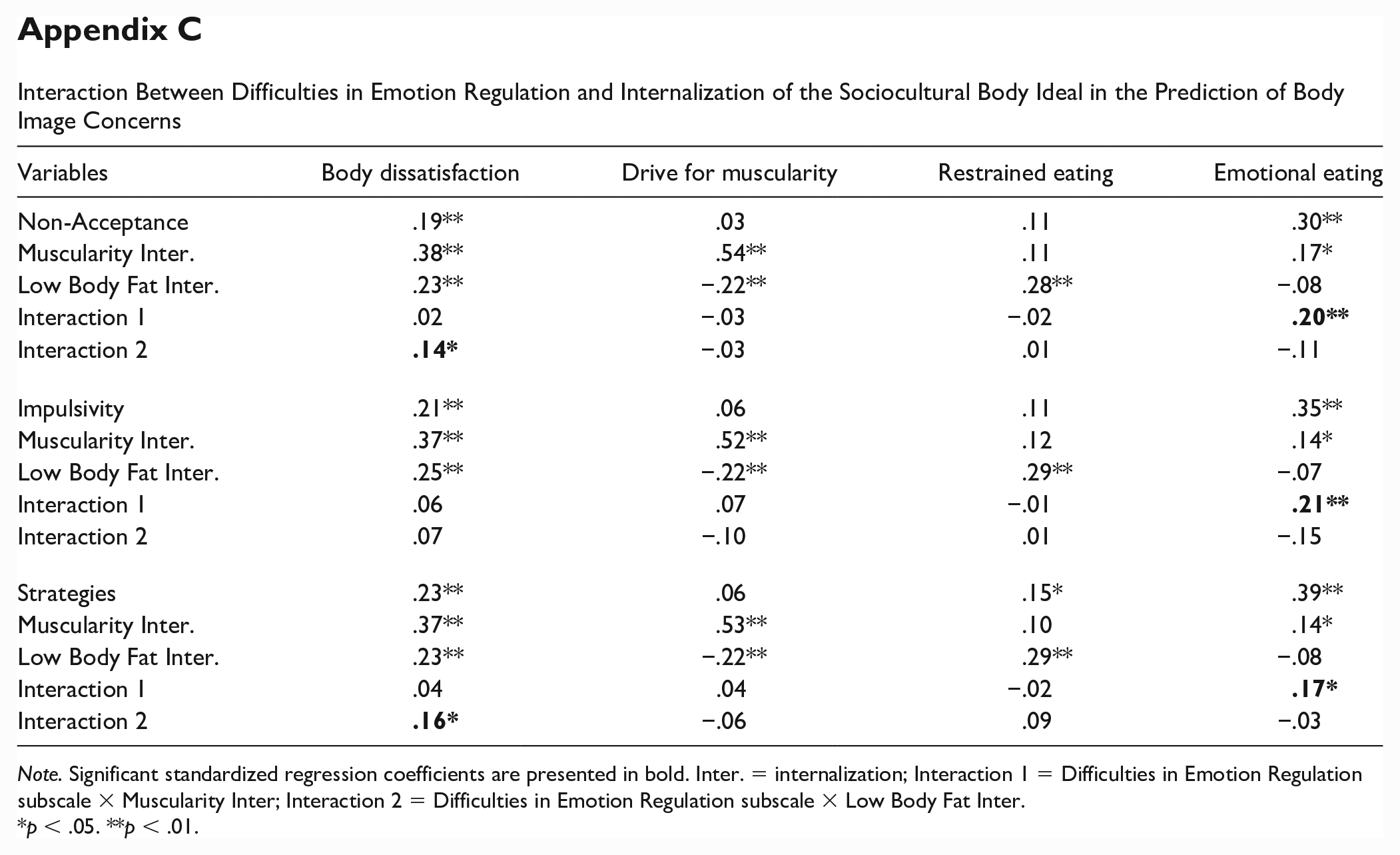
Only models in which the inclusion of interactions increased fit according to the Akaike and Bayesian information criteria are reported (see Appendix C). Results of these analyses showed that the Low Body Fat Internalization scale significantly moderated the relationship between the Body Dissatisfaction scale and both Non-Acceptance and Strategies subscales. The latter difficulties in emotion regulation were more strongly related to body dissatisfaction among individuals reporting greater scores on Low Body Fat Internalization. Moreover, the associations between the Emotional Eating scale and the Non-Acceptance, Impulse, and Strategies subscales were significantly moderated by the Muscularity Internalization scale. These relationships were stronger at higher levels of Muscularity Internalization.
Discussion
This study aimed to clarify the relationships between the internalization of the sociocultural body ideal, difficulties in emotion regulation, and body image concerns in a group of adolescent boys. In addition, the moderating role of the former variable on the association between deficits in emotion regulation and body image concerns was examined.
Internalization of the Sociocultural Body Ideal
As hypothesized, adolescent boys who more strongly endorse the sociocultural body ideal as their personal goal also tended to report higher levels of body dissatisfaction, muscle-building behaviors, restrained eating, and emotional eating. These results are in line with those of several other studies conducted among male youth (Flament et al., 2012; Smolak et al., 2001), adult men (Karazsia & Pieper, 2011), and adolescent and adult women (Cafri et al., 2005; Stice, 2002). As suggested by J. K. Thompson et al. (1999), because these standards of beauty are strict and almost unattainable, adolescent boys who aspire more to attain them may be more likely to face dissatisfaction with themselves and their appearance. Therefore, they may resort to inappropriate strategies to change their body image and deal with their negative moods (Stice & Shaw, 2002; J. K. Thompson et al., 1999). In the current study, the relationship between internalization of the sociocultural body ideal and body image concerns varied across specific aspects of these characteristics.
Indeed, while the internalization of muscularity norms was independently related to all body image concerns, the thinness facet was only positively correlated with body dissatisfaction and restrained eating. Interestingly, participants also indicated greater internalization of the muscularity aspect of the sociocultural body ideal. Hence, while the internalization of both muscularity and thinness sociocultural norms is important, these results substantiate the greater relevance of the former norms among adolescent boys (Cash & Smolak, 2011; Smolak et al., 2001). Since muscularity is closely associated with masculinity among men (Adams et al., 2005; Grogan & Richards, 2002), it is possible that adolescent boys’ pursuit of masculinity increases their vulnerability to the internalization of the muscularity norms and its negative effects. These findings are similar to those found in groups of college men, which, however, did not include a measure of bulimic tendencies (Klimek et al., 2018; Schaefer et al., 2017; Stefanile et al., 2019).
Furthermore, the internalization of the sociocultural body ideal relationship with body dissatisfaction and emotional eating seemed stronger and weaker, respectively, than other body image concerns. These differences were not noted in other studies conducted on adolescent boys (Biolcati et al., 2017; Flament et al., 2012; Rodgers et al., 2012), which often did not include the evaluation of bulimic tendencies. These differences are coherent with the sociocultural model of body image concerns (Stice & Shaw, 2002; J. K. Thompson et al., 1999). Indeed, in the latter theory, body dissatisfaction is a direct reaction to the internalization of the sociocultural body ideal. On the other hand, bulimic tendencies are proposed to be a less proximal repercussion of internalization, since it may only emerge to ease unpleasant emotions stemming from body dissatisfaction (Stice & Shaw, 2002).
Difficulties in Emotion Regulation
As hypothesized, in our sample of adolescent boys, greater difficulties in emotion regulation were associated with higher levels of body dissatisfaction, muscle-building behaviors, restrained eating, and emotional eating. Similar findings were reported in other studies conducted in samples of adolescent boys (Hansson et al., 2016; Hughes & Gullone, 2011; Kerremans et al., 2010; Todd et al., 2019) and adult men (Cunningham et al., 2018; Dakanalis et al., 2015; Lavender & Anderson, 2010). However, to our knowledge, this is the first study carried out among adolescent boys to include muscle-building behaviors. In addition to this contribution, three important specificities emerged from the present results.
First, relationships between difficulties in emotion regulation and both muscle-building behaviors and restrained eating seemed weaker than those with body dissatisfaction and emotional eating. Such differences were not observed or as pronounced in other studies conducted among adolescent boys (Hughes & Gullone, 2011; Kerremans et al., 2010) and adult men (Dakanalis et al., 2015; Griffiths et al., 2014). This difference is also surprising since several scholars argued that both muscle-building behaviors and restrained eating may be used to compensate for difficulties in emotion regulation (Lamanna et al., 2010; Schmidt & Treasure, 2006). However, as expected of adolescent boys from the community, participants reported low levels of muscle-building behaviors and restrained eating. Hence, in the present sample, these body image concerns may be less motivated by difficulties in emotion regulation than in clinical populations (Prefit et al., 2019). On the other hand, body dissatisfaction and emotional eating are known to be more pervasive (Calzo et al., 2013) and directly involve unpleasant experiences (Cash & Smolak, 2011; Van Strien et al., 1986).
Second, although several difficulties in emotion regulation were correlated with each body image concern, only non-acceptance and lack of strategies to regulate one’s emotions emerged as unique predictors. While both deficits were independently related to body dissatisfaction, the former (i.e., Non-Acceptance) was uniquely linked to restrained eating, and the latter (i.e., Strategies) to emotional eating. Interestingly, participants also reported lower difficulties with respect to these two facets of emotion regulation. Similar findings were reported in other samples of adolescent boys (Hansson et al., 2016) and college men (Cunningham et al., 2018; Lavender & Anderson, 2010; Robinson et al., 2014). However, only studies among the latter population controlled for all other difficulties in emotion regulation included in Gratz and Roemer’s well-established model (2004).
As mentioned above, several authors argued that body image concerns may serve to compensate for deficits in emotion regulation strategies, especially bulimic tendencies (Fairburn et al., 2003; Schmidt & Treasure, 2006). A greater focus on body image may also provide feelings of control and empowerment to adolescent boys who perceived themselves as lacking emotion regulation abilities (Polivy & Herman, 2002). Scholars have also argued that a lack of awareness, acceptance and understanding of one’s feelings may exacerbate unpleasant emotions and lead to somatization, increasing body image concerns (Polivy & Herman, 2002; Taylor et al., 1997). In addition, non-acceptance of appearance-related unpleasant emotions may increase one’s focus on body image and body change strategies, leading to greater body image concerns (Werner & Gross, 2009). Although the current findings emphasized the role of acceptance over awareness and clarity, it is possible that the latter difficulties are implicated in more severe body image concerns, such as eating disorders. Nonetheless, these results appear to support the role of both experiential and behavioral difficulties among adolescent boys from the community, even though these models are derived from clinical populations.
Finally, as hypothesized, the relationship between some difficulties in emotion regulation and body image concerns was moderated by the internalization of the sociocultural body ideal. Indeed, among boys reporting greater internalization of the sociocultural norms of thinness, the positive associations between body dissatisfaction and both non-acceptance of one’s emotions and lack of emotion regulation strategies were stronger. Similarly, the positive relationships between emotional eating and non-acceptance, lack of strategies, and emotional impulsivity were stronger in boys reporting greater internalization of the sociocultural norms of muscularity. Another study combining both college men and women found similar results (Hutchison et al., 2020). To our knowledge, no study investigated such interaction among adolescent boys. Since difficulties in emotion regulation are a non-specific risk factor for psychosocial impairments (Striegel-Moore & Cachelin, 1999), adolescent boys may opt for other means to regulate their emotions. However, individuals who place greater value on the sociocultural body ideal may have a greater heightened focus on their body image and eating behaviors. Therefore, it is possible that these individuals are at greater risk of developing body image concerns when facing difficulties in emotion regulation.
Strengths and Limitations
This research has several strengths. It was conducted with a homogeneous sample of adolescent boys whom until recently have been understudied in the body image literature (Cash & Smolak, 2011). Body image concerns have been found to increase in male youth throughout this developmental period (Calzo et al., 2013) and to show gender specificities, such as boys’ emphasis on muscularity (Ricciardelli & Yager, 2016). Furthermore, this study examined correlates of body image concerns that are well-established in other populations (Jenkinson et al., 2018; Stice & Shaw, 2002) and distinguished between specific facets of these constructs. Thus, to our knowledge, this is the first study in a group of adolescent boys that distinguished between the internalization of sociocultural norms of muscularity and of thinness, and that investigated the unique contribution of several difficulties in emotion regulation, allowing for a more nuanced understanding. Moreover, no other known research has explored the interaction between these variables among adolescent boys, and few studies have done so in other populations (Douglas & Varnado-Sullivan, 2016; Hutchison et al., 2020). Yet, several scholars have suggested that specific and non-specific risk factors may interact in the development of body image concerns (Polivy & Herman, 2002; Striegel-Moore & Cachelin, 1999), as primarily supported in the current study.
However, this study is not without limitations. It used a correlational and cross-sectional design, precluding the observation of directionality and causality. For example, it is also possible that greater body image concerns increase individuals’ vulnerability to sociocultural pressures and, thus, the internalization of sociocultural norms. Furthermore, only self-reported questionnaires were used in the current research. This method may increase the risk of social desirability and self-awareness response bias, especially since the themes explored are gender sensitive (Adams et al., 2005; Grogan & Richards, 2002) and the sample was composed of adolescents. Finally, participants were mostly Caucasians, from high-income households, from private schools, and of average weight. It is critical to note that different results may be obtained from other sociodemographic samples, such as overweight or underweight boys, student athletes, and non-cisgendered or non-heterosexual youth. Other findings may also emerge from groups of male youth with eating disorders or with physical health problems. Adolescent boys’ sociodemographic and health characteristics may impact the nature and form of sociocultural messages related to body image. These factors may also influence adolescent boys’ overall mental health and social support, which may in part act as a buffer against sociocultural influences and distress of all kinds. For example, in the current study, one school had dedicated psychosocial professionals, while another offered a curriculum promoting sports participation.
Conclusion
This study yielded several novel and important results. Among adolescent boys, higher levels of body image concerns were associated with greater internalization of the sociocultural body ideal, particularly its muscular dimension, and more difficulties in emotion regulation. However, of the various deficits in emotion regulation studied, non-acceptance of one’s emotions and lack of strategies to regulate one’s emotions emerged as independent predictors of body image concerns. Furthermore, the relationships between several difficulties in emotion regulation and certain body image concerns were moderated by the internalization of the sociocultural body ideal. These results are in line with studies conducted among college men (Hutchison et al., 2020; Klimek et al., 2018; Lavender & Anderson, 2010). They are also consistent with dominant theories of body image concerns, and the derived prevention and intervention programs (Pennesi & Wade, 2016).
Future studies should attempt to replicate these findings, especially in more socioeconomically and ethnically diverse samples of adolescent boys and groups of overweight and underweight youth. Such studies are particularly important as the vast majority of research was conducted among Caucasian cisgender adolescent boys. In addition, studies using a prospective design are needed to clarify the direction of these relationships and their robustness throughout adolescence. Finally, research conducted among adolescent boys should explore the interaction between difficulties in emotion regulation and other variables related to the sociocultural perspective, such as social comparisons and self-objectification. These variables are all closely related to the developmental tasks of adolescence and may help clarify the unique process taking place during this period of increased risk for the onset of body image concerns (Ricciardelli & Yager, 2016).
Footnotes
Appendix
Interaction Between Difficulties in Emotion Regulation and Internalization of the Sociocultural Body Ideal in the Prediction of Body Image Concerns
| Variables | Body dissatisfaction | Drive for muscularity | Restrained eating | Emotional eating |
|---|---|---|---|---|
| Non-Acceptance | .19** | .03 | .11 | .30** |
| Muscularity Inter. | .38** | .54** | .11 | .17* |
| Low Body Fat Inter. | .23** | −.22** | .28** | −.08 |
| Interaction 1 | .02 | −.03 | −.02 |
|
| Interaction 2 |
|
−.03 | .01 | −.11 |
| Impulsivity | .21** | .06 | .11 | .35** |
| Muscularity Inter. | .37** | .52** | .12 | .14* |
| Low Body Fat Inter. | .25** | −.22** | .29** | −.07 |
| Interaction 1 | .06 | .07 | −.01 |
|
| Interaction 2 | .07 | −.10 | .01 | −.15 |
| Strategies | .23** | .06 | .15* | .39** |
| Muscularity Inter. | .37** | .53** | .10 | .14* |
| Low Body Fat Inter. | .23** | −.22** | .29** | −.08 |
| Interaction 1 | .04 | .04 | −.02 |
|
| Interaction 2 |
|
−.06 | .09 | −.03 |
Note. Significant standardized regression coefficients are presented in bold. Inter. = internalization; Interaction 1 = Difficulties in Emotion Regulation subscale × Muscularity Inter; Interaction 2 = Difficulties in Emotion Regulation subscale × Low Body Fat Inter.
p < .05. **p < .01.
Declaration of Conflicting Interests
The author(s) declared no potential conflicts of interest with respect to the research, authorship, and/or publication of this article.
Funding
The present study was founded by a grant from the Social Sciences and Humanities Research Council of Canada. One of the researchers was also supported by a doctoral scholarship from the Fonds de recherche du Québec – Société et culture for the present study.
