



Abstract
Social anxiety is related to a host of negative student outcomes in the educational context, including physical symptoms of anxiety, reduced cognitive functioning, and poor academic performance. Despite the prevalence of social anxiety, little is known about mechanisms that may underlie associations between social anxiety and outcomes in the context of higher education. Therefore, the goal of this study was to evaluate a conceptual model linking social anxiety, communication with peers and instructors, students’ experiences (i.e., engagement, connectedness, and satisfaction), and indices of socio-emotional functioning at university. Participants were 1,073 undergraduate students (Mage = 20.3 years, SD = 3.49) who completed a series of self-report measures. Among the results, social anxiety was negatively related to communication with instructors, socio-emotional functioning, and student experiences, and academic communication accounted for significant variance in the links between social anxiety and student experiences. In addition, there was at least some evidence that student experiences partially mediated the association between social anxiety and socio-emotional functioning. Gender effects suggest that social anxiety is related to less communication with instructors, lower engagement and satisfaction, and poorer socio-emotional functioning among females compared with males. Results are situated within current literature examining social anxiety in education. The discussion provides concrete suggestions for educational practitioners to increase support for students who experience social anxiety.
Keywords
It is well documented that interactions with peers and instructors are important predictors of classroom success (Donnelly, 2010; Moore, 1989). However, not all students feel comfortable engaging in social or academic interactions in the university context. For instance, individuals who experience social anxiety often struggle with social or performance situations (Schneier, 2006), putting them at a clear disadvantage in their academic pursuits. Despite the high prevalence of social anxiety in higher education (e.g., Baptista et al., 2012; Hakami et al., 2017; MacKenzie & Fowler, 2013), there appears to be a relative lack of research examining the correlates and outcomes of social anxiety and student experiences among university students. Accordingly, this research examines a conceptual model linking university students’ social anxiety, communication, student experiences, and indices of socio-emotional functioning. Identifying underlying mechanisms accounting for the negative association between social anxiety and educational outcomes can help target academic interventions.
Overview of Social Anxiety
Social anxiety is conceptualized as distress and feelings of discomfort when meeting and talking to people (Mattick & Clark, 1998). Milder symptoms of social anxiety materialize as social apprehension, occurring often in response to socio-evaluative situations. As severity increases, social fears may become disabling and pervasive, and individuals may engage in social avoidance (Crozier, 2001; Liebowitz, 2003). Social anxiety as a disorder is relatively common with typical lifetime rates of 7% to 13% for adolescents and adults (e.g., MacKenzie & Fowler, 2013; G. Russell & Shaw, 2009), and is a persistent and often hidden disability that impacts learning and well-being (G. Russell & Topham, 2012).
Previous research underscores a need to consider individuals who report elevated but subclinical levels of social anxiety (Crozier & Alden, 2005). Many students experience heightened symptoms and still experience an adverse impact on their life and educational experiences (Topham et al., 2014). There is growing literature linking heightened symptoms of social anxiety with a wide range of negative socio-emotional experiences in young adulthood (Fehm et al., 2008; Schneier et al., 2002), with female university students experiencing higher levels of social anxiety compared with males (MacKenzie & Fowler, 2013; G. Russell & Shaw, 2009).
There are several conceptual models of the mechanisms that may underlie the development and maintenance of social anxiety, including Clark and Well’s (1995) cognitive model of social phobia and Rapee and Heimberg’s (1997) cognitive-behavioral model of social anxiety. Perhaps most relevant to this study is the self-presentation model (Schlenker & Leary, 1982), where the drive for creating a good impression on others is combined with low expectations of obtaining that goal. Based on early experiences, individuals develop a range of negative assumptions that relate to themselves and their social world. This theory is often applied when examining behaviors of socially anxious individuals across different communicative modalities (Burke & Ruppel, 2015) and is applicable when examining socially anxious individuals within the educational context (Pierce, 2009).
Social Anxiety in Education
The academic context appears to be particularly stressful for socially anxious students. Mattick and Clarke (1998) explained that central concerns of individuals with social anxiety include fears of being inarticulate, sounding boring or unintelligent, not knowing how to respond, and being ignored. These fears may become exacerbated in the academic environment, given the participatory and social nature of the classroom. In the context of the self-presentation model (Schlenker & Leary, 1982), these fears may become pervasive for individuals who experience social anxiety. Not only do students want to make a good impression on others, but also their grades often rely on it, making it a high-stakes situation. They may be expected to interact with people they do not know, participate in classroom discussions, give presentations, and receive criticism from their peers and instructors (Topham, 2009).
Students often experience anticipatory anxiety prior to learning, fears of negative evaluation within the classroom, physiological indicators of anxiety (i.e., quaky voice, blanking mind), self-consciousness, embarrassment during learning activities, and rumination (Topham, 2009). These events may exacerbate preexisting feelings of self-consciousness and reduce both social and cognitive functioning in the classroom (Topham et al., 2014). Social anxiety negatively impacts students in learning situations, contributes to decreased engagement and academic achievement, and is associated with lower rates of retention (Brook & Willoughby, 2015; M. Cohen et al., 2019; Kessler, 2003; Wittchen et al., 1999).
Students have reported that social anxiety is emotionally painful and indicate that their social anxiety tends to be overlooked within the educational environment (Topham, 2009). Bernstein and colleagues (2008) reported that severity of social anxiety is correlated with deficits in communication skills, attention difficulties, and learning problems within the school setting. Results from several other studies suggest that socially anxious students have impaired functioning within the educational environment, which may lead to increases in exam failure, lower grades, greater likelihood of leaving school prematurely, and a lower likelihood of graduating from their program (Brook & Willoughby, 2015; Stein & Kean, 2000; Wetterberg, 2004; Wittchen et al., 1999). Therefore, it is important to examine the conceptual mechanisms that may contribute to positive student experiences, which in turn could promote well-being among socially anxious students.
Social Anxiety and Communication
Despite these findings, there is still much to learn about the experiences of socially anxious students in the context of higher education. A key feature of social anxiety is discomfort when meeting or talking to unfamiliar people (Mattick & Clark, 1998). As the classroom environment is inherently social, individuals who experience heightened social anxiety are likely to struggle when social or performance situations arise. Discomfort communicating with others in the academic setting may disadvantage students who experience social anxiety. For example, pedagogical strategies used to increase classroom engagement often require communication, which may intensify anxiety for individuals who experience distress when speaking in front of others (Czekanski & Wolf, 2013). This may lead to a cascading effect, negatively impacting student experiences and socio-emotional functioning.
Topham and colleagues (2014) conducted thematic analyses on socially anxious individuals’ experiences within the classroom. Participants reported experiencing negative physiological responses, fearful self-consciousness, and distress. In addition, M. Cohen and colleagues (2019) examined the associations between social anxiety, active learning discomfort, and student performance. Among the results, social anxiety was positively associated with active learning discomfort, which interacted to predict final course grade. Active learning often requires discussions with peers (M. Cohen et al., 2019), which can be intimidating for socially anxious students as they are often concerned with negative evaluations (Crozier, 2001).
Given the prevalence of social anxiety, it is imperative to explore additional mechanisms to explain the negative association between social anxiety and poor student experiences. Accordingly, this research examined the potential mediating role of the multimodal measure of academic communication (i.e., communication for the purpose of academic advancement; Archbell, 2020) in the links between social anxiety and important predictors of student success (i.e., student engagement, classroom community, and course satisfaction). Furthermore, the mediating roles of student engagement, classroom community, and course satisfaction were examined in the links between social anxiety and indices of socio-emotional functioning. Understanding these links can shed light on potential pedagogical practices and recommendations that can be implemented by educators in the university context to enhance learning and support student mental health.
The Present Study
The goal of this study was to evaluate a conceptual model linking social anxiety, academic communication, student experiences, and socio-emotional functioning. Specifically, we sought to understand whether purposeful communication with instructors and peers might help to explain the negative association between social anxiety and student experiences (i.e., engagement, classroom community, and satisfaction), which in turn was expected to predict poorer socio-emotional functioning (i.e., multiple mediation). Moreover, although the links between social anxiety and socio-emotional functioning have been well established, it was of interest to understand whether student experiences could explain variance in this negative relation. Therefore, a structural equation model was specified in which both direct and indirect links among study variables were examined (see Figure 1).
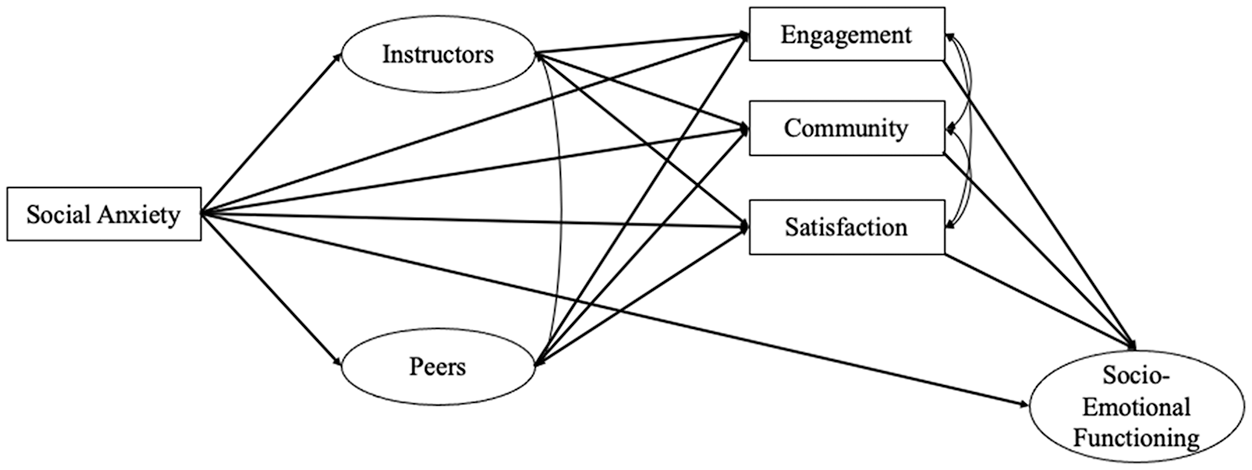
Conceptual model (multiple mediation) linking social anxiety to student experience (i.e., student engagement, classroom community, and course satisfaction) through academic communication (i.e., communication with instructors and peers), and social anxiety to socio-emotional functioning through student experiences (i.e., student engagement, classroom community, and course satisfaction).
Social anxiety was expected to be negatively associated with academic communication (with both instructors and peers). Individuals who experience social anxiety are more often worried about performance in social situations and experience concerns about being inarticulate or sounding unintelligent (G. Russell & Topham, 2012). It was further anticipated that social anxiety would negatively predict indices of student experience (i.e., student engagement, feelings of classroom community, and course satisfaction). It has previously been established that social anxiety negatively impacts upon classroom engagement, student learning, and retention (Bernstein et al., 2008; Kessler, 2003). Moreover, social anxiety has an adverse impact on quality of life (Keller, 2006) and was therefore expected to be negatively associated with socio-emotional functioning.
Communication and interaction are deeply embedded within classroom engagement (Czekanski & Wolf, 2013), and so it was expected that communication with both instructors and peers would be significantly and positively associated with student engagement, classroom community, and course satisfaction. In addition, it was expected that at least some of the student experiences explored would be significantly and positively associated with indices of socio-emotional functioning. Research examining higher education supports the benefits of engagement in relation to retention, social connectedness, grades, and positive adjustment (Tinto, 2000; Van Ryzin et al., 2009). Furthermore, connectedness in school can positively influence well-being (Dubow et al., 1991); classroom community is inversely related to feelings of alienation (Rovai & Wighting, 2005).
With regard to indirect effects, it was expected that social anxiety would be negatively associated with student experiences (i.e., student satisfaction, classroom community, and course satisfaction) through academic communication. Because student–student and student–instructor interactions are essential in the prediction of student outcomes (Woo & Reeves, 2007), it was postulated that academic communication would be an underlying mechanism in this model. It was also expected that student experiences would mediate the link between social anxiety and socio-emotional functioning as higher education places many demands on students, which may exacerbate negative feelings among socially anxious individuals (Topham, 2009).
Gender differences were also examined on an exploratory basis to understand whether the pattern of associations differed for males compared with females. Compared with males, females tend to rate higher on indices of social anxiety related to public speaking and fears of authority (Caballo et al., 2014)—which may exacerbate distress in the educational environment, given the importance of student–instructor interactions and learning assessments. Therefore, it is possible that negative associations between social anxiety and student experiences may be stronger for females compared with males.
Method
Participants
Participants were recruited online through the institutions’ SONA system, where students enrolled in specific courses (i.e., psychology, neuroscience) voluntarily participate in research studies for course credit. Participants were 1,073 undergraduate students (21.6% males, 77.9% females, and 0.5% Other) enrolled at a postsecondary institution in southeastern Ontario, Canada, primarily between the ages of 17 and 25 years (92%), (Mage = 20.3, SD = 4.49). In terms of ethnicity, 56.6% identified as Caucasian, 17.2% Asian or Pacific Islander, 7.6% Black, 2.3% Hispanic, and 1.4% Indigenous (with the remaining 14.8% indicating Other). About 30% of the sample indicated that their major was psychology, followed by 24% computer science, 15% finance, 6% cognitive science, and the remaining 25% dispersed across a wide range of disciplines.
Measures
All measures were completed online for course credit through Qualtrics. Participants completed the Academic Communication Inventory (ACI) and measures of student experiences with a specific course in mind. Approximately, 38% reported on a blended course, 27% reported on an offline course, and 35% reported on an online course.
Academic communication
Participants completed the recently created ACI (Archbell, 2020) to assess their communication behaviors for the purposes of academic achievement in a specific course. The ACI contains two subscales, Communication with Instructors and Communication with Peers rated on a 5-point scale, ranging from 1 (strongly disagree) to 5 (strongly agree; for example, “I attend office hours”; “I send peers text messages about coursework”). Items on the ACI demonstrated good discrimination and information values when examined through item response theory, and both scales displayed good internal consistency, with alpha ranging from .86 to .88 (Archbell, 2020). Both scales demonstrated good internal consistency with the current sample (α = .84–.85). Items were used as latent variable indicators to reduce measurement error.
Social anxiety
To assess social anxiety, participants completed the Liebowitz Social Anxiety Scale (LSAS; Liebowitz, 2003). The LSAS is a 24-item self-report designed to assess fear and avoidance of social (e.g., going to a party, meeting strangers) and performance situations (e.g., taking a test, giving a report to a group). When rating for fear/avoidance, participants rated their response on a 4-point scale, ranging from 1 (none/never) to 4 (severe/usually). Higher scores indicate more fear and avoidance. A total score of social anxiety was created and was treated as a continuous variable. Both scales on the LSAS demonstrated excellent internal consistency with the current sample (α = .92–.95).
Student experiences
Participants’ course-specific learning experiences were assessed with three separate questionnaires examining their course engagement, feelings of classroom community, and course satisfaction. Participants were asked to think of the same course while completing these questionnaires.
Participants completed the Student Course Engagement Questionnaire (SCEQ; Handelsman et al., 2005) to assess their course-specific student engagement. Sample items include “applying course material to my life” and “participating in small-group discussions” on a 5-point scale, ranging from 1 (not at all characteristic of me) to 5 (very characteristic of me). A summary score was computed, with higher scores indicating higher levels of course engagement. The SCEQ has demonstrated good internal consistency in previous studies (α = .76–.82) and with the current sample (α = .92–.90).
Next, participants responded to the Classroom Community Scale (CCS; Rovai, 2002). The CCS is a 20-item self-report assessing feelings of connectedness (e.g., “I feel that students in this course care about each other”) and learning (e.g., “I feel that I am encouraged to ask questions”) in a specific course. Questions were responded to on a 5-point scale, ranging from 1 (strongly disagree) to 5 (strongly agree). Items were averaged, with higher scores indicating increased feelings of classroom community. Consistent with previous studies (Rovai, 2002), this measure demonstrated good internal consistency with the current sample (α = .82–.87).
Finally, participants completed selected questions from the Student Satisfaction Scale (SSS; Bollinger & Halupa, 2012) to assess their perceived educational value of a selected course. Eight questions were selected from the original 24-item scale on the basis of generalizability across courses (e.g., “I am satisfied with the level of effort this course requires,” “I will be satisfied with my final grade in this course”). Items were rated on a 5-point scale, ranging from 1 (strongly disagree) to 5 (strongly agree). Total scores were computed with higher scores, indicating greater student course satisfaction. This measure presented good internal consistency in the current sample (α = .87).
Indices of socio-emotional functioning
Participants completed the 20-item University of California, Los Angeles (UCLA) Loneliness Scale to measure their subjective feelings of loneliness and social isolation (D. Russell, 1996). Participants were asked to indicate how often each statement presented described them (e.g., “I cannot tolerate being alone,” “I feel left out”), on a 4-point scale, ranging from 1 (I never feel this way) to 4 = (I often feel this way). Items were reverse scored and aggregated (higher scores indicating less loneliness), which was used as an indicator of socio-emotional functioning. Internal consistency with the current sample was excellent, α = .96.
Social connectedness was also assessed using the 20-item Social Connectedness Scale–Revised (SCS-R; Lee et al., 2001), examining respondents’ feelings of closeness with others in their social environment (e.g., “I am able to connect with other people”). Items are rated on a 5-point scale, ranging from 1 (strongly disagree) to 5 (strongly agree). Consistent with previous research, the reliability in the current sample was excellent (α = .93).
Finally, participants completed the revised 10-item Perceived Stress Scale (PSS; S. Cohen et al., 1994) that measures the degree to which one appraises experiences as stressful. Participants were asked to rate how often they felt or thought a certain way (ranging from 1 [never] to 5 [very often]). Sample items include “How often have you felt nervous or stressed?” and “How often have you been able to control irritations in your life?” The PSS was reverse coded, and an aggregate score was computed, with higher scores indicating less perceived stress. In this study, the PSS demonstrated good internal consistency (α = .86).
Results
Preliminary Analyses
Full-information maximum likelihood (FIML) was used to handle missing data (Enders, 2010), which was less than 5%. Winsorization method was employed to treat univariate outliers. Multivariate outliers were identified using diagnostic statistics and were removed if a participant distance was greater than the critical chi-square cutoff (dfcritical = 26.12; αcritical = .001). Next, tolerance and variance inflation factor (VIF) scores indicated no issues with multicollinearity. Finally, descriptive statistics and bivariate correlations were examined for all study variables (see Table 1).
Bivariate Correlations Among Main Study Variables for the Main Analyses.
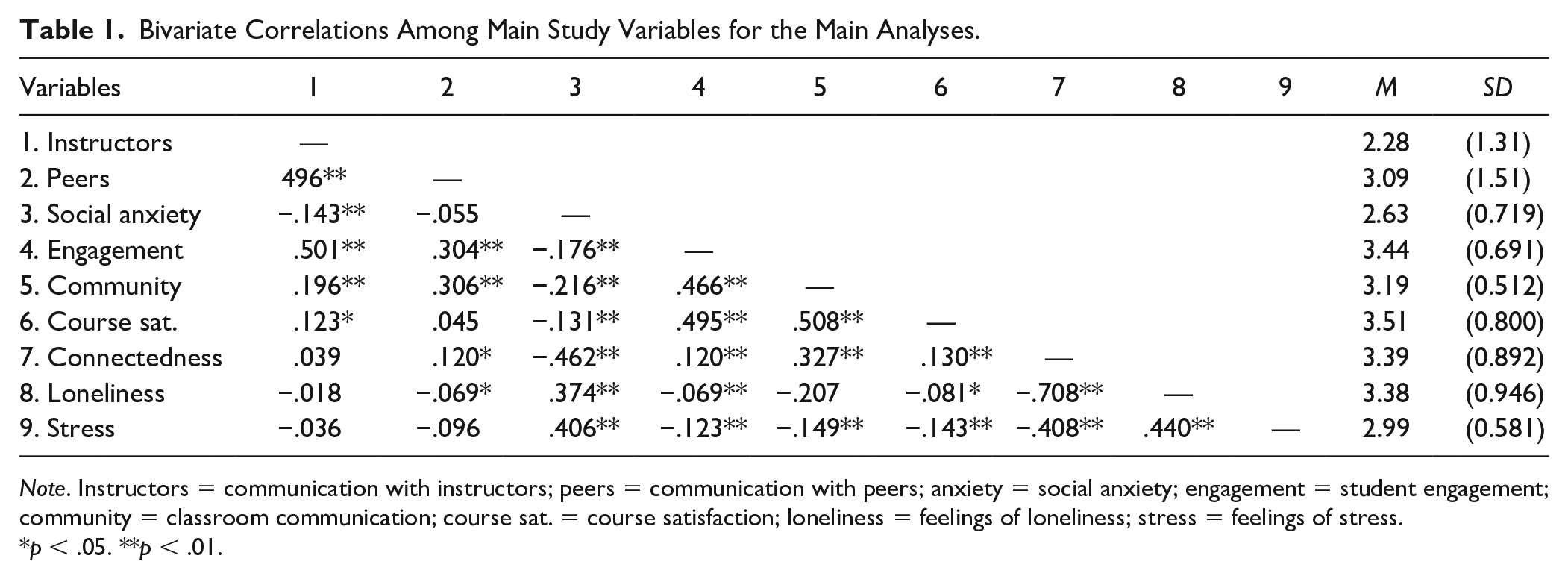
Note. Instructors = communication with instructors; peers = communication with peers; anxiety = social anxiety; engagement = student engagement; community = classroom communication; course sat. = course satisfaction; loneliness = feelings of loneliness; stress = feelings of stress.
p < .05. **p < .01.
Multiple Mediation
The purpose of these analyses was to test a hypothesized model depicting both direct and indirect effects between social anxiety, academic communication (instructors, peers), student experiences (engagement, community, and satisfaction) and socio-emotional functioning (loneliness, stress, social connectedness). A structural equation model analysis was conducted in which a measurement model and structural model were specified prior to evaluating the conceptual model and group differences.
Measurement model specification
To examine the measurement model, the original model was re-specified as a confirmatory factor analysis. Two latent variables were included (communication with instructors, seven indicators; communication with peers, five indicators), which were permitted to covary. A third latent variable (socio-emotional functioning) was included but was not permitted to covary based on the original model specification. Three observed variables served as the indicators for socio-emotional functioning: (a) social connectedness, (b) loneliness, and (c) stress. Loneliness and stress were reverse coded with higher scores indicating more positive socio-emotional functioning.
The initial model demonstrated good fit, χ2(85) = 440.40, p < .001, root mean square error of approximation (RMSEA) = .062 [.057, .068], comparative fit index (CFI) = .956, Tucker–Lewis index (TLI) = .945, standardized root mean squared residual (SRMR) = .055, Akaike information criterion (AIC) = 45290.58, and Bayesian information criterion (BIC) = 45539.54, with the exception of the chi-square value. Of note, the chi-square test is no longer relied upon as a basis to accept or reject model fit, due to its sensitivity to large sample sizes (Vandenberg, 2006). Modification indices were examined, but suggestions to improve model fit were not theoretically justifiable or in good statistical practice.
Structural model specification
Following the specification of the measurement model, the model was re-specified with the addition of the structural components. Social anxiety was added as a single measured exogenous variable, and student engagement, classroom community, and course satisfaction were added as measured endogenous variables. This model demonstrated good fit, χ2(135) = 690.38, p < .001, RMSEA = .062 [.057, .067], CFI = .942, TLI = .927, SRMR =.056, AIC = 52147.30, BIC = 52515.76. Next, the modifications indices were examined to determine which justifiable alterations could be made to the model. There were no theoretically justifiable changes to be made to the model, and therefore the original model was retained.
Conceptual model
The conceptual model was evaluated in Mplus 8.0 (results from estimated direct paths are displayed in Figure 2). As expected, social anxiety was directly and negatively associated with communication with instructors, student engagement, classroom community, course satisfaction, and socio-emotional functioning (all ps < .001). Contrary to expectations, when communication with peers was regressed on social anxiety, the negative association only approached significance (p = .078). Moreover, communication with instructors was positively associated with student engagement (p < .001), but not classroom community (p = .147), and course satisfaction only approached significance (p = .067). Communication with peers was significantly and positively associated with student engagement (p < .001) and classroom community (p < .001), but not course satisfaction (p = .195). Moreover, student engagement (p = .040) and classroom community (p < .001) was positively associated with socio-emotional functioning, but no significant association was found between course satisfaction and socio-emotional functioning (p = .466).
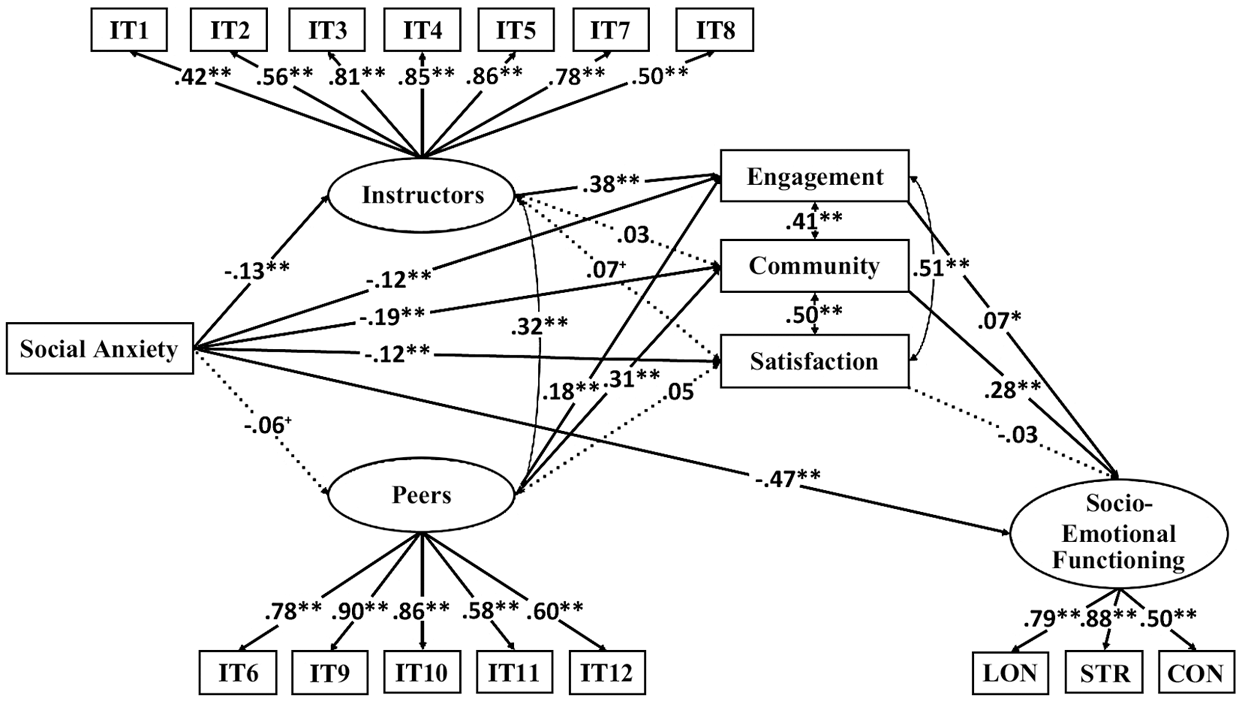
Structural equation model (N = 1,073) depicting estimated direct associations between social anxiety, communication with instructors and peers, student experiences, and socio-emotional functioning.
Finally, communication with instructors and peers was positively correlated (p < .001), as was student engagement and classroom community (p < .001), student engagement and course satisfaction (p < .001), and classroom community and course satisfaction (p < .001).
Indirect effects were also estimated to examine the potential mediating role of academic communication (i.e., with instructors and peers) in the links between social anxiety and academic experience, and the mediating role of student experiences (i.e., engagement, community, satisfaction) in the links between social anxiety and socio-emotional functioning (see Table 2).
Indirect Effects of Social Anxiety on Student Experiences Through Academic Communication and Academic Communication on Socio-Emotional Functioning Through Student Experiences.
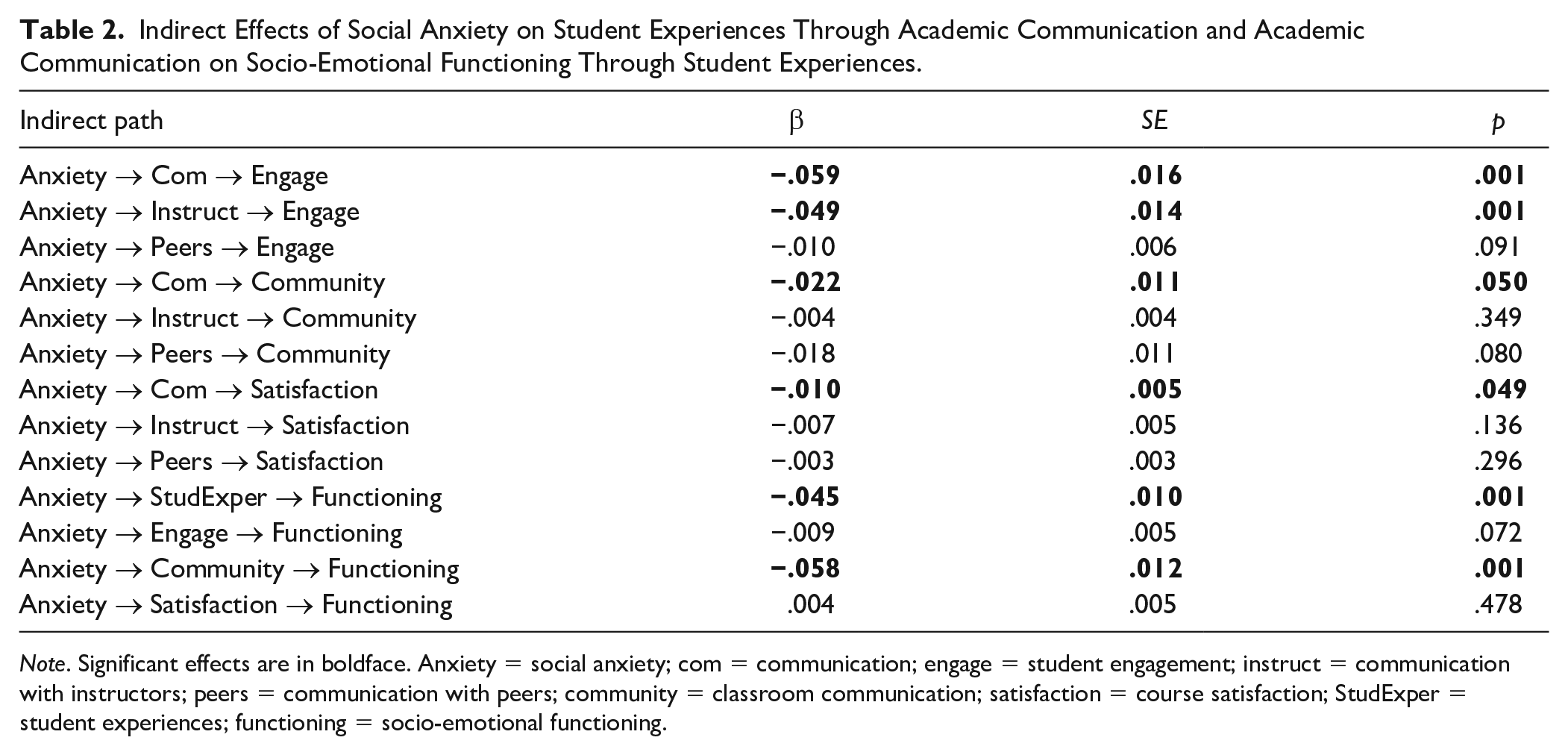
Note. Significant effects are in boldface. Anxiety = social anxiety; com = communication; engage = student engagement; instruct = communication with instructors; peers = communication with peers; community = classroom communication; satisfaction = course satisfaction; StudExper = student experiences; functioning = socio-emotional functioning.
There was a significant and negative indirect effect of social anxiety on engagement through communication with instructors, but the mediating role of communication with peers only approached significance. Contrary to expectations, neither communication with instructors nor communication with peers mediated the link between social anxiety and classroom community. However, the sum of both academic communications together (i.e., multiple mediation) accounted for significant variation in the negative association between social anxiety and classroom community. The same pattern was found with regard to course satisfaction. The combined effect of both communication with instructors and peers accounted for significant variation in the links between social anxiety and course satisfaction.
Academic experience was found to play a mediating role between social anxiety and socio-emotional functioning. For example, although social anxiety was not associated with socio-emotional functioning through student engagement (approached significance) or course satisfaction, it was associated significantly and negatively through classroom community. Thus, a multiple mediation was also present, and student experiences accounted for significant variance in the negative association between social anxiety and socio-emotional functioning.
Taken together, these results suggest that academic communication accounts for variance in the association between social anxiety and student experiences, and academic experience accounts for at least some of the variance in the links between social anxiety and indices of socio-emotional functioning. Consistent with hypotheses, academic communication acts as a mechanism to help explain the negative association between social anxiety and a variety of course-based outcomes in higher education. Furthermore, social anxiety is indeed associated with socio-emotional functioning through academic experience, particularly classroom community.
Gender effects
Multigroup analyses were conducted to determine whether the current conceptual model can be tested across gender (i.e., to compare males and females). Participants who selected “other” as their self-identified gender (i.e., 0.5% of the participant pool) were not included in the analyses due to the sample size. A configural model was specified, in which parameters were freely estimated and demonstrated good fit, χ2(164) = 483.051, p < .001, RMSEA = .060 [.054, .066], CFI = .961, TLI = .950, SRMR =.058, AIC = 45166.89, and BIC = 45694.68. As a result, a series of model constraints were added sequentially to examine the potential decline in model fit indices, which would suggest model invariance. Accordingly, a metric model was specified in which factor loadings were set to be equal between males and females. Results indicated good fit, χ2(179) = 508.57, p < .001, RMSEA = .059 [.053, .065], CFI = .959, TLI = .952, SRMR =.063, AIC = 45162.31, and BIC = 45615.41, with fit indices only minimally declining. Finally, scalar invariance was examined by constraining both factor loadings and item intercepts across groups, which resulted in adequate-to-good fit χ2(194) = 592.747, p < .001, RMSEA = .062 [.056, .068], CFI = .951, TLI = .947, SRMR =.069, AIC = 45216.58, and BIC = 45595.01. Fit indices once again diminished slightly but remained within the acceptable range. Therefore, meaningful mean differences could be estimated between males and females.
Accordingly, a series of Wald chi-square tests of parameter equalities (using Holm’s Sequential Bonferroni Procedure) were conducted to examine potential gender effects on pathways present in the current model. Therefore, one at a time, gender differences on individual paths were evaluated by being constrained to be equal across males and females, whereas other paths were freely estimated. Significant results were then reevaluated based on the outcomes of the Holm’s Sequential Bonferroni Procedure, which was implemented to reduce familywise error. All significant group differences fell below the critical cutoff score at the p < .05 level (ps ranging from .005 to .05) and were thus interpreted.
Complete results are displayed in Table 3. The positive correlation between communication with instructors and peers was significantly stronger among males than females. The path from social anxiety to communication with instructors and peers different significantly by gender, with females demonstrating a stronger negative association than males. The negative relations between social anxiety and both student engagement and course satisfaction were also significantly stronger among female than males. Furthermore, the path from communication with instructors to course satisfaction was also significantly different (i.e., negative for males and positive for females).
Summary of Wald Chi-Square Test Results Using Holm’s Sequential Bonferroni Procedure to Examine Gender Differences on Pathways From Figure 12.
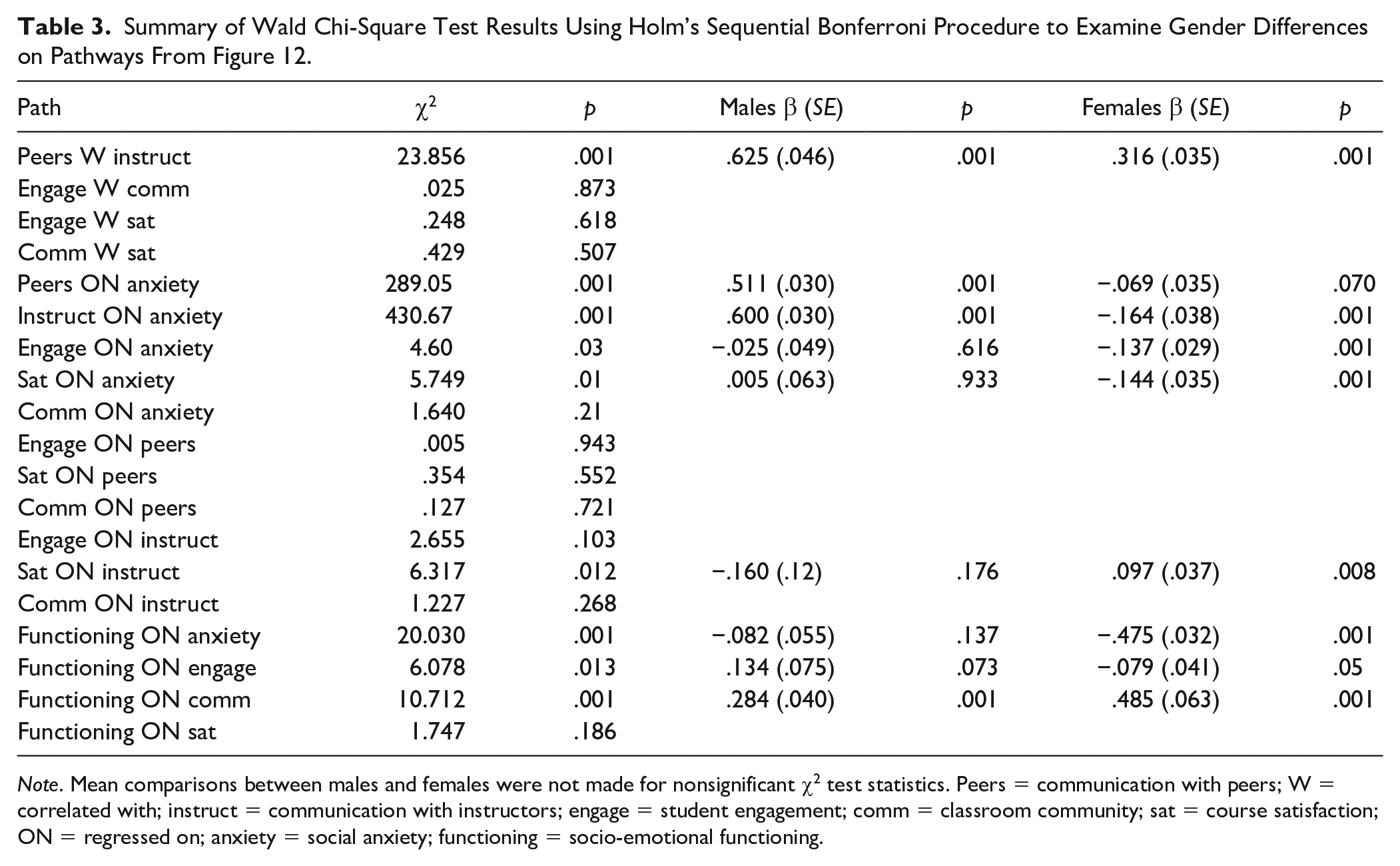
Note. Mean comparisons between males and females were not made for nonsignificant χ2 test statistics. Peers = communication with peers; W = correlated with; instruct = communication with instructors; engage = student engagement; comm = classroom community; sat = course satisfaction; ON = regressed on; anxiety = social anxiety; functioning = socio-emotional functioning.
Significant gender differences were also found when examining paths to socio-emotional functioning. For example, the negative association between social anxiety and socio-emotional functioning was stronger among females than males. Student engagement was positively associated with socio-emotional functioning among males, and negatively associated with socio-emotional functioning among females. Finally, course satisfaction and socio-emotional functioning were more strongly positively associated for females compared with males. Pathways not mentioned did not differ significantly by gender.
Discussion
The overarching goal of this study was to evaluate a conceptual model of the links between student social anxiety, academic communication, student experiences, and socio-emotional functioning in the context of higher education. Among the results, academic communication (joint effect of instructors and peers) accounted for significant variance in the links between social anxiety and student experiences (i.e., student engagement, classroom community, and course satisfaction). Moreover, social anxiety was negatively related to student experiences, and there was at least some evidence that student experiences explained part of the association between social anxiety and socio-emotional functioning. A number of gender differences were also found, suggesting that some aspects of this model displayed stronger effects for female versus male students.
Academic Communication With Instructors and Peers
Research finds that student–student and student–instructor interactions relate to a myriad of positive academic outcomes, including student engagement (Joksimovic et al., 2015). Therefore, it was anticipated, and found, that communication with both instructors and peers would be associated with student engagement. Because communication is an essential component to student engagement, it is important that higher education continues the shift from the instructional paradigm (i.e., delivering content through straight lecture) to a learning paradigm, involving high levels of active participation (Barr & Tagg, 1996). An active approach to learning can increase communication between students and instructors, leading to positive outcomes.
There were no significant effects between academic communication with peers and course satisfaction, and the association between communication with instructors and course satisfaction only approached significance. However, communication with peers (but not instructors) was significantly associated with classroom community (i.e., feelings of connectedness with others). Therefore, it appears that interactions among students may be the driving force in developing a sense of classroom community. Student–student interactions may lead to friendships, which could result in increased feelings of closeness that may bolster academic outcomes. For example, Bronkema and Bowman (2017) found that friendships in higher education were predictive of academic achievement and degree completion. In addition, Brook and Willoughby’s (2015) findings suggest that students with social anxiety may have higher academic achievement when they have stronger social ties with their classmates. Generally speaking, classroom community is associated with knowledge sharing behaviors and student success (Yilmaz, 2016). This is important to consider when thinking about students who experience social anxiety as they often struggle in both the social and academic domains.
Social Anxiety and Student Experiences
Consistent with hypotheses, results add to the limited research, indicating that social anxiety is negatively associated with student engagement in higher education. In a qualitative study, G. Russell and Topham (2012) found that social anxiety impacts engagement in learning activities. For example, socially anxious students reported experiences of anticipatory anxiety when presented with a classroom learning activity, embarrassment, and disabling effects. These described how student experiences correspond to dimensions of student engagement as outlined in Henrie et al. (2015). For example, behaviorally engaging tasks (i.e., participatory learning) may cause disabling effects such as thought blocking or drawing a blank, which may impact socially anxious students’ ability to cognitively engage with material. This may subsequently lead to excessive blushing, resulting in self-consciousness (G. Russell & Topham, 2012), negatively impacting emotional engagement. Therefore, socially anxious students may experience a snowball effect of undesirable events related to student engagement.
Computer-mediated communication may also be a more comfortable medium for socially anxious individuals (Pierce, 2009). Socially anxious individuals often hold beliefs that their self-presentation online is easier to control compared with offline settings (Caplan, 2007)—which can lead to more positive outcomes. However, online learning activities (i.e., those mediated through computer) were recently demonstrated to have little compensatory effects for university students who experience social discomfort (Grieve et al., 2016). Because socially anxious students have difficulty engaging in both face-to-face and computer-mediated learning activities, it is critical for educators to develop novel ways to engage all students in the classroom. For example, mobile-based interactive teaching tools have been found to increase student engagement and performance (Lim, 2017), and these tools may be beneficial for socially anxious students as they allow for anonymous polling, quizzes, and games.
Students are often expected to engage with unfamiliar peers during learning activities (Topham, 2009), which may increase socially anxious student’s experiences of stress, potentially resulting in withdrawal from classmates. In line with this, results from this study found that social anxiety was negatively associated with classroom community. Low sense of community is associated with two key components linked to student dropout—student burnout and feelings of isolation (Wang, 2010). Socially anxious students are already at risk for negative academic outcomes, including higher rates of attrition (Wetterberg, 2004; Zukerman et al., 2019); therefore, it is necessary to find ways to mitigate their discomfort with others, in hopes to increase feelings of classroom community. One such way could be including icebreakers in activities, which can build community in the classroom (Eggleston & Smith, 2004). Although they may be intimidating for individuals who experience social anxiety, having students engage in small-group icebreakers may lead to long-term benefits and peer relationships. For example, overtime, the familiarity with peers and the classroom environment has been found to reduce anxiety for some individuals (Topham et al., 2014).
Although no previous studies have examined social anxiety and satisfaction in higher education, this study hypothesized and demonstrated that social anxiety was negatively associated with course satisfaction. It has been documented that both clinical and subclinical levels of social anxiety is linked to poor satisfaction with life in a variety of domains, including achievement, family, employment, and social functioning (Eng et al., 2005; Fehm et al., 2008). Results from this study suggest that dissatisfaction extends to the educational setting.
Results further demonstrate that communication with instructors partially explains the negative association between social anxiety and student engagement. Therefore, to increase student engagement among socially anxious students, it is important to target nonthreatening communication strategies that can facilitate student–instructor interaction. Moreover, it is important to encourage instructor immediacy, while discouraging intimidating behaviors that highlight power dynamics. Immediacy relates to approach and avoidance behaviors (Andersen, 1979), including both nonverbal (gesturing, eye contact, positive affect, and relaxed posture) and verbal behaviors (knowing names, inclusive terminology, outside of class conversations, approachability, and interest in student perspective). Instructor immediacy is associated with teacher responsiveness, caring, and trustworthiness (Thomas et al., 1994), as well as student attendance and participation (Rocca, 2004). Increasing instructor immediacy may help socially anxious students feel less intimidated and more comfortable in their interactions with instructors, which may subsequently increase communication and student engagement.
Finally, the results demonstrated that academic communication accounted for significant variance in the relation between social anxiety and both classroom community and student satisfaction. Therefore, academic communication is an important underlying mechanism explaining the links between social anxiety and student experiences. It is important to provide opportunities to increase communication that will appeal to students who experience social discomfort. For instance, Wang (2010) found that incorporating both online communication, using blogs, and face-to-face learning activities in a course helped to maintain interactions among students, fostering a sense of community in the classroom. Including less-threatening forms of communication may increase comfort and thus academic communication. Furthermore, providing students with their preferred communication modality or platform (i.e., discussion post, small-group setting) may increase comfort and bolster interactions.
Research indicates that both engagement and connectedness in school are associated with indices of socio-emotional functioning (e.g., Dubow et al., 1991; Rovai & Wighting, 2005; Tinto, 2000; Van Ryzin et al., 2009), which is consistent with the results from this study. However, for successful learning to take place, students need to feel well-adjusted physically, socially, and emotionally. Therefore, it may be that student socio-emotional functioning influences student experiences in higher education (instead of student experiences influencing functioning, as conceptualized in this study). It is also possible that these two constructs impact upon each other transactionally over time. As mentioned, classroom community explained some variance between social anxiety and socio-emotional functioning. Therefore, if students who experience social anxiety perceive higher classroom community, this may serve to improve their functioning. This highlights the importance of academic communication for socially anxious students. If communication is increased, sense of classroom community may increase as well, which may have a positive effect on functioning.
Gender Effects
There were gender differences found on direct pathways. As compared with males, females were found to have significantly stronger negative associations between social anxiety and (a) communication with instructors, (b) student engagement, (c) course satisfaction, and (d) socio-emotional functioning. Research demonstrates that, compared with their male counterparts, females experience higher levels of social anxiety (MacKenzie & Fowler, 2013), which may help explain these stronger negative effects. Baptista and colleagues (2012) found that, among socially anxious college women, fear of public speaking was the most common social fear. Public speaking is commonly incorporated into classroom activities meant to promote student engagement (Davidson et al., 1994), which may consequently strengthen the negative association between social anxiety and student engagement among women.
Alternatively, there may be contextual factors impacting the interplay between social anxiety and self-identified gender in higher education. For instance, feelings of social anxiety among women may be exacerbated in certain disciplines, such as science, technology, engineering, and mathematics (STEM), when their gender identity may be more salient. For example, studies demonstrate that females in STEM face a chilly climate, where there is more discrimination and stifling experiences (e.g., Litzler et al., 2014; Walton et al., 2015). This may present a uniquely difficult circumstance for women who experience social anxiety to thrive.
The positive association between communication with instructors and student satisfaction was also significantly stronger for females than males. Previous research demonstrates that males tend to communicate with their teacher more than females (Hutchinson & Beadle, 1992; Jones & Dindia, 2004). It is possible that, compared with males, females experience more positive student–instructor conversations, which may thereby increase their course satisfaction. In partial support of this, Kim and Sax (2009) found that females are more satisfied with their interaction with faculty than their male counterparts, which may contribute to overall course satisfaction.
Conclusion and Caveats
This study is one of the few to examine the correlates and outcomes of social anxiety and student experiences at university. Academic communication accounted for significant variance in the negative relation between social anxiety and student experiences. Therefore, improving socially anxious students’ interactions with others may enhance their educational outcomes. Results suggest that social anxiety is negatively related to communication with instructors and student experiences, and therefore educators should consider the needs and struggles of these students when designing their courses to create an inclusive learning environment. For example, incorporating the use of anonymous modes of communication, icebreakers, nonthreatening participation (i.e., polls, computer-mediated quizzes), and providing time to mentally prepare for discussions are strategies that may support students who experience social anxiety.
Nevertheless, some caveats should be considered. For example, some of the statistically significant direct and indirect effects found in the structural equation model had relatively small effect sizes (although it is important to note that the model was statistically well fitting). Moreover, the use of a more diverse sample would allow for greater generalizability of results. For example, this study collected data from only one institution, and more than 50% of participants identified as Caucasian, with majority of the sample enrolled in psychology, computer science, or finance. Future studies may benefit from exploring the group differences among academic disciplines, specifically with regard to the meaning and implications of the ACI (i.e., STEM vs. Humanities). In addition, there are additional sample characteristics that were not investigated, which may impact social anxiety, academic communication, and educational experiences (e.g., economic stability, parental education, first-generation status, English language proficiency, health care access and quality, and disability status). As such, an approach framed around the social determinants of mental health (World Health Organization, 2014) may provide greater insight into academic communication and highlight social positioning factors. Future studies would benefit from multi-institutional data collection with greater diversity in this regard.
This research design does not examine the interplay between race/ethnicity, social anxiety, and communication. Given the presence of racial microaggression in higher education (Johnson & Joseph-Salisbury, 2018) and the increase in reported mental health issues among Black, Indigenous, and People of Color (BIPOC; Lipson et al., 2019), the communicative experiences of students who identify as BIPOC may differ substantially from their Caucasian peers. Thus, forthcoming studies should meaningfully investigate the impact of race/ethnicity on academic communication to create a set of recommendations for instructors, so as to ultimately enhance academic communication and educational experiences among BIPOC students.
Given the association between social anxiety and preferences in communication modality (e.g., Pierce, 2009), future research may consider investigating the impact of academic communication among students who experience social anxiety in offline, online, and blended learning environments. In addition, future studies may benefit from including multiple reporters (i.e., instructor/teaching assistant reports, peer reports) and data sources (semi-structured interviews, classroom observations), and a longitudinal study design to better understand the directionality of effects, particularly keeping in mind student experiences and well-being.
Footnotes
Declaration of Conflicting Interests
The author(s) declared no potential conflicts of interest with respect to the research, authorship, and/or publication of this article.
Funding
The author(s) received no financial support for the research, authorship, and/or publication of this article.
