



Abstract
This article examines how the cognitive, affective, and evaluative dimensions of social identity buffer negative shifts in fans’ commitment and loyalty following controversial club decisions. Two cross-sectional studies of European football fans (Study 1: N = 172; Study 2: N = 184) assessed reactions to their favorite club's potential participation in the European Super League. Structural equation modeling shows that cognitive identity is the most robust buffer against commitment declines (β = –0.22 to –0.27). Loyalty change is strongly predicted by commitment change (βs = 0.63–0.73), with models explaining 26%–36% of commitment change variance and 44%–53% of loyalty change variance. Commitment change mediates the effects of evaluative identity (both studies) and affective identity (Study 1) on loyalty change, but not the effect of cognitive identity. Crucially, strong opposition to the club's decision significantly weakens the buffering effect of all identity dimensions, highlighting the contingent nature of social identity in sustaining fan relationships during crises. Our research enriches social identity theory by applying its tripartite conceptualization to the sports marketing context. It advances understanding of how psychological constructs and opposition intensity jointly shape fan attitudes and behaviors, providing valuable insights into managing fan relationships during crises.
Introduction
Identifying with a favorite sports team, a phenomenon rooted in social identity theory (Rocha & Fleury, 2017), has not only psychological (e.g., Grégoire et al., 2009; Toder Alon et al., 2022) and sociological (e.g., Cobbs et al., 2017;Herold et al., 2023;Toder Alon et al., 2022) implications but also significant impacts on fans’ consumption behavior (Dimofte et al., 2015; Katz et al., 2020; Kim et al., 2019; Ma & Kaplanidou, 2021; Yoshida et al., 2015a). This makes fan identification a highly relevant topic for marketing management scholars and practitioners. In sport contexts, strongly identified fans develop greater attachment to their teams (Shapiro et al., 2013; Wann & Robinson, 2002), recommend games to others (Biscaia et al., 2018), and spend more on team merchandise and tickets (Dalakas & Melancon, 2012; Hedlund, 2014; Rocha & Fleury, 2017).
Yet these identity-based ties can be strained when clubs appear misaligned with traditions and community values (Chien et al., 2016; Fink et al., 2009; Wegner et al., 2020), making it crucial to understand how identity sustains (or erodes) fans’ behaviors during crises. Sports organizations increasingly face situations where controversial decisions threaten fan commitment and loyalty (Kaden et al., 2026). Such controversies may stem from singular decisions like ticket price hikes (Cleland et al., 2018) or structural changes such as club relocations or breakaway leagues (Lewis, 2001). When teams violate core sporting values or fan expectations, supporters often react with anger, protests, or withdrawal (Ames et al., 2021; Kossakowski & Ludvigsen, 2025).
The European Super League (ESL) announcement crystallized these tensions on a global scale. In April 2021, 12 elite European football clubs proposed a breakaway competition with guaranteed places for founding members, directly challenging football's meritocratic ethos (Herman, 2023). The backlash was immediate and unprecedented: mass demonstrations, organized boycotts, and condemnation from supporter groups, pundits, and policymakers (Jackson, 2021). Protesters unfurled banners accusing “greedy” owners of “ruining our club,” chanted that “it 's not football anymore,” and echoed the now-iconic claim that “football belongs to the fans” (Hamilton, 2021). Within 48 h, all six English clubs withdrew, issuing apologies amid accusations of betrayal and severe reputational damage (Ames et al., 2021; Herman, 2023; Meier et al., 2024). The ESL revealed both the intensity of fans’ bonds with their clubs and the vulnerability of those bonds when traditions and values are perceived as betrayed (Turner & Millward, 2023). Its acute combination of brand trust erosion, public outrage, and policy response (Football.co.uk, 2021) makes the ESL controversy a uniquely powerful context for studying how identity dynamics shape fans’ responses under crisis. Despite the fiasco, ESL proponents again tested the waters following a December 2023 European Union (EU) court ruling that criticized aspects of the Union of European Football Associations' (UEFA) prior stance. Although clubs and leagues reiterated their rejection in favor of existing structures (Herman, 2023), the case obviously remains salient beyond its 2021 announcement.
From a theoretical perspective, fans’ collective actions in controversies such as the ESL reflect strong social identification: when club membership is central to the self-concept (Tajfel, 1982) and positively valued, perceived threats to the club or to core football norms are experienced as threats to the self and elicit protective actions such as protests and boycotts (Heere & James, 2007; Lock et al., 2012). While the literature consistently recognizes social identity as a key antecedent of fans’ behavior (e.g., Bertin et al., 2025; Katz et al., 2020; Kim et al., 2019; Ma & Kaplanidou, 2021), some questions warrant further investigation.
First, the attitudinal and behavioral consequences of individual identity dimensions have been underexplored and remain somewhat detached from Tajfel's (1982) tripartite (cognitive, affective, evaluative) conceptualization of social identity. Early studies often treated identification as unidimensional (e.g., Trail et al., 2003; Wann & Branscombe, 1993), offering parsimony (Lock et al., 2014) but obscuring potential differences among components. Later multidimensional scales (e.g., Dimmock et al., 2005; Heere & James, 2007; Lock et al., 2014) captured greater nuance but diverged from the social identity's core by including elements such as behavioral involvement (Ashforth et al., 2008). Although prior work shows that social identification shapes attitudes and behaviors (Lock & Heere, 2017) and supports relationship maintenance (Lam et al., 2010), we still lack studies that systematically apply the tripartite (cognitive, affective, evaluative) conceptualization to attitudinal and relational constructs such as commitment and loyalty. Accordingly, our first research question asks how the three social identity components, as specified in Tajfel's (1982) tripartite framework, are associated with fans’ commitment and loyalty.
Second, beyond this dimensional gap, research lacks systematic exploration of how fans’ attitudes and behaviors vary (as a function of social identity) depending on their level of opposition to a team's decision. Although prior studies (e.g., Biscaia et al., 2018; Dalakas & Melancon, 2012; Hedlund, 2014; Katz et al., 2020; Rocha & Fleury, 2017; Wang et al., 2020; Yoshida et al., 2015a, 2015b), largely in non-European contexts, link identification to attitudes and behaviors, little is known about whether and how fan identification buffers declines in commitment and loyalty when decisions are perceived as unacceptable, particularly in contexts of reputational threat. While identity threats and coping mechanisms have been examined (e.g., Kwak & Pradhan, 2021; Mansfield et al., 2023; Wegner et al., 2020), two gaps remain: (1) studies have primarily addressed poor sporting performance (Doyle et al., 2017; Kwak & Pradhan, 2021) or immoral behavior by individual athletes (Chien et al., 2016; Fink et al., 2009; Lee et al., 2016), rather than controversial off-field club decisions; and (2) prior work has considered either identity (e.g., Mansfield et al., 2023; Wegner et al., 2020) or attitudes/behavior (e.g., Chien et al., 2016) as direct outcomes of negative events, without testing whether the intensity of controversy moderates identity–outcome links. Our second research question therefore examines how social identity mitigates changes in commitment and loyalty under different levels of opposition to a controversial club decision.
Linking psychological mechanisms that shape downstream behavioral intentions and fan responses, including commitment, word-of-mouth, and behavioral loyalty, with social identity dimensions in the context of controversial decisions is important because it not only enhances understanding of fan behavior (the consequences) but also clarifies the psychological mechanisms behind negative reactions (the reasons). This dual focus enables broader theoretical implications for sports marketing and offers actionable insights for clubs and leagues seeking to manage relationships, shape communication, and tailor engagement strategies during controversies.
Theoretical Background and Construct Definitions
Fan Identity in the Context of Social Identity
Recent developments in fan identity research have significantly deepened our understanding of how individuals relate to sport organizations, particularly during periods of organizational change or perceived threat. In particular, scholars have explored the multidimensional structure, stability, and interrelationships among the dimensions of team identification over time. After adapting the original Team*ID scale (Heere & James, 2007) to include five dimensions, Lock et al. (2014) demonstrated that these dimensions of team identification exhibit relative stability while also exerting mutual influence.
Additionally, research has examined the hierarchical relationship between team and league identities, showing that fans’ perceptions of the league brand are linked to team-related behavioral intentions (Kunkel et al., 2017). More recently, attention has turned to how external perceptions, specifically brand associations, influence team identification (Wear & Heere, 2020). Studies focusing on communal brand associations, such as shared group experiences, rituals, and social spaces (Wear et al., 2018), have found these to be particularly strong drivers of team identification, especially for newly established teams (Wear & Heere, 2020). This growing body of work underscores that non-team-related communal associations can be especially influential in fostering identification—at times even more so than on-field success or playing style.
In light of these advancements and the complex, multifaceted understanding of fan identity emerging from sport-specific research, this study revisits Tajfel's (1982) foundational model of social identity as a conceptual anchor. While both identity theory and social identity theory have been applied to explain sport fan identification, social identity theory provides a more appropriate framework when the focus is on group membership (Lock & Heere, 2017), particularly for understanding how fans maintain, adapt, or redefine their identities amid major organizational transitions. According to this theory, individuals define themselves through personal and social aspects (Ashforth & Mael, 1989; Tajfel, 1982), with social identification reflecting a sense of belonging to a group and fostering a heightened sense of “we-ness” (Sherif, 1966). Tajfel's (1982, p. 255) definition of social identity as “that part of an individual's self-concept which derives from their knowledge of their membership of a social group together with the value and emotional significance of that membership” applies well to sports groups (Lock & Heere, 2017).
Social identity theory distinguishes three core identity components: cognitive, affective, and evaluative (Bergami & Bagozzi, 2000; Lam et al., 2010; Tajfel, 1982; Wang, 2017). Although Tajfel (1982) did not explicitly formulate this tripartite framework, it has become a widely accepted interpretive extension of his theory that differentiates among these three components of group identity. Cognitive identity refers to awareness of group membership and self-categorization (Bergami & Bagozzi, 2000), often based on perceived similarity between the individual and the group (Lam et al., 2010). Affective identity reflects emotional attachment and involvement with the group (Bergami & Bagozzi, 2000; Tajfel, 1978) and has been linked to greater brand resilience in times of organizational change (Wear et al., 2018). Evaluative identity involves the self-worth and value derived from group membership (Lam et al., 2010; Tajfel, 1978), indicating collective self-esteem (Ellemers et al., 1999; Wang, 2017). Empirically, affective identification reflects the intensity of emotional resonance and attachment to the group, whereas evaluative identification captures value congruence and the extent to which group membership enhances one's self-worth. While related, these components contribute differently to overall fan identity. For example, some fans may derive strong self-worth from group membership (evaluative identity) while exhibiting lower emotional engagement (affective identity), especially when individual traits such as low extraversion are at play (Johnson et al., 2012). Furthermore, identity salience can fluctuate during periods of organizational disruption, potentially destabilizing established identification patterns.
Building on social identity theory and recent insights from multidimensional and longitudinal research, this study investigates how the three identity dimensions function as a buffer against fans’ commitment and loyalty change during times of organizational threat (Mansfield et al., 2023; Wegner et al., 2020). Here, “buffering” is understood as reducing the magnitude of negative change rather than eliminating it altogether, meaning that stronger identification helps lessen, but does not prevent, commitment and loyalty change. Examining the dynamic nature and interplay of these distinct identity dimensions under such challenging conditions addresses an underexplored yet increasingly important area in sport management research.
Commitment and Loyalty
Commitment and loyalty originate in psychology but are widely applied in marketing as key outcomes of customer engagement (Brodie et al., 2013). Moorman et al. (1992, p. 316) define commitment as “an enduring desire to maintain a valued relationship.” Like identification, commitment reflects a psychological link between an individual and organizational values (van Knippenberg & Sleebos, 2006), often leading to confusion between the two (Ashforth et al., 2008). However, identification involves “feeling as one” with the group (implying self-concept), whereas commitment reflects the strength of one's psychological bond with the group, with the self and group remaining distinct (Ashforth & Mael, 1989; Johnson et al., 2012). Commitment is therefore more attitudinal, reflecting a positive stance toward a group or team (Ashforth et al., 2008; van Knippenberg & Sleebos, 2006).
In sport, commitment is a multifaceted psychological construct that helps explain why fans continue supporting their team across time and different contexts (Funk & James, 2001). It is rooted in psychological attachment and associated emotional bonds. Psychological attachment reflects a stable connection or emotional tie to a sport or team (Funk & James, 2001), often linked to emotional value (Lock et al., 2014). This attachment contributes to attitudes that are persistent, resistant to counter-persuasion, and predictive of behavior. These characteristics of commitment enable fans to demonstrate deep devotion and sustain support even during periods of poor performance or controversy (Funk & James, 2001; Kunkel et al., 2017; Lock et al., 2014; Mahony et al., 2000). In football, commitment is often expressed through “brand love” by highly identified fans (Küster-Boluda et al., 2024) and is reflected in a desire to uphold team norms and maintain the relationship, aligning well with Moorman et al.'s (1992) general definition of commitment.
With regard to loyalty, we adopt Bowen and Shoemaker's (2003) definition, which views it as the likelihood of repeat patronage and the willingness to engage in partnering behaviors, such as referrals—a conceptualization frequently applied in sport contexts (Doyle et al., 2013; Kunkel et al., 2017). Santana (2009) and Doyle et al. (2013) emphasize that loyalty is a multidimensional construct comprising attitudinal, behavioral, and word-of-mouth components. Distinguishing these is essential for conceptual clarity, especially given their different sensitivities to identity threats. According to Bee and Havitz (2010), attitudinal loyalty reflects a psychological predisposition to remain loyal, whereas behavioral loyalty captures observable actions such as consumption. It reflects repeated purchases without interest in competing brands (Prado, 2004; Yoshida et al., 2015b). For sport fans, it extends to attending games, following club news, and similar behaviors (Chang et al., 2019; Kim et al., 2019; Yoshida et al., 2015b). Word-of-mouth involves noncommercial, person-to-person communication that promotes positive opinions about a product, service, or brand (Alonso-Dos-Santos et al., 2024; Ferguson et al., 2010). Among football fans, this includes recommending the club to others, sharing positive experiences, and refraining from public criticism (Marquetto et al., 2017).
Beyond these observable behaviors, research also emphasizes the emotional aspect of loyalty (Funk & James, 2006; Katz et al., 2020), highlighting affective bonds between fans and teams that often reflect high identity centrality and strong team-related self-categorization (Heere & James, 2007; Lock et al., 2012). These bonds are often reinforced through community identification, where a strong sense of belonging to the broader fan network sustains loyalty even under adverse conditions (Katz et al., 2020). Affective bonds can also manifest in identity defense strategies, where fans protect their self-concept in response to organizational failures or controversies (Doyle et al., 2017). However, such emotional ties may be fragile when fans perceive betrayal—defined as a violation of core expectations by the organization—which can lead to disengagement (Herold et al., 2023).
Scholars have long debated the interplay between commitment and attitudinal loyalty, and this distinction is particularly important during periods of controversy. Following Heere and Dickson (2008), we conceptualize commitment as a cross-sectional, internal psychological bond, whereas attitudinal loyalty is a longitudinal construct that captures whether this bond is maintained when negative external changes occur. In the context of reputational threat, fans may remain psychologically attached to the club (commitment) while reconsidering how strongly they intend to support it (attitudinal loyalty). In this sense, commitment denotes the underlying attitudinal bond, and attitudinal loyalty captures how that bond is maintained or revised over time in response to negative external changes. Given this conceptual overlap between commitment and attitudinal loyalty (Li & Petrick, 2010; Pritchard et al., 1999), this study treats commitment as the core attitudinal construct and does not model attitudinal loyalty separately. In our framework, commitment reflects the enduring attitudinal bond that drives loyal behavior, while word-of-mouth and behavioral loyalty represent its outward manifestations. The following section introduces the conceptual model and develops hypotheses based on this framework.
Conceptual Model and Hypotheses Development
Conceptual Model
In developing our moderated mediation model (Figure 1), we draw on social identity theory (Tajfel, 1982) and customer engagement literature (Brodie et al., 2013). The model examines how football fans’ cognitive, affective, and evaluative identification with their club influences commitment change and, in turn, word-of-mouth and behavioral loyalty change following a controversial club decision. Additionally, we assess how opposition to the club's decision moderates the identity–commitment change relationship. The following subsections provide arguments for the proposed hypotheses.
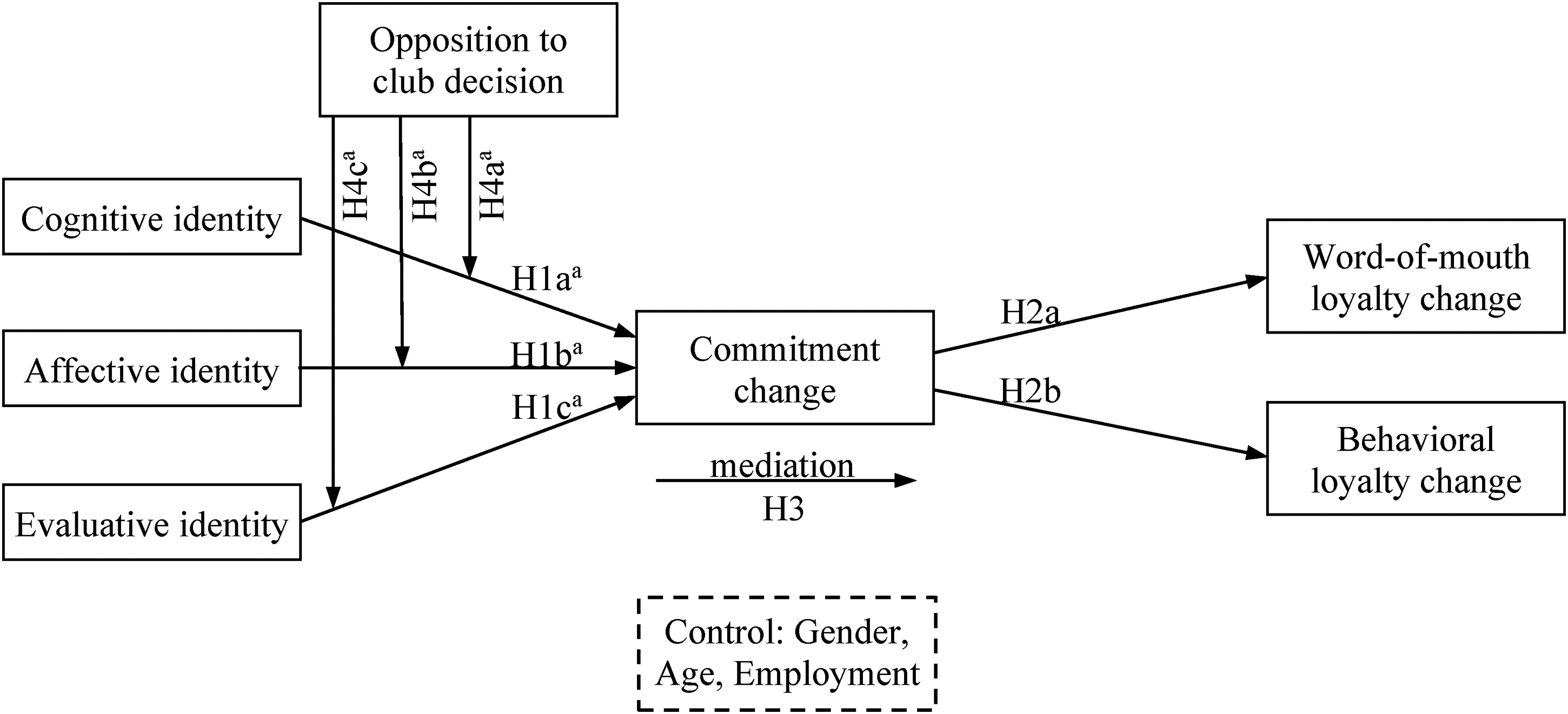
Conceptual model with the proposed hypotheses.
The Relationship Between Social Identity and Commitment
The link between social identity and commitment has been confirmed in various business contexts (e.g., Farooq et al., 2014) and among sports fans, where Bodet and Bernache-Assollant (2011) found that identification with the team directly and indirectly affects commitment. Although prior research has not explicitly linked social identity to commitment change, Matsuoka et al. (2003) found that Japanese football fans’ commitment correlated more strongly with team identification than with satisfaction with performance, suggesting stability over time. Likewise, Fink et al. (2002a) reported that strong team identification fosters lasting commitment that endures poor performance and negative events. This suggests that social identity contributes not only to fan commitment but also to its resilience in the face of negative news.
Although past studies have not examined how each social identity dimension (cognitive, affective, evaluative) affects commitment, theoretical reasoning supports these links. Fans with stronger membership awareness (cognitive identity) are less likely to stray from group values, leading to more stable commitment (Burke & Reitzes, 1991). Similarly, greater emotional investment (affective identity) fosters stronger relationships, making commitment more resistant to external shocks. Conversely, when the value of group membership (evaluative identity) diminishes, individuals feel less connected, disengage from group norms, and lose the desire to maintain the relationship (Roth et al., 2018).
The ESL case provides a unique context for testing how resilient commitment remains when group norms are violated. By breaking away from long-standing traditions of meritocracy and open competition, participating clubs were widely seen as betraying core values that underpin European football fandom. Fans were thus forced to reconcile loyalty to their clubs with opposition to the ESL. In this setting, strong cognitive identity may have prevented commitment declines through shared group belonging, strong affective identity may have sustained emotional bonds despite disappointment, while strong evaluative identity could have slowed the disengagement processes and thereby limited commitment declines. Taken together, these arguments suggest a common mechanism: stronger identification provides psychological grounding that helps fans reinterpret or withstand organizational transgressions. In controversial situations such as the ESL, identity acts as a stabilizing force that reduces the extent to which commitment deteriorates. Accordingly, we hypothesize: H1(a, b, c): The stronger the fans’ (a) cognitive, (b) affective, (c) evaluative identity, the less their commitment to the club will change due to a controversial decision.
The Relationship Between Commitment and Loyalty
Researchers (e.g., Kwon & Trail, 2005) agree that commitment and loyalty are related but distinct, with commitment acting as an antecedent to loyalty. Positive links between both constructs have been confirmed across industries (e.g., Dogan & Erdogan, 2016), including sports (Mahony et al., 2000). Bee and Havitz (2010) found that psychological commitment directly influences consumer loyalty in tennis, while Tachis and Tzetzis (2015) confirmed its positive effect on word-of-mouth and behavioral loyalty among football fans. Moreover, Pritchard et al. (1999) argued that resistance to changing preferences, a key trait of commitment, is crucial for stable loyalty.
In the ESL case, many fans expressed outrage through protests, boycotts, and vocal criticism, putting both word-of-mouth and behavioral loyalty under pressure. We expect that fans whose commitment to the club remained intact are less likely to withdraw support or spread negative commentary, while fans whose commitment faltered are more inclined to reduce their supportive behaviors, including word-of-mouth advocacy and match attendance. This supports the expectation that more stable commitment translates into more stable word-of-mouth and behavioral loyalty during controversial events such as the ESL decision. H2(a, b): The less fans’ commitment to the club changes due to a controversial decision, the less their (a) word-of-mouth, (b) behavioral loyalty will change.
The Mediating Role of Commitment
In addition to strengthening commitment, social identity is a strong predictor of consumer behavior (Sparks & Guthrie, 2006). In sports, identification with the team positively influences behavioral loyalty, including attending games and purchasing merchandise (Dalakas & Melancon, 2012; Hedlund, 2014; Katz et al., 2020; Rocha & Fleury, 2017; Yoshida et al., 2015b). It also boosts word-of-mouth intentions, such as recommending games to others (Biscaia et al., 2018). However, Ashmore et al. (2004) argue that loyal behavior is not a direct result of social identity. Research among sport fans shows that team identity first impacts attitudinal loyalty (commitment), which then drives behavioral loyalty (Fink et al., 2002a; Madrigal, 1995).
This mechanism is particularly relevant in the context of the ESL controversy, where fans who felt their club had abandoned core football principles faced a tension between identity and loyalty behaviors. The attempted ESL breakaway directly challenged fans’ identification with their clubs, translating first to weakened commitment and then to reduced attendance, merchandise purchases, or supportive word-of-mouth (Bertin et al., 2025). Consequently, we expect that reduced commitment functions as the key mediator between social identity and reduced loyalty in the ESL context. H3: The change in fans’ commitment to the club mediates the relationship between the fans’ social identity and the change in their loyalty.
The Moderating Role of Intensity of Opposition to Club Decision
Past studies on identity threat have examined how negative events, such as poor sports results (Chang et al., 2019; Doyle et al., 2017; Kwak & Pradhan, 2021) or athletes’mpa#nbsp;immoral behavior (Chien et al., 2016; Fink et al., 2009; Lee et al., 2016), affect fan attitudes and behavior. Strong team identification can reduce the impact of poor performance (Doyle et al., 2017; Madrigal, 1995), though highly identified fans often feel stronger negative emotions after losses (Kwak & Pradhan, 2021). In off-field scandals (more relevant to this study), Lee et al. (2016) found that highly identified fans use moral disengagement to maintain support for the wrongdoer. Chien et al. (2016) similarly noted that fans tolerate their team's scandals but judge rival team's transgressions more harshly. Conversely, Fink et al. (2009) argued that strongly identified fans react more strongly to management decisions they see as failures and cannot ignore major off-field mistakes. These mixed findings suggest that social identity's buffering effect on commitment change may depend on how negatively fans perceive and oppose club decisions. Although opposition is often conceptualized as a negative reaction, research also shows that rivalry-based or oppositional engagement can strengthen fan identity by reinforcing in-group boundaries and shared norms (Liao et al., 2021). However, in cases where opposition reflects perceived betrayal—such as the decision to join the ESL—these identity-reinforcing functions may give way to deeper fractures in the fan–club relationship (Herold et al., 2023).
The ESL decision represents precisely the type of off-field controversy where opposition becomes a defining factor. For many fans, the move symbolized a violation of football's traditions and community values, transforming dissatisfaction into active resistance. Because opposition in this context reflects not only disagreement but also moral and identity-based disapproval, it is likely to weaken the extent to which identification protects commitment from deteriorating (Pauwels & Mogos Descotes, 2018). Incorporating opposition as a moderator extends existing theory by recognizing that identification does not operate in isolation but interacts with situational evaluations of organizational integrity. Practically, this acknowledges the reality of the ESL controversy, where fans mobilized collectively against their clubs’ decisions, making opposition central to understanding commitment outcomes. H4(a, b, c): Opposition to a club decision moderates the relationship between fans’ (a) cognitive, (b) affective, (c) evaluative identity and the change in their commitment to the club.
Methods
Data Collection
The target population for this study comprised football fans across Europe. Participants were recruited by contacting fan clubs of prominent European football teams via email and social media platforms. Invitations to participate in the survey were extended to fan clubs of all teams that had either qualified for the UEFA Champions League at least once in the previous three seasons or finished among the top five in the English, Spanish, German, Italian, or French domestic leagues in at least one of the past two seasons. Although these criteria extended the sampling frame beyond the 12 ESL-invited clubs, the wording of the ESL-related questions ensured that the topic was relevant for all respondents, as the proposed competition would have directly affected both domestic and European competitions for invited and noninvited clubs. When no fan-club email address or social media profile could be identified, the questionnaire was sent to a contact person within the club (typically someone in charge of marketing), with a request to forward it to the club's fan community. Invitations were sent to 395 fan clubs or club representatives identified through online research. Fan-club representatives shared the survey link through their usual communication channels (e.g., mailing lists, closed social media groups), reaching active members of their fan communities. Participation was entirely voluntary and anonymous.
Data were collected across two studies: Study 1 was conducted a few weeks after the ESL announcement, and Study 2 approximately 6 months later. This two-wave design allowed us to capture fan responses when the ESL controversy was still highly salient in public debate (Study 1) and after media attention had partly subsided (Study 2). Both studies targeted fans of the same clubs and relied on the same sampling and recruitment procedures. Treating the datasets as separate but parallel data collections enabled internal replication and assessment of the robustness of the observed effects across time.
The final sample sizes were 172 for Study 1 (Mage = 28.4; SDage = 9.0) and 184 for Study 2 (Mage = 29.2; SDage = 10.6). The samples were predominantly male (Study 1: 90.1%; Study 2: 89.1%), consistent with European football demographics. Most participants were employed (69.2% in Study 1; 65.2% in Study 2), followed by students (22.1%; 27.2%), the unemployed (5.8%; 3.8%), and the retired (2.9%; 3.8%). Only a marginal share of respondents were based outside Europe (3.5% in Study 1; 1.6% in Study 2), in line with the study's aim to capture the reactions of fans most directly affected by the ESL proposal. Although responses were not obtained from fans of every club that met the inclusion criteria, the final samples included supporters of 26 clubs in Study 1 and 22 clubs in Study 2. This included fans of all 12 clubs originally involved in the ESL, but mainly of Barcelona (9.9% in Study 1; 7.6% in Study 2), Real Madrid (8.1%; 8.7%), Liverpool (8.1%; 6.0%), PSG (7.6%; 9.8%), Juventus (7.6%; 6.5%), AC Milan (5.8%; 7.1%), Bayern (5.8%; 6.5%), and Chelsea (6.5%; 5.4%), while fans of other clubs accounted for less than 5% each. Demographic variables (age, gender, employment status) and favorite club did not differ significantly between the two studies, making the samples comparable.
Measures
Model variables were operationalized using established measurement scales with minor adjustments. All items were rated on a 7-point Likert scale (1 = strongly disagree, 7 = strongly agree). The three-dimensional scale for fans’ social identity aligns with the original tripartite social identity conceptualization (Bergami & Bagozzi, 2000; Lam et al., 2010; Tajfel, 1982; Wang, 2017). Independent constructs—cognitive, affective, and evaluative identity—were measured using adapted scales from Wang (2017). These dimensions capture the core mechanisms through which fans understand, emotionally engage with, and assign value to group membership, while offering a theoretically coherent framework for examining identity-based responses to changes in sport brand associations. While we acknowledge the broader richness of fan identity and its antecedents (Wear et al., 2018; Wear & Heere, 2020), focusing on these three dimensions enables a conceptually cleaner test of how distinct identity components relate to fan behavior, without compromising the study's clarity or parsimony. This approach offers a focused yet flexible foundation for future research extensions.
For the outcome constructs, we assessed commitment following Sharma and Patterson (1999), word-of-mouth following Carroll and Ahuvia (2006), and behavioral loyalty in line with Bauer et al. (2005), as also applied by Marquetto et al. (2017). Respondents first rated all items regarding their current attitude toward their club (“actual”), and immediately afterwards answered parallel items imagining the club participating in the ESL (“if”). In both blocks, items were anchored on the club (e.g., “I am very committed to my club” vs. “If my club were participating in a Super League, I would still be very committed to my club”). The difference between the two sets of responses captured perceived commitment change, word-of-mouth change, and behavioral loyalty change. Although this method measured perceived rather than actual change, hypothetical before–after designs are well established in consumer behavior research (e.g., Ahluwalia et al., 2000; Dean, 2004; Pullig et al., 2006), particularly for examining responses to crises when real-life events cannot be observed. As the ESL was never implemented, this approach allowed us to capture meaningful perceptions of potential changes in commitment, word-of-mouth, and behavioral loyalty. For simplicity, the term “change” is used throughout. Detailed measurement information for the outcome constructs is provided in the Appendix.
The moderator variable—opposition to the club's decision—was measured with the following item: “What do you think about the idea of your club joining a Super League (in the format originally presented by the 12 clubs, or in a similar format of a closed competition involving selected clubs)?” Responses were recorded on a 7-point Likert-type scale (1 = I strongly oppose, 7 = I strongly support) and reverse-coded for analysis. This question was administered to all respondents, regardless of whether their club was one of the 12 ESL founder clubs; for fans of noninvited clubs, it referred to a hypothetical scenario in which their own club would join such a closed Super League-type competition. This item directly captures general evaluative opposition to the club's decision. For fans who viewed their club's potential participation as a betrayal of core values, this opposition reflects brand-related disappointment or emotional disillusionment. Following Bergkvist (2015), a single-item measure was deemed appropriate given the concreteness and clarity of the construct.
Gender, age, and employment status were included as control variables due to their potential influence on commitment change, word-of-mouth change, and behavioral loyalty change (Byun & Dass, 2015; Fillis & Mackay, 2014; Karjaluoto et al., 2016; Zhang et al., 2014). The questionnaire was presented in English and was pretested with 30 participants prior to data collection.
Analysis
With missing values accounting for less than 1% of all measurements, they were deemed unproblematic and replaced by the mean of the variable. A sensitivity power analysis (root-mean-square error of approximation [RMSEA]-based; Jak et al., 2021) with an alpha of 0.05 (two-tailed), 80% power, and 89 degrees of freedom indicated a required sample size of 143 for the test of close fit. Our sample size was sufficient to meet this criterion. We assessed skewness and kurtosis, finding no significant deviations from normality, justifying the use of maximum likelihood estimation.
Before creating parcels for the outcome variables—commitment change, word-of-mouth change, and behavioral loyalty change—we confirmed within-subject measurement invariance between the “actual” and “if” occasions. Parceling, which involves combining two or more items into averaged indicators for a latent construct (Matsunaga, 2008), was used to improve measurement reliability and model parsimony. We found support for configural, metric, and scalar invariance (Hoffman, 2015) for all three constructs. We assessed the reliability of the scales measuring commitment (four items), word-of-mouth (four items), and behavioral loyalty (three items) for both studies and statement sets. Composite reliability (CR) was high (0.81–0.98 in Study 1; 0.90–0.98 in Study 2), indicating good measurement reliability. For the overall measurement model, we then assessed reliability and validity using standard structural equation modeling (SEM) criteria (CR ≥ 0.70, average variance extracted (AVE)≥0.50; Fornell–Larcker tests of discriminant validity), as reported in Section 5.1. In addition, overall measurement model comparability across both studies was confirmed, showing support for configural, metric, and scalar invariance (χ2 difference tests and changes in comparative fit index (CFI) and Tucker–Lewis index (TLI) within recommended thresholds) (Putnick & Bornstein, 2016).
Regarding common method bias (CMB), we applied procedural remedies by Podsakoff et al. (2012) and statistical controls. The marker variable test (Lindell & Whitney, 2001) used a superstition item (“I sit in the same spot every time during football matches of my club”; Dwyer et al., 2018) theoretically unrelated to at least one substantive variable. After adjusting zero-order correlations, all remained significant, suggesting CMB is unlikely to have inflated the model's relationships.
We conducted a structural model analysis and tested the mediation effect of commitment change using bias-corrected bootstrap confidence intervals (CIs) (Preacher & Hayes, 2008), with 5,000 resamples and a 95% CI for the parameter estimates. We then examined the moderation effect of opposition to the club's decision on the relationships between identity constructs and commitment change. A series of moderated mediation models (Model 7) in PROCESS v4.1 were tested. In each model, one identity construct served as the independent variable, commitment change as the mediator, and word-of-mouth change or behavioral loyalty change as the dependent variable. Opposition to the club's decision was the moderator, while the remaining two identity constructs and control variables (gender, age, and employment status) were included as controls. Analyses were conducted using IBM SPSS 29 and MPlus v8.5.
Results
Measurement Model
The measurement models (Table 1) had an acceptable fit (Hair et al., 2010). The results of the reliability analysis show that all values for CR are above 0.70 and for AVE above 0.50 (Table 1), indicating that all constructs have good reliability. All t-values of the loadings of the measurement variables on the respective latent variables are statistically significant (Table 1), providing support for convergent validity (Anderson & Gerbing, 1988). For all pairs of latent variables, the AVE values were greater than the squared correlations between the latent variables (Table 2), confirming discriminant validity (Fornell & Larcker, 1981). Comparison of the correlations (Wald test of parameter constraints) revealed no significant differences between the two studies.
Measurement Model.
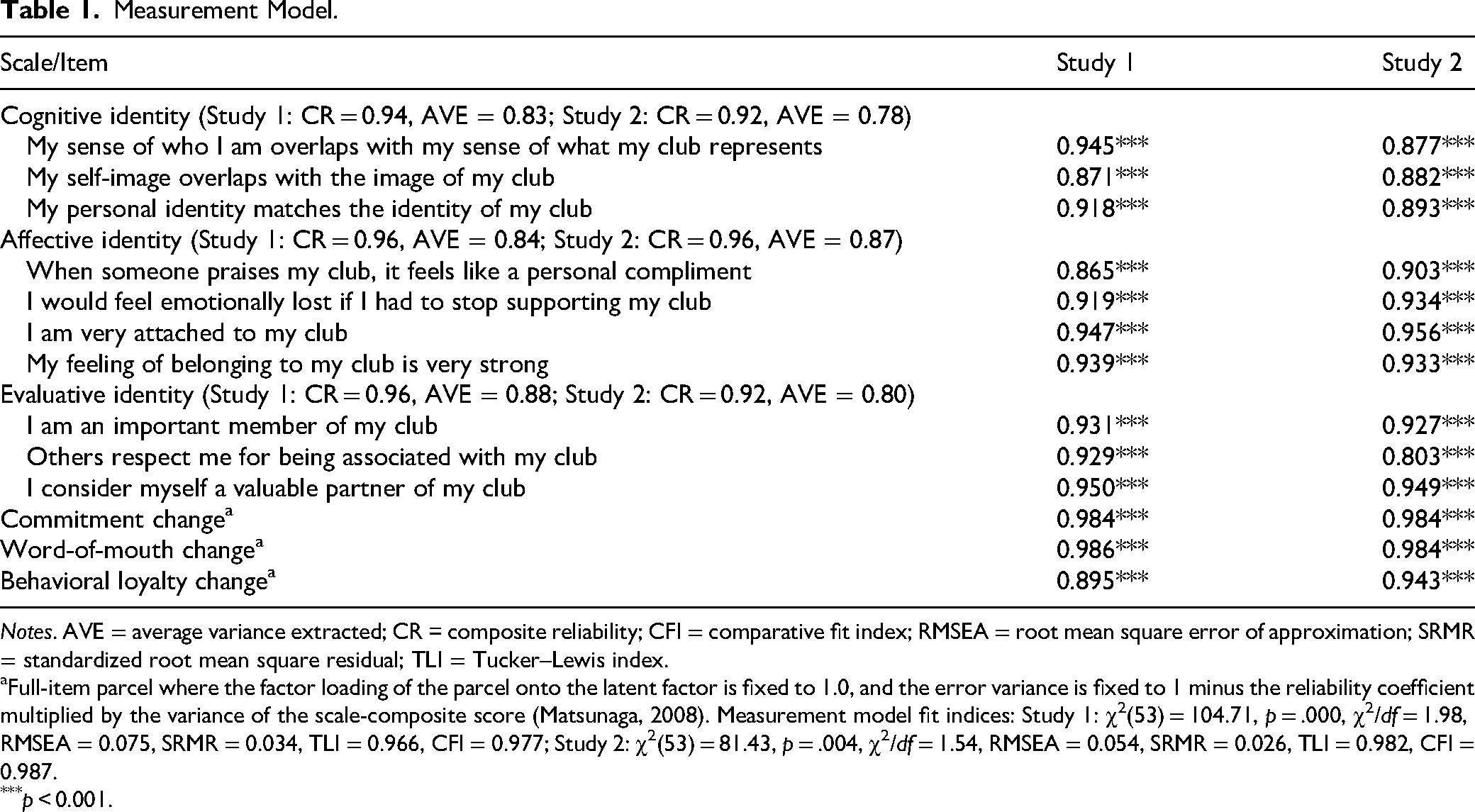
Notes. AVE = average variance extracted; CR = composite reliability; CFI = comparative fit index; RMSEA = root mean square error of approximation; SRMR = standardized root mean square residual; TLI = Tucker–Lewis index.
Full-item parcel where the factor loading of the parcel onto the latent factor is fixed to 1.0, and the error variance is fixed to 1 minus the reliability coefficient multiplied by the variance of the scale-composite score (Matsunaga, 2008). Measurement model fit indices: Study 1: χ2(53) = 104.71, p = .000, χ2/df = 1.98, RMSEA = 0.075, SRMR = 0.034, TLI = 0.966, CFI = 0.977; Study 2: χ2(53) = 81.43, p = .004, χ2/df = 1.54, RMSEA = 0.054, SRMR = 0.026, TLI = 0.982, CFI = 0.987.
p < 0.001.
Means, Standard Deviations, and Correlations.
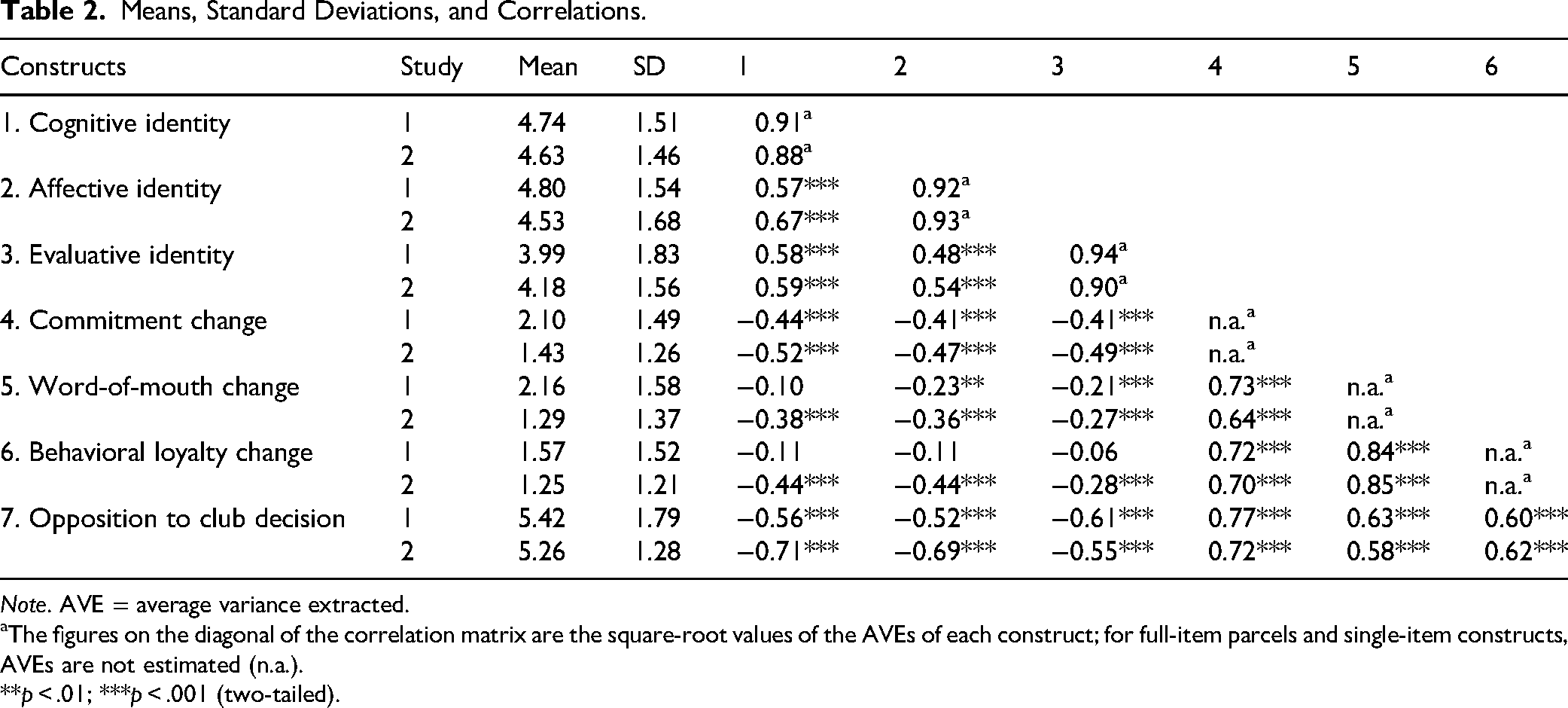
Note. AVE = average variance extracted.
The figures on the diagonal of the correlation matrix are the square-root values of the AVEs of each construct; for full-item parcels and single-item constructs, AVEs are not estimated (n.a.).
**p < .01; ***p < .001 (two-tailed).
Structural Model
The fit indices of both structural models (Figure 2) indicated an acceptable model fit. The independent variables explained the dependent variables relatively well (R2 = .26 and .36 for commitment change; R2 = .53 and .44 for word-of-mouth change; R2 = .52 for behavioral loyalty change). The direct effects supported hypotheses H1 and H2 (Figure 2). Fans’ cognitive identity (H1a; β = –0.22, p˂.05 in Study 1; β = –0.27, p˂.01 in Study 2), affective identity (H1b; β = –0.19, p˂.05 in Study 1; β = –0.18, p˂.05 in Study 2), and evaluative identity (H1c; β = –0.19, p˂.05 in Study 1; β = –0.23, p˂.01 in Study 2) were all negatively related to commitment change. Fans’ commitment change was positively related to word-of-mouth change (H2a; β = 0.73, p˂.01 in Study 1; β = 0.63, p˂.01) and behavioral loyalty change (H2b; β = 0.71, p ˂ .01 in Study 1; β = 0.70, p˂.01 in Study 2). Control variables showed no significant effects, except age, which was negatively related to word-of-mouth change in Study 2. We additionally tested subgroup robustness with a multigroup SEM (comparing fans of ESL-invited vs. noninvited clubs). Constrained models (paths equal across groups) fit equivalently to configural models in both studies (ΔCFI ≤ 0.002; ΔRMSEA ≤ 0.002; Δ standardized root mean square residual [SRMR] ≤ 0.004), indicating the structural relationships reported above hold for both fan groups. Although fans of ESL-invited clubs reported somewhat lower opposition on average, this difference did not alter the structural relationships.
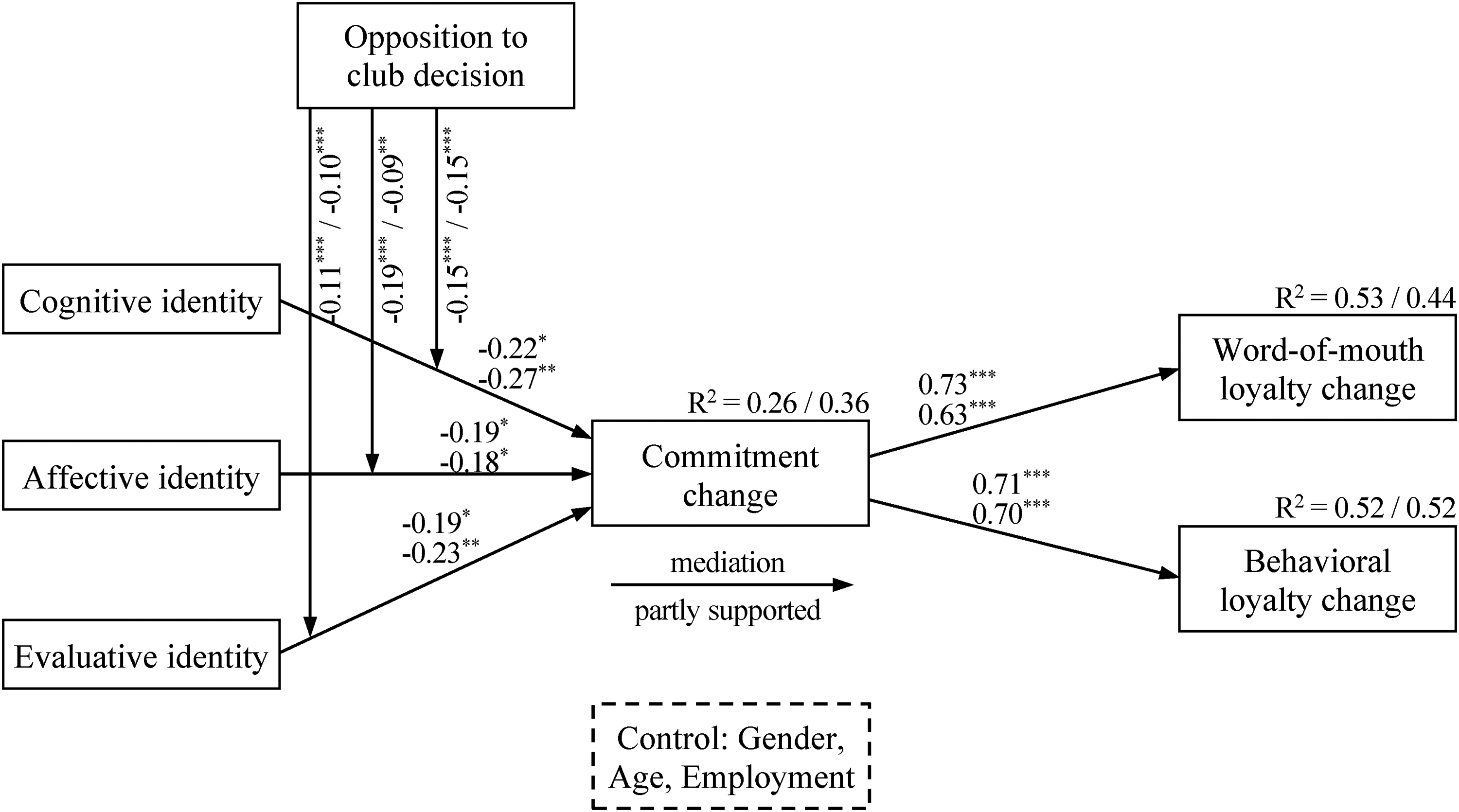
Final model with results.
Analysis of Mediation Effects
As shown in Table 3, evaluative identity consistently demonstrated significant indirect effects on loyalty outcomes across both studies. Specifically, the indirect effect on word-of-mouth change was −0.121 (95% CI [−0.244, −0.005]) in Study 1 and −0.126 (95% CI [−0.234, −0.031]) in Study 2. For behavioral loyalty change, the indirect effect was −0.105 (95% CI [−0.210, −0.005]) in Study 1 and −0.117 (95% CI [−0.212, −0.027]) in Study 2. Affective identity exhibited significant indirect effects only in Study 1: −0.155 (95% CI [−0.322, −0.011]) for word-of-mouth change and −0.133 (95% CI [−0.284, −0.011]) for behavioral loyalty change. No significant mediation effects were found for cognitive identity. These results offer partial support for H3, highlighting evaluative identity as a stable predictor of loyalty outcomes through commitment change.
Structural Model Estimation Results (Indirect Effects).
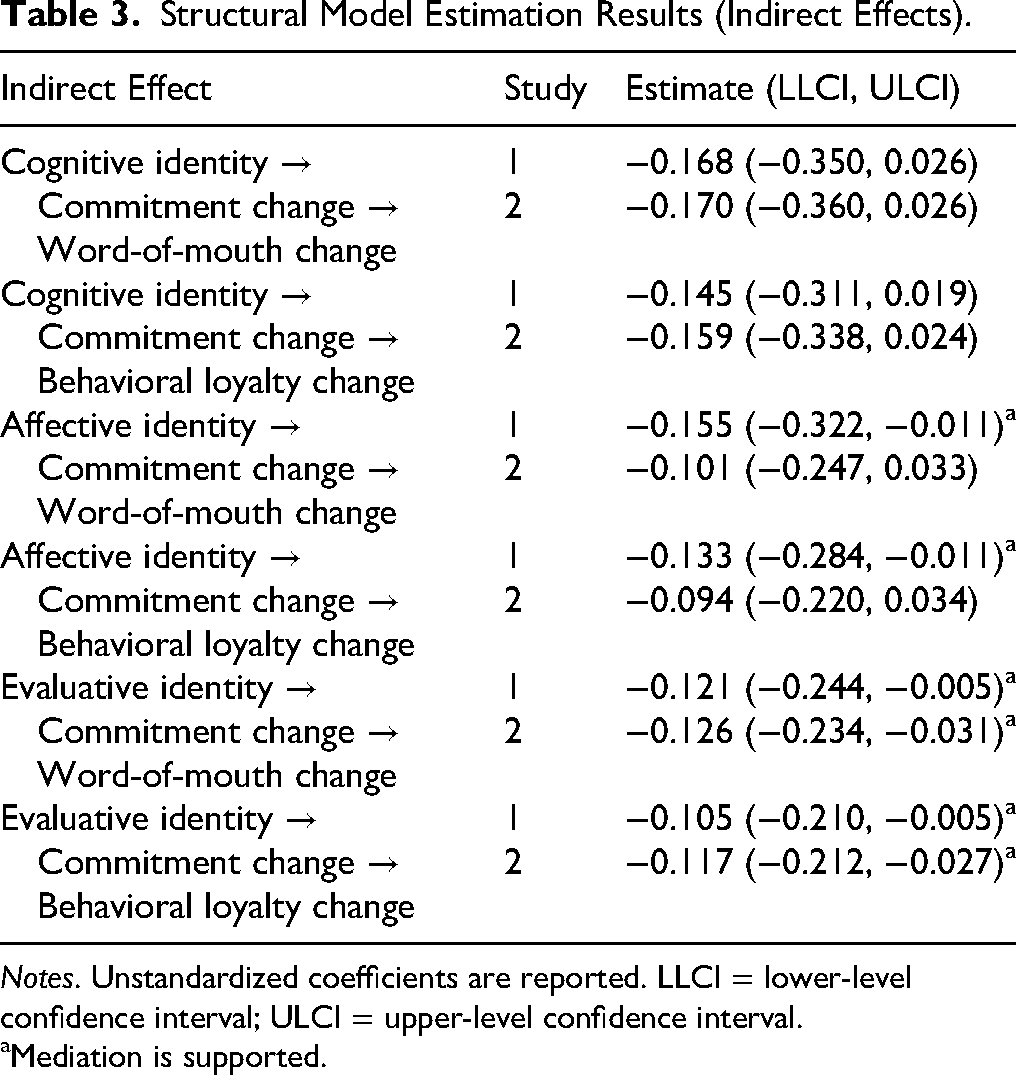
Notes. Unstandardized coefficients are reported. LLCI = lower-level confidence interval; ULCI = upper-level confidence interval.
Mediation is supported.
Analysis of Moderation Effects
The results indicated that opposition to the club's decision negatively moderated the relationship between all three dimensions of fan identity and commitment change (see Figure 3). The interaction effect for cognitive identity and commitment change was significant (Study 1: β = –0.145, p˂.001; Study 2: β = –0.146, p˂.001), supporting H4a. Similarly, opposition moderated the affective identity–commitment change link (Study 1: β = –0.191, p˂.001; Study 2: β = –0.087, p = .006), supporting H4b, and the evaluative identity–commitment change link (Study 1: β = –0.110, p˂.001; Study 2: β = –0.104, p˂.001), supporting H4c. While the effect sizes (except for affective identity) were consistent across both studies, simple-slope analyses at the 16th (low), 50th (medium), and 84th (high) percentiles of opposition revealed some differences between the studies (Figure 3).
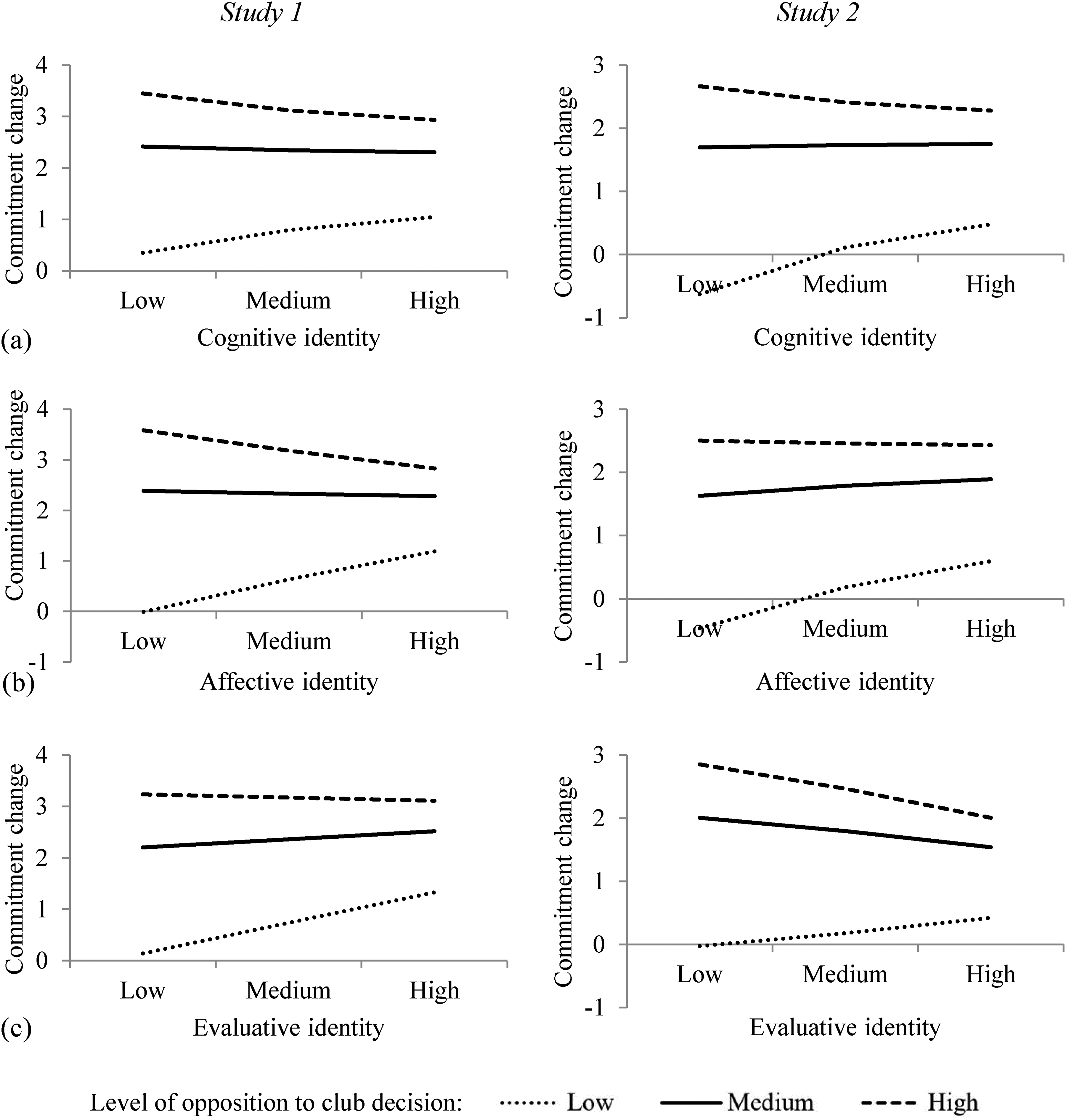
Simple slopes analyses for the conditional effects of (a) cognitive, (b) affective, and (c) evaluative identity on commitment change across opposition levels to the club decision.
Figure 3a shows that the cognitive identification–commitment change link was significantly positive under low opposition (Study 1: β = 0.25, p = .009; Study 2: β = 0.37, p < .001), weakened and became nonsignificant at medium opposition (Study 1: β = –0.04, p = .525; Study 2: β = 0.02, p = .777), and turned significantly negative in Study 1 (β = –0.19, p = .010) and marginally negative in Study 2 (β = –0.13, p = .064) under high opposition. Figure 3b illustrates that the affective identity–commitment change link was strong and positive under low opposition (Study 1: β = 0.35, p < .001; Study 2: β = 0.28, p = .006), but substantially weakened at medium opposition (Study 1: β = –0.03, p = .591; Study 2: β = 0.07, p = .226), and reversed to a significant negative effect in Study 1 (β = –0.22, p = .001), while remaining nonsignificant in Study 2 (β = –0.02, p = .761) under high opposition. Figure 3c shows that the evaluative identity–commitment change link was positive under low opposition in Study 1 (β = 0.30, p < .001), but nonsignificant in Study 2 (β = 0.12, p = .119). At medium opposition, the effect became nonsignificant in both studies (Study 1: β = 0.08, p = .139; Study 2: β = –0.13, p = .016). Under high opposition, the effect was nonsignificant in Study 1 (β = –0.03, p = .616) and significantly negative in Study 2 (β = –0.23, p < .001).
Discussion
Theoretical Implications
This study's results are consistent with prior evidence that stronger fan identification with a club is associated with greater attachment (e.g., Shapiro et al., 2013) and a range of consumption-related behaviors (e.g., Dalakas & Melancon, 2012; Hedlund, 2014; Katz et al., 2020; Ma & Kaplanidou, 2021; Yoshida et al., 2015a, 2015b). Building on this baseline pattern, our contribution is both dimensional and contextual. At a dimensional level, we apply Tajfel's (1982) tripartite view of social identity (cognitive, affective, evaluative) to examine how they differentially relate to changes in commitment and loyalty. At a contextual level, we situate these effects in a reputational threat setting by analyzing how the strength of fans’ opposition to a controversial club decision conditions how far social identity can buffer against declines in these outcomes. In doing so, we extend social identity applications in sport that typically rely on global identification scores by showing that the three components operate as distinct sources of resilience under threat (Bergami & Bagozzi, 2000; Lam et al., 2010; Tajfel, 1982).
A first key theme is the differential buffering capacity of the three identity dimensions, with the cognitive component emerging as the strongest protection against declining commitment across both studies. Fans with strong cognitive identification tend to view their alignment with the club's identity as a fundamental part of their self-concept (Luhtanen & Crocker, 1992), which makes them more resilient when confronted with negative events (Chun & Sagas, 2022). This resilience stems from the cognitive dimension's ability to facilitate rationalization and maintain a sense of belonging (commitment) under challenging circumstances (Lam et al., 2010). Unlike affective identity, which relies on emotional involvement, or evaluative identity, which depends on perceived group value, cognitive identity anchors commitment through a rational awareness of alignment. This makes it the most enduring against external disruptions and supports our use of cognitive identity as the most structurally resilient dimension within the tripartite model when identity is challenged by organizational change (Mansfield et al., 2023; Wegner et al., 2020).
The second theme concerns the mechanisms through which identity dimensions translate into loyalty change. Commitment change mediates this relationship only for evaluative identity (in both studies) and affective identity (in Study 1). Although this finding may be surprising, it can be explained by the nature of these dimensions. Evaluative identity, being linked to self-esteem, requires commitment as a mechanism to translate self-worth into consistent group-related behaviors (Wang, 2017). Fans who positively evaluate their group membership (Ellemers et al., 1999) are motivated to maintain psychological attachment (commitment), which sustains their loyalty. In a reputational crisis such as the ESL, this mediating role of commitment can also be interpreted as part of a trust-repair (Gillespie & Dietz, 2009) and moral-alignment process (May et al., 2015). Evaluatively identified fans derive self-worth from belonging to a club they perceive as principled. When club actions are framed as violating shared values, they reassess their commitment in light of perceived integrity and benevolence. Where trust is restored and moral alignment re-established, renewed commitment allows evaluative identity to continue supporting loyalty.
Similarly, affective identity, rooted in emotional investment, preserves commitment because emotions can trigger deeper personal attachment (Bergami & Bagozzi, 2000), ultimately translating into sustained loyalty. In this respect, affective identification operates as an emotion-focused coping response to identity threat, as highly involved fans draw on their emotional bond with the club to manage distress and remain attached despite negative events (Delia, 2019). Taken together, these mediation patterns refine tripartite social identity accounts by specifying evaluative–attitudinal and affective–emotional pathways through which identification maintains loyalty under reputational threat (Bergami & Bagozzi, 2000; Wang, 2017).
In contrast, cognitive identity is a more rational and stable dimension involving self-categorization (Lam et al., 2010). Fans with strong cognitive identification may remain loyal directly because they view themselves as part of the group (Hirshon, 2020), bypassing the need for intermediate psychological commitment. This resilience reflects a cognitive reframing process, whereby fans rationalize the event and preserve a sense of belonging. Combined with our earlier discussion that cognitive identity is the strongest buffer against negative changes in fans’ attitudes and behaviors, this finding highlights cognitive identity's function as a structural component of social identity—inherently stable and less dependent on fluctuating psychological constructs (like commitment) when explaining fans’ loyalty.
The third theme involves how opposition reshapes the protective role of identity. Across both studies, stronger fan opposition to a club's decision reduces the protective effect of all identity dimensions on commitment change. In sports, rivalry and disagreement often foster engagement, but moral disapproval transforms them into opposition. Strong opposition tends to trigger identity dissonance, as fans experience a conflict between their existing identification with the club and the perceived violation of core sporting values by the club. In more pronounced cases, this opposition may activate betrayal aversion, intensifying negative reactions when a trusted organization is perceived to have breached fundamental expectations (Herold et al., 2023; Tsordia et al., 2024). These psychological mechanisms help explain why the buffering effect of fan identification on commitment change weakens under conditions of strong opposition. Our findings illustrate multidimensional resilience under reputational threat and show that the identity-protective role of identification is contingent rather than uniform. When perceived moral violations are severe, even strong identification cannot fully prevent commitment erosion (Ashforth & Mael, 1989; Kwak & Pradhan, 2021).
These moderation findings extend existing literature on identity threat (Kwak & Pradhan, 2021; Wegner et al., 2020) in two important ways. First, while previous studies have primarily focused on the immoral behavior of individual athletes (Chien et al., 2016; Fink et al., 2009; Lee et al., 2016), our study examines highly controversial off-field decisions made by entire teams. This distinction matters because club-wide controversial decisions do not allow for balance theory effects. In sports, occasional misconduct by individual players can be offset with positive “balancing” actions by the team (Dietz-Uhler et al., 2002). When the club as a whole makes a controversial decision, there is usually no one to provide such balancing responses, leading fans to seek balancing techniques on their own through disengagement (Fink et al., 2009). Similar dynamics have been observed in other club-wide controversies, such as ownership changes and proposed relocations, where fans perceive that commercial or political interests override community ties and respond with protests, boycotts, or even the formation of breakaway clubs (Bain & James, 2025; Jones et al., 2024). Viewed in this broader context, the ESL is not an isolated anomaly but a prominent episode in an ongoing trend of fan disillusionment with the direction of the modern game.
Second, most earlier studies focus on either identity (e.g., Wegner et al., 2020) or fan attitudes and behavior (e.g., Chien et al., 2016) as consequences of negative events, often reporting mixed results. While Chien et al. (2016) and Lee et al. (2016) argued that strongly identified fans continue to support their team despite adversity, Fink et al. (2009) noted that even strongly identified fans cannot overlook major off-field mistakes. In contrast, we argue that the relationship between fans’ social identity and commitment change following a controversial decision depends on the strength of their opposition to that decision. By incorporating this moderation effect and the multidimensional nature of social identity, our research helps explain the mixed findings in previous studies and offers a more nuanced understanding of how different identity components and opposition intensity jointly shape commitment and loyalty under crisis.
To conclude, linking psychological mechanisms that shape downstream behavioral intentions and fan responses such as commitment, word-of-mouth, and behavioral loyalty with social identity dimensions in the sports context clarifies both the consequences (sports consumers’ behavior) and the underlying reasons (social psychological mechanisms behind negative fan reactions). Regarding consequences, weaker social identification after a controversial decision leads to greater declines in commitment. This results in reduced efforts to recommend team games to others and less money spent on team merchandise and tickets, as also reported by Biscaia et al. (2018), Hedlund (2014), and Rocha and Fleury (2017). Conversely, understanding the social psychological reasons behind suboptimal fan reactions is equally critical. Competitive sports present considerable potential for “vicarious shame” to emerge (Mowen, 2004), where fans feel ashamed of their team's wrongdoing even if they had no direct involvement (Lickel et al., 2005). When fans perceive that a negative event reflects poorly on them personally, they may distance themselves from the club, resulting in suboptimal marketing output. Alternatively, fans’ negative reactions may be driven by “consumer vengeance,” an emotional desire to “get even” with the club in response to perceived wrongdoing (Bechwati & Morrin, 2003) or betrayal (Grégoire et al., 2009; Herold et al., 2023). Fans may respond similarly (through reduced commitment and loyalty) but for different reasons. This study helps clarify these reasons by linking them to three social identity dimensions. Cognitive and evaluative dimensions (which are high among fans feeling ashamed of the wrongdoing) as well as the affective dimension (which is high among fans feeling betrayed and vengeful) provide only limited protection for commitment and loyalty as fans’ perception of controversy increases.
Practical Implications
The ESL controversy highlighted that clubs must anticipate how fans interpret and react to decisions that appear to violate long-standing values and traditions. Our findings show that the strength and nature of fans’ social identity shape both the magnitude of commitment erosion and the likelihood of loyalty declines. Accordingly, practical implications are best understood within the controversy context: identity-based strategies can help clubs both minimize backlash and rebuild trust after contentious decisions. To translate these insights into actionable guidance, we organize recommendations into three themes corresponding to the cognitive, affective, and evaluative dimensions of social identity. This structure reflects the same identification processes outlined earlier in the paper, where cognitive clarity, emotional resonance, and value congruence were shown to stabilize commitment under threat (Ashforth & Mael, 1989; Fink et al., 2002a; Heere & James, 2007; Lock et al., 2012; Matsuoka et al., 2003; Tajfel, 1982).
Cognitive identity centers on knowledge of, and belonging to, the club community. Clubs can strengthen this dimension by preserving and communicating traditions, symbols, and narratives tied to their historical identity. For instance, FC Barcelona's motto, “més que un club” (“more than a club”), ties the team to Catalan culture and political history, providing fans with a symbolic anchor. Similarly, Borussia Dortmund emphasizes its working-class roots and community orientation, enabling fans to align their personal identity with the club's narrative. These initiatives help solidify the psychological anchor that, as our results indicate, reduces commitment declines when clubs face reputational pressure. Digital platforms—such as supporter forums, curated historical content on streaming channels, or interactive match-day archives—offer additional avenues for strengthening cognitive identity. Because identification is increasingly negotiated online, maintaining coherent identity cues across both physical and digital environments is key.
Affective identity reflects emotional attachment to the club. This dimension can be cultivated by supporting rituals that deepen emotional resonance. Liverpool's prematch singing of “You’ll never walk alone” serves as a powerful ritual that creates a sense of unity and emotional connection, while Tottenham Hotspur's stadium design, featuring a single-tier “home end,” amplifies collective chants and enhances matchday atmosphere. Clubs can extend these rituals through digital channels (fan forums, social media, streaming platforms) creating additional spaces where fans collectively experience and negotiate their emotional bond. Communication strategies also matter. Emotionally grounded messages that acknowledge fans’ concerns, validate their emotional stake in the club, and transparently explain decision rationales can help manage negative reactions. Digital channels—including behind-the-scenes content, documentary-style storytelling, and livestreamed Q&As—offer increasingly important touchpoints for sustaining emotional connection.
Evaluative identity is reinforced when fans feel recognized and morally aligned with club initiatives. Our results show that when fans perceive a misalignment between their values and the club's actions (as in the ESL case), commitment and loyalty decline more sharply. Therefore, clubs should proactively demonstrate consistency between their decisions and the values they claim to embody. For example, Celtic FC links its identity to charity and social justice, fostering moral pride among supporters. Chelsea's engagement with supporter groups around governance reform, and Real Madrid's emphasis on sporting merit and institutional identity, illustrate efforts to foreground values that supporters recognize as central. Such initiatives align with research showing that value congruence strengthens trust and mitigates disengagement (Herold et al., 2023; Roth et al., 2018; Tsordia et al., 2024). Sponsorship and partnership strategies should also reflect value congruence. Fans evaluate sponsors not only in terms of commercial fit but also through shared meanings and moral alignment (Anagnostou & Tzetzis, 2021; Bauer et al., 2005). Partnerships that affirm community orientation, youth development, or sustainability can contribute to trust restoration after reputational controversies, whereas poorly aligned partnerships risk amplifying perceptions of betrayal.
Across all three identity dimensions, the underlying principle is consistency: clubs must align their communication, partnerships, traditions, and supporter engagement with the identity-based mechanisms that structure fan–club relationships. Doing so targets the same processes that our data suggest are most protective during episodes of fan opposition. By reinforcing shared traditions, cultivating emotional rituals, and upholding communal values, clubs can better anticipate backlash, preserve commitment, and rebuild loyalty in the aftermath of divisive decisions.
Limitations and Suggestions for Further Research
This study has several limitations that offer opportunities for future research. The first set of limitations concerns the composition of our samples. Although the two samples showed no significant differences in demographics such as age, gender, employment status, or favorite club, approximately 90% of respondents were men. This gender imbalance aligns with similar studies on football fans (Anagnostou & Tzetzis, 2021) but limits generalizability. Gender differences in sport engagement have been documented (Fink et al., 2002b), suggesting that men and women may differ in the intensity of their affective or evaluative identity. Research also shows that women as sports fans can be highly committed supporters, but their engagement is often expressed differently and is shaped by gendered social contexts and constraints (Allison & Pope, 2022; Hoeber & Kerwin, 2013; Tofoletti, 2017). Female or nonbinary fans may respond differently to organizational controversies, potentially placing greater emphasis on relational or ethical dimensions. Additionally, the geographic composition was skewed toward Europe, with only a marginal share of respondents based outside the continent (3.5% in Study 1; 1.6% in Study 2). While this provides confidence that our findings primarily reflect the perspectives of the most affected and emotionally involved fans, it also reduces insights into global fan communities. Moreover, the survey was administered in English, so some participants responded in a nonnative language, which may have affected subtle item interpretations and limits the cultural generalizability of the findings. Future research should aim to reach more diverse audiences by gender, geography, and fan involvement level, explicitly compare them, and capture potentially divergent responses to controversies such as the ESL.
A second limitation relates to the measurement of the moderator variable—opposition to the club's decision—which was assessed using a single item. Although this item captured general evaluative opposition to joining the new competition format, it may not reflect the full range of reasons fans might oppose such an initiative. Future research could develop a multi-item scale to capture more nuanced dimensions of opposition, such as ethical concerns, perceived commercialism, or threats to sport-related identity. A more differentiated measure would help clarify how distinct types of opposition influence fan reactions.
A further limitation concerns the study design's reliance on perceived changes in fan attitudes based on hypothetical scenarios, as the ESL ultimately did not materialize. One concern is that hypothetical contexts may elicit idealized responses, since individuals are not bound by real-world consequences. Wertenbroch and Skiera (2002) found that consumers often overstate willingness to pay in hypothetical settings, illustrating the risk of hypothetical bias. Similarly, reported changes in fan commitment and loyalty may not fully align with actual behavior, and because our surveys were conducted after the initial ESL announcement, they capture reconstructed evaluations and may be subject to recall bias. Future research could complement survey-based measures with more time-sensitive behavioral indicators, such as time-stamped digital engagement metrics (e.g., social-media interactions with club content), to test whether attitudinal shifts translate into observable changes in fan behavior. Another concern is that asking participants to respond to nearly identical items twice introduces the risk of consistency bias or anchoring effects. Finally, although the two studies were conducted 6 months apart and no similar real-world event occurred during that time, unrelated shifts in public sentiment may still have influenced responses. Despite these concerns, perceived change measures offer a reasonable proxy when real-world controversial decisions are difficult to study.
Building on these limitations, future research should also consider the temporal dynamics of fan attitudes and loyalty. Although our two cross-sectional studies offer relatively robust findings over a 6-month period, future studies should adopt longitudinal designs, behavioral tracking, or natural experiments to observe actual changes in fan attitudes and behaviors over time. Such designs would be especially feasible when clubs announce major and potentially controversial decisions, such as changes in ownership, sharp ticket price increases, or morally contested sponsorship deals. Tracking the same supporters before and after such decisions would allow researchers to examine how initial reactions evolve.
Taken together, these limitations also point to broader governance challenges. Our results suggest that fan identity can buffer the impact of controversial club decisions when opposition is low or moderate, but under strong opposition the same identity ties are associated with sharper declines in commitment and loyalty. These findings highlight the importance of understanding when identity functions as a protective resource and when it becomes a liability for clubs. Building on this, future research could inform more proactive reputation-management efforts in football and sport in general, where clubs systematically monitor identity-related signals and opposition, and engage with supporters before, during, and after contentious decisions.
Social media statement (280 characters): Sport fans’ social identity helps sustain commitment and loyalty during club controversies, but its protective role depends on the strength of fans’ opposition. Understanding how psychological constructs and opposition intensity jointly shape fan attitudes and behaviors aids in managing fan relationships during crises.
Footnotes
Funding
The authors disclosed receipt of the following financial support for the research, authorship, and/or publication of this article: This work was supported by the Slovenian Research and Innovation Agency, research core funding no. P5-0128.
Declaration of Conflicting Interests
The authors declared no potential conflicts of interest with respect to the research, authorship, and/or publication of this article.
Data Availability
The data supporting this study's findings are available from the corresponding author upon request.
