




Abstract
The word Odogwu has gained significant popularity in contemporary Nigerian discourse, particularly due to its pervasive circulation within the nation’s eclectic and creative popular culture. Upon this widespread recognition, this study theorizes and examines the construction and performance of Odogwu masculinities within Nigerian popular culture, focusing specifically on music and Nollywood as key sites of gendered identity construction. Rooted in traditional Igbo concepts of valor, leadership, and resilience, the Odogwu figure has been (re)configured in urban Nigeria. Employing a qualitative, multi-method approach through a detailed lyrical and visual semiotic analysis of Burna Boy’s hit song “Odogwu” (2020) complemented by a close reading and visual analysis of the Nollywood film Love in Every Word (2025), the study posits core traits such as economic power, social recognition, cultural legitimacy, and performative visibility defining Odogwu masculinities, further arguing that the performance of Odogwuness is diverse, reflecting varied enactments and not a “monolithic” ideal.
Keywords
Nigerian popular culture, encompassing music, film, television, comedy, fashion, digital media, and entertainment, has increasingly become an object of significant scholarly inquiry and global fascination. Over recent decades, Nigeria’s vibrant popular culture scene has not only established itself as one of Africa’s most influential creative industries but has also served as a dynamic arena for diverse analytical frameworks and cultural debates. In the past few years, scholarly attention has increasingly turned toward the growth and digital innovations of the Nigerian cultural industry (Falola, 2022; Krings & Simmert, 2020), the performance of “hype” and the role of the hypeman (Akinsola, 2025; Orhero & Nwoke, 2025), the political and cultural economy of media (Isike et al., 2023; Popoola & Fadipe, 2025), as well as social media cultures and the rise of cultural netizenship (Adeoba & Yékú, 2024; Imoka, 2023; Yékú, 2022).
Additionally, scholars have critically examined comedy and its relationship to otherness and commodification (Adebisi et al., 2023; Amaefula, 2024; Filani & Williams, 2023; Krings & Nwankwọ, 2024), while Nollywood film studies continue to illuminate how postcolonial, spiritual, and gendered identities are negotiated through cinematic texts (Alola & Alola, 2020; Jemiluyi, 2025a; Kekeghe et al., 2025). To include, Afrobeats and Nigerian pop music have been analyzed as mediums for articulating pan-African sensibilities, decolonial imaginaries, and diaspora linkages (Babalola, 2025; Dasent, 2023; Jemiluyi, 2025b; Onanuga, 2023; Onanuga & Akingbe, 2020). These studies, in their diverse critiques, reflect the extent to which Nigerian popular culture has robustly emerged as a dynamic and fertile site for examining the intersections of identity, politics, economy, globalization, and social aspiration.
Just as Nigerian popular culture has become an important export of the country’s creative economy, reaching global audiences through platforms like Netflix, YouTube, and Spotify, among others, it has simultaneously transformed into a canvas upon which contemporary cultural anxieties, ideals, and aspirations are vividly painted and contested. Significantly, it has also evolved into an arena where constructions of gender, particularly masculinities, are prominently staged and negotiated (Amaefula & Ayodabo, 2021; Dasent, 2023; Falola, 2022). Within this cultural landscape, contemporary representations and performances of Odogwu masculinities have risen prominently, epitomizing an idealized form of male identity characterized by economic empowerment, social prestige, and conspicuous displays of affluence. In contemporary Nigerian popular culture, the construction and performance of the Odogwu figure is notably conspicuous and this phenomenon is evidenced by diverse media productions and popular trends, ranging from music and film to viral social media trends.
One pertinent example is the viral dating show “Pop the Balloon,” notably adapted in Nigeria as the “Hunts Game Show” hosted by popular influencer Nons Miraj. The female contestants who appear on the show frequently and explicitly express, across several episodes, their desire to find and “match up” with an Odogwu, which is a man that embodies wealth, status, and masculine ideality. The aspirational figure of the Odogwu is further reinforced and celebrated within nightlife and club culture through elaborate performances such as “Dorime,” a ritualized spectacle characterized by expensive champagne and elaborate rituals of conspicuous consumption, highlighting the intersections between wealth, social visibility, and masculinity (Orhero & Nwoke, 2025). “Dorime,” derived from the Latin chant of the song “Ameno” by ERA, signifies the public affirmation and celebration of masculine economic power within club settings, reinforcing the Odogwu ideal through performative acts of wealth display.
The title of Odogwu holds a distinguished and culturally revered status within Igbo society, symbolizing courage, authoritative leadership, and extraordinary service to one’s community, and even in some cases, to women who achieve incredible feats. Firmly rooted in traditional practices, it stands among the most esteemed honors in southeastern Nigeria, carrying substantial social and symbolic weight. In traditional Igbo society, the title Odogwu is usually conferred upon men renowned for exceptional courage and notable accomplishments, particularly in relation to warfare and communal defense. Like the titles Onowu and Onovo, it was originally associated with martial valor and social distinction. Linguistically, Odogwu is believed to derive from the Igbo expressions “O de n’ogwu or O de ogwu,” which translate roughly to “one who treads upon thorns” or “he who walks through thorns.” This metaphor evokes the image of a figure who confronts hardship and adversity with enduring tenacity, signifying extraordinary strength, endurance, and the capacity to withstand suffering without retreat. In customary Igbo societies, individuals bearing the Odogwu title are marked by distinctive regalia that signify their elevated status and social authority. These adornments typically include coral beads worn around the neck and wrists, emblematic of wealth and honor; the okpu ododo (red cap), a traditional symbol of prestige and seniority; and the ọfọ, a ritual staff representing justice, ancestral authority, and rightful leadership (Agama, 2020; Ndubisi & Okere, 2020). And, to be called an Odogwu, is to be referred to as “a great man,” “a valiant man,” “a distinguished man,” “a man of incredible esteem,” and/or “a victor,” among many other closely related interpretations.
Additionally, the concept of Odogwu in Igbo culture is not monolithic; it contains hierarchies that reflect the degree of valor or distinction an individual has attained; some were recognized as having faced more formidable challenges or demonstrated a more pronounced embodiment of Odogwu attributes than others. For instance, the title Odogwu Akataka designated a man who not only endured metaphorical thorns but did so with unmatched fearlessness and aggressive resolve. The term Akataka evokes hardness, resilience, and an indomitable spirit. Expressions such as Odogwu karịrị Odogwu (There are Odogwus greater than other Odogwus) encapsulate this insight, suggesting that within the pantheon of masculine achievement, degrees of distinction exist in honoring those whose strength, courage, and impact surpass the ordinary. 1 While this non-monolithic conception of Odogwu reinforces the use of the plural form—“Odogwu masculinities”—in this study, it also affirms the inherent plurality within masculinity itself, where no single performance can fully encapsulate its cultural meanings or social enactments. As Jemiluyi (2025b) posits, “there is no unilateral existing form of masculinity anywhere…. Masculinity is constructed differently by distinct periods of history and different cultures” (63).
Informed by that temporal fluidity, the present-day reconfiguration of Odogwu masculinities is transitioning from its core ancestral features of martial honor and communal service to re-emerge in urban Nigeria as a performance scripted by capital, status, and spectacle. Contemporary usage which is shaped by shifting urbanization, economic ideals, and digital media visibility positions financial might, material acquisition, and symbolic dominance as the new signifiers of masculine distinction. In this recoding, the Odogwu figure becomes a cultural shorthand for Nigeria’s aspirational man: affluent, celebrated, and unchallenged; an embodiment of modern success in a competitive and image-conscious society. This study, hence, examines the representation and performance of Odogwu masculinities within Nigerian popular culture, specifically focusing on how this evolving male ideal is constructed and communicated through contemporary popular music and Nollywood film. By theorizing Odogwu masculinities as a plural, historically inflected, and culturally situated formation, the study contextualizes this form of masculine performance within broader conversations on African gender identities and their production and mediation through local and popular imaginaries, and advances the concept of Odogwu masculinities as a theoretical framework within African masculinity studies.
Employing a qualitative multi-method approach, the study undertakes a detailed lyrical and semiotic analysis of Burna Boy’s hit song “Odogwu” (2020), complemented by a close reading and visual analysis of the Nollywood film “Love in Every Word” (2025). The integration of these analytical lenses allows for a comprehensive understanding of how masculinity is symbolically and materially constructed, articulated, and consumed in contemporary Nigerian society. The significance of this study is tied to its exertion to contribute to ongoing conversations within African masculinity studies and lend in to the growing call for research grounded explicitly in indigenous and local cultural contexts (Chitando et al., 2024). By closely analyzing culturally-specific performances of masculinity, this article contributes to a deeper, contextualized understanding of gender identity formations, popular media’s influence on societal ideals, and the broader implications for masculinity studies within African and global contexts.
African Men and Manhood: Toward Odogwu Masculinities
As with many concepts in the humanities and social sciences, the meaning of “masculinity” remains a site of considerable debate. While there is broad acknowledgment that no singular, universally accepted definition of masculinity exists (Drummond, 2016), this lack of consensus has not deterred scholars from exploring and theorizing its various forms and expressions. At its most basic level, masculinity refers to the social and cultural expectations associated with being male within a given context. Yet, increasing scholarly attention has highlighted the impossibility of capturing male identity within a fixed or universal framework. This has led to a conceptual shift toward the plural form—masculinities—to account for the diverse, dynamic, and context-dependent ways in which masculine identities are constructed and performed (Connell, 1995). To include, the avenues through which masculinity is expressed are highly diverse, shaped by the range of contexts in which individuals engage with gendered expectations. This is where the notion of masculinity as practice becomes noteworthy.
Masculine identity is not a static attribute, but a performative accomplishment enacted through everyday behaviors, such as speaking, thinking, moving, dressing, writing, and interacting with others. Boys and men are routinely expected to demonstrate their alignment with culturally sanctioned forms of manhood in ways that are specific to particular social settings. These performances are not singular or fixed; rather, they require ongoing affirmation and recalibration through one’s actions and communication. As Young (2001, p. 5) argues, gender is continually reproduced through public acts that align with the social structures in which individuals are embedded, and consequenlty not a one-time accomplishment. In recent years, there has been a growing recognition of the need to critically examine men and masculinities within African contexts. Over the past two decades, gender studies across the continent have expanded significantly, with increasing scholarly attention devoted to African masculinities.
Notable interventions and works in this evolving field have offered critical insights into how manhood is constructed, interpreted, and lived across various social, cultural, and historical landscapes—both within Africa and across its diasporas (Dery & Ganle, 2020; Jemiluyi, 2025c; Lindsay & Miescher, 2003; Mfecane, 2018; Mugambi & Allan, 2010; Ouzgane, 2011; Ouzgane & Morrell, 2005; Ratele, 2020). Much of this research has been driven by the imperative to theorize masculinity through the lens of African experiences, resisting the imposition of Western-centric frameworks. As Ayodabo and Amaefula (2021, p. 2) observe, African societies contain internal “hierarchies” among men, with power relations shaped by intersecting factors such as ethnicity, religion, class, and geographic location. These intersecting dynamics contribute to the formation and contestation of dominant masculinities, producing multiple—and often competing—ideals of what it means to be a man in specific African settings. It is precisely this complexity and variation that underscores the urgency of more nuanced, context-specific scholarship which is, in fact, the foundational impetus behind the recent and expansive scholarly effort, The Palgrave Handbook of African Men and Masculinities (Chitando et al., 2024).
With fifty chapters spanning nearly one thousand pages, this volume edited by leading African scholars assembles contributions that collectively challenge monolithic and predominantly negative portrayals of African men. The editors assert compellingly that discourses around men and masculinities in Africa are significantly more complex than the prevailing stereotypes imply. While recognizing that certain constructions of masculinity on the continent have undeniably contributed to gender inequalities, the Handbook emphasizes that this narrative is incomplete. African men have consistently navigated and reshaped their gender identities, often confronting a host of intersecting adversities including economic pressures, cultural expectations, political instability, and shifting societal norms. Consequently, many African men continuously find themselves involved—by choice or necessity—in multifaceted struggles, negotiating the compounded forces shaping their lives and masculine identities. As Chitando et al. succinctly articulate: This Handbook seeks to draw attention to the different struggles and preoccupations of men and masculinities in diverse African settings. It endeavours to explode the notion of masculinities in Africa as belonging only to the category of the negative and unedifying. Positively, it highlights the extent to which men in different African settings strive to sometimes uphold and other times critique the ideals set for them by society. Further, the volume acknowledges the multiple and sometimes contradictory settings and institutions in which men are being required to express their masculinity … the volume problematises the idea of a homogenous ‘African masculinity’ … [it] seeks to analyse men and masculinities in Africa as part of the normal, everyday human experience. This is due to the tendency to set aside men and masculinities in Africa as a spectacle of one form or another. (Chitando et al., 2024, pp. 2–3)
This orientation toward nuance and contextual specificity provides a vital framework for exploring the diverse formations of masculinity within national contexts, where localized meanings and performances of manhood are constantly being (re)negotiated. In Nigeria, one of Africa’s most culturally dynamic and populous nations, masculinities are similarly marked by complexity, contradiction, and continual adaptation. Nigerian masculinities are produced at the intersection of tradition and modernity, shaped by educational factors, regional cultures, environmental and health variables, religious and spirituality frameworks, class structures, and the pressures of both postcolonial nationhood and global cultural flows (Ezegwu & Cin, 2022; Izugbara, 2024; Jemiluyi, 2025, 2025c, Smith, 2017, 2020; Uchendu, 2007). While masculinities in Nigeria are highly diverse and influenced by regional, ethnic, and cultural variations, traditional gender norms remain widely influential. These norms often prioritize male authority, economic provision, and heterosexual virility, casting men as primary breadwinners, household decision-makers, and figures of sexual dominance. Such expectations are also reinforced through familial upbringing, religious doctrines, media representations, and entrenched institutional structures, contributing to their persistence across Nigeria’s multifaceted social landscape.
Within this terrain, “Odogwu masculinities” are gaining ground as an increasingly prominent configuration of Nigerian manhood. Rooted in the cultural traditions of southeastern Nigeria, as briefly explored in the introduction, this masculine ideal has experienced significant transformation, reflecting broader societal shifts and contemporary realities. Masculinities, as Connell and Messerschmidt (2005) argue, are not static entities but rather evolving configurations that respond dynamically to historical moments, socio-economic contexts, and cultural negotiations. Odogwu masculinities exemplify precisely such dynamic negotiation, continuously shaped by shifting social conditions, global cultural flows, and local aspirations. One of the core features of Odogwu masculinities is the profound emphasis on economic power, specifically financial visibility as a demonstration of masculine worth. Wealth, conspicuously displayed and publicly acknowledged, serves as tangible proof of masculine success and potency. The act of wealth display, involving lavish expenditures, luxurious lifestyles, and visible economic gestures to “spend,” “provide,” and “flex” reinforces the individual’s claim to manhood, underscoring the capitalist ethos that scholars like Smith (2017, 2020, 2023) identify as increasingly influential in Nigerian masculinities.
Alongside material affluence, Odogwu masculinities are reinforced through social recognition, which is a form of symbolic capital that marks one out as a man of status, authority, and respect. This recognition is often conferred through both verbal affirmation and public performance, extending into the digital sphere where visibility itself becomes a currency of masculine value. These performances of status, sometimes, interlock with gendered behavior, including emotional stoicism, romantic dominance, and the expectation of sexual prowess, all of which underscore the patriarchal undercurrents that still animate many Nigerian gender norms. Cultural legitimacy also distinctly marks the practice of Odogwu masculinities. Incorporating ethnic pride and traditional motifs in appearance, language, and behaviors, men performing this masculinity invoke historical and cultural authenticity. This practice serves as a counterbalance against perceived cultural dilution from global influences, thereby rooting contemporary masculine identities within local frameworks of meaning and belonging.
To include, performative visibility constitutes a crucial component of Odogwu masculinities, and it usually manifests through charismatic presence, aesthetic boldness, and confident public affirmation. Odogwu masculinities require visibility to achieve their full expression, leveraging platforms such as social media, public events, and cultural performances to reinforce the masculine ideal. Such performances underscore Butler’s (1990) theorization of gender as inherently performative, reliant on constant public enactment to achieve coherence and social legitimacy. Nevertheless, it is important to note that men who perform Odogwu masculinities do not necessarily embody all associated traits simultaneously or equally. One may prioritize economic power and financial visibility, while another emphasizes cultural legitimacy, performative visibility, or physical strength as markers of Odogwuness. 2 These variations speak to the evolving and non-exhaustive nature of masculine identity. As scholars such as Connell, 1995; Jemiluyi, 2025c; Mfecane, 2018 argue, masculinities are historically contingent, contextually shaped, and continually negotiated. These features of Odogwu masculinities, therefore, should not be viewed as a fixed checklist but as a constellation of possible expressions shaped by dynamic social, cultural, economic, and personal forces.
Method
This study employs a qualitative, multi-method design, combining lyrical and visual semiotic analysis with film textual analysis to investigate the construction and performance of Odogwu masculinities. The adoption of this approach is grounded in the recognition that Nigerian popular culture operates across multiple platforms—most notably music and film—each of which encodes gendered identities through varied but at the same time complementary aesthetic forms. Recent methodological reflections in the humanities and social sciences note that working with more than one qualitative strategy within a single project can offer a fuller account of complex cultural phenomena than reliance on a single mode of inquiry (Castro et al., 2023; Nowell et al., 2022; Timans et al., 2019).
For the music component of this study, Burna Boy’s 2020 single “Odogwu,” which was selected due to its explicit invocation of the Odogwu figure and its wide cultural resonance, a close reading of the lyrics was undertaken alongside a semiotic analysis of the accompanying music video, attending to imagery, symbols, and performance cues that communicate gendered power and visibility. Semiotic approaches have long been used in Nigerian cultural studies to decode the meanings inscribed in cultural texts (Alozie, 2011). For the cinematic front, Omoni Oboli’s Love in Every Word (2025) was analyzed through a combination of textual interpretation and visual analysis. Attention was paid to character construction, costume, dialogue, and cinematography, with particular focus on the representation of Obiora (fondly called Odogwu) as the cinematic embodiment of Odogwu masculinities. Such close reading and film analysis is a common practice in African cinema scholarship where film is understood as a site for articulating social identities, cultural tensions, and aspirations (Jemiluyi, 2025a). These two strands of analysis were then placed in dialogue, enabling a triangulation of insights across music and film.
Performing the Odogwu in Music
Born Damini Ebunoluwa Ogulu in 1991, Burna Boy has risen to become one of Africa’s most globally acclaimed musicians. Hailing from Rivers State, Nigeria, and with roots in a lineage of musical and political consciousness, Burna Boy is the grandson of Benson Idonije, who was at one time the manager of the Afrobeat legend Fela Kuti, a role later taken up by Idonije’s daughter, Bose Ogulu, who is also Burna Boy’s mother. Known as the self-proclaimed “African Giant,” Burna Boy’s artistic identity merges cultural heritage with contemporary sound and his music traverses Afrofusion, dancehall, reggae, and hip-hop, carrying with it rhythm, assertion, defiance, and continental pride. While Burna Boy enjoys both local and global fame, he also engages in the performance and construction of contemporary ideal Nigerian manhood, an act one might describe as a performative evangelization of Odogwu masculinity – a model of gendered authority rooted in tradition, amplified through popular music, and projected across transnational cultural landscapes. His artistry, which is both self-referential and socially instructive, position him as a beneficiary of Odogwu status and an architect shaping its evolving symbolic contours as he conjures the Odogwu figure—part warrior (with “warrior” understood not only in its literal sense but more crucially as a metaphor for relentless striving, social ascension, and the pursuit of triumph in various arenas), part kingpin, part cultural emissary, and at times a blend of these— embodying wealth, charisma, pride, and power.
Even as Burna Boy’s performance of Odogwu masculinities is particularly pronounced and narratively complex, it would be erroneous to claim that he is alone in mobilizing the term in Nigerian popular music. In recent years, songs like Eltee Skhillz’s 2022 hit “ODG,” a title that appears to abbreviate Odogwu, have elevated a more celebratory, pleasure-centric construction of manhood. With its groovy beat, achievement of cross-border appeal, and attainment of global recognition as the most shazamed song at its peak (Ihekire, 2022), the song emphasizes conspicuous consumption and club-based performativity as key indicators of masculine success. 3 For instance, contained explicit lyrics such as “Odogwu na the spender” (Odogwu is the one who spends lavishly) and “Balling, balling, them dey see me now” (Living large, everyone sees my success) frame visibility, affluence, and spectacle as central markers of masculine distinction. This strand of Odogwu masculinity leans into performance for public acclaim, underscoring the role of wealth and visibility in contemporary gender expressions.
Nevertheless, Burna Boy’s 2020 track, aptly titled “Odogwu,” offers a broader and more culturally grounded template through which to analyze Odogwu masculinities. Rich in lyrical content and visual semiotics, the song fuses personal mythmaking with communal validation, framing masculinity not just as spectacle but to also implicate heritage, authority, and symbolic presence. This makes his song “Odogwu” especially fruitful for the purposes of this study. In the opening lines of the song, Burna Boy sings: When I reach Igbo land them calling me Odogwu (Odogwu) (When I arrive in Igbo land, they call me Odogwu) And as I enter the town I put am for egwu (Odogwu) (And as I enter the town, I make it worthy of celebration / I bring the dance) And nobody can stop you, na so we dey fly pass oh (And no one can stop you, that’s how we rise above) Over any obstacle e be Odogwu (Odogwu) (Overcoming obstacles is the mark of an Odogwu)
Burna Boy’s opening chorus immediately reinforces the historical and cultural legitimacy of Odogwu masculinities, directly referencing “Igbo land” as the authentic space where he is rightfully asserted as an Odogwu. This direct invocation grounds the contemporary figure in its traditional origins, suggesting that his status is not merely self-proclaimed but recognized and affirmed by the ancestral and cultural custodians of the title. The aura he carries, signified by his arrival, enables him to be revered, emphasizing the social recognition inherent in being an Odogwu. The line, “And as I enter the town I put am for egwu,” further illustrates this, indicating that his presence itself elicits celebration and joy, positioning him as a figure of influence and communal pride. What is also crucial to note here is Burna Boy’s assertion that his emergence as an Odogwu was not by sheer decoration or accident, but through persistent struggle and the surmounting of challenges, especially as he notes that “And nobody can stop you, na so we dey fly pass oh/Over any obstacle e be Odogwu,” directly linking the Odogwu ideal to the act of overcoming adversity. This advances the understanding of Odogwu masculinities to suggest that it is one that is “earned” through a journey of relentless striving and eventual triumph, rather than being an inherent or accidental status. To be an Odogwu, therefore, is not a “one-day job” but a manifestation resulting from continuous effort and resilience in the face of difficulties. This, in fact, resonates with the traditional Igbo understanding of Odogwu as one “who treads upon thorns,” indicating a figure defined by enduring tenacity.
In the post-chorus, Burna Boy proceeds to draw a more vivid picture of the Odogwu man, outlining the key characteristics that define this empowered ideal in contemporary terms. He sings: Say na who they draw the map e oooo (Odogwu) (Who draws the map? Odogwu) You are looking at the champion (Odogwu) Where they girls na shaky nyansh eho (Odogwu) (They make girls shake their behinds) Wey the person, with the cash eho (Odogwu) (The person with the cash, Odogwu)
For one to assert being the one who “draws the map” is to lay claim to being a pioneer, an innovator, and a leader, a figure who dictates direction and sets trends and not just merely following them. This signifies social authority and a form of cultural hegemony where the Odogwu shapes the narrative and defines what is aspirational within society. The recurrent adlib “champion,” which now appears in many of Burna Boy’s other songs, solidifies his self-assertion as an Odogwu, an undisputed winner who consistently achieves success. It is also crucial to acknowledge that Burna Boy’s self-proclamation as an Odogwu and its attached championship feature, while being a personal assertion of masculine dominance, also serves to cement his self-positioning at the pinnacle of the Nigerian Afrobeats industry. In a highly competitive music industry, often colloquially framed by the “Big Three” debate (referencing Davido, Burna Boy, and Wizkid in no particular order), Burna Boy’s self-alignment with the Odogwu archetype; a figure of unparalleled achievement and authority, is to reinforce his status as a leader who dictates trends and maintains artistic and commercial supremacy, directly connecting the musical performance of Odogwuness to his contested standing within the industry.
Additionally, the lines “Dem make girls dem shaky yansh” unequivocally link the Odogwu to sexual prowess and romantic dominance. This connection highlights the pervasive influence of heterosexual virility as a marker of masculinity in many Nigerian contexts, where attractiveness to women and the ability to elicit their admiration contribute to a man’s perceived status (Smith, 2017). Significantly, this sexual appeal is directly linked to the Odogwu’s economic power, as the subsequent line “Na the cash” makes explicit. The “cash” here is presented as the foundational element that underpins and enables this romantic and sexual success, demonstrating how material wealth translates into social capital and gendered power. This emphasizes the financial visibility component of Odogwu masculinities, where wealth, beyond being accumulated, is strategically deployed to enhance one’s attractiveness and reinforce patriarchal norms.
Burna Boy’s construction of the Odogwu is further amplified in the second verse, where he paints a vivid scene of arrival and assertion, detailing the material trappings and social interactions that define this ideal: Oh my God What a symphony Ahan So tell me What has gotten into me? I step in real ride Pull up in a Bentley And with the The diamond shinning on every ring you see Lights on Lights on I be commodore The girls dem Dem want to touch pon my kponornor (They want to touch my private parts / get intimate) And if you nor get work you be jantara (If you don’t have a job, you’re useless / irrelevant) Abegi (Please / don’t bother me) So make you go sit down for one corner (So go sit quietly somewhere) You con dey bother me (You’re now disturbing me) I go need my apology (I expect an apology) You know I wanna see All the fine girls wey dey totori (All the beautiful girls who excite / please me) Make I kolobi (So I can take / have them for myself) Hmmm
This verse presents a declaration of conspicuous consumption and performative visibility. The lines referencing symphony, pulling up in a Bentley, and shining diamonds are a direct showcasing of financial might. Just as the “Bentley” and “diamond rings” are potent symbols of luxury and wealth, immediately establishing the Odogwu’s economic status, the metaphorical expression of a symphony alludes to the sophisticated grandeur attached to being an Odogwu and, the repeated “Lights on, Lights on” explicitly communicates a desire for attention and the expectation of being the undeniable center of attraction, aligning with the notion that Odogwu masculinities require visibility to achieve their full expression. The self-proclamation “I be commodore” elevates the Odogwu figure beyond mere wealth to a position of command and authority.
A commodore signifies a high-ranking officer, suggesting leadership, respect, and control, reinforcing the idea of the Odogwu as a dominant figure within his sphere. This assertion of authority is then seamlessly linked back to sexual dominance: “The girls dem, Dem want to touch pon my kponornor.” This line, combined with his desire to “kolobi” the “fine girls wey dey totori”, reinforces the notion of sexual prowess as a key component of being an Odogwu for their economic power and high status directly translate into desirability and access to women. Perhaps most starkly, Burna Boy uses this verse to define the “other” against whom the Odogwu is contrasted, explicitly stating, “And if you nor get work you be jantara/Abegi, So make you go sit down for one corner.” This dismissive stance towards those who are unemployed or lacking economic standing (“jantara” – useless/nobody) highlights the primacy of economic power in contemporary Odogwu masculinities. It establishes a clear hierarchy where financial success, while being desirable, is more importantly essential for respect and social standing, casting those without it as unworthy of attention or inclusion.
To understand Burna Boy’s construction and performance of Odogwu masculinities, it is essential to also examine the visual semiotics of the song, and in fact, its accompanying imagery contributes significantly to the visual articulation and characterization of what it means to be an Odogwu. The song’s cover image, as shown in Figure 1, presents a salient visual statement; depicting a gorilla seated on a throne, dressed in traditional Igbo attire with the characteristic red cap (okpu ododo) and holding a short staff (ọfọ), all set against a natural setting with a prominent tree in the background. The significance of this imagery is multifaceted. Cover art for Burna Boy’s “Odogwu” single. The imagery of a gorilla adorned in traditional Igbo regalia, seated regally, visually encapsulates the “African Giant” persona and the formidable, culturally rooted authority central to Burna Boy’s construction of Odogwu. (Image Source: Burna Boy, https://www.youtube.com/watch?v=onQmiURQCyU&list=RDonQmiURQCyU&start_radio=1)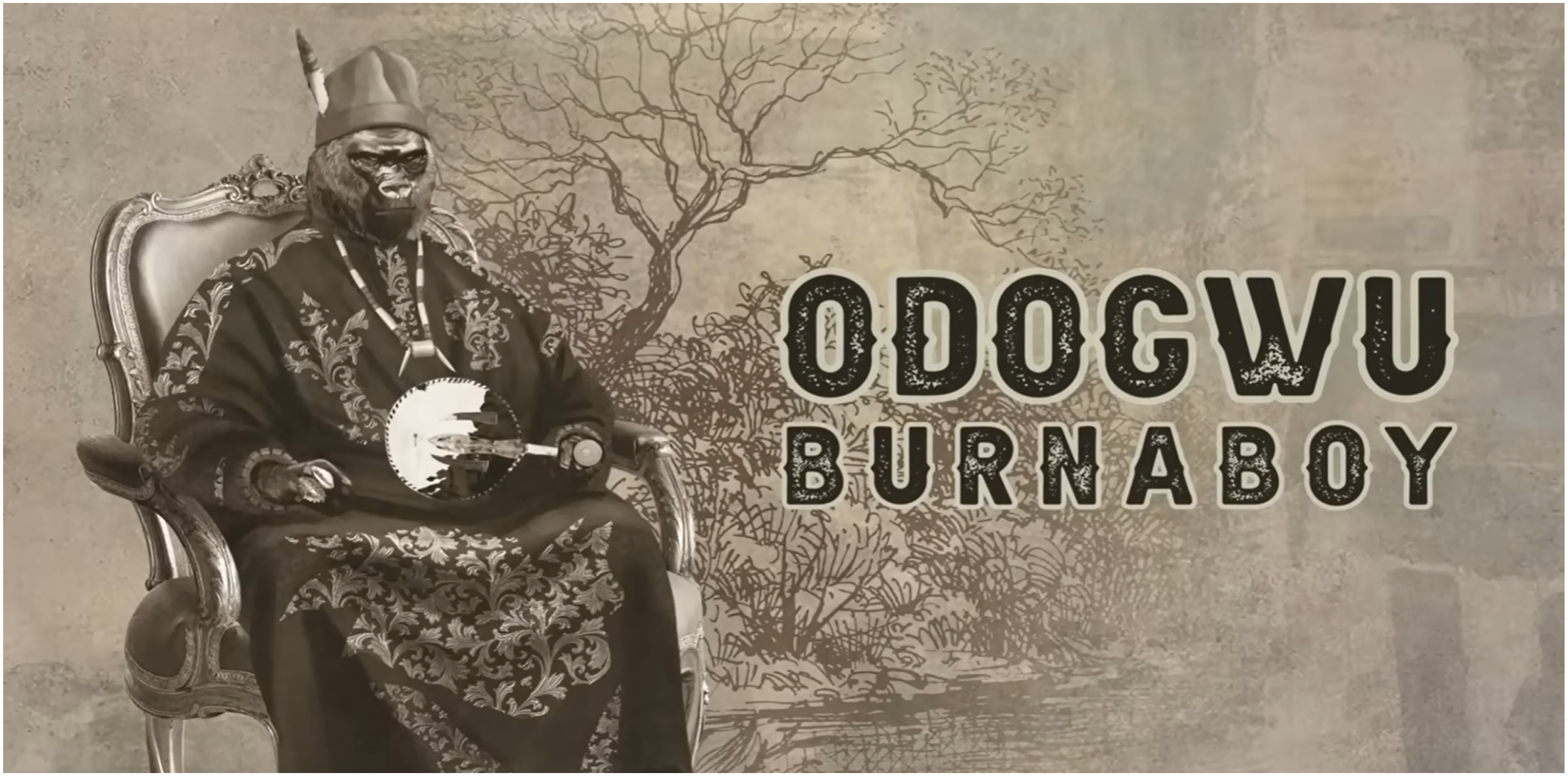
Firstly, Burna Boy, known as the “African Giant,” uses the gorilla, a powerful, dominant, and often revered primate as a direct visual metaphor for his self-proclaimed identity. And by presenting this imagery as an emblem of himself, he affirms his status as not just any kind of Odogwu, but a “giant Odogwu,” implicitly separating himself from other Odogwus who might be perceived as less formidable or of lesser status. More importantly, as this visual declaration reinforces his performative visibility and asserts a hierarchical distinction, positioning him at the apex of Odogwu masculinities, the traditional Igbo regalia on the gorilla further grounds this modern interpretation of Odogwu in its cultural legitimacy, blending ancient symbols of authority and honor with contemporary assertions of power. This potent imagery of the construction and performance of Odogwu is further carried into the music video itself, which immediately establishes its cultural background through its opening scenes and deliberate visual cues that feature traditional aesthetics, symbolic regalia, and staging, just as the lyrics attest to Igbo land as the foundational space for the Odogwu ideal.
The video opens with a half close-up face shot of a man adorned with beads around his neck and a native cap, notably with a cock perched on his head, a symbol often associated with dawn, vigilance, and rural life, immediately rooting the scene in a traditional African context. This shot immediately cuts to a group of men in the background, with Burna Boy centrally positioned, holding an “Akupe” (traditional hand fan), and dancing majestically. This scene is accompanied by a chorus of red-cap chiefs and other men chanting “Odogwu” while the “Akpele” (flute) plays in the background. This collective chanting and the traditional instrumentation underscore the communal validation and cultural legitimacy that are fundamental to the Odogwu title. The persistence of the chanting and the traditional music then transitions to dynamic shots of boat drivers showboating, in a manner that appears celebratory, before cutting back to Burna Boy dancing in a majestic, traditionally Igbo style. These scenes of showboating and traditional dance serve as visual manifestations of performative visibility and spectacle, showcasing different ways in which masculine power and celebration are enacted.
The music then kicks in with, and as shown in Figure 2, a long up-shot that is overtly exhibitionist, capturing Burna Boy sitting pridefully across an open curtain in the middle of a circular, recessed bench or platform. Behind him, a man dressed traditionally appears to conjure and “prepare” the atmosphere specifically for him, signifying a ceremonial anointing or endorsement of his status. This deliberate staging of Burna Boy’s presence emphasizes his performative visibility and social prestige, positioning him as a central figure deserving of reverence. A subsequent close-up shot of him, with the song’s title boldly displayed and his name beneath, gazing directly into the camera as the other man respectfully excuses himself, further solidifies his unchallenged authority and the direct connection between his persona and the Odogwu ideal. A merged visual shots and framing of Burna Boy as a culturally sanctified figure, evoking notions of initiation, power, and ancestral connection. (Image Source: Burna Boy, https://www.youtube.com/watch?v=sUliAM1ByDk&list=RDsUliAM1ByDk&start_radio=1)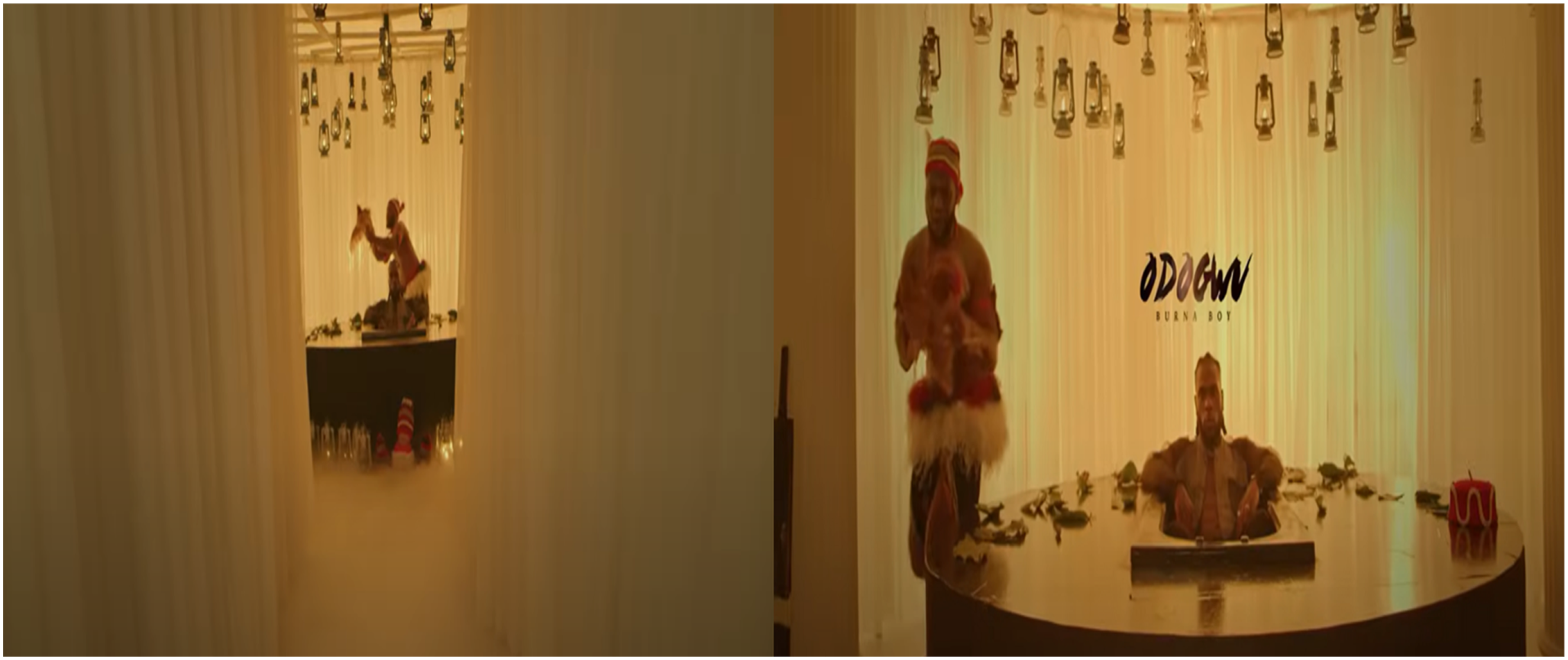
Throughout the video, the idea of collective affirmation and the diverse manifestations of Odogwu masculinities are continually reinforced. As captured in Figure 3, men in traditional dresses, chiefs, and young men in different colored caps are portrayed in a supermarket, sometimes sitting, standing, or raising their hands in affirmation, and this setting is noteworthy for while they attest to Burna Boy as an Odogwu, the others are simultaneously affirming themselves as embodiments of Odogwu themselves, albeit perhaps not on the same global scale of visibility as Burna Boy. Their presence in a supermarket grounds them as economic drivers and participants in the modern economy, demonstrating that the pursuit of Odogwu status through economic power is a widespread aspiration. This scene also illustrates how performative visibility can manifest even in everyday settings, linking economic activity to masculine identity. A visual tableau articulating a collective performance of Odogwu masculinities, highlighting the diffusion of the Odogwu ideal beyond celebrity status into the everyday aspirations of ordinary men, with the modern supermarket scene highlighting economic participation and public presence function as key dimensions of masculine affirmation within contemporary Nigerian society. (Image Source: Burna Boy, https://www.youtube.com/watch?v=sUliAM1ByDk&list=RDsUliAM1ByDk&start_radio=1)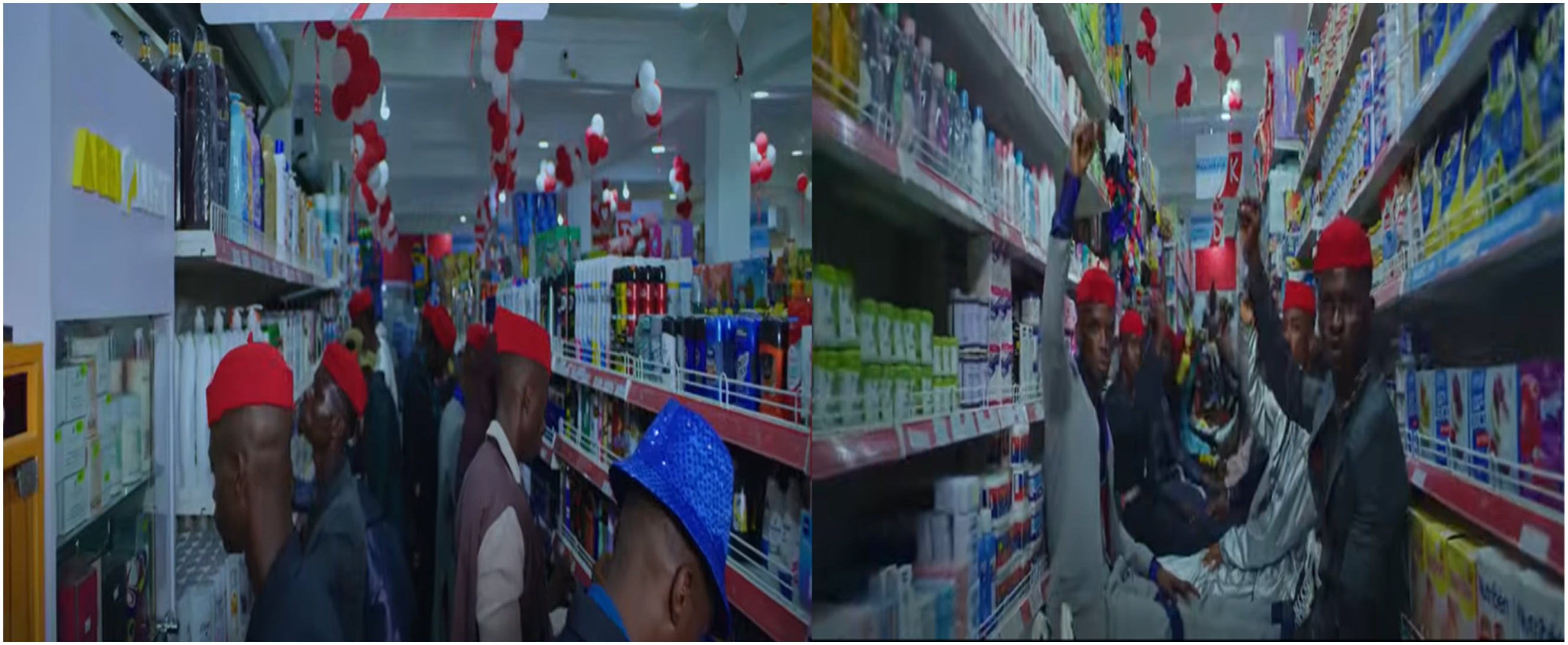
In another scene, a lady with her butt naked dances in a circle of men, including other Odogwu men in traditional red caps sitting, as captured in Figure 4. This depiction exemplifies the voyeuristic (male) gaze that often characterizes Afrobeats, a masculine-dominated genre (Rens, 2021). This scene directly links to the sexual prowess aspect of Odogwu masculinities, portraying women as objects of desire and pawns in the hands of the dominant male figures, reinforcing patriarchal power dynamics. Other scenes show men traditionally dressed and armed with cutlasses, signifying strength and harkening back to the “warrior” aspect of traditional Odogwu, implying a readiness to defend and assert dominance. The video culminates with Burna Boy being crowned with an “Okpu Ndi Nze” (red cap of titled men). This is a highly significant moment, as the red cap in Igbo culture is a symbol of chieftaincy, wisdom, and high social standing, typically conferred upon or worn by individuals who have achieved significant feats and earned communal respect, and the video ends with Burna Boy fully robed in an Igbo traditional dress, notably keeping his chains on with his royal white beaded cap and dress. This final image blends traditionality with modernity, showcasing how the contemporary Odogwu embodies both cultural heritage and global affluence. He is entertained by a lone flute player, and the music ultimately fades into darkness, with the flute’s haunting melody surviving and piercing through the silence until it too ceases. This ending suggests that while the spectacle of a modern Odogwu may fade, the underlying cultural essence and traditional roots, symbolized by the enduring flute, remain a powerful and resonant force, emphasizing the deep cultural legitimacy that underpins this evolving male ideal. Visualizing masculine authority and spectacle. Seated men in a circular formation encircle a nude dancing woman, merging traditional council imagery with sexualized performance. The scene stages masculinity as both ritualized and erotically charged, affirming Odogwu identity through power, virility, and collective gaze. (Image Source: Burna Boy, https://www.youtube.com/watch?v=sUliAM1ByDk&list=RDsUliAM1ByDk&start_radio=1)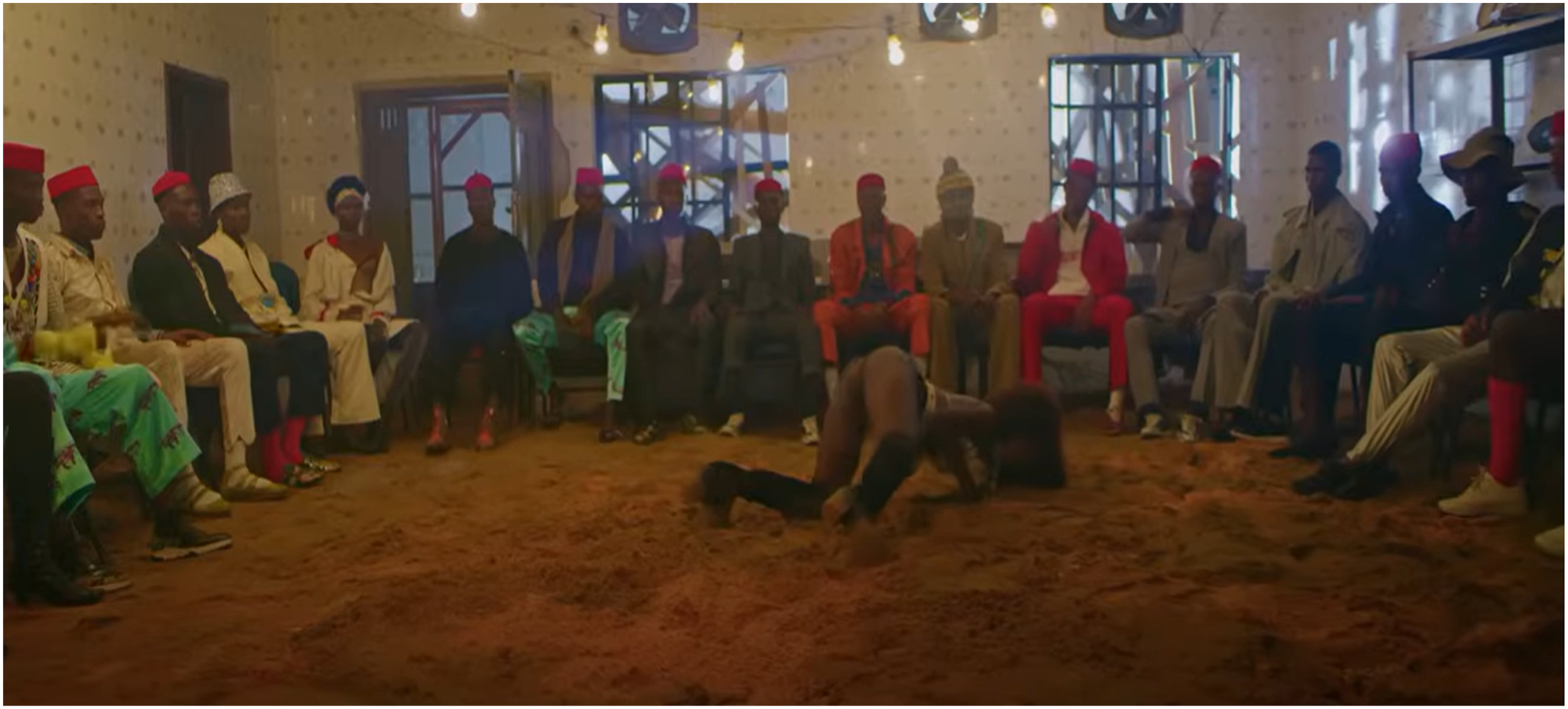
Taken altogether, Burna Boy’s “Odogwu,” through both its lyrical narrative and rich visual semiotics, constructs a comprehensive and aspirational model of Odogwu masculinities. It artfully merges traditional Igbo values of courage, communal recognition, and overcoming adversity with markers of economic power, social prestige, conspicuous consumption, performative visibility, and sexual prowess. The song and its video, while describing an ideal; they also actively perform and evangelize it, offering a dynamic blueprint for the empowered male in contemporary Nigerian popular culture, a figure who is culturally legitimate, financially dominant, and socially revered.
Cinematic Odogwu in Nollywood’s Visual Culture
Nigerian popular culture finds one of its most pervasive and influential expressions in Nollywood, which is the nation’s prolific film industry. Having rapidly emerged as one of the world’s largest film producers by volume, Nollywood has become a vital site for the negotiation and popularization of contemporary Nigerian social norms, aspirations, and identities (Akinola, 2013; Jemiluyi, 2025a; Onuzulike, 2007; Ryan, 2023). Beyond its economic significance, Nollywood functions as a dynamic cultural mirror, reflecting and shaping discourses around modernity, tradition, religion, class, and notably, gender. And, this cinematic landscape, provides the avenue to explore how evolving notions of masculinity are visually constructed, performed, and consumed by a broad audience, significantly contributing to the collective understanding of male identity in contemporary Nigeria.
For the purpose of this study, the Nollywood film Love in Every Word (2025) has been selected for close analysis. This film is particularly illustrative as it offers a compelling narrative that enacts wealth, social standing, and desirability within modern romantic relationships, directly engaging with the characteristics that define contemporary Odogwu masculinities. Additionally, its narrative structure and character portrayals provide a rich textual canvas to examine how the idealized Odogwu figure is presented, in particularly concerning romantic success and economic provision. However, it is pertinent to mention that beyond the film’s narrative structure and character portrayals, Love in Every Word gained significant cultural traction upon its release and trended widely across Nigerian social media platforms, sparking fervent conversations around concepts such as “soft femininity,” affectionate gestures, especially what makes an Odogwu, and romantic expressions such as “Achalugo,” an Igbo term of endearment typically meaning “eagle’s feather,” symbolizing beauty, grace, and nobility, often used for a beloved woman (Akhimen, 2025; Eti-Inyene, 2025; Omosola, 2025).
As Love in Every Word lends itself meaningfully to the ongoing cultural conversation on the construction and desirability of the Odogwu figure, especially with the popularity it gained, it becomes a productive text for examining how the Odogwu is imagined and circulated in Nigerian visual culture. Nevertheless, it is pertinent to acknowledge that while the film, undoubtedly opens up several avenues for interpretation; from class dynamics and femininity to emotional labor, the aesthetics of romance, and gendered trauma, this article focuses specifically on the construction of the Odogwu character and his performance as a popular ideal of empowered masculinity. To undertake this examination, the section is divided into two subsections. The first offers a synopsis of the film, outlining the central storyline and character arcs. The second analyzes how the Odogwu character is shaped and constructed, and more importantly, performed through the male protagonist himself to present the popular imagination of the growing ideal male identity in Nigeria.
Film Synopsis
Released in 2025 and produced by Omoni Oboli under her YouTube platform Omoni Oboli TV, Love in Every Word unfolds a heartfelt narrative of emotional turmoil, self-assertion, growth, and romantic awakening. The film centers on Chioma, played by Bambam Adenibuyan, a character embodying the quintessential representation of the modern, urban Nigerian woman; intelligent, driven, and constantly navigating the pressures of professional and personal life. While she excels at meeting deadlines and delivering results, her personal life tells a different story. Chioma is entangled in a frustrating relationship with a financially dependent boyfriend who routinely exploits her under the guise of vague “investment” schemes that yield nothing except disappointment. Concurrently, her work environment proves equally draining, as her boss inundates her with tasks, including those seemingly designated for a colleague named Jude, all without any semblance of appreciation.
Reaching her breaking point, Chioma ends her relationship with the financially exploitative boyfriend but remains trapped in a professional setting where her efforts are unrecognized. A timely respite arrives when she travels to Anambra for her cousin’s wedding. It is during this trip that she encounters Obiora, affectionately known as Odogwu, played by Uzor Arukwe. Odogwu is presented as a man of considerable wealth and unapologetic confidence, who, from their very first exchange, boldly asserts his intention to marry her, saying “I will marry you.” Following this declaration, he embarks on a campaign of grand romantic gestures. Upon returning to Lagos, Chioma feels overwhelmed by Odogwu’s relentless confidence and extravagant expressions of affection. In an attempt to deter him, she fabricates a disinterest in Igbo men and even resorts to ridiculing his accent to steer him away. Though visibly hurt, Odogwu responds with dignified withdrawal. However, this distance proves transformative for Chioma; the very man she sought to push away soon becomes an inescapable presence in her thoughts. Overcoming her initial resistance and pride, Chioma ultimately re-engages with Odogwu, marking the true commencement of their love story.
The Odogwu
To understand the critical intervention of the Odogwu figure within Love in Every Word and what led to his emergence as idealized, it is pertinent to first examine the narrative context that fanned the need for such an archetype to surface as the “ideal” man for single women in an urban-driven environment. The film strategically opens with a scene designed to establish a contrasting, undesirable version of masculinity. Before the credit sequence fully concludes, viewers witness Chioma in a heated exchange with her initial boyfriend, Davies. He casually requests an additional $2,000, dismissively stating it’s “not a big deal” and urging her not to be “stingy” given her apparent financial capacity. Chioma’s anger escalates, leading her to demand that he return everything she has ever purchased for him, revealing that his possessions are entirely dependent on her financial support. This dramatic confrontation immediately precedes the film’s opening credits, setting a foundational tone of financial imbalance and masculine inadequacy.
The subsequent scene provides needed context, showing Chioma at work receiving a reminder through a phone call from her mother about her cousin’s wedding in Anambra. It then cuts back to the aftermath of the initial confrontation, where Davies shamefully confesses his significant blunder where he has squandered Chioma’s entire $5,000 investment, leaving them with a mere $7.83. Astonishingly, he still presses for the additional $2,000, claiming to have a new “plan and a strategy.” This extended portrayal of Davies firmly establishes him as the total opposite of an Odogwu. His complete lack of economic power, coupled with his blatant financial irresponsibility and manipulative tendencies, positions him as a stark antithesis to the empowered male ideal. He exhibits a profound absence of social prestige due to his parasitic reliance on Chioma, and his inability to manage personal finances speaks to a broader emotional immaturity that renders him an unideal partner. This contextualization, while justifying Chioma’s initial fury, more importantly connects viewers to a prevalent and undesirable form of masculinity that, perhaps, many contemporary Nigerian women seek to escape. As this marks the definitive end of Chioma’s relationship, she transcends being merely an individual character to become a collective metaphor for single Nigerian women who are disillusioned with such inadequate masculine expressions and are actively seeking the envisioned ideal man.
Upon arriving in Anambra for her cousin’s introduction ceremony, a pivotal step in Nigerian cultural marriage rites, Chioma’s world begins to shift. She catches a glimpse of Obiora, the titular Odogwu, making his grand entrance.
4
He walks in with an air of confidence and majesty, distinguished by his traditional attire, including an honorable walking stick, beads adorning his hands, and a red cap that signifies chieftaincy and symbolizes prestige, seniority, and wisdom in Igbo culture. As seen in Figure 5, the cinematography elevates his impact; the camera constantly shifts between Chioma and her cousin, Ifunaya, who are captivated by Odogwu’s composed walk. Despite other individuals being present in the same frame, Odogwu’s presence undeniably outshines them, drawing the admiring gaze of both Chioma and her cousin. This initial introduction of Odogwu immediately sets him apart, establishing his formidable social prestige and an undeniable aura of charisma. Juxtaposing this with Burna Boy’s lyrical assertion of being called Odogwu upon arrival in “Igbo land,” Obiora’s cinematic entrance similarly lends itself to his subtle and meaningful acknowledgment as an Odogwu, which is visually framed by the camera’s focus and amplified by the affectionate gaze and sleek composure of the onlookers, reinforcing the social recognition and performative visibility that define the Odogwu trait. Odogwu’s charismatic entrance (right, middle), with presence visually eclipsing those around him, as Chioma and Ifunaya gaze on in admiration (left), signaling his elevated status and the performative visibility that mark Odogwu masculinities. (Image Source: Omoni Oboli TV, https://www.youtube.com/watch?v=bslcx4LRFL0)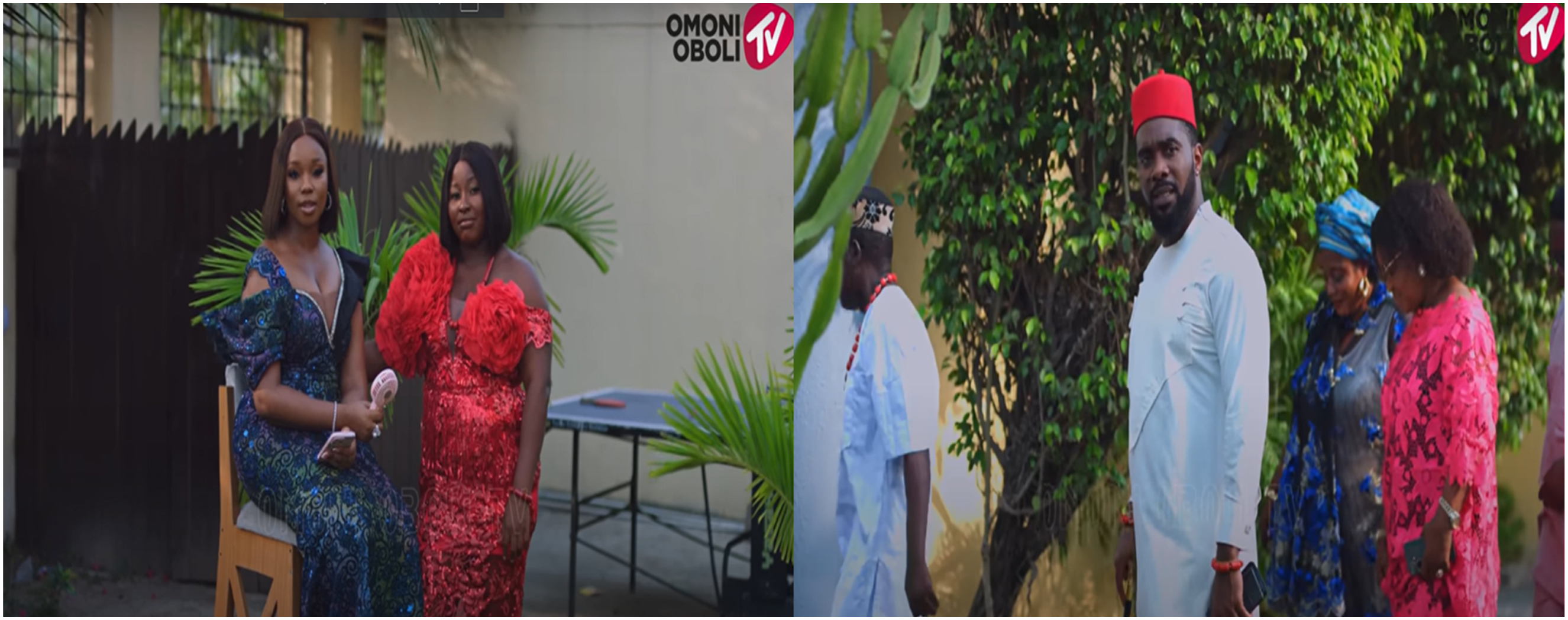
The Odogwu, as constructed in Love in Every Word, embodies the aspiration of many women in Nigerian social contexts. This is articulated in a subsequent conversation between Chioma and her mother upon Chioma’s eventual arrival in Anambra for her cousin’s wedding. Chioma’s mum, surprised to find her daughter working during a festive occasion, dismisses Chioma’s explanation of a “quick fix” on her laptop, stating, “There is someone I want you to meet….” When Chioma replies, “Mummy, I am seeing someone,” her mother retorts: Who are you seeing? Is it that your boyfriend that has not been able to figure out what he wants to do with his life? I want you to meet a real man, an Odogwu, a man that will treat you like the queen that you are.... Listen, I want you to meet a man that will truly take very good care of you, not that one that hasn’t even been able to figure out how he’s going to pay his rent, how much more being able to break an ordinary kolanut on your head. Look at your cousin’s wedding, this is just an ordinary introduction, imagine what will happen if she’s about to do her real traditional wedding. Don’t you want something like that for yourself?
5
Chioma’s mother here represents a generational perspective on idealized masculinity, one that is firmly rooted in a man’s capacity for economic provision and his ability to fulfill traditional responsibilities, particularly those pertaining to lavish marriage rites and ceremonies. In her scathing description of the undesirable man and her glowing portrayal of the Odogwu, she highlights that significant wealth and affluence are paramount for a man to be considered truly ideal, enabling the grand gestures, such as those seen at the cousin’s introduction ceremony, that are coveted by many. This dialogue firmly establishes that true social prestige is inextricably linked to a man’s financial capability to provide abundantly and perform culturally significant acts of generosity.
Once Odogwu eventually meets Chioma, he embarks on an unyielding journey to win her heart. His character construction in the movie, much like Burna Boy’s persona in the visuals of his song, is heavily influenced by traditional motifs. Throughout the film, Odogwu consistently appears dressed in traditional Nigerian attire, frequently adorned with his beads and the distinctive red cap. This consistent visual appearance grounds him in cultural legitimacy, signifying a deep-seated connection to heritage and an authentic form of authority. Furthermore, his speech, characterized by a pronounced Igbo accent that Chioma initially found bothersome, also lends to the traditionality of his character construction. The fact that Chioma eventually comes to accept and even appreciate his accent suggests that Odogwu’s authenticity, even if it deviates from urban “modern” sensibilities, possesses an inherent allure that ultimately prevails. This signifies that a man of Odogwu stature does not need to compromise his cultural identity to appeal to a contemporary woman; his genuine self, and accompanying traits, will ultimately offer him victory, affirming the notion that an Odogwu is undoubtedly the victorious champion.
Another key trait through which the Odogwu is portrayed in the film is through the demonstration of economic power, encompassing both financial might and financial generosity. In one scene, Odogwu stages a grand visit to Chioma’s workplace. Rather than arriving alone, he is accompanied by a band of musicians, making the moment feel more like a celebration than a casual stop-by. Chioma, her perpetually angered and toxic boss, and a colleague step out of the office mostly in awe to witness this traditionally dressed man, complete with beads and topnotch charisma, approaching Chioma. He explains his purpose, which is to simply collect her phone number, as they hadn’t exchanged contact information after their initial encounter. When Chioma’s boss, ever hostile, summons security to eject him, the security guard informs them that Odogwu has purchased the entire building in cash just to gain access to Chioma and get her phone number and he is, in fact, now the new landlord. This financial grand gesture is the epitome of economic power and conspicuous consumption. It is a dramatic, public display of financial might that, firstly, allows him to literally overcome perceived obstacles (security intervention) and assert his will. And secondly, it also serves as an example of performative visibility where his wealth is not just present but ostentatiously deployed to achieve his romantic objective and make him appealing and ideal.
This grand financial gesture, however, never ceases. Odogwu consistently showers Chioma with very expensive gifts. In a bid to reach her and fearing he might be ghosted due to Chioma’s unresponsiveness, he sends a series of lavish gifts that pile up on her desk as shown in Figure 6, eliciting covetous glances from her colleague and boss. He also buys costly necklaces for her and her friends when he meets them at a store and explicitly expresses his intention to invest in her business ventures, even though Chioma initially declines the gesture. These consistent acts of financial generosity and provision powerfully underscore the Odogwu character’s immense financial prowess and his capacity to “take very good care” of Chioma, demonstrating how material wealth functions as a potent tool for romantic pursuit and persuasion. Chioma (seated) gazes skeptically at her phone while her colleague (standing) secretly eyes the growing pile of luxurious gifts from Odogwu on Chioma’s desk. (Image Source: Omoni Oboli TV, https://www.youtube.com/watch?v=bslcx4LRFL0)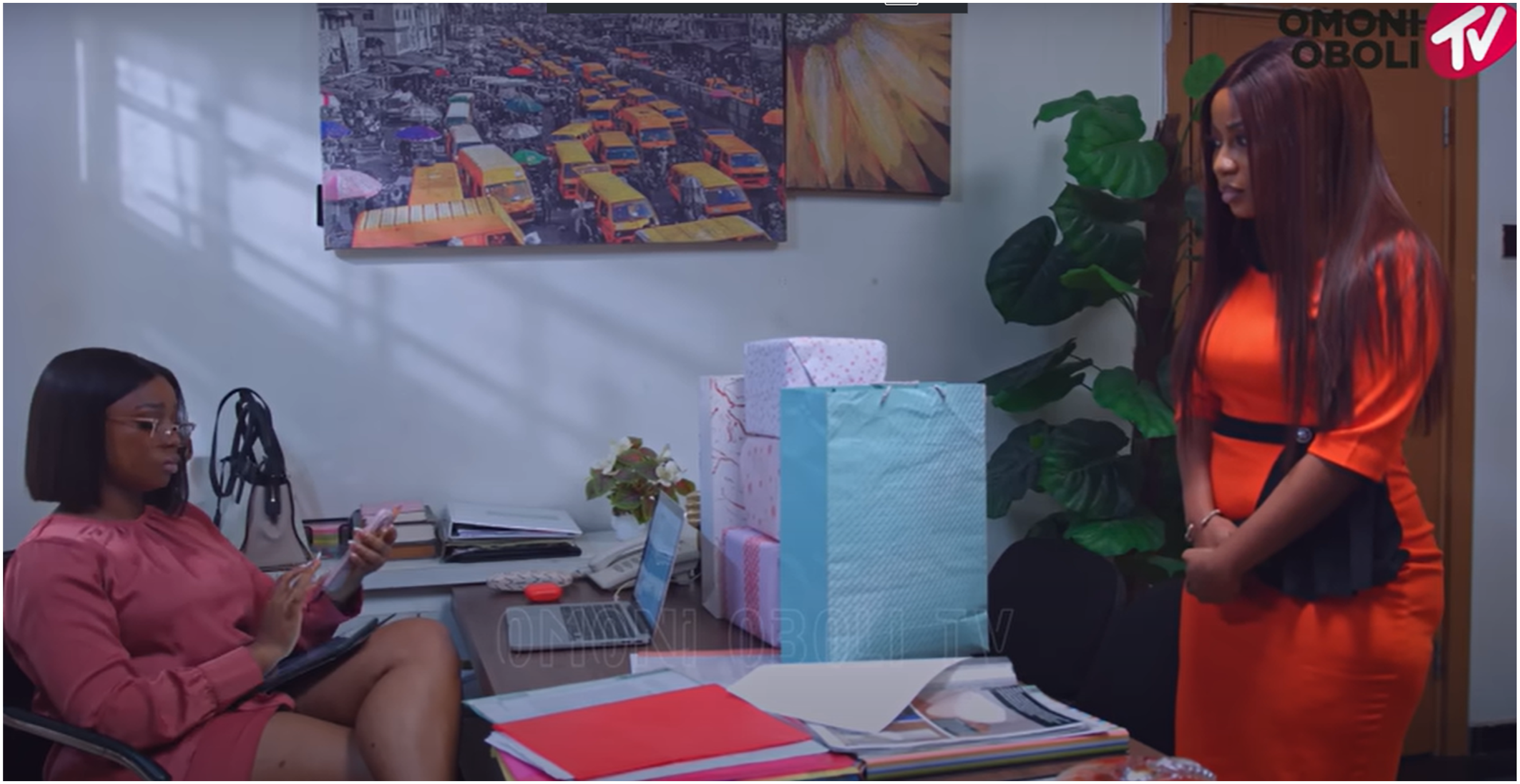
While this overt financial might is presented as a strong marker of what it means to be an Odogwu, the Odogwu character in the film is also portrayed with a notable degree of calmness, patience, and gentlemanly conducts. Throughout the film, he consistently demonstrates courtesy such as opening doors for Chioma. More significantly, despite his bold declarations of intent, he actively restrains from keenly seeking immediate sexual gratification, even after playfully bragging about his eventual intentions. He handles Chioma’s initial rejection, particularly her aversion to his accent, with remarkable grace and maintains a patient demeanor throughout his pursuit. This quality introduces a crucial nuance to the Odogwu ideal, suggesting that wealth alone doesn’t suffice. Odogwuness, as constructed in this film, necessitates emotional maturity, self-control, and a respectful approach that elevates the character beyond sheer material display. This integration of “softness” and “restraint” into a figure of immense power enhances his charisma and social prestige, making him formidable and at the same time highly desirable and trustworthy.
Seen in totality, one can view the character of Odogwu as one who eventually emerges as a champion. From their first encounter, Odogwu clearly sets his sights on his ultimate goal, which is to marry Chioma. Despite initial obstacles and Chioma’s reluctance due to his perceived “thick accent,” she finds herself unable to entirely dismiss him. This inability to let go can be interpreted as a form of irresistible charm that an Odogwu wields, which is a captivating influence that transcends superficial objections. This profound charm, complemented and accentuated by his overwhelming financial might, undeniable social prestige, deep cultural legitimacy, and compelling performative visibility, creates an allure that Chioma ultimately cannot resist.
When placing Burna Boy’s construction and performance of what it is to be an Odogwu in dialogue with that presented in the Nollywood film Love in Every Word, it becomes clear that there is no singular or monolithic portrayal of who an Odogwu is or should be. While both portrayals share significant similarities, particularly their emphasis on economic power, social recognition, and performative visibility as defining traits, notable differences, however, also exists. Burna Boy, on one hand, leans into a more defiant, “giant” archetype, overtly linking wealth to sexual prowess and asserting dominance through a confrontational stance, even while also acknowledging the presence of other Odogwus in his visual narrative; and on the other hand, Love in Every Word’s Odogwu, Obiora, while equally affluent and prestigious, tempers his power with gentlemanly patience and emotional control, presenting a more refined, albeit still dominant, romantic ideal. These compelling similarities and illuminating differences collectively enrich our understanding that this empowered male ideal cannot be viewed solely from a unitary perspective, but rather as a dynamic and multifaceted cultural construct continually shaped by diverse contexts and individual expressions.
Implications for African Men and Masculinities Studies
Since the 1990s, scholarship on men and masculinities in Africa has re-emerged with deliberate and sustained energy. Although, as Chitando et al. (2024) point out, this renewed focus does not necessarily translate into a fully expansive or densely populated field—given the relatively small number of scholars publishing consistently— the area is nonetheless consolidating into a recognizable domain of inquiry. This scholarly momentum has developed partly in conversation with masculinity studies in the global North, whose conceptual tools and institutional infrastructures created openings that African scholars have appropriated, revised, critiqued, and provincialised (Chitando et al., 2024; Jemiluyi, 2025a; Ouzgane, 2011; Ratele, 2020). Over time, special/themed issues, monographs, edited collections, handbooks, peer-reviewed articles, and NGO reports have collectively signaled both the consolidation of African masculinity studies and a widening acknowledgement that men and masculinities in Africa require context-specific, critical examination rather than being treated as taken-for-granted backdrops (Ammann & Staudacher, 2020).
Read against this intellectual landscape, the theorization of Odogwu masculinities offers a focused, culturally grounded framework for thinking about how ideals of manhood are being reworked in contemporary Nigeria. In distilling Odogwu masculinities around key traits encompassing economic power, social recognition, cultural legitimacy, gender performance, and performative visibility, the article proposes a named configuration of African manhood that is both locally intelligible and analytically generative. It critically reads “Odogwu” as a mid-level conceptual category that sits at the intersection of indigenous honor systems, globalized “celebrity” culture, and everyday social aspiration, thereby moving far beyond its surface use as a loose colloquial label. And consequently, it contributes to ongoing efforts within African masculinity studies to theorize context-specific masculine formations from within African cultural logics, rather than merely applying Western-derived models such as hegemonic masculinity and stopping there (Mfecane, 2018; Ratele, 2020).
Additionally, when placed in dialogue with other forms of African masculinities, Odogwu masculinities both converge with and diverge from more familiar patterns. Like hegemonic and “provider” masculinities documented elsewhere on the continent, Odogwu masculinities hinge strongly on economic achievement, heterosexual desirability, and social authority (Jemiluyi, 2025c; Smith, 2017, 2020). The expectation that a “real man” should be financially capable, command respect, and attract women resonates across many African contexts. Even so, Odogwu masculinities also accentuate dimensions that are less central in classic accounts, particularly performative visibility—the imperative that power be seen, staged, and publicly affirmed, and aesthetic bravado, where dress, bodily style, and spectacle serve as key markers of status. These emphases speak to urban, media-saturated environments in which masculinity is increasingly performed across screens and stages, within nightlife spaces, and on digital platforms, thereby enriching African masculinity studies with a framework attuned to the visual and sonic infrastructures of present-day cultural expressions.
To include, it is noteworthy to mention that the framework of Odogwu masculinities is not reducible to a single script of loud, hyper-materialist performance. The comparison between Burna Boy’s “Odogwu” and the Odogwu character in Love in Every Word clearly evidences that Odogwuness can be enacted through different emphases and tonalities. Burna Boy’s rendition foregrounds global fame, expressive force, and spectacular consumption; the filmic Odogwu, while equally wealthy and generous, is also marked by emotional restraint, patience, gentlemanly conduct, and a willingness to care, listen, and wait. These differences matter. They demonstrate that even within a named ideal such as Odogwu, there is no single way to “be” an Odogwu. Instead, the category as well accommodates quieter forms of authority, softer modes of romantic pursuit, and a greater degree of emotional maturity than stereotypes of African masculinities often allow. This aligns with Chitando et al.’s (2024) insistence that “the narrative about men and masculinities in Africa is much more complex than the stereotype would have us believe” (p. 2), challenging the reductive impulse of presenting African men as a homogenous bloc of patriarchal actors who are nothing but “an unmitigated disaster … rapists, ultra-violent, incompetent; and hypersexual” (p. 1).
Crucial to also mention is that the Odogwu framework also opens a window onto the ambivalent consequences of such ideals for young men’s lived realities. The intense valorisation of economic power, lavish spending, and public recognition tend to generate powerful pressures in a context marked by unemployment, precarity, and widening inequality. In Nigeria, the quest to “be an Odogwu” has, for some young men, been channeled into illicit economies and morally fraught strategies—ranging from internet fraud (often associated with “Yahoo boys”) and kidnapping for ransom to ritualized practices tied to quick wealth (Tade, 2013). While Odogwu masculinities offer aspirational narratives of success and recognition, they can also animate fantasies of “shortcut” achievement, exacerbating the tension between moral expectations and material constraints (Orhero & Nwoke, 2025; Smith, 2017, 2023). Recognizing this ambivalence is vital if African masculinity studies is to grapple seriously with how idealized masculine scripts interact with structural conditions and generate both aspiration and vulnerability.
Conclusion
This study has examined the construction and performance of “Odogwu masculinities” through a detailed analysis of Nigerian popular culture, specifically within music and Nollywood. It has argued that Odogwu masculinities constitute an emergent formation of African manhood, capturing how ideals of power, recognition, and authority are reconfigured in contemporary Nigeria. By theorizing Odogwu masculinities as a distinctive configuration within broader African masculinities—through the lyrical performance of Burna Boy’s “Odogwu” and the cinematic construction of the male protagonist in Omoni Oboli’s Love in Every Word—the analysis demonstrates that African masculinities are dynamically enacted and continuously renegotiated across cultural, economic, and symbolic frameworks.
The key characteristics identified; economic power, social recognition, cultural legitimacy, and performative visibility highlight the multifaceted nature of Odogwu masculinities as both culturally grounded and aspirational. The findings demonstrate that Nigerian popular culture, while reflecting existing norms around masculinity, also actively participates in constructing, valorizing, and complicating them. The Odogwu figure, as portrayed by Burna Boy and embodied by the film character, Odogwu, becomes an aspirational ideal that encapsulates contemporary Nigerian anxieties and desires around masculinity. At the same time, these portrayals reveal how the Odogwu archetype resists reduction to a fixed model, instead offering complex articulations of masculine identities that intertwine tradition and modernity, dominance and restraint, local cultural authenticity, and global visibility.
This analysis of this study holds significant implications for masculinity studies within Africa. It reinforces the importance of popular culture as a critical site of theorization, revealing how masculinity is continually constructed, contested, and reconfigured through everyday performances and media representations. Nigerian popular culture, in particular, provides rich insights into the fluid and adaptive nature of masculinity, challenging static or monolithic understandings of African manhood. The contribution of this study, nonetheless, is its theoretical articulation and construction of Odogwu masculinities, positioning it as a valuable addition to African-centered scholarship on men and masculinities, thereby enriching ongoing scholarly debates about plural, fluid, and contextually negotiated indigenous masculinities.
A limitation of this study, however, is its focus on a single song and one Nollywood film as case studies, and while this scope was deliberate to provide depth, it leaves open further opportunities for broader comparative analyses across genres, artists, and regional contexts. Future studies could also examine how different audience demographics such as age, gender, or geographic location interpret and internalize the Odogwu ideal, and per consequence, expand the reception-oriented dimension of this inquiry. Likewise, exploring how female artists and filmmakers engage, critique, or subvert the Odogwu archetype would enrich the narratives and expand the discourse and scholarly inquiries on gender power dynamics in African cultural production.
Footnotes
Acknowledgement
I would like to thank the anonymous reviewers for their constructive comments which have significantly strengthened the clarity and scope of the argument. I am also grateful to my Igbo friend, Ihuoma, for her generous cultural insight that this article profited from.

Funding
The author received no financial support for the research, authorship, and/or publication of this article.
Declaration of Conflicting Interests
The author declared no potential conflicts of interest with respect to the research, authorship, and/or publication of this article.