




Abstract
This quasi-experimental exploratory research focused on school belonging among early adolescent boys in public schools in Nova Scotia, Canada. GuysWork is a male-specific program that allows participants to critically examine and disrupt harmful masculinity stereotypes. We hypothesized that GuysWork would increase the boys’ sense of school belonging. We observed that most boys who participated in GuysWork reported a small, but statistically significant increase in their sense of school belonging after the initial year of recruitment. Early evidence suggests that programs like GuysWork offer a protective effect against decreasing school engagement over time.
Introduction
According to Baumeister and Leary’s ‘belongingness hypothesis’, belonging is a need to form and maintain at least a minimum quantity of interpersonal relationships Baumeister and Leary (1995), which play a fundamental role in human survival and thriving. Among these relationships, school belonging is important for adolescent development, as it impacts social identity, interpersonal relationships, and emotional regulation (Allen, 2022; Allen et al., 2024). Many school systems in Canada focus on the promotion of healthy relationships of adolescents, particularly with teachers and the school, as well as with peers and families/guardians (Robinson et al., 2023). At the middle school level, helping students understand the importance of healthy relationships is a major focus of school-wide programming through health curriculum (Robinson et al., 2023). This curriculum-based approach is important for supporting the mental health of students and aligns with the work of educators, as curriculum outcomes are intended to guide what they teach. Given that approximately one in three students do not feel a sense of belonging to their school (Organisation for Economic Co-operation and Development, 2019), which is an important protective factor for bullying victimization, the sense of school belonging decreases as students get older (Jenkinson et al., 2018), and boys generally have a lower sense of school belonging compared to girls (Palikara et al., 2025), this research focuses on school belonging among early adolescent boys.
School Belonging Overview
Belongingness is a long-standing topic in psychology in schools going back to Dewey, Vygotsky, and Erikson (Slaten et al., 2016). Although it is widely conceptualised, the most cited definition is by Goodenow and Grady (1993), who define school belonging as “the extent to which students feel personally accepted, respected, included, and supported by others in the school social environment” (p. 60). Research shows that school belonging is tied to a host of positive outcomes across adolescence. For example, school belonging improves school attendance, educational outcomes, school completion and results in higher grades (Jenkinson et al., 2018) and is a protective factor against substance abuse, violence, unintentional injury, absenteeism, and early sexual initiation. School belonging also protects against mental health problems, emotional distress, eating disorders, and suicidal ideation and attempts (Jenkinson et al., 2018), particularly in the long term across young adulthood (Allen et al., 2024). Systematic reviews have concluded the need for comprehensive strategies that address multiple school contexts (Greenwood & Kelly, 2019), as elementary school interventions between 1–3 years in duration demonstrated increased school belonging and reduced risk-taking behaviours, which were also shown to be effective in secondary school interventions (Allen et al., 2022). Allen et al. (2022) documented strong evidence for the effectiveness of behavioural modules (e.g., social skills training) in reducing psychological distress of adolescents, and that interventions aimed to improve students’ relationships with their peers (either through behaving more pro-socially or by reducing bullying among peers) had similar positive effects. Interventions focusing on students’ emotional regulation and co-regulation with peers and teachers have also demonstrated effectiveness in improving the psychological wellbeing and social connectedness of students in primary and secondary schools.
Despite the overall positive results in these systematic reviews, there remains a gap in understanding how school belonging can be developed and fostered in schools because the interventions were heterogenous (i.e., ranging from group to individual delivery, in-person to online settings, and two days through three years of deployment). Although this does suggest there can be multiple modes to impact school belonging (Jenkinson et al., 2018). Limited conclusions about the effectiveness of any given class or style of intervention (Allen et al., 2022) can be made.
School Belonging and Ethnicity
School belonging is a complex, multi-dimensional construct and, as several studies on school belonging have demonstrated, the influence of ethnicity on school belonging is a nuanced and complex topic. For example, Walton and Cohen (2007) found that black students who were led to believe they would have few friends in an academic domain displayed a drop in their sense of belonging and potential, whereas this did not happen for white students. Conversely, when doubts about school belonging were mitigated for black students, their academic achievement increased, whereas it did not for white students. Morris et al. (2020) claim it is imperative to consider the racial context of black youths’ schools when seeking to understand the effects of racial discrimination and school belonging on academic attitudes and beliefs. Their study found that for black students, school belonging does play a role in academic success, with important factors at play. For example, within majority white schools, high levels of school belonging demonstrated a protective effect for black students for high levels of racial discrimination stress. Conversely, school racial composition exacerbated the effect of high levels of racial discrimination stress and low levels of school belonging on academic efficacy. In schools with inequitable discipline practices (i.e., where black students were suspended more than white students) black students felt less school equity, less school belonging, and increased adjustment problems, even when accounting for student demographics, whereas these associations were not significant for white students. Murphy and Zirkel (2015) found that black middle school students’ self-reported belonging in school predicted educational efficacy and ambitions, but not for white students. Walton and Cohen (2011) found that when receiving a three-year intervention to improve their sense of belonging, black university students improved their grade point averages, their perceived sense of health and wellbeing, and reduced the number of doctor visits.
Early Adolescent Boys, School Belonging, and Masculinity Norms
There are few studies that focus on school belonging and the main effect of gender, and this small body of research is considered inconsistent and weak (Palikara, 2025). Witherspoon et al. (2009) and Wong et al. (2003) found no gender differences, while several other studies found that girls had higher school belonging than boys (Furrer & Skinner, 2003; Gillen-O'Neel & Fuligni, 2013; Hughes et al., 2015), although their sense of school belonging levels declined during high school (Gillen-O'Neel & Fuligni, 2013; Witherspoon & Ennett, 2011). Hernandez et al. (2017) found that Mexican-origin boys (in USA schools) generally had lower school belonging and ethnic pride levels than girls and that Mexican-origin boys may benefit most from positive individual self-affirming factors such as ethnic pride and self-esteem in promoting school belonging.
Moreover, the middle school years (grades 5–8 or ages 10–13) is an important period for the onset of powerful masculinity norms, some of which are associated with greater depressive symptoms and lower academic engagement, particularly during the 1st-year transition to middle school (Rogers et al., 2017). Middle school youth that are more likely to be dismissive of sexual harassment will display a higher likelihood of homophobic name-calling (Espelage et al., 2018). Subsequently, boys who engaged in homophobic taunting in grade 6 are more likely to engage in sexual harassment by the end of grade 7 (Espelage et al., 2018). Individual homophobic behaviours during middle school years were strongly linked to the beliefs of their peers, and attitudes toward masculinity within these peer groups were significantly predictive of these behaviours (Birkett & Espelage, 2015). At this age, some boys are actively engaging in the harmful policing of masculinity among their peers, resulting in poor self-esteem, emotional distress, and social discomfort (Reigeluth & Addis, 2016; Sirin et al., 2004). Early adolescent boys may feel pressure to adhere to masculine norms (Nielson et al., 2020), which may negatively impact their desire or ability to help others for fear of deviating from those norms or being ostracized by their peers. Young men who perpetuate harmful gender role norms, which increases the likelihood of interpersonal partner violence, are often victims of traumatizing or adverse life experiences themselves (Zhu et al., 2024). The perpetrators of some of the most severe forms of bullying in adolescence, who are also those with some of the poorest mental health outcomes, are described in the literature as victim-bullies (PREVNet, nd) and are more likely to be male than female. Among Canadian students from grades 6 to 10, more boys than girls report bullying others, and in some of those grades, boys were twice as likely to be reported for bullying than girls (PHAC, 2020). Those who report being bullied also report lower school belonging (Davis et al., 2019) and, not surprisingly, when youth are repeatedly victimized by peers, they report lower school belonging than youth who have never been victimized (Holt & Espelage, 2007).
A meta-analysis of the last twenty years of research in male suicide demonstrates that cultural norms of masculinity, including emotional suppression, failing to meet standards of male success, and the devaluing of men’s interpersonal needs, are strongly associated with increased suicide risk (Bennett et al., 2023). Furthermore, these norms are associated with dysregulated psychological pain, which calls for supporting males to understand and regulate emotions, expand masculine identity, and build meaningful interpersonal connections, all of which can happen in schools through health curriculum, and are a part of helping cultivate school belonging.
Current Study
School belonging for male-identifying students is needed, and developing this through healthy relationships with adults and peers at school is critical to supporting the mental health of middle school youth (Allen et al., 2022). The purpose of this study is to contribute to this area of research by exploring the impact of GuysWork health program for Grade 6 to 9 boys and its promise for promoting school belonging among early adolescent boys through unique curriculum-based school programming.
Developed by Morris Green, managed by Bridges Counselling (Nova Scotia, Canada), and implemented by educators and other school personnel in Nova Scotia’s public school system, GuysWork is designed to disrupt harmful masculinity stereotypes boys face with the hope of reducing homophobia, transphobia, sexism, and misogyny, and improving the health of the boys and those around them (Gilham et al., 2023). Long term, the goal is for GuysWork to serve as an upstream preventive intervention (i.e., primary prevention) to help mitigate gender-based violence. As an upstream approach, GuysWork aims to help boys see their agency and responsibility to help them be healthier individuals. Within GuysWork, masculinity is framed as something flexible and self-defined, emphasizing empathy, respect, and responsibility rather than dominance or conformity. This framing helps boys recognize that there are many ways to be male, to contradict the notion of how to “be a man”, and that healthy expressions of masculinity include care for oneself and others. Through engaging, reflective, and often expectation-thwarting scenarios and activities, GuysWork helps boys see how a predominant, traditional masculinity-often referred to as hegemonic masculinity (Connell, 2005)-may be influencing them in harmful ways (Rice et al., 2011).
The program intentionally encourages boys to consider multiple and diverse expressions of masculinity, including those that affirm gender and sexual diversity. Rather than prescribing a single view of what a boy “should” be, GuysWork invites participants to reflect on personal values, respect for others’ identities, and to challenge norms that marginalize peers, including 2SLGBTQIA + youth.
GuysWork is typically comprised of 10 sessions, which are offered directly in schools during instructional time as part of Health curriculum, and generally takes two months to complete all sessions. GuysWork facilitators are trained professionals who already work with youth, and range in profession from educators and counsellors to social workers and mental health clinicians. All facilitators undergo one full day of training and engage in optional bi-monthly community of practice sessions. This training provides facilitators with the capacities needed to create trusting and open social spaces within GuysWork for individual and group dialog and introspection, supporting participants in exploring their identities and the forces shaping them. GuysWork is not restricted to male facilitators, as sessions are led by professionals of any gender who are trained to create safe, reflective, and respectful environments for all participants. Additional details on GuysWork can be found in Gilham et al. (2023).
Each grade-level cycle covers key health and social topics relevant to early adolescent boys, including healthy relationships and boundaries, empathy and communication, peer influence, emotion regulation, consent, and help-seeking. The curriculum is grounded in a relational, discussion-based pedagogy: sessions rely on guided dialogue, scenario work, and reflective activities rather than direct instruction, inviting boys to examine restrictive norms and practice inclusive, pro-social alternatives. While components can be adapted by trained facilitators in other youth settings (e.g., community programs), this evaluation focuses exclusively on school-based implementation.
Beyond increased cognitive awareness, participants may also experience broader social, academic, and personal benefits from their involvement. For example, the program’s emphasis on belonging and pro-social behaviour may encourage more inclusive peer interactions and respectful communication, contributing to improved relationships at school and at home. Strengthened school belonging and reduced teasing can support classroom engagement and participation, while positive shifts in masculinity norms may extend into community and family settings, promoting help-seeking and healthy coping (e.g., Goodenow, 1993; Oransky & Fisher, 2009).
We hypothesize that boys would report low school belonging at baseline and consequently would also report higher adherence to traditional masculinity norms that would be inversely related to pro-social behaviours. Based on this hypothesis, we expect changes in their school belonging, male role norms, and/or pro-social behaviours at post-intervention, as well as positive changes in school belonging that coincide with changes in male role norm adherence or pro-social behaviours. We hypothesize that GuysWork may help boys develop healthier relationships among themselves and with their facilitators that would correspond to increases in pro-social behaviours and their sense of school belonging, as well as changes in how they perceive the male role norms around them. Such changes would suggest GuysWork is helping teach boys to challenge and resist hegemonic stereotypes of masculinity. Finally, as boys are rarely given boys-only space to question and discuss pressures on them, especially in school settings, we hypothesize changes to their school belonging scores, which would provide supporting evidence that they are benefitting from GuysWork program content.
Methods
Participants and Procedures
During the initial year of recruitment, participants (Grade 6 boys) were recruited from nine schools across five participating school divisions known as Regional Centres for Education (RCE) that offered GuysWork during the 2023-2024 academic year. Participating schools represented rural (100% of participating schools) locations across Nova Scotia, Canada. All students enrolled in the GuysWork program were given a research information packet inviting them to participate in the study by their facilitator in early fall. The packet contained a caregiver information letter and consent form; caregivers were asked to sign and return the consent form if they agreed that their child could participate in the study. Students also completed assent forms to participate in the study, and all students with parent consent provided their own assent to the study; the overall consent rate was 86%.
Participants completed pre-test surveys between September and May (before program start; T1) and post-tests (T2) between November and June of the given academic year. The focus of the survey was assessing key program outcome domains; however, reported results will focus on male role norm adherence, pro-social behaviour, and school belonging. The survey was conducted during the participants’ regularly scheduled instructional time at school under the supervision of the GuysWork facilitator using either a written questionnaire or online questionnaire administered through Qualtrics. This study was reviewed and approved by the StFX University Research Ethics Board, as well as the participating schools and RCEs.
Measures
Psychological Sense of School Membership (PSSM)
School belonging was measured using the Psychological Sense of School Membership (PSSM) scale (Goodenow, 1993). The PSSM is a validated metric that contains 18 questions based on a five-point Likert scale. Examples of questions include “I feel like a part of this school” and “People here notice when I am good at something.” Likert scale response items are scaled between varying degrees of trueness (i.e., 1 = Not true/Not all true to 5 = True/Completely True). The PSSM scale, which is summed and divided by 18, has a scale range between 1.0 to 5.0, where a higher total score indicates a stronger sense of school membership and belonging. Per Hagborg (1994) and Cheung (2004), using 5 of the PSSM items that were on a reverse scale (i.e., “It is hard for people like me to be accepted at my school”), a subscale of the PSSM relating to feelings of rejection was also determined that, according to Ye and Wallace (2013), “has great value as a screening tool to diagnose or identify students at risk of disengagement from school, with potential mental health issues, or on a path to academic failure” (p. 212).
Meanings of Adolescent Masculinity (MAMS)
Traditional masculinity norms were measured using the Meanings of Adolescent Masculinity Scale (MAMS) (Oransky & Fisher, 2009). The MAMS is a validated metric that contains 27 questions based on a four-point Likert scale. Examples of questions include “A guy should always seem as manly as other guys that he knows” and “No matter what happens, a guy should seem strong to others.” Likert scale response items are scaled between varying degrees of agreement (i.e., 1 = strongly disagree to 4 = strongly agree). The MAMS scale, which is summed and divided by 27, has a scale range between 1.0 to 4.0, where a higher total score indicates a stronger conformity with traditional male gender role norms. The MAMS is comprised of four subscales: emotional restriction, heterosexism, social teasing, and constant effort. Internal consistency for each subscale are as follows: constant effort with α = .79, emotional restriction with α = .80, heterosexism with α = .80, and social teasing with α = .61 (Oransky & Fisher, 2009).
Pro-Social Behaviour Scales (PBS)
Pro-social behaviour was measured using the Pro-social Behaviour Scale (PBS) (Nielson et al., 2017). The PBS is a validated metric that contains 20 items based on a 5-point Likert scale. The questions explore five types of behaviour; defending behaviour, emotional support, inclusion, physical help, and sharing. Examples of questions include “If I see someone being given a hard time, I stand up for that person” and “If someone is sad, I try to make that person laugh.” Likert scale response items are scaled between varying degrees of agreement (i.e., 1 = strongly disagree to 5 = strongly agree). The PBS scale, which is summed and divided by 20, has a scale range between 1.0 to 5.0, where a higher total score indicates a stronger likelihood to perform actions that aim to benefit or improve the well-being of another individual or groups of individuals.
Covariates
Several studies have focused on different student populations (e.g., different ages, gender identity, ethnic background(s), family-living situation, and socio-economic status), indicating that population differences could impact our results (Exner-Cortens et al., 2020, 2022; Gwyther et al., 2019; Kutcher et al., 2015). As such, participant characteristics were collected from the questionnaire, along with information relating to their specific school and RCE. In the current study, basic demographics, including age, grade, gender identity (i.e., male, non-binary, trans-male, and questioning), and ethnicity were recorded. To understand the family living situation, participants were asked whether or not they lived with a single or two parents/guardians or if they lived in other situations to better understand and capture various family dynamics. To understand socio-economic status, a surrogate in the form of area-level income (ALI) was used and was based on the median income of households within a specific geographic area that were estimated through postal codes. ALI reflects social and economic characteristics of neighbourhoods, including environment, access to services, and provides a stable measure of SES (Hanley & Morgan, 2008).
Analysis
Based on the within-groups evaluation of GuysWork, summary statistics, including mean (standard deviation) and count (marginal proportion) will be reported and potential confounding variables with PSSM will be assessed using t-tests, ANOVA, or Pearson’s correlation, or their nonparametric equivalents. Exploratory multivariable analysis examining the impact of behaviour scales (e.g., MAMS and PBS) on PSSM will be completed using generalized linear models. Additionally, due to the nested nature of the data (i.e., students within schools), hierarchical linear mixed-effects model with school as a random-effect will also be used to examine the impact of behaviour scales on PSSM. The following results are part of a planned interim analysis of Year 1 of 3. Due to the exploratory nature of the analysis, a less conservative α = 0.10 was used to balance power and risk of Type I errors during this interim exploratory analysis (Schumm et al., 2013; Warner, 2013). As this study is exploratory, the analysis was adjusted to increase sensitivity to better detect small effects and, given the nature of the intervention, the risk of false negatives might be more severe than false positives (Fiedler et al., 2012).
Results
Data for this study were drawn from a within-groups evaluation of GuysWork obtained between Fall 2023 and June 2024. A total of 140 surveys were recorded during the first school year of participation, which involved 9 schools over 5 RCEs, and on average, the questionnaire took 40 minutes to complete. Among the 9 schools, 8 schools had follow-up responses, resulting in 79 participants with baseline responses and 60 participants with follow-up responses for a post-test retention rate of 75.9%, which included one student who missed the baseline survey. The number of participants by school varied between 6–12. The program completion times among schools ranged between one and three months, with post surveys completed within two weeks of the completion of the last lesson of the program.
Sample Description
Baseline Demographics of Study Population Stratified by REC
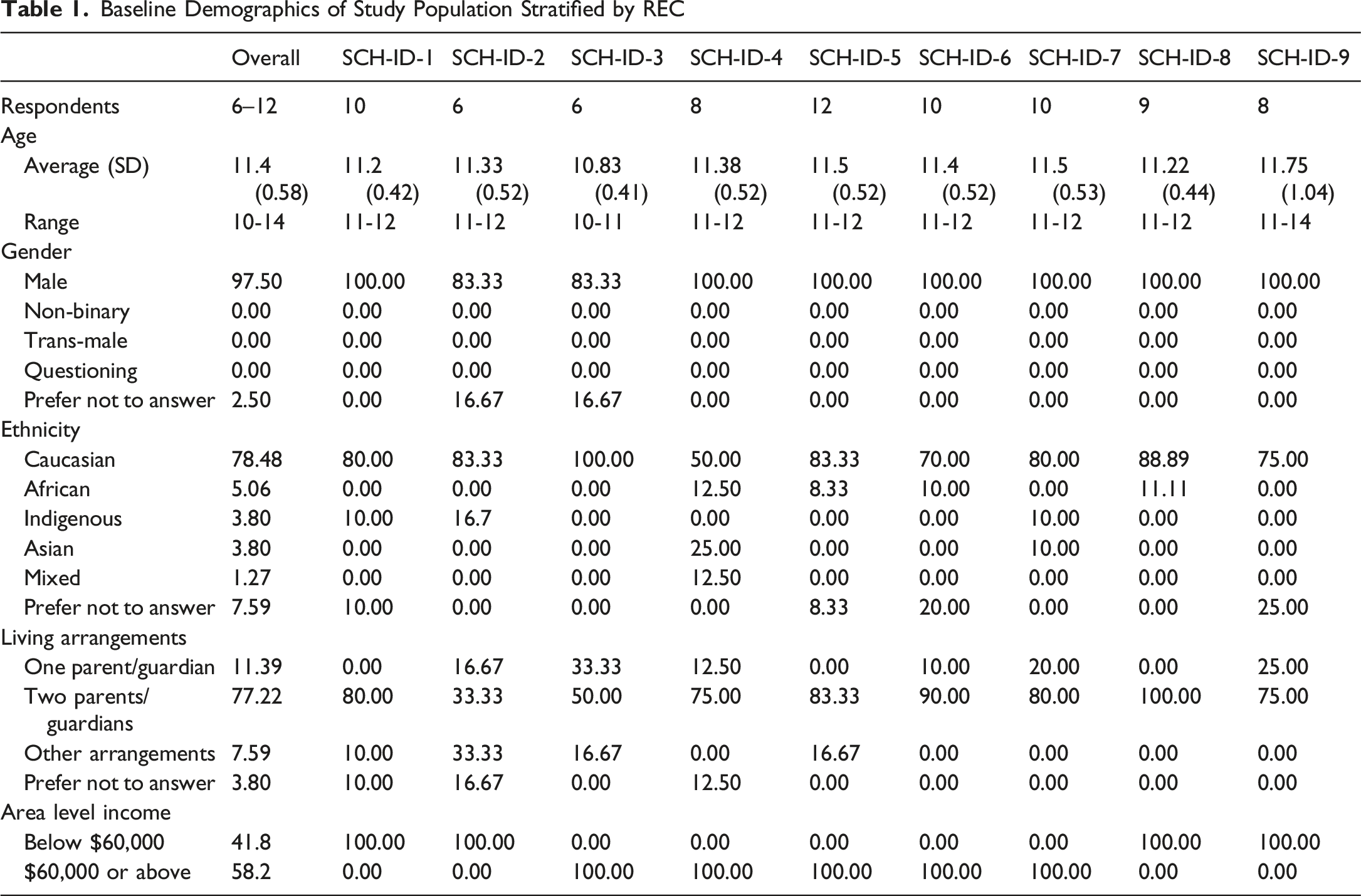
Overall, participating schools recruited a homogeneous group of students across most covariates except for one school (SCH-ID-9) that had a wider age range. Most students identified as being Caucasian and male, while most students were from areas where the ALI was above the poverty line, with nearly 60% enrolled in schools where the average income based on postal code was above $60,000 CAD. Although not significant, there were some differences (p-value <0.10) between schools with respect to Gender and Living Arrangements.
Among the 79 participants, the overall average PSSM score was 3.63 (0.76) with a range between 1.89 and 4.83, indicating most respondents believed to some degree they had some sense of school belonging; however, almost 1 in 5 respondents had scores below 3, indicating a lack of belonging. Across schools, which had 6 to 12 participants, PSSM scores were heterogeneous, with one school (SCH-ID-8) recording the lowest group mean of 2.89 (p = 0.02). Among demographic variables, except for socio-economic status (SES), no apparent associations were observed for age, gender identity, ethnicity, and living arrangements. Dichotomizing based on if the ALI was above $60,000, which is just above the poverty line for a family with 2 adults and 2 children (Government of Nova Scotia, 2024), there was a positive association between ALI above $60,000 and PSSM.
For both MAMS, PBS, and their four and five respective subscales, no significant differences were observed between schools. The overall average MAMS score was 15.13 (3.17) with a range of 6.67 to 24.75. As MAMS has a maximum score of 27, most participants (70%) showed stricter adherence to traditional masculinity tendencies (i.e., scoring 13.5 or higher). Conversely, the overall average PBS score was 3.70 (0.59) with a range of 1.45 to 5.00, and most students (>90%) had scores above 3, indicating a greater likelihood of engaging in pro-social behaviours. At baseline, there was no correlation between PSSM and MAMS, nor with its four subscales; however, there was a significant and moderately positive correlation between PSSM and PBS (Cohen’s d = 0.65, p < 0.01), as well as a significant and moderately inverse correlation between MAMS and PBS (Cohen’s d = 0.78, p-value <0.01), whereby students with a low PBS score tend to have a high MAMS score (and vice-versa).
Separate multivariable linear regression models were built using MAMS, PBS, or both scales while adjusting for age, gender, ethnicity, living arrangements, and ALI. Using a backwards variable selection method, PBS and ALI showed significant associations with baseline PSSM. After adjusting for ALI, PBS showed moderately positive associations with PSSM (estimated Cohen’s d = 0.56, p-value = 0.02). A similar hierarchical linear mixed-effect model, which was built using School as a random-effect to account for the nested nature of students within schools, demonstrated similar significant associations between PBS and PSSM. Likelihood ratio tests comparing the model with and without a random-effect for School showed no improvement in model fit when including the random-effect. No violations of model assumptions, including heterogeneity and normality, were observed.
Pre-Post Comparisons
Comparison of pre-GuysWork and post-GuysWork, saw overall changes with respect to PSSM scores, as students experienced a modest, but significant increase in their sense of belonging from (Pre-PSSM = 3.63 vs. Post-PSSM = 3.89, Cohen’s d = 0.39, p = 0.03) since the initial implementation of GuysWork. With respect to MAMS and PBS, no significant changes were observed when comparing pre- and post-GuysWork results; however, although changes were not significant, decreases among 2 of the 4 MAMS subscales (Heterosexism and Teasing) and increases in PBS scores, as well as among all subscales, were observed.
Among the 60 participants with matched pre/post survey responses, similar trends were observed among the paired analyses, whereby the pre-survey responses for participants acted as their own control for comparison of the post-survey responses after working with the GuysWork facilitators. Within this subset, there was an expected modest increase in PSSM that remained significant, albeit the effect size was smaller (Cohen’s d = 0.24, p = 0.08), as well as similar trends in MAMS and PBS scores as above. Similar to the baseline analysis, no significant associations were observed between changes in PSSM scores and changes in MAMS; however, there was a significantly large positive correlation between changes in PSSM and PBS (Cohen’s d = 0.83, p < 0.01), as well as a significantly moderate inverse correlation between changes in MAMS and PBS (Cohen’s d = 0.63, p-value = 0.03). Although no associations were observed between changes in PSSM and ALI, ethnicity and changes in PBS were significantly associated with baseline PSSM. After adjusting for ethnicity, changes in PBS showed positive associations with PSSM (estimated Cohen’s d = 0.63, p-value = 0.04). Similar results were observed for the mixed-effect models and no violations for any model assumptions, including heterogeneity and normality, were observed.
Examining the subscales of PSSM, the positive subscale resulted in similar results as the analysis above; however, for the negative subscale, the effects of MAMS was more apparent. For the baseline analysis, multivariable linear regression indicated that both PBS and MAMS had associations with feelings of rejection. Specifically, PBS had a small but significant inverse effect on feelings of rejection (estimated Cohen’s d = 0.42, p-value = 0.08) while MAMS had a slightly larger and positive effect on feelings of rejection (Cohen’s d = 0.49, p-value = 0.04), i.e., those that had high MAMS scores were more likely to experience feelings of rejection.
Comparison of pre-GuysWork and post-GuysWork, saw changes similar to increases to the positive subscale that remained among the subset of 60 participants with matched pre/post survey responses. For the negative subscale, there was no overall significant change when comparing pre- and post-GuysWork; however, when examining the subset of 60 matched participants, a small but significant increase in feelings of rejection (Cohen’s d = 0.24, p = 0.08) was observed. Using a similar multivariable linear regression to look at changes on the subscales, similar results were observed for the positive scale; however, on the negative scale MAMS, although changes in PBS was no longer associated with changes in the negative PSSM subscale, changes in MAMS were both significantly related to changes in feelings of rejection with a moderate to large effect size (estimated Cohen’s d = 0.79, p-value <0.01), which suggests that lowering MAMS scores could reduce feelings of rejection.
Discussion
In this quasi-experimental study, we observed that most boys who participated in GuysWork, a gender-transformative health program that allows participants to critically examine and disrupt harmful masculinity stereotypes (Gilham et al., 2023), reported a small, but statistically significant increase in their sense of school belonging following the end of the program. Additionally, we observed that engaging in pro-social behaviours has an important positive relationship to their sense of school belonging, both before and after GuysWork programming, and that increases in pro-social behaviour corresponded to increases in their sense of belonging as well. Moreover, their pro-social behaviour was negatively associated with their adherence to traditional masculinity norms. Both of these relationships were stronger after they participated in GuysWork. Given that boys tend to feel a decrease in their sense of school belonging over time, and the increased challenges associated with adherence to traditional masculinity norms, including less pro-social behaviour, these are important outcomes that add to the nascent body of evidence supporting male-specific school-based health programming (Claussen et al., 2024; Exner-Cortens et al., 2022; Gilham et al., 2023).
Based on the initial year of recruitment, the results show evidence supporting our main hypothesis (i.e., that boys would report low school belonging at baseline and consequently would also report higher adherence to traditional masculinity norms at baseline). At baseline, although we observed that most boys reported some sense of school belonging, which was slightly higher than expected, 1 in 5 reported low or no school belonging, and most boys had some adherence to traditional masculinity norms. Moreover, given the boys indicated a strong likelihood of engaging in pro-social behaviours at baseline, and there was a strong positive relationship between pro-social behaviour scores and school belonging scores (i.e., the greater the likelihood of engaging in pro-social behaviours, the greater the boys’ sense of school belonging), and pro-social behaviours had an inverse relationship with traditional masculinity norms, the higher sense of belonging could be explained by their positive pro-social behaviours. In other words, boys who perceive themselves as having higher pro-social behaviours also perceive themselves as more connected to their schools and less driven by traditional masculinity norms.
By school, boys had a greater sense of school belonging where incomes were above Nova Scotia’s poverty line, mirroring findings in other studies of school belonging (King, 2022). The association between family income and young adolescent boys’ sense of school belonging is important, as the province of Nova Scotia has the highest poverty rate nationally (Government of Nova Scotia, 2024) along with the third lowest minimum wage in Canada (RCC, nd). This study highlights the potential importance of reducing family poverty, as lower SES has not only a multitude of direct consequences, but also indirect consequences that can exacerbate challenges in an already vulnerable population. We suggest that supporting families that are struggling financially and implementing health programming like GuysWork across the province holds a combined promise to help boys be further connected to their schools, complete high school, and reduce gender-based violence, all of which are likely to help strengthen Nova Scotia.
After participating in GuysWork, the boys had a greater sense of school belonging; however, although there were no significant changes in their overall adherence to masculinity norms, there were decreasing trends in two of the subscales (Heterosexism and Teasing), which could be associated with GuysWork’s specific lessons on homophobia and the overall GuysWork culture of increasing understanding among the boys. These findings reflect the program’s focus on empathy and respect for difference, which are central to how GuysWork encourages boys to explore positive, inclusive understandings of masculinity. Moreover, although there was no decrease in masculinity norms, there was no increase that, in and of itself, is an important outcome. During school years, boys begin to experience a strengthening or reinforcement of traditional masculinity norms, and any delay or attenuation towards these norms are a positive sign of the impact of GuysWork. Similarly, although there were no overall significant changes in their pro-social behaviours, given they were already likely to engage in pro-social behaviours prior to starting GuysWork, it was unlikely that we would have observed substantive changes within the first year of the three-year project. Nonetheless, increases in pro-social behaviour scores was a strong predictor for increases in scores for the boys’ sense of school belonging. There was also a connection between stronger adherence to traditional masculinity norms and feelings of rejection, and given its inverse relationship with pro-social behaviours, increasing pro-social behaviours could decrease the boys’ adherence to traditional masculinity norms, which are primary objectives of GuysWork. These are important outcomes for the program’s lesson creators and facilitators to consider as part of their ongoing review and adaptation of GuysWork.
The interpretation of the paired analysis of a subset of boys’ scores is somewhat different and more nuanced. As observed through the multivariable analyses, Ethnicity and Socio-Economic Status are confounding variables that may be attenuating the effect size within the paired analysis, thereby weakening the observed relationship between GuysWork and changes in their sense of belonging, as well as pro-social behaviour and masculinity norms. For example, non-Caucasian boys were more likely to have a lower sense of school belonging compared to Caucasian boys, which persisted after completing GuysWork. Additionally, as the paired analysis only involved approximately 75% of participants, the loss of power, and subsequent changes in effect size and significance, was not surprising. Importantly, this was an interim analysis and, based on a post-hoc power analysis using the estimated effect sizes observed, a total of 107 participants are required to produce a power of 80% for our study. The number of additional participants is well below the recruitment target for the remaining two years of the study. Regardless, positive changes are associated with GuysWork and, given the results of this interim analysis, further research involving GuysWork and ethnicity, including following the evaluation completed by Exner-Cortens et al. (2022) could be incorporated as part of future program adaptations and evaluation.
Limitations
This study was part of a planned interim analysis of the impact of the GuysWork program during the initial year of recruitment and, as such, the results are preliminary and exploratory in nature. As noted above, when comparing the baseline to initial follow-up, we detected a moderate and significant change in sense of belonging after the implementation of GuysWork; however, when looking at the individual changes, the effects were attenuated but remained significant. These changes were not surprising given the reduction in sample size but, importantly, the positive trends remained despite the loss of power. At the time of preparation of this article, an additional 70 students were enrolled and baseline surveys collected, which will close to double the study size by the end of Year 2 and will help further elucidate the individual-level impact GuysWork is having on participants. Another important limitation in the study relates to the generalizability of the current schools, as no urban schools were initially enrolled; however, planned expansion of GuysWork across not only Nova Scotia, but the Atlantic provinces will increase the likelihood that we will capture a diverse group of schools and students to increase the generalizability of our results. In this preliminary analysis, facilitator gender and team composition were not recorded or analyzed. Future phases of the evaluation will explore safe and practical ways to document facilitator characteristics to assess whether these factors influence participant outcomes.
Finally, although inclusivity is a core focus of GuysWork, this analysis did not collect detailed information on sexual orientation while gender diversity and ethnicity were not included in the analysis due to limited power to investigate their impact at this time. Although gender and ethnicity differences are important, 98% of respondents identified as male while the remaining 2% preferred not to respond, and almost 80% of respondents identified as being of Caucasian, which is in line with the demographics of Nova Scotia. Information on the participating boys’ male-identified role-models was not collected and family-make-up (e.g., One parent/guardian, Two parents/guardians, Other situation, or Prefer not to Say) was limited. Although the majority of respondents (i.e., almost 80%) indicated two-parents/guardians, only 1% of couples in Canada are same-sex and, among them, only 12% have children, and given that half of all same-sex couples are living in major urban cities like Toronto, Montreal, Vancouver, and Ottawa (Government of Canada, 2017; Government of Canada, 2021), we would expect even less in rural areas. Future qualitative research could explore ways to safely capture these perspectives to further strengthen the inclusivity of program evaluation.
Implications
For school-based practitioners concerned about boys’ engagement levels in schools, our findings have several implications. First, creating facilitated spaces for boys to talk about the pressures they face via a program like GuysWork, offers a protective effect against decreasing school engagement over time, as seen in the increased sense of school belonging. The relationship pro-social behaviour plays in school belonging and traditional masculinity norms suggests that school programming ought to focus on teaching and mentoring pro-social behaviour as well as providing scaffolded opportunities for boys to engage in pro-social behaviours, which GuysWork programming does. Moreover, any delays or attenuation towards masculinity norms, as well as increased exposure to positive role models, which GuysWork programming does, will help support positive masculinity and mental health development. Importantly, decreasing harmful masculinity norms has the potential to prevent partner-based violence (Pascoe & Wells, 2022), as well as bullying and violence towards those with diverse sexual identities and orientations (Barrett et al., 2020). As previously noted, a strong sense of school belonging does play a role in school success; this is especially the case for black students (Morris et al., 2020). As part of health curriculum outcomes for middle school students, our early findings support gender-specific health classes like GuysWork to increase boys’ sense of school belonging.
The success of such programming also depends on the adults who facilitate it. GuysWork is designed for in-school delivery as part of Health curriculum, with facilitators typically organized as dyads made up of educators, school counsellors, or school-based youth-service professionals who receive program-specific training to deliver the sessions and engage boys in reflective, relational dialogue. Their preparation helps ensure that conversations about masculinity, belonging, and mental health are guided in ways that are safe, supportive, and developmentally appropriate for early adolescents. In practice, schools should ensure that facilitation remains inclusive and explicitly welcoming diverse masculinities. School social workers, school nurses, athletic coaches and school-based community organizations hold potential as facilitators. Establishing group norms that address homophobia and transphobia and using affirming language throughout sessions helps reinforce that all boys, and diverse ways of being male, belong in these conversations.
Conclusion
We conducted this exploratory evaluation to better understand whether a gender-transformative, curriculum-based program for early adolescent boys could support school belonging at a developmental stage when belonging often declines and harmful masculinity norms intensify. Across the first year of implementation, we observed a modest but meaningful increase in boys’ sense of school belonging following participation in GuysWork, alongside robust associations between pro-social behaviour and school belonging, and inverse associations between pro-social behaviour and traditional masculinity norms. Taken together, these findings suggest that school-based programming that explicitly names and challenges some traditional masculinity norms, while simultaneously inviting boys to practice pro-social, relational ways of being with peers and adults, can contribute to a more secure sense of connection to school. Although preliminary and based on an interim sample, our results add to a small but growing body of evidence that male-specific, gender-transformative Health education can serve as an upstream, school-based strategy to support boys’ wellbeing, relationships, and engagement.
The preliminary nature of this analysis, its limited sample size, and the rural and relatively homogeneous school contexts underscore the need for caution in interpreting these results. The influence of socio-economic status and ethnicity, the loss of power in the paired analysis, and the absence of urban schools all signal the importance of continuing the planned evaluation as GuysWork expands within Nova Scotia. Future phases of this multi-year evaluation, including larger samples, urban and more demographically diverse schools, and, ideally, complementary qualitative work, will help clarify the mechanisms by which GuysWork influences belonging, pro-social behaviour, and masculinity norms over time. As systems leaders and school practitioners seek concrete ways to support boys’ mental health and reduce gender-based and peer-based violence, programs such as GuysWork offer one promising model for integrating evidence-informed, upstream intervention into existing health curriculum, with the long-term goal of fostering schools in which all boys can experience safety, connection, and multiple, healthy ways of “being a boy,” and eventualy being a male.
Footnotes
Acknowledgements
Thank you to our school-based partners for their role in supporting this research. Their support and direct role in the research were essential.

Ethical Considerations
This study was reviewed and approved by a University Research Ethics Board, as well as the participating schools and
Consent to Participate
The StFX University Research Ethics Board and the Regional Centres of Education approved our survey instruments. Written parental consent and participant assent with signatures were collected before surveys were administered.
Funding
This work was supported by funding from the Nova Scotia Advisory Council on the Status of Women, and Women and Gender Equality Canada.
Declaration of Conflicting Interests
The authors declared the following potential conflicts of interest with respect to the research, authorship, and/or publication of this article: Brandon Hamilton was employed by Bridges Counselling Inc. (receiver of provincial and federal funds for GuysWork implementation) as the GuysWork Project Coordinator. Christopher Gilham and Derrick Lee received consultation fees from Bridges Counselling Inc. to help lead quantitative research activities for GuysWork. Brandon Hamilton was a member of the Nova Scotia Provincial GuysWork Advisory Board.
Data Availability Statement
Data is available upon reasonable request.