



Abstract
This article explores how Filipino men negotiate and reinterpret the breadwinner role—a crucial feature of local hegemonic masculinities—in response to the challenges of internal displacement. Drawing on the life stories of 31 men from the Southern Philippines who experienced conflict-induced internal displacement, we found that despite not always fulfilling traditional breadwinning expectations, men continued benefitting from its associated privileges. To manage disruptions to their life story projects that threatened their identities, Filipino men redefined breadwinning by shifting focus from income generation to efforts involved in finding work, emphasizing its legality and downplaying the type of work or pay. This redefinition allowed men to maintain authority in their family and community, thus preserving their position in local hegemonic masculinities.
Keywords
While women’s economic participation in the Philippines rates among the world’s highest, many Filipino men and women continue to cultivate the perception of breadwinning as primarily, if not solely, a man’s duty or primary responsibility (Medina, 2015; Salazar Parreñas, 2008). This perception is interesting in itself but has broader implications in the context of five decades of protracted conflict and internal displacement, which adversely affected the income levels and employment status of internally-displaced men.
Few studies have examined the relationship between the masculinities of internally-displaced Filipino men relative to the breadwinner role (Bagaporo, 2021). However, the general literature on breadwinning in the Philippines indicates that challenges to the enactment of this role have triggered its reconfiguration, occasionally generating positive outcomes (Turgo, 2014). Yet, in the case of marginalized masculinities, negotiations and reconstructions of the breadwinner role often valorize notions of masculinity that perpetuate women’s subordination (Bagaporo, 2021). Thus, understanding men’s relationship to the breadwinner role is crucial in addressing women’s subordination and gaining insight into men’s gender identities in the context of conflict-induced internal displacement, which could be helpful to other countries experiencing similar challenges.
Based on the life stories of 31 Filipino men from Southern Philippines who experienced internal displacement, supplemented by interviews with women and local officials, this paper examines the impact of conflict-induced internal displacement on men’s constructions of masculinity, focusing on their views of the breadwinner role. To this end, this paper explores Filipino men’s perspectives on who should undertake the breadwinner role, what qualifies as breadwinning, and the important aspects associated with performing this role.
To fully understand these concerns, some background information is required. We begin by providing a brief overview of conflict and internal displacement in the Philippines, followed by an examination of masculinities in relation to these issues, with a focus on specific attributes of Filipino masculinities. Finally, we investigate men’s perception of the breadwinner role and how it influences and shapes their gender identity.
Contextualizing Conflict and Internal Displacement in the Philippines
The Philippines is marked by one of Southeast Asia’s longest-standing and enduring violent conflicts (International Alert Philippines, 2016). The history of protracted violent conflicts and displacement in Mindanao is primarily rooted in the following underlying conditions: (a) the historical objections of Muslims, dating back to the colonial period, against integrating into the Philippines; (b) land ownership issues, particularly the effects of policies such as Philippine Commission Acts 2254 and 2280, which led to landless farmers—mainly from Northern Luzon—migrating to Mindanao, after being promised financial assistance by the Philippine government (Gloria, 2014). This migration eventually made Muslims and Lumads (indigenous people of the Philippines) minorities in their homeland (Rasul, 2003, see p. 127); and (c) the persistent economic and social hardship faced by the Muslim communities (Diaz, 2003; Hull & Echavez, 2010; Rasul, 2003), where essential services such as education and health in mostly Muslim-dominated communities remain grossly inadequate (Diaz, 2003).
The secessionist war in Mindanao was primarily a conflict between the Armed Forces of the Philippines (AFP) and the two prominent Muslim secessionist groups in the country—the Moro National Liberation Front, formed in 1972 (MNLF), and the Moro Islamic Liberation Front (MILF), a breakaway group from the MNLF formed in 1984. The latter gained prominence after a military show of force in 1996 in response to their dissatisfaction with the peace agreement that the MNLF signed with the Philippine government (Verbrugge & Adam, 2016). The other Muslim militant groups in the country, such as the Abu Sayyaf Group (ASG) and the Bangsamoro Islamic Federation Freedom Fighters (BIFF), were former members of the MILF. The report shows that “factions of the BIFF and ASG, who have pledged allegiance to the Islamic State in Iraq and Syria”, are also affiliates of the MILF (International Alert Philippines, 2016, p. 12).
Furthermore, the conflict situation in Mindanao is multi-faceted, given the presence of clan feuds, bandits, and political elites (Schiavo-Campo & Judd, 2005; Strachan, 2015; Torres, 2014). However, it can be said that the MNLF and MILF are the main Muslim secessionist groups in the Philippines, as these groups mainly fought for the autonomy of Muslims in Mindanao, while other non-state armed groups mostly engaged in banditry.
While writing this paper, the Bangsamoro Organic Law has been ratified, and the previous Autonomous Region in Muslim Mindanao (ARMM) has transitioned into the Bangsamoro Autonomous Region of Muslim Mindanao (BARMM). ARMM was under the general supervision of the President of the Philippines, while BARMM has “an asymmetrical relationship with the national government” but “will have more autonomy than other regions in the country” (Gutierrez, 2019). This history of conflict and the current political situation of Southern Philippines provides an interesting setting to examine masculinities among Filipino men who have experienced conflict and internal displacement.
Theorizing Masculinity in the Context of Conflict-Induced Displacement
In line with other critical research on men and masculinities, our analysis is informed by Connell’s (1995) theorization of masculinities, particularly her concept of hegemonic masculinity. According to Connell (1995), hegemonic masculinity is “a configuration of gender practice which embodies the currently accepted answer to the problem of the legitimacy of patriarchy, which guarantees (or is taken to guarantee) the dominant position of men and the subordination of women” (p. 77). Connell acknowledges the multiplicity of masculinities and the recognition that hegemonic masculinity not only subordinates women but also some men. Demetrio (2001) referred to this internal hegemony as “a social ascendancy of one group of men over others” (p. 341). Moreover, hegemonic masculinities operate at three levels: local, regional and global. Local hegemonic masculinities are constructed in the arenas of face-to-face interaction of families, organizations and immediate communities; regional hegemonic masculinities are constructed at the society-wide level of the nation-state; and global hegemonic masculinities are constructed in such international arenas as geopolitics and transnational business and media. (Messerschmidt, 2008, p. 106)
Connell’s reconfigured framework recognizes the existence of diverse hegemonic masculinities that are dynamic and responsive to specific contexts while noting that masculinities shape the broader narrative of global hegemonic masculinities. Scholarly works on men who experienced conflict-induced displacements noted these men’s attempt to position themselves in relation to local hegemonic masculinities through three core characteristics: having a heterosexual orientation (Grabska & Fanjoy, 2015; Myrttinen et al., 2014), enacting the provider role or fulfilling the breadwinner role (Kabachnik et al., 2013; Mrayan, 2016), and assuming the protector role (Abrams, 2010; Echavez et al., 2016). Yet, the literature shows that embodying these attributes can prove challenging and sometimes even impossible in conflict and displacement (Achili, 2015; Myrttinen et al., 2017).
Filipino Masculinities: From Colonial to Current Times
To gain insight into the masculinities of noncombatant 1 Filipino men, an examination of the attributes of local hegemonic masculinities in relation to the colonizing powers—particularly Spain (1565–1898) and America (1898–1946)—is useful. As with most colonized societies, the colonizers’ masculinities were often ranked superior to those of the colonized (Banerjee & Connell, 2018), with Filipino masculinities presented as needing “enlightenment” or “civilizing” (Lira, 2014). Both Spanish and American colonizers asserted their dominance mostly by dehumanizing Filipino men (Gamas et al., 2017), frequently describing them as “savages” (Lira, 2014).
Muslims in Mindanao were not only dehumanized but also demonized. Gamas et al.’s (2017, p. xii) review of “correspondence between European colonial officials, travel reports, and treaties from the 1500s to the late 1800s” reveals how Spain described Muslim men as treacherous and conflict-hungry. Phrases such as “knowing nothing … of good faith and loyalty, mak[ing] a pretense of being trustworthy and attentive,” and “will resort to treason and cunning” were just some of these depictions (Saleeby as cited in Gamas et al., 2017, p. 240).
The literature above implies that Filipino men and Muslim men were depicted to have inferior masculinities in relation to that of the colonizers’ masculinities. While the literature on how Filipinos or Filipino men responded to their dehumanization is limited, studies show that despite power imbalances during colonialism, local hegemonic masculinities emerged through resisting and incorporating some elements of colonial masculinities (e.g., Owen, 1999).
The scholarly works differentiating Filipino and Muslim men’s construction of masculinities in the context of armed conflict and internal displacement are also limited, making it challenging to determine the extent to which ethnicity and religion might have affected the men’s enactments of masculinities. The dearth of literature exhibits Malkki’s (1995) contention that development scholarship tends to depoliticize and decontextualize these issues. Thus, it is reasonable to assume that in the literature on gender in the context of conflict-induced internal displacement in the Philippines, most of the participants are likely Muslim. Hence, while we use the term “Filipino” to present men’s performances of masculinities below, we remain mindful of the specific contexts in which these masculinities are located.
Within the context of local hegemonic masculinities, the available literature suggests that Filipino masculinities emphasize the roles of provider and father, often treating them interchangeably. The provider role involves a complex combination of practices, encompassing breadwinning (Yea, 2015), being a father (Borjal, 2016), and assuming the position of the head of the family or the padre de pamilya (Bagaporo & Papadelos, 2023). Notably, breadwinning extends beyond merely providing for the family; it is also associated with traits such as acting “bold, [and] brave” (Fabinyi, 2007, p. 517), indicating that Filipino men are expected to engage in work that demands self-sacrifice (McKay & Lucero-Prisno, 2012) or involves a certain level of risk (Yea, 2015). Furthermore, embodying the role of padre de pamilya suggests that men should exercise authority and control within the family (Borjal, 2016), particularly in decision-making (Margold, 1995).
Fatherhood is an important feature of local hegemonic masculinities in the Philippines as it marks the transition from youth to adulthood. According to Yea (2015, p. 129), men truly “become men” when “they have started a family and can demonstrate that they can look after the family’s welfare.” Implicitly intertwined with this notion is an exclusively heterosexual orientation ingrained in the enactment of fatherhood. Heterosexuality is inherent in Filipino men’s virility and “macho-ness”, often manifested through multiple sexual relations with women (Cañete, 2014) and/or the act of siring children (Pingol, 2001). Lastly, valuing a sense of community or a collectivist mindset is also integrated into Filipino hegemonic masculinities. For instance, hosting small or grand community celebrations is common for seafarers and migrant workers returning from long absences (McKay & Lucero-Prisno, 2012). Overall, the predominant traits of local Filipino hegemonic masculinities include assuming the provider role (breadwinner), serving as the head of the family, fathering children, maintaining a heterosexual orientation, and valuing the community.
However, conflict-induced internal displacements hinder men’s capacity to adhere to local hegemonic masculinities, causing frustration and a perceived “loss of face” (Cagoco-Guiam, 2013; Dwyer & Cagoco-Guiam, 2012). Societal expectations compound this frustration by emphasizing the necessity for men to conform to this role. Myrttinen et al. (2017, p. 103), employing Dolan’s (2002) concept of “thwarted masculinities,” similarly characterize the masculinities of noncombatant men as those struggling to align with the hegemonic forms due to circumstances outside of their control. Thus, men’s inability to perform the breadwinner role may lead to exasperation often expressed in “forms of violence, against both others and oneself” (Myrttinen et al., 2017, p. 108) and a greater risk for alcoholism (de Alwis, 2004; Lwambo, 2013). In some instances, men undervalued the economic contributions of their wives (Hewamanne, 2009; Lwambo, 2013), a perspective often endorsed by women due to the prevailing belief that men should be the main or sole provider (Echavez et al., 2016; Lwambo, 2013). Yet, Dwyer and Cagoco-Guiam (2012) noted that men’s inability to secure employment and their reluctance to contribute to housework imposed a “double burden” (p. 10) on their wives, compelling them to increase their time in paid work while still managing unpaid domestic responsibilities.
In addition, the existing literature shows that men’s distress was heightened by their perception of limited mobility, stemming from a sense of insecurity in seeking employment beyond their barangays (villages) (Cagoco-Guiam, 2013; Dwyer & Cagoco-Guiam, 2012). In Mindanao, for instance, Muslim men faced notable restrictions driven by a perceived need to avoid arousing suspicion regarding affiliation with the secessionist group by the AFP, and conversely, there was anxiety about being perceived as informants for the AFP by the secessionist group (Bagaporo & Papadelos, 2023; Dwyer & Cagoco-Guiam, 2012; Hull & Echavez, 2010).
In describing the stress experienced by internally-displaced persons (IDPs) during forced displacements, the Consultancy for Human Rights and Displacement (Consultoría para Los Derechos Humanos y el desplazamiento, CODHES) employed the term “life project loss” (cited in Shultz et al., 2014, p. 11). The term refers to the collective experience of leaving behind home, land, crops, livestock, and possessions during violent conflict and forced displacement, that extends to the loss of livelihood, means of support, stature and identity, self-sufficiency, reputation, stability, community connectedness, and social network destruction. (p. 11)
Thus, internal displacement presents significant challenges for men in fulfilling their breadwinning role, which in turn disrupts considerable life events, leading to increased frustration. In these situations, the concept of “life project loss” becomes essential in understanding how men who experienced internal displacement reshape their perspectives on breadwinning in the absence of traditional breadwinning opportunities. It is against this background that this article investigates Filipino men’s constructions of masculinity.
Method
Study Sites A and B
The men in this study resided in two of the five barangays in one of the cities in Southern Philippines that found themselves entangled in a one-off armed battle between the AFP and the MNLF. 2 To observe anonymity and confidentiality, we deliberately decided not to specify the timeframe of the conflict that affected the interviewees. Livelihoods in the barangays were affected, leading to a decrease in formal sources of income and insufficient earnings to meet the needs of men’s families. Interviewees also commented on the presence of “new faces” in their barangays. While some interviewees expressed relief that former “bad people” (i.e., rebels and neighbors who were involved in illicit activities like illegal drugs) had departed, many were apprehensive about the arrival of these “new faces”. For most interviewees from Study Site A, a barangay comprising Muslim and Christian residents, “new faces” indicated the arrival of new Muslim residents. In contrast, interviewees from Study Site B, predominantly Muslim-dominated, noted the heightened presence of the AFP.
Interviewees also highlighted positive transformations in the barangays. Before the siege, houses were closely spaced and constructed with light materials. The barangays lacked proper roads, mainly consisting of narrow pathways, with some areas using wooden planks as walkways. Vehicles could not enter parts of the barangays due to the poor condition of the roads. After the siege, with assistance from the government, the houses were organized into rows and built using durable materials. The roads were paved and widened, allowing adequate vehicle access between and within barangays.
Data and Sampling
This study utilized a combination of qualitative data collection methods, with life story interviews as the primary technique for gathering data. Focus group discussions (FGD) and in-depth interviews (IDI) were conducted with women and community profile questionnaires were administered to local officials. Given that men’s masculinities are constructed in relation to femininities and other masculinities, FGDs and IDIs with women aimed to capture their perspectives on men’s masculinities in the study sites. A purposive sampling technique was employed for this study due to its exploratory nature (Byrne, 2018). Purposive sampling allows for the selection of “participants with certain characteristics important to the study” and is considered a “robust sample that will provide both depth of understanding and diverse perspectives” on the topic (Hennink et al., 2020, p. 92).
The main criteria for choosing the study sites were that recent violent conflict had caused internal displacement in the area and that those displaced had returned. A separate set of criteria guided the selection of research participants. Interviewees for life stories interviews were all men who had experienced conflict-induced internal displacement. In addition, participants also needed to meet the following criteria: (a) be residents of the study sites at the time of fieldwork; (b) be between the ages of 20–50; (c) have lived in the study areas before and during the siege; (d) have lived in the study areas for at least five years; and (e) be able to understand and speak in either Cebuano or Tagalog. The rationale for the age range was to ensure the representation of both younger and older adult categories. The criterion for length of stay was based on typical timeframes used when measuring program impacts (i.e., after 5 years, 10 years, and more). Finally, the first author, originating from Southern Philippines and fluent in Cebuano and Tagalog, conducted the fieldwork with support from two local research assistants. FGD and IDI participants were also selected based on the same criteria.
Both snowball and volunteer sampling were employed in the recruitment of study participants. For snowball sampling, potential participants were visited after being referred by local officials of the study sites or by another participant. However, as not all of those who joined the study were able to refer others, the first author also used volunteer sampling. This approach addressed the limitation of snowball sampling, which is the “possibility of interviewing people within one network … [that] could have similar experiences” (Byrne, 2018, p. 167). Volunteer sampling allowed access to participants outside the snowball sampling network who were willing to engage in the study and were able to offer interesting stories and perspectives (Byrne, 2018). Despite using two sampling methods, the criteria set for selecting participants ensured a level of homogeneity among study participants.
In the Philippines, gaining entry to communities to conduct research requires permission from relevant government offices. The first author initially sought approval from the City Mayor’s office, followed by the local officials in the study sites. We began recruiting participants after the barangay officials approved the study’s implementation. Recruitment began with a barangay official from each site accompanying the team during visits to the study sites. This process conveyed to residents that their barangay officials were aware of the team’s presence, understood its intentions, and had authorized the team to conduct the study.
A semi-structured interview guide was used to conduct the life story interviews. However, the interview guide did not restrict the researcher from following aspects of participants’ stories that they considered relevant or necessary to elaborate on their responses. The interviews were conducted at participant’s preferred venues (e.g., their homes) and according to their schedules. On average, the life story interviews lasted approximately two hours and 46 minutes, while FGDs and IDIs averaged one hour and 52 minutes.
Profile of Male Participants to the Life Story Interviews From Study Sites A & B.
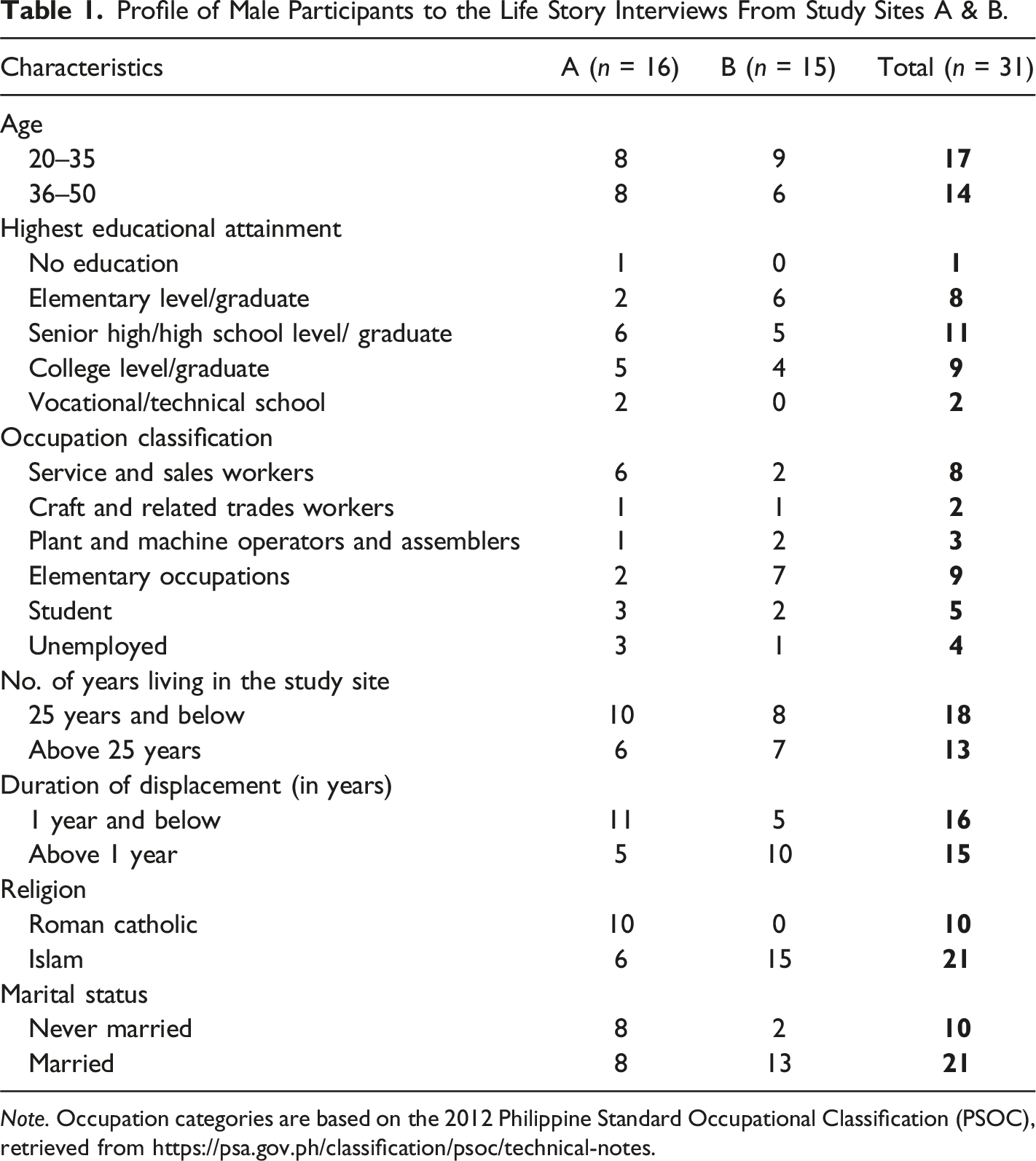
Note. Occupation categories are based on the 2012 Philippine Standard Occupational Classification (PSOC), retrieved from https://psa.gov.ph/classification/psoc/technical-notes.
Profile of FGD and IDI Participants From Study Sites A & B (n = 26).
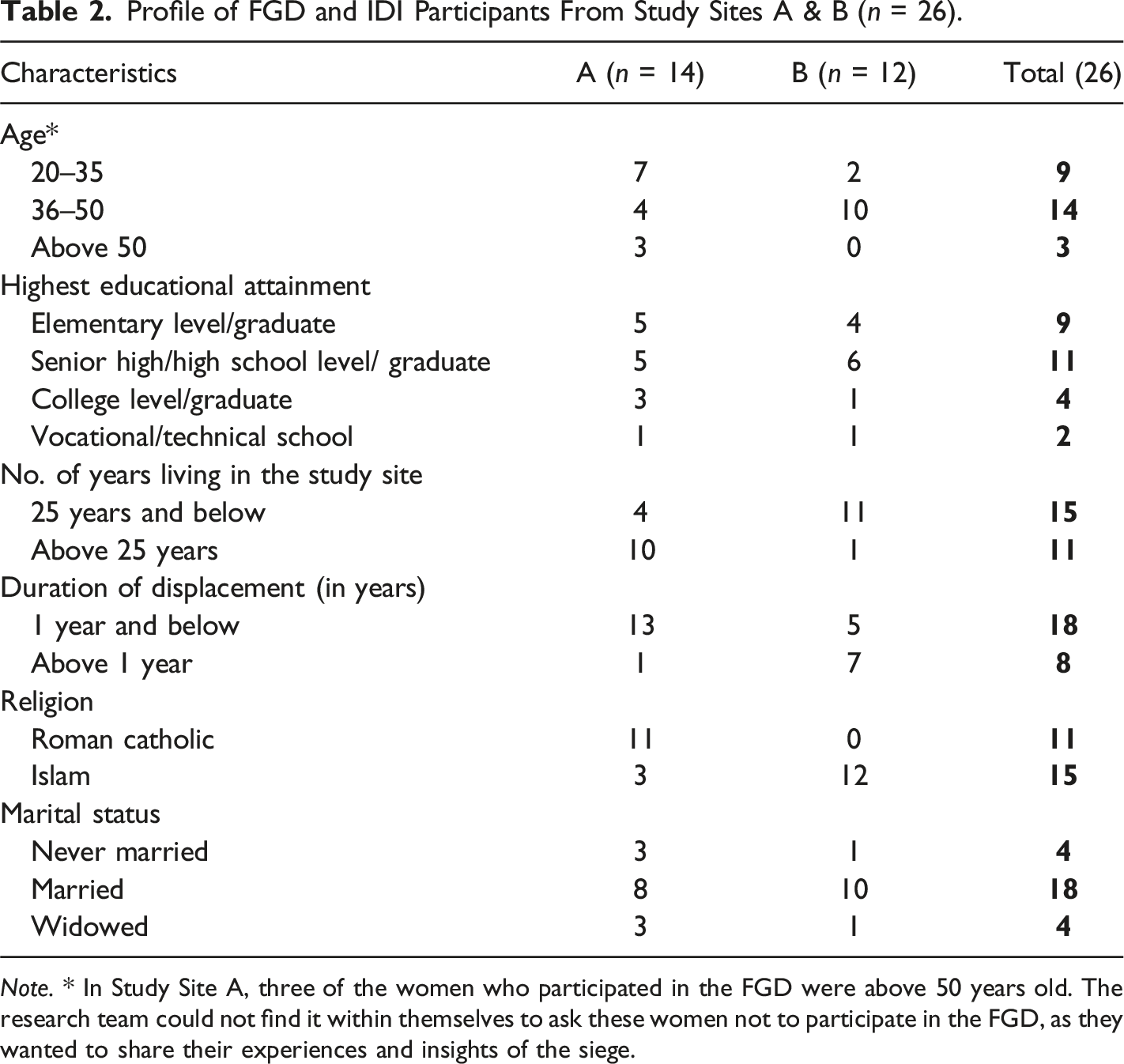
Note. * In Study Site A, three of the women who participated in the FGD were above 50 years old. The research team could not find it within themselves to ask these women not to participate in the FGD, as they wanted to share their experiences and insights of the siege.
An iterative data processing method was employed. The first author conducted an initial review of the data simultaneously with the data collection process and through debriefing sessions with research assistants. These sessions included discussions about the team’s well-being during interviews and group discussions, as well as reflections on the data gathered. The team kept fieldwork journals throughout the data collection phase, which allowed the first author to begin analyzing the data gathered while transcriptions were still in process. All interviews and group discussions were transcribed in the vernacular used during each session. Completed transcripts were organized into data matrices for thematic analysis. In these matrices, participants’ responses to each question were arranged side by side for cross-comparison. Following this, a comparative analysis was conducted within each data collection method—life story interviews, FGDs, IDIs, and open-ended questions from the community profiles. Ethical research practices were observed pre-, during, and post-fieldwork phases, which included obtaining approval from the University’s Ethics Committee, 3 conducting courtesy calls to local government officials, and using pseudonyms for all interviewees and study sites.
Findings and Discussion
Before asking participants about significant events in their lives, they were first asked about the characteristics of an ideal man. Participants were not specifically asked about the traits of an ideal “Filipino” man to avoid limiting their descriptions to the Philippine context or the “Filipino” culture. Despite this more generic phrasing, participants often began their responses with, “an ideal Filipino man is […]”. This tendency may be indicative or reflective of participants’ nationalist attitudes, possibly in opposition to colonialism. By starting their descriptions in this way, they seemed to imply that the ideal man they were describing was not of Western origin. If the concept of the ideal Filipino man is analyzed in relation to Muslim resistance towards integration during colonial times in the Philippines, the Muslim participants’ conception of an ideal man as Filipino indicates a change in their perspective, at least among these men. The authors also hypothesize that this shift in perspective may represent a means of exercising caution among male Muslim participants, reflecting a concern about being perceived as members or supporters of Muslim secessionist groups.
Participants’ description of an ideal man involved six dominant characteristics: being heterosexual, the primary breadwinner and padre de pamilya (head of the family), caring for his children and wife, and possessing a good-natured social persona. While these traits align with normative gender roles assigned to heterosexual men in Philippine society, men also engage in some level of localization (Andaya, 2014), which allows them, to some extent, to appropriate this idealized masculinity for themselves (Bagaporo & Papadelos, 2023).
Participants were asked to identify and rank significant life events, which were then analyzed for their connection to expressions of masculinity. The data revealed similarities, rather than differences, in what men considered significant live events and what constitutes breadwinning, regardless of religion. None of the interviewees mentioned their respective religion when asked to identify important life events. We suggest that, overall, class, rather than religion, may have shaped the men’s experience of conflict and internal displacement.
A careful analysis of 31 interviews with internally displaced men identified three key life events: (a) marriage and starting a family, (b) sending their children to school, and (c) experiencing conflict and internal displacement. Except for conflict and displacement, we found that breadwinning was deemed essential to fulfill the other life events successfully. In addition, the men described feeling “at a loss” or “paralyzed” when they were unable to fulfill these life events due to disruptions in their breadwinning role, which they believed posed a threat to their masculine identity. Finally, we present the ways that men “strive” to retain the breadwinning role despite clear inadequacies and contradictions. We contend that their revised definition of breadwinning is linked to constructions of masculinity that reinforce and perpetuate unequal power dynamics rather than using the experience of internal displacement to advance more equitable practices.
More than Just a “Loss of Face”: The Effects of Disrupting Men’s Breadwinning Role
The following narratives go beyond depicting mere frustration or a loss of face caused by the siege’s disruption of men’s breadwinning role. These stories reveal that men perceived a necessary connection between their role as breadwinners, their sense of self-worth, and the realization or fulfillment of their life story projects.
Perspectives of Men Not Fulfilling the Breadwinner Role: “Like I Am Useless”
The depiction of an unemployed man as “useless” persisted in the narratives of most interviewees. Daaim (25, Study Site A) encapsulated this sentiment when reflecting on his unemployment, stating, “Perhaps I would be the only head of the family who could not raise a family […] like I am useless.” The notion of being unemployed not only leads to feelings of inadequacy but also provokes community judgment, as articulated by Nageenah (28, female interviewee, Study Site A), who remarked, “For me, they [unemployed men] seem worthless.” The prevailing belief is that a man’s value is closely tied to his ability to provide for his family, and the absence of work not only affects his self-worth but also influences how he is perceived within the community. Thus, men’s inability to secure employment could, as Correia and Bannon (2006) suggest, “translate into being perceived as a nobody” and result in a lack of “status in the eyes of his family” (p. 246).
Exasperation and even shame were often cited as emotions experienced by men when they fall short in their breadwinning responsibilities due to unemployment, a sentiment echoed even in the context of conflicts and forced displacements (Echavez et al., 2016). The narratives of Daaim and Nageenah reflect what the literature emphasizes: that fulfillment of the breadwinning role is entwined with men’s sense of masculinity, and without it, they grapple with feelings of insignificance and shame.
Disrupting a Life Story Project
The upheaval caused by the siege not only disrupted men’s position as breadwinners but also impeded their plans for the future, thereby interrupting their life story projects. While existing literature on conflicts and internal displacement in the Philippines often highlights men experiencing frustration or a loss of face due to the interruption of their economic activities (Cagoco-Guiam, 2013), the men in this study presented a deeper consequence when they could not fulfill their breadwinner role in this context. Yaamir (46, Study Site B) stated that losing his business did not only cripple his income and obstruct his economic mobility; it made him feel “paralyzed”. That war had a big effect on my being. First, I lost my business… even if we were just mere vendors, we needed that [business]…. Even if we only had a small business, we still needed to operate it, to have a source of income for the family. However, when the siege erupted, everything was gone. Like people were paralyzed, paralyzed by what (happened). My life was paralyzed when the armed conflict erupted.… I was not able to do anything.
Yaamir’s narrative highlights the profound personal and psychological impact on men when their breadwinning role is hampered, reaching beyond financial consequences to influence their overall well-being, respect in their community, and sense of agency. Men’s feelings of being at a loss or paralyzed stem from a direct threat to their identities and the disruption of their life story projects caused by the siege’s interruption of their breadwinning. Hence, the next section sheds light on men’s endeavors to navigate and negotiate their performances of this crucial role.
“Striving”: Navigating Enactments of Breadwinning
Men employed three strategies to navigate their role as breadwinners: (a) demanding a return to their barangays, (b) emphasizing their efforts to fulfill the breadwinner role, and (c) highlighting the pursuit of “decent” work. To gain insight into the men’s narratives, we employ Schulz’s (2018) “displacement from a gendered personhood” framework. This framework explains how men, in their life stories, redefine the concept of breadwinning to reconfigure their understanding of their masculinity.
Demanding a Return to the Barangay: “Let Us Die Inside!”
Men’s primary motivation for insisting on returning to their barangays was either to commence work or actively seek employment opportunities. Ibrahim, the Barangay Chairperson of Study Site B, explained that men were less concerned about their safety and were eager to return to the barangay to settle and begin looking for work. He noted the government’s requirement for men to sign a waiver at that time. When they [men] were not yet allowed to return to the barangay … they were wondering among themselves how they were going to raise their families.... The government prohibited them from returning as the barangay had not been cleared of booby traps. Men were angry that the government was taking so long to allow their return to the barangay. Men said, “Let us die inside [the barangay]! It is not you who is going to die anyway!”
Securing work would have been considered futile if men ended up dying due to their insistence on returning to the barangays despite the official safety declaration. Nevertheless, the men felt that the prolonged inability to fulfill the breadwinner role was more unbearable than the risk of losing their lives.
By returning to the barangays, men reintegrate into “a familiar space” (Daamin, 20, Study Site B), where they “know the livelihood” (Ebadaah, 37, Study Site B). The historical context of the protracted conflicts and internal displacements in Southern Philippines is routinely marked by IDPs’ return, or their expressed desire to return, to communities of origin after the conflict has settled (Verbrugge & Adam, 2016). The frequently cited reason for their return is to resume economic activities (Canuday, 2009).
Schulz’s (2018) “displacement from a gendered personhood” (p. 1107) framework conceptualizes “displacement” to signify the temporality of the consequences of conflicts. Applying this framework, men’s insistence on returning to their barangays to resume breadwinning, while seemingly illogical because they were not deemed economically viable in terms of income sources, can be read as a proactive response to the displacement of their gendered personhood. When men demanded a return to their barangays to either resume working or actively seek employment, they signaled to their families their commitment to the breadwinner role. Thus, returning to the barangays indicates the beginning of men’s efforts to re-enact the breadwinner role, that proactively rekindled their life story projects, simultaneously demonstrating strength and leadership within their families and communities.
Salience on the Effort Towards Breadwinning: “Even if He Only Earns a Little”
Another means by which men negotiated their enactment of the breadwinner role was by emphasizing the effort exerted in finding work or maintaining jobs, irrespective of the nature of the work or the paltry income. Malik (35, Study Site B) conveyed the belief that a man should not be ashamed to take on “sideline work”, such as ambulant vending, if income from other jobs is inadequate. Ambulant vending, although looked down on, is a common informal livelihood in the Philippines. However, according to Malik, the type of work and the amount of income are not paramount; what holds significance is the man’s dedication to breadwinning. He further emphasized that persisting in the breadwinning role means not feeling ashamed of the work, even if certain economic activities might be perceived as un-masculine (Turgo, 2014). A man should always find a means to earn an income. An ideal man must be ready to take on other jobs if the income he is earning from one work is inadequate for his family. He should not be ashamed to do that. (Malik, 35, Study Site B)
Vahar (20, Study Site A) stressed that a man can still be considered worthy if he perseveres in providing for his family despite facing challenges or deficiencies. I have observed that others are struggling to raise their families and their children. Their salaries are not enough to sustain the needs of their families, especially when the children enter college. They are having difficulties. However, if they persevere in sustaining the needs of their families, then they could be considered ideal men.
Consequently, by avoiding emphasis on the type of work or wage earned, men can strategically negotiate the definition of breadwinning, giving their economic endeavors significance and maintaining their status as head of the household. Since I have not completed my education, I just have to work hard […] it was already difficult before [the siege], but now [it is harder], so I have to strive. A man should work hard to provide for his children and his wife, even if he only earns a little. Even if it is not that much, that is fine. (Fred, 46, Study Site A)
Notably, men’s narratives suggest a new perspective, indicating a redefining of breadwinning that highlights the notion that effort holds equal importance to financial outcomes.
Emphasis on “Decent” Work: “You Must Sweat It Out”
Some men introduced an additional criterion to navigate their enactment of breadwinning. For these men, breadwinning transcends mere physical exertion in seeking work or maintaining jobs with modest incomes. For them, the work must also be characterized as “decent”. In their view, respectable work involves economic activities that require hard work, adhere to moral standards, and are legal. Recounting the moment when he became a father, Caliph (28, Study Site A) expressed his motivation to work but qualified his response with the claim that the job must be “decent and lawful”. Now that I have become a father…. I wanted to work. Nevertheless, the work must be … decent work, not disreputable. Your [income] from work comes from you sweating it out…. You should not provide for your wife [with something] that comes from indecent work.
Caliph’s emphasis on decent work is influenced by the environment in his barangay. Before the siege, interviewees described their barangays as chaotic, serving as a hub for drug peddling and petty crimes. Caliph implies that the siege made finding legitimate work challenging, whereby there is a high probability that some men will resort to illicit economic activities–an assertion confirmed by Cahil, the Chairperson of Study Site A. Men are distressed over the difficulty of finding work. They think of many things, to the point that they cling to the knife’s edge…. They enter all forms of business. Other men are selling drugs […] to buy rice as the conflict ruined the businesses that they had before.
Incorporating respectability as a criterion in the enactment of breadwinning constructs a dichotomy between “bad” and “good” work. For the men in this study, “good” or decent work, is considered a legitimate performance of breadwinning, irrespective of the siege’s impact. Yaamir said that he stood by his “principles”, implying that other men of lesser character may have failed to do so. By emphasizing the importance of decency in the type of work that men should undertake, these men differentiated themselves from others in their engaged in what they perceived as unlawful economic activities. This enactment of the breadwinner role not only redefines breadwinning but also establishes a hierarchy of masculinities among the men in the study sites, positioning themselves as superior to those engaged in illicit economic activities.
Overall, the men’s insistence on returning to their barangays to rebuild their lives manifested in a redefinition of what counts as breadwinning. Upon returning, men valorized their effort, perseverance, and adherence to lawful practices in seeking or maintaining work despite earning a low income. This redefinition is consistent with the gendered personhood framework, illustrating men’s mitigation of temporal “gendered disempowerment” (Schulz, 2018, p. 1114) by reframing breadwinning in this context. The resulting changes ensure that breadwinning remains within their domain, bolstered by the establishment of a hierarchy of masculinities among the men and others in the study sites.
Conclusion
The Filipino men discussed in this paper considered getting married, starting a family, sending children to school, and experiencing the siege as important life events. With the exception of the latter, these events were integral components of the men’s life story projects, aligning with societal expectations of masculinity in their barangays. Moreover, being the breadwinner of the family is inherently tied to men’s identities and their position in the gender order, as it assumes primacy in the contexts of marriage, family formation, and raising children, especially sending them to school. Consequently, the siege emerged as a pivotal life event, disrupting their fulfillment of the breadwinner role. Given the central importance of the breadwinner role in men’s lives, this disruption led to feelings of being “at a loss” or experiencing “paralysis,” which profoundly affected the men as they wrestled with their sense of identity. These findings both contribute to and challenge existing literature that often portrays men’s response to disrupted breadwinning merely as frustration or a loss of face.
In response to disrupted life story projects due to situations caused by conflict and internal displacement, the men attempted to salvage their masculine identities and uphold the gender order by redefining breadwinning, including determining who has access to the role, what qualifies as breadwinning, and the crucial aspects of its performance. This reformulation valorized their enactments of the role while marginalizing other men in their barangays, as well as women who, in some cases, were the primary earners, as interviewees became exemplars of the redefined concept of breadwinning. Examining displacement through a gendered personhood framework revealed that men’s reshaping of breadwinning is a strategy used to mitigate the effects of the siege on their ability to fulfill this role. Nonetheless, this redefinition reinforces and perpetuates unequal gender relations, as the redefined notion of breadwinning remains within the men’s domain despite the disparity between societal expectations and actual reality.
Despite these insights, it is important to note that our findings have certain limitations. Past conflict-induced internal displacements in the Southern Philippines have primarily occurred in rural communities and were longer-lasting, potentially influencing men’s experiences differently. Therefore, further research into how men enact and (re)define the breadwinner role in these contexts is recommended. Moreover, while our interviewees provided rich accounts of their (re)constructions of breadwinning, the findings may not be generalized to all men who underwent conflict-induced internal displacement due to the limited sample size. Finally, while religion was not raised by the men in this study, it is anticipated that it might be a factor that would provide a more nuanced account if included. Nevertheless, interviews with displaced men and women, as well as barangay leaders, offer valuable holistic insights into men’s masculinities in relation to breadwinning that would be useful when designing lasting solutions addressing the conditions of IDPs, particularly those related to economic mobility and empowerment.
Footnotes
Acknowledgments
The information contained in this thesis reflects the narratives of Filipino men and women in Mindanao who experienced violent conflict and internal displacement. This article draws on their stories which also formed the basis of the first author’s PhD thesis. The authors are grateful for their participation in this study. The authors are also thankful to Dr Anna Szorenyi and Dr Erica Millar, who co-supervised the corresponding author during her doctorate. The authors acknowledge the Research Institute for Mindanao Culture-Xavier University (RIMCU-XU) for giving the corresponding author a place to work while doing fieldwork. Thanks also go to the research assistants, Eil Ryan Barillo and Vergil Boac of RIMCU-XU. The first author acknowledges the Australian Government Research Training Program Scholarship – International, which funded her doctoral studies. Generous financial assistance was also received from the following grants and scholarships: the Global Learning Travel Grant; Research Abroad Scholarship; School of Social Sciences Postgraduate Research Travel and Conference Support Scheme; the Hugh Martin Weir Prize; the Karen Halley Trust Fund; and Walter and Dorothy Duncan Trust.
Declaration of Conflicting Interests
The author(s) declared no potential conflicts of interest with respect to the research, authorship, and/or publication of this article.
Funding
The author(s) disclosed receipt of the following financial support for the research, authorship, and/or publication of this article: This work was supported by the Australian Government Research Training Program, Scholarship-International, The Karen Halley Trust Fund, The Hugh Martin Weir Prize 2018, the Global Learning Travel Grant, the Research Abroad Scholarship, the School of Social Sciences Postgraduate Research Travel and Conference Support Scheme, and the Walter and Dorothy Duncan Trust.
Ethical Statement
Data Availability Statement
Research data are not publicly available. Accessing the data can be discussed with the authors via the corresponding author.