




Abstract
Homelessness among older adults is a growing global phenomenon, with men disproportionately affected compared to women. This study uses a life-course approach to examine the intersection of age and gender as reflected in older men’s experiences of homelessness. Drawing on semi-structured interviews with older men living in transitional housing in a major Czech city, it explores how the situation of homelessness shapes the way older men “do” gender and experience ageing, and how categories of gender and age intertwine in men’s actions and self-conceptions. The article outlines three main themes of intersectionality: liminality and ageism in temporal housing; breadwinner expectations and gendered social embeddedness; masculinity and able-bodiedness. By focusing on older men’s experiences of major life transitions, this research addresses a gap in the study of men, ageing, and homelessness within the post-socialist context of Czech society.
The increasing proportion of older adults without stable housing has emerged as a significant societal concern with gendered implications since men in Europe experience living without a house or a roof three to five times more often than women (Baptista & Marlier, 2019; Bretherton & Mayock, 2021). 1 Current research addressing homelessness and aging is mainly aimed at exploring dimensions of aging “in” and “out” of place (Burns, 2016; Canham et al., 2022), home and housing (Burns et al., 2020; Grenier, Barken, & McGrath, 2016), policy and practice (Grenier, Barken, et al., 2016; Weldrick & Canham, 2023), and pathways and transitions related to homelessness (Burns & Sussman, 2019; Walsh et al., 2022). In post-socialist countries, homelessness, especially at an older age, is a relatively recent phenomenon that has not yet been thoroughly examined, although the proportion of the older homeless population in Czechia is growing continuously (see Magistrát města Brna, 2018; Váně & Kalvas, 2014) and the latest data shows that almost half of the homeless population is at the age of 50 and older (Nešporová & Holpuch, 2020). This article builds on the life-course approach while aiming to address the complex intersection of aging and gender in the experiences of older men living in temporary housing (transitional houses and night shelters). The question driving this research is: How does living in temporary housing shape the way older men “do” gender and experience aging? How do categories of gender and age intertwine in men’s actions and self-conceptions? Drawing on 13 semi-structured interviews with older men in a major city in Czechia, the research strives to map how older men, particularly within the context of gender, navigate the challenges of homelessness and aging. Understanding gendered dynamics is crucial for developing comprehensive strategies aimed at the prevention of homelessness in later life. At the same time, it reveals their individual strategies for constructing and reconstructing masculinity in a crisis-related context of loss of housing and relocation as major life transitions (see Urbaniak & Walsh, 2019).
Homelessness and Aging: Gendered Perspective
The population of homeless older adults has been gradually increasing worldwide since the 1990s (Baptista & Marlier, 2019; Brown et al., 2016; Cohen, 1999; Crane & Joly, 2014; Culhane et al., 2013; Petersen & Parsell, 2015) and the number of people aged 65 and over is estimated to reach nearly threefold growth rate by 2030 (Culhane et al., 2019). Of the estimated minimum of 895,000 people without stable housing in Europe (Foundation Abbé Pierre & FEANTSA, 2023), some countries, such as Estonia, Latvia, Hungary, Poland or Sweden, report that people aged 50 and over make up more than half of the users of shelter services (Baptista & Marlier, 2019, p. 42). The growing number of older adults affected by housing poverty has been connected to labor market inequalities and the lack of affordable housing (Sermons & Henry, 2010, p. 3), as well as the increasing number of single-person households (Crane & Warnes, 2010, p. 356), the impact of the global recession and economic crisis, and long-term demographic changes in the population (Grenier, Barken, et al., 2016). The phenomenon of homelessness itself is most often described from the perspective of the absence of permanent housing and through the observation of events or life episodes of individuals that are among the risk factors leading to housing poverty (Somerville, 2013, pp. 388–389). 2 Nevertheless, since the phenomenon is embedded in economic, political, and social relations, the absence of permanent and stable housing is only one of its dimensions, with extreme poverty being the most explicit one (Rossi, 1991; Snow & Anderson, 1993). In this article, I approach homelessness not as an analytical category but as a set of negotiated positions in institutionalized social, cultural, and economic fields commonly understood as excluded and marginalized from society. Although homelessness is commonly perceived through the lens of marginalization and socio-economic exclusion, I follow Vašát’s suggestion (2021, pp. 26–28) that homelessness should be more accurately understood not as a state of being excluded from society and its institutions but rather as an integral element within its structure. Existing simultaneously both “in” and “out” of society, homelessness is continuously shaped and negotiated through ongoing interactions and is deeply embedded into the normativity of social relations and its ideals.
Homelessness in the Post-socialist Context
In post-socialist societies, homelessness is a part of the historical, sociocultural, and political-economic context associated with the era of state socialism and its transition to neoliberalism in recent decades (Vašát, 2021). The ideological embeddedness of the state before 1989 did not allow the phenomenon of homelessness to manifest in the public space. Extreme poverty remained absent in public discourse for much of the period of state socialism in Czechoslovakia, and citizens who did not fulfil their work obligations or did not stay in their place of residence were subjected to state repressions. The issue only fully opened up for debate in the second half of the 1990s (Váně & Kalvas, 2021, p. 23), addressed mainly by the church and non-profit organizations (Marek et al., 2012, p. 54). As the post-socialist Czech cities underwent post-totalitarian and post-industrial transformation, more scholars focused on the interplay of homelessness and political-economic development represented by the processes of de-industrialization, gentrification, and implementation of neoliberal government reforms (Vašát, 2023). Transition between the two political systems also gradually shifted the focus of academic research of homelessness from individual predispositions to a more inclusive socio-economic perspective on poverty, power relations, institutional dynamics, and their effect on people’s everyday lives (Holpuch, 2011; Pospěch, 2022; Vašát et al., 2017; Šimon et al., 2020). The topic of homelessness in older age, although increasingly mentioned in the public discourse, has so far tended to evade the attention of researchers.
In 2019, according to estimates and a survey by the Ministry of Labour and Social Affairs, 21 230 adults were counted in the ETHOS conceptual categories “roofless” (11 608) and “houseless” (9 622) in Czechia (Nešporová & Holpuch, 2020, p. 15). More than half of the population lives in outdoor spaces, 16% use overnight shelters (low-threshold facilities for overnight stays), 23% live in transitional houses (facilities offering short-term stays up to one year), and 9% use municipal hostels and halfway houses (2020, p. 16). In this study, the primary focus is on men using services of night shelters or transitional houses where half of the residents in Czechia are 50 years and older (2020, pp. 16–17). 3 Despite the relatively low numbers of older adults over 65 among the homeless population (11%), their share in the Czech Republic is gradually increasing. This trend is also highlighted by the 2018 report on the number of homeless people in Brno, whose qualified estimate points to a “serious trend of increasing homelessness in the older population over 61”, indicating not only an increasing proportion of older people “roofless” and “houseless”, but also an increase in the pace of these demographic changes over the years (Magistrát města Brna, 2018, p. 10). In terms of the gender distribution of the homeless population, the proportion of men remained throughout the years around 70% (Šobáňová et al., 2022, pp. 16–17).
In the European context, the homelessness phenomenon is highly masculinized 4 and presented through stereotypical images of older “male alcoholic rough sleepers who invariably beg and are work-shy” (Devereux, 2015, p. 264). A similar stereotypical depiction of homelessness is prevalent in Czechia, characterized by an older, bearded man dressed in worn clothing, consuming alcohol, and frequently occupying public spaces such as train stations, parks or city centers. This image often portrays such individuals as lacking proactive efforts to improve their circumstances, framing homelessness primarily as a consequence of their personal life choices (Vašát, 2021, see p. 135). Some authors link these frames to the impact of wider conservative neoliberal discourses, politics of care and austerity measures that enforce the dominant view of homelessness and poverty as a matter of individual responsibility and consequently reproduce housing insecurity, social invisibility, and stereotypes (Jacobs, 2019; Willse, 2010). Furthermore, as Farrugia and Gerrard (2015) note, value-accruing practices that view structural inequalities as rare deviations from an otherwise unproblematic social terrain are constructed through both neoliberal discourses and the politics of homelessness research. Such practices and representations co-occur in most countries of Central and Eastern Europe (CEE) with stigmatization of homelessness in the public discourse, design of anti-homeless provisions, 5 and uncivil policing of public space (Hejnal, 2013; Pospěch, 2021). Public interventions and marginalization of the poorest residents manifest in policies implementing “urban design prevention” in public areas, such as removing benches, increasing surveillance or prohibiting alcohol consumption in public spaces (Grainger, 2021; Temelová et al., 2017), which affects the daily activities and access to services and mobility among the poorest population. However, in general, although most studies of homelessness implicitly focus on men’s narratives and interactions with social services and police, their gendered experience and construction of masculinities have not been extensively thematized (Lorentzen, 2017), especially in the context of aging.
The Intersection of Gender and Age in the Situation of Homelessness
To address the intersection of age and gender, I look at the interplay of how men “do” gender, what they see as normative gender behavior, and their interpretations and normative expectations related to masculinity, age, and aging in everyday interactions. To “do” gender derives from understanding gender as formed through interactions in which to display or mark gender successfully also means to modify or transform it to specific contexts and occasions (West & Zimmerman, 1987, 2009). Central to discussions of men and gender is the notion of multiple masculinities as models of expectations, ideals and behavioral patterns constructed in opposition to models of femininity and often related to the breadwinner role, sexuality, fatherhood, care, violence, or domestic labor. One of the models—the concept of hegemonic masculinity by Connel and Messerschmidt, which represents its dominant form as men’s “strategy for the maintenance of power” within gender relations—received special attention (2005, p. 852). Most importantly, given their non-static character, masculinities are dynamic practices that change with the specificity of the environment and through time, as studies on aging and masculinities suggest (Jackson, 2016).
In the context of structural intersectionality (Cho et al., 2013), age is considered a crucial social dimension shaping power relations and masculinities, being, on the one hand, a “source of patriarchal power” and on the other representing “lack of power” with the change and loss of able-bodiedness and position in the labor market (Hearn & Sandberg, 2009, pp. 153–154). Hearn and Sandberg’s argument that older men and masculinities are both visible and invisible to society (2009, p. 154) can be applied even more in a situation of homelessness and loss of permanent housing, as individuals aged 50 to 65 are considered at a higher risk of homelessness compared to their younger counterparts (Cohen, 1999). Age and perception of aging belong to one of the influential dynamics that manifest in men’s strategies to manage the liminal character of living in transitional houses and night shelters surrounded by cultural stigma and socio-economic exclusion. Considering the intersectionality of age and gender in the context of homelessness among older men allows to address the diverse inequalities and systems of discrimination driven by power structures and processes embedded in the normativity of social behavior and their impact on men’s life trajectories and their decision-making.
Aging processes, which are contextually grounded in the cultural, economic, and social conditions in which people live, vary in their manifestation and in how individuals perceive them. Among the homeless population, studies suggest that individuals facing homelessness often also exhibit indications of mental and physical aging a decade earlier than the broader population (Crane et al., 2005; Gonyea et al., 2010), along with experiencing an elevated mortality rate compared to national averages (Morrison, 2009). Therefore, while the chronological threshold demarcating older age starts conventionally at 65, research on homelessness now widely recognizes the threshold age as 50 (Grenier, Barken, et al., 2016). This paper adopts and operates within this understanding of aging through a selection of participants aged 48 and above while paying special attention to their perceptions of how age relates to their everyday activities, interactions, and decision-making processes.
Methods and Data
In exploring the intersection of age and gender in the lives of older men living in temporary housing, this study adopts a case study approach, utilizing methodology centered around 13 semi-structured interviews (Wengraf, 2001) with 12 men (one interview was multiple) living in a transitional house. The environment was specifically chosen due to the author’s previous research there conducted between 2019–2020 through interviews with social workers regarding institutional barriers related to services for older adults. The transitional house provides a night homeless shelter, temporary housing for up to one year, a place for food preparation and hygiene, and social counselling services centered on social prevention. The night shelter often serves as a drop-in point for social workers who, after consideration, can offer their transitional house service to regular clients. Both housing options provide services to people 18+ who deal with a loss of housing and, most importantly, are oriented and self-reliant without special needs (such as immobility or sensory impairment). The conditions of admission significantly limit the population that can use the housing services. Although assessing autonomy and self-reliance is a matter of negotiation in interactions between social workers and clients, in 2022, from the total of 110 clients, 41 were aged 50–64, but only 12 were over 65.
Interviews and Communication Partners
Communication Partners and Their Socio-economic Positions (According to Their Self-reports During the Interviews).
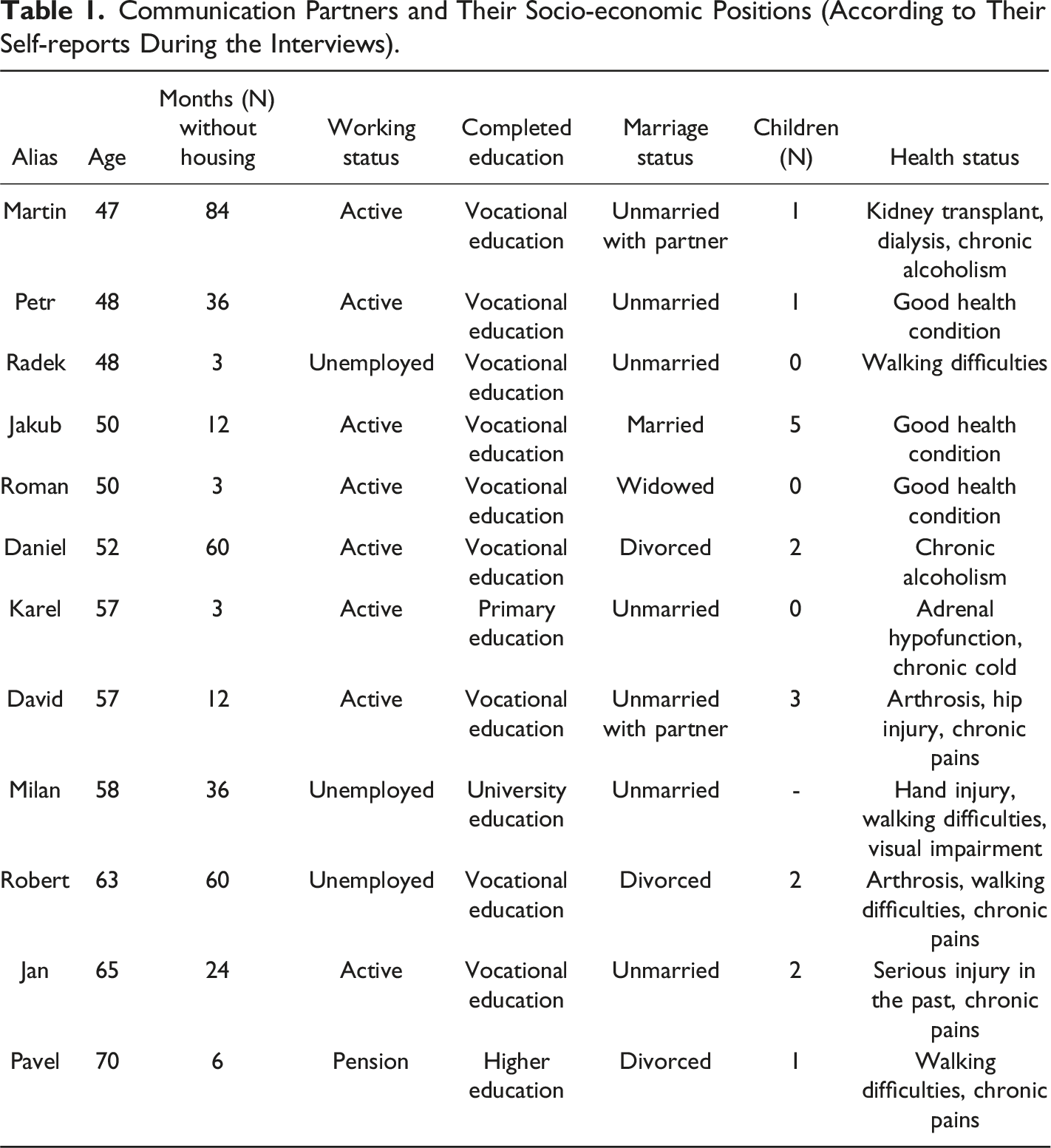
As the study is part of a larger project focused on understanding how men do gender, age and aging (Krekula, 2019) in various Czech social settings, the interview topics were derived from the project’s conceptual framework addressing the process of aging as a reflected gendered practice in the context of power and caring relationships. The main themes were focused on setting up a general timeline of their pathway to transitional housing/shelter to conceptualize age in their narrative, differences between experiences with a situation of homelessness among men and women and people of different ages, topics related to social relations (family, friendships, conflicts), health (wellbeing, limitations, leisure activities), and care (receiving/providing help and care) along with their life in the center and use of its services, including questions regarding socio-demographic information. As part of a more in-depth approach to the temporary housing environment, four additional interviews with social workers from the center were added to provide context encompassing the client selection criteria, their work-related practices with clients, and their approach to older adults.
Positionality and Ethical Considerations
Communication partners from among the clients of the transitional house were recruited by social workers who informed them about the opportunity to be part of a research project on the topic of men’s experiences in precarious living conditions. No exclusionary conditions were present apart from the communication partners identifying themselves as men and being around the age of 50 and older. One of the trust-building interactions before the interview was a short informal conversation about the situation at the nearby local centers and their clients, where the author had previously volunteered. This often aided in overcoming the challenge of the researcher being a younger white female, presenting herself through the previous volunteering experience and long-term interest in the lives and experiences of the clients (see reflexivity and trust-building challenges in Hoolachan, 2016). The interviews were conducted in a room without the presence of other clients or social workers to ensure the anonymity of statements, particularly if they included sensitive information about relationships within the center, potential criminal activities, or clients’ personal information. All communication partners were provided with information sheets and consent forms informing them about the research aims, anonymization process, data storage, and analysis, and the clients of the center were provided with herbal teas, pastries, vitamins, and stationery. The research project was approved by The Research Ethics Committee (REC) at Masaryk University and acted in accordance with its rules and recommendations.
Analysis Process and the Context of Major Life Transitions
The analysis was based on thematic and interpretation-focused coding (Adu, 2019) in Atlas.ti software, revealing key insights and connections between dimensions of age and gender in the interviews with clients and social workers of the center. The key themes of participants’ interpretations of norms and ideals related to masculinity and aging were approached in relation to their experience with major (often multiple) life transitions. Research suggests that major or critical life transitions (CLTs) in later life, such as retirement, the onset of ill health and dementia, widowhood and bereavement, and relocation, have the potential not only to impose changes in individual life-course but also to disrupt a person’s social relations and increase exclusion from social and economic relations (Burholt & Aartsen, 2021; Urbaniak et al., 2023; Walsh & Urbaniak, 2023). Following Amanda Grenier’s approach to the study of transitions in later life (2012), I look at the sociocultural interpretation of age and aging and the lived experience of men living in temporary housing while treating major life transitions identified in participants’ narratives as the main “grid background” on which the intersection emerges.
Results
The interviews highlighted three major themes related to how men construct masculinity in their actions and self-conceptions and experience aging in the context of living in temporary housing. The first theme was related to the liminality of temporary housing and its management, which repeatedly pointed to the collision of the center’s rules with the ageism experienced in housing and job searches. The second theme arose from their understanding and interpretation of expectations related to men’s breadwinner role and expectations connected with their reduced social embeddedness due to the loss of relations. The third theme formed around men’s practices of negotiating respect and autonomy through the management and understanding of their own able-bodiedness connected to their age and gender.
Theme 1. Liminality, Ageism, and the Cyclic Character of Temporary Housing
Transitional housing, where the men were currently residing, serves as a provisional solution to the crisis related to transitions such as a loss of housing and associated relocation. The general vision of the institution is to provide basic needs and counselling to people in emergency situations while being purposely organized as a transitional and temporary service with accommodation offered only for the night in the shelter or in apartments for up to one year. Transitional housing clients must complete and update their individual plans each month to motivate them to find stable housing and work. This act is also connected to a monthly extension (or termination) of their housing contract, keeping them constantly aware of the temporality of their situation. Transitional housing can, therefore, be described as a liminal space with a hybrid character of keeping the clients on the borderline status of homelessness. As Chamberlain and Johnson (2018) argue, the concept of liminality is useful in making visible the process of “how people make the transition from one housing status (homeless) to another (housed)” (2018, p. 5).
With liminality representing a transitional state, reaching a stable housing situation is uncertain. In the institutional environment, uncertainty is often managed through systematic intensification of control and discipline (Grainger, 2021; Johnsen et al., 2018). This is symbolized in transitional housing through individual plans and their monthly adherence to them through efforts shared with social workers. The main aim of finding stable work and housing in the institution is understood as crucial for breaking the temporary and transitional character of the housing service. However, in some men’s experience, the aim was obstructed by structural ageism,
6
which affected their everyday lives and had an impact on men’s feelings of loss of value in the labor market at an advanced age. Robert (63), who had worked mainly in the black labor market after returning from abroad, was in a situation where he was looking for long-term employment. He linked his search for a new job with the aim of qualifying for a retirement pension in the future, but on several occasions, his age was seen as a disadvantage by a new employer: When I was looking for the job, they just notified me that I'm not prospective for them anymore (laughs). I'm just old... Well, it's like that with jobs, they're not interested in an old guy anymore. (Robert)
Although age-based discrimination in the labor market among men over 50 occurs regardless of class (Ojala et al., 2016), men with perceived lower social positions and status within society may face ageism more directly than men protected by their privileges based on “social class, retirement status, good health and ability to conform to hegemonic masculinity ideals” (Clarke & Korotchenko, 2016, p. 1769). On the other hand, men’s individual strategies and decisions sometimes led to conflicts with authorities at work, which resulted in them being fired or quitting the job. Radek (48), who recently lost his job in a brewery and the accommodation related to it, found it more difficult to compromise on his needs as he got older and would rather leave a job if his opinion or self-respect were compromised (elaborated further in theme 3). Similar experiences were described by other men, whose negotiating practices left them in a vulnerable position regarding their finances and not keeping up with their individual plans in transitional housing.
Facing obstacles to overcome their situation also applied to the case of looking for housing. Jan (65), who had been trying unsuccessfully to find a new home for some time and had just been turned down by a potential landlord, cited his age as a disadvantage: Like I said, I've got it arranged, but they're always tossing these people, well, like a hot potato. I'm older, so they [potential landlords] kind of look down on me.… So, as I said, I'm not going to freak out, hopefully, they'll extend my contract again [in the transitional house]. (Jan)
Despite being in relatively good health and having a job as a receptionist, Jan faced obstacles in finding permanent accommodation on his return from abroad. He first tried to find accommodation through existing social connections, but when these broke down, like other men in temporary housing, he found himself in a situation where he was refused permanent contracts because of his age, as landlords preferred younger tenants. According to social workers, for older clients, the path to finding stable housing is more complicated and rarely successful due to the absence of pensions, being ineligible for institutionalized type of care in nursing or retirement homes, and the general stigmatization of homelessness and older age in other housing institutions. Some men unsuccessfully tried to manage the situation in the past by living in a friend’s apartment, but, as the research suggests, single men generally receive less support from relatives and their social network than women (Winetrobe et al., 2017). In addition, although more than half of the men had children, with a few exceptions, they had no current contact with them and, therefore, could not rely on the potential help of their family ties. Consequently, even when some men kept the hope of breaching the liminality of their housing situation, the practices of ageism, overall stigmatization of homelessness, and their individual respect-management strategies helped co-create a loop of temporality which, from their position, came to appear more like a permanent state.
Theme 2. Breadwinner Expectations and Gendered Social Embeddedness
One of the main characteristics of men’s life-course experiences was their pathway through multiple and often repetitive transitions with a cumulative effect on feelings of uncertainty, stigma, exclusion, and loneliness (Grenier, Sussman, et al., 2016). Most frequently mentioned in this context were experiences with loss of job and housing, and loss of relations (divorce, loss of contact with children and family). Several men described their experience as “being at the bottom” (Peter, 48) or “being in the mud, in a vicious circle” (Karel, 57), with a reflection of failing their role in life connected to breadwinner expectations (fatherhood, providing for family). Men in transitional housing may experience feelings of not living up to society’s expectations and ideals of hegemonic masculinity, while reframing the breadwinner role to being responsible and caring men (Liu et al., 2009). Petr (48), of Roma ethnicity, who spent half of his life in prison and now works as a construction worker, emphasized his empathy for older people on the street and his role as the protector of those of ill-health and older age. However, feelings of loss and not living up to the expectations of society were present in his self-conception as well: They still laugh about it, but when you're older, you realize it’s like, yeah, how you've turned out, and how just that life situation is not good … like mostly some of the young ones, they're already secured. Yeah, they have a house, they have a house built, they have a business, and you think: “I’m 48, 49 years old, and you have nothing and you're still in a factory”. (Petr)
Men’s reflection on their situation was often associated with comparisons to other, younger men or younger selves who would have, in their view, more options and strength to “shake it off” (Jakub, 50) and manage the situation better. This view was sometimes related to a sense of loneliness caused by broken family relations and a lack of quality social ties (friendships). Robert (63), who lost housing due to divorce and spent five years in various shelters, garden huts and other transitional houses, was burdened by the feeling of having undergone the transition of divorce, through which he lost part of his family ties and life certainties: [W]hen I was just in the night shelter for example, I thought if I didn't get divorced, I would have a background, a family. And when you're alone and all that, I don't know how to put it.... I used to take it lightly, but the older I got, the more it bothered me. (Robert)
Divorce is not only regarded as a frequent risk factor for homelessness among men (Vágnerová et al., 2018) but also affects men more than women if they have low income (Endeweld et al., 2022). Dissolution of marriage or partnership has, therefore, also impacted men’s social connections with children and family, for whom they are not regarded as primary caregivers. In the Czech environment, despite the state policy mandating women’s emancipation before 1989, the dual role of men and women and the stress on biological aspects of motherhood has been reinforced and reinvented (Šmídová, 2019, pp. 240–241). Subsequently, one of the gendered aspects of divorce may also concern the loss of a home base in the case of men and shifting the economic strain of raising children to women (Fučík, 2016).
Theme 3. Masculinity and Able-Bodiedness: Negotiating Autonomy and Respect
The interplay of gendered roles and behavior and the experience of aging in the liminality of the transitional house was manifested in men’s strategies to manage transitions and negotiate autonomy and respect in their position connected with the prevalent stigmatized status of homelessness. Transitional houses and shelters are very male-dominated environments, and men consider the place itself to be unsafe and untrustworthy, where it is hard to trust others or display friendliness. Respect among men in the transitional house has often been negotiated through roleplays of masculine behavior connected to their ability to intimidate or physically enforce dominance on others. Jan (65), who spent two years without stable housing, one of which was at the transitional house, took a strategy that he described as conscious roleplay to assert his position: Just so they don't climb on my back and make up nonsense, I'll put on a play. And I go into them, I'm not afraid of anybody. So even these people, a generation younger, shut up and listen.… I'll give them a good scolding, sometimes I even swear if I have to, sometimes I grab somebody and squeeze them against the wall a bit, and maybe even slap them, but as I say, simply, these people have to know how to behave themselves. (Jan)
With the possibility of conflicts emerging in interactions with others, some men tried to avoid contact with others as much as possible, whereas others turned to powerplays using traditional gender roles and normativity of masculine behavior to defend their position in social relations. Other men residing in the transitional house employed comparable strategies to negotiate their social standing and independence, particularly in interactions with authorities, and debated the need for its utilization as they grew older. As mentioned in the previous chapter, Radek (48) moved into the transitional house only recently after he lost his job along with his accommodation and had to care for his ill mother. While looking for a new job, he found it more challenging to withdraw from confrontations, especially when in conflict with authority. That also contributed to him losing his next job and having trouble with the institutionalized individual plan outlined in cooperation with social workers.
However, the effort to maintain dominant status through management of conflict and demonstration of strength, especially in interactions with other men in a similar situation, collided with significant health difficulties faced by more than half of the participants (consequences of injuries, organ and immunity failures or arthrosis). Men overall attributed many of their health limitations to the aging process, such as David (57), of Roma ethnicity, who lost his apartment upon entering prison. As a renowned brawler who earned respect by physically resolving conflicts, he began to refrain from physical confrontation due to his health issues and change of perspective, which he attributed to aging: I think it's age, that a person is getting older. Like you say, maybe I'm out of breath, too. Some young guy comes and dances me down and then I hit the floor (laughs). So it's like that, it's age already. That you want to have peace. (David)
Emphasizing physicality relates to the specificity of the environment, which establishes physical interactions and vocalization of masculine powerplay as a form of normativity that is very rare in other contexts. Displaying able-bodiedness and dominant masculine behavior may also be critical for deflecting potential assaults since older adults in shelters and on the streets face more violence and threats to their safety, being perceived as easy targets (Tong et al., 2021). The intersectionality of older age, gender, and lower social status in their everyday interactions shapes the dynamic forms of masculinities that continue to reference hegemonic normativity while also being reimagined in the light of the contradictory source of power and disempowerment that men’s older age represents (see Hearn, 2011). Engaging in hyper-masculine behaviors as a strategy to negotiate and maintain dominance and agency in a socially marginalized environment while facing embodied frailty associated with aging can also be understood as an expression of what Connell defines as “marginalized masculinity” (Connell, 1995, pp. 80–81). Shaped by social exclusion and structural inequalities, its relational character is negotiated with reference to dominant masculine traits but constantly adapted to navigate men’s social reality.
With the age-related loss of able-bodiedness as a tool for negotiation and sociocultural resource, men employed diverse strategies to manage this transition. On the one hand, some used their age as an asset connected with experience and wisdom, which they expected should be considered by their younger counterparts. They mentioned this way of obtaining respect and status in individual encounters with younger men; however, as the strategy collides with the stigmatized position of homelessness, it didn’t carry the same weight of a traditional source of power as in other social contexts associated with stable financial resources (Hearn & Sandberg, 2009). On the other hand, as the transition of “onset of ill health” advanced, several men perceived it as an opportunity to commodify their status and apply for a disability pension. In men’s narratives, retirement and disability pensions played the role of leverage that could significantly improve their economic situation. As a major life transition in older age, retirement can be understood as a process “providing a person with new roles, practices, and a new identity as a retiree” (Wanka, 2019, p. 2), therefore having the potential to end the liminal character of men’s housing situation. However, according to the social workers, only a few clients of the transitional house were eligible for a retirement pension. Consequently, at the time of the interview, some of them were caught in a situation where they were unable to work and were still waiting for a decision on whether to approve or reject their pension application.
Overall, the interplay of the process of aging and requirements towards masculinity that are self-assessed and renegotiated in interactions based on able-bodiedness and fading physical capacities force men to adopt new transition management strategies according to their assessment of risks of failure or sustaining power (respect and authority) in the environment. These strategies, however, face obstacles based on their disadvantage in completing the process of retirement, age-based discrimination, and the stigmatized status of homelessness.
Discussion and Conclusion
In this paper, I have explored the ways in which older men living in temporary housing “do” gender and experience aging, and how categories of gender and age intertwine in men’s actions and self-conceptions. Although men’s experiences and self-conceptions were very diverse, the structural forces of their situation and an environment characterized by a high degree of uncertainty contributed to their need for constant adaptation and employment of various strategies to mitigate risks and maintain control over their authority, autonomy, and respect. These strategies were directly linked to men’s gendered experiences with aging manifested in (mostly but not limited to) ageism in looking for a job or housing, transformation and a feeling of having failed in the role of breadwinner, and the changes to their able-bodiedness and social status and the respect powered by them.
Men employed different strategies based on their fluid and situational approach to “doing” masculinity properly (West & Zimmerman, 2009) in relation to their effort to assess the risks of failure or sustaining power (respect and authority) in the environment through individual decisions. That often led them to employ violence or threats toward others, as this was viewed as legitimate masculine behavior for gaining autonomy and authority in specific situations. Although the role of able-bodiedness in gaining respect diminished as men grew older, since men often found no other safe strategy, they consistently spoke of physical confrontation as a necessary defense mechanism against younger men.
The interviews have also shown that even men in or near their 50s interpreted their advancing age as a liability and a process of losing their socio-economic capital (Bourdieu, 1998). As opposed to men drawing on their privileges based on being middle-class or wealthy, who may experience contradictory relations to power and patriarchy with advancing age (Jackson, 2016, p. 171), men in transitional shelter draw more socio-economic capital from their able-bodiedness, as they lack other resources and, therefore, can be in a more vulnerable position with its decline. As Hearn and Sandberg emphasize, “older men are not only older men” but their self-conceptions, identities, needs, and strategies are always also tied to their class, abilities, and other social and geographical differences (2009, p. 162). In the context of homelessness, the differences manifested in situations where some men were left in an institutional vacuum—unable to apply for a pension, unable to work properly due to health issues, and being subjected to structural ageism in looking for a job or housing—which was also supported by the experience of social workers at the transitional housing. This prolonged the liminal character of transitional housing for many men, some of whom passed through several transitional centers without finding permanent housing or work for years and were thus drawn into a “loop of liminality”.
This study, with its focus on aging and masculinities, pointed to the precarious situation of transitional housing, which functions as an aid program in a housing crisis but at the same time can unintentionally contribute to prolonging the liminality of the housing situation for older men, while they encounter ageism and the limits of social housing for the older population in Czechia. Among the major deficits in the Czech context that deepen the barriers faced by older adults are the long-term absence of a Housing Support Act—currently undergoing its final approval process—affordable and accessible healthcare, and equal access to social resources (Horák & Horáková, 2024). As other studies have shown, to ensure “aging in place” and the effectiveness of interventions for homelessness, the emphasis on building social connections in a safe environment, the accessibility of individualized services focused on mental and physical health, and the reinforcement of permanent supportive housing options need to be successfully implemented (Canham et al., 2022) while also paying attention to gendered experiences of older adults and structural inequalities to which they face.
Footnotes
Declaration of Conflicting Interests
The author(s) declared no potential conflicts of interest with respect to the research, authorship, and/or publication of this article.
Funding
The author(s) disclosed receipt of the following financial support for the research, authorship, and/or publication of this article: The work on this paper was supported by the Grantová Agentura České Republiky/Czech Science Foundation (GAČR), project Institutions of Ageing Men (No. 23-05047S).
