




Abstract
Poker, a million-dollar industry and a leisure activity, is played between close-knit friends, at casinos, and online. It is gendered; masculine positions are produced between players, often in competitive, aggressive, and sexist ways. However, the (homo)social relationships of poker have hardly been studied. Using interviews with Swedish men poker players, this article investigates masculine positions and homosocialities within poker, demonstrating that poker was associated with a range of social relationships, from close friendships to relatively anonymous online relationships. Poker made room for friendship, but it also structured relationships and led to a simplification and a formalization of them. Competition and emotional detachment were central, but not sexism; the article suggests that poker players are constructed as nerdy, rather than tough guys, and that nerdy socialities are formed between players.
Poker is a global industry, cultural phenomenon, and leisure activity, played between close-knit friends, at casinos, and online. An emerging body of research discusses it in relation to gender, and points to the proliferation of competition, aggression, sexism, and homophobia within poker (Manno, 2020; Simonsen, 2012; Wolkomir, 2012). In poker, one must play the man rather than the cards, that is, play differently depending on who the opponent is, which points to the importance of social, often homosocial (as poker is predominantly played by men) relationships within the game. Such homosocial relationships are central to the production of masculine positions (Bird, 1996), but they have hardly been studied in the context of poker.
Leisure activities like poker “are not simply an ‘escape’ from everyday culture; rather, they resonate, reify, and circulate icons, myths, and systems of sociocultural life” (McKahan, 2009, p. 70). The aim of this article is to investigate the production of masculine positions and (homo)socialities within poker, from friendships to relatively anonymous online relationships, using interviews with Swedish men poker players. Poker playing was a way to make room for friendship, but it also led to a simplification and a formalization of interaction. The relationships produced were intimately related to masculine positions that emphasized competition and emotional detachment, but not sexism, which suggests that poker players are constructed as nerdy rather than tough guys, and that nerdy socialities form between players.
Poker and Gambling as Gendered Arenas
Poker is a game played against other players which contains both skill and luck elements; Texas hold’em, which is discussed in this article, is one of the most common poker variants. Like other forms of gambling, poker is a cultural phenomenon with its own legends, skill sets, and terminology.
Gambling research is dominated by medical and psychological perspectives and quantitative methods. However, poker research encompasses qualitative methods as well as critical perspectives and has covered online playing and poker in card-rooms and casinos, and has discussed poker as problem gambling, sport, and profession (Hayano, 1982; Jouhki, 2011; Palomäki et al., 2013, 2014; Schuck, 2010; Vines & Linders, 2016; Wolkomir, 2012; Zurcher, 1970). Fiona Nicoll suggests that poker has a higher status than other forms of gambling: It is seen as a game for the “mobile and successful” and “celebrates a neoliberal subject of gambling” (2011, pp. 241–242).
Gambling research has a history of gender-blindness and of treating gender as a variable (Phillips, 2009). Indeed, the majority of poker studies fail to approach men as an explicitly gendered category despite being about men players and homosocial groups (e.g. Hayano, 1982; Palomäki et al., 2013, 2014; Zurcher, 1970). However, a growing body of research investigates the production of gendered positions within gambling; indeed, a “broad range of gambling activities […] coexists with widely accepted views of men as risk takers, innovators, and speculators” while clashing with femininity (Volberg & Wray, 2007, p. 65; see also Cassidy, 2014). Relatedly, an emerging body of research points to the connection between poker and masculinity, even hypermasculinity. According to Andrew Manno (2020), modern (US) life-styles offer few chances to actually practice aggression, daringness, and risk, but poker represents a chance to embody such masculine qualities (see also Zurcher, 1970, p. 178). Poker is played in competitive and aggressive ways and centered around intimidating, controlling, and dominating one’s opponents, sometimes using sexist and homophobic behavior (Manno, 2020; Simonsen, 2012; Wolkomir, 2012). Michelle Wolkomir’s poker-playing research participants engaged in “unrelenting but well-timed aggression” as well as heterosexist harassment; this “made them feel like men” (Wolkomir, 2012, p. 416, emphasis in original; see also Simonsen, 2012). Marcus Vines and Annulla Linders’ research participants similarly equated being a “capable poker player” with being a “capable man” (2016, p. 1073).
Contrastingly, Jukka Jouhki (2011) suggests that while narratives of luxury or misery and addiction are common, the reality of poker is often mundane; the ups and downs of the game are endured at the kitchen table, spoken about with one’s spouse, and the money won is used to buy new car tires. Jouhki’s interviewee aimed to “play sharp and tenaciously” (2011, p. 7) rather than aggressively. Although he does not discuss gender, Jouhki’s research points to the multi-facetedness of men’s poker playing and of masculine positions and points to that online poker playing, integrated in family life and in Scandinavia, may differ from IRL (in real life, that is, not online) poker playing in US contexts; while masculine positions are arguably still produced, this might happen in other ways.
Relatedly, poker includes a celebration of stoicism, control, logic, rationality, and mathematics (Goedecke, in press; Simonsen, 2012; Vines & Linders, 2016). These are qualities that are historically connected to white, Western, middle-class men (Lloyd, 1993). Nowadays, they are connected to the nerd, a White, middle-class, masculine position (Bucholtz, 2001) which has been discussed in research on superheroes, scientists, and programming, and linked to technology and online spaces (Kendall, 2000, 2011; Mendick et al., 2023). Nerd positions are, I suggest, central to understanding the gendered dynamics of poker.
This article contributes to qualitative poker research by deepening the understanding of the production of masculine positions and homosocialities beyond the hypermasculine, in different poker contexts. It views poker as productive and produced; that is, poker is seen as shaping the gendered positions and socialities produced within it while it is also shaped by existing discourses around gender and relationships.
Men’s Friendships and Homosociality
In the production of gendered positions, homosocial relationships are at least as central as those between gendered categories. Men’s relationships with men are intimately linked to the production of masculine positions, the consolidation of gendered power, and the reproduction of sexism and homophobia (Bird, 1996; Kimmel, 1997; Meuser, 2007). In a seminal text, Jean Lipman-Blumen defines homosociality as “seeking enjoyment, and/or preference for the company of the same sex” (1976, p. 16) and as a desire to be close to controllers of resources. Homosocial relationships are built around emotional detachment, competitiveness, and sexual objectification of women (Bird, 1996, p. 121), as well as homophobia and fear of failure (Kimmel, 1997): “[t]o express feelings is to reveal vulnerabilities and weaknesses; to withhold such expressions is to maintain control” (Bird, 1996, p. 122). According to Michael Meuser, competition in homosocial groups simultaneously effects “distinction and conjunction” (2007, p. 45), that is, it produces distinction between members but participating in competition is also a condition for membership.
Homosociality rests on the exclusion of women but also some men, who are “peripheralized” (Lipman-Blumen, 1976, p. 24). This points to the non-homogeneity of the category of men; race, class, sexuality, and certain ways of producing masculine positions are essential to being allowed in to and reaping the benefits of homosociality.
Same-sex friendships are a specific version of homosocial relationships. Men’s friendships are structured by masculine positions and homophobia and have been seen as based on shared activities and permeated by inability to confide, fear of closeness, and competitiveness (Messner, 1997). Friendships, unlike homosocial relationships more broadly, contain expectations of closeness and intimacy, often through verbal disclosure (Jamieson, 1998), and recent research points to the effects of renegotiated and possibly less homophobic ideals of men’s friendship: increased acceptability of touch and disclosure (Goedecke, 2022). Nevertheless, gendered positions are performed and produced within friendships; thus, the questions that pertain to homosocial relationships about their consequences for gendered power relations are equally important when it comes to men’s friendships (Goedecke, 2022; Messner, 1997).
As mentioned above, poker is a social enterprise: the cards and behavior of other players are at least as important as one’s own “hand”. Poker entails varying socialities: “In addition to playing in pub tournaments, you can play with strangers online or face to face in casinos; you can organise a friendly poker night at home or play within geographically dispersed friendship networks through social networking sites” (Nicoll, 2011, p. 241). Wolkomir writes that men poker players “developed strategies that centered on applying pressure to their opponents, either by forcing them to make difficult decisions for large sums of money or by challenging their masculinity in some way” (2012, p. 415). I suggest that poker, like computer games which encourage “rule-governed interactions” and “echo the common association of traditional male bonding with a formal, rule-governed behavior” (Almog & Kaplan, 2017, pp. 37-38; see also Toft-Nielsen, 2016), produces and shapes various (gendered) socialities and positions.
Poker may connect to aggressive forms of homosociality and as an individualist and competitive game, it may resemble neoliberal markets (Manno, 2020). However, poker may also entail trust: In the poker rooms studied by David Hayano (1982), money was lent between regular players, and poker-chips could be left at the tables without risk of theft. In the all-male, friendly poker circle studied by Louis Zurcher (1970), there was familiarity, and routines and patterns both within and around the game had been established over the years. Meanwhile, competitiveness, rationality, and stoicism were still important (Hayano, 1982; Zurcher, 1970).
In this article, I scrutinize narratives about different kinds of poker playing and how poker shaped gendered positions and social relationships, ranging from friendship to relatively anonymous online relationships. The socialities of poker have received scant attention, and little has been written about domestic poker, between friends (Zurcher, 1970 is an exception). This article contributes with an in-depth understanding of (homo)socialities in a little-studied context, and of their gendered dynamics and meanings.
Before going on to the next section, the Swedish gambling context must be presented. During much of the 20th century, Swedish gambling was dominated by state-owned company Svenska spel (Swedish games). In 2003, the global “poker boom” occurred, with poker variant Texas hold’em gaining exponential popularity (Manno, 2020). In 2005, Svenska spel launched the world’s first state-owned online poker site (Binde, 2007), an attempt to steer Swedish poker players to domestic sites and to profit from the “boom”. In 2019, a license system was introduced in Sweden. The stories discussed below stem from before and just after this reregulation.
Material and Methodology
Interviewees.
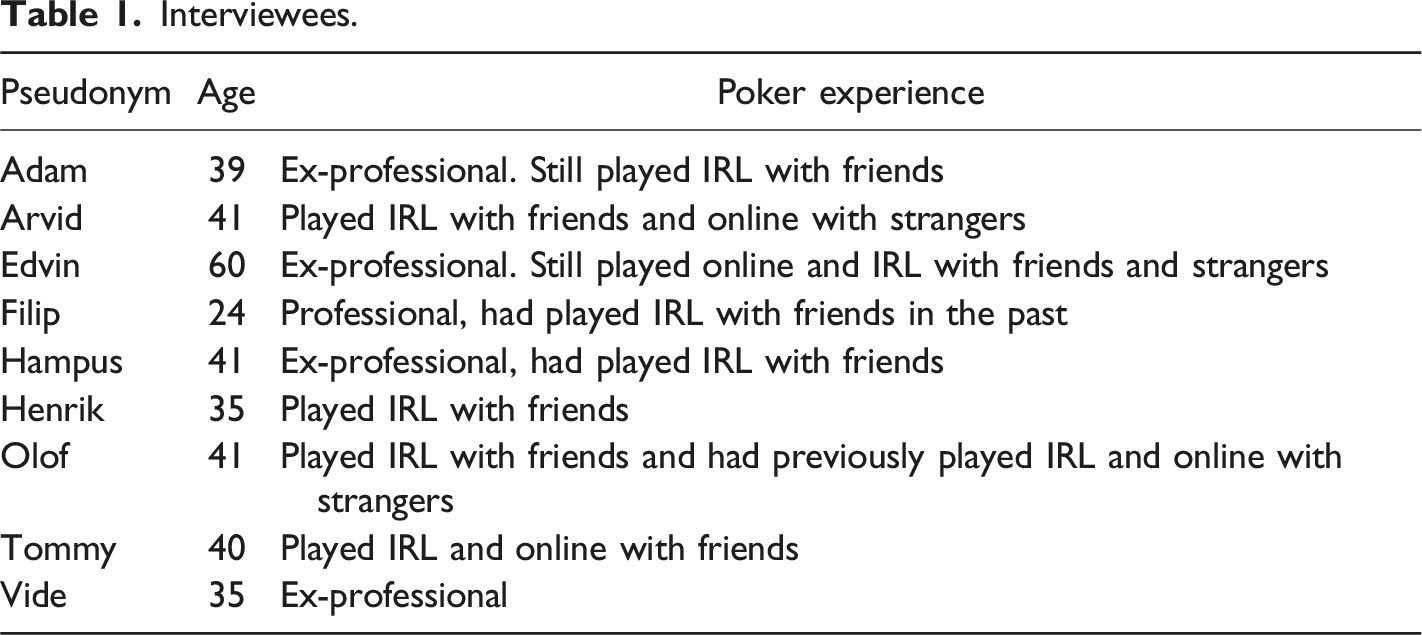
The interviewees lived in small or larger cities, located all over Sweden, and ranged from lower to upper middle-class. With one exception, they had experience of higher education, all were White heterosexuals, and all but one had grown up in Sweden. Six had children, six had (female) partners, and three were single. Interestingly, the poker players were more homogenous compared to the sample as a whole with regards to race, class, and education.
The interviews were semi-structured and lasted 35–90 minutes. They covered themes like gambling practices, with whom the interviewee gambled, and what gambling meant to him. Almost all interviewees had started playing poker during the “poker boom”. Typically, they had been introduced to poker at school, by an older brother, or during military service, after which they had expanded their poker knowledge by talking to (male) friends, reading books, and watching poker games. Their gambling experience ranged from occasional, a life-long interest, to being professional or ex-professional gamblers (defined as having had poker as a main source of income for some time), and most played both social and lucrative poker; that is, online or IRL poker intended to be a social activity, with friends, and poker intended to be profitable, which mostly took place online, with strangers. Most played primarily Texas hold’em and tournaments rather than cash games.
Due to the COVID-19 pandemic, the interviews were conducted online. Online interviewing may exclude people without access to and/or knowledge of the relevant technology, but it may also enable people pressed for time or without access to transportation to participate (Roberts et al., 2021). In this case, it expanded the geographical scope of the study and led to, I believe, a digitally literate and young to middle-aged sample who mainly gambled online. The interviews were carried out by the author, a White woman in her thirties. This affected the interview interaction; for instance, previous knowledge about poker was seldom presumed, instead the game was often explained in great detail.
The audio of the interviews was recorded and then transcribed verbatim by the author, whereby all names and cities were changed, as well as any potentially identifying information. The research was approved by the Swedish Ethical Review Authority (no. 2020–05017), and the interviewees were informed that participation was voluntary and could be aborted at any time.
The material was studied using a discursive approach, which entailed repeated re-readings and listenings, copying quotes concerning prominent themes into separate documents, whereafter the interviews, themes, and quotes were re-read and re-evaluated and read together with theories and previous research in a back-and-forth, hermeneutic process (see Potter & Wetherell, 1994). Explicit mentions of social contexts of poker playing were focused upon, whereafter analytic points born of this theme, such as how friends and strangers were related to and how competitiveness was handled between friends became important. My reading was inductive and deductive, as analytical themes emanated both from the material and from theories and previous research.
In my approach to masculine positions and social relationships I am inspired by discourse analysis (Wetherell & Edley, 1999). I regard poker as productive; it was an arena where social relationships could be conducted but which also shaped them—for instance, competition became central to relationships produced through poker—and an arena where gendered positions could be (re)produced. At the same time, poker was shaped by overarching discourses about, for instance, gender or financial issues, thus constituting an arena through which larger social issues may be studied.
I now present the analysis; I start by discussing competitiveness and care in social poker playing. After that, I discuss competitiveness, nerdiness, and nerdy socialities in poker playing intended to be lucrative.
Social Poker: Shaping Friendships
Almost all interviewees were engaged in social poker playing with friends and acquaintances, online or IRL. In the stories about social poker, winning money was valued, but the chance to spend time with friends, new and old, was the main attraction. For instance, Tommy lived in Sweden but had grown up in another European country, and despite the geographical distance he had travelled back and forth for many years to play poker with his old university friends. During the pandemic their games had moved online (using poker and video call software simultaneously, permitting the friends to see each other while playing) which enabled them to play more frequently. When asked about whether he had any important gambling memories, Tommy said: Tommy: not where the gambling is a bigger memory than whatever else happened that evening. I don’t think... the game has never been that exciting to me, more important than... whatever, the music we were listening to, whatever we were talking about... whatever just happened in our lives.
1
Poker was the glue which kept Tommy and his all-male group of friends together; the recurrent poker nights had become their way of socializing and for making room for friendship in their lives. The amounts of money involved were small, and winning was seen as “enjoyable” but “not that big a deal”. Instead, the social relationships and keeping up their friendship despite living far apart was the main focus.
Henrik similarly used poker to keep in touch with his friends; they met up once or twice a year to socialize and play poker. Similarly, Olof and Arvid, childhood friends, regularly met with a group of male friends, all in the same phase of life, with wives, small children, and busy jobs, at each other’s homes to play. These evenings were fun: they ate a non-elaborate meal and then drank a beer or two, talked, and played (see also Zurcher, 1970). Unlike Tommy, these men endeavored to play as skillfully as they could in order to win over their friends.
Claus Toft-Nielsen suggests that games and gaming allow for the production of new types of sociality and togetherness (2016, p. 81; see also Zurcher, 1970). Even if poker is a form of gambling not gaming, I suggest that poker structured the friendship interaction in a similar fashion. For instance, Henrik saw poker as an ideal form of interacting with both new and old friends: Henrik: the social walls and... demons or stuff that people may have when you first meet them, they disappear entirely when you have a task [in common] […] It’s almost like you’ve known that person all your life after an hour at the poker table (KG: Wow) It gets… Well, not, you don’t talk so much about, well you talk about ordinary stuff, from real life, like relationships and stuff, but mostly it’s stuff like… that you just talk to each other
Henrik argued that poker offered a kind of effortless sociality with conversations about the personal and the impersonal, where silences could be interrupted by banter about the game. Michael Messner (1997, p. 347) suggests that engaging in an external activity allows men to uphold emotional distance; such interaction enables socialization while also maintaining boundaries between participants. Poker constituted such an external activity and enabled a relaxed interaction in Henrik’s poker group. Henrik emphasized that poker acted as a great equalizer: it made long-time friends and new acquaintances feel equally close. Arguably, the sociality produced thus was less than intimate. Poker playing thus structured the sociality of these evenings, and to some extent also the relationships between Henrik and his friends.
The poker groups resembled a book club where a regular, shared activity holds a group together. However, they were even more similar to, for instance, an amateur sports team, as competition, winning, and measuring yourself were central to the friendly interaction: Olof: you get into this kind of jargon, and you sit and play a role, maybe… So it’s a bit more, the social is a big part, apart from the game… The poker in itself, and also the game behind [the scenes], how you bluff and scheme and that. So that’s nice I guess Hampus: Playing poker, it’s a bit to measure yourself against the others in a way (KG: Right) it is a game after all, so it requires a certain skill… When you play socially [as opposed to online] […] you have to read [each other] […] there’s more of a psychological thing, not only doing the numbers and the statistics.
During Olof’s poker nights, he and his friends engaged in their usual “jargon”, but the interaction was structured by the competitiveness of the game. Efforts to play as skillfully as possible included bluffing and “reading” one’s friends, who for the duration of the game were also one’s opponents. Whoever won had the “bragging rights” until they met next time, Hampus explained. As Messner points out, competition and rivalry between men allows them “to develop a powerful bond together, while at the same time preventing the development of […] ‘intimacy’” (1997, p. 347; see also Meuser, 2007). Competition is pronounced even in sports where players compete as a team, and in poker, where players play against each other, it is arguably even more central.
So far, the stories differ from the poker playing described by Wolkomir (2012), which centered on heterosexist slurs and intimidation. Meanwhile, they resemble stereotypical views of men’s friendships with their focus on “jargon” and, most importantly, competition. Competitiveness was not uncontroversial, however. In Henrik’s poker group, people who primarily wanted to win had not been re-invited. Also, at one time: Henrik: There was a guy who took part quite a lot when we were younger, suddenly we found out that he had cheated once… It was pretty, it was probably quite harmless, but just the fact that he cheated was unforgivable you know […] of course, it wasn’t the financial betrayal [but] the social betrayal that was unforgivable.
Poker playing with friends meant balancing competitiveness and one’s wish to socialize. Here, the wish to win had overridden even the social obligations to play honestly and by the rules, which constituted an “unforgivable” betrayal. Other poker playing groups moderated their wish to win by limiting buy-ins to 100-300 SEK ($ 9–28) and the number of permitted “rebuys”. As Adam put it: “you want to win a hundred off your best friend, but you don’t want him to [have to] go home to his wife and… have to explain himself” (see also Zurcher, 1970, p. 182).
Edvin wanted to win: “it’s a struggle, it’s a competition. I play against, against beloved friends but I always want to beat them […] I do all I can to win in every situation”. However, his poker group deployed elaborate strategies to keep each other financially safe: Edvin: I would never like to beat someone […] who is, like, affected by it financially… And we don’t have left, there are no such friends [left], everyone is stable and (KG: Right) that’s a demand from us, we don’t say it out loud but we take care of each other, check backgrounds and discuss drinking and stuff like that, and family time
Members were monitored closely. “You need to be able to speak out”, Edvin said, describing interventions he had performed with friends whose gambling habits were out of control: “And that’s love, I care enough about you to think about you […] and also figure out a plan”. Edvin’s wish to outsmart his friends was coupled with efforts to keep them financially and emotionally safe. The financial limitations and the monitoring and intervening if a poker friend wagered or played more than was deemed suitable constituted a form of care (and a form of exclusion, as these friends had been “weeded out” from the group), which was coupled with the competitiveness of poker. Notably, Edvin was the only interviewee who did not play almost exclusively with other men; he estimated that his regular poker group consisted of 20% women.
The narratives discussed in this section point to a complex sociality connected to friendly poker-playing. Poker constituted an organized, external activity where the interviewees could meet their friends despite other commitments; this was most noticeable among the interviewees who had small children. The poker nights enabled them to take time for and thus uphold pre-existing friendships, and in some cases also form new friendships. Poker was thus central to friendship as it enabled friends to meet at all.
However, poker also shaped the time spent together. As a formalized game, it provided a rhythm for the evening: meeting up was followed by various rounds of buying in, playing, folding, or raising (see also Zurcher, 1970). Ultimately, someone would win while the others lost. Thus, I suggest, poker offered a schema for socializing, and, relatedly, a simplification of social interaction. Social interaction between friends is infinitely complex; right and wrong are decided through subtle gestures and interactional patterns, if at all. Poker, meanwhile, offered a rule-bound, slightly formulaic sociality. This will be returned to below.
In shaping interaction, poker also shaped the relationships. Meuser argues that “[c]ompetition and solidarity are like the two sides of one coin. The competitive pressure is a source of comradeship and of mutual affection” (2007, p. 44) in relationships between men, while Messner (1997) argues that competition prevents the development of intimacy. Among my interviewees, poker rendered competitiveness central, and while it was perceived as fun and as something that tore down “social walls” between players, it fostered sociability rather than intimacy.
However, poker also encompassed care which moderated competitiveness: Amounts of money were strictly regulated in order to prevent competitiveness from growing harmful. This ensured that poker playing was a sustainable friendship practice. The care described was however also shaped by poker, as the caring practices happened within the boundaries of the game. The rules and logics of poker were kept intact, so care could only be expressed by limiting spending or preventing friends from participating at all.
The sociality of social poker playing was clearly gendered; it enabled competitive interaction and fostered non-intimate relationships and thus connected to men’s friendships and homosocial relationships (Bird, 1996; Messner, 1997; Meuser, 2007). “[T]he kind of instrumental rationality practiced in gaming culture seems to be a crucial strategy, one that helps [men] manage and govern social interactions and emotional situations” (Almog & Kaplan, 2017, p. 38): Poker connected to forms of interaction probably familiar and attractive to many men, but poker, the rules, rhythms, and conventions of the game also produced its own sociality and allowed for the production of certain masculine positions.
Lucrative Poker: Competition in Context
In addition to playing poker socially, most interviewees played poker intended to be profitable. Such playing was almost exclusively done online, using various poker clients and websites. 2 Notably, the combination of video calls and poker used when playing with friends online was not mentioned in this context; instead, these interviewees related to other players solely through the game. The interviewees appreciated the possibility to play whenever and wherever they liked, and online playing also enabled playing several tables simultaneously, which potentially made the game more lucrative. Lucrative poker was appreciated as it constituted a mathematical challenge, a hobby where one could get to think and ponder; it enabled the interviewees to “test your mathematics and theories” and “measure your… how good you are in relation to others and get a rating” and then get instant feedback on their skills by winning—or losing—money.
Lucrative poker playing offered various socialities. Several interviewees had (male) friends, also poker players, with whom they could discuss their playing, and Filip had not only hired a poker coach for himself but also coached and staked a younger colleague: “he plays for my money and I coach him and then we split the profits” (see also Holts & Surugiu, 2016). However, the main social relationships were with fellow, online players. The large majority of players presented themselves as men; thus, these groups were homosocial (as Meuser (2004, p. 396) points out, homosociality may be preserved even in the presence of women if the woman “adapts to the symbolic order of the male majority”). The relationships were extremely competitive: Adam: When someone had lost, you know, several… really unfair, they had the odds on their side to win those hands really, but [didn’t]… and then the money just flew away because then they tried to win back the money. (KG: Right) And then I was there.
Adam, who had played professionally for several years, described a situation where his opponent experienced “tilt” and engaged in “chasing”.
3
With a humorously diabolical smile, he pointed out that such situations could be very lucrative—for him. Vide reasoned similarly: Vide: I had automated alarms to play the worst players whom I felt were… the most lucrative to play against […] In that way I could, as soon as these really bad players who were really worth dropping everything else so you could play with them […] I had automated how I can… give myself a notification and automatically sit down, ready to play, before the table gets full.
Vide’s “fish finder” software (Holts & Surugiu, 2016, p. 97) not only alerted him but also signed him up to games with “really bad” players. 4 All interviewees were knowledgeable within mathematics and probability theory, and Vide was also a gifted programmer. These skills were harnessed while playing online poker and essential to the interviewees’ measuring of themselves and competing with other players; all of these aspects were important to the socialities of lucrative poker.
Unlike forms of gambling played against “the bank” or a bookmaker, poker is played against one’s opponents and winning entails a loss on somebody else’s part (although the poker company always takes a cut, known as “the rake”). Competitiveness is thus not unexpected; as Filip put it, “since you sometimes lost yourself, then you felt that, what the heck, if you participate, it’s all part of the game”. Notably, the combination of care and competitiveness in games between friends was absent in lucrative poker. Instead, it produced an intensely competitive sociality; bad players were actively sought out in order to increase profits. As Sharon Bird points out, competition in homosocial groups prevents “likeness and cooperation” while fostering “separation and distinction” (1996, p. 122). The competitiveness of poker disallowed equitable, ambivalent, and even indifferent relationships and produced hierarchical relationships where other players were rendered either winners or losers, better or lesser players than the interviewees.
Relating to other men in a competitive manner is common in poker. However, the poker players studied by Wolkomir characterized their play in terms of some version of being “in command” at the poker table, each positioning himself as the person who dictated the action at the table and referring to himself in dominant masculine terms such as: “an alpha male,” “a guy’s guy,” “the master of my domain,” “a general,” and “a catdaddy”. (Wolkomir, 2012, p. 412, original emphasis)
These relationships centered on competitiveness and heterosexist harassment of women and of “lesser” men, thus resembling homosocial relationships (Bird, 1996). The ways in which my interviewees spoke about competitiveness were markedly different from this, as overt references to the interviewees’ masculinity, sexualization of women, and feminization of unsuccessful poker players were absent.
This dissimilarity may have several reasons. For instance, the interactions observed by Wolkomir (2012) and Simon Simonsen (2012) occurred in IRL poker rooms, not online. Gendered bullying and harassment may be less lucrative strategies online than IRL; alternatively, they may be difficult to perform depending on the poker site’s design.
Additionally, national and cultural context may make a difference. Manno (2020) suggests that US poker taps into contemporary politics there, with fantasies of “self-made men” engaged in extreme individualism. In my material, competitiveness proliferated but extreme individualism did not. Jussi Palomäki and colleagues write that the “ruthless logic” of poker clashes with strong beliefs that “an individual should always receive a fair/just compensation or acknowledgement for his/her work” as well as the “cultures of egalitarianism and social care” of the protestant Nordic welfare states’ “amalgamation of social equality and capitalism” (2013, p. 257). Even if competition within the game was paramount to my interviewees, they voiced similar misgivings: Several of the professional players wished for clearer taxation rules for poker winnings in order to be able to pay taxes, and one interviewee had given a third of his winnings to charity as a voluntary tax, to mitigate his “feeding” of the poker companies which he saw as morally indefensible.
Furthermore, the silence around sexism and “aggression, dominance, and control” (Wolkomir, 2012, p. 412) in my material resonates with how masculine positions have been articulated in Sweden. Sweden has a long history of emphasizing present fatherhood, emotionality, and other “new men” qualities (Klinth, 2002), ideas which also permeate cultural ideals of men’s relationships with men (Goedecke, 2022). Aggressiveness and overt sexism in men are not socially desirable traits, especially in the educated middle-classes, which are seen as “gender equal” and progressive. Of course, this silence does not mean that such practices were not engaged in, merely that they were not central or common (or considered acceptable enough to bring up).
Most importantly, the (possible) absence of heterosexism does not mean that gender was not performed or produced among the interviewees or in their interactions, merely that it was produced and made intelligible in relation to other discourses. Rather than claiming to be “alpha male[s]” (Wolkomir, 2012, p. 412), I suggest that poker enabled my interviewees to draw upon rationality, mathematics, statistics, and computer programming in the production of their masculine positions. These are intimately connected to White, middle-class, Western masculine positions (Lloyd, 1993), and nowadays to the nerd: Filip: Now, those that are good at poker, it’s nerdy guys who have spent huge amounts of time in front of the computer. Those are the ones that get good […] well, it’s German physics students, engineering students […] Poker has become so nerdy kind of, it’s almost like chess.
In Filip’s view, nerdiness and spending time in front of the computer, not aggression or daringness, characterized good poker players. As mentioned above, the nerd is a masculine, White position associated with computers, mathematics, and science (Bucholtz, 2001; Kendall, 2011). As Filip indicated, being a proficient poker player rhymes well with such nerdy skills.
Some researchers see the nerd as an emergent hegemonic or complicit masculinity, that is, a position receiving a large patriarchal dividend and legitimizing gendered power relations (Mendick et al., 2023), while some regard it as a marginalized, “un-cool” position with low status (Bucholtz, 2001; Kendall, 2011). Yet others regard the nerd as a hybrid or ambivalent position (Almog & Kaplan, 2017; Gruys & Munsch, 2020); associated with low social skills, logics, and technology, nerds are seemingly marginalized in relation to more aggressive and tough men. This, Lori Kendall argues, “allays fears of the nerd’s power, and by extension, the power of the computer” (2011, p. 21). However, as a largely White, middle-class, technology-savvy, male category, nerds are rich in resources and in possibilities to influence the world.
I suggest that nerdiness and nerdy skills have high status within poker and are central to the masculine positions and socialities produced. Indeed, poker is an arena where nerdy skills may transform into monetary value; this can be understood as “geek entrepreneurialism” (Mendick et al., 2023). The articulations of the game and the skills needed for it among my interviewees evoked the “geek entrepreneur”; the nerdy poker player was gifted, strategic, and tenacious, and poker playing was an effort to deploy mathematics, statistics, and programming in an extremely competitive fashion in order to earn money. To put it simply, whoever was most nerdy won. These nerdy discourses were coupled with Swedish and Nordic discourses about taxes and (non)sexism, which rendered the open, sexist hostility described by Wolkomir (2012) unintelligible. This centering of the nerd rather than the tough guy, as it were, points to the development of new masculine positions within poker, and to the interaction of poker cultures and larger discourses.
This shift also points to new homosocialities; instead of expressing competitiveness through intimidation and sexist and homophobic remarks, my material points to a competitiveness based on rationality, logics, mathematics, and interaction (seemingly) devoid of emotions. Nerds are often associated with loneliness (Cervelli & Schaper, 2022), but I suggest that the nerdy masculine positions produced in my material were intertwined with the homosocialities of poker, producing a nerdy sociality; this is the theme of the next section.
Nerdy Sociality: Playing Like a Machine
As mentioned above, friendly poker playing offered a sociality that was formalized and rule-bound, and therefore simplified. In lucrative poker, this was exacerbated. Social poker entailed “reading” one’s friends, but Filip suggested that “I get significantly more information when playing online [than IRL], how long people take, how much they, like how much they bet, that gives me so much information”. Vide also emphasized timing: “why did this person think for this amount of time?”, and suggested that when playing online “everything is… the same over time kind of, which makes it easier to notice aberrations”. Timing was a significant aspect of the social interaction of online, lucrative poker; it offered information, and through timing, one could bluff or be bluffed (for instance, by taking very long to make an obvious decision). The player with the best grasp of this could reap the benefits: “When I was playing there were no programs that measured timing […] [But] I had written a program that helped me collect and compile important stuff”, Vide said.
While online playing patently offered less information about the opponents than IRL poker, the information it offered, such as timing, was easy to systematize. Like current poker software, Vide’s program noted, quantified, and helped him analyze “aberrations” in the game. Gaming “encourages rule-governed interactions” and helps men manage social interaction (Almog & Kaplan, 2017, p. 37). Among my interviewees, reading other players by measuring and noting their timing constituted an attempt to handle and thus simplify what would have been a multifaceted, messy interactive process.
Focusing on timing also constituted an attempt to alter one’s perceptions: to take into account only relevant factors and care about only the rights kinds of stimuli, in order to win money (see also Palomäki et al., 2013). In this process, much information, including non-quantifiable impressions of and interactions with co-players, was deemed irrelevant. Even winning and losing were not good enough indicators of how the game was going: Vide: it’s easy also to, to draw [a hasty conclusion], like regret something that was good really because it got a bad result […] You have to have enough data that indicates that it actually was bad. (KG: Right) There’s a lot of processing of that: “Was this thing I did good or bad?” no matter if I, if the outcome was that I won or lost, doesn’t matter, you need to be critical and question, on both occasions. Edvin: it doesn’t matter really if I lose or win, because the important thing to me is that I play correctly […] you don’t control all the parameters, all you can do is to perform your best every time, and then never mind, don’t get angry or sad you know, because [losing] is a part of it!
Edvin expressed a common sentiment among the interviewees: the laws of statistics would lead to both wins and losses—this was discussed as “variance”—and the important thing was to hold on to the “correct” way of playing. “It’s about being better than everybody else, on average, over time”, Adam said. Playing “correctly” over time to beat the “variance” was far removed from heroic tales of huge poker wins; instead, it entailed a kind of computational approach: Edvin: When I’ve played the most I have played 20 tables simultaneously, but then I didn’t play poker, I played statistics (KG: Yes, right) then I just sit and, mechanically, push the buttons thousands of times an hour, and make decisions at lightning speed.
When playing multiple tables, Edvin experienced himself as machine-like, with his fingers and brain working in tandem, “mechanically” and “at lightning speed”. Edvin experienced this kind of poker playing as less rich and complex than playing with friends; instead, he was solely focused on “statistics”.
Edvin’s description captures the work performed on the poker playing self: interaction was simplified and perceptions were selected in order to play “correctly”. This included looking beyond wins and losses (and performing emotion work in order to do so, see Goedecke, in press), playing mechanically, focusing on “variance”, and approaching one’s own playing as well as that of other players as “data” and “aberrations”. To simplify: the interviewees sought to alter their perceptions so that they could play like machines or computers, and to reduce their opponents, their behavior, and the interaction to quantifiable data points that could be analyzed (these efforts did not always succeed, see Goedecke, in press). These practices constituted “geek entrepreneur” skills (Mendick et al., 2023).
Notably, the efforts to look beyond winning and losing and focus on “variance” stand in stark contrast to the participants in Wolkomir’s study, to whom winning individual games was essential, and where “successful play that wins pots [was linked] to masculine behavior and any submissive play (like folding a hand) [was linked] to femininity” and thus derided (2012, p. 413). This speaks to the emphasis placed on mathematics and statistics among my interviewees and to the emphasis on nerdiness rather than toughness.
Above, I suggested that the interviewees were engaged in formalizing and simplifying friendship; in this section it is clear that this pertained also to the more distant relationships of lucrative poker and themselves as players. This approach rhymes well with nerdy positions and qualities. Poker produced nerdiness and a nerdy sociality, where controlling emotions, simplifying and formalizing perceptions, using mathematics and technology, and playing as machine-like as possible were central.
The nerd has been associated with social isolation, but this is a simplification (Cervelli & Schaper, 2022). A sense of community may arise online and offline, for instance through a shared interest in computers and programming (Kendall, 2000), and hierarchies may be established between nerds, with the genius entrepreneur as envied and admired by friends and colleagues (Mendick et al., 2023, p. 289; see also Willey & Subramaniam, 2017).
In the context of poker, I suggest that nerdy sociality encompassed extreme competitiveness as well as a kind of love for learning. Above, Filip pointed to nerdiness in the poker community; he was troubled by it (as it affected his income) but he also delighted in the advancement of and the increased interest in strategy: “You can get so nerdy about it…. It’s so much bigger and more sophisticated and more advanced than people think”. Several other interviewees similarly commented that poker players today were more proficient than before due to the ever-growing number of books, videos, and online communities where strategy was discussed and disseminated. Filip taking on a coach and a “coachee” also points to interest in enhancing strategy not only in the self but more broadly. The delight in strategy and technical, mathematical, and emotional-cognitive challenges was coupled with fierce competition in order to profit from being better than others. This combination of competitiveness and love for strategy pushed the skills in the poker community as a whole.
However, the competitiveness of nerdy sociality also had negative effects: Behind every win there were losses with potentially dire consequences. Additionally, nerdy sociality was centered on de-personifying not only other players but also the self and its reactions and perceptions. The relatively rich social relationships between friendly poker players above stand in stark contrast to nerdy sociality, where that richness was actively simplified. Reducing others to data points and the self to a machine entailed a sociality that drew upon normative masculine positions, was exploitative, determinedly un-empathic, and doggedly intent upon reducing, not accepting, the complexity of human interaction.
Nerd culture, like science, is purportedly meritocratic and democratic; the most technically or mathematically skilled person gets the highest status, and such skills are seemingly equally accessible to all (Willey & Subramaniam, 2017). The idea of meritocracy obscures the privileges often associated with the nerd position, including Whiteness and access to resources and technology, but it also legitimizes competitiveness and the accumulation of wealth in some and the exclusion and marginalization of others. Even if the extreme individualism noted by Manno (2020) in the US context was moderated by Nordic ideas about taxation and fairness, nerdy sociality, with its focus on competition and meritocracy, reinstated individualism, competition, and capitalist values.
Conclusion
In this article, I have investigated masculine positions and (homo)socialities produced in the context of poker. I have discussed social poker games between friends and games intended to be lucrative, and shown that these forms of playing produced specific, gendered socialities. The socialities of poker and gambling form a vital part of the lived experience of gambling, of people’s relation to a global, exploitative industry, and of men’s everyday intimacies and lives. The article has contributed to friendship and homosociality research as well as poker and nerd research. By connecting these fields, I have deepened the understanding of the social and gendered aspects of a global phenomenon—poker—and the varying ways in which it is played.
I have approached poker as productive; the interviewees not only played their cards and the men they encountered at the poker table, but the cards and the game also played them. Poker produced and shaped both friendly and more distant socialities and positions. At the same time, competition is an important feature of homosocial relationships more generally, and poker thus connected to familiar forms of masculine interaction. It also connected to gendered, nerdy discourses as well as to Swedish masculine positions. The view of gambling as productive but also produced discursively is yet uncommon within but arguably crucial to gambling research, not least in order to understand subtle, gendered gambling dynamics.
Discussing men’s friendships and homosocialities together showcases that relationships on either part of this spectrum may include care or some version of closeness (as in limiting buy-ins or the shared delight in strategy within nerdy socialities) but also that both kinds of relationships must be viewed as having consequences to gendered positions and power relations. The developments noted within friendship research, including closer, less stoic, and less overtly homophobic friendships between men (Goedecke, 2022), are only applicable to poker socialities in the sense that they contained little open heterosexism. Instead, nerdy socialities normalized fierce competition, hierarchical relationships, de-personalizing the self and others, and reducing the complexity of social relationships and interaction.
The notion of nerdy socialities offers possibilities for future research, as this concept provides a lens through which gendered online and offline communities, solidarities, and intimacies as well as feelings of non-relatedness or loneliness, including the manosphere, certain professions, and interest groups, may be better understood. Given its connection to individualism, capitalism, and entrepreneurship, a nuanced understanding of how nerdy socialities function and what they effect in different contexts (e.g. welfare states and states with weaker safety nets, see Palomäki et al., 2013) is desirable. Nerdiness and nerdy socialities might also be a fruitful lens in research on current developments within poker, including the GTO (game theory optimal) approach, “the mathematically perfect way to play poker” (Upswingpoker, n.d).
Angela Willey and Banu Subramaniam suggest that the nerd’s “shift away from the valorization of physical strength and physical (and physically violent) displays of power […] is a complex and generative shift with myriad implications to which feminists […] should be attuned” (2017, p. 25). While nerdiness and absence of open sexism keeps the nerd and his skills from becoming threatening, nerdy sociality is a highly undisruptive version of homosociality. Indeed, poker is an arena where masculine positions are not only reproduced but distilled; when the richness of social interaction is rejected, only competition and rationality remain.
Footnotes
Acknowledgments
The author wishes to thank the interviewees for generously sharing their stories, and Jenny Björklund for valuable comments on an earlier draft of this article.
Declaration of Conflicting Interests
The author(s) declared no potential conflicts of interest with respect to the research, authorship, and/or publication of this article.
Funding
The author(s) disclosed receipt of the following financial support for the research, authorship, and/or publication of this article: This work was funded by Forte, the Swedish Research Council for Health, Working Life and Welfare, Grant 2019-00102.
