




Abstract
Although Sweden is a top country for gender equality, there are disparities in domestic labor and parental leave use between men and women. The COVID-19 pandemic changed work-home life by increasing remote work. This study explored eight fathers’ work-family experiences in Sweden before, during and since the COVID-19 pandemic using interviews. Three group themes were developed using Interpretative Phenomenological Analysis: “Fatherhood as protected and restrained before and during COVID-19”, “COVID-19 as an opportunity for introspection” and “COVID-19 as an opportunity for better balance”. Fathers made meaning of the pandemic in terms of new freedom and flexibility, whilst also expressing the importance of social connection at work. The study contributes insights on fathers’ needs and the debate on post-pandemic work organization.
Men’s involvement in family life has developed in the global north over recent decades, with more mothers in the workforce and shifting expectations on fathers to take on a more active caregiving role beyond breadwinning (King, 2017; Lamb et al., 2004). Despite these changes, there is still a mismatched rate of father involvement in the home compared to maternal participation in the workforce. Since the 1980s, this has been referred to as the “stalled revolution” in gender equality (Edlund & Öun, 2023; Hochschild, 1989), and despite some further progress, mothers in almost all countries still do the majority of domestic labor in addition to their paid work (Evertsson et al., 2015) and take the majority of parental leave (Chzhen et al., 2019). This highlights that more needs to be done globally to achieve gender equality in parenting.
When the World Health Organization (WHO, 2023) classified COVID-19 as a pandemic in March 2020, many national governments placed restrictions on public behavior to curb the spread of infection (Hale et al., 2021). This triggered dramatic and widespread shifts in everyday life. In many ways, these restrictions became challenging for parents. However, the shifts brought about by the pandemic were also understood as events that could affect family development to potentially enable parents to become more gender equal (Shafer et al., 2020) and could be conceptualized as a “developmental event” for family organization (Crapo & Bradford, 2021). This has led to several studies in different countries exploring what the pandemic restrictions led to for parents (e.g., Cox et al., 2023; Lyttelton et al., 2023; Petts et al., 2021; Petts et al., 2023; Prime et al., 2020; von Rieben et al., 2022).
With Sweden differing from other countries in national regulations in relation to both the pandemic, and gender equality in parenting more generally, this article contributes to this growing literature on gendered parenthood in relation to COVID-19. The main objective was to explore Swedish fathers’ experiences of parenthood before, during and since the pandemic, with a certain phenomenological emphasis on how changes brought about by the restrictions made shifts in how they could navigate the work-family interface possible. In the longer run, results from the study can hopefully be part of shedding light on the changes that are needed to counteract the “stalled revolution” (Edlund & Öun, 2023; Hochschild, 1989) in gender equality in parenting.
Parenting During COVID-19 Restrictions
Although the COVID-19 virus has not disappeared and continues to cause health problems globally, the pandemic was determined to no longer be a global public health emergency in May 2023 (WHO, 2023) and was no longer a national emergency in Sweden from April 2022 (Socialstyrelsen, 2024). Several studies have thus been conducted on the challenges in relation to parenthood during the time when pandemic restrictions were most prominent. International research has for example highlighted the negative impact on expecting mothers’ when companions in healthcare were prohibited (von Rieben et al., 2022). Studies have also explored expecting fathers’ experiences of being excluded from healthcare (Poulos et al., 2021; Recto & Lesser, 2021; Wells et al., 2022), showing how this limited their opportunities to engage as a parent, consequently leading to negative effects for them, their partners and later child development.
In addition to affecting transitions to parenthood, lockdowns, school closures and restrictions that required employees to work from home also affected everyday family life (Yavorsky et al., 2021). Studies on mothers showed that they experienced more interruptions of work in the home and shouldered the emotional management of the family to another extent than fathers, suggesting differences in how burdens were experienced among parents (Cox et al., 2023; Hjálmsdóttir & Bjarnadóttir, 2021) and potentially reifying gender inequalities (Martucci, 2023).
However, research conducted during the early lockdown also suggested that changes in remote work conditions could prompt change in domestic labor distribution due to greater awareness of needs in the household, termed the “needs exposure hypothesis” (Shafer et al., 2020). While some research showed some increases in father involvement in domestic work (e.g. Petts et al., 2023), these shifts have been inconsistent or affected by the overall demand in the home increasing meaning that mothers’ engagement in domestic work also increased (Craig & Churchill, 2021). Potential shifts also seem to differ between national contexts (Petts et al., 2023). Although there are studies specifically on fatherhood in relation to the pandemic (Iztayeva, 2021; Petts et al., 2023; Vaterlaus et al., 2023), the majority focus on the United States context and further research in countries that differ when it comes to both parental support policies and pandemic restrictions is needed. Sweden is a unique context, both in terms of having taken a different approach than most other countries in relation to restrictions and in terms of the country’s strong focus on gender equality, making this specific context important to study.
The Swedish Approach During the Pandemic
During the pandemic, Sweden took some measures that were similar other countries. For example, there were restrictions on how many people were allowed at gatherings, and no companions were allowed to accompany patients in healthcare (Björkman et al., 2023). As indicated in international research, studies have highlighted that these measures led to Swedish fathers feeling excluded in antenatal care (Cox et al., 2023; Wells et al., 2022). However, Sweden also took a unique approach of issuing public recommendations and largely trusting the public to act in a responsible manner instead of restricting behavior with lockdown and curfew measures. In addition, whereas many other countries closed kindergartens, resulting in increased childcare demand in the home as well as homeschooling responsibilities, Sweden kept primary schools open throughout the pandemic (Björkman et al., 2023). In other words, parents working from home in Sweden did not have the same responsibility to simultaneously take care of children during school hours, leaving more space for work. However, research shows that Swedish mothers did experience similar problems with overwhelming domestic burden as in international studies, but also positives of having their coparent in the home more (Cox et al., 2023). Fathers’ experiences have not been studied to the same extent in Sweden. However, to better understand the experiences and meanings that fathers made of the changes brought about by the pandemic, their perspectives are important. In addition, if we want to learn more about what potential long-term impact parents understand that the pandemic has or can led to, we need to also focus on the meaning that parents make of this.
Parenting in a Wider (Swedish) Sociocultural Context
The challenges and potential opportunities for gender equality brought about by the pandemic needs to be understood against the wider sociocultural context framing gender and parenthood more generally. Gendered and unequal patterns of labor distribution are found worldwide (Hook, 2010), including in Sweden (Evertsson et al., 2015). One main issue facing families is that as the population of working mothers has increased, the need to balance both time-based demands as well as strain-based demands (Voydanoff, 2008) in work as well as in the family has increased. Fuwa’s (2004) analysis of 22 countries concluded that improvement of gender equal labor distribution on individual levels is limited by wider, societal inequalities. Building on such insights, many countries have tried to take societal measures to address gender inequality, for example in relation to parental leave policies.
In Sweden, gender equality in parenting has been highly prioritized in national regulations since the 1970s. Sweden was the first country in the world to introduce gender-neutral paid parental leave benefits in 1974. In 1995, a specific quota for each parent starting with one month in 1995 was introduced, then two months in 2002 and three months in 2016. There was a matching increase in actual uptake of parental benefit, and fathers’ use of longer parental leave translated into sharing tasks more equally after the leave (Almqvist & Duvander, 2014). As such, societal norms on fatherhood and masculinity in Sweden was shifted to highlight active engagement as a parent, e.g., “new fatherhood” (Johansson, 2011). Currently, parents have 480 days to split between them (with 90 non-transferable days each). However, overall distribution has been 69% maternal and 31% paternal since 2018 (The Swedish Social Insurance Agency, 2019). It therefore appears that there are remaining barriers to fathers’ use of the paternity leave policies make available to them in Sweden. This is a worldwide issue, as similar trends are seen globally with increases in paternity leave allowances and father-specific quotas, although actual uptake remains low (Chzhen et al., 2019).
In addition to societal policy, workplace culture also seems to be important (e.g., Kossek & Lautsch, 2012). Studies suggest that workplace culture and colleagues’ use of parental leave might explain why fathers do not take the full amount of leave available (Allard, 2011). Additionally, studies on fathers’ experience of work-life balance have shown that fathers struggle to integrate work and family life when workplaces do not fully support their family role (Ndzi & Holmes, 2023; Raiden & Räisänen, 2013). This is problematic as Kossek and Lautsch (2012) suggests that individual preference and perceived control in the organizational climate define the individual’s ability to manage work-life boundaries and should thus be supported by employers. Conceptual analyses of how fatherhood interacts with “new” (as opposed to hegemonic) masculinity also highlight that ideals of new fatherhood, i.e. being an active and engaged parent, is sometimes also in conflict with ideals of new masculinity, i.e. still emphasizing the value of being the breadwinner (Offer & Kaplan, 2021).
In sum, these challenges leave the responsibility on individual fathers to break out of societal, and workplace, norms and ideals and actively readjust their work life for their family responsibilities if change is to happen. With the changes brought about by COVID-19, many employees experienced a breaking down of barriers between work and home, and for fathers, this could potentially open up new experiences and meaning-making of parenthood and the work-family interface.
Theoretical Frameworks for Exploring the Work-Family Interface Before, During and Since COVID-19
To better understand what shifted in the work-family interface during the pandemic, we used Voydanoff’s (2008) conceptual model outlining time-based demands (requiring the individual’s time, and time-management) as well as strain-based demands (requiring mental or physical efforts of the individual). With the pandemic measures taken in Sweden, the time and space for managing the demands between work and family changed drastically. In addition, the existing literature has defined two main ways in which individuals manage competing demands and establish boundaries between work and family, by either segmenting life domains (keeping as much separation as possible between work and family) or integrating (finding overlaps and bringing demands together as far as possible) (Colombo & Ghislieri, 2008). Kossek and Lautsch (2012) also suggest individual orientations to work and family, suggesting that individuals could be work-centric, family-centric or dual-centric, with the latter involving an alternating approach to boundaries. Irrespective of what strategy fathers had before the pandemic, the shifts prompted by remote work and altered household responsibilities created an opportunity to examine how Swedish fathers navigated these changes. Given Sweden’s unique focus on gender equality and its distinct approach to pandemic restrictions, the experiences of Swedish fathers offer valuable insights.
The specific research question of the article is: “How do fathers experience the interface between work and family in light of the changes brought about by the COVID-pandemic?”. The present study offers novel contributions providing insights from fathers in a country deeply committed to gender equality, thereby broadening our understanding of gendered parenthood and the work-family interface in the context of significant societal shifts.
Method
Design
As the central purpose of interpretative phenomenological analysis (IPA) is to examine human experiences in detail, we considered it to be the most appropriate form for exploring both individual and group experiences in depth. It should be noted that some terminology in the IPA approach has been updated since its earlier development (Smith et al., 2009), and this study uses the updated terminology (Smith et al., 2021). The “phenomena” under consideration is the experience of the shifts brought about by COVID-19 restrictions for parents, and the changes in work-family interface as a result.
Procedure
Ethical approval was granted by the Swedish Ethical Review Authority (diary number: 2023-03929-01). Recruitment was conducted using adverts in healthcare clinics and via contacts (Smith et al., 2009). Potential participants signed up on a contact list and were provided with detailed written information outlining the project, data management, and contact information for a clinical psychologist separate from the study, in case fathers wanted to seek support. Information was provided in both Swedish and English, with ample time to consider participation. Participants then completed a sign-up form indicating their preferred time and medium (digital or in person), which was followed up in email communication with the interviewer. All participants gave oral consent to participate and be recorded at the start of the interview and were verbally reminded of key details from the information sheet.
The first author conducted semi-structured interviews with eight participants. Interviews were divided into the following structure: 1) fathers’ current experiences of work and family life, 2) their work-family experiences before the pandemic, 3) their work-family experiences during the pandemic, and 4) fathers’ perceptions and hopes for the future regarding work and family. Additional questions specifically focusing on relationships with friends and colleagues, and workplace attitudes were also asked. All interviews took place between September-November 2023 and lasted between 50 and 90 minutes (mean = 65 minutes). The interviews were digitally recorded and later transcribed verbatim. In this process, the transcripts were anonymized, and participants were given a pseudonym.
Participants
Participant Demographics.
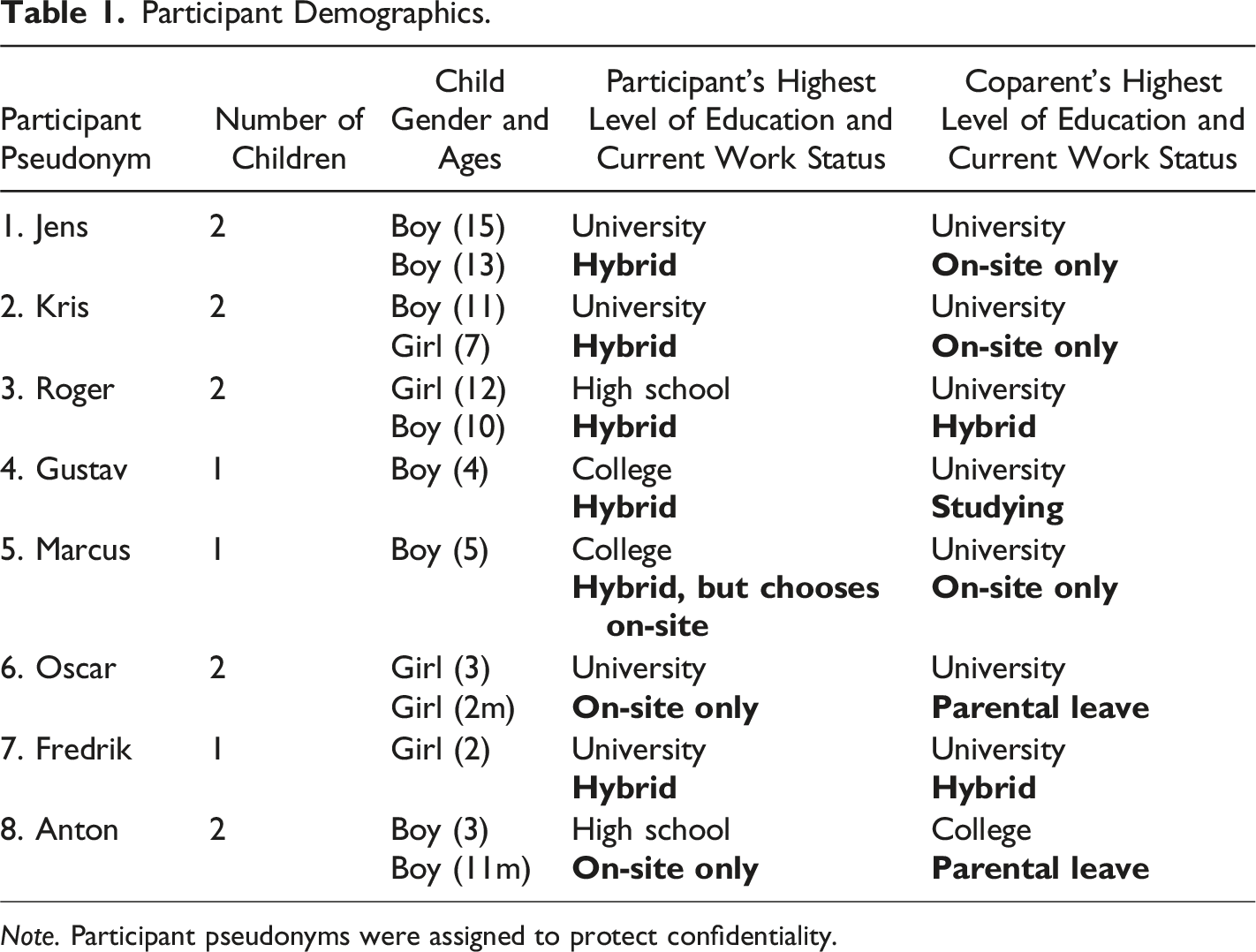
Note. Participant pseudonyms were assigned to protect confidentiality.
Data Analysis
The interviews were analyzed using Interpretative Phenomenological Analysis (IPA; Smith et al., 2021). This process was also guided by qualitative phenomenological quality criteria by Elliott et al. (1999). In order to “own one’s perspective” (Elliot et al., 1999), the first author kept reflexive notes throughout the analytical process. In each analytical step, these notes were used to prompt reflexive discussions together in the research team including what authors brought into the research. This included reflecting on experiences of gender, class, and parenthood. The latter focusing on authors’ experiences of their own parents and two of the authors also reflecting on being parents (one a father) during the pandemic restrictions. These reflections facilitated important discussions on what to focus on in the interviews as well as how to interpret them, as illustrated below.
In line with the first step of IPA, the first author familiarized herself with each specific case by reading and listening to the interview. To facilitate credibility checks of the interpretations (Elliot et al., 1999), the second and the third author also familiarized themselves with a couple of the cases each. In the second step, all authors separately noted exploratory ideas elicited by reading the data as suggested by Smith et al. (2021). In this process, the authors attended to both specific words used by the participants, but also more holistic accounts expressed, to try to capture the texture of each participants’ experiences before, during and since the pandemic. This involved the focus on the work-family interface but also a focus on the texture on how participants made sense of their role as a father, as a partner and as positioned in a Swedish context. In the third step, the first author used the notes from all authors and systematically documented “experiential statements”, summarizing participant’s experiences, reflections, and their own interpretations for each interview.
The first author then explored connections across all experiential statements throughout each interview in the fourth step leading to the formulation of “personal experiential themes” (PETs) (e.g., “Life before COVID-19 felt like a hamster wheel”, “Lots of support for mothers but nowhere to turn as a father”) with experiential quotations from the interview. When all interviews had been analyzed, the PETs were discussed by all three authors before the first author started to develop “group experiential themes” (GETs), to capture both shared and unique elements from the participants as a group. In the final step, the first author drafted the GETs. In dialogue with the first author, the third author later went through the text to make the experiential texture clearer in each GET, before the final draft was discussed and amended by the three authors together. In this step participants were invited to review and comment on their transcripts and the analysis. This draft was also presented to a group of qualitative researchers at the department, who provided their feedback on the results section before it was finalized. From these discussions, we refined the boundaries between each theme and improved the explanation of how the themes related to each other.
Results
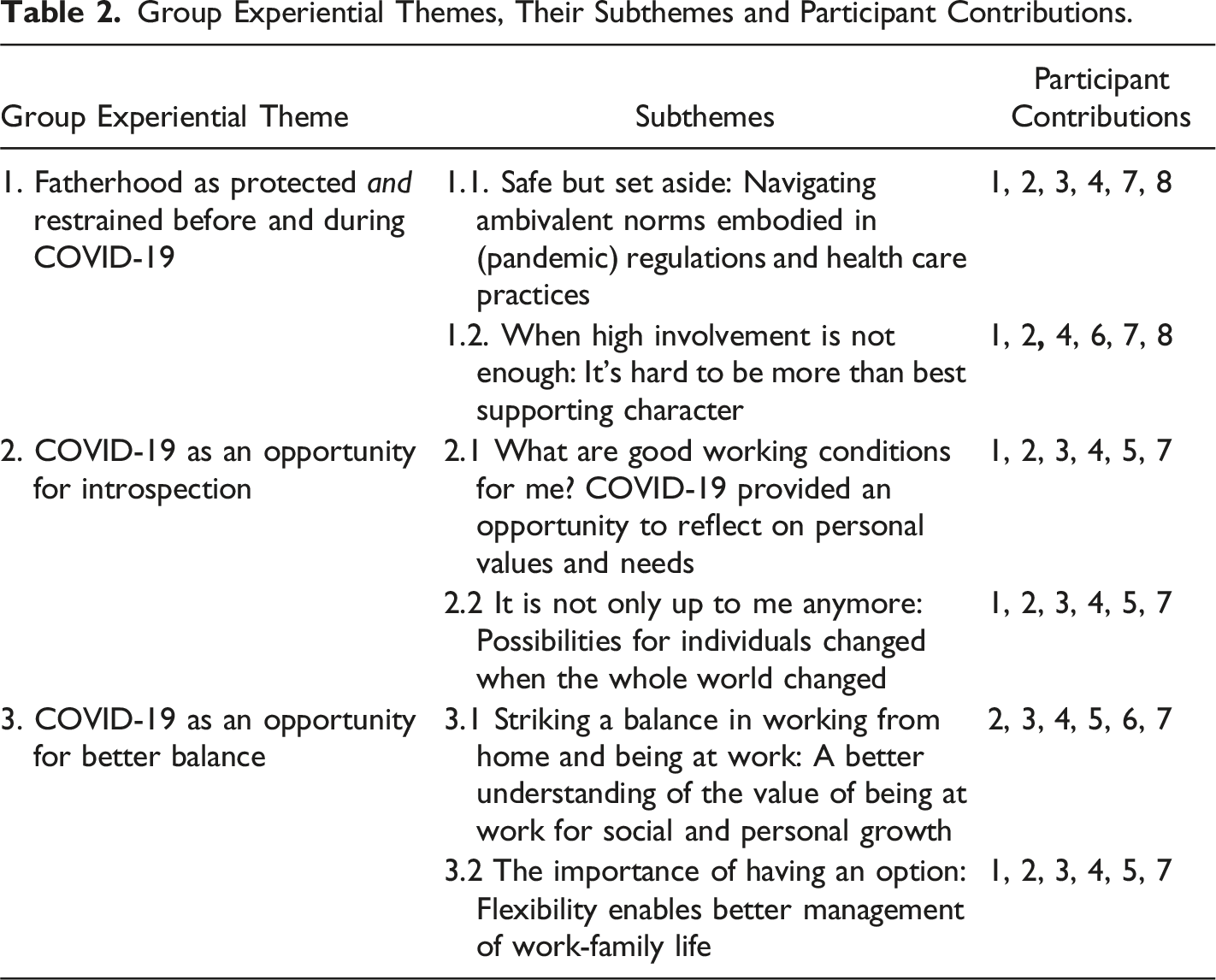
Group Experiential Themes, Their Subthemes and Participant Contributions.
GET 1: Fatherhood as Protected and Restrained Before and During COVID-19
The first GET captures the more general underlying tone expressed by participants in relation to their father role. Although all participants mentioned several ways in which they are actively involved in their family life and felt that the importance of their role as a father was guarded by Swedish law (subtheme 1), many also talked about experiences where their parenthood were pinioned, hindered, or restricted – by partners, other family members or healthcare (subtheme 2).
Subtheme 1: Safe But Set Aside: Navigating Ambivalent Norms Embodied in (Pandemic) Regulations and Healthcare Practices
This subtheme emphasizes the power that national regulations have in either helping or hindering fathers’ experiences of work and family by setting standards and boundaries around father involvement. For example, legalization on parental leave and childcare arrangements after separation helped fathers feel secure because the time is clearly dedicated specifically for them, and results in a sense of obvious benefit by taking the leave and obvious loss by not doing so. This was summarized by Gustav who perceived it as “stupid” not to take the parental leave set aside for fathers, even though he kept only the 90 days of paid parental leave reserved for him and gave away the rest to his partner. Gustav also highlighted that having strict laws helped with coordinating after separation, as well as not needing to worry about his workplace not respecting his responsibilities as a father because according to the law: “The kid is the highest priority” and “it’s not like they [the workplace] can do anything about it.”, for example requiring him to work later at the office when he would need to pick up his child from pre-school.
For Jens, general social security benefits in Sweden provided him with a sense of safety that he did not previously realize was not an automatic right for other countries: My entire fatherhood, my family life and my work life is influenced by the fact that I’ve lived in Sweden because of the extensive welfare state that we have. I feel very safe because if anything were to happen to me, society would take care of me. And I realized in conversations with others that it’s not always a given, they had to fight for everything.
Although fathers drew on different elements of Swedish regulations, it appeared that participants experienced a strong foundation of trust in the social welfare state, and that each father did use this policy-based support to reconcile their work and family lives before the pandemic, at least to the extent reserved for them. In this way, regulations in Sweden acted as a norm-setter which encouraged and valued fatherhood, as fathers could depend on the supports available that were clearly there to encourage them.
However, this norm of a valued fatherhood embodied in Swedish legislation was often undone by other practices, for example in healthcare. Some of the most pertinent examples of a gap between the expectations on fathers set by legal measures, such as parental leave allowance, and healthcare practice, was the lack of support available to fathers in adjusting to parenthood compared to mothers. For example, Anton described feeling like there was nowhere to turn for mental health support after the birth and that post-birth support was only for mothers and not for him as a father: If you google birth depression you get a ton of information on where to seek help, but only for women. I got into a depression when I first became a dad, but I had nowhere to go. We talked to [the clinic] about my feeling, but they only said: “Well you should have thought about this before.”
Anton’s account highlights that the need for support is evident and abundant for women in the transition to parenthood, yet fathers can experience being pushed away and even blamed for struggling, as the response from the clinic appeared to expect him to have planned ahead for difficulty and for him to have total responsibility.
This feeling of being set aside in the time before childbirth was accentuated during the pandemic, as participants who experienced the journey of pregnancy and birth during the pandemic described how they felt physically being set aside by healthcare. Anton expressed that he was thrust from the first ultrasound to the birth of his first child, with no ability to adjust in appointments between the two time points: “We got our first kid during the pandemic, I was only allowed to attend the first ultrasound and the next thing was during childbirth.” Similarly, Fredrik explains that during the pandemic: “I just had to wait outside… there were quite a few times where I wasn’t allowed in.” even if he came with negative COVID tests, and that “nothing really worked except for a few times when a female doctor would see that this was not okay, and then allow me to be there.”
Fredrik’s account highlighted two important elements of father involvement in the pregnancy and birth period that were hindered by COVID restrictions: first, the importance of being present as support for the birthing parent, particularly in terms of processing worrying and difficult information, and secondly as an element of the father’s own experience: not wanting to miss out on key moments of the journey. It was notable that this latter point came as secondary in Fredrik’s account, and only after follow-up questions in the interview. This could suggest that the focus on the mother is overwhelming, also in the father’s account, so much so that they view their own needs as secondary too. Fredrik clearly highlights trying to fight to be there to support his wife because of the risks in the pregnancy, yet the cultural imperative to be quiet and without conflict compromised even that. It could be the case that in less risky pregnancies where there is even less ground to stand on, fathers automatically swallowed their own hopes and needs in acceptance of a secondary, outsider position. Fredrik linked this to cultural norms of being quiet and agreeable: “As a Scandinavian, usually afraid of conflict, I tried to explain and use common sense to get them to see that my wife was vulnerable and some of the checks were because they feared that there were issues.”
Although the experience of being set aside was most mentioned in the perinatal period, there were frequent mentions of being locked out by fathers of older children as well, as explored further in the next subtheme. The pandemic amplified how fathers were unable to receive information and support in the way mothers were, which hinders their full participation by putting them at a disadvantage in terms of knowledge about their child, and their partner’s needs, at the same time as having sole responsibility for managing their own health during the transition. The meaning given by the interviewees, especially those who were excluded in the time of the pandemic, was that fathers are largely alone in supporting not only themselves, but also their partner and child(ren).
Subtheme 2: When High Involvement Is Not Enough: It’s Hard to be More Than Best Supporting Character
This subtheme extends the experience of being put aside, limited, and even locked out, as a father, as the majority of participants indicated a sense of some parenting elements being “not for them”. There was also relatively little mention of fathers’ own opinions on their parenting role except for two accounts, where fathers clearly centered their fatherhood as a rich and textured role in their life and described their relationship with their child in depth. In comparison, most fathers positioned themselves more in relation to their female coparents, who were often portrayed as putting boundaries on conduct in parenting or household management. In our analysis, this was interpreted as fathers being limited to a “supporting character” role as even though fathers expressed high involvement and interest, this was often still positioned as in service to or subject to the direction of a female coparent.
Kris experienced that his coparent “puts a lot of boundaries around herself, but also around others”. He interpreted her boundaries as adding extra emotional and mental consideration of others onto herself: “You take responsibility for everyone’s feelings, and I don’t know how she does that, but it’s way too tiring.” Kris appeared unable to make sense of his partner’s approach and viewed these considerations as unnecessary and exhausting for his coparent, as well as complicated for his schedule and management of childcare responsibilities.
Similarly, Jens described how his wife does considerable emotional and mental labor, while he takes on more household tasks: “When we try to count those hours, I would say that we are probably sort of quite very egalitarian, I think, because she does all of these womanly, quiet stuff that you don’t see.” Jens framed their division as his wife taking on more “mental” work and he took on “practical” work. The use of “practical” rather than “domestic” or “household” might suggest underlying gendered notions of labor, particularly when considered alongside the use of “womanly”, “quiet” tasks. His account also suggests that physically laborious household tasks fit with concepts of masculinity as they can be rebranded as “practical”, yet tasks that require care and attention are feminine and off-limits. In other words, although their household and childcare labor could be equal on time spent in these tasks, there appears to be underlying meaning regarding what is for him to do versus for his wife to do. The mix of “probably”, “sort of”, “quite” and “very” in expressing equality might suggest that there is some uncertainty about where he can meaningfully participate in the family in comparison to his wife.
A similar pattern was indicated in Marcus’ account, particularly on the topic of arrangements for their child’s birthday parties: “She plans a lot, and I’ve become an executor. But she managed everything”. The use of the word “executor” highlights a commonality in three of the interviews in terms of the father as an action-focused figure, with much of the invisible mental preparations being done by the female coparent behind the scenes for that to be the case. However, one interview suggests that although mental and emotional labor may seem more apparent from mother to child, it could be the case that an underacknowledged element of the father role is the emotional and mental labor in support of the mother. For example, Anton explains that he serves his coparent a cup of coffee in bed each morning to help her wake up, and stated: “When I’m not at work, I do what I can do to make things easier for my partner. If she´s having a rough day, there can be a lot of sighing”, which was in addition to preparing his children’s breakfast, and often seeing to their needs during the night before needing to commute and go into work.
In summary, while fathers could be giving their best efforts, they appear to still have difficulties acting as a “co-star” in the family domain. The meaning given by interviewees was a sense that their participation was a distinct type of involvement – being practically involved – but their partners were responsible for the mental and emotional labor, and some aspect of family life were not easily accessible or understandable to them. This was primarily expressed in relation to coparents and healthcare, however this was also implicit in lack of flexibility in work arrangements, as explored further in the second GET.
GET 2: COVID-19 as an Opportunity for Introspection
In contrast to the former GET, this theme captures the experiences of new ways of organizing work and family life brought about by COVID-19. Particularly, the shift from remote work as being off-limits, or disadvantageous, to the norm during the pandemic was positive and highly meaningful for fathers. Most enjoyed and appreciated new possibilities in location flexibility and expressed getting to know themselves and their families better throughout the transition. In contrast to the experiences of fatherhood as limited, side-stepped or pinioned described above, remote work because of COVID-19 instead opened up new possibilities for fathers and for fatherhood.
Subtheme 1: What Are Good Working Conditions for Me? COVID-19 Provided an Opportunity to Reflect on Personal Values and Needs
Participants, particularly those who had shifted to hybrid working models, described experiences of personal development through the pandemic, as the new context prompted an evaluation of their lives, fatherhood, and their relationship to work. For example, Roger reflects on how his energy needs have reshaped whether he would remain at the company if they forced a full return to office: The pandemic made me realize I didn’t feel good the way it was before. I’ve learned a lot more how I like to live my life now. When I’m home it’s quiet and my energy level is much more in tune now when I get to be more by myself. I think I’m a bit more stable in my mood and I maybe spent too much energy before.
The subtheme of learning more about oneself also applied for learning about personal preferences regarding work location for Marcus, who discovered that working from home was enjoyable at first, but he later craved the boundaries that going to a physical office afforded. He described becoming so fed up with being in his apartment constantly that he would go into an empty office each day: I was a completely different person. And I said, no I can’t have it like this anymore. I was quite fed up sitting home all alone with the computer on the kitchen table and working all day long. It never felt like your workday was over. There was no start. There was no end. So, I started to drive in to work every day, basically every morning.
While working from home was generally viewed positively amongst other fathers, and Marcus did express that it was positive at first and for family, this account emphasizes the importance of variation and boundaries in working from home. For some workers, remote working during the pandemic may have become synonymous with being trapped due to the context of the pandemic. Overall, the pandemic was meaningful for fathers in understanding their own needs and preferences better and being motivated to implement these newfound understandings in their life beyond the pandemic.
Subtheme 2: It is Not Only Up to Me Anymore: Possibilities for Individuals Changed When the Whole World Changed
A common experience among five interviewees was a sense of new possibilities because of increased working from home. Kris reflected on the pandemic as a “total gamechanger” in his work-family management and considered how he had previously made work sacrifices to prioritize family, which might not have been necessary if the pandemic had come earlier: “I already made some career decisions because of family situations and commuting. If COVID had happened when I was at the other job, I might have kept that one.” His account highlights that previously, his choice was his responsibility as an individual because of inflexible workplace attitudes, but the pandemic introduced an external pressure that forced a larger shift. A similar sense of relief and freedom was apparent in Roger’s account, who explained that he knew he was unhappy with his work-family balance before the pandemic but felt unable to change his circumstances: To be honest, I was quite unhappy before the pandemic started because I was getting very tired of this 8-5, and I felt I don’t see the kids because I get home later, and when I get home, I have stuff to do. The quality time with the kids was worse before the pandemic, and I actually was thinking about should I get a different job, this is not really fun doing this.
Roger described that he felt like a “hamster in a wheel”, and before the pandemic, he would have needed to make an individual shift away from his current job. He clearly positioned this as a conflict with his role as a father, in that an on-site 8-5 schedule meant he had less time and energy for his children because quality time was mixed with housework, and his energy was spent during the day at the office (as in subtheme 1). The pandemic provided a larger, external shift that changed this for him: I have always been very family-orientated and I didn't like the low amount of quality time I was getting with the kids. Quality time for me is just being there for my kids and having energy when they talk to me…when you came home later, you were more tired, and you had more chores to do. It was more of a routine. Now it's freer when they come home, we have the whole afternoon and I’m finished with the chores during the day.
Kris also highlighted that the pandemic made workers respect each other more, and respect distance workers who were otherwise neglected previously: They didn’t take care that they were engaged. There was always this silent acceptance that if you’re remote, you should almost expect not to be able to participate with all the nuances in the meeting and get all the information and be able to be as vocal in the discussions. You were always on the back foot before COVID and after, I think everyone respects the one calling in, even if you have a physical meeting.
This account showed how a remote worker calling in before the pandemic would be more excluded and less able to engage and demonstrate their worth, whereas the pandemic put everyone in the same situation and took away the sense of being on the “backfoot”. This connects with elements in interviews with Gustav and Marcus, who both expressed the importance of being able to prove oneself at work and felt that they needed to be physically on-site in order to do so. These shifts appeared to be meaningful for fathers in that they realized what was missing before (quality time, energy and technological presence), and how the pandemic conditions were changing the options available to them through making remote work a more viable option.
GET 3: COVID-19 As an Opportunity for Better Balance
The importance of being able to choose and have the flexibility of working from home was apparent in all interviews. None of the participants expressed a current desire to fully work from home, as they recognized that in-person work was essential for social connection and personal growth, even if it was less convenient. However, there was a strong commonality of not wanting to give up the newfound flexibility and be forced back into the office full time, as hybrid flexibility had fundamentally changed their relationship to work and family.
Subtheme 1: Striking a Balance in Working From Home and Being at Work: A Better Understanding of the Value of Being at Work for Social and Personal Growth
An important shared theme across the accounts was fathers’ recognition of the need to go into work sometimes, not necessarily for the work tasks themselves but for the interpersonal elements of a workplace, for example social interaction and collaboration. It was also highlighted that working from home full time could present a risk of becoming too isolated and too comfortable. For example, Roger reflects on his journey through loving working from home to now appreciating the structure of a couple of days in the workplace: “Some energy disappeared as well. You got maybe a bit too comfortable, you kind of need a bit of adversity sometimes to grow as a person… Maybe the pandemic, if it would keep on going, you would get too comfortable and isolated.” A similar conclusion was expressed by Fredrik: It can make you a bit too comfortable. Just being at home and not seeing other people… I can tell that that’s not good when I’ve done it too much. I’ve become better at making sure to get into the office because I can tell that it’s healthier mentally as well.
Although Oscar personally did not have any opportunities to work from home himself, he expressed both envy and caution on the topic, with the risk being reduced social input and skills: “That’s a great change that’s come from this pandemic that it’s possible for people to work at home way more. I believe it’s a good thing if people can handle it. I think it can be hard just sitting at home not seeing people socially. You shouldn’t stay at home for life.”
In this sense, the fathers' meaning-making regarding working from home was that it can be a great benefit but one that is unwieldly if constant and unmanaged. This was also apparent in Marcus’ experience of the pandemic itself, when working from home was highly enjoyable and freeing at first but became unenjoyable because of the lack of boundaries and lack of engagement with the outside world: “I like to come to office or go somewhere. The first month working from home was great, and then you start getting tired, you gain weight, you start getting different routines and so on. There was no break in between work life and private life. It was just so mixed up for me.”
Overall, it appeared that working from home was a powerful resource that could give fathers more control over their lives, however fathers did also recognize the intangible benefits of going into work and the need for boundaries and maintaining social engagement for a fulfilling life. Building on their reflections about learning new preferences during the pandemic in GET 2, fathers appeared to derive meaning from social inputs and variety, and that these are worth putting in extra effort for.
Subtheme 2: The Importance of Having an Option: Flexibility Enables Better Management of Work-Family Life
The preciousness of time was apparent in all interviews, especially among fathers with younger children. In the five interviews where fathers had transitioned to a hybrid working model, it was clear that hybrid working enabled them to have more control over their schedule and manage competing demands. For example, Roger describes feeling free and able to adapt his life to the way he wanted to live rather than having it completely structured for him: “I loved working from home. I loved the freedom it gave me. I could plan my days in a way that suited me. It made me feel more in control of my life and how I wanted to live it.”
In contrast, Anton spoke of how he had no flexibility and needed to adapt around the strict times of his workplace, which appeared to become even more difficult after sleepless nights with young children: “I was told recently that the working times are strict, so now I have to reschedule my routines. I don’t have any possibilities to work hybrid. I have to run around a lot and it has also resulted in nights without sleep to then go to work.”. Oscar also had no possibility to work from home due to the nature of his job and considered the importance of time for maintaining personal health (going to the gym), seeing friends, and spending time with one’s partner. Oscar expressed repeatedly that there was simply no time to do these things, and that by the time he is alone with his wife, they are both extremely fatigued.
Working from home also enabled fathers to take care of simple household duties within the course of the workday, for example putting on the washing machine, cooking, or cleaning. This in turn enabled more quality time with their family when all members came back together again, as chores did not need to be done within the time together. This appeared helpful no matter what style of quality time fathers were preparing for. For example, Kris mentioned how being able to ensure everyone has clean clothes meant that going out for activities as a family became more straightforward: “Just running a washing machine during the day makes a lot of difference if you have activities in the evening. I know, people joke about these things like cleaning your clothes is actually part of what you need to do, right?”
The expression of this point, for example saying “right?” suggests that Kris sees this as a basic necessity that is obvious but otherwise glossed over. Throughout the interview, he highlighted the essential realities of family life for example, ensuring everyone is fed, clean, and able to get to and from different places (school, home, activities). This focus on the basic tasks may be because they become overwhelming if they do not have the space and time otherwise, yet they are the crucial foundation for other elements such as socialization and connection. It could be the case that not having enough time for these responsibilities causes fathers to home in on the basic tasks first, potentially leaving less time for the more subtle, longer-term needs of emotional connection with their children, as also suggested by Roger’s account in GET 2, subtheme 1.
These narratives suggest that the pandemic did enable fathers to engage with childcare and household tasks in new ways because of greater time in the home, and greater flexibility with work location. The way the comments were expressed suggested that fathers were aware of needs but felt restricted in their ability to manage both household and family time in the context of fixed work hours. Fathers reflected on the importance of work flexibility and what this means for their ability to be present in family life, in that these new options give fathers the space needed for taking care of tasks during the day and enabled a reduction in split attention in the evening. In many interviews, it was clear that fathers wished this to continue in the future and that having now experienced the difference this flexibility can make, they felt able to prioritize it in their decision-making in work.
Discussion
The aim of this study was to explore Swedish fathers’ experiences of the work-life interface, with the research question “How do fathers experience the interface between work and family in light of the changes brought about by the COVID-pandemic?”. In summary, we found that most participants felt secure in terms of family-friendly legislation, but relationally limited in how involved they could be in family life. One core reason for this was the need to physically go into a workplace every day resulting in feeling strained in terms of time and energy (cf. Voydanoff, 2008). Most of the fathers found the pandemic meaningful for changing their work-family life by giving them an opportunity to experience working from home and explore how they worked best, as well as reflect upon their relationships to family and work. The pandemic appeared to be a transformative force for most participants, opening options that they did not previously consider possible. Prior to the pandemic, fathers may have felt that segregation of work and home was the best or only option available to them, but pandemic conditions showed them the value and possibility of integrating their work and family lives (Colombo & Ghislieri, 2008). Considering these findings together with studies from other countries where governmental paternity support is less available (for example, the US), we highlight that despite clear and ostensibly gender-neutral options for fathers in Sweden, important barriers remain in this context as well. This extends our understanding by indicating that there are similar barriers and benefits for fathers internationally, and that governmental support is necessary but not sufficient if other areas are not addressed. New arrangements of hybrid working models were highly appreciated by fathers, as they derived meaning from both the social input of work as well as the better distribution of time and energy that working from home could give them. This connects with Kossek and Lautsch’s (2012) theory of the dual-centric worker who functions best by alternating their boundaries between work and home and showed that fathers were able to meaningfully assess their own needs and limitations through the pandemic. This, in turn, enables higher quality family time, as they highlighted the role of this in having more mental space and energy for their family. These findings are in line with Voydanoff’s (2008) theory of time and strain-based demands and resources, allowing fathers to both reduce the strains imposed by commuting and accumulation of tasks, whilst also increase their resources by preserving energy.
This study was the first to take an overarching view of fathers’ experiences before, during and since the COVID-19 pandemic, which and to analyze the work-family experiences of Swedish fathers in depth in light of the changes in the COVID-19 pandemic. Contrasting with other studies of fathers’ experiences (Iztayeva, 2021; Petts et al., 2023), our study suggests that extending the impacts of the pandemic is possible but nuanced in terms of addressing psychological and social elements. Furthermore, the consequences of isolation in this Swedish sample were emphasized more as an individual responsibility and social input at work as an important benefit, whereas other studies have conceptualized isolation more as loneliness (Iztayeva, 2021). This difference may be due to Sweden’s approach to COVID-19 regulations, where individuals still had relative freedom to decide their level of social interaction, compared to lockdowns and curfews in other countries. In other words, Swedish fathers may have felt more autonomous regarding their level of social input, and fathers in other countries may have felt more restricted.
The results suggest that despite gender equality efforts, fathers still experience feeling secondary, whether implicitly (for example by their coparent directing what is appropriate) or explicitly (for example by being shut out of prenatal appointments). Other IPA studies conducted during the pandemic have highlighted how the changes in maternity care resulted in feeling alone for mothers (von Rieben et al., 2022) and how fathers felt both restricted by healthcare but otherwise able to participate more in the pregnancy (Siudem-Kuna & Cierpka, 2022). Fathers’ access to parenthood appears to be helped by some national regulations such as reserved portions of parental leave but hindered by others such as healthcare restrictions. The participants also shared that more flexible work-family options (such as remote work) seemed disadvantageous or simply was not an option for them before the pandemic, which could be part of explaining the limited use of parental leave and disparities in domestic labor.
Existing research on fathers and their work-family interface emphasizes patterns of fathers struggling to integrate their work and family roles due to not feeling supported by their workplace (Raiden & Räisänen, 2013) and feeling limited by norms amongst colleagues (Allard et al., 2011) as well as difficulties in reconciling hegemonic and new masculinity (Offer & Kaplan, 2021). Although perceptions of the father of primarily being a breadwinner have shifted and there are expectations of active involvement in childcare (King, 2017; Lamb et al., 2004), and even though fatherhood is central in discussions of “new” masculinity (Offer & Kaplan, 2021), there were few shifts in the workplace to support fathers in actively embracing this. A recent study by Ewald et al. (2024) on fathering identities and flexible work arrangements highlighted this conflict, with fathers wanting to be more involved in family life but cautious of how it could affect their career negatively.
The results in this study indicated that the pandemic was a transformative period for the participants, in terms of offering an opportunity to understand their relationship to work and family in new ways, experience the flexibility of remote and hybrid work models, and gain benefits from having more space and time to manage household tasks. It appears important to extend the flexibility and autonomy initiated in the pandemic, but also to contextualize how the pandemic context may have led to more isolated and uncomfortable experiences of working from home. On one hand, the pandemic provided a widespread and forced opportunity to explore the role of remote work in the work-family interface regardless of gender or parenting status, but it also did so in highly uncertain and restricted time. As in Colombo and Ghisleri’s (2008) integration and segmentation model, the pandemic offered an opportunity for fathers to experience integration of work and family life that would have depended on individual choice before, which may not have felt possible in other circumstances. In turn, learning about oneself and one’s family also shaped individual preference, and the pandemic seems to shift the landscape of organizational culture itself, aligning with Kossek and Lautsch’s (2012) model.
Strengths and Limitations
Unravelling the complex meanings and experiences of the pandemic and gendered parenthood requires deep exploration and consideration. The use of IPA allowed for an in-depth, experiential focus that has been missing in other studies and the ability to focus on the nuances in fathers’ experiences was an important element of the present study. However, we recognize that expectations, norms, and legislation for fathers are different, especially considering different possibilities and limitations in other cultures. Some aspects of the current study are applicable elsewhere, but care must be taken when transferring the findings as countries with other welfare systems and attitudes likely need their own investigation. Furthermore, we recognize that focused efforts are needed for recruiting international fathers, who likely have additional barriers such as cultural expectations, more distant extended family, and language. The implications of these findings are limited to fathers in workplaces that can work support remote work, and further research is needed to understand how to support fully on-site fathers, for example greater parental leave allowances or more flexible timings, if location flexibility is not possible. Finally, this study did not include gay fathers’ experiences, although their voices are represented in Swedish research elsewhere (e.g., Evertsson & Malmquist, 2022), however it is important to note that same-sex father couples likely have different needs and experiences to the fathers in this study.
Implications for Research and Practice
The findings from this research indicate fathers made meaning of the pandemic in terms of having greater flexibility and freedom in managing their work-family balance. Creating opportunities for flexibility is crucial and we recommend further studies to investigate the impact of different work organization approaches. This research highlights the importance of legislation in both removing barriers for fathers and setting standards for their participation. Parental leave is one important option to increase the involvement of fathers by giving them time alone with their child and experience of full-time domestic responsibility, however it is temporary and does not fully support the day-to-day labor distribution of parents in practice. The pandemic has concretely emphasized the viability of balancing work and family together and given workplaces and individuals an opportunity to adapt and develop their practices for remote working. In order to maintain the learning and skills from the pandemic, supporting families by making hybrid working models more secure and accessible is paramount, and arguably something that should be set at a policy level, rather than relying on individual workplaces to implement. Furthermore, policies around coparent inclusion in perinatal healthcare are important for supporting father involvement before the birth and enabling them to fully transition into parenthood. There are considerable benefits for their child, their partner and relationship, and their own development in doing so, and considerable costs in neglecting fathers’ needs. Our study has indicated that the pandemic was experienced as a “gamechanger” for fathers, and policies, workplaces and healthcare should actively build on these insights.
Footnotes
Author Contributions
Laura Cox: Conceptualisation, Data management, Formal analysis, Investigation, Methodology, Project administration, Writing - original draft, Writing - review & editing, Visualisation, Resources. Tove Lundberg: Conceptualisation, Supervision, Writing - original draft, Writing - review & editing, Methodology, Project administration. Jonas Bjärehed: Supervision; Writing - review & editing, Methodology.
Declaration of Conflicting Interests
The author(s) declared no potential conflicts of interest with respect to the research, authorship, and/or publication of this article.
Funding
The author(s) disclosed receipt of the following financial support for the research, authorship, and/or publication of this article: The research was funded by the Researchers’ Educational Institute.
Ethical Statement
Prior Dissemination
This paper and its findings have not been published and are not under consideration for publication elsewhere.

Data Availability Statement
In accordance with the Swedish Law concerning research with humans, and in order to protect our participants, we cannot share any personal data from the present study. However anonymized data, analysis code, and research materials can be made available by emailing the corresponding author.