



Abstract
While most violent crime declined during COVID-19, domestic and gender-based violence either remained the same or increased in most jurisdictions. Some social movements have turned to engaging men in change for gender equity initiatives—confronting intersecting oppressions. In this systematic review, we examine peer-reviewed studies on White men’s allyship across five electronic databases which resulted in seven studies that met the inclusion criteria. White men’s allyship is an emerging research area that is primarily qualitative and exploratory with few high-quality studies. Antecedents of White men’s allyship were a sense of fairness, justice, and equality; compassion; personal experiences of oppression; and caring community membership along with leadership skills. The processes allies experienced as they developed were turning points, learning and knowledge acquisition, joining social movements and engaging in social action, and skill building and maturation. Learning from the critiques of allyship is an opportunity for White men to engage in relationally accountable allyship.
In 2019, the Government of Canada took an active role as a funder, leader, and convener of strategies to engage men and boys in gender equity work with the report “Calling men and boys in” (Women and Gender Equity [WAGE] Canada, 2021). They recognized the overlapping and structural oppressions which construct ongoing inequalities and violence against women and adopted an intersectional feminist framework to guide initiatives to change men’s negative norms and behaviours. This report arguably aligned the federal government’s analysis to the injustices highlighted by social movements such as the Sisters in Spirit (Native Women’s Association of Canada, 2009), #MeToo (Ohlheiser, 2021), and Black Lives Matter (Black Lives Matter - Canada, 2020). Throughout the report and within these social movements, there are calls for men, settlers, and White people to join in structural change work that will prevent and resist ongoing violence and trauma.
At the same time, Canada has witnessed a surge in public White nationalism, hate speech, and gendered violence (Badwall et al., 2019; Wang & Moreau, 2022). White men are most often at the nexus of these movements that reassert White male supremacy (Canada, 2022; Greig, 2019). For instance, the trucker convoy in Canada created a rallying point for many White and male supremacist causes, claiming oppression and victimization (Canada, 2022). In the United States, Republican courts and legislatures have over-turned Roe v. Wade and reduced choices for people who give birth (Coen-Sanchez et al., 2022). Violent transphobia, the historic rise in library censorship, as well as anti-trans or trans-antagonistic policies that have been proposed or adopted in conservative-led Canadian provinces are some of the most recent public attacks on human rights (Cecco, 2024; Westbrook, 2022).
In this political context, some White men are seeking to resist White supremacist colonial misogyny and instead contribute to a just society (Murphy, 2010; WAGE Canada, 2021). However, activists and scholars have widely critiqued White men’s involvement in social movements and often view them as untrustworthy (Gehl, 2013; Gorski & Erakat, 2019). White men seeking to ally to social movements are socialized by privilege, frequently take space, leadership positions, and direct strategy; they create emotional labour for women and racialized activists; and, often leave when faced with adversity (Gorski & Erakat, 2019; Patton & Bondi, 2015). These pitfalls necessitate further research on how White men can develop the skills to meaningfully join social movements for justice.
Allyship is a common way that White men define their involvement in progressive social movements (Anicha et al., 2018). Allyship is described as both actions taken by people with privilege who are working to undermine the structures that create their privilege (Broido, 2000), and as practices of relational accountability (Almassi, 2022; Mitchell et al., 2018). Broido (2000) defined social justice allies as “members of dominant social groups (e.g., men, Whites, heterosexuals) who are working to end the system of oppression that gives them greater privilege and power based on their social-group membership” (p. 3). While allyship is widely critiqued, it offers a starting point for many White men who are seeking to join progressive social movements. Dialogues on White men’s accountability within activist spaces are ongoing within the burgeoning literature on allyship (e.g., Carlson et al., 2020), but much of this literature focuses on participant groups that have mixed gender and mixed race characteristics, leaving the specific social location and roles of White men largely unexamined.
Intersectionality theory (Crenshaw, 1989) and Carbado and Harris’ (2019) more recent work direct our attention to analyze the unique social location of White settler men, and calls for analysis and critique of White men’s impacts and involvement in progressive social action. This scholarship underscores peoples’ unique positionality and experiences within anti-racist or gender justice allyship for example, calling attention to on factors such as racial or gender identity, Indigeneity, etc. (Carbado & Harris, 2019; Crenshaw, 1989). Specific to White men within these movements, a comprehensive and systematic review of the literature has not been conducted that focuses on the antecedents of White men’s commitments to allyship, and the processes and events that occur as White men develop as allies. Therefore, the objective of this study was to use a systematic review methodology to examine peer-reviewed studies on White men’s allyship following the Preferred Reporting Items for Systematic Reviews and Meta-Analysis ([PRISMA] Moher et al., 2009) guidelines for the reporting of systematic reviews, the assessment of study quality, and synthesis of the existing literature. This systematic review will contribute to the knowledge base for initiatives seeking to “call in men and boys” (WAGE Canada, 2021), and to inform future research directions to build a culture of allyship, and resist the rise of far-right extremism in Canada and globally (Canada, 2022, Recommendation 5).
Allyship
Research on allyship with groups experiencing oppression is historied and multi-layered and includes the history of Gentiles assisting Jews during the Holocaust (Fogelman, 1995); and White allies in abolitionist, civil rights, and anti-racist movements (Pinkney, 1968). In Canada, Dr Cindy Blackstock, a Gitxsan activist scholar who has championed the rights of Indigenous children, honoured the history of Dr Peter Bryce as an ally to Indigenous peoples for strongly criticizing the racist and genocidal residential school policy of the Canadian government with his 1907 report (Tennant, 2020). Literature on White male allyship also emerged in the context of heterosexual allyship for lesbian, gay, bisexual, transgender, and queer plus (LGBTQ+) activism in the global North in the late 80s and early 90s, particularly during the HIV/AIDS epidemic (Washington & Evans, 1991). After this point, literature on allyship took a broader turn, moving from single cause to a more general or interconnected understanding of oppression, and frequently cited Broido’s (2000) definition of allyship, which centered the work of allies in ending systems of oppression.
Anicha and colleagues (2018) trace the use of the term allyship online, which was first used in reference to an LGBT allyship training program in 1988. In the 1990s, allyship was used in reference to anti-racist allyship and a discussion of ally accountability emerged (Anicha et al., 2018). In the 2000s, allyship was associated with terms such as diversity and cultural competency as well as the emergence of allyship “dos and don’ts lists” (Anicha et al., 2018, p. 156; e.g. Bishop, 2015/[1998]); McIntosh (2003). Since 2010, the discussion of allyship has shifted to the “pitfalls and commoditization of allyship/ally identities; [and] despair of marginalized folks due to ineffective/insecure allyship claims” (Anicha et al., 2018, p. 156). Overall, they contended that allyship shifted from a paternalistic helping relationship to a lateral relationship with the expectation that allyship is “an ongoing real-time behaviour rather than a static identity” (p. 163) and includes commitments to accountability to the group allied with.
Over the last two decades, much of the literature on allyship has focused on ally identity development and the processes through which people come to see themselves and then act as allies, and has examined the antecedents that predispose individuals to social justice allyship. These noted antecedents include family influences (Broido, 2000; Coulter, 2003; Duhigg et al., 2010), egalitarian values (Russell, 2011; Young, 2010), empathy (Fingerhut, 2011; Munin & Speight, 2010), faith background (Duhigg et al., 2010; Munin & Speight, 2010), and personal experiences of intersecting oppression such as poverty (Casey et al., 2017). Many of the studies that included family influences examined how participants choose to resist oppressive family teachings, characteristics, and experiences, such as racism and family violence, or aligned to their family’s social justice values (Casey & Smith, 2010; Coulter, 2003).
Conceptual Models of Allyship
Several scholars have contributed conceptual models of allyship development. Expanding on Broido’s (2000) study, Reason and Broido (2005) proposed a six-step allyship development model. “(1) pre-college attitudes… (2) acquiring information… (3) meaning making… (4) confidence: in themselves, in their views, and in their knowledge bases… (5) skill development… and, (6) the importance of chance and recruitment” (pp. 21–23). Reason and Broido (2005) designed their model to align to the university context and did not include any analysis of ally identity development such as later stage critiques of allyship. The model did not address ongoing personal transformation or many of the critiques of allyship such as the emotional labour that White allies demand of Black, Indigenous, and racialized people (Gorski & Erakat, 2019).
Casey and Smith (2010) adapted Reason and Broido’s (2005) model, synthesizing Banyard and colleague’s (2010) transtheoretical approach to propose a process model for engaging men in gender-based violence prevention. Their model included a sensitizing experience, an opportunity experience, and a process of shifting meaning which men experienced iteratively; these experiences then led to involvement in anti-violence.
Shifting to a focus on ally motivation, Edwards (2006) provided a conceptual model of ally development which argued that motivation for allyship will lead to either ally effectiveness or ineffectiveness. He categorized three areas of motivation: (1) allies for self-interest who focus on individual perpetrators of injustices against the people they know, (2) allies for altruism who see themselves as protectors of the weak, and (3) allies for social justice who implicate themselves in power structures and use their privilege to undermine systems of privilege and oppression. Edwards’ (2006) model highlighted the motivation and approach to allied action but did not examine how allies move between the categories that he proposed.
Bishop (2015) proposed a seven-step model based on her 30 years of experience as a community activist that further examined allyship skill maturation and maintenance, which the previous models had not examined: Understanding oppression, how it came about, how it is held in place and how it stamps its pattern on the individuals and institutions that perpetuate it; (2) understanding different oppressions, how they are similar, how they differ and how they reinforce one another; (3) consciousness and healing; (4) becoming a worker for your own liberation; (5) becoming an ally; (6) educating other allies; and (7) maintaining hope. (p. 12)
Bishop’s (2015) model focuses on early commitments and extends into active allyship. Bishop’s (2015) work provided an introduction into allyship but requires further detail of the specific forms of domination that White men must become aware of, and the ways to overcome these interpersonal enactments of oppression.
While a small body of research on allyship has emerged since Broido’s (2000) ground-breaking study, there has been very little examination of the specific antecedents and processes which White heterosexual men have experienced to come to engage in intersectional allyship. A limited number of studies include White men, but very few (i.e., Patton & Bondi, 2015 is a notable exception) have focused exclusively on this group that has been described as holding a position of “hyper-privilege … with a disproportionate amount of societal power relative to women and people of color” (Cabrera, 2014, p. 31). Social movements and government strategies that seek to call men into social change require research that specifically examines how White heterosexual men may be engaged in these movements as accountable and trustworthy allies.
To build the trustworthiness of the analysis, we position ourselves as follows: Jeff Halvorsen is a White male settler of German, Norwegian, and Scottish heritage with 18 years of experience in social work practice, research, and evaluation focusing on gender-based violence, homelessness, and racial injustice. Tamara Humphrey is a White women settler of Norwegian, French, and Welsh heritage and a critical feminist criminologist and community-engaged researcher. Liza Lorenzetti is a settler from Italian heritage with over 30 years of social work practice, research, and activism. Mario Rolle is of Bahamian heritage and lives in Atlantic Canada. He is a Clinical Social Worker, university instructor, and has 10 years of experience developing domestic violence prevention and intervention programming with Black men.
This systematic review is the first to specifically explore White men’s allyship identity development. The aim of this review is to identify, examine, and synthesize the peer-reviewed evidence on the antecedents that contribute to White heterosexual men’s involvement in social justice activism, and the processes through which White men develop as allies. The findings from this systematic review respond to two research questions: (1) what antecedents contribute to White men’s involvement in social justice activism? and (2) what processes and events do White men experience to develop as allies?
Methods
Data Sources and Search Strategy
We conducted this systematic review following the PRISMA guidelines (Moher et al., 2009). The search strategy was devised in consultation with a university librarian for the ERIC database via EBSCO Host and we employed two search concepts: social justice (“social justice” OR oppression OR “violence against women” OR racism OR “violence prevention” OR “human rights” OR “gender issues” OR “equality” OR anti-racism OR “LGBT-affirmative”) and allyship (“allies” OR “ally role” OR “heterosexual allies” OR “engaging men” OR “white men” OR ally* OR pro-feminism OR “men’s role” OR “male feminism” OR “community activism” OR “male activism” OR “doing good”) connected with the Boolean functions “and”. The search was limited to peer reviewed published articles with full text available in English with no limits set for geographic location or time-period of publication. We did not limit the search to a specific time-period because we understood that this was an area with limited research and wanted to access as many studies as possible.
We did not include a separate search concept of the population (White men), because many of the studies on allyship do not explicitly state the gender or race of participants within the abstract and we wanted to include as many studies as possible. We understood this lack of explicit reporting as a result of the way privileges operates, often taken for granted and not explicitly identified by people who experience privilege (Frankenberg, 1993; McIntosh, 2014). Instead of filtering studies using the term “white men”, we decided to screen for the population of interest in the full-text review. We also did not search for intersectional allyship as this is an emerging term and instead decided to focus on the topic of social justice broadly and selected areas of injustice such as violence against women, racism, and discrimination against LGBT peoples. We conducted the search in June of 2021 and updated in February of 2023, of six electronic databases Academic Search Complete, CINHAL Plus, LGBTQ+ Source, ERIC, SociIndex, and Social Work Abstracts.
Inclusion and Exclusion Criteria
Prior to initiating the search, we identified the following inclusion criteria: (1) ally development, growth, or the process of becoming an ally; (2) identification of antecedents that encouraged or supported research participants in becoming allies; (3) study participants included White male identified individuals; (4) included results and analysis specific to White men; and, (5) was original naturalistic or empirical research. Studies were excluded if: (1) White men ally participants were youth, under 18 years old; (2) only examined allyship between groups or community/nations and did not analyze individual actions, stories, or trajectories, e.g. country to country agreements; (3) presented only a conceptual or theoretical model without including naturalistic or empirical data; or (4) only considered the programming or activities that supported the development of allies. These inclusion/exclusion criteria were selected to narrow the results on studies which contained data that responded to the research question.
Screening
We undertook the screening process in accordance with the Cochrane Collaboration guidelines (Lefebvre et al., 2019). Firstly, we downloaded all the search results from individual databases into Zotero (Digital Scholar, 2023), a reference management software, and removed duplicates. One reviewer (JH) screened titles and abstracts to determine whether they met the specified inclusion criteria. A second reviewer (TH) independently screened all results at title and abstract level. Any discrepancy between two reviewers were discussed until a consensus was reached. The studies included in the title and abstract review were then downloaded and one reviewer (JH) completed a full-text screening to ensure the study met the eligibility criteria. In accordance with the PRISMA guidelines, the reasons for exclusion were noted, and each decision to include or exclude a study was discussed with a second reviewer (TH).
Data Extraction and Analysis
Data were extracted by JH and reviewed by TH. The following data were extracted for each study: authors; year of publication; the methodology and sample; group or cause allied with; primary objective of the research; and relevant findings or results. After data extraction, studies were uploaded to the qualitive research software package NVivo (QSR International, 2022) and coded, using an inductive thematic analysis approach (Guest et al., 2012). We developed themes to synthesize the current knowledge on the research question and we noted the number of studies that identified each theme to identify patterns. We did not conduct a formal meta-analysis because a majority of the studies were conducted with a qualitative methodology, and there were too few studies with quantitative methodologies to implement this approach.
Quality Assessment
We conducted three types of assessment in this systematic review: quantitative quality assessment, qualitative quality assessment, and level of evidence. We operationalized quality through examining methodological rigour and then assessed the quality of evidence. Following Fisher and colleagues (2021), we assessed the methodological quality of the evidence for qualitative studies with the Critical Appraisal Skills Programme (CASP) Qualitative Research Assessment Tool (2018). During the assessment process, we engaged in critical reflexivity (Foley, 2002) and performed an interpretivist analysis through our positionalities, and understanding of anti-racist, intersectional feminist, and anti-colonial principles to complete the assessment process.
We assessed the methodological quality of the quantitative studies using the National Institutes of Health Quality (NIH) Assessment Tool for Observational Cohort and Cross-Sectional Studies (National Heart Lung and Blood Institute, 2018). We assessed the level of evidence of the studies using the National Health and Medical Research Council (NHMRC) Evidence Hierarchy (NHMRC, 2009). Acknowledging the disparate ontological assumptions between quantitative and qualitative studies, we only assessed the quantitative studies for level of evidence. JH assessed study quality while doing data extraction and TH resolved any uncertainty in classifications of the studies.
Findings
The initial abstract search resulted in 1866 responses. Once duplicates were removed (n = 534), 1332 unique studies remained. Based on the title and abstract review, 1247 studies were excluded, and 85 articles remained. After a full-text review, 7 articles were retained in the final study for data extraction and analysis (see Figure 1). Prisma flow chart.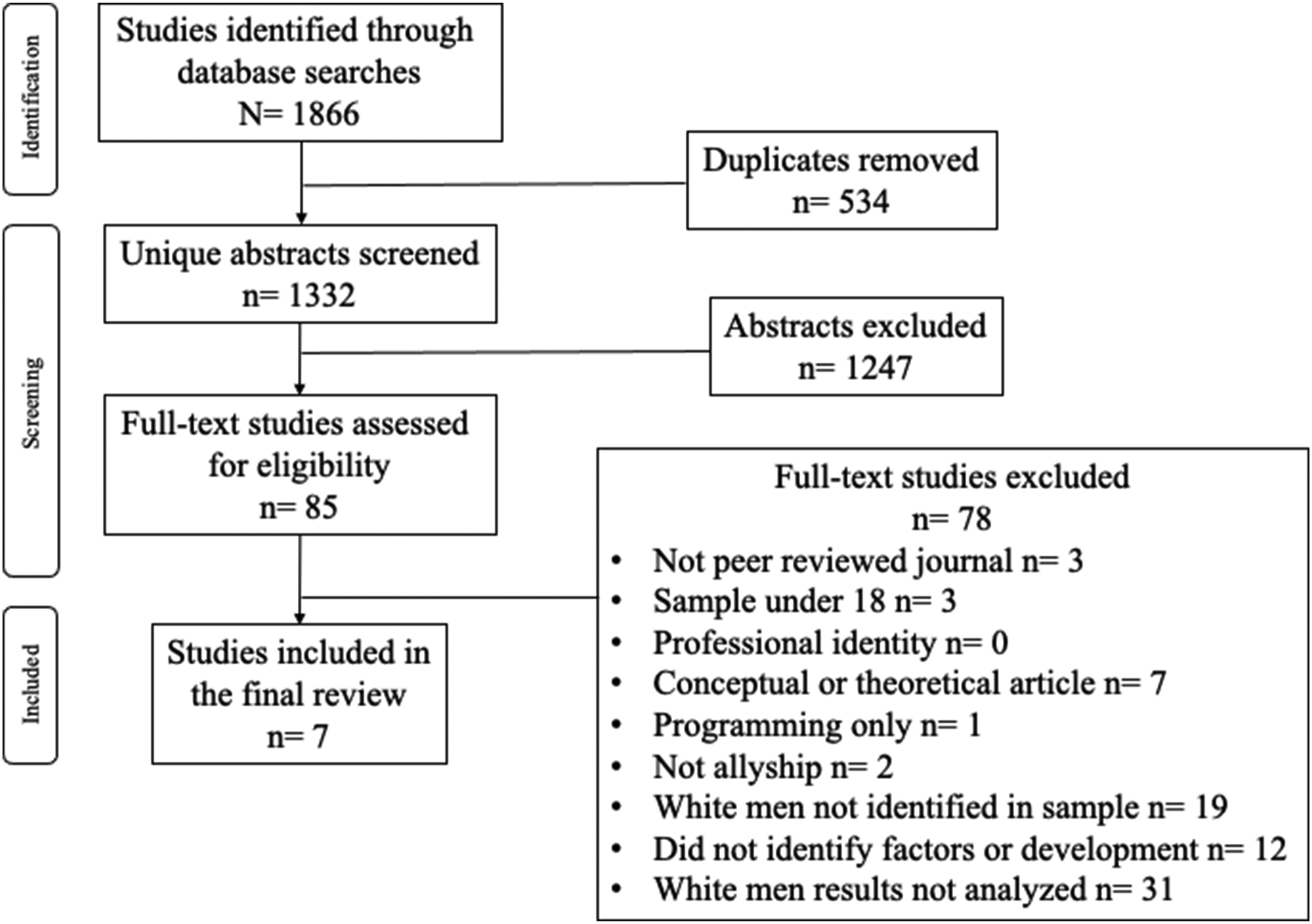
Study Characteristics
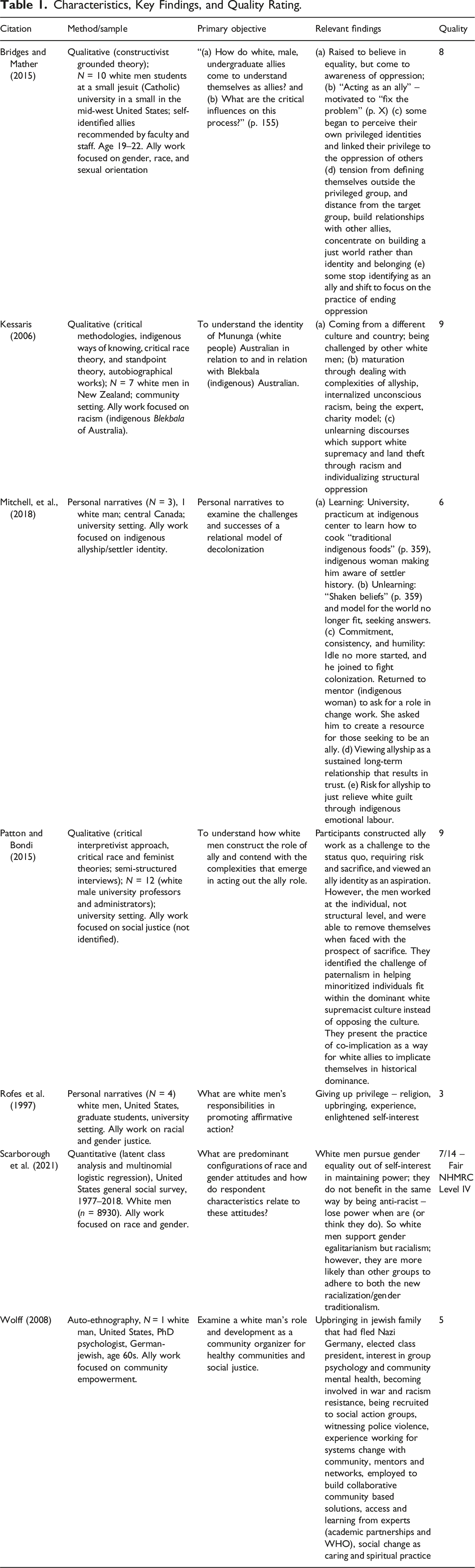
The selected studies focused on two populations: college/university students (n = 3), and adult professionals (n = 4). Five studies identified the participants as exclusively White men, while two studies had a mix of gender and race, but specifically analyzed results for White men. The focus issues for allyship in the studies included race and gender (n = 2), race, gender, and sexual orientation (n = 1), general social justice (n = 1), Indigenous allyship/settler identity (n = 2), and community empowerment (n = 1). Methodologically, most of the studies were qualitative (n = 6), where the authors did not explicitly identify their methodology but included personal narratives of White men. We identified the methodologies that were used as auto-ethnographic (n = 1), narrative inquiry (n = 2), constructivist grounded theory (n = 1); critical interpretivist, critical race, and feminist theory (n = 1); critical race analysis of White men’s narratives (n = 1); and quantitative (n = 1; latent class analysis and multinomial logistic regression).
Quality Assessment and Level of Evidence Results
Most of the qualitative results (n = 5) were assessed as moderate to high quality, with one study assessed as low quality. Many of the qualitative studies relied on personal narratives where a common weakness in the implementation of the qualitative designs was that authors did not explicitly identify a methodology, and did not include analysis of the narratives (see Supplemental File: CASP Qualitative Study Quality Assessment). Only one quantitative study was included, and this study was assessed as fair quality.
Characteristics, Key Findings, and Quality Rating.
Synthesis of Findings
Findings of the seven included studies were synthesized to address the two research questions: (1) What antecedents contribute to White men’s involvement in social justice activism? (2) What processes and events do White men experience to develop as allies?
What Antecedents Contribute to White Men’s Involvement in Social Justice Activism?
Four (Bridges & Mather, 2015; Rofes et al., 1997; Scarborough et al., 2021; Wolff, 2008) papers reported on antecedents experienced by White men seeking allyship. Meaningful antecedents included values such as a sense of justice, being part of a caring community, and compassion. Taken together, the findings are useful in exploring the values, beliefs, and experiences that led the White men to aspire to act as social justice allies and the processes they experienced.
Bridges and Mather (2015) and Rofes and colleagues (1997) identified commitments to a sense of fairness, justice, and equality as antecedents that later led White men to aspire to allyship. These came from adopting parent’s values, and in one instance, being strongly corrected by a parent for a racist statement. In contrast to a sense of justice, Wolff (2008) shared that his identity as a child of German Jewish immigrants who fled the Holocaust led to his later social activism. He identified this as an indirect factor, and more directly, he developed a desire to belong to a caring community at a summer camp as an adolescent, developing his skills as a community leader, which all contributed to his identity as a community organizer.
Scarborough and colleagues (2021) analyzed over 40 years of general social survey data to examine endorsement of gender and racial equitable attitudes. They found that while White men were the least likely group to endorse gender and racial equity compared to White women, Black women, and Black men, the group of White men who did endorse racial equity were more likely to also endorse gender equity. However, the pathway from gender to racial equity was not as strong as other groups, and they argued that White men showed higher endorsement of gender equity because they were self-interested and did not receive the same personal benefits from racial equity as Black men. This study demonstrated that previous equitable attitudes were antecedents for some White men to endorse gender and racial equity.
Participants in Bridges and Mather’s (2015) study identified the characteristic of compassion as an antecedent. This attribute was not defined or analyzed in the study, and like many of the statements, these antecedents were identified in reflective life history interviews. Taken together, these antecedents were important in some of the White men’s narratives of the change processes they engaged in to begin aspiring to allyship.
What Processes and Events Do White Men Experience to Develop as Allies?
All of the studies examined the change processes that White men underwent as they aspired to allyship. We synthesized these findings, into the steps of turning points, learning and knowledge acquisition, joining social movements and engaging in social action, skill building, and maturation (see Figure 2). Proposed model of white Men’s allyship development.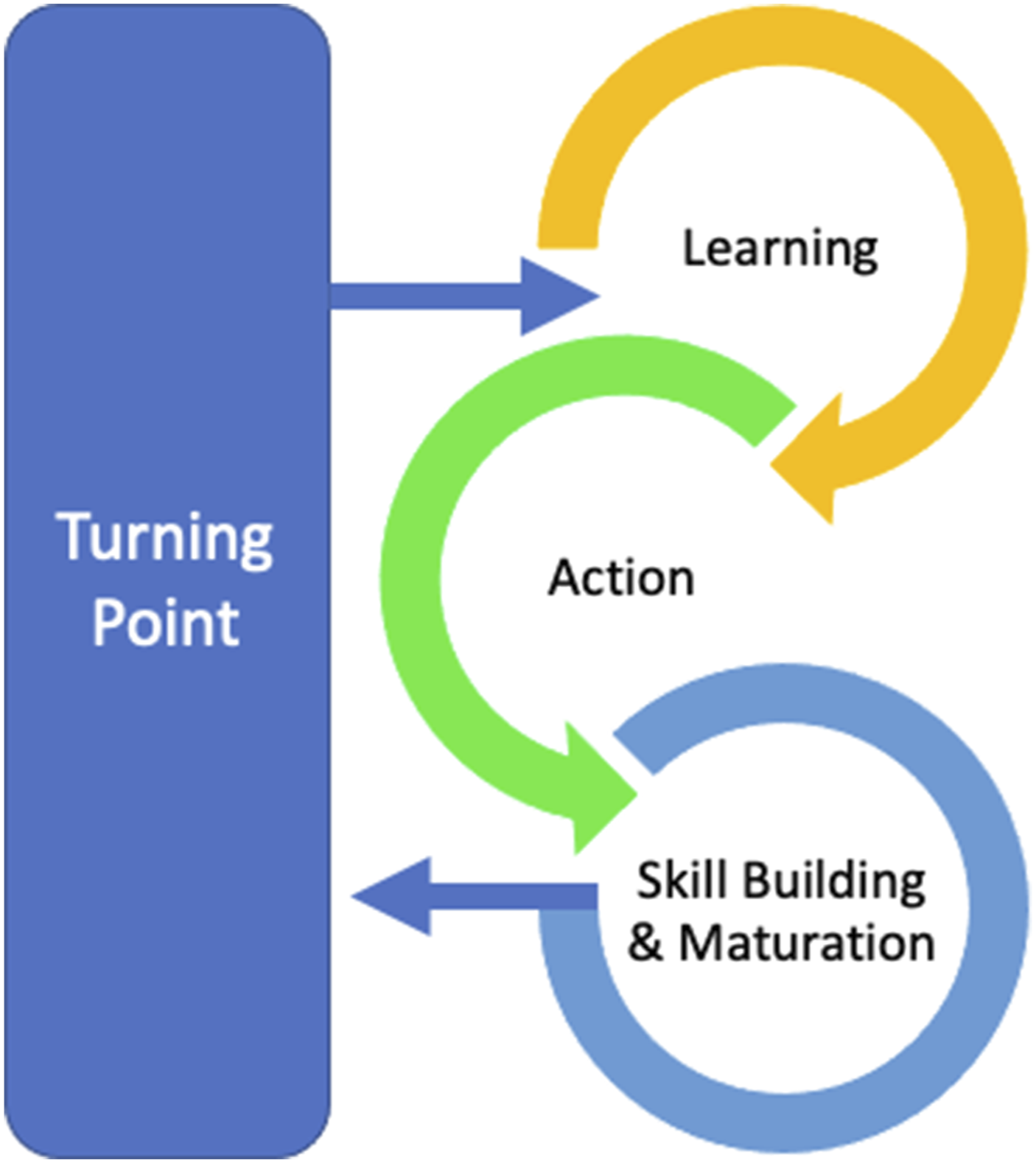
Turning Points
Four studies (Bridges & Mather, 2015; Kessaris, 2006; Mitchell et al., 2018; Wolff, 2008) identified specific turning points in men’s narratives where experiences were noted to change the trajectories of their lives, and initiated their pursuits of social justice allyship. The most common experience shared in the studies was when White men witnessed injustice. These injustices occurred in several ways; for example, Kessaris (2006) examined the autobiographies of two White men who had moved to Australia and were confronted with the overt and explicit racism of White people against Blekbala (Indigenous people). One man was “alarmed and disturbed” (p. 350) after witnessing young Indigenous children locked in prison for missing school. Kessaris (2006) examined a third autobiography of a White man in Australia who had two White children and one adopted Blekbala child and was confronted with the racist treatment their adopted child experienced, particularly from school officials and police officers. The differences in treatment was a turning point that unsettled their belief that Australia was a meritocratic and just society. Taken together, the White men identified these experiences that led them to commit to aspire to allyship.
Bridges and Mather (2015) examined the stories of ten young White men in a Jesuit College who had experiences that crossed culture and class boundaries, including different worldviews and perspectives, which functioned to destabilize the men’s understanding of the world. The participants described these turning points as a “slap in the face … a wake-up call” (p. 160). Mitchell and colleagues (2018) shared a similar experience where Mitchell was having a conversation with an Indigenous woman whose stories made him reflect on the narrative of his family history and he realized his family was complicit in a colonial history. He identified this moment of re-storying his history as a “watershed moment” (p. 359). Cross-cultural and class experiences created powerful turning points that changed the trajectories of these White men’s lives. Once the men experienced a turning point, they often felt distress, which then led them to re-examine their worldviews and beliefs.
Wolff (2008) shared how learning and developing community leadership skills predisposed from his mentor, Paul Cooper, led him to a turning point. As a young psychologist, through Cooper’s mentorship, Wolff learned how to link his passion for community leadership to his practice. He noted that many common issues with his patients were related to macro-economic oppression, and he learned from Cooper that he could be involved in prevention work through community organizing. The mentorship was a turning point in Wolff’s life trajectory and moved him toward social justice activism.
Many of the studies identified the initial turning point that motivated men to aspire to allyship, however, several of the studies identified later turning points that occurred well after the men become involved in allyship work. Wolff (2008) reflected on how he witnessed police violence against Vietnam activists while involved in community organizing. Witnessing police brutality and the “loss of 50,000 lives” (p. 66) in the war was a second turning point for Wolff (2008) and he committed to learning more about this issue.
Learning
Once many of the White men experienced a turning point, three of the studies (Bridges & Mather, 2015; Mitchell et al., 2018; Wolff, 2008) described how the men pursued opportunities to learn about oppression and shift their worldviews. Bridges and Mather (2015) synthesized the sources of learning for White men aspiring to allyship and included experiences such as “school, travel, parents, role models, co-curricular activities, and friends’ experiences with oppression exposed participants to new realities” (p. 160). Mitchell and colleagues (2018) shared how an Indigenous woman invested her time and emotional labour in this learning and growth of Mitchell, sharing her experiences and knowledge. She asked many critical questions that allowed him to reflect on his life, worldview, and experiences. Finally, Wolff (2008), shared how he learned many lessons from other White men allies about how to politicize his work as a psychologist and join in community activism. Throughout the studies, learning was characterized as an ongoing process rather than as a single step. Learning, particularly relational learning, led to unsettling and destabilizing further beliefs and values which had to be re-examined and began the learning process anew. This ongoing and iterative learning process was often lifelong for many of the White men in the studies, as they developed an ongoing commitment to change, learning, and growth. Some of the men also emphasized that learning had to be followed by action, or in some cases, was preceded by action (Wolff, 2008).
Action
Four studies (Bridges & Mather, 2015; Kessaris, 2006; Mitchell et al., 2018; Patton & Bondi, 2015) examined joining social movements and acting as an ally as part of the process of aspiring to allyship. Learning, acting, and joining were iterative, and at times, concurrent processes where White men learned through the experience of joining and action, and learning also spurred further action. Bridges and Mather (2015) identified early actions as a relief for White men from the tensions that had emerged from their unravelling worldviews. Acting in alignment with a new sense of the world and toward justice allowed White men to “fix” (p. 160) the problems they perceived around them and to perceive themselves as part of the “solution” (p. 160). Of note, several of the participants in the study later learned to problematize the “fix” and “solution” frame through which they approached their aspirations to allyship.
Patton and Bondi (2015) further emphasized “doing” (p. 503) as part of an ally identity for White men. Without action, the White men felt inauthentic, or performative, and the more risk or consequence they experienced, the more they felt legitimacy as allies. In their study of 12 academic White men, they sought to distinguish the difference between nice and allied White men. Many of the men shared that actions were the difference and described how they pursued racial, gender, and social justice actions in their teaching, supporting racialized students, at home as fathers. In their research, the participants shared that they advocated for diversity in hiring, critiqued the lackluster outcomes of institutional policies such as positions to support scholars of colour, and critiqued standardized test scores.
Paradoxically, Patton and Bondi (2015) reported that many of the men acted without risk, and quickly disassociated themselves from social justice action when they perceived personal risk. Wolff (2008) examined his motivations to join in social action and found that he joined when he was recruited to join, when he felt a personal connection to the cause, and felt he had the skills to contribute to the social change. The iterative learning and action/joining processes was not linear; in the words of Wolff (2008), “[some] turns that look like disasters lead to new and fascinating opportunities” (p. 76). These turns of learning and action often led many of the men to identify and negotiate the tensions in aspiring to allyship.
Skill-Building and Maturation
Through ongoing learning and action, five of the studies (Bridges & Mather, 2015; Mitchell et al., 2018; Patton & Bondi, 2015; Rofes et al., 1997; Wolff, 2008) described White men’s tentative negotiations through the many tensions of White men’s aspirations to allyship, and the process of building allyship skills and later stage maturation, including critiquing an ally identity. Bridges and Mather’s (2015) analysis of college age White men who had engaged in learning about privilege and oppression found that many of the men sustained their commitment by conceptualizing their involvement as self-interested; they wanted to live in an equal world, without privilege and oppression. This perspective was shared by Rofes et al. (1997) who wanted to live in a multicultural community. Wolff (2008) also perceived allyship as a way to integrate his whole spiritual self into his experience of his community activism. For Wolff (2008) and others, allyship offered a pathway to contribute to the development of the world they hoped for.
Some of the studies found that as White men matured in allyship, they distanced themselves from an allied identity. They shifted from identity claims and belonging in social movements to move toward narratives of action. Bridges and Mather (2015) and Patton and Bondi (2015) both examined how White men allies shifted their narratives of allyship toward action and did not examine their identities or group membership. Maturing often meant developing skills to contribute meaningfully in ways that were significant and appropriate for the social justice group. As White men continued to develop their allyship relations and actions, they often experienced secondary and tertiary instigating experiences which began the process of learning anew. For instance, through Wolf’s (2008) anti-racist activism, he became aware of the United States’ loss of “50,000 live in [the] Vietnam war” (p. 66) which then led him to anti-war and political activism. These processes were not linear and often occurred multiple times in different areas in the studies.
In contrast to the focus on action, Mitchell and colleagues (2018) compared how Indigenous and White people described allyship, and Mitchell found that while White people focused on describing allyship as action, Indigenous people centered relationships in defining who they identified as their allies. Mitchell et al. (2018) specifically emphasized that because of the history of harms experienced by Indigenous peoples at the hands of White people seeking to “help”, should be “consensual and relational” (p. 354). They further directed people seeking to ally with Indigenous peoples to begin with humility, to be “reflexive (taking stock of one’s own feeling, power relations, and responsibility for one’s words and actions) and to engaging in decolonizing processes within ourselves and with others through educating and challenging/unsettling other non-Indigenous people” (p. 355). Shifting from a focus on action and productivity, to one of consensual relationship offers an iterative, non-linear interpretation to the process of developing as an ally. Mitchell et al. (2018) emphasized that White people can never be decolonized, but rather continue to engage in processes of decolonization.
Relational allyship and maturation requires that White men remain engaged in these relationships. Patton and Bondi (2015) highlighted a primary tension of White men’s allyship which was that White men’s privilege and ability to dissociate and leave social justice actions when faced with adversity or personal expediency often means that many White men do not develop allyship skills before leaving. Taken together, the studies found that White men’s allyship shifts from identity and group inclusion in the early stages of allyship, to relationships with groups who have experienced oppression, focus on actions, and relational accountability.
Discussion
In this systematic review, we found seven peer-reviewed studies that explored what antecedents contribute to White men’s involvement in social justice activism and the processes and experiences that lead them to aspire to relational allyship. Our analysis led us to conclude that White men’s allyship is an emerging research area of primarily exploratory qualitative research with few high-quality studies. The antecedents that the studies identified suggest that values, beliefs, and experiences in early life may lead to a sense of fairness, justice, equality, compassion, and belonging to a caring community that later motivated White men to act as social justice allies. We synthesized the study findings of the processes of change into the themes of turning points, learning and knowledge acquisition, actions, and skill building and maturation. Turning points were the most common experience that distinguished before and after points in men’s stories, where witnessing injustice was a significant turning point. Once men experienced a turning point, many experienced distress, which led them to re-examine their worldviews and beliefs, and to then seek out learning opportunities and join social movements. Once engaged, many sought to build their skills and mature as allies. This process is not linear, and for many, occurred iteratively as they learned more and became more involved in communities committed to social change.
Fairness, justice, and equity, were common antecedents that primed participants to pursue allyship; many of the studies with mixed samples examined the sources of these values. These studies, which focus primarily on college-age White men provide analysis of how these antecedents develop in young people. Faith is a common antecedent in allyship literature which was not examined by the current studies. Munin and Speight’s (2010) study of allyship found that some participants were taught a universal view that everyone was created equally and to be in service to humanity. Duhigg et al. (2010) also found this and illustrated the point with a participant quote, “as a Christian, I have two obligations. One is to love and serve God and one is to love and serve his creation, which includes everybody. And love, in my opinion, for me, love is a call to action” (p. 9). On the other hand, some participants in these studies problematized their engagement with religion by recognizing the complicity of the Christian church in human rights abuses and promotion of oppressive beliefs (Munin & Speight, 2010). The latter study underscores the impacts of Eurocentric interpretations of Christianity, which are central to settler colonialism historically constituted White settler masculinities (Morgensen, 2015). Morgensen (2015) contended that an enduring feature of these masculinities is that White settler men construct threats against White women from a racialized other, which they must then act as protectors against. Allyship motivated by protection must be interrogated for its sexist and colonial roots, particularly in contexts of intersectional allyship.
In an American study, Russell (2011) found one participant who identified his commitment to equality as a part of American patriotism, “part of being an American is standing up for other people when they’re having problems, or they’re being oppressed” (p. 384). Patriotism, often associated with the far-right (Canada, 2022), when redefined as a motivator for social justice action, a complex notion when examining reconciliatory commitments. This motivation is clearly problematic in allyship work with anti-racist and anti-colonial groups who often challenge constructs of nationalism and citizenship as historically rooted and ongoing tools used to recreate White supremacy (Walia, 2021).
Intergroup contact (Pettigrew & Tropp, 2006) was identified as important turning points in Kessaris’ (2006) study, which aligns with allyship research on turning points. Broido (2000), DeTurk (2011), and Munin and Speight (2010) identified travel as an opportunity to develop perspective-taking; be exposed to and incorporate other value systems; learn other ways of being; and be socialized to value difference. One participant, for example, reported seeing people living in apparent poverty who they viewed as “happy”, which confronted their capitalist assumption of happiness based on material possessions (Munin & Speight, 2010). However, White people’s transformative travel is critiqued by critical scholars, including Guttentag (2009), for the disruption of local economies, rationalizations of poverty, and reinforcement of privilege and conceptions of the ‘other.’ Notably, in Pettigrew and Tropp’s (2006) meta-synthesis of contact theory research, which included 515 studies, they observed that travel and tourism had a significantly smaller effect size than other settings of contact. Unlike these studies highlighting cross-cultural contact, Kessaris (2006) highlighted the unique contribution to allyship research of within-group differences (White people) as the turning point. This highlights the geographic formations of Whiteness (Frankenberg, 1993; Gallagher & Twine, 2017), and the potential for White peer accountability across groups of White men.
Skill building, and maturation of White men allies in the reviewed studies examined framing allyship as self-interest. This is a common framing of gender justice among profeminist men leaders in Canada (Forthingham & Wells, 2019), and of reconciliation for Canadians (Fedio, 2015). A tension with this approach is that it may be misunderstood by some White men as an invitation to take strategic direction and leadership of movements, recentering and reforming the patterns of Whiteness and patriarchal masculine control (e.g. Bridges, 2021). Taking leadership roles is observed by Patton and Bondi (2015) in their critical race study of White men allies as a micro practice manifesting Whiteness and patriarchy. When White men take leadership roles instead of investing in personal change, Gorski and Erakat (2019) reported that this practice leads to burnout of racial justice activists within the impacted communities. Halvorsen’s (2022) critical ethnographic examination of White men’s allyship distinguished between White men who take leadership roles at the start of joining a social movement and those who entered with humility, but then became comfortable and began to assert themselves in leadership roles. The study advised White men to maintain discomfort, humility, awareness of complicity in oppression, and avoid constructing an alibi as a “good” White man (Leonardo & Zembylas, 2013).
A pattern not observed in this review is labeled by Bridges (2021) as disidentification, where men complicit in patriarchal oppression distance themselves from their gender, and at the same time, recreate the oppression. Bridges observed this among profeminist men who would present a gay aesthetic, but then emphasize their heterosexuality. More poignantly, Tuck and Yang (2012) demonstrated “moves to innocence” (p. 9) settlers perform to distance themselves from complicity in settler colonial oppression, and Whiteness scholars, Leonardo and Zembylas (2013), examined how an anti-racist identity often “becomes a sort of image management for Whites” (p. 156), which they term a post-White alibi. At best, this alibi is problematic because it creates another us/them dichotomy of good (anti-racist) Whites and bad (racist and non-racist) Whites, an attempt to obfuscate the benefits that all Whites experience as a result of racial hierarchies and inequities. At worst, it is used to excuse and replicate oppression. Synthesizing disidentification and moves to innocence demonstrates how progressive actions can be used to redeem individual and organizational identities and simultaneously distance themselves from the impact of systemic oppression.
Because of White men’s replication of oppressive practices in their allyship, the concept itself has been contested (Carlson et al., 2020; Gehl, 2013; Greenberg, 2014; Indigenous Action, n.d) and several alternatives have been proposed, including, solidarity work (Greenberg, 2014), justice-doing (Reynolds, 2011), or accomplicing (Indigenous Action, n.d). In Bridges and Mather’s (2015) study, some of the men participants shared that after their initial identification with the term ally, they had moved on from identifying with the term ally, and the authors proposed a post-ally identity. We would suggest that this post-ally identity may be a shift toward the relational accountability described by Almassi (2022) and Mitchell et al. (2018), and if it is to be meaningful, must integrate the critiques of disidentification raised above. The importance of a post-ally identity is recognizing allyship as an ongoing, iterative, and developmental process in an intersectional framework—staying committed and active in relationships, being accountable in these relationships, and continuing to learn and join in resisting different, new, and shifting oppressions which manifest over time (Gillborn, 2018).
Limitations and Future Research
A primary limitation of this review study was the quantity and quality of studies identified. Most of the studies were single person reflective narratives, three examined the experiences of multiple White men, and only one utilized a quantitative methodology. Taking an intersectional approach to allyship and specifically studying White men significantly limited the number of studies that may have included White men. A further limitation was that the studies did not provide an intersectional analysis of White men’s allyship to examine how their Whiteness, settler status, and masculinities influenced their aspirations and actions toward allyship. The initial search also did not include social justice issues related to disability, poverty, or other concerns. Future studies could further expand the search terms, or re-analyze results already collected and further examine the similarities and differences to define the specific antecedents and processes that are common among White men as a result of colonial, White supremacist, and patriarchal socialization, as well as the specific geopolitical contexts within which the studies were conducted. Further, experimental designs could be used to examine interventions to increase ally action and relational accountability among White men allies.
White men are a heterogenous group and the studies excluded White men who experience economic disadvantage. This is a significant gap in the allyship literature and future studies and interventions should examine how White men with this experience come to allyship and the supports and interventions that are effective in engaging these men in progressive social movements, potentially through the labour movement and worker solidarity. These studies will be of particular importance in undermining Whiteness, which Du Bois (1998/[1880]) observed was constructed by the White economic elite to disrupt Black and White solidarity movements for worker’s rights. Whiteness and far right masculinities are recruiting grounds for violent extremism in Canada and globally (Canada, 2022; Greig, 2019), and future research could examine men’s experiences of moving away from far-right extremism as well as economically disadvantaged White men’s engagement in progressive social justice to inform effective interventions. This is not to conflate blue-collar men and the far-right, as Scarborough and colleagues (2021) only 30% of White men endorsed racial and gender justice even when controlling for educational attainment and SES.
Implications for Policy, Practice, and Research
Understanding the antecedents of allyship, such as a sense of justice, compassion, and leadership is an important contribution to policy and practice of calling in White men. Further research and program development can draw on the current findings to create initiatives, communication strategies, and opportunities for White men and boys to experience turning points that lead to allyship development. As an example, this may include communication campaigns that target White men and boys through the frame of a just(ice) masculinity (Almassi, 2022; hooks, 2004a, 2004b).
When social movements emerge that highlight injustice (e.g., Black Lives Matter, #MeToo, and Sisters in Spirit), activists from these movements who are interested along with trustworthy and relationally accountable White men may develop practices and opportunities to build relationships where they can grow and develop as relationally accountable allies. We are sensitive to the long history of White men’s entitlement to emotional labour and the burnout these campaigns may cause (Gorski & Erakat, 2019); however, these findings may be used to inform engagement strategies and common development challenges which can be addressed through these initiatives. For instance, Flood (2011) reminds us that White men allies must not be held up as protectors, or saviours, thereby reifying the construction of patriarchy and men’s power. These campaigns calling in White men can also learn from initiatives that counter far-right narratives of crisis masculinity, gender binary, and White male oppression (Greig, 2019). These initiatives should address the process of disidentification and distancing between good/bad White men (Bridges, 2021) and instead focus on ongoing skill building, relational accountability and dismantling systemic racism, sexism, and decolonizing our systems. Collectively, these policies and practices may call men into the work to change those structural conditions that make violence, trauma, and abuse so prevalent.
The policy implications of this study respond to government calls (Canada, 2022; WAGE Canada, 2021) to support initiatives and progressive social movements that include allyship ‘call-in campaigns’ and skill development. Government can also investigate and implement the policies and practices that create a robust system that will critique and provide alternatives to existing institutional policies and structures.
Further research is needed to examine the antecedents, processes, and experiences that lead White men to develop as allies for progressive social action, including gender, racial, and reconciliatory justice. Studies examining these factors should include a theoretical frame that includes a critical examination of settler Whiteness masculinities to support an analysis of how the positionalities and privileges of White settler men differently influence their allyship development. These studies could also examine the difference in developing as allies to different groups experiencing oppression, for instance, what is the difference between learning to be an anti-racist ally and an anti-ableist ally and what are the common threads and needed self-reflexivity? Future White men’s allyship research should particularly focus on economically disadvantaged White men as well as middle and upper SES men involved in far-right movements who have changed and come to join progressive social actions. Further research should also examine the ways that people account for their privileged positionalities when engaging in solidarity for social justice. Not reflected in the current findings was an analysis of the impact of life stage and future studies could integrate a life course perspective to examine the impact of cohort, turning points, and life stage on White heterosexual men’s allyship experiences.
Supplemental Material
Supplemental Material - Engaging White Men in Allyship for Structural Change: A Systematic Review
Supplemental Material for Engaging White Men in Allyship for Structural Change: A Systematic Review by Jeff Halvorsen, Tamara Humphrey, Liza Lorenzetti, and Mario Rolle in The Journal of Men’s Studies
Footnotes
Acknowledgments
We would like to thank Laura Koltutsky with the University of Calgary Library, Christine Walsh, and Janelle Lee Pong for review of concepts, methodological training, and their support in earlier versions of this study.
Declaration of Conflicting Interests
The author(s) declared no potential conflicts of interest with respect to the research, authorship, and/or publication of this article.
Funding
The author(s) received no financial support for the research, authorship, and/or publication of this article.

Supplemental Material
Supplemental material for this article is available online.
Author Biographies
References
Supplementary Material
Please find the following supplemental material available below.
For Open Access articles published under a Creative Commons License, all supplemental material carries the same license as the article it is associated with.
For non-Open Access articles published, all supplemental material carries a non-exclusive license, and permission requests for re-use of supplemental material or any part of supplemental material shall be sent directly to the copyright owner as specified in the copyright notice associated with the article.
