




Abstract
Programs that engage men and boys in health promotion and violence prevention are proliferating. Many aim to foster “healthy masculinities”, using education and support to involve men and boys in adopting more positive or gender-equitable forms of selfhood and relating. This paper offers a critical stocktake of 15 such programs in one state in Australia, assessing them against common standards for gender-transformative programming among men and boys. The programs are diverse in their aims and approaches and their understandings of men and gender. There were common themes, that men’s and boys’ lives are constrained by typical constructions of masculinity and that there are widespread gender inequalities that disadvantage women and girls, although the balance between these differed among programs. This paper articulates the significance of critically analyzing these programs through a gender transformative lens to discern their utility in supporting gender justice.
This paper presents a critical stocktake of community-based programs designed to support boys and young men to adopt more positive and respectful masculinities and taking place in the state of Victoria, Australia. We assess the programs against widely accepted standards for work with men and boys and, in particular, a gender-transformative standard.
There has been in the past five decades an increasing visible attention to and politicization of masculinities in many countries (Flood, 2017). A field of “engaging men” or “work with men and boys” has developed, involving gender-conscious interventions aimed at men and boys and addressing violence, health, parenting, education, and other areas (Flood, 2015). In Australia there has been a proliferation of projects and organizations in the past decade, from local programs to large-scale violence prevention and health promotion initiatives. This is accompanied by an increasingly rich scholarship, including on men’s health promotion (Galdas et al., 2023; Pirkis et al., 2023), father engagement (Lechowicz et al., 2019), intimate relationships (Oliffe et al., 2022; Sharp et al., 2023), work with boys and young men (Wilson et al., 2022), and other areas.
One stream of this work is focused on boys and young men, in both secondary school and community settings. This review focuses on the latter, exploring community-based programming among boys and young men.
Gender-Transformative Programming
There is a growing emphasis in the “engaging men” field on the need for interventions to be “gender-transformative”—to transform gender inequities and generate more gender-equitable relations (Burrell & Flood, 2019; Flood, 2021). Gender-transformative programs will have feminist content (such as curricula addressing gender inequities), processes (such as engaging participants in critical reflection on such inequalities), and structures (such as location in or partnerships with women’s rights organizations; Flood & Burrell, 2022). To be truly gender-transformative, however, programs will also demonstrate that they do transform gender relations.
This article holds up programs engaging young men against a gender-transformative standard, evaluating their potential to contribute to gender justice. It also assesses programs, however, against other elements identified as part of effective practice in fields such as health promotion and violence prevention. We have since integrated these criteria in an online tool for assessing programs (Keddie et al., 2023).
Six criteria of programs are used to organize the assessment: they (1) aim to change harmful and inequitable gender norms and relations; (2) are based on an appropriate theoretical framework for both the problems they seek to address and the change methods they use; (3) involve a comprehensive or whole-of-institution approach; (4) involve effective curriculum delivery, in their teaching methods, structure, and educators; (5) are relevant to the communities and contexts in which they are delivered; and (6) involve robust evaluation and continuous improvement.
These are based on a desk review of scholarship regarding work with men and boys, including guides to engaging men and boys (American Psychological Association, 2018; Greig & Flood, 2020; ICRW, 2018; Institute of Development Studies (IDS) et al., 2015; Marcus et al., 2018), articulations of principles for violence prevention with men and boys (Flood, 2019; Wells et al., 2020), discussions of work with boys and young men in schools (Keddie & Mills, 2007), and other scholarship on men and masculinities.
There are some caveats regarding these standards. There is no universal consensus regarding the elements of effective practice in work with men and boys. There is heterogeneity in both the programs and their participants, and some criteria simply may be less appropriate for them. Further, a gender-transformative standard itself is not necessarily shared among the programs, and while some programs are centered on transforming gender inequities, for others this is more secondary.
Masculinities-Focused Community Programming Among Boys and Men
This critical stocktake of masculinities-focused programs among boys and young men was conducted in the state of Victoria, Australia. Programs were eligible for inclusion if they (1) seek in some way to improve boys’ or men’s lives; (2) have an explicit and self-conscious focus on masculinities; (3) are predominantly community-based; and (4) include young men aged 15 to 35. As at January 2021, we identified 63 such programs in Victoria. All eligible programs were approached for interview, and representatives of 15 programs agreed to participate. Programs have been given pseudonyms.
Some interviewees were educators or facilitators involved in the delivery of the program, while others were leaders of the organizations responsible for the program. Interviews covered the programs’ conceptual framework, content and structure, teaching methods, participants, perceptions of successes and challenges, funding, and evaluation. Ethics approval for the study was given by the Deakin University Human Research Ethics Committee.
Profiles of the 15 Programs.
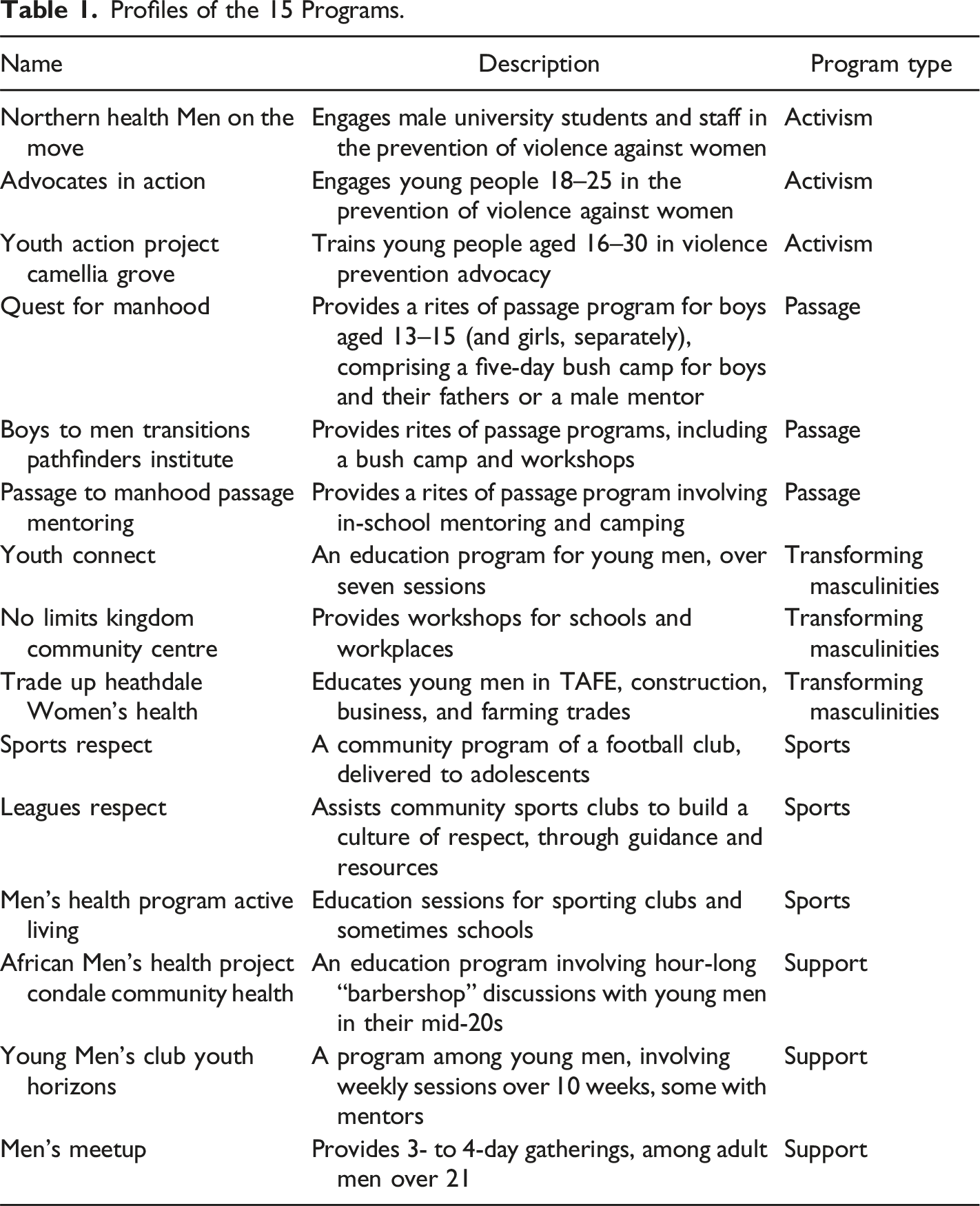
First, an “Activist” stream includes three programs aimed at the prevention of violence against women. These overlap with three programs aimed at transforming masculinities and gender relations, in a “Transforming Masculinities” stream. These first six programs all have a strong focus on gender and gender inequities. A third stream of program is focused on men’s health and wellbeing and the provision of support to men, with three programs in this “Support” stream. In a “Sport” stream, three programs take place in or are provided by sporting clubs. One focuses on men’s health and is addressed to sports players, thus overlapping with the “Support” stream. Two more focus on building cultures of respect in clubs or among adolescents. Finally, there is a “Passage” stream characterized by the use of rites of passage, comprising three programs.
The following section begins the comparison of these 15 programs with the programming standards identified earlier. Because of the number of programs and range of standards involved in this assessment, in general we provide summary commentary on programs rather than extensive quotations from the interviews.
Program Agendas and Frameworks
The first two aspects of a gender-transformative standard—agendas or purposes, and conceptual frameworks—are discussed together, as in practice it proved unhelpful to separate them in the interview analysis. For three of the 15 programs, the primary problem—the phenomena their program aims to prevent or change—is violence against women or gender-based violence. In what we have termed the “Activist” stream of programs, three programs seek to engage young people (in two cases) or university students and staff (in one case) in prevention efforts. These programs share the violence prevention sector’s characteristic emphases on gender inequities as a key ‘driver’ of domestic and sexual violence (Our Watch, 2019, p. 13).
The program Men on the Move has an explicit gender transformative approach to its project design. Aimed at male university students and staff, it is typical of efforts to engage men in violence prevention (Flood, 2019): it frames men as potential “male allies”, understands men’s positions in terms of patriarchal privilege, and seeks to involve men in deconstructing inequitable forms of masculinity. The program provides intensive training and support to the recruited men to undertake small scale prevention projects. The two other projects in this stream, the Youth Action Project and Advocates in Action, both seek to involve young people as agents of change, using face-to-face or online education to build their knowledge, confidence, and advocacy in violence prevention. For example, the Youth Action Project recruits and trains young people as active bystanders and peer educators to challenge and support their peers.
These three programs’ emphases on gender inequities also are visible in the three programs in the “Transforming Masculinities” strand. Comprising seven to 14 1.5-h education sessions, Youth Connect is intended to engage young men in critical reflection on dominant constructions of masculinity, improve their understanding of gender and violence against women, and empower them to be active bystanders against sexism and violence. The program No Limits has similar goals and curriculum content. Both programs explore patriarchal norms of manhood, invite young men’s reflections on the value and harms of these, and enable their resistance to them.
These emphases on gender inequities continue in the third program in the “Transforming Masculinities” strand. Trade Up seeks to increase women’s participation in non-traditional workforce roles such as in construction and farming trades, in part through education and training among young men in technical and further education institutions (TAFEs). The program is hosted by an organization with a feminist agenda of ending the disadvantage and violence experienced by women in the region.
The six programs profiled so far all include a significant emphasis on gender inequalities that unfairly privilege men and disadvantage women, and in three cases they focus on a problem—violence against women and girls—understood as an expression in part of these inequalities. Change the Story, an influential national and feminist-informed framework for violence prevention (Our Watch et al., 2015) is a common point of reference, mentioned by many of the program facilitators. For example, Men on the Move required the male allies to apply Change the Story to their project idea, and the facilitator for the Youth Action Project emphasized that the program made extensive use of the framework in their training development.
These first six programs also include acknowledgement of how gender relations also constrain or harm men or boys, and therefore include strategies aimed at alleviating this, although that is not their sole or primary focus. We move now to a stream of program more centered on this.
A third stream of program is focused on men’s health or wellbeing. The “problem” for these three programs is the limits or burdens of masculinity among boys and men or the impacts of other social problems among them. Two of the three programs are addressed to young men who face significant social disadvantage, including poverty and racial injustice. The Young Men’s Club is run by an organization supporting homeless young people, and consists of a ten-week program among small groups of young men. The program is intended to foster young disadvantaged men’s participation in and connection to community, through the development of positive relationships and communication. The African Men’s Health Project is an education program aimed at fostering healthy relationships, involving hour-long “barbershop” discussions with young men in their mid-20s. The third program, Men’s Meetup, is focused on men’s health and wellbeing, promoting this among adult men primarily through four-day residential programs or retreats held in a rural or ‘bush’ location. The program also offers individual coaching and mentoring and group facilitation.
A fourth stream of programs is distinguished by its setting, sports, with three programs here. Sports Respect is run by a sporting club that competes in a national sporting code. This initiative is intended to foster gender equality and respect among schools, workplaces, and communities, and includes an education program in schools, education for the code’s players and senior leaders, and an awareness-raising campaign. Leagues Respect also aims to foster a culture of respect, but in local sporting clubs in particular. It does this by providing a suite of resources including guidance on mission statements, inclusion, codes of conduct, and desirable forms of behavior on and off the field and by coaches and players. The activities in both Sports Respect and Leagues Respect are aimed at mixed-gender audiences, but their attention to gender and inclusion of young men in their target audiences made them eligible for consideration in this stocktake. The third program in the “Sport” stream, the Men’s Health Program, comprises education sessions for sporting clubs and sometimes schools. This program is one of a number of educational programs run by a mental health organization, and focuses explicitly on the promotion of “healthy masculinity”.
Among the three programs that take place in sporting settings, the first two align conceptually and politically with the programs in the “Activist” stream, sharing their focus on violence prevention and their gender-transformative agendas. The third sports program, the Men’s Health Program, is similar instead to the programs in the “Support” stream, focusing on supporting boys’ and men’s health and particularly their mental health.
The fifth and last stream of programs, “Passage”, is distinguished by the use of a specific approach for engaging boys and young men. Three programs center on the use of rites of passage—a structured set of processes, modelled on rituals and ceremonies in Indigenous communities—to foster boys’ positive identities and development. Boys take part in three- to five-day outdoor, residential camps, facilitated and mentored by adult men including program leaders, fathers and father figures. Some of the programs also include schools-based education sessions and mentoring.
Those involved in the rites of passage programs frame the problem as one of a lack of appropriate rites of passage for boys and young men, where this absence is detrimental to male identity formation and development. Explaining the Boys to Men program for example, the interviewee described young boys as often wanting power, irresponsible, unable to handle their emotions, and prone to temper tantrums if things go wrong. He emphasized that boys ideally go through a rite of passage such that they see themselves as members of a community, can manage their emotions, look to form healthy relationships with others, are humble, and so on. For the facilitators of these programs, rites of passage are seen as a vital means of inducting boys into healthy manhood and adulthood.
An outdoor, residential camp for males also is used among one of the programs among adult men in the “Support” stream, Men’s Meetup. This initiative is framed in similar terms to the rites of passage programs, with emphases on the need for men to forge deep forms of community, draw on Indigenous knowledge, heal themselves and each other, and develop authentic, vulnerable, and purposeful ways of being. Men’s Meetup also sometimes involves the direct involvement of Indigenous leaders and facilitators.
Addressing Gender
The most explicit conceptual frameworks across the 15 programs were connected to gender, evident in programs’ focus on gender inequities and on the constraints imposed on boys and men by masculinity. Programs varied in their degree of emphasis on patriarchal gender inequalities, boys and men themselves as constrained, and other forms of social difference and inequality.
Programs had to have an explicit focus on masculinities in order to be included in the study, but while most are very much defined by this, a few programs have only a moderate focus on masculinity and gender. For example, the Men’s Health Program is focused on mental health, but does address how “the pressures of masculinity” shape suicide, alcohol consumption, and other issues. Leagues Respect is oriented towards general norms of respect in the club, with only slight attention to gender.
A common gender-related theme throughout the programs is that boys’ and men’s lives are limited in important ways by typical constructions of masculinity, forms of masculine socialization, or patterns of gender relations. This theme is particularly strong among the programs aimed primarily at supporting boys and men and promoting their health and wellbeing. Interviewees emphasized, for example, that young men have not been raised or socialized to communicate, so resort to anger and violence, and are then judged for this (Young Men’s Club); young men do not speak or share or seek help when they “have issues” (African Men’s Health Project); young men have not had positive role models (Young Men’s Club); men lack emotional self-awareness (Men’s Meetup); and boys’ and men’s lives have been shaped by limited and negative models of masculinity (Men’s Health Program). This theme included an emphasis on recognising and building on the strengths that boys and men show.
A second gender-related theme, visible particularly among the programs in the “Activist” and “Transforming Masculinities” streams, is that contemporary gender relations disadvantage women and privilege men. These six programs show a shared feminist emphasis on the fact of inequitable gender relations and the need to change them. Some, such as Youth Connect and No Limits, also endorse the point emphasized in the “Support” and “Passage” streams that widespread social norms and practices associated with manhood are unhealthy or harmful for boys and men themselves, but complement this with attention to male dominance and men’s violence against women.
Although a feminist understanding of gender relations is most pronounced in the “Activist” and “Transforming Masculinities” streams, at least some level of attention to gender inequities is visible across all 15 programs. This receives least emphasis among the “Passage” programs, but even here, the facilitator of Passage to Manhood, for example, noted that the program has recently adopted a “power/feminism” lens for its work, drawing on the violence prevention approach detailed in Change the Story (Our Watch et al., 2015).
Programs differed to some extent in their explanations of boys’ and young men’s lives and situations. Among the interviewees there was broad agreement with a social constructionist account, in which boys’ and men’s lives are shaped by socialization by parents and others, media and culture, and social norms. At the same time, there were more essentialist understandings among the staff associated with the “Passage” programs. Rites of passage programs tend to draw on mythopoetic understandings, grounded in Jungian and psychoanalytic accounts of gender, and are more likely to emphasize that male psychology is structured by transcultural masculine archetypes (Schwalbe, 2007). They are more likely to see the process of healthy male development as involving boys’ separation from mothers, “breaking from the feminine”, and induction into manhood by fathers and father figures (Kimmel & Kaufman, 1994).
A second set of conceptual frameworks, expressed in a language of wellbeing and positive psychology, was visible across the 15 programs. Facilitators and leaders described their programs as fostering boys’ self-esteem, resilience, self-confidence, positive character, and other aspects of personal and emotional health and wellbeing. Therapeutic and personal growth orientations thus were evident across all 15 programs. For example, the facilitator of Men’s Meetup, in the “Support” stream but similar to the “Passage” programs, referred to men developing emotional self-awareness, with this then having “ripple” effects as they shared this with their families and community. The facilitator of Youth Connect, in the “Transforming Masculinities” stream, referred to the use of psychological frameworks and to fostering emotional intelligence. These conceptual approaches are the complement to the programs’ typical emphases on boys’ and men’s lives as limited or constrained, particularly with regard to their emotional lives and relations.
A third set of conceptual and programmatic emphases was visible in some programs, on an intersectional approach to men and masculinities. An explicitly intersectional approach—naming and addressing inequities among men and boys associated with ethnicity, class, sexuality, and other forms of social difference and inequality—was evident particularly among many of the programs in the “Activist” and “Transforming Masculinities” streams. We return to this further below.
Promoting Healthy Masculinity
There is shared language among the six programs in the “Transforming Masculinities” and “Support” streams regarding what they seek to promote, a common emphasis on “healthy masculinity”. Informed by the critique of stereotypical or traditional forms of masculinity described above, the programs work to promote a desirable alternative, often framed in terms of “healthy” or “positive” masculinity. These notions embody the proposals that there are desirable traits and behaviors that men and boys should adopt and that should be part of the social expectations placed on men and boys, including ones that are already stereotypically associated with manhood and others that are not. Interviewees referred to helping men “reconnect to humanity” (Youth Connect), fostering “emotionally balanced men” and true connection (Men’s Meetup), and promoting the “positive and healthy aspects of masculinities” (No Limits). The notion of “healthy masculinity” has a widespread currency in work with men and boys in Australia, visible for example in health promotion frameworks (VicHealth, 2019). There are also debates about such notions, for example that they may reinforce essentialist assumptions that specific desirable qualities are available only to men and boys (Wilson et al., 2022) or continue to privilege masculinity over femininity and men’s and boys’ rejection of the latter (Waling, 2019).
Although the notion of “healthy masculinity” is a popular reference point, there is some variation among programs in the qualities seen to comprise a healthy masculinity. All emphasize that healthy masculinities must be healthy for men and boys themselves: based in qualities such as emotional intelligence, self-care, empathy, and inner strength. At the same time, some programs also emphasize that healthy masculinities must be “healthy” or equitable for those around men and boys, giving greater emphasis therefore to a political or ethical framing. For these respondents, healthy masculinities must be based not only in emotional health but also in equality, respect, compassion, partnership, and non-violence—in the equitable and respectful treatment particularly of women and girls, and also of other men and boys. There is thus variation in the extent to which desirable ways of being among boys and men are framed in terms of health and wellbeing, on the one hand, or equity and justice, on the other.
In some of the “Transforming Masculinities” programs, such as No Limits and Youth Connect, there were emphases also on the value of some stereotypically feminine qualities that are shunned and stigmatized in traditional patriarchal constructions of masculinity, such as compassion, kindness, and vulnerability.
The three programs centered on rites of passage showed a stronger emphasis than most other programs on community-oriented and collective goals of contributions to family and community. For example, the facilitator of Boys to Men emphasizes the value of building community and encouraging recognition among the young men that they are part of a community. This emphasis fits with “Passage” programs’ borrowings from Indigenous, collectivist-oriented rites of passage.
However, a focus on community also is evident among one of the Support programs and two of the Sports programs. The first represents a response to the target participants’ typical disconnection from community. The Young Men’s Club’s work among disadvantaged, homeless young people is intended to nurture their participation in and connection to community and their sense of community belonging. The second and third examples reflect the programs’ location in a sporting club, in that fostering positive communal aspects of the club and code is a likely goal for health promotion or violence prevention. Leagues Respect shows an emphasis on building a safe, connected culture in the club, where everyone involved identifies with the club and has a sense of shared ownership of it. Community is a significant focus of Sports Respect’s work, and two of their three core values are about fostering a sense of belonging and making their community proud.
The “Activist” and “Transforming Masculinities” streams were somewhat more prescriptive than other streams regarding their visions of healthy masculinity. Interviewees for the “Passage” stream and to a lesser extent the “Support” stream used open-ended language for the kinds of personal change participants may undergo: “creating a vision for their future”, “strengthened identity”, self-reflection, resilience, maturity, and so on. Interviewees in the “Activist” and “Transforming Masculinities” streams tended also to refer to more specific qualities, such as non-violence, respect, and gender-equitable attitudes and behaviors.
Approaches to “Men’s Issues”
The approaches to gender and masculinity visible among the five streams of program echo the varied approaches in the “men’s movement”, the groups and networks self-consciously involved in activities related to men and gender (Flood, 2007). Although there is considerable diversity in this movement, and some practitioners and groups working with men and boys do not align themselves with the movement, one way of understanding it is in terms of four strands of activity. A “men’s liberation” strand argues that men and boys are hurt by male “gender roles” and their lives are alienating and unhealthy. Its goals are primarily therapeutic or liberatory, to free men and boys from the confines of rigid, stereotyped masculinity. Overlapping with this, a “mythopoetic” strand, drawing in part on Jungian psychology, sees masculinity as based on deep unconscious patterns and archetypes that are revealed through myths, stories and rituals. It draws on Indigenous practices such as rites of passage, in order for men to “heal” and restore their psychospiritual health. An “anti-sexist” or “profeminist” strand, while acknowledging the constraints of masculinity, emphasizes male privilege and systemic gender inequities, and its goals are more political, intended to engage men to challenge these inequities.
The agendas and approaches of the 15 programs map, to some extent, onto the first three strands of men’s movement activity. The “Support” stream, and one of the programs in the “Sport” stream, have similarities to the men’s liberation strand. The “Passage” stream echoes the mythopoetic strand. The “Activist” and “Transforming Masculinities” streams and two of the programs in the “Sport” stream echo the profeminist strand.
The differing emphases among the 15 programs also reflect their origins in differing strands of community and advocacy work. The programs in the “Activist” stream, and two of the three programs in the “Transforming Masculinities” streams, originate in violence prevention or gender equality work undertaken by community agencies (including, in one case, in partnership with a university), while the remaining program in the “Transforming Masculinities” stream, No Limits, is provided by a community organization oriented towards social justice. Two of the three “Support” programs are provided by community health organizations, and both are aimed at disadvantaged boys and men. The third, Men’s Meetup, has similar origins to those of the three “Passage” programs, in grassroots men’s movement activities. These four programs all began as volunteer-based events, emerging from the therapeutic and mythopoetic wings of the men’s movement. Among the programs in the “Sports” stream, Sports Respect was established by a national sporting club, Leagues Respect by a gender equality organization, and the Men’s Health Program by former sports players and coaches.
A Comprehensive Approach
The third criterion of this stocktake is a comprehensive or whole-of-institution approach. Programs among boys and young men are more likely to make change if they adopt comprehensive and multipronged intervention strategies, engage with stakeholders, and have institutional support (Casey & Lindhorst, 2009)
A whole-of-institution approach has particular resonance where programs are located in an institutional setting such as a school or workplace, whereas this stocktake focuses on community-based programs. Very few of the 15 programs had a whole-of-institution approach, and for most, this was neither possible nor relevant given their community location and funding constraints. All of the 15 programs are small in scale, and most are short-term and operating at a single level. At the same time, three features of some programs brought them closer to a “whole-of-community” approach: multi-pronged implementation, a supportive organization, and partnerships with community.
One of the programs involves multiple strategies in multiple settings, taking place in a discrete institutional context. Sports Respect, driven by a national sporting club, includes awareness-raising via communications materials, education for players, and education for senior leaders. The club worked with the national violence prevention organization’s Our Watch’s Workplace Equality and Respect Project. A second program, Men on the Move, was situated as part of the Safer Communities unit within the university which includes the development of policies and procedures for responding to victim-survivors, staff training, and education for students. The program seeks to give students multiple points of contact with its messages, via student peer leaders, classroom sessions, involvement in the student days such as Mental Health Day, and student leadership conferences, and this increased “dosage” is likely to intensify the program’s impact (Flood, 2019, p. 200).
A supportive, committed, and inclusive organizational culture was emphasized by some program facilitators or leaders as a vital ingredient in their work. Two made particular mention of leadership support. The facilitator for Sports Respect, based in a sporting club, emphasized that senior leadership’s genuine commitment to the work had been essential to the program’s implementation. The program’s establishment also required building a “business case” in the organization, explaining the program’s rationale and bringing people on board. Support for principles of gender equity by the CEO of the organization for the Youth Action Project has enabled developments such as training of senior staff and others.
A third dimension of a comprehensive approach is the use of partnerships, and some of the programs in this stocktake were described by their educators as grounded in partnerships with communities. Such partnerships can engage relevant stakeholders, increase community members’ contact with the intervention, and make it more likely that the program is locally relevant (see below). For example, the facilitator for the Young Men’s Club emphasizes that as a small, place-based organization, the host organization has strong connections to community, and this “means that we can have very meaningful relationships with our local community, which, therefore, opens up the door”. Men on the Move was conducted in partnership with a local health service that led the work and provided additional expertise and reach to the broader community.
Some of the strongest examples of community partnerships among the 15 programs involved partnerships with parents. Parental involvement is particularly well developed in two of the rites of passage programs. Passage to Manhood involves an evening for parents, a remote presence at the residential camps e.g. through a letter written to their sons, participation in a return ceremony after the camps, and roles for some parents as mentors on the camps. In Quest for Manhood, parents participate in events with the young men who have gone through the program. The facilitator spoke of a “whole family experience” and of efforts to engage the boys’ families, including involving separated and step parents.
A different form of partnership involves collaborations with other organizations or professionals. These were important for some programs, whether to extend the program’s impact, support the program, or guide its development. Leagues Respect had made connections with various sporting clubs, Trade Up liaised with builders and manufacturing companies, and the No Limits program had plans to engage organizations including councils and sports clubs. The facilitator for Youth Connect noted that they run a short education session with teachers such that they can support the boys’ program. Finally, Sports Respect engaged the violence prevention organization Our Watch as content experts to guide their program development.
A further dimension of a comprehensive approach is the presence of institutional support and funding, yet few of the programs surveyed could rely on this. Effective strategies of gender transformation require sustainability, systemic coordination, and resourcing for tools, training, and infrastructure (Gleeson et al., 2015). Most interviewees spoke of significant challenges in securing sufficient, let alone sustained, funding, expressing frustration at meagre and short-term funding.
These constraints had various implications for programs’ work and audiences. Some program staff devoted considerable time and resources to securing external funding: as the facilitator of the Men’s Health Program commented, “We spend an awful lot of time trying to impress potential funders/grants to support us.” Other programs had shifted to targeting more resource-rich populations and settings. For example, based on the recognition that schools are both money- and time-poor, Youth Connect increasingly aimed itself at corporate audiences and organizations. Some programs cross-subsidized participation. For example, Quest for Manhood received funds largely from private schools and uses this to subsidize other families’ participation. Limited resourcing also constrained programs’ abilities to report on their activities and to conduct impact evaluations.
Effective Curriculum Delivery
The fourth criterion for interventions likely to be impactful is that they focus on particular content and involve effective forms of teaching and learning. There are four dimensions to this: curriculum content, teaching methods, structure, and educators.
Curriculum Content
In order to be gender-transformative, programs among men and boys should include content on gender—on gendered norms, practices, and inequities. The specific content required will depend on the program’s focus, but whether the program is addressing violence perpetration, sexual and reproductive health, fathering, or some other area it should include content on relevant, gender-related risk factors. Gender-transformative programs require explicit attention to privilege and power, including patriarchal inequalities and their intersections with other forms of difference and inequality. Information on program curricula here is based on facilitators’ interview comments, as written curricula were not available for most programs.
The 15 programs’ content reflected the differing agendas and frameworks described earlier in this paper. The programs in the “Activist” stream included considerable content on violence against women, its roots in gender inequities, and its prevention. Similarly, the programs in the “Transforming Masculinities” stream have substantial content on patriarchal inequalities, and they address violence against women although to a lesser extent than those in the Activist stream. These six programs are explicit about what they take to be dominant norms of masculinity, and critical of these. Overt attention to gender, particularly to the expectations associated with manhood, also defines the content of the three programs in the “Passage” stream, although they are more open-ended in their diagnoses of the problems associated with masculinity and less explicitly feminist. Program content in the “Support” stream, and in the third of the programs in the “Sport” stream, was focused on health and wellbeing: self-care, emotional literacy, communication skills, and connecting with communities.
Engaging participants as agents of social change is a feature of the curricula of the six programs in the Activist and Transforming Masculinities streams and two of the three programs in the Sport stream, Sports Respect and Leagues Respect. These eight programs use teaching processes and curricula intended to mobilize young men, to empower them to challenge unjust and limiting social norms and inequalities.
Teaching Methods
The second dimension of effective teaching is the use of effective teaching methods. There is a growing consensus in face-to-face education for gender transformation and violence prevention that education must be interactive, participatory, and include small-group learning and critical reflection (Flood, 2019, pp. 197–199, 324–332; Flood et al., 2009).
The use of interactive teaching strategies was ubiquitous among the programs, with facilitators and leaders describing participatory discussions, small groups, and role plays. A rejection of didactic teaching methods was evident particularly among the programs based on rites of passage. A narrative or story-telling approach also was an important part of some programs’ practice, particularly the rites of passage programs, although No Limits and Men on the Move also used narrative approaches to invite critical reflections on masculinity.
Engaging boys and young men in questioning and reflecting on norms of masculinity was common to some programs. This was more visible among those with explicitly gender-transformative agendas, as is emphasized in gender-transformative approaches (Flood, 2019, p. 197). Many facilitators and leaders described their programs as intended to be: questioning and reflexive; positive, nonjudgemental, and respectful; and engaging and fun. Beginning with the positive, and building on boys’ and men’s strengths, is widely endorsed in the “engaging men” literature as an effective way to invite participants in and to lessen defensive disengagement, although this should avoid a naïve, uncritical celebration of men (Flood, 2019, pp. 157–162).
Although being “trauma-informed” was mentioned by various interviewees as an aspirational ideal, few programs could claim to meet it. A related dimension of gender-transformative practice is attention to risk, including risks associated with work with men and boys who may be using violence. Although some facilitators discussed risk in terms of child protection requirements or police checks for working with children, there was little discussion by facilitators of effective ways of responding to victimization or perpetration, so it is difficult to gauge program practice here.
Curriculum Structure
The third dimension of effective teaching is structure, including duration, group size and composition. One-off, short duration programs simply cannot make substantial and lasting change, and good practice programs have sufficient duration and intensity to produce change (Flood, 2019, pp. 199–203).
About half of the 15 programs rely on a single one-to two-hour session, while the other half rely on multiple sessions or multi-day residential programs. The three rites of passage programs, and the one other program also focused on rites of passage but among adult men, all rely on three-to five-day camps. At least two or three sessions are used by the three programs in the Activism stream, two of the three programs in the Transforming Masculinities stream (Youth Connect and No Limits), and one of the programs in the Passage stream. Most programs are conducted among small groups, anywhere from 10 to 30, and this allows greater participation and discussion.
All but four of the programs involve all-male participants, with the exceptions being Advocates in Action, the Youth Action Project, Clubs for Respect, and Young Men’s Club. There is no consensus in the literature on gender-transformative practice regarding best practice in group composition (Flood, 2019, pp. 204–207). However, the weight of evidence regarding sexual assault prevention is in favour of single-sex classes (Vladutiu et al., 2011), and the reasons for their greater efficacy may also be relevant for gender-transformative programs addressing other issues.
Staff: Teachers and Educators
The fourth dimension of effective teaching concerns the teachers themselves. Impactful educational interventions are delivered by trained teachers or educators with subject matter expertise, teaching skills, and supported by resources, training, and ongoing support (Flood, 2019, pp. 207–213).
Facilitator training in the 15 programs took a variety of forms, from formal and lengthy training to informal apprenticeships. Programs in which educators went through structured professional development included Sports Respect, the Men’s Health Program, No Limits, Quest for Manhood, and Trade Up. Peer educators were utilized in four of the programs: the Youth Action Project, Men on the Move, and in two of the “Passage” programs where former participants in the program can return as mentors. Advocates in Action included substantial co-design by the young participants, including co-design of the prevention projects they then implemented.
All but five of the programs relied on all-male educators. There has been little direct assessment of the relative merits of male and female educators in programs aimed at boys and men, and what evidence there is suggests that there are advantages to both (Flood, 2019, pp. 212–213). When asked what qualities educators in their programs should show, respondents emphasized empathy, sensitivity, authenticity, critical self-reflection, positive values, skills in communication, and emotional intelligence. Such traits are similar to those described as ideal in scholarship on sexuality education and violence prevention (Flood, 2019, pp. 207–209). If the program educators do live up to such qualities, this brings these programs closer to a gender-transformative standard. On the other hand, there are other aspects of this dimension of effective teaching on which the programs often fall short. Programs’ attention to the content expertise of their educators seemed uneven, and few programs provided substantial training, resources, or institutional support to facilitators. This is likely to reflect the fact that programs’ own funding typically was meagre and short-term.
Relevant, Inclusive, and Culturally Sensitive Practice
The fifth criterion for effective, gender-transformative interventions is that they are relevant, inclusive, and culturally sensitive. Programs should be relevant to local contexts and communities, and intersectional, attentive to intersecting forms of disadvantage and privilege among boys and men (ICRW, 2018, p. 21). In the field of men’s health, for example, there is growing attention to heterogeneity among men and increasing recognition that health inequities among men are shaped by intersecting structures of oppression (Griffith et al., 2019, p. 4).
A degree of orientation towards an intersectional approach was visible among programs. Interviewees were asked if the program had been tailored in any way to the particular groups of boys or settings in which it takes place, e.g. for their ethnic or class backgrounds. They described attention to privilege and disadvantage in the Youth Action Project, addressing class and race in partnering with multicultural, Indigenous, and LGBTQIA+ services in Youth Connect, and working with diverse groups of men and boys in Sports Respect and No Limits. Two of the programs in the “Support” stream are aimed at specific, disadvantaged groups of men, and facilitators spoke of addressing young men’s material and economic circumstances in the Young Men’s Club and of working with differences in culture, economic position, or immigrant status among men in the African Men’s Health program. A different practice was visible in the rites of passage programs, the use of practices borrowed from Indigenous culture.
Few of the programs had robustly intersectional approaches. Few address culturally specific risk and protective factors, engage with participants’ specific cultural and material conditions, develop the work in collaboration with communities, and acknowledge intersectional disadvantages and privileges. Some educators did speak of the economic, cultural and political injustices that impact on the lives of boys and men, as we explore in greater detail elsewhere (Keddie et al., 2022). Nevertheless, programs’ attention to diversities and inequities tended to focus more on ethnicity and less on class or sexuality, and more on disadvantage and less on privilege, and in both respects this echoes wider limitations in the “engaging men” field (Flood, 2021).
Impact Evaluation
The final criterion of gender-transformative practice in this stocktake is robust evaluation and continuous improvement. One of the 15 programs, Men on the Move, had been subject to evaluation, including observation, focus groups, interviews, and examination of project documentation (Shearson et al., 2020). However, none of the programs had been subject to evaluation involving pre-test/post-test assessment of their impact on relevant attitudes and behaviors, data on long-term change or on processes of change, or assessment of wider impacts on interpersonal and community relations. This reflects lack of investment in monitoring and evaluation e.g. in the men’s health field in Australia (Smith, 2018), and lack of impact evaluation is typical in the “engaging men” field internationally (Greig & Flood, 2020).
Some programs had made efforts to collect information on participants’ experiences and perceptions of the program, primarily through post-project feedback, and some had conducted debriefings and interviews with facilitators. Some facilitators spoke of wanting to conduct or commission more substantive evaluations but noted constraints of time, funding, or reluctance from the institutions with which they work.
Although there is not rigorous data on programs’ impacts, facilitators certainly gave reports of the programs’ benefits to participants. There were accounts, for example, of boys’ increased confidence, greater honesty, better behavior, and smarter choices (Passage to Manhood), development of confidence and leadership skills (Youth Action Project), men forging deep connections and offering mutual support (Men’s Meetup), demonstrations of affection and trust (Men’s Health Program), and a greater sense of ownership of the problem of violence against women (African Men’s Health). Participants in Men on the Move reported moving to deeper awareness of gender inequities and violence against women and developed skills in advocating and sustaining violence prevention activities, with these shifts corroborated by female allies (Shearson et al., 2020).
Some facilitators also described challenges and resistance among participants, including men feeling defensive, blamed, and shamed (African Men’s Health), teenage boys showing disruptive bravado (Men’s Health Program), reluctance to participate in unfamiliar activities such as a bush camp (Quest for Manhood), fears of vulnerability and of each other (Youth Connect), and boys continuing to behave in troubling ways (Passage to Manhood).
Facilitators also spoke of programs’ benefits to the community. They referred, for example, to the creation of a culture of care in the sporting club (Men’s Health Program), schools being more able to provide respectful relationships education and to partner with other organizations (Youth Action Project), and workplaces with greater opportunities for women and more flexible work for men (Trade Up).
Conclusion
Community programs in Victoria, Australia involving men and boys and focused on masculinities show considerable heterogeneity in their agendas, methods, and participants. Among the 15 programs included in this study, around half have clearly feminist or gender-transformative agendas and frameworks, intended to engage men and boys in addressing violence against women and supporting gender justice, although all programs give at least some attention to gender inequalities that disadvantage women and girls. The stocktake’s inclusion criteria would have allowed programs focused on boys or men and with an anti-feminist or “men’s rights” agenda, but no such programs were evident in Victoria.
There is a shared understanding among program leaders and facilitators that men’s and boys’ own lives are constrained by typical constructions of masculinity. These patterns are reflected in the programs’ curriculum content. Notions of “healthy masculinity” are common, framed in primarily therapeutic terms in some streams of programming and in more political terms in others.
The 15 programs surveyed fall short of the general standard that interventions should be comprehensive, in that many are small and short-term. This is typical of many programs in the “engaging men” field: many have short-term, project orientations rather than a long-term, social change orientation (Greig & Flood, 2020, p. 43), and this is shaped in part by the limited extent and timescale of resourcing available.
Many of the programs can make strong claims against another common element of standards for violence prevention and health promotion, the use of participatory and interactive teaching methods, as these were widespread. On the other hand, about half the programs rely on one-off and short sessions rather than multiple or long-duration ones, and this is higher than in the profiles of programs in three international reviews (Dworkin et al., 2013; Gwyther et al., 2019; Marcus et al., 2018). Interviewees emphasized relevant skills and orientations among program facilitators, but training and support for them is more uneven.
Regarding the standard that programs should be relevant and inclusive, an intersectional approach is only weakly evident among programs, primarily in programs’ focus on specific, disadvantaged groups of men or boys and tailoring content to them. Some programs did borrow elements from traditional Indigenous cultural practices, and it is possible that these could be used in gender-transformative approaches to healthy masculinities programs more broadly.
Finally, none of the programs meet the sixth standard used in this discussion, rigorous evaluation. Again, this is typical of the “engaging men” field (Greig & Flood, 2020; Gwyther et al., 2019). If the programs surveyed here are to make plausible claims about their positive impacts, then they will require more substantive forms of assessment than they have been able to conduct thus far.
The six standards for work with men and boys applied in this paper do not represent the final word in effective practice. Nevertheless, as the “engaging men” field grows, it is vital that it is subject to ongoing and robust assessment. Although many of the 15 programs profiled in this study have important strengths, many also show the same weaknesses visible in such efforts internationally. There is work to do—including adopting more comprehensive forms of implementation, lengthier programming, greater support for educators, more fully intersectional approaches, and rigorous evaluation—in building forms of intervention among men and boys that are likely to engage them in positive personal and social change.
Footnotes
Declaration of Conflicting Interests
The author(s) declared the following potential conflicts of interest with respect to the research, authorship, and/or publication of this article: One of the authors, Shelley Hewson-Munro, was involved in the implementation and management of one of the programs described in this paper.
Funding
The author(s) disclosed receipt of the following financial support for the research, authorship, and/or publication of this article: This study is supported by Centre for Resilient and Inclusive Societies, Deakin University.
