



Abstract
Increases in overt displays of homosocial tactility among men and declines in homophobia and homohysteria are contributing globally to changes in the social dynamics of masculine expressions. Said changes spill over into various social institutions, including that of contact sport. Long regarded as a hypermasculine context, studies show that rugby has become more inclusive. Although research conducted in the US and UK is well-documented, the topic remains under-researched in South Africa. To this end, the article relates findings of a qualitative sociological exploration of seven self-identified gay rugby players and their experiences of homohysteria. The findings showed that the participants mitigate homohysteria through accruing gender and body capital and establishing horizontal homosocial brotherhoods with their gay and heterosexual teammates.
British settlers introduced rugby to South Africa in 1885. It was “imbued with masculine values and ideals” (Allen, 2016, p. 26), contributing to reinforcing male hegemony among white English and Afrikaner men. The sport became “a crucial vehicle for ‘making men’” through the idealisation of values, including competitiveness, strength and sometimes violence (Nauright & Chandler, 1996). Winch (2022, p. 3) contends that although “sport in the late 19th century was woven into the fabric of imperial power”, it was the Afrikaner who “developed a special affinity for games, and rugby became an important part of his culture”. In the following century, rugby was used to maintain the apartheid system (Morrell, 1998). White Afrikaner men had to participate in rugby and enlist into the South African Defence Force, further conveying the monolithic association between masculinity and displays of power, violence and domination. These ideals were earmarked for white upper- and middle-class men “to sharpen their competitive skills without being challenged by alternative masculinities, which… [was] embodied in black masculinity” (Morrell, 1998, p. 618). Regardless of empirical proof of black and coloured men’s enthusiasm for the game between the late-nineteenth century and apartheid (Odendaal, 1989), they were not allowed to play rugby officially, resulting in international sport boycotts against South Africa (Swart & Maralack, 2021).
After the democratic election in 1994, former South African president Nelson Mandela used sport for the purpose of nation building. Winch (2022, p. 8) writes: [Mandela]…believed that sport, and in particular rugby, could play an important role in the post-apartheid reconciliation process. At the 1995 Rugby World Cup final [which South Africa won], he wore his Springbok cap and a replica no. 6 jersey [of former Springbok captain, Francois Pienaar]. It was probably the most symbolically unifying event in South Africa’s post-apartheid history.
Thereafter, the core values driving the post-apartheid sport context encompassed the government’s commitment to non-racialism, equality and transformation (Swart & Maralack, 2021). But realising ideals such as racial representativity in rugby was controversial and difficult; the first black Springbok captain, Siya Kolisi, was only appointed in May 2018. This signalled inspiration, representativity and inclusion for all men, irrespective of race and social class (Winch, 2022). Regardless of deeply entrenched racial divisions in South African rugby, our primary focus is on how such divisions extend to upholding the rights of self-identified gay men who play rugby. In addition to constitutional provisions to safeguard persons, irrespective of their race, the country’s Constitution (Act no. 108 of 1996) (RSA, 1996) states that neither the State (section 9(3)) nor any person (section 9(4)) may discriminate against someone based on their sex, gender and sexual orientation. Regardless of these protections, the LGBTIQ+ community continues to face condemnation from religious (Meyer, 2020) and political leaders (Ratele, 2014) and from the general population (Rothmann, 2022). Although South African scholarship about the intersections between rugby and race and social class (Allen, 2016; Morrell, 1998, 2001, 2017; Swart & Maralack, 2021) are relatively well documented, there is no focus on the life-worlds of gay men who play rugby (Rothmann et al., 2022).
The article consequently reports on findings of a qualitative sociological exploration of the influence of inclusive masculinities on self-identified gay rugby players’ experience of homohysteria in their respective inclusive rugby clubs.
Gay Men, Inclusivity and Sport
Research on contact sport in the 20th and twenty-first centuries monolithically posits it as “a highly homophobic institution” (Muir et al., 2022, p. 178). Studies show that gay male athletes face verbal and physical discrimination when disclosing their sexual orientation to their fans, teammates or coaches (Denison et al., 2021), being particularly prevalent in male contact sport. Vilanova et al. (2020, p. 23) write that during the 1980s and 1990s, contact sport “maintained strong institutional cultures in which hegemonic masculinity was produced and defined; an athlete was thought to represent the ideal of what it is to be a man—an ideal that ran counter to what was considered feminine and/or gay”. Scheadler et al. (2021) contend that contact sport is rooted in traditional masculinity, a statement to which South African scholars attest (Morrell, 2001; Niehaus, 2014). Such perceived heteronormativity in sport stifles the inclusion of openly gay male athletes. This is supported by studies in Australia (Doull et al., 2018), Italy (Baiocco et al., 2018), the UK (Anderson, 2014), the US (Denison & Kitchen, 2015) and South Africa (Rothmann et al., 2022), among others.
Anderson (2002) was the first to investigate the coming out experiences of gay men in American high school and collegiate teams. He claimed that cultural homophobia had been decreasing since the early 2000s and that it continued to encourage the acceptance of openly gay athletes and the eschewal of orthodox, homophobic and patriarchal displays of masculinities among men, irrespective of their sexual orientation (Anderson, 2005, 2009, 2014). Echoing his sentiments, scholars continue to apply the tenets of Anderson’s inclusive masculinity theory (IMT) in their theorisation of said changes in sport globally, arguing that men are “less concerned with mitigating homosexual suspicion through homophobia and heterosexism” (Anderson, 2005, p. 339). As part of their seven-year longitudinal study about team sport hazing activities, Anderson et al. (2012) describe how male athletes no longer engage in such humiliating practices or subordinate to others, even kissing voluntarily without fear of stigmatisation. Gay rugby players in the UK reported “progressive attitudes”, inclusivity and acceptance from their heterosexual peers (Gaston & Dixon, 2019). Likewise, Robinson and Anderson (2022, p. 245) confirm that male athletes “expressed strong support, acceptance, and admiration … for homosexuality”, displaying a “deep sense of unburdened disclosure and emotionality based on trust and love” (ibid., p. 117) among themselves.
These findings point to the emergence of softer masculinities (White et al., 2017). Considering that homophobia occurs in different institutions and organisations, sporting leagues are actively trying to curtail homophobia in sport (Channon & Matthews, 2019; Gaston & Dixon, 2019). A South African example is the inclusive rugby team Jozi Cats. According to Brand South Africa (2018), in 2015, South Africa became the first country on the African continent to have a publicly acknowledged inclusive rugby club. The team has achieved and continues to raise awareness about the ideals of masculinity through their campaign called “Rugby, That’s So Gay” (Figure 1) that went viral in 2016 (Brand South Africa, 2018). Jozi Cats poster: Rugby that’s so gay!.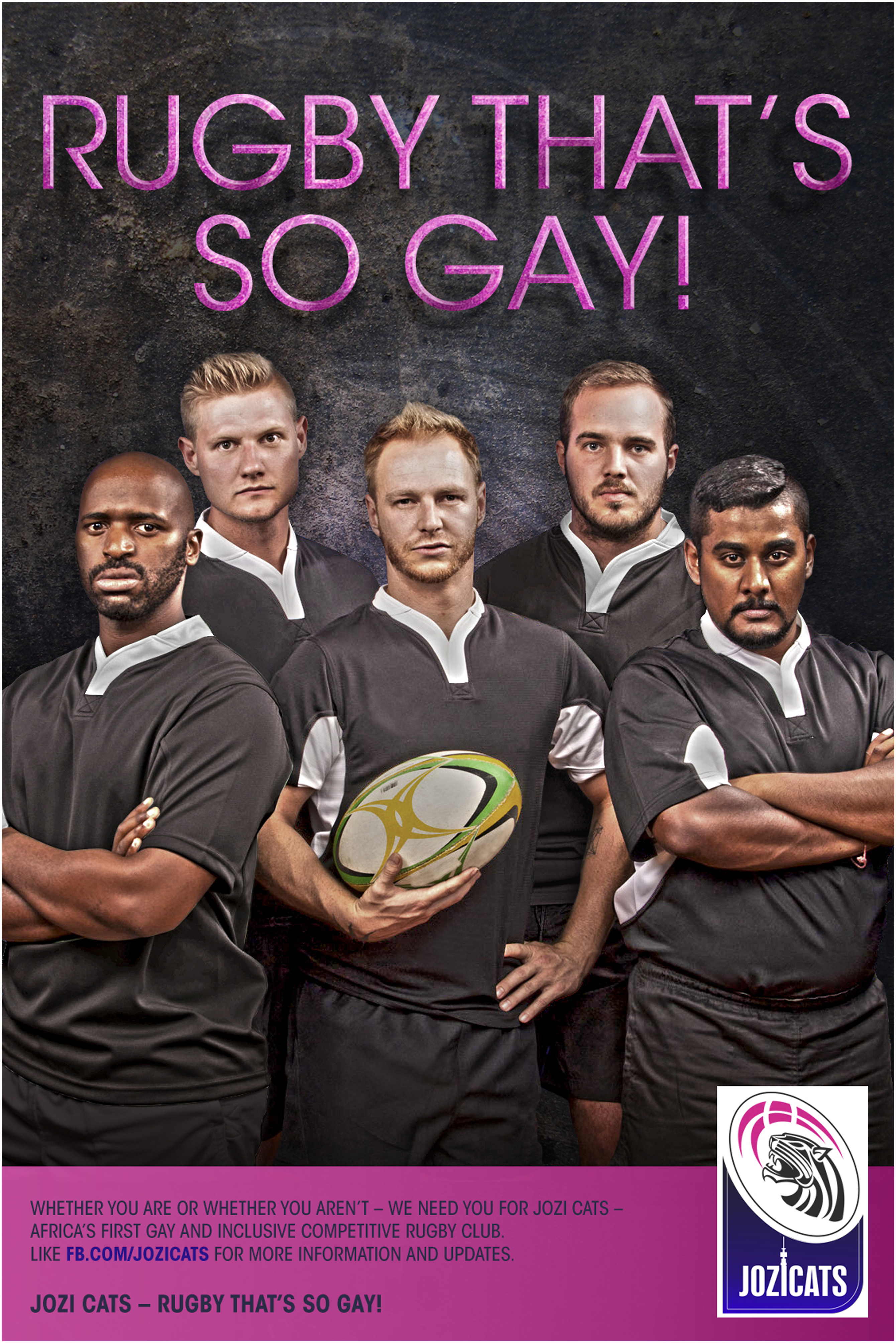
In 2017, the team was the first African team to participate in an international inclusive rugby tournament in Madrid, known as The Union Cup. Jozi Cats is a fully inclusive gay, straight and bisexual full-contact rugby and touch-rugby team committed to asserting the value of gay and bisexual rugby players as competitive sportspersons in the rugby community. Their recruitment campaign sought to challenge the presumption that just because you do not look like the “standard” rugby player, you cannot be a “normal” rugby player. To this point, the club’s former creative director, Chris Verrijdt, noted: Our job…is to get the word out there that there is a place where you can be gay and a rugby player and be who you are without fear of discrimination…When the naysayers and haters have their say, it will show that we still need to have these kinds of conversations in South Africa and wherever discrimination still takes place. (Wong, 2016)
The club aims to be a role model for the gay community and a successful example of inclusive, supportive and reciprocally respectful interactions among people along intersectional lines.
Theoretical Framing
Aligned with these sentiments, the present study drew on Anderson’s (2005, 2009) IMT. Most studies initially adopted the tenets of Connell’s (2005) hegemonic masculinity theory (HMT), but recent studies show that masculine expressions have become more inclusive, resulting in a shift away from men’s taken-for-granted internalisation and performance of so-called “traditional”, heteronormative or patriarchal forms of masculinity (Ratele, 2014), that is, the most honoured ways of being a man (Connell, 2005). Hegemonic men are stereotypically considered as heterosexual, cisgendered, dominant, aggressive, competitive and in control. Hearn and Morrell (2012, p. 4) agree. They define such masculinity as an “embodied, collective practice, a set of social processes, [at] the centre in a relational gender system, to which other positions relate, [and] a normative structure, to which all or almost all men aspire”. HMT was pronounced to explain masculinity during the 1980s and 1990s. Its centrality resulted from modernisation—specifically, the Second Industrial Revolution and urbanisation. These processes contributed to new understandings of homosexuality.
Prior to urbanisation, persons with same-sex desires were homoerased. Through modern developments, men migrated to urban centres and started to “organise socially” to form new “sexual subcultures” (Robinson & Anderson, 2022, p. 75). Consequently, homosexuality became more visible. During this period, homophobia and homohysteria steadily increased in cities around the US, UK and South Africa (Gevisser, 2020). Homohysteria results from a “fear of being socially perceived as gay”, existing in contexts aware of the existence of a distinct gay and lesbian subculture; displaying a dislike towards homosexuality; and being partial to cisgenderism (Anderson, 2014, p. 15). These processes were exacerbated by the spread of the HIV/AIDS pandemic among mainly gay men in American cities during the early 1980s. Irrespective of the strides made by gay and lesbian liberationists since the late 1960s, the pandemic curbed the potential for the agentic homosexualisation of society (Altman, 1982). The apex of hegemony proliferated through medical, religious and highly conservative political censure of the visible and “emaciated” gay man (Robinson & Anderson, 2022, p. 77). Consequently, heterosexual and gay men started policing their gender and sexual identities stringently to disassociate themselves from overt homosexuality.
IMT emerged from findings on more inclusive behaviours of heterosexual men in UK and US fraternities and in contact sports (Anderson, 2002, 2005, 2009). White and Anderson (2017, p. 128) opine that IMT “is the only gender theory capable of capturing this transition” from hegemonic to inclusive masculinities. Its proponents argue that millennials and Generation Z reject homophobia; they are prone to include more gay friends in their social group; they espouse the need for emotional and physical intimacy and closeness with other men (i.e., horizontal homosociality through kissing and cuddling); and they tend to recognise bisexuality as a legitimate form of sexual orientation (Anderson, 2014). Anderson (2009) argues that, owing to a less homophobic and homohysteric context, men are less prone to policing their own and others’ masculinities. Although its critics decry IMT’s supposed oversimplification and exaggerated optimism regarding the changing dynamism of masculinities (De Boise, 2015), Anderson and McCormack (2018, p. 10) state that the decline in homophobia, particularly in developing countries like South Africa, is an “uneven” process; that is, men’s levels of homohysteria may decline even in countries where homophobia still exists.
Methodology
Social constructionism and interpretivism formed the metatheoretical bases of the study. These approaches correspond with using an explorative qualitative research design. This design assists in understanding the nuanced, in-depth and subjective interpretations of the participants’ everyday experiences and their interactions in their natural setting (Creswell & Poth, 2018).
Sampling and Recruitment
The non-probability sampling procedures of purposive and snowball sampling were applied. The sample comprised seven self-identified semi-professional gay rugby players living in South Africa; there were no other exclusion criteria. For this study, we contacted the director of an inclusive South African rugby club, who consented to share information about the study (i.e., a formal summary outlining the title and objectives of the study and the researchers’ institutional affiliation and contact details) with the club members. Owing to the “hidden” nature of the research population (Maake et al., 2023), snowball sampling proved to be an effective means to recruit six participants. After concluding their interview, participants were requested to share details about the study with other prospective interviewees who then contacted the primary investigators. These methods, notwithstanding the sensitivity of the research topic, made recruiting participants difficult. Some of the prospective participants, who initially expressed interest in the study, finally refrained, citing their fears of homophobia in a country characterised by increasing sexual and gender-based violence towards gay men and women (Ratele, 2022; Rothmann, 2022). This made it difficult to recruit more than seven interviewees. However, it was imperative to ensure the trustworthiness of the findings. We obtained “multiple accounts of social reality” (Bryman et al., 2022) by recording and transcribing the interviews with the participants, thereby procuring dense descriptive accounts of all the men. Furthermore, we employed member validation by having the participants confirm that the transcripts correctly captured their subjective narratives (Creswell & Poth, 2018). To ensure dependability, we retained complete records of the study—from the initial problem formulation through to the interview transcripts, data analysis and reporting (Bryman et al., 2022).
Biographical Information
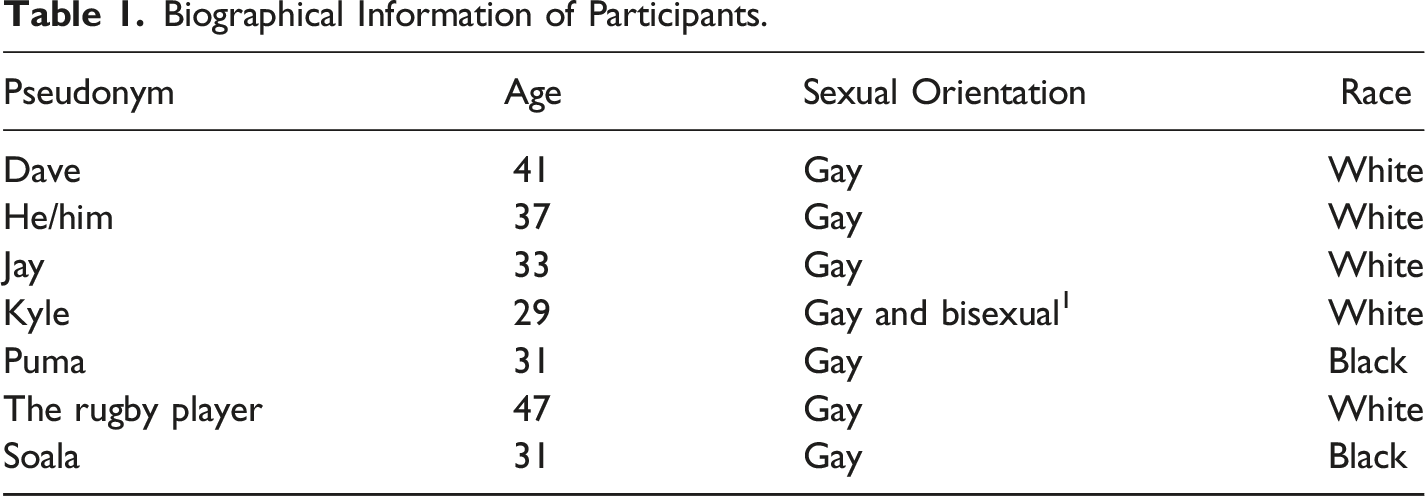
Biographical Information of Participants.
Data Collection
Explorative research provides a highly interactive context between the researcher and the participants. Meiring (co-author) conducted seven semi-structured interviews during 2021. Owing to the compulsory governmental lockdowns during the COVID-19 pandemic, only one of the interviews took place in person. Four of the participants were interviewed via Zoom, and the remaining two participants opted to answer a self-administered questionnaire comprising the same questions as the interview schedule. The use of virtual interviews did not compromise the quality of data collected. The interviewer was still privy to eye contact, facial expression, and other non-verbal and verbal cues. The interview schedule comprised Section A, centring on the biographical questions, and Section B, encouraging participants to elaborate on their answers through open-ended, opinion-related questions. The biographical information included the participants’ self-chosen pseudonyms, their sexual orientation, race, age, and geographical location at the time. Pertaining to the general research objective to explore the influence of inclusive masculinities on self-identified gay rugby players’ experience of homohysteria in their respective inclusive rugby clubs, we asked the following opinion-related questions during the interview: • “Why have you chosen to play rugby?” • “Who, or what, in your opinion, is the ‘ideal’ rugby player? (i.e., in terms of appearance and behaviour)”. • “What are some of the challenges that you have faced as a self-identified gay rugby player in your team?” • “How did you overcome these challenges?”
Data Analysis
We employed thematic analysis to code inductive themes that emanated from the transcribed interviews through open coding, which assisted us in identifying sub-themes, together with their meaning, which represented the participants’ stories. Additionally, we used selective coding—that is, a selection of a specific category (e.g., the influence of inclusive masculinity practices on self-identified gay rugby players) and then relating it systematically to other categories (e.g., the experience of homohysteria in such contexts) (Bryman et al., 2022).
Ethical Considerations
Before the commencement of the study, all participants were given an informed consent form that clearly stated the objectives and procedures of this study, the researchers’ contact details and their institutional affiliation. Given information outlined the rights, obligations and roles of the researchers and participants; the importance of observing the principles of anonymity, confidentiality and privacy; and a commitment to avoid any emotional, physical and social harm to the participants (Creswell & Poth, 2018). All participants provided informed, voluntary, explicit and specific consent. If a participant felt uncomfortable at any time during the interview, they had the right to stop the interview and withdraw—none of the participants did so. To ensure reliable transcription, the participants agreed to an audio-recording. Anonymity allowed them to choose their own pseudonym to be used for conducting the interviews, transcribing the interviews, engaging in analysis, and writing up the findings. Having participants choose their own pseudonyms rather than having us do so on their behalf possibly gave them a sense of agency, control and commitment to the study (Mukungu, 2017). Concerning confidentiality, the identity of the participants was and will be protected by ensuring that none of the information (whether biographical or opinion-related) can be traced to them. The privacy of the participants was also protected—thus not coercing the men to talk about matters they regarded as personal (Bryman et al., 2022). The Basic Social Sciences Research Ethics Committee (BaSSREC) of the North-West University’s Faculty of Humanities provided ethical approval (Ethics number NWU-02093-20-A7).
Findings
Gay men must carefully select, navigate and ultimately reflect on how they construct and perform their gender and sexuality in sport. Such institutional reflexivity involves a continuous interplay between their agency and the structural conditions of their contexts. Drawing on the tenets of social constructionism, the findings show that the participants subjectively construct, “do” and negotiate their gender and sexual expression amid potentially heteronormative contexts. To this point, participant narratives explained why the men played rugby and how this aided or inhibited their attempts to mitigate homohysteria. First, they spoke to how their socialisation led to them accruing or challenging certain forms of gender capital. Secondly, they commented on the need to acquire body capital. Finally, they expressed the need for homosocial bonds with gay and heterosexual men alike.
Dialling up the Testosterone: Rugby as Source of Masculinity
Consider the following view of one of the participants about rugby: [It] is considered a masculine sport; there’s a lot of rough and tumble. Growing up and living in a country where people love rugby, you get hyped up by the people around you. The harder you play and tougher you are, the more people respond to you. (Jay)
On this point, participants cited primary gender-role socialisation as the first reason for playing rugby. This process required them to socially construct, negotiate and perform their masculine gender appropriately. Parents and siblings, according to the participants, were a major influence in their decision to play rugby. The Rugby Player recalled that he wanted to play rugby his “whole life because, I mean, one of the photos of me as a newborn was me with a rugby ball next to me”. He continued: …[my] parents were very sporty…. I loved watching rugby; that was the one thing I loved—the adrenaline…. My brother played rugby. So, I would do whatever to be part of that team “spirit”.
The influence and encouragement of the men’s fathers were palpable during the interviews. Although his father was understandably ignorant about homosexuality and, to some extent, homophobic (e.g., using the word “moffie”, i.e., a derogatory Afrikaans word that translates to “fag”), He/him recalled that his father invested time to encourage and assist him to excel in sport. “Coming to terms with my sexuality”, he continued, required support from his father. He regarded his father as his “safe space and my best friend, and as we were best friends, you know, we did everything together”. This notwithstanding, he first disclosed his sexual orientation to his mother. He said “it was easier to tell my mother. [Since] my father [was my best friend], the fear of breaking up that friendship or losing that friendship, of not being loved or accepted was a major [issue]”. He eventually told him, and it strengthened their relationship.
Presenting as more masculine, Jay recalled receiving a “generally positive response from people. It props up your feelings of self-worth and because it’s rugby, masculinity plays a role”. Although one could interpret his response as mainly transgressive, Jay emulated the masculine behaviours of his heterosexual counterparts to accrue integration and respect. Similarly, playing the game required The Rugby Player to “dial up the testosterone and dial down any kind of feminine qualities”. In so doing, he sought to emulate: …the captain of the rugby team or the water polo team. Thus, those guys that I wanted to aspire to, be like, because they were goodlooking. The attention they got; they had the bodies that I always kind of wanted.
So, the participants (inadvertently) expressed their need to accrue the “correct” (read heteronormative) gender capital through playing rugby by which gay men seek to emulate the expected complicit masculine attributes associated with ideal men and rugby players in South Africa. The Rugby Player engaged in rugby because it “tapped into my competitive side … it’s because I knew that I was different…. I needed to compensate in all aspects of my life”. He elaborated: I think deep down inside, I knew that I was gay, and I would do whatever I could … for people … to like me. It was more for me to … overcompensate. But unfortunately, that wasn’t necessarily being more masculine. Because I still participated in drama. I played netball with the girls. Yet, at the same time, my struggle was that I could be playing soccer with my male friends and then, one minute [later], play Barbie with my girlfriend.
Correspondingly, to divert attention from his sexual identity, Puma acknowledged that, while growing up, he was: …very scared of anyone finding out about my sexuality…. So, for the most part, I didn’t physically behave differently…. Except … while I’m doing the sport…to avoid any sort of discussions or questions that would go down the lines of sexuality or flag [me being gay] in any way. So, when I’m just hanging out with the boys after a match…. I try and avoid talking about…the sport. I just felt like my contribution to those more manly conversations wouldn’t be sufficient.
Interestingly, he noted that when one is engaged in the sport on the field, “no one actually cares” about one’s sexual orientation. Regardless, while growing up, some participants sought to perform the acceptable gendered behaviour. The Rugby Player, for example, noted that if his teammates in high school were aware of his homosexuality, “100%. …Yeah. I think if you had [come out as gay], there would have been even more bullying and ostracisation by the kids”. Relatedly, He/him …gravitated to individual sports, where I didn’t rely on a team. Because so often what my experience was of team sports … [was] that I was going to be the one that was going to be ridiculed. I was going to be the ‘moffie’. I was going to be blamed … if there was a mistake … because I wasn’t quick enough [among others].
Being gay, in his opinion, was likened to “weakness…Especially in that sort of hypermasculine culture. Like in those days [the 1990s], absolutely”. Jay mirrored these sentiments. In his opinion, if people “had known that I was gay, it may have affected my participation or my ability to be included or accepted in a team. I didn’t pick rugby for myself initially but once I started, I really enjoyed it”. Therefore, playing rugby helped him to fit in. He noted: Knowing that I was gay probably also helped me to fit in. For rugby I had present[ed] myself as masculine and ‘normal’ to fit in with the team and other players. I probably overcompensated sometimes because I knew I was gay. In general, though, once you are in a team, every member feels like they are your friend, and I really enjoyed the sport.
He/him elaborated on whether and how this required him to subscribe to specific gay masculine stereotypes. He mentioned one specific example—“big boys don’t cry”. This, according to him, relates to simply facing your everyday struggles—that is, to “get on with it”, be more of a man, and “stop being soft”. He related this to the pejorative Afrikaans word “moffie”. While he was growing up under apartheid, the term was “sort of thrown around like a normal slang word”. To avoid such stigmatisation, he engaged in sport. He decided to play tennis. This choice of sport, however, exacerbated subtle (read covert) homophobia. By not playing rugby, he became much more of a “target in terms of discrimination”. He recalled being “picked on by the students and…by the teachers”. He said: …rugby was part of my upbringing, like every South African kid…I was targeted for not playing it, because I was actually a very good rugby player as well…I was really authentic [he identified with the game of rugby] and competitive…discrimination was part of my every day in primary school.
The Rugby Player was also subjected to homophobic language. Although he did not consider himself as someone who was “really sporty”, cricket and hockey were his initial go-to options when he was younger. He said: During the 1990s…people used to call [the hockey stick] the ‘mof stok’ [faggot stick] because, in retrospect, the more ‘obvious guys’ like me … huddled together. I’ve also played cricket once, and I was told that I threw like a girl or … someone who is gay.
Likewise, Soala cited the influence of playing different sports—netball, soccer, and rugby. Regarding netball, his main concern revolved around how his perceived “male physicality” would be called unfair and said to be putting his team in a more favourable position. “Fortunately,” he was the “shooter and, as such, this was not necessarily a problem”. The soccer environment provided a similar situation. Consider his reflection: …as a child, to fit in with the boys in the class, one would try to not appear feminine. However, I never really experienced any backlash from being my authentic self, which I believe exhibits some traditionally feminine traits—but I think that was because I was a particularly strong goalkeeper and an asset to the team.
Accruing muscular body capital was closely associated with the importance of gender capital.
Accruing Muscular Body Capital: Reification versus Diversification
Accruing body capital enabled some of the participants to attain the required muscularity to pass as heterosexual. Jay commented on how this encouraged him to exude masculine traits. He said: …[I] strongly identify with typical characteristics and feelings one would associate with masculine identity. As a man, I like to occupy the space around me; I am bigger than other men. Because of this, they respond to me like I am [bigger] and that makes me feel confident. I like to feel dominant, self-controlled, independent, healthy and strong. I gym 5–6 days a week to maintain overall health and muscle mass—this enforces my feelings of masculinity.
The Rugby Player attested to this: Because I’m a big guy … I weigh 98.2 kg and [I’m] 1.8 [metres tall], people assume that I am [a] straight rugby player.
Puma and Soala echoed this sentiment. Puma’s proficiency as flanker made him a “kind of rugby athlete who [must] do a job that requires [him to be] fast [and] strong… I trained to try and be a good-looking flanker”. This, however, did not influence how he enacted his sexual orientation because, as he noted, “[p]ersonally, I haven’t had, especially more recently…a need to behave differently just because [I’m gay]”. Intense bodywork also aided Soala to attain a “more fit appearance”. Engaging in gym work informed the way he “experienced [his] physical appearance, particularly because [he] picked up a lot of muscle quite quickly”—a change that contributed to his presence on the rugby field. Moreover, attaining more muscle mass: …was [an] epic courage builder…knowing that I had this team, it made me feel like I’m stronger together [with them], if … I’m going into battle, but my teammates were going into battle [with me]. So … it just made me feel…stronger. It made me feel more willing to put my body on the line (Soala).
Jay summarised this best. As a “more muscular guy…when I play rugby, I am more aggressive but that is probably because of the adrenaline/excitement of the match”, not necessarily because of the gender performance he wanted to espouse. He noted: I have always been a bigger guy due to genetics, [my] active lifestyle and sport. If I feel big and strong, then I feel masculine. Feeling self-confident and good about my physical appearance is directly tied with my sense of masculinity and sexual confidence (Jay).
Irrespective of acknowledging others’ association between rugby players and being muscular, The Rugby Player acknowledged how playing rugby encouraged the appreciation of diverse body types and behaviours. Consider his thoughtful view about specifically gay rugby: …that’s one of the things that I love about rugby.… The whole game is designed for people with different body types…. [For example, for] the wings, obviously [they] have to be like leaner and more ‘sprinty’. The locks, obviously [are]…bigger. And that’s what I love about … gay rugby, or the LGBT rugby movement…. It doesn’t matter, there is some way for you to fit into the team … that’s why rugby is the most powerful sport on the planet. To be able to promote inclusion, because you literally need all shapes, sizes [and] skills to make a rugby team.
Puma agreed. He, like The Rugby Player, “love [d]” rugby because “it welcomes all shapes and sizes. You know, bulky, tiny [and] chubby”. Relatedly, Kyle reflected on how his inclusive rugby club facilitated an appreciation of diverse body types versus a reified gay male caricature. He noticed how “very happy…they [their teammates] are [with themselves] and that you know [which] categories they fit into”. He came to realise “that…it was great to be able to play with all sorts of different body types. And it gave me a confidence boost… To be able to be with guys who were super confident in their bodies”. Playing with his teammates allowed him to negotiate which position suited him best because, as he humorously recalled, “I’ve learnt that my bones are made of cotton wool. I’m not built to play contact [rugby]. …So, that’s sort of my own physical sort of identity—if I can call it that. I realised that … my body is not made for that”.
Consequently, He/him attributed the “beauty of rugby as a sport” to “the diversity … it requires, “[i.e.,], lots of different types of physicality”. Akin to The Rugby Player’s narrative, He/him differentiated between the various positions in rugby that contributed to its inclusive potential: …[A] prop is a different shape and size to a wing or a flank. They perform different functions. [Other players are] very different in size, shape and the functions they perform…. So, all this influences … the character of a rugby player.
Notwithstanding the inherent physical and skills differences among players, He/him postulated that “every player must be athletic and have a strong sense of physicality and a strong muscle mass, [otherwise] they’re going to get severely injured. So, yes, you must be rough and tough and strong”. Such common denominators do not, however, imply binary-based typologies of idealised gay men. He/him wondered whether playing rugby necessarily required that men: …give up being [either] heartless or empathetic [to exude] good sportsmanship? Because you have physicality and all of that? No. And I think that’s what’s masked; is it’s always been [this] either/or [view]…when you break it down to the basic stereotypes … that’s the problem…. Those stereotypes have filtered in and not given space to look at the different types of players required and who you need to be in each of those roles.
Jay differentiated between competitive and aggressive players. Although being “competitive is great”, being “aggressive [is] less so. A competitive player likes to win. To win, you have to focus on developing your skills, game-play strategy and teamwork”. Conversely, an “aggressive player is good to have around for a few minutes or [in] some situations…But the match is 80 minutes long. So…the level-headed competitive player is best”. Although in support of the above ideals, Soala cited “having a healthy dose of a competitive spirit [and being] a good sportsman and being respectful”. He added, “I think people of all shapes and sizes can play touch-rugby”.
Moreover, the participants continued their critique of such binary-based logic about gay men’s gender and physicality in rugby by expressing their need to establish homosocial bonds with team members.
Encouraging Horizontal Homosociality
The findings showed two configurations of such bonds: One was organised along vertical lines; the other one was more horizontal. Regarding the former, some participants commented on being “half gay” and “half straight”, depending on the context. Kyle recalled how participating in rugby provided them (albeit sometimes temporarily) some acceptance and heterosexual privilege (i.e., complicit masculinity) by performing their masculinities in this specific context. Reflecting on their formative years at school, it was apparent that some of the participants, including He/him, Kyle and Puma, sought to project a “normalised” image of masculinity (i.e., remaining closeted) to establish rapport, a sense of “self-worth” and camaraderie with their teammates on the field, in the locker rooms and socially. In so doing, they distanced themselves from overt displays of effeminacy and homosexuality, which, as they noted, would be read as “weakness” and a lack of masculinity that could result in discrimination.
Although much of said gendered policing occurred during the 1980s and 1990s, heteronormativity continues to stifle attempts to establish supportive homosocial bonds among gay and heterosexual rugby players. Kyle recalled how a recent match against a mainly heterosexual rugby team required gay players to carefully navigate their sexuality. He noted: We had to be on our guard … because it’s a hypermasculine environment. We are there openly as the incumbent inclusive competitive rugby team. It was tough when playing against homophobes because … the competition will always try and throw you off your game. And it’s a lot easier, or it’s a lot stronger when you have a giant target painted on your chest [i.e., referring to the logo on the rugby jersey].
Likewise, Dave, Puma and Soala could not recall pertinent or in-person examples of discrimination as openly gay male rugby players. They, like He/Him and Jay, mainly reflected on indirect homophobic remarks from the sideline during their matches. One such instance stayed with He/him. As reserve player, he recalled hearing: …the homophobic comments and the slurs [from the opposing team], and the tensions that bubbled up, [which] were almost constant…. As respectful as people want to be … their cultural afflictions are way stronger than any sort of conscious sportsmanship that they may have had on the field [on] that day. …It was quite a sad feeling to walk off the [field] that day, knowing that the reason we were leaving for having a great time was because our physical safety [was at risk].… It was just time to leave.
Conversely, horizontal homosocial bonds foregrounded much of the men’s present-day experiences as rugby club members. The Rugby Player opined that being a member of an inclusive gay rugby club: …literally gives people an opportunity to be who they want to be. To socialise … communicate … learn … have fun. Also, the […] friendships that have been made.… Then they feel connected to something. Community is really big.
To this point, Jay, Kyle and Soala said that they had “really grown to enjoy the sport” owing to how it also contributed to their making “some really good friends”. Likewise, Kyle underlined the importance of establishing a sense of community, which, initially, he likened to an “impossible” feat. Yet, he soon came to realise that this was indeed an achievable ideal. He said: I was like, hey … let’s play … some rugby. Let’s go to the club and see what happens. And [then I went], ‘Hang on a second. This is a club for LGBT people that plays [sic] rugby. Yes. I couldn’t sign up fast enough!’
Similarly, The Rugby Player argued that his rugby club provided gay and heterosexual players with a “safe space that isn’t like a nightclub or something else where they can just be who they want to be and play rugby and be part of this … community”. This provided the players with a “brotherhood, [similar to that] of a sibling, … of people who are just like them, and happen to play rugby”. His fellow players, like him, had grown “tired of the stereotype” associated with the requirement that rugby players necessarily had to be “macho”. Heterosexual men, in his opinion, also face discrimination if they do not conform to certain heteronormative expectations. According to him, “[w]e often forget that straight guys also get called…homophobic slurs”. The Rugby Player illustrated his statement: [One of the inclusive gay rugby club’s coaches is] 23. He just wants to teach people to play rugby. So, he teaches it. So, he’s straight. His girlfriend actually said to him, ‘You need to go and help out [members of the inclusive rugby club]’. He loves teaching. …He teaches primary school kids to play rugby. He came on as our technical coach because he was also tired of that whole ‘macho thing’ and [players] having to live up to it.
Kyle provided a comparable account: …a [straight] friend of mine … he’s an extremely attractive man. He is the longest standing waiter at ‘Beefcakes’ of all time. So, ‘Wow!’ Just yeah, he managed to pay for his doctorate by going to a bar and working at Beefcakes in the evening and studying. However, he played for Cape Town 10’s…[wearing] pink shorts. He’s this straight man in pink shorts. And a couple of guys from Pretoria took exception to that and put him in hospital. He was in the ICU for about two weeks.
Such aggression, fuelled by heteronormativity, manifests in “all shapes or forms [on and] off the field”. Having these heterosexual male allies facilitates establishing a homosocial brotherhood among men, irrespective of their sexual orientation. This encourages “camaraderie” among gay men and their heterosexual allies. By acknowledging the joint “battle” during their games, the participants favoured displays of amicable sportsmanship through displays of reciprocal respect and competitiveness during games as opposed to overly excessive aggression before, during or after their games.
Discussion of Findings
Next, we critically discuss three themes that emanated from the findings and speak to mitigating homohysteria in rugby. The themes are: the importance of accruing gender capital and bodily capital and establishing horizontal homosocial brotherhoods.
First, the narratives emphasised the importance of accruing or challenging specific forms of gender capital, that is, “the knowledge, resources and aspects of identity available—within a given context—that permit access to regime-specific gendered identities” (Bridges, 2009, p. 92). According to the participants, two processes maintained or challenged specific espousals of masculine gender roles: primary and secondary gender-role socialisation. The former refers to the “process by which individuals develop, refine and learn to correctly do their gender through internalizing gender norms and roles as they interact with key agents of socialization” (Neetu et al., 2017, p. 6). In this regard, the participants cited specific persons who served as gender role models (i.e., their fathers and brothers). They opined that such socialisation, in the context of the family, took place through the participants interacting with their significant others—particularly their fathers. The latter sought to socialise the men into conforming to and correctly performing predetermined gendered rituals (Du Pisani, 2001). These processes teach young boys and girls to act in a specific way to establish a direct link between their biological sex (male) and their socially constructed gender (man/masculine) and sexual orientation. Some participants recalled how they exuded the stereotypical features of aggressiveness, competitiveness and stoicism—features that South African (Allen, 2016; Morrell, 1998; Niehaus, 2014) and international (Messner, 2002; Scheadler et al., 2021; White et al., 2017) scholars associate with contact sport. They did so to divert attention from their sexual identity—a finding that recalls IMT’s references to homoerasure and homohysteria (Anderson, 2014).
Considering the sexual orientation of the participants, it is worth noting that primary socialisation required the gay men to imitate hegemonic ideals insofar as “there are no existing norms to create diverse and unique rituals akin to homosexuality” (Rothmann, 2016, p. 51)—that is, none of them were socialised to “be” or “do gay” (Halperin, 2012). Some of the participants sought to perform their “very straight gay” (Connell, 1992) and “good gay” (Greenland & Taulke-Johnson, 2017) personas to partly overcompensate for their supposed lack of cisgenderism. The “good gay”, according to Greenland and Taulke-Johnson (2017), is perceived as a straight acting, private, discreet and moderate gay man; the “bad gay” is depicted as being effeminate, promiscuous and predatory. The latter typology is akin to those stereotypes that the Afrikaner government associated with gay men under apartheid (i.e., Puritan) (Du Pisani, 2001) and some persons continue to do in contemporary South Africa (Rothmann, 2022). Irrespective of recent scholarship that speak to a democratisation of gender ideals in South Africa that contribute to challenging, displacing and “undoing” cisgender ideals (Buiten & Naidoo, 2020), under apartheid and even presently, some families mostly remain heteronormative, using ideologies to condition children into maintaining heterosexual gender ideals (Sonnekus, 2013). Morrell (1998) comments on how traditional (read heteronormative and patriarchal) understandings of masculinity were perpetuated during apartheid. Men were, for example, required to display orthodox masculine features to be considered as “real men” (cf. Anderson, 2014). The image of the Puritan father as breadwinner and moral caretaker of the Afrikaner family (Rothmann, 2011) contributed to internalising these masculine ideals (e.g., aggressiveness, competitiveness, strength and hypermasculinity) and applying it in rugby (Anderson, 2014; Morrell, 1998). Akin to traditional Afrikaner culture, traditional African ideologies continue to socialise young men to be dominant and violent (Rwafa, 2016). Such a configuration of dominant masculinity, therefore, valorises roughness, aggressiveness and emotional stoicism (Rothmann et al., 2022). The participants’ narratives reflected the varied influences of socialisation. Although some advocated for an androgynous gender performance, they and others acknowledged that they continued to exert complicit masculinity to gain social, sexual and cultural capital (Connell, 2005)—that is, they sought to disassociate themselves from being labelled as either marginal or subordinate men.
Primary gender-role socialisation extends to rugby as secondary socialisation agent (Gennrich, 2013; Morrell, 2001). White et al. (2017) show that sport, as a socialising agent, may reinforce the ideals of hegemonic masculinity. Gaston and Dixon (2019) concur. They postulate that gay persons’ fear of homophobia and rejection from the sport inform their decision to perform appropriate and correct gender and sexual scripts. Our findings attest to the work of South African scholars (Morrell, 1998, 2017; Rothmann et al., 2022) and studies conducted in the US (Roberts, 2013), the UK (Anderson et al., 2012; Gaston & Dixon, 2019), Australia (Drummond et al., 2015), and New Zealand (Van Campenhout & Van Hoven, 2014). Van Campenhout and Van Hoven (2014, p. 1094), among others, liken the game of rugby to a “battle”—a practice that displaces presentations of “weakness” in favour of being seen as courageous and heroic (Messner, 2002). They contend that if a player “performs poorly on the field”, his identity may be judged as being “less masculine” in comparison to those of his teammates. Our findings showed that playing rugby meant having to enact masculinity in a specific way—that is, espousing an orthodox masculinity by being physically tough (Stephenson, 2012), aggressive (Clayton & Harris, 2009), and mentally and instrumentally agile (Cupido, 2014) to contribute to the success of the team. Such gender policing (Bullingham et al., 2016) and homoerasure (Anderson, 2009) required some participants to remain closeted. Performing the “correct” gendered behaviour, therefore, allowed the men to “blend in” (Gaston & Dixon, 2019).
Interestingly, the participants reflected on the use of homophobic language as contributing to their homohysteria on and off the rugby field. Kettley-Linsell (2020, p. 243), for example, comments on the supposed “incompatibility between having a sporting career and (or even vs.) being gay”. “Doing” heteronormative masculinity was, therefore, of the utmost importance to some of the participants when they were younger—during the “apex” of homohysteria in the 1980s and 1990s (Anderson, 2014; Vilanova et al., 2020). To avoid homophobic language (e.g., fag or sissy), Bullingham et al. (2016) argue that gay men, especially when they are growing up, police their gender and sexual identity expressions. This recalls McCormack’s (2013) distinction between “gay”, “pro-gay”, “homophobic” and “fag” discourse. Although the former two emphasise inclusive practices among heterosexual and gay men, the latter two, according to McCormack (2013), may result from and further reinforce homophobia and homohysteria insofar as it differentially polices and regulates men’s behaviour in sport.
Regarding the second inductive theme, the findings recorded varied views on the participants’ bodily aspirations as rugby players. On the one hand, studies show that male musculature encourages gay men to attain the necessary musculature as “the social mask that illustrates [their] manhood” (Alvarez, 2009, p. 234). Although “[b]odies are not the only source of gender capital” and “the value of bodies is dictated largely by the contexts in which they are presented”, they remain “an important source” (Bridges, 2009, p. 92). Thus, accruing and exuding one’s body capital “correctly” provides men with the required gender and sexual respectability (Martino et al., 2020). “Dialling up the testosterone”, as one participant noted, afforded (and continued to afford) some of the gay players the necessary respect and social integration into a perceived hypermasculine context. As such, gay men “borrow bits and pieces” from their heterosexual counterparts (rather than necessarily vice versa) (Demetriou, 2001). As our findings show, this may mean that gay men project a “very straight gay” persona—presenting as assertive, independent and strong (Connell, 1992) and refraining from overt displays of emotionality when on the field. Levine’s (1998) work about the gay clone refers. The gay clone came to exist alongside the frailer and more fragile image of gay men who were dying of AIDS in the 1980s. The typology came to represent a healthy, muscular, rugged and athletic gay man dressed in either Levi’s, leather boots, or fitted muscle T-shirts. Although arguably seen as complicit, the gay clone “was also the embodiment of gay men reclaiming those things that society had denied homosexual men for centuries: their body, their masculinity and, ultimately, their manhood” (Alvarez, 2009, p. 100). This typology continues to persist. Consider recent studies about some gay men’s partiality for the “gay clone” look (Rothmann, 2022).
On the other hand, the findings of the current study showed that some gay men could exude their masculinity and muscularity on the field while, concurrently, such hypermasculinity allowed them to embrace their sometimes more effeminate and “stereotypically” gay self in other contexts (Rothmann, 2022). Some participants, for example, referred to how they used their gender through androgynous gender performances and the fluid displays of their sex characteristics, for example, using cosmetic products and wearing clothing that may be considered feminine (Adams, 2011). Scoats (2017) suggests that no single masculine archetype necessarily represents the apex of masculinity. Rather, the narratives of some of the participants expressed a partiality towards the display of multiple, often paradoxical, masculine ideals that encompass feminine expressions. In keeping with the cited scholarship, our study contributes to findings on how rugby players increasingly value displays of softer masculinities along inclusive and horizontal homosocial lines (Anderson & McGuire, 2010; Murray & White, 2017).
Of related importance is how the participants acknowledged, negotiated and valued the display of “multiple masculinities” arranged horizontally (i.e., equally dominant) versus a vertical stratification that distinguishes between hegemonic and subordinate men (Anderson, 2014). These accounts show how gay men negotiate, adapt to and perform diverse masculinities and muscularities on and off the field (Murray & White, 2017). This was pronounced in their appreciation of diverse and multiple gay, bisexual and heterosexual masculine identities and bodies. Although they cited the influence of primary and secondary socialisation agents (e.g., their fathers, brothers and male coaches) as a source of hypermasculinity when they were growing up, at the time of the interviews, they sought to challenge their own and the internalised homophobia and homonegativity of other gay men. Forming part of an inclusive gay rugby club facilitated their disavowal of internal hegemony among gay men (i.e., the deterministic distinction between the good and bad gay male typologies according to body type) in favour of encouraging gender and sexual agency on the part of the players to redress homoerasure and homophobia.
Thirdly, the research illustrates the importance of establishing horizontal homosocial brotherhoods in rugby to curtail homohysteria. Regardless of proof that the participants remained acutely aware of and decried vertical homosociality (i.e., stratifying relationships among men to uphold heteronormativity and patriarchy) and may seek to distance themselves from overt displays of effeminacy and homosexuality (Denison & Kitchen, 2015) to avert discrimination (Gaston & Dixon, 2019), they favoured horizontal homosociality. In this regard, homosociality points “toward relations between … men … that are based on emotional closeness, intimacy and a nonprofitable form of friendship” (Hammarén & Johansson, 2014, p. 5). Our finding backs recent scholarship that contends that male athletes are opting for displays of softer masculinities in contact sport (Murray & White, 2017; White et al., 2017). The participants joined their respective inclusive rugby clubs to attain a relatively safe(r) space of inclusivity. Joining said clubs, the participants championed and, as the findings show, became champions, role models and leaders in and for sexual minorities. Having these heterosexual male allies facilitates establishing a homosocial brotherhood among men, irrespective of their sexual orientation (Ralph & Roberts, 2020; White & Anderson, 2017). This encourages “camaraderie” among gay men and their heterosexual allies (McCormack & Anderson, 2014).
Conclusion
Providing inclusive spaces is imperative in a country where heteronormativity, patriarchy and homophobia remain deeply ingrained in the cultural fabric and individuals’ mindsets. It is encouraging that recent theorisation shows that men are increasingly espousing inclusive masculinities alongside orthodox and hegemonic configurations. Our study confirmed that the gay men came to appreciate diverse and multiple gay (and heterosexual) masculine expressions and bodies, and they sought to challenge their own and the internalised homophobia and homonegativity of other gay men. This helped them to disavow internal hegemony among gay men (i.e., the deterministic distinction between the good and bad gay male typologies) in favour of encouraging gender and sexual agency on the part of the players to redress homoerasure, homophobia and homophobia. Consequently, some participants experienced higher levels of horizontal homosociality and lower levels of homohysteria in their respective rugby clubs. This relates to the tenets of IMT for three reasons. Firstly, joining the club encouraged gay men to adopt assertive attitudes as openly gay rugby players. This encouraged acceptance, social change and inclusivity and resulted in more self-confidence and validation from and towards other players; thus, they did not necessarily erase their homosexuality through a denial of their gay identity. Secondly, depending on the context, the players projected a hybrid performance to best negotiate their unique gay masculine selves to accrue gender, body and homosocial capital in the club—some masculinities were more dominant versus domineering at certain times and in certain spaces (Anderson, 2014). Thirdly, a meaningful contribution of the study is how men, irrespective of their age cohort, construct and perform their gay masculinities along inclusive lines. Considering that the participants formed part of Generations X, Y and Z adds to the hypothesis that differentiational views of masculinities exist among and within generational cohorts (Magrath, 2017).
The study’s central contribution centres on our critique of a monolithic conceptualisation and understanding of what constitutes a “true reflection” of homophobia, homohysteria and inclusive masculinities in South African rugby. Echoing the work of IMT proponents, the study encourages readers to acknowledge the intersection and reciprocal interplay between the intent of gay, bisexual and heterosexual players’ behaviour among and towards one another and the context in which this occurs. This would contribute to better understanding and engaging with the meanings of homophobia, homohysteria and inclusivity by and among gay and heterosexual men (McCormack et al., 2016, see pp. 762–763).
To conclude, we wish to encourage South African scholars to adopt IMT when researching gender and sexuality. Such studies are non-existent in South Africa. We found it difficult to source South African literature that specifically addresses inclusive masculinities and gay male players in rugby. By conducting such research, one would not only focus on conceptualising homophobia (as a risk factor) but also explore the nature of inclusive and softer masculinities in mainstream South African sport as protective and mitigation strategies to curtail homohysteria among gay and heterosexual men.
Footnotes
Declaration of Conflicting Interests
The author(s) declared no potential conflicts of interest with respect to the research, authorship, and/or publication of this article.
Funding
The author(s) received no financial support for the research, authorship, and/or publication of this article.
