



Abstract
This article explores how upon self-defining their manhood identities as unimpacted by their impairments, the participants, traditionally initiated Xhosa men with visible physical impairments, instead identified their social status as impacted. The study reports data from in-depth semi-structured interviews with 20 Xhosa men, onegroup interview, and one cultural expert interview. The data was analysed using interpretative phenomenological analysis (IPA). This article identifies Xhosa traditional initiation as a grantor of equality; thus, the participant’s identities remained unimpacted, contrary to existing research about the co-existence of disability and masculinity. However, the lack of the impairment’s diminishing impact on their manhood identities notwithstanding, the participants identified both the impact of impairments on their status, and cultural pathways through which they seek to maintain a respectable social status as men in the communities. This article, therefore, explores these cultural pathways and how the participants negotiate the demands of able-bodied masculinity that often accompany their performance.
This article comes out of a qualitative doctoral project in Sociology about the intersection of disability and manhood masculinity amongst Xhosa men in the Eastern Cape. One of the goals of the doctoral project was, through the focus on traditionally initiated disabled Xhosa men, to interrogate a prevalent claim in Western masculinities scholarship that disability diminishes or relegates masculinity to marginalization or subordination (Nolan, 2013; Ostrander, 2008; Shuttleworth et al., 2012). This body of research notes that the bodies of disabled men serve as a continual reminder that they are at odds with the expectations of the dominant manhood cultures.
The co-existence of disability and masculinity emerges as “antithetical, or mutually exclusive” (Barrett, 2014, p. 37); the “dilemma of disabled masculinity” (Shuttleworth et al., 2012, p. 175); and as “embattled identities” (Murphy, 1990). This line of argumentation is rooted in the claim that cultures of masculinity privilege men who are strong, independent, and self-reliant, while disability is perceived as a negation of all these attributes (Gerschick & Miller, 1997; Ostrander, 2008). Therefore, it is argued that disability in men is tantamount to a loss of masculinity (Nolan, 2013; Shuttleworth et al., 2012). This scholarship is in tandem with Raewyn Connell’s (Connell, 1995, 2000) hegemonic masculinities, which positions disabled men outside the hegemony because they ostensibly lack the independence, virility, and the self-reliance associated with hegemonic men. However, this line of argumentation contrasts with arguments that the hegemony or circle of legitimacy in Xhosa manhood masculinity is achieved by primarily having a traditionally circumcised penis (Mayekiso, 2017; Mfecane, 2016).
Therefore, the focus for the doctoral study was on Xhosa manhood masculinity because notions of Xhosa manhood emphasize the traditional Xhosa initiation (ulwaluko) into manhood as a grantor of equality to all traditionally circumcised men regardless of their sexual orientation (Ntozini & Ngqangweni, 2016), social class (Mfecane, 2016) and any other markers of difference. Very little has been researched about the impact of disabilities on Xhosa manhood masculinities. In the Xhosa culture, manhood is a state of being that is acquired only after the successful completion of the ritualised traditional initiation practice of ulwaluko (Mfecane, 2016; Siswana, 2016). The ritual is the customary rite of passage from boyhood to manhood, which affords the new man legitimate membership, and a state of high responsibility in the tribal community (Magodyo et al., 2017; Ntsaba, 2002). The transition from boyhood to manhood begins with a specific act of inserting a cultural mark of manhood during the traditional initiation process (Mfecane, 2016). The ritualised traditional Xhosa initiation separates Xhosa boys from Xhosa men. An uncircumcised Xhosa male remains a boy (inkwenkwe) (Gwata, 2009). There is, therefore, a clear distinction between boyhood masculinities (Qambela, 2019) and manhood masculinities in the Xhosa culture thus I use manhood masculinity throughout this article.
One of the aims of the doctoral study was to investigate how visibly physically disabled Xhosa men constructed, defined, and negotiated Xhosa manhood masculinity for themselves. Additionally, how they subjectively perceived physical disability and its impact in doing Xhosa manhood masculinities? This aim was operationalised by exploring the strategies through which they responded to, and negotiated dominant cultural demands of Xhosa manhood masculinity. In this regard, the study established that all the participants were adamant that their manhood identities remained unimpacted by the physical impairment (Sipungu, 2021). From their narratives, I argued that the manhood identity remained unimpacted because it emerges from successful completion of traditional initiation, which acts as a grantor of equality amongst all Xhosa men who have undergone the process (Sipungu, 2021). The participants demonstrated a neat separation between the manhood identity and the disabled identity. The two identities were neatly packaged and constructed in ways that allowed them to not perceive them as intersecting. They negotiated their manhood identities and disabled identities as two parallel identities to an extent that who they were as men and how they self-described remained completely unimpacted by the impairments.
However, it was my argument that the participants viewed their social status - rather than their manhood identities - as impacted by the impairment. The participants also drew a neat separation between their manhood identities, which remained unimpacted, and their social status. Ironically, while they were adamant that their manhood identities were unimpacted, the things they identified as impacted, thus potentially diminishing their status, are those often considered achievements of manhood in most Nguni cultures. This was another reminder that Xhosa manhood, as an identity category, is separated from the activities that flow from it, and everything else. It stands alone as the pride of all men and it is not to be mixed with any other identities; not to be spoiled. Mfecane (2016, p. 207) has already noted that “the social fact of having undergone ulwaluko to completion means that one remains an indoda (a man), even if he violates the expected social conduct; he does not lose his status as an indoda.” However, based on my participants’ narratives I differ, purely on phrasing, with Mfecane’s (2016) above assertion. I argue that the participants’ narratives tell us that while one’s manhood does not get diminished, it is rather their status that takes a knock (Sipungu, 2021, 2023). This is because the participants informed me, as it will be shown in the following sections, that one has to do, and achieve certain things for a better or improved status as a man which is the aspect they identified as encumbered by their impairments.
Social status in this case does not refer to a form of hierarchy of masculinities comparable to that of Connell (1995). As argued previously, the traditional initiation is a grantor of equality to all men; thus, there is a oneness in manhood because Xhosa men all undergo the same process, learn the same language, and bear the same circumcision scar of manhood. The only established hierarchy is one based on seniority in terms of the number of years since one has completed the traditional initiation (izilimela). This article is structured as follows. This section outlines the background and the aim of this article. The following section outlines the theoretical frameworks underpinning the analysis of disabilities, and masculinities in this study. Next, I outline the methods of data collection and analysis employed in this study. Then the sections that follow present the findings and the discussion in relation to the identified cultural pathways through which the participants sought to attain a respectable status as men in their communities.
Theoretical Framework
This study traversed two different literatures—masculinities and disabilities—and thus it drew on two different theoretical approaches. For disability, this study employed the novel embodied approach as advanced by scholars such as Powis (2017) and Hall (1999) instead of the well-established disability models namely the medical model (Barnes et al., 1999; Oliver, 1983; Ritief & Letšosa, 2018) and the social model (Finkelstein, 1980; Oliver, 1990; Shakespeare, 2010). The medical model also known as the individual model or the personal tragedy approach explains disability as a “problem” of the individual. Through this approach, disability is a defect that stems from physiological or psychological limitations thus needing medical intervention. This model was unsuitable for this study because it reinforces the notion of disabled people as fragile and helpless. Xhosa men, by virtue of being traditionally initiated, hold enormous dominance within the home and community and, therefore, are neither fragile nor helpless.
The social model, which emerged as response and negation of the individual model, has been applauded for creating a distinction between impairment and disability. The latter is structural while the former is personal. Through this approach, disability becomes the outcome of social structures (Siebers, 2008). However, this approach was also unsuitable for this study because it completely disregards the body and how disabled people experience impairment. The two models create an untenable dichotomy between the environment and the body. For this study, disability should be viewed as neither completely personal nor purely social. While this study sought to place the body at the centre of analysis, the participants still had to account for how they experienced their impairments in relation to their environments. Therefore, an embodied approach that accounts for both the environment and the body was chosen. This study’s embodied approach was grounded in embodiment (Csordas, 1994; Wilkerson, 2015), the Phenomenological concept of the lived body (Merleau-Ponty, 1945), Sociologies of the body (Bourdieu, 1990; Cooley, 1902; Shilling, 1993; Turner, 1996), and recognition of local terminologies and beliefs about disability.
Insofar as the analysis of masculinities was concerned, this study employed African centred theories of masculinities as evident in the scholarship of African scholars of masculinities such Mfecane (2016, 2018), Dery (2017), and Ratele (2008, 2016). Mfecane’s (2016) analyses of Xhosa manhood, Dery’s (2017) caution against wholesale application of western theories of masculinities despite their usefulness, and Ratele’s (2016) suggestion to study men in poverty stricken contexts through the lens of dominance without hegemony instead of hegemonic masculinities were foundational in the analysis for this study. Therefore, in the analysis of masculinities, this study employed ulwaluko (traditional Xhosa initiation) as an entry to manhood and a respectable personhood, dominance without hegemony, and everyday rhetoric and local proverbs and idioms of manhood.
Methods
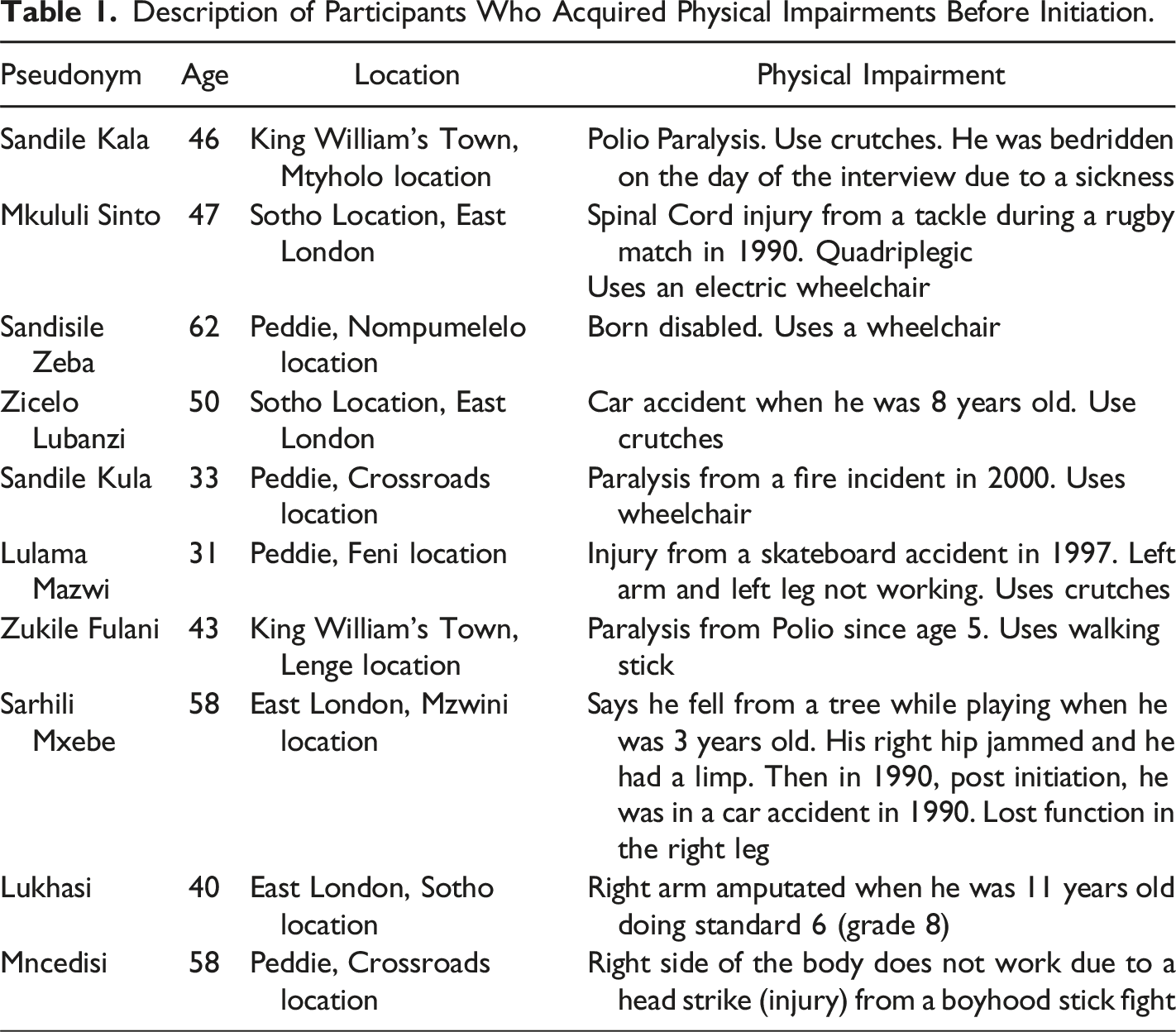
Description of Participants Who Acquired Physical Impairments Before Initiation.
Description of Participants Who Acquired Physical Impairments Post Initiation.
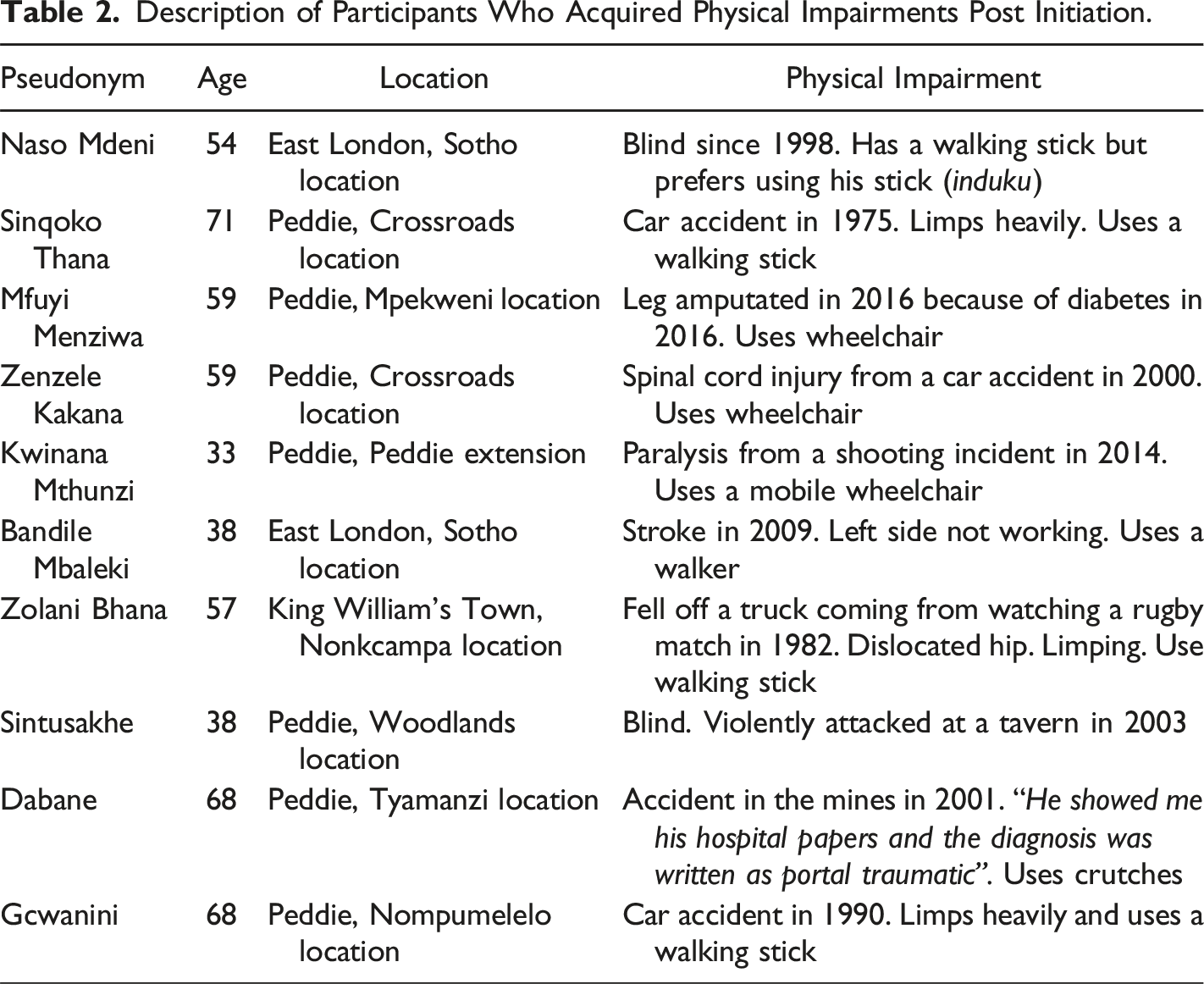
Of the twenty men, 10 men acquired impairments before the traditional Xhosa initiation, and the other 10 acquired impairments after initiation. Additionally, there was one group interview with 12 visibly physically disabled Xhosa men, and one in-depth interview with a Xhosa cultural expert. As it will become evident in the analysis, I interviewed men of varying ages to capture the issue of hierarchy because it is premised on seniority amongst Xhosa men. The ages of the participants ranged between 30 years and 71 years. In sum, the inclusion criteria for participants in this study were as follows: Xhosa men who had undergone traditional initiation (ulwaluko), living with a visible physical impairment, and permanently residing in the rural areas surrounding Peddie, King William’s Town, and East London in the Eastern Cape.
The open ended in-depth semi-structured narrative interviewing approach was selected to gain “thick descriptions” (Geertz, 1973, p. 8) in centring the subjectivities of the participants in how they made sense of their manhood status and position in society. All recorded interviews in IsiXhosa, the participants' language, were transcribed verbatim and then given to a professional translator to translate them into English. This data was the corpus for an interpretative phenomenological thematic analysis (IPA). The process of identifying themes involved six steps, as advanced by Smith et al. (2009), during which I attempted to make sense of the co-existence of disability and manhood masculinity as experienced by the participants. IPA researcher is engaged in a double hermeneutic, or a two-stage interpretation because the researcher is trying to make sense of the participants whilst the participants are simultaneously trying to make sense of their own world (Murray & Holmes, 2014; Smith et al., 2009). Through IPA, I sought “to give voice to, and make sense of the participants’ experiences” of manhood and disability, among, and between other men and women in the Xhosa community (Farmer & Byrd, 2015, p. 290). All participants, except the cultural expert, were given pseudonyms. Ethical clearance for this study was obtained from the Rhodes University Ethical Standards Committee.
Findings
“Indoda Kumele ibe Nomfazi.” A Man Should Have a Wife
The most prevalent elevator of men’s social status that the participants talked about was being married to a woman. From their narratives, it became clear that while the traditional Xhosa initiation makes one a man, marrying elevates one’s standing within the community. While their manhood identities remain unimpacted by the impairments because initiation grants all men equality, I gathered that their social status is further elevated if they marry. The participant’s narratives demonstrated a clear, although confusing, separation between manhood identity, as an identification category, and social status measured by the respect and admiration one receives. The former is a given through traditional initiation while the latter is dependent upon certain achievements. While it has been noted in literature that successful completion of traditional initiation affords one isidima (dignity) (Mayekiso, 2017; Mgqolozana, 2009; Ndangam, 2008), marriage elevates one’s isidima to greater heights. The following account from Zukile, who was impaired from a polio paralysis from age 5, demonstrates this point. Zukile (43): Your dignity as a man grows once you get married and have some responsibilities. Indeed, a man has to have responsibilities. Thoko: So, if I don’t want to get married, where does that put me? Zukile: Eh, you see now, your peers will not really consider you as an equal. You have one thing you lack. I mean your only responsibility is yourself, you don’t have problems, your status doesn’t equal to those who have responsibilities, yeah? Thoko: Ok, but socially I am still viewed as a man? Zukile: At the end of the day you will remain one. You are a man... (Interview, 14 November 2018) Sintusakhe (38): A man is supposed to get married, brother. You see when the (brandy) bottles are distributed, the ones called ibhotile zamabele (breast bottle), in a traditional ceremony. When there are many of you as men… you won’t drink from this bottle of brandy if you don’t have a wife, you can’t drink this bhotile yamabele. Whose wife’s breasts are these when you don’t have a wife? So you must get married so that you can also reach that level. (Interview, 4 December 2018) Matshoba: Hierarchy among amaXhosa is counted according to izilimela, you understand, the number of years as a man, because you will find at the bottom amakrwala (new men), after sometime you rise to the next level and you become abafana (young men) … and then on top its amaxhego (grandfathers), you understand, that’s how it is. (Interview, 5 December 2018)
At first, the participants spoke in general and ambiguous terms - their narratives about marriage did not account for their disabled embodiments. As evident in the above accounts, they talked as if they had no awareness of their impaired bodies. Generally, in the Xhosa culture marriage is permissible after one has successfully transitioned from boyhood to manhood. It becomes clear that marrying affords a man isidima (dignity), which elevates his status within the community. However, the participants spoke as if they were able-bodied and I wanted them to account for their impairments.
It was at this point that I prodded more about how they negotiated this expressed need to achieve this elevated status, through marriage, within the community and manhood circles. I wanted them to account for their disabled social selves. What impact does the disabled identity, which they separate from the manhood identity, play in their prospects for romantic relationships and marriage? I asked if there were any issues that they believed were peculiar to them as disabled men. It is at this point that they started to reveal that there is a layer of undesirability, because of their impaired bodies, that they are aware they must deal with in their searches for sexual partners and spouses. In the section that follows, I explore this undesirability that the participants bring to the fore.
Negotiating Perceived (Un)Desirability in Relationships
Despite the highly prevalent ideal, amongst the participants, about the necessity of marriage to elevate one’s status, there was, however, an appreciation from all of them of the fact that disability, being strange and awkward, makes it difficult for them to climb this symbolic ladder for dignity and a more respectable social status within the community. There was an awareness that in pursuing romantic relationships, that may lead to marriage, they had to contend with, and negotiate the “undesirability” that disability is imbued with by the ableist society within which they live. Marriage and romantic relationships constituted the site where the participants were most aware of their impairments, and by extension their bodies. While the participants’ disabled identities were not incorporated into their manhood identities, they (disabled identities) were clearly a consideration when it came to potential sexual partners and thinking about marriage. Suddenly, when I interrogated them about how they negotiated their perceived undesirability in the terrain of romance and marriage, I began to elicit narratives that demonstrated the ways in which the participants envisioned themselves through the eyes of others (Byrne, 2017).
When we started to speak about women and marriage prospects, particularly for the unmarried participants, I heard about how they imagined judgements about their bodies (Cooley, 1902). I observed that the body suddenly featured in how they spoke about themselves in relation to women but was hardly mentioned in relation to other men. In relation to women, the participants demonstrated an awareness of their disabled identities but also of the ableist nature of their communities. The following narratives from the participants aptly illustrate the manner in which they imagined themselves to appear in the eyes of potential sexual partners. Naso (54): I met the lady I am married to when the electricity (eyesight) was gone. When we started, I thought this one is playing games because she knows (laughs)…I would think to myself that she looks at me and says oh, poor blind person. (Interview, 23 January 2019) Zicelo (50): Oh, my brother, sometimes you meet a person and you doubt whether they have come for your grant money or they genuinely love you…. We know that they gossip about us as physically impaired people. (Interview, 24 January 2019)
However, contrary to scholarship (Oliver, 1990; Pearce, 2012; Wheeler, 2004) that notes that the person usually develops a negative perception of themselves from self-imagined judgment, the participants in this study did not necessarily demonstrate any form of negative perceptions in their self-descriptions. It was intriguing to me that they mentioned their independence and manhood as reasons for not caring what they think other people say about them. Thembani (34): At the end of the day I am feeding myself, right? I buy clothes for myself and I also man-up like other men. So what other people say I don’t put it in mind a lot. (Interview, 28 January 2019) Zicelo (50): It is just this thing of being too self-conscious because when you are in this situation it is difficult not to be self-conscious. However, I don’t blame God because I am independent. Through the strength he has given me I am able to do other things other men do. (Interview, 24 January 2019) Thoko: so when I asked you about living with other men you were saying that being physically impaired had nothing to do with your manhood, right? So I want to understand why do you see yourself as a physically impaired person when it comes to women? I mean it seems like you always have that in mind when we are talking about women. Thembani (34): You see brother, when it comes to women, there is an element of wanting them. It is not the kind of socialising that I do with men. So the thoughts of “I wonder how she will look at me,” will be there, you see. I am supposed to strip off naked with this person, if I get lucky. So the men I live with don’t know how my legs are twisted, but she will. (Interview, 28 January 2019) Sinto (47): I am not married to a disabled person, my wife is not disabled and nobody chose on my behalf. I did, and I met her when I was already disabled and then we got married after a year. I wouldn’t cope with a disabled person my brother, because you can see, right?… So at least I need someone who will take care of me in the house. (Interview 20 November 2018) Sinqoko (74): For example, let’s say I want to visit that person (a partner) who is on wheelchair or that person wants to come to my house. That person is on bicycle (wheelchair), right, and I am also on bicycle. Who is going to pick up another person to bed? (Interview, 5 November 2018)
Lastly, it is important to mention that the perceived undesirability was not the main reason why the majority of the men were not married. Similar to Hunter’s (2010) study and observations, the participants constantly expressed their frustrations about the scarcity of opportunities for gainful employment. The participants were constantly complaining about not having enough money, about the government disability grant being insufficient, lack of job opportunities meaning no money to pay lobolo for a wife. In addition to being able to marry, upon completion of traditional initiation, Xhosa men are also allowed and expected to build a homestead (Mayekiso, 2017; Mfecane, 2016). The next section explores how the disabled participants perceived this taken-for-granted allowance of being able to build a home, after initiation, as an elevator of status.
Umzi: A Man Should Build a Home
Out of the 32 men I interviewed, only 10 had their own homestead (imizi). The remainder of participants lived in their family homes. However, almost all of the participants made mention of their aspirations of building their own homestead (umzi). Having your own homestead as a man emerged not only as a marker of an accomplished manhood masculinity but also as an elevator of social status within the community. The following accounts from Sarhili and Zicelo demonstrate this point. Sarhili (58): A man my brother has to have at least one rondavel where he will settle. (Interview, 05 December 2018). Zicelo (50): As I was saying my brother, I live at home but I am busy building my own house.…. I want to be a man among other men. I also want to make umqombothi [traditional beer] in my own house … to invite other men. (Interview, 24 January 2019) Lukhasi (40): When I was admonished by the elders (ukuyalwa), it was said that a man works to build a house or revives his home. Sarhili (58): It’s exactly like that. It is as this man explains. I don’t think there is a man here who was not told that he is supposed to work and build a home. (Group interview, 20 November 2018)
While prevalent, this ideal of owning a homestead was more aspirational amongst the participants as only 10 out of 32 had their own. It soon became clear that this aspiration was hard to attain for most of them primarily because of their impairments. It is in this way that they view their impairments as threatening their social status as men. While building/owning a homestead is pinned as an achievement of manhood, not owning one does not diminish one’s manhood but rather their status. Again, while the context is characterised by widespread unemployment, the participants' accounts reflected a dominant view that there are no jobs for them in particular because of their impairment(s). The most dominant sentiment amongst all of them is that the impairment hinders their ability to get a job which would help them build a home. Zicelo (50): I am building but it is very difficult. I am trying to get out of my family home because that is not my house. I save up even if it’s R100 for bricks. I am building using this disability social grant. My wife is helping me. She uses her money to buy food and I take mine and use it for construction material. (Interview, 24 January 2019)
Children: A Man Should Have Children
In his book Love in the time of AIDS, based on research conducted in KwaZulu Natal, Mark Hunter (2010, p. 170) notes that “most young men I knew would agree that fathering a child symbolizes sexual virility and improves a man’s social status.” Additionally, Morrell and Richter’s (2006) study on traditional African masculinities demonstrates how fatherhood is associated with an achieved manhood. When I asked the participants about the impact of their varying physical impairments upon their male subjectivities/manhood identities they, as mentioned above, told me that that has no threat on their manhood identities. Who they are as men is unimpacted by their disabilities. Having established that the impairment has no impact on their manhood identities, they, in turn, told me that one of the things that can either threaten or elevate one’s social status is procreation. Zukile (43): When you are a man without children, a house, and a wife, your value decreases. Well, at least, the house is expensive, because money is scarce. There is no livestock for lobola, you understand. But at least one child…you must be able to call your son to the kraal and share meat with him like other men do, you understand brother? (Interview, 14 November 2018)
While the participants were evidently comfortable in their manhood(s) and did not feel in any way threatened within manhood circles, I gathered that that sense of security does not extend to the broader community and, therefore, the manhood identity does not shield them from general stigmas and stereotypes about disabled people. It was in this regard that I considered that the need to sire children, for them in particular, is not only a means to achieve a respectable manhood masculinity but also serves as a strategy that the men use in order to manage the stigma and disprove myths about disability. Thembani (34): You know brother, when you are in my condition for example, you are a limping person, right, or you are in the wheelchair, other people, I am sure they think a penis doesn’t get erect. I am sure they are wondering why the person you are dating is still around … when you have impregnated her, the perception that you don’t get erect changes…. I want a child but I am also scared of these diseases because these girls sleep around (giggles). (Interview, 28 January 2019) Sinto (47): God made it possible for my wife to get pregnant in 2005 or 2006 and we had twins, a boy and a girl. Words were spoken while she was pregnant and God’s things are surprising. My children were born, and they look exactly like me. While I was still looking at that in 2008 God once again blessed us with a baby boy, eh, my last born, eh. (Interview, 20 November 2018)
I also learned that for the participants, the anxieties did not end with their preoccupation about dispelling the myths and rumours of asexuality or infertility by impregnating. There were also fears and anxieties about raising children. I found that their accounts about fathering, or the aspirations thereof, brought about somatic concerns and inadequacies to the conversations. While the men did not see the correlation between the impaired body and doing manhood, fathering and the responsibilities that flow from it brought to the fore the inadequacies of the bodies that they exist in. Sarhili (58): Some men work, you see. These men from here go to Gauteng, isn’t it? So my children will say why is their father sitting here and not seeking for a job. It’s difficult to rely on this grant because it’s not enough, brother. But I can’t help the situation. (Interview, 5 December 2018)
Being Visible: A Man Should Be Seen
Xhosa men in traditional rural areas are expected, as a requirement and a performance of manhood masculinity, to partake in community activities such as the digging of graves, slaughtering during ceremonies, attending community meetings, which predominantly require an able-bodied corporeal presence. The intention with focusing on rural ideas of Xhosa manhood was, therefore, to explore how men with physical impairments navigate all these expectations of an able-bodied physicality in doing manhood on a daily basis. While the participants informed me that their impairments had no bearing on their manhood identities, one of the factors that frequently came up as a possible threat on their status as a man was visibility within the community in which one lives. The participants did not see any correlation between their impaired bodies and their manhood identities. These two aspects of their lives seemed to not intersect. However, the participants reported that one must be seen/visible in the community to be of good standing. Visibility within the community emerged as an important factor in boosting one’s standing within the community. Zukile (43): You see, a man is not a man by being circumcised, you can be circumcised but behave like a boy. Manhood is your deeds in the community. There is always an expectation when you are a man… and you feel it yourself too, that you must also be noticed. (Interview 14 November 2018) Mncedisi (58): There can’t be a situation where there is slaughtering or a meeting where you are absent. How are you a man? Tell me? A man must be present among other men, brother…. Staying indoors takes one’s dignity away; people will end up insinuating things. (Interview, 5 November 2018) Kwinana (33): Sjo, brother, when I was discharged from hospital it was difficult. You understand that you are supposed to attend gatherings because you have to represent your family but you are shy and you avoid the many questions that will be asked. (interview, 23 January 2019) Naso (54): For example, there were once robbers in the neighbours. I heard the cry, she stays alone that woman, and the man is in Gauteng. Now, it was difficult for me to stand up and respond because I mean there is no electricity (eyesight), right. What will the community say when I don’t stand up for things like that? Interviewer: But they know you don’t have electricity (eyesight), right? Naso: Yes, they know sir, but I say that pains me. I am supposed to be present in such places so I don’t look like lame man, you understand? (Interview, 23 January 2019)
Lastly, I learned that in the case of these disabled participants, visibility and presence rather than the actual doing helps with establishing a social self as argued in this article (Sipungu, 2023). Therefore, in their descriptions and daily practices, the participants in this study actively and deliberately did things that resisted perceptions that might reduce them to the disability. It then becomes clear that the emphasis on visibility, building a home, and marrying, and having children served as markers of respectable Xhosa manhood masculinities, and as resistance to perceptions that reduce them to the disability. These actions were, I concluded, also intended to counter the perception of disability in the imagination of the non-disabled as ambiguous and liminal “between humanity and animality, life and death, subjectivity and objectivity” (Shakespeare, 1994, p. 285).
Conclusion
This article has demonstrated that, contrary to Western scholarship on the intersection of disability and masculinity, the participants in this study did not report any sense of loss of masculinity or threat upon their manhood identities. However, the participants talked about their status as having been affected instead. In this regard, this article has demonstrated that their social status was threatened in areas such as getting married and the politics of (un)desirability that come with a disability, the (im)possibility to build one’s own homestead due to the lack of resources because of disability, the possibility of being unable to sire children because of the impairment, and the impediments different impairments place upon the need to be visible within the community as is required. This article has identified these as cultural pathways to a respectable manhood masculinity for disabled Xhosa men.
I have also argued that it is clear from their narratives that the manhood identity remains unimpacted because it results purely from successful completion of traditional initiation, while their social status rests upon achieving certain markers of respectable manhood. The acquisition of manhood through traditional initiation assumed a master status that remained unshaken by impairments. Therefore, in light of research about gay Xhosa men’s experiences of ulwaluko, I have noted that traditional initiation is a grantor of equality amongst Xhosa men. Additionally, because their manhood identities assumed a master status in their self-identification, contrary to mainstream disability studies wherein male participants would self-describe as “disabled men”, the two categories of identification—disability and manhood—did not, in these participants’ self-descriptions intersect to form one conjoined identity category.
Footnotes
Declaration of Conflicting Interests
The author(s) declared no potential conflicts of interest with respect to the research, authorship, and/or publication of this article.
Funding
The author(s) received no financial support for the research, authorship, and/or publication of this article.
