



Abstract
In this article, I set out to study Foreskin Quarterly, which was the Official Publication of the Uncircumcised Society of America (USA). Over the course of its history, it changed editorial hands and publishers hands several times, and with each change the magazine shifted direction that influenced and affected its original goals of foreskin activism. I argue that this magazine braided together pornography and activism in a way that was novel and important because in arguing against circumcision, it also sought to reclaim and eroticize the foreskin in a culture where the foreskin was anomalous and rare. Unfortunately, this magazine has largely gone unread by scholars, not just of pornography, but also of circumcision, and men’s bodies more generally. This article, thus, contributes to a growing body of scholarship on anti-circumcision activism, while also arguing for the importance of pornography in that activist milieu.
In the winter of 1984, Foreskin Quarterly, which was known as the “Official Publication of the Uncircumcised Society of America,” published its first issue. The organization itself was founded “on July 4, 1976” and was initially a “correspondence club for men to share their ideas about circumcision … both pro and con” (Berkeley, 1993, p. 45). In the 1980s, circumcision was normative throughout the United States of America, and thus Foreskin Quarterly represents a departure from those norms. Foreskin Quarterly was interested in exploring the politics, erotics, sexuality, and meanings of the foreskin. As a magazine, it has remained largely unstudied, in large part, because it remains relatively unknown except outside of, perhaps, the intactivist or anti-circumcision community. This article, therefore, sets out to introduce scholars to Foreskin Quarterly, thereby adding it to a growing body of scholarship on circumcision and the foreskin in popular culture. Moreover, I set out to describe and study the magazine as a kind of pornography-as-activism, which is to say the magazine was undoubtedly pornographic but it did double-duty insofar as it sought to reclaim the foreskin, to consider its politics, and to argue for the importance of the foreskin. I show how the magazine lost its original animus as the magazine became commercialized and tried to move into the mainstream market, which resulted in the loss of its activist agenda and intentions. At bottom, in this article I show that erotics and aesthetics can be a compelling argument for keeping the foreskin, and a valuable way to argue against circumcision.
Studying Foreskin Quarterly
The scholarly study of magazines represents an important avenue for research, particularly when addressing sexuality and specific sexual concerns. I have studied circumcision debates in gay men’s magazines (2019), as well as in the pages of Hustler magazine (2018), and Sexology magazine (2021). Over the course of my work, I have demonstrated how debates about circumcision are often found in pornographic or erotic publications, and perhaps, we might imagine, these magazines offered a space for these discussions insofar as they could be frank and detailed, often including visuals or articles that would not be published elsewhere. Thus, pornographic magazines had license to study and describe sexual concerns in ways that other magazines may not have had that opportunity. Foreskin Quarterly is an important historical document in these debates, and unfortunately, it has been largely unnoticed by scholars not only of pornography, but also of circumcision and genital autonomy. The only references of Foreskin Quarterly available in scholarly literature is a passing mention in Kirsten Bell’s article, “Genital Cutting and Western Discourses on Sexuality,” which notes the magazine’s “activist activities” (2005, p. 129), and a passing comment in a thesis, which quotes sex-writer Tuppy Owens: “I particularly like Foreskin Quarterly although it’s very hard to get hold of” (in Ramsay, 2007, p. 80). These references note that Foreskin Quarterly exists, but there is no analysis of the periodical, its readers, or its contents.
Beyond the scholarly record, there are a few references to the periodical in other publications. For instance, in her anti-circumcision novel, The Measure of His Grief, Lisa Braver Moss explicitly mentions Foreskin Quarterly: “It’s certainly one of the best FQ articles I’ve seen lately,” added Everett. “Um—I’m sorry,” Sandy interjected, his pen poised over his notebook. “What is FQ, exactly?” “Oh!” Jim exclaimed. “It stands for Foreskin Quarterly.”
Sandy gaped. “We should explain,” Jim went on. “There’s a subculture within the gay community of—a kind of foreskin worship, I guess you might call it. Or obsession. One boyfriend of mine was really into—” (2010, pp. 262–263)
But even in this example, we have very little engagement with the text itself beyond a recognition of its importance to the anti-circumcision movement, and that there is a “foreskin worship” in the gay community.
One of the only full, complete, and publicly accessible collection of Foreskin Quarterly, that can readily be found, is housed at the Leather Archives and Museum in Chicago, Illinois. Other archives and libraries host parts of the collection, that is, they will have a few issues, but not the full run. The periodical consists of thirty-six issues, which run from 1984 through 2001. Given there were thirty-six issues over this period, it is quite clear that Foreskin Quarterly did not publish quarterly. The publication faced numerous challenges, including a shifting editorial board and direction, new publishers, and a declining readership, especially, one presumes, with the rise of the digital age.
The Leather Archives and Museum collects materials that are “personal, organizational, and conglomerate records with historical significance and enduring value to communities involved in kink, Leather, fetish, sadomasochism, and alternative sexual practices.” 1 As such, “foreskin” falls under “fetish,” insofar as the foreskin is a fetish within the context of American culture, where the foreskin remains something of an anomaly. Harri Kalha has noted this in his work on foreskin fetishism and pornography, “the foreskin or prepuce, while intimately familiar to millions of people (including to me, a Finn), enjoys a dubious status in the United States, where penises tend to be circumcised, dye to hygienic ideology that emerged in the early 1900s” (2014, p. 376). In this regard, Foreskin Quarterly disrupts the pornographic culture which had long celebrated the circumcised penis, and instead, focuses its attention on the uncut, intact, and natural penis. Showcasing and foreground the foreskin was an intentional gesture to call attention to the aesthetics and erotics of the foreskin. 2
Restoration and Early Intactivism in FQ
Foreskin Quarterly is, I argue, an intactivist publication, insofar as it participates in debates of and critiques of routine neonatal circumcision, as well as arguing about circumcision more generally. My sense is that as much as the magazine may have initially been interested in “both” sides of the debate, the reality is that its interest was in the “anti-circumcision” side of the debate. The magazine sought to foreground the foreskin. For those unfamiliar with the term, intactivism is, as Lauren M. Sardi describes it, a social movement that is “broadly considered to be an anticircumcision movement that began in the early 1980s” (2014, p. 94). The definition of intactivist provided by David Wilton in his book, The Intactivists: San Francisco Pride 2009-2010, is fairly broad; he writes: “an intactivist is a person who supports the fundamental human right of all people to intact genitals” and further explains, “while no gender or person is excluded from those intactivists seek to protect through lobbying and political action, infant boys are the most wide-spread victims of genital cutting in the United States” (2011, no pagination). Today, the intactivist movement “is located primarily online, using social media and networking to disseminate their ideas” (Kennedy & Sardi, 2016, p. 2). While the movement is broadly concerned with “genital integrity,” the focus of argument has been on male neonates. Circumcision debates continue, and the work of this article then is historical in nature and seeks to contribute to those early intactivist debates. To be certain, anti-circumcision movements are not without their critiques, and some scholars have highlighted the problematic elements of the movement, notably the comparison between female genital mutilation and male circumcision (for critiques, see Silverman, 2004; Kennedy, 2016; Osserman, 2021). I am arguing here, as I have elsewhere (Allan, 2018, 2019, 2021), that pornographic texts were and continue to be central in debates surrounding the foreskin and play an important role in the history of intactivism.
As a periodical, Foreskin Quarterly was largely aimed at men, most likely gay and bisexual men. Ostensibly, the magazine sought to eroticize and valorize the foreskin, to show the foreskin without reservation or shame, which lends to its activist inclinations.
The first issue includes a cover image that recalls the work of Tom of Finland, we find a rustic man, perhaps a laborer, with a mustache and hairy chest (see Figure 1). This first issue is interested in reframing discussions regarding the foreskin. For example, the first issue provides a lengthy article about foreskin reconstruction, which begins by noting that “foreskin restoration is a phenomenon of the 80s” and the article explains that, “the editors of Drummer [a magazine targeted at gay men interested in the leather subculture
3
] and Foreskin Quarterly receive more letters concerning the possibility of foreskin reconstruction than we do any other aspects of foreskin or circumcision” (1.1:7).
4
Foreskin restoration is not a “new” idea, after all, it can be traced back to the ancients, but here the article provides an in-depth overview. The article looks at “material from BUFF (Brothers United for Future Foreskins)” and includes a “first-person account” (1.1:7). For those unfamiliar with BUFF, readers are told that “this is an information organization concerned with techniques of restoration. It does not have a membership, publish ads for persons seeking correspondence, nor provide photographs of reconstructions” (1.1:7). This last note is important because while BUFF does not offer these services, Foreskin Quarterly does, as such it fills a gap for those men who may want those services. Cover of first issue of Foreskin Quarterly.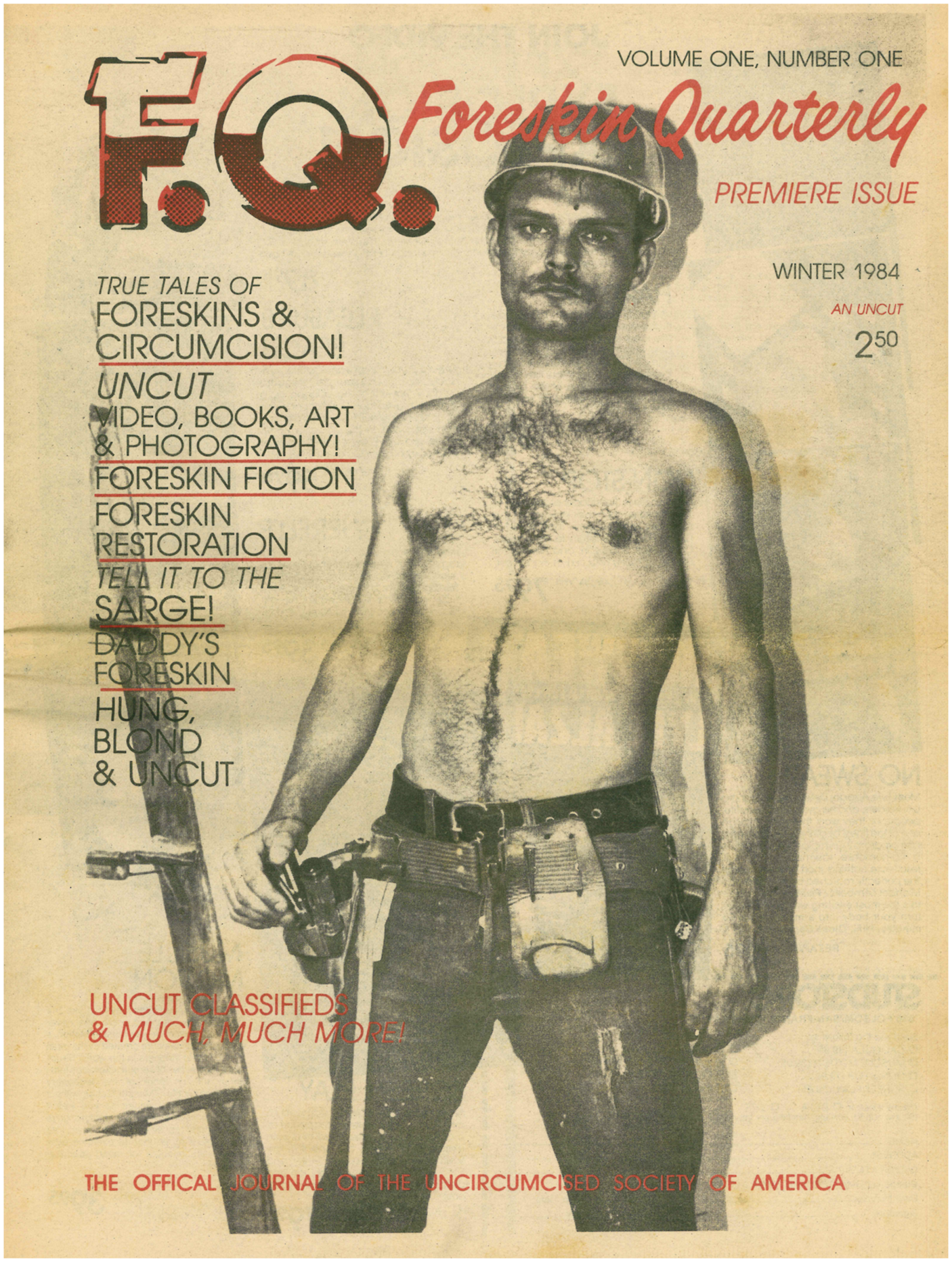
One might wonder, however, why one would want to restore the foreskin or even if it is possible. As such, the article provides reasons for foreskin restoration, which include, cosmetic, psychological, sensitivity, and sexual manipulation. In many ways, if one looks at intactivism broadly, these are some of the most often cited reasons for the movement, along with the legal right(s) to genital integrity and autonomy. The article then explains “What to expect from restoration,” noting that the “results vary with the method used, and the individual,” while also stating that “the new foreskin, although it may be quite satisfactory cosmetically, will not regain all of the lost sensitivity” (1.1:7). In thinking about the methods for foreskin restoration, the authors consider surgical options, which may “use a skin graft to cover the head of the penis” (1.1:7), as well as discussing the option for those with “slack in the shaftskin,” which “reshapes the slack to get enough length to cover the head,” or, a third option, which “stretches the skin of the shaft to form a new foreskin” (1.1:7). The last option, we are told, “is the least objectionable” because “it involves no foreign tissue grafted onto the penis” (1.1:7). Indeed, much of the foreskin restoration literature today is about “stretching” the skin to, in essence, create a foreskin. Readers are, however, warned that there are “many disadvantages to the surgical methods,” noting that most doctors “ridicule the patient, as did one who said sarcastically, ‘I take them off, not put them on’” (1.1:7–8). As well, the article suggests that “some of the plastic surgeons who do restorations insist on a psychiatric examination before they’ll consider surgery” (1.1:8). In all, the article lists some ten reasons not to modify the penis surgically. The article prefers the “non-surgical method” which involves “stretching the shaft-skin to cover the head of the penis, using tape to hold it in place” (1.1:8). However, readers are advised that while the “cost is low,” that “the results come slowly” (1.1:8). What is striking about this article, read nearly forty years later, is how so many of these same ideas still exist. Despite advances in plastic and cosmetic surgeries, foreskin restorations are still seen as trivial, laughable, and held with contempt.
Importantly, in the very first issue, readers are introduced to the themes that will resonate throughout the periodical, a deep appreciation of the foreskin. Foreskin Quarterly sought to eroticize and sexualize the foreskin thereby advocating a countercultural position since the USA circumcised the vast majority of its neonates. There is much information about the foreskin, ranging from historical studies to circumcision statistics, to be found in the pages of Foreskin Quarterly, including a section on Foreskins around the World, which speaks to “Aussie Statistics,” Mexico, “Cutting Rites in Kenya” and “A Scotsman in London” (1.1:28). Subsequent issues will include articles on male infibulation, subincision, the history of foreskin restoration, the most famous foreskin, Michelangelo’s David, circumcision in the Sudan, and the Holy Foreskin. However, and of particular interest, Foreskin Quarterly’s persistent desire is to normalize, as well as, eroticize and aestheticize, the foreskin. The foreskin has, especially in American culture, been framed as “ugly” (Allan, 2020) and thus, to combat this ugly perception, Foreskin Quarterly has two strategies, firstly to show the normalcy of the foreskin around the world. For example, in the opening issue, there is “a brief article about “The Royal Prepuce,” which notes that “Princess Diana has convinced Prince Charles that young Prince willie and young Prince Harry will keep their foreskins. Princess Di is strongwilled on the subject” (1.1:6). In his memoir, Spare, Prince Harry would, however, correct the record, declaring that indeed his “todger” had been circumcised. 5 And secondly, Foreskin Quarterly sought to eroticize the foreskin, a tactic which will prove strong throughout its publication history.
Eroticizing the Foreskin via Activism
The opening issue includes an article titled, “The Lace Curtains of Taormina,” which introduces readers to the photography of Baron Wilhelm von Gloeden, who is now recognized as canonical in queer art, particularly for gay men (Goldman, 2006; Herring, 2007). Readers learn that “since circumcision was extremely rare, the majority of Von Gloeden’s models were uncut and more than a few of them carried the Sicilian distinction of being very well endowed” (1.1:18). As is clear, in this article readers are given images of the naked male with foreskin, but also, “well endowed” men, or rather, teenagers (1.1:18). These images, of course, today are well-known in queer canons of photography, but for the reader of Foreskin Quarterly, they were being introduced to a new source of images. Readers are also told, A compelling biography of Baron von Gloeden (now out of print) has been written by Charles Leslie, filled with sterling examples of his work. The images used here are from that volume and from the private collection of Brad Lemery of Photoclassics. (1.1:19)
These images are important because they do a political work of eroticizing and making the foreskin beautiful. This political project, one which showcases the foreskin not just in terms of visuals, but also in terms of the articles that appear throughout the magazine, is important in a culture where circumcision was, at the time, nearly universal.
In this first issue of Foreskin Quarterly then, we have an idea of the political project of Foreskin Quarterly, as its editors intended it. Over the years, this project will be lost in favor of a continued project of eroticizing the foreskin. But, what is interesting for the purposes of this article, in the earliest issues there is a braiding together of the “activist” and the “pornographic.” That is, Foreskin Quarterly served at least two purposes insofar as it sought to educate and titillate its reader. Foreskin Quarterly, then, becomes something of pornography-as-activism. While the journal was explicitly interested in promoting the foreskin, most often by means of visual representations of the foreskin in both canonical and popular art, including erotic photography, it was also interested in advocating an ideological ideal for its readers, that is, that the foreskin is normal and should remain a part of the male body. For this reason, then, I describe the magazine as a kind of pornography-as-activism. The magazine brought together the pornographic (lush visuals) with the activist (articles about the foreskin), and this braiding together showed the vitality and richness of the foreskin and intact penis.
In the second issue, for instance, there is an article on “Celebrity Foreskin” which lists of celebrities, worthy of idolization, who retained their foreskin. The article concludes: “Know of any other well-known foreskins? Our source (which is very reliable) would appreciate your information. So would we!” (1.2:16). The goal in this article, thus, is once more to normalize the foreskin, but also, and implicitly, eroticize the foreskin. If these are the celebrities considered to be sexually desirable, so too is the foreskin. And this point should not be lost on us, the argument is implicitly, if not explicitly, one in which the foreskin becomes desirable precisely because the actor to whom it is attached is desirable, famous, worthy of admiration.
Of course, the idea of the celebrity foreskin also provokes an important question that will be answered in another article, “How to Spot an Uncut Man,” which helps readers identify the uncut man. Presumably the “uncut man” will have cues and signs that indicate his uncircumcised status. In the article we learn that, One man insists that the thumb tells all! Not the thumb in particular, but the thumbnail. If it is set high on the thumb and the nail is inclined to overhang the flesh of the thumb (whether or not it has recently been trimmed, then there is a good chance there is an overhang on the corresponding penis. (1.2:22)
While another man explains that “circumcised men have anger on their faces (this man is circumcised himself) while the uncircumcised men have softer expressions” (1.2:22), and yet another man explains that “circumcised men are more sexually aggressive, have anxiety in sexual relations and really pound your ass when they are fucking!” (1.2:22) Here then, the article is directly addressing the reader of the text, which is an assumed queer reader, and thus, foreskin spotting serves not just an aesthetic purpose, but also a sexual purpose. Readers are told about the man because of his circumcision status.
In these instances, we find a sort of mythology of the foreskin and circumcision. One common argument in intactivist and anti-circumcision circles is the question of the psychological harm of circumcision (Boyle et al., 2002; Goldman, 1999). However, the article continues, and we find an interesting discussion that is almost too incredulous to believe. In this discussion we find “proof” as it were for the anger hypothesis: Well, a recent clinical test might give this theory a slight credulence ... as generalized as it may be. Scientists circumcised a group of male mice and let them loose among female and uncircumcised male mice. They observed that the circumcised mice had a more difficult time attracting mates and thus did become more aggressive in their general attitudes and developed leadership qualities lacking in the uncircumcised mice (ooops!). Sounds stupid, right? Well, a college coach recently explained to a USA member that prefers his track stars to be circumcised because it makes them more competitive and he suggests to his uncircumcised jocks that they see the doctor! (1.2:22)
At first, when I read this, I imagined it could not be real, and assumed the journal was making up research to bolster its claims. Truthfully, I found myself laughing as I imagined asking an Animal Care Review Board for permission to circumcise mice and just set it aside for it could not be real, but I did search to see if the article was real on an odd chance. Indeed, the study is real. In 1983 in the Bolletino di zoologia, Paul F. Brain, Merza H. Homady, and Marisa Mainardi published their study, “Preputial glands, dominance and aggressiveness, in mice.” The author of this article, thus, was not merely speculating upon these hypotheses, but was rather well connected with up-to-date scholarship on the prepuce. Obviously, circumcision status and aggression does not necessarily translate to human subjects, but the magazine was interested in ongoing discussions in the scientific community. Indeed, in the 13th issue, readers find a note “Circumcision versus AIDS,” which reports on a study of 357 men in Kenya. The author treats this article is a great deal of skepticism: “Consider the undisputed fact that in the United States, where the majority of adult males are circumcised, the AIDS rate is much higher than in Europe, where circumcision is rare” (13.5). Foreskin Quarterly, in this way, was very interested in the debates surrounding the foreskin not just in the popular zeitgeist, but also, at least in this example, in the academic realm of scientific studies.
Indeed, this interest in research is perhaps nowhere clearer than in the section on “Foreskins in the News,” which includes the heading “Research Assistance.” In this news section, readers are told that researchers are working “on a major study of masturbation among uncut and circumcised men” (1.2:6). In their research, they seek to answer questions such as: “What effect does the loss of foreskin have on the practice and enjoyment of masturbation? What are the most favored techniques used in masturbation by men with foreskin? What are the most favored techniques used by men who are circumcised?” At bottom, “the project hopes to unearth the entire custom of masturbation in all its forms, and be able to share that information with the general public” (1.2:6). Readers are then told how they can participate in the study. Foreskin Quarterly thus imagined itself as participating in the development of research on the foreskin, and not just as a passive consumer of research. Readers were encouraged to be part of the activist agenda of the magazine by contributing directly to the study, and thus, testifying about how they have been affected by foreskin loss or about how they pleasure a circumcised man. Explicitly then, the magazine agrees with the researcher that the foreskin serves a sexual purpose and the goal then is to validate that empirically by participating in the study.
The third issue of Foreskin Quarterly continues to provide information on foreskin restoration, as well as providing a “Foreskin Tour of the World,” that includes highlights from Hungary, Germany, the Canary Islands, African Safari, and Thailand. The article also asks: “Want to do some foreskin counting in Yugoslavia in July/August 1985? FQ editors, John W. Rowberry and Bud Berkeley, are planning a tour for a small group of our readers, probably during July or August” (1.3:19), and, we are told, “You need not be uncut, but the group will be limited in number” (1.3:19). As well, the issue includes an article by Bud Berkeley on Male Infibulation, which according to the dictionary quoted in the article is, “The fastening up of the sexual organs with a fibula or clasp” (3:21). For Berkeley, “infibulation can become a fascinating hobby, as many USA members can attest. […] While this article does not mean to promote such activity, and it certainly warns of self-infibulation without medical advise [sic], it does point out one more use for the wondrous foreskin” (3:22). Each issue braids together the pornographic and erotic with the informative, which, I would contend, has an activist bend to it insofar as the magazine works each and every issue to normalize the foreskin in a circumcising culture. Foreskin Quarterly participated in an argument against circumcision because it advocated for the beauty of the foreskin.
The Changing Face of FQ
The fourth issue of FQ marks a shift in format, the original broadsheet format has disappeared, and we are now dealing with a something more akin to a magazine, whereby it has shrunk in size to a standard booklet format. The contents, however, remain largely the same. There is a continued interest in foreskin restoration, with an article on the psychological effects of circumcision, and another article on the care of the foreskin. In these articles the authors work to teach their readers about the foreskin, which once more speaks to the “unknown” quality of the foreskin for an American audience. In the News section, we are told of a “Demonstration Against Circumcision” that took place “on the streets of Sacramento” (1.4:35). Again, the braiding together of the erotic and the activist cannot be lost on us. To the right of the note about the protest is the picture of a penis, foreskin slightly raised up.
Issue five is the first issue that includes a glossy cover. This also marks the beginning of the commercialization of Foreskin Quarterly. After its first year, the magazine no longer publishes quarterly. The counting has begun anew, and so we begin with issue 5, rather than, volume 2, issue 1 as was done the year before (see Figure 2). Cover of issue 5 of Foreskin Quarterly.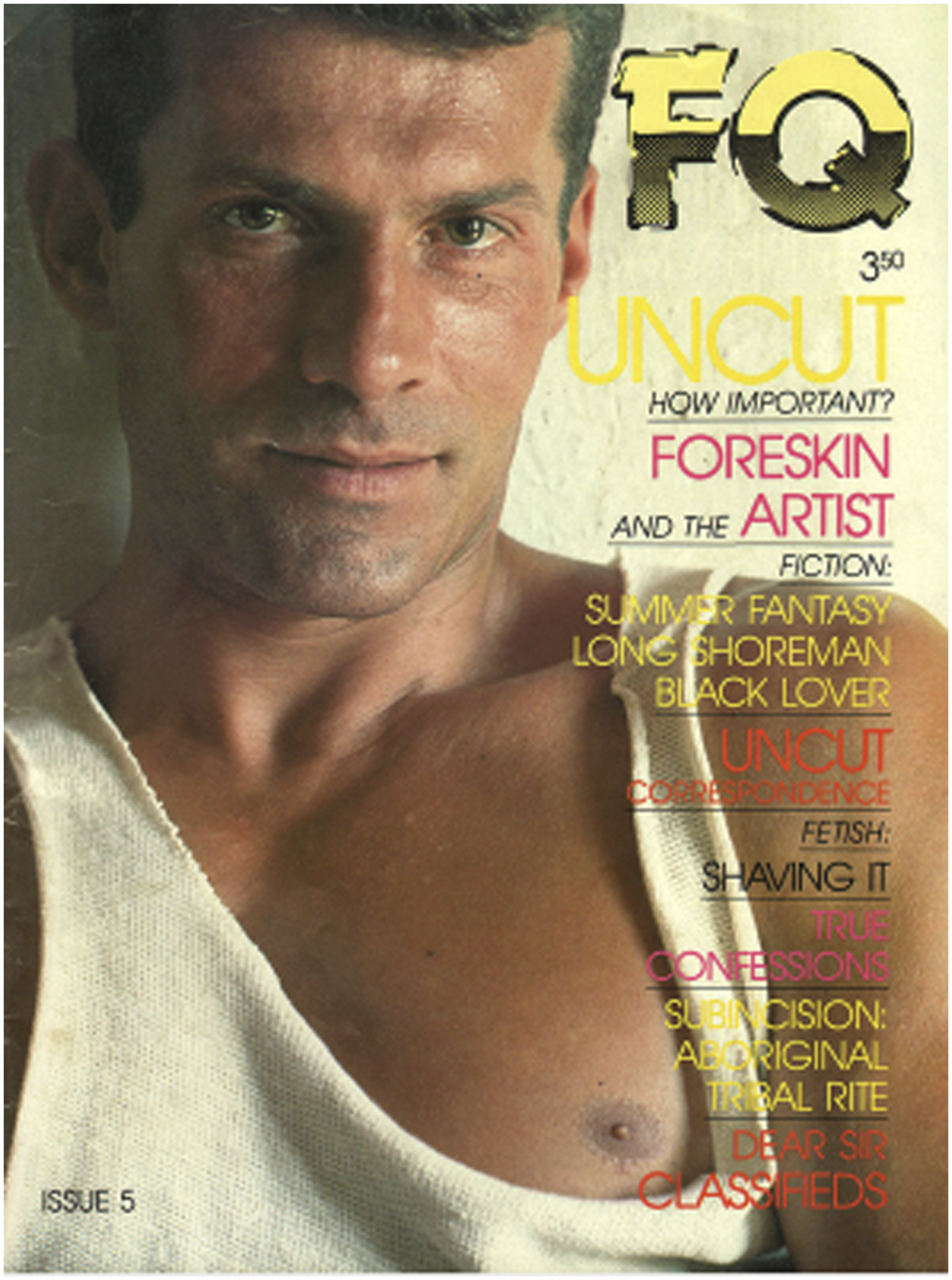
Slowly over this period the editorial board will shift and change, and by issue 14 (see Figure 3), we will find the cover headline, “Bud Berkeley, Joe Tiffenbach, Don Lockwood, Skin Search and the Rest of The FQ Gang Are Back!” (Issue 14). Cover of issue 14 of Foreskin Quarterly.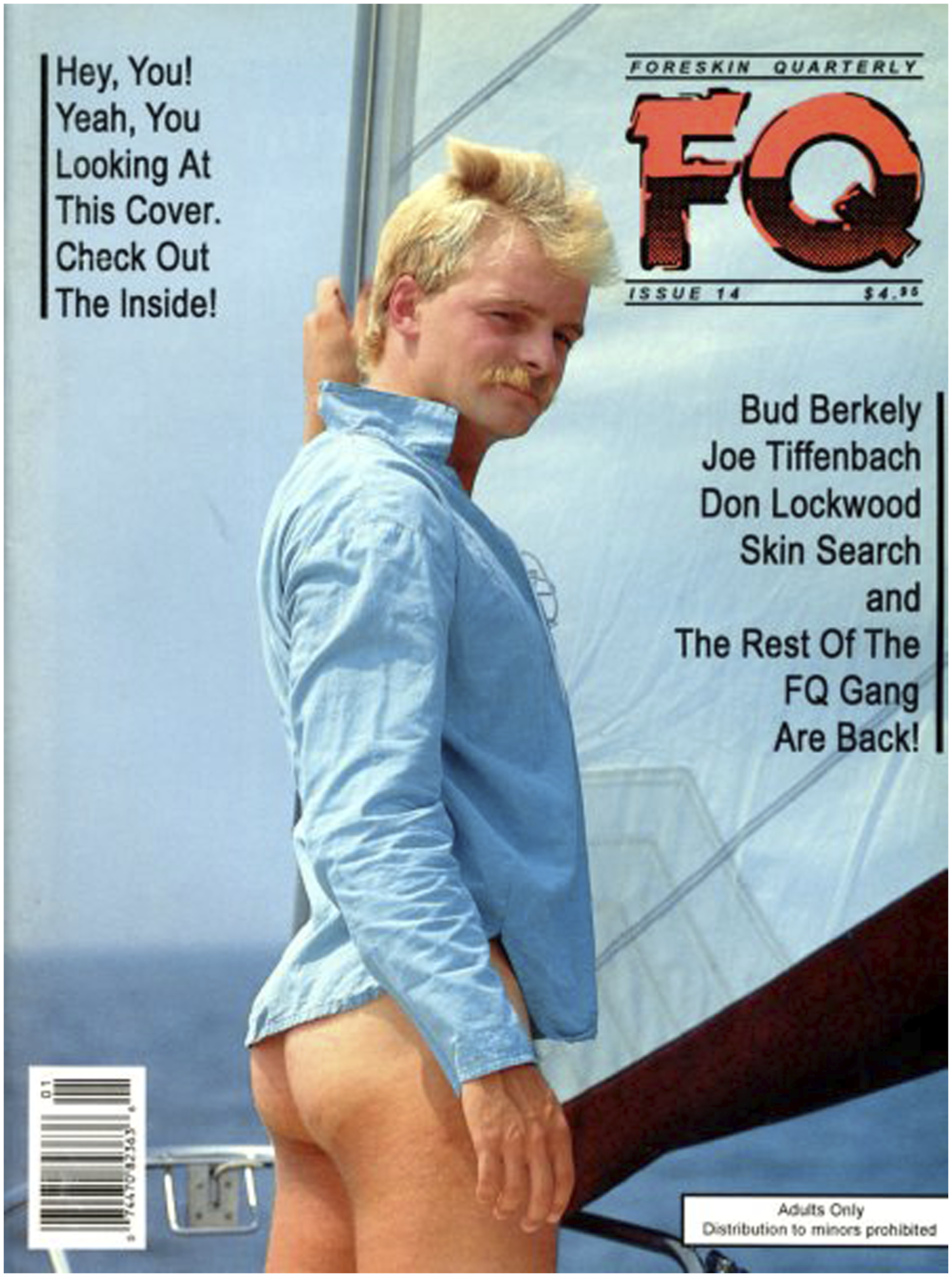
Readers thus are reminded of the original goals of the magazine by the reintroduction of the original group of authors and columns. Bud Berkeley was the founder of the Uncircumcised Society of America, which declared Foreskin Quarterly as its publication, he was also the author of Foreskin, and thus would have been a known commodity to readers of Foreskin Quarterly. And a feature like “Skin Search,” would once more remind readers of what they once enjoyed in Foreskin Quarterly. This issue is also the first to include color photographs within the magazine, a photospread of the cover model, Gareth MacKenzie. 6 This issue also includes an obituary for Joe Tiffenbach, who had photographed many of the foreskins that appeared throughout Foreskin Quarterly, and who died “age 67, January 27, 1992” (Fritscher and Hemry, 2008, p. 574). There is something, in a sense, then misleading about the return of Tieffenbach as it is not so much his return, as his memory.
Over the course of the 90s, the editor of the periodical changes, as does the publisher, and with each change, it seems, Foreskin Quarterly becomes less and less aligned with its original vision set out in those first four issues. The articles begin to disappear and are replaced by sumptuous visuals, mostly of a singular male being photographed. Admittedly, issue 24, for instance, still has an article called “The Case Against Circumcision” by Thomas J. Ritter, who had written extensively on circumcision. Over time, the periodical has in large part lost this research component. Thus, the magazines moves from what I have called pornography-as-activism to something that is more wholly recognized as pornography.
Foreskin Quarterly’s shift in editorial direction is most often marked by a diminishing role for Bud Berkeley, who began as the Editor, was demoted to a Contributing Editor in 1987, and disappeared from the journal after the 11th issue (with a brief return with the 14th issue). The 12th issue marks significant changes in the history of Foreskin Quarterly, namely, it is no longer the official magazine of “Official Journal of the Uncircumcised Society of America,” and it is now published by a new publisher, Desmodus. In the 13th issue, we read about some of these editorial challenges: Well, after a long hiatus we got FQ 12 off with a bang and thought we had the situation well in hand. But best laid plans and all of that. The Editor [Sal Vittore] of #12 loved doing this magazine, but he was unhappy with some other arrangements with the publishers and has terminated his relationship.
Thus we are again without an editor for FQ who shares a particular love of foreskins with its readers. The position is open and we welcome applications from among the readers. The job is to accumulate, compile, and edit materials for each issue and prepare it for us on an appropriate word processing disc. Those interested are welcome to send letters and resumes to: Desmodus Inc. PO Box 11314, San Francisco, CA 94101. We can promise no further FQ’s until we locate an appropriate editor. We are not ceasing publication, but we are putting it on hold for a while. If you have a subscription and do not want to wait for further FQ’s you may write and request that the balance of your FQ subscription be filled out with an appropriate number of any of our other titles. If you have prepared further insertions of a classified as [ad?], you may wait for further FQ’s or write and request that the ad be inserted in another of our publications. (13:4)
In this editorial note, then, readers begin to see the challenges unfolding at Foreskin Quarterly, it is seemingly without direction, both literally in the forms of an editor, and figuratively in terms of its content. While issue 14 welcomed back Bud Berkeley and the FQ gang, by issue 17 the journal is in the hands of Joseph W. Bean, who will remain in either the role of editor or managing editor for the remainder of Foreskin Quarterly. In the 20th issue, a letter writer explains he sent “Bud Berkely $25 on June 30, 1995, with a letter. I waited until September 15, 1995, and since I had not heard from him, I sent him a follow-up letter. I still, to this date, have not heard a word from him” (20.2). Berkeley who had been, in many ways, at the heart of Foreskin Quarterly, as well as the Uncircumcised Society of America, has seemingly disappeared. To protect the magazine, the editor, LeRoy Dysart writes, We have received so many letters regarding Mr. Berkeley that it’s impossible to answer them all. However, we want to assure all our readers that the relationship between Bud Berkeley/USA and FQ/Brush Creek Media no longer exists. Wish we could help those who lost money. (20.2)
This response to the letter writer marks the finality of the relationship between Bud Berkeley and Foreskin Quarterly. Under Brush Creek Media, the magazine moves more and more towards the pornographic with a focus on visuals rather than article. For instance, issue 21 is the first and only issue to include more than one person on the cover.
This issue is perhaps the first to openly consider a homoerotic cover, wherein there is a closeness between the models (see Figure 4). Otherwise, all issues included a singular subject on the cover. The photograph is from Kristen Bjorn’s work, who has long been a favourite for the foreskin aficionado. Issue 26 will welcome Scott McGillivray, and issue 27 welcomes Peter Millar as editor, and Scott McGillivray as assistant managing editor. With the shifting editors, the focus and vision of Foreskin Quarterly is largely lost, but what remains consistent is a focus on the foreskin. Cover of issue 21 of Foreskin Quarterly.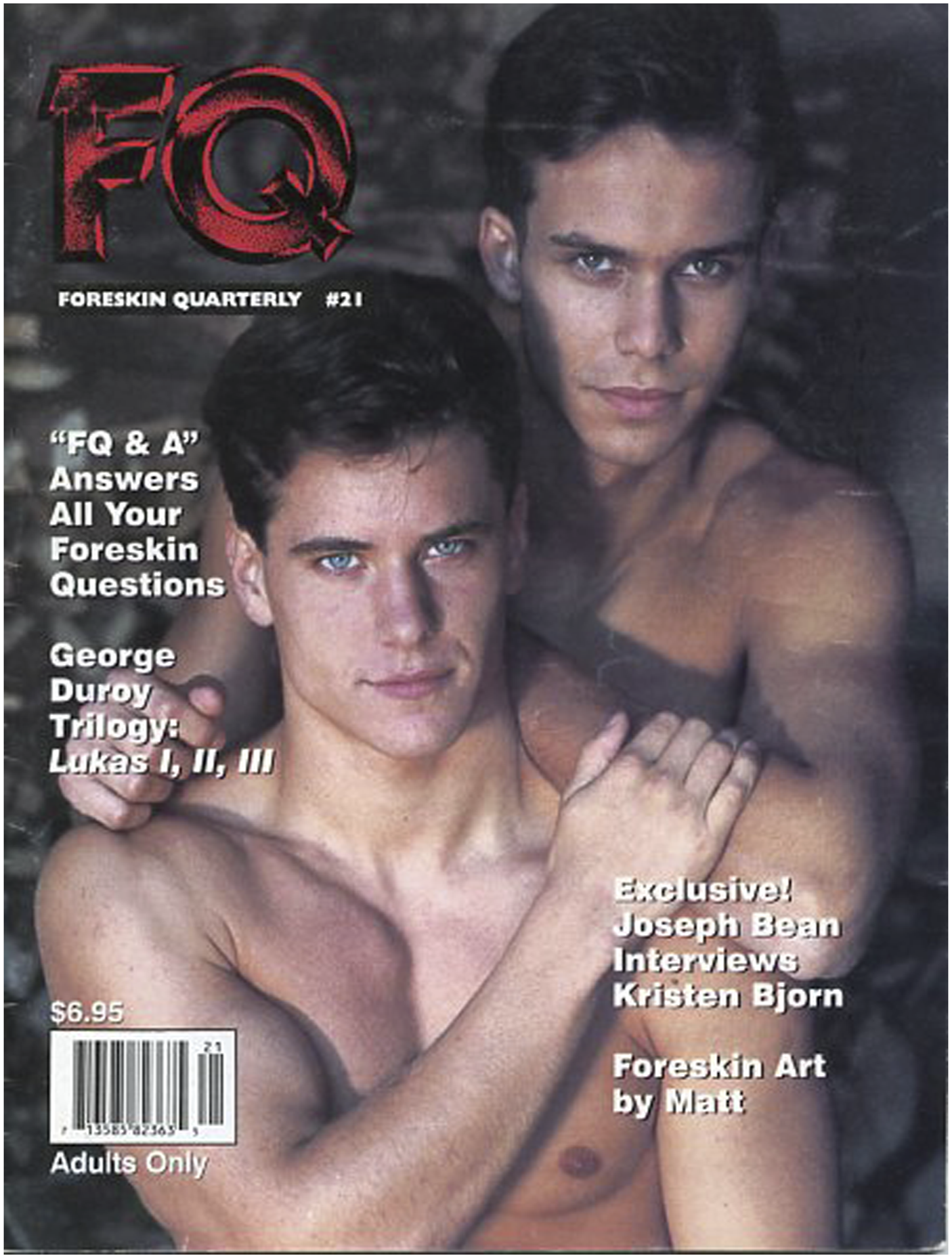
In terms of the publisher, the magazine has something of a complicated history, shifting from one publisher to another, and another. As Joseph W. Bean notes in an editorial titled, “Important Notes from the New(?) Editor” that appeared in issue 17, Foreskin Quarterly has been published by Desmodus, then Parkwood, and then “Brush Creek Media, and the publisher here—Bear-Dog Hoffman—has picked up FQ from Parkwood, and put it back in my hands again” (17:2), where it will remain until its final issue. In the first issue with Brush Creek Media, we also see changes to the classified section, which now requires readers to, First, if you want your picture published with your personal ad, we need for you to send in a letter saying that you want to be published by Brush Creek Media, and adding that you are old enough to make that choice. You also have to tell us what stage names or aliases you’ve ever used for any purpose, or tell us that you have none. And, you have to supply us with a clear photograph or photocopy of your identification—something with both your birth date and face on it, like a driver’s license or the personal data pages of a passport. This is a legal change, and it’s very important. There can be no exceptions. (17:2)
The periodical, thus, changes how it approaches the classifieds and moves more and more towards a kind of “pornification” of the classified authors, for instance, asking for their stage names, which presumes that readers have done this in the past. The ads are not pornographic in the way the visuals are but represent the ways in which the pornographic impacts and influences the mainstream. Thus, as the magazine becomes more and more pornographic, so too do the personal ads—and with it a kind of legalistic fear that requires personal ads be verified. That is, writers were required to include a copy of their identification, and not just that, but the identification must have both a photograph and the legal age, thus ensuring minors are not submitting to Foreskin Quarterly. Previously, the classifieds were more about finding fellow uncut men.
Reading Foreskin Quarterly as Pornography
Over its publication history, Foreskin Quarterly became less pornography-as-activism and more clearly a pornographic magazine. What I mean by this is that the magazine seemingly lost or repressed its earlier activist leanings. The articles disappear, the visuals increase (as does some of the fiction). It might be tempting to dismiss the magazine simply because the articles disappear, but I want to pause here briefly to suggest that while explicitly the activist leanings had been lost, implicitly they are still present. In essence, what I seek to suggest is a kind of reparative reading of these visually oriented issues. My point here is not that activism is better than pornography, but rather that it might be easy to dismiss this material as merely pornographic. Instead, I argue that there is still a lot happening even as the articles disappear that is worthy of consideration—quite simply the visuals are important because they work to normalize and eroticize the foreskin.
In thinking about the idea of “reparative reading,” I am drawing here on Eve Kosofsky Sedgwick’s work, wherein the there is a tension between the paranoid reader for whom “surrender[ing] the knowing, anxious paranoid determination that no horror, however apparently unthinkable, shall ever come to the reader as new” and thus, “to a reparatively positioned reader, it can seem realistic and necessary to experience surprise” (2003, p. 146). However, as Segdwick has noted about reparative reading, once “reparative motives […] become explicit, [they] are inadmissible in paranoid theory both because they are about pleasure (‘merely aesthetic’) and because they are frankly ameliorative (‘merely reformist’)” (2003, p. 144). In these theoretical postures, then, one would have to surrender the paranoid search for meaning and instead opt in for the possible pleasure of surprises. What happens if a text does something it is seemingly not supposed to? In the case of Foreskin Quarterly, it would appear that it has lost its activist intentions as it has become pornographic and surrendered the publication of articles about circumcision. However, as Sedgwick notes, “there can be terrible surprises […] there can also be good ones” (2003, p. 146). The reparatively positioned reader “tries to organize the fragments and part-objects she encounters or creates” and thus, “the reader has the room to realize that the future may be different from the present” (2003, p. 146). In a sense, what I want to argue is that these later issues may be more about surprises, and indeed, good ones, which still affirm the politics of Foreskin Quarterly. The idea of reparative reading is not unique to literary studies, but has found vitality in porn studies. Kath Albury has deployed reparative reading because it allows us “to consider the ways that even flawed of imperfect texts offer me a space to rethink contemporary sexual landscape” (2009, p. 649).
Consequently, a paranoid reading of Foreskin Quarterly would be that it merely becomes more pornographic, and thus, less activist, as it relies more and more on images to sell its contents. That is, it seems to adopt the perspective that “sex sells,” and “ideas” dot not. A paranoid reading might suggest that instead of committing to its activist ideals, Foreskin Quarterly sold out. In this way, the text becomes flawed or imperfect, as Albury might suggest, because it leaves behind its original intentions, which were made so evident in the earliest issues of the magazine. However, there is, of course, another reading, one that is more reparative in nature, and that is, that the images themselves become a site for activism, put more simply, the images are activism. Sometimes a photograph really does speak a thousand words. The photographic series becomes an essay in the erotics, sexuality, and aesthetics of the foreskin. In a culture in which the circumcised penis is normative, the uncircumcised and intact penis becomes a spectacle to be looked upon. Indeed, in American pornography an uncut penis is a rarity, the very act of publishing images of the foreskin is activism which relishes in the pornographic. Foreskin Quarterly sought to eroticize the abject foreskin, to give the foreskin a sexuality and eroticism of its own. Harri Kalha suggests that part of the reason Robert Mapplethorpe’s “Man in Polyester Suit” was so controversial in the United States was because it revealed the foreskin (2014, p. 375) and in the same way, Foreskin Quarterly does the same. As such, I would contend that even the mere showing of the foreskin becomes a kind of activism insofar as it disrupts “dominant culture counterpart” of the foreskin, namely, “circumcision” (Kalha, 2014, p. 376).
Shifting the debate away from the ethics and morality of circumcision, and instead seeking to re-eroticize the foreskin is an important avenue for anti-circumcision activists. In many ways, Foreskin Quarterly embraces the perspective Andrew L. Freedman, who writes: …rather than directing an angry focus on the negative and the courts, your efforts [addressing anti-circumcision activists] would be better spent to educate and promote the prepuce positively, win in the court of public opinion, and to change the culture, so as to make having a foreskin be the ‘popular thing to do.’ (2016, p. 2)
Indeed, this is precisely what Foreskin Quarterly sought to do over the entire course of its history. Even if we might be tempted to suggest that as it became less textual and more visual that its activist inclinations also declined, I contend that is not quite true. The visuals were important to normalizing the foreskin. For example, a series of photographs might show not only the foreskin, but also its mechanics, which undoubtedly say less about hygiene, morality, or religiosity. A visual focus might represent the pleasures of the foreskin in ways that are inaccessible in a textual article. In a photo essay of Alexander in issue 36, readers find Alexander showing his foreskin covering the glans, halfway down the glans, he pinches the foreskin over his glans. In another example, Oscar, in issue 35, viewers see the foreskin covering a flaccid penis, the foreskin retracted on the erect penis, close-up visual of the frenulum. In these examples, then, readers have a sense of the flexibility of the foreskin, the ways in which the model takes pleasure in the foreskin, and thus there is a rewriting of the foreskin as an erotic and sexual appendage.
Conclusion
Even though Foreskin Quarterly becomes more and more visual in nature over its publication history, and thus becoming more a pornographic magazine than an activist publication, the magazine remains an important text in the history of anti-circumcision activism and foreskin fetishism. Arguably, the turn to visual was still activist, but it was differently so. This article has sought to introduce Foreskin Quarterly to readers, while also providing ideas about how pornography and activism interdigitate throughout the periodical’s publication history, initially by braiding together articles and photographs, and later by focusing on the visuals. Given an increasing interest in anti-circumcision activism and intactivism today (Barutçu, 2023; Kennedy & Sardi, 2016; Rassbach, 2016; Sardi, 2011), both as a practiced and embodied activism and as a scholarly pursuit, it seems worthwhile for scholars to also consider and recognize the role of a magazine like Foreskin Quarterly. Moreover, scholars of intactivism should consider the importance of so-called “grey literature,” such as pornography, because these texts are often quite rich and complex, just as in recent years there has been a proliferation of very interesting and provocative self-published materials, which are largely absent from the research. While this article has focused on Foreskin Quarterly, there are other pornographic texts, in addition to pamphlets, ephemera, videos and lectures that have explored the foreskin in one fashion or another that have yet to impact and influence the debates surrounding anti-circumcision activism and its histories.
Footnotes
Declaration of Conflicting Interests
The author(s) declared no potential conflicts of interest with respect to the research, authorship, and/or publication of this article.
Funding
The author(s) received no financial support for the research, authorship, and/or publication of this article.
