




Abstract
Refugee fathers have been largely ignored by family researchers and service providers. This article presents an interpretive phenomenological analysis (IPA) of data from semi-structured interviews conducted between November 2020 and March 2021 with 17 Syrian refugee fathers resettled in Canada. The interviews focused on the meanings refugee men gave to fatherhood, their fathering practices, and the sense they made of their experience of being a Syrian refugee father in Canada. This article highlights how Syrian fatherhood is shaped by cultural norms of the home country as well as by religious beliefs. However, participants’ definitions of fatherhood as head of the household, primary breadwinners and decisionmakers in the family, holding unique positions both within their families and in their communities, shifted during the resettlement process. Following resettlement, these meanings were revisited and redefined. Hyper-fatherhood and adjusted fatherhood practices are new types of fatherhood that emerged during resettlement for Syrian refugees.
Refugee fathers have been largely ignored by family researchers and service providers. Yet, fathers have a significant impact on both child and family well-being, especially during the resettlement process. This article presents an interpretive phenomenological analysis (IPA) of data from semi-structured interviews conducted between November 2020 and March 2021 with 17 Syrian refugee fathers resettled in Canada. The interviews focused on the meanings refugee men gave to fatherhood, their fathering practices, and the sense they made of their experience of being a Syrian refugee father in Canada. This article highlights how Syrian fatherhood is shaped by cultural norms of the home country as well as by religious beliefs. However, participants’ definitions of fatherhood as head of the household, primary breadwinners and decisionmakers in the family, holding unique positions both within their families and in their communities, shifted during the resettlement process. Following resettlement, these meanings were revisited and redefined. Hyper-fatherhood and adjusted fatherhood practices are new types of fatherhood that emerged during resettlement for Syrian refugees. The article concludes by outlining practice implications to support fathers during the resettlement process, arguing that refugee family programs must be inclusive for fathers.
What began as peaceful, anti-government demonstrations in 2011 were met with violent pushback, a military response against citizens, and finally, a civil war in Syria, leading to one of the worst humanitarian crises in recent history (Mercy Corps, 2018). More than 11.3 million people, over half of the Syrian population, have been killed or displaced, with more than 6, 8 million Syrians registered as refugees in neighbouring countries and around the globe (UNHCR, 2022). As a result of this crisis, Syrians now are experiencing “dark living conditions” (Abi-Hashem, 2018, p. 114). Inside Syria, 6.7 million have been internally displaced, and 13.4 million need humanitarian assistance (UNHCR, 2022). Syrian children and families, dispersed throughout the world, have lived in situations of social and economic insecurity and vulnerability to exposure to violence, abuse, sexual exploitation, decreased livelihood opportunities, exploitation gender roles changes, early marriage and different forms of gender-based violence (Harvey al., 2013; UNHCR, 2013; Usta & Masterson, 2015). Syrian men are no exception to this tragic situation; studies found they reported “lower self-esteem … [that] in some cases led to a negative expression of masculinity” (Harvey et al., 2013, p. 14), sometimes resulting in different forms of gender-based violence. For parents and children, the loss of their home social environments has resulted in social isolation, a lack of social and emotional support, influencing parenting practices, both during displacement and in refugee camps (Ashbourne et al., 2021; El-Khani & Calam, 2019).
Among global humanitarian responses to the Syrian war and the resulting refugee crisis, the Canadian Government committed to assisting the resettlement of 25,000 Syrian refugees between November 2015 and February 2016. Known as the #WelcomeRefugees initiative, Canada successfully delivered upon this commitment (Government of Canada, 2020). In fact, as of 31st October 2020, 44,620 Syrian refugees were resettled in Canada: 21,745 came as Government-Assisted Refugees (GARs) 1 , 18,930 came as Privately Sponsored Refugees (PSRs) 2 , and 3,945 came as Blended Visa Office-Referred Refugee (BVORs) 3 (IRCC, 2021). Eighty-five per cent of Syrian refugees who resettled in Canada were families, consisting of couples with an average of 2.8 children (IRCC, 2021; Statistics Canada, 2019). A variety of services were available to resettled refugees, including specialized immigration services, adapted intake in the public health system, publicly funded language classes, and non-profit support services. As permanent residents in Canada, resettled refugees can, in theory, access all public social services provided to citizens.
The health and social wellbeing of Syrian refugee families has become the focus of several studies in very recent years. These studies reveal multiple psychosocial challenges faced by families, including social isolation among those without close contacts in the host country and higher unemployment than the general population (Hanley et al., 2018), with Syrian refugee women reporting higher rates of unemployment than other refugee groups (Statistics Canada, 2019). Moreover, persistent unmet health needs for issues already present pre-migration appear to have been exacerbated in the migration process (Tuck et al., 2019), especially among women (Guruge et al., 2018). Studies focusing on youth describe difficulties while navigating the school context and with academics specifically (Walker & Zuberi, 2020). All these challenges undoubtedly influence how parents can ensure the wellbeing of their children in a new environment.
While the literature on the impact of migration and resettlement on refugee families is extensive, there is still a paucity of literature specifically dedicated to immigrant and refugee fathers (Merry et al., 2017; Shafer & Bellamy, 2016; Shapiro & Krysik, 2010). The limited existing literature shows that refugee fathers have distinct experiences of forced migration and resettlement.
Forced Migration, Resettlement and Refugee Fathers
Despite advances in understanding the importance of fathers for the wellbeing of their spouses and children (World Health Organization, 2015; Lamb, 2010), fathers remain underrepresented in the parenting and family literature and continue to be considered less central to family life than mothers (Gervais et al., 2021; Panter-Brick et al., 2014). This holds especially true of immigrant and refugee fathers (Este & Tachble, 2009; Papadopoulos & Gionakis, 2018). Eltanamly et al. (2022) argued that war and displacement affect parents’ ability to take care of their children. Losing social support, not being able to provide financially, and the struggle to survive, can all cause “parental stress” (Eltanamly et al., 2022, p. 148).
The small but growing literature on immigrant and refugee fathers has highlighted the unique challenges that these fathers face. Studies on refugee fathers in the Canadian context found that they encountered under- and unemployment, which impacts their roles as providers, (Este & Tachble, 2009; Shimon et al., 2003). Similarly, Forget et al. (2018) found that refugee fathers who resettled in Australia faced discrimination, problems with stable housing, and personal challenges related to changing gender roles and expectations. A major challenge faced by refugee fathers is a lack of social support, especially from extended family members (Bulford et al., 2022; Este & Tachble, 2009). Acts of fathering become a complicated task during resettlement, as fathers are expected to adapt and integrate to the social landscape of their new country, while still maintaining the expected paternal roles of their culture of origin (Chuang & Tamis-LeMonda, 2009; Riggs et al., 2016; Bergnehr, 2022).
Migration is sometimes seen as an opportunity for fathers to recreate their roles and expand their involvement in their children’s lives. For example, Roer-Strier et al. (2005) found that migration was viewed as an opportunity for fathers to broaden their parenting practices, and to be more involved with their children’s schooling and education. Moreover, Este and Tachble (2009) found that despite the challenges faced by immigrant fathers, they were optimistic about the future of their children, especially those fathers who had previously witnessed social, political or religious oppression.
Given the critical roles that fathers play within the family, greater attention needs to be paid to their unique experiences and realities, as well as their experiences during migration and resettlement. Syrian refugees constitute a growing population in Canada, yet there is limited research to support social service providers’ understanding of and engagement with them. Drawing on interview data, the two main aims of this article are: (1) to describe the experiences of fathering among Syrian refugee fathers and meanings they attribute to their role and (2) to examine the impact of resettlement on these experiences and meanings. This paper seeks to address the gap in research by highlighting the experience of fatherhood both in Syria and in Canada, as well as the challenges encountered.
Methods
Study Design
This article draws on data from a larger study that explores the migration experiences of Syrian refugee fathers and how these experiences impact their understandings of fatherhood, acts of fathering and being a father, alongside their migration trajectories. In the larger study, fathers’ perceptions about motherhood, and their definitions of mothers in Syria were also explored, however, fathers’ perceptions of motherhood are beyond the objective of this article and will be published separately. In this article, we use Interpretive Phenomenological Analysis (IPA) (Smith et al., 2009) to access the perceptions and experiences of resettled Syrian fathers. IPA was privileged for the design of this study, as it is a qualitative research method designed to allow close and detailed explorations of people’s lived experience, and how they make sense of these experiences in the context of their personal and social worlds (Smith et al., 2021). IPA has been used to explore significant life transitions, such as becoming a parent and migration (Chemutai et al., 2020; Kings et al., 2017; O’Brien & Tribe, 2014; Vurgec et al., 2021). IPA is an interpretive endeavour, influenced by hermeneutics (Smith et al., 2009). Researchers are intricately involved in the sense-making process through their close engagement with participants (Smith et al., 2009). It is through the double-hermeneutic process that the researcher tries to make sense of the participant’s experience as the participant is trying to make sense of it for him/herself (Smith, 2007; Smith & Osborn, 2003). IPA thus provides a framework to allow researchers to delve into the perceptions, perspectives and understandings of the people who experience a phenomenon in question (Creswell & Poth, 2018; Spiers & Smith, 2019).
In our study, the phenomenon under study was the experience and meaning of fathering among Syrian refugee men. We were interested in drawing out the subjective accounts of the fathering experience with each study participant, and exploring in-depth how each participant made sense of that experience in the context of his own life, which included experiences of migration and resettlement. The main research question for this study, therefore, is as follows: How did Syrian refugee men understand their fathering role in their home country, and how did those understandings and experiences of fathering change during the displacement and resettlement process?
Recruitment
The sample of fathers was recruited based on the following inclusion criteria: they (1) were 18 years old and older; (2) had resettled in Canada through one of the refugee resettlements programs; (3) had migrated to Canada at least 2 years prior to the time of the interview; (4) had become fathers in Syria and had parented their children there; and (5) remained involved with parenting their children during the migration journey.
Recruitment was conducted using purposeful and snowballing sampling (Smith et al., 2021; Creswell & Poth, 2018). Invitations were distributed through social media platforms, the WhatsApp messaging application, and through word-of-mouth strategies. Twenty-one fathers contacted the first author via these forms of outreach. Sixteen fathers met the inclusion criteria, and two fathers withdrew after the first interview, expressing that talking about their fatherhood practices was “a private matter”. Snowball sampling was achieved through the first author’s connections with Syrian community members and by inviting research participants to identify acquaintances who might fit the criteria and might be interested in participating in this study. This latter strategy led to the identification of three participants. In total, 17 participants met the inclusion criteria and were fully interviewed by the first author. 4
Data Collection
Data were collected between November 2020 and March 2021, through semi-structured individual interviews following verbal consent. A semi-structured interview guide was used to explore fathers’ individual definitions of fatherhood in the Syrian context, fathering practices, and how these meanings and practices shifted after resettling in Canada. Questions about fathers’ perceptions of motherhood, mothering, and the role of mothers, according to their cultures were also evoked in order to better understand and contextualise individual family organization, and the organization of parenting roles and practices within each family unit. Sociodemographic information was also collected during the interview process.
The first author conducted two in-depth interviews with each participant and followed recommendations by Bevan (2014) by structuring each conversation in a way that “enables a thorough investigation” (p. 138). Consequently, while the interview guide served as an initial roadmap to prompt discussion about topics, each interview was more of a purposeful conversation, allowing the researcher to listen for salient issues, and to explore those issues in depth. Interviews were conducted in Arabic by telephone because the study took place during the COVID-19 pandemic. All interviews were audio recorded and transcribed by the first author. This study was reviewed and approved by the McGill University Research Ethics Board Office. It is important to mention that the first author shares the same cultural background and language as most of the participants. Furthermore, being a father himself made him aware of some of the dimensions of the phenomenon under investigation, as well as the challenges refugee fathers might face. Being aware of the contexts like social, historical, and cultural factors that can affect participants’ lived experiences can help better understand of what it means for participants’ experiences within a particular context (Noon, 2018).
Data Analysis
Data analysis was conducted following the six-step IPA process. Interview data from each participant was read and re-read, offering the researcher the opportunity to examine ‘what was at stake’ for each father in the context of their own (personal and social) lives. First, the first author read each individual transcript, making notes and comments in the margins and in the text, using a “systemic approach” (Spiers & Smith, 2019, p. 8). These included descriptive (what the participant said), linguistic (how the participant delivered the story, paying attention to pauses, metaphors, and words), and conceptual (comments and questions emanating from the researcher’s early interpretation of each interview) notes and comments. Themes were developed to capture the fathering experiences of each participant throughout their migration trajectories. These themes allow the reader to chronologically “step inside the experiences of the participant” (Spiers & Smith, 2019, p. 11). Then, the researcher moved to comparing individual participant analysis for the group of participants (Spiers & Smith, 2019). A cross-participant set of themes was produced by examining connections, similarities, and difference between participant experiences. A coding tree was developed using NVivo Version 1.6.2.
Participant quotes that best illustrated themes were translated into English by the first author, for inclusion in this article. The translated quotes were then verified by professional interpreters and two Arabic-speaking doctoral students.
Study Participants
Participant Characteristics.
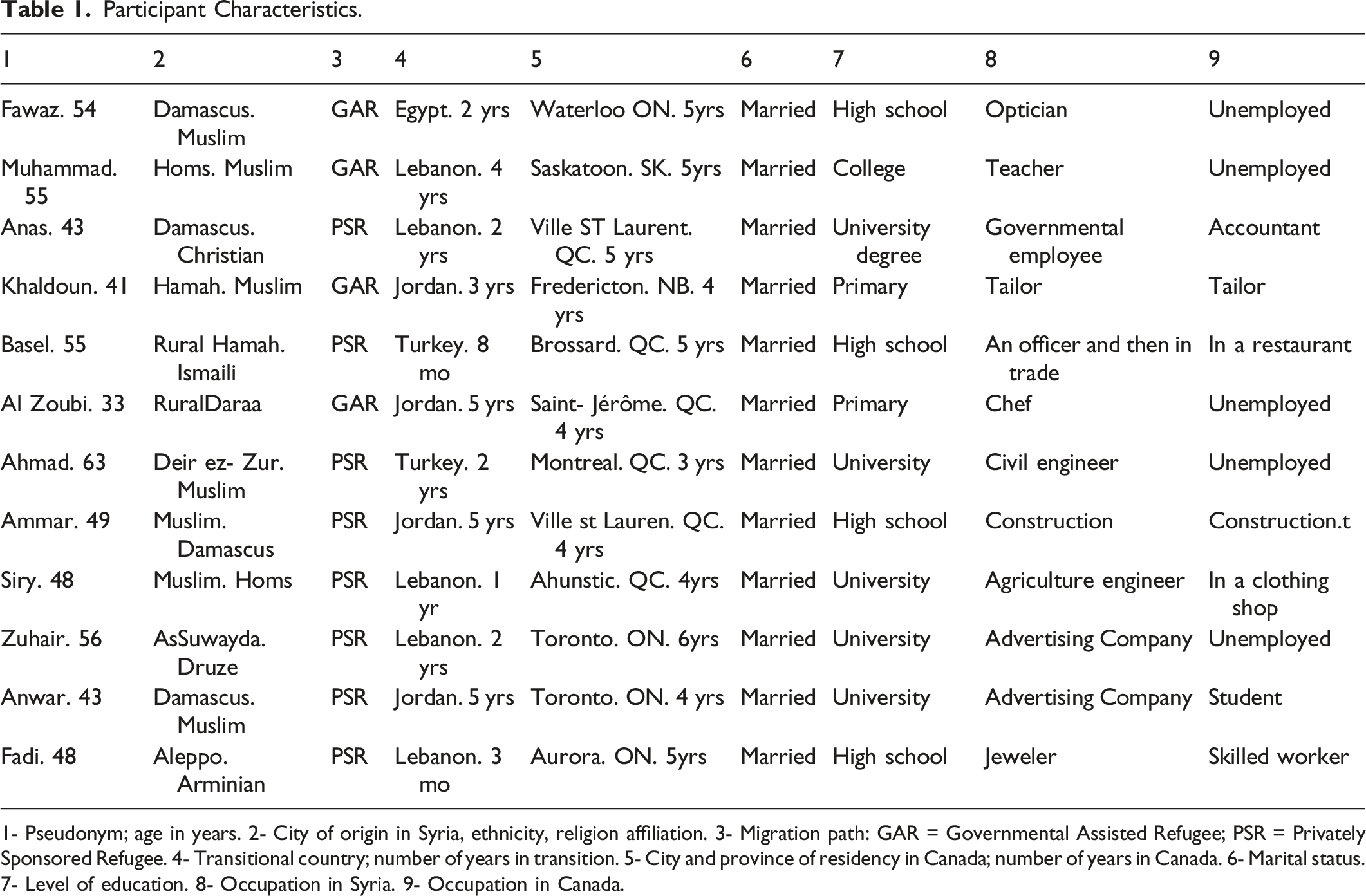
1- Pseudonym; age in years. 2- City of origin in Syria, ethnicity, religion affiliation. 3- Migration path: GAR = Governmental Assisted Refugee; PSR = Privately Sponsored Refugee. 4- Transitional country; number of years in transition. 5- City and province of residency in Canada; number of years in Canada. 6- Marital status. 7- Level of education. 8- Occupation in Syria. 9- Occupation in Canada.
Findings
Experience of Fatherhood Before and After Migration
For the fathers who participated in the study, Syrian fatherhood was influenced by their sociocultural environment and shaped by religious factors. Fatherhood was first described within the context of Syria, which was steeped in cultural expectations and traditions. Then, participants explored the meaning of fatherhood following resettlement within the Canadian context.
Religion as Influential to Syrian Fatherhood Across Contexts
Fathers in this study explained that fatherhood is defined by religion and social norms. For them, being a man in a Syrian community will be deeply determined by the religious and cultural meanings of the community. For these men, fatherhood is also intertwined with masculinity or what one participant referred to as Al Rugulah (الرجولة). Al Rugulah refers to the characteristics expected of men, and includes values about being a “good person”, associated with generosity, compassion, wisdom, and a commitment to being a good man. Fathers explained that Syrian men are encouraged by their families, motivated by their religious beliefs and cultural norms, to act according to these characteristics.
In some cases, religious teachings are inextricably linked with all acts, including parenting. For Fawaz, Muslims should think about Islam as a complete code of life. Islamic beliefs and values are deeply rooted in some communities in Syria, and these Islamic/cultural beliefs define manhood/fatherhood and shape fathering practice. He also emphasized how Muslim parents are encouraged to follow the Prophet’s guidance. I grew up in one of the well-known neighbourhoods in Damascus, and as in any other Syrian environment, it was important what being a man and manhood meant. Men should grow up in an Islamic environment. Our example [role model] in that is our Prophet, the Messenger of God, he told us pray as you saw me praying, so we have to follow the Muhammadiyah school in our daily lives, including the way we act as fathers. (Fawaz)
Another participant affirmed these ideas when he defined the Syrian father. He said: “Our cultural background is rooted in our Islamic belief. And this is what define fathers and their roles in our society” (Muhammad)
Fawaz and Muhammad’s quotes emphasize the ways in which Islamic rules may be internalized and shape expectations and behaviours across roles and activities. These include the fathering role, behaviours in the community and in activities of everyday life. Referring to the Muhammadiyah school, Fawaz’ quote highlights his values related to key sources of knowledge that he believes ought to guide the lives of Muslims in general, and men in particular. Muhammad’s quote affirms how Islamic beliefs are embedded in Syrian culture among Muslim communities. From Fawaz and Muhammad, we also understand the traditions bound up in these teachings, that have been passed on from generation to generation.
Similarly, Anas, who lived in the same city as Fawaz, but was affiliated with a different religion, describes how the Church and religious leaders taught men how to be fathers. It is the transition from being a husband to a father… for me, I was part of the Orthodox Youth movement in Damascus. Priests taught us many things about social life, religion, and other things. These Christian movements had a huge impact on who we are as individuals, as men, and as a father. Through them I learned how to follow my religion. In the end, Jesus is the Father. This what Christianity is. (Anas)
These quotes from Syrian fathers from different religious backgrounds and different cities show how religion and culture are embedded and intertwined in many Syrian communities. Together they translate into a social belief system that shapes both manhood and fatherhood and how they should be practiced. Being part of a religious group made these fathers learn and act as fathers.
Fatherhood in the Context of Syria: The Backbone of the Family and the Main Provider
Participants in this study talked about the meaning of being a father in Syria. They used different metaphors to define fathers, and what it means to be a father in Syria. Socially, participants agreed that fathers in Syria occupy a unique social position within the household and the community.
One father defined the Syrian father as كائن اجتماعي (Kaen ijtemaei) “a social being”, a metaphor to describe the social position Syrian fathers hold, not only within their family but also within their communities. Another participant, Fawaz, associated fatherhood with words such as sympathy and intimacy, love and being faithful. He also described the symbolic presence of the father: Fatherhood is being a good example, kindness, giving and loving, intimacy, sympathy, giving the right guidance. This is what fatherhood is about … and this is something that distinguishes the Syrian father and the Syrian society: Syrian fathers have the most presence in his family. (Fawaz)
Khaldoun described the Syrian father as the backbone of the family, the person responsible for ensuring the safety, security, economic wellbeing, and stability of his family. In his view, fathers should be responsible and accountable for the family as a whole, having the responsibility to pass on traditions and norms to their children. The father is the backbone of the family, he is the one who is responsible for feeding the children, making sure they are safe, and nurturing them according to the norms. It is his responsibility to offer them a house where they can grow up safely. (Khaldoun)
Using the metaphor of “backbone” reflects Khaldoun’s perceptions of his physical unity with his family and extends to his expectation of himself to be financially accountable and responsible to keep this ‘body’ united (in a house).
Bassel’s definition of fatherhood evokes a similar metaphor, that of a bond. That bond seems to represent the connection between fathers and the members of his family, but also the responsibility to ensure the dignity of his children is protected. The father is the bond of the house and the family; he works hard to ensure that the children have a meaningful and dignified life. (Bassel).
Fathers in this study claimed the meaning of fatherhood is associated with being the head of the family. Syrian fathers can be seen as described by a participant as the “pillar” of the family. Some participants used the term Rab al ussrah (رب الأسرة), which can be translated into the God of the family. as Muhammad said: “the father can be seen as Rab Al ussrah”, same sentiment used by Zuhair who said: as a father you are the God of your household. This term suggests the position fathers occupy within the household, the roles they perform within the family as fathers, and the authority they have as fathers within their household. Using the term God of the household signifies the hierarchical nature of the Syrian household, the position they occupy at the top of this hierarchy and the authority and power fathers have within the household, with great responsibility attached.
According to participants in this study, being a father means being able to meet the needs of the family—it is essential to be able to provide financially for the family. This is part of what fatherhood means in the Syrian context: to be able to work, so you can guarantee your kids a good life, to cover the expenses, to have a career so you can earn money (Ammar). Another participant described how this meaning has been transmitted through his father, Al Zoubi said: The father is the one who is responsible for any expenses, he is responsible for buying us food, drinking, clothes, and anything you might think the family will need. If you ask me why this definition, well because when I was a kid, I used to ask about my father constantly, and my mother’s answer was he is working to bring us food to the table, he has to do that.
Beyond simply having a job, fathers also need to work hard so they will be able to cover everything the family needs. Syrian fathers perceive themselves as the sole provider for their families: To be a father means to be able to provide financially, to be able to bring everything the family needs (Mohammad). From the narratives of Syrian fathers in this study, it is apparent that being a father is associated with being able to provide for the family. It is also essential before thinking about establishing a family to have a career or a job.
Fathers’ Responsibility
Fatherhood in Syria is associated with responsibility, and this responsibility described by participants as being socially, economically, and morally responsible so fathers can create a meaningful life for their families. One participant described this responsibility as the following: “A father’s responsibility is huge and heavy. He doesn’t think of himself. He only thinks about his family, and to make their lives much meaningful” (Bassel).
Participants in this study described the Syrian father’s responsibility as being to make plans for his family, and especially for his children’s education. For some participants, responsibility calls for supporting the family emotionally. It is the father’s responsibility to support and ensure the family’s wellbeing. Syrian fathers have to work hard to ensure that their children can have a better future. Fathers should help their children to have a proper vision for their future. One participant described being a father as like being a soldier, who works in silence. He [the father] makes plans for what his child might study, where his children will be 20 years from now, how he can buy a house. The father has his presence, and this presence should be respected, in our community we value the father because he is the unknown soldier who works behind the scenes to ensure the family’s wellbeing. (Anas)
“Responsibility” was the most cited word used by participants to describe fatherhood in Syria. It is an ongoing, unlimited, challenging responsibility. For Ahmad, responsibility is the only word that comes to his mind when he talked about fatherhood. This responsibility starts the moment a man became a father, as expressed by Muhammad who stated that “your responsibility [as a father] starts the moment your child is born, it goes on until the father dies.” When he was asked when this responsibility stops, Ahmad said: It stops when the father dies, when he does not exist anymore. Yes, this responsibility became less, gradually, as the child grows up, but still, you feel it is your responsibility to be there for your children. (Ahmad)
Fatherhood in the Context of Canada: Leading From Behind
Being a father in a new society adds another challenge to the integration and adaptation processes of refugees. Syrian fathers in this study spoke about the shifting meaning of fatherhood in the new context. Fathers in this study have to revisit the meaning of being a father, and their perceptions of fatherhood.
While fatherhood in Syria was clearly defined as being the main provider and the head of the household, resettlement brought changes and challenges to these meanings. Some fathers believe that they have to give up some of what characterizes Syria fatherhood. They maintain the image of being the head of the household, but differently in this new context. In the Canadian context, fathers used the leadership concept to describe fatherhood. One father described these changes as the following. Since I arrived, I tried to give up most of my authority as a father. I preferred to lead from behind to keep the household. At the same time, I don’t want them [children] to see me in a vulnerable position, a father without roles. It is important to keep a position of leadership. (Zuhair)
New Expectations According to Child Age and Gender
Fathers in this study talked about the challenges they face and how these challenges are associated with a child’s age and gender. While norms and traditions are usually things taken for granted in the Syrian context, resettlement brought a big concern for fathers on how to keep their children connected to their culture, keep using their mother language (Arabic, Armenian, Kurdish), and practicing their religion. Comparing the situation here to Syria, one participant rated himself less as a father, because of what he thinks of as a new reality in which he has to study and change careers. Dealing with children and taking care of them, trying to teach the youngest children their culture and keep them connected to it through language are added responsibilities for Syrian fathers. He outlined this by saying: I can say that I am 60% a father, though I hope I am 100%, but because of the current situation, the relationship with the child is a problem. I have a five-year-old, and I have a teenager. Those teens discover the world here, it is a different world. I also have to make sure that my youngest son learns Arabic, and this is my responsibility. (Anwar)
Fathering in a new cultural context can be seen as more complex and harder. An important change and challenge Syrian fathers in Canada expressed was the different fathering practices towards girls and boys. Coming from a patriarchal society such as Syria (Yalim & Critelli, 2023) can be seen as a great challenge for fathering in Canada. This challenge, in some cases, was considered a threat and expressed as a fear when it comes to fathering girls in particular. For example, in Syria, girls would be expected to stay close to the family, including as support for parents as they age; on the surface, the message seems quite different for girls in Canada. Syrian fathers in this study talked about the fear of losing their children, males and females, to the mainstream culture, as they might adapt new behaviours that do not match fathers’ cultural beliefs. One father gave the following example of different gender norms in Syria versus Canada, and linked it o his future hopes for his family: It is unacceptable for me if my daughter invited her boyfriend to the house. It doesn’t fit our thinking; it is very hard to accept. Even my son, he cannot do that. Personally, I prefer he get married to a woman from our own heritage [Druze]. Same if I have a daughter. (Zuhair)
In general, Syrian fathers believe daughters should be fathered differently than sons. They stressed gentle, flexible, soft and more open-minded fathering practices, especially in the post migration stage. According to Syrian fathers in this study, based on their cultural beliefs, girls should be taken care of more than boys; fathers talked more about close relationships with daughters than sons. As Khaldoun pointed out, With your daughter you need to be more present, respectful, and overall, very close. You can’t scream at her. With boys you need to be present but at the same time on certain occasions you need to be tough. (Khaldoun)
Some fathers talked about the challenges they face when their children transition from childhood into adolescence in a new country. Growing in a new society, according to some fathers, also means children will have different perspectives, and different ways of thinking, which might be a challenge for fathers. Some Syrian fathers in this study talked about how the new society contributed to create a gap between refugee fathers and their teenage children. One father noted: The problem is, when the child becomes a teenager in this country, he/she will have a different way of thinking. The way they create their conscience through the school and the community makes it difficult to agree on some issues. As I told you, we came from a different place, our way of thinking, and our culture are extremely different. (Fadi)
Living in a multiethnic society raises a challenge for fathers as they themselves have also to adapt to a new life. According to participants in this study, relatives and neighbours play crucial roles in bringing up children. The new social life can impact fathering and bring an extra challenge to the way fathers wish to practice their fathering. One participant described how children interact with their peers more at school, and how they are exposed to different ideas and thoughts through their friends, which makes fathering much harder, and the role of being a father is a challenge. To be a father for a teenager here [in Canada] is much harder. Because his/her personality has been affected by his friends more than his family, friends now can intervene in the teens’ lives and have an impact more than anyone else. The teenager is more affected by the surrounding community and its culture. (Siry)
Lack of Social Support in Canada
Most participants talked about the lack of social support, especially from the extended family: “What we are missing now is the social life we used to live back in Syria” (Bassel). Moving to Canada meant losing the social support system they used to have it back in Syria. Living in a new environment with people from different cultural backgrounds can result in limited interaction with some community members only. Some fathers rely on technology to communicate with their extended family for support, yet they still rely on their wives for direct support. When a participant was asked if he receives enough social support, or if he talks to anyone about the challenges he faces as a father, he said: Unfortunately, no, I wish I had some friends here, at the same time my brother lives in a different country. The time difference is 12 hours, which makes it hard to communicate. I don’t meet many people. I wish I could find someone who could be like a brother for me, but it is difficult. It is only my wife, no one else. This is what I call exile. (Ammar)
Discussion
This article sheds light on the experience of Syrian refugee fathers in Canada and documents their perceptions of fatherhood. Forced migration and resettlement is a life changing event for participants in this study. Data from this study shows how religion and fatherhood in the Syrian context are intertwined. Syrian fathers talked about the religious institutions shaping who they are as fathers. A similar study suggests that religion can be considered as “a guide for parenting” (Magan & Elkhaoudi, 2023, p. 4).
A significant finding in this study has been the shifting nature of fatherhood. Fathers in this study emphasized the breadwinner’s role as the main component of being a provider, and this meaning is not only associated with the participants’ cultural beliefs, but also the precondition to be a father. Lamb (2010) argued that being a breadwinner is a core meaning of fatherhood shared by men from various origins and often shapes their manhood, while “cultural and social contexts” affect parenting styles (Yaffe, 2023, p. 25). Findings from this study suggest that resettlement in Canada has challenged many Syrian fathers’ capacity to fulfill this role of breadwinner, and therefore the authority of being a father in a new social environment. Certain cultural elements of fatherhood are thereby impacted, leading to concerns which translated into imposing new way of fathering or what the authors call hyper-fatherhood. This was clear when participants talked about how children might be affected by the new culture, such as teenagers having a girlfriend or a boyfriend, fathering young children and girls differently, and being more involved in daily caregiving activities than they were in Syria. This act of involvement that is a new way of fathering, and care can be described as hyper-fatherhood.
The limited studies on the experience of refugee fathers highlight the ways in which refugee fathers appear to relinquish some of their traditional roles and adapt to the new culture and context. This is a significant shift, especially for fathers who identify themselves as the providers and authority figures in their families. In their study of Muslim Arab and non-Arab fathers, Hossain and Juhari (2015) argued that fathers are typically identified as the public-facing head of the household whereas mothers typically carry out domestic tasks within the household. Fathers in our study tended to redefine themselves according to their relationship with their immediate families (spouses and children), and not according to their traditional roles. Findings from this study are consistent with other research findings in other contexts (Bergnehr, 2022; Lamb & Bougher, 2009; Riggs et al., 2016; Yalim & Critelli, 2023), with our participants eloquently describing taking on an adjusted role of leading from behind. Syrian fathers in our study sought to adjust their relationships with their children and spouses to continue to provide support and guidance in a way that makes sense in their new setting. We argue here that settlement brought a new type of fatherhood, something we call adjusted fatherhood, where Syrian refugee fathers adjusted their fathering practices according to the new social reality. This is especially true when fathers spoke about the definition of being a father back in Syria, as the head of the household, and how this has to be adjusted by giving up some of their authority, as mentioned by Zuhair, or as expressed by another participant when he rated himself 60% as a father.
The study demonstrates some of the challenges Syrian refugee fathers may experience. Fathering children in a multiethnic and multicultural society is one of the most significant challenges these fathers face. Unsurprisingly, similar to findings from Fleck and Fleck (2013), fathers in our study reported being concerned about “losing” their children to the mainstream culture. Fathers wished for their children to maintain their religious and cultural practices but felt the Canadian context would make it a great challenge.
Fathering in most Muslim and Arab countries is viewed as a collectivist practice (Hossain & Juhari, 2015). Extended family members play significant roles in the upbringing of children. It also can be argued that extended family members can be supportive throughout different life stages for both parents and their kids, before and after the marriage. Neighbours also have the right to give advice for children and discuss any inappropriate behaviour with their parents; this is considered a collective responsibility for all neighbours. Deng and Marlowe (2013) argued that the meaning and structure of family for Arab refugees – meanings that shape family dynamics and parenting styles – can be completely different from how Canadian might define and structure it. However, moving to an individualistic society where parenting styles can be described as “authoritative” (Yaffe, 2023, p, 24), this transition has an impact on the way parents practice their parenting (Hynie, 2018). It also means losing the support that comes from extended family members, neighbours and other community members. At the same time, however, participants spoke of the advantages and benefits of being in Canada (namely, security and educational and economic opportunities for their children), echoing Roer-Strier et al.’s (2005) findings that immigration can be a protective factor for family cohesion and resiliency.
The semi-structured interviews with Syrian refugee fathers revealed the meaning of fatherhood from the perspective of the Syrian refugee fathers themselves. This meaning varied from being the head of the household, the main provider, the role model, and the backbone of the family. This echoes previous findings that suggest that the meaning of fatherhood is socially and culturally constructed (Este & Tachble, 2009; Este, 2013; Roer-Strier et al., 2005).
Fathers in this study talked about “giving up” some of their authority as fathers in the new context, similar to findings from Riggs et al. (2016), where fathering in a new context can be seen as a challenge. Fathers have to reconcile their fatherhood tradition and values from their home country with the practices and perceptions of fatherhood in the host society. Fathers in this study also expressed how the lack of social support, especially from the extended family, impacts their roles as fathers and the way they perceive themselves as fathers, similar findings from Este (2013)’s study.
Conclusion
This article offers an understanding of the meaning of fatherhood and the way Syrian refugee fathers identify and perceive themselves as fathers. It also describes some of the challenges Syrian refugee fathers encounter during the resettlement stage. The qualitative study on which this article is based is one of the first to be conducted with Syrian refugee fathers. The findings highlight participants’ shifting conceptions of fatherhood and the redefinition of the cultural and social meaning they give to fatherhood. The study also highlights the lack of social support for Syrian refugee fathers, especially the lack of extended family support. This suggests the need for community members and policymakers to consider new ways to help these newcomers in order to avoid social isolation.
The study reveals that fathering and parenting practices of Syrian refugee fathers are influenced by their pre- and post-migration experiences. As Syrian refugees attempt to adapt and integrate across Canadian provinces and cities, a better understanding of their needs as fathers is required. Service providers and practitioners should be aware of the role of faith in parenting practices, something should be understood as rooted in Syrian culture. Service providers should be aware of the significant impact of migration on refugee fathers, particularly in relation to their lives in transition. As stated by Turcotte and Ouellet (2015), fathers in general have been “ignored” by service providers (p. 72). There is a need for more gender sensitive programs that acknowledge and minimize the impact of forced migration and resettlement on refugee fathers. Furthermore, programs that connect refugee fathers, Canadian fathers and other immigrant fathers to exchange and share their fatherhood experiences were considered valuable by our participants and are recommended.
Practitioners need to better understand the ways in which Syrian refugee fathers define themselves so they can deepen their understanding of how to better meet the needs of refugee families, and understand the unique position of the father within the family structure. Moreover, care should be taken when assessing refugee fathers’ involvement and behaviour towards children, with efforts made to understand fathers’ intentions and actions for their children’s wellbeing. This is especially true for child protection workers, whose assessments carry great weight in the lives of refugee families. Too often, fathers are dismissed, considered unimportant, uninvolved, even dangerous (Shadik & Shafer, 2023, p. 93). Those who work in the child protection system should be aware of the importance of fathers’ roles, as well as the challenges refugees face when leaving everything behind. In this context, any advertising for fatherhood programs should pay attention to the language used, the spaces where it would be delivered, and if they are attractive for refugee fathers.
Programs and policies, whether in Canada or in contexts across the globe, should take into account the unique experiences of refugee fathers. Understanding their roles as fathers in their home country and the impact of forced migration and settlement can help service providers to better understand the experience of refugee fathers, and therefore develop programs that are culturally/gender sensitive, and family oriented. Moreover, given the importance of language, multi-lingual professionals and/or interpreters are needed to work with Syrian refugee fathers in order to overcome the language barriers and challenges they might face during the resettlement process. Of particular importance, activities that target children alongside their fathers are sorely needed to promote effective father involvement, as well as the health and well-being of the entire family.
More research is needed in the area of refugee fathers, especially in the context of resettlement. An ecological approach is useful to help researchers and practitioners understand the experience of refugee fathers, and the importance of their roles, especially in the lives of their children. Future work would also benefit from participatory action research, where practitioners, policy makers and fathers can work collaboratively to better understand the needs and the experience of Syrian refugee fathers (Turcotte & Ouellet, 2015). Finally, we suggest that future research should include sufficient numbers of privately sponsored Syrian refugees as well as government-assisted Syrian refugees, so comparisons can be made between the two groups, as they each have unique characteristics.
Strength and Limitation
This is the first qualitative study to specifically document the experiences of Syrian refugee fathers living in Canada. The strength of this study is the use of the phenomenological approach to better understand the experience of these fathers. The principal investigator and participants share the same language and came from the same cultural heritage, which helped in the design and framing of the questions in a culturally sensitive way. Nevertheless, limitations include that, since the data was collected during the global pandemic COVID-19, interviews were done by phone, which limited the observation of fathers in their settings. The study also did not document the impact of COVID-19 on fathers, despite most of them being in public health-required social isolation. Further research is needed to better understand how COVID-19 impacted the parenting style of these fathers. Moreover, translation of participants’ words raises some issues, especially when translating quotes that have cultural meaning; to avoid losing the meaning, the authors explained some of the quotes (e,g, Rab Alusrah) and put them in context.
Footnotes
Declaration of Conflicting Interests
The author(s) declared no potential conflicts of interest with respect to the research, authorship, and/or publication of this article.
Funding
The author(s) disclosed receipt of the following financial support for the research, authorship, and/or publication of this article: This work was supported by the Fonds de Recherche du Québec-Société et Culture (269056).
