




Abstract
This article studies pregnancy books that are written largely by men for men and that account for men’s roles in pregnancy. Drawing on an analysis of the texts themselves, this study shows recurring themes across these books, which include: Expecting, too! which frames men as having a role in pregnancy beyond fertilization; fatherhood as a rite of passage; Unlike our dads, in which men are taught to be different from their fathers recognizing that expectations of fathers have changed; and, expectations of expectant fathers, namely, how men are to be caring partners. This article explores how these books frame masculinity and the roles men play in pregnancy. This article thus shows how these books contribute to a growing body of scholarship interested in “caring masculinities.”
In recent years, we have witnessed an increased interest in the roles men can and sometimes do play in the procreative realm. Consider the following example from Pleck (2012), a pioneer in fatherhood research: From the perspective of someone who began working on fathering research in the 1970s, the way that the landscape of fatherhood, both scholarly and cultural, has changed over the last four decades is remarkable. When I started out, ‘fatherhood research’ meant the investigation of the consequences of father absence. […] That changed, of course, and new research subsequently emerged that focused instead on what fathers do when they are present. (p. xiii)
Fathers are now being studied not only as “absent,” but also and increasingly as “present,” and we now speak, with some ease, about “father involvement.” Fatherhood has undergone changes in recent decades and as Glenda Wall and Stephanie Arnold note, “the ‘new fathers’ of today are ideally more nurturing, develop closer emotional relationships with their children, and share the joys and work of caregiving with mothers” (p. 509). In this article, I am interested in exploring the roles men play as “expectant fathers,” for instance, fathers being present during pregnancy, and perhaps even before pregnancy. I am especially interested in what I see as an increased market presence of books for men about to become fathers, titles like, Dude, You’re Gonna Be a Dad and The Expectant Father now appear with some frequency in bookstores, including mainstream bookstores. These books, it must be admitted from the outset, are normative in focus, that is, they are heteronormative and ignore the specificities of how gay men participate in the procreative realm, and moreover, they are ignorant of transmasculine people as gestational parents. Indeed, these books rely on a normative notion of the couple, which often includes marriage or a committed and monogamous relationship. This article, therefore, explores how these books frame masculinity and the roles that men play in pregnancy. This article, thus, shows how these books participate in “caring masculinities.”
Even though we are seeing more and more interest in men’s roles in parenting, it has widely been recognized that “even for privileged men, ‘new fatherhood’ has not translated into gender equality, as women still provide most of the day-to-day care for families” (Randles, 2018, p. 519). Wall and Arnold (2007) explain that, “although there are indications that fathers are spending more time with their children than they did 30 years ago, their involvement in caregiving, especially with young children, is still a fraction of that undertaken by mothers.” (p. 509) In this paper, then, I consider books written for men about becoming fathers, books for expectant fathers. Each of these books for expectant fathers seeks to “teach” cisgender, heterosexual men how to become fathers and caregivers, in a climate where “women still shoulder the majority of childcare and housework, and men still prioritize breadwinning and their careers, even in dual-earner couples” (Dush et al., 2018, p. 716).
From the outset, I think it is important to admit that “fatherhood cannot be understood separate from masculinity: to study fathers is to study masculinity” (Hunter et al., 2017b, p. 2). For example, in the above discussion where men “prioritize breadwinning and their careers,” this is as much about masculinity as it is about fatherhood and the intersections therein. While this paper is very much about fatherhood, it is also implicitly and explicitly engaging in questions about masculinity. Masculinity and fatherhood are bound together. Jordan (2019) writes that “the politics of fatherhood is central to investigating questions around contemporary meanings of masculinity and gendered inequalities” (p. 293). At the level of the individual, Dermott (2008) writes, “masculine and fathering identities are interwoven” (p. 39). Such a recognition is important because while this paper may at times appear to be more interested in fatherhood than masculinity, I would agree with those before me that it is very difficult to separate the two. Indeed, Ranson (2015) contends that “fathering identities are inextricably [emphasis added] tied to understandings of masculinity” (p. 16). There are, of course, challenges to this idea of fatherhood and masculinity and certainly queer fathering would be one example, and this would, I think, align with Ranson who notes that “changing cultural images of fathers, and changing fathering practices, have the potential to trouble conventional constructions of masculinity” (2015, p. 16). As will become clear throughout this study, the books being studied are written for normative, heterosexual, cisgender men in monogamous relationships with long-term partners. In So You’re Going to be a Dad, for instance, we read: “obviously, this book is primarily intended for soon-to-be or new dads, the man who knows little or nothing about fatherhood but wants to face the storm and be the best damn dad he can be,” and we then read, “but the absence of discussion here around moms or particular maternal issues should in no way lessen the obvious importance of moms or detract from the integral relationship of the husband-wife parenting team” (Downey, 2016, p. 7).
In this article, I am interested in books written for men about pregnancy written in the last 20 years; however, these types of books are not wholly new. For instance, 1956 saw the publication of William H. Genné’s Husbands and Pregnancy: The Handbook for Expectant Fathers, which was published with the National Board of the Young Men’s Christian Association, and received a second printing in 1961. In his book, Genné begins by declaring, “Husbands Are Pregnant, Too!,” a claim that will be echoed by Harlan Cohen’s Dad’s Expecting Too (2013). In Husbands and Pregnancy, Genné begins by explaining, “men join the army of expectant fathers in different ways. Some are enthusiastic volunteers. Others are reluctant draftees. More than a few resent this intrusion and change in their lives” (1956, p. 11). First published in 1956, one might be able to recognize the militaristic language as part of a post-war culture. Fatherhood is framed as a kind of military that one joins the ranks of. What is so striking is that in the 1950s, husbands are framed as “expectant,” like wives. For Genné, men, then, play an important role in pregnancy when they join “the AEF—the Army of Expectant Fathers—‘for the duration’” (1956, p. 12). As much as Genné is speaking about husbands and pregnancy, he is also speaking about masculinity and putting that masculinity in the language of the military. Men become fighters when wives become pregnant, for Genné. This will be another theme that will appear in books for “expectant fathers,” for example, in Rocking Fatherhood: The Dad-to-Be’s Guide to Staying Cool, Kornelis (2016) writes that men should “fight for the fatherhood you want for your family” (p. 47). The books, then, that I am interested in studying in this article are those that speak to what Genné has called “expectant fathers,” rather than those who are fathers in the sense of the child having been delivered. These books look forward to birth and while they may contain post-natal care information, they are largely interested in the period of pregnancy. Oftentimes the books are organized in terms of months of pregnancy or trimesters.
In this article, I will address the genre itself, by which I mean, books written for expectant fathers. From this vantage, I will consider a number of recurring themes across a series of books, and finally, I will show how each of these books participates in the construction of “caring masculinities” (Elliott, 2016), a recent theoretical innovation in the critical study of men and masculinities. At bottom, I argue that these books teach men how to care and advocate for the importance of “caring masculinity.” In the discussion of this paper, I will also consider some challenges and concerns regarding “caring masculinity” and how we might consider those moving forward.
Books for Dad
Books written for dads are seemingly plentiful, from Bill Cosby’s (once-upon-a-time best-selling, now discredited and dismissed) Fatherhood (1986) through to The New Father: A Dad’s Guide to the First Year (1997) by Armin A. Brott, to the more particular, Strong Fathers, Strong Daughters (2007) by Meg Meeker or Raising Men: From Fathers to Sons—Life Lessons from Navy SEAL Training (2017) by Eric Davis. As these books have appeared, scholars have taken note. In 2000, Jane Sunderland, argued that these books are about “the textual construction of fatherhood,” and that they have “hitherto been underexplored” (p. 249). Her work sought to explore and understand the discourse surrounding fatherhood in “parentcraft texts” (Sunderland, 2000, p. 249). An article published in Psychology of Men & Masculinity asks “where is daddy?” in popular child-rearing books (Fleming & Tobin, 2005, p. 18). The authors of this study concluded that “popular child-rearing books do not accurately depict the current roles of fathers and continue to perpetuate outdated cultural beliefs,” and ultimately that, “it appears that although women continue to find support for their roles as mothers in popular child-rearing books, men do not share that support and guidance for their roles as fathers” (Fleming & Tobin, 2005, p. 22). To be certain, these books respond to a desire for fathers to be more active and more present in their child’s lives, especially from the earliest ages.
Recently, Hunter, Riggs, and Augoustinos have considered the recent books for fathers, and found that in these book “fathers must remain tied to their financial provider role, they must demonstrate an established masculinity, they must provide care in a masculine way, and they must remain inferior caregivers to mothers” (2017a, p. 18) and thus, they argue that “it is important that as researchers we focus on taking a critical approach to accounts that seek to encourage primary caregiving, as they can simultaneously produce accounts of primary caregiving that fits within norms of established hegemonic masculinity” (2017a, p. 18). Their review of these books seeks to move beyond the absent or missing father, and instead to read them in light of critical theories of masculinities, notably, hegemonic masculinity.
All of these books are interested in men’s experiences of being fathers after a child has been born. These books teach men how to be fathers “on the job,” as it were. The child has arrived and now fathering must begin. How does one become a good father? What should a father know how to do? These are the kinds of questions and ideas that these books are interested in. And in many ways, these books respond to a growing recognition in society for gender equality not only in the workplace, but also at home. What, then, we might ask can be said of fathers in relation to books about pregnancy, and especially the months before baby has arrived? In this article, then, I seek to explore those books.
Studying Pregnancy Manuals for Men
Studying pregnancy manuals is certainly not a new topic, but what is new in this article is the focus on books written for men. One study notes that 33% of pregnant women surveyed had “obtained information about pregnancy and birth through books” and that “book market analysis has indicated that 60% of customers buy books suggested by friends and family” (Kennedy et al., 2009, p. 319). Thus, the authors argue, “it is important for women and practitioners alike to understand women’s sources of knowledge, convictions, and concerns, to enable them to disentangle the linkages between women’s beliefs and desire, childbirth care practices, and maternal and infant outcomes” (Kennedy et al., 2009, p. 319). As the authors of this study note, “few formal evaluations of childbirth advice books have been published” (Kennedy et al., 2009, p. 319), and those that have been published tend to focus on women’s experiences of pregnancy. Leading the authors to ask: “how influential are books in helping women prepare for the realities of birth?” (Kennedy et al., 2009, p. 319). To date, so far as I can tell, only one study has been published on pregnancy books that are explicitly targeted at men. In their article, “Love, Fear, and Disgust: Deconstructing Masculinities and Affective Embodiment in Pregnancy Guides for Men,” Alison Edgley and Julie Roberts (2021) adopt a material discursive approach and focus on the emotional advice in these manuals. To these ends, they suggest the importance of thinking affectively about these works. In so doing, they expand the study of not only fatherhood, but more broadly masculinity, to include the work of affect theory, which is also relatively new in the study of men and masculinities.
This article thus aligns itself with a growing interest in men’s experiences in the procreative realm, particularly with the need to study men’s roles. Hanna and Gough note that “the engagement and perspectives of men in research relating to the ‘procreative realm’ remains an underdeveloped aspect pertaining to fatherhood” (2015, p. 1). Likewise, in another study, Culley, Hudson, and Lohan conclude that, Further research is needed in all areas including: men’s perceptions of infertility and infertility treatment seeking; men’s experiences of treatment; their information and support needs; men’s decisions to end treatment; fatherhood post assisted conception; the motivation and experiences of sperm donors and of men who seek fatherhood through surrogacy or co-parenting (2013, p. 229).
Simply, this study agrees that “men have compelling experiences in the procreative realm that deserve more attention” (Marsiglio et al., 2013, p. 1012). However, admitting this, I do want to be careful and explicit that the goal in highlighting men’s pregnancy manuals is not to “re-center” men in the study of pregnancy and reproduction. Jeff Hearn has argued that the critical study of men and masculinities “needs to be carefully monitored – to avoid creating a new power base for men, and a new way of ignoring or forgetting women, feminist work, and gendered power relations between men and women” (2013, p. 35). Accordingly, this study situates itself within the subfield of critical studies of men and masculinities, which is part of the broader field of gender studies. This study largely follows Jeff Hearn’s description of the subfield as “compris[ing] historical, cultural, relational, materialist, deconstructive, anti-essentialist studies of men” (2015, p. 9) and within this framework, it is imperative that, Men and masculinities are understood as socially constructed, produced, and reproduced rather than as somehow just ‘naturally’ one way or another; as variable and changing across time (history) and space (culture), within societies, and through life courses and biographies, spanning both the material and the discursive in analysis; and also in terms of the intersections of gender and gendering with other social divisions” (Hearn, 2015, p. 9).
Men’s lives are worthy of study, as over 40 or 50 years of studies on men and masculinities (as gendered subjects) has demonstrated; however, the purpose must not be to merely re-center men’s experiences at the cost of women’s experiences. But it is to recognize that men and masculinities do, in the words of Marsiglio and colleagues, “have compelling experiences” (Marsiglio etal., 2012, p. 1012) that are worthy of study.
Best Sellers and Most Gifted.
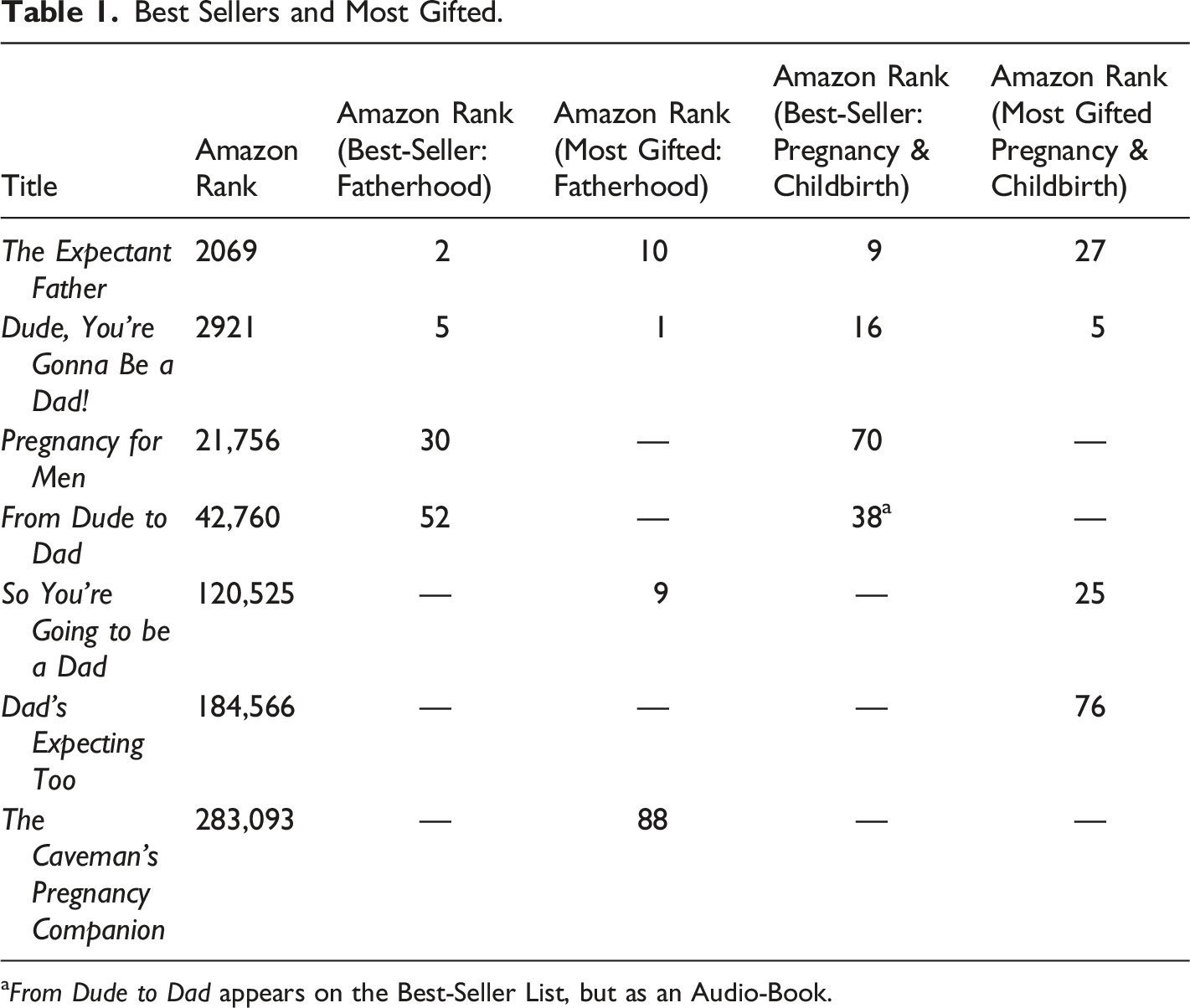
aFrom Dude to Dad appears on the Best-Seller List, but as an Audio-Book.
There is, of course, a limitation in relying on best-sellers and most-gifted books, that is, these books tend towards the “mainstream,” and as such, as will be discussed in greater detail, these books are all based on a heterosexual, cisgender couple, generally in a monogamous relationship, that mimics what Foucault called “the legitimate and procreative couple” (1978, p. 3). For Foucault, “the couple imposed itself as model, enforced the norm, safeguarded the truth, and reserved the right to speak while retaining the principle of secrecy” (1978, p. 3). In some ways, this couple has become central to how pregnancy is represented in pregnancy manuals; as such, the books being studied do not speak to queer family practices and queer pregnancy and much research remains to be written not only on queer pregnancy manuals, but also ideas of queer fatherhood, including the experience of trans folks. This is an unfortunate and troubling oversight in many of these books because we can think of examples of gay men who are heavily involved with their surrogates, and would surely see themselves as an “expectant father.” Additionally, these books do not speak to the realities of the trans* community and its experiences of both pregnancy and fatherhood. In “The Manly Art of Pregnancy,” j wallace laments that “even books which say Dad’s Pregnant in large friendly letters on the cover turn out to be written by cisgender men in heterosexual relationships, and about how to deal with your partner’s pregnancy in your relationship” (2010, p. 188).
In this article, I focus on what might be called ‘archetypes’ within the text. My approach to archetypes follows Northrop Frye, for whom an archetype is a “typical or recurring image” (Frye, 1957, p. 99; Allan, 2016, p. 29). While Frye’s method was squarely situated in the literary and concerned with the repetition of particular symbols, such as the sea, I understand the archetype as “recurring” across a set of texts. In speaking about archetypes, I am less interested in specific symbols, and more in repetition of kinds of experiences or descriptions. In their work on thematic analysis, Braun and Clarke note that these themes themselves are not ‘natural’ to the data, per se, but rather it must be admitted that “it is important to acknowledge our own theoretical positions and values in relation to qualitative research” (Braun & Clarke, 2006, p. 80). Thus, these themes, or what I understand as archetypes, are undoubtedly informed by my own experiences of research on masculinities and fatherhood, particularly with an interest in caring masculinities and new ideas and ideals about fatherhood. Methodologically, my approach is that of a literary scholar who engages in close textual reading, paying close attention to how ideas and stories are repeated across various texts—as such I am not engaging in thematic analysis or textual analysis that is common to the social sciences, though, undoubtedly, there are affinities. Accordingly, I am chiefly interested in what I see as repetitions in the data, that is, that archetypes appeared across a host of texts, rather than existing in a singular text. As such, given my interest in masculinities and theories of masculinity, notably in this case caring masculinities, I attended to archetypes that “capture something important about the data in relation to the research question, and represent some level of patterned response or meaning within the data set” (Braun & Clarke, 2006, p. 82). Another reader with another question or concern may well find different archetypes in the data set, these differences are no less valuable, nor are they any more right than those highlighted in this essay. Admittedly, an approach such as this is one that is “top-down” (Braun & Clarke, 2006, p. 83) insofar as “a ‘theoretical’ thematic analysis would tend to be driven by the researcher’s theoretical or analytical interest in the area, and is thus more explicitly analyst-driven” (Braun & Clarke, 2006, p. 84). I would agree with this entirely insofar as my approach to these texts was very much motivated by my theoretical inclinations, which included a focus on those “typical or recurring” stories, anecdotes, and so on that become part of how fatherhood is described.
The themes to be considered are all in the service of caring masculinity. Firstly, I was interested in the ideas of “expecting too,” wherein books would make an argument for the importance of a father considering his role as ‘expectant.’ Secondly, fatherhood as a rite of passage was a common trope that appeared in these books. Thirdly, we also find a recognition of doing fatherhood differently from their fathers. Finally, I consider the expectations of the expectant father. Each of these books spoke about the expectations of the expectant father, not just in terms of the child, but also in terms of his pregnant partner.
Expecting, Too!
Across many of the books is the idea that men, like women, are “expecting,” which generally means that author set out to write books for men, “you—the father” to help them “understand and make sense of what [they’re] going through during pregnancy” (Brott, 2015, p. 8). The argument that these books so often make is that both the father and the mother are expecting—of course, in very different ways. For instance, many books include insular, self-reflexive ideas of being an expectant father. In The Expectant Father, Armin Brott begins by acknowledging, “it finally hit me that I, too, was expecting (although in a very different kind of way)” and in recognizing this, he admits, “pregnancy was bringing out feelings and emotions that I didn’t understand, there simply weren’t enough resources for me to turn to” (2015, p. 7). In this example, readers are presented with the idea of men not understanding their emotions and feelings—his emotionality challenges his ideas of masculine stoicism, for instance. When we find this discourse of “expecting,” we also see authors justifying the book that has been written, I looked for answers in my wife’s pregnancy books, but information about what expectant fathers go through (if it was discussed at all) was at best superficial, and consisted mostly of advice on how men could be supportive of pregnant wives. (2015, p. 7)
As such, for Brott, there was a need in the marketplace to explore and explain the experiences of men’s experiences of their wife’s pregnancy. In From Dude to Dad, we read that “one of the reasons I wrote this book was because when my wife got pregnant there wasn’t much on the shelves for men explaining what to do when she’s expecting” (Pegula, 2014, p. xiii).
In their book, Nurturing Dads: Social Initiatives for Contemporary Fatherhood, William Marsiglio and Kevin Roy note that “a father’s initial efforts to construct his identity as a father do not necessarily depend on a child’s being born. In recent years the growth of childbirth preparation classes, availability of ultrasound technologies, and doctors’ willingness to have prospective fathers involved have altered men’s worlds” (2012, p. 42). Indeed, they explain that “the average man generally has numerous opportunities to develop his paternal identity and shape it before he ever hears, sees, touches, or smells his baby” (Marsiglio & Roy, 2012, p. 42). Each of the books under consideration here places emphasis on this “paternal identity,” which is a new identity (pre-paternal to paternal), but also a caring identity. He is expected to become a part of the process and to participate in the pregnancy.
Fatherhood as Transition
The transition to being a father is treated in fairly significant ways in these books, almost always, becoming a father happens from the moment of conception – as is the case in most books written for women. In Dad’s Expecting Too, we read, “from the moment the pee hits the stick, we [men] are on call, engaged, immersed, and involved in childbirth like no generation of men that has come before us” (Cohen, 2013, p. xxix). This sentiment is echoed in Dude, You’re Gonna be a Dad, “when the pregnancy test stick turns blue, the light to fatherhood goes green” (Pfeiffer, 2011, p. 3). These kinds of reactions to pregnancy are, of course, very much a part of the contemporary moment and requires a certain amount of access to technologies such as home pregnancy tests. For instance, in Pregnancy for Men, we read that “it wasn’t until the 1980s that pregnancy tests as we know them started to appear” (Woods, 2018, p. 18). However, what is seemingly true across all of these books is that the moment when one finds out about the pregnancy is a transition in the life course of the man.
Like many transitions, expectant fatherhood is one filled with a range of emotions. The emotions used are not limited to terms like happy, sad, bored, etc., but are often more descriptive, employing metaphor, for instance. In this article, I opened with an example from an early book on men and pregnancy, in which the author noted the possibility of mixed feelings about pregnancy. This has not disappeared in recent books. For example, in So You’re Going to be a Dad, we find these same mixed feelings, “some men are thrilled and ‘over the moon’ to hear the news of their impending dadhood. Some feel numb and uncertain. I felt a whole lot of emotions at once” (Downey, 2016, p. 26). Indeed, in So You’re Going to be a Dad, readers are presented with two kinds of fathers, the first who has been “trying” and the second who has “not been trying” (Downey, 2016, pp. 20–21). Both kinds of fathers experience different feelings, but their feelings are essential to how they imagine the rite of passage. For the first type, once they become pregnant, “he experiences of sensation of being lifted off the ground. He soars above the trees and spins among the clouds. Clutching his wife to him, he feels deep inner warmth and fulfilment” (Downey, 2016, p. 21), for our second type of father, when he learns of the pregnancy, “the room lurches like at the end of a bad bachelor party. His head swims and his knees buckle. He clutches to his wife, for stability. In a feeble attempt at speech, he produces only pathetic squeaks and gurgles” (Downey, 2016, p. 22). It is striking how different these two imaginary fathers are—not only different but almost positioned as divisive. In the former, the idea is one of reproduction as a goal, whereas in the latter, men are framed as perpetual bachelors. These examples function as a binary, rather than perhaps understanding the complexity of the experience. But what is essential, the author tells us, is that “it is important for the moment to be handled delicately” (Downey, 2016, p. 22) and thus, the now expectant father should not ask, “How did you let that happen?” nor should he say, “that’s fine, but don’t expect me to get involved” (Downey, 2016, p. 22). Men are expected to play an important role in becoming fathers—and there are right ways, being a caring man, and wrong ways, being apathetic. Expectant fathers are thus expressing the complexities of their emotions with regards to fatherhood, recognizing that it is quite possible to experience a range of emotions when imagining fatherhood. These books moreover encourage men to admit these feelings from shock to excitement to anxiety.
Admittedly, I want to be careful here, because there is a risk here that these men become projects of emotional labor for their partners, but time and again, these books revert to a traditional and normative masculinity, in which he becomes a protector. Pegula writes, “I can guarantee it’s more attractive to a woman to have a man who will listen and support her than someone who thinks pregnancy is a female problem she needs to deal with” (2014, p. 7). This is a mutual experience where the man must play a caring and supportive role.
Modern Dads
In the previous themes, fatherhood is treated as a transitional stage and there is a recognition that pregnancy is also about men too, and these themes lend themselves to another recurring archetype within these text, which is that the men reading these books will do fatherhood differently. Men are now encouraged to be a part of the pregnancy, as Pfeiffer writes, “this next stage—after conception—is all about research, planning, and making decisions” (2011, p. xi) and it is important that the father is able to “give input right from the start” (2011, p. xii), as such, the reader should “man up, get some knowledge of your own, and the entire process will go more smoothly for everyone” (2011, p. xiii). Men are being told to play an active role in the entire procreative realm, notably, between conception and birth. Indeed, men’s engagement with pregnancy becomes yet another proof of his masculinity, he will “man up” to the experience.
In Pregnancy for Men, we read: “a generation or two ago you were more likely to see a fully grown llama attending a birth than the father of the child,” (Woods, 2018, p. 3) which echoes, Dad’s Expecting Too, wherein the author writes, “when my mom went into labor, my dad was given a chair in the expectant father’s waiting room” and we are told that “today, expectant fathers are no longer stuck in the waiting room—we are in the trenches watching it unfold in real time” (Cohen, 2013, p. xxix). Of course, this is a generalization that is not historically accurate, after all, fathers may have played any number of roles in delivery from being a witness through to being the doctor delivering the child. Moreover, it should not be lost on us that pregnancy and fatherhood become tied to another masculine space, that of the battlefield. Even when not about actual fathers, we find this same trope. In The Caveman’s Pregnancy Companion, we read: But as a human being living in the twenty-first century, you’re not getting off the hook that easy. The fatherhood role you’ve seen reinforced in all those Leave it to Beaver reruns has changed. Ward Cleaver is a dinosaur. Thus the expectant caveman needs to look elsewhere for his role models, and (speaking of beavers) the animal kingdom is a good place to start. Nature is full of examples males seizing control of childbearing and child-rearing responsibilities (Port & Ralston, 2006, pp. 6–7).
In this example, then, men are told not to be like Ward Cleaver, who is a kind of retrosexual (see Waling, 2014), he is a dinosaur of the past from whom men ought to have evolved, but instead, to be like male seahorses who “embrace fatherhood. They carry the eggs and bear full child-rearing responsibilities once the eggs hatch,” or to be like the red fox who “is the consummate gentleman when it comes to treating his vixen right. He supplies her with fresh food several times a day while she nurses the young ones” (Port & Ralston, 2006, p. 7). 1
In The Expectant Father, this same archetype of being unlike dad is considered when the men become fathers: “more and more of us are figuring out that traditional measures of success are not all they’re cracked up to be, and we are committed to being a major presence in our children’s lives, physically and emotionally” (Brott & Ash, 2015, p. 281). The fatherhood of yesteryear is no longer a viable model for the fathers-to-be and new fathers of today. As The Caveman’s Pregnancy Companion, argues, sensitive guys are “your role models” (Port & Ralston, 2006, p. 7). There is an interest in being “unlike dad,” a phenomenon that has been documented elsewhere and outside of these books (Allan et al., 2021).
Expectations of Expectant Fathers
These books, as much as being about fatherhood, are also about what it means to be a partner to an expectant mother. In From Dude to Dad, expectant fathers are told, Dude, I hate to break it to ya, but you need to go to many, if not all, of your doctor’s appointments during her pregnancy. Don’t forget that she is the one who will soon be pushing out a butterball out of her lady parts, so it’s the least you can do. Seriously, be there for your partner. Your support will often be just what she needs (Pegula, 2014, p. 12)
As is often the case, apparent humour is used, for instance, the baby is described as a “butterball.” This is a seeming attempt to bring men into the conversation by way of humour, perhaps this is a kind of “locker room” talk within the genre of pregnancy books for men that creates a homosociality of readership, but this humour is not universally funny for all readers. Indeed, some readers may well be turned off by this (attempt at) humour and thus feel excluded.
Pregnancy is a team effort, the medical appointments are seemingly as much his as they are hers: “you may need to go to many, if not all, of your doctor’s appointments during her pregnancy.” In The Caveman’s Pregnancy Companion, readers learn that “the last thing they [an expectant mother] want or deserve is a knuckledagger who can’t cope with the new demands of pregnancy and fatherhood” and thus, “what they need is someone who’s willing and able to evolve into a well prepared, secure partner, someone who’s ready to stand upright and embrace all the new responsibilities of expectant fatherhood” (Port & Ralston, 2006, p. 1). Once more we see this retrosexual turn in describing men as “cavemen,” a point Waling notes when she addresses the retrosexual narrative and notes the specific use of words like dinosaur and caveman (2014). In Dude, You’re Gonna Be a Dad, readers are told, “your best possible move is to attempt to make her pregnancy easier by any means. Find out things she has to deal with in her everyday life that you can take off her hands, even if it means a little extra effort on your part” (Pfeiffer, 2011, p. 25). In From Dude to Dad, Pegula writes: “Be a real man and be a rock solid partner for your partner. Don’t buy into the bullshit stereotypes that men cannot be supportive or expressive when it comes to pregnancy” (2014, p. 7). Here then, being there for “your partner” becomes a proof of masculinity, “bullshit stereotypes” can be left behind as long as he is a “rock solid partner,” which, of course, ends up reinforcing those “bullshit stereotypes.” These books speak about the new expectations of the expectant father.
In Dad’s Expecting Too! readers find a chapter on “spoiling your pregnant partner,” which includes information on dating a pregnant woman, the babymoon, the prenatal rubdown, and “doing the little things,” in which readers are told that, “I would focus on the small things—like not only folding her laundry, but bring it upstairs and putting it away too. From time to time, I’d bring home a magazine she likes” (Cohen, 2013, p. 241). But the advice also extends to adapting to a new life, for instance, men can “do everything we used to do before she got pregnant. But she can’t. And really, it’s not fair,” and so, tips are provided like, “avoid eating things she can’t eat,” and “avoid alcohol, cigarettes, and illegal drugs,” but also continue these “smaller things,” like, “clean up around the house (a little bit goes a long way)” and “do the dishes (but load the dishwasher properly—see Tip #46)” (Cohen, 2013, pp. 242–243). None of these tips really have anything to do with fathering, but rather about being a husband and/or partner.
These examples speak to a recognition of how difficult it can be—and often is—to be pregnant. Throughout these books, then, emotional support is significant. Of course, problems remain since these books assume that washing, for instance, is “her work,” rather than mutual work. Showing support, being a caring partner, is about more than providing resources, for instance, but rather about demonstrating care and intimacy for a partner throughout the pregnancy, and, as noted above, it is also about preparing for being a father when the baby actually arrives. As Pegula asks, “If you can’t support her now, how do you expect to do it once your little one arrives?” (2014, p. 7)
Caring Masculinities and Fatherhood
All of these books agree then that men have important roles to play from conception to birth, and this is, in many ways, a significant shift from times gone-by when pregnancy books for men “would be smaller and simpler. Get her pregnant, go to work, have a kid, smoke a cigar” (Cohen, 2013, p. xix). Expectant fathers are expected to do a great deal of work, to support their partners, to learn how to be fathers. These masculinities are about masculinities changing, but are they about the shifting nature of hegemonic masculinity? Recalling here that for Connell, “hegemonic masculinity embodies a ‘currently accepted’ strategy. When conditions change, the bases for the dominance of a particular masculinity are eroded” (Connell, 2005, p. 77). I want to suggest that these masculinities represent a movement from hegemonic masculinity and towards caring masculinity (which may well just be a shift in the ‘currently accepted strategy’), but that we should tread cautiously as the structures that underpin hegemonic masculinity are still intact.
As a concept, “caring masculinity proposes that men are able to adopt what is viewed as traditionally feminine characteristics (i.e. emotional expression, sensitivity, domestication, interdependence, caring, etc.) without departing from or rejecting masculinity” (Hunter et al., 2017a, p. 3). It is important here to frame this as less a typology and more a concept, for, as Elliott has argued, “the theoretical framing of caring masculinity […] is not intended as a homogenizing typology of men” (2016, p. 256). 2 As a concept, then, perhaps, we might argue that there is a hybridization at play insofar as these men are taking on new tasks while not “departing from or rejecting masculinity.” Indeed, Hunter and colleagues ultimately conclude, “it is too early to suggest that there is a wholesale departure from hegemonic masculinity” and thus suggest that “the ideas surrounding a caring masculinity are better understood as a broadening of hegemonic masculinity to include roles more traditionally undertaken by women” (Hunter et al., 2017b, p. 6). For Hunter and colleagues, then, if there is any challenge to hegemonic masculinity, it is that caring masculinities expands and broadens hegemonic masculinity to allow for men to be caring.
Within Elliott’s caring masculinity, we find a need for “interdependence,” which is about “relationality and the intertwining of interests in the care relationship” (2016, p. 251). As feminist philosopher Virginia Held (2006) notes, “persons in caring relations are acting for self-and-other together” and further, Their characteristic stance is neither egoistic nor altruistic; these are the options in a conflictual situation, but the well-being of a caring relation involves the cooperative well-being of those in the relation and the well-being of the relation itself. (p. 12)
At its core, then, a caring masculinity is a relational masculinity. In the case of the care relationship unfolding in these books, it works at least two ways for the father, he cares for the baby and he cares for his partner. These three people, thus, become interdependent, which aligns itself with an understanding of interdependence that “highlights that everyone is dependent at different times and in different ways and that everyone exists within reciprocal networks” (Elliott, 2016, p. 251). What these books are seeking to do, I would argue, is show these expectant fathers how their relationships will change, whether it be while the partner is pregnant, or after the arrival of the child.
All of the books under consideration privilege the importance of care. However, the challenge that remains is how scholars are to conceptualize caring masculinities. I would contend that these are not so much an identity, as they are a way of doing masculinity and doing and performing gender more broadly. Moreover, I am not certain I would accept the idea of “broadening hegemonic masculinity,” for it seems then that any positive modification of masculinity may well be subsumed into hegemonic masculinity thereby making it impossible to leave behind hegemonic masculinity, which is generally understood here less in terms of its structure and more in terms of what is commonly called “toxic masculinity”. 3 In all of the books under consideration there is no encouragement to renounce or depart from masculinity, but to find ways to be a caring father and husband. And thus, it recognizes that masculinity is relational and interdependent. Consider, for instance, the subtitle to Pfeiffer’s book, How to Get (Both of You) Through the Next 9 Months, the parenthetical is doing a great deal of work there recognizing that “both of you” are part of the equation.
One of the risks of caring masculinity is that it all sounds so good. Men are caring more and caring is becoming a part of their masculinity. In some ways, we might imagine that caring masculinity becomes a kind of reparative or generous reading of hegemonic masculinity, recalling Sedgwick’s worry that reparative reading sounds “merely aesthetic” or “merely reformist” (2003, p. 144). 4 That is, it focuses so much on the seemingly ‘good’ or ‘healthy’ or ‘caring’ ways of doing masculinity that it may run the risk of losing sight of the ways in which hegemonic masculinity is still operating. It is important, thus, to remember that even in theories that ostensibly move away from the hegemonic in search of a better masculinity or a different masculinity, the hegemonic is still a lodestar.
To return then to Hunter and colleagues, I would agree it is “too early to suggest that there is a wholesale departure from hegemonic masculinity,” but I would not agree that this is just a “broadening of hegemonic masculinity” (Hunter et al., 2017b, p. 6). Raewyn Connell reminds us that, Hegemonic masculinity can be defined as the configuration of gender practice which embodies the currently accepted answer to the problem of the legitimacy of patriarchy, which guarantees (or is taken to guarantee) the dominant position of men and the subordination of women (2005, p. 77).
Elliott, the originator of caring masculinities, notes caring masculinity is about “relationality and the intertwining of interests in the care relationship” (2016, p. 251). More explicitly, Elliott writes that, “the rejection of domination, a characteristic so integral to traditional hegemonic masculinity, is of central importance to this model of caring masculinities” (2016, p. 252). These books imagine a masculinity that is not one of domination, but rather one of interdependence wherein the partners are caring not only for one another, but also the forthcoming child.
Of course, and it is important to acknowledge this, these books are also still affirming and reaffirming a practice of masculinity that depends upon the hegemonic. Caring masculinity is a kind of hybrid masculinity insofar as we find a discursive distancing, that is, caring must become masculine (rather than is assumed feminine), there is a kind of strategic borrowing wherein fathers borrow the habits and customs of mothers and make them masculine, and finally, there is a fortification of the boundaries, wherein “men’s practices that initially appear to be feminist can also reify gender inequality even as they obscure it” (Bridges & Pascoe, 2014, p. 255). For example, all of these books speak to the need for a caring masculinity, one in which fathers are active and present, but they do so at the cost of imagining other fatherhoods and other masculinities. These books are all squarely focused on what might be called ‘traditional family’ values, rather than expanding our ideas about the family. There is a notable absence of recognition of queer and trans families. These books thus serve as a cautionary tale wherein we must carefully negotiate how we understand shifting dynamics of fatherhood and gender. It is certainly true that there are changes, but are these changes shifting the structural terrain, or are they “perpetuating social hierarchies in new (and ‘softer’) ways” (Bridges & Pascoe, 2014, p. 255)?
Conclusion
Drawing upon ideas of “caring masculinities” and “fatherhood,” this study has sought to study books for expectant fathers and to think through how they represent and understand masculinity. These books seek to show men ways of being caring and doing carework. In this way, each of these books shows how men can modify their behavior in light of becoming a father and living with and alongside a pregnant partner in anticipation of a child. And, of course, as most will likely admit, the arrival of a child does change a person. These books all contribute to literature on “caring masculinities” and by extension “hybrid masculinity theory,” insofar as they present examples of “a cultural process with incredible potential for change” (Bridges & Pascoe, 2014, p. 256), and that change is potential not assured.
In their article, “Carework and Caring: A Path to Gender Equitable Practices Among Men in South Africa?” Morrell and Jewkes rightly ask, “is male carework a constituent element of a path to gender equity?” and respond, “our answer in this paper is both yes and no” (2011, p. 8). The answer is not to suggest that they don’t know, but rather that actions can serve many needs or desires. As they note, for some, “when men engage in carework as practice they challenge gender norms by showing that men can play a role in an area of work generally regarded as the responsibility of women” (Morrell & Jewkes, 2011, p. 8) while for others, “carework can also be framed by men in a way that is congruent with patriarchy and patriarchal ideals of gender roles, albeit without its violent expression” (Morrell & Jewkes, 2011, p. 8). Both of these realities are true. It is quite possible that caring masculinities serve the needs of patriarchal and hegemonic masculinity, but it is also true, and I note this, that they can “challenge gender norms.” Caring masculinities are, as I see them, a welcome challenge (not without risk), but also a step towards greater gender equality. As Morrell and Jewkes conclude, “men’s engagement in carework deserves to be an explicit goal of interventions aimed at ‘changing men’ and, although far from a perfect indicator of gender equitable ideals and practice, it is valuable in its own right as an outcome for such interventions” (Morrell & Jewkes, 2011, p. 9).
In the concluding chapter to their edited collection, Father Involvement in Canada: Diversity, Renewal, and Transformation, Kerry Daly and Jessica Ball admit, While the current volume has deliberately set out to highlight diverse populations of fathers, there are populations of fathers whose experiences, behaviours, and viewpoints are not represented explicitly, including stepfathers, adoptive fathers, and fathers from different stages of the life cycle. There is still much work to be done (2012, pp. 224–225).
I could not agree more, and this study is but an opening to the study of expectant fatherhood, which remains a relatively understudied topic of inquiry, especially when considering texts, such as expectant fatherhood manuals. As noted, these books are limited in their scope, as they chiefly address cisgender, heterosexual men who are in a committed relationship, and thus, they do not speak to the realities and experiences of many. As such, caring masculinities as presented in these books is limited to cisgender, heterosexual men. There is a growing market of books devoted to expectant fathers and scholars of men and masculinities, particularly those interested in gender equality as a policy-based issue, would do well to consider the supports provided to expectant fathers. Nearly all of the books studied mentioned a lack of resources for expectant fathers and yet all of these books spoke of a desire for resources. If we are to encourage fathers to play a more active role in childrearing, perhaps we can begin in the prenatal stages and provide men with the resources that they desire and need, whether this be books about becoming a father or prenatal classes that provide a model that is relational and recognizes how relationships need to change and adapt over the course of pregnancy and the arrival of the child.
Footnotes
Declaration of conflicting interests
The author(s) declared no potential conflicts of interest with respect to the research, authorship, and/or publication of this article.
Funding
The author(s) disclosed receipt of the following financial support for the research, authorship, and/or publication of this article: his work was supported by the Canada Research Chairs Program and the Social Sciences and Humanities Research Council of Canada.
