




Abstract
This article explores the online construction of masculinity and fatherhood in contemporary Greece. Through a digital observation of five celebrities’ Instagram activities that identified with the image of family man and affectionate father, the article argues that self-representations of affluent and involved masculinity and fatherhood represent a popular media trend. The article analyzes such self-representations as the outcome of historical transformations in gender and family politics, economy, and media that go back to the 1980s, the 1990s and the 2000s. It also argues that the acceptance of such imagery by wide audiences demonstrates the persistence of the male archetype of breadwinner, the value of the family, and the nostalgic survival of elements of earlier prosperous consumer aesthetics throughout the Greek economic crisis of the 2010s.
This article discusses masculinity and fatherhood in Greece through an examination of Instagram focusing on the period 2017–21, which encompasses the last years of the bailout agreements era (2010–18) and the COVID-19 crisis (spring 2020 to present). During this period, images of carefree and prosperous fatherhood from celebrities proliferated. Displays of tender fatherhood in affluent settings have flourished in the West since the 1980s (Wall & Arnold, 2007). This popularization has aligned with the shift toward more egalitarian gender roles and increased expectations regarding men’s participation in child-rearing; it has been shown that a lack of willingness to commit to these expectations reduces men’s attractiveness (Schneider & Becker, 2012). In Greece, however, displays of affluence received criticism in the early stages of the government-debt crisis. This article argues that more recent imagery linking tender fatherhood to affluence shows that although earlier consumer culture was criticized as superficial during the first years of the crisis, audiences at large continued to approve of imagery that reflected former levels of prosperity.
While there is ample literature on the Greek crisis (e.g., Siani-Davies, 2017; Tziovas, 2017), it is important to be mindful of some key developments that are referred to later in this article. Between 2008 and 2013 Greece lost about 25% of its GDP and unemployment rose from 7.76 to 27.27%. SYRIZA (the Coalition of the Radical Left) expressed public anger toward austerity, and its electoral support grew from 5.04% in 2009 to 35.34% in 2015, when it formed an anti-austerity government with the right-wing party Independent Greeks (ANEL). Following negotiations with creditors and a referendum, this government continued austerity. The mediascape and society was polarized (Ferra, 2019) until the summer of 2015, when tensions began to ease. The previously anti-austerity media threw their support behind a pro-austerity government, which changed the tone of public discourse and gradually refacilitated displays of affluence. Along with other countries in the aftermath of the 2008 crisis, Greece experienced a downward harmonization of labor conditions. Construction, processing, and commerce were vulnerable sectors, with 402,200 jobs lost between 2008 and 2015 (Yannitsis & Zografakis, 2016). The middle class, a pillar of Greece’s economic progress since the 1950s, suffered and socioeconomic security was undermined (Aranitou, 2019; Panagiotopoulos, 2021). Rampant unemployment affected masculinity norms and the self-confidence of men who suffered from the disruption of their economic roles (Fakuda-Parr et al., 2013; Papageorgiou & Petousi, 2018). Men found themselves unable to fulfill their role as breadwinners, which resulted in feelings that their status as family leaders was under threat (Yannitsis & Zografakis, 2016). In a culture where masculinity is associated with diligence, unemployed men were seen as effeminate; these men experienced a loss of dignity (Avdela, 2011; Kambouri et al., 2020).
(Self-)representation is a key practice in celebrity cultures (Jerslev & Motensen, 2016). This is a gendered area of social action that structures practices in media marketing and advertising, especially in the context of its pervasive influence on how we (re)see gender in contemporary media-driven societies (Banet-Weiser, 2015; Wood, 2006). This analysis approaches gender identities as performative: they are tenuously constituted in time and instituted in an exterior space through a stylized repetition of acts; such an identity is conceptualized as a constituted gender temporality (Butler, 1999). I consider masculinities to be multiple (Connell, 2005; Ross, 1998) and characterized by internal connections and contradictions. The examination of masculinities requires the recognition of geographical factors, with emphasis on the agency of women and of gender and family relations in their constitution, and on the interplay among local and global levels. It also necessitates the treatment of embodiment in contexts of privilege and power and an understanding of the dynamics of hegemonic masculinity, recognizing internal hierarchies (Connel & Messerschmidt, 2005). Such hierarchies are sophisticated, as privileged men occasionally integrate elements of subordinated masculinities into their identities in order to maintain or elevate their status (Bridges & Pascoe, 2014; Eisen & Yamashita, 2017). Other scholars investigate masculinities as moving toward a horizontal rather than hierarchical organization; increasingly, previously stigmatized norms are being included and established norms of power and inequality are being challenged (Anderson, 2009; Anderson & McCormack, 2018). Furthermore, current work approaches fatherhood as a performance that is shaped by political, social, cultural, and historical antecedents and current concerns (Miller, 2011a). Economic crises are productive terrains on which to discuss transformations in masculinity and fatherhood, as deteriorating living standards impact gender hierarchies and the family. During the crisis, Greek society embraced nonheteronormative masculinities, while affluent men employed self-representations that included elements of subversive masculinity to demonstrate the persistence of established masculine identities—especially the role of breadwinner.
This article considers Instagram as an archive comprising material that expresses interactions between those uploading the material and their followers, and employs this archive to deconstruct masculinity and fatherhood. Instagram is a social media platform used by computer-mediated, self-contained, and self-referential communities of users (Leaver et al., 2020). Launched in 2010 and purchased by Facebook for USD 715 million in 2012 (Frier, 2020), Instagram had 300 million users in late 2014, became the fastest-growing social media platform by 2017, and surpassed two billion users in late 2021 (Blank & Lutz, 2017; Rodriguez, 2021). Instagram revolutionized the dissemination of photography (Vivienne & Burgess, 2013) through photo-sharing, microblogging, networking, and commercial exchange (Abidin, 2016) and transformed business, art, celebrity, and culture (Frier, 2020). Instagram offers researchers insight into people’s social activities by means of their photos (Hu et al., 2014), and is especially appropriate for research because user profiles are often public (Blank & Lutz, 2017). In Greece, the study of Instagram is crucial, given visual culture’s importance in the cultural politics of the crisis (Tsilimpounidi, 2018). My focus on the visualization of masculinities enables a discussion of (dis)continuities in gender performances, of how self-mediatization intersects with positioning toward the family, of the relations between the circulation and reception of photographs, and of nostalgia for the affluent aesthetics that existed before the crisis.
Use of Instagram in Greece in 2019.
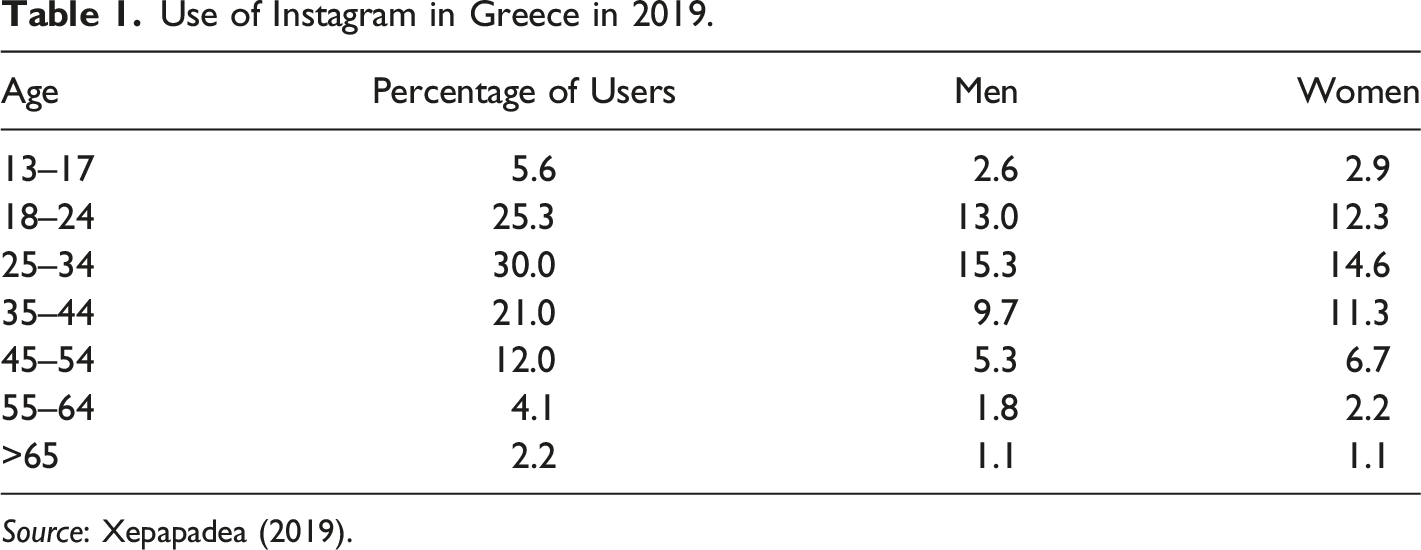
Source: Xepapadea (2019).
As followers’ reactions influence what celebrities share (Toffoleti & Thorpe, 2018), to a degree their posts reflect the positioning of their followers, which designates social media accounts as noninstitutional archives placed in the everyday (Beer & Burrows, 2013). Constituted by visual stimuli that gain meanings through interactions with followers, these archives demonstrate the importance of non-textual interaction in current archive culture (Zajc, 2015). Social media activity involves the crafting of identities to be consumed online (D. Miller, 2011b), and therefore Instagram activity represents a sort of self-advertising. As images in advertising express coding systems embedded in ideological environments that in turn express the hegemonic values of the surrounding culture (Jouhki, 2017; Wiles et al., 1995), the popularity of celebrities’ gender identities provides fertile ground to discuss masculinity and fatherhood.
Masculinity, Fatherhood, and the Family in Contemporary Greece
In Greece, extreme poverty had subsided by the 1970s. Better financial conditions did not lead to more births, as parents still opted for small (usually one- or two-child) families, similarly to in other Western countries (Doepke & Zilibotti, 2019). In the 1980s, the middle class expanded and parenthood was performed in better material conditions. The average apartment reflected the ambitions of a family open to consumer modernization; children often had private rooms for study and play (Tsiampaos, 2017). Society remained significantly patriarchal and women maintained their roles as housewives, but gender politics became more elastic.
From the 1970s, Greek women increasingly challenged established gender hierarchies, questioned the nuclear family as a site of women’s oppression, and claimed gender equality. The socialist government elected in 1981 modernized gender relations and family life by introducing civil marriage, abolishing the dowry, and adopting constitutional equality of the sexes (Pollis, 1992). In rural areas, men remained critical of participating in childcare or housekeeping (Maridaki-Kassotaki, 2000). The nuclear family remained the dominant social identity and divorce remained rare by Western European standards. Divorce rates fluctuated between 8 and 20% of marriages between 1980 and 1998 (Maratou-Alipranti, 2004).
Fathers remained more distanced from pregnancy and childbirth than in other European countries, such as the United Kingdom (Dragonas et al., 1992), but they gradually adopted the model of the father who is more emotionally involved, more nurturing, and more committed to playing and conversing with his children (Wall & Arnold, 2007). Since the 1980s, the figure of the strict father who inspired fear in his children has been succeeded by more laid-back performances of fatherhood. New habits, such as eating pizza with one’s parents while watching television or playing games, emblematized a modernity in which the ideal of fatherhood included providing material experiences that resulted in a joyful childhood (Panagiotopoulos, 2010). Being a father meant not only caring about the health, education, and living standards of one’s children, but also being affectionate and offering them time and happiness.
Economic progress and cultural pluralism impacted young men, who pursued playful consumer experiences and distanced themselves from the breadwinner and family man ideals. Rebellious masculinities in which men were seducers more than husbands emerged to threaten the norms that were central to the breadwinner identity (Holt & Thompson, 2004). Lifestyle media promoted conspicuous consumption and advocated bachelorhood as a marker of successful masculinity, which appealed to young urban men without drastically challenging the creation of family as a purpose in life (Zestanakis, 2020a). The economic potential of Greeks rose from 60 to 78% of the European average between 2000 and 2008 (Liakos, 2019). Between 2002 and 2009, household expenditures increased by about 50% (Aranitou, 2019). Marriage, which did continue to be seen as a desirable life goal, was nonetheless postponed for a later age, and marriage ceremonies became impressive events that demonstrated the family’s power (Panagiotopoulos, 2021): the average age of first marriage increased from about twenty-six in the early 1990s to about thirty in the late 2010s (Balourdos et al., 2019).
Parents saw financial provision as a key factor in the molding of children (Teperoglou, 1999), and they supported their children in obtaining expensive goods, such as brand-name clothes or cars that young consumers generally could not afford. In interviews carried out in the 2000s, youngsters often admitted that their parents offered them shelter, food, sometimes a car, and other facilities, such that they could reserve their own incomes to pay for personal expenses (Max, 2007). Elders also often helped youngsters pay debts (Placas, 2008). Improved pensions (previously low pensions increased by 133% between 1996 and 2003; Chrysolora, 2003) boosted this trend, and grandfathers and grandmothers assisted their grandchildren financially. As in France (Pleux, 2002), Greek families embraced the “child-king” model (Panagiotopoulos, 2018). This climate was eloquently visualized in the successful television comedy Highly Familial (Άκρως οικογενειακό, 2001–3), which depicted an upper-middle-class patriarchal family. In the show, the children maintained friendly relations with their father, who offered them a carefree life in a rich suburb.
Fathers performed sensitive masculinities in tune with the “new masculinity” (Hondagneu-Sotelo & Messner, 1994), but only to a degree. As in Canada, Australia, and the United States (Craig, 2006; Fox, 2001; Singley & Hynes, 2005), men were actively involved in their children’s lives, offering them a carefree childhood. They continued, however, to avoid participating in childcare activities such as cleaning or dressing the children; these duties remained in the female realm, even in the perspectives of well-educated men (Maridaki-Kassotaki, 2000). A survey in the early 2000s of 6629 women revealed that among couples with at least one child of up to seven years old, men dedicated only seventeen hours per week to child-rearing activities (i.e., bathing, dressing, feeding, transport, play, and reading) while women dedicated 36.1 hours to the same efforts (Grigoriou, 2003). These relations between gender roles, consumption, and family influenced the crisis environment, as increasing politicization and juvenile anti-establishment contestation usually excluded family issues (Panagiotopoulos, 2018). The 2008 revolt that followed the murder of an adolescent by a policeman in Athens offers an eloquent example: through slogans, graffiti, and other performances, the participants in the revolt challenged various historical and social aspects of contemporary Greece (Kornetis, 2010), while leaving the concept of family intact.
Ironically, trust in the nuclear family continued in a public sphere in which discourses that challenged it were increasingly welcome. During the crisis, films and novels challenged the nuclear family (Papanikolaou, 2018a). Politically emancipated audiences embraced these discourses, which contested patriarchy, homophobia, and heteronormativity, and academic interest in queer culture blossomed (Papanikolaou, 2018b). In spite of the recession, Greek society participated in the weakening of homohysteria. This weakening, which was expressed on social media, also characterized other European societies, such as the United Kingdom (Scoats, 2017). Mainstream media promoted LGBT events such as the annual Athens Pride. In a mid-2010s survey, 50% of those surveyed supported same-sex civil partnership, while they still repudiated more “advanced” calls such as that for the adoption of children by homosexual couples (which was endorsed by a mere 14%; Kostopoulou, 2016). Greek society increasingly accepted nonheterosexual masculinities, albeit without fundamentally challenging the nuclear family or established gender roles. Heterosexual masculinities that were attached to nuclear family, religion, homeland, or the fulfillment of parental duties under conjugal familiarity remained popular (Public Issue, 2018).
The crisis destabilized relations within families, unsettling the psychological status of a society accustomed to higher levels of social and economic stability. This was evident in the rise in the use of antidepressants (Siani-Davies, 2017). Domestic violence against women increased from 1630 cases in 2012 to 3196 in 2017 (General Secretariat, 2019), and the divorce rate rose as economic hardships rendered families vulnerable to ruptures, while some couples even resorted to iconic divorces for financial reasons (Elafros, 2017). Families had fewer opportunities to enjoy carefree moments, leading to an increase in disputes over financial differences (Charalabaki, 2017). Although the cost of leisure decreased (Yannitsis & Zografakis, 2016), during the crisis 68% of the population went out for leisure much less often than in the 2000s (Star.gr, 2018). Only half of the population could afford a weeklong vacation (Eurostat, 2020). Generous fatherhood became less common, something that was especially traumatic for middle- and upper-middle-class men, who were used to performing fatherhood in affluent conditions; these groups (defined as having an annual income between EUR 30,001 and 50,000 and EUR 50,001 and 75,000 respectively) were heavily affected by the crisis (Aranitou, 2019; Yannitsis & Zografakis, 2016). It is thus understandable that representations of affluent fatherhood began to provoke frustration; nevertheless, as we will see, this was not always the rule.
Methodological Choices and Limitations
I selected the sample from a wider pool of celebrities that I considered to be indicative of a frequently discussed media phenomenon (e.g., Antonatos, 2019; Motherblogs team, 2019). I focused on five male celebrities, which allowed me to provide details of their lives that may be helpful for readers who are not familiar with the Greek context. The main selection criteria were popularity (a high number of followers, for a country with about four million Instagram users; Statista, 2021) and the media’s preoccupation with these celebrities as successful fathers. Instagram communities are self-reflective in nature, and therefore it is not surprising that followers applaud celebrity posts. However, I would argue that the enthusiasm of followers for the ways that these celebrities visualize masculinity and fatherhood and associate them with affluence demonstrates that wide groups of young and middle-aged people in contemporary Greece applaud performances of masculinity and fatherhood in luxurious settings; such performances remind people of the historical climate before the years of economic crisis.
The sample includes celebrities of various ages and professions. Singer Sakis Rouvas, chef, media persona, and entrepreneur Sotiris Kontizas, entrepreneur Dimitris Yiannakopoulos, basketball player Vassilis Spanoulis, and media persona Petros Kostopoulos (born in 1972, 1983, 1974, 1982, and 1954 respectively) had 911,000, 356,000, 242,000, 126,000, and 82,000 followers respectively in late 2020. These celebrities do not have sympathizers only; for example, in the past, the media have castigated Kostopoulos’s attitude (Zestanakis, 2020a). The media’s negative critiques, however, do not characterize these celebrities’ Instagram audiences—therefore, they lie beyond the scope of this study. Kostopoulos divorced in 2014 after eighteen years of marriage and three children; the other celebrities are married and have children only with their current wives. Greece has had openly gay celebrities since at least the 1980s, and non-white celebrities have become more visible in recent years—NBA star Giannis Antetokounmpo is a significant example. Gay and non-white celebrities have, however, consistently been underrepresented in Greek celebrity culture, which has been dominated by white heterosexual men (such as those examined here). This category of men continues to be associated with prosperous and successful masculinity and fatherhood.
The examined celebrities have systematically and publicly commented on the importance of family and procreation: in recent interviews, Yiannakopoulos, Kostopoulos, and Spanoulis (Alpha TV., 2020b; Antenna TV, 2021; Mega Channel, 2020) have each highlighted the value of family and of having children. The media have expressed equal levels of interest in their wives (and ex-wife in one case) as symbols of motherhood and fertility (e.g., The TocTeam, 2021; Zoitos, 2021). Such celebrities do not discuss having children as a national duty; they mostly refer to it as a pleasant and meaningful activity. Their positioning differs from the popular discourse that associates parenthood (particularly motherhood) with the preservation of the Greek nation in the context of demographic decline (Halkias, 2004).
The celebrities examined here do not enjoy the same economic status—some are richer than others. However, likely with the exception of Kostopoulos, who experienced economic problems after his media company went bankrupt in 2012 but remains engaged in smaller entrepreneurial projects, these celebrities generally enjoy high living standards. Yiannakopoulos owns a pharmaceutical company and Kontizas owns three trendy restaurants in Athens and is a presenter on the Greek edition of the successful reality show MasterChef. Rouvas has enjoyed popularity as a pop singer since the 1990s, and Spanoulis recently retired from a legendary basketball career. In all cases, their depictions of fatherhood are associated with above-average affluence.
I draw on some 2700 posts, starting from when these celebrities opened their accounts, with a focus on the period between 2017 and 2021. 1 While many of the photos concern professional activities, in order to maintain this work’s focus on the family, such photos have not been prioritized. Through invisible observation I explored the accounts as a “lurker” (Garton et al., 1999); I did not engage in personal communication with the informants. This article aims at a historicized and contextualized intervisual analysis; such an analysis remains to a degree personal, as people are influenced by their cultural background when they interpret images and react differently to the same stimuli (Hall, 1997; Rose, 2001). While my main focus is on the images, I have also referred to the captions and followers’ reactions when necessary. Examining masculinity on YouTube in the United Kingdom, Morris and Anderson (2015) argued that audiences’ responsiveness to popular YouTubers’ masculinity requires further research. I argue, however, that although further research (e.g., oral interviews with followers) could offer more elaborated outcomes, investigating celebrities’ high numbers of followers also permits elucidation of the popularity of masculinity and fatherhood in Greek society as visualized through these accounts, at least from the perspective of young and middle-aged audiences (see Table 1).
Discussion
Instagramming Joyful and Affluent Fatherhood
As mentioned, the celebrities examined do not share the same economic potential. Regardless, these celebrities maintained a standard of living that was far superior to that of most Greeks. To employ Veblen’s terminology, they belong to the leisure class. The social performances of this class feature expenditure on consumption and leisure, and their status is derived from public displays of affluence. 2 While the celebrities displayed their affluence on Instagram in various ways, this analysis focuses on comfortable housing, expensive and stylish vehicles, and mobility for leisure.
Many of the posts demonstrated a comfortable lifestyle in cozy houses or big apartments with enviable facilities. Photos of Yiannakopoulos in his swimming pool (18 April 2020) and his game room (11 August 2020) or of Rouvas in the family’s greenhouse (16 October 2020) are typical. Spanoulis, who is more reserved in showing off his house in the prestigious suburb of Vouliagmeni, uploaded a family photo next to a huge Christmas tree on 1 January 2018. Followers admired the celebrities’ comfortable lifestyles, applauding suburban family life. Photos such as these reproduce the ideal of a healthy suburban family life that has been popularized since the 1980s. The crisis ended two decades of economic development that had been largely based on construction. Due to the degradation of the city’s central districts (largely through environmental pollution), from the 1980s the suburbs in Athens were seen as cleaner areas that were more suitable for bringing up children. Suburbanization contributed to the popularization of the breadwinner identity, supporting the ideal of a spacious house in the suburbs and a father who shared his time between work and family. Spacious houses were emblems of the prosperity of a period during which salaries, pensions, and social benefits increased by 90%; real estate prices increased by about 170% between 1997 and 2007 (Papadogiannis, 2016) before dropping by 41% between 2008 and 2015 (Yannitsis & Zografakis, 2016). Only some homeowners were able to maintain their status during the crisis, and media reports of houses going up for sale, often because owners could not pay back loans, flourished (e.g., To Pontiki, 2015a). Men who could no longer maintain their living standards were left feeling disappointed, and celebrities’ Instagram posts unwittingly reminded people of earlier conditions that were no longer achievable for most of the middle class. The display of this affluence did not generate envy among followers, however; most received the imagery with enthusiasm and likely with indirect nostalgia.
Celebrities also displayed their ability to travel for leisure with family. Successful masculinity tends to be constructed around experiences of mobility for personal and professional purposes, while for women, marriage and motherhood may limit such experiences (Morgan, 2005). This mobility often takes place by car, and in Greece, car ownership was common from the 1970s (Tsakirides, 2004). Until the 1990s, only limited consumers could afford expensive models, but economic progress and easier access to credit permitted wider groups of consumers to access brands, such as BMW, that previously would only have been affordable to the upper classes. BMW, for example, only sold 2219 cars in Greece in 1998; they sold 7809 in 2008 (Truong et al., 2008; Zestanakis, 2020b). The idealized masculinity of the 1990s and 2000s included ownership of expensive cars, as demonstrated in a Honda advertisement filmed in Athens with Zeljiko Obradovic, the then-manager of Panathinaikos Basketball Club. (YouTube, 2007). The reduction in sales of the cars that had emblematized the prosperity of the 1990s and 2000s signified a disturbing shift for drivers during the crisis. While 289,753 new cars circulated in 2004, 2012 saw only 58,482 new cars on Greek roads; most of these were small vehicles from more affordable brands such as Toyota, Nissan, and Opel (Markou, 2017). Nevertheless, luxurious vehicles remained common among celebrities. Expensive cars are associated with secure and comfortable family transportation, and celebrities continued to drive such cars, exemplified for instance by posts featuring Rouvas and his children in his Mercedes Jeep and his minivan (e.g., 28 August 2020; 1 March 2020). Others posed alone with their cars, reproducing the connection between masculinity and powerful vehicles. Yiannakopoulos posed with his Mercedes and Porsche cars (22 November 2020; 8 October 2020), as well as with his son and his Hummer Jeep (27 July 2020). Celebrities preferred vehicles that communicated status: a Mercedes was an obvious choice (Truong et al., 2008). Kostopoulos and Kontizas preferred stylish motorcycles, such as a Triumph or Suzuki XF 650 (Kostopoulos, 30 January 2018 and 14 November 2019; Kontizas, 21 July 2019), or smaller vehicles that suggested countercultural trendiness, such as the Italian Vespa (Arvidsson, 2001; Kostopoulos, 9 June 2020). These men symbolically distanced themselves from consumer attitudes that were linked with hegemonic masculinity, such as driving limousines; they associated their masculine selves with commodities that held a rebellious status. Such motorcycles connect drivers to a trend that marked consumer culture in the 2000s—namely, the familiarization of consumers of all ages with expensive commodities that carried a subversive status and differed from old, aristocratic luxury that traditionally targeted older audiences (Truong et al., 2008).
Other photos displayed experiences of joyful mobility, such as Jet Ski riding or cart driving, which associated fatherhood with endless childhood. Kostopoulos endorsed this value in a photo of him with his son captioned, “the man who remains a kid until the end wins” (11 July 2018). Such images convey a desire for “Peter Pan masculinity”—a masculinity that is more childlike and relatively irresponsible (Avery, 2012) and that is performed by men who refuse to get older, thereby remaining close to their children. Photos and videos of Yiannakopoulos using his son’s skateboard or training in kickboxing (15 May 2021; 4 May 2021), of Kostopoulos riding a Jet Ski with his son (10 August 2019), or of Kontizas playing PlayStation (24 December 2020) corroborate the idea that modern men often do not disengage from juvenile pursuits such as playing video games or risky sports (Cross, 2008). Followers approved of these masculinities, viewing them as conveying interest in one’s children. The playful interactions usually took place in affluent houses and holiday resorts. This Instagrammed interest in children subtly conveyed a gendering of time regarding childcare. Involved fatherhood was associated with the public space (whatever is posted on Instagram becomes public regardless of where it happens) and children’s entertainment, while motherhood was tacitly linked with less exciting tasks; the role of “good mother” is defined similarly to that of “good worker” (Dermott, 2005).
The celebrity experiences shared on Instagram also included holidays. Mobility for leisure and culture was reduced by the crisis. Due to the rise of taxes (unleaded gas skyrocketed from EUR 0.99 per liter in 2009 to EUR 1.75 in 2013; Grimanis, 2021) many drivers limited their leisure car travel. Holidays became inaccessible to many middle-class consumers (Panagiotopoulos, 2021), while celebrities remained unaffected. Yiannakopoulos visited ski resorts (12 March 2017; 19 February 2018) and used yachts (1 September 2017), while Kostopoulos rode Jet Skis in the Greek islands with his son (10 August 2019) or visited his daughter who lives in Los Angeles (30 April 2019). He also often visited Mykonos, which is a very expensive tourist destination (e.g., 31 July 2017; 20 June 2019). Some such posts were extremely popular; for example, Spanoulis’s photo with his family in a speedboat on 3 July 2018 received some 39,000 likes—11,000 more than one announcing his new professional contract just one day before. A photo of Kontizas with one of his babies by a ship’s window (13 July 2020) exceeded 70,000 likes. Ideal family life was associated with travel, which intrigued viewers even when they could not afford an equivalent lifestyle.
Photos from holidays enabled celebrities to show off their fit bodies in swimwear, next to their children (e.g., Kostopoulos, 19 August 2019; Rouvas, 15 July 2020; and Yiannakopoulos, 1 September 2020). Fitness demonstrates the healthy masculinity necessary for playful and protective fatherhood (through association with physical strength). Such fit bodies differed from those of most men in Greece. Nutrition standards worsened during the crisis. While gym memberships remain(ed) affordable, many consumers limited such leisure activities, as they saw them as unessential (Kambouri et al., 2020). In 2017, about 75% of men were overweight or obese, largely due to consumption of low-quality food, especially meat fat (Naftemporiki, 2017). Bodies are a mechanism through which people appropriate, perform, and negotiate differences (Barber, 2008), and on Instagram, celebrities visualize a hierarchy between the minority, who have the time and money for healthy food and exercise, and the majority, who cannot follow such a lifestyle.
Imagery that expressed happiness in affluent contexts occasionally appeared to be compatible with traditional cultural referents, especially nation and religion. Rouvas used photos of the Greek flag (14 June 2019; 31 July 2017) and hashtags such as “proud to be a Greek” to demonstrate his enthusiasm for the concept of nation. Yiannakopoulos, who supported the considerably nationalistic Independent Greeks party (Alpha TV, 2020), displayed his passion for homeland, family, and religion with photos of the Greek flag captioned with the 1967–74 dictatorship slogan “Homeland, religion, family” (25 March 2020), and of himself with his children in churches (3 February 2018; 23 October 2018). His affluent lifestyle seems compatible with faith and family, which corroborates the idea that modern masculinities can be constructed through reference to tradition (Hondagneu-Sotelo & Messner, 1994). Yiannakopoulos embraced tradition, mentioning his intention to perform traditional fatherhood and protect his adolescent daughter (a person whose photos he often uploads; e.g., 19 November 2017; 15 August 2018) from casual dating. Such intentions are expressed through jokes, such as in a photo in which he wears a T-shirt with the slogan, “Guns don’t kill people. Dads with pretty daughters do” (22 March 2017) or one where he wears a jacket with the slogan, “Is there life after death? Touch my daughter and you will find out” (8 April 2017). It is common knowledge that jokes often convey convictions (Emerson, 1969), and here one can detect Yiannakopoulos’s respect for the concept of family honor, implying the prohibition of any sexual activity before marriage for women, which was a reason for many crimes in Greece during the early postwar years (Avdela, 2002). Such ideas reflect the outcomes of recent anthropological research in rural Greece. In southern Crete, men often see modern lifestyles and flexible gender relations as corruptive (Kalantzis, 2019), while the media associate such parental brutality with authenticity and discuss it positively, presenting it as humorous. 3 Yiannakopoulos’s fatherhood demonstrates that privileged men may incorporate reactionary ideas into their identities (Heath, 2003) and corroborates the notion that female bodies represent battlegrounds upon which male antagonisms are inscribed. Most celebrities avoid such posts, but such exceptions show that “protective” performances of fatherhood remain appealing, even among juvenile audiences.
Nostalgic Hues?
Research has shown that users prefer to express positive emotions on social media (Novak et al., 2015; Waterloo et al., 2018). This contrasts with the experience of the Greek crisis, during which polarization blossomed (Ferra, 2019). In this research, however, reactions indicated that followers welcomed celebrities’ posts and that posts involving children were very popular. It was common for followers to post love emoticons (hearts) below posts depicting babies and children. Users’ comments identified fatherhood with absolute happiness (e.g., Spanoulis, 2 January 2021; Kontizas, 9 July 2021; Kostopoulos, 11 July 2021). The affluent background that framed such performances of fatherhood and reflected the more prosperous material culture that existed before the crisis was not perceived as offensive. This attitude provides evidence that the identity of the breadwinner who provides a comfortable life to his family continues to strike a chord in Greek society. This positivity seems to reflect enthusiasm for the recent past, which characterizes contemporary media culture (Niemeyer, 2014). In Greece, this enthusiasm conveys nostalgic emotions for the more affluent years before the crisis. Social media depicts nostalgia for the 1980s, a decade identified with PASOK’s (the Panhellenic Socialist Movement) redistributive politics, more often than it does for the 1990s, a period reconstructed in the contemporary Western imagination as an optimistic fin de siècle and an interregnum between the end of the Cold War and the post-9/11 era (Ewen, 2020). Facebook groups celebrating 1980s material culture, such as one named “The old, original PASOK” with approximately 153,000 followers, are very popular. This group’s main narrative is that people lived more happily at that time (happiness is associated with material prosperity).
The celebrities’ Instagram followers embraced the former’s opulent family lives, which often reproduced the affluent living standards that had been commonplace before the crisis. This indicates that enthusiasm for luxury survived the crisis. It is worth commenting that this enthusiasm also survived the SYRIZA-ANEL government (2015–19), which drew upon a tradition of left-wing asceticism and relied on historical roots that went back to the 1970s, if not even earlier—theoretically, this government castigated luxury. 4 In 2015, Yanis Varoufakis, the then-minister of finance, declared that “we are in favor of frugal life” (Athens Voice, 2015). Nevertheless, SYRIZA claimed the role of the symbolic continuer of PASOK’s generous 1980s-era politics (Kornetis, 2019), something that is incompatible with frugality. Furthermore, some SYRIZA cadres embraced luxury; Varoufakis himself gave an interview that included photos of him posing with his wife in their stylish apartment (Gröndahl & Lechevallier, 2015). SYRIZA leader Alexis Tsipras, meanwhile, appeared repeatedly in expensive clothes such as Moschino suits (Το Pontiki, 2015b).
Nostalgia signals a need to transform the present and secure a desirable future. “Controlling” the future becomes possible if one takes command of the present and the past via power over history and memory. To achieve this, nostalgia recycles images, objects, and styles that are associated with the past (Higson, 2014; Kalinina, 2016). In Greece, this nostalgia must be explained in the context of the survival of imagery of prosperity during the crisis and the revival of such imagery during its last stages, along with expectations for a better future in the post-crisis era. The plummeting of collective happiness in the early 2010s disappointed a society that had been accustomed to a gentle life.
The gradual re-regularization of images of affluence after 2017 shows that reduced polarization and the relaxation of financial supervision rendered audiences comfortable again with the imagery of affluence. The earlier moralizing anti-consumption rhetoric weakened as audiences tired of polarization. Furthermore, the management of authority by a government that had articulated an anti-consumer rhetoric and its subsequent compromise with austerity constituted an experience of disillusionment, defused a disappointed society, and helped it to overcome polarization. The adoption of lavish lifestyles by members of this left-wing government facilitated this process. Positive feelings gained ground—in a late-2019 survey, 60% of participants responded that the social climate was improving (Pulse, 2019). This shift was also expressed in media developments, including the return of the reality show Greece’s Next Top Model, which promoted a culture of lavishness. The show had ended in 2011 when the crisis deepened, but returned in 2018 and experienced renewed success. Similarly, Kostopoulos relaunched a coffee-table version of the lifestyle magazine Nitro in 2021, which he published himself. Nitro had experienced success in promoting its brand of lavishness in the 1990s and the 2000s before it closed down in 2012. This shift is reflected on Instagram: the celebrities’ posts expressed affluent masculinity and fatherhood. Their appeal demonstrates that affluent lifestyles continued to hold interest for wide audiences and that the nostalgic association between the nuclear family, established gender identities, and material prosperity remains powerful.
Epilogue
This article has discussed how masculinity and fatherhood have been visualized by male celebrities on Instagram during the last years of the economic crisis and the years that followed, which, in spite of the COVID-19 pandemic, have been marked by higher levels of optimism. This research considered Instagram posts as expressing transformations in gender politics. As we saw, new performances of masculinity and fatherhood have emerged in Greece since the 1980s. The concept of tender fatherhood popularized the expression of improving living standards and the flexibilization of gender roles. Performances of affluent masculinity and fatherhood became more common between the 1980s and the crisis, at which point worsening living standards rendered such performances difficult. In the polarized environment of the early crisis, public displays of affluence became less acceptable as they were associated with superficiality. This perspective gradually softened and nostalgic sentiments toward earlier aesthetics of prosperity grew; this facilitated a renewal of public acceptance of displays of affluence.
Posts that demonstrated affluent masculinity and fatherhood and were reminiscent of pre-crisis material conditions were accepted again by followers. These posts demonstrate that the idea that successful fatherhood includes the fulfillment of the male provider role survived the crisis. They also express a masculinity that encompasses displays of tenderness and care toward children. Celebrities visualized involved and affluent fatherhood as a pleasurable experience and associated fatherhood with leisure; conversely, they avoided posts that implied open involvement with childcare activities. The latter fact reproduces the distinction that associates children’s amusement with fatherhood and tacitly identifies childcare with motherhood. Put more simply, fathers care about their children, and they express this care by offering them fun. This affluent and playful fatherhood also appears occasionally to be compatible with traditional values such as nation and religion, which demonstrates that online performance of more flexible masculine identities can be combined with enthusiasm for traditionalist values. Imagery of affluent masculinity and fatherhood establishes hierarchies between those who are able to fill such roles and those who are unable. One could expect that such images might have provoked emotional reactions even among followers (for example, envy) during the crisis, as they depicted a lifestyle that few consumers could afford; however, reactions that conveyed condemnation or envy were not common among those commenting on the public accounts of these celebrities. The identity of the successful, protective, and tender father who offers a carefree and prosperous life to his family remains inspirational for wide groups of Instagram users, confirming that established gender identities did indeed largely survive the Greek crisis.
Footnotes
Acknowledgments
I am thankful to the anonymous reviewers for commenting on earlier drafts of this article. Most of the research for this article was conducted during my time at the Institute for Media and Communication of the University of Hamburg which was supported by the Fritz Thyssen Foundation. I am grateful to this institution for supporting my research.
Declaration of Conflicting Interests
The author(s) declared no potential conflicts of interest with respect to the research, authorship, and/or publication of this article.
Funding
The author(s) disclosed receipt of the following financial support for the research, authorship, and/or publication of this article: This work was supported by the Fritz Thyssen Stiftung.
