



Abstract
This mixed method study explores importance of and influences on men’s grooming behaviors and appearance concerns. Survey data from 83 men based in the United Kingdom showed high social media users engaged in significantly more grooming behaviors than low users. Gay men viewed grooming as significantly more important and implemented more grooming habits than straight men. Qualitative responses yielded themes relating to standards set by traditional media and the blurring of boundaries between traditional and new forms of (social) media. Themes reflected the freedom and constraints of sexuality in relation to grooming as well as the management of attraction and status. More research is needed to consider the impact grooming pressures and influences might have on men in the future.
Representation, commodification, and expected self-regulation of the body are now more obvious societal expectations for men. Men are increasingly being cast as image-conscious subjects, but how men negotiate appearance management is complex, somewhat due to the feminization of such concerns (Bennett & Gough, 2013). Adolescent boys are increasingly disclosing pressures to look good, increase muscle mass, and change behaviors due to advertising (Nagata et al., 2019; Rousseau et al., 2020). UK-based research has also shown the influence of social media can start before minimum age limits of these platforms, and one’s friendship group can propagate and amplify these influences (Credos, 2016). It is not just the body itself that is of importance but how one maintains and styles it to achieve a certain look (Frith & Gleeson, 2004; Ricciardelli, 2011). The marketing industry has begun to target men’s appearance anxieties more directly, and there are growing concerns around the use of more extreme cosmetic procedures as well as the financial implications of these (Elan, 2021; Rumsey, 2008). Although we should be concerned about the influential effect such matters will have on generations moving forward, older men are also increasingly expected to adhere to a certain level of grooming or manage the effects of aging (Calasanti, et al., 2018). Moreover, gay men, who have historically felt more pressure to maintain a certain elevated appearance (Hart, 2004), may experience additional burdens associated with changes in what level of grooming is expected of men today. As such, more research attention is needed to understand the effect these pressures could have on men today and in the future.
Where body image can be thought of as perceptions of our bodies, the body can also be considered as a body project, through processes often termed bodywork. The body as a project incorporates identity functions, seeing the body as a performance of self-expression through changes made to the body’s blank canvas (Gill et al., 2005). Thus, the body must also be thought of as being situated within a certain social and cultural context, additionally reflecting elements of status, class, and power (Liu, 2019). With men now situated as objects of gaze in the media (Bernard et al., 2018), appearance enhancing practices appear to be more readily conducted by men to maintain, manage, and enhance their status, in attempts to set them apart from the typical man (Bridges, 2014). As noted by Scheibling and Lafrance (2019), bodywork is not simply about bodybuilding, it also incorporates personal practices such as grooming.
There are many potential influences on how we feel about our bodies and how we might change or maintain them. In this forthcoming investigation, we look to the potential influence of social media and sexual identity when exploring men’s grooming expectations and pressures. In our initial literature review, we consider previous research on men’s grooming, potential influences from the media, as well as connections to gay culture. Two analyses follow, based within quantitative and qualitative methodologies, where links and divergences are considered.
Male Grooming
Much research on the body has focused on overall body perceptions, and associated factors such as weight/muscle mass. There has been less research on appearance management strategies employed as part of bodywork such as grooming. We define grooming as looking after, maintaining, or altering certain aspects of the body, which may relate to skincare, bodycare, body hair or beard management, hair styling or cosmetic procedures. To date, research in this area has investigated men’s body hair removal practices in both the UK (Clarke & Braun, 2019) and New Zealand (Terry & Braun, 2016), as well as hair style considerations in the US (Barber, 2008), and construction of masculinity in grooming advertisements and magazine materials (Frank, 2014; Scheibling & Lafrance, 2019). Grooming is unavoidably intertwined with processes of attractiveness, but what is considered attractive is historically specific. For men, we have seen a plethora of “looks” come and go, from increasing size, possessing specific proportions, gaining muscle definition, getting leaner, wearing certain fashions, and styling hair a certain way (Cole, 2000; Diebelius, 2016). A prevailing discourse in relation to this is that if an “attractive” look cannot be accomplished, one’s place in the romantic marketplace is weakened (Giles & Close, 2008). As such, bodywork often occupies references to status, and striving to be better than the typical man (Barber, 2008; Bridges, 2014; Frank, 2014; Gill et al., 2005). Using qualitative story completion methods with UK males, Clarke and Braun (2019) highlight how body hair grooming can be constructed as both desirable and threatening towards masculinity, in terms of navigating what might be necessary for sexual success versus what might be seen as vain. This demonstrates how men may be required to strike a balance with their grooming in terms of maintaining a certain status.
The men’s grooming industry has seen a vast increase in sales in the past decade, likely illustrating the importance men and/or wider society now place on their appearance. Sales of men’s toiletries are growing faster than the sales of toiletries overall, with men using products beyond traditional shaving items (Cooke, 2018). In the UK, cosmetic procedures, or “tweakments” (e.g., hair-growth treatments and jawline modification) are becoming more prevalent and accepted (Hart-Davis, 2020). Men now frequently embrace the bearded look (Cooke, 2018), introducing additional considerations in relation to grooming regimes and the kinds of products sought. Facial hair itself is a maturity portraying feature, and bearded men are typically seen as more masculine than their non-bearded peers (Dixson & Brooks, 2013). Facial hair in some men may help overcome looking “baby-faced,” which the women may view as less attractive (Cunningham et al., 1990). One could speculate that retaining facial hair today allows men to re-balance masculinity perceived to be reduced by carrying out habits traditionally deemed as more feminine.
In terms of justifying certain grooming behaviors, men utilize a variety of discourses. Partners are often employed as scapegoats for product use, that is, “they bought it for me,” and seen as important influencers on purchase decisions (Hall et al., 2012). Hall et al. (2012) note other justifications include health/hygiene reasons, covering flaws, and protecting skin from environmental influences. As such, certain meanings are given to various forms of grooming. Those associated with keeping clean, for instance, will be viewed without scrutiny, whereas those that hold certain socially constructed elements (such as makeup use and femininity) are likely to involve more controversy (Scheibling & Lafrance, 2019). Celebrity endorsement has also been found to affect consumption of grooming products; celebrities who embrace typically masculine achievements such as sporting prowess are examples of such influences (Cheng et al., 2010). Much of the advertising used in men’s grooming products tap into these kinds of stimuli (Scheibling & Lafrance, 2019). Thus, reasoning is not typically associated with beautification but “maintenance” (Fury, 2016). However, when considering identity functions and issues of status, in some instances grooming may be a way of demonstrating one is following the current trends/“looks”; being able to afford a modern and professional haircut may be one example of this (Barber, 2008).
Media and the Male Body
Historically, the media has often been cited as a key influencing factor on how we view our bodies (see Thompson et al., 1999). Social comparisons research highlights the reciprocal relationship between media-internalization and appearance dissatisfaction (Rodgers et al., 2015). However, new forms of social media have complicated these observations due to the interplay between various influences on these platforms. Social media platforms function as constant sources for comparison, both within peer groups as well as wider online networks and the celebrity realm, further highlighting concerns here (Credos, 2016; Uhlmann et al., 2019). Another feature of the social media generation is that of online dating, which brings additional pressures in terms of assessing one’s place in the dating marketplace, for example, through same-sex comparisons (Hendrickse et al., 2017). As such, both on-and-offline communities play a role in how men think about and approach their bodywork. One community often at the forefront of discussions around appearance management is that of gay men.
Gay Men and Body Projects
Research shows gay men report more pressure to be attractive than their heterosexual peers (Carper et al., 2010). Despite gay men showing greater body dissatisfaction (Kaminski et al., 2005), and a greater tendency to be impacted by gendered body ideals (Carper et al., 2010), there has been comparatively little research on gay men’s attitudes and behaviors towards their bodies; likely due to the challenge of recruitment. Tylka and Andorka (2012) highlight how gay males may feel a greater drive to pursue a muscular body shape to alleviate potential ridicule associated with the more feminine aspects of being a gay man. Such an outward image of strength and masculinity may further portray a vision of health and genetic prowess, challenging an old-fashioned and socially engrained discourse surrounding the abnormality of homosexuality (Wood, 2004). This masculinization within gay culture is noted by Cole (2000), who highlights the reaction gay men had to constructions of effeminacy in the 1970s; seeing gay men dress in ways more akin with the macho-man identity (but with additional identity signifiers, such as more precise facial hair grooming or use of specific clothing styles or colors). During this phase of identity recasting, having the right body (i.e., gym fit aesthetic) was as important as wearing the right clothing (Levine, 1998). Moreover, the early adoption and diffusion of fashionable styles/looks from the gay to the straight community has created the societal discourse placing gay men as leaders in the realm of appearance management. Gay men who are more involved in the gay community may also be more likely to engage in appearance comparisons with others (Levesque & Vichesky, 2006). The influence of the social media community, and perpetuation of idealized images via platform algorithms further highlights concerns in this area.
Research Importance
Appearance has been considered an often-overlooked research topic in health and clinical disciplines (see Rumsey, 2008). Statistics from the British Association of Aesthetic Plastic Surgeons (2019) show a rise in men willing to undergo cosmetic surgery procedures, and the increase in spending on beauty, fitness, and diet is also exponential (Rumsey, 2008). Not only do sustained concerns about appearance increase the likelihood of mental and physical health concerns associated with self-esteem (Verplanken and Velsvik, 2008), but such feelings may also lead to wider problems in society such as implications on health services or individual financial burdens/debt. In addition, if factors such as social media use or sexual orientation are considered to play a pivotal role in considerations of image, bodywork and grooming concerns, deeper exploration is needed to be able to consider supportive action.
Objectives
From our review of the literature, men are experiencing increasing pressures to manage their appearance through grooming, and this appears to be influenced by various forms of media (increasingly social media). Individual differences such as sexual orientation may also impact pressures felt here. The interplay of various influences may also resonate with status and power dynamics as features of masculinity, and further investigation is needed to understand the role such influences play in men’s conceptualization of grooming. Furthermore, very little research has explored men’s grooming practices in the UK setting, warranting investigation. Considering the increasing influence of social media as well as the historical impact of sexuality in relation to image and appearance, this study firstly aimed to explore these factors within the realm of UK men’s grooming. Two hypotheses were put forward. First, there would be a significant difference in importance attributed to grooming and number of grooming habits engaged in by men who are high social media users, compared to men who are low users (H1). Second, there would be a significant difference in the importance attributed to grooming and the number of grooming habits engaged in by gay males, compared to straight males (H2). To develop a greater understanding of grooming expectations and associated influences, this study also qualitatively explored accounts surrounding grooming in participant narratives. This in-depth approach aimed to expand on and critically consider the quantitative findings pertaining to H1 and H2 above.
Method
Design
An online questionnaire combined quantitative questions exploring demographics, social media use, grooming opinions, and habits, with subsequent qualitative questions. The open-ended questions provided participants time to contemplate and review their responses, shown to provide focused and rich data (Terry & Braun, 2016).
Participants
In total, 83 men took part and were recruited via opportunity sampling (e.g., via social media adverts), with further snowball sampling through encouragement to share the survey link within participant networks. In terms of age: 14.5% were 18–24 years old, 62.7% 25–34, 10.8% 35–44, 8.4% 45–54, and 3.6% 55+. Regarding sexual orientation, 62.7% defined their sexuality as straight, 34.9% as gay, and 1.2% as bi (1.2% did not disclose their sexuality). The data collection period ran from July to September 2019.
Materials and Procedure
The online questionnaire presented participants with an initial information page outlining details about the study. Participants were asked to confirm they understood their involvement, voluntary participation, and withdrawal rights. Demographic questions asked about gender identity, sexual orientation, and age. Questions about social media requested the platforms used. Participants were asked to rate the importance they attributed to grooming (1: not at all important – 5: extremely important), as well as the importance of individual grooming habits using the same scale. Habits included use of skincare, bodycare, suncare, and makeup, as well as hair care, hair styling, body hair maintenance, beard maintenance, clean shaving, and cosmetic procedures. Participants were also able to provide additional habits carried out via a free text entry option. The number of these predefined habits selected as well as those additionally provided under the “other” option were totaled to provide a score for number of habits carried out per individual. Participants were also asked to provide text-based qualitative responses to open-ended questions. These covered 1) grooming expectations today, 2) influences on expectations, 3) how expectations affected participants’ own grooming, and 4) why they felt certain aspects of grooming were more important than others. On completion, participants were presented with a debrief, provided with further study information and support. The questionnaire did not request identifiable information. Any identifying information disclosed in qualitative responses was removed during transcription. Ethical approval was granted by the authors’ institutional ethics committee (reference: 19–213).
Analytic Approach
Quantitative data were analyzed using one-way analysis of variance (ANOVA) models to explore the effect of social media use (high vs. low) and sexuality (gay vs. straight) on the importance of grooming and grooming habits done. A reflexive thematic analysis was conducted to analyze qualitative responses (Clarke et al., 2019), adopting a critical realist epistemological stance. Participant accounts were therefore treated as a reflection of a real truth but were also interpreted to allow for a deeper understanding of the structures that generate phenomena participants discussed. The analysis featured initial familiarization of qualitative responses. Preliminary coding, noting extracts linking directly to the research question, formed the latter part of this phase. First-order codes were checked for patterns/associations and grouped into broader candidate themes centering around specific narratives. Themes were reviewed to ensure they appropriately reflected their content and the data as a whole.
Results
Social Media Use
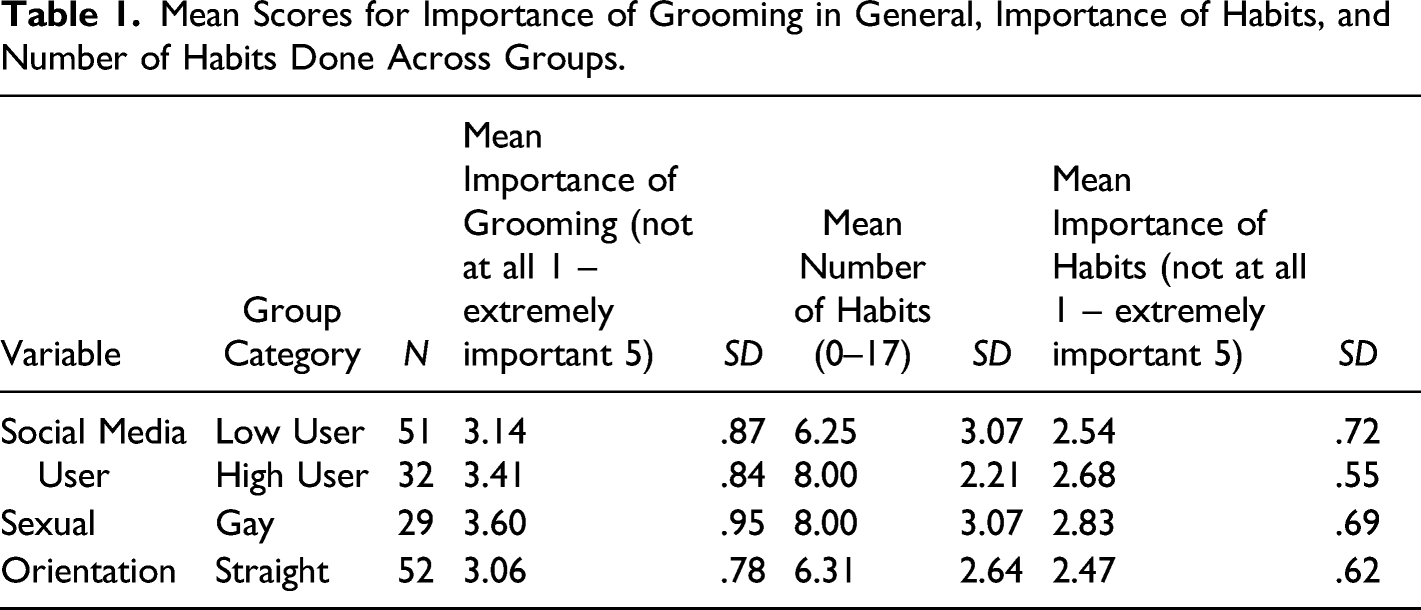
One-way ANOVAs were run, with level of social media 1 use (high/low) as the independent variable (IV), and importance attributed to grooming, importance of grooming habits, and number of habits typically carried out as dependent variables (DVs). The effect size of analyses were interpreted using the partial eta-square (ηp2) statistic at traditional cut-offs of small (.01), medium (.06), and large (.14). There was no significant difference for importance attributed to grooming, F (1,81) = 1.93, p =.169, ηp2 =.02, or importance of grooming habits, F (1,81) =.22, p = .788, ηp2 = .01. However, there was a significant main effect for number of habits carried out, F (1,81) = 7.49, p = .008, ηp2 = .09. Thus, H1 was partially supported since higher social media users were seen to carry out more grooming habits compared to low social media users.
Sexuality
Mean Scores for Importance of Grooming in General, Importance of Habits, and Number of Habits Done Across Groups.
Qualitative Analysis
Adopting a qualitative approach allowed us to delve further into participant interpretations of grooming expectations and influences. This line of enquiry permitted us to ask open-ended questions and build on our quantitative observations by allowing men to conceptualize and contemplate their bodywork in relation to the grooming realm. It provided an opportunity to explore reasons why higher social media users engaged in more grooming behaviors, and why gay men saw grooming as more important. Reflecting our quantitative findings, the subsequent analysis provides commentaries that echo our hypotheses: 1) seeing traditional media as a starting point for grooming standards, 2) social media as amplifying standards, and 3) sexuality as both freeing and constraining grooming behavior. Our inductive approach led to a fourth theme that built on quantitative findings and ran parallel to reflections on media influence and sexuality: 4) attraction as a component of managing status.
Traditional Media: A Starting Point for Grooming Standards
Participants frequently cited the media in influencing their own and other’s grooming behaviors. However, there was a distinction seen between traditional media influence, such as celebrities, sportspeople, television, advertising, and social media, including the effect of platforms and associated “influencers”
2
. In terms of traditional media, participants cited factors such as reality television stars as having an influence on how men felt they should aim to look. Reality television shows and advertising were frequently cited as setting certain standards, with men feeling they had to try keep up with or get close to the ideals portrayed by these platforms: Men are expected to fit a very narrow window of expected grooming standards, e.g., shaving adverts with muscular men going for a perfect clean shave. (Participant 39: Gay, 25-34) With the introduction of Love Island
3
every man has to have a six pack, fake tanned, head shaven down the sides and long on top. (Participant 74: Gay, 18-24) I think the attitude toward male grooming is shifting. It is becoming more accepted that a man may “groom” regularly. Particularly backed up by popular shows such as Love Island where the men are perfect each day. (Participant 18: Straight, 25-34)
It was also the case that some pressures on grooming behaviors specifically, such as the use of sun protection products, stemmed from what was discussed in the media, for instance the pressures to avoid or halt the aging process: I use moisturizer and SPF because of all the media warnings about premature skin aging. (Participant 46: Gay, 25-34)
Thus, men were aware of the influence of advertising and televised media on setting grooming standards; standards were seen as increasing and aiming for something nearer to perfection.
Social Media: Amplification and Blurring Boundaries of Reality
When turning to social media, platforms were perceived to have power to amplify the effect of traditional media. Celebrities may have influence through television, film, or sport to project a certain image, but it may be through accounts of less famous (but equally attractive) individuals that further spread a certain way to look/groom; often seen as prescribed or rigid. This might relate to a specific hairstyle, beard length, tan intensity, or body type. Social media influencers also affect my approach as they “influence” viewers on social media to by grooming products with ads on Instagram. (Participant 31: Gay 25-34) Models on tv and social media have quite a prescribed look and everyone seems to tend to gravitate towards that. Especially facial hair and hair. Almost seems to be a pressure to have some kind of facial hair. (Participant 87: Straight, 25-34)
There was a difference noted in what men might see and what they might seek in relation to grooming. The nature of social media platforms like Instagram and Facebook have made advertising and content delivery relating to this area more probable, and users may not always be aware of this marketing. This in turn may lead to men seeking certain products or striving to achieve certain appearance goals prevalent online, likely to have originated in the more traditional media channels (e.g., via celebrity looks or trends). Grooming attitudes and approaches are seen as filtering down from the celebrity realm to the public and as such may help provide an explanation as to why those who were seen as higher users of social media were shown to engage in more grooming behaviors. As a result, we see the boundaries blurred between highly edited adverts and televisual content and the influx of content suggesting a certain reality or attainability of looks. Use of social media may additionally portray some of generational differences considered here, in how younger men are more likely to be consumers of social media content, and thus more “in-the-know” about current grooming practices.
Gender, Sexuality, and Grooming: Freedom versus Constraints
The part played by sexuality and gender perceptions in relation to men’s grooming was highly prevalent throughout the data. Participants noted increasing pressures on men today and how these pressures might be starting to near those historically felt by women. However, there were differences in opinion across the sample, some suggesting a similarly in pressures experienced between genders, and others noting women still had a greater societal burden; men still having more freedom in how they could look: There’s a lot pressure on men to be perfectly groomed and to look a certain way, but compared to the expectations of women, men have it easy. (Participant 43: Straight, 25-34) I would say they are increasingly being viewed in the same way that expectations for women are. (Participant 10: Straight, 25-34)
As might be expected within this gender-centered discourse, discussion around masculinity and femininity was clear, such as what kinds of grooming might be acceptable for a man to remain masculine, and what areas might be reserved for more feminine endeavors: It still seems socially unacceptable for straight men to wear makeup - by society. This is sad - gender roles are clearly well entrenched. (Participant 67: Straight, 25-34) You might even say things are tougher for guys as they have the added expectation of looking good physically but also trying to avoid coming across as too feminine from overly caring about the way they look. (Participant 46; Gay, 25-34)
Interweaving within discussion were thoughts on sexual identity, and differences seen between gay and straight men. Both straight and gay men noted differences in how grooming might be approached by these groups. Gay men were seen to have the freedom to partake in the more feminine grooming acts, such as the use of makeup: “It is still seemed socially unacceptable for straight men to wear makeup” (Participant 67: Straight, 25-34)
However, gay men were also considered to have higher pressures or constraints on how they should look compared to straight men. This may help explain our quantitative findings related to higher importance of grooming and associated habits engaged in by gay men. Frequently, the expectations and standards of grooming were suggested to be higher for the gay community: …there is a higher expectation that gays should know better when it comes to grooming and we have to uphold those standards. (Participant 31: Gay, 25-34) …as a gay guy there’s a certain level of grooming expectations placed on you. If you’re gay and totally ungroomed that’d be seen as very strange. (Participant 46: Gay, 25-34) “Makeup and HD brows are important to me, I want to be myself but also be accepted amongst female friends and the gay community” (Participant 31: Gay, 25-34)
These examples show an interesting dichotomy, where gay men have increased freedom to groom as they wish but suffer from increased pressures to look good or fit in. Straight males were not seen as having as high expectations but must negotiate a balancing act between grooming to look good but not grooming so much it is perceived as feminine.
Attraction as a Component of Status Management
A theme that additionally ran alongside reflections on media influence and sexuality was associated with managing one’s level of attractiveness and how this related to status (e.g., in the dating or romantic marketplace). One of the main aims of grooming identified by participants was to attract a potential partner, or make sure a current partner continued to be attracted to you: I also think, stereotypically, it’s probably to do with my perception of how attractive I feel I am to potential partners. (Participant 83: Straight, 18-24) There becomes a sense that if males aren’t well groomed, they are less likely to find love. (Participant 13: Gay, 18-24)
Status and maintenance of a certain image played a key role here, where certain looks were deemed more desirable (as noted above). Younger men were also considered to experience more pressures here, in terms of increasing expectations as concepts of masculinity and bodywork change. Thoughts were not always restricted to issues of attraction, but also in gaining respect from others more generally: Younger men can become victims by feeling obliged/pressurized to buy ridiculously expensive products to maintain an image or be branded up is crazy really. (Participant 71: Straight, 45-54) I feel that if you look smart other persons react in a positive manner and seem to express more respect. (Participant 51: Straight, 55+)
In relation to this, various contexts to grooming there seen. For instance, a man might perform a greater level of grooming when dating or in a new relationship, compared to what he might do in a long-term relationship (e.g., managing body hair): You feel the pressure even more when single as you don’t really know how people will take the way you look or look after yourself like with body hair and stuff. (Participant 46: Gay, 25-34) The only person that sees any of my body hair is my partner. Previously when single, this sort of grooming has been important to me to make a good impression to others, however this has now dropped in importance due to feeling more comfortable with my partner. (Participant 13: Gay, 18-24)
These extracts demonstrate an inter-play between being seen as attractive and how certain behaviors (e.g., hair removal) may be more important in different contexts (e.g., when dating or in a new relationship). Comfort in one’s looks, and a reduction in grooming, are described alongside longer-term relationships, suggesting a level of discomfort and concern for one’s appearance when seeking potential partners as part of a single lifestyle. Looking attractive not only raised status in the romantic marketplace but changed how others viewed you.
Discussion
This study sought to provide insights into the importance men place on grooming today, in addition to exploring influences associated with grooming behaviors and how these are linked to aspects of social media use and sexuality. Quantitative findings suggested although there was no statistically significant difference in overall importance of grooming when comparing social media users, high users were found to carry out more grooming habits. This offered partial support for H1. Gay men considered grooming, and various aspects of this, as more important in comparison to straight males. Gay men were also found to engage in significantly more grooming behaviors. These findings offered support for H2.
The qualitative findings help explain and build on the quantitative results noted above. Pressures noted by gay participants linked with previous research exploring the influence of gay community involvement and additional body image burdens felt by this group (Carper et al., 2010; Tylka & Andorka, 2012). Findings tap into a societal discourse surrounding the expected grooming competence of gay men (Hart, 2004) and how this perception may increase pressures and behaviors done. Qualitative discussions linked with the greater appearance potency in gay culture noted by Jankowski et al. (2014) in UK gay magazines compared to those aimed at straight men. The influence of the gay community also chimes with similar observations in terms of changes in doing masculinity, and how this community has also set expectations for straight men regarding what good grooming looks like (Bridges, 2014; Cole, 2000; Frank, 2014; Gill et al., 2005).
Responses covered romantic endeavors and management of one’s attractiveness level. Such observations support findings from other UK-based work, where some men see grooming as allowing them to “get the girl” (Clarke & Braun, 2019). However, this finding conflicts with some characteristic remarks seen in this area of research, where men typically set their bodywork motives apart from a desire to look attractive or beautify themselves, since this would be considered “unmanly” (Gill et al., 2005; Scheibling & Lafrance, 2019). This may suggest men’s grooming identity functions are shifting. Our qualitative data also alludes to the importance of life phases in terms of attention paid to grooming. In relationships men may not put as much effort into their grooming due to comfort or relationship security. However, efforts must be made if they wish to couple-up as a single man. This focus on romantic success/influence may suggest when males consider their appearance, pressures link with the often cited “macho” hegemonic masculine identity, where competing in this way may be valued within society (Wetherell & Edley, 1999). As such, status is seen as a key factor in performance of masculinity in relation to one’s grooming, as has often been observed in research when men are conceptualizing their bodywork (Barber, 2008; Gill et al., 2005). Seeing grooming as something most men do nowadays may lead to belief in the existence of a new inclusive masculinity (Anderson & McCormack, 2018), but placing influences within the realm of romantic success and competition may actually demonstrate men warranting grooming with hegemonic masculinity. Bridges (2014) puts forward the concept of developing hybrid masculinity in considering men’s current aesthetic practices, where the boundaries between what is aesthetically straight, or gay may be blurred. This hybrid approach may be applicable here, in terms of inclusive and hegemonic balancing acts. Thus, influences are not just seen as descriptive, but serving a discursive purpose.
Considerations of attraction/attractiveness are also a product of media representations. The UK reality television show Love Island was mentioned by several participants as having an influence on appearance concerns today. Nichols (2019) stresses how the show promotes a certain aesthetic where masculinity is tied to the toned body. Additionally, with contestants being encouraged to “couple-up” to progress, the influence of being seen as attractive to succeed as well as the importance of finding a mate are reinforced. In fact, Love Island was sponsored by UK high street health and beauty retailer Superdrug, who also supplied products for the contestants to use. Although beyond the scope of this paper, Nichols (2019) noted how men from the Love Island generation are required to be both emotionally available but also aesthetically very masculine in order to succeed in heterosexual relationships. Behaviors that may have been considered overtly feminine or gay have been incorporated into this new form of masculinity and are consistent with cultural shifts in UK masculinity noted by Anderson and colleagues (e.g., Anderson & McCormack, 2018; Gaston et al., 2018; McCormack & Anderson, 2010). The influence of such a show on UK men cannot be understated. L’Hoiry (2019) noted that in the summer of 2018, Love Island content was often trending as the UK’s top discussion topic on Twitter. In addition, this frequently moved above conversation around the football/soccer World Cup, underway during that summer. This is no mean feat, considering the British passion for the sport. This blurring of boundaries between traditional media and public discussion highlights how shows such as Love Island have been able to adopt new forms of media to create multi-platform consumption (L’Hoiry, 2019). As such, viewers are likely to consume associated media beyond allotted timeslots, opening viewers up to further appearance comparisons.
Media influence from sources such as high-profile men in television, film and sport were mentioned in almost all qualitative accounts. These “looks” would be sought after, and likely filter down into the realm of social media where “influencers” would further promote a certain look. In our quantitative findings, higher social media users engaged in more grooming (H1), and this idea that social media consumption may lead to grooming uptake shows connections between these datasets and accounts. Participants noted an increase in visibility of highly groomed individuals on social media as well as companies advertising through influencer accounts. Essentially social media was increasing one’s peer and non-peer group pool for comparisons, linking with Fardouly et al. (2017) finding that social media provides more relevant comparison targets.
Some participants noted envious feelings associated with not being able to achieve a desired look (e.g., “beard envy”) as well as having to put more effort in for photos posted online. Barber (2008) research on men’s use of hair salons highlights this desire to achieve a certain fashionable look. Such styles may also hold certain masculine status functions, setting one apart from the “regular” man, for instance, the ability to grow a thick and defined beard (Dixson & Brooks, 2013). As noted, comparisons on social media are particularly concerning since sites can function for both comparison within one’s social circles and beyond. As such, the influence of such platforms in providing unrealistic image comparisons cannot be ignored (Credos, 2016; Rodgers et al., 2015; Uhlmann et al., 2019). A challenge for researchers and traditional body image models (such as the tripartite influence model) are that nuances associated with social media influence cannot be easily disentangled, since influences may be at play across a range of medias. For instance, as traditional media (such as television) increasingly integrate newer forms of media (e.g., promoting the use of hashtag discussions during live televised programming) this further complicates considerations regarding the locations of influence.
In today’s social media world, advertising is often a circular process. We cannot separate the influence of what is advertised on someone’s account, promoted due to search history/algorithms, or advertised more traditionally (e.g., on television or in print). Many men’s grooming advertisements draw on discourse around grooming as a “treatment,” or a means for romantic success, as opposed to being a beautification product (Barber, 2016; Scheibling & Lafrance, 2019). Our data highlighted how having a prescribed/polished look, maintaining one’s pubic hair, or preventing the signs of aging, may all influence how someone judges you. These discourses give men “permission” to beautify themselves both to be successful sexually as well manage themselves for reasons associated with health. As a result, traditional forms of masculinity are now being recast into an image-concerned consumer-orientated society (Hall et al., 2012).
In addition to an observed move towards grooming pressures akin to those experienced by women, men have an added consideration in terms of negotiating what is deemed manly or unmanly (Scheibling & Lafrance, 2019). Some participants alluded to this, in terms of makeup being too feminine in most instances (but more accepted for gay men) but growing and maintaining a beard being deemed more masculine. Clarke and Braun (2019) additionally highlight that it may not just be a distinction between gendered behaviors, but the extent of grooming carried out. Here even an accepted or expected grooming behavior like maintenance/removal of body hair could be conceived as vain or feminine if a man spends too much time on this endeavor. It is interesting to consider if the popular bearded look has been taken-up to alleviate the perceived ridicule of more feminine grooming (e.g., waxing, eyebrow shaping, and tanning). Alternatively, this could arguably demonstrate a tension between older and younger generations in terms of grooming and status management, incorporating a masculinity of clean shaving versus the masculine marker of a full beard (Scheibling & Lafrance, 2019). Turning to removal of body hair, this may demonstrate a desire to highlight one’s masculine body, since skin free of hair will emphasize muscle definition. This may also be seen to link with the more macho or heroic identity discussed by men in relation to masculinity (Wetherell & Edley, 1999) and allude to status functions discussed above, in terms of setting oneself apart from the typical man (Barber, 2008). Bennett and Gough (2013) UK men’s health forum research suggested that a man’s attention to appearance can be recast as an authentic masculine concern when framed in relation to muscle growth, much like participants here who signposted success in the dating marketplace as validating grooming efforts. Our data certainly alludes to a balancing act between traditionally masculine and feminine grooming habits. Promotion of prescribed looks suggests media and advertising norms are limiting options men have in their bodywork performance. As Rumsey (2008) has suggested, promotion of certain ideals within these industries lessens attempts to promote diversity in accepted images of beauty, aging, and desirability. This stands in contrast to some of the justifications from men in Gill et al. (2005) work, where autonomy and individuality were seen as features of bodywork.
Limitations and Future Research
This study only provides a snapshot into men’s grooming behaviors. It has strength in the mixed method approach, but self-reports will always suffer from the likelihood of socially desirable responses. The exploratory quantitative questions were not based on previously tested scales and developing latent variable measures (as opposed to single-item) would have offered more robust validity and reliability. From a purely quantitative perspective, this study comprises a small and under-powered sample; meaning sub-group comparisons may be problematic. As such, statistical interpretations should be considered with caution. From a qualitative standpoint, detail provided by the substantial open-ended survey responses provided a solid basis for supporting such findings. However, although providing more depth, the qualitative survey method cannot follow-up on accounts from individuals as in face-to-face approaches (Terry & Braun, 2016). Although part of this study’s focus was to consider social media use, we should note men on these platforms will not be fully representative of all men. Future research may want to consider designs that further unpack perceptions related to male appearance both generally, and in relation to social media consumption (e.g., experimental designs utilizing associated stimuli). Future work would also do well to explore the circular processes involved in advertising and promotion on social media, since what one sees is now often a product of their social media use/history. Our findings relating to the gay community suggest a need to explore such perspectives further in this potentially vulnerable group. It may be that associations between discourse surrounding the gay community and social media use could have a magnifying effect on pressures or feelings of self-worth. As such, researchers may wish to consider how the level of affinity with this community and media engagement may be linked to bodywork. Findings here also relate to a UK sample only. Additional influences may be at play in alternative locations and cultures. Finally, if one is to consider the societal level of influence associated with male appearance, it would also be fruitful to consider social constructions of such concerns in focus group/discussion settings, so shared meanings can be explored.
Conclusion
This study has shown that men from the UK experience various pressures in relation to their grooming. Participants discussed the role played by various media cultures on the way they feel about their looks, and how there may be different levels of expectation dependent on relationship or sexual identity. Gay men were seen to hold stronger views on the importance of grooming and noted pressures to conform to a certain level of grooming in qualitative accounts, which was often reinforced online. Higher users of social media also engaged in more grooming. Despite nuances across groups in our sample, the relative similarities discussed in relation to expectations discussed signal how popular culture transmitted via the media and the grooming industry have successfully marketed pressures to a greater variety of men today, with most men feeling they must meet heightened appearance standards and portray certain looks. If we wish to promote more positive and diverse outlooks on our bodies, we must tackle attitudes towards appearance within society. There is still much to do if we are to confront the damaging effects various platforms or prevailing discourses can have. Media literacy programs, especially to educate young people, are needed to target idealized and edited content as well as destructive discourse or ways of thinking. Education programs may also need tailoring to the differing needs of young men (and gay men). Given the prevalence of concerns centering on appearance and image, work in this area will have a positive and enduring impact on everybody’s health and wellbeing.
Footnotes
Declaration of Conflicting Interests
The authors declared no potential conflicts of interest with respect to the research, authorship, and/or publication of this article.
Funding
The authors received no financial support for the research, authorship, and/or publication of this article.
