



Abstract
Traditional masculinity norms are generally defined as hegemonic because they contribute to maintaining men’s favorable position in the gender hierarchy. Nevertheless, many observers argue that traditional masculinity norms are fading away under the pressure of feminist movements and are being replaced by more progressive, non-hegemonic masculinity norms. The present research examines men’s perceptions of how traditional masculinity norms are viewed by three reference groups: society as a whole, other men, and women. We assessed these perceptions via two experiments based on the self-presentation paradigm and involving American (N = 161) or British (N = 160) men. Participants in both experiments perceived traditional masculinity as being valued by other men but not by society as a whole or by women. We discuss the implications of these findings in the light of current changes in masculinity norms.
In October 2018 the English journalist Piers Morgan mocked James Bond actor Daniel Craig for carrying his daughter in a baby sling. Morgan’s comment that Daniel Craig was an “emasculated Bond” (Heritage, 2018) conforms to the so-called traditional masculinity idea of how men should behave. Although masculinity norms take different forms in different cultural and social contexts (Arciniega et al., 2008; Doss & Hopkins, 1998; Janey et al., 2013), Western traditional norms are usually considered hegemonic because they contribute to maintaining men’s favorable position in the gender hierarchy (Connell 1995; Connell & Messerschmidt, 2005; Messerschmidt, 2019). At the same time, these norms have detrimental effects for men. For example, men’s tendency to conform to these norms means they are more likely than women to be victims of violent crimes, be imprisoned, or die from traffic accidents (see American Psychological Association Boys and Men Guidelines Group, 2018).
Many scholars argue that traditional masculinity norms are dying out (Thompson & Bennett, 2015; Wade, 2015) as a result of feminist movements advocating greater equality between men and women and challenging traditional views of gender (Bohan, 1993). In other words, the traditional masculinity norms prevalent before the emergence of feminism would be replaced by more “progressive” masculinity norms (Anderson & McCormack, 2018; Buschmeyer, 2013; Flecha et al., 2013; Padgett, 2017). Reactions to Piers Morgan’s comment about James Bond support this point of view, as some people, both men and women, derided the idea that wearing a baby sling is incompatible with masculinity and claimed that it is something “James Bond would do.” Further evidence for the decline of traditional masculinity norms is provided by the relatively low scores on traditional masculinity scales reported by many studies, which suggest that men (and women) tend to disagree with items reflecting traditional masculinity (Smiler, 2004; Thompson & Bennett, 2015). However, most research has focused on inter-individual differences in the endorsement of traditional masculinity norms and has tended to overlook perceptions of how they are viewed by others (i.e., whether men perceive other groups as valuing traditional masculinity; for a commentary on this issue, see Wong et al., 2013). This issue is of great importance, as men’s propensity to comply with traditional expectations will depend on whether they perceive traditional masculinity to be valued by society as a whole. If society is no longer perceived as valuing these norms, men have no reason to follow them. Hence, the present study’s first aim was to determine whether or not men feel that society still values traditional masculinity norms.
However, what is perceived to be valued by society as a whole is not necessarily seen as being valued by all subgroups of people. Because local groups (e.g., family, university peers, religious peers, work colleagues) may be perceived as favoring different kinds of masculinity (Wong et al., 2013), we also examined men’s perceptions of how these norms are valued by two socially-relevant reference groups, that is, whose perspective is used as a frame of reference by the actor (Shibutani, 1955): other men (ingroup) and women (outgroup). Although the issue of whether men perceive traditional masculinity as valued by the two gender groups has never been studied, to the best of our knowledge, there are reasons to believe that men do not perceive women and men as valuing traditional masculinity to the same extent. For example, many adolescent males report being particularly pressured to endorse traditional masculinity when they are with other boys (Duckworth & Trautner, 2019), and men feel greater discomfort when they imagine themselves performing a behavior typical of women (which is proscribed by traditional masculinity norms) in front of other men than when they do so in front of women (Bosson et al., 2006). In addition, traditional forms of masculinity are less valued by women than by men (Levant & Richmond, 2007; Maltby & Day, 2001). Hence, it would seem reasonable to infer that men will tend to perceive both society as a whole and women as not valuing traditional masculinity, but perceive other men as valuing it.
Present Research
Across two experiments, the present research examined whether men perceive traditional masculinity to be valued by three reference groups: society as a whole, women, and other men. We based our methodology on the self-presentation paradigm (Jellison & Green, 1981), which can be used to examine perceptions of societal norms (i.e., norms prevalent in society as a whole; Félonneau & Becker, 2008; Jellison & Green, 1981) and local norms (norms specific to a group Dubois & Beauvois, 2005; Pillaud et al., 2013), and to compare norms attributed to different reference groups (Iacoviello & Spears, 2018). Studies using the self-presentation paradigm typically ask participants to provide three sets of responses to a scale of items referring to a certain issue, with each set of responses given in accordance with a specific instruction. First, participants are asked to give their personal opinion (standard instruction). They are then asked to respond in such a way as to generate a positive impression of themselves in the eyes of a reference group (self-enhancement instruction). Finally, they are asked to respond in such a way as to generate a negative impression of themselves in the eyes of the same reference group (self-depreciation instruction). A higher score under the self-enhancement instruction than under the self-depreciation instruction shows that an individual perceives the reference group as valuing the issue (i.e., it is normative).
The items in our two experiments referred to traditional masculinity. Before completing the items, each participant was assigned to one of the three experimental conditions, which differed in terms of the reference group the participant had to think of when giving a positive and negative impression of himself. The three reference groups were society as a whole (society condition), other men (ingroup condition), and women (outgroup condition). The difference between each participant’s score under the self-enhancement instruction (self-enhancement score) and under the self-depreciation instruction (self-depreciation score) indicated the extent to which that participant perceived traditional masculinity as valued by his assigned reference group.
We hypothesized that men would perceive traditional masculinity as not being valued either by society as a whole or by women (outgroup), but as being valued by other men (ingroup). Hence, we expected self-enhancement scores to be similar to self-depreciation scores in the society and outgroup conditions but higher than self-depreciation scores in the ingroup condition. We tested this hypothesis for overall perceptions of traditional masculinity. We also examined perceptions of ten specific traditional masculinity norms, but without advancing any hypotheses regarding them.
In addition to testing our main hypothesis, we used participants’ responses under the standard instruction to assess the extent to which they endorsed traditional masculinity. Doing so enabled us to examine the extent to which men’s self-descriptions are influenced by their perceptions of how each reference group (society as a whole, men, women) values traditional masculinity. However, we did not formulate any specific hypothesis in this case since previous studies suggest two possibilities. According to self-categorization theory (Turner et al., 1987) and a number of supporting studies (e.g., Miller & Prentice, 1996; Van Knippenberg & Wilke, 1992), men’s self-descriptions should be influenced primarily by the ingroup. Conversely, given that interdependencies between individuals define opportunities and constraints, interacting individuals often influence each other (Kelley & Thibaut, 1978; Rusbult & Arriaga, 1997). Therefore, the social interdependence between men and women (Glick & Fiske, 2001), created by the fact that men interact with women (and not just with other men) every day, may motivate men to respond to norms promoted by women and by society as a whole, as well as to prescriptions from the ingroup. Consequently, all three reference groups may be equally influential.
Experiment 1
Experiment 1 used the self-presentation paradigm to determine whether a sample of American men perceived traditional masculinity as valued by society as a whole, by men (ingroup), and by women (outgroup). We also examined the relationship between participants’ self-descriptions and their perceptions of the extent to which each reference group values traditional masculinity.
Method
Participants
We used Amazon’s Mechanical Turk to recruit a sample of American men to take part in an online survey. Participants received US$0.80 in compensation for their time. As recommended by Simmons et al. (2013), we aimed to recruit approximately 50 participants per experimental condition. In the end, 173 participants completed the online questionnaire. Because heterosexuality is one of the most relevant dimension of masculinity (e.g., Bosson et al., 2006; Falomir-Pichastor et al., 2019; Herek, 1986), and because gay men (as compared with heterosexual men) are likely to interpret and react very differently to items regarding the ‘negativity toward sexual minorities’ and ‘disdain for homosexuals’ dimensions of traditional masculinity, the present research focuses on heterosexual male participants. Consequently, we excluded participants who said they were not heterosexual (n = 10). 1 Excluding a further two participants who reported being not sincere and/or not focused when answering the questionnaire gave us a final sample of 161 American heterosexual male participants (Mage = 40.53 years, SDage = 12.30). Most of our participants identified as non-Hispanic/non-Latino White (70.8%). The others reported being Asian American (9.3%), Hispanic/Latino White (9.3%), African American (6.8%), Native American (2.5%), or Multiracial (0.6%). One participant did not report his race. We assigned each participant randomly to one of three experimental conditions in a between-participants design (reference group: ingroup vs. outgroup vs. society). A sensitivity analysis in G*Power indicated that the final sample size gives us an 80% probability of detecting effects with a size of ηp2 = 0.058 (d = 0.49) or greater. Thus, our sample was large enough to detect medium-size effects.
Procedure
In line with the self-presentation paradigm, we began by asking participants to give their personal opinions on a 20-item scale describing ten traditional masculinity norms (standard instruction). Responses to all the items were given on 7-point scales ranging from one (completely disagree) to seven (completely agree). 2 The following two pages asked participants to respond to the same items in such a way as to make a positive impression on another group (self-enhancement instruction) and then in such a way as to make a negative impression on the same group (self-depreciation instruction). After responding to this three sets of twenty items, participants provided demographic information and answered two yes-no questions to check if they had been sincere and focused when completing the questionnaire. Before answering these last two questions, participants were told that they would receive the US$0.80 compensation regardless of their answers. Finally, we debriefed participants about the purpose of the experiment and asked them to consent to their data being used.
Dependent variables
We used traditional masculinity scores under the standard instruction as a measure of personal endorsement of traditional masculinity and assessed participants’ perceptions of how the different reference groups value traditional masculinity by subtracting self-depreciation scores from self-enhancement scores.
Self-descriptions
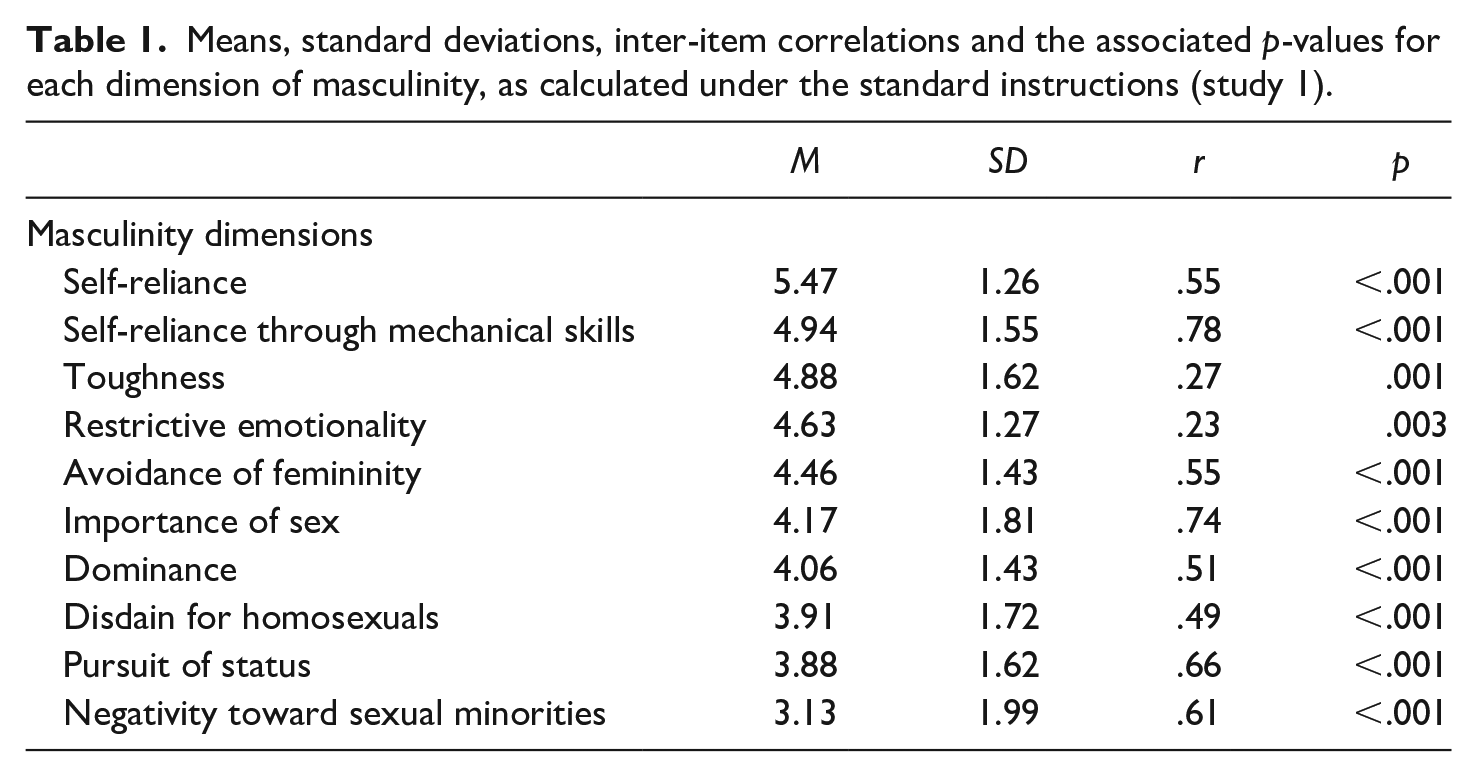
The standard instruction asked participants to indicate the extent to which they agreed with 20 items describing 10 traditional masculinity norms (two items per norm, see Appendix A for a full list of the items). 3 We created the items specifically for our study and expressed them in the first person in order to measure self-descriptions. Seven of the norms corresponded to the norms in Levant et al. (2013) Male Role Norms Inventory–Short Form (MRNI-SF; i.e., Restrictive Emotionality, Self-Reliance through Mechanical Skills, Negativity toward Sexual Minorities, Avoidance of Femininity, Importance of Sex, Dominance, Toughness). The remaining three norms corresponded to norms within Mahalik et al.’s (2003) Conformity to Masculine Norms Inventory (CMNI; i.e., Disdain for Homosexuals, Self-Reliance, Pursuit of Status). After recoding, we computed a personal endorsement of traditional masculinity index (α = .86, M = 4.35, SD = 0.91). Table 1 shows means, standard deviations, and inter-item correlations for each norm; correlations between the norms are shown in Table 2.
Means, standard deviations, inter-item correlations and the associated p-values for each dimension of masculinity, as calculated under the standard instructions (study 1).
Correlations between the dimensions of traditional masculinity as measured under the standard instructions (study 1).
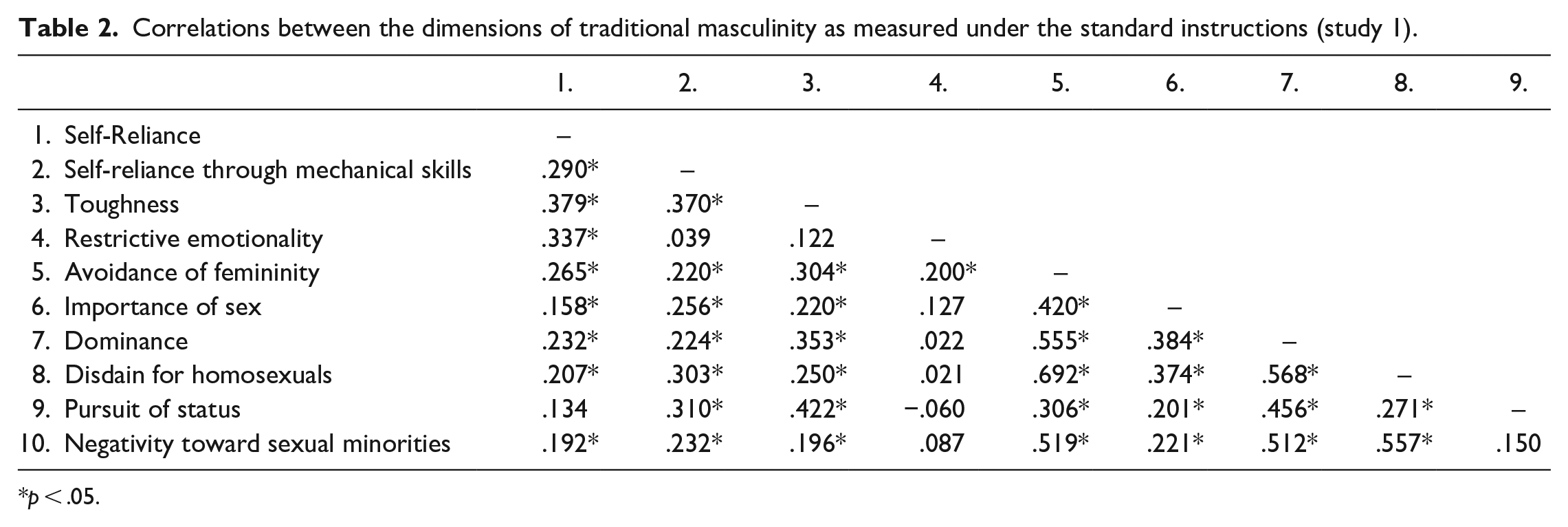
p < .05.
Perceptions of Whether Reference Groups Value Traditional Masculinity
Participants completed the same 20 items under the self-enhancement and self-depreciation instructions with reference either to society as a whole (society condition), to other men (ingroup condition), or to women (outgroup condition), depending on the experimental condition. In the society condition [instructions for the ingroup and outgroup conditions are shown in brackets], the self-enhancement instruction was: “We would like you to complete the questionnaire in such a way to generate a good image of yourself in the eyes of people in general [other men; women]. More specifically, we ask you to answer as if you were attempting to get people in general [other men; women] to like and approve of you.” The self-depreciation instruction was: “We would like you to complete the questionnaire in such a way to generate a bad image of yourself in the eyes of people in general [other men; women]. More specifically, we ask you to answer as if you were attempting to get people in general [other men; women] to dislike and disapprove of you.”
After recoding, we calculated a perception of traditional masculinity index for each participant by averaging his self-enhancement responses for each item (α = .90, M = 4.86, SD = 1.09) and his self-depreciation responses for each item (α = .93, M = 3.49, SD = 1.58), and then subtracting his mean self-depreciation score from his mean self-enhancement score (Iacoviello & Spears, 2018). Thus, a positive perception of traditional masculinity index indicated that the participant perceived his reference group as valuing traditional masculinity (i.e., endorsing traditional masculinity is normative), whereas a negative perception of traditional masculinity index indicated that the participant perceived his reference group as valuing the rejection of traditional masculinity (i.e., endorsing traditional masculinity is counter-normative). A perception of traditional masculinity index of 0 indicated that the participant perceived his reference group as not valuing traditional masculinity (i.e., endorsing traditional masculinity is non-normative).
Next, we used a similar procedure to examine participants’ perceptions of the extent to which their reference group valued each of the ten traditional masculinity norms. Because all the inter-item correlations for the ten norms under the standard instruction were significant (see Table 1), we averaged each participant’s two responses for each norm under the self-enhancement instruction and under the self-depreciation instruction. We then computed a perception index for each norm by subtracting each mean self-depreciation score from each mean self-enhancement score. 4
Results
We tested our hypothesis by first analyzing results for perceptions of the extent to which three reference groups value traditional masculinity. We then examined the relationship between these perceptions and self-descriptions (i.e., endorsement of traditional masculinity) in order to assess the extent to which participants’ self-descriptions conformed to their perceptions of how their reference group valued traditional masculinity.
Perceptions of Traditional Masculinity as a Whole
We performed an ANOVA on the perception of traditional masculinity index, with reference group (ingroup vs. outgroup vs. society) as a between-participants factor. The main effect of reference group was significant, F(2,158) = 26.39, p < .001, ηp2 = .25, showing that participants perceived different reference groups as having different attitudes toward traditional masculinity. In line with our hypothesis, the perception of traditional masculinity index in the society condition was not different from 0 (M = 0.36, SE = 0.30), F(1,158) = 1.44, p = .232, ηp2 = .01, but this index differed significantly from perception of the traditional masculinity index in the ingroup condition, p < .001, 95% CI [−3.39, −1.79], which was positive and different from 0 (M = 2.95, SE = 0.27), F(1,158) = 118.09, p < .001, ηp2 = .42. Although the perception of masculinity index in the outgroup condition was also positive and different from 0 (M = 0.62, SE = 0.27), F(1,158) = 5.28, p = .023, ηp2 = 0.03), it did not differ from the index in the society condition, p = .528, 95% CI [−0.54, 1.06], and was lower than the index in the ingroup condition, p < .001, 95% CI [−3.09, −1.58] (see Table 3).
Means and standard errors (in parentheses) for perception of the overall traditional masculinity norm and the respective sub-dimensions according to the reference groups (study 1).
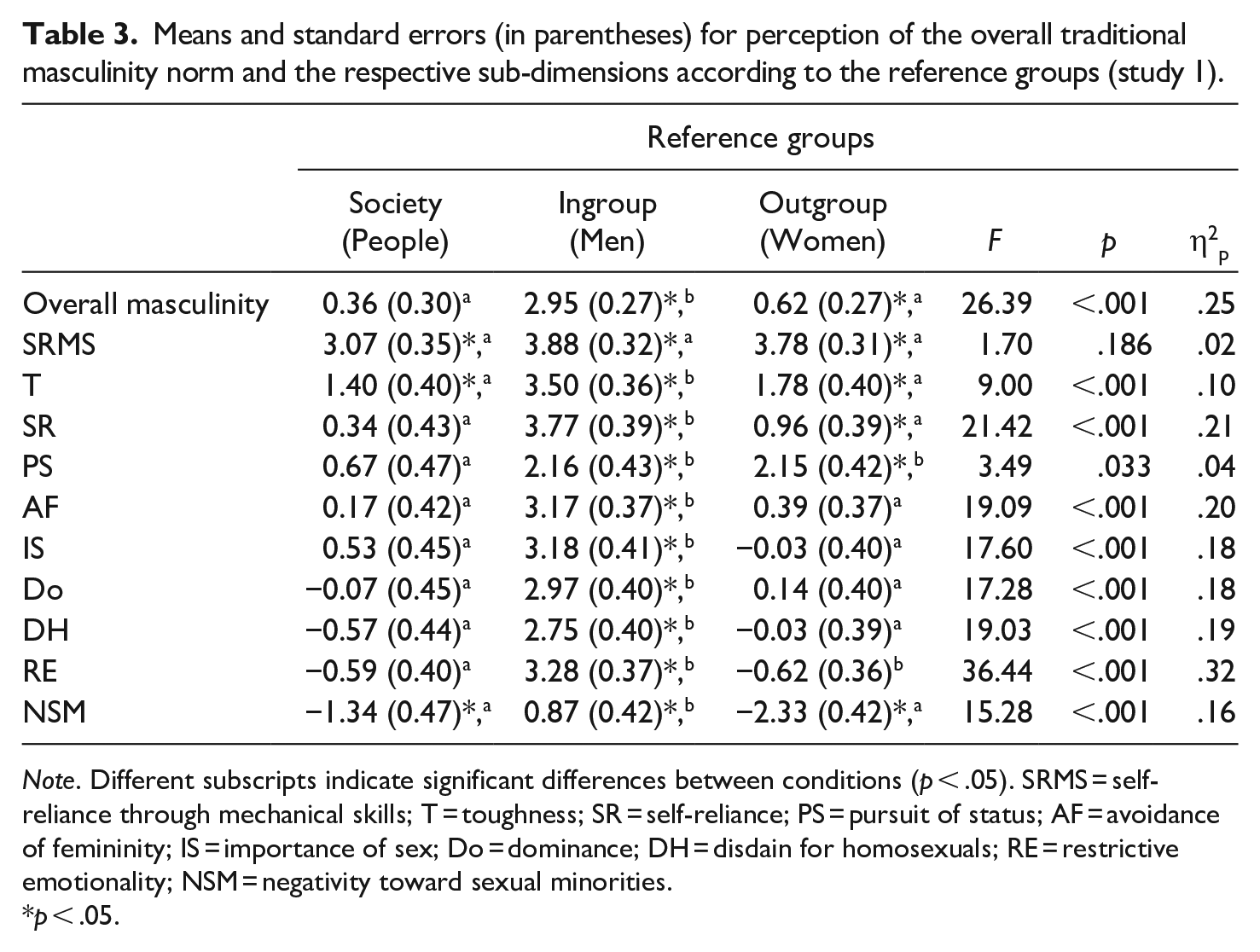
Note. Different subscripts indicate significant differences between conditions (p < .05). SRMS = self-reliance through mechanical skills; T = toughness; SR = self-reliance; PS = pursuit of status; AF = avoidance of femininity; IS = importance of sex; Do = dominance; DH = disdain for homosexuals; RE = restrictive emotionality; NSM = negativity toward sexual minorities.
p < .05.
Perception of Specific Traditional Masculinity Norms
We performed full-factorial ANOVAs on the perception indices for each of the ten traditional masculinity norms, with reference group (society vs. ingroup vs. outgroup) as a between-participants factor. Participants in the society condition perceived society as a whole as valuing only two of the ten norms (Self-Reliance through Mechanical Skills, Toughness), whereas they perceived society as considering seven of the norms to be non-normative (Self-Reliance, Pursuit of Status, Avoidance of Femininity, Importance of Sex, Dominance, Disdain for Homosexuals, Restrictive Emotionality) and one norm (Negativity toward Sexual Minorities) to be counter-normative (Table 3). We obtained similar results for participants in the outgroup condition, except that they perceived women as also valuing Pursuit of Status. Participants in the ingroup condition perceived all the norms as being valued by men.
Self-Descriptions
In order to examine conformity dynamics, we looked at the relationship between the perception of the reference groups’ attitudes toward traditional masculinity and self-descriptions. Thus, we investigated whether this relationship depended on the reference group (i.e., whether participants’ self-descriptions matched a specific reference group’s perceived norm). We first computed two Helmert contrasts with reference group as the contrasted variable. In line with our main hypothesis, results showed that the ingroup was perceived as having a different norm to both the outgroup and society as a whole. Therefore, the first contrast (C1) compared the ingroup condition (coded +2) with the outgroup and society conditions (both coded -1). This contrast would indicate whether self-descriptions differ between the ingroup condition on the one hand and both the outgroup and society conditions on the other hand. The second contrast (C2) compared the outgroup condition (coded +1) with the society condition (coded -1); the ingroup condition was coded 0. This second contrast would indicate whether participants report different self-descriptions when the reference group is the outgroup than when the reference group is the society as a whole.
We then performed a linear regression analysis on self-descriptions with reference group’s perceived masculinity norm (centered continuous variable), C1, C2, and their interactions (except those including the two orthogonal contrasts) as predictors. Perceived masculinity norm was positively linked to personal endorsement of this norm, β = 0.15, t(155) = 4.29, p < .001, 95% CI [0.08, 0.21]. This effect was not moderated by C1, β = −0.02, t(155) = −0.67, p = .502, 95% CI [−0.06, 0.03], or by C2, β = −.00, t(155) = −0.04, p = .969, 95% CI [−0.09, 0.09]. These findings show that participants’ personal endorsement of traditional masculinity was positively linked to their perceptions of the extent to which their reference group values traditional masculinity, regardless of the reference group.
Discussion
The results of Experiment 1 supported our hypothesis by showing that male participants perceived traditional masculinity as not being valued by society but as being valued by other men. Moreover, they perceived women’s attitudes toward traditional masculinity to be more similar to those of society as a whole than to those of men, even though there was a weak but significant tendency to perceive women as valuing traditional masculinity. This was mainly due to participants perceiving women as valuing three specific traditional masculinity norms (Self-Reliance through Mechanical Skills, Toughness, Pursuit of Status), even though they were not perceived as valuing the other seven norms we measured. Finally, participants’ endorsements of traditional masculinity (i.e., self-descriptions) were related to their perceptions of the extent to which their reference group values this norm and this was the case for all three reference groups. This last finding could be interpreted as preliminary evidence for perceived ingroup norm, perceived outgroup norm, and perceived society norm playing a combined role in shaping men’s self-views. Before interpreting these findings further, we replicated our experiment in a different cultural setting: the United Kingdom.
Experiment 2
Method
Participants
We recruited 175 British men to take part in an online experiment via the Prolific crowdsourcing platform. As in Experiment 1, our aim was to have approximately 50 participants per experimental condition. Each participant received £1.40 in exchange for their time. Excluding participants who reported being non-heterosexual (n = 12) and those who reported not been sincere and/or focused when answering the questionnaire (n = 3) gave us a final sample of 160 participants (Mage = 36.85 years, SDage = 12.64), all of whom were British, although four said they were currently living outside the UK (in Finland, Hungary, New Zealand, and Spain). 5
A sensitivity analysis in G*Power indicated that a sample of this size gives us an 80% probability of detecting effects with a size of ηp2 = .053 or greater. Because the effect size of differences in perceptions of the reference groups’ attitudes toward traditional masculinity norms obtained in Experiment 1 (ηp2 = .25) was greater than this threshold, our sample has sufficient power to detect the investigated effect.
Procedure
We followed an identical procedure to Experiment 1, with the same items assessing traditional masculinity under the self-description, self-enhancement and self-depreciation instructions as a within-subjects factor. Each participant was randomly assigned to one of the three independent conditions (i.e., reference group: society, ingroup, outgroup). Once they had completed the items under the three instructions, they provided demographic information and answered the two questions assessing whether they had been sincere and focused when answering the questionnaire. Finally, they were debriefed about the purpose of the experiment and asked to consent to their data being used. Answers to all the items were given on 7-point scales ranging from 1 (“Completely disagree”) to 7 (“Completely agree”).
Dependent variables
Self-descriptions
After recoding, we used each participant’s responses to the items under the standard instruction to compute a traditional masculinity index (α = .79, M = 4.05, SD = 0.70). 6
Perception of masculinity norms
We also computed indices for overall perceptions of traditional masculinity and perceptions of each of the ten masculinity norms. For overall perception of traditional masculinity, we subtracted each participant’s mean score under the self-depreciation instruction (α = .90, M = 3.95, SD = 1.46) from his mean score under the self-enhancement instruction (α = .90, M = 4.50, SD = 1.01), as in Experiment 1. Thus, a positive index shows that masculinity is perceived as normative, an index of zero shows that masculinity is perceived as non-normative and a negative index shows that masculinity is perceived as counter-normative.
For the ten specific traditional masculinity norms, we began by calculating mean scores for each norm (two items per norm) under the self-enhancement instruction and under the self-depreciation instruction. Because all the inter-item correlations were significant under the standard instruction, we computed a perception score for each norm by subtracting the mean score under the self-depreciation instruction from the mean score under the self-enhancement instruction. Means, standard deviations, and inter-item correlations for each norm are shown in Table 4. Correlations between the norms are shown in Table 5.
Means, standard deviations, inter-item correlations and the associated p-values for each dimension of masculinity, as calculated under the standard instructions (study 2).
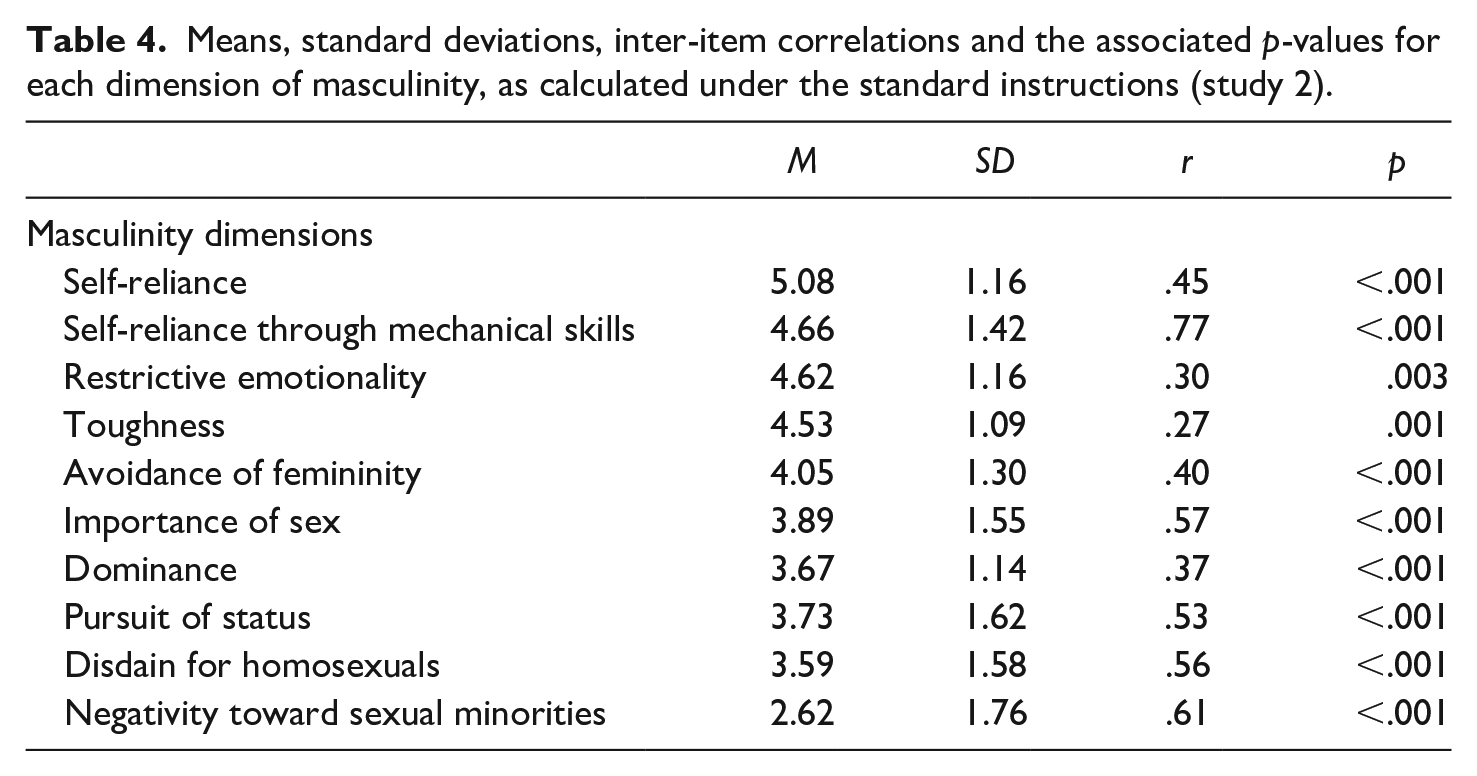
Correlations between the dimensions of traditional masculinity as measured under the standard instructions (study 2).
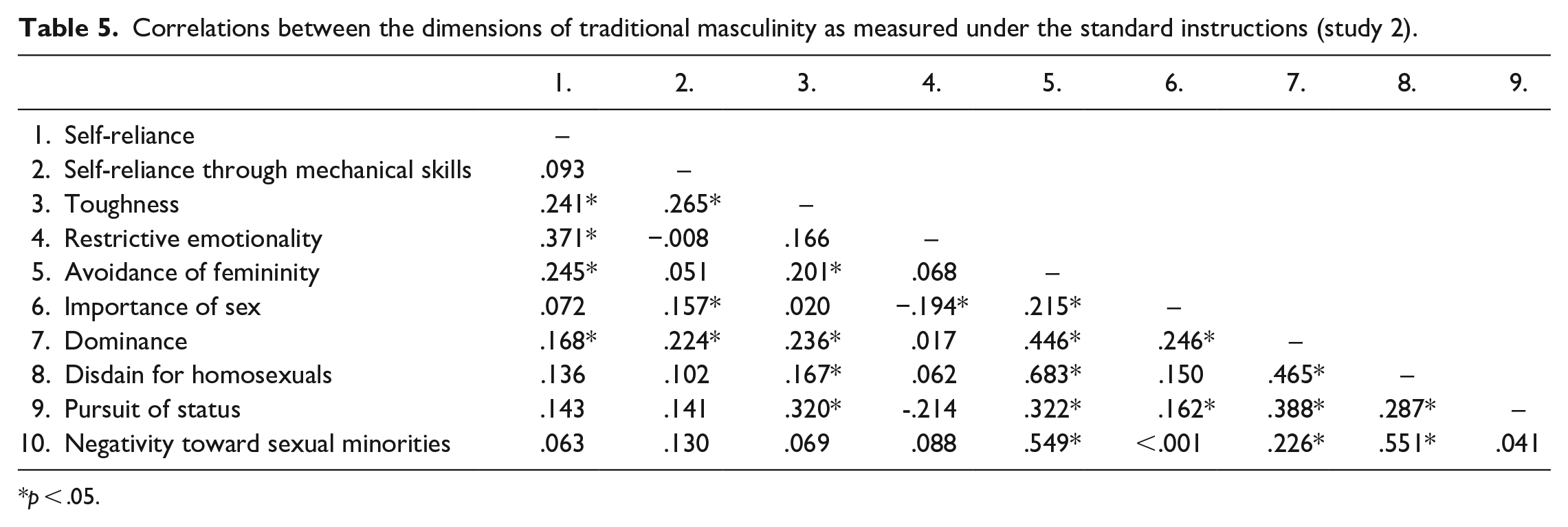
p < .05.
Results
As in Experiment 1, we first looked at perceptions of the three reference groups’ attitudes toward traditional masculinity and then examined the relationship between these perceptions and participants’ self-descriptions (i.e., personal endorsement of masculinity) in order to assess whether these self-descriptions were influenced by participants’ perceptions of the extent to which their reference group values traditional masculinity.
Perceptions of Traditional Masculinity as a Whole
An ANOVA on the perception of traditional masculinity index, with reference group (ingroup vs. outgroup vs. society) as a between-participants factor, showed a significant main effect of reference group, F(2,157) = 36.97, p < .001, ηp2 = .32, indicating that the three reference groups were perceived as having different attitudes toward traditional masculinity. In line with our hypothesis, the perception of traditional masculinity index in the society condition were not different from 0 (M = −0.32, SE = 0.25), F(1,157) = 1.65, p = .201, ηp2 = .01, but differed significantly from the index in the ingroup condition, p < .001, 95% CI [−3.31, −1.91], which was positive and different from 0 (M = 2.28, SE = 0.25), F(1,157) = 85.13, p < .001. Moreover, the perception of traditional masculinity index in the outgroup condition was not different from 0 (M = −0.34, SE = 0.25), F(1,157) = 1.87, p = .174, ηp2 = .01. This index did not differ from the index in the society condition, p = .969, 95% CI [−0.68, 0.71], and was lower than the index in the ingroup condition, p < .001, 95% CI [−3.31, −1.93] (see Table 6).
Means and standard errors (in parentheses) for perception of traditional masculinity norms as a whole and the specific dimensions according to the reference groups (study 2).
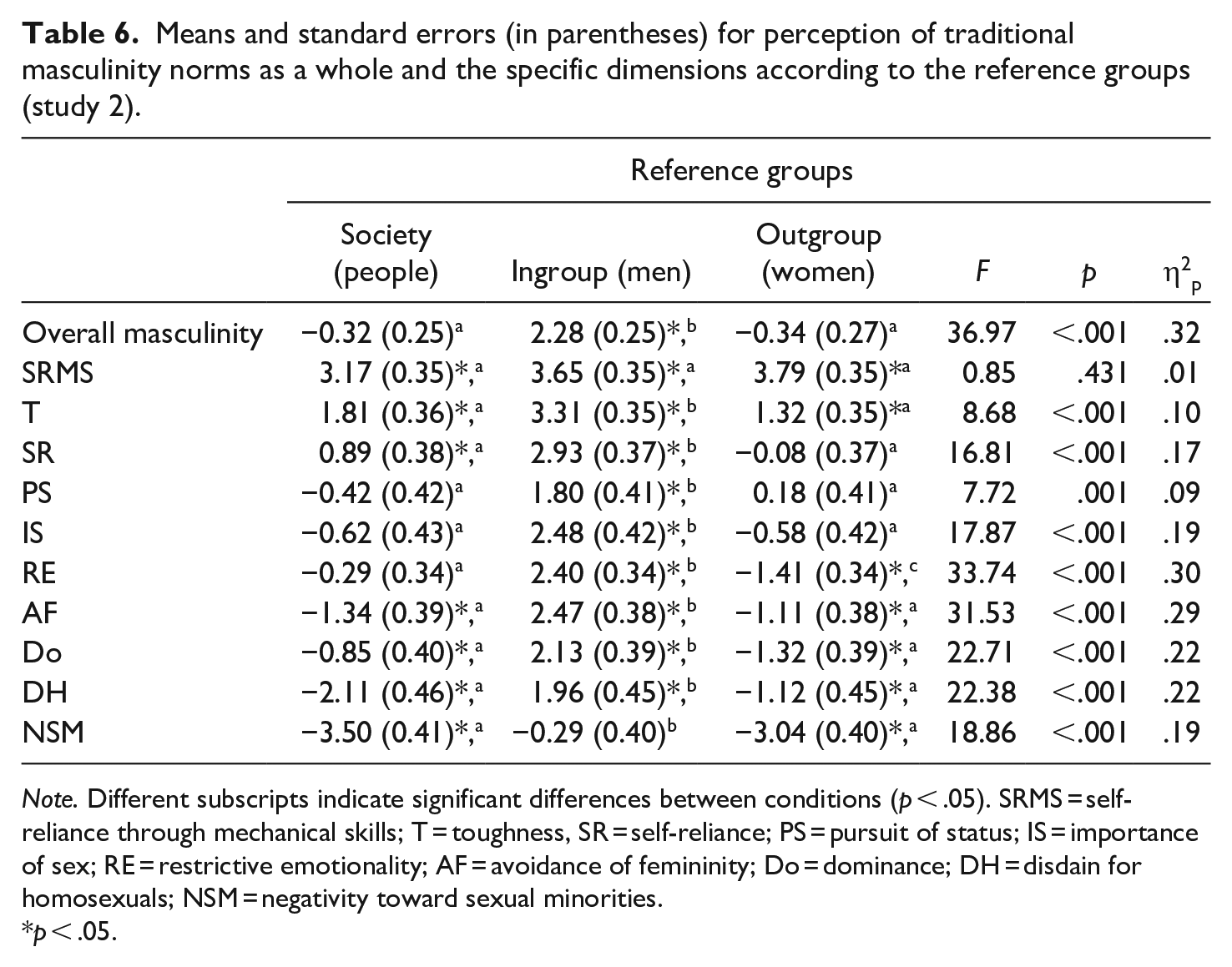
Note. Different subscripts indicate significant differences between conditions (p < .05). SRMS = self-reliance through mechanical skills; T = toughness, SR = self-reliance; PS = pursuit of status; IS = importance of sex; RE = restrictive emotionality; AF = avoidance of femininity; Do = dominance; DH = disdain for homosexuals; NSM = negativity toward sexual minorities.
p < .05.
Perceptions of Specific Masculinity Norms
We also performed a series of full-factorial ANOVAs on the perception indices for each masculinity norm, with reference group (society vs. ingroup vs. outgroup) as a between-participants factor. As Table 6 shows, participants perceived society as valuing only three of the ten norms (Self-Reliance through Mechanical Skills, Toughness, Self-Reliance), as considering three norms to be non-normative (i.e., Pursuit of Status, Importance of Sex, Restrictive Emotionality), and as considering four norms to be counter-normative (Avoidance of Femininity, Dominance, Disdain for Homosexuals, Negativity toward Sexual Minorities). Participants in the outgroup condition had similar perceptions of the ten norms, except for Self-Reliance, which was perceived to be non-normative, and Restrictive Emotionality, which was perceived to be normative. Participants in the ingroup condition perceived all of the norms to be normative, except for Negativity toward Sexual Minorities, which was perceived to be non-normative.
Self-Descriptions
As in Experiment 1, we computed two Helmert contrasts with the reference groups. The first contrast (C1) compared the ingroup condition (coded +2) to the outgroup and society conditions (both coded -1). The second contrast (C2) compared the outgroup condition (coded +1) to the society condition (coded -1), with the ingroup condition being coded 0. We then performed a linear regression analysis on participants’ self-descriptions, with perception of value attributed to traditional masculinity (centered continuous variable), C1, C2 and their interactions (except those including the two orthogonal contrasts) as predictors. Results showed a positive link between participants’ self-descriptions and their perceptions of the value attributed to traditional masculinity, β = .13, t(154) = 4.26, p < .001, 95% CI [0.07, 0.19]. This effect was not moderated either by C1, β = −.02, t(154) = −1.08, p = .280, 95% CI [−0.06, 0.02], or by C2, β = .04, t(154) = 0.97, p = .334, 95% CI [−0.04, 0.12]. These findings are in line with those observed in Experiment 1 and suggest that endorsement of traditional masculinity is positively associated with perceptions of the extent to which the reference group values traditional masculinity, and this is the case for all three reference groups.
Discussion
In line with our hypothesis, participants in Experiment 2 perceived traditional masculinity as being valued by men, but not by society as a whole or by women. Moreover, as in Experiment 1, participants’ endorsements of traditional masculinity were related to their perceptions of the extent to which their reference group valued traditional masculinity. This was the case for all three reference groups, suggesting that participants’ self-descriptions are influenced by the norms they perceive among a reference group.
General Discussion
Because gender roles are evolving towards equality, some scholars have suggested that traditional masculinity norms may be eclipsed by more progressive masculinity norms (e.g., Anderson & McCormack, 2018; Padgett, 2017; Wade, 2015; see Thompson & Bennett, 2015, for a discussion). We postulated that men still perceive traditional forms of masculinity as normative, but that this norm is perceived as emanating specifically from the gender ingroup. In order to test this hypothesis, we investigated the idea that men perceive both society as a whole and women as not valuing traditional masculinity, but other men as valuing this traditional norm. Results for samples of American (Experiment 1) and British (Experiment 2) heterosexual men supported this hypothesis.
Traditional Masculinity Norms
Despite the general similarity in perceptions of traditional masculinity as a whole, perceptions of the value different reference groups accord to specific masculinity norms varied slightly. Thus, other men were perceived as valuing most of the ten masculinity norms we tested (e.g., anti-femininity, disdain for homosexuals), but the only norm perceived as being valued by all three reference groups was Self-Reliance through Mechanical Skills. This difference in perceptions may be due to this specific norm being viewed as consistent with promoting diversity and equality for all social groups (particularly women and sexual minorities), whereas the other norms are seen as incompatible with this ideal (McDermott et al., 2019). If so, this suggests that Self-Reliance through Mechanical Skills is no longer considered a hegemonic norm. For example, being able to do small household repairs may now be seen as a valued skill for everyone, regardless of their gender. Future studies should explore this issue more thoroughly.
We also noted differences between the results for American and British men. For example, our American participants perceived both men and women as valuing Pursuit of Status, but the British participants perceived only men as valuing this norm. This may be due to a cultural difference between the US and the UK. However, given that the literature classifies US and UK as two of the world’s most individualistic countries (Hofstede, 2001), it may also reflect a difference between our specific samples.
Is Traditional Masculinity Still Valued?
Participants in both of our experiments perceived other men as valuing traditional masculinity. Even though we believe this perception stems from what men actually value (indicated by men’s everyday experiences with other men), there may be a disparity between the extent to which men perceive traditional masculinity as valued and the extent to which it is valued. Indeed, people sometimes privately reject a norm but incorrectly believe that others endorse it (Allport, 1924; Prentice & Miller, 1996). This phenomenon, known as pluralistic ignorance, has been reported in groups of men. For example, male workers were found to believe that male coworkers endorse traditional masculinity norms more strongly than they do (Munsch et al., 2018), and male undergraduates were found to believe that other male undergraduates endorse sexist beliefs more strongly than they do (Kilmartin et al., 2008). Hence, future studies should examine whether this disparity exists in the case of traditional masculinity norms and, if it does, why? More research is also needed to provide a better understanding of men’s reactions to changes in masculinity norms, both in society as a whole and among men (Falomir-Pichastor et al., 2019; Iacoviello et al., 2020).
Norm Perceptions and Endorsement of Traditional Masculinity
In both of our experiments, participants’ self-descriptions were linked to their perceptions of how others valued traditional masculinity norms, whichever reference group they were asked to consider. While correlational findings must be interpreted with caution, the fact that norm perceptions were measured before self-descriptions could suggest that the latter is influenced by the former. It would then appear that men’s attitudes and behaviors relating to traditional masculinity are influenced by all three reference groups (men, women, society as a whole). The fact that men seem to conform to masculinity norms that are valued both by other men and by women means that their attitudes and behaviors are compromises based on what they perceive to be normative in different socialization contexts. At first sight, this may appear inconsistent with people’s tendency to conform mostly to ingroup norms (Miller & Prentice, 1996; Van Knippenberg & Wilke, 1992). However, the small number of studies to examine the impact of outgroup norms has shown that these norms can also influence people’s behavior (Jetten et al., 1996). Thus, when intergroup contact and interdependence are high (as in the case of relations between men and women; Glick & Fiske, 2001), men may wish to give good impressions of themselves to both groups and therefore conform to both men’s and women’s expectations.
This raises the question of how men can simultaneously conform to men’s and women’s attitudes toward traditional masculinity when these attitudes are perceived to be contradictory, as we found in our studies. One possibility is that men simply try to find the right balance between what they believe is expected from them by other men and by women. If this is the case, men’s behaviors will be a compromise between what they perceive to be normative in different socialization contexts. Another possibility is that men adapt their behavior to the norm they perceive as applying in each situation (Kallgren et al., 2000). For example, men may endorse traditional masculinity norms when they are exclusively with other men (e.g., in all-male settings, such as some sport activities; see also the Trump “locker-room talk” controversy) and more progressive norms when they are with women (e.g., at work). It is also worth noting that male participants in our experiments perceived both society as a whole and women as having the same attitudes towards traditional masculinity, so they would be expected to align their behavior with these (more progressive) attitudes in contexts involving both men and women. Thus, men may freely express the traditional masculinity norm only in all-male contexts and mostly hide expressions of this norm in other situations (see also Bosson et al., 2006). As Messerschmidt (2019) noted, “the newest research confirms the omnipresent nature of hegemonic masculinities—locally, regionally, and globally—yet simultaneously demonstrate how these complex, specific masculinities are essentially hidden in plain sight” (p. 89). More research is needed to better understand how men deal with these perceived antagonistic norms.
Conclusion
At a time when gender roles and norms are increasingly being challenged, we feel it is important to know what men and women believe people of their gender ingroup and outgroup expect of them. The present findings shed light on the dynamics that shape men’s behaviors by showing that men perceive traditional masculinity to be normative only in ingroup contexts.
Supplemental Material
sj-docx-1-men-10.1177_10608265211018803 – Supplemental material for Is Traditional Masculinity Still Valued? Men’s Perceptions of How Different Reference Groups Value Traditional Masculinity Norms
Supplemental material, sj-docx-1-men-10.1177_10608265211018803 for Is Traditional Masculinity Still Valued? Men’s Perceptions of How Different Reference Groups Value Traditional Masculinity Norms by Vincenzo Iacoviello, Giulia Valsecchi, Jacques Berent, Islam Borinca and Juan M. Falomir-Pichastor in The Journal of Men's Studies
Supplemental Material
sj-docx-2-men-10.1177_10608265211018803 – Supplemental material for Is Traditional Masculinity Still Valued? Men’s Perceptions of How Different Reference Groups Value Traditional Masculinity Norms
Supplemental material, sj-docx-2-men-10.1177_10608265211018803 for Is Traditional Masculinity Still Valued? Men’s Perceptions of How Different Reference Groups Value Traditional Masculinity Norms by Vincenzo Iacoviello, Giulia Valsecchi, Jacques Berent, Islam Borinca and Juan M. Falomir-Pichastor in The Journal of Men's Studies
Footnotes
Declaration of Conflicting Interests
The author(s) declared no potential conflicts of interest with respect to the research, authorship, and/or publication of this article.
Funding
The author(s) received no financial support for the research, authorship, and/or publication of this article.

Supplemental Material
Supplemental material for this article is available online.
Notes
Author Biographies
References
Supplementary Material
Please find the following supplemental material available below.
For Open Access articles published under a Creative Commons License, all supplemental material carries the same license as the article it is associated with.
For non-Open Access articles published, all supplemental material carries a non-exclusive license, and permission requests for re-use of supplemental material or any part of supplemental material shall be sent directly to the copyright owner as specified in the copyright notice associated with the article.
