



Abstract
Children and adolescents in families experiencing illness or other health challenges often assume caregiving responsibilities. School health care professionals are well-positioned to identify and support these young carers, who are at risk of poorer well-being. The primary aim of this study is to examine the association between a caring relationship and receiving support from a school health nurse (SHN) among 16- to 18-year-olds in the general population. The second aim is to explore whether a caring relation, together with sociodemographic factors, explains unmet support needs from SHN. The original data source for this cross-sectional study is the School Health Promotion (SHP) study conducted in Finland in 2019. The target group for our study consisted of 1st- and 2nd-year students from vocational institutions and general upper secondary schools. The data contains 62,273 students, of whom almost 14% reported having a caring relationship on some scale.
Background
In families where one family member has a physical or mental illness, substance abuse problem, or other health challenges, children or adolescents are often involved in caregiving roles (Leu et al., 2019). The previous literature defines these young people as young carers (Joseph et al., 2020; Leu et al., 2019). They perform significant caregiving tasks and may need to assume an adult role within the family. These tasks are, among others, administrative and/or household tasks, personal or nursing care, and/or providing company to an ill family member (De Roos et al., 2017; Nenonen et al., 2021). Furthermore, young carers often worry about their sick family member (Ali et al., 2012). According to previous research, young carers experience more mental health problems, insomnia, and lower life satisfaction than their peers without a caring role (Dharampal & Ani, 2020; Haugland et al., 2020). Additionally, the number of hours spent caring is associated with adverse health outcomes in a dose-response pattern (Haugland et al., 2020). Moreover, the number of young carers with mentally ill parents has increased, with specific needs and risks. (Dharampal & Ani, 2020).
Many children around the world are in education systems where support and care can be provided. The World Health Organization has long recognized the potential for schools to play a central role in securing the health and well-being of children and young people (WHO, 2021). For example, in Finland, these services cater to the needs of a diverse range of children, young people, and families (Välkkilä et al., 2020). However, almost half of schoolchildren and students lack access to a wide range of health services for various reasons (THL, 2022). According to Välkkilä et al. (2020), 11% of young people in Finland are unsatisfied with the support they receive from school health nurses (SHNs). Additionally, young people face unequal access to support and help due to health, educational, economic, and geographical disparities (THL, 2024; Välkkilä et al., 2020). The previous research results are controversial; although students have had access to school health services, a small number of students still could not access them, even when needed (Hietanen-Peltola et al., 2023; Kivimäki et al., 2020). Furthermore, schoolchildren who grow up with a parent with a chronic illness at home experience a lower quality of life because they have less support (De Roos et al., 2022). Those children with a chronically ill family member seemingly have a greater need for help and support than their peers without a caring responsibility. Special attention needs to be paid to those young carers who require support but are unable to access and find help (Stevens et al., 2024).
Purpose of the Study
The primary aim of this study is to examine the association between having a caring relationship and receiving support from a school health nurse (SHN) among individuals aged 16 to 18 in the general population. The secondary aim is to explore whether a caring relationship, along with sociodemographic factors, can explain unmet support needs from SHNs.
Method
Data Source
The data source for this study is the School Health Promotion (SHP) study conducted in 2019. The Finnish Institute for Health and Welfare conducts the SHP study, a nationwide survey of children and adolescents in Finland, conducted every 2 years from March to April. The target group for our specific study consisted of 1st and 2nd-year students from vocational institutions and general upper secondary schools. Permission to use the 2019 data was applied for and granted by the Finnish Social Science Data Archive. The data contains 62,273 students. In 2019, data from the SHP study covered approximately 70% of upper secondary school students. The precise number of vocational school students in the sample was not documented during this period but they were included. All students were over 15; therefore, parental permission was not required. The complete questionnaire is publicly available on the Finnish Institute for Health and Welfare's website https://thl.fi/en/research-and-development/research-and-projects/school-health-promotion-study/questionnaires.
Measures
Support from the School Health Nurse (SHN)
The outcome measure of interest was the SHN. It was measured by asking one question: “Have you received support and help from adults at school during this school year (school health nurse)?”. The respondents rated the items using a 4-point Likert scale: “Yes, a lot,” “Yes, some,” “No, but I would have needed,” or “I have not needed help”. In this study, we first used all four categories to describe the associations between the caring relationship and perceived support from SHN. In further analysis, we used three categories: “Yes, a lot,” “Yes, some,” and “No, but needed”. We omitted the option “I have not needed help” because we were especially interested in young people who have used or needed support from the SHN. This question has been in use in the SHP study for several years (Kivimäki et al., 2024; Välkkilä et al., 2020; Finnish Institute for Health and Welfare, 2024, https://thl.fi/en/research-and-development/research-and-projects/school-health-promotion-study/questionnaires.
Caring Relationship
One question assessed the caring relationship: “Are you helping or caring for a family member or some other person close to you who has, for example, a serious illness or an injury or who is very old?”. The response options in the original survey were: “This situation or need for help does not concern my family”, “A few times in the year”, “Every month“, “Every week”, and “Daily or almost daily”. In our study, the indicator was classified into three categories: “None”, “At least yearly or monthly”, and “Weekly or daily” (caring responsibilities). This question was used in the survey for the first time and was developed by an international panel of professionals and experts on young carer research.
Socio-Demographic and Confounding Factors
This study utilized the following socio-demographic factors: sex, age, mother's highest level of education, family structure, perceived family financial situation
The sex of the respondents was “boy” or “girl”. The respondents’ ages ranged from 16 to 18. The highest level of the mother's education was initially measured by asking the participants to answer, “What is the highest educational level your parents have achieved? with the following options: “Comprehensive school or equivalent” or “Upper secondary school, high school or vocational education institution” or “Occupational studies in addition to upper secondary school, high school, or vocational education institution” or University, university of applied sciences or other higher education institution”. Our study employed a classification of four categories: “Comprehensive school”, “Secondary or vocational school”, “Further occupational training”, and “Higher education at a university or a university of applied sciences”.
Family structure was assessed by asking the respondents to identify their environment as “Where do you live? Select the option that best describes your situation.” The variable was categorized into five categories: “With parents”, Living alternately with separated parents in two homes”, “Living in two homes with one parent after separation”, “With one parent,” or “Some other environment”.
When assessing the family's financial situation, the students were asked whether their family's financial situation was “Very good,”, “Fairly good”, “Moderate”, “Fairly poor” or “Very poor”. We used the same categories when assessing the financial situation.
Our study assessed the respondents’ ethnic background as simply “Finnish” or “Foreign”. The original question in the survey concerned the birth country of the respondents and their mother and father; the four categories were “Finnish”, “Other parent foreign”, “Foreign, born in Finland”, and “Foreign, born abroad”.
Confounding variables were
Data Analysis
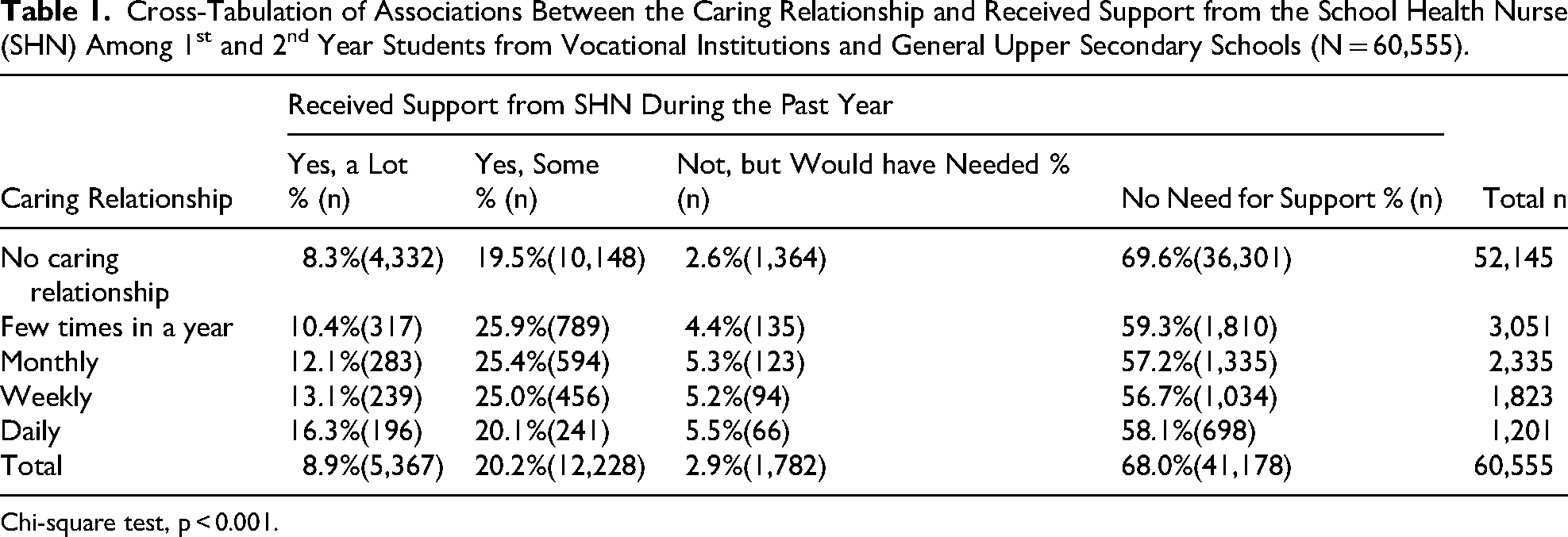
The data was first described using percentages and frequencies. Cross-tabulation and χ2 tests were performed for categorical variables to analyze the association between the caring relationship and support or lack of support from the SHN (Table 1) and the association between socio-demographic factors and unmet needs from the SHN (Table 2). Adjusted and unadjusted odds ratios were then calculated using logistic regression analyses to describe and test the associations between the caring relationships, background factors, and the received support/unmet needs from SHNs (Table 3). The model was adjusted for confounding variables, including self-perceived health and anxiety. P-values for unadjusted odds ratios were calculated using Fisher's exact test. Results from the logistic regression analyses are presented as odds ratios (ORs and aORs) and their 95% confidence intervals. The level of statistical significance was set at p < 0.001 due to the large number of respondents. The statistical analyses were conducted using IBM SPSS Statistics 27 and R version 4.0.2.
Cross-Tabulation of Associations Between the Caring Relationship and Received Support from the School Health Nurse (SHN) Among 1st and 2nd Year Students from Vocational Institutions and General Upper Secondary Schools (N = 60,555).
Chi-square test, p < 0.001.
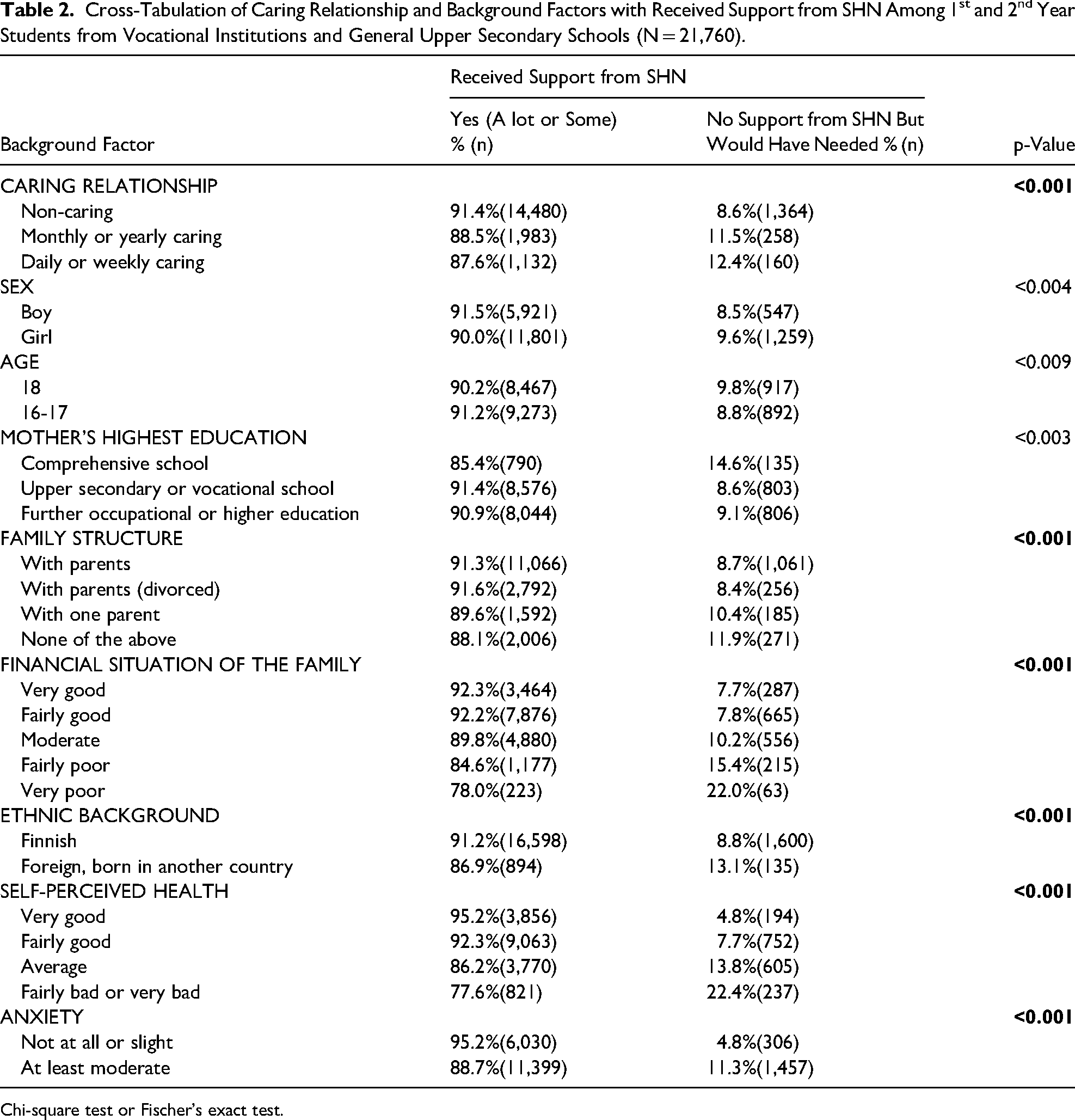
Cross-Tabulation of Caring Relationship and Background Factors with Received Support from SHN Among 1st and 2nd Year Students from Vocational Institutions and General Upper Secondary Schools (N = 21,760).
Chi-square test or Fischer's exact test.
Factors Associated with Unmet Support Needs from SHN – An Unadjusted and Adjusted Logistic Regression Model with Received Support from School Health Nurse (SHN) among 1st and 2nd Graders from Vocational Institutions and General Upper Secondary Schools (n = 21,760).
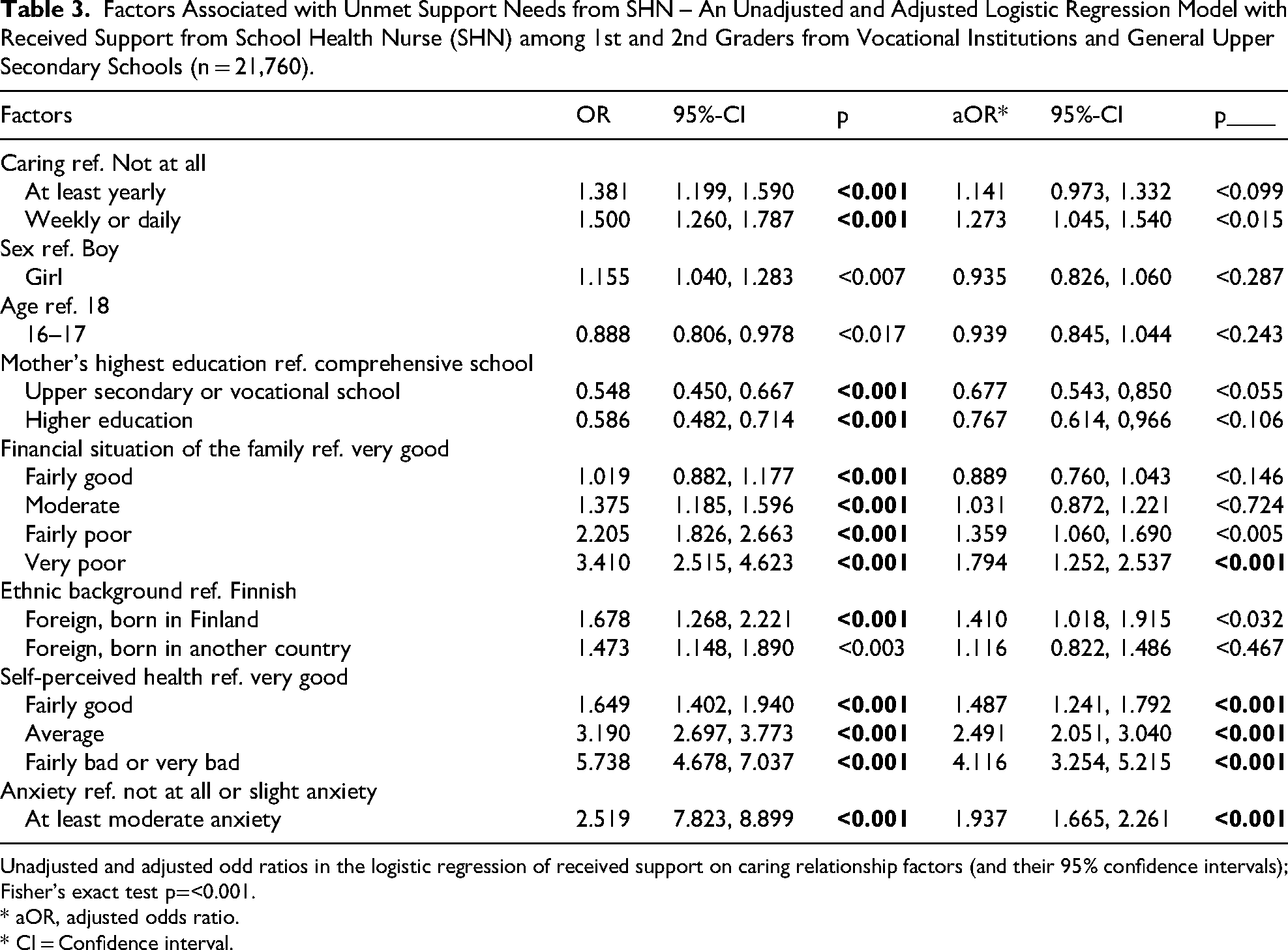
Unadjusted and adjusted odd ratios in the logistic regression of received support on caring relationship factors (and their 95% confidence intervals); Fisher's exact test p=<0.001.
* aOR, adjusted odds ratio.
* CI = Confidence interval.
Ethical Considerations
The Finnish Institute for Health and Welfare (THL), a research and development institute under the Finnish Ministry of Social Affairs and Health, had approved the SHP study protocol. The THL working group on research, as the Institutional Review Board of the Finnish Institute for Health and Welfare (THL/1578/6.02.01/2018), assessed the original survey and SHP study data collection in 2019. The multi-professional panels carefully reflected and evaluated all measurement scales in the School Health Survey.
In the original survey, all responding students were given a detailed explanation of the study by the research team via their instructed teacher; according to normal ethical regulations, voluntary participation in the study was considered informed consent. Participants were informed of their right to withdraw from the study. Respondents anonymously completed a classroom-administered questionnaire under their teacher's supervision, and the level of missing answers was low. The best scientific practices were followed throughout the research (Polit & Beck, 2021).
Results
Characteristics of Respondents and Associations Between Caregiving Relationship and Received Support from the School Health Nurse
The study included 63,273 adolescents, of whom 5% reported being in a caregiving relationship a few times a year, 4% monthly, 3% weekly, and 2% daily. Altogether, 14% of the 16–to 18-year-old respondents were involved in some form of caregiving relationship.
Table 1 shows the associations between caregiving relationships and self-reported need/no need for support and support received/not received from SHNs. Most students (68%) felt they did not need support from an SHN. This proportion was lower among students with caring responsibilities (57%–59%) than among those without (70%).
Furthermore, students in a caregiving relationship more frequently reported receiving a lot of support (10%-16%) or at least some (26%-20%), compared to their peers without caring responsibilities, who reported 8% and 20%, respectively. Nonetheless, young carers reported support from an SHN less frequently (4%–6%) when they needed it, compared to their non-carer peers (2.6%).
In the following analysis, we aimed to understand the situation for students who reported needing support from the SHN. Therefore, respondents who reported not needing support from the SHN were excluded from the analysis (67.8%), resulting in a subsample of 21,760. Table 2 describes associations between respondents’ caregiving relationship, socio-demographic factors, confounding factors, and received support from SHNs among this subgroup.
Students with caring responsibilities reported slightly lower levels of support from school health nurses (daily or weekly caring: 88%; monthly or yearly caring: 89%) compared with students without caring responsibilities (91%).
In addition, several background factors were associated with receiving or not receiving support from the SHN. Girls reported more frequently (10%) than boys (8.5%) about not receiving support when they needed it.
A lower level of maternal education was associated with a higher reported need for support from the SHN among young people. Young persons whose mothers had lower education felt more often (15%) that they did not receive support than those whose mothers were more highly educated (9%). Children of mothers with higher levels of education appeared to have access to an SHN more frequently (91%) than their peers whose mothers had lower levels of education (85%).
Additionally, the family structure was associated with perceived support from SHN. Those living with both parents reported a lack of support less often (9%) than those living with only one parent (10%) or in other conditions (12%).
The family's financial situation was also perceived as fairly (14%) or very poor (22%), particularly in the absence of support from the SHN, compared to those who perceived the financial situation as very good (8%) or fairly good (8%).
A foreign background seemed to be associated with a feeling of not being supported by the SHN. Students with a foreign background expressed more often (13%) that they did not get support from SHN, even when they needed it, than students with a Finnish background (9%).
Self-perceived health and anxiety were associated with receiving or not receiving support from SHN. Those young persons who felt a lack of support from the SHN perceived their health more often as average (14%), fairly, or very bad (22%) than students who perceived their health as very good (5%).
Self-reported moderate or higher anxiety was more prevalent (11%) among students who needed but did not receive support from SHN, compared to those who reported no or slight anxiety (5%).
Associations Between a Caregiving Relationship and the Unmet Support From the School Health Nurse
To analyze the multivariable associations of a caregiving relationship, background factors, confounding factors, and received versus unmet support needs from an SHN, logistic regression analyses were conducted (Table 3). First, in the unadjusted model, the caregiving relationship, several socio-demographic factors, and confounding factors were associated with receiving support from SHN. A daily or weekly care relationship had higher odds (OR 1.50, 95% Cl 1.26, 1.79) of unmet support needs from an SHN than a no-care relationship. Higher education of the mother was associated with lower odds (OR 0.57, 95% CI 0.48, 0.71). In contrast, the family's very poor financial situation was associated with higher odds (OR 3.41, 95% CI 2.52, 4.62) of not receiving SHN support. Furthermore, ethnic background as foreign but born in Finland also demonstrated higher odds (OR 1.68, 95% Cl 1.27, 2.22) for lack of SHN support. Also, the confounding factors, i.e., fairly or very poor self-perceived health (OR 5.74, 95% Cl 4.68, 7.04) and at least moderate anxiety (OR 2.52, 95% Cl 7.82, 8.90), showed higher odds for unmet support needs from SHNs.
In the adjusted model (Table 3), when the eight variables, i.e., a caring relationship, socio-demographics (sex, age, mother's educational level, family structure, family's financial situation, ethnic background), and confounding factors (self-perceived health and self-perceived anxiety) were entered into the same model, some of the associations remained almost as similar as in the unadjusted analyses, with some exceptions. In the adjusted model, a very poor family economic situation (aOR 1.79, 95% Cl 1.25, 2.54), fairly or very poor self-perceived health (aOR 4.11, 95% Cl 3.25, 5.22), and at least moderate self-perceived anxiety (aOR 1.94, 95% Cl 1.67, 2.26) explained a lack of support from an SHN. Those with a weekly or daily caring relationship (aOR 1.27, 95% Cl 1.05, 1.54) had greater odds of unmet support needs from SHN when controlling for socio-demographic and confounding factors. However, the p-value (=0.015) approached the statistical significance (p < 0.001) set for this study.
Discussion
This study examined associations between young carer relationship and adolescents’ support needs and received support for SHN services as well as the associations between the young carer relationship, socio-demographic factors, and unmet support needs for SHNs as reported by vocational school and secondary high school students in Finland. We were interested in exploring whether being in a caring relationship is associated with receiving or not receiving support from SHN.
First, our results revealed that the prevalence of 16–18-year-old vocational and upper secondary school students with caring responsibilities at least weekly is 5% in Finland. This is quite similar to several other prevalence studies in Europe (Di Gessa et al., 2022; Lacey et al., 2022; Saragosa et al., 2022). Although research and awareness about young carers are increasing in many countries, it remains a reality that professionals often fail to identify young carers (Leu et al., 2021; Nap et al., 2020). However, this is a significant group of young people whose identification and recognition as part of informal care would be necessary to include. The caring role that children and young people undertake has a significant impact on education, schooling, and their psychological and emotional well-being (Lovell & Cleaver, 2015). According to our research, not all young carers report a need for support from SHNs. One reason may be that many young carers do not consider their caring responsibilities a burden.
Second, our results showed that students with caring responsibilities reported not receiving support from the SHN, even though they often needed it more frequently than their counterparts without caring responsibilities. Similarly, De Roos et al. (2022) found that schoolchildren who grow up with an ill parent at home received less support than their peers. Still, those children with chronically ill family member seemingly had a greater need for help and support than their peers without a caring responsibility. Thus, specific attention needs to be paid to those young carers who require support but are unable to access and find help (Stevens et al., 2024). Some unmet support needs of school health nurses (SHN) among young carers may stem from missed appointments, especially when parental involvement is needed, and the parent has health challenges that affect their ability to support the young person. Our research reveals additional indicators of unmet support needs for SHNs that school health services should be aware of. Such risk factors may include, for example, the mother's lower education, a family structure other than living with both parents, a poorer family financial situation, an ethnic background other than Finnish, weaker self-perceived health, and at least moderate anxiety. After adjusting for background and confounding factors, particularly a poor financial situation, poor self-rated health, and at least moderate anxiety, were associated with unmet needs for SHN support.
Several previous studies have shown that young carers face more challenges than their peers without caring responsibilities (Joseph et al., 2020; Saragosa et al., 2022; Untas et al., 2022). It is essential to recognize the presence of young carers across countries and acknowledge their unique support needs (Frech et al., 2021; Ulrich et al., 2019; van der Werf et al., 2022). Recent findings indicated that students with caring responsibilities perceived psychosomatic symptoms more often than their peers without caring responsibilities (Eronen-Levonen et al., 2025). We also agree with Haugland et al. that professionals within the healthcare and educational systems must be familiar with the concept of young carers. The adverse health outcomes among young carers should be acknowledged, and adequate support made available (Haugland et al., 2020).
Frech et al. (2021) found that research on the specific needs of young carers is limited. In this study, we found that young carers in Finland report receiving less support from school health nurses (SHNs) than their peers without a caring relation. We also identified some indicators that can predict the specific needs for an SHN. Future research that examines the experiences of young carers from their own perspective is urgently needed. We need first to (1) reveal how to find young carers, (2) determine what support they need, and (3) how to offer it in a timely and correct manner.
Limitations
Some of the limitations of our study need to be discussed. Due to the large sample size, even minor differences between groups reached statistical significance (p < 0.05), although the absolute differences were modest and may not be practically meaningful. Therefore, we set the statistical significance at 0.001. One limitation is that only one question was used to measure a caring relationship, which is likely not adequate to explain the entire nature of the caring role. Moreover, young carers may not always recognize themselves as in a caring relationship or may assess their caring relationships differently than those reported in this survey. Another limitation is that vocational school students seem to be less eager to participate in the survey, and their participation may be lower. The reason for this is unknown, but there may also be on-the-job learning periods, i.e., the students were not even in educational institutions during the period the SHP study was conducted. Furthermore, the type of school (vocational vs. general upper secondary) was not separated in our analyses, although it could be associated with unmet needs of school health nurse support. Future studies should examine this further.
Additionally, subjective perceptions and levels of support can vary, potentially biasing the results. The original survey does not explore why a young carer feels the need for support from an SHN. This study's strength also lies in the large population-based sample. This is the first time the caregiving background of young people and its associations with the support received in school health care have been investigated in a nationally representative sample in Finland. Establishing a cause-and-effect relationship is impossible due to the study's cross-sectional design. A longitudinal study would enable the monitoring of the situation's development.
Conclusion and Implications for School Nursing
The presented findings demonstrate that young people with caring responsibilities appear to need more support from an SHN compared to those without caring responsibilities. This study also highlights the associations between select background factors, such as mothers’ lower education, poor financial situation, and foreign ethnic background, and several confounding factors, i.e., bad health and at least moderate anxiety, with higher levels of unmet support needs from an SHN. At the individual level, gaining as much support as possible in a caring relationship is essential. At the professional and societal levels, it is important to provide knowledge to develop support and services for young carers and to make further policy recommendations. Professionals across the education system and healthcare, not just in school health nursing, need more information about young carers and the tools to manage caring situations in everyday life.
Further research should focus on developing ways for schools to identify, recognize, and support young carers. Developing and assessing the practical tools and methods for schools to recognize and support young carers would be useful. In Finland, the Alisa Project—created in collaboration with healthcare professionals—has introduced the Young Carers’ Concern Cards, a practical tool designed to help identify and map the roles and needs of young carers (Alisa Project, 2022). Also, a Finnish medical publisher, the Finnish Medical Society Duodecim has issued evidence-based recommendations for approaching potential adolescents’ caregiving situations in practice (Eronen-Levonen & Joronen, 2024). It is essential to identify and recognize young carers in schools and acknowledge that they pose a set of potentially unique needs requiring support. School nurses play an important role in addressing those needs to ensure their success.
Footnotes

Author Contribution(s)
Funding
The authors disclosed receipt of the following financial support for the research, authorship, and/or publication of this article: This work was supported by the Kaisu and Antti Ravanti Foundation Finnish Cultural Foundation.
Declaration of Conflicting Interests
The authors declared no potential conflicts of interest with respect to the research, authorship, and/or publication of this article.