



Abstract
Background
The importance of school nurses’ active involvement in health promotion directed to school aged children is widely recognized. Research on school nurses’ experiences of health promotion remains limited.
Aim
The aim of this study was to describe school nurses’ health promotion practices and experiences within the Swedish educational context.
Methods
National cross-sectional data from school nurses (n = 596) were collected through a web-based survey. Narrative data from an open-ended question (n = 354) were analyzed using qualitative content analysis.
Results
Findings highlight how adoption of health promotion activities was shaped by variations in collaboration, resources, and organizational support. Many school nurses relied on their own initiative and creativity to work with health promotion, often with limited time and beyond the boundaries of the regular program.
Conclusion
There is an urgent need for clearer national guidelines and methods for health promotion, collaborative approaches and organizational support with clear expectations and sufficient time allocation.
Keywords
Introduction
Across countries, school nurses play a vital role in health promotion, yet their responsibilities and practices vary considerably depending on national policies and contexts. Schools are pivotal arenas for health promotion and the prevention of ill health among children and adolescents. Within these educational settings, where young individuals spend a substantial portion of their formative years, there exists a unique opportunity to deliver health promotion. Furthermore, health promotion in the school context could foster health equity, ensuring that all students, irrespective of their socio-economic backgrounds, have access to essential health services (The National Board of Health and Welfare & The Swedish National Agency for Education; World Health Organization, 2021).
A systematic review has recognized the effectiveness of school nurses’ health promotion efforts (Pawils et al., 2023), highlighting that school nurses are crucial in managing chronic conditions, providing health education, and implementing preventive measures within schools. Despite school nurses’ vital health promotion role, their potential might be threatened by a lack of organizational support, training, and contextual challenges (Al-Yateem et al., 2023; Flodin et al., 2024; Jakobsson & Moberg, 2025).
The tasks of school nurses can vary significantly across countries, ranging from primarily focusing on medical care and disease prevention (Davis et al., 2021; Hoekstra et al., 2016; Hoskote et al., 2023), to predominantly focusing on health promotion (Baltag et al., 2015; Holmström et al., 2015). In Sweden, however, the role of school nurses has shifted toward an emphasis on health-promotion. According to Rising Holmström et al. (2015), this transformation requires school nurses to engage more deeply in preventive care and health promotion rather than solely addressing medical issues.
In Sweden, the Education Act (2011) mandates that student health services within schools prioritize preventive and health promotion activities to create optimal conditions for student learning and development. Furthermore, it stipulates that school nurses operate within the regular program. All students are entitled to at least three health visits, which all include a health dialogue, during primary and secondary school. An additional health dialogue is offered in upper secondary school. These health visits are face-to-face sessions, typically lasting 45–60 min, during which school nurses perform physical screenings for vision, hearing, scoliosis, and growth. However, the primary focus of the health dialogue is a student-centered conversation based on the student's self-perceived physical, mental, and social health where the school nurse can include health education, prevention, and suggest early intervention based on the student's needs (Golsäter, 2012; Swedish National Board of Health and Welfare [Swe: Socialstyrelsen] & Swedish National Agency for Education [Swe: Skolverket], 2016). In addition to promoting health through individual health dialogues within the regular program, school nurses are expected to collaborate with other professionals in the school health services, including school physicians, psychologists, counsellors, and special education teachers, to promote health at group and school levels (Education Act, 2011).
School nurses and students highlight the positive effects of health promotion at group and school levels. Building relationships through group-level activities can strengthen trust, making students more willing to share personal concerns during individual dialogues (Gädda et al., 2023; Hilli & Pedersen, 2021; Jakobsson et al., 2022; Rising Holmström & Boström, 2021). Such activities also provide school nurses with opportunities to observe students’ social interactions and to increase students’ knowledge on various health topics in a reflective, collective setting (Hilli & Pedersen, 2021; Moen & Jacobsen, 2022). Despite their critical role and the emphasis on health promotion, Swedish school nurses operate without comprehensive national guidelines, tools, or models detailing the specific content and execution of health-promoting activities. This lack of standardized directives results in considerable variability in the quality of school health promotion practices (Flodin et al., 2024; Jakobsson, 2024; Jakobsson & Moberg, 2025; Kostenius, 2023).
Although the importance of school nurses’ involvement in health promotion is recognized, research that specifically examines the practices and experiences of Swedish school nurses’ health promotion remains limited. Moreover, as the context of school health services varies between countries, international findings may not be directly transferable to Sweden. Understanding how Swedish school nurses approach health promotion, and what facilitates or hinders their efforts, is essential for strengthening their practice and for supporting student health and well-being. Additionally, examining these practices is vital to provide robust evidence for policy planners regarding school health services, ensuring that all students, regardless of socio-economic background, have access to similar health promotion services. Therefore, this study aims to describe school nurses’ health promotion practices and experiences within the Swedish educational context.
Methodology
Design
To address this study's aim, an inductive qualitative research design was adopted (Creswell & Creswell, 2023). The data consisted of narrative responses to an open-ended question in a cross-sectional survey. The consolidated criteria for reporting qualitative research (COREQ) were applied throughout the study (Tong et al., 2007).
Ethical Considerations
This study adhered to relevant ethical standards and Swedish legislation, which stipulate that ethical approval is not required when no sensitive personal information, such as date of birth, religion, ethnicity, or health status, is collected (Ethical Review Act, 2003). Nonetheless, careful considerations were applied to ensure participant autonomy, nonmaleficence, beneficence, and justice (Swedish Research Council [Swe: Vetenskapsrådet], 2024), e.g., written information stating what participation in the study means and allowing the individual to decide for themselves whether they want to participate. In the study, all data was anonymized, i.e., no personal information such as name, municipality, school, e-mail, or IP address was collected, and responses were securely treated and stored. Before the first survey question, participants were provided detailed information about the study aim and participants gave active consent to proceed with the survey. These actions ensured clear information, the obtaining of informed consent, the safeguarding of confidentiality, and the appropriate use of all collected material in compliance with the ethical principles of the Declaration of Helsinki (World Medical Association, 2025).
Data Collection
In May 2023, the Swedish National Association of School Nurses held its annual conference, which attracted 1500 visitors. While there are no official records of the current number of school nurses in Sweden, estimates suggest there were around 3000 in 2022 (Swedish Government Official Reports (SOU 2021:11), 2021). During the conference, attendees were invited to participate in an anonymized electronic survey. Information about the study aim with a survey link were emailed to all association members (n = 2400) one day before the conference, and the link was also shared on the association's Facebook and Instagram pages. Conference visitors (n = 1500) were also encouraged to respond via printed posters with QR-coded links and occasional reminders from the stage. Survey items were developed and pilot tested together with board members of the Swedish National Association of School Nurses. More details about the survey development and data collection can be found in previous reports (Jakobsson & Moberg, 2025).
Data
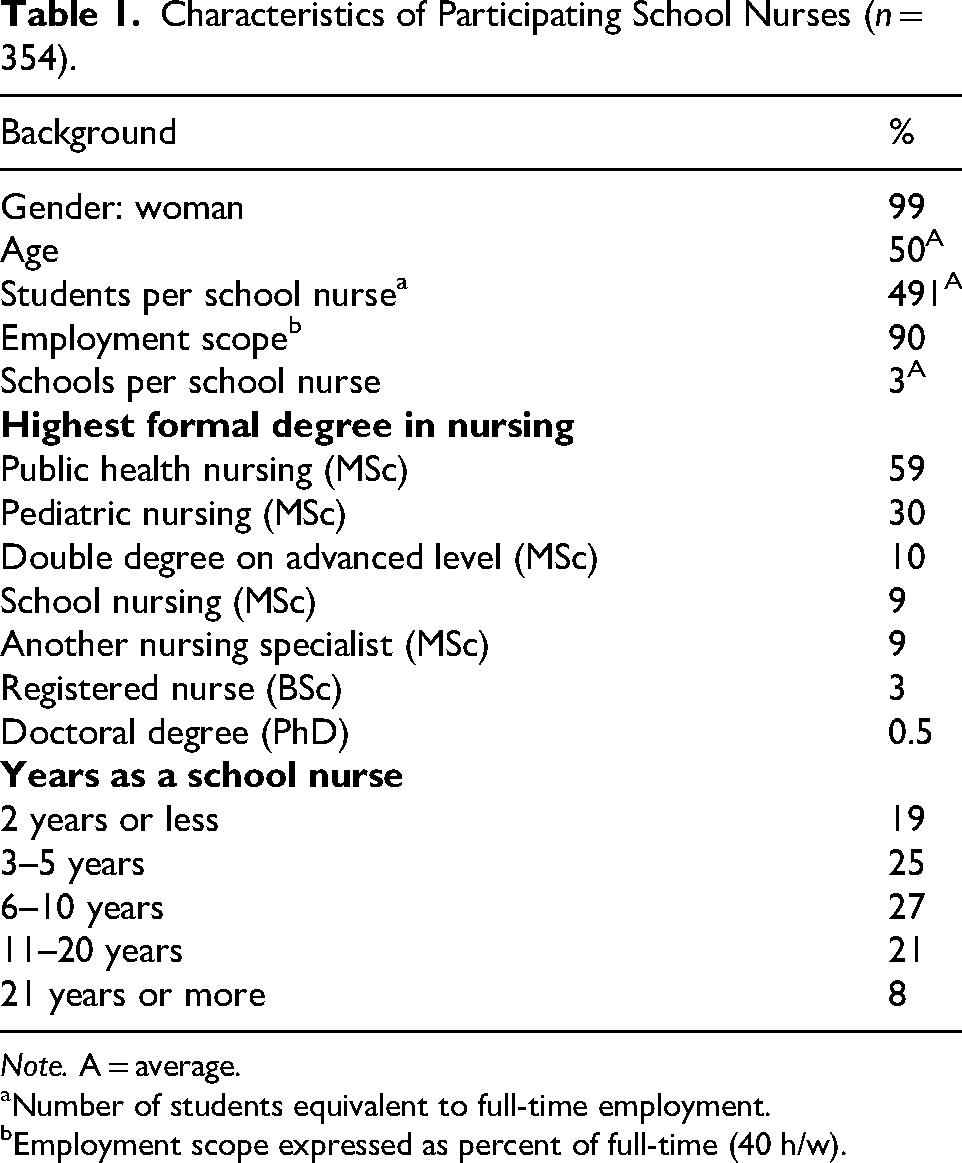
Data consisted of (n = 354) school nurses’ written narratives based on the open-ended question: “Please describe your health promotion work as a school nurse, beyond the individual health dialogues, in your own words.” The narratives ranged from 2 to 576 words; most were between 100 and 200 words. In addition to the open-ended question, the school nurses answered background questions (Table 1) and 26 survey items, out of which some are included and reported in this study to provide descriptive information on school nurses’ health promotion practices. The descriptive information is presented first in the results section. The included items were: “During the previous academic year, what topics has the systematic health promotion work focused on for you as a school nurse?” “During the previous academic year, how have you systematically worked with health promotion targeting the students?” and “During the previous academic year, what profession have you most often collaborated with regarding health promotion targeting students?” The questions were introduced with the text: “Following are some questions about how you systematically have worked with health promotion as a school nurse—beyond the regular individual health visits and conversations.” The answers were provided in a multiple-choice format, with an option for respondents to provide free-text responses. Only responses from participants who reported working as a school nurse during the previous school year were included in the analyses. Quantitative data were processed using SPSS (IBM Corp., 2020) and presented using summative statistics.
Characteristics of Participating School Nurses (n = 354).
Note. A = average.
Number of students equivalent to full-time employment.
Employment scope expressed as percent of full-time (40 h/w).
Participants
The 596 participants who responded to the web survey, of whom 354 answered the open-ended question that constituted the data for this study, included school nurses from all 21 geographic regions of Sweden (Table 1). The average age of respondents was 50 years, and nearly all identified as women (99%). On average, each school nurse was responsible for 491 children per full-time employment (40 hr per week). The participating school nurses worked with children of all ages, ranging from primary to upper secondary schools, and the majority of respondents worked with students younger than 16 years (73%).
Respondents were highly educated and most (98%) hold an advanced level degree (Table 1). The most common qualification among the school nurses was public health nursing (59%), followed by pediatric nursing (30%). Other common specializations included school nurse (9%) or another nursing specialization (9%), e.g., midwife, psychiatric nurse, or surgical nurse. A few respondents (3%) had only completed a bachelor's degree in nursing. The results also show that 59 (10%) of respondents hold double degrees at an advanced level. The most common combinations of degrees were another nurse specialist (e.g., midwife, mental health nursing) together with public health nursing (3%) or school nursing (2%), and a combination of public health nursing with pediatric nursing (2%).
Data Analysis
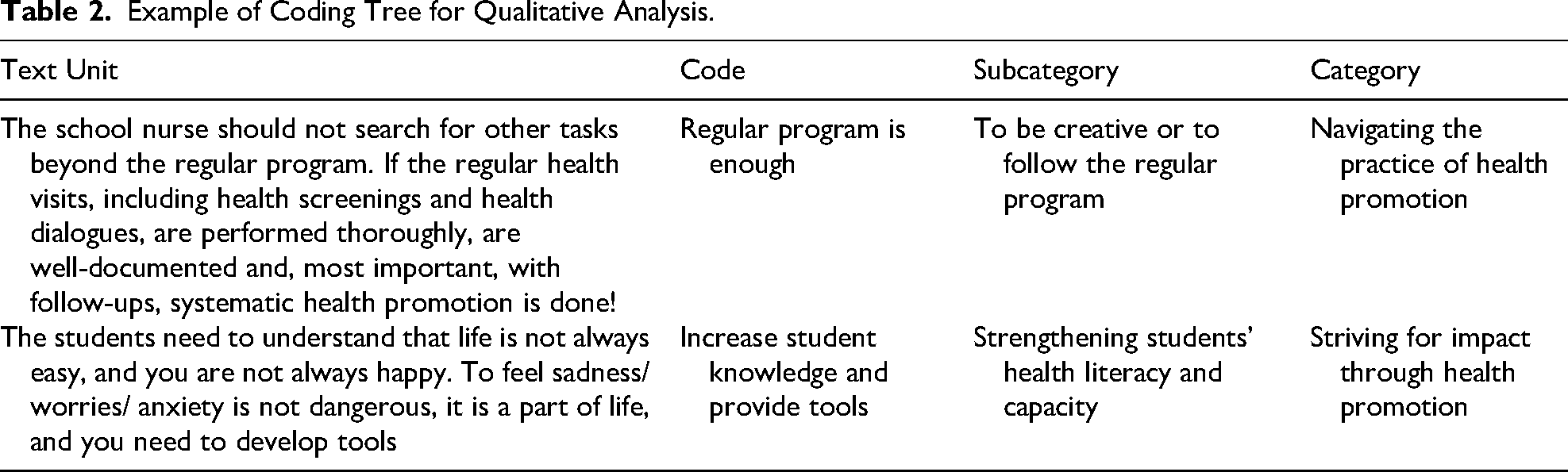
A qualitative content analysis was carried out guided by the approach of Elo and Kyngäs (2008). An inductive approach was applied, given the focus on a relatively unexplored area. To become familiar with the material, all data was read repeatedly. Comments and codes were written in the margins and on sticky notes to capture emerging impressions. Text units that addressed the study aim were systematically compiled into a structured digital document, see examples in Table 2. Then the units were coded, meaning labeling the condensed meaning unit with a descriptive code close to the original text and on a low level of abstraction and interpretation. In the next step, the codes were grouped and color-coded based on similarities and differences, and carefully named and sorted into emerging subcategories. The data was read through multiple times to ensure thoroughness and to avoid overlooking import aspects. All four co-authors were actively involved in the analysis process, engaging in ongoing discussions to refine subcategories and categories. This iterative process resulted in nine subcategories being organized into three overarching categories.
Example of Coding Tree for Qualitative Analysis.
Results
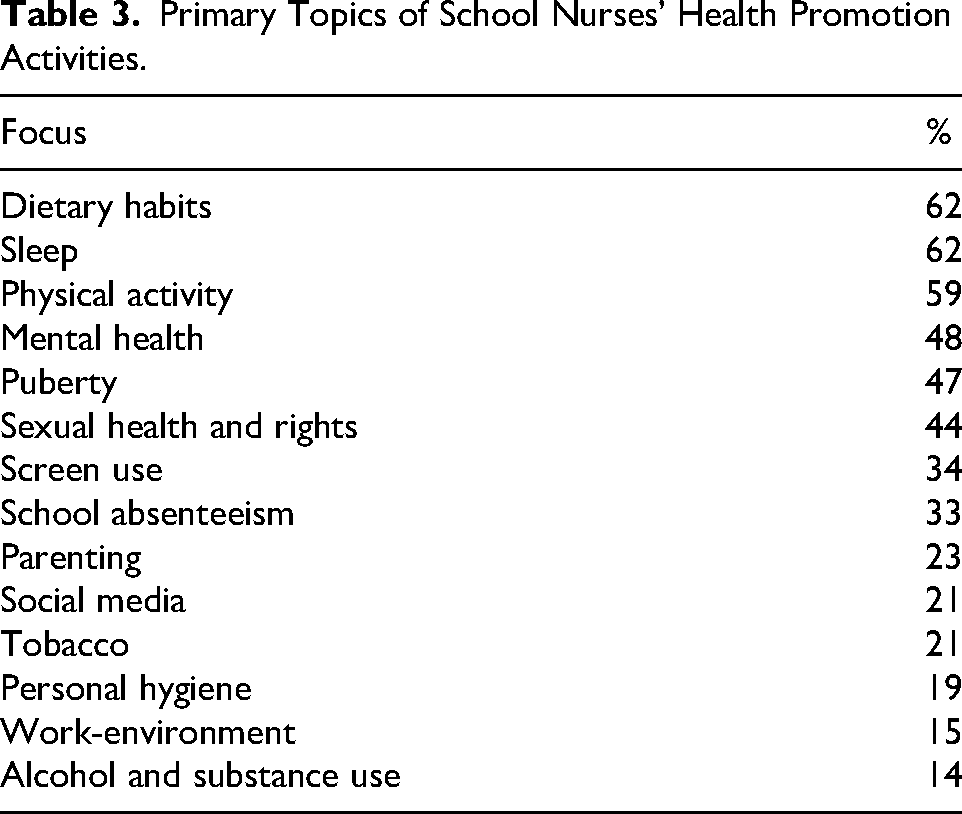
Demographic information based on the three survey questions on school nurses’ health promotion practice is provided to give background on the Swedish school nurses’ context. In their health promotion work, the school nurses reported interprofessional collaboration, most frequently with the school counsellors (59%), followed by other school nurses (10%), teachers (9%), special education teachers (7%), principals (3%), and school physicians (1%). In addition, 10% of school nurses reported that they always carry out health promotion on their own. The school nurses’ health promotion practices (Table 3) focused primarily on dietary habits (62%), sleep (62%), and physical activity (59%), followed by mental health (48%), puberty (47%), and sexual health and rights (44%). The most common reported methods for health promotion were individual conversations (69%), classroom activities (61%), and small group sessions (41%).
Primary Topics of School Nurses’ Health Promotion Activities.
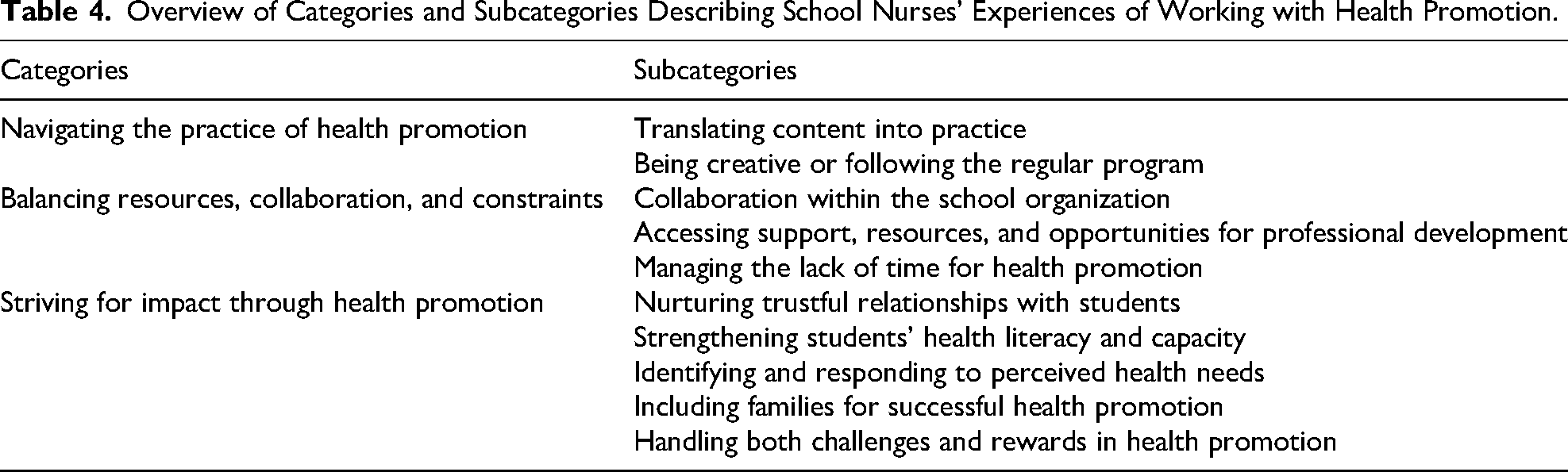
The results describe school nurses’ health promotion practices and experiences in three categories: Navigating the practice of health promotion, Balancing resources, collaboration, and constraints, and Striving for impact through health promotion, with nine sub-categories (Table 4). Quotes from the school nurses in each subcategory exemplify the results.
Overview of Categories and Subcategories Describing School Nurses’ Experiences of Working with Health Promotion.
Navigating the Practice of Health Promotion
The first category concerns health promotion content and how school nurses use the regular program.
Translating Content into Practice
Health promotion varied from school to school and involved a range of different subjects, performed in multiple ways. Some school nurses focused on several health-promoting subjects, while others concentrated on just one or sometimes none. The subjects included physical activity, dietary habits, sleep, stress, mental health, life knowledge, relations, self-esteem, violence, substance use, puberty, hygiene, consent, and sexual health. The school nurses employed various strategies in their health promotion efforts. They had lectures, conversations, or activities in classes and groups, workshops and themed weeks as part of their health promotion initiatives. Some school nurses followed an annual structure, while others adapted their approach based on the students’ needs. I have an annual plan with different themes for every grade that I update before every new semester. (SN 71)
Being Creative or Following the Regular Program
The majority of the school nurses described a need for and joy in health-promoting activities outside of the regular program. They expressed that passion for students’ health is the foundation that drives their health promotion. The passion included a desire to gain more knowledge and a willingness to try diverse ways of working to enable students’ health. The lack of guidelines and consensus regarding health promotion resulted in a need to be creative and committed to enable health promotion activities, or it would not happen. Most of it [health promotion work] has come about because we’ve had to create it ourselves (SN 24) and It has been up to us to create it. (SN 103) The school nurse should not search for other tasks beyond the regular program. If the regular health visits, including health screenings and health dialogues, are preformed thoroughly, are well-documented and, most important, with follow-ups, systematic health promotion is done! (SN 61)
Balancing Resources, Collaboration, and Constraints
The second category concerns how school nurses collaborate within the school organization, receive support and access to resources, and develop within their profession. It also addresses how school nurses manage the lack of time they have, which complicates their health promotion work.
Collaboration Within the School Organization
Collaboration with colleagues was described as essential to enable effective health promotion. Many school nurses worked closely with school counsellors, while others collaborated with class teachers, advisory teachers, or physical education teachers. Health promotion at the group level is an important tool for reaching all students equally, preferably in collaboration with teachers. The best is when you find interprofessional ways to work and integrate it into regular teaching so that it becomes a natural part of the school's work. (SN 263)
Accessing Support, Resources, and Opportunities for Professional Development
The school nurses frequently emphasized that effective health promotion required support, material, and opportunities for professional development. They highlighted the importance of feeling supported by both their colleagues and management. Support from managers in the organization and the principal was described as fundamental for any health promotion initiatives to take place in schools. The opportunity for professional development was also mentioned in connection with the need for support. School nurses expressed a need to take courses and stay updated on the latest guidelines to facilitate health promotion in schools. The potential for professional development largely depended on the support and opinions regarding health promotion provided by managers and principals. The school nurses also described how a lack of material for their health-promoting work led to uncertainty about what and how to perform these activities. This uncertainty could, in turn, result in the absence of health promotion activities. I believe that we school nurses need more tools and training to be able to work with health promotion. (SN 309) Look at the national regular program for child health services; it gives clear and equal healthcare for all children. It is also needed for all schoolchildren. There is so much more we can do, but every school nurse cannot sit alone in their own chambre and create it, then it does not become quality assured or equal. (SN 62)
Managing the Lack of Time for Health Promotion
Many school nurses mentioned an increasing number of students assigned to each school nurse and high demands for immediate action in their daily work. This left them with little to no time for anything beyond the regular program. In some cases, school nurses did not even have sufficient time to carry out the regular program. I regard preventive and health promoting work as very important and rewarding, but I do not have the time to perform it to the extent that I wish. (SN 44)
Striving for Impact Through Health Promotion
The third and final category focuses on how health promotion nurtures trusting relationships, strengthening students’ capacity to take care of their health. It is also about identifying, responding to, and including students and families in emerging needs. The school nurse's role in health promotion is described as both challenging and rewarding.
Nurturing Trustful Relationships with Students
Building trustful relations with the students was described as the most crucial part of the health promotion work. School nurses noted that group health promotion work provides an opportunity to shape relationships, which in turn enhances individual health dialogues. Further, it could make the students perceive the school nurse as a safe person they can confide in when struggling with challenging feelings or situations. School nurses explain that students need to feel they can trust the school nurse to achieve a positive outcome for both the group and the individual. Building relations with students early in the semester so the students dare to come for both mandatory health dialogues and spontaneous visits. (SN 59)
Strengthening Students’ Health Literacy and Capacity
The opportunity to help students understand that their actions and choices have consequences for their health was emphasized repeatedly. A key part of this approach was focusing on their strengths and capacities to promote health rather than on negative aspects. The nurses also highlighted the importance of helping students recognize that life includes both ups and downs and that experiencing feelings of sadness, worry, or stress is a normal part of life. Students can strengthen their capacity by understanding that a range of emotions is normal. The students need to understand that life is not always easy, and you are not always happy. To feel sadness/worries/anxiety is not dangerous, it is a part of life, and you need to develop tools. (SN 67)
Additionally, school nurses stressed the value of encouraging students to find their own solutions to problems with their support, rather than telling them how to do it. This approach was described as strengthening the students’ problem-solving skills in life.
Identifying and Responding to Perceived Health Needs
School nurses highlighted that health promotion is needed in schools today for multiple reasons. The needs were identified during individual health dialogues, and when several students in the class shared the same health promotion needs, activities were designed accordingly. Further, school nurses stressed that health promotion gives today's youth tools and an understanding of how they can improve their health both now and in the future. They also emphasized that when health promotion is performed in schools, it is also available to all students regardless of socio-economic background. It is important to even out the knowledge among children to achieve the goal of equal health. (SN 43)
Including Families for Successful Health Promotion
The school nurses experienced that a key aspect of health promotion involves successful collaboration with parents or legal guardians. This could include sharing general health information through flyers, parent meetings, or emails, and direct cooperation when a student is identified as having health issues. We invited parents to breakfast lectures about different themes connected to both school such as reading and different aids but also connecting to health: the concept of health and screentime. (SN 150)
Handling Both Challenges and Rewards in Health Promotion
The school nurse's role in health promotion was described as both challenging and rewarding. The school nurses expressed joy and appreciation for their work, with some mentioning that health promotion is what motivates them to continue, even during tough times. Additionally, some nurses mentioned that their involvement in health promotion positively affected their professional and private lives. I love working as a school nurse! It is so complex, evolving, fun, educative, rewarding, and challenging. It is nice to be able to plant a seed and guide students to the proper support. (SN 34)
Discussion
The aim of this study was to describe school nurses’ health promotion practices and experiences within the Swedish educational context. The findings highlight a variation in how health promotion is implemented, shaped by differences in collaboration, resources, and organizational support. Many school nurses rely on their own initiative and creativity to make health promotion possible, often beyond the boundaries of the regular program. The results also concerned the importance of relational work, where trust-building and presence in students’ everyday school life are seen as central to effective health promotion. Importantly, this study contributes to the limited empirical knowledge regarding health promotion in Swedish school health services and emphasizes the urgent need for clearer national guidelines, sufficient time for health promotion activities, clear expectations, collaborative approaches, and organizational support. The Swedish school nurses’ were engaged in a broad range of health-promoting activities, with a primary focus on dietary habits, sleep, physical activity, mental health, and puberty. The health promotion activities were mainly carried out through individual conversations, classroom-based work, and small group discussions. Collaboration most often occurred with school counsellors, while collaboration with teachers and principals was less frequent. Many school nurses worked alone with health promotion.
One of the main findings of this study was the variation in how school nurses carry out health promotion. This reflects the lack of national guidelines for health promotion beyond the regular program, a gap previously noted in Swedish research (Jakobsson & Moberg, 2025). Instead, health promotion appears to depend on individual initiative and local conditions, which risks undermining equity and quality. Similar concerns have been raised in international literature. For example, Shannon (2018) points out that although professional standards emphasize the importance of evidence-based clinical guidelines for school nursing, very few such guidelines exist in practice. In a recent systematic review by Kühne and Mugo (2025), it was identified that structured activities led by a school nurse, such as health education sessions, screening, and collaboration with school staff, can effectively promote students’ health and reduce inequalities when implemented consistently across school settings. These findings are in line with school nurses’ perceptions in our results and indicate a need for national frameworks similar to those in child health services to provide greater clarity, consistency, and support for structured health promotion within school health services.
The results showed that collaboration and organizational support were seen as crucial for effective health promotion in schools. While school nurses described that they often collaborated with school counsellors, whereas collaboration with other important staff members, such as teachers and principals, appeared to be more limited. Previous research has shown that school nurses find collaboration with other professions meaningful, but that there is a lack of clarity regarding roles and responsibilities (Alhammadi et al., 2024; Jakobsson & Moberg, 2025). Strengthening health promotion in schools may therefore require not only clearer frameworks for the nurse's role, but also strategies for building interdisciplinary collaboration, as well as engagement and support from leadership. Without this, the potential of school nurses to contribute to health promotion remains underutilized.
A key finding emphasized the importance of the relational aspect of school nurses’ health promotion work. Their presence in students’ daily school life, during breaks, in corridors, and through group activities, was described as crucial for building trust and encouraging students to seek support. These informal interactions were experienced to improve health discussions and help nurses identify needs early. However, the very relational work that underpins successful health promotion is often time-intensive and thus not prioritized by school nurses facing high workloads (Jakobsson & Moberg, 2025).
Furthermore, the school nurse's role in enhancing students’ health literacy, helping them reflect on their emotions and developing strategies for managing challenges, and protecting their health in the future was emphasized. These findings resonate with previous research, which demonstrates that school nurses’ health promotion work can strengthen health literacy among both students and parents, fostering a sense of security as well as the ability to understand, evaluate, and use health-related information to maintain good health and make informed decisions (Alhammadi et al., 2024; de Buhr et al., 2020; Pereira et al., 2023). Improving conditions for school nurses, such as lower student-to-nurse ratios, clear expectations, and stronger organizational support, should therefore be essential to ensure that relational and health-promoting practices can be sustained and further developed.
Implications for School Nursing
‐ There is an urgent need for national guidelines that provide evidence-based materials and methods for school-based health promotion. Policymakers and national health authorities should take responsibility for developing and disseminating these guidelines to ensure consistency and quality across schools. These resources should be practical, research-informed, and accessible to all school health professionals.
‐ Organizational support and clear expectations are crucial for enabling school nurses to deliver effective health promotion. School leadership and health authorities should jointly prioritize activities, allocate time, and provide resources that allow school nurses to focus on preventive and health-promoting activities.
‐ Collaboration across professions is essential for promoting student health. Hence, there needs to be a common understanding among all involved professions of how health is defined and perceived, ensuring that joint efforts are aligned and coherent. Structured collaboration should focus on integrating perspectives and expertise to create effective, unified health-promoting strategies.
Strength and Limitations
This study has several methodological strengths, including the combination of quantitative and qualitative data, which provides a comprehensive understanding of school nurses’ health promotion practices. The sampling approach resulted in a voluntary response (self-selected) sample that aimed to capture a broad and in-depth perspective on school nurses’ experiences. Also, the national survey, with responses from nurses across all 21 regions of Sweden, contributes to the representativeness of the quantitative findings, supporting transferability of the results (Creswell & Creswell, 2023; Lincoln & Guba, 1985). Additionally, the open-ended survey questions offered valuable insight into everyday experiences among school nurses, which strengthens the credibility of the qualitative findings. Triangulating both quantitative and qualitative data further enhances dependability and confirmability, as interpretations are grounded in systematically collected and diverse data rather than individual assumptions (Creswell & Creswell, 2023; Lincoln & Guba, 1985).
However, there are limitations to consider. In particular, the written responses lack the depth of spoken interviews and may have restricted opportunities for follow-up and clarification, which could reduce credibility (Lincoln & Guba, 1985). Furthermore, it is possible that school nurses who are more engaged in health promotion were more likely to participate in the survey, which could have led to a more optimistic picture of current practices, potentially affecting transferability (Creswell & Creswell, 2023; Lincoln & Guba, 1985). Despite these limitations, the findings offer valuable insights into an under-researched area and suggest directions for practice development.
Conclusion
School nurses stress the importance of relational work, where trust-building and presence in students’ everyday school life are seen as central to effective health promotion with the potential of supporting students’ future health. Importantly, this study contributes to the limited empirical knowledge regarding health promotion in Swedish school health services and emphasizes the urgent need for clearer national guidelines and evidence-based methods for health promotion activities, collaborative approaches, and organizational support with clear expectations and sufficient time allocation. Thus, while school nurses describe their work as deeply meaningful and grounded in relationships that foster trust and hope, they simultaneously express a pressing need for clearer guidance and stronger support to sustain and develop their health-promoting role.
Footnotes
Acknowledgments
We sincerely thank the school nurses who willingly shared their experiences and made this study possible.
Author contribution(s)
Funding
The authors received no financial support for the research, authorship, and/or publication of this article.
Declaration of Conflicting Interests
The authors declared no potential conflicts of interest with respect to the research, authorship, and/or publication of this article.
Data Availability Statement
The data is available from the corresponding author upon request.
