




Abstract
This article confronts a core challenge within 4E research: the “motley crew argument.” According to this argument, the scientific credibility of 4E research is diminished because the range of factors considered constitutive of a cognitive phenomenon encompasses neural, morphological, and environmental structures. The claim is that the sheer number, flexibility, and interchangeability of the involved variables render cognitive phenomena extremely difficult to identify and study in rigorous scientific investigation. This paper systematically outlines a range of established methods for handling the complexity inherent in situated cognitive phenomena by introducing four key methodological approaches. By deploying this methodological toolkit, the article argues that 4E cognition research can be equipped to empirically investigate complex cognitive phenomena. These methods offer a pragmatic pathway to address the challenge of the motley crew argument and bridge the gap between rich philosophical theory and empirical validation.
Keywords
1. Situated Cognition, the Motley Crew Argument, and Validity Critique
Cognitive systems emerge from a complex interplay of neural networks, morphological features, and environmental structures. They exhibit high adaptivity, meaning they quickly adjust to changing environments and can be composed in various ways from diverse materials while generating their properties through the interaction of their individual components. Crucially, these individual components do not necessarily possess the properties displayed by the overall structure. Furthermore, cognitive systems can show significant variability in their responses to highly similar stimuli, thereby exhibiting non-linear behavior. It is also problematic to pinpoint the beginning of the causal chains that constitute cognitive systems. This is because cognition is understood as a specific form of feedback loop that operates through exogenous structures and lacks a defined “starting point.” These statements represent foundational premises for research into “Situated Cognition” or “4E”—enacted, extended, embodied, embedded—cognition (Newen, De Bruin & Gallagher, 2018; Clark, 2010; Robbins & Aydede, 2008; Gallagher, 2006; Varela et al., 1991, 2017). Cognitive science that fully or partially accepts these premises tends to view cognitive phenomena as something complexly produced, and therefore, it should be investigated in this “natural” complexity.
1.1. The Motley Crew Argument
When complex phenomena are to be investigated in their “natural” contexts, methodological concerns are usually not far behind. The Motley Crew Argument falls under these concerns (similar critique exists against, e.g., ecological research: O’Donnell et al., 2021; Low-Décarie et al., 2014; Odenbaugh, 2005; Loehle, 2004; Peters, 1991). The term “motley collection” (Adams & Aizawa, 2001, 61, 63) was used in the 4E debate to refer to the disadvantageous fragmentation that a 4E-based conceptualization of cognitive systems allows. The reason for this fragmentation is that cognition’s constitutive entities are too distributed, too flexibly substituted, and too numerous, in quantity but also in kind, if 4E premises are accepted. Cognitive phenomena brought about by brain-bound neural networks are claimed to be substantially different from “cognitive systems” relying on a decentralized organization that involves neural aspects, morphological conditions, niche structures, technological gimmicks, socially enacted norms, etc. According to Adams and Aizawa, proponents of such fragmentation seem to ignore the relevant causal system for cognitive information processing which is—due to contingent empirical facts—realized by neural activity (producing non-derived content). 1 Furthermore, transcranial cognition as imagined by 4E researchers might be a theoretical possibility, but it is not actually existent. Apart from these considerations about the constituents of cognitive systems, the “motley crews” of neural and non-neural entities are additionally suspected to lack scientifically interesting regularities. Hence, “there is little hope of finding a science of transcranial processes” (Adams & Aizawa, 2001, 62). Similar difference-in-kind arguments were prominently fostered by Rupert (2004, 407) and Wilson (2002) and discussed by Clark (2010, 93ff.).
Despite highly elaborated intersections between the 4Es and complexity studies (Barandiaran, 2017; Beer, 2000; Favela, 2020), the naturalization of phenomenological methods (Gallagher, 2003; Petitmengin et al., 2019; Varela, 1996), and decades of successful research in ecological psychology (Fajen & Warren, 2003; Warren, 2018), I claim that the debate on situated cognition has still not paid sufficient attention to critiques such as the Motley Crew Argument. This critique remains highly relevant and continues to pose a pressing research challenge since basic methodological discussions and synopses regarding 4E approaches are still ongoing (Casper & Artese, 2023; Felisatti & Fischer, 2023). Phenomenological methods do not seem to offer sufficient explanations for cognitive phenomena (e.g., Casper & Haueis, 2022), and dynamical approaches risk relying on mathematical formalisms that may be incapable of capturing the fine-grained, situated nature of these phenomena (Kaplan & Craver, 2011; Lee, 2023). Moreover, enactivism’s core research profile is currently under debate, as it remains unclear whether this branch of 4E research is a “mere” philosophy of nature, a utopian vision, or a rigorous scientific research program (Meyer & Brancazio, 2022, 2023). In light of these issues, the challenges raised by the Motley Crew Argument appear far from settled.
Since the motley crew argument addresses both the nature and the scientific inquiry of situated cognition, I suggest differentiating two versions of the motley crew argument. The first version, the “
The second version, the “
In what follows, I address subversion (c) of the coordination view. This aim is not as humble as it may sound, since the underlying idea is that greater methodological rigor in 4E research can lead to the detection of meaningful scientific regularities (contra subversion (b)) and improve our ability to coordinate different premises (contra subversion (a)). Ultimately, such a development could also argue against the phenomenon view by reinforcing the more general idea that cognitive systems are decentralized and heterogeneously composed. The following paragraphs highlight methods that have received little attention in recent methodological overviews of 4E cognition (e.g., Felisatti & Fischer, 2023).
1.2. Validity Critique
For the sake of completeness, however, it should be noted that there is also criticism of research practices that adhere to premises other than those of the 4E approach. In biology, one can find such critiques, as well as in the psychology of the 1950s and 60s (Brunswik, 1956; Campbell & Stanley, 1966; Orne & Holland, 1968). This criticism remains valid today (Ibanez, 2022; Kingstone et al., 2008) and can be extended to other disciplines, such as neurosciences (Aliko et al., 2020; Sonkusare et al., 2019).
Experimental laboratory practice often relies on highly controlled environments and the use of artificial stimuli. The hope with such laboratory practice is usually to be able to transfer results collected in these environments to other and more complex contexts (“generalizability” 2 ). Criticism of this type of laboratory practice, which was and often still is tied to reductionist ideals and analytical methods, targets its lack of “external validity” or “ecological validity.” The central point of conflict lies either in the artificial nature of laboratory and experimental settings or in the artificiality of the stimuli used in (psychological) experiments. This is correct insofar as complex systems and non-linear behavior can be suppressed by the spatial, temporal, and interactive limitations of the experiment, thus preventing them from becoming the focus of investigation. The generalizability of results from such laboratory work must inevitably suffer under these premises.
This validity critique, although plausible from my perspective, does not, however, make 4E research either easier to implement or theoretically more robust. Whoever points towards mereological, holistic, or dynamic directions for cognitive science is indicating an area of scientific uncertainties that may be fundamental in nature. These uncertainties are kept alive by the Motley Crew Argument.
2. Hands-On Complex Phenomena: Methods in Situated Cognition Research
This section focuses on four different methods (two of them highly undervalued) to address the Motley Crew Argument. A scientific leitmotif of 4E research is the commitment to acknowledge constituents of cognitive phenomena at different scales, including very large scales, and to integrate the constituents across scales. Such integration can involve approaches to study the behavioral level (e.g., chronometrics, continuous, and physiological methods (Felisatti & Fischer, 2023, Part II)) as much as the neuroscientific level (e.g., correlational, neuropsychological, and non-invasive brain stimulation methods (Felisatti & Fischer, 2023, Part III)). The compatibility of these levels might theoretically depend on accepting “interlevel integration” (e.g. Craver, 2005) which basically says that theory reduction goes wrong. Instead, explanations of behavioral patterns require a “lower” level for their implementation details (such as the neural basis of behavior), and the lower level requires a higher level in order to assign any functional meaning to the biochemical processes in the first place. 3 In addition, whether different methods and their results can be effectively combined depends on further assumptions. For instance, endorsing an explanatory pluralism could theoretically and practically enable the development of a coherent “cluster” of methods and findings. The less pluralism is endorsed the more relevant mono-explanatory strategies become and vice versa. Further discussions on this topic can be found under labels like “new mechanism” (Craver et al., 2021; Craver & Darden, 2013; Kästner, 2020; Krickel, 2024) and “explanatory pluralism” (Carls-Diamante, 2019; Casper, 2023; Dale et al., 2009; de Jong, 2001; Gervais, 2021; Mitchell, 2002; Zednik, 2011), where theses on the compatibility and incompatibility of different levels and methods are discussed.
Here, I will exclusively elaborate on methods intended to contribute to the analysis of the “higher level” or “largest” scope employed by 4E research: entire situations. These do not necessarily have to be more unmanageable than phenomena addressed by the microscale—they do not have to involve more entities and relations, nor do they have to exhibit more complex dynamics than, for example, social-dyadic interactions or the connections between the gastrointestinal tract and the central nervous system. However, they can exhibit complexities that require their own methodological modeling to make them understandable and researchable. In one sense, an entire situation might naturally encompass a biological system (with its internal connections like the mentioned gastrointestinal tract and central nervous system), social-dyadic interactions, and additional contextual variables of the situation. From this perspective, an entire situation would inherently be more complex than the behavioral and neuroscientific levels, as it would always contain them and something more. However, the analysis of the overall situation in this article focuses on a different interpretation. It aims to highlight those entities and relations that are not specifically addressed by other levels. Therefore, an entire situation, when viewed through this specific analytical lens, does not necessarily have to be more complicated than the other levels. Its complexity is defined by the unique elements it introduces, rather than by merely aggregating all lower-level components. The methodical approaches in this section are united by a common goal: the methodically structured investigation of cognitive processes within their overarching social and physical environment.
The selected methods cover both the quantitative and qualitative demands of 4E research. Quantitative demands arise from the desire to capture phenomena characterized by temporal continuity, feedback loops, context dependence, and dynamic (non-linear) behavior as prominent in dynamical system approaches (Lamb & Chemero, 2018; Thelen & Smith, 1994) and also in parts of affordance research (Barsingerhorn et al., 2012; Warren, 1984). Qualitative demands stem primarily from enactivism, which posits the first-person perspective as crucial for describing and explaining cognitive processes. Lived experience is assumed to directly shape the trajectory of a cognitive process. Within both quantitative and qualitative domains, this section deals with a mix of established approaches and those less established, at least in philosophical discourse. For the quantitative domain, alongside familiar dynamic research approaches (e.g., those employing non-linear differential equations), this section presents structural equation models (SEM) as an often-overlooked yet powerful interdisciplinary tool. SEM enables the statistical and confirmatory testing of complex, theory-driven assumptions about systemic relationships. Analogously, for the qualitative side, in addition to established cognitive ethnography, the specific “Course of Action” (CoA) approach will be introduced. This framework is particularly well-suited for thoroughly analyzing agents’ lived experience and situational action logics.
This balanced presentation aims to introduce less known methods and to illustrate that 4E research can leverage a diverse set of tools to adequately address its subject matter’s complexity. Each method in this section will be discussed in sub-paragraphs which entail: first, a fundamental introduction to the premises and definition of the method and, second, a current application example. After the introduction and the example, each method will conclude with a brief discussion of its capacity to address the Motley Crew Argument.
2.1. Structural Equation Modeling (SEM)
Structural equation modeling (SEM) (Hoyle, 2014; Hoyle & Gottfredson, 2023; Kline, 2023; Newsom, 2023) is often ignored, if it is known at all, within more philosophically oriented debates on cognitive phenomena. Typically, other mathematical approaches for the scientific quantification of networks receive more attention, such as non-linear differential equations in the context of dynamic system theory and dynamic explanations (see below). This status is undeserved, as SEM is a powerful tool for the systematic analysis of complex networks. It renders (cognitive) networks accessible by modeling relationships between theoretical constructs (latent variables), often derived from philosophical or ecological considerations of cognition, and their operationalized indicators (manifest variables). Manifest variables typically provide aggregated observational data. This can include average values from an experiment, questionnaire data, or summaries of physiological measures.
SEM represents a confirmatory approach to bridging the gap between pure theory and collected raw data. It accommodates both a strong theoretical grounding, such as overarching enactive conceptions of cognition, and the empirical testing of these conceptions in broader scenarios. Such analyses yield the quantified behavior of variables within a network, expressed as covariances. By doing so, SEM offers a multivariate statistical framework that enables the modeling of complex variable networks and the testing of hypothesized relations between them. These relationships are formalized, at least in standard SEM, through a system of linear equations with parameters estimated from observed data. How this stochastic model, despite initially being based on linearity, can still support the investigation of complex, dynamic cognitive phenomena will be explained further below. As mentioned, the application of this framework inherently rests on a strong theoretical foundation: the modeling of a situation, network, or phenomenon prior to data analysis. This strict reliance on a strong theoretical foundation is valuable not only for 4E approaches with highly elaborated philosophical baselines, but it also directly addresses the “theory crisis” in psychology and its detrimental influence on empirical research (Hale et al., 2020; Szollosi et al., 2020; van Rooij & Baggio, 2020, 2021). Because SEM requires clear, pre-defined specifications of latent and manifest variables, it mandates exactly the kind of theoretical constraint that exploratory psychological research often lacks.
SEM can be applied across numerous disciplines, including psychology, sociology, education, economics, behavioral biology, and ecology (Kwok et al., 2018).
4
This parallels dynamic approaches, which also identify patterns or principles shared by phenomena that, at first glance, appear very different. The application of SEM in 4E research signals a promising avenue for ecologically valid and systemic empirical investigations (contingent on the studied networks being sufficiently comprehensive to be deemed “ecologically valid”). To achieve this, the importance of sample size and iterative model modification must be emphasized, enabling robust and hypothesis-driven cognitive research facilitated by SEM. This holds the potential to provide more robust and nuanced empirical evidence for 4E assumptions, thereby at least narrowing the gap between rich philosophical theory building and empirical validation. This, in turn, contributes to addressing the Motley Crew Argument. The following five aspects of SEM as a “middle-range tool” between abstract theory and data-driven experiments are fundamental: (a) (b) (c)
The strength of the relationships between all variables, manifest and latent ones, is statistically estimated, typically from the covariance matrix of the observed manifest variables. The structural model defines the connections between latent variables using linear equations which take their data from the observation matrix to understand how manifest variables covary. Defining the conceptual meaning of a latent variable is a conceptual task (see “Theoretical Basis” above) performed prior to model specification and influences both the measurement and structural models. (d) (e)
Beyond these five points, an important question remains: How can SEM address the assumed non-linear characteristics of cognitive phenomena? To capture the highly temporal and interactive nature of situated cognition, standard cross-sectional SEM can be extended into longitudinal models (Little, 2024). Traditionally, Cross-Lagged Panel Models (Kenny, 1975; Zyphur et al., 2020) have been used to model temporal development and reciprocal influences over discrete time points. These models primarily estimate two central types of temporal dynamics. Autoregressive Effects predict a variable’s state at a later time (t2) from its own state at an earlier time (t1). By doing so, they capture the inertia or stability of a systemic state, illustrating, for example, how strongly an organism’s current stress level dictates its future stress level. Alongside these, Cross-Lagged Effects quantify how strongly one variable at an earlier time influences a different variable at a later time. A significant, 4E-friendly advancement of this logic is Dynamic Structural Equation Modeling (DSEM) (Asparouhov et al., 2018; McNeish & Hamaker, 2020). Traditional Cross-Lagged Panel Models are often limited to macro-developmental timescales, that is, long-term developmental processes spanning months or years, such as language acquisition or the stabilization of personality traits. DSEM is explicitly designed for intensive longitudinal data. Despite this difference in temporal resolution, both approaches share similar research aims. They seek to quantify the continuous, reciprocal feedback loops between an organism and its environment or between multiple interacting agents over time. Furthermore, modern extensions like the Random Intercept Cross-Lagged Panel Model (Hamaker et al., 2015; Usami et al., 2019) elegantly separate within-person state fluctuations (the actual dynamic process) from between-person trait differences (stable individual baselines). Ultimately, these developments of SEM offer robust tools to study the highly dynamic phenomena of situated cognition.
2.1.1. Example | DSEM
A notable example of empirical research using DSEM to examine both autoregressive and cross-lagged effects is the study by Somers et al. (2022). The main focus of this study is the emotional regulation of infants via self-regulation and social co-regulation. Specifically, the authors examine how an infant’s biological constraints moderate the strength of these regulatory effects. To do so, they measured the mean and standard deviation (SD) of respiratory sinus arrhythmia (RSA). RSA describes the variability in time differences between heartbeats caused by breathing patterns. Importantly, it does not measure the overall heart rate (i.e., how fast the heart beats), but rather the flexibility of the intervals between beats. If the mean of the RSA is high, it indicates that these time intervals fluctuate strongly in sync with the breathing cycle. Such high variability in time differences is strongly associated with low stress levels. The SD of the RSA, on the other hand, describes the (in)stability of these time differences over time. The higher the SD, the more erratic and unstable the RSA fluctuations are from moment to moment. High deviation is associated with neural regulatory deficits.
The first aim of the study is not only to determine the differences in the mean and SD of RSA among the observed infants, but also to evaluate whether these differences account for variations in the infants’ emotion regulation processes. This represents the autoregressive effect, which describes how variable A at time t1 influences itself at time t2 (the emotional state of an infant and how persistent that state is over time). The second aim of the study is to evaluate whether the mean and SD of RSA account for differences in the co-regulation of the infant by a caregiver. Additionally, the authors aim to clarify whether the infant or the caregiver is the driver of synchronous interactions. The assumption is that a context-appropriate physiological state, indicated by a higher mean and lower SD of RSA in infants during playful situations, functions as a social entry point, enabling the caregiver to become the primary driver of the interaction and, hence, of emotional co-regulation. This illustrates the cross-lagged effect, which describes how variable A (the emotional state of the caregiver) at t1 influences variable B (the emotional state of the infant) at t2.
To capture the temporal dynamics of self- and co-regulation, Somers et al. (2022) employed a high-resolution research design with dual data collection. The researchers observed a sample of 210 mothers and their 24-week-old infants during a naturalistic free-play interaction. The methodology involved the synchronous collection of physiological data and behavioral time-series data. On the physiological level, the infants’ cardiac activity was continuously recorded via electrocardiogram to extract two key metrics: the mean and SD of the RSA. On the behavioral level, the interactions were video-recorded and micro-coded on a second-by-second basis, yielding hundreds of data points. Specifically, trained coders evaluated the exact emotional state (positive or negative affect) of both the infant and the mother for every single second of the play session.
The analytical core of the study is the application of a dynamic structural equation model (DSEM) to merge these two distinct data streams: the physiological and the behavioral. Level 1 contains the highest amount of recorded data, retrieved from the continuous time-series video coding. Here, the second-by-second changes in affect are used to calculate two temporal dynamics: autoregressive effects (the internal system inertia, which describes how quickly or slowly an emotional state changes over time) and cross-lagged effects (the social co-regulation in which heterogeneous, distributed entities, caregiver and infant, dynamically interact). Level 2 then integrates the physiological data. It uses the infant’s individual mean and SD of RSA as structural predictors to explain the variances found at Level 1. In other words, the DSEM mathematically tests whether the biological hardware measured at Level 2 dictates the strength and direction of the cognitive-affective regulatory processes modeled at Level 1. A unique feature of this study design is that Level 1 lacks multiple indicators for a possible latent variable. Instead, the authors highlight that the observed indicators, the second-by-second behavioral data (infant positive affect, infant negative affect, caregiver positive affect), serve directly as manifest variables in an observed time-series model without any theoretical construct. From these indicators, the model estimates individual dynamic interaction parameters (such as the inertia of emotional states). At Level 2, these estimated parameters become latent variables. To explain the variances in these latent variables, objective physiological baseline values (mean and SD of RSA) are introduced at Level 2 as new, predictive manifest variables.
The results of the study by Somers et al. (2022) demonstrate the extent to which the biological constraints of the infant shape their emotional dynamics. Regarding the first aim, the analysis of infant self-regulation, a clear functional distinction emerged between the mean and the variability of the RSA. A low SD of RSA proved crucial for maintaining a stable emotional equilibrium. Infants with a steady physiological baseline generally exhibited more positive and less negative affect. The findings concerning the second aim show that a high mean RSA significantly amplifies caregiver-driven co-regulation. Specifically, when the caregiver displayed positive affect, it immediately resulted in more positive and less negative affect in the infant during the subsequent moment. In conclusion, the study provides mathematical evidence that an intact vagal function, indicated by a high mean and a low SD of RSA, functions precisely as an entry point for co-regulation. It not only enables the infant’s system to balance itself more efficiently on an internal level, but it is also the very condition that allows the caregiver to become effective as a constitutive part of the extended regulatory network.
2.1.2. Addressing Motley Crews
Dynamic structural equation modeling (DSEM) directly confronts the motley crew argument by countering its core premise of methodological intractability with a concrete analytical tool. The argument posits that the sheer number, ontological diversity (i.e., distinct kinds), flexibility, and interchangeability of the variables constituting 4E phenomena lead to permanent methodological disorientation. SEM and DSEM, in particular, refute this critique by providing a rigorous multivariate statistical framework wherein this complexity becomes empirically testable when guided by strong theoretical considerations.
Instead of surrendering to the abundance of involved factors, DSEM requires researchers to clearly define theoretical constructs (latent variables) alongside their measurable indicators (manifest variables) and to formalize their causal relationships within systems of equations. Thus, the heterogeneous “motley crew” is not eliminated, but rather translated into a structured, measurable system. As demonstrated by Somers et al. (2022), DSEM enables the analysis of intensive longitudinal data by calculating autoregressive and cross-lagged effects. This allows for the quantification of complex feedback loops and the continuous coupling of ontologically distinct entities over time, such as physiological constraints (e.g., respiratory sinus arrhythmia, RSA) at the biological level and social interactions at the behavioral level.
DSEM demonstrates that specific 4E hypotheses, such as the claim that cognitive phenomena presuppose continuous organism-environment interaction, can be translated into formal models and tested against empirical data via “model fit.” In the specific context of Somers et al. (2022), the tested assumptions regarding emotional co-regulation align strongly with established concepts in the 4E literature. Ideas such as the embodied constraints on cognitive competencies and their social enaction (Casper, 2018) closely mirror the study’s second aim: evaluating whether the mean and standard deviation of RSA account for differences in an infant’s emotional co-regulation by a caregiver. Crucially, mapping autoregressive effects to the “embodiment of constraints” and cross-lagged effects to the “susceptibility to social enaction” allows researchers to explicitly identify and study reciprocal influences within an agent–environment or agent–agent system. Numerous similar study designs could be conceptualized to test detailed hypotheses within situated cognition. Consequently, the accusation of 4E’s unwieldiness loses its force once it is recognized that the heterogeneous variables of a situated system can be modeled not as a chaotic tangle, but as a quantifiable network of interacting factors. By providing a formal, quantitative framework for investigating such feedback loops and real-time temporal dependencies, studies applying DSEM demonstrate that specific 4E hypotheses regarding continuous organism-environment coupling are empirically testable.
2.2. Dynamical Explanations and Non-Linear Differential Equations
The dynamic systems approach—in the 4E context—frequently seeks to model a close connection between cognition, body, and environment, as it is done, for example, in affordance research, theories of the self, and research on sensori-motor contingencies (Barandiaran & Moreno, 2006; Buhrmann et al., 2013; Chemero, 2000; Kirchhoff, 2015; Kiverstein & Kirchhoff, 2023; Kyselo & Tschacher, 2014; Lamb & Chemero, 2014; Richardson & Chemero, 2024). The goal of a dynamic explanation is to elucidate how a system’s or phenomenon’s trajectory, development, or behavior unfolds over time. More precisely, it investigates which variables influence the rates of observed change and how they do so. Within cognitive science, a core focus of this approach and its explanations lies on the temporal dynamics that emerge and can interconnect at neuronal, physiological, behavioral, and environmental levels. The crucial characteristic that makes all these levels interesting for the dynamic approach is their (capacity for) real-time reciprocal coupling and influence. This fundamentally distinguishes it from static models. It provides a conceptual vocabulary and mathematical options that, when combined, allow for the description and explanation of phenomena arising from the interplay of various levels and elements. The modeling of these processes aims to reveal the larger circularities that give rise to cognitive systems.
The modeling of these larger circularities—in the dynamic context—is based, among other things, on non-linear differential equations. The term “non-linear” refers to a classification of the mathematical equation used. An equation becomes non-linear when it departs from a certain simple form and describes specific relationships between variables. A system of equations is considered linear if its rules for change are relatively simple: the rate of change of each variable is merely a sum of terms that appear only in the first power and are not multiplied by each other. If either of these two conditions is not met, the equation is non-linear. Consequently, non-linear equations describe multiplicative interactions between variables. Additionally, variables appearing under non-linear functions like sine, square, exponential, root, saturation functions (such as the sigmoid function), or threshold functions also lead to non-linearity (Goodfellow et al., 2016; Strogatz, 2024).
Why are non-linear equations necessary? Because real biological and artificial systems are assumed to exhibit non-linear behavioral patterns and can interact with their environment in non-linear ways. For example, if the influence on a system (the cause) is not proportional to the system’s reaction to that influence (the effect)—for example, tripling an input does not triple the output—then this is recognized as non-proportionality between cause and effect. Modeling this non-proportionality then requires non-linear methods. Threshold effects and saturation effects are also found among real phenomena, as is the state-dependence of transition phases. The latter means that, for some systems, the rules of change a system can undergo from a given state depend on the system’s current state. The same external influence can lead to very different reactions depending on the system’s current condition. Due to their biological embodiment, cognitive systems almost invariably exhibit some of these effects. Differential equations are the primary mathematical language for formally capturing dynamic explanations.
2.2.1. Example | Dynamical Explanations
A system of differential equations, where the rate of change of each relevant variable is defined by the values of the other variables in the system, describes the overall dynamic behavior of that system. Analyzing such equation systems allows for predicting the system’s future development, identifying stable states, or investigating its behavior under various conditions. Simultaneously, it’s assumed that some phenomena emerge only when a certain level of complexity is present; these are considered emergent phenomena. This focus on larger circularities, non-linear behavior, and emergence forms a common conceptual platform for enactivism and the dynamic systems perspective. These commonalities can be explored in studies that, for instance, examine the “natural intelligence” of organisms and their adaptive capabilities. An excellent example of such studies is “A dynamical systems approach to optimal foraging” (Chaturvedi et al., 2024). This simulation study builds upon findings and theses from behavioral ecology. Foraging, in this discipline, is described as a fundamental and cognitive activity every biological organism must pursue—the act of searching for and gathering resources from the environment to satisfy an organism’s needs. This behavior is widespread, observed in organisms from bacteria to primates. Optimal foraging is a particularly relevant feature of “natural intelligence,” with its patterns, for example, being extensively studied in primates.
This study is based on a specific thesis for improving foraging (Optimal Foraging Theory, OFT; cf. Pyke, 2019). OFT posits that animals adjust their foraging behavior to maximize their net energy gain, implicitly requiring the cognitive ability of decision-making—for example, to evaluate food sources (quality, quantity) and anticipate costs (search, handling time, risk). It assumes animals are capable of selecting the most efficient foraging strategy. This involves further cognitive processes such as recalling past experiences with food patches or prey types. For this study to work, a computer simulation is created. It designs and simulates adaptive artificial agents that “learn” the hypothesized patterns of OFT. The development of optimal foraging behavior is modeled as a learning process. The artificial agent learns adaptive foraging behavior by optimizing its control parameters to maximize a specific goal: the rate of collected resources minus a cost factor for movement. The simulation results demonstrate how adaptive foraging behavior emerges within the agent. This includes learning behaviors such as initial movement to a resource patch, position control within the patch, and leaving the patch to switch to another. The study observes in the simulation that most of the training time is spent optimizing the dwell time within the resource patch. Thus, foraging behavior in this study is understood as a fundamental, optimizable activity, and its development as an adaptive learning and optimization process. The cognitive phenomenon of “foraging optimization” is, therefore, modeled as a dynamic system consisting of three components. Each component is described by its own differential equation, with these differential equations being coupled. The model is as follows (Figure 1):
The “coupling” of the differential equations means that the equations cannot be solved independently. Instead, the components mutually influence each other, with the states or outputs of one component’s differential equation serving as parameters in the differential equation of one or more other components. The three components are: (1) The control model (a surrogate for neural factors of motor system speed, which influences the position model). (2) The position model (determining the agent’s distance to the resource; this distance influences both the resource model and the control model). (3) The resource model (values of currently available resources and consumed resources; these influence the control model).
The study’s main finding is that an agent, modeled as a coupled dynamic system, develops adaptive foraging behavior. The optimized artificial agent’s behavior aligns with predictions from the optimal foraging theory, which originates in behavioral ecology. This suggests that the dynamic systems approach can capture relevant aspects of natural intelligence.
2.2.2. Addressing Motley Crews
As mentioned, the Motley Crew Argument fundamentally assumes that 4E premises preclude scientifically valid empirical investigation. The dynamic systems approach directly addresses this critique: it refutes the accusation by providing non-linear differential equations as the precise formal language to mathematically describe these very phenomena. Here, complexity transforms from an obstacle into the explicit subject of investigation. While simulation studies, like the foraging example mentioned earlier, offer valuable insights, one might argue that they cannot be the ultimate answer to the Motley Crew Argument. The reason is that this specific simulation bypasses certain details: analyzing complex, uncontrolled real-world phenomena where the relevant variables are not known beforehand. However, this concern overlooks that modern simulation studies are not necessarily limited to simplified scenarios. On the contrary, state-of-the-art simulations, especially when based on comprehensive data or complex rule sets, can model a level of complexity that is on par with real-world conditions (Funcke, 2011; Stummer et al., 2021). They enable the controlled investigation of dynamic interactions among a multitude of variables whose constellations and effects would be difficult to isolate in the real world. The challenge of identifying relevant variables in uncontrolled, real-world phenomena is not negated, but simulations can serve as a bridge: they can help test a system’s sensitivity to specific variables or identify emergent patterns that can then be specifically sought out in empirical studies. Therefore, the true strength of the dynamic systems approach in addressing this challenge lies in both the systematic analysis of empirical time-series data and advanced simulation modeling. It offers a methodological pathway to infer the underlying dynamic structure of real-world phenomena directly from their observed data or to explore it through the construction of complex model worlds.
This path from data to explanation and vice versa involves multiple stages. Exploratory, data-driven analytical methods allow researchers to characterize a system’s “dynamic signature” directly from measured data series. Instead of assuming a pre-existing model, these methods identify recurring patterns and quantify properties like the stability or complexity of the observed behavior (e.g., movement patterns or physiological measures), enabling initial hypotheses about the nature of the system’s dynamics. Formulating formal models follows this exploratory analysis in the form of differential equations, as specific, testable hypotheses about real-world processes. Statistical procedures then test how well these theoretical equations can reproduce the empirically observed behavioral patterns. A successful fit of the model with the data thus provides strong, quantitative evidence that the postulated dynamic principles indeed give rise to the observed behavior. This replaces the assertion of the empirical untestability of complex, situated systems with a concrete research program that translates philosophical assumptions into testable scientific models. Block diagram showing how the control model, the position model, and the resource model can connect in a dynamical explanation. (Chaturvedi et al., 2024) “Overview of the study methodology. AC: advisory committee; CoD: co-design session.” (Tremblay et al., 2022)
2.3. Situation Engineering and Confrontation Interviews
Following the two quantitative methods discussed, this section changes the focus to qualitative approaches. The approach encompassing the previously mentioned situation engineering and confrontation interviews is known as the “Course of Action (CoA) framework” (Poizat et al., 2023a; Poizat & Martin, 2020; Theureau, 2003, 2015). It asserts a comprehensive aim: to investigate the global dimension of real-world situations, thereby fostering a better understanding of the cognitive phenomena occurring within them. This approach develops tools and methods to describe, understand, and, through “situation engineering,” co-design work processes—that is, everyday, enacted problem-solving strategies in various work contexts—outside the laboratory.
Proponents of this approach conduct empirical fieldwork on cognitive activity, distinctively focusing on the perspective of the individuals who actively apply their cognitive competencies in real work situations. The focus on the first-person perspective stems from CoA’s dual commitment to phenomenological issues and cognitive science. These commitments allow to fully account for the subjective viewpoint and its active role in cognition. CoA also draws from enactivist neurophenomenology and French existentialism, without, however, becoming deeply subsumed by philosophical phenomenology (Gallagher, 2007; Olivares et al., 2015; Varela, 1996). The objective of this approach is to understand and subsequently enhance the flow of cognitive enactments. The practical context is the situational “engine room” of cognition, which is to be influenced. “Situation engineering” can be seen as analogous to “neuroenhancement” (Antal et al., 2022). It embodies the idea of directly shaping cognition by altering material and social settings, thereby influencing the dynamics between an agent and their environment. 6 This parallels the idea of directly shaping cognition by empirically testing neuropharmaceuticals to enhance cognitive abilities. A significant advantage of the CoA method is its high degree of individual adaptation to the research subject. Each “situation engineering” project must develop a comprehensive understanding of the specific situation intended for transformation. A major drawback of these methods is that they do not aim for the replicability and generalizability of their results. Instead, they are strongly tied to a “design intent” or “transformative intent” (Theureau, 2020)—these methods aim to modify concrete situations to facilitate cognitive tasks. This, however, is done with a strong focus on those elements actually utilized by a cognitive system as resources to achieve a goal or solve a problem.
The primary mode of data collection for CoA is the “developed method,” essentially comprising confrontation interviews or reenactment interviews (Poizat et al., 2023b). These are qualitative methods designed to make the pre- or unreflective awareness of agents (e.g., sensorimotor habits) explicit and accessible, particularly regarding their role in problem-solving. To achieve this, agents are confronted with recordings of their actions to ascertain, for example, how they orient themselves during demanding phases of a situation, when and how they perceive problems, how they believe they reacted, and why they reacted in that manner. Such answers, however, are very often a post hoc rationalization, serving merely to provide an addition to a comprehensible account of situational intuition, the direct application of competence, and the person’s embodied and tool-mediated adaptability.
Confrontation interviews can also be synchronized with other recorded data, such as heart and respiration rates, eye movements, or sounds and tones, to offer interviewees cues for a “re-enactment” of the navigated situation. Simultaneously, the analysis of a situation’s objective conditions (i.e., recorded data, relationships, and interactions) constitutes an independent part of the overall analysis, aiming to develop a comprehensive picture combining individual experiential reports and situational realities. The distinctive status of the CoA framework lies in its claim to perform “transformative” work; that is, not only to analyze but also to alter and “re-form” the entire situational system it focuses on. Analogies can be drawn here to both medical-therapeutic and design- and engineering-technical practices.
The CoA framework has been applied in numerous fields and cases. Examples include analyses of experiences by pilots in formation flight (Morisson et al., 2024), investigations into pedagogical development in science education (Hamel et al., 2018), user experience in e-health (Tremblay et al., 2022), interactions of ultra-trail runners (Rochat et al., 2018), and the practice of climbing (Ganachaud et al., 2023). Among these, the e-health study will be detailed further below to illustrate the implementation of the Course of Action framework within a study design.
2.3.1. Example | CoA
Co-design studies in eHealth frequently involve developing software, such as clinical information systems (CIS) or electronic health records (EHR), in collaboration with medical or nursing staff. The goal is to ensure these systems simultaneously cover legal and practical work aspects, enabling quick and competent medical decision-making. This includes documenting diagnosis and therapies, managing laboratory results, supporting medication orders, and presenting a patient’s clinical progress.
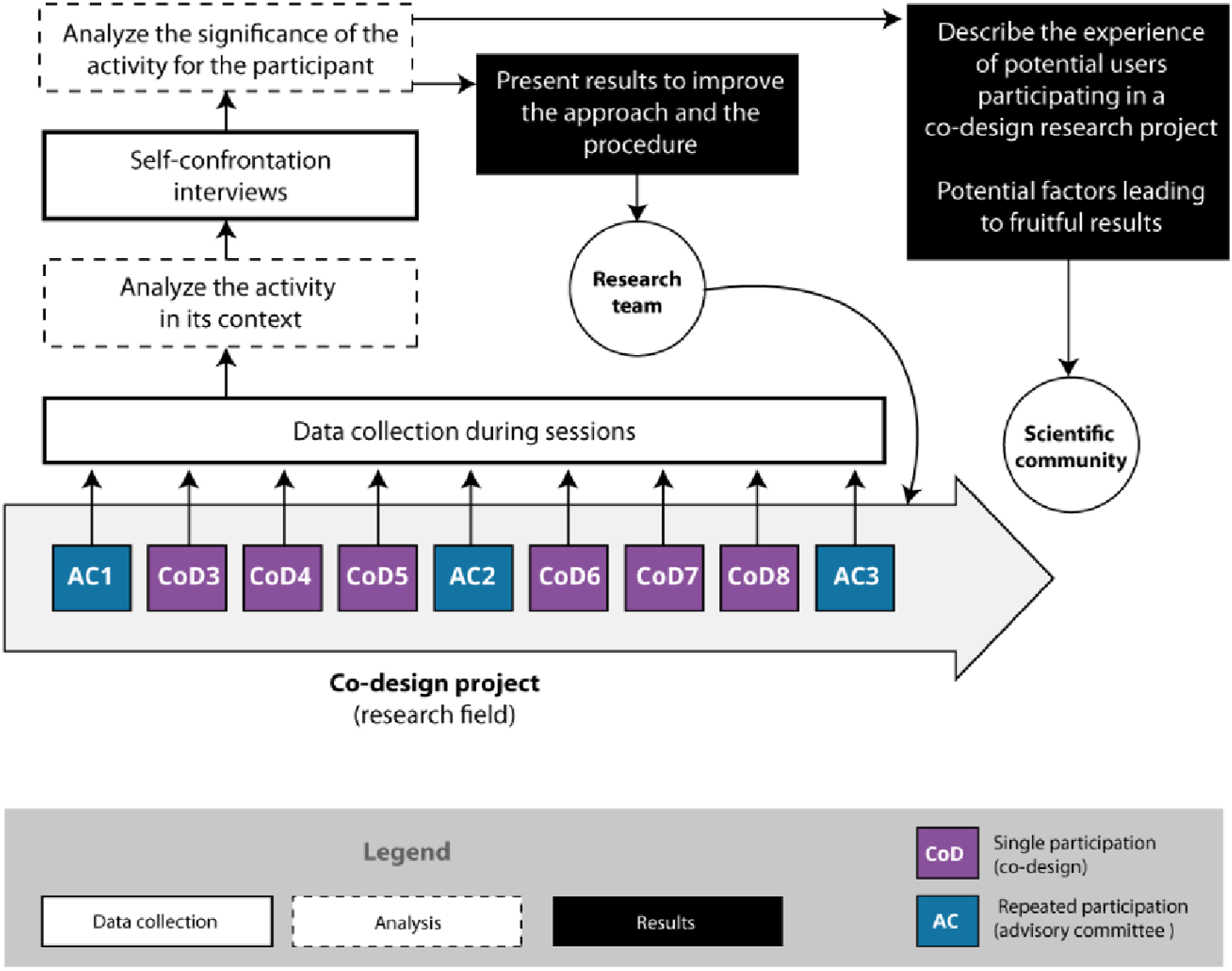
The aforementioned study by Tremblay et al. (2022) aimed to digitally support individuals caring for functionally impaired older adults. More precisely, Tremblay et al. focused on the development process of a digital app which is supposed to support caregivers while the caregivers are part of the developmental process. This digital tool’s development involved a diverse pool of directly affected individuals. An Advisory Committee (AC), composed of members from this pool, guided the tool’s 13-month development process. Additionally, co-design (CoD) sessions, these are one-time exchange meetings with various individuals also recruited from the pool, were held. These individuals were neither part of the AC nor the CoA research team. The AC maintained a consistent membership, whereas the CoD sessions had varying participants. The following diagram illustrates these exchange meetings as the foundation of the development process. It also highlights that the previously mentioned confrontation interviews were an essential component of the app’s development history. Furthermore, it depicts the research team’s influential role in shaping these exchanges and, consequently, the development of the tool itself, which was the defined objective of the meetings. Parts of the research team were involved in moderating the exchange meetings and participated in design decisions for the digital tool. This feedback loop is represented in the diagram by the connection between the research team and the “base” (i.e., the participants) (Figure 2):
This study design also illustrates where confrontation interviews can be utilized to extract information essential for situation engineering. In this context, the Course of Action framework does not directly study caregiver’s work but the development of the digital tool that modifies the situations in which individuals assist others. The link between the engineering process of the app and the situation to be digitally supported lies in the shared perspectives of those in caregiver roles who are simultaneously part of the AC or CoD. This study focuses on where communication between caregivers and developers is successful—perspectives are comprehensively shared—or under what conditions communication is hindered or when it breaks down (no mutual understanding of what is said).
To avoid leaving this “perspective sharing” as a schematic abstraction, it is crucial to understand what confrontation interviews concretely achieve and how they are operationalized. As demonstrated in studies applying the Course of Action framework (in our case Tremblay et al., 2022), self-confrontation interviews utilize video recordings of specific activities. In Tremblay’s case, the co-design sessions themselves were recorded. These video cues help participants recall their immediate, intuitive experiences in the specific situation, before any conscious reflection or retrospective rationalization takes place. Concretely, this method achieves a highly granular, intrinsic description of cognitive activity, allowing participants to verbalize exactly what they were doing, thinking, or feeling at specific moments (e.g., moments of feeling “destabilized” or overwhelmed by environmental constraints). The operationalization of this shared perspective for “situation engineering” occurs when these subjective, unedited experiences are systematically translated into actionable design parameters, or “affordances” to use a technical term. Because the interviews reveal specific interactions, emotional and cognitive states the caregivers genuinely experienced, the engineering process of the app can be adjusted precisely to the actual needs of the caregivers who will use the app afterward and who contribute to the development. For example, by altering the sociotechnical environment, providing clearer advance information, or restructuring the physical workspace.
This qualitative methodological analysis, sometimes coupled with quantitative data at selected points, aims to help understand, from the perspective of the cognitive system, both the mechanisms of resource identification and utilization, as well as the type and quantity of resources employed while a cognitive system is under performative pressure. Confrontation interviews are, therefore, a crucial source of information regarding the situationally relevant entities, variables, and relations for a cognitive system.
2.3.2. Addressing Motley Crews
Research as done in the CoA framework, which prioritizes the qualitative investigation and modification of processes, offers a direct contribution to mitigating the Motley Crew Argument. However, this response is only possible because these methods do not explicitly address downstream problems such as the replicability of results. This appears to be a necessary “trade-off” when employing this approach. CoA methods confront the Motley Crew Argument by tackling its core problem of manageability and orientation. They offer a systematic way to identify the entities, variables, and relations that are actually situationally relevant, from the perspective of the cognitive system. They effectively reduce the “motley crew” by demonstrating that not all environmental factors are equally significant for cognitive performance, especially not from the cognitive system’s viewpoint, but only those that become integrated into the lived cognitive activity.
CoA methods thus draw their strength from analogies to neurophenomenology (Gallagher, 2007; Olivares et al., 2015; Varela, 1996), where participants are trained to verbalize experiences. This training allows for precise information regarding, for example, attention spans, perceived details, and changes in perception during perceptual psychology experiments. Similarly, analogies exist with microphenomenology (Bitbol & Petitmengin, 2017; Gaete Celis, 2019; Petitmengin et al., 2019), a specific interview technique aiming to explore and describe subjective experiences with very fine, detailed resolution without resorting to suggestive questions. However, CoA methods are unique in applying these phenomenological approaches to the analysis of an overall situation and with a design intent—an application scope not specifically envisioned by neurophenomenology and microphenomenology.
CoA methods replace the (scientifically conservative) search for universal laws with a quest for ecologically valid patterns of practice that are stable within their respective domains. By doing so, they mitigate the accusation of disorientation and intractability, providing an empirically grounded procedure for identifying significant factors that are distinguished from purely contextual ones. This effectively increases the analyzability of complex environments. A significant drawback of this methodological approach, however, is that without linguistic-phenomenological access to the cognitive system, the orienting capacity of these methods cannot be utilized. Non-linguistic animals, for example, can hardly or not at all be investigated using these methods. Also another relevant question arises: if a method is designed to actively improve and shape a situation, does it provide a genuine scientific understanding of cognitive activity? We argue that it is indeed scientific, insofar as it provides a crucial and empirically grounded analysis of how cognition is dynamically constituted in practice.
To fully appreciate this claim, it is necessary to make an implicit epistemological premise explicit: genuine scientific understanding does not strictly require the formulation of universal, context-independent laws. While the classic “covering law model” of explanation demands strict universality, contemporary philosophy of science has fundamentally challenged this assumption. Philosophers of science argue (e.g., De Regt, 2017; De Regt & Dieks, 2005) that epistemic success is not defined by universal laws, but by intelligibility, the ability of scientists to use a theory to explain phenomena within a specific, circumscribed context. Furthermore, philosophers like Mitchell (2003) emphasize that sciences dealing with complex, adaptive systems rely on “contingent generalizations” rather than strict universal laws. The regularities found in these domains are highly sensitive to contextual and environmental constraints. Others similarly (Feest, 2011, 2017) defend the claim that cognitive phenomena are not just objectively “out there” waiting to be subsumed under universal principles but that they are scientifically constituted and stabilized through specific, local experimental and observational practices.
In such a philosophical context, the methodological scope of CoA is justified. CoA does not aim to uncover context-independent laws of cognition. Instead, by detailing the concrete, localized coupling between an agent and its sociotechnical environment, it delivers precisely the kind of context-sensitive, pragmatic understanding that some philosophers identify as the hallmark of successful scientific understanding. This epistemological reframing directly addresses the Motley Crew’s concern: identifying relevant variables in complex, lived contexts is not a methodological deficit, but a robust scientific practice.
2.4. Cognitive Ecology/Ethnography and Representative Design
Cognitive ecology/ethnography (Hutchins, 2010, 2025; Nersessian, 2019; Real, 1993) and representative design (Dhami et al., 2004) focus on describing and experimentally emulating complex and variable contexts. They share a close affinity with the CoA framework, but the two approaches differ in their scientific objectives—a point that will be elaborated on below. Cognitive ecology generally posits that cognitive processes are not intracranial phenomena, but rather dynamic interactions occurring between an organism and its environment. The fundamental question of cognitive ecology is how cognition is produced in real-world situations and culturally organized activities. It, therefore, strongly emphasizes that the investigation of cognitive phenomena must reflect the complexity of the relationships often necessary for cognition’s emergence and execution. This stands in contrast to research that examines its phenomena under more controlled laboratory conditions. Cognitive ethnography also holds methods for investigating the aforementioned general thesis in scientific practice. One can be described as “participant (or participatory) observation” (Seim, 2024; Van Donge, 2006; Spradley, 1980/2016), beginning with the selection of a specific cognitive system or an activity regarded as cognitive. 7
For example, if spatial navigation is chosen as the phenomenon, and a specific instance is selected—such as the navigation of large units like aircraft, ships, etc., or the navigation of military units in an operational area (e.g., Hutchins, 1995)—the first methodological step is to organize field access. This involves contacting organizations, companies, communities, or other groups to weigh research possibilities and ensure research goals and processes are transparent to all involved parties. Once the contact phase is complete, participant observation commences. This central part of cognitive-ethnographic fieldwork involves researchers observing activities over extended periods and, when possible, actively participating in them. Participant observation is a unique aspect of cognitive ethnography, as it explicitly breaks with traditional scientific standards of neutrality, distance, and passive observation. This introduces the challenge that the researchers’ personal experiences, beliefs, biases, and habitual actions can influence the events and processes under investigation. On one hand, they might trigger effects that would not have arisen without their presence, thereby altering the activity to be studied in an individual way. This complicates or even precludes the generalizability of findings. On the other hand, participant observation offers significant advantages, such as access to implicit knowledge, more accurate identification of relevant action details, leading to more precise and richer data, and a deeper understanding of the context. Participant observation thus operates within this tension between the potential for undue influence by the act of observation and the immersive production of knowledge about the phenomenon under study.
Building upon the results of cognitive ethnography, the so-called “representative design” can be applied. This is a research methodology primarily developed by Egon Brunswik (Brunswik 1955, 1956). Brunswik argues that the results of laboratory experiments, which abstract from reality, often exhibit low “ecological validity” (Araujo et al., 2007); that is, they cannot be reliably transferred to situations outside the laboratory. To circumvent this problem, representative design proposes that not only the participants but also the stimuli and situations used in a study should be representative of the natural environment in which the investigated phenomenon occurs. This means that the complexity, variability, and correlational structure of the environment must be incorporated into the research design. Instead of manipulating individual variables independently, it acknowledges that environmental features in the real world are often correlated (e.g., the perceived size of an object correlates with its distance). Such natural correlations are crucial to how organisms perceive and process information. The method often involves sampling stimuli from the relevant natural environment. For example, when investigating how people estimate distance, real objects at real distances in a typical environment should be used as stimuli, rather than isolated light points on a laboratory screen.
Furthermore, representative design aims to enable research to incorporate the probabilistic relationships of the environment (Brunswik, 1943, 1955; Brunswik & Herma, 1951). “Probabilistic relationships” refer to the reliability with which a stimulus indicates a state, process, or property. Environmental cues do not, in all cases, reliably indicate the nature of an object. Meanings can be “assigned” to stimuli; that is, a stimulus, in context and when processed by an organism, may generate a certain appearance that suggests something is the case when it is not (mimicry, as in the imitation of appearance and behavior for predator deterrence in animals or as a status indicator in humans, serves as an example). Therefore, environmental cues indicate world states only with a certain probability. Probabilistic relationships also support the assumption that many forms of perception are inherently uncertain and that organisms manage these uncertainties by tightly coupling perception with adaptive behavior. Fundamentally, cognitive ethnography and participant observation can be said to provide the (descriptive) data foundation upon which representative design operates. The latter, therefore, often requires a preceding ecological analysis of the relevant environment to approximately understand its structure and typical patterns of stimuli.
2.4.1. Example | Cognitive Ethnography
An example of cognitive ecology studies is Personal Health Information Management (PHIM). PHIM studies primarily examine the memory, planning, and decision-making strategies developed and employed by individuals to maintain therapeutic rhythms (medication intake, wound care, medical consultations, and consultations with health insurance providers) in the context of chronic diseases (which are among the leading causes of death). How are these cognitive capacities implemented in a home-based illness situation, and how can they be improved if necessary? This question, in many studies, is guided by a “studying cognition in context”-premise, with explicit reference to cognitive ecology.
The overarching goal of the study by Werner et al. (2018) was to investigate how the sociotechnical system of the home environment interacts with the cognitive work of Personal Health Information Management (PHIM) in individuals with chronic illnesses. The central focus was on how the cognitive work of PHIM is shaped by the characteristics of the home. The study utilized a simulation approach to investigate PHIM within actual home environments. Diabetics were selected due to their chronic condition requiring long-term self-management activities, including health information management. 3D visualizations of 15 real homes were used, displayed in a fully immersive VR CAVE (Cave Automatic Virtual Environment). These virtual replicas were created using LiDAR (Light Detection and Ranging) from actual household interiors and were fully navigable and explorable—this meets certain demands of representative design. The VR CAVE generated visual stimuli that conveyed the feeling of being present in a location removed from reality. Participants were tasked with exploring the 3D visualizations of a real home and evaluating how features within the domestic context could be used for PHIM tasks, such as medication management and blood sugar control. Participants were instructed to walk through each home and mark objects, features, and spaces they would use to manage their health information tasks. Marking resulted in a visible yellow “blob” on the object. A research assistant acted as a “guide,” documenting the selected feature, the room, and taking notes on the participant’s statements—this fulfills aspects of participant observation. After each home tour, an individual debriefing was conducted and recorded.
The results indicate that the distribution of cognitive tasks across the physical-spatial context is widespread. Memory tasks, for instance, are managed by placing medications in frequently visited locations or linking them to recurring actions. For example, nighttime medications are kept by the bedside. Individuals also distributed cognitive work through interaction with care team members, family, and partners. This occurred both synchronously (via phone, in person) and asynchronously (e.g., notes for partners). Social relationships did not always facilitate cognitive work; participants actively tried to minimize the impact, disruption, or even intrusion of others. While the CoA framework includes transformative intentions aimed at changing work and stress situations and more explicitly integrates the verbally articulated first-person perspective into the investigation, cognitive ecology tends to seek a fit between the cognitive system and the environment, with the first-person perspective being more integrated into participant observation. One might somewhat overstate that CoA prioritizes a design interest, whereas cognitive ecology is guided by a more conventional analytical epistemic interest.
2.4.2. Addressing Motley Crews
Cognitive ethnography and representative design offer a two-pronged response to the Motley Crew Argument by also not eliminating the complexity of cognitive phenomena, but rather systematically describing them and translating their situatedness into experimental setups. Ethnography relies on participant observation as its central fieldwork method. This immersive approach allows for an empirical, bottom-up identification of which environmental elements are relevant for cognitive performance. While this deliberate break from traditional observer distance risks influencing the processes under study, it yields a crucial advantage: access to implicit knowledge and a deep, contextual understanding of the situation. Through this method, the significant, system-shaping factors are distinguished from mere background noise. However, there’s a previously unmentioned limitation: there might be causes, mechanisms, or influences on the phenomenon of interest that cannot be (or are not) captured by ethnographic description. The existence of these influences diminishes the sole relevance of ethnographic descriptions. This simply means that ethnography alone cannot eliminate the Motley Crew Argument but must operate in conjunction with other methods. As mentioned earlier, this necessitates an explanatory pluralism (Carls-Diamante, 2019; Dale et al., 2009; de Jong, 2001; Gervais, 2021; Mitchell, 2002) to counter the complexity of phenomena with a complexity of methods. Participant observation can play a role because it meticulously uncovers the real-world interactions and dependencies of cognitive performances, it portrays cognitive systems not as a chaotic jumble but as describable, albeit complex, wholes. Compared to CoA, participant observation is distinct in its ability to trace, confirm, and supplement individual reports on cognitive performances.
Furthermore, within 4E research, these methods can pursue a specific but limited type of generalization of results. This is not about generalizing laboratory results to an external world, but rather about identifying transferable principles of situated cognition. If an analysis reveals how a specific sociotechnical environment structures cognitive work (as in the PHIM example), then, this is the assumption, such principles are transferable to other, structurally similar sociotechnical environments. Generalization occurs at the level of interaction dynamics. These methods confront the Motley Crew Argument by demonstrating that it can add something in order to scientifically manage the complexity of situated phenomena, not by eliminating it, but by methodologically guided learning to describe it and reproduce its essential features when needed.
3. Conclusion
The “Motley Crew Argument” posits that situated cognition research gets lost in an overwhelming complexity of neural, bodily, and environmental factors, thereby losing its scientific credibility. This article has formulated a reply: the alleged unmanageability is not a principled obstacle but a methodological challenge requiring methodological (re-)considerations. To address this task, a robust toolkit can be built using already existing quantitative and qualitative methods. This article has presented four central methodological approaches that at least mitigate the accusation of empirical intractability: Structural equation models (SEM), particularly in their dynamic variants, translate theoretical assumptions into networks of variables, forming empirically and statistically verifiable models of complex cognitive phenomena. They allow for the quantitative capture of relationships within the “motley crew,” rather than surrendering to its multifaceted nature. Dynamic approaches, using non-linear differential equations, provide the precise formal language to mathematically model phenomena like emergence and reciprocal coupling. Here, complexity transforms from a problem into the explicit subject of investigation. The “Course of Action” approach pragmatically reduces complexity by using methods like confrontation interviews to identify factors that are actually relevant during cognitive performances from the perspective of the acting system. It tames the “crew” by, from a specific perspective, naming its crucial members. Finally, Cognitive Ethnography and Representative Design bridge the gap from uncontrolled reality to ecologically valid research. They describe the ecologically valid patterns of situated activity and make them accessible for controlled, yet reality-proximate, analysis. The methods presented are not isolated solutions. They form a complementary toolkit that allows 4E research to empirically substantiate its rich philosophical theses. The accusation of scientific disorientation loses its force when considering the methodological map that is already being drawn. The gap between situated cognition theory and empirical investigations is therefore demonstrated to be increasingly bridgeable.
Footnotes

Funding
The authors disclosed receipt of the following financial support for the research, authorship, and/or publication of this article: This work was supported by the Deutsche Forschungsgemeinschaft 542329417.
Declaration of Conflicting Interests
The authors declared no potential conflicts of interest with respect to the research, authorship, and/or publication of this article.