



Abstract
A core issue of embodiment is the question of how phenomenal and agentive consciousness relates to external forms of behavior. Instead of biasing the question in terms of the “hard problem” as to why and how consciousness arises from brain processes (D. Chalmers), it is suggested to ask for psychophysical correlations in a metaphysically neutral way. This, however, demands (1) to explore both sides of the problem with equivalent precision and depth—not only the physical—and (2) to develop a metaphysically neutral tool to formalize them in a consistent way. Concerning (1), the basic structure of mental micro-activities found in first-person studies on cognitive processes suggests extending the scope of qualia as a mark of consciousness. In the context of Structure Phenomenology (H. Witzenmann), functionally negative phenomenality experienced in ambiguous or meaning-deprived situations and inner agentive qualia of mental activities are correlated with the decompositional signature of sensory-neural processing and synchronized neural oscillations. Concerning (2), G. Günther’s Transclassical Logic is briefly introduced and deployed to integrate the mental, psychophysical, and physical contextures in a three-valued formal framework which also includes enacted and embodied aspects. The emerging picture rebalances first-person and third-person aspects of cognition by functionally separating and dynamically integrating them, thus revitalizing the neurophenomenological research agenda with new experimental proposals and concrete hypotheses.
Keywords
1. Introduction
Since Chalmers (1995) formulated the “hard problem of consciousness,” that is, the question of why and how it arises from brain processes, there has been much debate about whether the problem actually exists, whether it can be solved, and whether it has already been solved. While the simplest way to get rid of the problem is to deny the existence of conscious experience (Dennett, 1991), many scholars have made efforts to answer the question by neuro-scientifically inspired information processing theories (e.g., Global Neural Workspace: Dehaene et al., 2011, Integrated Information Theory: Tononi et al., 2016). Others criticized this brain-centered and thus “internalist” perspective and aimed to broaden the focus to an embodied, embedded, enacted, and extended (4E) cognition, especially highlighting interaction between the whole body and its environment (Newen et al., 2018; Noë, 2004). However, even though there are studies conducted in 4E contexts that address conscious experience at various qualitative levels (e.g., Marti et al., 2020; Nave et al., 2021), much work in this area still adheres to more external (i.e., behavioral or quantitative) measures and naturalist frameworks. Therefore, to date, the predominant tendency in both neurocentric and 4E approaches, is to deal more or less indirectly with phenomenal consciousness, that is, in reductive ways without including original (i.e., qualitative) first-person data. On the one hand, this is understandable, since the four-century track record of modern science justifies indirect explanations insofar as they can integrate externally measured data into consistent theories from which reliable predictions can be derived in an objective, person-independent manner. On the other hand, when it comes to the scientific study of subjective consciousness and especially to the hard problem, it is questionable whether indirect explanations can approach it in an adequate, consistent, and sustainable way. This is because the first-person perspective of consciousness is necessarily linked to “empirical self-observations in contrast to third-person data, the observations of objects and processes external to the observer’s mind” (Choifer, 2018, p. 336). Phenomenal consciousness is “radically self-referential” in that formulating, understanding, and answering a question about consciousness are all themselves acts of consciousness in which, beyond the abstractable contents in question (including self-reference), our lived experience is always directly and inescapably involved (Bitbol & Luisi, 2011, p. 209). Therefore, if one takes the self-referentiality of the explanandum seriously, one should keep open the possibility of granting it at least partially the role of an explanans as well—as, for example, at this moment when you, the reader, are trying to make sense of what has been written. In other words, sense-making regarding consciousness would have to methodologically include its self-referentiality in a most direct, experientially accessible way instead of deferring it to other descriptive levels, whereby it makes no difference whether these are set up in a neurocentric or 4E context. Hence, with view on the above formulation, some scholars argued that the hard problem might be ill-posed from the outset and therefore intractable because of another false premise, namely, that consciousness is functionally—and implicitly also metaphysically—subordinate to any physical or biological processes (Gomez-Marin & Arnau, 2019; Thomas, 2009; Whitehead, 2010). While it is true that most contemporary philosophers hold a materialist or naturalist viewpoint (Bourget & Chalmers, 2014; Kammerer, 2021), it does not follow that a corresponding bias in the question about consciousness must lead to conclusive answers.
Despite the broad materialist agreement and the fact that science has been facing the hard problem since at least the 19th century (Pecere, 2020), no breakthroughs have been made to date, except for an enormous diversification of (sub)theories. Thus, instead of sticking to routines such as “shut up and measure” (Pinto & Stein, 2021) or the evasive construction of a “meta-problem of consciousness” (Chalmers, 2018), it would be better to put the actual problem into a more scientific, metaphysically neutral form that allows for fresh attempts to address it. While metaphysical neutrality can be associated with Husserlian phenomenology (Zahavi, 2017), it is also the basic phenomenological stance of any empirical science—and should be recognized as such. Therefore, it should be also applied to the question of brain and consciousness which simply means examining both sides of the problem without giving either of them greater metaphysical power. So, why don’t we just ask about psychophysical correlations without already attributing a particular role to one side or the other? First, of course, this would challenge researchers to explore both sides of the problem with methodologically equivalent precision and depth—not only the physical but also the mental—and, second, a metaphysically neutral or at least unsuspicious tool would have to be found to connect the two sides in an integrative formalization. 1 Of course, the 4E extension of the physical (neural) domain would also have to be taken into account and the approach should not relapse into substance dualism. Any further wishes?
If this reasoning is accurate, then the two methodological tasks at stake should be clarified and approached as far as possible. As for the first, some cognitive scientists and philosophers have recently acknowledged the significance of consciousness for human existence (e.g., Cleeremans & Tallon-Baudry, 2022) and speak of “consciousness science” (Michel et al., 2019) or “conscious neuroscience” (Gomez-Marin & Arnau, 2019), but without elaborating on how to establish it. Therefore, a novel approach of an empirical-introspective, qualitative-quantitative method, the Task-based Introspective Inquiry (TBII), will be introduced and its results presented as far as they are relevant here (Wagemann, 2022a). It was developed in the context of the revived interest in reintegrating the first-person perspective into phenomenological, psychological, and cognitive science questions, although this movement currently still has a rather marginal status, as introspection was widely discredited in the 20th century (Lumma & Weger, 2021; Weger & Wagemann, 2015). Nevertheless, the method of TBII seems to be suitable for the empirical part of the outlined challenge, as it has been proven to uncover structures of pre-reflective mental activity and accompanying agentive and emotional phenomena in experimentally controlled tasks and to validate these structures up to statistical analyses. Epistemologically, TBII thus takes a bridging position that reconciles the requirements of direct experiential access to the first-person perspective and the objectifying methods of empirical science. The central result of these investigations is that phenomenal consciousness no longer must be limited to receptively experienced qualia or representational states, but that their emergence can be explained, at least in a participatory sense, by agentive first-person processes. To date, eight studies have been published substantiating this idea in terms of perception (Wagemann, 2010, 2011; Wagemann et al., 2018; Wagemann & Raggatz, 2021; Wagemann & Walter, 2024), thinking (Wagemann, 2022b), and social interaction (Wagemann et al., 2022; Wagemann & Weger, 2021), whereby we will focus here on perception as the most elaborated topic in this context. To be brought into functional correlations with neural processes, these empirical results can be interpreted as specific kinds of (agentive and functionally negative) qualia and integrated into the framework of Herbert Witzenmann’s Structure Phenomenology (SP), written in the early 1980s (Witzenmann, 2022).
In view of the second task of formalization, various mathematical models have been suggested for neural processes, whether confined to the physiological level (e.g., Tewari et al., 2016) or intended to explain the causal emergence of consciousness from it (e.g., Aristov & Stepanyan, 2022), but only few which include mental phenomenality in an adequate way. 2 While sharing the conviction that psychophysical correlations should be amenable to proper formalization, it is questionable to what extent this can be done without losing the interpretative context of the experiential and agentive dimensions of the first-person perspective. Care must be taken that the choice of mathematical tools does not tempt us to reduce aspects of consciousness (e.g., qualia in phenomenal space) to quantitatively calculable, predictable states which are thus determined in a third-personal, non-agentive framework. Hence, without excluding other formalisms in principle, we prefer to explore the options given by Transclassical Logic (TL), developed by Gotthard Günther in the 1950s in a philosophical context and fully elaborated in formal-symbolic terms (Günther, 1978). An important reason for this choice is that logic is fundamentally superior to the third-person and first-person perspective; it applies to both and thus has no metaphysical bias. Moreover, a particular form of TL, namely, a three-valued logic, lends itself to formalizing the first-person empirical results when generalized in a structure-phenomenological context. While Witzenmann’s SP integrates the phenomenal, transitory, and agentive-participatory aspects of mental activity found in first-person studies into a comprehensive dynamic of reality formation between the mental and neural levels, TL serves to formalize this dynamic, which in terms of a polycontextural approach can be extended to the nexus of neuroscience and enactivism or, more generally, the 4E framework. In short, a synthesis of SP and TL will be proposed to mediate between direct (experiential) and indirect (formal language) forms of explanation, as demanded above, but avoiding metaphysically biased presuppositions.
As outlined, this article aims to integrate quite different topics pertaining to different subdisciplines of philosophy and cognitive science and thus faces the difficulty of doing justice to all of them. As far as possible, connections to specific debates are indicated, although this can only fulfill the role of suggestive strokes in an initial sketch here. In any case, it remains an outline to be further elaborated. The article starts in the following section with a review of the first-person empirical studies on perception outlined above and their structure-phenomenological interpretation in terms of psychophysical correlations. In the third section, after introducing Günther’s three-valued logic, the mental and psychophysical activity structures are formalized. Then, this approach is extended to enactive (or 4E) processes, leading to a comprehensive picture of reality formation and human cognition embedded into mental, physical, and psychophysical contexts. Fourthly and finally, the article concludes on how this approach addresses current limitations in the field, both empirically and theoretically, and previews future research with specific suggestions and hypotheses. In particular, an extension of enactivism in terms of an agentive first-person science of consciousness is proposed to bundle the motives and strengths of related research intentions.
2. First-person studies on perceptual reversal and their structure-phenomenological interpretation
2.1. Historical background and the method of Task-based Introspective Inquiry
From the earliest written texts of ancient cultures up to the rise of modern psychology in the late 19th century, introspection was used by scholars and laymen alike as an indispensable tool for looking into the mind (Doniger, 1981; Sharma, 2003). However, since Kant’s and Comte’s fundamental critiques, introspection was increasingly discredited in scientific contexts as a non-valid and non-reliable method (Comte & Lenzer, 2009; Kant, 2004; Ryle, 2009; Schwitzgebel, 2008). Especially with the advent of behaviorism in the 1910s, which opposed introspectionist research programs, looking inward was officially banned from the psychological toolkit and replaced by external behavior measurement and statistics (Lyons, 1986). Nonetheless, in the second half of the 20th century, behaviorism was relativized by cognitivism, constructivism, and enactivism, and historical analyses have shown that its success over introspective psychology did not primarily rely on methodological superiority but was strongly driven by economic and political interests in the United States during the 1930s (Brock, 2013; Costall, 2006). On the other hand, the methodological shortcomings of early introspectionism do not appear as insurmountable (Danziger, 1980; Lieberman, 1979) but can rather be overcome, as recent rapprochements with first-person methodology demonstrated (Weger & Wagemann, 2015). Nevertheless, contemporary cognition research is still widely influenced by the persistent legacy of behaviorism, which is not least related to the hegemony of materialism.
Against this background, various first-person approaches have been developed in recent decades to relax the charged relationship of current psychology, philosophy, and cognitive science to introspection. Since there is not space here to present these approaches and discuss their intricacies (see Lumma & Weger, 2021; Ramm, 2018), we turn immediately to the method of Task-based Introspective Inquiry (TBII), with which the above-mentioned studies were conducted, and which is intended to address the empirical part of the challenge. The development of this method was inspired by Witzenmann’s suggestions about psychophysical correlations in his Structure Phenomenology (Witzenmann, 1983, 2022), which in the first step were elaborated at a conceptual level (Wagemann, 2010, 2011). To further substantiate this approach empirically in terms of first-person experience and mental agency, Wagemann and colleagues (2018) conducted a study on voluntary perceptual reversal in which participants were instructed to intentionally change their percepts in face of an ambiguous visual stimulus. In following studies, the method was extended to other modalities and topics such as visual counting of moving objects (Wagemann & Raggatz, 2021), thought processes (Wagemann, 2022b) and nonverbal social interaction (Wagemann et al., 2022; Wagemann & Weger, 2021) and continually refined by diverse experimental conditions and analytical tools. In contrast to much other first-person or phenomenological work drawing on receptive or passive aspects of experience, 3 the cognitive task is central here because, on the one hand, it defines the external conditions for replication and, on the other, stimulates participants’ sense of mental agency. With a well-tuned demand characteristic, experiences of failure and success are enabled allowing subjects to observe phenomenal contrasts of different phases and forms of activity during task performance. To overcome the shortcomings of early introspective psychology, studies were conducted with multiple (to date: N = 16–63), independent, and untrained participants to avoid expectation or experimenter bias and to allow for subsequent statistical analyses. 4 The instructions generally required participants not only to perform the cognitive task, but also to observe themselves in terms of what they were doing mentally and how they were coming to grips with the task. Introspective data were collected by open-ended, retrospectively written self-reports, which were first subjected to qualitative content analysis resulting in hierarchical category systems safeguarded by intercoder reliability testing. In a second step, qualitative data were quantified in terms of code frequencies and fed into statistical tests for evaluating the hypotheses on invariant structures of mental activity and their modulation by independent variables such as experimental conditions and sensory modalities. What demarcates this approach from conventional procedures is “late” quantification only after fine-grained qualitative analyses which fully acknowledges first-person experience as data, which can be denoted as qualitative-quantitative crossover analysis (Small, 2011). In contrast, as is common in experimental psychological or cognitive science, first-person experience is quantified “early” and is thus in danger of being hastily reduced to abstract constructs or neural mechanisms (Weger & Wagemann, 2015). In sum, TBII and late quantification set up a unique empirical approach that connects qualitative, introspective access to consciousness with mental agency by safely extending standard methodology. This also goes beyond previous empirical approaches to these topics in enactive contexts, which mostly remain on a theoretical level (e.g., Brancazio, 2019) or do not focus sufficiently on mental agency to draw conclusions for psychophysical correlations (e.g., Nave et al., 2021). 5
2.2. Mental micro-activities in consciously controlled perceptual reversals
Without going into more detail, we focus here on the results of four studies on voluntary perceptual reversals in different sensory modalities (vision: Wagemann et al., 2018; Wagemann, 2022b); audition: Wagemann, 2023, speech: Wagemann & Walter, 2024). Experimental conditions further varied as to whether the task consisted in intentionally changing between different percepts, for example, spatial variants of the Necker cube or tone frequencies of a singing bowl, or whether the task was to hold a certain percept while the stimulus changes in a distracting way. While terms like “mental act” or “mental activity” are often used unspecifically (e.g., Rowlands, 2018) or taken synonymously with brain processes (e.g., Zeman, 2001), the TBII studies revealed a concrete, cross-modally confirmed structure of four mental micro-activities, as observed from the first-person perspective. Across conditions and sense modalities, subjects reported that they, in order to perform a perceptual reversal, (1) turned away (TA) from ambiguous, unwanted, or otherwise distracting parts of the stimulus, (2) produced (PR) awareness and semantic context of the perceptual variant to which they wanted to shift as well as corresponding strategies, (3) turned their attention toward (TT) the stimulus again to search for anchor points that might confirm the intended percept, and (4), finally, perceived (PE) it with full distinction. In Figure 1, exemplary results of quantitative analyses are shown, which can be explained by activity-specific features (e.g., variety of productive strategies) and in the context of common theories (e.g., “global workspace” with limited attentional resources, Baars, 1988). Through this qualitative-quantitative crossover analysis, phenomenal consciousness is made measurable, but not with the reductionist intention of explaining it away, but by revealing a balanced dynamic of constitutive micro-activities that are both consciously accessible and quantitatively responsive to independent variables. Moreover, mental activities were accompanied to varying degrees by different forms of conscious intention (O’Shaughnessy, 2000; Wu, 2014) and metacognitive feelings (Proust, 2015), both of which underline their potential status as full-blown mental actions (for an overview of the mental action debate, see Fiebich & Michael, 2015). This opens a developmental spectrum between pre-reflective mental activities performed in automatic cognitive (everyday) routines, which (mostly) cannot be ascribed an agentive status, and their consciously intended and controlled execution with a cultivated “agentive attention awareness” (Watzl, 2017, p. 232) and an “intrinsic” or “self-generated normativity” (Barrett, 2016, p. 251). These are first indications of a direct, non-reductive approach to phenomenal consciousness, which will be further elaborated in section 2.3. Exemplary results of first-person studies on perceptual reversal in terms of mental activity. TA: turning away, PR: producing, TT: turning toward, PE: perceiving. Frequencies can be interpreted as lower or higher conscious access to otherwise pre-reflective mental activities. Significant differences were identified by Chi-square tests. (a) Producing in speech change is significantly higher than in vision and non-linguistic audition, which can be explained by more differentiated (semantic and articulative) strategies in speech perception. (b) For speech, turning away and turning toward differ significantly and reversed across experimental conditions, which can be explained by limited and complementarily exploited attentional ressources in introspection. That TA is lower for hold than for change, was expected from comparison of visual change with visual hold (Wagemann, 2022b).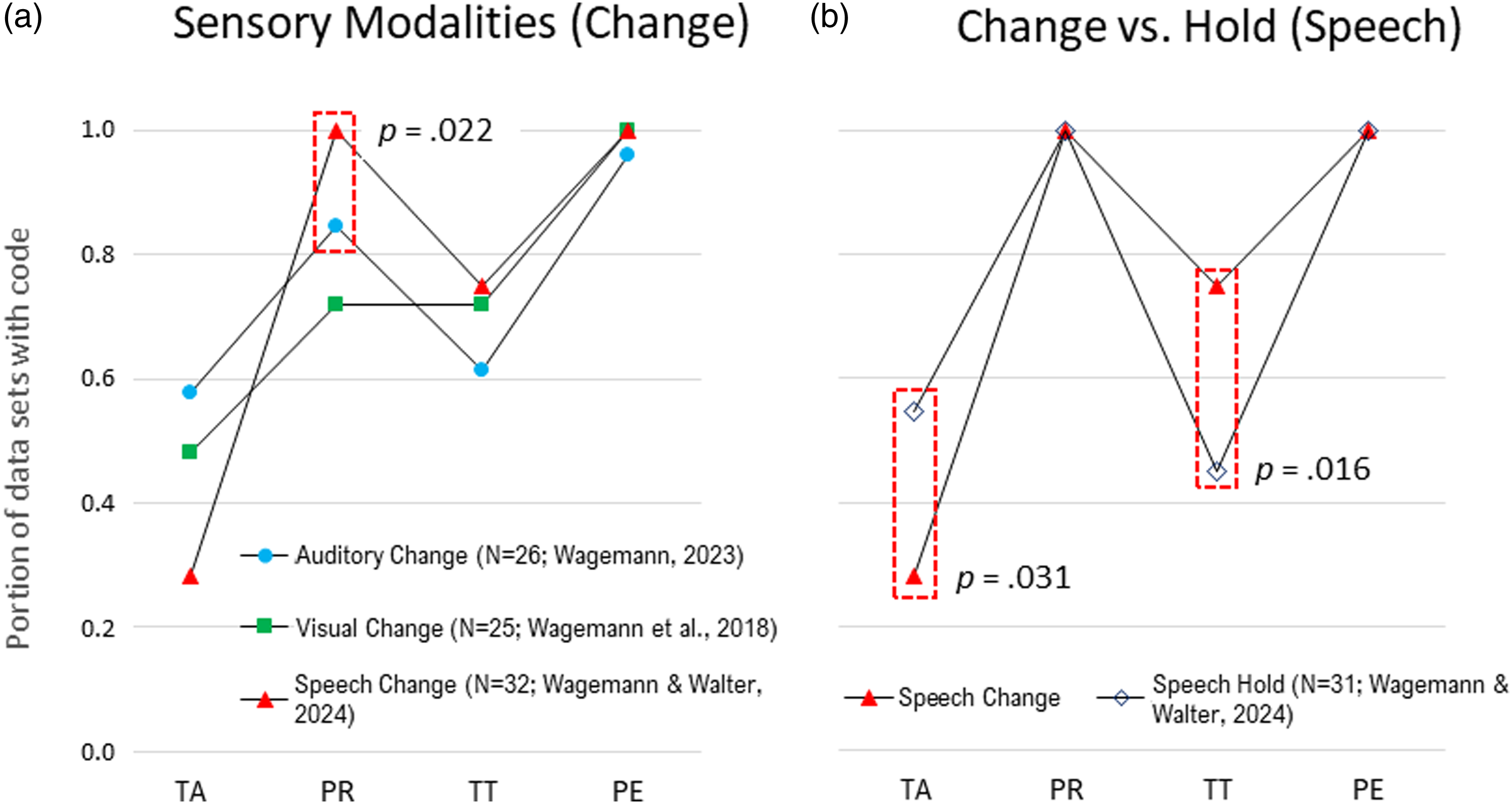
It is also noteworthy, that the four activity forms can be neatly distinguished from each other, beyond reliable coding, because the perceptual dynamics can break down in each phase. However, the diachronic sequence of activities could not be reliably verified in the data so far, it is well supported by Posner and Petersen’s (1990) classical paradigm of attentional shift comprising (A) disengagement from current focus of attention, (B) orientation towards new focus, and (C) engagement with the new focus of attention (Posner & Petersen, 1990). This shows that first-person studies can provide findings that are consistent with theories developed using conventional behavioral methods and even refine them in terms of a more sophisticated subdivision of phases. Interestingly, Posner and Petersen’s phase (B) which is most distanced from the stimulus can be subdivided into (2) the production of mental content and strategies (PR) and (3) the reorientation toward the stimulus, using this content as a focusing lens, so to speak (TT) (Figure 2(a) and (b)). Models of attentional shift and perceptual reversal. (a) In Posner and Petersen’s (1990) model, subfunctions are identified with neural processes, consciousness is epiphenomenal, and the explanatory gap remains. (b) The cross-modally confirmed structure of mental-micro-activities relies on first-person data which allow to distinguish inner agentive qualia and functionally negative phenomenality. (c) Structurephenomenological interpretation of (b) leads to bidirectional psychophysical correlations of decomposition and recomposition and corresponding cross-domain effects.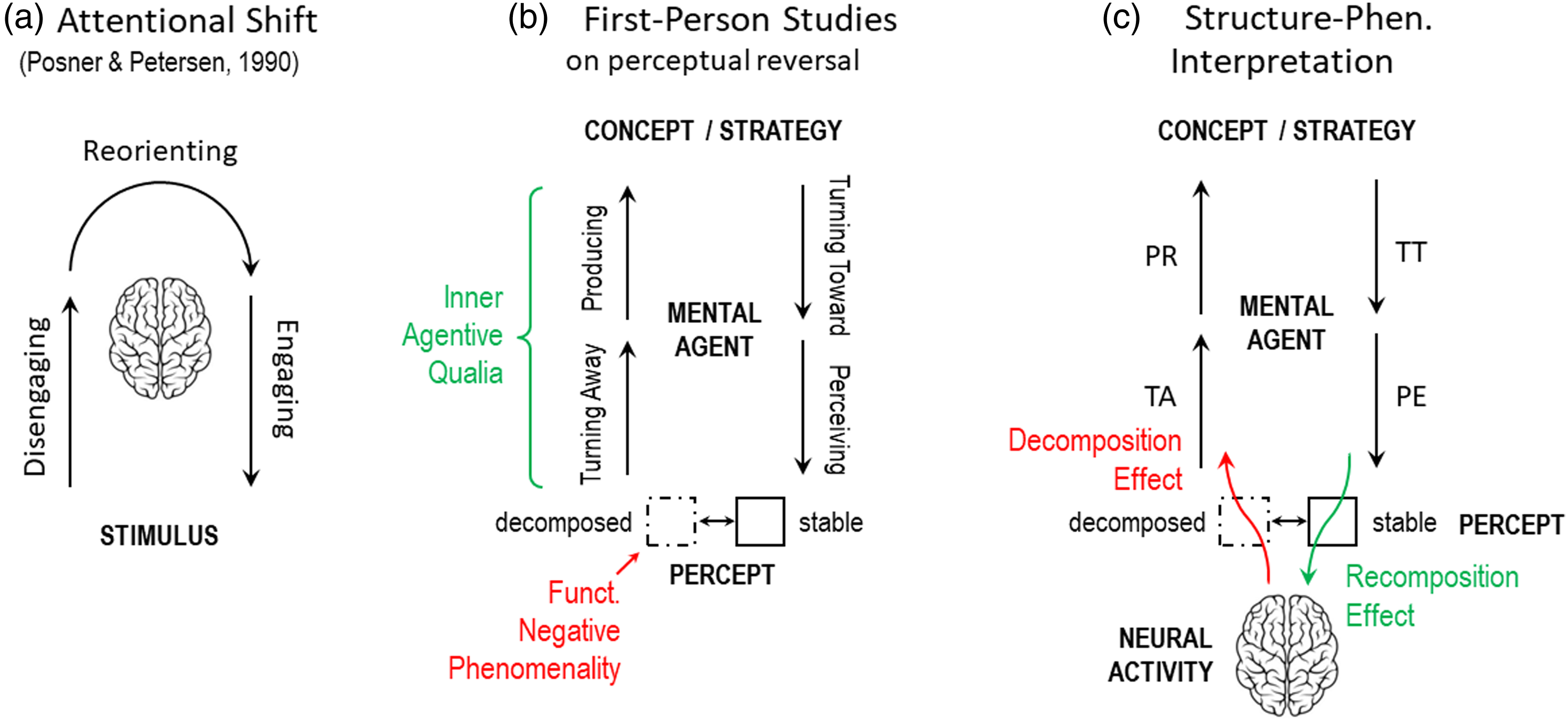
2.3. Extension of qualia to agentive and negative forms
Another important implication of the studies in view of psychophysical correlations is that qualia as another mark of the mental beyond intentionality (e.g., Coleman, 2022) can be further differentiated. As a first pragmatic distinction, object- and subject-related qualities of experience can be denoted as phenomenal character and inner qualia (Kriegel, 2002; Merleau-Ponty, 1962). Both are usually understood, if not denied from the outset, to be “raw feels” (Tye, 2006, p. 139) which are “directly and immediately given in consciousness” in connection with sensory perception (De Leon, 1997, p. 2). Thus, in the experiments, qualia can first be identified by the contrasting phenomenal character of the two or more perceptual variants perceived with reference to one and the same physical stimulus, be it different spatial orientations of the Necker cube, different tones in the sound of a singing bowl, or the difference between “ice cream” and “I scream” as heard in ambiguous speech. While this phenomenal character refers to what is perceived on the object side as otherness, subjects experience inner qualia as a pervasive and specific mineness, such as perceiving themselves as looking at the Necker cube from above or below, finding the high-pitched sound as unpleasant, or getting into a summer mood when hearing “ice cream.” But this is only part of the whole qualia picture because it only covers the endpoint of a successful perceptual reversal. To the extent, subjects are aware of their mental micro-activities by which they bring about the intended percept, at least in a participatory sense, they also experience themselves as event-causing agents (Alvarez & Hyman, 1998). On the one hand, this undermines the apodictic, receptive-passive givenness with which qualia are experienced in everyday life and connoted in philosophical thought experiments. On the other hand, since mental micro-activities can be qualitatively distinguished both from object- or subject-related event qualia (as “raw feels”) and from each other they exhibit another kind of inner qualia which can be termed as inner agentive qualia. If it is true that there is no sensory modality or set of modalities in which agentive experiences can be located in the context of bodily actions (Mylopoulos, 2015), then this is even more true for inner agentive qualia of mental actions, which is a first extension of the scope of qualia. 6
As a second extension of qualia, participants also reported on passive experiences at the sensory level which cannot be subsumed under the above forms of object-related phenomenal character. During the phases of turning away and turning toward, or in gazing or listening without any content-related intention, they experienced the stimulus as gradually deprived of meaning or decomposed, ranging from slight distortion over ambiguously mixed percepts up to incoherently fragmented, meaningless data (Wagemann, 2020; Wagemann & Walter, 2024). Similar experiences are described in perceptual or intellectual crises (Dewey, 1910; Oevermann, 2005) or when encountering unexpected, alien phenomena (Waldenfels, 2011), but otherwise this phenomenon seems to be underresearched in philosophy and cognitive science. Nevertheless, based on the self-report data, a transitional phase can be identified in the process in which the hitherto stable or not yet stabilized percept blurs and dissolves into decomposed, that is, nonconceptual and de-qualified, particulars. Here, it is important to note that, while this experience occurs in the uninterrupted stream of phenomenal consciousness, it exhibits an interrupting impoverishment of qualitative coherence of any kinds and therefore deviates from determined qualities, properties, and other specifications, as discussed about nonconceptuality in analytic philosophy (e.g., Heck, 2000; van Geen & De Vignemont, 2006). Of course, if one confines conceptuality to judgment and belief (Peacocke, 2001), propositional attitudes in general (Bermúdez & Cahen, 2020), or “mental” representations (Werning et al., 2013), there is much room left for nonconceptuality in the inexhaustible wealth of perceptual experience, for example. In contrast, the nonconceptual content addressed in the introspective data does not belong to any category due to its under- or indeterminacy and poverty of coherence which can occur in various degrees. Complementarily, during the other phases of the process, a new percept is recomposed by mental activity and conceptual (e.g., strategic-semantic) means. 7 In terms of systems theory, as applied to psychological self-regulation processes, these aspects could also be understood as destabilization and restabilization (Karoly, 1999). Paradoxically, the decomposition of the percept does not indicate either an absence or a presence of qualia in the conventional sense, which is why we propose to speak of functionally negative qualia with respect to these experiences (Figure 2(b)). 8
2.4. The structure-phenomenological framework of psychophysical correlations
Before introducing an interpretation of the outlined empirical results by Structure Phenomenology (SP), its most important predecessors and demarcation to the Husserlian tradition of phenomenology shall be briefly addressed. The first to mention is J. G. Goethe (1749–1832), who saw himself less as an important poet than as a researcher, as he developed a phenomenological method for natural research and strove for insight about a basic structure of life. He was convinced that the “plant archetype” (in German: Urpflanze), as he termed it, could be observed as a constitutive dynamic of separation and integration in concrete organisms (Goethe, 1988). R. Steiner (1861–1925) took up Goethe’s method, transferred it to the phenomena and dynamics of consciousness, and thereby connected it with early accounts of cognitive agency (e.g., Fichte, 1889; Maine de Biran, 2021; Steiner, 1964; Steiner, 1988). Steiner developed this further in terms of an introspective or meditative epistemology and applied this to ontological issues such as a stratified conception of the human being and reality (Steiner, 1972). 9 H. Witzenmann (1905–1988) studied with Husserl and Heidegger, among others, and further developed Goethe’s and Steiner’s framework into what he called SP (Witzenmann, 1983). However, he was not the only one speaking of SP at that time, for H. Rombach (1980) also developed an approach with the same name, which is in the Husserlian tradition of phenomenology. The most important difference between these two approaches lies in the notion of the basic structure. While in Rombach, there are infinitely many basic structures determined by the manifold intentional objects or contents of consciousness, Witzenmann conceives of only one basic structure as a unified process of structure generation. Thus, the difference is also between structural pluralism and monism, which will be concretized below.
Interpreting the empirical-introspective findings within Witzenmann’s SP suggests two conclusions, one referring to the first-person descriptive level and one which correlates it with the neural domain. Firstly, since the outlined pattern of mental activity in perceptual reversal occurs in modified forms also in the context of other cognitive tasks (counting of moving objects, thought processes, social interaction), it can be hypothetically generalized to a first-personal basic structure of consciousness: “The basic structure can be detected in all phenomena insofar as we become conscious of them. It results from the unification of percept and concept in the relationship characteristic of the unification process” (Witzenmann, p. 5). Because unification presupposes separated parts to be unified, its starting point lies in the separation of what Witzenmann calls “percept” and “concept” or, synonymously, the nonconceptual and the conceptual. Here, as anticipated above, “percept” does not refer to the intended result of cognitive performance in the task but rather to its raw, ambiguously indeterminate, or fully decomposed stage from which its recomposition proceeds. Accordingly, “concept” comprises more than the content of propositions or propositional attitudes, namely, virtually all forms of cognitive coherence which constitute the qualitative determinacy of conscious phenomena, whether perceived, felt, judged, inferred, believed, or even hallucinated. In this respect, cognitive processes can be explained as the interworking of components in need of and capable of qualitative-phenomenal determination, whereby the former are embedded (“universalized”) in coherent contexts, while the latter are specified and fixed (“individualized”) in spatiotemporally situated, sensory-mediated cases (Witzenmann, 2022, p. 12). However, not only the object-related structural components addressed in this way, but also we ourselves work in a “participatory act of the process of realization” (Witzenmann, 2022, p. 23), as demonstrated in the empirical studies in analogous ways for perception, thought, and social interaction. Regarding perception, the four micro-activities represent what the mental agent performs to establish a stable percept (Figure 2(c)) and thus can be mapped onto the dynamic of the basic structure (Figure 3(b)), whereby Turning Away (from the stimulus) and Producing (mental content) can be summarized as universalization, while Turning Towards (the stimulus) and Perceiving (the stimulus as intended) can be summarized as individualization. The fact that from the perspective of naïve introspection we are only aware of the perceptual or intellectual results of this process is explained by Witzenmann through a layered conception of conscious experience. While the basic structure proceeds at the constitutive level, which can apparently be accessed initially via introspective tasks, its object- and subject-related results appear as “memory-like elements” furnishing everyday consciousness (Witzenmann, 2022, p. 50). In other words, subject and object as comparatively static, representational entities are memorative references to their dynamic constitution by the basic structure (Figure 3(b)). Accordingly, the permanent implicit self-awareness promoted by Kriegel (2003) and Thompson and colleagues (2005) as a key feature of consciousness could be explained by pre-reflectively performed and experienced micro-activities, the conscious performance and experience of which would then be an explicit agentive self-awareness and participation in reality. Put differently, inner agentive qualia, as found in the empirical studies and located in the subject-related part of the basic structure by Witzenmann, ensure self-referentiality on a conscious level, even if the basic structure as such is not made conscious. The basic structure according to Structure Phenomenology. (a) As a precondition of participatory reality formation in the basic structure, a holistic, pre-decomposed state of being can be assumed including the human bodily organization as a result of evolution which decomposes reality for its owner. In a narrower sense, decomposition is the suppression of the qualitative and conceptual threads of reality by sensoryneural processing; in a broader sense, it also includes the restriction of all possibilities of interaction and experience to a maximally individualized, spatiotemporal situatedness of a body in its environment. (b) The basic structure comprises the recomposition of conscious reality by unification of its conceptual und nonconceptual components, which is performed by normally pre-reflective but potentially conscious mental activity. In this process, conceptual contents are individualized by nonconceptual singularities which in turn are embedded in lawful and meaning-bearing conceptual relations. While this is the perspective of (threevalued) participatory reality formation, its results are experienced as reified objects and personalized subjects at a (two-valued) representational level.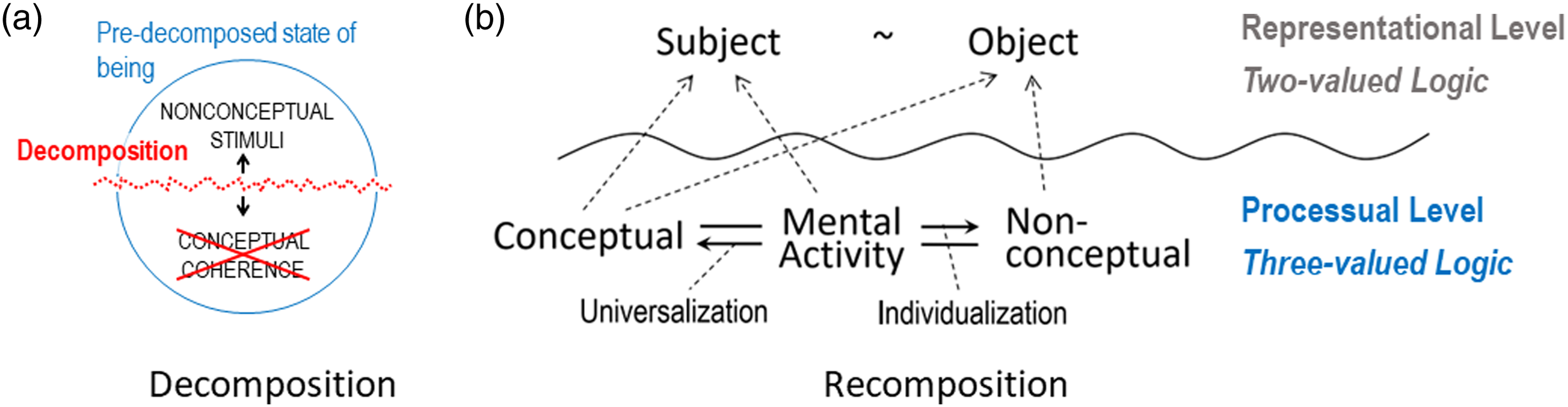
The other key argument of SP couples the first-person basic structure of consciousness with the physical level in that it proposes a bidirectional and functional interdomain correlation, which has been elaborated elsewhere (Wagemann, 2010, 2011). When considering the above scenario of perception, two aspects remain that cannot be explained at the first-person level, and these are, on the one hand, what breaks into the well-ordered determinacy of stable percepts as decomposition and, on the other hand, what accepts or rejects a perceptual intention in achieving a new stable percept. While in these two aspects mental activities of turning away and turning toward appear to be influenced by something outside their range, they otherwise interconnect phenomenally and logically consistent among each other and with conceptual content which is then retrieved in the completed percept. Therefore, firstly, SP interprets neural activity as exerting a decomposition effect upon the mental domain or, with other words, as providing it with functionally negative qualia in which the qualitative and coherent threads of reality are diminished or extinguished (Figure 3(a)). 10 While neural activity in this respect has a disintegrating or deconstructive impact on mental realization, it can secondly be suppressed in this function and then serves as a counterbearing or touchstone, as it were, for the fitness of perceptual intentions. Here, functional suppression of decomposition can be illustrated by our everyday experience that we are mostly able to make sense of what we are exposed to by our sensory systems and other cognitive challenges. More precisely, however, this refers to the mental micro-dynamics of sense-making or recomposition which SP interprets to have a corresponding effect on the neural level, as can be concretized in synchronized neural activity connected to cognitive performance. Overall, SP proposes to correlate the descriptive levels by two cross-domain efficacies, namely, the decomposition effect of the neural on the mental side and the recomposition effect of the mental on the neural side (Witzenmann, Figure 2(c)). This implies an at least partial suspension of causal closure of both domains, which for the mental side seems uncontroversial, whereas for the physical side is traditionally fraught with grave concerns (Papineau, 2001). However, causal closure of the physical domain is not itself a physical law but rather a generalized heuristic guide (Vicente, 2006) and does not seem to stand up to philosophical analysis (Bishop, 2005; Buhler, 2020). Therefore, while this approach runs counter current habits of thought and may even seem bizarre from a physicalist point of view, it offers a balanced inclusion of the third-person and first-person perspective and shall be further explained now.
Since we first focused more precisely on the mental level, a more detailed reasoning for the neural side of the proposed correlations is now in order. While standard explanations in neuroscience still aim to locate cognitive functions in specific brain areas, this view is increasingly challenged by the context-sensitivity and multifunctionality of local networks leading to neural overlaps between distinct psychological constructs (Burnston, 2016). This questioning of the computational or information processing view that the brain is spatially organized into separate cognitive functions should actually start at the periphery of the organism, where its holistic situatedness in an environment is decomposed by sensory systems into a multitude of stimuli. Already here, however, the reference to qualitatively distinguishable aspects, which is crucial for cognitive functions, is lost, in that the modally specific stimuli are transformed into de-qualified neural signals, which Heinz von Foerster called “the principle of undifferentiated encoding: The response of a nerve cell does not encode the physical nature of the agents that caused its response. Encoded is only ‘how much’ at this point on my body, but not ‘what’” (von Foerster, 2003, p. 214/5). 11 Beyond this aspect, the spatiotemporally continuous energy distributions of the distal stimuli are fragmented into many millions of individual frequency-modulated signals, which applies to all kinds of sensory receptors. Therefore, we can speak here of a double fragmentation of perceptible situations, which are first decomposed into different sensory modalities (vision, audition, olfaction, etc.) and then, within the specific sense organs, again decomposed into multiple neural signals. Although the facts of dequalification and (double) fragmentation in sensory processing are of course known, they are rarely considered in their full significance. Textbooks as well as scholarly papers quickly move on to emphasize that “elementary features” are extracted from the stimuli in early processing stages, before higher level operations “specify their recombination into the correct wholes” (Treisman, 2002, p. 400) or “into mental representations of objects” (Konen & Kastner, 2009, p. 455). On closer inspection, however, it cannot be denied that instead of semantic features of experience (e.g., “relevant image attributes,” Perna et al., 2008, p. 1), quantitative differences of electrochemical signals are selectively filtered out and further processed (Ringach, 2002). While from the neuroscientist’s perspective, these filtered signals can be interpreted as “visual edges” or “auditory pitches,” for example, there is no evidence that the brain does so. The indicated gap between neural signals and experiential features becomes even more salient in view of a differentiated concept of information. Already the unsettling statement of cybernetics pioneer Norbert Wiener that “information is information, not matter or energy” (Wiener, 1948, p. 132) suggests to consider more than just the physical level of description, as concretized in Lauber’s (2001) multi-layered concept distinguishing (1) the physical carrier that (2) can be used as a signal when (3) a syntax is applied to convey (4) semantic content. While the first and second aspect of information can be uncontroversially attributed to the neural level, the third and fourth cannot and are subject to severe criticism (Bennett & Hacker, 2022, pp. 88, 328). So, if we leave open whether consistent forms of encoding and decoding (syntax) and meaning-making (semantics) can be detected at the neural level, interpretation must be restricted, at least in a first step, to what can be soberly observed in early neural processing stages. According to the principle of a dequalifying and (double) fragmenting decomposition of experiential and environmental contexts, early neural processing leads to a fundamental loss of information rather than to its preservation or even construction. And, as suggested, this neural signature can be correlated with first-person decomposition experiences pertaining to individual sense modalities or intellectual contexts, or negative qualia, as we termed it.
Coming to the other thread of structure-phenomenological interpretation, we focus on aspects of neural processing exhibiting a closer connection to mental recomposition than decomposition. Here, transient synchronizations of firing patterns in widely distributed brain areas on different frequency bands are observed in conjunction with conscious perception (Melloni et al., 2007; Singer, 1993), on which major theories build (Dehaene et al., 2011; Tononi et al., 2004). Apart from the specifics, central hypotheses in this general framework are (a) that synchronized neural oscillations emerge from neural self-organization (Bayati et al., 2015; Lewis & Rinzel, 2000), and (b) that synchronized neural oscillations give rise to phenomenal consciousness (Gallotto et al., 2017; Ward, 2003). While the mechanisms of neural interactions are well understood at the level of single cells and smaller assemblies, the concept of self-organization, originally introduced to describe living systems (Kant, 1987; Maturana & Varela, 1980), is borrowed to explain spatially distributed neural synchronization. However, it is still unclear according to which self-referential principle, beyond mere signal feedback or “reentry” (Edelman & Gally, 2013), initially separate networks should coordinate so that specific oscillation patterns correlatable with phenomenal experiences result and how such a principle should be realized neuronally (Cerullo, 2015; Mindt, 2017; Wagemann, 2011). But even if the binding problem could be solved at the neural level, it would remain to be explained how phenomenal consciousness should arise from synchronized oscillations. As suggested above regarding a flawed semantic interpretation of neural signals, it is also worth asking to what extent self-awareness and conscious content experienced by neuroscientists and study participants themselves is unnoticedly brought in for a mentalization of synchronized oscillations and the speculative theories based on it. This is even more due in view of the inner agentive phenomenality based on (initially) pre-reflectively performed mental activities. Since these activities are consistently related to each other as well as to conceptual meaning and may be performed by mental agents as consciously intended and metacognitively controlled actions, there seems to be much more of an empirical basis for self-organization here. Therefore, from a structure-phenomenological point of view, self-organization is attributed to the mental recomposition dynamics while synchronized neural oscillations are interpreted as their cross-domain effect.
Among the many questions arising from this correlative scenario, at least the one concerning the ambivalent character of separation and integration between the physical and mental domains should be briefly touched, since this is crucial for the next step of formalization. Initially, it should be noted that the proposed account is based on a comparison of the above explained phenomena and features that are distinctly attributable to the neural or mental domain and empirically confirmed by respective third- or first-person methods. To comply with the most possible parsimony, out of these phenomena and features those are selected for cross-domain correlations which cannot be consistently explained within the methodological or theoretical framework of their own domain. Therefore, as complementary candidates for cross-domain correlations, we introduce neural decomposition leading to mental decomposition effects and mental recomposition leading to neural recomposition effects, which is a first attempt to be examined and further refined. On the one hand, these correlations provide functional separation by assigning and balancing agentive and reactive parts to the domains, as each takes on these roles in different situations or phases of the dynamics. On the other hand, they suspend causal closure of both the mental and the physical as indicated above, which has recently been acknowledged by Irruption Theory in terms of neural underdetermination and corresponding cross-domain effects (Froese, 2023). However, since Irruption Theory explores measurable conditions on the neural side that enable interventions or irruptions from the mental side, they must be distinguished functionally from neural decomposition irrupting into the mental domain. Nonetheless, this does not rule out that both aspects of neural processing are interrelated, insofar the aspects of decomposition (double fragmentation, dequalification, selective filtering, see above) together with the brain’s highly complex connectivity are suitable preconditions of neural entropy (e.g., Saxe et al., 2018). On this view, increased neural entropy amounts to a self-abandonment of informational autonomy of the brain—the fundamental loss of contextual and phenomenal coherence (or semantic information) mentioned above—giving way for recompositional or motivational irruptions from the mental side.
While this suggests a general compatibility of psychophysical correlations according to SP with the enactive framework, especially the concept of precariousness must be reconsidered from a first-person perspective on cognition. In enactivism, precariousness means that, in principle, the integrity of autonomous systems (e.g., their life, personal identity) is permanently in danger of being threatened or even destroyed due to internal or external factors. Faced with this condition, the “intrinsic teleology” of autonomous systems aims at preserving their identity and sense-making related to their environment (Weber & Varela, 2002, p. 117). While for material systems, precariousness can be explained by “nonlinearly fluctuating material relations” (Beer & Di Paolo, 2023, p. 3), it remains unclear whether this notion can be extended to non-material, that is, first-person aspects of cognition. One option would be to focus on sense-making as the “relational side of autonomy” (Thompson & Stapleton, 2009, p. 25) and to grasp precariousness as the experiential, potential or actual loss of sense or meaning (e.g., perceptual irritation, state of not knowing). This could be directly related to decomposition, as the neural process causing precariousness, and functionally negative qualia, as its effect experienced from the first-person perspective. Recomposition, however, by which a cognitive agent responds to the challenge of decomposition, originates at the first-person level, as experienced in terms of inner agentive qualia, and exerts its effects onto the neural domain. 12 Therefore, at least for the experiential dimension of precariousness, it is useful to distinguish between the system levels that are responsible for it (e.g., the sensory-neural system) and those that are challenged by it and seek to overcome its detrimental effects (e.g., agentive attention awareness). Nevertheless, enactivist scholars tend to blur these antagonistic functions, as they attribute both to one and the same system or system level. 13 However, the paradoxes emerging from the tension of precariousness and intrinsic teleology can be omitted by balancing separation and integration of functionally distinct system levels, as outlined in our approach.
3. Formalizing and integrating the dynamics with a three-valued polycontextural logic
3.1. Brief introduction to Günther’s three-valued logic
So far, we have argued for two dynamic structures, the first one of which describes mental micro-activities performed in perceptual reversal, while the second gives an account of psychophysical correlations. As shown, both structures are interrelated but should also be distinguished, as the former does not go beyond the first-person (mental) perspective, whereas the latter connects it with the third-person (neural) perspective. The structure-phenomenological interpretation suggests that the mental and the psychophysical dynamics have in common that they constitutively precede the representational level of consciousness characterized by the subject-object relation. Therefore, when it comes to formalization, it is questionable whether these dynamics can be adequately modeled by a two-valued logical account.
Classically, however, at least since Aristotle, logic is two-valued in that every proposition is either true or false without a third option (law of excluded middle), and every proposition is decidable (Figure 4(a)). Without doubt, this logic is fundamental for the development of modern consciousness and science. However, there are also one-valued and many-valued logics. For example, a one-valued logic can be identified in irreflexive expressions of pure existence, a pure dwelling in being without effort of reflection, where subject and object are indistinguishable (Günther, 1978). This can be illustrated, for example, by archaic states of consciousness (Gebser, 1986) and children’s self-forgetting immersion in playing (Taipale, 2021). In contrast, two-valued reflection on existence entails the subject-object relation in which a subject makes a decidable proposition about an object. Once reflection is operating, however, it can dissociate from its own object-related statements and turn them into objects of reflection themselves, such as the preceding sentence. If this meta-reflection is considered true, the subject asserts itself and thus subdues the object to its proposition, regardless of whether there is an object at all. Then, the subject warrants the existence of the object. In contrast, if considered as false, the object absorbs the subject, since it is not the latter that makes a valid proposition, but consequently must be the object giving rise to the subject. Thus, continuing two-valued reflection at the meta-level implies to either assume the truth of the subject or the object, whereby the first option leads to radical constructivism or idealism and the second to physicalism.
14
Obviously, this second-order or self-referential reflection is not decidable on the grounds of classical logic and has led to centuries of unresolved philosophical debates, in which none of the opponents could prevail—simply because both alternatives are logically equivalent. Classical and transclassical negations/reflections. (a) T: true, F: false, the negation symmetrically reverses the values, double negation leads back to original truth. (b) and (c) I: irrelflexive, R: reflexive, D: double reflexive, ∼ : first negation, ∼’: second negation, different sequences of negations yield different results, only for R three alternating negations lead back to the original value, but this can be achieved on two different ways.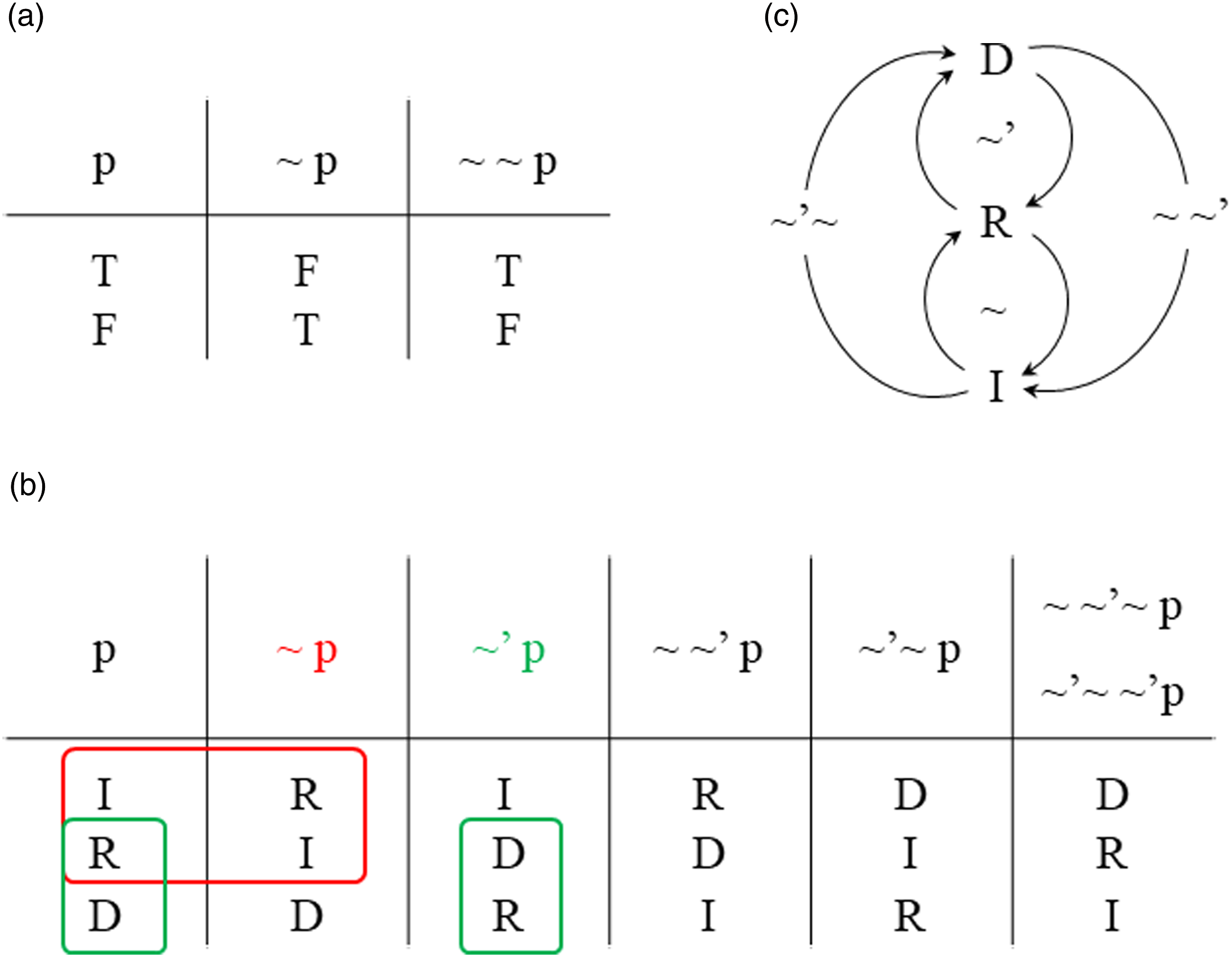
So, a genuine higher-order approach to logic is needed that not just inserts intermediate positions (e.g., “undefined,” Kleene, 1938) or quantizes the gap between true and false or subject and object, respectively, into truth degrees (Gottwald, 2022), which would be no solution to the problem of self-referentiality. Instead, Günther (1978) completely discards the notion of bivalent truth by introducing a third logical value which is not a weaker version of the two other values but rather equipped with equivalent formal and semantic features. This is due to Günther’s close association of negation with reflection regarding which it would make no sense to speak of “weak” and “strong” forms, but rather to distinguish the irreflexive (I), the reflexive (R), and the double reflexive (D). Accordingly, there must be two qualitatively different negations, under which the values are changed, as can be seen in Figure 4(b). The first negation regulates the relation of I and R while leaving D unaffected. The second negation governs the transitions between R and D but has no impact on I. Therefore, R is the central value from which the other two can be reached directly, whereas I and D must be mediated by chained negations via R (Figure 4(c)). Starting from R, continued reflection leads back to R on two different paths, depending on whether one goes “up” or “down” through the full cycle: ∼ ∼ ∼’∼’R ≡ R or ∼’∼’∼ ∼ R ≡ R. Thus, cycles can be started in I or D, and when entering R, it depends on R itself in which direction to other reflexive levels, I or D, the process continues. Therefore, with this logic, transitional processes with a certain degree of unpredictability or freedom can be modeled. In this way, Günther’s approach addresses the (originally Hegelian) problem that double negation is not just the positive starting point but rather something new.
While this already makes Günther’s logic a suitable candidate for formalizing mental and psychophysical dynamics, his own interpretation of the three values can be viewed critically. Although he invested much effort in a formalism that overcomes the logical limitations of the two-valued subject-object relation, he did not exploit the (structure-) phenomenological depth of interpretation enabled by this, since he retained the classical object and subject and merely added the interpersonal subject as the third value (Günther, 1978). Although this option can be applied to observer paradoxes in physics (Falk et al., 2022) or in reconstructive social research (Jansen et al., 2015), it wastes the opportunity of a processual view in which subject and object are not presumed but rather emerging.
3.2. Formalization of mental, psychophysical, and physical contextures
Against this background, another application of Günther’s logic is suggested in which the explained cognitive dynamics are formalized in three-valued contextures that are connected to each other by their phenomenological overlap. This exhausts the full potential of different negations or exchange relations within each contexture while refraining from inconsistent ad hoc solutions. Furthermore, since the formalism does not prescribe semantic content, the interpretation of the logical values and exchange relations is adapted to the different descriptive levels (or ontological domains) involved in the contextures. In this way, firstly, the mental and the psychophysical contexture are formalized; secondly, the physical part of the latter is extended to the whole body and its environment establishing a third contexture to also address 4E aspects. In sum, a metatheoretical framework is proposed to functionally separate and integrate the contextures of cognition and action in a transdisciplinary and metaphysically balanced way.
Regarding the mental contexture which is empirically based on first-person cognitive research and conceptually embedded by SP, its closeness to a three-valued reflection logic has already been alluded. Here, formalization seems to be particularly evident, as structure phenomenology considers the three-valued processual-constitutive level of the basic structure from which the two-valued representational level is derived. So, we can speak here of a projection of the three-valued contexture onto a two-valued subcontexture. For the former, the assignment of logical values to the conceptual, nonconceptual, and mental activity can be explained as follows. Given the decompositional ambiguity, fragmentation, and dequalification of the nonconceptual, it can be assigned to the irreflexive, which, unlike the one-valued and two-valued cases, is now deprived not only of reflection but also of meaning and is, in this stage, not a consistent object. During recomposition, however, the nonconceptual exerts an individualizing impact on the conceptual and thus serves as a counterbearing or touchstone in the formation of an object-related structure. These two aspects can be assigned to the different transitions that the irreflexive is involved in when leaving it and when approaching it. Next, in view of the two forms of reference which can be found in the conceptual, it can be assigned to the double reflexive. On the one hand, the conceptual includes logical self-referentiality independent of confirmed perceptions (as a result of producing meaning patterns such as geometrical variants or pitch relations); on the other hand, it provides coherence of the nonconceptual in the stimulus-oriented activities. The single reflexive can be identified with mental activity which is potentially aware of itself as has been shown in the studies in terms of mental agency. Thus, it is considered that mental activity has direct access to both the nonconceptual (irreflexive) and the conceptual (double reflexive) and mediates between them in structure generation.
In the psychophysical contexture, it is all about interdomain correlations, which can be considered as bridging a deeper explanatory gap than the intradomain exchange relations of the mental. In formal terms, however, this makes no difference. As explained, neural decomposition induces the decomposition effect on the mental domain, while mental recomposition leads to the recomposition effect on the neural domain. Corresponding to the epistemological perspectives of the domains (first-person vs. third-person), the irreflexive can be attributed to sensory-neural processing, thus changing its role from meaning-deprived and meaning-absorbing mental content in the above contexture to the agent of deprivation or decomposition, respectively, and meaning-susceptible plasticity. Consequently, another role change applies to the mental side, where mental activity is now considered regarding its double reflexivity due to agentive self-awareness (identity) and other-related intentionality (meaning-making). Structurally, this is the same reasoning as for the conceptual’s double reflexivity in the mental contexture, but here it is individualized to the mental agent. Both features clearly distinguish mental activity from neural activity, which has neither self-consciousness nor intentionality. Between double-reflexive mental activity and irreflexive neural activity, the (single) reflexive literally takes the role of a reflection—in an optical-metaphorical sense—in that effects of the domain-specific activities are reflected into the other domain, as it were. More precisely, in an optical mirror, the object to be reflected and its reflected image are correlated by the laws of reflection, whereby in relation to the “real” object its reflection is only a “virtual” image. 15 Accordingly, decomposition and recomposition transcend the borders of their original domains in terms of their effects, which thus do not exist from their specific perspective. Therefore, (single) reflexivity separates and integrates the two domains by changing the perspective in both directions and can be understood as acting as an anthropological divide and nexus. So, here is the point through which the neural and the mental side are bidirectionally correlated.
Coming to the physical contexture, the brain-body-environment schemes often used in enactivist contexts (e.g., Beer, 2003; Rietveld et al., 2018) already seem to suggest the same formalism (Figure 5). Here, however, the situation is different, as the relata (brain, body, environment) as such do not include the first-person perspective, which is why the reasoning of the assignment of logical values to them must be adapted. From a third-person, physical perspective, these relata are connected within a mereological relationship of hierarchical nesting: the brain is a part of the body, which is a part of the physical cosmos. Thus, in this contexture, the brain is the most separate element, while the physical cosmos is the most integral. Additionally, as other organs (e.g., eye, hand) or physiological functions (e.g., digestion, metabolism) of the body, also the brain and its functions cannot be claimed to possess any kind of self-referentiality beyond its mere distinction from other organs or functions.
16
Without referring to higher system levels (e.g., lived body, phenomenal consciousness), all organs and physiological functions can be subjected to self-exclusion, since their specific functional purpose can only be determined and integrated from the perspective of the higher level, as is acknowledged, for example, by the theory of integrative levels (Feibleman, 1954; Hartmann, 2017; Witzenmann, 2022; for review, see Kleineberg, 2017). Since no special metaphysical status can be claimed for the brain and its processes, it is also subject to the principle of self-exclusion, which is why we assign it to the irreflexive in the context of formalizing the physical contexture. Consequently, the role of the double-reflexive can be assigned to the physical (cosmic, natural, and culturally shaped) environment providing the actual and potential stimuli and affordances for all embodied individuals. This includes the double perspective of a most individualized and unrepeatable, spatiotemporal situatedness of an ontogenetically conditioned body, on the one hand, and of a maximally unspecified physical environment as a universal distal stimulus, so to say, on the other hand. While the transition from the latter to the former can be seen as a first step of (non-neural) decomposition or specification, radically fragmenting and constraining the holistic space of possibilities and giving rise to precarious situations, the reverse transition opens leeways for shaping and transforming the physical world by embodied agents and thus to ecologically embed themselves into the world. This already indicates why the body here takes the role of the (single) reflexive transition point, mediating between environmental factors and the brain, and enabling the owner of that brain and body to act in the world and shape it accordingly. Therefore, in the same way as the precarious situatedness of the body in its environment is analogous to the neural decomposition effect (see above), the effects of mental recomposition in the brain (synchronization, plasticity) can be extended to the tool-like use of the whole body (and its technological extensions), acting as a medium of interaction with the environment and dissemination of individual motivations (e.g., in terms of ecological footprint, Dutta & Chandrasekharan, 2017). Integrated contextures of mental, physical, and psychophysical processes.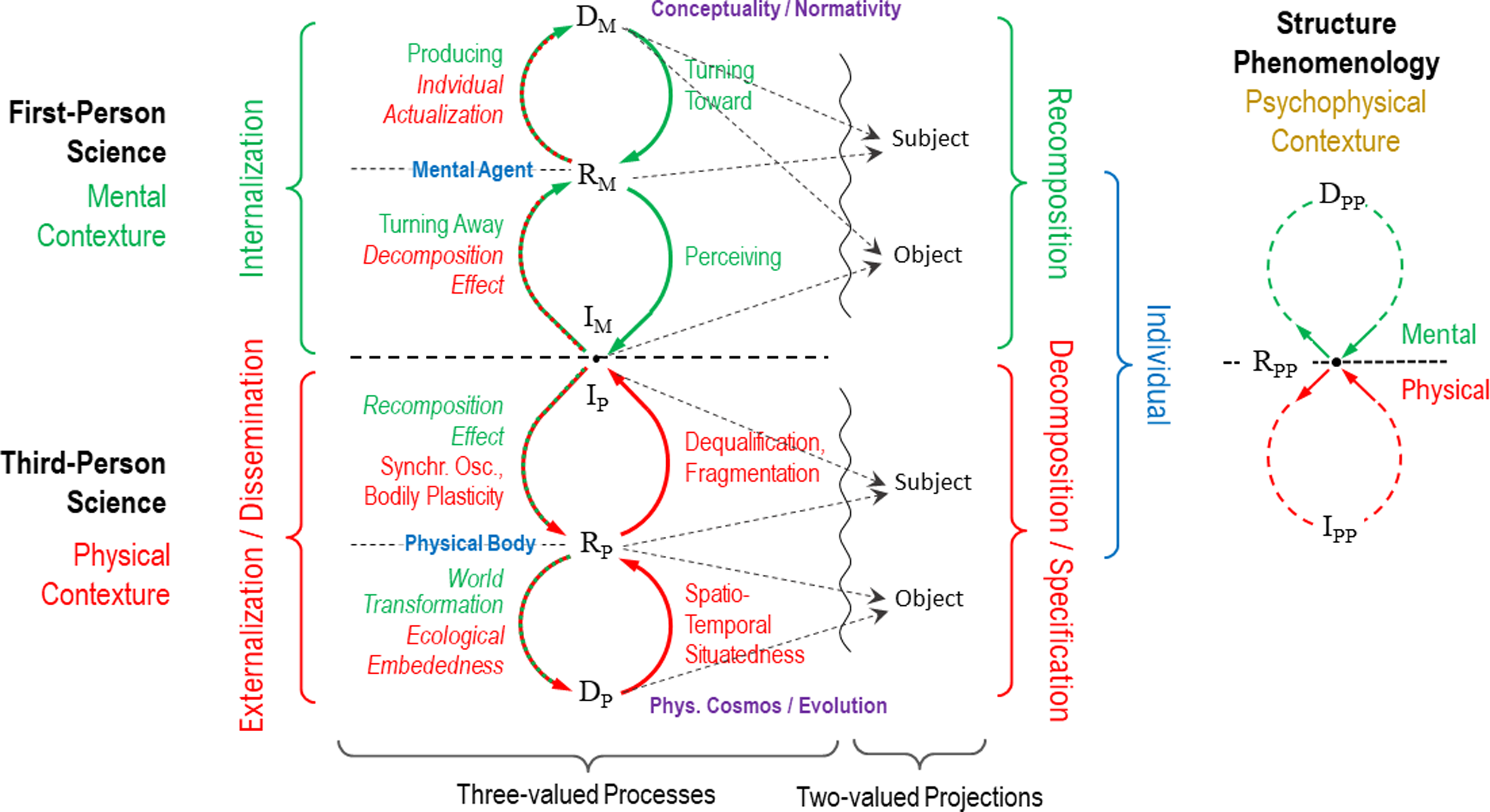
In Figure 5, an integrative overview of the mental, psychophysical, and physical contextures is provided, some aspects of which go beyond the given explanations. Due to the overlap of the contextures, the two inner negation or interaction cycles can be viewed in different, intra- or interdomain contexts, whereas the two outer cycles appear only in their proprietary context (first-person vs. third-person science). Nevertheless, depending on how broad the perspective is taken, the psychophysical contexture can be expanded to them and then covers the entire scheme. Accordingly, the mental and the physical contextures can be boiled down to single cycles, so that the psychophysical contexture represents a simplified version of the entire scheme. These are just options of contextual reading, but in the figure is also indicated that the three-valued processes are reductively projected onto their two-valued derivatives. In both cases, as consistent with Günther’s interpretation of a two-valued reflection logic, subject and object emerge from this reduction which can be understood as a shift of the observational level. Here, an asymmetry becomes salient which can be explained by the different forms of constitution in the mental and the physical contexture. In the mental contexture, the basic structure as unification of the conceptual and nonconceptual is valid for both object and subject, whereby for the object, the nonconceptual is receptively given via sensory-neural processing, while for the subject it relies on (normally preconscious) inner agentive qualia. Even though these are adaptations of the basic structure to different epistemological domains, the coherence-constitutive role of the conceptual is valid throughout. Since in the physical contexture the three relata (brain, body, environment) are already considered as such, that is, as recomposed objects without considering the basic structure, they can be structured based on their spatial part-whole relations. In this sense, the brain and body, as an integrated whole, are collated to subjects, while the body and its environment belong to the object level. This reflects the dual perspective of being a body (the body as subject) and having a body (the body as object) based on which H. Plessner (2019) granted humans an “excentric positionality” that sets their experience apart from one-valued dwelling in being. 17 The ability to step out of their center allows humans to switch between the first-person and third-person perspective, and insofar as even the latter as an apparent “view from nowhere” (Nagel, 1986) is a perspective taken by humans, it too emerges from recomposition in participatory reality formation through the basic structure. While this again emphasizes the relevance of SP for an extended scenario of scientifically bridging the first-person and third-person perspective, it allows to grasp the three contextures or processes in a comprehensive, metaphysically neutral account. 18 So, why shouldn’t this also invite enactivist approaches to become integrated into this picture or, in turn, to integrate it into their own framework, even if some controversies would have to be considered?
4. Conclusion and outlook
In view of the integrative approach delivered in this article and particularly the framework given in Figure 5, some scholars engaged in enactivism or 4E cognition research might feel misunderstood regarding the limitation of these approaches to the physical domain, for example, in view of the lived/living body (Stilwell & Harman, 2021) or in terms of a “strict identity thesis” (Kirchhoff & Hutto, 2016, p. 304). Already the early, seminal work on enactivism aimed to include the mental domain from the first-person perspective as in neurophenomenology (Thompson et al., 2005; Varela, 1996; Varela et al., 1991). However, at least one of the settings of this project distinguishes it from the empirical-introspective and structure-phenomenological approach: First-person experience, particularly in its implicit, pre-reflexive forms, is considered to rely principally on passively given affections implying “a dynamic gestalt or figure-ground structure” (Thompson et al., 2005, p. 52). 19 This conviction is in line with Varela’s (1995) core hypothesis of psychophysical correlations that “mental-cognitive states are interpretations of current neural activity, carried out in reference to a transient coherency-generating process generated by that nervous system” (Varela, 1995, p. 90/1). Thus, similarly as in cognitivism, the role of coherence or structure generation is deferred to the brain, and relevance of first-person data is confined to “sheer witnessing or noticing of the process of experiencing” so as not to intervene judgmentally in what is phenomenally given (Thompson et al., 2005, p. 72). Some scholars also claim conceptual closeness of enactivism to the predictive processing view, “that unconscious perceptual inference is a matter of Bayesian inference, such that the brain in some manner follows Bayes’s rule and thereby can overcome the problem of perception,” making first-person data redundant (Hohwy, 2018, p. 130). Others, however, criticize predictive processing for being incompatible with the historicity, that is, the developmental dimension of agents and worlds, for example (Di Paolo et al., 2022), illustrating controversies about the scope and central goals of enactivism. As for empirical work, current studies vary between neuro- and micro-phenomenological approaches that incorporate qualitative first-person data committed to receptive openness, sometimes requiring special training for participants (Nave et al., 2021) or interviewers (Petitmengin, 2017), and those that exclusively draw on external behavioral measurement (e.g., via mouse-trajectories and button press), such as in the context of perceptual crossing experiments (Auvray et al., 2009). Even more, the radical stance of not only naturalizing phenomenology (Petitot, 1999) but also favoring naturalistic accounts in enactivism (Hutto & Myin, 2013; Kee, 2021) prevents its necessary extension to systematic first-person research on cognition, primarily in terms of conscious mental agency and its implications for participatory reality formation.
Overcoming these limitations and enabling a true expansion of enactivism in terms of first-person science could benefit from conceptual clarification. Although interest in enactivism has increased greatly since the field opened up to various 4E or even 5E perspectives, this does not mean that every research question must include all of these perspectives. Regarding the enactive and embodied dimension, it might have been necessary to first extend activity to the whole body and its interaction with and embedding in a physical environment in demarcation to neurocentric cognitivism. But it does not follow that “enacted” and “embodied” must always be considered in inseparable conjunction; rather, our approach reveals embodied aspects that are not enacted but experienced passively (functionally negative phenomenality) as well as forms of mental action that can be observed and theoretically framed independently of embodiment (inner agentive qualia). Therefore, we propose to conceptually disentangle the enacted and embodied dimensions, as they may have considerable overlap but are not congruent. While this seems to be consistent with the notion of “extracranial processes”—when not confined to the physical domain—and a definition of “enacted” independent of other E-dimensions (Newen et al., 2018, p. 6), the appropriate consequences have not yet been drawn.
Hence, depending on the perspective, enactivism should include more strongly first-person research and mental forms of agency; or structure phenomenology combined with Günther’s logic suggests an integration of enactivism. In any case, such an alliance offers two advantages over the outlined limitations of mainstream enactivism with respect to qualitative first-person experience. First, a direct empirical access route to phenomenal consciousness can be developed making explicit introspection and mental agency in enactivism that already exist in many places but are usually deployed covertly or methodologically underdeveloped (Froese & Sykes, 2023). This is meant to ramp-up and diversify first-person methodology to include it more explicitly into enactive research programs, especially with the intention to balance the one-sided preference of receptive openness by experimental settings focusing on mental agency and metacognitive control. Nevertheless, a certain kind of receptive openness is also necessary for this purpose, but one by which subjects become aware of their autonomous performance of differentiated mental activities. This dynamic coincidence of receptive and productive activity traits (inner agentive qualia) constitutes the “radical self-referentiality” of consciousness (Bitbol & Luisi, 2011) against which both conceptual coherences and nonconceptual incoherencies (functionally negative phenomenality) can be distinguished (Witzenmann, 2022). With an empirical and theoretical focus on this kind of a phenomenally and agentively accessible self-referentiality, the explanatory gap of the hard problem could be closed by completing the range of relevant phenomena and drawing appropriate conclusions for psychophysical correlations. Moreover, as possible effect of a rebalanced relationship of the mental and the physical domain, a change in our self-perception and self-image as humans can occur—which would be a perceptual reversal at a paradigmatic level, so to speak—changing our view from a rather abstract or distanced (self-)understanding of consciousness to a more intrinsic and developmental one (e.g., Tomasello, 2019; Watzl, 2018).
Second, the presented approach not only provides a metatheoretical framework with transdisciplinary implications, but also invites to further experimental research and allows deriving concrete, falsifiable hypotheses, and predictions for cognition research from it. While examples pertaining to the inner relations of mental micro-activities are indicated in Figure 1, their references to embodiment have been explored above in terms of psychophysical correlations. One interesting line of research would be to search for neural correlates of the four mental activity forms and then compare their temporal sequence at the neural and the mental level. Thus, since only two or three event-related potentials (ERPs) have been detected in the context of visual reversals to date (Kornmeier et al., 2019), previously undetected ERPs might be expected as candidates for the recomposition effect. As another aspect of a recast neurophenomenology, neurocorrelative measures of stimulus-averted (TA, PR) and stimulus-oriented mental activities (TT, PE) could be investigated, suggesting that the former are related to more globally distributed neuronal oscillations, whereas the latter are associated with more locally specific ones (e.g., related to individual sensory systems). In view of irruption theory (Froese, 2023), it could also be expected that neural entropy reaches a maximum in certain brain regions during the phase of mental producing, because here the decision for a new pattern is made and implemented with contextual contents and strategies. In this way, we attempted to show that “the lived experience of an agent’s sense-making behavior must be granted some efficacy over brain-body activity,” as originally called for in the neurophenomenological research program (Froese & Sykes, 2023, p. 4). However, Varela’s own implementation of neurophenomenology and subsequent studies in this field did not reveal conscious efficacy on neural processes beyond non-ordinary states of consciousness (e.g., epileptic seizure, near-death experiences; see Froese & Sykes, 2023), as opposed to conscious dynamics in ordinary forms of cognition (perception, thought, etc.), and especially did not explain how such an efficacy might work in detail. Nevertheless, I think that a recast neurophenomenology is perfectly suited to test the structure-phenomenological hypothesis of psychophysical correlations in a fine-grained way. This could be done by exploring forms of activity on both sides, the neural and the mental, and by using tasks challenging mental agency (e.g., by decisions to be made by participants as, e.g., in perceptual reversals). Also, regarding embodiment, this opens up an expanded understanding, insofar as “embodied” no longer has to be imposed on phenomena simply as a static label, but rather shows a dynamically oscillating character in the sense of stronger and weaker embodied activities, as in, for example, the measurement of a body reference index pertaining to different activity forms in the context of social perception (Wagemann et al., 2022). Against this background, for example, experiments on perceptual crossing could be developed, in which the behavioral differences between human agents, fixed objects, and computerized agents (Barone et al., 2020) could be triangulated by qualitative first-person data on stronger or weaker embodied forms of mental activity. And as a final proposal, the impact and embodied modifications of mental agency and agentive attention awareness on material-related action, such as in art-based research on crafting and sculpting, could be studied in terms of a consciously enacted and dynamically embodied cognitive science.—So, there are enough ideas, waiting to be critically appraised and creatively implemented by curious philosophers and scientists who want to explore beyond the apparently fixed horizons.
Footnotes
Acknowledgements
I would like to thank Tom Froese for insightful discussions on the connections and differences between Irruption Theory and the structure-phenomenological/transclassical-logical approach, from which sections 2.4 and 4 of this paper benefited.
Declaration of conflicting interests
The author(s) declared no potential conflicts of interest with respect to the research, authorship, and/or publication of this article.
Funding
The author(s) received no financial support for the research, authorship, and/or publication of this article.
