



Abstract
We draw on insights from ecological psychology, explorative architecture, and psychiatry to provide an analysis of basic trust in relation to urban places. We use the term basic trust to refer to the attitude of certainty we express when we act in skilled, often unreflective, habitual ways in the living environment. We will argue that the basic trust of people living in cities should be understood in relation to what we will call trusted urban places. Trusted urban places can be understood similarly as what Giovanna Colombetti and Joel Krueger have called “affective niches” that provide affordances for amplifying, dampening, and sustaining affective states. The basic trust of people living in cities, we will argue, depends upon people moving through and engaging with trusted urban places. In urbanism and architecture, it is barely recognized how the city affords places of affective significance that the person incorporates into their bodily way of existing. Persistent exposure to urban stressors can disturb basic trust in one’s living environment, resulting in a person no longer being at home in the world. We provide examples in which people, as a consequence of the repeated exposure to stressors, no longer move through and engage with trusted urban places, and the impact this has on their basic trust. Our aim is to understand how the urban environment can contribute to the path from stress to anxiety and mood disorders, and how a person can regain their openness to possibilities for regulating their emotions skilfully.
1. Introduction
Stressors, for example, noise, pollution, and overcrowding, are an inevitable part of urban life. Cities provide people with a rich variety of possibilities for flourishing, yet paradoxically can also challenge us physiologically in ways that can undermine our mental health. People living in cities have an increased risk of developing mental health conditions as compared to non-city residents (Van der Wal et al., 2021) 1 . The urban dweller is entrenched in an alluring landscape of social, cultural, and economic possibilities that on the one hand enables people to realize their dreams, concerns, and evokes projections of living a better life. On the other hand, the urban environment can be experienced as noisy, polluted, corrupt, unsafe, overcrowded, economically challenging, and often as offering a multitude of stressful experiences. Examples include: the overcrowded city center of Amsterdam that is being overrun by tourists, and the never-ending noise of airplanes landing overhead in the west of Amsterdam, near to Schiphol Airport.
As such, cities can be experienced as “landscapes of stress.” The concept of stress has a long history and has been used by many writers in diverse ways. 2 We understand stress as the physiological, behavioral, and experiential relation to changes in the living environment that are perceived as threats to body, mind, or social integrity. People living in cities are prone to an accumulative and prolonged exposure to stressors, which can lead to positive and negative feedback in a person’s stress responses (de Kloet et al., 2005). Stress promotes adaptation, but prolonged stress leads to wear-and-tear of the body, sometimes referred to as “allostatic load” (McEwen & Stellar, 1993). 3 A persistent allostatic load is related to disorders in a person’s adaptiveness to the world. People describe themselves as feeling overwrought, burned-out, or emotionally drained. 4 This long-lasting affective state we will refer to as being persistently stressed.
We draw on insights from ecological psychology, explorative architecture, and psychiatry to describe what we will call the basic trust of people inhabiting urban environments. Basic trust in everyday life develops over time through the skilled, often unreflective habitual ways of acting of people in their living environment—the shared natural, material, social, and cultural environment that help them live a healthy emotional life. Wittgenstein, in discussing the justification for the rules a person follows when they act habitually, observes that the person will reach a point when there are no longer reasons they can offer that justify what they do. He writes: “my spade is turned. Then I am inclined to say: “This is simply what I do.” (Wittgenstein, 1953, p. 217) This way of going on, which the person points to as what they simply do, refers to their habitual way of acting. Basic trust pertains to what we ordinarily take for granted in our everyday life. To be more precise, we use the term basic trust to refer to the attitude of certainty we express when we act in skilled, often unreflective, habitual ways in the living environment. Our aim in this article is to argue that the basic trust of people living in an urban environments is, in part, made possible by moving through and engaging with what we will call “trusted urban places.” Persistent stress can then be understood as a disturbance of basic trust that may sometimes lead to a loss of habitual ways of acting in the living environment.
We will describe how the urban environment is made up of collectively constructed places that offer multiple possibilities, including the possibility for people to find relief, in a rich variety of ways, from the stresses of the city. For example, we take for granted the possibility to go for a stroll through a park, to feel some relief after suddenly feeling irritable; or to go to the movies with friends in the evening, to decompress after an intense day at work. Our aim is to understand how public places—like parks, squares, canals, rivers, and streets—can contribute to, and make possible, basic trust. We will therefore argue that basic trust should be understood, for city dwellers, in relation to the urban places that have come to make up a city. Public places can provide affordances for living healthy emotional urban lives, and the possibility to engage with affordances of public places form a crucial part of what people take for granted in their everyday lives in the city. We will propose that this possibility to engage with trusted urban places is a possibility that the person incorporates in their habits. If trusted urban places cease to be incorporated into a person’s bodily way of existing, as happened during the COVID-19 lockdowns, for example, this can gradually result in stress dysregulation, and may even increase the risk of the onset of mental health problems such as anxiety and depression. 5
2. Architectural tradition of the “affective” city
The practices of urbanists and city planners hardly articulate how the city is an “affective niche,” full of possibilities for dealing with daily stress. Maybe out of a fear of vagueness these fields have preferred to use a functionalist vocabulary and quantifiable data on the management of stressors in the city (Burton, 1990). In sociology and human geography, there is a long tradition of writing about the perils of urban life (White and White, 1962). Think, for example, of Georg Simmel’s “The Metropolis and Mental Life” (1903) or “Landscapes of Fear” by Yi-fu Tuan (1979). Alongside the rising awareness in the humanities of the 19th century city’s “inventions”, like publicly accessible city parks, gardens, sport fields, and boulevards, that came out of the tradition of humanist architecture. We can look back at these 19th century inventions as spatial and social experiments that gave form to our contemporary notion of public space.
A great landmark in the design of the urban landscape is New York City’s Central Park. Its original purpose was “to offer urban dwellers a place to escape from the stresses of urban life and to commune with nature and fellow New Yorkers” (Olmsted, 1886, p. 32). Its main designer Frederick Law Olmsted wrote in 1870, “The beauty of the park should be the beauty of the fields, the meadow, the prairie, of the green pastures, and the still waters. What we want to gain is tranquility and rest to the mind” (1886: 32). The park was designed to give “… a pleasure, common, constant and universal to all town parks, and that it results from the feeling of relief experienced by those entering them, on escaping from the cramped, confined and controlling circumstances of the streets of the town; in other words, a sense of enlarged freedom is to all, at all times, the most certain and the most valuable gratification afforded by a park” (1886: 32). The park for Olmsted was a refuge for the mind and nature. Already in the 19th century Olmsted theorized the effects of the urban landscape on man.
According to Olmsted, 6 urban green spaces like public parks worked on the body through unconscious processes, producing an “unbending” of what he calls “faculties” made tense by the noise and artificial surroundings of urban life (cf. Beveridge, 2000). The noise and hustle and bustle of the city can take their toll on the body, inducing states of physiological stress, as we described above. As a consequence of encountering persistent urban stressors, the body enters a state of vigilance that can disturb the flow of unreflective action, leading one to overthink things and to get locked inside of the head. The “unbending” that Olmsted describes can be thought of as a restoring of the flow of unreflective action. The experiences that green public spaces can elicit, afford relief for a person from the stresses of the city. In Olmsted’s analysis, this experience of relief did not come as a result of explicit or reflective examination, analysis or comparison, nor of appreciation of particular parts of the landscape; it occurs prior to reflection, either unconsciously or pre-reflectively.
Central Park can be understood as Olmsted’s grand experiment that put to the test his thesis that: “The chief end of a large park is an effect on the human organism … like that of music, is of a kind that goes back of thought, and cannot be fully given the form of words” (Olmsted, 1886, p. 35). Olmsted’s speculations concerning the restorative effects of urban green spaces have since been empirically confirmed and elaborated into a number of different theories. 7 The experience of natural environments, like Central Park, has been shown to strengthen one’s resilience to the strain of the city by affording “effortless attention,” a state of diffuse and unfocused attention as contrasted with voluntary attention that requires a directing and redirecting of attention in response to distractors as we try to stay on task. 8 More recently, effortless attention has been described as having “an unconscious effect on the autonomic nervous system” (Ungar & Theron, 2020; Zautra et al., 2008), which is in line with the pre-reflective “unbending of the faculties” as described by Olmsted. This effect on the autonomic nervous system is an example of affect regulation. 9 More specifically, it amounts to a down-regulation of sympathetic and autonomic activation associated by Cannon (1929) with the fight or flight response, which is central to the stress reaction of the body. The notion of effortless attention implies that these effects on the autonomic system also have effects on how a person attends to their environment. That is to say, it has effects on the structure of what we will later refer to as the “field of invitations”—the multiple relevant affordances or possibilities for action the individual agent is ready to act upon (De Haan et al., 2013; Rietveld et al., 2018). Specifically, effortless attention can be understood as a broad, diffuse state of attention, a kind of hovering attention in which equal attention is given to all inviting affordances, with no biasing or privileging of especially relevant possibilities.
The public places of cities offer people many more possibilities to regulate their feelings, moods, and emotions compared with “natural environments” that afford “effortless” attention. We would suggest the city as a whole can be understood as a landscape: a constellation of places, we act in relation to, shape, and re-shape, to give form to our feelings, emotions, and moods. For example, think of how we can visit a cinema to cheer ourselves up on a depressive rainy day, or enjoy the shade in a secluded square in the middle of summer. For example, the Haarlemmerplein in Amsterdam—a stony square in front of a neo-classical arch marking the end of a major canal in the city, is free from car and bicycle traffic making room for intermittent fountains spraying upwards from the pavement. Many people seem to enjoy just sitting in the cooling spray, enjoying watching the bustle of child’s play in the summer heat. 10 We propose to understand the entire urban environment as a constellation of affectively significant places that the basic trust of people living in cities may come to depend upon.
3. Basic trust in the city
In everyday actions, we trust in our abilities and our environment, without paying much attention to how actions unfold. In biking quickly to the supermarket to get lunch, one effortlessly and unreflectively avoids the rush of bicycles and cars driving along the narrow streets that run parallel to Amsterdam’s canals. Our basic trust in the ability to steer safely through this maelstrom is directed towards ourselves, our surroundings, and the others on bikes and in cars. We trust in this ability and the world insofar as we take the ability and the affordances it depends on for granted when we act skillfully. A group of cycling tourists unpredictably wobbling across the street may, by contrast, lead immediately to heightened level of arousal and frustration because of their erratic trajectories. During a period in our lives when we feel especially burdened by stress, a busy place in the city may feel overwhelming. Normally, one can effortlessly find a path through a stream of bikes, moving about in all directions. However, when stressed this path may no longer be inviting. The dangers of crossing incautiously and causing an accident become more apparent, making one hesitant to act.
As explained in the introduction, the notion of ‘basic trust’ we use in this article is based on the attitude people have towards the living environment when they perform everyday habitual and skilled activities, such as riding bikes. Using the word ‘trust’ in this sense is a way of talking about what is taken for granted and unquestioned—namely, the everyday practical ways of understanding the world. In previous work, we have described this as basic trust (De Haan et al., 2013). Basic trust is grounded in the way in which we act. Wittgenstein described this as follows: “Why do I not satisfy myself that I have two feet when I want to get up from a chair? There is no why. I simply don’t. This is how I act.” (Wittgenstein, 1969, p. 148). Basic trust in the living environment is based upon the familiarity of practical ways of understanding the environment we take for granted as we go about our everyday activities.
Our notion of basic trust can be analysed using Ratcliffe and colleagues’ notion of one-place trust (Ratcliffe et al., 2014).
11
Ratcliffe and colleagues usefully distinguish between three relations of trust in the context of providing a phenomenological analysis the effects on lived experience of trauma. They note that trust is standardly understood either as two-place interpersonal trust whereby person X trusts person Y, or it is understood as a three-place relation in which a person X trusts person Y to do Z (e.g., to fulfill a promise). Ratcliffe and colleagues notice, however, that both these notions of trust may depend on a more fundamental one-place trust, that we are calling “basic trust.” They write: One-place trust is seldom remarked upon in mundane, everyday discourse. However, its loss is a conspicuous theme in first-person accounts of traumatic experience. It might be objected that the term “trust” is misleading here, as “trust” ordinarily refers to the three-place and perhaps also the two-place relation, both of which are quite different. But one-place trust is closely related to the others: one must first have trust in order to trust y to do z or to trust y more generally… “Having trust” might be construed as a non-phenomenological disposition to adopt certain attitudes and have certain kinds of experience. But it also has a phenomenology in its own right; “losing trust” involves losing a habitual confidence that more usually permeates all experience, thought, and activity. (Ratcliffe et al., 2014, p. 3)
Ratcliffe and colleagues describe how the loss of one-place trust, that occurs when people experience trauma, consists of a doubting of bodily capacities and skills, and a disturbance of structures of anticipation that ordinarily orient one within an environment of relevant possibilities. The person comes to relate to the environment with an attitude of anxious uncertainty, and “an environment that was previously taken to be dependable now seems dangerous and unpredictable” (Ibid, p.3). We will argue (later in Section 5) that encountering persistent stressors in the city can also lead to a disturbance of basic trust. When the person is persistently stressed, the basic trust in our abilities and in the world can be disturbed. The person can become hyper-vigilant for threats like wobbling tourists, and find they are no longer able to act unreflectively in ways that they come to take for granted. Persistent stress can put the body in a state of constant vigilance that interferes with a person’s ability to act based on their habits and skills.
Our everyday habitual activities include many activities in which we act on the environment in ways that result in changing our moods, emotions, and feelings. The streets along Amsterdam’s canals, do not only offer us affordances for practical ends. Such as the possibility to speed towards the supermarket before it closes. The city also offers a myriad of affordances for regulating our affective and emotional states, as we saw in the discussion of Olmsted in Section 2. For example, sitting along Amsterdam’s canals under the marvelous elm trees, staring at the rippling of the water can bring, to many of us, a moment of calmness of mind, in the midst of the busyness of the city. These possibilities can call to us when we suddenly feel stressed. 12
This idea of places that are purposefully set-up to regulate a person’s emotions has already been anticipated in Giovanna Colombetti and Joel Krueger’s work on situated affect. Colombetti and Krueger (2015) use the concept of “trust” to refer to the confidence a person has in the environment to have an effect on their affective state, making them feel, for instance, happy or relaxed. In the background of their use of the concept of trust is the idea of “affective scaffolding”—the resources people habitually rely on to sustain, amplify, or dampen their affective states. They introduce the term “affective trust” to refer to the confidence that a person has in affective scaffolding to have a certain effect on their affective states (e.g., to make them happy or relaxed (Colombetti & Krueger, 2015, p. 1162)). Colombetti and Krueger describe how the environment is actively altered and modified by individuals for purposes of affect regulation, through processes akin to niche construction (Sterelny, 2010). An excellent example is the use of mobile phones to listen to music while exercising. Here the music one is listening to produces a “cascade of autonomic and somatic responses generating the associated emotion (Krueger, 2014).” 13
Our understanding of basic trust partially overlaps with how Colombetti and Krueger understand affective trust, but it is also different. In line with Colombetti and Krueger, we are arguing that cities include places that are actively designed to regulate stress, like in the example of Central Park discussed in Section 2. We would agree with Colombetti and Krueger that these places can be thought of as performing the role of affective scaffolding. However, unlike Colombetti and Krueger, we take basic trust to be a one-place relation that refers to an attitude of confidence or certainty that permeates one’s experience, thought, and activity. A person has basic trust in the living environment when they skillfully go along with the social, cultural, and material practices they take part in. For Colombetti and Krueger, by contrast, trust is understood as a three-place relation—an individual x has trust in a resource y that serves as affective scaffolding to do z (e.g., to make them relax). On our view, basic trust describes how an individual relates more generally to the living environment because of the social, cultural, and material practices they participate in. 14 Crucially, we claim that the living environment is given structure by social, cultural, and material practices, and it is by taking part in these practices that individuals come to have basic trust in their environment. Thus, basic trust is not something individuals have in affective scaffolding. It refers to a more global habitual confidence that an individual has in the living environment because of the lives they lead.
We will argue next that basic trust, for people who make cities their homes, depends on their making use of public places that are set-up to shape our affective states, which we call “trusted urban places.” We can thus understand the world of the city-dweller, an urbanite, to be an incredibly rich landscape of trusted urban places, including ones that are specifically but not exclusively used to regulate affect and stress. In a way similar to what Colombetti and Krueger have called affective niches, we argue that the entire city is a constellation of places that we visit precisely because of the effects they have on our bodies as we move in and out of them.
Krueger and Colombetti (2018) describe how, in depression and schizophrenia, subjects can become disconnected from other people and from social spaces. They describe how people typically act against a background of “affective trust that the things in the environment will do what we want them to when we want them to do it” (p.15). 15 Our notion of basic trust, as a one-place form of trust, corresponds to what Krueger and Colombetti (2018), in their discussion of depression and schizophrenia, have called “affective trust.” Krueger and Colombetti argue that the loss of affective trust that occurs in psychopathologies is a consequence of a feeling of being cut-off from the world, and loss of “bodily resonance” with others and with environmental affordances. Part of being cut-off from the world and from other people is that one loses access to possibilities for affect regulation. Persistent stress, we will argue, disturbs a person’s basic trust in the world but in a different way from the loss of connection to the world that occurs in depression and schizophrenia. We are building up an argument that the basic trust of people inhabiting cities is made possible by the incorporation of urban places in their habits for regulating stress in their everyday lives. Krueger and Colombetti do not make the argument, as we will do, that affective scaffolding is a precondition for basic trust.
4. The incorporation of trusted urban places
Public places have been collectively set up in cities, for example, quiet places, that invite affective engagement by city dwellers who have become accustomed to particular rhythms of life in the city. Compare, for instance, the frenetic pace of life in the 24/7 bustle of downtown Manhattan or Shinjuku in Tokyo, which make everyday life in Amsterdam seem almost dormant and provincial. Places can become incorporated into a city dweller’s bodily ways of acting, in such a way that the person comes to depend on engagement with those places for the regulation of their stress responses, as part of such urban rhythms. It is in part by habitually moving through and engaging with trusted urban places that they are able to cope well with the stresses of urban life. If, for whatever reason, they cease to habitually engage with trusted urban places, this can lead to a temporary loss of basic trust and so to persistent stress dysregulation, and perhaps even to mental health problems.
Incorporation in the tradition of phenomenology refers to the capacity of the lived body to take something into itself—a process that reshapes both the experience of the body and our embodied agency, our sense of what we can do with our bodies (Merleau-Ponty, 2002/1945; Colombetti, 2014, p. 2016). Colombetti (2016) makes a helpful distinction between what she calls “object” and “habit” incorporation.” Habit incorporation occurs through skill acquisition. When a person acquires the skill of dancing tango, for instance, they incorporate the capacity to perform this style of dance into the body schema, a set of capacities that position the person’s body in space from moment to moment (Gallagher, 2005). Through the incorporation of the skill to perform this dance style, these skills become a possible way of being involved with the world and others.
Colombetti (2016) describes how object incorporation occurs when an object becomes integrated into what she refers to as a person’s “body schema.” As an example of object incorporation, consider the relation of a driver with the car they are driving. A person that knows how to drive can sense the width of the car, and whether they are able to safely pass other vehicles on the road. The car is experienced transparently as that through which the road is experientially given to the driver. Colombetti (2016) argues that both notions of incorporation also apply to affective states such as happiness, fear, anger, and positive and negative moods.
Learning to dance, for example, not only expands the range of movements we can make with our bodies, but also enables us to explore our feelings through the activity of dancing. As an example of affective object incorporation, consider how a musician may play their musical instrument to “change, amplify or dampen” what they are feeling. The musician’s performance supports how her feelings unfold over time (Colombetti, 2016, p. 12). The instrument is experienced, just as in the example of the car, as that through which the musician’s affective state is created and given articulation.
We suggest that it is not only objects that can be incorporated into a person’s habits but also the places in which those habits are typically enacted. Dancing, for instance, has been an important practice for (collective forms of) self-expression and emotional exploration and something people typically do in public places. Think of the dance pavilions in the center of European towns, Salsa in the streets of Havana, Cumbia on the squares in Mexico City, or the thousands of people dancing in parks across China.
A place is not simply a location, but a site nesting human meaning and experience. It is a location that has been invested with significance through human engagement, memory, and history (Malpas, 1999; Tuan, 1977). Places are not outside of, and alien to us. We dwell in them; our very existence is rooted in them (Jacobson, 2020). Merleau-Ponty described this well when, in his discussion of spatiality, he wrote: “the world is entirely on the inside, and I am entirely outside of myself” (Merleau-Ponty, 2002/1945, p. 430).
One might raise the objection that objects, and perhaps other people such as close friends and long-term partners (see Garavito, 2019), can be incorporated into one’s habits but places cannot. Object incorporation requires tight temporal coupling and functional integration. Think of our earlier discussion of incorporation using the examples of the driver and musician. According to this objection, places lack the right kind of functional and temporal integration to be incorporated. 16
We agree that object incorporation does not provide the right model for the incorporation of places. We suggest instead that the incorporation of places is better understood in terms of what Colombetti (2016) has called “habit incorporation.” She uses this term to refer to the process of sedimentation through which “bodily habits develop and become part of our style of being-in-the-world” (p.3). We are suggesting that places and habits stand in a relation of dependence. An individual’s habits are nested within places—like the home, cafés and bars, parks, churches, mosques, or synagogues and so forth. Places structure our manner of existing in the world. This is equivalent to saying that places structure our habits, since habitual ways of acting are our manner, or style, of existing in the world. Thus, when habits are incorporated, so also are places as sites nesting meaning and experience. Insofar as habits are structured by places, we are suggesting that places are incorporated along with habits.
The urban places that the habits of city dwellers are nested within are affectively significant. They are examples of what we have earlier termed trusted urban places. A bar, for instance, as also noted by Colombetti and Krueger (2015), can invite meeting friends and talking through problems. The intimate lighting and the round tables of the bar, makes such places well suited to meeting friends in the evening to share stories, or to vent the frustrations of one’s working life. In Marrakech, tea houses afford similar affective possibilities. Tea houses are nested into the urban fabric of the city of Marrakech. Like the brown bars of Amsterdam, tea houses can be found along many streets. These places provide settings for complex affective and social public practices to unfold among small groups of people (Oldenburg, 1999). Think of, for example, Café La Habana in Mexico City where Fidel Castro and Ernesto Guevara met to discuss the political future of their respective lands and the multiplicity of possibilities that drew them to this specific bar. Places play an important and complex role in the regulations of our current concerns in life. 17
As an example of how habits depend on places, consider how lack of access to public places can be profoundly disabling (Roxberg et al., 2020; Hendren, 2020, ch. 1). The social model of disability, developed in the 1970s in the UK, starts from a conceptual distinction between physical impairment and disability (Davis, 1995). Disability, according to the social model, is to be understood in terms of oppression, instantiated in social barriers that exclude and disable physically impaired individuals (Shakespeare, 2006). 18 Proponents of the social model argued that disability isn’t due to a person’s physical condition but to their position in society. “Disability” is not a word describing “the state of their body but to keep alive in the cultural consciousness the enduring reality of a disabling world” (Hendren, 2020, p. 6). Examples are “flights of steps, inadequate public and personal transport, unsuitable housing, rigid work routines in factories and offices, and a lack of up-to-date aids and equipment” (UPIAS Aims, 1).
The field of disability studies has since called into question the social model’s hard distinction between disability and impairment. Impairments arising from pain, aging, and illness are also a part many disabled people’s lived experience of their embodiment. Any model of disability should also include an analysis of how disabled people embody impairment (Toro et al., 2020). Disability would not suddenly disappear were all discrimination and barriers to accessing the public environment to somehow be removed. In a detailed analysis of people living with rheumatoid arthritic conditions that restrict movement, Dokumaci, (2023) has developed an account of disability as a mode of inhabiting what she calls a “shrunken world of possibilities” (p.13). What we will later refer to as the “field of invitations” is diminished (cf. De Haan et al., 2013) for the person living with disability as compared to able-bodied people. Part of what shrinkage involves is the body of the disabled person “misfitting” the affordances of the built environment.
Public places were historically, and are sometimes still, built, and designed with the assumption that they would be navigated and used by people with certain kinds of bodies, and without considering the skills of disabled people and their possibility to access them. A disabled person can come to feel not at home in the world, a “misfit” (Thomson, 1996). However, the shrinkage of possibilities isn’t only due to lack of access to public spaces but also from bodily experiences of pain and illness that mean that the environment is in turn experienced as a series of problems and challenges to be navigated. Dokumaci argues that shrinkage also occurs because disabled people inhabit what she calls a “habitus of ableism.” Certain affordances become normalized and privileged as canonical ways of engaging with the world, negating other possibilities. She gives the example of walking, one possibility among many for moving through the environment. Through its repetition and normalization, walking comes to seem like the natural way of moving through the environment rather than a skill that some, but not all of us, can develop. Shrinkage follows from a habitus in which walking has become the norm: other possibilities, that might better fit bodies not made for walking, are erased from view.
What the shrinkage of possibilities in disability illustrates is how much of a person’s existence is structured by how their body inhabits their environment. To consider the habits the person incorporates in isolation from the places they inhabit is at best an abstraction. When habits are incorporated so also are places. In the next section, we describe how trusted urban places are incorporated into our habits and skills, making basic trust dependent upon the places we rely on for affect regulation. When places are trusted, we can unreflectively anticipate their inviting character. A temporary breakdown of such trust leads to the uncanny feeling of not being at home in one’s own world. We will describe next how trusted urban places are incorporated into our bodily existence by structuring what we call the field of invitations for a person.
5. Trusted urban places as structuring the field of inviting affordances
In previous work, we have shown how the habits and skills people perform unreflectively in their everyday lives can be conceptually analyzed in terms of selective engagement with inviting relevant affordances. Affordances are the possibilities for action provided to us by the substances, surfaces, objects, and living creatures that surround us (Chemero, 2009; Gibson, 1979; Heft, 2001; Rietveld & Kiverstein, 2014; Stoffregen, 2003). We use a broad definition of affordances as relations between (a) aspects of the sociomaterial environment in flux and (b) abilities available in a form of life (Rietveld & Kiverstein, 2014). Our definition of affordances uses the notion of a form of life from Wittgenstein (1953), which refers to “the relatively stable and regular patterns of activity found among individuals taking part in a practice or a custom” (Kiverstein et al., 2019). We use form of life in our definition of affordances to account for the skills that humans come to embody by developing in and being enculturated in particular sociocultural practices. At the level of forms of life, we have characterized the ecological niche as a landscape of affordances (Rietveld & Kiverstein, 2014). 19 In this article, we will focus on affordances that are nested within a landscape in such a way as to form places—meaningful locations (Tuan, 1977, p. 4), for a form of life. Places are examples of what we have elsewhere called “large-scale affordances”—structures that form out of the responses to smaller scale invitations over time (Van Dijk & Rietveld 2018).
We propose that it is possible to understand all skillful action in terms of engagement with affordances. Activities as varied as calling a friend, eating, watching movies, meeting friends at a bar, and making works of art can be analysed as skilled engagement with inviting affordances. Inviting affordances can be distinguished from available affordances in the landscape of a form of life (Rietveld, 2008; Rietveld & Kiverstein, 2014; cf. Withagen, 2022). Invitations are those possibilities for action that are experienced as relevant for a person in a place in a certain situation. Invitations elicit bodily states of “action readiness.” As in real-life, we engage with multiple possibilities to act at the same time. We refer to the constellation of affordances that are relevant or soliciting to an individual as the field of invitations. We note that invitations can be repelling as well as attracting. Invitations need not have positive valence of drawing a person into action. A cliff-face, for instance, can invite a person to move away from its edge. The field of invitations is in a continuous and often highly dynamic flux over multiple timescale at the same time. This is especially true of life in cities, with their great densities of possibilities of things to do, people to meet, and places to go.
Crucially, places, such as public parks, are large-scale affordances the engagement with which can lead to the alteration of the whole structure of the field of invitations. Through engagement with a trusted urban place, a field can change from being narrowly focused on inviting affordances that reflect specific practical concerns to being a broad and diffuse field of inviting affordances with shallow temporal depth (see Figure 1 for a schematic and simplified illustration). We are proposing to understand the state of “effortless attention,” that people experience in urban green places (and in natural environments more generally, Kaplan & Kaplan, 1989; Van den Berg et al., 2007), in terms of the structure of the field of inviting affordances. Comparison of field of inviting affordances and structure of field of inviting affordances during an episode of effortless attention. The possibility to visit a trusted urban place, such as a park or a garden, is an affordance that restructures one’s whole field of invitations, through inducing a calm, relaxed feeling. This is illustrated here as a wide field of invitations with each inviting affordances have low height indicating that attention is broadly spread over the field as a whole (which may include invitations outside of the park, such as the possibility to visit friends for dinner later in the day). The felt need to be “action-ready” is reduced by spending time in such a place.
Recall what Olmsted describes as the “unbending” of faculties of the mind (Olmsted, 1886). In terms of the field of invitations, one attends to a broad field of invitations that do not demand immediate action but afford a calm disposition. One may become attentive to leaves moving irregularly on a tree, the shimmering light on the water, a duck swimming with her brood, or brightly colored tulips popping their heads up in-between the grass in spring. These invitations have been called soft fascinations (Kaplan & Kaplan, 1989, p. 377) and have two specific aspects that come to characterize the whole structure of such a place. Such invitations are only modestly demanding our attention and have an immediacy with relatively little temporal depth. As long as the sun keeps shining, the flickering of light on the water continues without leading towards an end. There is little progression leading one away from where one is in the moment. 20 This characteristic of natural places in the urban environment, like parks, affords the possibility to open one’s field of invitations by going there and spending time calming down.
We have been arguing that basic trust depends on the incorporation of habits for engaging with trusted urban places into our bodily existence. Some suggestive evidence for this thesis comes from the recent experiences of people during the COVID-19 lockdown during which many trusted urban places people depend upon, were inaccessible. This took effort for all and a toll on many of us. Think, for instance, of how one can depend on going for a run through a park every morning. When one can no longer rely on this possibility, feelings of frustration can arise. The (desired) paths through a city park may no longer afford the daily route for running because of long periods of heavy rains or snow. The city’s policy of the accessibility of parks during the COVID-19 pandemic, or the unpredictable Dutch weather, may also have an impact on one’s openness to the possibility of “running.” For a runner, a run is not only a moment fixed on physical exercise, it also affords the exploration and release of affective tensions, feelings that can otherwise become stuck. When the possibility for going for a run, a trusted way to feel relief from everyday stress, the runner must put in effort to find new, alternative ways to reduce stress.
Whether “running in the park” is a relevant possibility to a person also depends on the specific state one is in. A person’s physical condition, how energetic they feel, can depend on whether they experience persistent stress in their lives. This can be crucial in influencing how open they are to engaging with the regulative aspects of urban places. Not running for a while can lead to the loss of the “habit of exercising.” Persistent stress can disturb an individual’s daily habits drastically, as we argue further in the next section. If we feel unable to cope with a stressful situation, our habits of affective regulation are ineffective, this can lead to us feeling more stress (Colombetti & Zavala, 2019; Lazarus, 1999), and gradually to an erosion of basic trust in the living environment.
6. The precariousness of basic trust
Basic trust in the city as a living environment can become increasingly precarious for a persistently stressed person. A city street that is lively and uplifting to one person can be overwhelming to another. Contemporary cities are filled with possibilities for stressful encounters. Stressors are inherent in the density of people and activities that characterize urban living but can be experienced as disabling. A persistently stressed person is (overly) sensitive to the negative affect of public places 21 that for another individual falls into the background of their experience. Even places specifically designed for (positive) social interactions and for relieving the pressures of city life—like Olmsted’s Central Park—can become a locus of negative feelings.
Why does one person become overwhelmed by a crowd of people passing through a street, while others are able to sit back and seem to enjoy watching the stream of people passing by? Persistent stress is we suggest an important part of the answer to this question. Persistently stressed individuals are invited to engage differently with the rich landscape the city offers. They will no longer be invited to engage with trusted urban places they depended upon for basic trust. The state of being persistently stressed can be understood as profoundly disturbing basic trust. A persistently stressed person becomes more open to (perceived) threats and less open to possibilities to regulate one’s feelings (see Figure 2). A person’s over-sensitivity to possible threats and obstacles typically takes months to develop, gradually changing one’s readiness to unreflectively act in agreement with social and cultural practices.
22
The field of inviting affordances in transition due to persistent urban stressors. The field of inviting affordances for a persistently stressed person is one filled with threats and dangers for which the person needs to be constantly vigilant. In some respects such a field has a structure that is similar to that of a person suffering from an anxiety disorder or with Obsessive Compulsive Disorder in that it is narrowly focused on affordances that relate to the control of a threat or danger.
Persistent stress may lead a person to constantly anticipate threats even when situations seem harmless to bystanders. The constant excitation seems to render ways of regulating stress ineffective over time, as one is no longer able to let go of the felt tension. The possibility to visit trusted urban places, that would provide a person with a feeling of relief, may cease to be alluring. A city park affording effortless attention may gradually become irrelevant, until eventually it ceases to invite engagement. The loss of trusted urban places acts as a negative feedback-loop in which fewer places for regulating one’s affective states invite the person to make use of them (see Figure 2).
When a person becomes persistently stressed, the meaning of places changes. The city comes to feel different; one can start to feel “misfitted” to the high pace of urban life. The world feels out-of-joint. A trusted urban place can cease to do the work of supporting basic trust for people suffering from persistent stress. Overcrowding in cities, for instance, is widely recognized as an important urban stressor (Aldi, 2017; Burton, 1990; Hall, 1959). Consider, for example, the Westerpark in Amsterdam; it was not until the redevelopment of the vacant Westergas factory as a park (of which the 19th Westerpark is now a part), that it became one of Amsterdam’s best visited green spaces. Overcrowding of parks, like in the Westerpark, can be stressful, especially to people sensitized by persistent stress. Instead of being open to the beneficial aspects of ‘positive’ interactions with natural aspects and other people, one becomes more open to the threats an overcrowded park may impose.
During the COVID-19 pandemic, the threat of overcrowding was amplified by the possibility of infection. Meeting places—like bars, coffee houses, restaurants—had to be closed, and elsewhere many parks, green recreational areas, and nature reserves attracted much more visitors. Confined to one’s apartment, meeting others for a safe one-on-one walk in the park was one of the last places available to seek relief from ‘confinement’ stress. The fear of overcrowding during the pandemic, led several times to the unprecedented closing of Amsterdam’s major parks. When the parks were accessible, they were extremely crowded.
Much is still unknown about the impact of the deprivation of access to trusted urban places during the COVID-19 pandemic and its effects on mental health. Addressing this empirical question is outside of the scope of this article. We do briefly however want to consider how the disturbance of basic trust that occurs in persistently stressed individuals can be compared to the loss of basic trust that we have argued elsewhere occurs in anxiety and major depression (De Haan et al., 2013; Kiverstein et al., 2019; Kiverstein, Rietveld & Denys 2020). The field of inviting affordances for the persistently stressed person, as we have sketched it in Figure 2, seems to lie somewhere in-between the field of inviting affordances of people suffering from severe obsessive compulsive disorder and major depression (see Figure 3). A comparison of the field of invitations of person with major depression (left); persistent stress (middle) and obsessive compulsive disorder (right) (based on De Haan et al., 2013). The field of invitations for the persistently stressed person oscillates between a field that resembles that of the depressed person in structure due to the person’s physical exhaustion and lack of motivation. On other occasions, the structure is closer to that of the person with OCD whose attention is occupied by taking care of threats or dangers they perceive to be present in their living environment.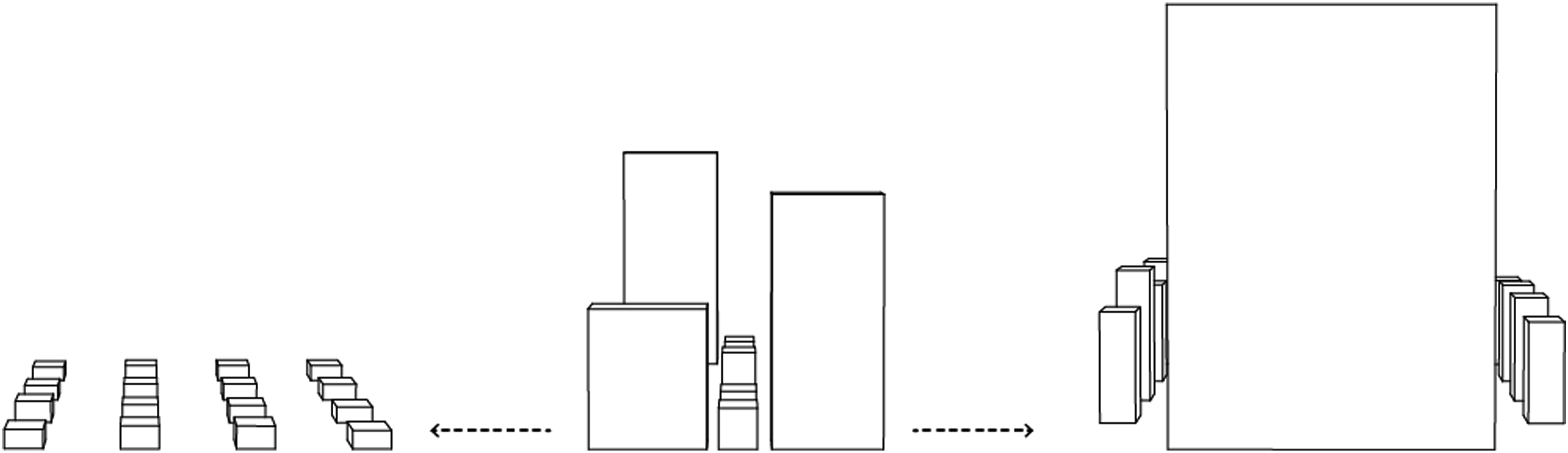
For the person suffering from major depression, the breakdown of basic trust leads to a state of mind where the world is experienced as meaningless, and no possibilities for action are experienced as inviting or alluring. In anxiety disorders, affordances for dealing with threat and danger typically dominate the field of inviting affordances, crowding out other possibilities for action like visiting friends in a bar or going to a park that might otherwise prove attractive. The persistently stressed person experiences something comparable in its dynamics, shifting between an overly anxious feelings in seemingly harmless situations, and feeling drained of motivation as occurs in depression. The world of the persistently stressed person takes more and more effort to live in. As the environment becomes increasingly demanding, this leads to feelings of being drained by life and motivation. In effect, this narrows one’s attention and renders irrelevant possibilities that require physical or mental activity. Their alluringness diminishes, as we saw in our examples of running or going out to meet friends in the weekend. The meaning of these affordances has not been lost to the persistently stressed person but they have lost much of their allure. By no longer interacting effortlessly in trusted public places, the person loses an important buffer for negative affect in the urban environment (Gruebner et al., 2017; Lederbogen et al., 2011).
7. Re-establishing basic trust: The example of RAAAF’s Black Water
What sort of places might re-establish basic trust in persistently stressed individuals? The answer to this question may require the use of a different spatial vocabulary to that which we used to describe public places that afford effortless attention (e.g., Central Park). Designing places that can re-establish basic trust in the world can, for instance, be projects that combine spatial and community interventions (i.e., interventions that engage with the communities that live in, or visit, a neighborhood). Temporary art installations made in public places are one such example. Such interventions in public places may help to re-establish basic trust because they lie outside of more mundane experiences of public places. Paradoxically, providing opportunities to experience the unknown, the unfamiliar, and threatening can sometimes be an effective way to induce forms of contemplation in a public place, which we will argue can increase openness to possibilities closed-off to the persistently stressed person.
Consider as an example of a temporary art installation Black Water, which we made with RAAAF in November 2021 on the Zeeburgereiland in Amsterdam. The installation was made in one of three large vacant concrete silos in a new urban area. The silos were once part of one of the city’s main waste water cleaning facilities, which was demolished years ago. Only the silos remained. For more than a decade, the solemn concrete towers stood waiting for a new city district to arise.
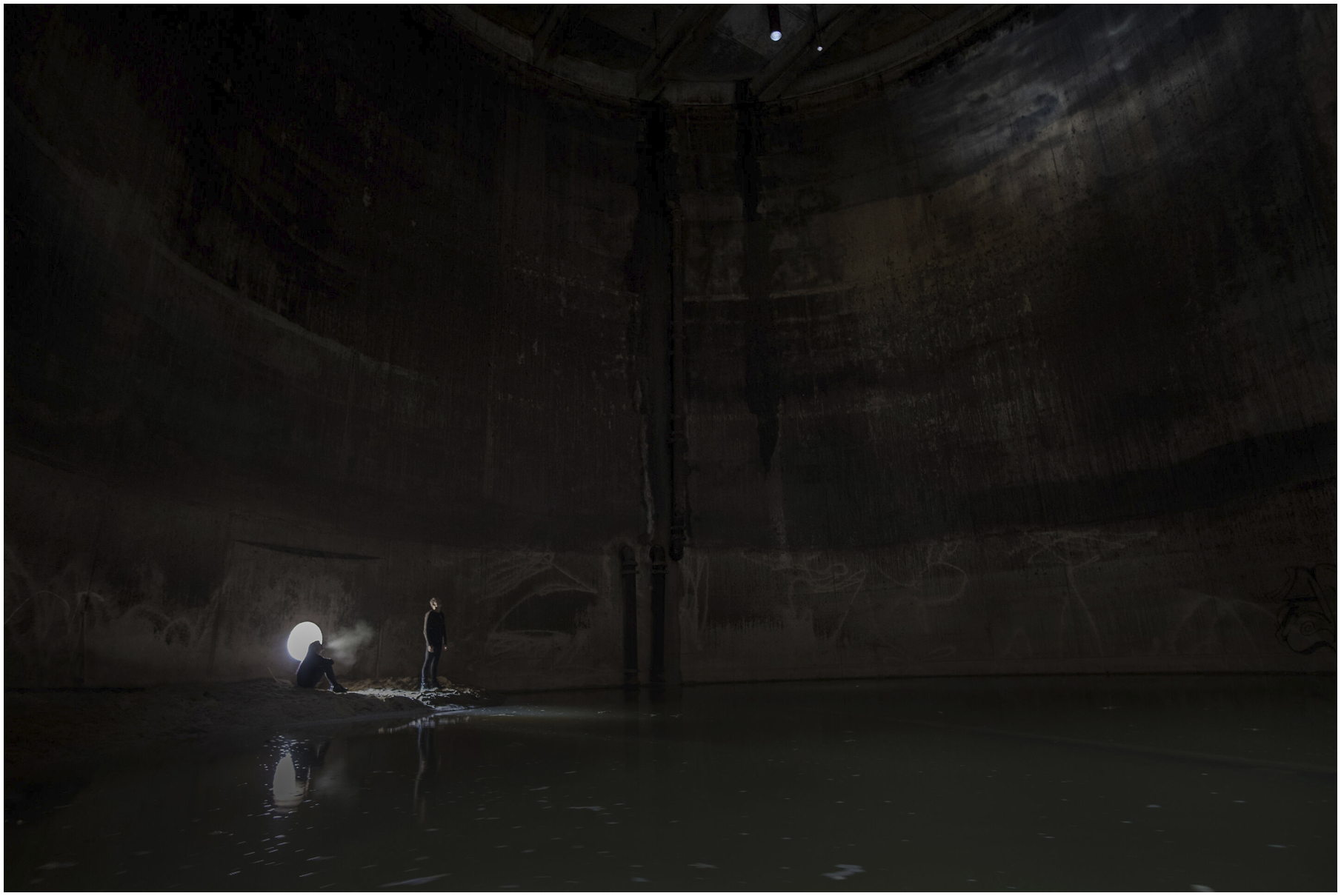
Visitors entered the concrete silo via an old drainpipe that was just big enough to crawl through. Before entering you would be asked to leave your mobile phone behind and warned that it would be very dark and to be careful not to wander of too far because you would walk into water. Once inside, it was pitch black at first. Inside the silos it was silent. One could hear drops falling into the water in an irregular pattern. As minutes passed (most people said they lost their sense of time), the visitor’s eyes would slowly adapt to the darkness, and the space seemed to become lighter than before. The expanse of the silo slowly and dimly unveiled itself, thanks to the daylight peeping through a number of holes in the ceiling.
Visitors described how the stress of entering the unknown of Black Water gradually eased into a tranquil experience. Despite the warning, entering an unknown and undefinable space in the darkness gave an uncanny feeling. 23 Visitors slowly entered a contemplative state of mind where they were attentive to the sensory experiences of the light and sound that the temporary installation made possible. This contemplative state of mind is similar to the state of “effortless attention” but occurred in the artificial environment of a dark industrial silo. The darkness and silence offered an opportunity to calm one’s senses and to become more attentive to small pleasures, like the movement of the light, the changing pitch of the drops, reducing the strain on one’s senses.
The spatial scenography of the temporary art installation provided a setting that invited the visitor to become aware of their own body gradually calming down from a high state of arousal to a state of relaxation. It made experiential, the feeling of opening to an environment that at first was encountered as possibly dangerous and as evoking fear. Some people reported that they experienced an expansion of space, for example, “after several minutes I had the feeling of standing in the middle of the universe looking up at the stars,” or in a “dark forest with light coming through,” or “it is an experience of your own radar, of enormous spatiality.” 24 Others reported “a complete reset of the senses” or a “fear that was corrected.”
By initially evoking a fear experience that was slowly resolved, an experiential arc was constructed that afforded a period of contemplation. Some people reported having insights about difficult situations in their own lives. One visitor described how the installation reminded her of her recovery from a burn-out: “it works like a detox.” Another reported that the smell and darkness reminded her of the times she had spent with her husband who recently had a stroke: “the space absorbed the quintessence of everything that happened in the last year.”
Black Water kicked-off a conversation about the concerns and desires for public space of the local community in the Zeeburburgeiland district and the city of Amsterdam more generally. Physically experiencing the tranquil qualities of the silos in their own neighborhood allowed people to look anew at the possibilities that the place where they live had to offer.
Besides locals, also key figures in Amsterdam’s city government visited the art installation. The need for “quiet” places is widely recognized yet the design of places for contemporary contemplation currently has no place in city planning. Artistic interventions like Black Water, can help citizens, urbanists, mayors, and local politicians to gain a better understanding of the affective dimensions of city life. Exploratory art projects can also make new meanings for often forgotten public spaces, like the silos, and emphasize the need to create public places that afford people unfamiliar experiences (see figures 4 and 5). Existing silo’s on the Zeeburgereiland Amsterdam on a foggy morning, © RAAAF photographer: Maurice Space. Black Water (2021) Zeeburgereiland Amsterdam, © RAAAF, photographer: Maurice Spees.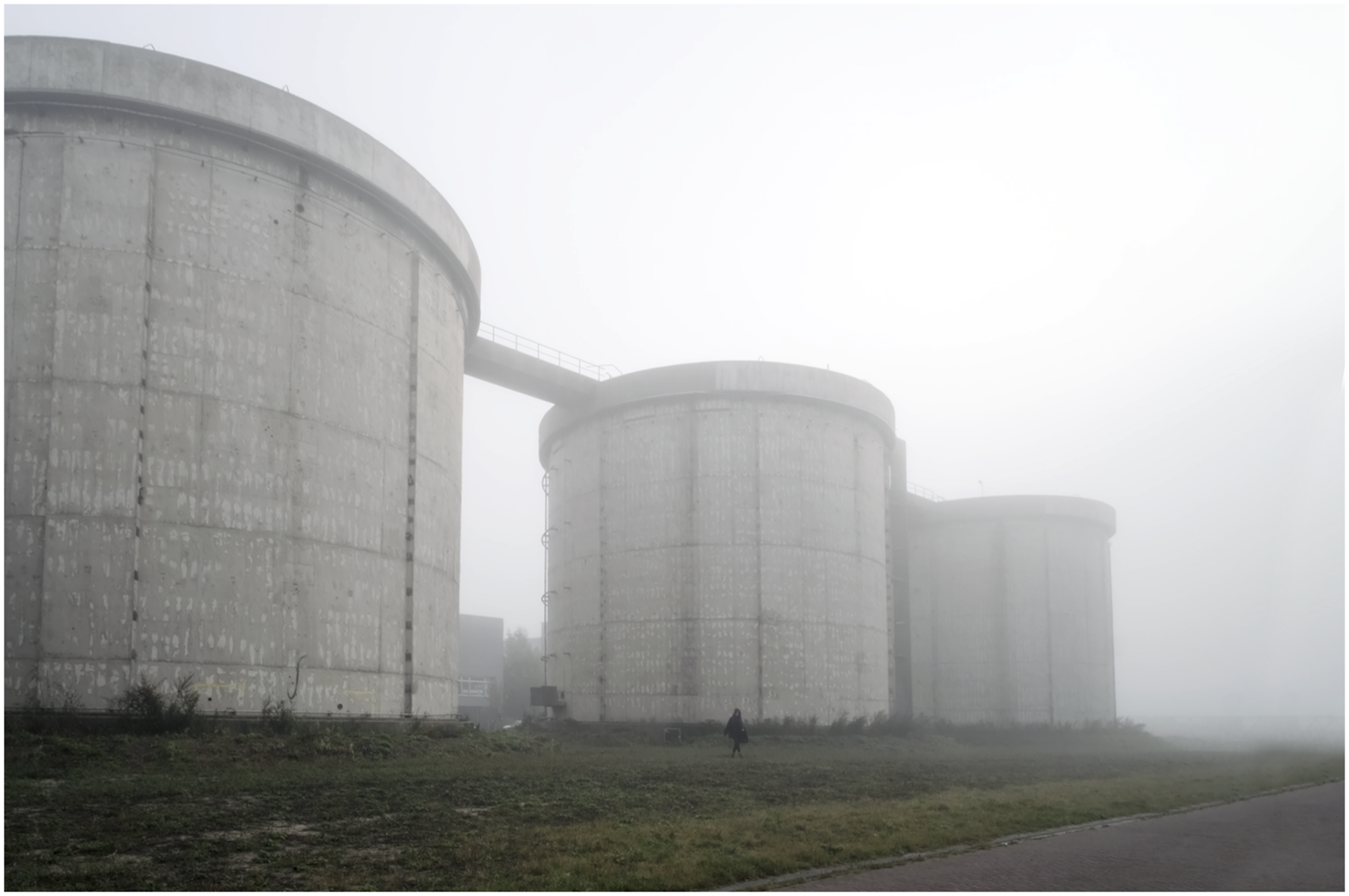
The contemplative experiences that such places afford is important for re-establishing basic trust. The possibility to attend to one’s sensory experiences, that contemplative public places can make available, serves to increase the openness to the environment that we have argued is diminished in the persistently stressed person. Art interventions like Black Water that are very different from places that offer effortless attention such as public parks, can nevertheless act as trusted urban places that do affective work for the individual because they are trusted. Black Water created an affective arc that began with fear but that gradually evolved into a contemplative experience as the person responded to the invitations to attend to the sensory qualities of the place. The effect of this contemplative experience may be to give people the opportunity to reflect on and work through difficult experiences, like those we have all lived through during lockdown, that for many of us were the source of persistent stress. In this way, contemplative public places can make possible the down-regulation of stress. This may in turn help to improve individual’s skills for adapting to the fast pace at which events unfold in urban environments.
The Black Water project as such can be understood as a place-making strategy. Over the last fifty years, place-making has become an important instrument used in spatial planning and urban design to activate under-used city spaces. It originates from the turn towards city life, found in the works of economist Jacobs, (1993), urbanist Jahn Gehl (1971), and sociologist William H. White (1980), among many others. Gehl wrote: “First life, then spaces, then buildings – the other way around never works” (1971, p. 7). Place-making is an urban intervention that is a (temporary) adaptation of a place in the city, like a street or a park, in dialogue with the community (Harvey & Aultman-Hall, 2015; Oldenburg, 1999). Place-making interventions call on the experience and creativity of the inhabitants of a place.
In practice, place-making strategies often have a clear economic incentive of revitalizing neighborhood economies. By, for example, lowering rents, small shops and artist’s studios can take root. An example is the Haarlemerstraat in Amsterdam, which was dangerous and rundown up to its revitalization in the 90s. Such revitalization can lead to more lively city streets and to the kind of trust that Jane Jacobs called, casual public trust (Jacobs, 1993; 56). More problematically, it has also been recognized as part of the process of gentrification (Kukla, 2022, p. 99). Overcrowding and the rising costs of living can happen because of the enlivened streets, possibly leading to segregation in a neighborhood, and in a city more generally.
Black Water proposes a different form of place-making, not based on economic incentives but by making a site-specific art installation. It calls for a form of public investment in community activities, outside of the commercial space. By combining community and temporary spatial interventions such place-making might be an important instrument for promoting urban mental health. Black Water is far from unique in offering such possibilities. Think of car-free Sundays when even a city’s high-ways can become playgrounds, or a national minute of silence, or neighborhood campsites temporally overtaking a park. Or of more long-term examples like the Silent Garden movement (Ahsan, 2017: 67), the community gardens like Prinsesinnen Garten in Berlin (Kukla, 2022, p. 156) or the Food Forest project in Amsterdam Zuid (Soloman, 2012, p. 377). Although such examples of place-making are experientially very different from art installations, they illustrate a variety of communal activities that temporarily (some just for a few minutes, some for years) change the meaning of a place, leaving the participant with a positive shared experience of public space.
City-wide policies for reducing physical stressors like noise, traffic, light- and chemical pollution, crime, or alcoholism, or for renovating existing public parks, gardens, sport fields, libraries, museums, and playgrounds could benefit from strategic place-making. Such an urban practice can transform the meaning of places in the city, through creating positive experiences and a feeling of trust towards others and in the place where one lives. Places beneficial for mental well-being can in such a way become incorporated into one’s urban life.
8. Conclusion
Our aim in this article was to understand better how public places—such as parks, squares, canals, and streets—can support basic trust in the living environment of the city and can thereby help city dwellers to live healthy emotional lives. We have described how persistently stressed people become more open to (perceived) threats and less open to trusted urban places that would otherwise allow them to regulate, set-up and amplify feelings, emotions and moods arising from encounters with urban stressors. The disturbance of habits for making use of trusted urban space might be a crucial and overlooked aspect in the pathway from mental health to illness, from stress to developing mental disorders such as anxiety disorders or major depression. One of the consequences of persistent stress is that people may cease to engage with trusted urban places with the consequence that their basic trust in the living environment becomes disturbed. We suggest that this disturbance of basic trust is a possible path to mental illness. We finished up by suggesting ways in which basic trust in the living environment can be restored in people living with persistent stress. We suggested that exploratory artistic interventions are examples of place-making that can help individuals to regain basic trust and may be an important new path to promoting urban mental health.
Footnotes
Author’s note
Department of Philosophy, University of Twente, Enschede, The Netherlands.
Declaration of conflicting interests
The author(s) declared no potential conflicts of interest with respect to the research, authorship, and/or publication of this article.
Funding
The author(s) disclosed receipt of the following financial support for the research, authorship, and/or publication of this article: This work was supported by the Netherlands Organisation for Scientific Research VICI grant awarded to Erik Rietveld.
Notes
Appendix
About the Authors
 .
.