



Abstract
Risk-taking is a ubiquitous behavior and its assessment is a central aspect of understanding human decision-making. Self-report questionnaires can be used to probe risk-taking propensities in a domain-specific manner. In contrast, most behavioral tools for risk-taking assessment provide nonspecific, unitary measures with a strong bias towards risk scenarios involving monetary gains and losses tied to probabilities. In the current work, we evaluate a behavioral task designed to specifically address recreational risk-taking, that is, situations where decision-making is driven by intrinsic motivation and performance is rewarding in its own right. For this, we chose the Tower Building Task (TBT), in which participants use wooden blocks to attempt to build the tallest tower they can; a trial ends if the building collapses, the allotted time ends, or the builder is satisfied with their tower. We correlated the TBT scores with each of the domains provided by two widely used self-report instruments, the Domain-Specific Risk-Taking scale (DOSPERT) and the Evolutionary Domain-Specific Risk scale (ERS). We found small, but significant correlations between TBT scores and those of (i) the recreational domain of the DOSPERT as well as (ii) the environmental exploration domain of the ERS. These correlation values reflect a small degree of similarity between these tests, suggesting that they capture some aspects of the complex construct that is recreation. However, the small magnitude of the correlations highlights the need for a complementary set of tools to evaluate the full spectrum of recreational risk-taking activities.
Introduction
Risk-taking behavior is a ubiquitous phenomenon in human life. Whether crossing a street, placing a bet, or skydiving, decisions involve weighing various scenarios regarding their potential gains and negative outcomes. Potential gains are difficult to integrate into a single entity and may range from monetary or social benefits to things that may only have intrinsic and highly personal value. Similarly, negative outcomes may also come in different levels of severity, from what for many may be small nuisances like being bored to a physical injury, to financial loss or even death. While some studies suggest that there may be a general risk propensity that sums a person’s risk attitudes across different situations (Frey et al., 2017; Highhouse et al., 2017), others suggest that risk-taking attitudes display little cross-situational consistency (MacCrimmon et al., 1988; Blais & Weber, 2006; Zhang et al., 2016). Because of such variability among situations, the current work subscribes to the view that risk-taking is a multidimensional construct (Jackson et al., 1972; Shou & Olney, 2020), that is, that there are different sets of risk-taking dilemmas with their own types of gains and losses. For instance, risk-taking decisions can be assessed in a financial context, where losses or gains imply a monetary exchange, or in the context of recreation, where losses may be represented by finding an activity dull or being hurt, while gains can be expressed in terms of having fun or achieving a goal.
Faced with such a challenge, some researchers have developed self-administered questionnaires that include several items, each addressing risk-taking in a specific scenario. In each of these, the question is framed to evaluate the responder’s perceived risk attitude (Weber & Milliman, 1997) as formulated within a risk-return framework (Weber et al., 2002). Answers are then combined to provide scores for each “domain”: these are built by grouping items which statistical data reduction techniques (e.g., factor analysis) identify as having a similar nature. One such tool is the Domain-Specific Risk-Taking or DOSPERT scale (Blais & Weber, 2006) which includes items meant to provide a score for each of the five different domains: financial, social, health, ethical, and recreational. With each item, the participant is asked to answer how likely it is they would choose to engage in a particular situation (e.g., choosing whether you would bet a day’s income at the horse races, a financial domain item, or revealing a friend’s secret to someone else, a social domain item). Intercorrelations between domains have shown heterogeneity among subscales (Hanoch et al., 2006; Shou & Olney, 2020), reflecting the idea that risk-taking behavior may not be generalizable across situations. In general, self-report methods can be efficient to apply, but are not without issues (Rosenman et al., 2011; Van de Mortel, 2008) as items may involve references to activities, particularly among those in the recreational domain, that are more relatable to certain cultures, ages, or socioeconomic subgroups (mostly characterized by the global north). In fact, five out of six items evaluating recreational risk on this scale involve activities (i.e., skiing, whitewater rafting, skydiving, bungee jumping, or piloting a small plane) that are rarely present in the spectrum of recreation that most people in the world have access to or otherwise engage in. Additionally, the situations depicted are mostly relevant to young or middle-aged adults, although a scale for children is being developed (https://sites.google.com/a/decisionsciences.columbia.edu/dospert/upcoming-projects).
Another notable tool in the field of risk-taking behavior is the Evolutionary Domain-Specific Risk Scale or ERS (Wilke et al., 2014), which evaluates risk propensity in situations that mirror those that may have been subject to the selective pressures shaping human evolution. The domains (i.e., between-group competition, within-group competition, status/power, environmental exploration, food selection, food acquisition, parent-offspring, kinship, mate attraction, and mate retention) are evolutionary-oriented and have been translated into modern-day problems with adaptive implications relevant for both current and ancestral situations (e.g., asking whether you would choose to sit in the section for fans of the opposing sport team with a group of friends while wearing your team’s colors as a proxy for between-group competition). Notably, the wording for most items in this scale makes it more accessible for different populations. For instance, activities described in the environmental exploration domain (i.e., swimming, hiking, and exploring) are mostly accessible to a wide range of people. Still, as in the DOSPERT, many items are only relevant to adult participants.
While self-report measures can provide an overview of an individual’s domain-specific risk-taking propensities, a similar effort in producing domain-specific behavioral tests has not gained traction. Risk-taking behavioral tests are those where participants are faced with a decision-making scenario and must weigh potential outcomes with realistic consequences (e.g., losing or gaining a reward). Evaluating actual decision-making can help overcome some of the basic limitations of self-report tools. For instance, many of the risk-taking items describe socially desirable or undesirable situations which may lead participants to over- or underreport their propensities, respectively (Chapk & Solomo, 1974; Van de Mortel, 2008). Such biases may be reduced using behavioral tests in which the measure of interest to the investigator is not necessarily explicit to the participant. Currently, most widely used behavioral tests address a type of risk-taking behavior that is akin to those in the financial domain. For instance, in the Balloon Analogue Risk Task (BART; Lejuez et al., 2003), the participant must decide up to which point they should inflate a balloon, earning a small amount of money for each pump while risking losing the accrued amount if it explodes. In the Iowa Gambling Task (IGT, Brevers et al., 2013), the participant must iteratively choose a card from one of four decks, which reveals either a reward or a fine; decks that yield high rewards also contain high fines, whereas others provide small rewards and smaller fines. Despite both these tasks involving outcomes framed in terms of either explicit monetary rewards or losses, the assessment of risk propensity may not be evident for participants undertaking such tasks compared to self-reports with explicit risk-taking content.
In summary, for the recreational domain there are fewer behavioral tests (but see Morrongiello et al., 2009), and even arriving at a conclusive definition of recreation has proved to be a challenge (Churchill, 1968; Brown et al., 1973). Recreational activities range from those of leisure (e.g., resting in the sun or playing a boardgame), to thrill seeking (e.g., rollercoaster riding or bungee jumping), or athletically demanding feats (e.g., rock-climbing or kayaking in river rapids). Some of the distinctive features of risk-taking recreational activities are (i) they involve a ludic component, in which (ii) performance is tied to intrinsic motivation (and not solely to economical remuneration), iii) lack a strict set of rules regarding how the activity takes place, and iv) may require some degree of skill (so purely chance games are not included) (Department of Communities, 2009).
The Tower Building Task or TBT (Gracia-Garrido et al., 2021; 2022), is a laboratory-based activity in which participants use wooden blocks to build the tallest tower they can within 10 minutes which was designed to capture the main aspects of recreational risk-taking. The trial ends if the tower collapses, the participant runs out of time, or is satisfied with their tower’s height. The authors argue that the task presents a good proxy of recreational risk-taking behavior, as it shares several features of risky situations in this domain, including (i) being rooted in intrinsic motivation, (ii) a subjective assessment of what is considered a reward, (iii) involves basic motor and cognitive skills, and iv) the capacity to adjust behavior according to feedback derived from performing the activity. Previous work has shown that participants were intrinsically motivated to build vertically and using up most of the pieces or the time allocated to the task (Gracia-Garrido et al., 2022). Motivation influenced tower height, which increased when a “record height” was experimentally introduced and decreased when attempts were limited to a single collapse (Gracia-Garrido et al., 2022). In a study involving participants of different ages, older subjects achieved taller more vertical towers, which suggest a possible link between sensorimotor skills and performance (Gracia-Garrido et al., 2021). Also, this task has shown a moderate but significant positive correlation with the main measure of the BART (r = .46, p = .01) as well as with the scores of the thrill and adventure seeking items of the Sensation Seeking Scale (r = .43, p = .02), a widely used self-report measure (Zuckerman, 1971).
The current study aims to compare the TBT, a behavioral tool designed to evaluate recreational risk-taking, with the scores of two self-report tools that address this sub-type of risk-taking in a domain-specific manner. We expect the performance metric of the TBT to align with the scores of the recreational domain of the DOSPERT and the environmental exploration domain of the ERS. Evaluating the similarities and differences between the TBT and these self-report instruments can provide a broader context to understand what constitutes recreational risk-taking as well as offer a complementary way to assess this risk domain.
Methods
Participants
We recruited a total of 120 undergraduate students (22.12 ± 2 years old, 54% self-identified as women) from the campus of a public university in central Mexico. An invitation to participate was posted on the sites of various student Facebook groups. Participants were paid a fixed amount, MXN 50.00 (approximately 2.5 USD), regardless of performance. All testing took place between November 2021 and February 2022.
Assessment Tools
Participants performed the Tower Building Task (Gracia-Garrido et al., 2022). They were instructed to use 108 standard-size wooden blocks (1.5 × 2.5 × 7.5 cm) from the board game Jenga (Hasbro Inc, Pawtucket, Rhode Island, USA) to try and build the tallest tower they could within 10 minutes. Building took place on a smooth 50 × 50 cm melamine board. Participants were told that (i) they were free to place blocks in whatever configuration they wished, but always in a single structure, (ii) they could remove any number of pieces from the tower at any moment throughout the task, and (iii) that it was not obligatory to use all the blocks. They were told that if the tower collapsed, the test would end no matter the remaining time, but that if satisfied with the height of their tower they could choose to conclude early. For this task, performance is summarized by a single dependent variable, the fixed height gain, which is obtained by dividing the height of the tower by the number of pieces used and multiplying this amount by the proportion of the time elapsed. Height gain is adjusted by the time spent building to differentiate the rates achieved by participants who end earlier from those who use up most of the allotted time. For instance, we can consider two cases: i) an 18 cm tower made from 6 pieces (e.g., two set of arches, that is, two vertical pieces and a horizontal one, stacked on top of each other) built in 20% of the allotted time and ii) a 90 cm tower made from 30 pieces built in 100% of the allotted time. Both these towers would have a height gain of 3. However, the second attempt represents greater risk-taking behavior as i) the increase in height is achieved at the expense of the tower’s stability and ii) the potential loss is larger for a taller construction. So, by adjusting for the proportion of the time used (18/6 * .2 = .5 and 90/30 * 1 = 3, respectively), the second effort obtains a larger score.
We then evaluated participants’ risk-taking attitudes by applying the DOSPERT (Blais & Weber, 2006) and the ERS (Wilke et al., 2014) scales. Both are self-report scales, each consisting of 30 items, and can be answered in 7–10 minutes each. In the DOSPERT, items assess risk-taking propensities in five different domains as outlined in the Introduction. Items contain statements such as “admitting that your tastes are different from those of a friend” or “riding a motorcycle without a helmet.” In the ERS, items match 10 evolutionary domains as outlined in the Introduction. Items contain statements such as “donating a kidney to your sibling” or “not boiling or filtering water from a questionable source before drinking it.” In both, respondents must choose on a Likert scale the likelihood they would perform or participate in the mentioned activity.
For both these tests, answers are summed up for each domain, with larger scores suggesting a larger likelihood of risky behavior to be taken in that domain.
Procedure
Experimenters scheduled participants for different time slots during the day. Upon arrival, participants were informed about the tasks involved, while avoiding any reference to risk-taking behavior, so as not to influence participants’ performance on the TBT and reduce demand characteristics, where instructions do not explicitly mention that risk-taking is being evaluated. If participants agreed to take part in the study, they signed an informed consent form. First, participants performed the TBT and then filled out the DOSPERT and the ERS scales.
For the TBT, participants were asked to sit behind the board and had the wood pieces placed next to their dominant hand. The experimenter explained the rules according to a script. Each trial was videotaped with a camera placed approximately two meters from the front of the board. Afterward, participants sat at a desk and were given the self-report scales. The experimenter explained how to fill out the scales and provided the participant with a pen.
Ethical Considerations
The experimental protocol was revised and approved by the ethical committee for human participants of the Instituto de Investigaciones Biomédicas of the Universidad Nacional Autónoma de México and in accordance with the principles of the Declaration of Helsinki.
Behavioral Coding
Video recordings were coded using the Behavioral Observation Research Interactive Software (Friard & Gamba, 2016). For each video, we coded the number of blocks used per participant, the height of the tower at the end of the test, and the elapsed time. For purposes of interobserver reliability, the videos were coded by the first author (J.H.M.) and a trained independent rater who was blind to the aims of the study. Interobserver ratings were calculated using Pearson correlations for 27% of trials (n = 32 trials) and were high for all variables (r > .96).
Statistical Analysis
The number of participants was determined for an expected correlation coefficient between .2 and .3 (α = .05, β = .2) which yielded a sample size between 85 and 194 participants (Hulley et al., 2013).
We used Spearman correlations to evaluate the relation between the fixed height gain and the individual domains of the DOSPERT and ERS, as the latter yield scores that are based on ordinal data. Statistical significance of all tests was set at p < .05. All analyses and plots were done using R (R Core Team, 2022). Scores for all tests are available on an online repository (https://doi.org/10.6084/m9.figshare.20365122.v1).
Results
Scores on the TBT, the DOSPERT, and the ERS.
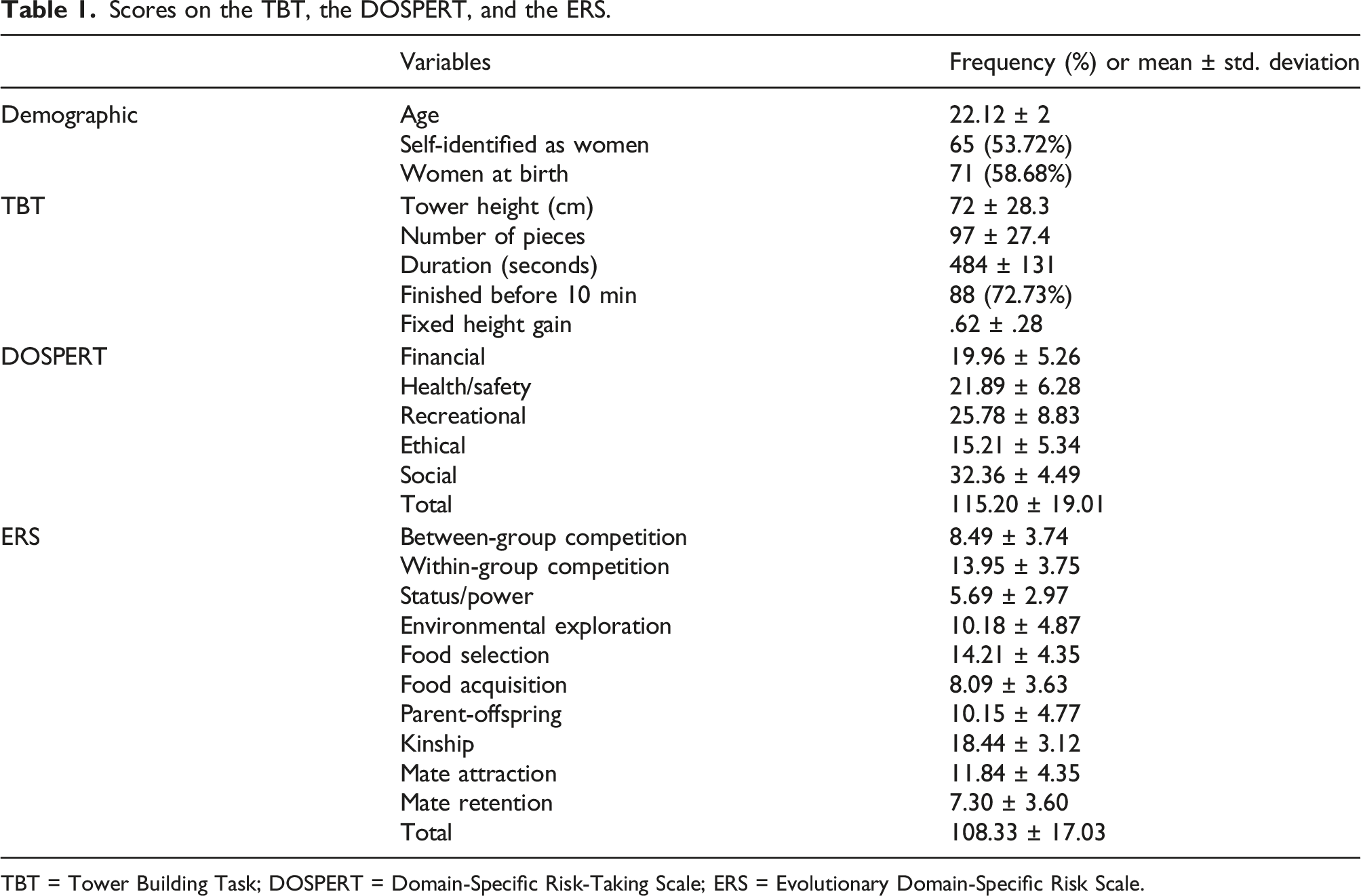
TBT = Tower Building Task; DOSPERT = Domain-Specific Risk-Taking Scale; ERS = Evolutionary Domain-Specific Risk Scale.
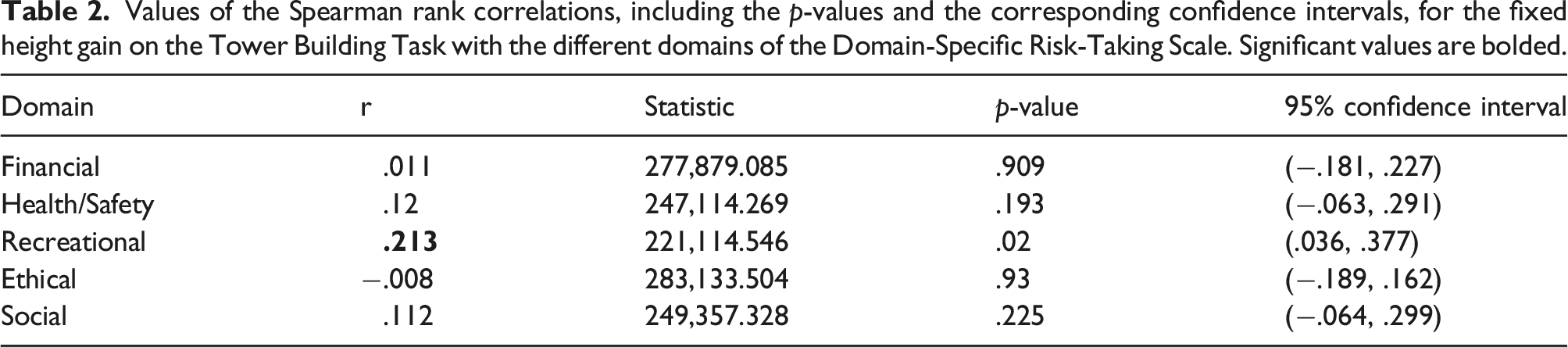
Values of the Spearman rank correlations, including the p-values and the corresponding confidence intervals, for the fixed height gain on the Tower Building Task with the different domains of the Domain-Specific Risk-Taking Scale. Significant values are bolded.
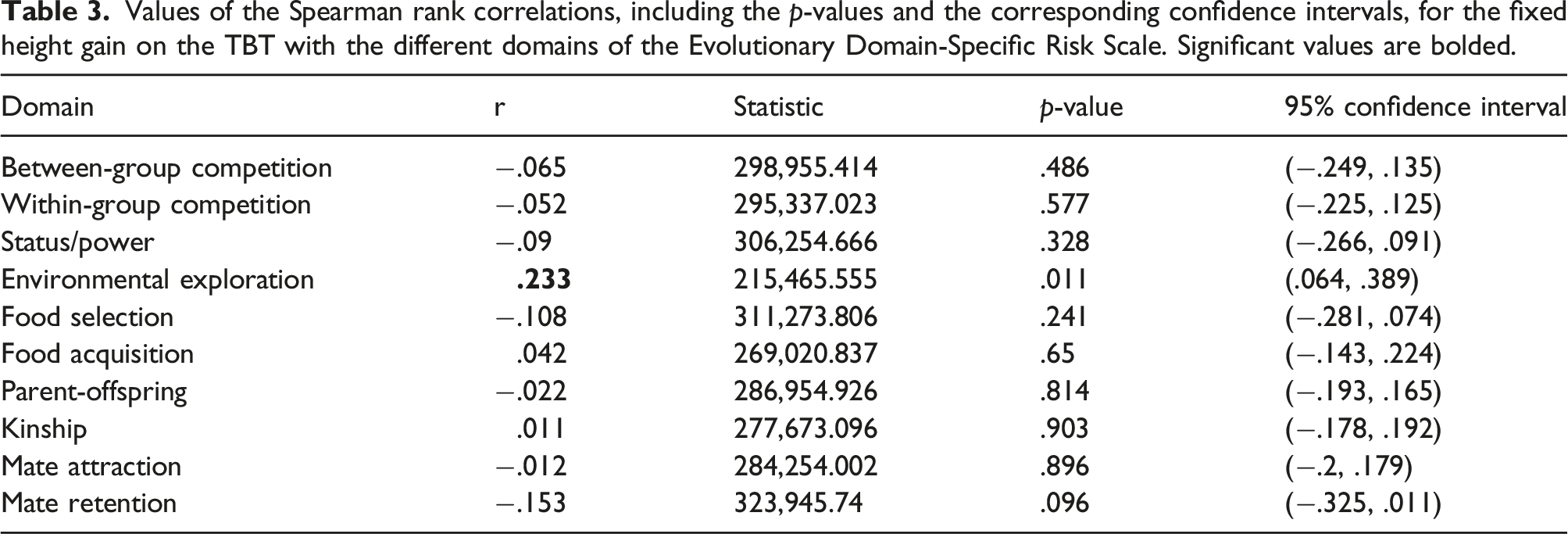
Values of the Spearman rank correlations, including the p-values and the corresponding confidence intervals, for the fixed height gain on the TBT with the different domains of the Evolutionary Domain-Specific Risk Scale. Significant values are bolded.
Discussion
In the present study, we found that the fixed height gain on the TBT, which we consider to be a measure that appropriately captures the main aspects of risk-taking on this task (Gracia-Garrido et al., 2022), showed small, but significant and specific correlations (i.e., only with the domains we hypothesized in the introduction) with scores of domains proposed in widely used risk-taking self-report measures: the recreational domain of the DOSPERT and the environmental exploration domain of the ERS.
First, we discuss the association between the TBT and the recreational domain of the DOSPERT. A significant correlation begs the question: what are the features shared by the recreational activities as outlined by the DOSPERT and the TBT? Gracia-Garrido et al. (2022) also found a positive association between fixed height gain and the thrill and adventure seeking subscale of the Sensation Seeking Scale, which in a similar way to the DOSPERT, contains a strong bias towards outdoor sports. Out of the 10 items that make up this subscale, eight represent activities that are rarely performed by most people in Mexico City (i.e., mountain climbing, water-skiing, surf-board riding, airplane flying, scuba diving, parachute jumping, boat sailing, and snow-skiing). Only the item asking if the participant likes to engage in “activities that are dangerous” is worded in general terms (Zuckerman, 1971). This significant, albeit modest, association suggests that the TBT contains a ludic, recreational component that is somewhat like the “popular” recreational activities included in the DOSPERT.
Given the modest correlation between the recreational domain of DOSPERT and the TBT, how does this specific domain of the DOSPERT contrast with the TBT? As mentioned in the Introduction, the recreational items of DOSPERT seem almost exclusively to represent outdoor, athletic situations. Additionally, the activities described seem to be constrained to a particular cultural and socioeconomic background, with many other people around the world having never engaged in such activities or drawing their experience exclusively from television or film. So, one potential interpretation for such a small association is the lack of over or underscoring from participants who are unfamiliar with the risks involved in such activities. In this sense, the inclusion of culturally relevant risk-taking recreational activities may result in more accurate estimation of risk-taking propensities (Demirhan, 2005; Llewellyn & Sanchez, 2008). Another possibility is to recruit and assess individuals who explicitly engage in the type of recreational activities described in the DOSPERT and evaluate the association in these subgroups (for an example of domain-specific risk-taking, see Hanoch et al., 2006). Finally, one last interpretation is that the DOSPERT’s definition of what constitutes a recreational activity is too narrow and needs to be broadened.
Secondly, we found a small but significant correlation between the fixed height gain on the TBT and the exploration domain of the ERS. This also raises a similar question as above: what are the features shared by environmental exploration as portrayed by the ERS and the TBT? Environmental exploration and recreation are strongly linked (Apostolou & Shialos, 2018; Chawla, 1992). It is reasonable to think that an activity that implies going out to explore carries a particular kind of risk, related to participants’ own health and sense of safety; at the same time, the benefit of finding new resources is clearly advantageous and rewarding. Exploration also fulfills the central recreational criteria: Skill is involved not only in motor, but also in cognitive terms as learning the better, shorter routes and being able to get to a destination or return home efficiently is a crucial aspect of the activity. In terms of motivation, recreation via exploration may stem from getting to know one’s surroundings and the location of potential resources (for an example, see Kaaronen, 2020). While resources may indirectly translate into a benefit akin to money, the type and number of resources collected as well as other foraging decisions such as when to stop collecting depend on the individual’s motivation. Moreover, the negative outcomes stemming from exploration are like those of recreational activities (and expand beyond those considered by the DOSPERT), ranging from getting rained on or not finding sufficient resources, to getting lost or any level of physical harm. Finally, items describing environmental exploration may have been more recognizable to participants in their everyday lives. Yet again, it is important to consider that the correlation was small, which in turn suggests some important differences between participants’ perception of the environmental exploration domain and their performance on the TBT. So, a potential interpretation for such a small correlation is that the ERS portrays risk-taking related to the environment but only some recreational activities take place outdoors, that is, only some forms of exploration entail recreation.
An additional point to note is the considerable variability in participants’ scores on the TBT. In fact, this might be a potentially valuable aspect of the task, as blocks can be arranged in different patterns reflecting a range of ways (“strategies”) to achieve height gain. Such variability might provide a good proxy for individual differences in the context of recreational risk-taking. Individual risk-taking profiles and individual differences in general, can be regarded as the basis of the characterization of personalities from a behavioral ecological perspective (Wolf & Weissing, 2012). However, further studies are needed to establish the existence of short- and long-term consistency in differences in performance among individuals.
Limitations
We only assessed a sample of urban students of similar age who probably had never performed most of the activities that are included in the recreational domain of the DOSPERT. Also, we did not subsequently ask participants whether they thought the TBT involved risk-taking, or if they found the task “fun.” And we did not assess their fine motor or visuospatial skills as covariates, which may have influenced the height of the tower or the time they took to build.
Conclusion
Recreational risk-taking behavior is an important and complex part of risk-taking behavior more generally. Tools to study it include subjective self-report questionnaires as well as more objective behavioral tests. However, these tools have notable cultural biases and are limited in the age range to which they can be applied. The Tower Building Task used in the present study provides an economical, culture-free, ludic behavioral test that can be readily implemented in whatever environment and across a wide age and socioeconomic range. We suggest that it provides a useful addition to the tools presently available for the study of recreational risk-taking behavior.
Footnotes
Acknowledgements
We would like to thank all students that participated in this study.
Declaration of Conflicting Interests
The author(s) declared no potential conflicts of interest with respect to the research, authorship, and/or publication of this article.
Funding
The author(s) disclosed receipt of the following financial support for the research, authorship, and/or publication of this article: Dirección General Asuntos del Personal Programa de Apoyo a Proyectos de Investigación e Innovación Tecnológica of the Universidad Nacional Autónoma de México (research grant no. IN207120) awarded to the corresponding author.

About the Authors