




Abstract
Causal cognition is a core aspect of how we deal with the world; however, existing psychological theories tend not to target intuitive causal engagement that is done in daily life. To fill this gap, we propose an Ecological-Enactive (E-E) affordance-based account of situated causal engagement, that is, causal judgments and perceptions. We develop this account to improve our understanding of this way of dealing with the world, which includes making progress on the causal selection problem, and to extend the scope of embodied cognitive science to causal cognition. We characterize identifying causes as selectively attending to the relevant ecological information to engage with relevant affordances, where these affordances are dependent on individual abilities. Based on this we construe causal engagement as based on a learned skill. Moreover, we argue that to understand judgments of causation as we make them in our daily lives, we need to see them as situated in sociocultural practices. Practices are about doing, and so this view helps us understand why people make these judgments so ubiquitously: to get things done, to provide an effective path to intervening in the world. Ultimately this view on causal engagement allows us to account for individual differences in causal perceptions, judgments, and selections by appealing to differences in learned skills and sociocultural practices.
Keywords
1. Introduction
One fundamental way in which we humans experience and deal with the world is by way of causal relationships. This seems to be true in any situation. Whether we are confronted with a scenario involving billiard balls colliding or a social setting in which a friend responds emotionally to someone else’s remarks. When we encounter worldly events, we perceive more structure than meets the eye (or any other sensory organ). To us it is not just that one billiard ball starts rolling after the other stops, it is not just that our friend becomes emotional after another’s words. Instead, it seems central to the way we cope with the world, both individually and as communities, that we experience that one ball caused the other to move and that someone’s words caused an emotional reaction.
This is the phenomenon under consideration here, that of an individual perceiving, judging, and selecting causes of concrete encountered happenings in the world. In the literature, these phenomena tend to be referred to as causal perceptions or causal judgments, however, our account targets something more basic that encompasses both perceptions and judgments. We focus on the type of causal cognition that is intuitive and forms in the relation between agent’s environment and her actions, a type of causal cognition that is ubiquitous. We will use the term “causal engagement” for this. This paper has three related aims. The main aim is to develop our understanding of the psychology of causal engagement, and the sub-goals are to make progress on the causal selection problem and to extend the scope of embodied cognitive science.
To improve our understanding of causal engagement, we will provide a philosophical analysis of the psychological processes that underlie this way of dealing with the world and elucidate why we perceive some things to be causes but not others. Understanding this aspect of our lives, we will argue, requires an affordance-based account, where affordances are the possibilities for action provided to us by the environment (Chemero, 2009; J. Gibson, 1979; Kolvoort & Rietveld, 2022; Rietveld & Kiverstein, 2014).
In providing such an affordance-based account, we extend the scope of embodied cognitive science to a core facet of so-called “higher” cognition. Our account is part of the larger literature using the framework of embodied and situated cognition. Embodied and situated approaches to cognition are starting to be applied to more and more facets of cognition. Initially, these accounts focused on what has been called “lower” cognition, such as perception or mechanical action routines. More recently, however, much work has been done to extend the scope of embodied and situated accounts to so-called “higher” cognition. Embodied accounts have made headway in understanding imagination (Gallagher, 2017; van Dijk & Rietveld, 2020), mathematical cognition (e.g., Abrahamson et al., 2020; Zahidi & Myin, 2016), anticipation (e.g., Jurgens & Kirchhoff, 2019; Stepp & Turvey, 2015; van Dijk & Rietveld, 2021a), change-ability (Rietveld, 2022), language (Atkinson, 2010; Kiverstein & Rietveld, 2021; Van Den Herik, 2018; van Dijk & Rietveld, 2021b), and more. These works generate doubt about the veracity and productivity of the higher-lower cognition dichotomy and help make sense of the mind using a unified approach. We continue this trend here by providing an embodied and situated account of a core component of “higher” cognition.
This paper is organized as follows. In section 2, we will introduce the causal selection problem and existing perspectives on causal cognition, both of these will illustrate the need for an embodied and situated account of how we engage with causality. Next, in section 3, we will introduce concepts from the Ecological-Enactive (E-E) framework that we will use to build our account. In section 4, we will introduce interventionism as a natural starting point of an embodied account of causal cognition. Then, in sections 5 to 7, we construct our account of causal engagement in three parts: Section 5 focuses on how agents identify parts of the environment as causal. In section 6, we discuss what causality and causal relationships are from the perspective of an agent. Lastly, in section 7, we analyze interventions, that is, the actions we take that are based on and impact the causal systems around us. We conclude the paper with a short summary and we suggest directions for future research based upon the theory developed herein.
2. Causality in Philosophy, Psychology, and Life
To set the stage before developing our own account, it is important to have a preliminary discussion of some of the relevant literature on causality. To restrict the scope of our account, we first discuss the distinction of “actual” and “general” causation. Next, we introduce the causal selection problem and discuss an important account of it that indicates how we can me make progress on it. Lastly, we discuss prominent theories of causal cognition in the psychological literature and empirical findings that point towards the need for further theoretical development.
2.1 “Actual” Causation Encountered in the Environment
The literature on causality commonly distinguishes two forms: actual and general causality. Actual causation 1 is about concrete cases. Judgments of actual causation come about by asking “What is the cause of this?”, where “this” refers to an actual, concrete event that happened in the world. An example of this is “Did Jane’s fatigue cause the traffic accident?”. This can be contrasted with general causation, which is about which causal relationships hold across multiple instances, for example: “Does fatigue cause traffic accidents?”.
As we are mainly interested in cognition situated in daily life, our analysis will be mostly restricted to actual causation. These causal judgments occur when we care about the causes of a specific event and tend to be more intuitive than judgments that require generalization. In daily life, we often care about causes of particular events in our environment. This makes judgments or perceptions of actual causes ubiquitous in everyday life (“What caused Mark to decline my invitation?”), but also in more formal settings, such as medicine (“What is the cause of this inflammation?”), legal settings (“What is the cause of the criminal’s actions?”), engineering (“What caused this bridge to collapse?”), and many others.
2.2 The Causal Selection Problem
Understanding how people perceive and judge causes is closely related to the problem of causal selection. The problem of causal selection has received attention from philosophers for many decades and concerns what we should pick out as “the cause(s)” of an event out of the many possible causes (Hesslow, 1988; Lewis, 1974). Logically speaking any event has infinitely many causes. We can, for example, trace back a causal chain as far back as the big bang for any event. This has led multiple philosophers to view causal selection as objectively groundless (e.g., Lewis, 1974), but the philosophical work on the problem is still helpful in informing our descriptive account.
A famous example discussed by Carnap (1966, pp. 191–192) illustrates an important feature of causal selection in real life, namely, that it can vary strongly: EX1 An angry driver is speeding down a street while it is raining. While turning a corner he hits a bump, the car spins and crashes into a wall. What was the cause of this car crash? Carnap claimed that we shouldn’t expect a consensus regarding the cause of the crash as different people will focus on different aspects. A policeman might attribute the crash to the driver speeding, while an engineer would point to the state of the road, and a psychologist would focus on the driver's mental state.
So it seems that there are an infinite amount of causes to select, and people tend to select different causes. These facts seem pertinent to any theory of causal cognition. While much progress has been made in understanding causal selection, it is still unclear how and why people make different causal selections.
Hesslow (1988) has argued famously that we should see differences in these causal attributions as differences in questions asked, that is, differences in the object of comparison. For example, the question “What caused this house to burn down?” could refer to “What caused this house, but not the one next door, to burn down?”, but it could also refer to “What caused this house to burn down now and not yesterday?”. These questions are different, they involve different comparisons. Pointing out a cause that involves the building materials of the house is appropriate for the former question but not for the latter as they probably did not change from yesterday to today. Hesslow (1988) thus proposes that people select different causes because they are actually asking different questions. Unfortunately, no proper explanation is provided of what makes people ask these different questions. Why did the policeman and engineer “ask different questions” and thus select different causes? Hesslow puts it down to what he calls “subjective” and “unconscious” factors such as experience, norms, and education, but provides no account as to how those factors lead to differing causal judgments. This is unfortunate as getting that process in view would help us understand what causes people select and why they do so. We aim to fill this gap with our account by providing more guidance on how and why factors such as education, learned abilities, and sociocultural practices affect causal selection.
2.3 The Psychology of Causal Cognition and Attribution
While philosophers have debated what makes a cause a good cause to be selected, psychological theories have focused on what information people use and how they use it to make causal judgments. The most prominent theories come in two flavors, they either focus on how individuals learn and reason from statistical dependencies (also called difference-making theories, e.g., Causal Model Theory; Sloman, 2005) or from considerations of (physical) forces (e.g., Force Dynamics; Wolff, 2007). Roughly speaking, the former posits that A causes B if the occurrence of A increases the probability of the occurrence of B, while the latter holds that A causes B if A transfers some physical force to B. It is certainly true that statistical and force considerations affect causal judgments and it has been argued that both are involved in our causal cognition (e.g., Glymour et al., 2010; Lombrozo, 2010; Waldmann & Mayrhofer, 2016). However, it is also clear that these two criteria do not provide the full story. Appealing to considerations of statistical dependency or of forces will not help us pick a cause in the car crash example (EX1) nor provide guidance on why the different agents pick different causes. There are too many possible causes that fit the criteria of dependence and transference. For instance, there is both a dependency and force relationship between the crash and the invention of the combustion engine, but this invention as such is unlikely to be picked out as the cause. Hence, applying these criteria would give us a list of candidate causes that is too long to be useful, which means that these accounts suffer from too much underdetermination in concrete situations.
Reducing causality to a single objective criterion, whether it be statistical co-occurrence or transference of force, necessarily leads one to abstract away from experience and the context in which causality is judged (Bender, 2020). While such isolation is essential to science, it can hamper appreciating more complex phenomena. Instead of isolating the psychological phenomena of causality purely in terms of cognition, information, or logic (see Dutilh-Novaes, 2019), we need to regard the full human-environment system in order to more fully appreciate how causes play a role for the human mind.
Empirical evidence points us this way too. Multiple experiments have shown that context (like culture) is incorporated into causal judgments (Bender et al., 2017; Bender, 2020; I. Choi et al., 1999; McGill, 1995; Morris et al., 1995) and developmental evidence indicates the interconnectedness of causal cognition and concrete motor abilities (Sommerville et al., 2005). These facts seem pertinent to any theoretical account that tries to elucidate how people make sense of and use causes in daily life.
The fact that the aforementioned theories are decontextualized reflects their narrow scope: while most authors state the fact that causal reasoning is ubiquitous in human life, the experimental methods used in this field mostly require participants to think reflectively about abstract causal relationships, of (possibly) abstract events or variables, in an abstract laboratory setting. This is in stark contrast with the intuitive manner in which we deal with causal relationships in our daily lives. When someone asks you “What caused you to be late?” or “What caused John to be sad?”, do you really always reflect on the set of possible causes? We think not. This is not to say that people do not have this ability. Experimental evidence clearly shows that they do, it is just that often such reflection is not at play. This divide between reflective and intuitive causal reasoning is also suggested by developmental data indicating their separate development (Kuhn, 1989; Muentener & Bonawitz, 2017). However, we will not attempt to provide or promote a clear separation of these processes. Instead, we focus on understanding the phenomena of engaging with actual causes in daily life, which is often more an intuitive than a reflective phenomenon.
Before developing our account it will help review some of the core principles of the E-E framework as these principles are the foundation on which we build our account in later sections.
3. The Ecological-Enactive Framework
Our account will combine insights from the fields of ecological psychology and enactive cognition (see Kolvoort & Rietveld, 2022). The central notion behind the enactive approach to cognition is that perception is something an organism does (Froese & Di Paolo, 2011; Gallagher, 2017; McGann et al., 2013; Myin, 2016; Noë, 2004; 2012). In this tradition, cognition has been defined as “perceptually guided action” (Varela et al., 1991) with action and perception part of the same “perception-action loop” (Stewart, 2010).
Ecological psychology also appreciates the inherent relationship between action and perception. The core concepts underlying this ecological approach are affordances and ecological information (J. Gibson, 1979). Affordances refer to action possibilities provided to an organism by its environment and they are central to the ecological view on perception: organisms do not perceive the world in a way separated from themselves, instead they perceive the action possibilities the environment affords them. Which affordances are perceived is dependent upon aspects of both the organism and environment. The abilities or skills an organism has are crucial here, as it is those abilities that allow it to interact with the environment in a specific way. Hence, affordances are relative to what an organism can do, they are relative 2 to their abilities (Heft, 1989; Kolvoort & Rietveld, 2022; Rietveld & Kiverstein, 2014). This view of affordances allows for expanding the explanatory scope of affordances to include all skillful behavior 3 (Bruineberg et al., 2018; Kiverstein & Rietveld, 2018; 2021; Rietveld et al., 2018; Rietveld & Kiverstein, 2014; van Dijk & Rietveld, 2021b).
Ecological information refers to the regularities and structures present in the environment that enable an organism to engage with affordances (J. Gibson, 1979). To expand the traditional scope of ecological psychology, Bruineberg, Chemero, and Rietveld introduced the notion of general ecological information (Bruineberg et al., 2018), which refers to the structures and regularities in the sociomaterial environment. By encompassing material aspects of the environment, this notion takes into account law-like regularities we find due to our world being governed by physical laws. Crucially though, general ecological information also encompasses the social environment, and thus takes into account regularities that an individual encounters due to sociocultural practices. We will see later that these practices are an important component in understanding judgments and perceptions of causation.
4. Interventionism: The Natural Starting Point for an Ecological-Enactive Account
Using the empirical facts and concepts discussed in previous sections, we can now start building our affordance-based account of causal engagement by discussing the interventionist theory of causality.
Philosophers have developed various interventionist 4 accounts of causation (Hitchcock, 2012; Hitchcock & Knobe, 2009; Menzies & Price, 1993; Pearl, 2009; Woodward, 2005; 2014; 2016) which share the same core principle: causes are like handles in the world, that can be acted upon and used to manipulate the world. It is because of this core principle that interventionism is a natural starting point for an ecological and enactive perspective on causal cognition, it puts action immediately on the center stage.
Interventionism was developed as a philosophical account of what causation is. It posits that what it means for “X to cause Y” is that “bringing about X would be an effective means to bring about Y” (Menzies & Price, 1993). Otherwise put: X causes Y if and only if intervening on X changes Y.
While many critiques of interventionist theories of causality have been offered (see Price, 2017; Woodward, 2016), these are not inherited by our proposal as we are not offering an account of the epistemology or metaphysics of causation itself 5 . Rather, we offer an account of the psychology of causation and in particular of how we experience and engage with causes in daily life.
Building on the interventionist accounts of causation, psychologists and philosophers have developed an account of the function of causal cognition (Hitchcock, 2017; Hitchcock & Knobe, 2009; Kirfel et al., 2021; Lombrozo, 2010; Vasilyeva et al., 2018; Woodward, 2014). The main thesis of that position is that one central function of judging causes is:
to identify relationships that can be exploited for manipulating and controlling the world by intervening on them
Our proposal is built on this psychological interpretation of the interventionist approach to causation but goes beyond it. Instead of interpreting interventionism as a purely functionalist account, we propose that the act of intervening plays a more intrinsic role in causal cognition rather than functioning as its “goal.” Following the enactive view of cognition we take intervening to be an intrinsic aspect of causal cognition in daily life. What people are doing when they are engaging causes in their environment is identifying relationships and exploiting them by intervening on them. Hence, our approach will be to characterize these phenomena—the process of identifying relationships, the character of these relationships, and controlling the world by interventions—in ecological and enactive terms. Doing this will lead us to appreciate the roles that learned abilities, practices, and wider sociocultural context play in determining what we perceive or judge as causal. We will describe the identification of causes as a special instance of selective attention, causal relationships as ecological information, and intervention possibilities as affordances. Let us start with the process of identification.
5. Identification of Causes as Selective Attention
The psychological process of identification as such has received little attention in the literature on causation. What does it mean when we identify something? Our starting point in answering this question (in relation to actual causation) is to look at a necessary condition of identification. When we identify something we necessarily pay attention to it. On the E-E account, attention should be understood as the selective openness to relevant parts of the environment (Chemero, 2003; E. Gibson & Rader, 1979; Rietveld & Kiverstein, 2014). Relevancy here is determined by what matters to the organism, those things that are related to either the improvement or degradation of its situation. This selective openness forms the basis of selective engagement with only those affordances that are relevant. Viewing attention in this way, we can understand the identification of an actual cause as a state in which an agent is selectively engaged with that cause. When we identify something as an actual cause, we engage with that cause and not with other possible causes. By engaging with the identified cause, we are open to the action possibilities (affordances) that it offers in conjunction with our abilities.
It is true that we often judge a single factor to be the actual cause of some event, however, we can also judge multiple factors to be causes of that event. So while the identification of events is not strictly exclusive in that we can only pick out one cause, it is at the least selective, as we simply cannot engage with all possible aspects of our environment at the same time.
Similar to the amount of possible causes, the amount of affordances in our environment is plentiful (Rietveld & Kiverstein, 2014). This raises the question how we become responsive to only the relevant affordances in a situation. Applied to the topic at hand, this question becomes how we come to identify particular relations or events as causal and not others. This is the problem of causal selection (Hesslow, 1988): why do we pick out only certain causes and not others? Put differently: How are we selective like this?
To answer these questions, we need to see identifying causes as a skill or ability that one develops throughout life (see Noë, 2012). Viewing this as a skill, as something we do, allows us to see that we can be better or worse at it (depending on circumstances). To be precise, the skill that we refer to here is the skill to correctly identify something as an actual cause, that is, to be selectively engaged with only specific events that are concurrently identified as causes. We used the word “correctly” to indicate that there is a type of normativity at play here. The act of judging a cause can be better or worse for an agent. This normative aspect makes that people often agree on what a cause is. For example, if someone told a group of people that “my dog caused a thunderstorm by barking at the sky,” there would (hopefully) be unanimous agreement that she was wrong and it would reflect negatively on her. In this sense, the causal judgment is incorrect. This is a type of normativity inherently dependent on context, which has been dubbed situated normativity (Rietveld, 2008; Van Den Herik & Rietveld, 2021). We will return to this notion of normativity later.
Construing the activity of making causal judgments as a learned skill makes it clear that investigating the way in which it is learned could help explain the patterns of judgments adults make. For this reason, we will look at how we get better at this skill and formulate an ecological account of this development in the next section.
5.1 Ontogeny of Identifying Causes: Education of Attention
Ecological theories of learning hold that learning is the process by which an individual becomes better adapted to environment they interact with, that is, they change to fit better in their ecological niche (Araújo & Davids, 2011; E. Gibson & Pick, 2000; J. J. Gibson & Gibson, 1955). We learn to become selectively engaged with only the relevant affordances in our environment through the education of attention (E. Gibson & Pick, 2000; J. Gibson, 1966, 1979), which Gibson characterized as “a greater noticing of the critical differences with less noticing of irrelevancies” (1966, pp. 52). Attention here is again understood as the selective openness to affordances that are relevant for the current activities of the agent. For example, when learning to ride a bicycle, we start to better notice the critical differences resulting from pushing or pulling the handlebar, and start to notice less those aspects that are irrelevant for effective cycling (e.g., the shape of the handles on the handlebar).
So the question of causal selection becomes the question of how we become selectively open to certain aspects of the environment, those aspects that we refer to as actual causes. The basis of this process is an individual’s repeated interaction with their environment, which allows them to identify the relevant regularities. For example, crawling through puddles of water can teach an infant that touching water causes their clothes to get wet and cold. In this way, learners use the sensorimotor feedback they collect to educate their attention towards the most useful perceptual information (J. J. Gibson & Gibson, 1955; Jacobs & Michaels, 2007).
On top of repeated interactions with the environment, the education of attention can be facilitated by supervision. We highlight this supervision here as it gives us additional clues to the situated and sociocultural nature of causal cognition. Supervising the education of attention is done by skilled individuals who selectively introduce someone to the relevant aspects of the environment and the affordances associated with them (Ingold, 2001). Skilled individuals (e.g., parents) guide a child’s attention towards the specific aspects of the environment. To develop the skill of identifying actual causes, caregivers guide the attention of an infant to a cause when the goal is to manipulate or understand (as a proxy for future interventions) a certain outcome. Such guiding of an infant’s attention can be done using linguistic or gestural acts.
Both explicit (linguistic) and implicit (non-linguistic) directions of attention can direct attention to causes. Such directions of attention can be understood as attentional actions, that is, recognizable and repeatable forms of behavior performed by one person to indicate an aspect of the current environment to another for some purpose (Van Den Herik, 2018). For example, a parent can point to a puddle of water after seeing that their child is observing their wet clothing and thereby link cause and effect. The important part of this process is that the attention is directed at a specific aspect of the environment (the actual cause of some event). While this is initially directed by a caregiver, ultimately the learner will be able do this later without direction. Repeated experiences of co-occurrences of causes and effects will build up her skill at detecting causes. In this way, the learner becomes sensitive to the right parts of the environment, which enables her to execute effective interventions. Hence, identifying actual causes is a very basic skill and it being learned partly through non-linguistic attentional actions shows that it is not necessarily linguistic, it can encompass both linguistic and non-linguistic behavior.
5.2 Identification of Actual Causes as Skilled Causal Engagement
That identifying causes is learned through both linguistic and non-linguistic behavior helps us characterize it further. The behaviors we have discussed so far are often described in the literature either as “making causal judgments” or as “causal perception,” but these might not be the best terms to use. “Making causal judgments” tends to be associated with explicit reporting of a cause. This is only necessary in experiments, in daily life the situation often requires us just to act after we identify a causal relationship. For example, when a mother sees her baby crying and judges the cause of this to be that she is hungry, no words are necessary for the mother to start breastfeeding. It seems to us that the notion of “judgment” starts to become strained here, as we seem to be discussing something more general. It is unclear what judgment exactly refers to. Does it refer to the perception, a decision, an act, an utterance, or specific behavior following a specific type of perception? The term judgment seems to come with notions of conscious awareness and the explicit reporting of an experience, both of which need not be the case.
A better term for how we engage with causes would be more descriptive and clearly cover all behaviors described hitherto. What underlies all examples of behavior discussed so far is a type of skilled perception (see Noë, 2012). That is, the ability to attend to and so perceive the relevant aspects of the environment, namely, the actual causes.
However, using the term “causal perception” does not seem intuitive either and would be confusing due to its use in the literature. Certain cases, mostly involving physical causation, tend to be described as causal perception, such as when viewing billiard balls colliding (e.g., Michotte, 1963). Other cases are more naturally described as involving causal judgments and they are also generally thought of as involving “higher” cognition. 6 These cases tend to involve linguistic expressions, such as in experiments using vignettes where participants are asked to rate to what extent certain factors are causes of some event. What we are targeting is something that covers both “lower” and “higher” cognition, as it involves what happens when we look at billiard balls colliding as well as when we reason about causes in a vignette.
Luckily we have no need to provide a distinction between what is perception and what is a judgment, nor between what is traditionally divided as “lower” or “higher” cognition. Since we attempt to characterize something more general, common to both these types of cases, we will use the notion of skilled causal engagement. We use the term “skilled” because it is an ability that we need to learn and that we can get better at. We use the term “engagement” as this is the starting point of all the phenomena we discuss. Whether described as “perception” or “judgment,” in all these instances an agent is engaged with a particular aspect of the environment, regardless of whether it is followed up by some form of communication, an act/intervention, or further reasoning. Throughout the rest of this manuscript we will still use the terms “judgment” and “perception” when discussing particular examples where they seem most natural. However, our account does not distinguish between them, and views them both as instances of skilled causal engagement.
We are now able to give an E-E description of the “identification” referred to in the interventionist view of causal cognition. This identification is the selective openness to the relevant aspects of the environment, that is, those aspects we deem to be actual causes. This openness results in selective engagement: we act only upon those relevant (the ones we have deemed causal) aspects of the environment. Since it is this selective openness manifest in engagement that is crucial in perceptions and judgments of actual causation, we will refer to the phenomenon as skilled causal engagement, which is defined as: the ability to be selectively open to or attentive of relationships that can be exploited for purposes of manipulation and control by intervening on them.
6. Causality as Ecological Information
6.1 Causal Regularities
The interventionist view on causal cognition refers to the identification of relationships. We have just analyzed the process of identification using the E-E view of cognition. If we view this “identification” as selective openness, what comes of the “relationships”? Within the E-E framework the concept of ecological information refers to the structures or regularities in the sociomaterial environment encountered by an organism (Bruineberg et al., 2018; J. Gibson, 1979). Causal relationships constitute part of the regularities we encounter in the world. When A causes B, we tend to encounter A and B together in the world. Causal regularities are part of the ecological information through which we are coupled with the environment. Let us take another look at how the interventionist account of causation (Hitchcock, 2017; Hitchcock & Knobe, 2009; Woodward, 2014) characterizes the relationships involved in judgments of causation. It posits that the goal of causal cognition is to:
identify relationships that can be exploited for manipulating and controlling the world by intervening on them
We take this to be true descriptively for much of our causal engagement in daily life. What people are doing when they judge causes is identifying relationships that can be used for interventions. We contend that these two things are the same from a psychological and phenomenological perspective. Those relationships that are exploitable for manipulation and control through interventions are the ones we mostly experience as causal. This statement is not intended to be about the metaphysics, ontology, or epistemology of causality. 7 This is a statement about human psychology. Crucially, we contend that what we typically do when we judge, reason or talk about causes is judging, reasoning, or talking about relationships that we can or could intervene upon to manipulate the world.
In most circumstances, when we are looking for the cause of some outcome, we are looking for an aspect of the environment that we can manipulate in order to change the outcome. When we are looking for the cause of our car failing to start, we are looking to fix it. When we are looking for the cause of our glass falling over on a table, we are looking to stop it from falling again. When we are looking for the causes of a successful birthday party we hosted, we might be looking to replicate it again next year. We return to this role of interventions in Section 7.
For now we can appreciate that relationships that can be exploited for manipulating the world constitute many different regularities that we encounter in the world. In other words, causality is a form of ecological information that allows for manipulation and control. Let us specify this further.
6.2 Causal Relationships Can be Both Law-Like and Conventional
Traditionally the focus of research in ecological psychology has been on lawful ecological information in order to explain the informational coupling between organism and environment (J. Gibson, 1979; Turvey et al., 1981). The regularities present in lawful ecological information are due to our world being governed by physical laws. For example, there is a lawful relationship between the shapes of objects (as felt by touching them) and the patterns of light they reflect.
Importantly, it has been argued that the information provided by lawful regularities in the environment is not enough to account for the diversity and richness of affordances available to humans (Rietveld & Kiverstein, 2014; Bruineberg et al., 2018). The key insight here is that for humans, affordances are not just specified by lawful regularities in the environment. On the contrary, the majority of human affordances are at least partly determined by sociocultural practices (Kolvoort & Rietveld, 2022). Most of our actions take place within a context of practices and conventions that have been laid out by others before us.
Bruineberg and colleagues (2018) introduced the notion of general ecological information 8 to capture all regularities in the environment that specify the actions possible to humans, conditional on their skills. This notion is defined in an evidential sense as “any regularity in the ecological niche between different aspects of the environment (X and Y) such that the occurrence of X makes Y likely” (Bruineberg et al., 2018). The regularities that fall under lawful ecological information are such that one aspect (e.g., shape) determines the other (pattern of reflected light). In contrast, the regularities in general ecological information require only that one aspect of the environment constrains another aspect. Like how a label on a cardboard box constrains the likely contents, or how the muffled sounds from a neighbor’s apartment constrain what your neighbors are likely doing. Hence, these types of regularities are also referred to as conventional constraints to contrast them with law-like constraints.
How do causal relationships fit within this conceptual framework? Certainly it is the case that some exploitable relationships can be characterized by one aspect of the environment determining the other, as in law-like ecological information. An illustration: The breaking of a wineglass is determined law-fully by a force acting upon it. Hence, we can say that some force caused the wineglass to break. This is an exploitable relationship, since we can impact the outcome (the wineglass breaking) by intervening on the cause (the force). This provides us with the action possibility of breaking a glass (by putting a force on it) or to stop a glass from breaking (by removing or stopping a force impacting it).
However, it can also be the case that an exploitable relationship is only conventional and not law-like. 9 This happens when one aspect of the environment constrains (but not strictly determines) another aspect of the environment. These relationships are exploitable when the constraint is reliable enough so that it can be adaptive to act upon the constraining aspect to impact the outcome. One example of this is the relationship between emotional states and behavior. We often perceive and make statements about how emotions cause behavior, like “his anger caused him to punch a wall”. There is no law-like relationship between anger and aggressive behavior, not every angry person becomes aggressive. There is a conventional regularity here though, emotional states of anger tend to co-occur with aggressive behavior. Even though the relationship is not law-like, our claim is that we perceive the relationship to be causal since in certain situations we are able to stop aggressive behavior from occurring by intervening on someone’s emotional state, by calming them down for example. This is what makes us perceive the relationship in those situations as causal. 10
Causal regularities are a form of general ecological information; both lawful and conventional regularities afford intervening in a way that is adaptive. Conceiving of causal relationships as ecological information highlights that they are inseparable from the affordances available to us. This allows us now to leverage what we know about affordances to understand causal judgments.
6.3 Causality: A Relational Affair Involving Abilities in Context
Humans grow up in highly complex cultures that allow for specialization, we learn very specific skills that distinguish us from others. The education of attention develops differently for all of us and this leads us to be capable of different interventions.
We will illustrate below how being educated to perform specific interventions is related to making different causal judgments, that is, to differences in skilled causal engagement (Gallagher & Zahavi, 2008; Noë, 2012). But before this it is important to note that we are not arguing for the existence of inter-individual variation in causal judgments. This has been established empirically. Glymour et al. (2010, p. 187), referring to an experiment on actual causation by Walsh and Sloman (2005), aptly recognized that: “Their results were decidedly ambiguous: except in the clearest cases—those on which the entire philosophical community agrees—the modal description for each situation was provided by 60% or fewer of the participants.” It goes beyond the scope of this paper to provide an overview of all of the relevant empirical results on causal cognition, for our purposes it is important to know that the findings of Walsh and Sloman (2005) are not an exception. A lack of unanimous agreement on causal ratings is the norm. 11 The traditional theories have problems with accounting for this variability as dependence and transference considerations shouldn’t differ between people. Our account, on the other hand, can explain this variability by appealing to differences in abilities and practices that agents are a part of.
To understand how differences in abilities impact what we experience as causal, we need to take into account that affordances are relative to abilities (Heft, 1989; Noë, 2004; Rietveld & Kiverstein, 2014). With regard to affordances, Kiverstein et al. (2019) proposed to distinguish between two levels of analysis: the individual and the “form of life.” Here the term “form of life” refers to “the relatively stable and regular patterns of activity found among individuals taking part in a practice or a custom” (Kiverstein et al., 2019; Wittgenstein, 1953). The notion of a field of affordances refers to the relevant action possibilities that are afforded by a specific environment to a specific individual. We can interpret the field of relevant affordances as those aspects of the environment that a particular individual is able and ready to engage with. The notion of landscape of affordances is used to refer to available affordances in relation to abilities available in a form of life. It is in these different forms of lives, for example, different sociocultural practices, where different abilities and skills are developed.
Now we can understand how different skills that let us intervene in the world can lead to the experience of different causes (see Gallagher & Zahavi, 2008; Noë, 2012). As an illustration of abilities in the context of different sociocultural practices, let us look at two people, a neurosurgeon and a lawyer, who have a friend that suffers from tremors. The lawyer might judge the cause of these tremors as being a “medical problem.” The neurosurgeon, however, will likely judge the cause to be different, something more specific, such as a lesion in a particular brain area. This difference arises because in the practices of which the neurosurgeon is part of (i.e., neurosurgery) there are skills available that are not available to lawyers and so they inhabit different landscapes of affordances. Over many years neurosurgeons are trained to attend to very specific aspects of our nervous system in order to intervene in this system. In the form of life of neurosurgeons, there are skills available to distinguish between different parts of the brain, these skills are not available in the practices of lawyers. Hence, the fields of relevant affordances are different for the lawyer and the neurosurgeon in the context of this concrete situation, they are solicited by different aspects of the environment (cf. Withagen et al., 2012). An affordance, that is, a possible intervention, for the lawyer would be to send his friend to the hospital, consistent with his causal perception of a “medical problem.” The field of relevant affordances in this case is different for the neurosurgeon. In her form of life, there is the ability available to operate on the nervous system and she might have specifically encountered ecological information of a form that constrains the type of neurological issues people face when they have tremors. Her being part of this practice has made her skilled causal engagement function in a particular way: she can identify a lesion in a particular brain area as the cause of the tremor. While the lawyer and neurosurgeon would probably agree on what the actual cause is after conversing, their initial identification of the cause of the tremor is different due to their different skills and learned practices.
A similar analysis applies to the car crash example mentioned in the introduction. In the example, a policeman, engineer, and a psychologist judge the cause of a car crash to be different (Carnap, 1966). Again, our affordance-based account naturally points us towards the different skills these persons have. Policemen, engineers, and psychologists have been trained in different practices to be sensitive to different parts of the environment. This has formed their skilled causal engagement. The policeman judged the cause to be the driver’s speeding as he has learned to intervene on this by writing speeding tickets. The engineer judged the road to be the cause, an object he could modify or repair. And similarly the psychologist focused on the driver’s mental state, as mental states are where she has learned to intervene.
Our affordance-based approach helps understand the situated causal selection problem by appealing to the available skills and relevant social, cultural, and material practices. In this way, it can understand why different people perceive different causes, something existing accounts struggle with. We simply cannot reduce the problem by appealing to a single criterion (Lombrozo, 2010) such as statistical dependence, transference of force, or even the quality of an explanation that the cause might provide. However, this does not mean causal judgments are completely subjective or that they cannot be incorrect. The phenomenon of situated normativity discussed in the next sub-section will help to see this.
6.4 Situated Normativity and Objectivity
There is a clear normative dimension to the things we do embedded in the practices we are part of. This is captured by the notion of situated normativity (Klaassen et al., 2010; Rietveld, 2008; Van Den Herik & Rietveld, 2021), which refers to the normative aspect of cognition in skillful action. This notion implies “distinguishing adequate from inadequate, correct from incorrect, or better from worse in the context of a particular situation.” (Rietveld, 2008). Situated normativity is what makes an individual’s actions adequate or not. In every concrete situation, an individual distinguishes between better or worse actions. Whether some action is adequate or not is dependent in part upon agreement among members of a sociocultural practice.
Let us continue the previous example concerning the neurosurgeon and the lawyer to illustrate this. Abstracting away from context, neither the judgment that the cause of the tremor is a “medical condition” nor that the cause is “a lesion in a particular brain area” is wrong. In a way both are right and neither proves the other incorrect. This is different when we look from within the context of a practice, which is where we find a strong sense of normativity.
Within the practice of neurosurgery, the practitioners have a clear sense of what is right and what is wrong. Claiming the cause of a patient’s tremor to be “a medical condition” does not agree with the standards and patterns of behavior that are the norm within the field of neurology. One can easily imagine that such a claim is frowned upon in a meeting of neurosurgeons.
This example illustrates that judgments of causation form a part of human practices. Practices differ in what causal judgments they allow for, which is dependent on the type of interventions they tend to engage in. Within these practices the situated normativity imbues actual causation with a type of objectivity, what we will refer to as the situated objectivity of skilled causal engagement.
6.5 Causal Engagement Spans Over the Objective-Subjective and Material-Social Dichotomies
We just discussed differences in abilities or skills as a source of variation in causal judgments. The complement source of variation lies in the environment. While the physical laws responsible for law-full regularities are the same for everyone, the sociocultural practices giving rise to conventional regularities differ from one culture to the next. As discussed earlier, these conventional regularities impact what we experience as causal. Since these conventional regularities and their relevancy depend on cultures and practices, people, by virtue of being part of different cultures and engaging in different practices, will perceive causality as pertaining to different regularities. 12
Taken together, differences in skilled causal engagement, due to the fact that the education of attention is idiosyncratic, can explain differences in causal judgments (i.e., identifying causes) between individuals in a culture or within a sociocultural practice. In addition, differences in the conventional regularities encountered in the world can explain the variance of causal judgments between cultures and individuals part of different sociocultural practices. While we can distinguish these two sources of variation on theoretical grounds, in reality they are of course strongly intertwined as the skills available in a form of life depend on the environment and vice versa. Ultimately, this variation in people’s judgments of actual causation underlines that the psychological reality of causality as ecological information is situated and relational: it connects people’s skills with their environment, the causal information we engage with constitutes a relationship between us and the environments we inhabit.
7. Interventions as Engaging With Relevant Affordances
We have now analyzed the process of identification and the relationships involved in causal judgments from an E-E perspective. What still needs to be unpacked are the interventions that can be executed when engaging with causal regularities.
According to the interventionist theory of causality, causes can be viewed as “handles for manipulating or controlling their effects” (Woodward, 2011, pp. 8, pp. 8).
13
While literal handles mostly just afford grabbing, the figurative handles Woodward refers to afford a lot more. Causal relationships, the identification of them and the acting upon them, are ubiquitous in (human) life and so there are many types of actions that causal relationships afford us. To characterize such actions and their surrounding dynamics, we need to look at the whole organism-environment system and at what drives an organism to act. For this, it is helpful to use a running example: EX2. A man sitting in a cafe sees his glass slowly move over the table and grabs it to stop it from moving further. Looking at the surface of the table he notices it is not completely horizontal. He puts one hand on the side of the table and pushes down, the table pivots somewhat and is now slanted towards the other direction. He pushes on the other side and sees the table wobble to its original position. Looking underneath the table the man sees that one of the four legs of the table is not touching the floor. He promptly grabs a few coasters from the table, puts them underneath the suspended table leg. This stabilizes and levels the table making sure that the glass will not fall off.
Let us first regard the skilled causal engagement and ecological information contained in this example, after which we will turn to the interventions involved and see how we can characterize them.
7.1 Skilled Causal Engagment and Ecological Information as Basis for Interventions
The man first perceives that the glass is moving, then he selectively attends to the table, which prompts him to attend to the table legs, and this ultimately leads him to put coasters under one of the legs. His attention flows from one relevant aspect of the environment to the next, from glass to tabletop, from tabletop to the table’s legs, and from there to the coasters. This is skilled causal engagement. The man in this example identifies a particular causal chain (Figure 1).
Note that the man observes the elements in this chain in reverse, he starts by observing the glass sliding off the table. Subsequently his attention is repeatedly guided from an effect to its cause. The behavior of the man would be impossible without a sense of the causal relationships involved. That the man perceived this causal chain is due to his skill in causal engagement. It is an example of skilled behavior, the whole sequence can play out in under half a minute and someone without experience with tables and glasses would have a hard time replicating that feat. As discussed earlier, skilled causal engagement is the selective openness to relevant relationships in the environment that allow for effective interventions. It is this selective openness that leads the man from one relevant aspect of the environment to another, and so leads him to quickly stop his glass from repeatedly falling off the table. Perceived causal relationships in EX2. Perceived causal relationships after intervention in EX2.
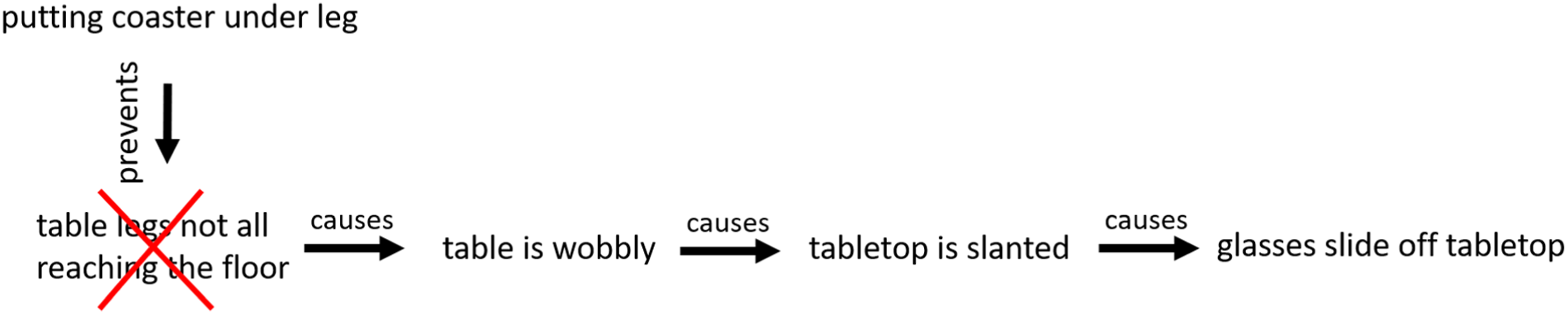
The ecological information that formed the basis for the education of attention that enabled identifying the causal chain above consists out of co-occurrences of sliding glasses and slanted tabletops, of slanted table tops and wobbly tables, of wobbly tables and not all table legs touching the ground. Via previous co-occurrences of any of the above events with the event of someone using coasters to level a table, the man was educated to attend to nearby coasters (which in turn was made possible by the conventional regularity of cafes having coasters). His use of a coaster to level the table is an intervention in the causal chain that led to his glass sliding off the table (Figure 2).
7.2 Relevant Causal Affordances are Intervention Possibilities that Improve Grip
By intervening in the causal chain the man in our example stops the “effect,” which is the glass sliding from the table, from occurring. This intervention would not have been possible without his identification of this causal chain. In this manner, skilled causal engagement helps to increase a person’s grip on a particular situation, in other words, it improves one’s grip on the field of affordances. The notion of tendency towards optimal grip (on the field of relevant affordances) describes the basic concern of any organism to improve its situation (Bruineberg & Rietveld, 2014).
This tendency is closely related to the notion of situated normativity: where situated normativity denotes that there are better and worse actions in a certain context, the tendency towards optimal grip involves executing those actions that are better, that is, to deal adequately with the field of multiple relevant affordances. The interventionist credo involved relationships that can be exploited for purposes of manipulation and control. On the E-E account, the manipulation and control referred to here are ways of improving grip on the situation.
Now we can ask ourselves: what led the man down this path of perceptions and actions? It is those affordances that will improve an individual’s grip on a particular situation that solicit that individual’s actions (Dreyfus & Kelly, 2007; Rietveld, 2012; Withagen et al., 2012) and those soliciting affordances are perceived. These soliciting affordances are the relevant intervention possibilities.
In our example, the man experiences directed discontent towards the glass falling off the table. Directed discontent is a phenomenological expression of situated normativity (Rietveld, 2008), it is what is experienced or felt in a situation that can be improved. The man experiences the glass staying on the table as being better than it sliding off the table. This is the point at which different people’s behavior would diverge based upon their skilled causal engagement, that is, their abilities. While the intervention possibility of stabilizing the table using a coaster is always present, only those with the necessary skilled causal engagement would have their attention guided in such a way to be able to act upon this affordance (Noë, 2012). People who do not have this skill might engage with a different affordance, like that of asking a waiter for a different table. Both these actions are effective interventions in the causal system described by the example, effective in the sense that they lead to improved grip on the situation, which here means having a glass that does not slide off the table.
Ultimately, what led the man down the particular causal chain involving the table and its legs was the possibility of an effective intervention, that is, a relevant affordance. Without the possibility of this effective intervention the man would not have selectively engaged with this causal chain, nor would there be any reason to. We contend that causes are generally identified as such in virtue of the possibility of an effective intervention (see next sub-section).
7.3 Is it Nothing but Intervention Possibilities?
Our thinking is in line with the idea that causal judgments and explanations are used for the identification of relevant interventions, which has been proposed before (Hitchcock, 2012; 2017; Hitchcock & Knobe, 2009; Kirfel et al., 2021; Lombrozo, 2010; Vasilyeva et al., 2018). However, our account goes further. We directly relate the experience of causality to possible interventions (relevant affordances), meaning that we contend that we are directly sensitive to relevant intervention possibilities as these solicit action (Dreyfus & Kelly, 2007; Rietveld, 2012; Withagen et al., 2012). Existing accounts posit that we are sensitive to particular dependence and transference considerations—such as stability, normality, and portability—and that these considerations in turn guide us towards effective interventions (Hitchcock & Knobe, 2009; Lombrozo, 2010; Vasilyeva et al., 2018). Additionally, we contend that we are sensitive to intervention possibilities (relevant affordances), which in turn guide us towards environmental regularities that are stable, normal, and portable. Information that provides clues to intervention effectiveness (such as the stability of a dependence relationship) is relevant for how we experience causality mainly because they are clues to intervention possibilities, not because they have some inherent value. For instance, there is a very stable relationship between the presence of oxygen and forest fires, however, oxygen itself does not provide an opportunity to intervene and so people do not tend to rate it as causal (Cheng & Novick, 1991). Instead, people tend to rate a less statistically normal factor, such as the lighting of a match, as causal. In this case, the consideration of normality trumps that of stability (not every lit match results in a forest fire). Which considerations are important is determined by the possibilities of intervention in the particular context. Putting these intervention possibilities as affordances at the forefront of our account of how we engage with causality, makes it so that we can assign the proper relevance to factors that have been hitherto underappreciated: learned skills and the wider sociocultural practice in which causal cognition takes place.
Our earlier statement that people generally identify causes in virtue of intervention possibilities needs some qualification. This is not to say that a direct intervention is always possible. Rather the idea is that in everyday life the identification of causes, either in form of a perception or judgment, primarily involves identifying intervention opportunities. There are of course exceptions. We can learn about causal relationships not by being in direct contact with them, but through communication with others. And it might be the case that a particular relevant intervention was available to someone at a different time or place, but not anymore at the time and place where this information is communicated. Future research could aim at developing an affordance-based account of such dynamics across time and space. Other examples of causal claims that tend not to be related to intervention possibilities are those that involve deities or supernatural phenomena. We believe that these type of instances are exceptions to the rule. People can, for a variety of reasons, express that anything is causal. However, we believe that in most instances that we engage with causation in our daily lives, there is a relevant affordance present as well.
In these concrete situations relevant affordances play a principal role. However, concrete situations are often more complex than meets the eye and so they require scrutiny of the particulars to understand the affordance dynamics at play. We can illustrate this by looking at the complexities at play in EX2, which also illustrates the constraints of the prominent psychological theories.
7.4 Concrete Situations are Complex and so is Causal Selection
The standard psychological theories of causal reasoning, using either difference-making or transference criterions, do not provide much guidance in a concrete situation like EX2. In EX2, there are too many factors that are connected in one way or the other to the glass falling off the table. For example, the smoothness of the table and the shape of the glass are on these accounts also causes. Then why are they not selected? These factors do not allow for effective intervention and so they play no role for the agent in our example. While people can study the table surface and the shape of the glass such that they will be identified as causes, most likely they will not. And this is exactly what we would like to explain. Here we see that the notions of improving grip and possibilities for interventions allow the affordance-based account to be more selective and alleviate the problem of underdetermination of existing accounts of causal selection.
It is important to realize that the processes we have described are part of the vastly complex dynamics between agent and environment. One source of such complexity is the fact that the field of relevant affordances is ever changing.
We can find an illustration of this complexity in our running example. In the example, after noticing the table was slanted, the man pushed down on one side of the table and discovered it was unstable. Pushing the table became a relevant affordance after the man perceived that the tabletop was not leveled. In itself this action can be construed as an instance of skilled causal engagement: after finding out that the table was slanted, the man, through an intervention, identified that the cause of this was an instability of the table (cf. Gallagher, 2017; Noë, 2004). Pushing on the table is an action, but it is also crucial in identifying that the table was unstable. In this way, an intervention can enable the discovery of another affordance, that is, interacting with causes can further the education of attention. Moreover, that the table was slanted afforded pushing on its corners to test its stability, the instability afforded improving grip by placing coasters under the table legs. Hence, the affordance of pushing on the table was nested within the affordance of stabilizing the table.
This is not an exceptional case, to the contrary, we are generally engaging with a multitude of relevant affordances over different timescales simultaneously (Kolvoort & Rietveld, 2022; Rietveld, 2012; van Dijk & Rietveld, 2021a). Situations unfold continuously and we deal with this in a similarly continuous fashion using a multitude of causal handles to help us along the way.
8. Summary and Concluding Remarks
The interventionist theory of causality views causes as “handles” that can be used to manipulate the world (Woodward, 2011). In the way literal handles afford grabbing, causes as handles afford intervening. We can think of the tendency to move towards optimal grip on the field of relevant affordances as including a tendency to grab the right causal handles. Hence, our E-E account of the interventionist view on causal cognition involves:
Selectively attending to the relevant ecological information in order to engage with action possibilities, determined jointly by individual abilities and the sociomaterial environment, to improve grip on the field of affordances by way of interventions
This account emphasizes the ecological and situated nature of causal judgments. We have argued to see the identification of causes as an instance of selective attention to particular aspects of the environment which we can understand as a skill: skilled causal engagement. This is a lifelong skill developed through the education of attention that results from repeated interactions with environmental regularities, which can be (partially) supervised by caregivers. This skilled causal engagement encompasses both so-called “lower” and “higher” cognition as it describes, for instance, the viewing of colliding billiard balls as well as reasoned judgments about past events.
Next, we construed an account of those causal regularities in the terms of general ecological information. Causality is form of ecological information which we encounter in both law-like and conventional regularities. This has implications for the psychological reality of causality, which we should see as a relational affair between aspects of both the agent and the environment. An agent’s skills and the practices they inhabit determine what is causal to them and the particular situated objectivity at play.
Ultimately this makes us understand the notion of effective interventions in terms of engaging with relevant affordances. Effective intervention possibilities are relevant affordances for a person in their particular situation. And the basis of such concrete intervention possibilities are skilled causal engagement and causal ecological information.
This E-E affordance-based account of causal perceptions and judgments provides a unified theoretical framework for understanding how and why we experience causation. By restricting themselves to one objective core criterion (such as dependence or transference), traditional theories of causal cognition apply only to a thin slice of behavior (Danks, 2017; Glymour et al., 2010; Lombrozo, 2010) and fail to grasp the situated and enacted nature of causality in daily life.
However, the affordance-based account provided here is not necessarily at odds with the difference-making and physical transference accounts that dominate current psychological perspectives, but rather it describes causation and the psychological role it plays at a more fundamental level. Our account shows that difference making and transference by themselves cannot fully explain our experience of causality and how we make causal judgments. Many more things factor into what a relevant affordance is—aspects of the environment, sociocultural practices, skills of the individual—and dependence and transference considerations do not take these into account. We need to accept this complexity of (actual) causation for the human mind and not falsely reduce it to a low dimensional problem.
Our account does justice to the fact that cognition is inseparable from perception, action, and the environment in which it takes place. This view foregrounds the role of concrete actions, skills, and context in determining what we experience as causal. To properly understand the role of causality in the mind, we recommend that future research into causal cognition explicitly incorporates sociocultural context, skills, and concrete possibilities for action.
Footnotes
Declaration of Conflicting Interests
The author(s) declared no potential conflicts of interest with respect to the research, authorship, and/or publication of this article.
Funding
The author(s) disclosed receipt of the following financial support for the research, authorship, and/or publication of this article: This work was supported by a NWO VICI grant awarded to Erik Rietveld, and by an Interdisciplinary Doctorate Agreement grant provided by the University of Amsterdam.

Notes
About the Authors