



Abstract
In this commentary on Rietveld’s inaugural lecture, we exemplify with one of our design cases for project Expedition RWS 2050, how Rietveld’s and our method are complementary. Within this project, RWS invited us to contribute our design skills and make relevant future scenarios experienceable. To scaffold imaginative discussions about everyday life in 2050 with a cross-section of the Dutch population, we wrote seven short speculative stories and designed a set of physical discussion tools. When looking at this design case and the cases Rietveld describes in his inaugural lecture, one can see that we both are guided by and contributing to the development of ecological and enactive philosophy, which rejects the dichotomy between sensorimotor and higher cognition. In his approach, Rietveld pushes the boundaries of the affordances of the material during the making process, whereas we predominantly investigate the affordances of the things and practices which we have designed. Despite these differences, we are both pursuing engagement with philosophical practice through non-discursive means while imagining new sociomaterial practices.
1. Intro
Rietveld (this issue) investigates what the visual arts (broadly understood) can offer for those involved in making technologies. Both artworks and technologies can ‘materialize a philosophical worldview’ (p. 30). In bringing these worldviews to the fore, good artworks can provide the affordances for reflecting on and imagining a philosophical worldview. Rietveld envisions a research programme in which artistic practices can improve the embedding of technologies in society.
Working at the interface between design and philosophy, we find much to agree with in Rietveld’s proposal. With our Transforming Practices team, located at the Department of Industrial Design at the Eindhoven University of Technology, we have an established line of research exploring how design can navigate ‘transforming practices’, that is, creating alternative ways to engage in complex socio-technical systems, to make sense of and address imminent societal challenges together with a multitude of stakeholders (Hummels et al., 2019; Hummels, in press). We research and question transforming practices and societies through theoretical lenses and seek to make theoretical contributions next to practical contributions. We recently started working on the question if and how design methods can be used to (non-discursively) do philosophy.
In this commentary on Rietveld’s inaugural lecture, we briefly introduce one of our recent design cases related to the embedding of technologies in an imagined future, and with it open up a correspondence (in Ingold’s, 2020 sense) and reflect on the complementarity of Rietveld’s and our method.
2. Scaffolding shared imagination
In a case similar to the solar car example with which Rietveld (this issue) starts, Rijkswaterstaat (RWS), the executive agency of the Dutch Ministry of Infrastructure and Water Management is dealing with the challenge of anticipating and preparing the embedding of technologies and infrastructure in the Netherlands. For this project, titled Expedition RWS 2050, RWS aims to imagine and anticipate possible future scenarios for living in the Netherlands in 2050, including their own working practices. In a collaborative effort, they invited us to contribute our design skills and make relevant future scenarios experienceable in order to organize and support discussions and reflections (see Figure 1).
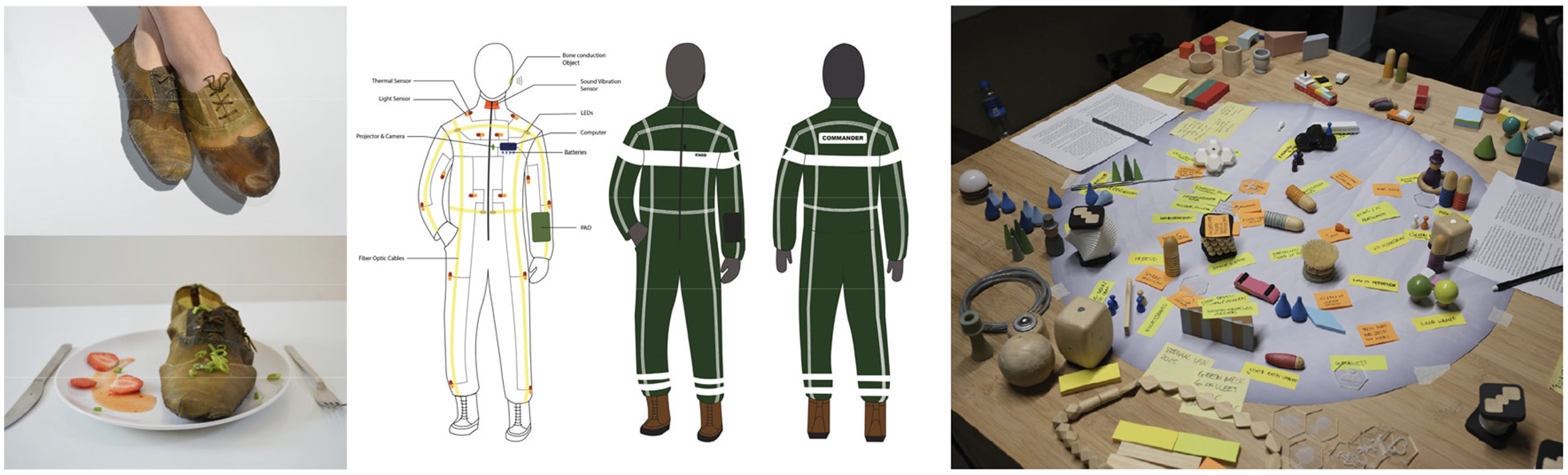
We used design in various ways to explore future scenarios for Expedition RWS 2050. Left: seaweed matters: a variety of commercially available seaweed products in 2050 (photo © Jing-cai Liu, first published in Liu, 2020); middle: The new Royal Dutch Disaster Rescue taskforce in 2050 with dedicated equipment (drawing © Chan Botter; first published in Botter, 2020); right: a playing-field with physical tools to support discussions on everyday life in 2050 (photo © Tom Djajadiningrat, DesignDrone, first published in Smith et al., 2021).
Part of our activities concerned discussion sessions on everyday life in 2050 with a cross-section of the Dutch population. To scaffold these imaginative discussions, we wrote seven short speculative stories and designed a set of physical discussion tools.
Rijkswaterstaat provided us with a collection of demographic, economic, political, socio-cultural and technological trends. We embedded these abstract third-person trends into stories of ordinary life that participants could relate to. We took care to present these ordinary, everyday stories as audiobooks with accompanying imagery. Next to this, we provided a playing-field and a collection of diverse objects, some recognizable, such as wooden figurines, others more abstract. Throughout the discussions that followed, the interviewers traced the conversation by placing physical objects and post-its on the table (see Figure 2).
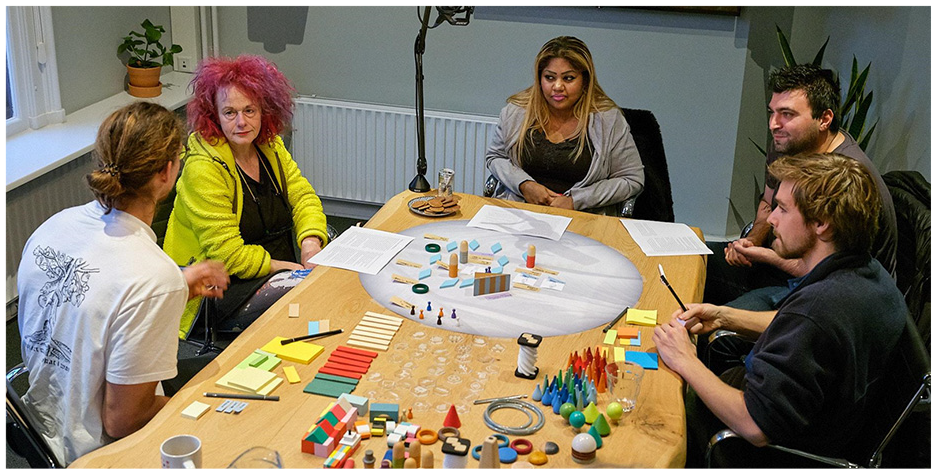
One of the sessions on possible futures of The Netherlands in 2050 (photo © Tom Djajadiningrat, DesignDrone, first published in Smith et al., 2021).
The stories sketched a possible future world, but they were written to leave a lot of space open for the participants’ imagination to work from. Features and characters from the stories were placed in the playing field and provided a foothold for the participants to imagine themselves in the possible future.
During the session, the traces formed on the playing-field afforded a number of actions. Among others, they afforded including or excluding relations from the imagined world by placing objects inside or outside the boundaries of the playing-field, they afforded summarizing things that were previously talked about by pointing at the field, they afforded remembering parts of the conversation by looking at the field, and in doing so provided the possibility to propose alternatives, by rearranging, removing and adding objects, and afforded the interviewers to interpret what had been said by tracing the conversation with the objects while in turn affording participants to correct misunderstandings. The material and social setting provided the opportunity to relate to the story and maintain a common ground.
3. Discussion
Our work is guided by and develops a broader development in ecological and enactive philosophy that rejects the dichotomy between sensorimotor and higher cognition (Bruineberg & Rietveld, 2014; Varela et al., 2017). In our design case, imagining was done by pointing, probing, rearranging, negotiating, and reflecting. Imagination in these examples is in the enactment of affordances. Our analysis has a lot of affinities with Rietveld (this issue) and Van Dijk and Rietveld (2020). In Enactivist Interventions Gallagher (2017) writes ‘In this respect, the imaginative practice is to manipulate concepts, thoughts, images—take them up and play with them, move them around, in order to solve a problem, or map them onto novel affordance spaces’ (p. 196). Imagination is a socio-material and therefore tangible practice, which can be scaffolded and designed.
Both our design case and Rietveld’s projects are aimed at imagining new sociomaterial practices as well as engaging with philosophical practice through non-discursive means. Let us close by reflecting on the complementarities of the two approaches.
One of the important skills Rietveld (this issue) highlights is a sensitivity for the possibilities that materials offer. In their process of making, RAAAF joins forces with materials to explore possible futures. The power of this approach lies exactly in pushing the boundaries of the affordances of the material: until now, nobody saw a bunker of the Dutch waterline as sawable, or the Luftschloss’s concrete as washawayable. Reimagining the material layer implies simultaneously reimagining the status of heritage as well. Through experientially exploring the potential of materials and creating artworks, RAAAF is opening-up and connecting layers of meaning, including unconventional ones. After their own correspondence with the material to create an artwork centred around radically new perspectives on human life, they open up correspondences between the artworks and the public allowing for radically different sociomaterial practices.
With our discussion sessions, we investigated the affordances of the things and practice which we have designed; how the design was appropriated and used, while leaving the making largely implicit. We aimed to afford imagining the Netherlands in 2050 for a cross-section of the Dutch population, and the stories and discussion tools were tailored to the skills and concerns of the participants. In designing the imaginative process, we were providing constraints such as the stories and the material objects to scaffold an open-ended yet directed process of imagination. And even though our stories of future worlds give radically new perspectives on human life in 2050, we soaked the imagined future in everyday reality, thus allowing us to focus on the infraordinary and endotic of the everyday (Levy, 2018), meaning the banal, not memorable and habitual of the everyday, instead of the extraordinary and exotic, the unconventional and radical. Our endeavours are focused on our ongoing correspondence with RWS using different forms of design, for example, the discussion sessions as well as speculative designs such as depicted in Figure 1. This way we support RWS in changing and adapting their sociomaterial practices towards 2050.
We consider Rietveld’s and our method complementary, with major overlap in theoretical embedding and overall aim. Both approaches are aimed to not ‘just’ use philosophical ideas in architecture and design respectively, but to imagine new worlds, create different sociomaterial practices and improve the embedding of technologies in society. Rather than a clash, we think the different approaches show the potential richness of a non-discursive approach to philosophy. We all bring our skills and background along in exploring this territory (Smith et al., 2021; van Dijk and Rietveld, 2020). As Rietveld (this issue) summarized this so eloquently: ‘can academic philosophy be done non-discursively, by visual means?’ (p. 32). We see great potential and through the projects of RAAAF and our project described above we are both exploring what it means to give an affirmative answer and how non-discursive philosophy might push the boundaries of philosophy. Our different correspondences explore the potential of non-discursive practices like art, architecture and design for philosophy. We can’t wait to see the continuation of our journeys, as well as journeys from others, to see non-discursive philosophy sprout and bloom.
Supplemental Material
sj-pdf-1-adb-10.1177_10597123211006463 – Supplemental material for Non-discursive philosophy by imagining new practices through design
Supplemental material, sj-pdf-1-adb-10.1177_10597123211006463 for Non-discursive philosophy by imagining new practices through design by Caroline Hummels, Sander van der Zwan, Maarten Smith and Jelle Bruineberg in Adaptive Behavior
Supplemental Material
sj-pdf-2-adb-10.1177_10597123211006463 – Supplemental material for Non-discursive philosophy by imagining new practices through design
Supplemental material, sj-pdf-2-adb-10.1177_10597123211006463 for Non-discursive philosophy by imagining new practices through design by Caroline Hummels, Sander van der Zwan, Maarten Smith and Jelle Bruineberg in Adaptive Behavior
Supplemental Material
sj-pdf-3-adb-10.1177_10597123211006463 – Supplemental material for Non-discursive philosophy by imagining new practices through design
Supplemental material, sj-pdf-3-adb-10.1177_10597123211006463 for Non-discursive philosophy by imagining new practices through design by Caroline Hummels, Sander van der Zwan, Maarten Smith and Jelle Bruineberg in Adaptive Behavior
Supplemental Material
sj-pdf-4-adb-10.1177_10597123211006463 – Supplemental material for Non-discursive philosophy by imagining new practices through design
Supplemental material, sj-pdf-4-adb-10.1177_10597123211006463 for Non-discursive philosophy by imagining new practices through design by Caroline Hummels, Sander van der Zwan, Maarten Smith and Jelle Bruineberg in Adaptive Behavior
Footnotes
Acknowledgements
We like to thank Tom Djajadiningrat for developing the stories, tools and scenarios together with us. We like to thank Pierre Lèvy for co-developing a non-discursive philosophy with design. We like to thank Erna Ovaa and Hans Peter Benschop from RWS for their trust and support. And we like to thank all Industrial Design students who participated by developing future scenarios and prototypes.
Handling Editor: Julian Kiverstein, Amsterdam University Medical Centres, The Netherlands
Funding
The author(s) disclosed receipt of the following financial support for the research, authorship, and/or publication of this article: The authors received financial support from RWS for the research, but not for authorship, and/or publication of this article.

Author biographies
References
Supplementary Material
Please find the following supplemental material available below.
For Open Access articles published under a Creative Commons License, all supplemental material carries the same license as the article it is associated with.
For non-Open Access articles published, all supplemental material carries a non-exclusive license, and permission requests for re-use of supplemental material or any part of supplemental material shall be sent directly to the copyright owner as specified in the copyright notice associated with the article.
