



Abstract
I briefly reflect on the work of John Stewart and his instrumental role in the development of enactive cognitive science, his outstanding ability to communicate across disciplines, and his research obsessions.
Keywords
1. Bridges
Have you ever seen an expert in genetics arguing passionately about some arcane point in the philosophy of technology? Have you ever witnessed a discussion that started off with the reflexivity of human consciousness and ended up on the mind-altering effects of shopping lists? If you have been in conversation with John Stewart, you may be familiar with the unusual, yet surprisingly sensible flights of his thinking. You may recall his mesmerizing hand gestures (Figure 1) and the paradoxical experience of lucid disorientation that his contagious excitement can provoke. A true adventurer of ideas, John Stewart has never ceased his search for the deep connections between life, mind, and human experience. Nor has he ever stopped pointing to the blind spots in the academic disciplines supposed to study them.
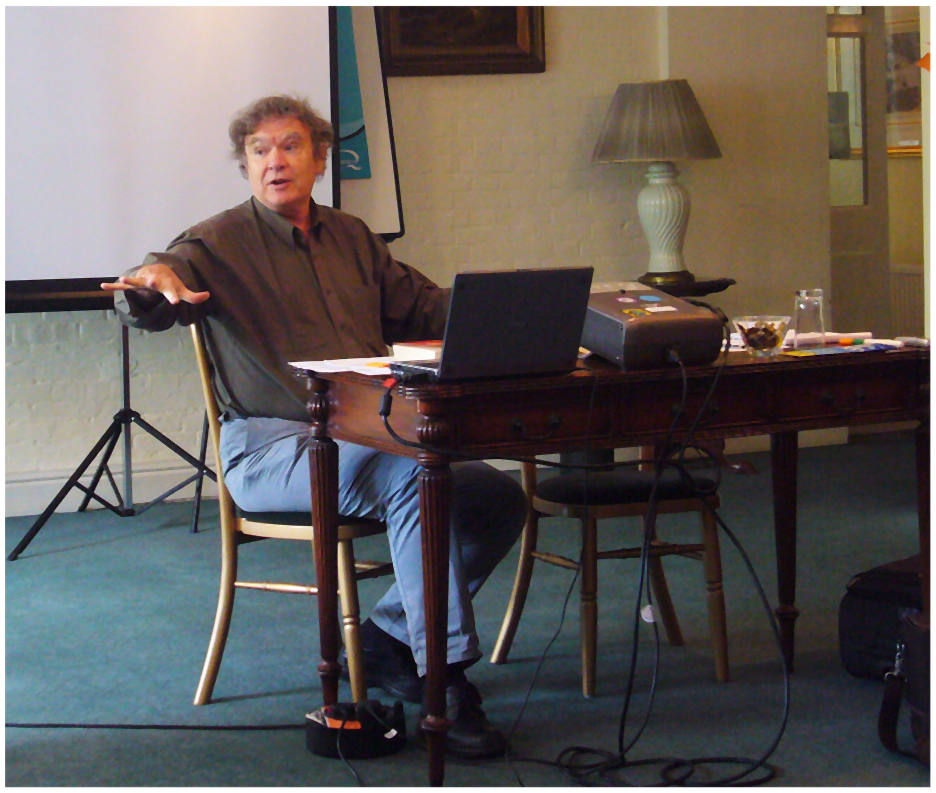
John Stewart waving his hands in 2008 at a workshop on Enactive Approaches to Social Cognition, in Battle, UK. Photo by the author.
Science has seemingly moved away from what was a common topos in the 17th century: the idea of the solitary scholar—a vision that was in fact at odds even with the realities of the time (Shapin, 1991). For some time now, we have conceived of the agents of knowledge not as individuals but as teams and communities grouped within scholarly disciplines, with their thematic journals, standards of excellence, networks of references, specialized events, societies, funding bodies, and all the rest of it. But to some extent, our current formula has only projected the solitude of the individual scholar onto the academic discipline itself, a solitude more actual and pernicious than the former, with its practices of gatekeeping and other cultural immune reactions that maintain the identity of a scientific field. And this pattern recurs fractally, as with the various subdisciplines we find in psychology, all the way down to the rival wings of a same university department. We are not talking here about necessary branches of a field such as the study of condensed matter and optics in physics. Branches may or may not come close to each other, but they still form part of a same tree. In the sciences of life and mind, the self-imposed solitude of different schools enacts divisions that are particularly unhealthy. Gibsonians are suspicious of enactivists, neo-Darwinians are wary of self-organization talk, Piagetians and Vygotskyans keep referring to the same things as if they were radically different, cognitivists look at embodiment as either irrelevant or trivial, and everyone hates behaviorism.
It does not take a genius to see that we need to cultivate different styles of enquiry and collaboration. It does take a bit of a genius to find ways to make this happen. This is where characters like John Stewart play a major role.
Fragmentation follows from the fact that researchers tend to exploit the problems they can already solve, and sometimes pretend that other problems are the business of other branches of science. In this semi-conspiratorial and rarely avowed pretending, important questions remain untouched, barely recognized in their importance. John Stewart is the kind of scientist who wants to talk precisely about these disenfranchised problems, the neglected questions that, when we attempt to formulate them, can appear to the experts as non-questions, issues they literally cannot work with.
To explore what lies in the gap between disciplines, someone has to start by building a bridge. I think John’s career repeatedly embodies this idea. He begins with the central questions of a discipline and then reconsiders them from an outsider’s perspective to invite insiders to inch out of their thinking framework. In this way, he has contributed to associating disparate areas such as, for instance, immune networks and cognitive development (a work done in collaboration with Antonio Coutinho and Francisco Varela; e.g. Stewart et al., 1989; Stewart & Varela, 1989) or human consciousness and the techniques of writing (Stewart, 2010, 2019)
John’s work has been instrumental in an important chapter in the development of enactive cognitive science (Varela et al., 1991), particularly in conceiving and building the Sussex-Compiègne bridge (or tunnel) during the 1990s and 2000s. This connection involved researchers at the COGS (the School of Cognitive and Computing Sciences) at the University of Sussex and the COSTECH lab (Connaissance Organisation et Systèmes Techniques) at the Université de Technologie de Compiègne, as well as other regular centers. The links developed through a series of encounters, visits, student exchanges, ongoing winter seminars at Compiègne, and a series of Enaction Summer Schools often organized by John and his colleagues. One could always find in these meetings a recurrent crowd with shared interests in autopoiesis, artificial life, evolutionary robotics, embodiment, active perception, sensory augmentation, technical mediation, phenomenology, and social cognition. These were exciting times for everyone involved, particularly for young researchers who learned not to be afraid of immersing themselves in problems outside their original training.
Out of one of these meetings came a landmark collection of essays, the book Enaction: Toward a New Paradigm for Cognitive Science (Stewart et al., 2010). But the most interesting outcome, to my mind, has been a network of people who could speak to each other across disciplinary boundaries and sometimes dared to establish new collaborations (e.g. Auvray & Rohde, 2012).
2. Hobby-horses
John’s role in the adventure of ideas is more maverick than polymath, even when the range of his interests is breathtaking. The polymath in some ways perpetuates the themes of solitude. The maverick, instead, is keen to point in new directions, merge unlikely areas of knowledge, plot courses into uncharted territories, and encourage unexpected partnerships.
Being a maverick may be unconventional, yet there is method in it. A sort of unity of thought underlies the questions that obsess John. Across the bridges, we don’t have to wait long to see him riding one of his hobby-horses. If a conversation innocently happens to land near the vicinity of one of these obsessions, we must ready ourselves for what follows. A deluge of knowledge and passion that can drown the unprepared. Ideas that John has been thinking about for decades and in which he finds anchor points to make sense of all the rest.
To mention just three,
Genetic analysis operates differentially by correlating relative distributions of traits with relative distributions of genes. In other words, using statistics, it is possible to establish how much variation in some trait may be attributed to genetic differences when comparing two subpopulations. This method, therefore, is operationally blind to traits in the subpopulations that present no variation, in particular it is blind to invariant characters of the species. It is also insufficient for establishing any positive causal relation between genes and traits in the presence of other varying factors. Consequently, it is misguided to derive from population genetics any account of a “gene-for-X,” where X is an invariant character of the species (e.g. Stewart, 2019).
The human mind is historical (I). The techniques of writing combine the massive themes of linguistic and technical mediation (see e.g. Leroi-Gourhan, 1993). Following the work of Jack Goody (1977), list-making, in particular, illustrates the cognitive transformation effected from the elaboration of retroactive lists (e.g. chronologies) and prospective lists (e.g. to-do lists), which are relatively concrete, to the cognitively more abstract lexical lists (e.g. categorization) (Stewart, 2010, 2019)
The human mind is historical (II). The categories of human thinking do not fall out of the sky, but emerge historically within communities of practice. Drawing on Émile Durkheim’s (1912/1965)The Elementary Forms of Religious Life and Alfred Sohn-Rethel’s (1978)Manual and Intellectual Work, it is possible to reveal how the Kantian categories of space, time, quantity, quality, causality, and so on are shaped and even constituted by modes of social engagement and modes of production and exchange (Stewart, 2014).
These and many other interests operate together in John’s work. They are linked by communicating vessels through which recurrent themes flow: the rejection of reductionism and methodological individualism, a suspicion of dualities when they are reified as dichotomies, an embrace of historicism and complexity, and an attention to human experience. Perhaps, more importantly, John’s work is particularly sensitive to alternative patterns of thought. This is why he spends significant time discussing ideas that may ultimately be proven to be wrong (as he admits himself) but still contain much needed lessons in out-of-the-box thinking. To mention just a couple, see his discussions on “scaffolding” in the origins of life following A. G. Cairns-Smith (1985) and on understanding the human mind historically, as in the postulated transition from hearing the voices of gods in antiquity to modern reflective consciousness in Julian Jaynes’s (1976)“breakdown of the bicameral mind.”
The most general lesson one can draw from knowing John Stewart is that participating in the quest for knowledge about ourselves is an open endeavor, always occurring and often surprising. That is why it can be an adventure. John’s adventure of ideas has never been about settled knowledge, but always about learning through vibrant interpersonal exchanges and challenges to the order of what we think we know. More than the ideas themselves, John loves a good discussion. I experienced this firsthand and not in the most relaxing of circumstances during my viva voce examination for my DPhil at Sussex University. John was my external examiner. As soon as we started, he and the internal examiner, Inman Harvey—another well-known rider of hobby-horses—said to me the following: “We want to start right off by telling you we really like your thesis. You have your PhD. So you can relax about that. Now we just want to have a little chat about it.” Four and a half hours later, the viva was done, the conversation barely started.
Footnotes
Handling Editor: Pierre Steiner, Université de Technologie de Compiègne, France
Declaration of Conflicting Interests
The author(s) declared no potential conflicts of interest with respect to the research, authorship, and/or publication of this article.
Funding
The author(s) received no financial support for the research, authorship, and/or publication of this article.
