




Abstract
This article considers the adaptive setting and probable origins of human aesthetic capabilities, using evidence of the Acheulean tradition in the last million years, and highlighting the importance of the preceding and enveloping social and technological contexts. Acheulean bifaces, made from about 1.75 to 0.1 Ma, often with an appearance of symmetry, give windows on crucial interlocking aspects of human intellectual evolution. These have been seen as the domains of technology, sociality and aesthetics, following Leroi-Gourhan, or in near-equivalence the ‘technological’, ‘sociological’ and ‘ideological/philosophical’ of L.A. White. These domains can be analysed to have a reality, in the sense that social worlds of the apes far antedate technology, which in turn is generally taken to be far older than a sense of aesthetic appreciation. The bifaces are helpful in illustrating early developments because they can be made only through bringing together a set of concepts linking form, function and technology of manufacture, in a recurring ‘deep structure’. As there are at least 6 to 12 necessary concepts, perhaps significantly more, the artefacts are essentially multivariable or multivariate. They thus impose high cognitive requirements in manufacture, pressing towards effective sequencing of steps so that not too many variables will be involved simultaneously. Support of such a knowledge base has social requirements of shared or collective intention. Biomechanical and functional necessities also exert pressures on concepts: rules maintained by all these requirements entail a notion of ‘appropriateness’ or ‘rightness’ that may have been a prime factor in driving evolution of a sense of aesthetics and even the shaping of moral feelings. As the rules are variably expressed through time and space in the Acheulean, some of the best information comes from seeing how far particular variables are ‘locked’ in relationships which recur to give the impression of deep structure.
1. Introduction
In this article, I examine aspects of aesthetics and human sociality as highlighted by Acheulean technology, setting forward a hypothesis about factors which may have driven the emergence of aesthetic sense. The Acheulean, as created by our modern classification, is the largest single cultural entity of the past, an adaptation lasting for more than 1.5 million years (De la Torre, 2016; Malinsky-Buller, 2016). It is linked by a characteristic stone tool form, its handaxes or bifaces, and they have long provoked the thought that they have something to do with aesthetics as well as with simple function (e.g. Berlant & Wynn, 2018; Hodgson, 2011; Le Tensorer, 2006; Oakley, 1981; Schmidt, 1936; Toth, 1990).
The analysis of the modern concepts entailed is not altogether easy. A number of past analyses, however, divide the human world into major segments. For A. Leroi-Gourhan (1993), these were technology, sociality and aesthetics (Figure 1). For the American ‘culturologist’ L. A. White, they were the technological, the sociological and the ideological/philosophical (L. A. White, 1959, 1962). Other authors have adopted somewhat similar schemes (e.g. Mithen, 1996). It seems undoubted that to be social comes first, starting from the long background of ape social worlds. The common background of deep sociality in the great apes suggests from the genetic and fossil evidence that this phenomenon goes back some 20 million years (Amici & Widdig, 2019; Dunbar & Shultz, 2007; Shultz & Dunbar, 2014; Simons, 2002). It cannot therefore explain everything new in Homo, except through changes in the nature and levels of sociality.
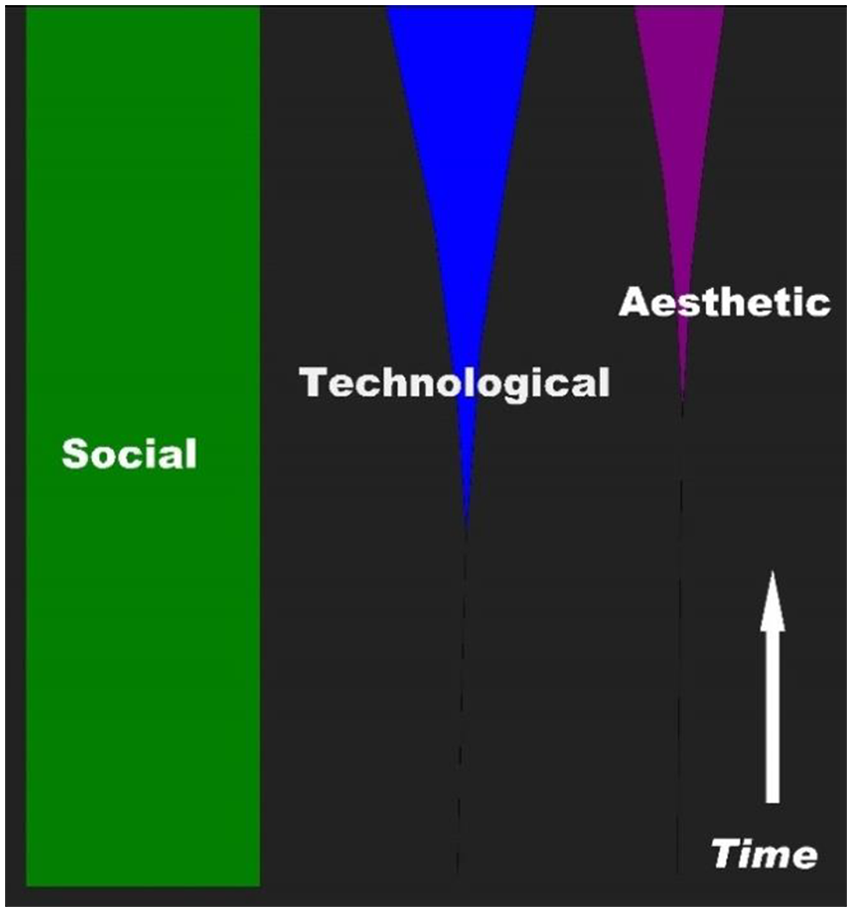
Domains of sociality, technology and aesthetics: an idealised view of their emergence.
Such changes, it is widely agreed, come partly through language and associated rule systems. Where we cannot see language, we may see other signs of symbol systems (cf. Barham & Everett, 2020; d’Errico et al., 2003; Galway-Witham et al., 2019, papers in Mellars et al., 2007; Sinclair, 1995) or of other rule systems as in Acheulean handaxes (Gowlett, 2006). I will argue here (below) that tests of appropriateness are an important part of making technology, the second domain. Where these are done to shared standards, a tool-maker must be concerned with both ‘How would others make this tool?’ and ‘How others would regard this tool?’. Here, the social and technical are intertwined, levels of intentionality are involved and judgements may be related to the aesthetic (all factors for further discussion below). That does not make it easy to trace the ideas to or from an ape background. Even the presence of ‘theory of mind’ is disputed in the apes, and we cannot ask apes what they have in mind when they make tools. Some studies give an indication that mental rehearsal may take place (Dunbar et al., 2005; Suddendorf & Busby, 2003; Suddendorf & Whiten, 2003), although Penn and Povinelli (2007) emphasised the lack of evidence for theory of mind in chimpanzees. More recent research demonstrating understanding of false belief suggests such social awareness (Kano et al., 2019).
Regardless of the precise cognitive demands, there is a great importance in the coming of technology, respected in the key role it is given in the schemes above. It is the second great domain, which might play some part in stimulating the third, of aesthetics. As tradition, it can emerge only out of sociality. At the very least, traditions entail shared values. Acheulean bifaces provide one of the earliest exemplars of these principles as hard evidence. They represent tool use as adaptation in one view (Finkel & Barkai, 2018), an adaptation successful over a very long period. They have been described many times (e.g. Wynn & Gowlett, 2018); here, it is enough to recapitulate that they are generally large stone tools (average length 150 mm and weight 0.5 kg), made to be approximately bilaterally symmetrical around a long axis, and having a major plane whose edges can form a working edge (Wynn & Gowlett, 2018).
2. Approaches to aesthetics in the past
The aesthetic is not easily defined, despite a long history and long history of study, but it would probably be widely accepted that it appears later than the social and technological domains. As a shorthand, it can be summarised that the essence of the aesthetic is that someone sees something, or makes something, the experience of which gives pleasure, which may not be related to immediate functional needs or expression. That pleasure is perceived through mind, brain and body, such that for Gear (1989), all human decisions are aesthetic – a view similar to Leroi-Gourhan’s (1993) concept of ‘functional aesthetics’. Couchot (2014) argues that similar phenomena can also occur in other animals. To set up a starting position as a prelude to later discussion, it can be summarised that aesthetics studies fall within both philosophy and psychology (Mace, 1968: Figure 2).

Major components in the study of aesthetics related to human evolution (cf. Mace, 1968).
There can be two quite different aspects of approach if we consider aesthetics in relation to the Acheulean:
Archaeologists make claims that bifaces show signs of early aesthetic sense. Essentially, they are envisaging the modern western aesthetic sense and testing the past record for its presence or absence.
Alternatively, we could aim to determine what factors in the course of human evolution might have led something like an aesthetic sense to develop, and could consider in particular whether Acheulean bifaces cast some light on this.
There is a real difference: the first is a test governed by projection of external considerations. A modern western sense of aesthetics is held up, and we ask if bifaces conform to it. The second, preferred here, is a broader investigation, which requires a model, or models, but not close definition – with the benefit that such characterisation can be considered later (below): we start from a notion rather than a definition (cf. Schlesinger, 1979). There can be no doubt, however, that the Acheulean is the oldest cultural manifestation commonly seen to be relevant to these issues (e.g. Le Tensorer, 2006; Wynn, 2021). In this perspective, Acheulean bifaces, ranging through much more than a million years of human evolution, are likely to be illustrative in some respect of more widely operating factors and processes in early hominin behaviour.
3. Acheulean specialness
Briefly stated, here are a few of the numerous examples from the Acheulean in which authors have seen something ‘special’. Among the first, Schmidt (1936) postulated that handaxes were deliberately shaped to emulate a hand shape. Kenneth Oakley (1981) felt that certain flint handaxes found in Britain were intentionally shaped to leave a shell or echinoid fossil at the centre of the piece (Figure 3). In that case, these specimens might foreshadow the importance of shells seen in early beads (Vanhaeren et al., 2006). Much work has assumed that symmetry and fine finish are the principal relevant features of the Acheulean, but other aspects may be equally or more significant, for example, the ways that the actions of flaking bring forth the knapper’s intentions, as suggested by Malafouris (2013), or colour and texture which Hurcombe (2007) argues have systematically underrated importance in material culture.
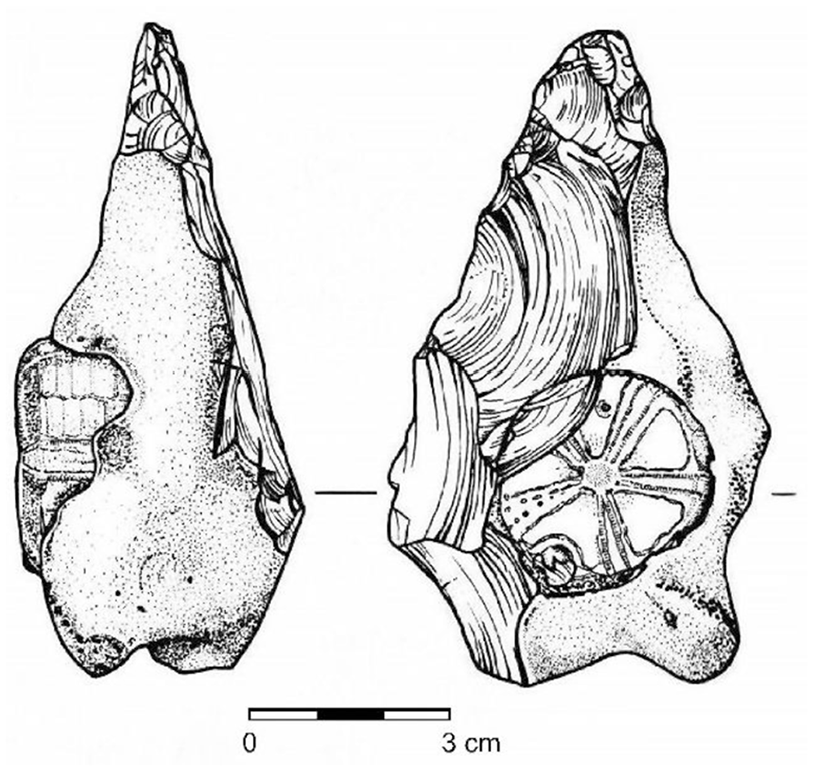
Fossil echinoid at the centre of an Acheulean handaxe (after Oakley, 1981, reproduced with permission after Phil. Trans. R. Soc. B).
Symmetry has been widely investigated as a key concept of the Acheulean, perhaps its most remarkable aspect (e.g. Cole, 2015; Hodgson, 2009, 2011, 2015; Le Tensorer, 2006; Lycett, 2008; Machin et al., 2007; Saragusti et al., 2005), but the significance and even intent of producing symmetry have also been challenged (e.g. McNabb & Cole, 2015; McNabb et al., 2004).
Gowlett (1982, 1984) noted that bifaces at Kilombe in Kenya, and other sites, showed that the makers had an accurate ability to transform– that is, to create similar complex output at different scales, making smaller and larger bifaces in very similar form. This scaling is often overlooked – many workers start by standardising size in their analyses – but really unequalled as a measure of cognitive and practical abilities (see also Feynman, 1965).
Scaling of similar objects entails the ability to manage proportion. The bifaces of Kilombe had a mean length/breadth ratio of 0.61, approximately that of the classical ‘golden section’ (cf. Boselie, 1984; Fensom, 1981; Gowlett, 1982, 2011; McManus, 1980; Pope et al., 2006). Le Tensorer (2006) has noted the same ratio in bifaces from Nadaouiyeh in Syria, finding that ‘golden section’ is most evident in the best-made series of handaxes. These date to ca. 0.5–0.4 Ma and stand out for their exceptional finish. More recent series on the site were both rougher and tended to depart from the ratio. Pope and colleagues found that the same 0.61 ratio occurs at Boxgrove (Pope et al., 2006). At Atapuerca, Carbonell and Mosquera (2006) have emphasised the fine form of the ‘Excalibur’ biface and claimed symbolic significance for it. Similar feelings have been expressed about other large, fine specimens, for example, at Isimila in Tanzania, or La Caune d’Arago in France (de Lumley, 2014; de Lumley & Barsky, 2004).
Although these examples are impressive in demonstrating some extra quality in bifaces, beyond the simplest needs of functionality, one may have some hesitation over possibilities of over-interpretation. In some cases, the intent of ‘making special’ can be doubted. The bifaces from Kilombe in Kenya give an example in relation to proportions. The full series from the site was observed to have a mean breadth/length ratio of 0.61 (Gowlett, 1982), but it became evident subsequently that the breadth/length relationship also shows a clear allometric shift (Crompton & Gowlett, 1993). The scale of that shift only becomes apparent when we plot a large series (Figure 4; Gowlett, 2011). The proportions of the largest and smallest specimens have been highlighted by separating those more than 1.5 standard deviations above or below the mean, and then calculating mean values for breadth and length in these ‘extreme’ groups. The longest specimens are then seen to be considerably narrower, with a B/L ratio of ca. 0.5: 1. The shortest specimens, in contrast, are far broader, approaching a ratio of 3:4 (0.75). As the trend line between these two extremes appears to be a straight line, it becomes very hard to insist that there is any one target value for the breadth/length proportion. The point was reinforced by the author’s studies at Kariandusi, also in Kenya – there the large lava bifaces, with mean length of 164 mm, had a mean B/L ratio of 0.58; from another locality, the short obsidian bifaces (M = 125 mm) had a B/L of 0.64, suggesting a different design goal. Put together, however, the two series can be seen to have a similar allometric shift to Kilombe, and the resulting combined B/L of ca. 0.60 shows how easily such a figure can emerge from other values (Figure 5).
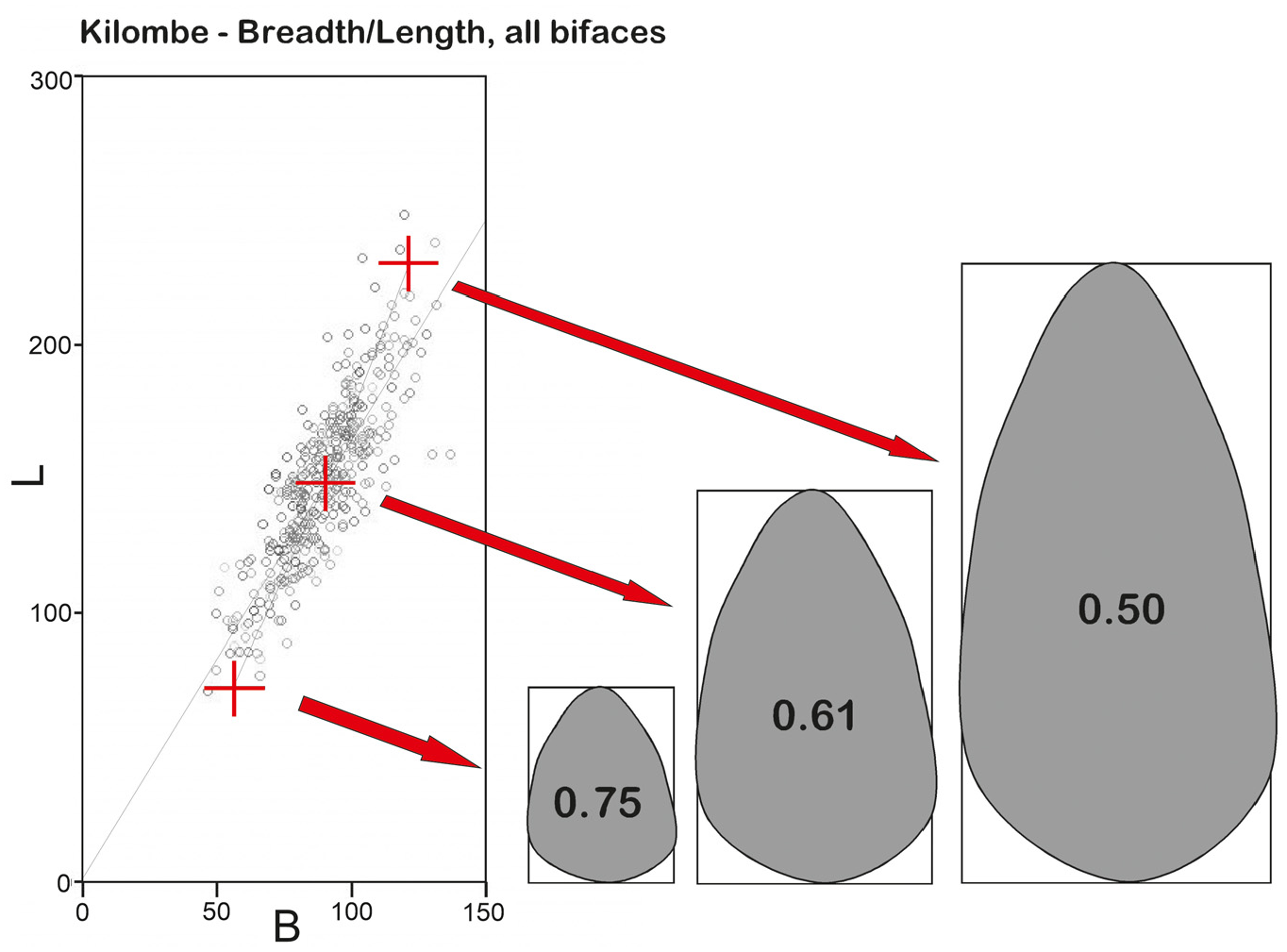
The size -shape shift in the planform of Kilombe bifaces: scatterplot of Length (L) and Breadth (B) illustrates the different mean proportions of (left to right) small bifaces, ca. 3:4, medium bifaces, ca. 0.61, and large bifaces, ca. 0.50:1.
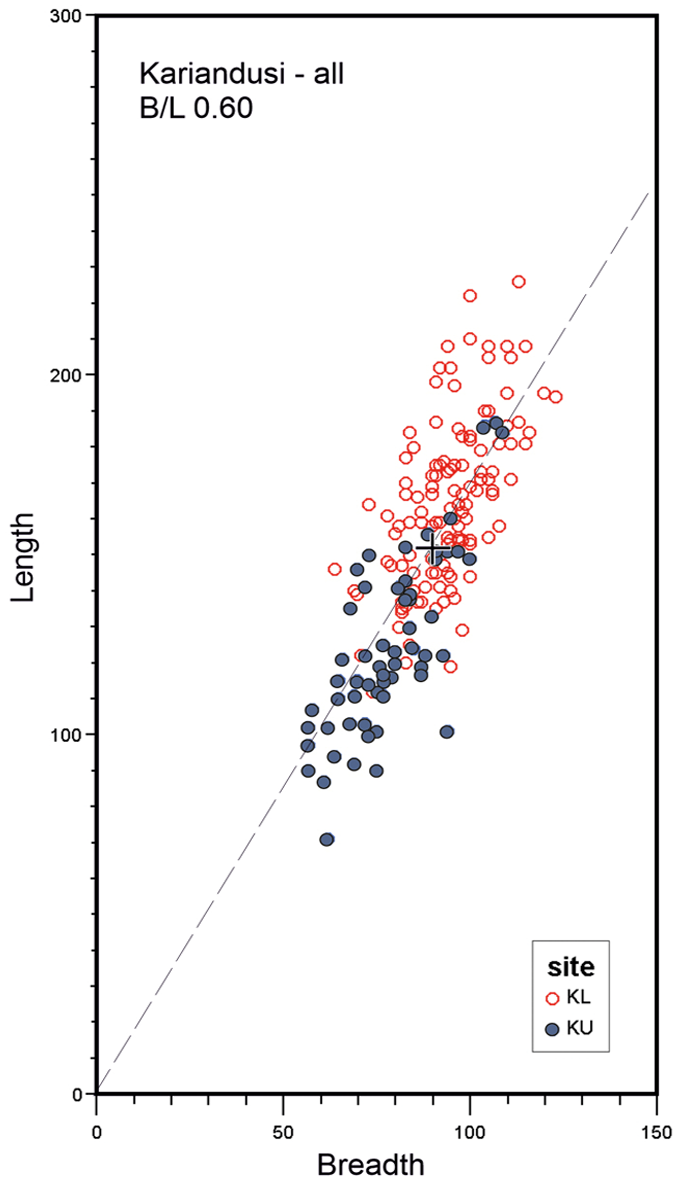
Proportions of breadth/length in Kariandusi handaxes, illustrating the difference in smaller obsidian bifaces (KU) and larger lava (trachyte) bifaces (KL).
A study of degree of finish in the Kilombe bifaces also suggests that the breadth/length proportion may be sacrificed expediently to function: the more heavily trimmed bifaces are distinctly narrower than largely cortical specimens in the same series, implying that at the stage of secondary working, it was more important to conserve length than to maintain ratio, with breadth being sacrificed (as Kilombe bifaces were mainly made on large flakes, they usually retain cortex on one face only: Gowlett, 1996b).
Holes within the shape of a biface (plates in Berlant & Wynn, 2018) offer fairly convincing evidence for ‘added value’ of some kind, as from a strictly functional point of view they risk deficit: they restrict the tool-maker’s freedom in knapping the piece, together with imposing potential fragility. The presence of shells at the centre of specimens is potentially convincing as a form of symbolism, but so extremely rare that its significance could be debated (it occurs at the rate of ca. 3 in >10,000 specimens in Britain) (Oakley, 1981).
4. Statement of problem
The Acheulean is a tremendous resource for examining past cognition, enduring as it did for more than 80% of the last 2 million years, but reading its value to its makers remains difficult. The problems of interpretation just mentioned are clearly relevant to issues of aesthetics in early artefacts – or in other terms ‘aboutness’, since Gear (1989), for example, has argued that all decisions have an aesthetic basis. There would seem to be two principal difficulties in establishing a more coherent view. The first is that archaeology tended for a long time to make studies of form and function as if they were completely separate. Form studies are still often dominated by typology, or rather abstract concepts of morphology. Hence, when symmetrical form impresses, it is often seen in isolation, rather than as affected by functional factors. Functional studies often been made with very little reference to form, other than the quality of the cutting edge (e.g. Jones, 1994).
Fortunately, very useful insights have come from experimental studies of bifaces: at Boxgrove, these involved considering edge length in relation to form and effectiveness in cutting meat (Pitts & Roberts, 1997). M. J. White (1995, 1998) considered the cutting properties of triangular and ovate bifaces, in relation to available raw materials. McPherron (2000, 2006) analysed biface assemblages in terms of factors determining patterns of form, including especially retrimming processes. Others, more recently, have carried out experiments considering, for example, cutting performance of handaxes, and the role of symmetry relative to performance (Key & Lycett, 2011, 2017; Machin et al., 2007; McNabb & Cole, 2015), with size being an important but often underappreciated variable (Tumler et al., 2017), while Baber and Janulis (2020) underline an underlying appreciation of purpose in the application of stone tools to tasks.
Ethnographic studies also provide valuable insights. In Stout’s research among the Langda of New Guinea, form in the knapping of modern axes can be related to function and also to social context and the status of the individual (Stout, 2002). Only in the rarest instance does a modern analogy involve something closely resembling the hand-axe itself, but such cases give particular insights into aspects of function which help to determine form (Tindale, 1941).
The second problem is that of recognising intent in past operations. It is a universal problem for palaeoanthropology of course, in the sense that we can never ask tool-makers directly. It means that description must come ahead of interpretation. We have seen (above) the major shape shift between small and large handaxes, but observing this descriptively does not amount to knowing the motivation for it. It can be hypothesised that the very marked phenomenon arises from the need to achieve a compromise between changes in weight and changes in linear form (weight altering in a cube function of the rate of linear change, unless shape adjustments are made: Gowlett et al., 2001). Such an explanation accounts for many of the facts, but it can only be tested through using additional data sets, seeking out discrepancies.
All such studies help to remind us that the biface is not a given – it is the product of past needs, in particular cultural contexts – and not one of Plato’s ideals: primarily, it was there to do a job, and its qualities were available to the makers within their tradition. In principle, it could acquire secondary meanings, and in individual specimens – perhaps Excalibur at Atapuerca – these might be more important than physical function (see Carbonell & Mosquera, 2006). Such meanings, however, would imply minds with higher levels of intentionality (a term with a chain of past usages and multiple definitions: for example, Cole, 2012, 2017; Dennett, 1996, 1998, 2003; Posner, 1986; discussed below). For Dennett (1996), as for Malafouris (2013), intentionality is ‘aboutness’, without a necessity of intent, but in the case of higher organisms, it is often used where an individual may have some capability of thinking about others’ thoughts.
5. Towards a model for the evolution of aesthetic sense
5.1. External processes and tests of ‘appropriateness’
Here, I aim to offer a more broadly based social model bringing together the major aspects of sociality, technology and aesthetics.
In most species, most perception is about seeking out and reacting to external information so as to make responses (Broadbent, 1987). These behavioural responses involve actions and interactions with inanimate and animate objects. They are taken a whole stage further when the species interacts with the world not just through immediate movements of self but also through the use of artefacts. They impart a new level of adaptation, both animal and human (e.g. papers in Biro et al., 2013). For example, a cat chasing a mouse predicts its future position; a human throwing a stone at prey engages in a second-order prediction, predicting both the path of the prey and the path of the stone (Rosenbleuth et al., 1943). Steps in the making of artefacts rise to the same or higher levels of prediction.
Complex artefacts can be made only through ‘instruction sets’, which entail the transfer or reworking of three-dimensional constructs from within the brain out into the external world, implemented through routines of shaping or assembly. Such instruction sets are sometimes referred to as ‘mental templates’ and their existence at such an early time has been doubted or queried by some authors (e.g. Dibble, 1989; Ingold, 2013; Noble & Davidson, 1996), but the term has seen resurgence recently, suggesting that the great majority of researchers accept the intentional form of handaxes (García-Medrano et al., 2019; M. White & Foulds, 2018). Cross (1983) and Malafouris (2013) query the distinction between mental representation and bodily engagement on broader grounds. A long explication is not desirable here, but two points may be set out briefly: (1) the fixity of the mental template term is at odds with both psychological accounts of image formation and retention (e.g. papers in Denis et al., 2001), and the consistent presence of fields of variation in handaxe sets; and (2) the complexity of handaxes and their variation is such that considerable and somewhat adjustable instruction sets must be required for their manufacture (Baber & Janulis, 2021; Gowlett, 2006, 2011; Wynn, 2002). The ideas that an individual could stumble across the design or that it is created by an archaeologist’s viewpoint not the original action-set, both struggle when set against objective evidence of sets of bifaces.
It follows that any species exerting itself in the outside world in this way – through making artefacts – must apply tests of appropriateness to determine whether its successive goals have been met. Such tests were first modelled at a simple level in systems theory and, in relation to basic human behaviour, were modelled formally in the TOTE (test–operate–test–exit) unit of Miller et al. (1960). Although such simple units cannot fully model the complexities of goal-directed behaviour, some of the difficulties of conceptualising, assembling and operating such problem-solving routines have been tackled (e.g. Sacerdoti, 1977), and the development of artefact-using routines has also been explored in human infants (Connolly & Dalgleish, 1989).
Some such routines can be applied by other animals, as when the gorilla adopts a particular means of preparing plant food such as thistles (Byrne, 1996; Byrne et al., 2001; Pruetz & Bertolani, 2007). In the case of chimpanzee tools, it is a necessity that judgements of appropriateness are made. In the simplest case, it can be argued that trial and error dominates the testing, but in more complex artefacts many of the decisions inevitably have to be made by the maker before the stage of use. Chimpanzee technology offers examples of the judgements, as when an ant-dipping stick must have the appropriate length and diameter (Bermejo & Illera, 1999), indicating some standardisation (McGrew, 1992, p. 80). In the case of Fongoli chimps and their spears, which regularly have a length of ca. 60 cm (Pruetz & Bertolani, 2007), Gowlett (2009) found that limits on variation are as tight in some chimpanzee-produced artefacts as in many produced by humans, and a response to the forces of functional constraints may operate more strongly on some parts of artefacts than others.
In human evolution, it is very widely agreed that socio-cultural complexity multiplies through the Pleistocene (e.g. Galway-Witham et al., 2019; Isaac, 1972; Leroi-Gourhan, 1993; papers in Barham, 2013; Camps & Chauhan, 2009; Malinsky-Buller, 2016) – and in general, the technological investment increases. This aspect is important: higher investment entails higher costs and higher returns, with more premium (or selective pressure) on effective performance. The long-distance transport of heavy stone raw materials illustrates the point (Leakey, 1975; Slimak & Giraud, 2007). (This is well demonstrated where there are major time/space separations in the processes of procurement, manufacture and use.)
5.2. The multivariate nature of artefacts
A new major point stems from the physical nature of the artefacts themselves. Even the simplest artefacts have a multivariate nature, in that the maker must consider at least three and often more dimensions of variation (Gowlett, 2006). In bifaces, these can be demonstrated either in the numbers of attributes needed by previous workers in descriptions of the specimens (e.g. Isaac, 1977; Roe, 1964) or in principal components analyses (PCAs) (Crompton & Gowlett, 1993; Gowlett, 2012).
Such complexity can be taken to arise as the makers need to take more specific factors into account to be assured of performance. A natural consequence might be that under selective pressure for better performance, artefacts come to have greater design content, involving more variables, such that a multivariate appreciation becomes necessary. In Acheulean bifaces, the basic dimensions of length, breadth and thickness will be subject to control, but multivariate analyses show that there are also other deep-seated dimensions of variation which recur (Crompton & Gowlett, 1993; Gowlett, 2006, 2012; Gowlett et al., 2001). If the bifaces are measured through a standard measurement system capturing numbers of attributes, and subjected to PCA, then, in view of the geometric similarities of specimens, it would be expected that a single principal component should account for most of the variance (in fact, if the specimens are identical in shape and merely different in size a single PC accounts for 100% of variance). In fact, it can be seen across many assemblages that several components are isolated, sometimes with remarkably similar patterns from assemblage to assemblage (Figure 6). They illustrate a deep structure in bifaces, which may be determined by a number of parameters. The main ergonomic factors pushing towards these were listed by Gowlett (2006) as ‘imperatives’ and accounted for individually (the GLOBFELTS of Wynn & Gowlett, 2018). It can be argued that these elements are subjective, so it is important to stress here that the features have emerged objectively through measurements of hundreds of bifaces from numbers of sites. Their interpretation in terms of ergonomics is more subjective. In the modern case, comfort of holding a hand tool and variations in performance can be investigated (Baber, 2009), and similar experiments can be carried out for Acheulean tool replicas, albeit by modern humans (Key & Lycett, 2011, 2017).
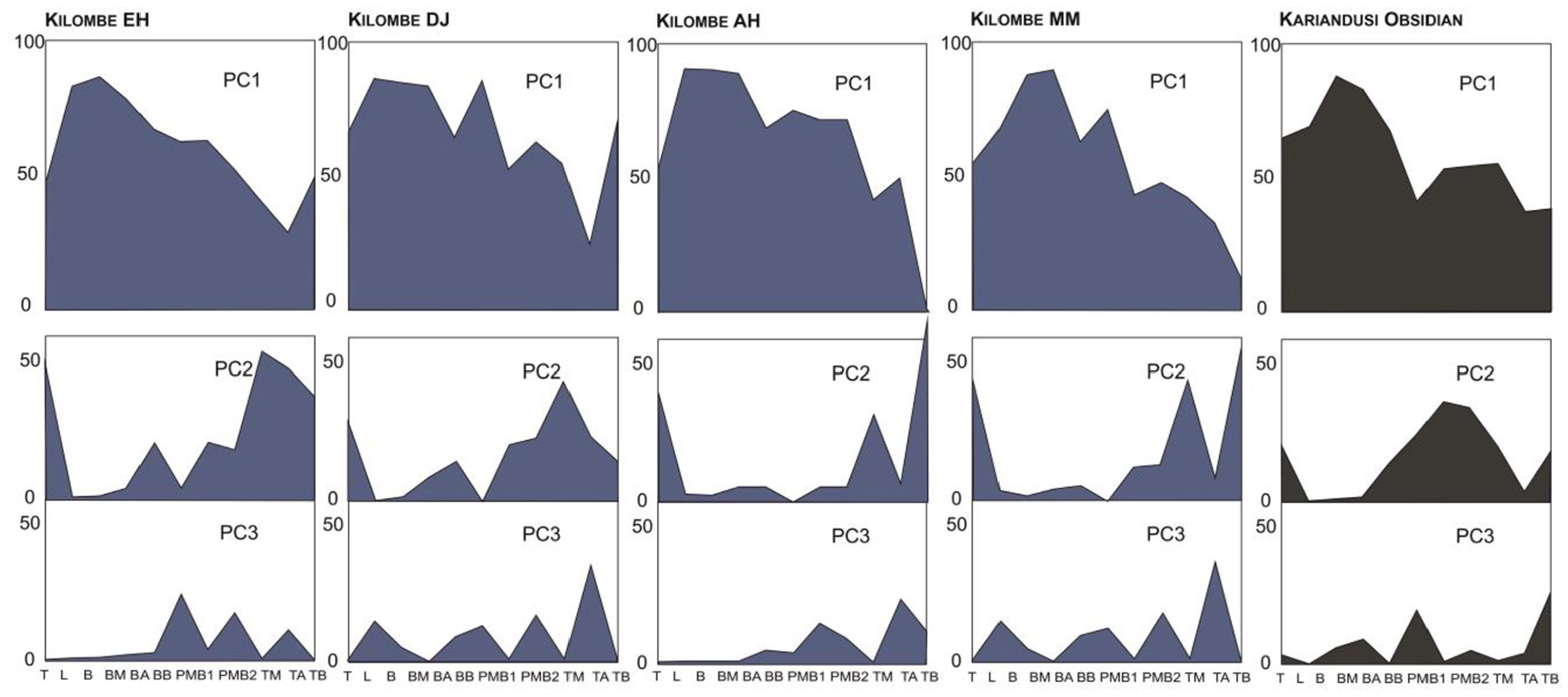
The strong patterning of ‘deep structure’ shown in a principal components analysis (PCA) diagram of Acheulean bifaces from four Kilombe site localities and Kariandusi (about 60 km south of Kilombe and of similar age) is similar for handaxes even from far separate sites.
Among the factors are the need for a compact butt, the need for tip-elongation, and the need to resist torsion. Particular dimensions of variation appear to be concerned with such matters as the placing of the centre of mass, and reconciliation of overall thickness and tip thickness. They are certainly evidence of several more real variables than are included in the main dimensions, making 6 to 12 major considerations for the maker in implementing a specimen (Table 1).
Selections and variables represented in procedures of making Acheulean handaxes (developed from Gowlett, 1996a, 1996b, and Wynn & Gowlett, 2018). Not all steps or variables are represented in all specimens. Creation of effective working edges is likely to have been a major goal.
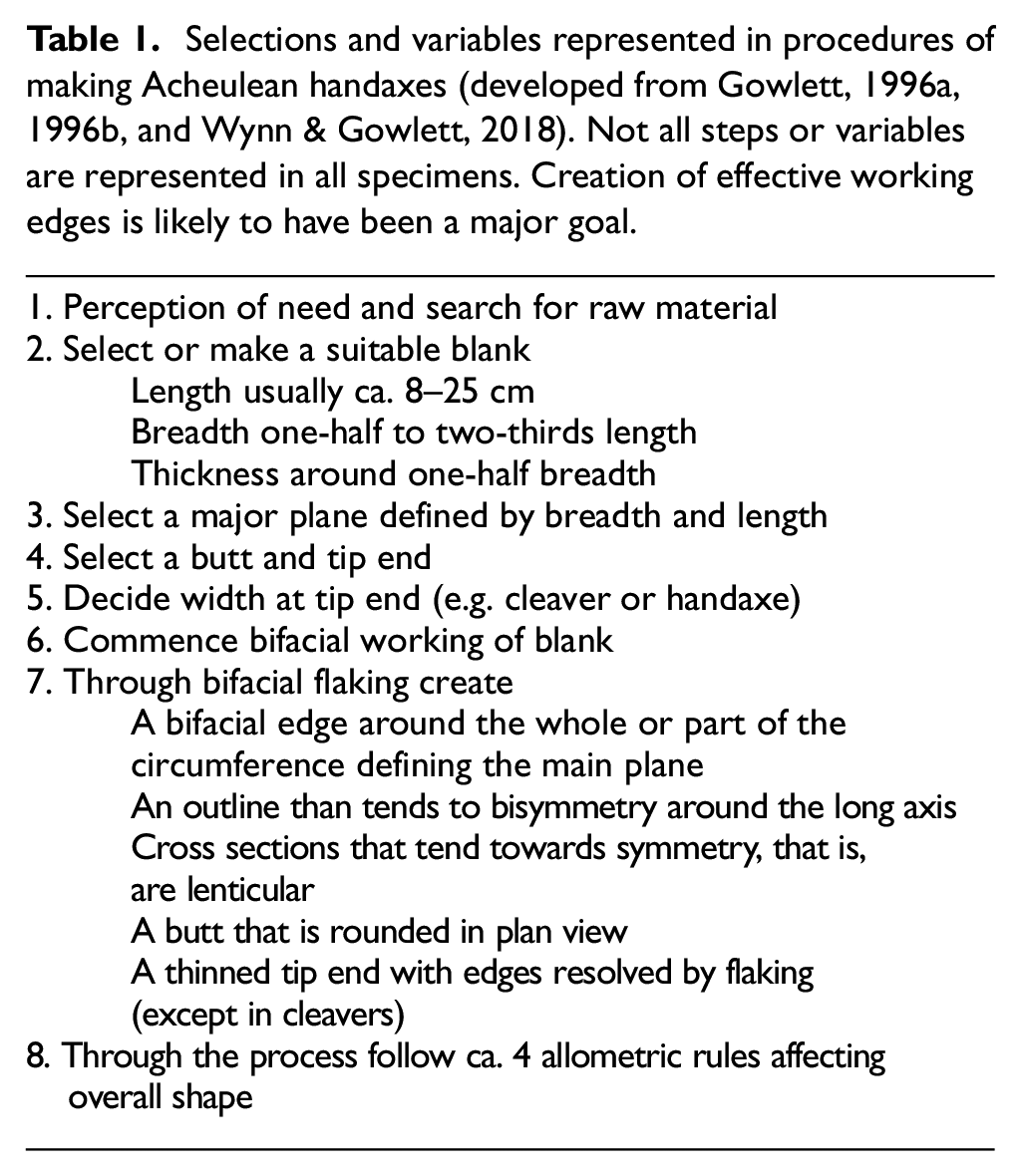
In an Acheulean biface, this complexity is superficially somewhat surprising. It would seem that strictly speaking the maker would need only appropriate mass, handhold, extension and working edge in the finished specimen. Yet, for these to be delivered in a workable artefact of stone, it is necessary to have an envelope that is not just physical but one that extends through time and is socially embracing. These points echo or are echoed by Malafouris (2013) in his discussion of handaxes and material engagement, which takes a broader view than one concentrating on the manufacture of the individual artefact itself, with or without particular characteristics such as imposed symmetry. In a narrow sense, the envelope is the mass of stone, shaped around a long axis: in another sense, it is the interaction of makers and material, the whole social context of manufacture and use, a package that is achieved along a temporal dimension perhaps far longer than the actual manufacturing time.
5.3. Symmetry and asymmetry
In terms of biomechanics, flaws in the physical envelope have a cost – helping perhaps to explain the meaning of symmetry and asymmetry, which have puzzled many workers. It seems surprising that symmetry has so rarely been approached in functional terms (with the exceptions noted). Observers tend to ask what symmetry shows about human capacities, rather than ‘What from a functional perspective requires symmetry?’ To a remarkable extent, symmetry in artefacts has been regarded as a mystery, because the uses have not been considered in terms of simple biomechanics.
Biological accounts of bisymmetry (i.e. bilateral symmetry) are helpful. They show that while bisymmetry is common in the plant and animal worlds (perhaps thus affording ideas to early humans), it is not a given (Kinsbourne, 1978). It is retained where it has advantages and abandoned where asymmetry works better. In artefacts, two particular factors might drive towards symmetry: weight-distribution properties, including especially resistance to torsion, and design simplicity. Pushing towards asymmetry are the needs of one-sided activities, such as cutting. These can be summarised in a diagram (Figure 7). As a further straightforward example, one can consider (1) a bilaterally symmetrical biface in cross section, which is neutral to torsion, and (2) a biface with an irregularity (Figure 8), which is not neutral to torsion and has a propensity to turn in one direction through the imbalance. Controlling such imbalance is likely to impose extra physical and cognitive load on the tool user – that is, distraction. Ergonomic principles stress the importance of comfort in tool use (e.g. Baber, 2009, p. 71; Kuijt-Evers et al., 2005, p. 71).
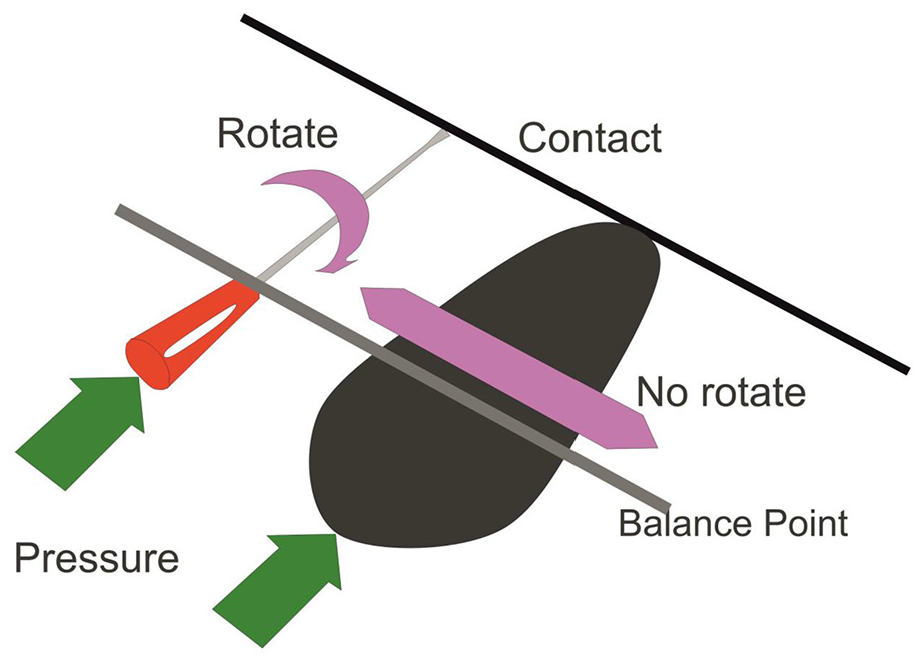
Some work (ergonomic) factors influencing form in bifaces (compared with a modern screwdriver (left): both have similar balance points).
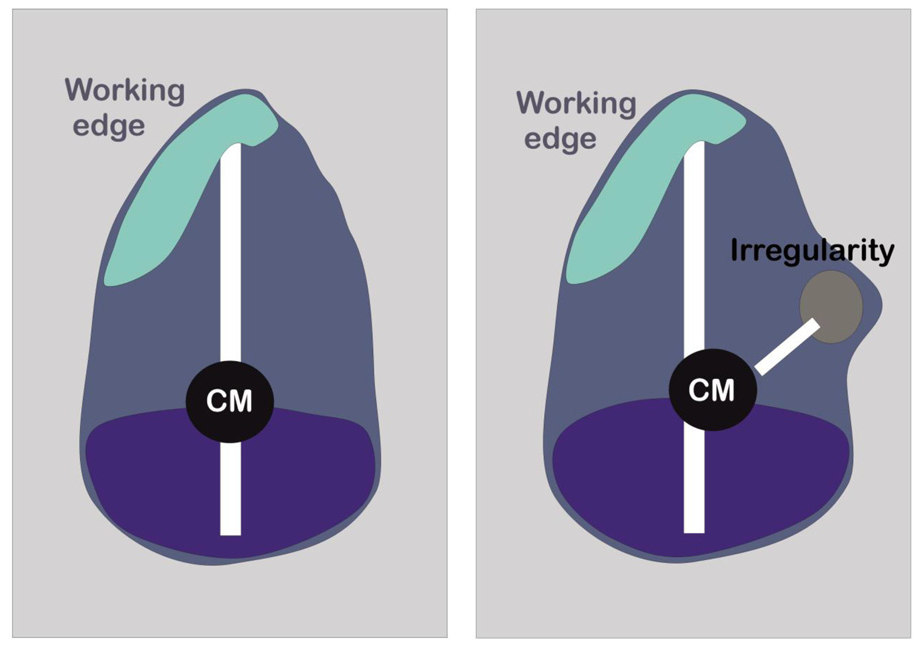
The potential deficit in performance caused by irregularities in Acheulean bifaces (CM = centre of mass).
Second, symmetry is parsimonious in terms of design, because it minimises the instruction set in manufacture and helps to set up fairly easy tests of success achieved. In contrast, is the more difficult mental task of ‘balancing’ like and unlike. In relation to a long axis (the essential feature of most bifaces), it is far easier to ask the question (measured visually): ‘Does a equal b?’ than to have to hold instructions sets for a differing a and a differing b. This point is akin to perceptual fluency as highlighted by Hodgson (2011).
Perhaps more remarkable than bilateral symmetry are recurring minor asymmetries which occur in bifaces (vide, for example, Wynn, 2002, on ‘symmetry breaking’, and Feynman, 1965, 1997, on its mathematical significance). Indeed, to the modern eye, slight asymmetries are among the most elegant feature of early bifaces, especially when seen in series so that the repetition of a character is confirmed. Figures 9 to 11 show some examples from the million-year-old site of Kilombe in Kenya. Among 700 studied bifaces, complete symmetry is rare, but this is not because of poor finish. Frequently, the butt end of the biface is more bisymmetrical than the tip end. A likely explanation is that the working direction does not follow the long axis forwards – something similar can be observed in a modern plastering spatula, or axe. The Acheulean bifaces show that the makers were readily able to morph components of the tool, ‘packaging’ the symmetrical butt and asymmetrical tip through smoothing routines. The examples show that they could do this in numbers of different combinations: to achieve their goal, they had to operate very flexibly with numbers of variables.
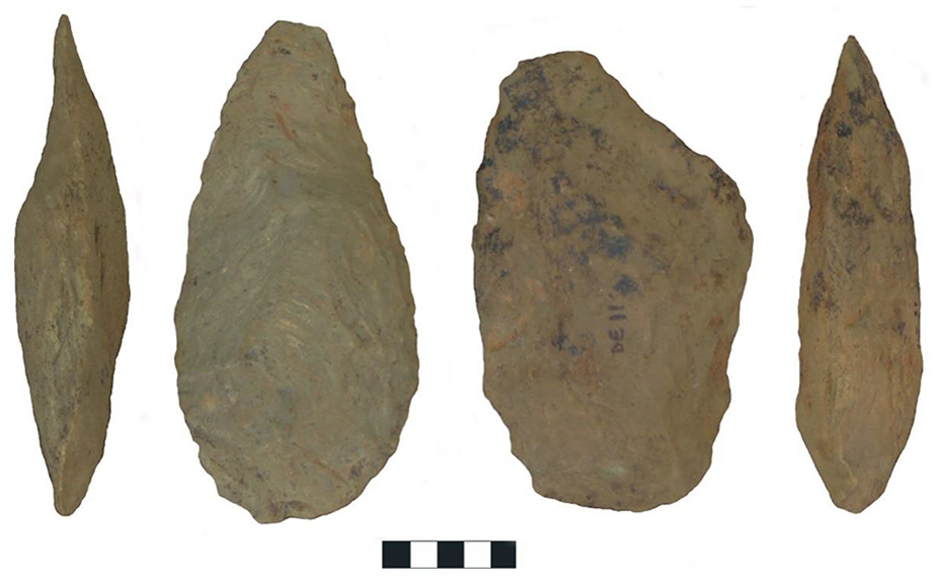
Two bifaces from Kilombe, in plan and side view, illustrate aspects of finish and symmetricality. The left hand specimen is very well finished and at first glance highly symmetrical, but its forward end is slightly asymmetrical in a way highly characteristic of Kilombe and some other sites. Its left hand side has a smooth curve, but the right hand side has a straight section. The second example (right) is a cleaver-form biface, with an angled edge. This asymmetric shape is common in cleavers (Scale in Figures 8 to 10 = 5 cm).
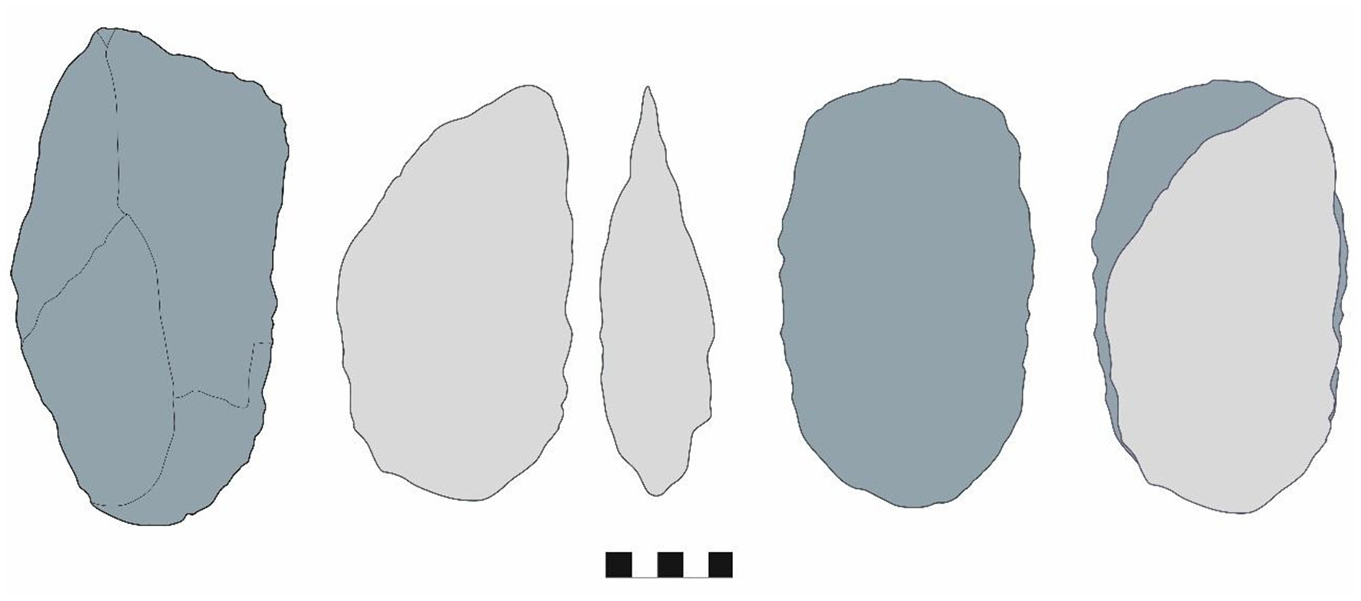
Asymmetric and symmetric bifaces from Kenya. Left, an angled cleaver of a form that is also found at Kariandusi. Second left, plan and section of a strongly asymmetric handaxe made in the form of an angled cleaver, but with a worked tip; third, a symmetrical cleaver; right – the asymmetrical angled cleaver superimposed on the symmetrical specimen: through about 60% of the length, the two outlines are almost identical.
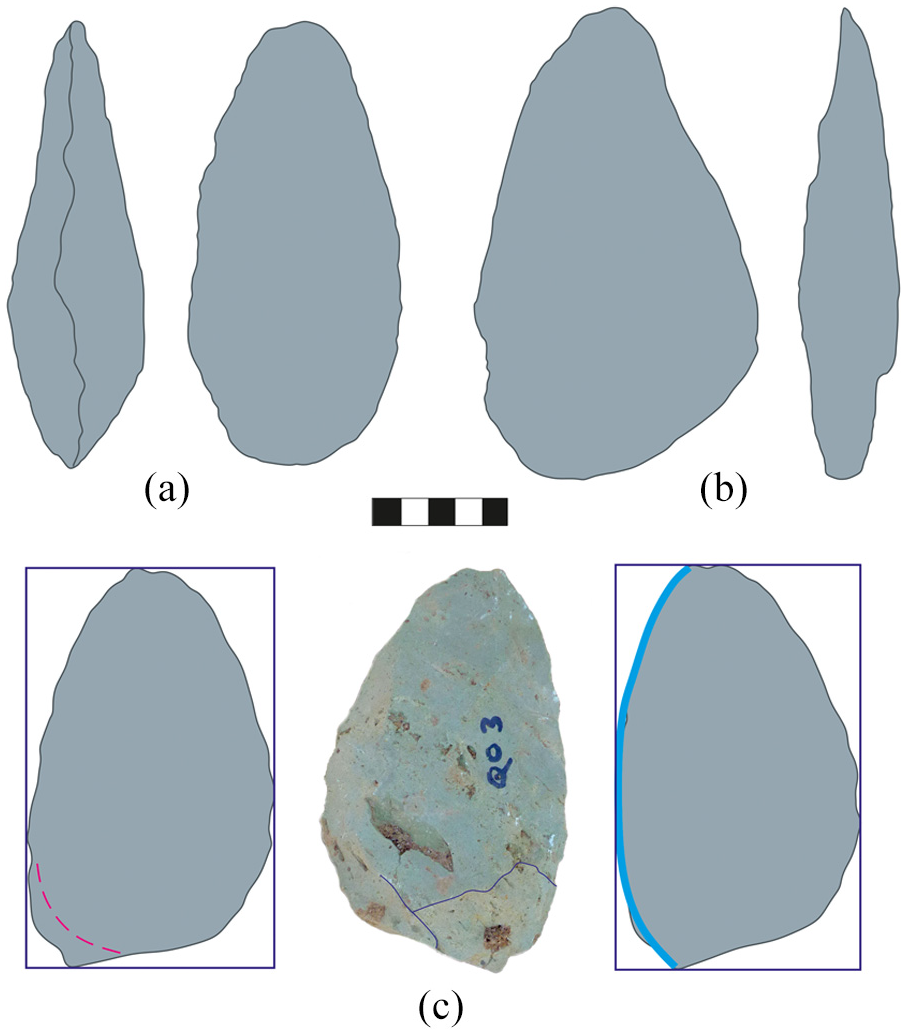
(a) One of the most ‘perfect’ handaxes from Kilombe, carefully shaped in both plan view and thickness section. (b) A highly asymmetric handaxe, with an exaggerated version of the features seen in Figure 9 (right). (c) It seemed that this handaxe might be unfinished (outline left), but inspection of trimming on the ventral face (centre) shows that the maker could easily have removed the last corner, but did not do so. The asymmetric orientation (right) highlights the sweeping curve of the left hand margin, itself in a symmetric form.
Both symmetry and asymmetry can be seen as special cases in the shaping of ‘appropriateness to need’. Their combination – the blending of asymmetric features onto an essentially bisymmetric design – need not be seen as a mystery, but it can be appreciated as a mastery of multiple concepts.
So far, it has been reiterated that in technology, there is social context, and I have argued that selective pressures militate towards efficient technology, simply because of the cost of the investments – which can be seen in terms of utility and value (Shott, 1996, and discussion below). In the Acheulean, the recurring similarities of variable combinations through a long period are very striking. It should be seen that the biface is just one example. Numerous other artefacts required to be finely balanced, including the spears from Schöningen (Thieme, 1998, 2005). Their balance point is different from that of bifaces, needing to be closer to the tip. A high intensity of finish, and a high degree of concentration, is also required for manufacturing small artefacts, which clearly existed over a very long period, from earliest Pleistocene to Holocene (De la Torre, 2004; Svoboda, 1987; Zaidner et al., 2003).
5.4. Higher levels of prediction, intentionality and evolutionary processes
Next, it is necessary to return to the ideas of prediction and higher levels of intentionality. Both have been given importance in the literature. They can be linked through the idea of heavy cognitive processing, with a particularly visual theme. Thus, the brain cortex has large areas devoted to visual processing (Alvarez & Cavanagh, 2004; Jolicoeur et al., 2006; Pins & ffytche, 2003; Swindale, 2006), and complex operations may need a degree of mental rehearsal (Dunbar et al., 2005), or visualisation (Cela-Conde et al., 2004; Craik, 1943; Denis et al., 2001), without which planning actions are severely limited (Hassabis et al., 2007). This evidence implies that higher levels of design and skill in manufacture require visualisation of the object at various stages, so that goals can be conceived and processes operated. In a corresponding way, it can be argued likely that higher levels of social interaction require ‘visualisation’ of relationships, actions and consequences – in both remembered and anticipated scenarios. It is less certain, however, that operation of such processes requires complete and sustained mental images: Pearson et al. (2001) suggest that these can be maintained by modern humans for a maximum of 250 ms, and reduction of complex processes to fixed sequences of action may help to relieve cognitive load. To return to the case of artefacts as our hardest linking evidence, the crux is that the maker constructs an artefact within a tradition and judges its appropriateness in relation to both individual experience and group practices – in effect taking into account the opinions of others. This business of considering how others would judge an artefact appears to be at the heart of modern aesthetics as a shared phenomenon.
How would these components be driven further towards aesthetics? One can try to map out these key developments as part of the evolutionary process in the emergence of Homo. In overview, the schematic diagrams (Figures 12 and 13) set forward first the sequence of sociality, technology and then of aesthetics, and then the importance of the ‘lighting up’ of intentionality (Figure 12). The last model diagram (Figure 13) highlights, beyond the somewhat linear development of technology and aesthetics, the great importance of interactions. In the processes,
human society becomes more complex;
levels of mind increase for social reasons (networking);
investment costs and returns increase (subsistence);
technology is sustained by increasing numbers of artefact classes and complexity;
the number of ‘appropriateness’, judgements increases, as do their dimensions and interconnections;
socio-technical abstraction increases; and
language (eventually) enhances the ability to make special.
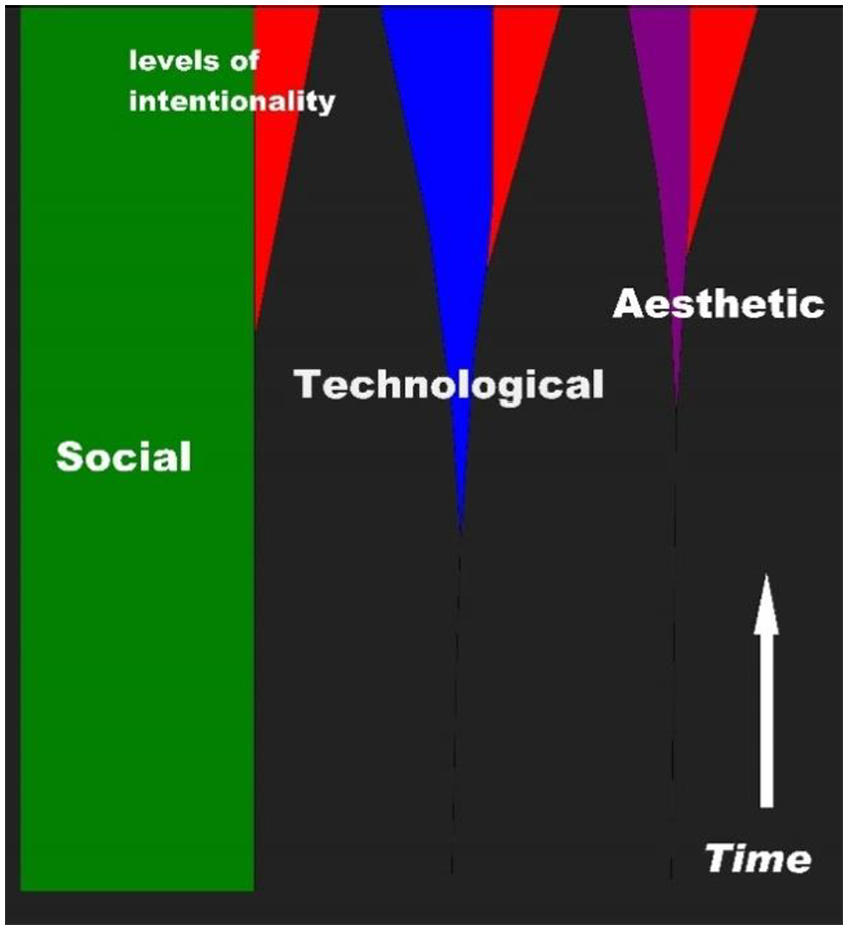
Domains of sociality, technology and aesthetics – the added layers of intentionality.
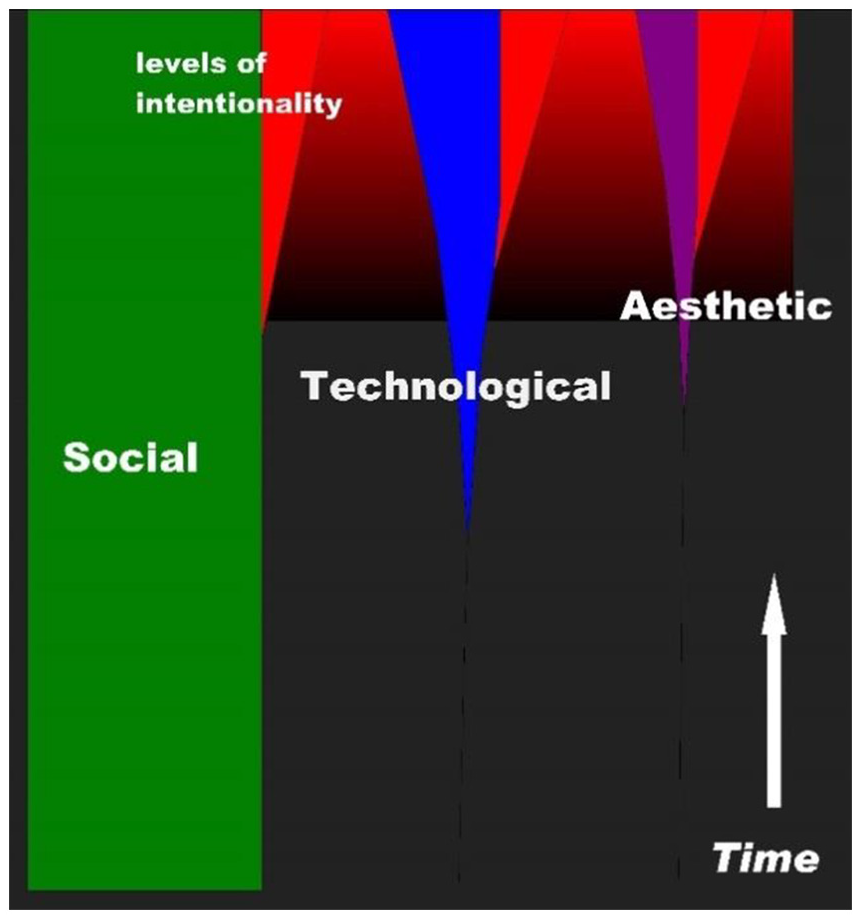
Domains of sociality, technology and aesthetics – a conceptualisation of the impact of interaction, as aided by language.
To be able to accept these as explanation, rather than simple description or assertion, it is necessary to ask, ‘What drives the loops?’ Primarily, it has to be selection pressure – driven by instability. Nothing less than strong selection pressures can explain the rapid development of Homo. To put this another way, prolonged evolutionary trends are rare (Janis & Damuth, 1990, p. 312). The continued change must be driven either by an unusual continuing shift in the external environment or by a within-species effect, in which there is a loop, as in Alexander’s social competition models (Alexander, 1989, 1990, 2008). In the nature of within-species competition, some individuals gain reproductive fitness through having, for example, larger antlers, better brains, and so on, and feedback continues until some external constraint is encountered. In this milieu, the aesthetic can be seen as a necessary outcome of the social-technological interaction. But what is the loop?
In the manufacture of complex tools, there may be several factors. In the basic TOTE unit of Miller et al. (1960), it is easy to judge when a nail has been hammered in. In the case of a complex artefact, the maker can only judge ‘finished’ or ‘appropriate’ by balancing judgement across all the relevant factors, in effect carrying out a cost-benefit analysis of any further changes. Some workers would hesitate to attribute such capacities to early tool-makers, but there is actually no workable alternative view. It is inescapable for the maker that the judgement is multivariate. Such balancing of judgements is inherently similar in its complexity to higher orders of prediction (or higher levels of intentionality). It is also similar to judgements apparently made by apes in utilising objects on landscape (Boesch & Boesch, 1984; Menzel, 1979).
Facing the cognitively demanding task of judging completion just mentioned, the tool-maker may find that the costs of continuing towards a more perfect tool are comparatively low, versus the costs of working with a poor tool, or starting again. Thus, an important aspect in the manufacture of artefacts is that often there is no barrier to ‘over-engineering’. Furthermore, it has long been appreciated that the worker who works with a very intractable material (perhaps granitic rock) may also sometimes have the opportunity to work with a fine material such as obsidian, which allows much greater control. In that case, if investment is kept equal, in the latter case, the results may easily surpass the strict needs of function. In such cases, with so many variables in play, judgements about satisfactory completion are unlikely to be maintained in one-to-one relationship with minimum needs of performance. Who, however, makes the judgements? There may well be a partitioning between the element of an individual decision, and appreciation of a group norm, a factor now established to exist in chimpanzee tool-making (Whiten et al., 2005). If social norms are evident, both in chimpanzees and modern human tool-makers, their presence is almost inevitable in earlier humans, and it can be construed that the greater investment will have a selective effect. Following Sackett’s idea of complementarity of style and function (Sackett, 1977, 1982), it seems unlikely that such norms would migrate far towards a reduced functional performance, rather that they would be neutral or enhance performance (cf. Lycett, 2008).
Other factors may also push towards separation of completion judgements and strict functional needs, especially the longer timescales of hominin activities on a landscape far larger than that of the apes. Operational chains of manufacture and use become necessarily segmented, interspersed with other threads of social and subsistence activity (Gamble et al., 2011; Gowlett, 1984).
The next linkage is that this potential separation of appropriateness judgements and function could easily be enhanced through the presence of language and higher levels of social intentionality so as to allow changes of goals and significance. Once ‘The right way’ of making an artefact can be somewhat separated from the strict functional needs for the individual, that appropriate way becomes a balance of personal experience versus group tradition. Here is an important connection with the aspect of group size (Dunbar, 1993, 1998; Zhou et al., 2005). In small-scale societies for practical purposes that group tradition is enshrined in the small group of peers with whom most time is spent (Lycett & Gowlett, 2008). The aspect of intentionality is focused on weighing ‘What I feel about the tool?’ relative to ‘What would they expect in the tool?’ and ‘What would I expect them to achieve in the tools?’
Language would be of enormous help in such matching, with a likelihood of co-evolution with technology (cf. Deacon, 1997), whether or not we can establish that one drives the other. The recurrence of deep patterning of variables in Acheulean artefacts from a million years ago onwards suggest that factors such as ‘length’ or ‘thickness’ were appreciated separately and so may hint at language (cf. Barham & Everett, 2020; Gowlett, 1996a, 2006, 2012; Stout & Chaminade, 2012), although various nuances of interpretation are possible. One is that there were functional imperatives which were unavoidably necessary, and which somewhat deterministically dictated the form of tools (with cultural transmission minimising trial-and-error learning). Another is that such imperatives being recurrently advantageous were principally culturally nurtured and eventually became labelled with words. Some combination of these factors is possible, but the artefact evidence does make plain that the variables are somewhat independently adjustable. Either way, the transmission of useful ideas along the lines ‘the tool works best if weight such AND edge length such’ would be much facilitated if the concepts could be labelled through language, and language could thus push towards enhanced concepts of quality.
Whereas Wynn (1979, 1995) showed the idealised nature of some of the concepts (e.g. production of straight edges), in this article, I have focused more on factors which promote and enhance their handling, an ergonomic dimension as one aspect of operation within a social framework. Although it would be hard to demonstrate that the sets of rules and concepts in early artefacts (which have their own value) indicate spoken language, this would be unnecessary if its presence can be established in other ways. For example, the human-derived version of the gene FOXP2 appears to be essential to language, and the presence of the same form in Neanderthals makes it implicit that this derived version was present in the common ancestor of Neanderthals and modern humans (Krause et al., 2007; Reich, 2018) – around 800,000 years ago in the era of the Acheulean, when arguments can be made both for early language (Barham & Everett, 2020) and the passage from Homo erectus to a more modern hominin (Sano et al., 2020). Even simple language would allow cross-associations and additional secondary meanings such as the labelling of value, or attributes of artefacts.
It was noted earlier that most evolutionary trends eventually bump into some end stop. In this case, however, the trend towards a perfectionism in finishing things, somewhat independent of true functional needs, can be seen as a trend which would not end, so long as payoffs continued to outweigh disadvantages. They could do so through the technology becoming bound up in a greater social world.
6. Aesthetics, art and arts
I return here to broader issues of how we perceive aesthetics – if we are trying to draw conclusions from artefacts of the early past, it is necessary to have a reference position in the present. This article has attempted to show how an aesthetic ‘sense’ might emerge, related to the social and technological, but is it consistent with modern views of the aesthetic? Here, there are almost as many views as for definitions of culture. The simple tripartite diagram shown earlier (Figure 2) can be elaborated to include at least double branches (Figure 14). The psychology runs in near-continuum from the experimental, with studies of perception (e.g. Makin et al., 2016; McManus, 1980) to neuroscience with its studies of brain circuitry (Chatterjee, 2014; Chatterjee & Vartanian, 2016; Ramachandran & Hirstein, 1999). Philosophical discussions divide at least into those aligning with western art (e.g. Davies, 2007) and those that are more craft and skill based (Hurcombe, 2007). The evolutionary record is lived once for itself, and again for us (Gellner, 1988). After the classic view of Schlesinger (1979), which seeks to explore the ‘notion’ of aesthetic experience as a prerequisite for defining art, some studies have attempted to escape circularity by conducting neutral investigations of preferences (McManus, 1980), defining aesthetic properties in terms of ability to recognise aspects of colour and shape (De Clercq, 2002), or defining aesthetics effectively in terms of what the brain does (Cela-Conde et al., 2004).
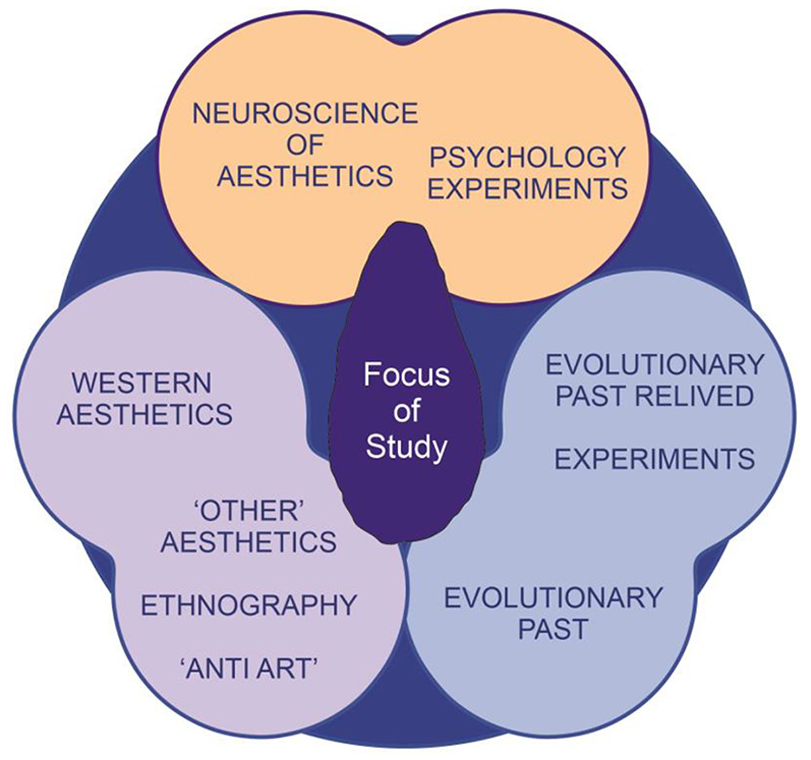
The components of aesthetics revisited (cf. Figure 2), showing elaborations that can be seen in each of three major zones of study.
Aesthetics can become something very visual – the ability to discriminate objects in terms of shape, colour and texture, but this is clearly only one side of it. For example, the western view in the past often focussed on literary forms, such as Carlyle’s ‘poetry as hero’ (Gilbert & Kuhn, 1956, p. 407), and we cannot offer a position that traces poetry in distant prehistory. Much of the western aesthetic view is about normal functional objects (or literary forms) being transcended by more perfect versions. Gell (1992) notes this dominant view that ‘in the aesthetically valued object there resides the principle of the True and the Good, and that the study of aesthetically valued objects constitutes a path towards transcendence’ (p. 161). They are then linked with material beauty (Mattéi, 2014) – beauty as of scientific interest arriving as early as John Locke in the 18th century (McMahon, 2007).
For Dissanayake (2015), there is a related view of art as making things special. But there is a difficulty with the elevation of beauty or specialness that it borders on the tautological and raises the question of whether making something ‘the finest’ is different from making it special. Dissanayake (2015) urges more emphasis on past and premodern, but her naturalistic aesthetics contrasts strongly with Gell’s ‘anti-art’: ‘The anthropology of art has to begin with a denial of the claims which objects of art make on the people who live under their spell, and also on ourselves . . .’ (p. 162), and whose view concentrates more on ideology than aesthetics: ‘. . . we can suppose that the art system contributes to securing the acquiescence of individuals in the network of intentionalities in which they are enmeshed’ (p. 161). Davies (2007) disagrees with both from a western art view, but like Dissanayake stresses the cross-cultural reality of art behaviour.
Aristotle (1935), paradoxically, rescues us from the western and philosophical with views that are as much historical ethnography as philosophy. For Aristotle, beauty is a real property of things (Metaphysics XII, 1072b: Pappas, 2001) – without a specific concept that art forms a separate category. Aristotle argues against Plato’s idea of ‘ideals’, though tends to revert to them (Russell, 1946), a difficulty which we still have. As nature was a vital process, so ‘art was for him a doing and shaping, a movement set up in some medium by the soul and hand of the artist’ (Gilbert & Kuhn, 1956, p. 63). (Aristotle also anticipated the concepts of ‘affordance’, in seeing ‘potentiality’ in a stone that can release a statue.) A further caveat on aesthetics as ‘Beauty’ lies in an intriguing idea from Mace (1968) that complexity is a necessary characteristic of something that is appreciated aesthetically. It may help to provide just that enchantment which offends Gell (1992). Ramachandran and Hirstein (1999) go further in listing eight principles which may underpin artistic sensibility.
In essence, there is a fundamental contrast between a western view of aesthetics and what may be termed an intrinsic view – one that takes technology and sees how it has unfolded into valued forms, as in the Acheulean, in which values read from the artefacts may be able to tell us something about the makers’‘other’ less immediate worlds. Elements of both may need to stay with us, just as similarly the study of aesthetics itself depends on both philosophy and psychology.
What is interesting and important is that the Acheulean itself does not entirely support a ‘craft’ view of art. It tends towards ‘exceptionalism’, which can be seen in several expressions as mentioned – fine finish, perfect symmetry, large size, holes in pieces, shells or crystals in pieces. In some cases, these seem to represent ‘added value’. ‘A crucial question might be whether they are simply one end of a normal range, or whether they form a distinct mode of ‘the special’– something which would accord more with Dissanayake’s view, or the classic western tradition, than with Gell’s ‘anti-art’, which aligns more with craft views (e.g. Bril et al., 2005), including Aristotle’s. The shells and holes do seem to form a distinct mode – that is, at the possible expense of functionality, they introduce a new axis of content into the tool. Their ‘positionness’ or embeddedness into the artefact may quite conceivably be more important to the makers than the normal function of the handaxe class. It is harder to say the same of size variation – the near-perfect normal distribution of length at Kilombe (Gowlett et al., 2017) suggests that very small and very large handaxes are equally produced. If there were a separate mode of specimens with some particular characteristic, this would be better evidence of intent to create something symbolically apart. The holes and shells – if we accept the deliberate intention – do provide that dimension. Whether we term that art is a cultural matter which comes close to the post-processual archaeology’s reading and rereading the record (Hodder, 1986). For Davies (2007), art cannot be imposed retrospectively: something that was not art cannot become art. Perhaps it is enough if the earliest objects, such as fine or embellished handaxes, which catch our modern attention as special, were undoubtedly made in Aristotle’s sense as ‘the finest’ (τòκáλλιστoν): they can meet modern western criteria for art, but we cannot be sure that they were perceived as art in a modern sense.
The exceptional finds mark a point where social behaviour is not just scaffolding technology through cultural transmission, but the harnessed technology can scaffold social interaction (cf. Gamble et al., 2011; Overmann, 2013). For this, the artefact must have value. Hallowell (1943) points out that for property, the enveloping structure is triadic not dyadic: it is not ‘A owns B’, but ‘A owns B against C’, where C is all other individuals. But here, A elaborates B in relation to at least some C. The artefact ‘symbols’ in the sense of L. A. White (1962), contributing to the identity signalling seen by Cole (2012). Value perhaps starts from a simple appreciation of utility, as with chimpanzee knowledge of the varying utility of anvils (Boesch & Boesch, 1984; Menzel, 1979), but in the case of fine artefacts, it touches on the abilities necessary for appreciating social relationships (Heatherton, 2010), and hence on the emotions, making these a further dimension engaged with aesthetics (LeDoux, 2010; Matravers, 2001; Prinz, 2004; Sripada & Stich, 2004).
6.1. To conclude
The ideas set out here start from this essence: satisfactory completion of externalised tasks requires appropriateness judgements. The role of these is greatly enhanced for animals that manufacture artefacts. All tools are multivariate, but in hominin lineages, selective pressures for better tools led them to be increasingly so, and hence to impose multivariate judgements, with high cognitive loads (Gowlett, 2006). These developments, which we can see developing from Oldowan to Acheulean through 2 million years, happened in a deeply social context, in which the aspect of intentionality is important in making complex judgements. The maker must weigh personal experience in relation to group knowledge, with the consideration of what others think (what makes the tradition). There are inherently strong pressures for such processes – which have a strong visual dimension – to be developed through feedback loops. These continue, seemingly because they continue to bring advantage, and no severe external constraint is met. It is implicit that making an ultra-fine artefact either has additional costs which are relatively low or costs which can be borne socially because of social advantages.
In any model such as I have sketched out, the gradient of necessary past happenings (what must have happened on the trajectory from ape to human) needs to be mapped against the actual past record with as much independence as possible. Is there demonstrably a continuing evolutionary connectedness between the social and technological domains, a degree of correlation? The social context certainly develops in human evolution, and that can be shown independently, from brain size considerations (Aiello, 1996; Aiello & Dunbar, 1993). Across humanity, the technological also develops, but this feature need not be highly expressed in a particular society, as noted for Australian aborigines (e.g. Brumm & Moore, 2005). The social and technological are congruent in this sense: levels of social intentionality involve increasing degrees of mental insight, as in third order, where one person knows that another person is thinking about another. Then, when people are dealing with artefacts, as in the Acheulean, interactions of essential variables result from interactions of various perceived needs, either in making the physical artefact or in the longer trajectory of need–manufacture–use–discard (Schiffer, 1972). For example, to feed at some future moment, it is necessary to undertake all the considerations of getting raw material, so that artefacts can be made, which are then judged to need certain characteristics, so that they will perform anticipated future functions.
The nature of a third domain, in addition to the (indisputable) social and technological, needs some final scrutiny. If modern humans are distinguished by the emergence of such a domain, then there is little doubt that it is intellectual, and far reaching. To see it as primarily aesthetic, as Leroi-Gourhan (1993) does, is a choice (e.g. vs. the ideological of L. A. White, 1959, and others). We can take a more restricted view of this third domain than does Leroi-Gourhan with his broad ‘functional aesthetics’, but there is no doubt of the existence of a range of aesthetic perceptions, and their importance in the functioning of modern humanity. Leroi-Gourhan’s view is obviously broad enough to be in tune with other approaches that link in the aesthetics of, for example, number, music, dance and ceremonial (Gell, 1992; James, 2003). These things seem related in a common family, but the extent of their relationships at a neurological level cannot be assumed.
To conclude, accepting the importance of form and (often) colour or texture in the material world, I argue that the aesthetic can be seen as taking shape practically from the judgements about the external that have to be made in the practice of technology. The aesthetic represents judgements about ‘what is appropriate’ and ‘what is right’, seen in two lights: first, the sharing of values of others in doing the same thing – one meets the standard by doing what they would do. Second, at a higher level of intentionality, one aims to do not just what one likes (‘painting for oneself’), but to envisage what others would like, or what would influence them. There can be an additional creative aspect, in the balancing of personal contribution and group experience, that an individual may attempt to stretch normal expectation so as to send a signal.
Such a signal would touch on the symbolic. The presence or absence of symbol has been seen as a key element in the origins of language and art by many authors. It has not been used as a foundation in this analysis of aesthetics, because it does not seem to be a prerequisite – although it occurs deep in discussion of aesthetics (Saw & Osborne, 1968), not just in archaeological theory. Nevertheless, the dissociation of fine artefact from strict functionality, which has been mentioned, might harmonise with the development of greater symbol use (which Deacon, 1997, indicates may be an evolution rather than a case of presence/absence). Thus, the views formulated here work forward towards issues which others have worked back to through tracing symbol (e.g. Barham, 2004; Bednarik, 1994). In summary, aesthetic experience has meaning only in a social context of shared values. It is not in itself art, but early artefacts show how it may have been enhanced and have had adaptive value. The social dimension with high levels of intentionality is a necessity, complementary to functional needs, for the aesthetic to arise in respect of technology.
Footnotes
Acknowledgements
This article has been prepared during the Covid-19 emergency of 2020 in part in lieu of fieldwork time sponsored by The Leverhulme Trust (grant RPG-2017-183) and PAST Foundation. I am grateful to Tom Wynn, Karenleigh Overmann and Lambros Malafouris for organising the workshops which prompted the final version of this article and for thoughtful comments from Fred Coolidge. Kernels of its ideas arose during the British Academy Centenary Project Lucy to Language, and thanks are also due to Prof. Henri de Lumley for a meeting at Tautavel. The author is grateful for earlier support from the British Academy and Wenner-Gren Foundation for work at Kilombe and from NACOSTI and National Museums of Kenya and the British Institute in Eastern Africa.
Handling Editor: Thomas Wynn
Declaration of conflicting interests
The author(s) declared no potential conflicts of interest with respect to the research, authorship and/or publication of this article.
Funding
The author(s) disclosed receipt of the following financial support for the research, authorship, and/or publication of this article: This work was supported in part by a British Academy international partnership grant [PM120165].
