




Abstract
Humans leverage material forms for unique cognitive purposes: We recruit and incorporate them into our cognitive system, exploit them to accumulate and distribute cognitive effort, and use them to recreate phenotypic change in new individuals and generations. These purposes are exemplified by writing, a relatively recent tool that has become highly adept at eliciting specific psychological and behavioral responses in its users, capability it achieved by changing in ways that facilitated, accumulated, and distributed incremental behavioral and psychological change between individuals and generations. Writing is described here as a self-organizing system whose design features reflect points of maximal usefulness that emerged under sustained collective use of the tool. Such self-organization may hold insights applicable to human cognitive evolution and tool use more generally. Accordingly, this article examines the emergence of the ability to leverage material forms for cognitive purposes, using the tool-using behaviors and lithic technologies of ancestral species and contemporary non-human primates as proxies for matters like collective use, generational sustainment, and the non-teleological emergence of design features.
1. Introduction
What differentiates human cognition from that of every other species? As neuroscientist Christof Koch recently observed, there is “no simple brain-centric explanation” for our putative cognitive supremacy—not the size of our brain, nor the number or type of its neurons (Koch, 2019). Some clues may be found in the traits distinguishing it among the brains of living and ancestral primates: Its shape is rounder, a change called globularization that has implications for intra- and inter-regional connectivity (Azevedo et al., 2009; K. R. Gibson, 1991; Kaas, 2000; Rilling & Insel, 1999). The proportionality of its lobes is also distinctive, especially in its relatively large parietal area, a region associated with both globularization (Bruner, 2004, 2010; Bruner et al., 2003, 2011; Bruner & Iriki, 2016) and tool use (Orban & Caruana, 2014; Orban et al., 2006).
Koch’s phrasing implies any potential explanations will be neither simple nor brain-centric, and certainly, our parietal structure and function suggest our cognitive differences might well be related to our use of tools. Non-human species also use tools, but both their tools and tool use differ qualitatively and quantitatively from ours. We often assume we have better tools because we have better brains. Here, the equation is reversed to suggest we have different minds because we have become able to leverage material forms for cognitive purposes: We recruit and incorporate them into our cognitive system (Clark & Chalmers, 1998), exploit them to accumulate and distribute cognitive effort between individuals and generations (Hutchins, 1995), and use them to recreate phenotypic change in new individuals and generations.
Such cognitive purposes may sound farfetched or more than a bit Lamarckian, so an example will be helpful: Consider reading, a cognitive state that does not exist—indeed, cannot exist—without interacting with a specific material form, writing. As a material form, writing is an excellent example of a material form integral to cognition, even if the particular cognitive state and its material incorporation exist only so long as someone reads. Writing is also a tool that has become adept at eliciting specific behavioral and psychological changes in its users (Overmann, 2016, 2017). We call these changes “literacy” and the process of acquiring them “learning to read and write,” terms showing we either ignore or take for granted the material form’s contribution and how its capacity to make that contribution developed and refined over time.
Essentially, literacy consists of a suite of behavioral and psychological changes acquired through sustained interaction with a particular material form. When someone learns to read and write, the temporal gyrus becomes trained to recognize written objects topologically (Figure 1) and associate them with language functions and the motor movements of handwriting (Dehaene & Cohen, 2007, 2011; Nakamura et al., 2012; Perfetti & Tan, 2013; Roux et al., 2009; Tremblay & Dick, 2016). Hands become proficient at making the fine motor movements that produce written marks, and coordination between the hands and eyes improves, as do recognition and recall functions, lexical retrieval, and tolerance for ambiguity in how characters are formed (Giovanni, 1994; James & Engelhardt, 2012; Longcamp et al., 2005; Roux et al., 2009; Sülzenbrück et al., 2011). These changes in functionality and the brain regions implicated in them appear relatively consistent between individuals and across differences in culture, language, character form, and whether writing maps to words, syllables, or sounds (Bolger et al., 2005; Carreiras et al., 2007, 2009; Frost, 2012).

Topological recognition of objects. (Left) A cube is apparent in the combination of local details (circles and cutouts) and global cues (relations between local details). (Right) The words “the cat” are recognizable, although the middle characters are neither H nor A. Meaning is derived from the letters themselves, their contexts within words, and associations with the mental lexicon for language acquired when learning to read and write. Image created by the author. Earlier versions were published in Overmann (2016, p. 288, Figure 2(A); 2019, Figure 10.7, p. 190).
If today that material form seems static, it has nonetheless changed greatly when considered over time. A little over 5000 years ago in the ancient Near East, writing began as small pictures and signs that were meaningful in virtue of resemblances and conventions (Figure 2). As brains became trained to recognize these pictures and signs topologically, the need to resemble the original objects or conventions was relaxed. As depictiveness was lost, the set of characters became less variable overall but reorganized within the remaining variability in ways that emphasized the features that individuated and distinguished them. Features are the parts or characteristics of an object used to identify it as itself (individuating) or tell it apart from other objects of the same type (distinguishing). Features are both aspects of capacity, form, and employment that make objects useful as tools and co-occurring perceptual, motor, ergonomic, and functional experiences that form the basis of categories and prototypes of tools (Barsalou, 2008; Malafouris, 2013; Overmann & Wynn, 2019a).
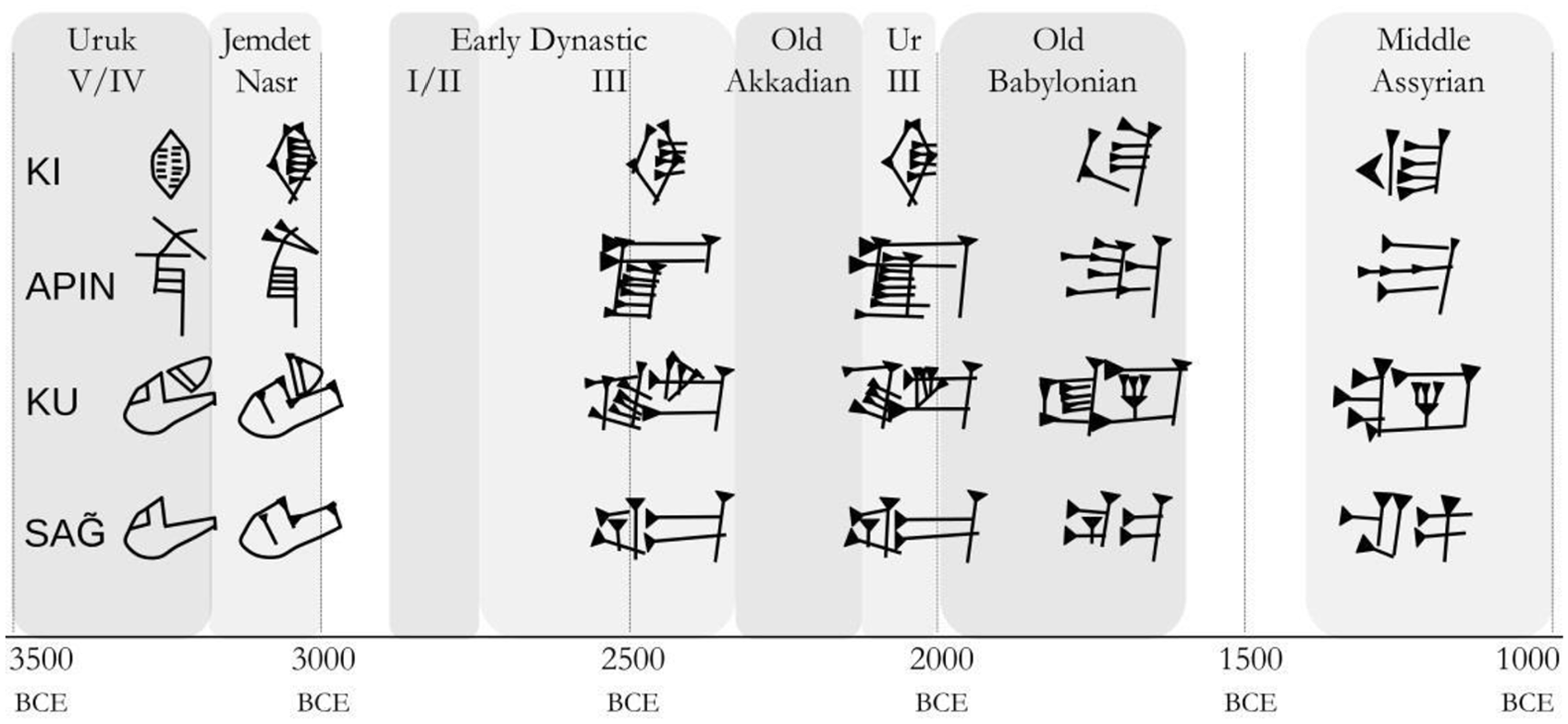
Chronology of sign forms in Mesopotamian writing. Writing began around 3200 BCE as small pictures and signs that were meaningful through resemblance and convention (these early signs were rotated 90° counterclockwise here to facilitate their comparison with later signs). By 2500 BCE, characters were noticeably less depictive of whatever they had initially resembled, and as a set, they were much more alike to one another than the earlier pictures had been, so that individuating and distinguishing them entailed learning and practice (as can be seen in Figure 3 with the emergence of an increasingly structured curriculum). Redrawn from Nissen et al. (1993, p. 111, Figure 88). Earlier versions were published in Overmann (2016, p. 289, Figure 3; 2019, Figure 10.6, p. 188).
This intensification of features was partly an effect of familiarity. When we are familiar with a set of objects, the individuating and distinguishing features can be subtle, but using subtle clues requires learning and practice (for a discussion of how brains change through experience, see Kelly & Garavan, 2005). Conversely, when we are unfamiliar with a set of objects, the individuating and distinguishing features must be more overt, and there is correspondingly less need for learning and practice. This same effect is seen in the recognition of facial features, where familiarity permits more fine-grained distinctions of increasingly subtle clues. Unfamiliarity, in comparison, means that things differentiated by subtle clues are more difficult to individuate and distinguish, an effect found in cross-race eyewitness identifications (Brigham et al., 2007).
Feature intensification was also an effect of use and usability. That is, aspects of the objects being used as tools intensified through use, becoming pronounced in ways that made them even more useful. These were “design” features (Gowlett, 2006) but not “designed” features: What they were as features and how they changed over time did not reflect a guiding teleology per se, but rather, use of the object as a tool by a particular species for a specific purpose. Further, while invention and intent to modify the tool or solve particular problems were undoubtedly part of the process, this was likely a minor aspect of the set of changes, especially those related to the reorganization of the visual appearance of the material form. Most participants merely used the tool, and in the process contributed variability—slight differences and new combinations of behavioral, physiological, psychological, and material capacities and qualities—that collectively influenced features to converge on usability maximized for the human average.
Changes in psychological processing enabled further change in both behaviors and tool form. An example is cursive, a form of writing characterized by the use of “abbreviated signs, crowded writing, and unclear sign boundaries” that emerged around 2000 BCE (Veldhuis, 2011, p. 72). Cursive traded clarity of form for speed of production. This exchange would have been enabled by the development of a tolerance for ambiguity in how characters were formed, something associated with writing by hand. Educators fear this tolerance will be lost as handwriting is replaced by production modalities like typing (Konnikova, 2014), though it is also true such automated production is typically accompanied by highly standardized displays (e.g. computer fonts) that mitigate the need for tolerance by reducing ambiguity below the threshold of perceptibility. Another example is the level of character detail, which decreased after 2000 BCE. In modern scripts, detailed characters are easier for novices to recognize but tend to slow proficient readers, who need less detail because they are able to make greater use of global cues (Bird, 1998, 1999; Ravid & Haimowitz, 2006). In modern cases (e.g. diacritics marking tone in African languages or vowels in Hebrew), it has been possible to develop different script forms, a more detailed version for learners and a less detailed version for masters, the trade-off being the need to learn both script forms. For ancient scripts, a balance of detail—enough for learners, not too much for masters—appears to have been achieved in a single script form, the trade-off being a suboptimum level of detail for both groups.
In the reorganization toward literacy, another change occurred in productive behavior, which became habitual and then automated. This is discerned as the standardization of the order in which the strokes of the characters were produced, something that is recoverable because of the way clay surfaces retain marks made in succession: continuous furrows were produced later than ones they cross and interrupt (Bramanti, 2015; Taylor, 2015). Automaticity would have freed cognitive resources like attention and working memory, enabling writers to focus on the content of their writing rather than the mechanics of its production. This same effect is noticeable when someone learns to drive a car: Novices must closely attend to road conditions and the mechanics of accelerating, steering, and braking, but proficient drivers need to attend less to such things, becoming alert only when something changes (Charlton & Starkey, 2011). This leaves proficient drivers free to attend to other matters consistent with safely operating a vehicle, like thinking, conversing, and listening to music. In ancient writing, this transformed writing from a tool that recorded mental content to one allowing its users to engage that content more directly, facilitating the “revolution in writing [that] took place around 2000
Topological recognition; tolerance for ambiguity; greater use of global cues; productive standardization, automaticity, and speed; and the recapitalization of freed cognitive resources are only some of the many behavioral and psychological developments that enabled the material form of writing to lose its depictiveness, detail, and clarity and intensify its useful features (Figure 3). This systemic change appears to have yielded literacy, or something analogous to the state we designate with the term, in Mesopotamia more than a thousand years after writing was invented there (Overmann, 2016). During its first millennium of use, the material form changed incrementally through the participation and behavioral–psychological reorganization of succeeding generations of writers. Yet each new generation only needed to learn to read and write using whatever form the characters happened to take at the time.
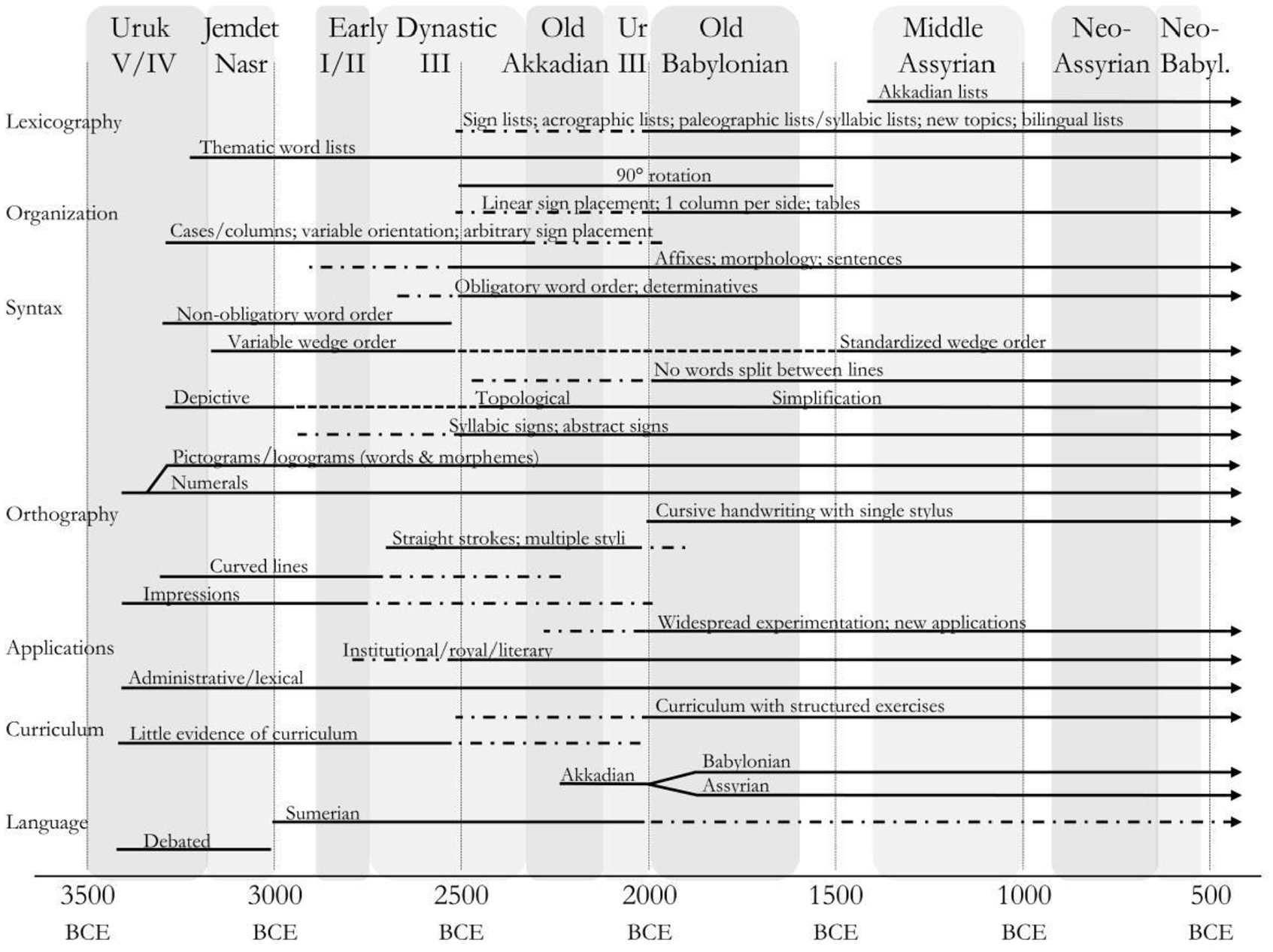
The development of literacy from writing. The data on Mesopotamian writing were sorted into seven categories: lexicography, dictionary-like compilations of words; organization, the layout of words on writing surfaces; syntax, how characters, words, and phrases were arranged to reflect language; orthography, conventionalizations of signs and sign combinations; applications, the purposes for which writing was used; curriculum, the systemization of training; and language, the degree to which writing expressed language. The data show dramatic change in Mesopotamian writing, especially prior to 2000 BCE, the point at which literacy is suggested by the emergence of several new characteristics, including (in orthography) a fairly standardized way to write characters, words no longer being split between lines, and the emergence of a cursive script; (in applications) widespread use and experimentation with writing; and (in curriculum) structured training (Overmann, 2016, 2019). Graph created by the author. Earlier versions were published in Overmann (2016, p. 297, Figure 9; 2019, Figure 10.8, p. 195).
In learning to read and write, writers acquired the specific behavioral and psychological reorganizations associated with recognizing and producing particular written forms, in the process changing those forms slightly, until at some point writing had changed to an extent it could no longer be read without training. As shown in Figure 2, the earliest written forms, which date to approximately 3200 BCE, are fairly easy to individuate and distinguish; those from 2500 BCE and thereafter are more difficult. In the course of adapting behaviorally and psychologically to the tool, each generation of writers became able to use it and influence its use and form. Crucially, the form itself—the set of written characters—was malleable enough to change in response to new behaviors and psychological states. This iterative process of change through sustained interaction is how the material form was able to facilitate, accumulate, and distribute incremental behavioral and psychological change.
2. Applying insights from a self-organizing system to stone tools
As just described, writing is a self-organizing system, one in which points of maximal usefulness emerge from a set of local, individual practices and interactions, under conditions of sustained, communal use. As such self-organization may hold insights applicable to human cognitive evolution and tool use more generally, these insights from writing are applied to stone tools, with the goal of understanding how the ability to leverage material forms for cognitive purposes might have emerged. (Readers interested in illustrations of stone tools might consult the article by Wynn, 2021.)
Writing and stone tools obviously differ substantially in terms of their forms and functions. However, several of these differences are worth examining for what they imply about the systemic self-organization of useful features through sustained, communal use. Written characters are produced and used together—in parallel—comprising sets. For the behavioral and psychological reorganizations of literacy to occur, written characters must also be produced with a relatively high rate of frequency. Stone tools, in comparison, tend to be produced and used individually, and at a lower repetition frequency. Simply, it is possible to write dozens of characters per minute, but it takes a more than a few minutes to produce a stone tool. Further, writing presupposes the close association of multiple characters in a visually appreciable space, something that is not true of stone tools. Parallel, highly repeated production and use would have let the useful features of written characters become defined against one another, such that writing would become a system of contrastive graphic elements within millennia. Less frequent, individual production and use, by comparison, would have meant stone tools were less likely to be employed or placed together for direct comparison. This would have necessitated a greater reliance on memory as the bridge between tool instances and employments, with the result that the features of stone tools would likely have been slower to self-organize systemically, relative to writing.
Written features are also primarily visual, with an important but secondary haptic component related to their production by hand. While the active manipulation of the material form of writing was essential to the systemic change that would yield literacy, not all individuals who participated in the system would have necessarily interacted with the tool physically themselves. This is true today of literate individuals with impaired mobility, and it presumably would have been possible in ancient times as well, given the requisite conditions of opportunity and support. In comparison, the features of stone tools—things like mass, weight, extension, thickness, skewness, and symmetry (Gowlett, 2006)—are largely haptic and ergonomic. Simply, heft and balance are difficult to discern visually but relatively easy to appreciate by handling and employing the tool. Further, ontogenetic changes related to haptic and ergonomic properties like heft and balance require physical engagement of the tool; they are unlikely to be acquired through visual interaction alone. They require active manual engagement of the tool in a way that is distinct from writing.
The different emphasis on visual and haptic perceptual modalities has implications for the conditions under which tool features might emerge and intensify, particularly in ancestral species lacking language. Writing capable of engendering literacy necessarily involves language, while stone tools began taking shape more than a million years earlier than language is thought to have developed, by any account of language origins (regardless of whether some of its anatomic and neural precursors were in place or concomitantly emerging). Because the emergence of pronounced stone tool features preceded language and haptic features are difficult to acquire visually, features of stone tools are unlikely to have been transmitted or acquired through observation or explanation. Rather, features more felt than seen would have been acquired and transmitted by handling the material forms themselves. Thus, for features of tools that are not visually appreciable nor linguistically explainable, acquisition implies repeated use, and transmission implies shared use. That is, tools must be handled more than once, and over a sufficient duration of time, for any individual to become familiar with haptic features in the absence of language. Similarly, transmitting the knowledge of haptic features between individuals in the absence of language implies that the same tool is being shared.
Another point to consider is the mechanism of change. For writing, the mechanism proposed to explain how and why our brains learn to recognize written objects topologically is known as neuronal recycling (Cohen & Dehaene, 2004; Dehaene & Cohen, 2007, 2011). Cortical areas with evolutionarily provided functions, like the fusiform gyrus and its functionality for recognizing physical objects, are thought to have enough plasticity that they can also respond to cultural stimuli like written marks. This, however, might not be the ideal approach for investigating diachronic change, for several reasons. First, the neuronal recycling hypothesis focuses on the brain’s response to contemporary written forms; it does not consider how and why the material form developed and over time refined its capacity to evoke specific behavioral and psychological responses in its users, or how it organized systemically as a system of contrastive elements. Second, neuronal recycling assumes the plasticity typical in contemporary human brains. Plasticity is an evolutionary trait associated with larger brains and concomitant altriciality (Zeveloff & Boyce, 1982). Neolithic brains demonstrated similar levels of plasticity in responding to ancient writing and influencing change in its form. Change in stone tools from the simple flakes found before two million years to the bilateral symmetry, compounding, and miniaturization that emerged after two million years suggests ancestral brains were also plastic, though the slow pace of technological change also argues they may have been less plastic than contemporary human brains.
Third, neuronal recycling is the kind of neurocentric mechanism assumed in standard accounts of cognitive evolution, wherein mind is conceived as a complex of “fixed and biologically determined capacities and genetically pre-specified inherited structures whose origins can be explained by appeal to some fortuitous mutations” (Malafouris, 2015, p. 358), with the archeological record serving principally to attest to its products and the timing of events. When the brain is positioned as the primary cause, the questions of how and why brains become capable of inventing tools that are more complex are either left unanswered or dismissed by appealing to genetic or environmental factors. There is no doubt that things like mutation, genetic drift, climate change, and resource availability have influenced hominin cognitive evolution. However, when the brain is positioned as the primary cause, the tool becomes a passive object, one that merely reflects the brain’s developing power and glory. Further, the idea that perceptual and motor aspects of tools and tool use engaged and enhanced neurological processes like neuronal recycling does not explain how this would have started or why it became pronounced in the human lineage: Presumably, tools that are more complex have a greater potential for influencing neurological change, but if tool complexity is the mechanism for neurological change and neurological change is what enables tool complexity, how and why the process started in the first place remain a mystery.
If not the brain, then tool-using behavior and the tools themselves seem like a reasonable alternative from which to start, since many species use tools. That is, we assume ancestral tool use resembled the tool-using behaviors observed today in contemporary non-human species. We also assume that tools are constitutive of cognition (Malafouris, 2013), not just in humans but in all species that use tools. Our goal remains the same: investigate how our hominin ancestors invented tools that were more complex and capable and had the potential to influence ontogenetic and phylogenetic change. Assuming tools to be an integral component of cognition lets us reverse the better-brains-make-better-tools relation to ask whether and under what conditions the kind of tool-using behaviors seen in contemporary non-human species might influence material change, with material change ultimately nudging the trajectory of cognitive evolution toward a selection biased by behaviors with material forms.
The idea that behavior can bias selection is known as Baldwinian selection. The idea is that “under some conditions, learned behaviors can affect the direction and rate of evolutionary change by natural selection” (Depew, 2003, p. 3). Applying Baldwin’s model, existing capacities for learning and plasticity are assumed to underpin the acquisition of behaviors like using tools to extract food resources. Here, we must consider what the material component contributes. The material component can influence behaviors toward becoming shared and sustained. Under the condition of shared, sustained use, the material form can itself change in ways that influence subsequent change in the behaviors and psychological processing of new users, as was seen in the discussion of writing and literacy. This modest but plausible start will let us examine how material affordances might foster common use, sustain behaviors intergenerationally, increase familiarity and automaticity, and intensify tool features toward greater usefulness, resulting in tools that accumulate and distribute cognitive effort between individuals and generations.
It is important to emphasize that the behavioral and psychological changes comprising literacy are not genetic, though they draw upon genetically endowed capacities and capabilities and—if they made a selectively visible difference in the phenotype and were given sufficient time—might influence how selective forces act on them. Rather, literacy is ontogenetic, a suite of behavioral and psychological changes acquired anew by each participating individual. Anyone denied the opportunity to engage the material form of writing in a sustained fashion remains illiterate; most individuals given the opportunity to engage the material form with sufficient repetition become literate, at any time of life.
Such acquired change depends on two things. The first is a material form used as a tool, one whose substance is malleable enough to change through use in ways reflecting its employment. Using the tool must also affect behavior and psychological processing, perhaps merely as simple a matter as becoming familiar with the tool’s visual, haptic, and ergonomic properties and acquiring skill and automaticity in performing the motor movements associated with using the tool. Familiarity, skill, and automaticity imply sustained use, employment that is repeated over whatever period of time is sufficient to change behaviorally and psychologically. Sustained use also increases the likelihood the material form will change in ways reflecting its employment, making its useful features more pronounced.
If material, behavioral, and psychological change are to occur in more than a single user, the second thing required is a social group, one in which multiple individuals use the same material form in ways that exceed merely witnessing the tool being used by others or its discarded form. Over time, collective use of the tool has the potential to influence material features toward points of usability maximized for average behavioral, physiological, and psychological capacities and tool employments.
As used here, the term sustained means that the same material form, perhaps but not necessarily the identical tool itself, is used (“retained”) with sufficient repetition to develop familiarity and skill, or it is not (“ad hoc”). The term collective means that the same material form, perhaps but not necessarily the identical tool itself, is employed by one (“individual”) or more (“communal”) users. Communal use implies social transmission of some sort (e.g. observation and emulation or imitation) but not necessarily language. These characteristics, when conjoined, form the spectrum of use and involvement shown in Table 1.
Tool use by individuals and groups.
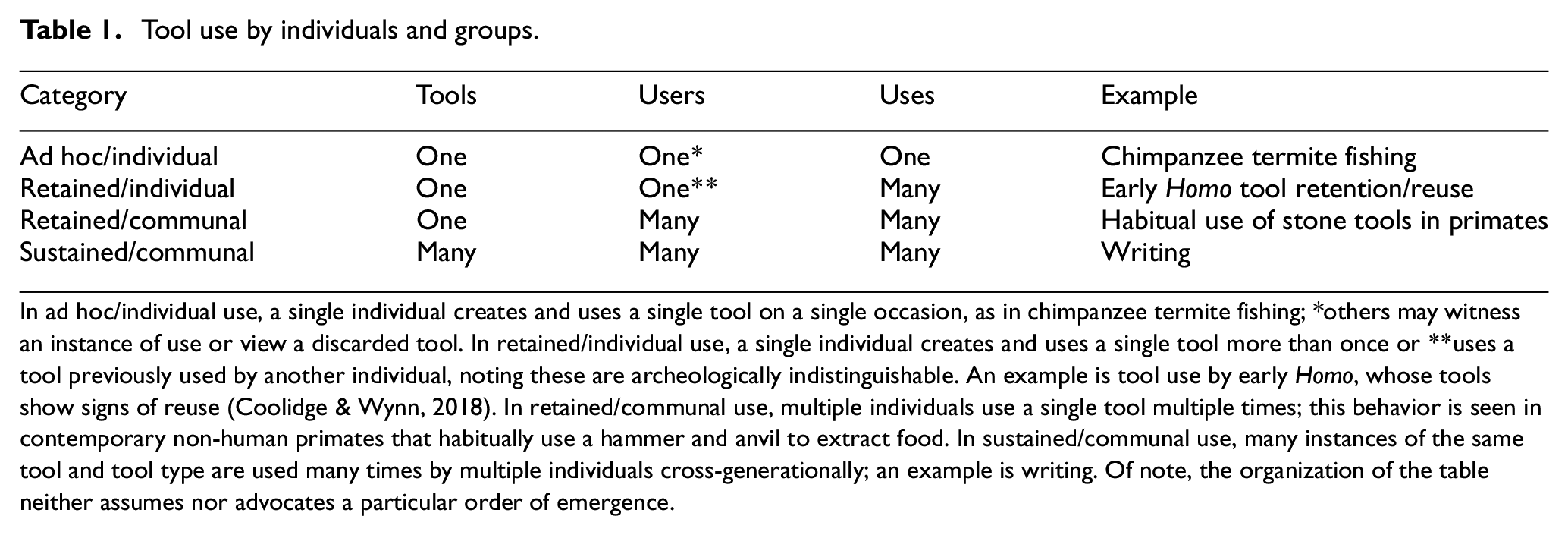
In ad hoc/individual use, a single individual creates and uses a single tool on a single occasion, as in chimpanzee termite fishing; *others may witness an instance of use or view a discarded tool. In retained/individual use, a single individual creates and uses a single tool more than once or **uses a tool previously used by another individual, noting these are archeologically indistinguishable. An example is tool use by early Homo, whose tools show signs of reuse (Coolidge & Wynn, 2018). In retained/communal use, multiple individuals use a single tool multiple times; this behavior is seen in contemporary non-human primates that habitually use a hammer and anvil to extract food. In sustained/communal use, many instances of the same tool and tool type are used many times by multiple individuals cross-generationally; an example is writing. Of note, the organization of the table neither assumes nor advocates a particular order of emergence.
As listed in the table, one end of the spectrum is ad hoc: the single use of a single tool by a single individual. This is characteristic of chimpanzee termite fishing (Sanz & Morgan, 2011; Stewart & Piel, 2014). Individuals see others creating and using the tools or their discarded forms, and they later create and experiment with their own tools. Behaviors are socially learned, and the individual proficiency required to manipulate the tool with effective precision develops across and despite creating and employing a new tool for most occasions of use. Ad hoc tools demonstrate that a material form need not be used more than once to be a tool. However, under this condition, the material form’s capacity for changing in ways that reflect its employment is negligible, limited to whatever occurs during a single use as informed by the level of familiarity and skill the user has gained from past employments of similar tools. The material form’s capacity to distribute cognitive effort is also constrained to what can be imparted through modalities of social learning, like observation and emulation.
At the other end of the spectrum, multiple copies of the same tool are used with significant repetition by many individuals across multiple generations, as in writing (Overmann, 2016). Sustained, communal use changes the material form in ways that reflect its employment for a particular task, influencing its usable features toward greater usability; in this way, the material form accumulates cognitive effort. As users learn to use the tool’s current form, they acquire any behavioral and psychological changes that are needed for its employment; in this way, the material form distributes cognitive effort. Sustained, communal use also enables the usable features of the tool, as they become pronounced, to remain synchronized to average capacities. Many factors contribute to this tool use, not just language but the ability to imitate and over-imitate motor movements (Whiten, McGuigan, et al., 2009).
The interesting cases are in the middle of the spectrum. Retained, individual tool use is exemplified by early Homo, which is associated with the earliest retouched stone tools, a characteristic implying the tools were retained and reused (Coolidge & Wynn, 2018). Retained, communal tool use is illustrated with the habitual use of hammer stones and anvils by contemporary non-human primates (Barrett et al., 2018; Carvalho et al., 2009; McGrew, 2010). For both these groups, tool use is assumed to be transmitted through social means (e.g. observation of actions and results, emulation and possibly imitation, and some ability to switch between these strategies; see Horner & Whiten, 2005; Whiten, McGuigan, et al., 2009), but not language, as well as underpinned by existing, genetically endowed capacities for learning and plasticity.
A novel behavior associated with early Homo appears in the archeological record at about two million years ago: Stone tools are retouched, implying they were retained and reused (Coolidge & Wynn, 2018). Retention and reuse are consistent with both the reuse of a tool by a single individual and the shared use of a tool by a group. While there are currently no techniques to distinguish which of these possibilities may have been the case, both have been observed in contemporary non-human primates. Retention and reuse by a single individual would have provided opportunities to develop greater awareness of usable features like extension and thickness (Gowlett, 2006), while shared use of the same tool might foster some level of common awareness of usable features between individuals. Reuse, whether by an individual or within a group, along with the repetition it implies, also increases the likelihood the material form will change in ways reflecting its use, intensifying its useful features toward greater usability.
Early Homo’s behavioral change—retaining, reusing, and possibly sharing its tools—requires some context: By the time this behavior is attested, stone tools had already been in use for about a million and a half years, given a date of 3.3 million years for the Pre-Mode I flaked tools from Lomekwi 3 (Harmand et al., 2015). It is also possible that early stone tool use has been underestimated, perhaps significantly so, as stones are likely to have also been used percussively, in addition to being used to produced flakes, and percussive use is more difficult to detect archeologically. This possibility is suggested by the widespread use of stones for percussive purposes by contemporary non-human primates. McGrew and colleagues (McGrew et al., 2019) suggest the common denominator of stone tool use by chimpanzees, capuchins, and macaques is the use of hammers and anvils to extract nuts. While this activity leaves archeologically detectible traces, these signatures can be less overt than those involving flakes (Whiten et al., 2009).
Retained, communal tool use, and possible insight into the earliest stone tool use as well, may be gained by examining the tool use of contemporary non-human primates. Using stone hammers and anvils to extract food has become habitual in a colony of Panamanian capuchins (Barrett et al., 2018). The designation “habitual” means the behavior has been observed repeatedly in several individuals (Whiten et al., 1999). In this case, the colony has used stone tools for more than 14 years (the period of observation to the point of publication) and greater than 80% of the days observed at the most active site, with the behavior occurring year-round and with more than half the identifiable individuals participating (Barrett et al., 2018). Barrett and colleagues identified several conditions as contributing to the behavioral habituation: The colony had limited access to food resources, which necessitated the use of extractive tools to exploit foods encased in hard shells. The species is also highly terrestrial, and the particular colony lives under a reduced threat of predation, conditions both permitting and opportunizing the use of ground-based tools. Other conditions would likely have contributed: Primates generally tend to be tool using and highly social, and they have hands and arms suitable for grasping and wielding objects.
Monkeys, however, tend to guard rather than share their tools (Michael Haslam, workshop comment, 9 Feb. 2018). If the key to sustained use of tools relates to conditions of need, opportunity, and sociality, the key to communal tool use may lie in their affordances. As defined by psychologist James J. Gibson (1977, 1979), an affordance is a relation between the actionable properties of a material form and the capacity of an actor to exploit them. Here, the analysis focuses on properties that attract or limit the use of stone tools. In terms of attractants, hammers and anvils afford access to critical resources, and the behavior can be transmitted through existing capacities and mechanisms (e.g. social learning). For limitations, anvils cannot be removed or exclusionarily guarded. This necessitates their being shared, often with one individual using and others looking on. As was mentioned earlier, repeated, shared use of the same tool affords some opportunity to appreciate its intrinsic features, in common and without language.
Habituation implies increased familiarity with the tool, the opportunity to develop skill in employing it, and the possibility the tool may change in ways reflecting its use. Familiarity and skill may influence tool use toward ergonomically adept ways of gripping and wielding: those requiring less physiological force, involving greater biomechanical comfort or grip security, or producing a more effective outcome. Change in the material form from repeated use, especially repeated use informed by familiarity and skill, implies an increased likelihood that tool features will intensify in ways related to their usability. This in turn might enhance the recognizability of internal features of objects being used as tools—the properties making them more grippable, wieldable, effortless, or effective—constituting a mechanism for generating a concept or category of tool, the idea being that a prototype is the association of co-occurring internal properties (Barsalou, 2008; Overmann & Wynn, 2019a; also see Table 2).
Categorical judgments.
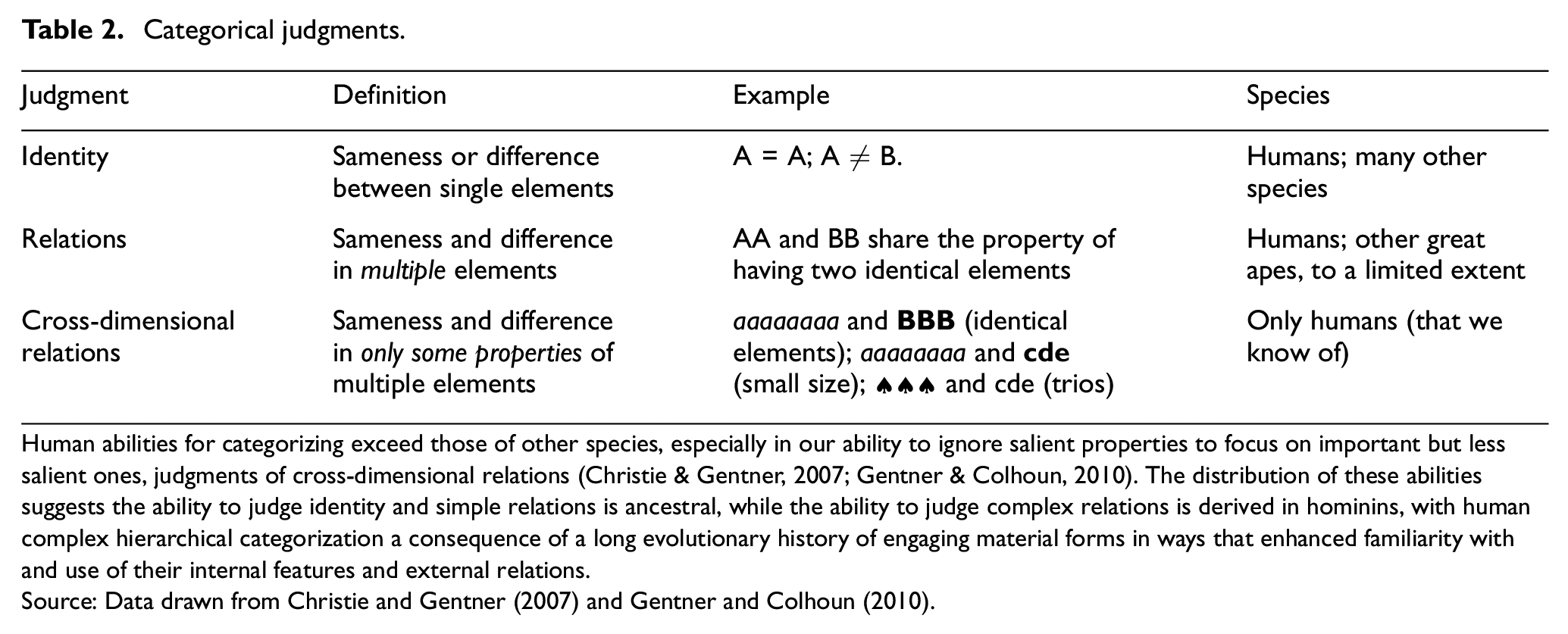
Human abilities for categorizing exceed those of other species, especially in our ability to ignore salient properties to focus on important but less salient ones, judgments of cross-dimensional relations (Christie & Gentner, 2007; Gentner & Colhoun, 2010). The distribution of these abilities suggests the ability to judge identity and simple relations is ancestral, while the ability to judge complex relations is derived in hominins, with human complex hierarchical categorization a consequence of a long evolutionary history of engaging material forms in ways that enhanced familiarity with and use of their internal features and external relations.
Source: Data drawn from Christie and Gentner (2007) and Gentner and Colhoun (2010).
Habituation and familiarity may have other effects. Carvalho, McGrew, and colleagues (Carvalho et al., 2009; McGrew, 2010) observed not just habitual but preferential tool use by wild chimpanzees, wherein they favored particular combinations of hammers and anvils rather than individual stones. Preferential use has several implications. First, the chimpanzees seem to be recognizing the two elements as comprising a functional whole. This too is categorizing, though the ability to construe complementary functionality in multiple elements differs from the ability to recognize co-occurring internal properties in objects (Table 2). The chimpanzees may also be making discriminations of tool effectiveness (Carvalho et al., 2009; McGrew, 2010), likely an effect of familiarity with multiple tools and tool combinations. Carvalho, McGrew, and colleagues also noted that repeated, preferential use of specific rocks for percussion would amplify their use-wear, increasing the likelihood they might fracture and create sharp, usable flakes through battering.
If their hammer stone were to break, how might habitual tool-using monkeys respond? Abandoning the behavior likely would not be their first reaction, given their capacities for memory and learning and the continuing conditions of resource scarcity and reduced predation. They might look for a replacement stone, since searching for resources falls within their behavioral repertoire. They might recognize as suitable a replacement with a similar look and feel to the original stone, given their ability to recognize qualities like size, mass, and hardness in raw materials (McGrew et al., 2019), their ability to learn and recognize new objects, and the familiarity, skill, and prototype availability implied by habitual tool use. They might bring a replacement back to use with the original anvil, given their habituation to the site, or they might find and use a new anvil. Behaving as they did before with replacement tools means habit and learning must provide the continuity across the change in material forms. Certainly, the preponderance of “might,”“maybe,” and “perhaps” in this hypothetical chain of events is not inconsistent with the slow and hesitant way ancestral tool use appears to have started.
3. Conclusion
Intensification of the features of stones used as tools is typically interpreted as users acquiring greater skill in manufacturing techniques and investing greater effort in making the usable features more pronounced. At some point, this would undoubtedly have been the case, but the intensification of the features of stone tool used by early hominins might also be a matter of form emerging as a byproduct of use (how form can emerge in producing stone tool has been demonstrated experimentally by Moore & Perston, 2016). Intensification means more than simply the shape a core gradually assumes as flakes are removed; it also means the emergence of features like sharp edges and grips as matters related to the functions and purposes to which the tool is applied. In a way similar to that seen in the reorganization of writing toward literacy, effects of sustained, collective use like habituation and familiarity would begin to influence the features individuating and distinguishing stone tools toward greater definition and usability. Similarly, automaticity of behaviors would free cognitive resources like attention to notice aspects of tool operation and employment, enabling these to become more deliberate. Under sustained, collective use, material forms malleable enough to change in ways reflecting their use would begin to accumulate and distribute cognitive effort, thereby influencing behavioral and psychological change between individuals and generations.
Over evolutionary spans of time, the combined effects of behavioral, psychological, and material change might influence selection through the Baldwinian mechanism previously noted. The forms such change might take are suggested by unique aspects of human brain form and function that appear related to our long history of tool use. One example is found in the human parietal cortex, a part of the brain particularly implicated in tool use (Orban & Caruana, 2014): A change in brain form with functional implications for categorizing is our ability to discern and differentiate subtle, intrinsic features of objects, known as detailed vision; this function, associated with the anterior portion of human intraparietal sulcus (IPS), appears derived in hominids since it lacks a homolog in monkey IPS (Choi et al., 2006; Lewis & Van Essen, 2000; Orban & Caruana, 2014; Orban et al., 2006). And as Malafouris has noted regarding the 2006 study by Orban et al., Of particular interest was the absence of recruitment of prefrontal cortex (PFC) activations associated with strategic action planning. These results suggest the possibility that evolved parietofrontal circuits, enhancing sensorimotor adaptation and affordance perception rather than higher abstract level prefrontal action planning systems and conceptualisations, were central to ESA [Early Stone Age] technological evolution. (Malafouris, 2010, p. 57)
Malafouris contrasted these results with a later study by Stout and colleagues (Stout et al., 2008), wherein neural activity associated with Late Acheulean knapping methods showed an increased PFC involvement, relative to Oldowan knapping methods, implying the former possibly demonstrated the “emergence of higher-levels of intentional organization in flake removal” (Malafouris, 2010, p. 57). Thus, our unique abilities for categorizing (Table 2) may well relate to our ability to discern and differentiate visually the subtle, intrinsic features of objects used as tools, capacities ultimately traceable to simple ancestral behaviors with them.
As was mentioned in some detail, writing and stone tools differ in many respects—not just the tools themselves and the species using them, but the particular movements needed to use them, the parts of the brain active during their use, and the purposes they support as well. Connecting such different technologies through their ontogenetic effects on familiarity, skill, and automaticity will undoubtedly be challenging, and the level of difficulty will only increase when we attempt to correlate them to phylogenetic changes like detailed vision. Yet when we consider the role of a material form like writing, not just in recording information but in realizing a cognitive state like literacy, we find that tools make minds (Malafouris, 2013), an evolutionary mechanism involving material forms that does not depend entirely on brains or appeal to genetic and environmental causes. It may have explanatory power that neurocentric accounts currently lack. The mechanism may enable us to explore how, when, and why our ancestors recruited and incorporated material forms into their cognitive system, exploited them to accumulate and distribute cognitive effort, and recreated phenotypic change in new individuals and generations through them, producing not just the human species as it is today but the human species as it will be in the future as it continues to respond cognitively to its tool use.
It remains to be seen whether there are further insights to be gained by considering stone tools—and for that matter, other technologies—as systems whose forms and features self-organize and intensify through sustained, collective use. Forms and features of writing like cursive, the trade-off in the level of detail for novice and proficient users, and the criticality of manual engagement may depend on capabilities that have developed within the past several million years of material engagement. These might include neural muscles and neural fossils, neural activity related to planning tool-using movements but not necessarily carrying them out (Overmann & Wynn, 2019a, 2019b); an example is the involvement of Exner’s area for handwriting in reading comprehension (Anderson et al., 1990; Roux et al., 2009). If this is the case, the forms and features of writing might not have direct parallels in other technologies per se but may suggest instead the possibility that similarly individualized effects emerge from different combinations of brains, behaviors, tools, and tool functions. Investigating this will require archeologists, primatologists, flintknappers, and cognitive scientists to adopt new ways of thinking, not only about how meaning emerges through use (the semiotic function Malafouris calls enactive signification), but how form can emerge as well, through the relations between usability, material properties, species capacities, and sustained, collective use.
Footnotes
Acknowledgements
Tom Wynn and Chris Baber also made helpful comments on workshop presentations and earlier drafts of the material.
Handling Editor: Thomas Wynn
Declaration of Conflicting Interests
The author(s) declared no potential conflicts of interest with respect to the research, authorship, and/or publication of this article.
Funding
The author(s) disclosed receipt of the following financial support for the research, authorship, and/or publication of this article: This project received funding from the European Union’s Horizon 2020 research and innovation program under grant agreement No. 785793. Additional funding was provided by the Center for Cognitive Archaeology of the University of Colorado, Colorado Springs.
