



Abstract
Biological agents need to complete perception-action cycles to perform various cognitive and biological tasks such as maximizing their wellbeing and their chances of genetic continuation. However, the processes performed in these cycles come at a cost. Such costs force the agent to evaluate a tradeoff between the optimality of the decision making and the time and computational effort required to make it. Several cognitive mechanisms that play critical roles in managing this tradeoff have been identified. These mechanisms include adaptation, learning, memory, attention, and planning. One of the often overlooked outcomes of these cognitive mechanisms, in spite of the critical effect that they may have on the perception-action cycle of organisms, is “emotion.” In this study, we hold that emotion can be considered as an emergent phenomenon of a plausible neurocomputational energy regulation mechanism, which generates an internal reward signal to minimize the neural energy consumption of a sequence of actions (decisions), where each action triggers a visual memory recall process. To realize an optimal action selection over a sequence of actions in a visual recalling task, we adopted a model-free reinforcement learning framework, in which the reward signal—that is, the cost—was based on the iteration steps of the convergence state of an associative memory network. The proposed mechanism has been implemented in simulation and on a robotic platform: the iCub humanoid robot. The results show that the computational energy regulation mechanism enables the agent to modulate its behavior to minimize the required neurocomputational energy in performing the visual recalling task.
1. Introduction
Environmental changes (e.g. food depletion and worsening climatic conditions) continuously force biological agents to evaluate a tradeoff between the optimality of the decision making, the time, and the computational load needed for making such decisions. Managing this tradeoff comes at a cost in environments in which predators are plentiful, but the computational power is scarce. One of the outcomes of managing this tradeoff, albeit not fully understood, is “emotion.” It plays potent roles in various cognitive functions of biological agents, like attention, memory recall, decision making, and reward extraction (Arbib & Fellous, 2004; Murray, 2007).
In this study, we build upon the idea that the emergence of emotion can be explained by the neurocomputational energy regulation need of an organism. To be concrete, we propose the following hypothesis: the computational shortcut mechanisms on cognitive processes to facilitate energy economy give rise to what we define as emotions (Kirtay & Oztop, 2013). Here, we use the term emotion to indicate high-level emotions (e.g. boredom) which play a role in low-cost computations rather than basic (reflex-like) emotions such as disgust, fear, and surprise. By leveraging this idea, we aim to show that the consumption of neurocomputational energy (i.e. the neural cost of cognitive processing) for visual recalling can be employed to generate an internal reward signal for action selection. As such, the selection of an optimal action can be carried out by minimizing the neural energy consumption over a sequence of decisions (actions) (Kirtay, Vannucci, Falotico, Oztop, & Laschi, 2016).
To test the proposed system and its interactions with a set of cognitive components (i.e. as information processing modules), we adopted a model-free reinforcement learning (RL) framework to guide the behavior of a simulated agent and a humanoid robot: a simple cognitive architecture involving the functions of visual perception, memory recall, action learning, and decision making. In this architecture, the actions performed by the agent to explore the environment are, for the robotic agent, movements of the neck and the eyes to direct the gaze, while for a simulated agent, they consist in the visiting of state–action pairs.
As a cognitive task, we have considered visual recalling, for three reasons. First, visual recalling is a task that can be performed both in a simulation environment and on a robot platform; this enables us to implement the proposed methods in a virtual environment and on an actual hardware setup. In this study, we employed an auto-associative network to form visual memories using visual patterns. However, other sensory modalities with different types of associative networks can also be integrated to process the stimulus in a multimodal way. Second, in the cognitive science literature, the roles of emotion are functionally linked in a number of cognitive visual task mechanisms such as visual attention, (visual) stimulus evaluation for action selection, and facilitating the storage and recalling memories (Arbib & Fellous, 2004; Pessoa, 2008; Salzman & Fusi, 2010). Finally, we hold that the implementation of this task on a physically embodied agent will enable us to evaluate the conducted experiment from the onlooker’s perspective. In this way, we can argue that the behavior displayed by the robot can be perceived as an affective state of the agent.
In a visual recalling setting, the goal of the agent is to find a sequence of visual percepts (i.e. states) that minimize the “neural cost” of performing visual recalling as the cognitive task undertaken by an auto-associative neural network. The network dynamics allows the definition of a “neural cost” for the recall process based on the prior experience of the agent and the current visual stimulus. This neural cost is used by the agent to learn the associations between energy and stimulus and thereby guide the agent’s behavior. An onlooker may interpret those visual patterns, whose recall consumes less amount of energy—thus that are more often preferred by the agent—as memories that the agent itself has the more emotional affinity with. This emergent affinity (the actions of the agent) even though merely aimed at reducing the neural recall cost, may be perceived as complex behavior regarding action dynamics that depend on the visual memories of the agent and the current visual input. As such, the neural cost of the computation and its use as an internal reward constitute the emergent emotion in our proposed system.
The proposed internal reward method might also be associated with the intrinsic motivation (or drive) of the agent: to explore this connection, we analyzed the differences between the concepts of emotion and intrinsic motivation, reviewing the relevant studies. Our agent, in each iteration, will process the visual stimulus to extract the stimulus-specific reward based on the recalling cost. In doing so, it will avoid processing the computationally expensive visual stimuli. Moreover, an intrinsically motivated agent will concentrate on the exploration of the decreasing numeric value of the reward for the exploited states. In our experiment, we used the term emotion for an emergent phenomenon that prevents an agent from searching for the best possible, yet computationally expensive decision rather than “driving” the agent to continuously engage itself in an activity (e.g. searching salient stimulus in the environment). More importantly, the intrinsically motivated agent will perform the curiosity-driven activities (e.g. play, seeking salient information) to satisfy the predefined emotions such as joy and surprise (Barto, 2013; Moerland, Broekens, & Jonker, 2018; Oudeyer & Kaplan, 2009; Ryan & Deci, 2000). On the contrary, in our experiment, there is no predefined emotion influencing the cognitive task. Instead, we observe “emotion” emerging from the behavior displayed by the agent in trying to minimize the required computational energy in making sequential decisions. That is why we interpret these behaviors as emotion-guided; in the next section we provide what is needed to support our claim, drawing from neuroscience studies.
Furthermore, in the “Related works” section, to emphasize the difference between our approach and the state-of-art studies regarding internal reward generation, we have discussed the internal reward generation methods from the intrinsic motivation and affective computing literature.
Overall, the results point out that adopting a modulatory role for neurocomputational cost-based emotion in decision making may pave the way for future designs of cognitive robots that will have the need to optimize for computational time and energy spent, both physical and computational. In that, we suggest that our study is the experimental indication that the cognitive robot architectures of the future must involve an emergent function of the emotion that is not only biologically inspired but also computationally justified. Unlike existing studies, we do not adopt a fixed set of basic emotion categories (e.g. fear, anger) or a weighted combination of them, but look for possible evolutionary arguments that might have acted to form neural structures for (high-level) emotional expressions as observable behaviors. We also do not consider any dimensional approach to define the appraisal aspect of the emotion (Scherer, 2001). Instead, we hold that emotion might be a behavioral manifestation of the neurocomputational energy regulation of the brain to facilitate fast and cheap neural decision making in the face of computationally expensive problems (e.g. visual search).
On the basis of the results obtained, we have highlighted the contributions of this study as follows. First, we proposed a novel way to extract a reward signal relying on the agent’s internal (neural) system rather than that arbitrarily assigned by the designer of the experiment. Importantly, we present that the proposed system with the same implementation procedure leads to similar results in both simulation and real-world environments. Second, in simulated and real experiments, we observed that the behavior demonstrated by the robot could be interpreted as emotion-guided and it is nontrivial regarding stimulus-energy-reward associations. Finally, we emphasize that the hardware realization of the proposed system is also an important aspect of the conducted work. To be concrete, a nontrivial behavior emerges from the robot’s internal mechanisms (i.e. associative memories and internal reward) while operating in a noisy environment; for example, reflections may substantially influence the processing of visual inputs.
2. Biological background of the proposed approach
Emotion and its mental processes constitute a vast research area. In this work, we adopt the position that—by accepting that it is not the only possible explanation—some of the emotional mental states of biological organisms may be explained by internal reward mechanisms that regulate computational energy consumption. To support our view, we first introduce the biological literature on decision making with reference to emotion-energy and energy-reward associations. Then, we present the emulation of a similar association mechanism within the perception-action cycle of an artificial agent.
2.1. Emotion-energy and energy-reward associations
Our proposal postulated that certain emotional states are due to the neurocomputational energy regulation mechanism of the neural system of the agent. Furthermore, this regulation mechanism is postulated to be used for forming the internal reward signal for making a series of decisions. To give support for this proposal, we review several neuroscientific studies indicating connections between emotion and internal reward.
The neuroscientific studies on the reward mechanisms are often linked to the neurobiological (e.g. dopamine) and physiological (e.g. learning, emotion (or affect) motivation) components of the agent (Berridge & Robinson, 2003; Dayan & Balleine, 2002). Here, we mainly address the coupling between emotion and reward. To be concrete, we have analyzed the decision making and reward circuits in the mammalian brain that has direct and indirect (reciprocal) interactions among different areas, including the amygdala (Amy), orbitofrontal cortex (OFC), sensory cortex, and basal ganglia (Haber & Knutson, 2010; Paton, Belova, Morrison, & Salzman, 2006). Some of these brain regions—that is, the Amy and OFC—also play a potent role in determining the affective (emotional) state of the agent. In particular, in interacting with other regions, they form positive or negative values for a perceived visual stimulus and manage the expectancy of the reward in a decision-making process (Moren, 2002; Paton et al., 2006).
Based on this review, we propose that an energy regulation mechanism might be a possible component linking the agent’s emotional states with the reward values in an RL framework. To ground our proposal in neuroscience, we considered energy consumption and its functions from an evolutionary perspective. The bodily energy of living beings (e.g. primates) is a limited resource to be sustained throughout their lifespans. The brain consumes a considerable amount of this bodily energy, which has been estimated at 20% (Laughlin, de Ruyter van Steveninck, & Anderson, 1998). Since the bodily energy is limited and the energy consumption by the brain is non-negligible, the neurons, neuronal codes, and neuronal circuits should have evolved to reduce the (costly) metabolic demands (Laughlin et al., 1998). In that, having a limited energy budget while being exposed to a considerable amount of noisy sensory inputs leads to selective pressure on the sensory systems of the related areas in the brain (Niven & Laughlin, 2008). For instance, the nervous system has to manage the tradeoff between the need for energy minimization and adaptive behavior generation as a response to changes in an environment (Niven & Laughlin, 2008). That is why, from these observations, we infer that the primate brain, as a large and complex organ, has been evolved to gain unique energy regulatory functions for maintaining the tradeoff between metabolic cost, information processing, and neural-bodily energy economy. For example, a biological agent may not always be able to afford the search for the best option during its lifespan; therefore, the agent needs to adopt a mechanism to regulate neural and bodily resources (Ross & Martin, 2006). For some animals, a mechanism to manage this tradeoff for decision making is already built into the perceptual system, for example, in the tectum of the frog (Arbib & Lara, 1982). However, for higher functioning species such as humans, the perceptual system must be able to work in high fidelity where other top-down neural mechanisms (e.g. visual attention) modulate its function and allow for decision making based on the environmental context and the state of the agent—that is crucial for a perception-action cycle to sustain the wellbeing of the organism. In addition to this review, we also noted that further literature findings on the emotion-energy association were provided in our previous studies (Kirtay & Oztop, 2013; Kirtay et al., 2016).
2.2. Emulation of the perception-action cycle
This study considers emotion as one of the fundamental mechanisms which emerge from managing this tradeoff (Kirtay & Oztop, 2013). To emulate the proposed mechanism in the RL framework as a simple cognitive architecture, we hold that the emotion emerges from the interactions between visual perception, associative memory, and the internal reward mechanism.
As illustrated in Figure 1, the agent employs five different cognitive components to carry out a visual recalling task. Here, we refer to components as information processing units in the designed architecture. The agent perceives a visual stimulus, processes it via an associative network, extracts stimulus-energy and energy-reward associations, selects an action to minimize the neural energy consumption, and learns the environment to sustain its life cycle. The emulated information flow among these components has been inspired by the neural pathways of the primate brain, including direct and indirect reciprocal interactions among the OFC, the sensory cortex, and the Amya (Levine, 2009; Moren, 2002; Murray, 2007).
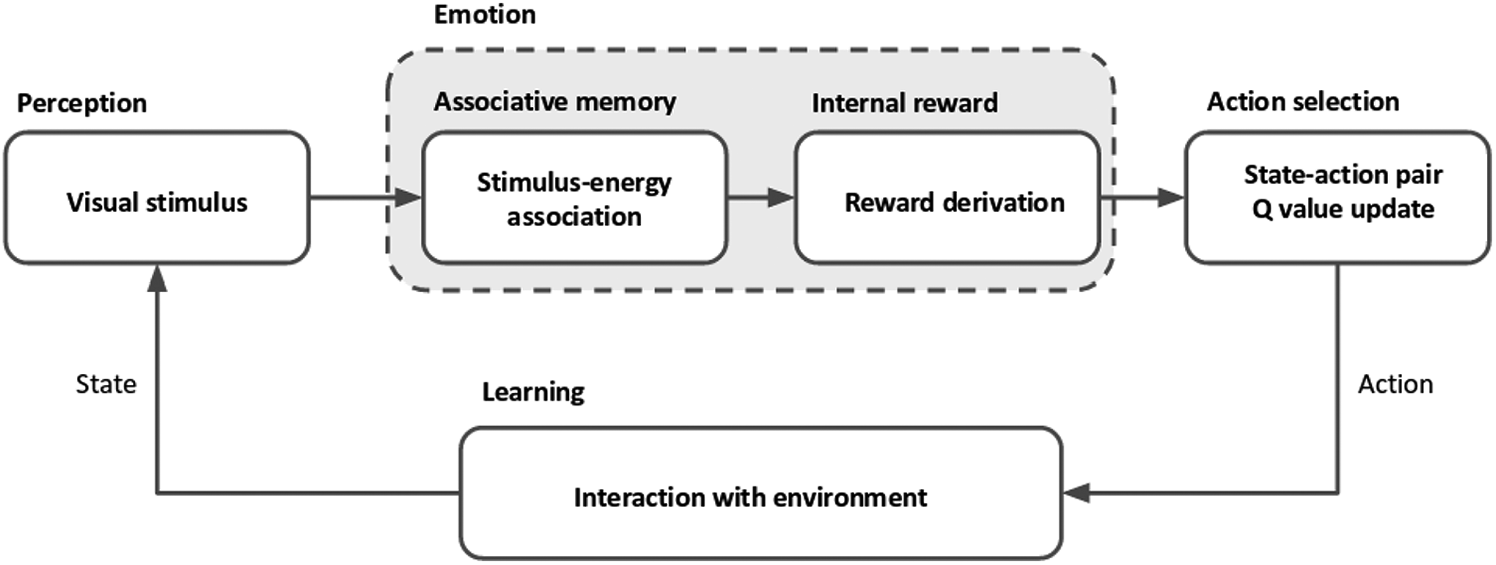
Information flow among components of the agent and their interactions to perform a perception-action cycle in a reinforcement learning framework.
The implementation of this framework presents how an agent can utilize this mechanism in a simple architecture to extract a reward value from a perceived stimulus and subsequently take a series of actions to find a region where a lesser amount of energy is required to sustain its life cycle. In this way, the agent learns the environment dynamics and how to regulate its energy while performing visual memory recalling as a cognitive task.
3. Related works
In this section, we first review, from an architectural perspective, the studies of cognitive agents that include emotion as part of their implementations. Then, we evaluate intrinsic motivation studies that consider self (internally) generated rewards in an RL framework. For the interested reader, we point out that a more comprehensive review of cognitive architectures, intrinsic motivation, and emotion-related robotics studies can be found in Barto (2013), Kirtay and Oztop (2013), Kirtay et al. (2016), and Langley, Laird, and Rogers (2009).
3.1. Cognitive architecture studies
Gratch (2000) proposed an emotional reasoning model to provide planning and reacting modules for an agent. This model was developed based on existing approaches to regulate an elicitation module for altering the agent’s behaviors. The elicitation module enables a virtual agent to operate five types of emotion: hope, joy, fear, anger, and distress. The model is employed in a simulator to show that the virtual agent is capable of planning and reasoning by appraising predefined emotions. Marinier and Laird (2008) integrated an RL algorithm with appraisal elements, emotions, and moods, to compare a standard RL agent with the agent that has appraisal elements. In this work, the task involves a virtual agent in a maze that can evaluate predefined situations such as approaching to the walls or the goal. While taking action in the maze, the software agent was designed to act via well-defined appraisals like suddenness, pleasantness, and so on. The work reported in Lin, Spraragen, Blythe, and Zyda (2011) presents a design of cognitive-emotional architecture to integrate the generation of emotion and its effects on cognitive processes. The article follows a unifying approach to selectively merge and combine the modified features of several cognitive architectures (Becker-Asano & Wachsmuth, 2010; Marinier & Laird, 2004). To be more specific, the appraisal mechanism consists of an arousal and valence node that bidirectionally interacts with the short-term memory component of the architecture. With these interactions, the mood of the agent is derived by averaging the arousal and valence values to obtain its effects on the cognitive process. Although this study benefits from a large body of previously developed cognitive architecture literature and cognitive observations, the emotion generation mechanism needs a detailed explanation regarding biological plausibility. In addition, the proposed system has not been implemented on an agent (either simulated or physically embodied) for quantitative evaluations in the real-world. Franklin, Madl, D’ Mello, and Snaider (2014) introduced a comprehensive cognitive architecture, LIDA, which has a conceptual appraisal model built on a node linking between emotion and appraisal. These conceptual terms—emotion and feeling—are considered a cognitive motivator for action selection. The cognitive architecture in this model has not been implemented on an agent to understand how the conceptual modeling behaves in a real-world scenario.
As discussed here, the studies of cognitive agents that consider emotions as a component of their designs, lack several features that exist in biological agents.
First, most of these studies focused on a categorical approach to basic emotions and their implications on agent behavior. This approach gives rise to a simplification of the complex nature of emotions and does not answer the functional characteristics of the emotion mechanism in performing a cognitive task (Kirtay et al., 2016). Contrary to this conventional approach, we consider emotions as an emergent phenomenon strictly constrained in the agent’s neural system rather than a deterministic input–output process. Integrating categorical emotions into an architecture requires well-defined rules in every state the agent perceives (which can be an external command to direct the agent). Functional integration of emotions considers in what situation emotions should emerge to create computational benefits (i.e. to accelerate learning and take a decision for immediate problems) for an agent.
Second, most of the studies mentioned above have limitations regarding the biological plausibility of the emotion mechanisms to describe its interactions with other cognitive components. We propose a simple cognitive architecture that enables an agent to form stimulus-energy associations and employ these associations to extract internal reward values while conducting a cognitive task. To this end, the agent regulates the neural energy consumption and displays behaviors that might be attributed to emotional affinity toward the specific visual stimulus.
Finally, the experimental realization of most of these architectures on real robot platforms is not available, and the proposed architectures cannot be tested in an experiment in which environmental (e.g. noise), and hardware constraints (e.g. camera resolution) are present.
3.2. Intrinsic motivation studies
Here, we review a number of self-generated reward methods from an intrinsic motivation perspective. Intrinsic motivation refers to the behavior of an agent driven by internal rewards rather than external ones from the environment; the motivation to engage in the behavior arises from its being exciting and enjoyable for the agent (Ryan & Deci, 2000).
Singh, Barto, and Chentanez (2005) proposed two different reward functions (i.e. extrinsic and intrinsic) to enable the simulated agent to acquire skills in a playroom environment. The intrinsic reward function was employed in response to salient events (e.g. changes in light and sound). In our experiments, the agent only generates an internal reward by deriving the computational cost of recalling; however, this study concerns intrinsic reward in a situation in which the agent is “surprised”—that is, perceiving a salient stimulus from the environment. In detail, if the agent is frequently faced with novel events, the value of reward decreases. Perula-Martinez, Castro-Gonzalez, Malfaz, Alonso-Martín, and Salichs (2019) proposed a reward function for Q-learning based on the wellbeing of a robot in an interaction scenario with a human. Although this study utilizes various psychological concepts: motivation, drives, and homeostasis, these concepts and their roles in the decision-making framework are predefined (Salichs & Malfaz, 2011). For instance, if the robot interacts with a user, the “interaction” drive increases. Similarly, if the robot is acting, the “rest” drive increases; on the contrary, the drive decreases when the robot is waiting. The reward function designed in Sequeira, Melo, and Paiva (2011) is based on predetermined appraisal dimensions of emotion, including novelty, motivation, control, and valence, which are adapted from Scherer (2001). The authors used the weighted linear combination of these dimensions to construct an intrinsic reward value. In detail, the agent employs an intrinsically motivated RL framework in simulated experiments in foraging scenarios.
In this subsection, we provide some representative studies from the agent-generated reward function literature. We point out that Moerland et al. (2018) provide a comprehensive review of emotion-related studies in RL frameworks.
Our proposed reward generation method differs from the studies we have mentioned, in the following ways. First, our reward function merely depends on the stimulus perceived by the agent, which employs associative (visual) memories to recall the pattern. Second, unlike these studies, in our experiments, there are no predetermined rules to guide the agent to behave in specific cases. To be concrete, there is no prior information about the environment on how the recalling task should be performed and on which decisions should be made. Finally, similar to the studies that we introduced in the cognitive architecture subsection, the robotic experiments of these studies are generally not available to understand the validity of the approach in the real-world. In contrast to the results presented in this study, they are mostly employed in game or simulation environments.
We emphasize that, in this study, we follow the same paradigm as our previous studies to assess both virtually and physically embodied agents’ behaviors under different experimental conditions (Kirtay & Oztop, 2013; Kirtay et al., 2016). The main distinctions of this study can be listed as follows: the agents operate in an environment where more state–action pairs exist and the agents are allowed to visit the same state in a row. More importantly, the agents have no a priori information (i.e. the agents do not know where to stop) about the environment, where to perform a given task while minimizing the computational energy consumption.
4. Methods
This section presents the performed methods for the components and their implementation in the RL framework. We employed High Order Hopfield Network (HHOP) to form an associative memory for the agent. This associative memory is used for recalling visual stimuli. To derive the consumed (neural) computational energy, we count the number of changed bits (i.e. bipolarized pixel values) between the converged pattern and the pattern that was received from the environment.
This energy value is used for extracting the reward value that enables the agent to learn the policy that is needed to select the best course of action. After taking a series of actions, the agent learns about the environment and moves from a higher energy state to a lower energy one.
Figure 2 depicts a comparison between a standard RL framework and our proposed model. The latter is conceptually derived from the previous, with the main difference being the way we extract reward values, as the product of internal regulatory mechanisms instead of receiving the reward signal received from the environment. We note that the implementation steps described in this section consider only the robotic agent and the same procedures are also valid for the simulated agent.
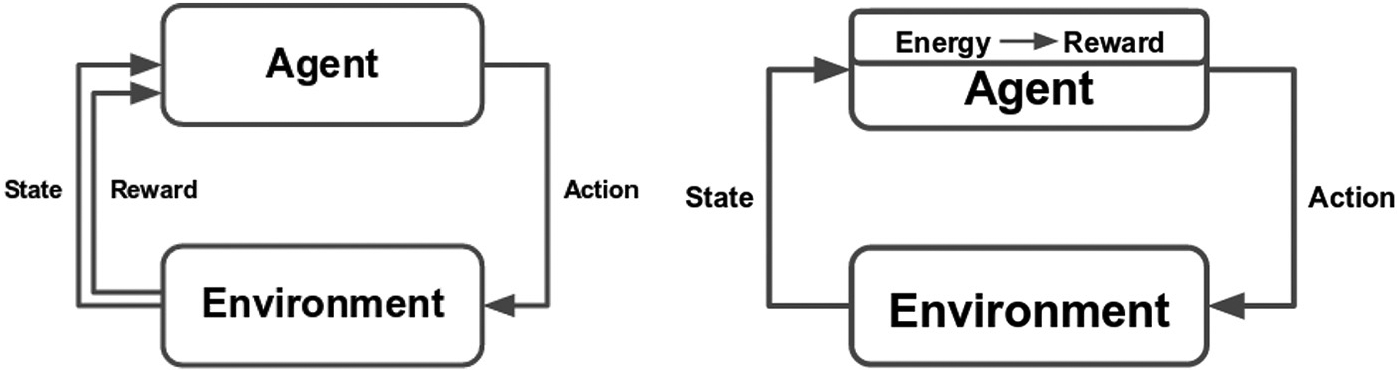
Comparison between standard (left) and our customized (right) reinforcement learning architectures. In standard reinforcement learning the reward is received from the environment, while in our custom architecture the reward is an outcome of the internal mechanisms of the agent.
4.1. Extracting reward values for perceptual processing
To process a visual stimulus from the robot camera, we employed a customized version of the Hopfield Network (Hertz, Krogh, & Palmer, 1991). In this implementation, named HHOP, the activation of each unit i (i.e. a neuron) is the sum of the products of the activations of all possible pairs of units (Chaminade, Oztop, Cheng, & Kawato, 2008) as

where

Initially, the network was trained with five different patterns, as shown in Figure 3. These patterns are selected to be either a digit or a letter. We perform the same procedure proposed in the study of Chaminade et al. (2008) to store these patterns for training.
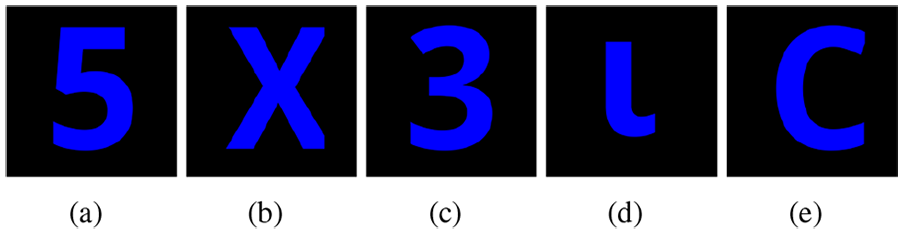
Visual patterns stored for associative memory.
The training phase starts receiving these patterns from the robot’s camera, then downsizes the patterns to

where
After initializing the weights, 20 different patterns including training patterns, noisy training patterns, and completely new patterns are shuffled to construct the scene depicted in Figure 4. The robot camera is fed with patterns composing the scene as an input pattern. The same vision and image processing algorithms are applied for each input pattern,
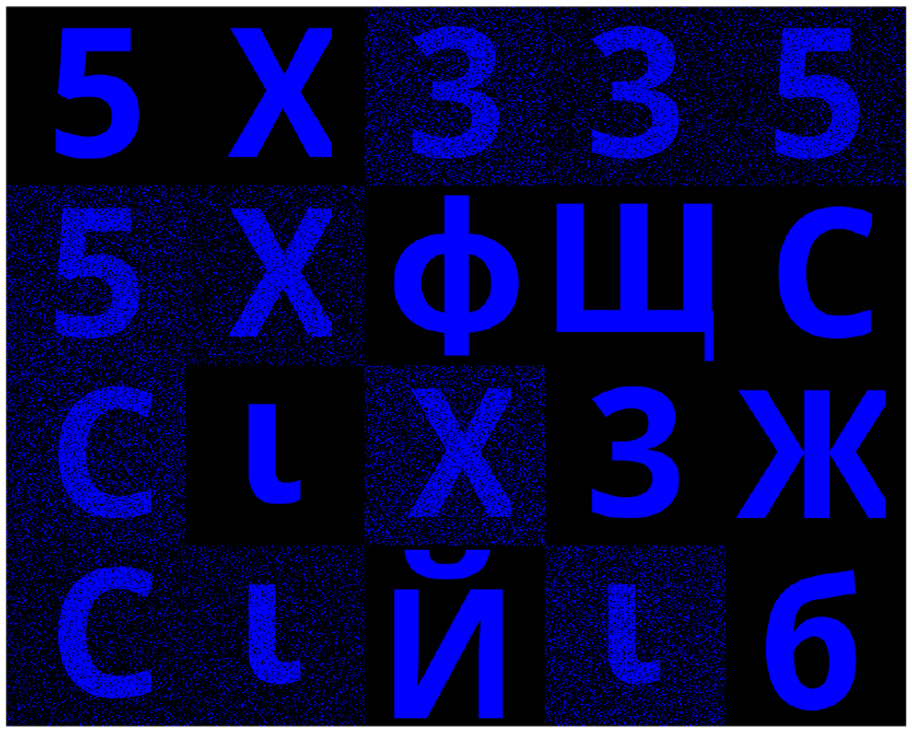
Constructed scene for visual perception.
The obtained pattern for the converged state is denoted by

Note that, due to the random activations of the units in the network, the obtained value
Recalling from Figure 2, these energy values are used to extract reward values to implement a temporal difference (TD) learning algorithm. In this way, the agent learns to shift its gaze direction toward a state (a discrete region in the scene) in order to maximize the cumulative discounted rewards. In other words, the agent sequentially learns to focus on the regions where a lesser amount of energy is required to process the given visual stimulus.
4.2. Reward value and interactions with other components
To learn the environmental dynamics with the proposed mechanism, we customized the reward function of a TD learning algorithm—namely SARSA—to carry out instructions based on an adopted policy (Sutton & Barto, 1998).
To formally define the adapted algorithm, we introduce the Markov decision process (MDP) (Ng, 2003; Sutton & Barto, 1998). The MDP framework can be described as a tuple
An action,
In the MDP framework, the agent chooses an action based on a policy,

In most MDP frameworks, the reward function, R, is often hand-crafted. Here, we extracted the reward value of an

We highlight that the agent does not have any prior information about an expected reward in any state–action pair. After a sufficient number of iterations of the Q values, for each state–action pair, the agent is able to perform sequential decision making by following the extracted policy. In other words, starting from any initial state, the agent will eventually find the states where it can perform the visual recalling task with lower energy consumption.
5. Reproducibility of the study
In order to reproduce the presented results and provide all the related data—including scripts, experiment report, parameters, figures, and images—to other researchers, we used a public repository. 1 Note that, even if the repository is frequently updated, the current state of the article with related sources can be found on the branch named ADAPTIVE2019-submission.
6. Results
The implementation of the proposed system was validated by performing experiments in simulation and by employing a robotic agent. In detail, we examined how internally rewarded actions of the agent can populate the Q-value matrix with state–action pairs and enable the agent to decide and move from a high energy consumption state to a lower one.
Here, we note that the same implementation steps were employed on the simulated agent and the iCub robot platform in order to test whether similar results can be achieved in a real-world environment, thus in the presence of hardware limitations and environmental noise. We emphasized that the agent, either simulated or robotic, performs its actions without prior information about the environment. In particular, there are no predetermined end states to stop the exploration and exploitation in the environment.
6.1. Interpretation of results
In this part, we provide an interpretation of the obtained results. First, we present the discovered states, that is, the discrete regions in the scene, at the end of each experiment, using Q-matrix values for each state–action pair. Second, to show that the discovered states are, in fact, the states in which a lesser amount of energy is consumed for the visual recalling task, we provide their average energy values. Then, we counted the number of actions that have led to moving from a high energy state to a lower one. In this case, we consider them as correct actions; otherwise, we deem them as wrong actions. Finally, we provide the cumulative reward curves to illustrate the behavior of the agent during the experiment.
6.2. Simulated agent experiments
In the simulation experiments, the possible actions consist of choosing one of the available states where a visual pattern is presented to the agent. The simulation trials were repeated 10 times for 200, 300, 400, 500, 600, and 1000 iterations. The same procedure was also applied for different learning rate and discount factors. Although the figures in this section are provided for the agent who performs TD learning with
In each iteration, the agent can select an action to move toward any discrete region in the scene, including the current. Since there are no predetermined final states to terminate the exploration and the exploitation, the agent should discover a final state or multiple final states by itself.
To test this, at the end of each trial, we first extracted the highest Q values for all the state–action pairs in order to obtain the final policy. If the learned policy leads the agent toward a subset of states (possibly a singleton), these are deemed final. We aim to demonstrate that these states are indeed the ones in which less energy is required to process that visual stimulus; moreover, the software agent is capable of regulating its internal processes by constructing stimulus-energy-reward associations. In order to learn the environment and increase the cumulative reward, the agent has to take action to move from a high energy state to a lower one.
Figure 5 shows the obtained results at the end of
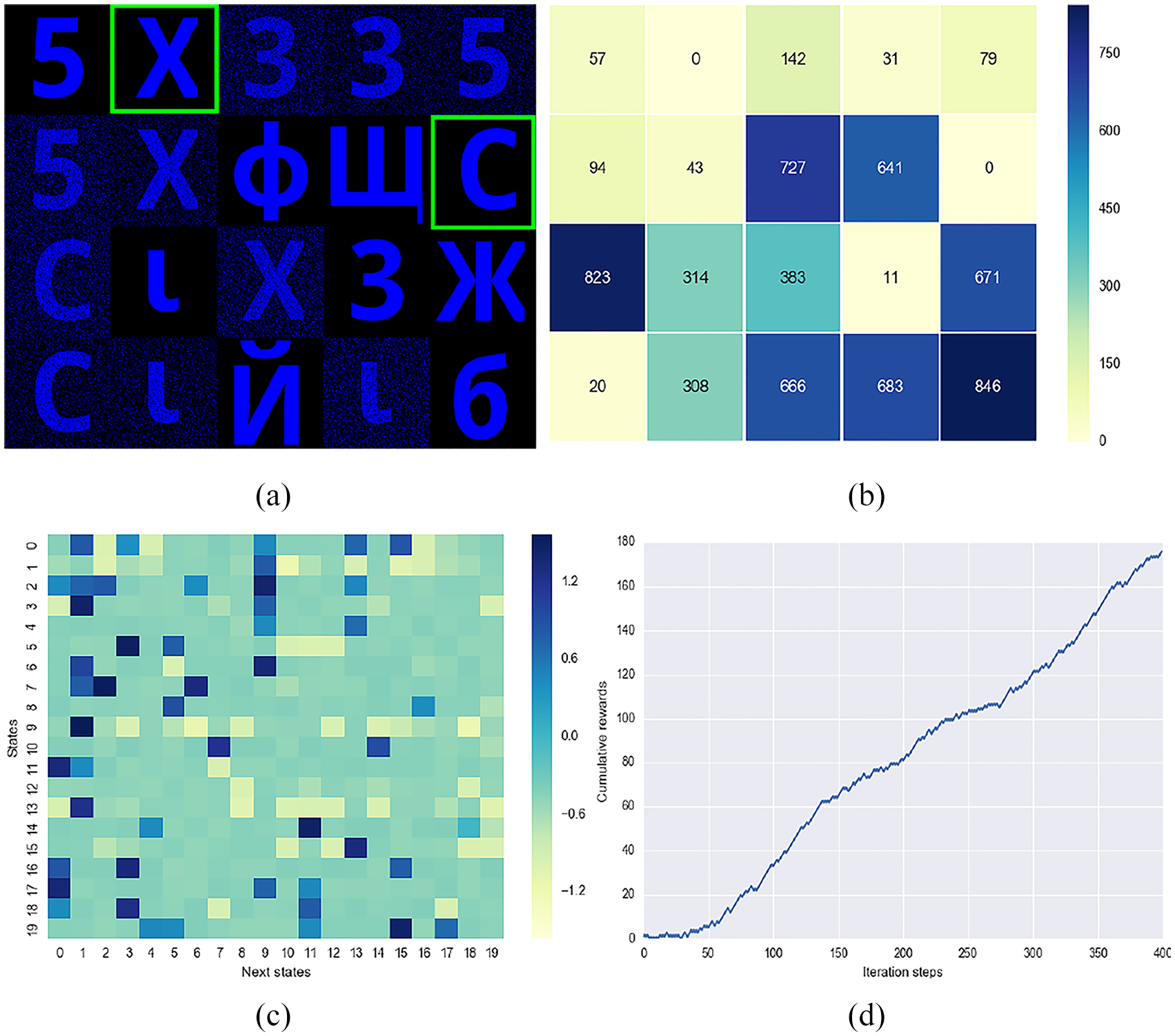
Simulated agent experiment results after 400 iteration steps: (a) Discovered final states. (b) Average energy value for each state. (c) Q-matrix heatmap. (d) Cumulative reward.
The Q-value matrix for all state–action pairs is shown in Figure 5(c) as a heatmap, where the color of each cell indicates how valuable it is to move from one state to the corresponding one. For example, if we assume that the agent is placed in state 7, it will end up oscillating between the two discovered final states where the X and C visual patterns are located (states 1 and 9). To achieve this, the agent will attend the following state sequence
This behavior is depicted in Figure 6 as a state transition diagram. In this figure, each state is represented by a full circle with the state number and the average energy value consumed in that state is reported below the circle. The dashed circles indicate the final states between which the agent oscillates. Since there is no environmental noise in the simulation experiments, though some patterns had been manually contaminated, the energy values for the discovered states are zero. Based on this state-transition diagram, we conclude that the agent found, indeed, the states requiring minimum energy for visual recalling.
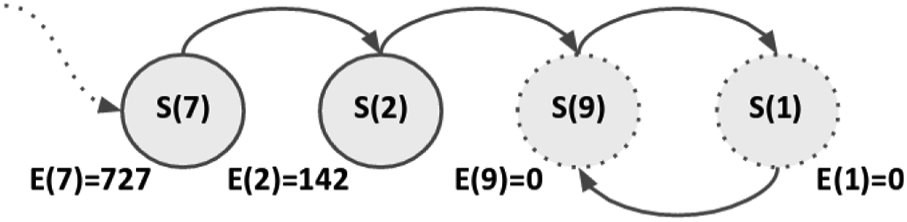
State transition diagram after 400 iteration steps for the simulation agent.
One important outcome of this experiment is illustrated in Figure 5(d), where it is shown that the agent steadily increases the cumulative reward by making decisions to move from high energy states to the lower ones. The cumulative reward is computed as the sum of all the rewards gathered during a trial. This behavior can also be observed for different iteration steps. Figure 7 illustrates the average cumulative reward curves of simulation trials.
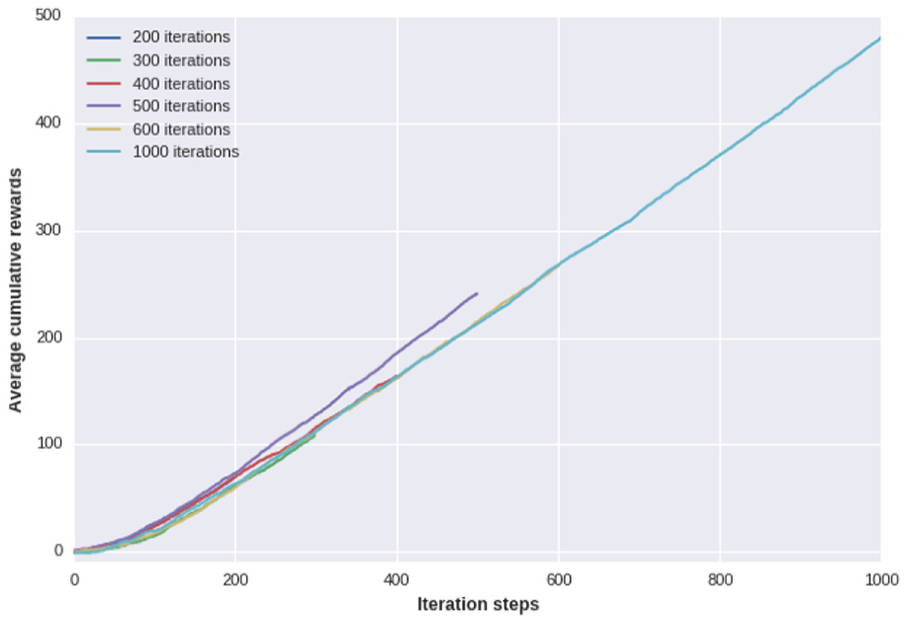
Cumulative reward curves for all iteration steps.
Table 1 shows the results for trials with different numbers of iteration steps. The table consists of eight columns which present the iteration steps, mean cumulative reward (normalized by iteration steps), standard deviation, classification of the state–action pair in the final policy, and the discovered final states. Furthermore, the columns are grouped into two subcolumns to display the numeric values for the simulated agent with different learning rates and a fixed discounting factor. To be more specific, P1 and P2 indicate the experiments where the
Experiment results for the simulated agent for all iteration steps with 10 runs.
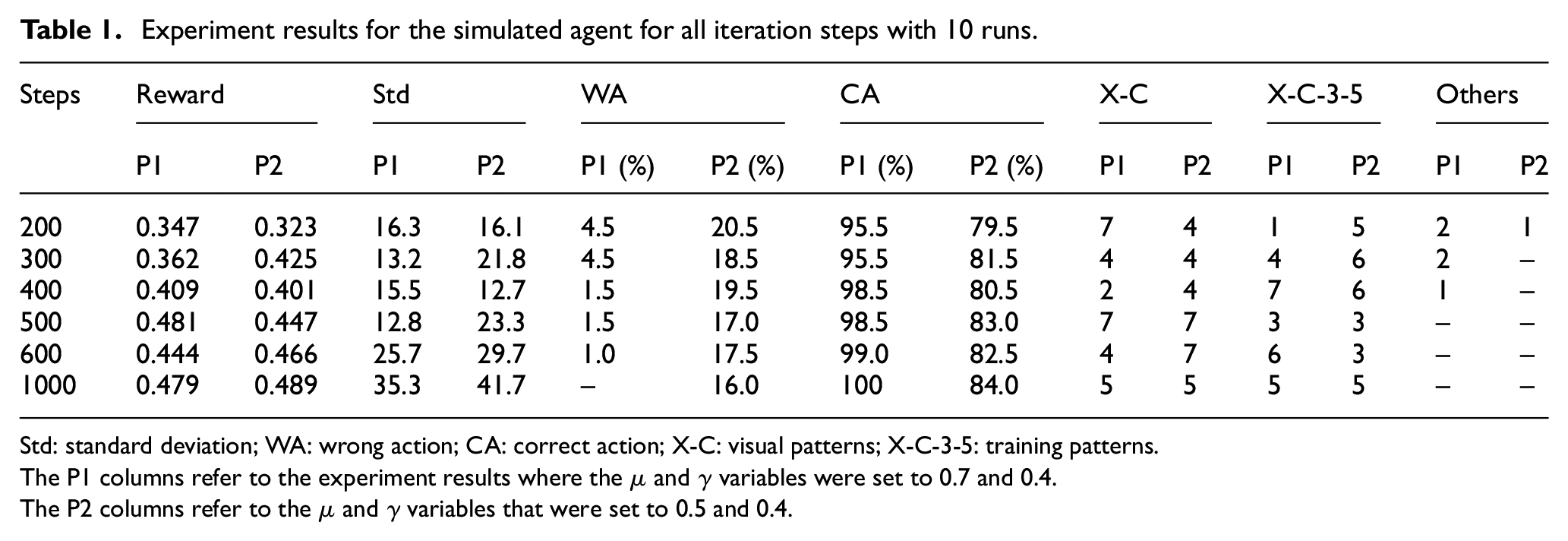
Std: standard deviation; WA: wrong action; CA: correct action; X-C: visual patterns; X-C-3-5: training patterns.
The P1 columns refer to the experiment results where the
The P2 columns refer to the
The cumulative reward value was averaged on 10 repetitions of the same trial and normalized by the number of iteration steps. As can be seen in the rows of the first column, the value of the cumulative reward increases with the number of iterations. This indicates that the more the agent performs the visual recalling task, the better the learned policy becomes. We noted that this observation is valid for both the P1 and P2 subcolumns. Moreover, to quantify the average behavior of the agent, we provide in the third column, named as Std, the standard deviation of 10 runs.
The fourth and fifth columns of Table 1 show the number of wrong and correct actions—labeled as WA and CA—taken by the agent for each iteration step. This classification is derived from the Q-value matrix of the agents (see Figure 5(c)). At the end of the experiment, we examine whether the agent moves from a high energy state to the low energy one by taking action corresponding to the highest Q-value, that is, the action given by the policy. We then compare the average computed energy for the initial state and the arrival state corresponding to the action. Recall that, if the computed energy of the initial state is higher than the energy for the arrival state, we consider this movement correct, otherwise, it is considered wrong. As can be seen in the P1 and P2 subcolumns, the percentage of correct actions increases with the number of iterations, though there exist small differences in Table 1, thus indicating an improved policy.
The discovered final states, resulting from the learned policy, are shown in the last three columns of Table 1. From the obtained results, these can be grouped into three categories. In the first category, the agent discovered a single final state corresponding to either the X or C visual patterns (state 1 or 9). In the second category, we can find policies that lead to two or more final states where the training patterns (X, C, 3, and 5) are located; these are the two aforementioned states (mostly 1 and 9) and the policies found in this category result in oscillation between at least two patterns or in creating two different attractors. It can also be observed that an increase in the iteration steps decreases the number of low energy states in the set of final ones. In the last category, the final states include other states with training patterns. However, the patterns in this category diminish with increasing the iteration steps for both the parameter settings in P1 and P2.
To assess the convergence of the behavior, we looked at the TD error plots

During the simulations, we recorded the
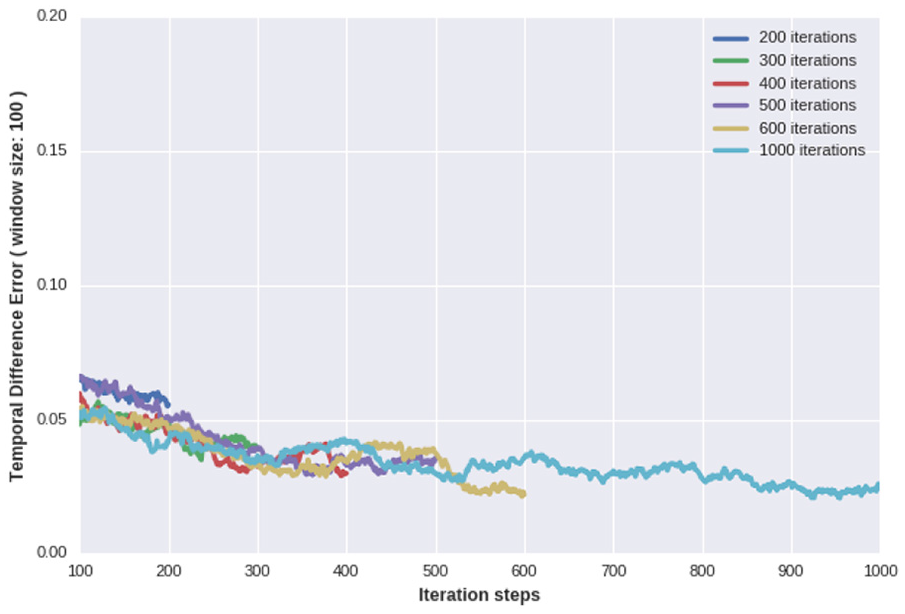
Running average on temporal difference error
6.3. Robotic agent experiment
To test the proposed system on a real robotic platform, we employed the iCub humanoid robot as a physically embodied agent. In this way, we aim to show that the proposed approach is also suitable for robotic applications in which environmental noise and hardware constraints hinder the processing of incoming visual patterns (see Figure 10).
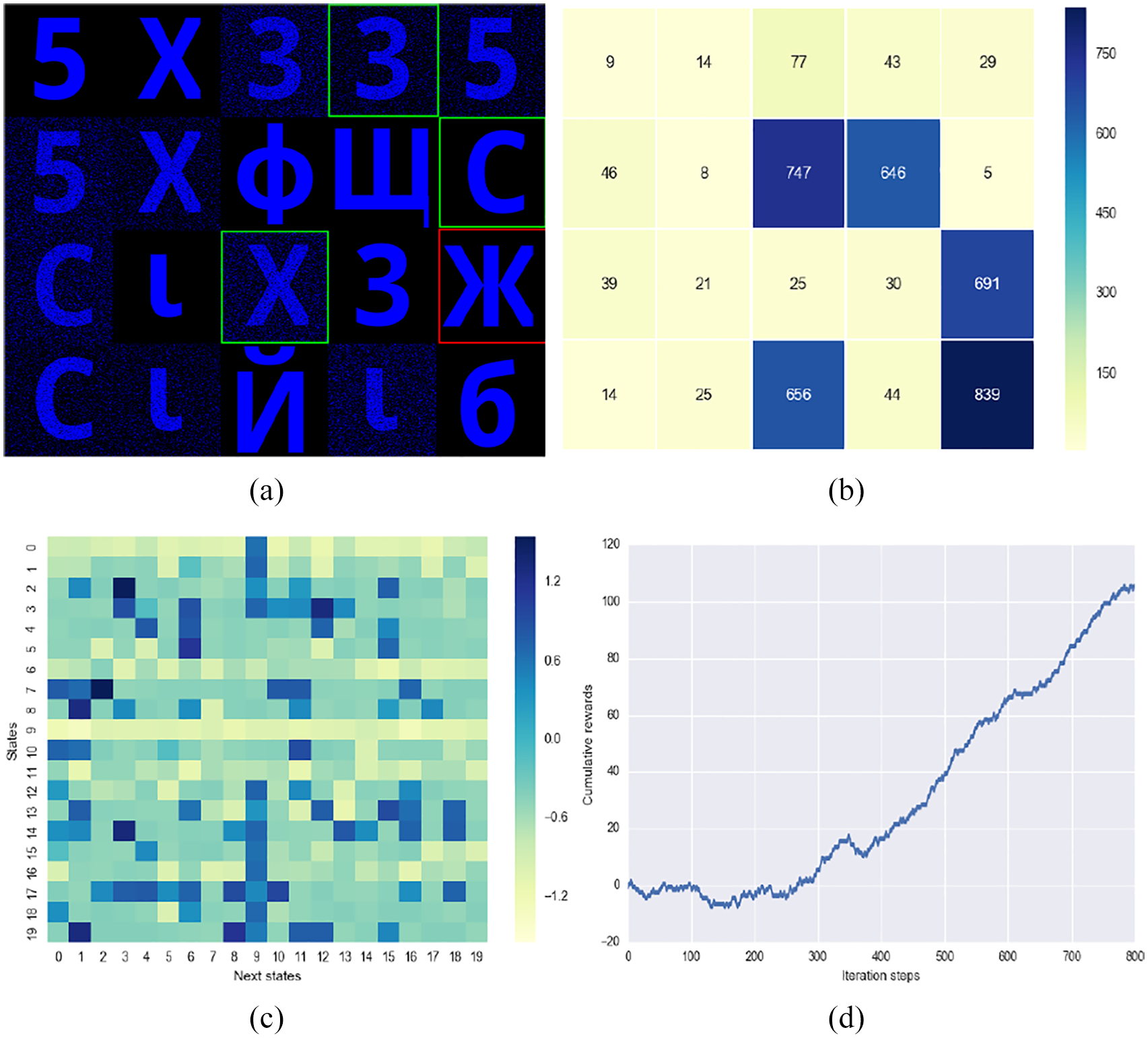
Robotic agent experiment results for 800 iteration steps. (a) Discovered final states. (b) Average energy values. (c) Q-matrix heatmap. (d) Cumulative reward curve.
6.4. Experiment setup
As shown in Figure 10, in the experiment setup the iCub robot is placed in front of a screen that displays some visual patterns. The iCub robot has two cameras that can capture images with a resolution of
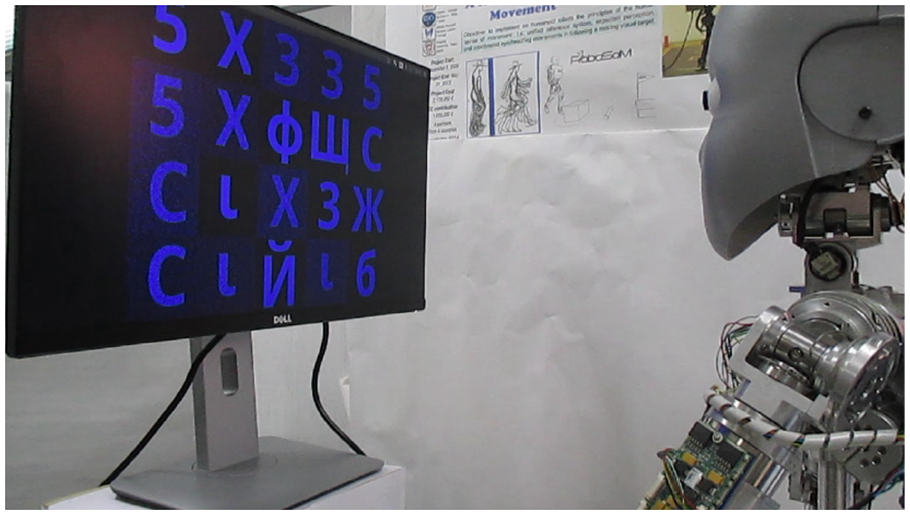
Experimental setup: the iCub robot and a scene for visual perception.
During the experiment, the robot directs its gaze toward some specific regions of the scene by employing a coordinated movement of the eyes and neck joints (Vannucci, Cauli, Falotico, Bernardino, & Laschi, 2014; Vannucci, Falotico, Di Lecce, Dario, & Laschi, 2015).
As in the simulated experiment, the physical one starts with showing a randomly generated scene to the robot. For comparison purposes, the same scene was used in both the cases (see Figures 4 and 11(a)). Each pattern in the scene shall be the target gazed at by the robot. We, moreover, define each of such patterns as a state. As shown in Figure 11, at the beginning of every iteration, the current state selected by the robot moving its gaze toward it, is highlighted by a green border. Then, a magnified version of the selected pattern, is shown to the robot for visual processing (Figure 11(b) and (c)). The scene is presented again to the agent so that an action can be chosen (Figure 11(d)). The new state is highlighted with a red border, the robot moves its gaze toward it, and the corresponding visual stimulus is given (Figure 11(e) and (f)).
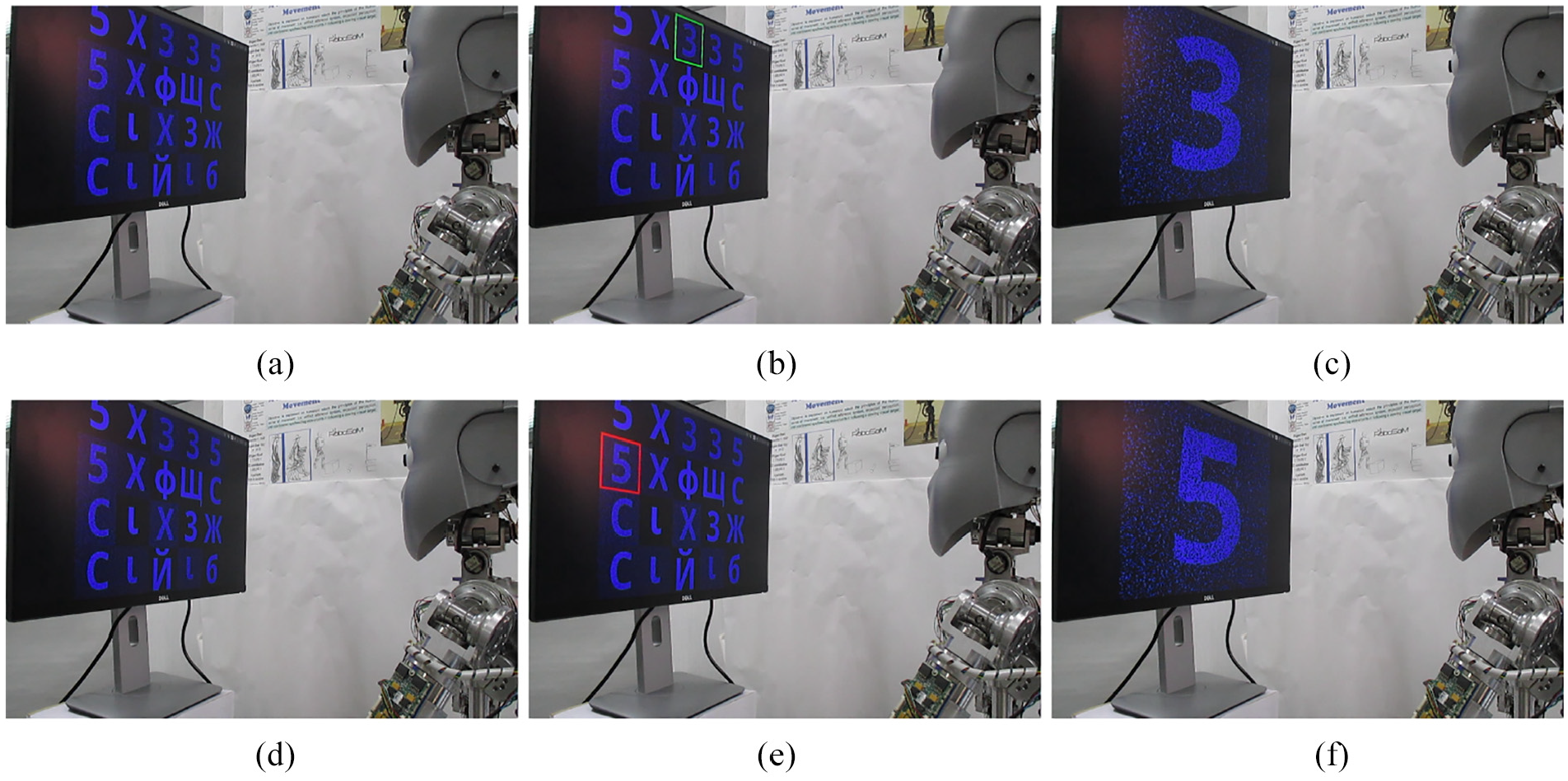
Robotic agent experiment snapshots. (a) States scene. (b) Current state. (c) Current state pattern. (d) States scene. (e) Selected action (next state). (f) Next state pattern. (Experiment media can be found in the following link:
6.5. Results for robotic agent
To evaluate the proposed approach on the iCub robot platform, we conducted an experiment for 800 iteration steps, and saved the data at the 400th step to compare the agent behavior throughout the experiment. This experiment was conducted with the same parameters as in the first simulation experiment, where
Figure 9 depicts the results obtained after 800 steps. The discovered final states are shown in Figure 9(a) with green and red rectangles. The corresponding average energy value for each state is provided in Figure 9(b). From this figure, we conclude that the noise in the environment and hardware constraints prevent the associative network to generate the same (or similar) energy values for the simulation experiments. In that, the discovered states obtained are
To be more descriptive, we provide the state transition diagram of the discovered states in Figure 12. As we explained for Figure 6, the circle indicates the discovered states and the corresponding energy values reported just below the state circles. We emphasize that regardless of the initial state of the agent, at the end of the iteration the final states will be the ones in Figure 12; moreover, the sequence of gaze direction change follows the path described by the directed arrows in the figure. It can be seen that the transition between two states will lead to lower energy consumption, except for state 14.
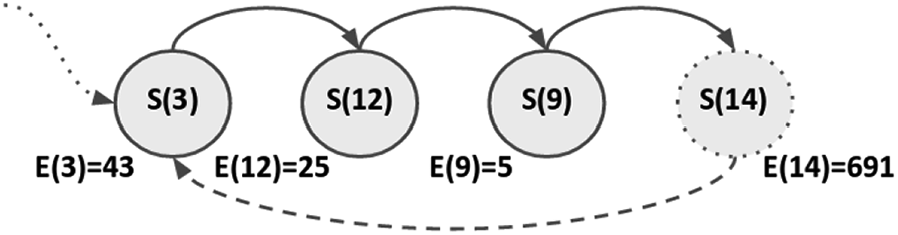
State transition diagram after 800 iteration steps.
In principle, one might expect that the agent should continuously gaze toward state 9, but such behavior cannot be learned due to the noise in the environment, for example, light and reflections. In particular, if the agent visits a state twice in a row, the obtained energy value and therefore the extracted reward values will be different, leading to oscillations in
As an important outcome of the robotic experiment, we observe that the number of correct actions increases from 80% to 90% for 400, and 800 iterations, respectively. This indicates that the robotic experiment requires more iteration steps to populate the Q matrix. We also note that the number of transition states—state with the red rectangle—decreases with the number of iterations. To be more specific,
The cumulative reward obtained throughout the 800 steps is shown in Figure 9(d). In this figure, by comparing the first and second halves of the experiment, we note that the agent needs more iterations to increase the cumulative reward. In particular, Figure 9(d) shows that after a longer initial phase, compared to the simulated trials in Figure 7 where the agent has to sacrifice some reward in order to compensate for the cost of learning, the agent steadily increases the cumulative reward up to the end of the experiment.
7. Discussions
In this section, we discuss the evaluation of the simulation and the robotic experiments, based on the results presented in Figures 5, 7, and 9. The trends in the plots of cumulative rewards are increasing for both the robotic and the simulated agent concerning the same number of iteration steps, at least after 300 steps. Both the minimum and the maximum values of the cumulative reward are higher for the simulated agent than for the robotic one, indicating that the robotic agent needs to lose more reward in the initial iterations before it starts to steadily improve the cumulative values. This observation can also be noticed from the duration of the initial phase, where the cumulative reward can get below zero for each agent. The simulated agent learns more quickly to compensate for the cost of the initial learning steps, while the robotic agent needs to take more steps for compensating the learning cost. Since the robot operates in a noisy environment and it receives contaminated patterns for visual processing, the average of the computational energy consumed for the discovered states is higher in the robotic experiment than in the simulation.
The reasons why the same implementation, with the same parameters, performs better in the simulation trials can be described by the external and internal factors of the experimental setup for the robotic agent. The external factors are mainly caused by uncontrollable environmental noise sources and limitations of the hardware, such as camera resolution, lights, and reflections. The internal factors are unique to the implemented algorithms, and they include initial values in the Q matrix for the state–action pairs, a high number of random actions due to the
To improve the robot experiment results, for the next phase of this study, the noise factor in the environment can be numerically derived by conducting multiple experiments before starting an actual experiment. This value can be used as a threshold to eliminate the transition states. Moreover, fine-tuning some parameters such as initial values in the Q-value matrix, decreasing
The obtained results from the simulation and robotic experiments highlight that the proposed system enables the agent to modulate its behavior to achieve a given visual recalling task with an energy minimization principle. In addition, the proposed method enabled the agent, in making a series of decisions, to display a nontrivial behavior regarding the consumed energy values.
8. Conclusion
In this work, we have demonstrated that emotion can be considered as the behavioral manifestations of a neurocomputational energy conservation mechanism of an agent that, for its survival, needs to make decisions and thus perform computations. Therefore, we implemented such a mechanism in a simple cognitive architecture and tested its functionality in simulation and real hardware (the iCub humanoid robot). The perception and memory-recall module adopted by the agent to construct stimulus-energy and energy-reward associations for the stimuli, presented in its visual field, was perceived from the environment. Then, the agent used these associations to learn how to make a sequence of actions to minimize the neurocomputational energy required by its perception-action cycle. By leveraging the proposed system, the agent displays a behavior that could be attributed to the agent’s emotional affinity toward a preferred stimulus.
The results show that, in a decision-making process, adopting the neurocomputational cost for a modulatory role may be a way to create rich robot behaviors that are not based on blind mimicry of biological emotions, but rather on their emergence from computationally and evolutionary valid principles. To sum up, we presented a novel approach to extract a non-hand engineered reward function in performing nontrivial behavior regarding stimulus-energy-reward association. We noted that the reward mechanism merely relies on the agent’s internal processes. The study also shows a realization of the proposed method on a robot platform in a real-world environment.
Our future studies will target a collection of cognitive agent applications with four distinct objectives. First, we will integrate the energy regulation component in a state-of-the-art cognitive architecture (e.g. LIDA) to perform more complex cognitive tasks (e.g. multimodal perception for concept formation).
Second, we will integrate more cognitive mechanisms into the architecture such as action generation, reasoning, and learning to incorporate emotion phenomenon to propose a novel (and more complex) cognitive agent architecture. Third, we would like to understand how onlookers perceive the embodied agent in executing a cognitive task driven by the emotion-like mechanism.
Finally, the reward generation method can be further investigated by employing a different type of network, such as Restricted Boltzmann Machine, to derive energy values for not only visual recalling but also multimodal sensory representation task. In addition, we envision that the proposed reward function can be considered as a new energy-based method which can be integrated into an intrinsically motivated agent in order to compare existing reward functions in the related literature.
Footnotes
Acknowledgements
The authors thank the anonymous reviewers for their invaluable and constructive comments that contributed to improving the content of the paper.
Handling Editor: Erol Sahin, Middle East Technical University, Turkey
Declaration of Conflicting Interests
The author(s) declared no potential conflicts of interest with respect to the research, authorship, and/or publication of this article.
Funding
The author(s) disclosed receipt of the following financial support for the research, authorship, and/or publication of this article: This research has received funding from the European Union’s Horizon 2020 Framework Programme for Research and Innovation under the Specific Grant Agreement No. 785907 (Human Brain Project SGA2) and the Specific Grant Agreement No. 720270 (Human Brain Project SGA1).
