



Abstract

Sackett et al. (2025) offer a valuable contribution to new venture team research by distinguishing between surface-level diversity, which refers to visible demographic characteristics such as age, gender, and ethnicity, and deep-level diversity, which encompasses less observable psychological attributes including goals and personality (Harrison et al., 1998). Their finding that deep-level diversity, particularly goal diversity, is more negatively related to initial venture viability than surface-level diversity helps explain decades of mixed findings in entrepreneurship research. The study’s counterintuitive discovery that team familiarity amplifies rather than mitigates the harmful effects of goal diversity challenges conventional wisdom about the benefits of working with people we know.
This commentary extends Sackett et al.'s analysis by examining the structural conditions that produce goal diversity in the first place. Drawing on standpoint epistemology (Harding, 1991) and Bourdieu’s (1986) concept of differential capital accumulation, I argue that the seven goals Sackett et al. measure are not only individual preferences; they also index unequal access to entrepreneurial social and cultural capital, which changes how we interpret the negative effects of goal diversity and the familiarity interaction. This structural lens reveals that what appears as psychological misalignment often reflects differential positioning within entrepreneurial ecosystems, where some team members possess the preparation, networks, and resources their teammates are still seeking to acquire.
This perspective is informed by seventeen years supporting internationally educated professionals navigating credential recognition and professional entry. Standpoint epistemology suggests such positional knowledge offers distinctive analytical purchase on structural processes (Collins, 1990; Harding, 1991).
Goal Diversity as Structurally Produced
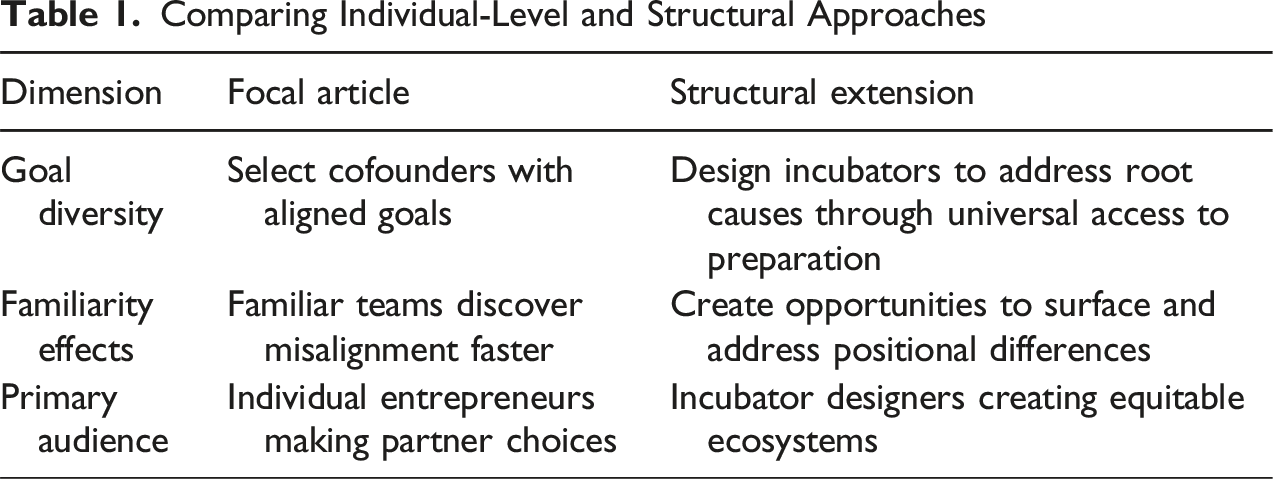
Sackett et al. (2025) identify seven distinct goals: learning about entrepreneurship, gaining entrepreneurial skills, obtaining mentorship, finding a cofounder, validating an idea, launching a venture, and securing funding. A structural reading reveals these goals map onto a developmental trajectory from novice to experienced entrepreneur, and one’s position along this trajectory is shaped by prior access to resources. Consider the distance between someone whose primary goal is ‘to learn about entrepreneurship’ and someone aiming ‘to secure funding from investors.’ The first position suggests limited exposure to entrepreneurial knowledge and networks. The second implies existing connections to investor communities, prior venture experience, and readiness for capital acquisition. These are not merely different psychological preferences; they reflect what Bourdieu (1986) termed differential accumulation of social capital—relationships providing access to resources—and cultural capital—knowledge and familiarity with dominant institutional practices.
The mechanism operates through several pathways. Unequal access to mentorship, investor networks, and entrepreneurial know-how shapes which goals individuals view as feasible and worthy of pursuit. Someone without existing connections to venture capital networks cannot reasonably prioritise securing funding as an immediate goal; they must first obtain the mentorship and network access that would make funding acquisition possible. These structurally shaped constraints influence how people prioritise learning versus execution and what time horizons they adopt for entrepreneurial achievement. The resulting variation in individual goals aggregates to team-level goal diversity, which Sackett et al. demonstrate harms early venture viability.
Reinterpreting the Familiarity Paradox
The study’s most striking finding is that team familiarity amplifies rather than mitigates the negative effects of deep-level diversity. Sackett et al. (2025) interpret this through a disclosure lens: familiar team members reveal their goals faster, accelerating discovery of misalignment. A structural reading suggests something additional. As team members engage in self-disclosure, they may discover that their differential goals stem from fundamentally different relationships to entrepreneurial ecosystems. One member may have family connections to venture capital; another may be seeking those connections for the first time. What appears as goal incompatibility may reflect structural inequality becoming visible through relationship development.
Standpoint epistemology (Collins, 1990; Harding, 1991) suggests that individuals occupying marginalised positions often possess distinctive knowledge about how systems operate. Team members who enter incubators seeking learning and mentorship may come to recognise, through deepening familiarity, that their teammates’ more advanced goals reflect advantages unavailable to them. The conflict that ensues may be less about personality incompatibility than about the discomfort of structural inequality becoming explicit within intimate working relationships. This structural interpretation suggests observable patterns: familiar teams might show earlier emergence of status asymmetries around ecosystem knowledge, with conflict episodes clustering around access to and control over external ties such as mentor introductions and investor meetings.
What the Structural Lens Changes
Comparing Individual-Level and Structural Approaches
Conclusion
Sackett et al. (2025) make an important contribution by demonstrating that deep-level diversity, particularly goal diversity, matters more for initial venture viability than surface-level diversity. This commentary has argued that goal diversity often reflects differential structural positioning rather than merely psychological preference. Adopting this structural lens does not diminish the focal article’s contribution; it extends the analysis by asking what produces the diversity that subsequently affects team outcomes. The authors acknowledge that ‘entrepreneurs sometimes have an unrealistic list of attributes they are looking for in a potential partner’ (Sackett et al., 2025, p. 19). Perhaps the unrealistic expectation is not the criteria themselves but the assumption that all potential partners have had equal opportunity to develop those attributes before entering the room. When goal diversity reveals structural inequality, the question becomes not only how to select aligned partners but how to create ecosystems where alignment becomes possible for everyone.
