




Abstract
Employers are investing heavily in mental health (MH) support for workers, yet employees often do not know about these offerings, limiting their potential for impact. In this study, employees (n = 128) were asked to contact a knowledgeable company representative to confirm whether nine common MH offerings were available. Before and after this, employees reported their perceptions of their company and its MH climate. Results reveal that simply asking and receiving information about MH offerings improved employees’ views of their company. Employees who discovered more offerings, because they asked, reported improvements in their view of the company. This study indicates that simple, low-cost strategies boost awareness of existing benefits, which can in turn improve how employees see their workplace. With rewards and benefits often complex and costly, this study shows that small, targeted actions can enhance their value and impact.
Keywords
Employers are spending more than ever on programs and resources to support their employees’ mental health (MH; see Thomas et al., 2025 for a thorough discussion on the term mental health). They make these investments for varied reasons, including legal compliance, mitigating loss, and to improve/maintain their desirability to workers (Deloitte, 2019). Despite high availability (Mercer, 2025), many workers continue the well-documented practice of not using them. For example, employee assistance programs (EAPs), offerings purpose-created to support employee MH, are available and free to use for 70%–90% of full-time U.S. employees, but only 5%–7% of employees use their EAP each year (Agovino, 2019). This matches employees’ tendency to not use and know about the full potential of their benefits, broadly (Voya, 2021). If employees do know too little about the support they can utilize, they are unlikely to use that support—even if they need it (Adams et al., 2022; Mejicano Quintana & Duxbury, 2025).
But awareness of available support improves more than potential utilization. Just knowing that their company has invested in employee MH can satisfy some employee expectations of their employers. Although these expectations may not be overtly stated, employees carry them, and their perceptions of employers suffer when expectations are not met (Tekleab et al., 2005). Evidence clearly indicates employees are expecting MH offerings in the modern workplace (Adams, 2021). In the case of workplace support, when employees know their company is going beyond what’s required in supporting employees—exceeding what is expected of the business—they report drastically warmer perceptions of their company (Eisenberger et al., 1997). Thus, employees’ awareness of their company’s MH offerings holds value as an antecedent of utilization and perceptions of their organization. A recent meta-analysis indicated that benefit availability bears stronger desired relationships with outcomes like employee perceptions, commitment, and satisfaction than using the benefits (Hong et al., 2024).
Companies’ investing in their employees’ MH, in the form of support programs and offerings, serve as a tangible signal of the company’s support, their concern for employees. Leaders and businesses can claim benevolent regard for supporting workers’ well-being, but (not) spending on resources to actually foster well-being communicates to employees the truth of those claims (Zhang et al., 2012). Beyond affecting employees’ perceived organizational support (POS), or the extent to which employees believe their company values their wellbeing, as a person (Eisenberger et al., 1997), these signals can communicate details about the mental health climate (MHC), the formal and informal social systems that make MH support available and acceptable to discuss at work, in their workplace. Companies with positive MHC maximize the use and benefit of support offerings for MH (Kelloway et al., 2023). MHC, like awareness of offerings, then serves as an important predictor of usage behaviors.
In this study I examined employees’ awareness of their workplace’s offerings for supporting MH and demonstrates an efficient method to improve that awareness, and workers’ perceptions of their companies as a result. I focused on two outcomes of increased awareness, POS and MHC, and predicted that:
I use the term awareness intervention to succinctly capture a process wherein employees receive instructions to take specific actions that are intended to increase their awareness. I detail the intervention below, but it effectively includes an employee asking a knowledgeable member of their company about available MH offerings. Compared to a process where the company initiates communication about MH offerings, I featured the employee soliciting information about MH offerings. For employees, the distinction between receiving solicited and unsolicited information merits consideration beyond the scope of this study (Landis et al., 2022), but the intervention intended to provide employees with solicited information, raising their awareness, about their MH offerings.
Methods
Sample
Full-time employed adults (n = 200) were recruited to participate in this study, via Prolific. The sample featured 121 men (61%), primarily white (80%) respondents from the USA with other racial groups represented (Asian, Black, Other each 5%-6%), whose average age was 38.33 years (SD = 10.42 years). In exchange for participation, every respondent received payment.
Design (Awareness Intervention)
All respondents were recruited to participate in a 3-part study and received compensation for completing each Part. In Part 1, all respondents answered three question sets: Workplace MH Offering Awareness/Availability (9 items): All respondents were presented with a list of 9 commonly offered MH support programs and asked, for each, “Is this offering available to you at your job?”, to which they could respond “Yes”, “No”, or “I don’t know”. Perceived Organizational Support (7 items; alpha
1
= .93, 95% CI [.92, .95]; alpha
2
= .93, 95% CI [.90, .94]; Hochwater et al., 2003): All respondents were presented with items like “My organization considers my goals and values”, to which they could respond using a 5-point Likert-type agreement scale (1 = Strongly Disagree; 5 = Strongly Agree) Mental Health Climate (5 items; alpha = .88, 95% CI [.88, .91]; alpha = .89, 95% CI [.86, .92]; Zweber et al., 2016): All respondents were presented with items like “My organization provides me opportunities and resources to be mentally healthy”, which they responded to using the same 5-point agreement scale (1 = Strongly Disagree; 5 = Strongly Agree).
At the end of Part 1, respondents received instructions for Part 2 (i.e., the intervention), which effectively asked them to contact their HR or benefits representative in their workplace and ask which of the 9 offerings listed in the questionnaire was available to them at their job. Respondents were told to complete this request, receive an answer to all 9 items (i.e., “do we have this?”), then return for Part 3. All respondents could begin Part 3 as soon as they received an answer.
Part 3 was a repeat of Part 1, except the first question, which asked “Did you communicate with a member of your company and receive an answer to the questions you asked in Part 2 of this research study?” People who had completed Part 2 and returned for Part 3 (n = 128, 62% retention rate) then completed the same items asked in Part 1.
In short, employees asked a knowledgeable member of their company whether their workplace supplied each of 9 common workplace MH offerings. Fundamentally, I explored the effect of employees’ inquiries about their offerings, and any resulting changes in their awareness, on employees’ reports of POS and MHC at work.
Results
Count of Availability and Awareness by Sample & Part for Common Workplace Mental Health Offerings
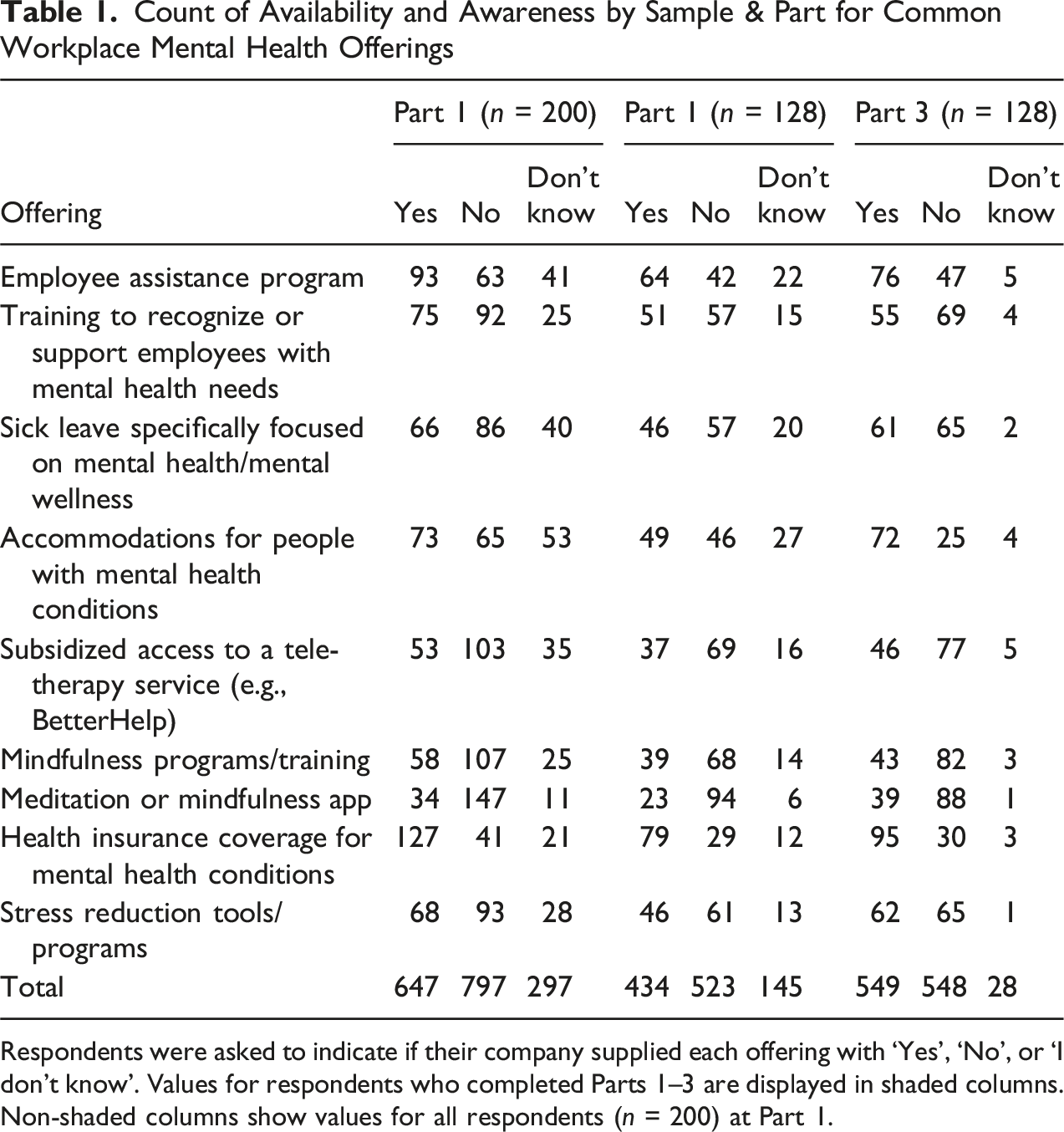
Respondents were asked to indicate if their company supplied each offering with ‘Yes’, ‘No’, or ‘I don’t know’. Values for respondents who completed Parts 1–3 are displayed in shaded columns. Non-shaded columns show values for all respondents (n = 200) at Part 1.
Effect of Awareness Intervention
The study focused on whether an intervention to raise employees’ awareness of their MH offerings would impact their reports of POS and MHC. First, I tested whether the intervention (i.e., Part 2) actually increased awareness of MH offerings (i.e., a manipulation check). I compared the rates of “I don’t know” answers received in Parts 1 and 3, among the people who completed all Parts. If the rate of not knowing about the availability of MH offerings decreased, then the intervention worked to raise awareness. Among the participants who completed all Parts, in Part 1, there were 214 “I don’t know” responses reported (cf. 40 “I don’t know” responses in Part 3), a statistically significant lower proportion of “I don’t know” responses, according to a Chi-Squared Test, χ2 (1) = 99.56, p < .001.
Additionally, I examined how many respondents discovered a greater (52% of sample) available set of offerings in Part 2, how many respondents discovered a smaller (16% of sample) available set of offerings in Part 2, and how many respondents discovered no change (32% of sample) in the number of offerings in Part 2.
Effect of Awareness Intervention on POS and MHC
First, I tested whether completing the awareness intervention (i.e., Part 2), resulted in a change in employees’ POS and MHC reports. I used a simple quasi-experimental approach, treating completion of the intervention as an independent variable. I employed a paired-samples t-test to examine average changes in POS and MHC from Part 1 to Part 3 (i.e., because of the intervention) for all respondents who completed all Parts.
The results of this comparison indicate that, when employees completed this awareness intervention, they reported higher levels of POS, t (127) = 1.67, p = .098 d = .15 (Hypothesis 1) and MHC, t (127) = 0.38, p = .702, d = .03 (Hypothesis 2), although these changes were not statistically significant. For both variables, the increase from Part 1 to Part 3 was not statistically significant. However, the magnitude of the change was much larger, as indicated by effect sizes, for POS (cf. MHC).
Effect of Awareness of Greater Availability of Offerings on POS and MHC
Compared to simply completing an awareness intervention, employees may also, because they asked, have discovered their workplace offers more support for MH than they previously know. The awareness intervention, for these employees, made them aware of more support (cf. raising the accuracy of their awareness). To test whether the awareness intervention’s impact on awareness of available offerings (i.e., finding out about more support because they asked), I isolated the data for the 67 respondents whose total number of “Yes” responses, individually, increased from Part 1 to Part 3. With only this subset of data, I used a paired-samples t-test to examine how POS and MHC levels changed from Part 1 to Part 3.
The results of these comparisons indicate that the intervention’s resulting awareness of more offerings resulted in increased levels of POS t (66) = 2.62, p = .011, d = .32, 90% CI (.07–.56) (Hypothesis 1), and MHC t (66) = 1.79, p = .079, d = .22, 90% CI (.03–.46) (Hypothesis 2). Here, the much larger effect sizes reflect how employees discovering more available MH offerings affects both POS and MHC levels. In the Appendix, I describe the results of parallel tests, comparing POS and MHC levels between Parts 1 and 3, for the people who discovered fewer resources (n = 20) or no change in resources (n = 41) because of the intervention.
Conclusion
Figure 1 displays results for all Part 1–Part 3 contrasts. Simply increasing awareness (i.e., reducing “I don’t know” rates) did not produce a statistically significant increase in POS or MHC. However, for those people who, by asking, became aware of a greater amount of support offerings from Part 1 to Part 3, POS increased significantly, while MHC approached statistical significance, with small to moderate effects whose confidence intervals did not cross zero. Asking about available MH offerings did increase both POS and MHC for respondents, although the differences were only significant for employees who found out about additional offerings by asking. Simply asking, it seems produced an effect on POS, whereas people finding out their company offers more offerings than they previously knew affected both POS and MHC levels. This study offers a first step for future research to further explore this kind of intervention’s impact on employee perceptions, including testing the change in available resources (e.g., reporting fewer “Yes” responses as a result of asking) or testing the change in awareness of a specific type of MH offerings. Among a larger sample of employees, one may determine that becoming aware of a specific offering’s availability may produce an outsized impact on outcomes. Effects of increased awareness or availability of MH support on MHC and POS by group and time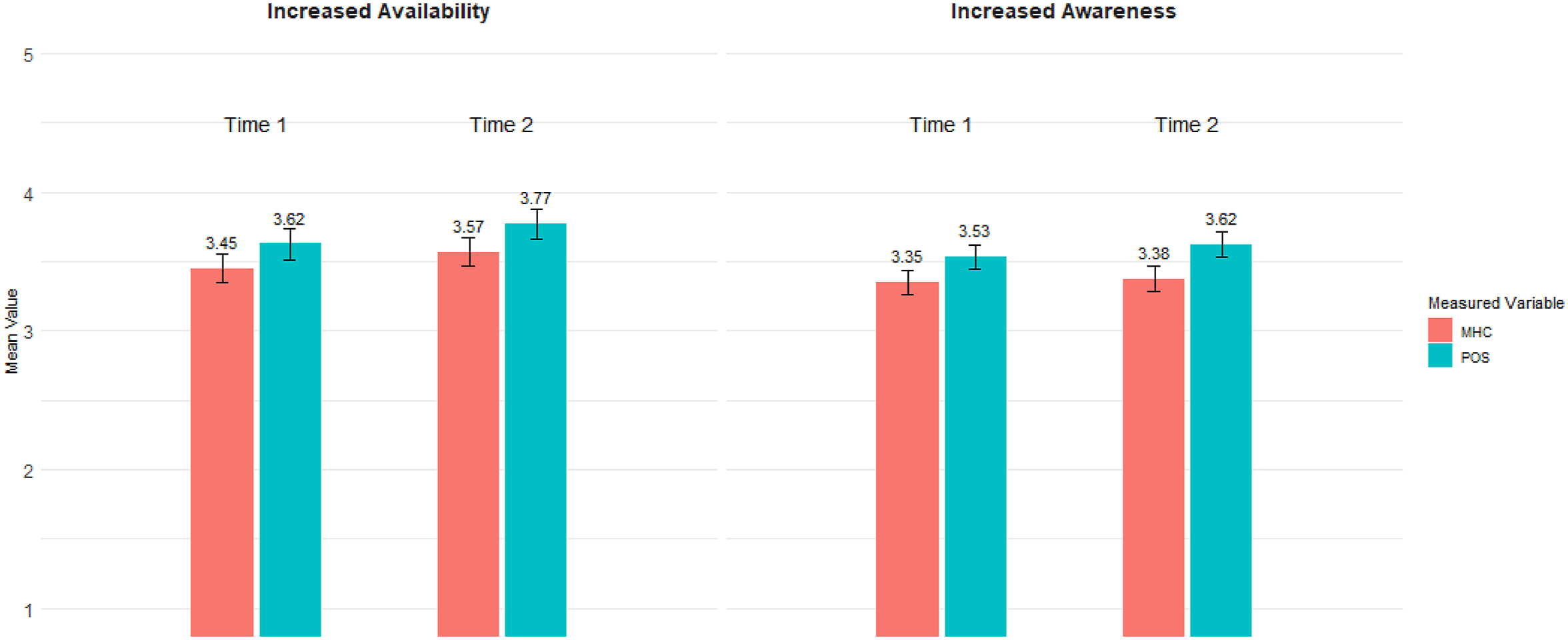
Discussion
For business leaders wanting to maximize the benefits of their investments in formal programs to support employee MH, this study reveals three important details. First, many employees do not know the full extent of their available MH resources—more than half of employees in this sample discovered additional offerings simply by asking specifically about them. Second, when employees ask about their MH offerings, regardless of the answer they receive, it can improve their perceptions about their company’s benevolent motives, which aligns with research about the prosocial attributions of receiving solicited information (Landis et al., 2022). Third, when employees discover their workplace offers more MH support than they previously knew, their perceptions of their company’s support and its MHC can increase.
Compared to fuller employee benefit education options, like polished handouts, email blasts, or brochures, the communication in this study was informal and direct. The communication, in its simplicity, generated small-to-moderate effects on employees’ views of their company’s intentions, especially when the communication revealed a greater range of support to the employee. These results are qualified by a relatively underpowered sample size that does not allow for a full test of the effects’ impact. Statistical tests were not uniformly significant, although effect sizes, which are less subject to sample size issues, indicate the simple communication and awareness action can improve employee perceptions. Leaders and managers, then, may consider proactively communicating with employees, to tell them about their available MH support resources, ideally with a brief description (i.e., 1 sentence) for each. These findings, then, support the value of very simple, fundamental user education for employees to better grasp their benefits’ function and ease of access (Kuykendall et al., 2021). Without knowing of a benefit’s availability and function, employees are unlikely to use it and unlikely to consider it as part of their employers’ investment in them (Fulmer & Li, 2022). Onboarding and open enrollment are inadequate windows for such education, especially when most adults lack basic confidence and knowledge surrounding topics like MH and MH support (Furnham & Swami, 2018). In short, this study demonstrates that employees often do not know all their available MH resources, which threatens to waste leaders’ investments. This study demonstrates that a quick communication exchange can raise awareness. Many issues surround employees’ knowledge of, confidence to use, and valuation of their ancillary benefits at work. This research may contribute to additional work on what businesses can do to maximize the value (i.e., awareness, use) of these rewards, for their strategic and employees’ benefit.
Supplemental Material
Supplemental Material - Employees Know Too Little About Workplace Mental Health Offerings, Simple Communications Can Produce Positive Impacts for Them
Supplemental Material for Employees Know Too Little About Workplace Mental Health Offerings, Simple Communications Can Produce Positive Impacts for Them by Benjamin J. Thomas in Group & Organization Management
Footnotes

Funding
The author received no financial support for the research, authorship, and/or publication of this article.
Declaration of Conflicting Interests
The author declared no potential conflicts of interest with respect to the research, authorship, and/or publication of this article.
Supplemental Material
Supplemental material for this article is available online.
Notes
Author Biography
References
Supplementary Material
Please find the following supplemental material available below.
For Open Access articles published under a Creative Commons License, all supplemental material carries the same license as the article it is associated with.
For non-Open Access articles published, all supplemental material carries a non-exclusive license, and permission requests for re-use of supplemental material or any part of supplemental material shall be sent directly to the copyright owner as specified in the copyright notice associated with the article.
