



Abstract
As societal attention to the political beliefs of business leaders has grown, the organization and management literature has evinced numerous differences in strategic decision-making attributable to executives’ ideologies. While the individual tendencies of liberals and conservatives provide a convincing mechanistic explanation within the upper echelons tradition, this perspective largely treats group-level ideological composition as static, overlooking the interpersonal processes through which ideological biases are generated and expressed within top management teams (TMT). Taking a novel role-theoretic approach, this study addresses these overlooked intraorganizational antecedents. We theorize and demonstrate that CEO partisanship increases ideological polarization and homogeneity in the TMT, proposing that CEOs with more extreme political views shape the ideological composition of their teams via two pathways. Contrary to prevailing assumptions, we find weak evidence for ideological homophily in executive selection. Rather, executives gradually shift towards the ideology of their CEO over their shared tenure, implying the dominance of a socialization mechanism based on interpersonal influence rather than structural power. A study of 823 U.S. firms over 21 years shows that these effects operate independently of the CEO’s political position but are intensified under liberal and female CEOs, further supporting an interactionist explanation. Complementary analyses of executive selection events and comparative trajectories of individuals’ political activity provide mechanistic evidence, and we identify temporal contingencies that reflect broader sociopolitical shifts. These findings contribute a processual explanation that extends causal understanding of how and why ideologically motivated decisions emerge from group contexts, with implications for theory, governance, and stakeholder management.
Keywords
Introduction
Recent scholarship highlights the pervasive influence of political ideology on organizational behavior and strategic decision-making (Busenbark et al., 2025; Georgakakis et al., 2025; Gupta et al., 2025; Hudson, 2025). Firm-level outcomes often reflect the political positions of their leaders (Gupta et al., 2021; Semadeni et al., 2022), demonstrating the power of upper echelons (UE) theory to understand this prevalent and contentious phenomenon (Hambrick & Wowak, 2021; Wright, 2023). Yet, the UE perspective has limitations, typically treating ideology as a preexisting characteristic of the top management team (TMT) (Georgakakis et al., 2024). This overlooks the intraorganizational processes through which politically motivated leaders and strategic decisions arise (Fezzey et al., 2024; Hudson & Morgan, 2022).
The necessity of understanding these processes is increasingly visible in the public sphere. A growing literature on CEO activism documents the rising tendency of leaders to take public stances on controversial sociopolitical issues, often framing these actions as an extension of their professional duties (e.g., see Barros & Prasad, 2025; Kazanjian, 2025; McKean & King, 2024; Wright, 2023). For partisan leaders, political ideology is not a private matter but a component and motivator of their power and influence (Krause & Miller, 2020; Miron et al., 2025; Sun et al., 2025). Our premise is that this influence extends to shaping the composition and norms of their team.
We therefore investigate the microdynamics of the political ideological composition of the TMT, developing a role-theoretic framework that differentiates between two mechanisms of influence: selection and socialization (Biddle, 1986; Georgakakis et al., 2022). Selection refers to the structural power of the CEO role to appoint ideologically aligned executives (Finkelstein, 1992; McPherson et al., 2001). Socialization reflects the interactional processes by which the soft power of the CEO influences incumbent executives’ political expressions over time (Biddle, 1979; Sarbin & Allen, 1968). We argue that CEO partisanship— the strength of the CEO’s alignment with a political position—activates these mechanisms (Huddy et al., 2015; Schedler, 2023), and that certain CEO characteristics facilitate each pathway, conditioning the extent of their influence (Bromiley & Rau, 2016). We examine two outcomes: polarization, representing the collective movement of the TMT toward a political extreme (West & Iyengar, 2022), and homogeneity, representing a reduction in ideological diversity (Evans et al., 2024).
We test this framework using longitudinal data on executives’ employment histories and political donations across 823 U.S. firms between 2000 and 2022, demonstrating a consistent increase in the political ideological homogeneity and polarity of top management teams led by partisan CEOs. Two complementary analyses directly examine the mechanisms driving this effect, using an event study of executive appointments and donation-level models that track the ideological shifts of executives over the duration of their shared tenure with a CEO. These provide robust evidence for the socialization mechanism: political ideological polarization among executives and convergence with their CEOs emerges gradually, becoming statistically detectable only after several years of working together. By contrast, we find no support for selection; partisan CEOs are no more likely to appoint ideologically aligned executives. The dominance of socialization is further reflected in our panel models, where the effects of CEO partisanship are amplified under female and liberal CEOs. Supplementary temporal analyses suggest these patterns have intensified since the 2008 global financial crisis, reflecting broader increases in the societal salience of political ideological divides.
Collectively, our findings suggest that changes in the political ideological composition of leadership teams are not imposed through formal authority, but emerge through interpersonal influence. This challenges the prevailing view that these shifts occur via homophilous selection (see Georgakakis et al., 2024; Hudson & Morgan, 2022). While this is a logical assumption when political ideology is considered a stable internal belief system (Jost et al., 2009), it is the behavioral expression of ideology that is functionally consequential in TMT decision-making (McKean & King, 2024; Wowak & Busenbark, 2024). We show that TMT-level compositional change can emerge from gradual shifts in individual executives’ political ideological expressions, which polarize and homogenize over extended exposure to partisan CEOs. This provides a novel explanation for socially and strategically relevant shifts in TMT composition that can—even if performative—significantly affect organizational outcomes (Fezzey et al., 2024; Hou & Poliquin, 2022; Miron et al., 2025).
As it becomes increasingly common for organizations to adopt public and polarized stances on political issues (Bondi et al., 2025; Wright, 2023), ideologically motivated decision-making in leadership teams is both a critical management challenge and a priority for theoretical development (Foss & Klein, 2024; Solomon, 2022). By conceptualizing the political ideological composition of the TMT as a shifting manifestation of intraorganizational selection and socialization rather than a stable attribute, we offer a necessary extension of causal understanding in this domain. We provide mechanistic explanations and evidence for a role-theoretic framework, empirically adjudicating between structural and interactionist perspectives of influence and identity with TMTs (Georgakakis et al., 2022) and complementing UE theory by revealing the antecedent group dynamics to team compositional factors (Miller et al., 2022). Explicating these pathways may assist in developing effective, nonintrusive approaches to mitigating group-level ideological conformity and extremity in organizations (see Duarte et al., 2015; Solomon et al., 2025) and offers a foundation for future research seeking to understand the emergence, expression, and impact of political ideological biases within leadership teams (e.g., Georgakakis et al., 2024; Hambrick & Wowak, 2025; Hudson, 2025).
Theoretical Background
Role-Theoretic Foundations of Political Ideological Change in Leadership Teams
To explain the emergence and change of the political ideological composition of TMTs, we develop a conceptual framework grounded in role theory. This complements and precedes assumptions in UE theory, where team-level ideological characteristics are taken as stable inputs (see Miller et al., 2022), by conceptualizing them instead as emergent outcomes (e.g., see Georgakakis et al., 2022). Role theory posits that individuals’ behavior is shaped by the expectations, legitimacy, and influence associated with their role within a hierarchical structure (Biddle, 1986). This provides a foundational perspective for understanding how social position mediates the enactment of individual characteristics in group settings (Sarbin & Allen, 1968), and thus a conceptually pertinent basis for theorizing the mechanisms through which political ideology is expressed, reinforced, or altered within TMTs (e.g., see Raes et al., 2011).
Political ideology originates in deeply held beliefs (Gerber et al., 2012; Jost et al., 2009) but only becomes organizationally consequential when it is expressed in behavior (Huddy et al., 2015; West & Iyengar, 2022). Organizations are not shaped by abstract values, but by how leaders use these values to interpret and perform their roles (Larsson et al., 2025; Weick, 1979). Accordingly, role-theoretic considerations are central to understanding how and why politically ideologically motivated TMTs might emerge.
Within role theory, structuralist and interactionist traditions offer distinct perspectives (Georgakakis et al., 2022). Structuralism emphasizes how formal power and institutional authority enable and constraint behavior (e.g., Busenbark et al., 2016; Finkelstein & D’Aveni, 1994; Shen & Cannella, 2002), whereas interactionist approaches highlight the informal and emergent nature of social influence through interpersonal modeling, negotiation of behavioral norms, and shared expectations (e.g., Ashford et al., 2018; Bromiley & Rau, 2016; Carmeli et al., 2011). Both imply that the CEO is the most powerful TMT role, endowing its occupant with unique opportunities to affect other executives’ behavior (and even their beliefs; see Adomako et al., 2025; Eagly, 2005) but suggest two distinct mechanisms by which this influence operates.
Mechanisms of Selection and Socialization
The structural–interactionist distinction in role theory reflects how organizational hierarchies afford both ‘hard’ and ‘soft’ power to roles (Pfeffer, 2013; Salancik & Pfeffer, 1974). These dual pathways are especially relevant in TMTs, where formal authority is essential for coordinating high-stakes decisions (Krause et al., 2015) yet the fluidity of executive roles and the intensity of interpersonal interaction create space for informally negotiated expectations and emergent influence (Simsek et al., 2018). Applied to the ideological composition of the TMT, this distinction implies two conceptually distinct pathways through which CEOs may shape the beliefs or behaviors of their teams, which we term selection and socialization.
The selection mechanism reflects a structuralist view, in which CEOs shape team composition through their discretion in executive recruitment and dismissal (Finkelstein & Boyd, 1998; Krause et al., 2022; Wangrow et al., 2015). The principle of homophily, where individuals preferentially associate with ideologically similar others (McPherson et al., 2001), suggests that given the opportunity afforded by the CEO role leaders may choose to appoint executives who share their values and political orientations (see Chow et al., 2022; Hudson & Morgan, 2022). At the dyadic CEO—executive level, alignment occurs instantaneously upon appointment, as ideologically incongruent members are replaced by those who share the CEO’s views (see Busenbark et al., 2023; Georgakakis et al., 2024). Over time, these discrete individual-level shifts cumulatively alter the group-level ideological characteristics of the TMT.
By contrast, the socialization mechanism is derived from an interactionist account of roles as socially negotiated and enacted over time. Ideological alignment is not a precondition for entry, but an outcome of sustained exposure to the CEO’s enactment of their own values (e.g., see Adomako et al., 2025; Ashford et al., 2018). The CEO, as a referent figure for other executives, may influence their beliefs and behaviors through informal cues, modeling, and norm-setting (e.g., see Carmeli et al., 2011; De Keyser & Langley, 2025). Incrementally, executives may begin to express political values that are more closely aligned with those of the CEO—not necessarily because their internal beliefs have changed, but because behavioral expressions have adapted to role expectations in this relational context (Biddle, 1986; Sarbin & Allen, 1968; Wowak & Busenbark, 2024). It is this ideological expression that ultimately determines how executives’ deeply held values affect group dynamics and organizational outcomes (McKean & King, 2024; Swigart et al., 2020).
Within a role-theoretic framework, it is therefore the enactment of ideological beliefs through selection (homophilous association) or socialization (interpersonal influence) that constitutes the relevant unit of analysis. These mechanisms are not mutually exclusive: while they imply distinct contingencies and temporal signatures, both come to be represented in the political ideological expressions of the TMT, providing a theoretically and empirically tractable basis for study. These foundations enable the development the conceptual framework shown in Figure 1. Below, we derive the hypotheses presented therein. Conceptual Framework With Hypothesized Directional Effects and Mechanisms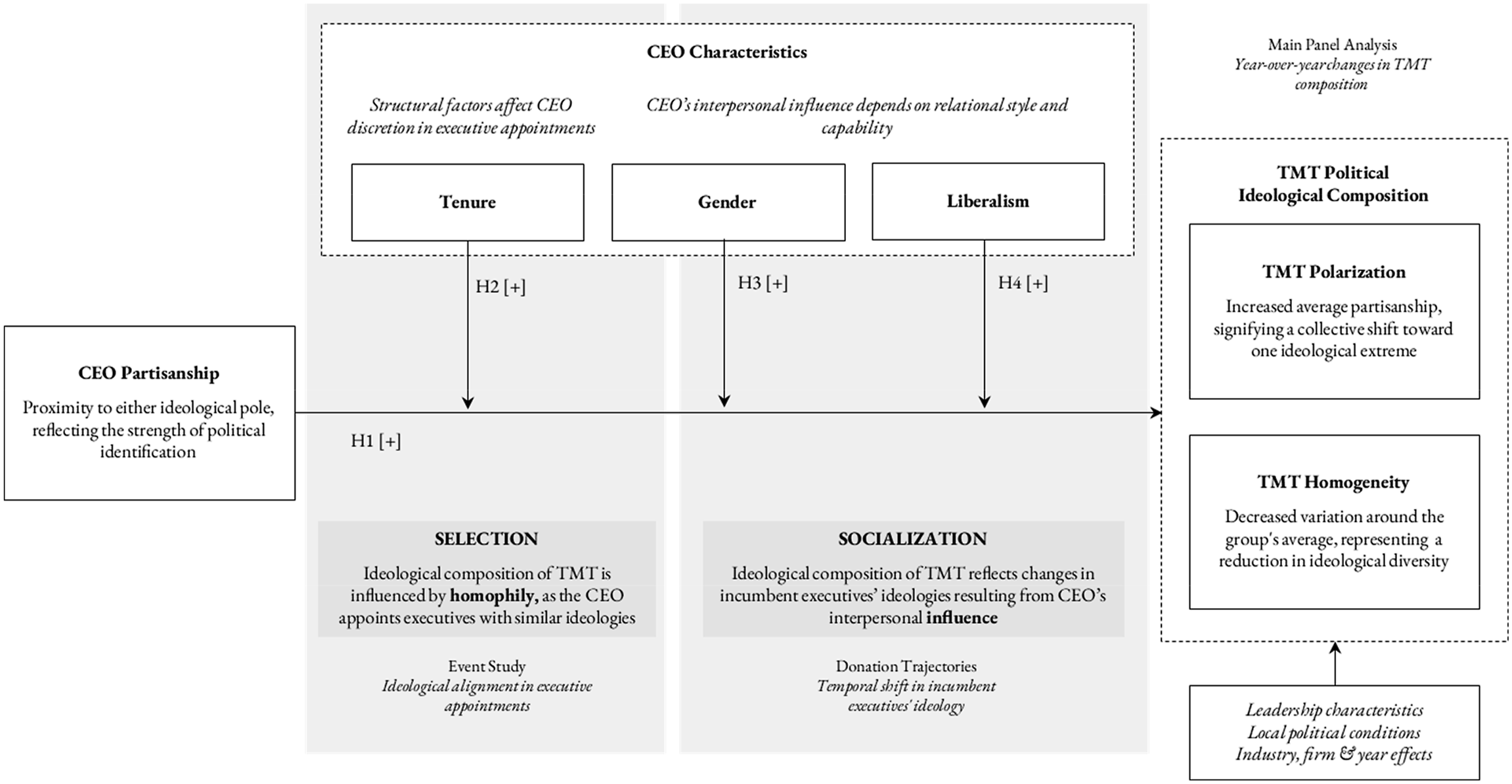
Conceptual Framework and Hypotheses
CEO Partisanship: A Motivator of Socialization and Selection
The extent to which a CEO’s political ideology influences their interactions with the TMT depends on the degree to which they enact these beliefs in their role (Krause & Miller, 2020). While this includes overt attempts to persuade others (McKean & King, 2024; Wowak et al., 2022) or form relationships around political identity (Mason, 2015; West & Iyengar, 2022), the most pervasive effects may occur subconsciously through the behavioral and interpersonal styles associated with the CEO’s ideological biases (Miller et al., 2022; Swigart et al., 2020). As CEO-TMT interactions are recurrent and reinforcing (Simsek et al., 2018), these subtle influences on the ideology of other members of the decision-making group may extend far beyond the direct effects of CEOs’ ideology on strategic decisions (c.f., Junge et al., 2024).
The CEO role affords both formal control over team composition (Finkelstein & D’Aveni, 1994; Hambrick et al., 2015) and informal influence over behavioral norms, interpersonal dynamics, and value expression (Ozgen et al., 2025). However, if and how a CEO uses this influence depends on whether they perceive political ideology as relevant to their identity (Peterson & Iyengar, 2020; Schedler, 2023) or to the enactment and fulfilment of their leadership role (Krause & Miller, 2020; Wright, 2023). Thus, the salience of political identity and motivation to shape others’ views are key enabling conditions for ideological influence in the TMT (Huddy, 2001; Huddy et al., 2015).
Partisanship—the strength of alignment with a political position (Huddy et al., 2015)—is a fundamental driver of both the social salience of an individual’s ideology and the motivation to enact their beliefs. While ideological moderates tend to avoid the expression of personal political values in their professional roles, partisans’ behavior across domains is informed by their ideology (Mason, 2015; West & Iyengar, 2022). This reflects the dual function of political partisanship as both a deeply held belief system that shapes cognition and behavior (Jost et al., 2009) and as a social identity that promotes ideological expression, issue advocacy, and homophilous affiliation (Hudson & Morgan, 2022; McPherson et al., 2001).
Evidence of these tendencies is increasingly visible in corporate settings (Swigart et al., 2020). CEOs now regularly adopt partisan stances on sociopolitical issues (Bondi et al., 2025), framing such actions as moral extensions of their leadership responsibilities (Krause & Miller, 2020; Wright, 2023). More broadly, societal trends demonstrate how partisanship affects the political composition of groups: ideological beliefs are becoming more extreme and tightly bound to identity (Schoenmueller et al., 2023), increasing homophily (Solomon et al., 2025). This reduces the variation within, but increases the distance between, political groups (Grossmann & Hopkins, 2025), creating contrastive and internally homogeneous communities (Schedler, 2023; West & Iyengar, 2022).
Accordingly, we argue that partisan CEOs—those with strong political identifications—are more likely to perceive their beliefs as relevant to their leadership role and thus to enact them in ways that influence the TMT, resulting in compositional changes in two key dimensions: polarization, a collective shift toward political extremes (Barber & Blake, 2024) and homogeneity, a reduction in ideological variation among members (Evans et al., 2024).
Moderating Effects of CEO Characteristics
Partisanship may motivate CEOs to shape the political ideological composition of the TMT, but the extent to which this is realized is contingent on their ability to enact their desired influence (Aral & Walker, 2012; Ozgen et al., 2025). Characteristics that alter the CEO’s structural power to select ideologically aligned executives (Finkelstein, 1992) or their relational capability to socialize the beliefs and behaviors of the incumbent TMT (Carmeli et al., 2011) are therefore likely to moderate the effects that partisan CEOs can exert on ideological expression at the team-level. We hypothesize that three CEO characteristics will increase the effect of partisanship on TMT polarization and homogeneity: CEO tenure, gender, and liberalism. These factors represent heterogeneity in formal power, social influence, and ideological salience (e.g., see Darouichi et al., 2021; Eagly & Wood, 2012; Georgakakis et al., 2022; Hambrick & Fukutomi, 1991; Swigart et al., 2020), affecting their structural capacity to appoint like-minded team members or their social capacity to influence others’ ideological expressions. These moderating hypotheses therefore provide insight into our proposed mechanisms of selection and socialization.
CEO Tenure
Long-serving CEOs possess greater structural discretion over personnel decisions, increasing their ability to affect group-level processes and outcomes in the TMT (Hambrick et al., 2015; Hambrick & Fukutomi, 1991). Tenure increases job security, perceived authority within the firm, and legitimacy among stakeholders (Darouichi et al., 2021), all of which provide long-serving CEOs formal power that need not be negotiated with other members of the TMT (Ocasio, 1994; Pitcher & Smith, 2001). This lessens the risk of expressing contested or divisive ideas (Graham et al., 2015), which can increase the willingness of a partisan CEO to bring personal political issues into their role (Bondi et al., 2025; Swigart et al., 2020). Most importantly, CEO tenure increases discretion in executive appointments (e.g. see Finkelstein & Boyd, 1998; Finkelstein & D’Aveni, 1994) providing a direct mechanism for CEOs to alter TMT composition through selection of like-minded executives. We therefore hypothesize that long-serving partisan CEOs will be associated with greater changes in the political ideological composition of the TMT:
Tenure may secondarily afford opportunities to enact ideological influence via socialization (for example, as a result of increased deference to a CEO’s views; see Finkelstein, 1992; Pfeffer, 2013), but does not imply effectiveness in these efforts. We therefore propose two further hypotheses, based on characteristics widely corroborated to represent differences in relational capacity and social influence (Eagly & Wood, 2012; Gerber et al., 2012; McPherson et al., 2001).
CEO Gender
While tenure enhances structural power, a CEO’s effectiveness in socialization depends more on their relational capabilities (Maak & Pless, 2006; Roberts & Spedale, 2025). We propose that the leadership styles more commonly associated with female CEOs facilitate the gradual interpersonal influence central to socialization mechanisms (e.g., see Carmeli et al., 2011; Mkrtchyan et al., 2023; Sarbin & Allen, 1968). Female leaders are more likely to employ values-based and participatory approaches that emphasize trust-building, collaboration, and relational sensitivity (Eagly, 2005; Lemoine & Blum, 2021); behaviors that establish shared norms and role expectations within the TMT (Simsek et al., 2018).
Crucially, this argument pertains to shaping the expression of ideology, not necessarily altering deeply held beliefs. Through interpersonal influence and role-modeling, a CEO can make the expression of certain political views seem more appropriate or expected within the TMT’s relational context (Avolio & Gardner, 2005; Buss et al., 2024). Studies find that women are often more skilled in the prosocial and trust-based behaviors that foster this kind of influence (Aral & Walker, 2012; Rosette & Tost, 2010). Therefore, a female CEO’s partisan stance may be perceived as more authentic and legitimate, encouraging other executives over time to align their own public or professional ideological expressions with hers, even if their private convictions remain unchanged (see Barrios et al., 2022; Chow et al., 2022). We thus expect the ideological expression of TMT members to be more responsive to the interactional influence of female partisan CEOs:
CEO Liberalism
While partisanship indicates the strength of a CEO’s political identity, its effects may differ across the liberal—conservative spectrum (e.g., see Hudson & Morgan, 2022; Wowak & Busenbark, 2024). Examining the effects of CEOs’ “directional” ideological position is therefore empirically important in itself—however, it is also theoretically pertinent to the activation of socialization mechanisms. Specifically, we expect liberal partisan CEOs to exert stronger interpersonal influence on the political ideological composition of the TMT.
This hypothesized asymmetry is firstly based on differences in perceptions of the CEO role (Krause & Miller, 2020). Liberal CEOs are more likely to view sociopolitical values as relevant to their leadership responsibilities and firm strategy (Foss & Klein, 2022; Wright, 2023). They are thus more inclined to engage in ideological persuasion, expressing and promoting political beliefs as an extension of ethical responsibility or stakeholder accountability (Hambrick & Wowak, 2021; Schedler, 2023). This is supported by higher rates of CSA and CSR activity (Chin et al., 2013; Gupta et al., 2021) and public messaging on sociopolitical issues (McKean & King, 2024; Wowak & Busenbark, 2024) in liberal-led firms. In contrast to the conservative disposition towards minimizing political expression in their professional lives (Tetlock, 2000; Wright, 2023), liberal CEOs may therefore perceive and enact their role in ways that heighten the salience of ideology in TMT interactions (Krause & Miller, 2020). Moreover, liberal ideology tends to align more closely with prevailing cultural and stakeholder norms, reducing reputational risk and enabling more open political expression (Hambrick & Wowak, 2021; McKean & King, 2024). By contrast, conservative CEOs may suppress ideological signaling to avoid backlash or interpersonal conflict (Solomon et al., 2025; Wowak & Busenbark, 2024). We therefore hypothesize a stronger effect of CEO partisanship for liberal CEOs, as a result of both intrinsic psychological motivations and ideologically asymmetric situational pressures:
To summarize, our conceptual model (Figure 1) posits CEO partisanship as a motivational trigger for political expression within their role, which influences the political ideological composition of the TMT (H1) through two distinct yet complementary pathways: homophilous selection of ideologically congruent executives, and gradual socialization of incumbent members such that they come to express values aligned with the CEO. We propose that three CEO characteristics moderate these effects by amplifying the CEO’s structural or relational capacity for enacting ideological change: tenure strengthens the structural discretion necessary for selection (H2), whereas gender (H3) and liberalism (H4) enhance the values-based motivation and relation legitimacy conducive to interpersonal influence. As shown in Figure 1, we subsequently conduct additional analyses to directly test the causal processes underlying these mechanisms. We next describe this multi-stage empirical approach.
Method
Data and Sample
We examine the political ideologies of executives using two main data sources: Execucomp, for information on the demographics, characteristics, and employment of TMT members; and the Center for Responsive Politics (CRP; see OpenSecrets.org) for individuals’ political campaign donations recorded by the Federal Election Commission (FEC). Following common usage of these sources and the ideological measures derived therein (e.g., Gupta et al., 2021; Semadeni et al., 2022), we combine the databases using multiple criteria, relying first on automated matching of names and organizational affiliations and using additional information (e.g., home addresses) to ensure accurate correspondence between records and resolve cases of multiple matching. Ten years of donation data is recommended to construct individual-level measures of ideology (Chin et al., 2013). Accordingly, the coverage of the FEC database (1990-2022) defines our sample period as 2000 to 2022. We combine these sources with data from Compustat, S&P Global Market Intelligence, BoardEx, and MIT Election Lab for measurement of control variables. Matching records across all databases and accounting for the one-year lag required to estimate our main models results in a final sample of 2,133 firm-year observations of 823 firms.
Measures
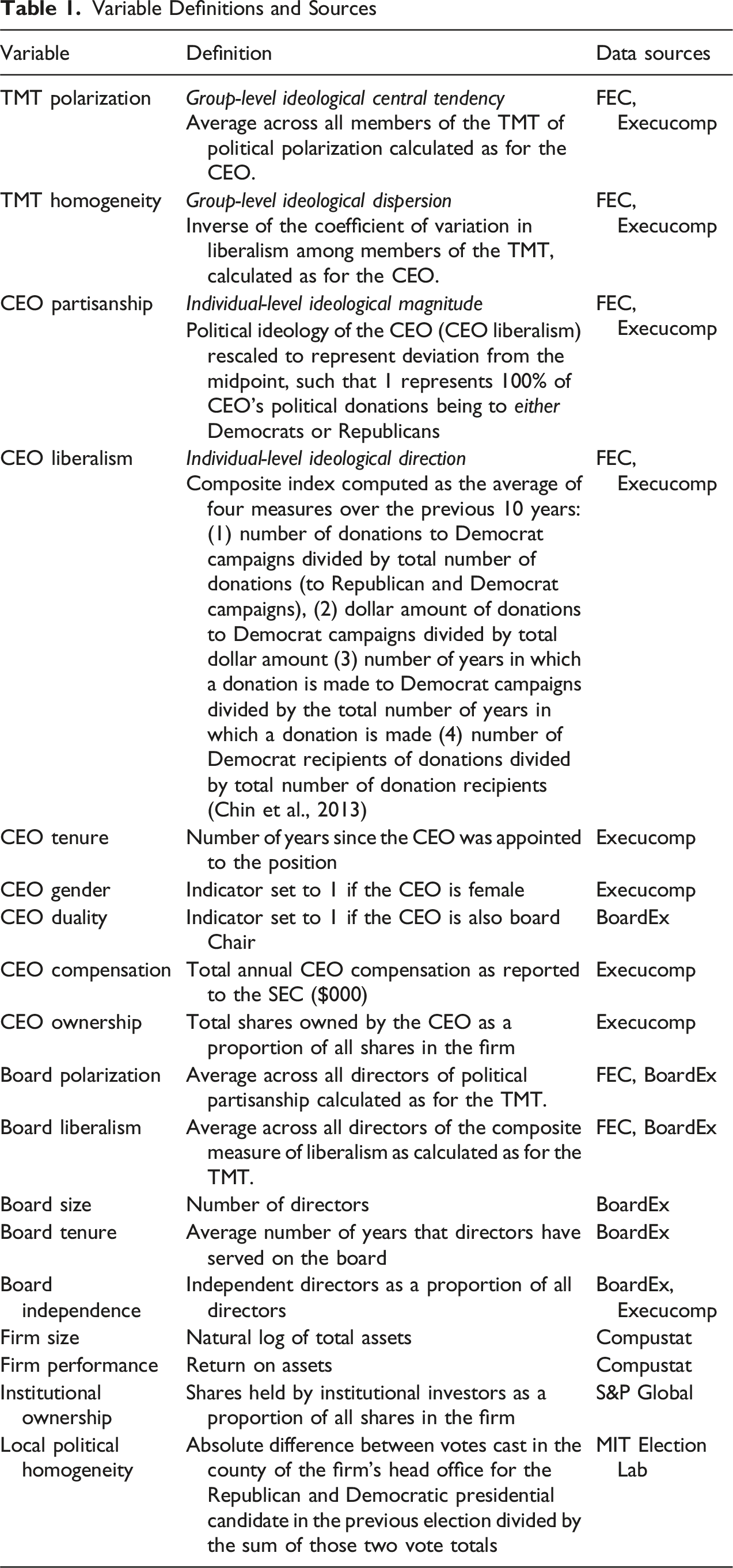
Variable Definitions and Sources
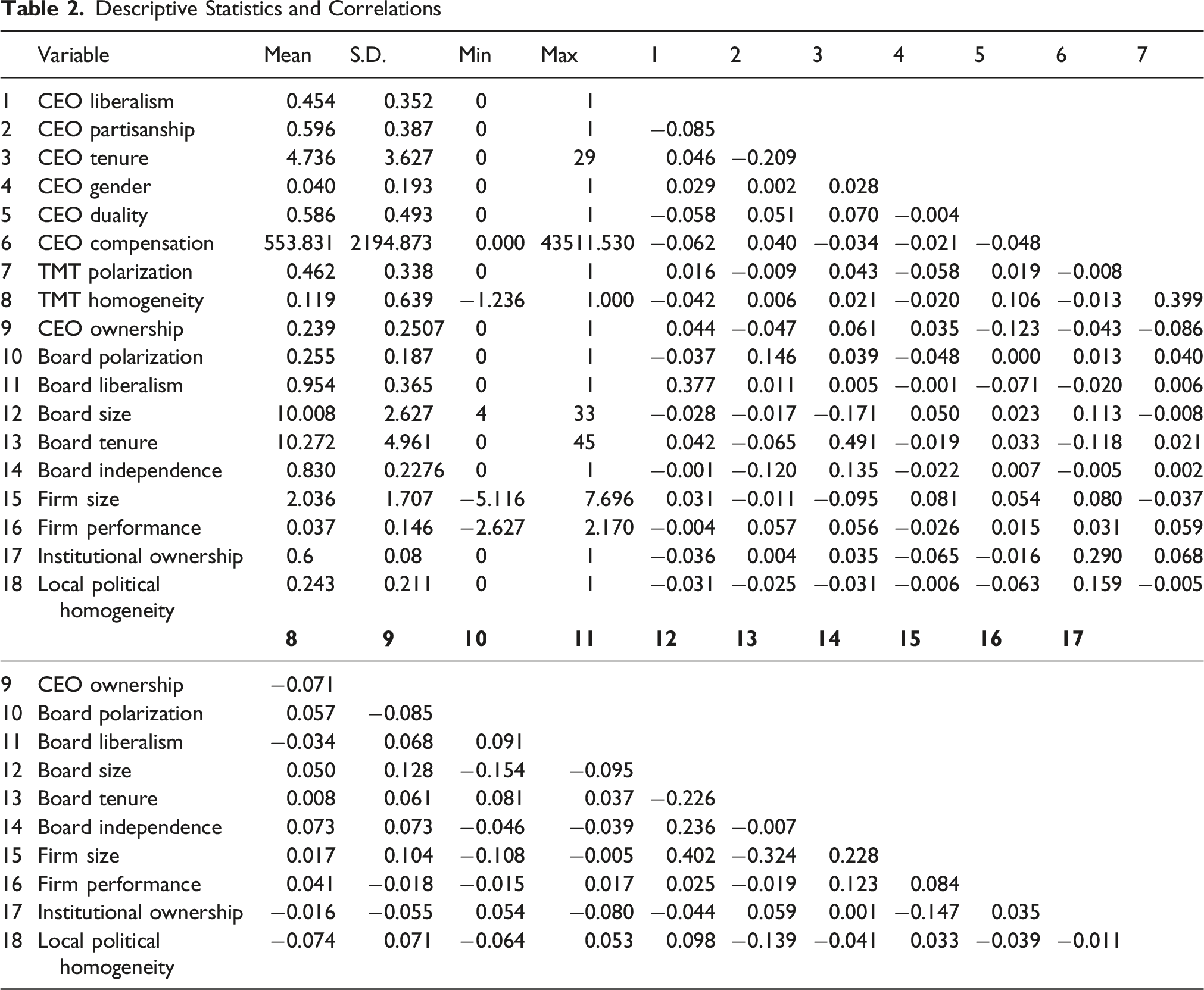
Descriptive Statistics and Correlations
Independent Variable: CEO Partisanship
To measure CEO partisanship, we first compute individuals’ political ideology before deriving a non-directional measure that represents the strength of the CEO’s political position, independent of the ideological position itself (see Hadani, 2024; Raffiee et al., 2023). Working within the U.S. context and following precedent in this research (e.g., Gupta et al., 2021; Wowak & Busenbark, 2024), we base this on the liberal—conservative continuum and use the procedure developed by Chin et al. (2013) to derive a four-component index from individuals’ donations to Democrat and Republican campaigns. This operationalization consistently and strongly correlates with self-identification as liberal or conservative, providing a reliable proxy for individuals’ internal beliefs (Ansolabehere et al., 2003; Fremeth et al., 2013; Gupta & Wowak, 2017; Lee et al., 2014). However, this is secondary in our role-theoretic focus on the enactment of these deeper values: for this purpose, political donations represent a direct observation of one form of ideological expression. Consequently, issues regarding the correspondence between inherently unobservable beliefs and their behavioral manifestations remain, but pose less of a methodological challenge in this context (see McKean & King, 2024; Swigart et al., 2020; Wowak & Busenbark, 2024).
We use the previous ten years of records to compute this index. This covers five congressional and two presidential elections and thus provides sufficient data to infer stable patterns in political donations (Chin et al., 2013). The four-component measure is the average of (i) the number of donations to Democrat campaigns divided by the number of donations to both Republican and Democrat campaigns in each year; (ii) the value of donations to Democrat campaigns divided by the total dollars contributed in each year; (iii) the number of unique Democrat recipients to which an individual contributed divided by their total number of recipients in that year; and (iv) the number of years in which a donation was made to Democrat campaigns divided by the total number of years in which any donation was made within the rolling 10-year window. Internal reliability (α = .99) is comparable to previous implementation of this measure (e.g., Gupta et al., 2021; Hudson & Morgan, 2022, 2023), justifying the use of this composite score. The score ranges from 0 (conservativism) to 1 (liberalism), with each pole representing that 100% of an individual’s political donations were made to one party. We impute a value of 0.5 for individuals for whom no data was available, i.e., we assume these to be ideologically moderate. This is standard practice in this research stream (Chin & Semadeni, 2017; Georgakakis et al., 2024) and thus facilitates the integration of our findings with the extant literature. Including these politically inactive CEOs also ensures that our analyses account for differences in the extent of political donations among executives over time, avoiding the false attribution of increases or decreases in TMT polarization or homogeneity to CEO effects when these shifts may instead reflect broader societal trends in political activity (Melloni et al., 2023). As we are primarily concerned with the strength of political identification, it is also of lesser conceptual importance to differentiate between political inactivity (no campaign donations) and ‘centrism’ (equal donations to both major parties) than in previous research contexts utilizing this measure (e.g., see McKean & King, 2024; Wowak & Busenbark, 2024).
This is a directional measure representing CEO liberalism, with a score of either 0 or 1 on the continuum indicating political positions that are equally strongly held. To operationalize partisanship in a manner that does not bias our analyses towards either ideological pole, we therefore compute the absolute value of the difference between the CEO’s liberalism score and 0.5. We then multiply this by two to obtain a 0-to-1 index of CEO partisanship, representing the degree to which the CEO’s ideological position—whether liberal or conservative—deviates from the point of neutrality or nonactivity (see Hadani, 2024; Raffiee et al., 2023).
Moderators: CEO Tenure, Gender, and Liberalism
To measure the CEO characteristics hypothesized as moderators, we set an indicator of CEO gender to 1 if the CEO is female, and define CEO tenure as the number of years the CEO has served in their role. The moderator CEO liberalism is computed as outlined above. We use the intermediate variable (before transforming to a nondirectional representation of CEO partisanship to capture only the extremity of the CEO’s position) for this moderator, such that higher values represent more liberal CEOs.
Dependent Variables: TMT Polarization and Homogeneity
We use the method described above to compute liberalism and partisanship scores for each executive in our sample. For each firm-year, we use these scores to calculate the average partisanship across all executives (excluding the CEO). This constitutes our measure of TMT polarization. We use the coefficient of variation in executives’ liberalism scores as a measure of ideological diversity (Hudson & Morgan, 2022, 2023; Miller et al., 2022). We take the inverse of this to represent TMT homogeneity. TMT polarization thus captures the degree to which the average political position of a firm’s leadership team deviates from neutrality. In contrast, TMT homogeneity represents the level of variation among executives around this mean. Similar to how partisanship and liberalism respectively represent the magnitude and direction of an individual’s political views and can thus vary independently, team-level ideological polarization and homogeneity represent concepts of central tendency and dispersion that are conceptually and empirically distinct (see Table 1). This is important in interpreting our analyses: shifts in TMT polarization may drive outcomes associated with the strength of decision-makers’ political identification (e.g., see Hadani, 2024; Peterson & Iyengar, 2020; Wowak & Busenbark, 2024), whereas differences in TMT homogeneity have greater implications for the literature on ideological diversity (e.g., Chow et al., 2022; Evans et al., 2024; Hudson & Morgan, 2023).
Control Variables
We control for a comprehensive set of factors that affect the CEO’s influence and incentives within the TMT, and thus their capacity or motivation to shape the political ideological characteristics of the group. These include CEO compensation and ownership, representing heterogeneity in behavioral incentives and power (Ozgen et al., 2025). We also include an indicator for CEO duality when the CEO also serves as board Chair. This accounts for the CEO’s influence within the board, which is a significant determinant of TMT composition (Junge et al., 2024; Krause et al., 2014). We control for other board-level factors that affect CEOs’ authority and discretion via the inclusion of board size, independence, and tenure (see Zattoni et al., 2023). We also compute and include board-level analogs of our focal ideological variables, to ensure that we isolate the ideological effects of interest at the level of the CEO.
While much variation in the sociopolitical environment is accounted for by estimating year effects (detailed below) and the geographical restriction of our sample, the U.S. political context is highly heterogenous. We therefore control for local political homogeneity to capture political differences that are not reflected at a national level but may still influence individuals’ ideological expressions (Lee et al., 2014). This is calculated as the absolute difference between Republican and Democrat votes cast in the county of the firm’s head office in the previous election, divided by total votes. Finally, we control for key firm-level characteristics that influence TMT-level decisions—firm size, performance, and institutional ownership (Georgakakis et al., 2022; Junge et al., 2024)—and include industry- and firm-level effects in our models to account for remaining unobserved heterogeneity, as specified below.
Model Specification and Estimation
While individuals’ political ideologies are relatively temporally stable (Chin et al., 2013), the dependent variables we derive from these measures change over time as executives enter and leave the TMT. We therefore employ a linear mixed model, which provides robustness and flexibility in handling the two key empirical concerns in this context: within-firm temporal correlation and between-firm variation (e.g., see Chin & Semadeni, 2017; Gupta & Wowak, 2017). This enables estimation of both fixed effects for the predictors of interest, allowing for robust hypothesis testing, and random effects at the firm-, industry- and year-level, accounting for unobserved firm-specific heterogeneity over time (Breuer & Dehaan, 2024; Hudson & Morgan, 2022). This allows for the inclusion of potentially temporally stable predictors without introducing bias into the estimates of their effects on time-varying outcomes. We specify the following relationship between CEO-level variables and TMT composition:
We lag all predictor variables by one period to address reverse causality concerns (Hudson & Morgan, 2022). The likelihood of omitted variables is reduced by the comprehensive inclusion of control variables and a model specification that accounts for other unobserved heterogeneity (Hill et al., 2021). However, endogeneity issues may arise from the possibility of reverse causality in our model. In addition to the CEO influencing the ideological composition of the TMT, it is feasible that ideological changes among other executives may affect the beliefs of the CEO. Although the theoretical foundations of our framework and extant empirical research indicate that the CEO has significantly greater power to determine the direction of this relationship (Georgakakis et al., 2024; Ozgen et al., 2025), we conduct additional tests of this assumption, estimating a two-stage least squares (2SLS) regression to test for reverse causality (Hill et al., 2021; see also Junge et al., 2024). For our instrumental variable, we calculate peer firm CEO partisanship as the average CEO partisanship across other firms in the focal firm’s 2-digit SIC code industry. We choose this instrument as industry norms plausibly influence a firm’s ideological composition while remaining exogenous to the specific influences of the focal firm’s CEO (Georgakakis & Ruigrok, 2017; Lee et al., 2014). This instrument is therefore theoretically exogenous (i.e., uncorrelated with the error term), as it pertains to the broader industry context rather than the processes hypothesized to be causal in our model. Peer firm CEO partisanship also meets the criterion of relevance, being correlated with CEO partisanship (r = 0.193) and a significant predictor of TMT polarization (F = 4167.7; p < .001) and TMT homogeneity (F = 4168.0; p < .001). Sargan and Basmann tests for overidentification indicate no evidence of instrument invalidity for either the polarization model (χ2 (8) = 0.168, p > 0.9000; F (8, 1863 = 0.021, p > 0.900) or the homogeneity model (χ2 (8) = 0.949, p = 0.90; F (8, 1863) = 0.118, p = 0.891). Analogous use of peer-based instruments is also well-precedented in the literature on TMT- and board-level effects of political ideology (e.g., Gupta & Wowak, 2017; Hudson & Morgan, 2022, 2023). A Wu-Hausman test did not indicate endogeneity for either TMT polarization (0.225; p = 0.640) or TMT homogeneity (0.004; p = 0.947), suggesting that reverse causality is not an issue in our model. Accordingly, we report the estimates from our main model specification.
Tests of Causal Mechanisms
We estimate three additional models to test the two causal pathways from which our formal hypotheses are derived. Using event-based specifications and micro-level data on executive appointments and individual political donations, we directly measure ideological expressions and differentiate between the temporal signatures of selection and socialization. These analyses use all donations from the FEC database that were a valid match with BoardEx employment histories. Prior to further matching the firm-year data (as above), we instead match executives to firms for the exact period between the start and end date of each role listed in BoardEx. CEO turnover and executive appointment events are defined by these dates.
First, we examine selection as the appointment of ideologically aligned executives. To operationalize this mechanism, we adapt the four-component continuous ideology score (Chin et al., 2013), used in our primary analyses, to a binary indicator denoting each executive’s partisan leaning, dichotomizing at 0.5. This simplification is a deliberate, theoretical choice: as we theorize selection to be driven by homophily, the CEO’s decision is fundamentally a discrete, categorical assessment of whether a candidate is ideologically ‘in-group’ or ‘out-group’ (McPherson et al., 2001). This entails a discrete assessment of whether an executive is ‘on the same team’ rather than a fine-tuning of ideological distance. A binary operationalization is therefore the most direct test of our selection hypothesis, whereas our tests of socialization use donation-level measures and temporal variation to capture gradual ideological convergence.
We model socialization as the presence of systematic patterns of change in (i) ideological convergence in CEO—executive dyads and (ii) ideological polarization in executives donations over their shared tenure with a given CEO. For the two tests, we code each individual donation in the FEC database as 0 if the recipient candidate is Republican and 1 if Democrat to examine political ideological alignment in each CEO-executive dyad, and to construct individual timelines of donations.
The FEC data contains 75,845,445 observations, of which we include the 52% that are made to Democrat and 42.5% to Republican campaigns. Matching these to executives results in 33,714,882 individual donations. Identifying when donations occur within the shared tenure of each executive produces 383,554 CEO-executive dyads (after removing self-dyads) for examining socialization processes. CEOs’ and executives’ donations are ideologically congruent in 47.8% of cases. CEO or executive turnovers occur in 70.3% of dyads, resulting in 235,591 appointment events over 28 years in which to examine selection processes.
Selection: Political Ideological Alignment in Executive Appointments
The first model assesses the probability that executives share the political party affiliation of the CEO at the time of their appointment, as a function of CEO partisanship. This examines whether TMT-level changes are driven by greater ideological homophily among partisan CEOs, enacted via their structural power in selection processes (see Finkelstein, 1992; McPherson et al., 2001; Ocasio, 1994). The sample is restricted to executives whose start date at the firm occurs at least one year later than the last change of CEO, ensuring that we only examine appointments in which the current CEO can be assumed to have discretion (Darouichi et al., 2021; Georgakakis et al., 2024). We specify a linear probability model:
Socialization: Political Ideological Convergence in CEO—Executive Dyads
Unlike the instantaneous shifts that occur via executive turnover, evidence that socialization processes drive TMT-level change would instead require that the political ideologies of CEOs and new TMT members converge over time; specifically, that the donation behavior of executives shifts towards the party affiliation of the CEO (see Carmeli et al., 2011; McKean & King, 2024). To examine this alternative mechanism, we restrict the sample to non-CEO executives and estimate the probability of ideologically congruent (i.e., same party) donations over the first five years of their shared tenure at the firm. We estimate a binned event-time specification (Jacobson et al., 1993; Schmidheiny & Siegloch, 2023), where donations (events) are grouped by year and year 0 (the first year under a new CEO) omitted as the reference category. This allows the effect of shared tenure to vary non-parametrically over time without imposing linearity (see Figure 3):
Socialization: Executive Political Ideological Polarization
Last, we complement the previous analysis by examining whether executives’ donations become more ideologically directional (systematically more Republican or Democratic) as their tenure under a given CEO increases. The dependent variable is donation polarity, coded −1 for Democratic, 1 for Republican, and 0 for other or neutral donations. The specification mirrors that of equation (3), using binned event-time indicators and executive fixed effects.
While equation (3) estimates whether executives’ donation behavior is more likely to align with the CEO’s ideology over time, equation (4) tests for shifts in intensity, i.e., whether executives become more consistently partisan in their giving. This allows us to differentiate whether socialization mechanisms decrease ideological differences between the CEO and executives (manifest as TMT-level homogeneity), and/or drives more extreme ideological patterns of donations at the executive-level (polarization).
Results
Effects of CEO Partisanship on TMT Political Ideological Composition
Effects of CEO Partisanship and Characteristics on TMT Political Ideological Polarization
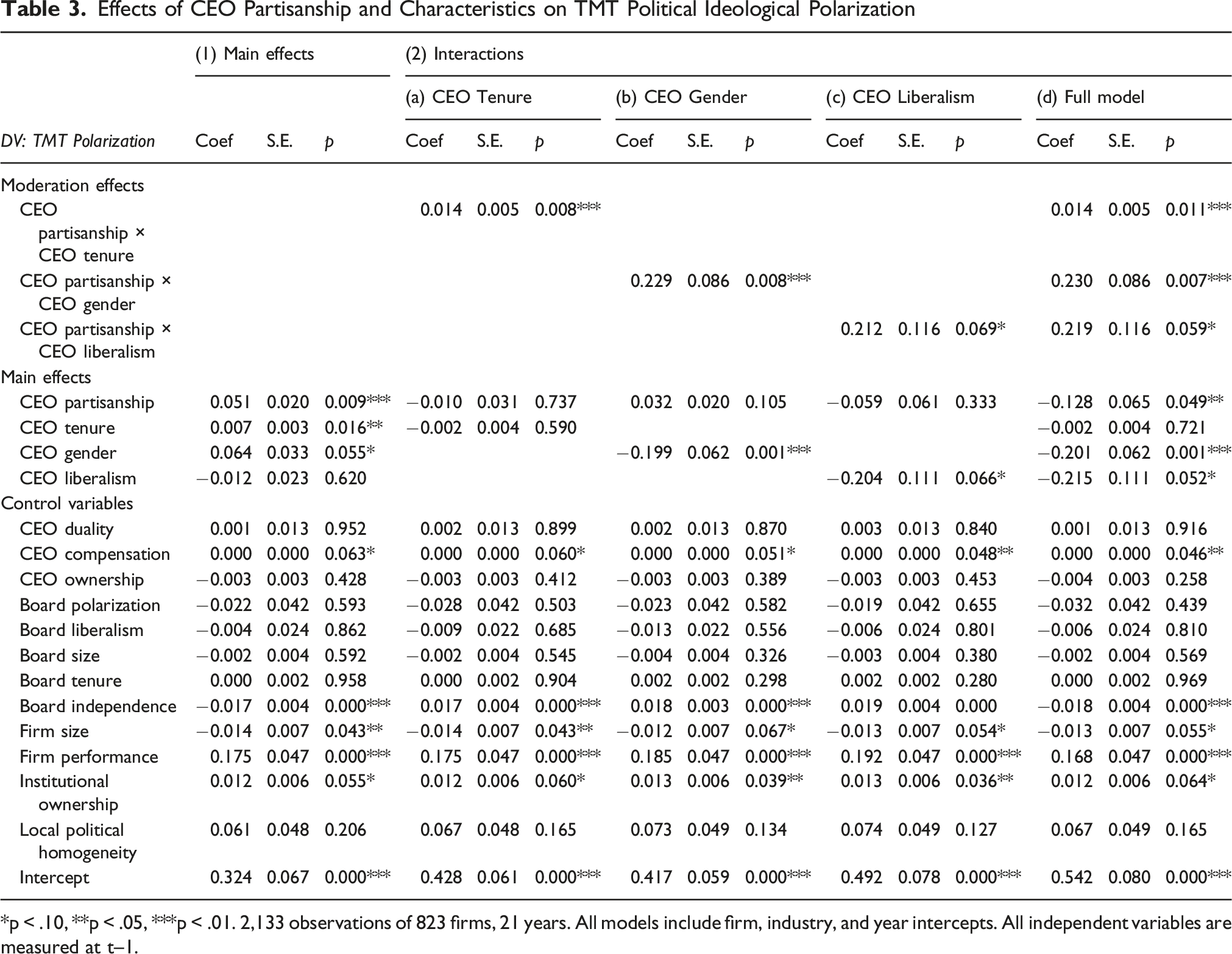
*p < .10, **p < .05, ***p < .01. 2,133 observations of 823 firms, 21 years. All models include firm, industry, and year intercepts. All independent variables are measured at t–1.
Effects of CEO Partisanship and Characteristics on TMT Political Ideological Homogeneity
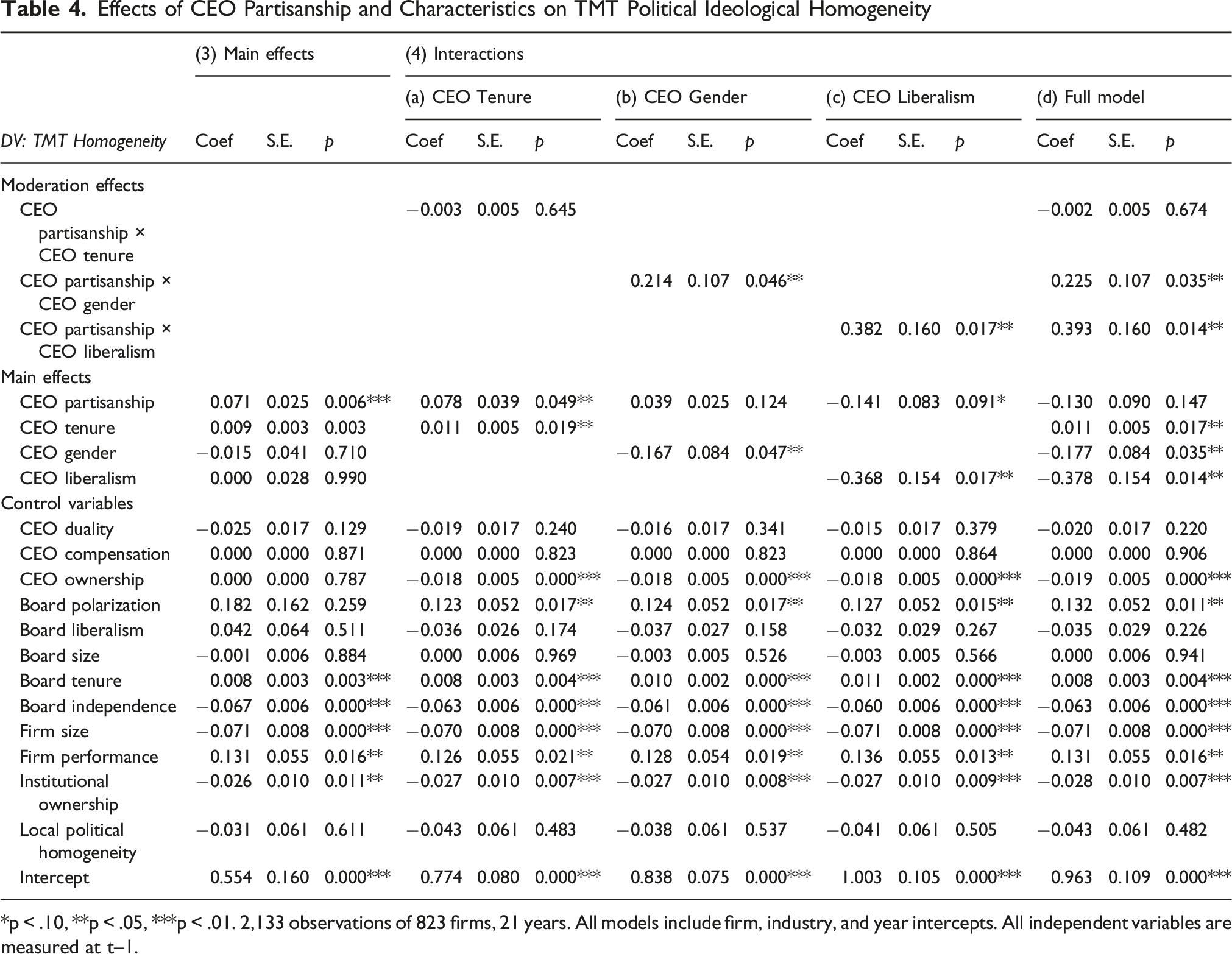
*p < .10, **p < .05, ***p < .01. 2,133 observations of 823 firms, 21 years. All models include firm, industry, and year intercepts. All independent variables are measured at t–1.
Models 2 and 4 add the interactions between CEO partisanship and CEO tenure, gender, and liberalism, as hypothesized in H2 to H4. Figure 2 illustrates these interactions, using the coefficients from the full interaction Models 2d and 4d. We first predicted that CEO tenure would positively moderate the main effect of CEO partisanship. We find support for H2a in the positive interaction effect (0.014; p = .011), indicating that longer-serving CEOs intensify the effect of CEO partisanship on TMT polarization. However, H2b is not supported, as there is no significant effect on TMT homogeneity (−0.002; p = .674). Moderation Effects of CEO Partisanship and Characteristics on TMT Political Ideological Polarization and Homogeneity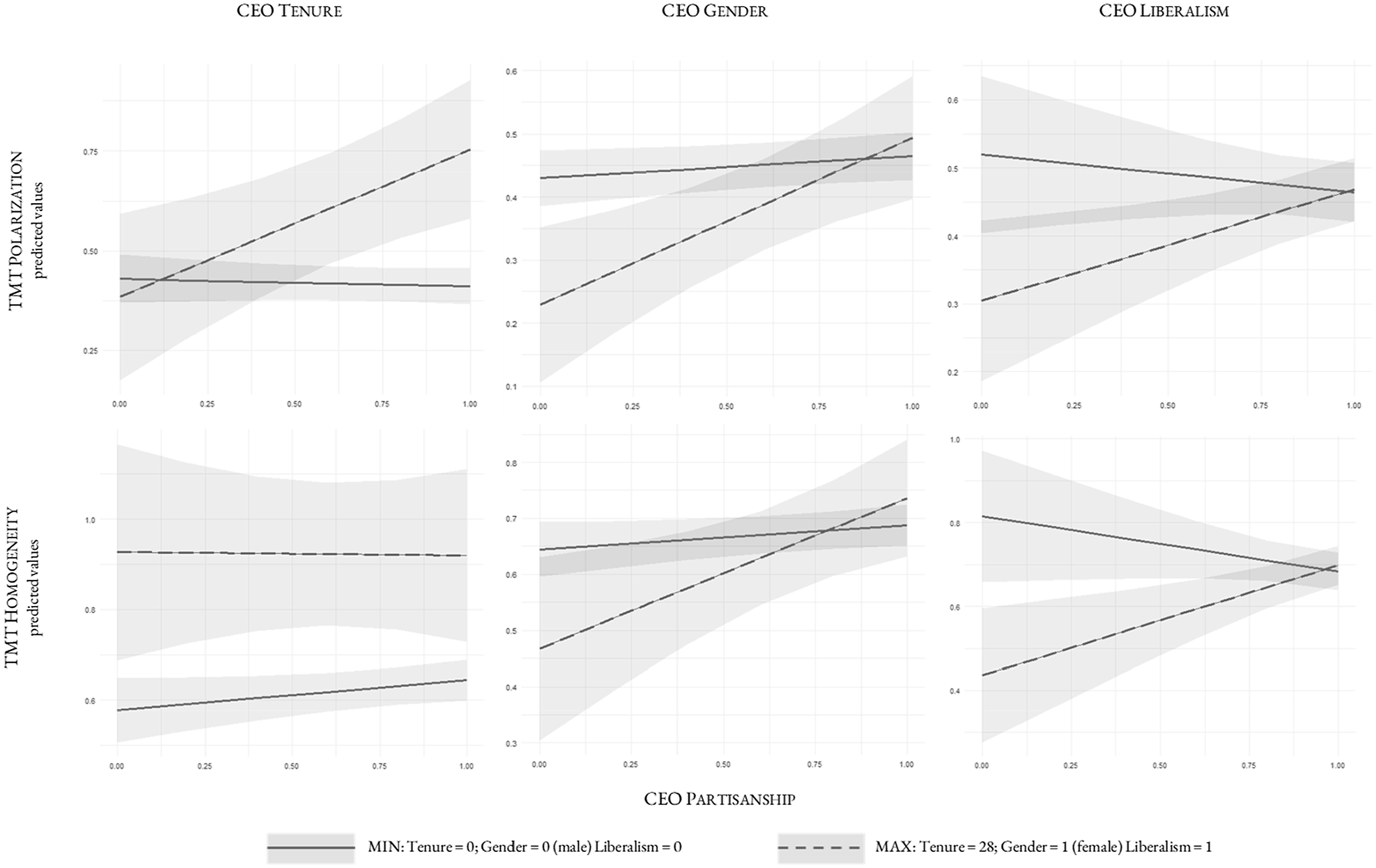
To further examine the moderation effect of CEO tenure, we conducted supplementary post-hoc analyses, which are presented in the Appendix. An alternative visualization of the interaction from our main model and a test of marginal effects (see Busenbark et al., 2022) confirm that the positive effect of CEO partisanship on TMT polarization strengthens as a CEO’s tenure increases, becoming statistically significant after five years in the role. For completeness, we also present the equivalent analyses for TMT homogeneity, which corroborate the non-significant finding reported in our main results.
H3 is supported: CEO partisanship has a stronger influence on political polarization (H3a: 0.230; p = .007) and homogeneity (H3b: 0.225; p = 0.035) in the TMT when the CEO is female. Likewise, liberal CEOs intensify the effect of CEO partisanship on both TMT polarization (0.219; p = .059) and homogeneity (0.393; p = 0.014), providing full support for H4a and H4b.
The predicted interaction effects between CEO characteristics and political partisanship are empirically supported, with the notable exception that long-tenured CEOs do not significantly influence the effect of CEO partisanship on the ideological homogeneity of the TMT. Partisan CEOs therefore appear to have a greater influence on the ideological composition of the TMT in terms of polarization than homogeneity, suggesting that the ultimate firm-level implications of CEO partisanship may be most detrimental in those decision areas where the strength, rather than diversity, of executives’ beliefs is of primary consequence. This difference is small for the main effects, with a one standard deviation increase in CEO partisanship resulting in a 6% and 4% increase in these outcomes, respectively. However, effect sizes differ notably for the interactions with gender (15% versus 4%) and liberalism (26% versus 13%; though the larger effect on TMT polarization is less statistically significant). Overall, our results provide support for our hypotheses and indicate substantive effects of CEOs’ political partisanship on the ideological composition of the TMT. Moderation effects imply that socialization drives these effects to a greater extent than selection. Our next set of results provides mechanistic evidence for these inferences.
Mechanisms of Selection and Socialization
Effect of CEO—Executive Ideological Alignment on Likelihood of Executive Appointment
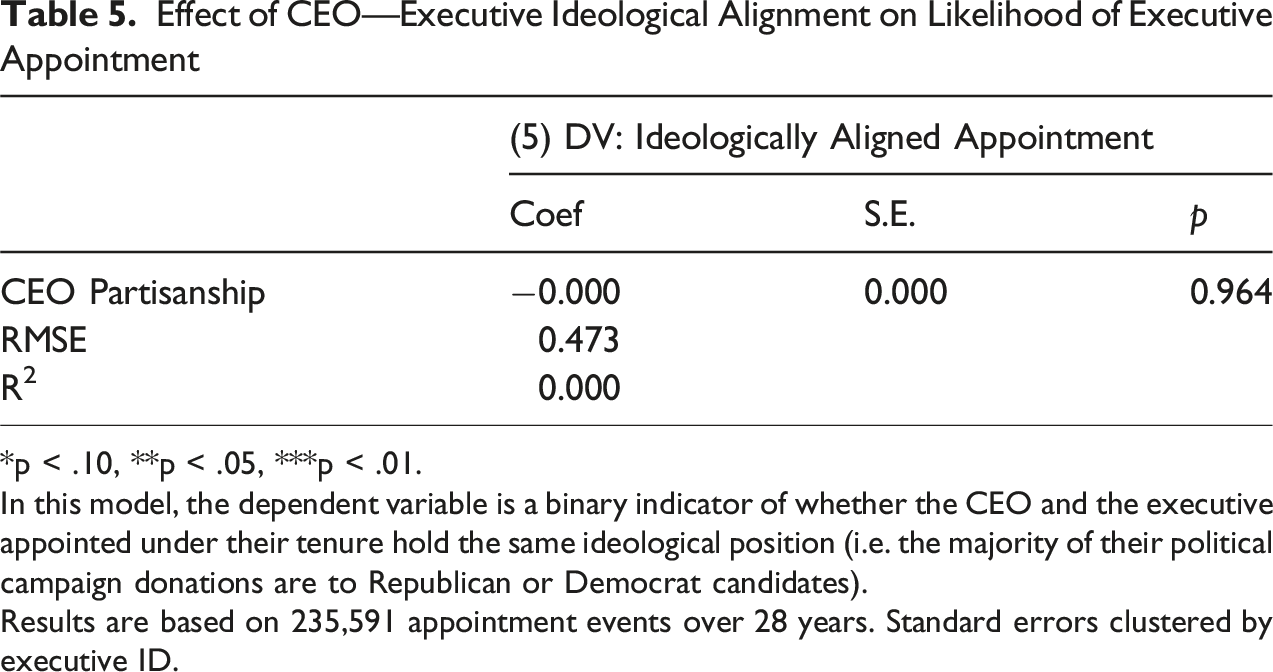
*p < .10, **p < .05, ***p < .01.
In this model, the dependent variable is a binary indicator of whether the CEO and the executive appointed under their tenure hold the same ideological position (i.e. the majority of their political campaign donations are to Republican or Democrat candidates).
Results are based on 235,591 appointment events over 28 years. Standard errors clustered by executive ID.
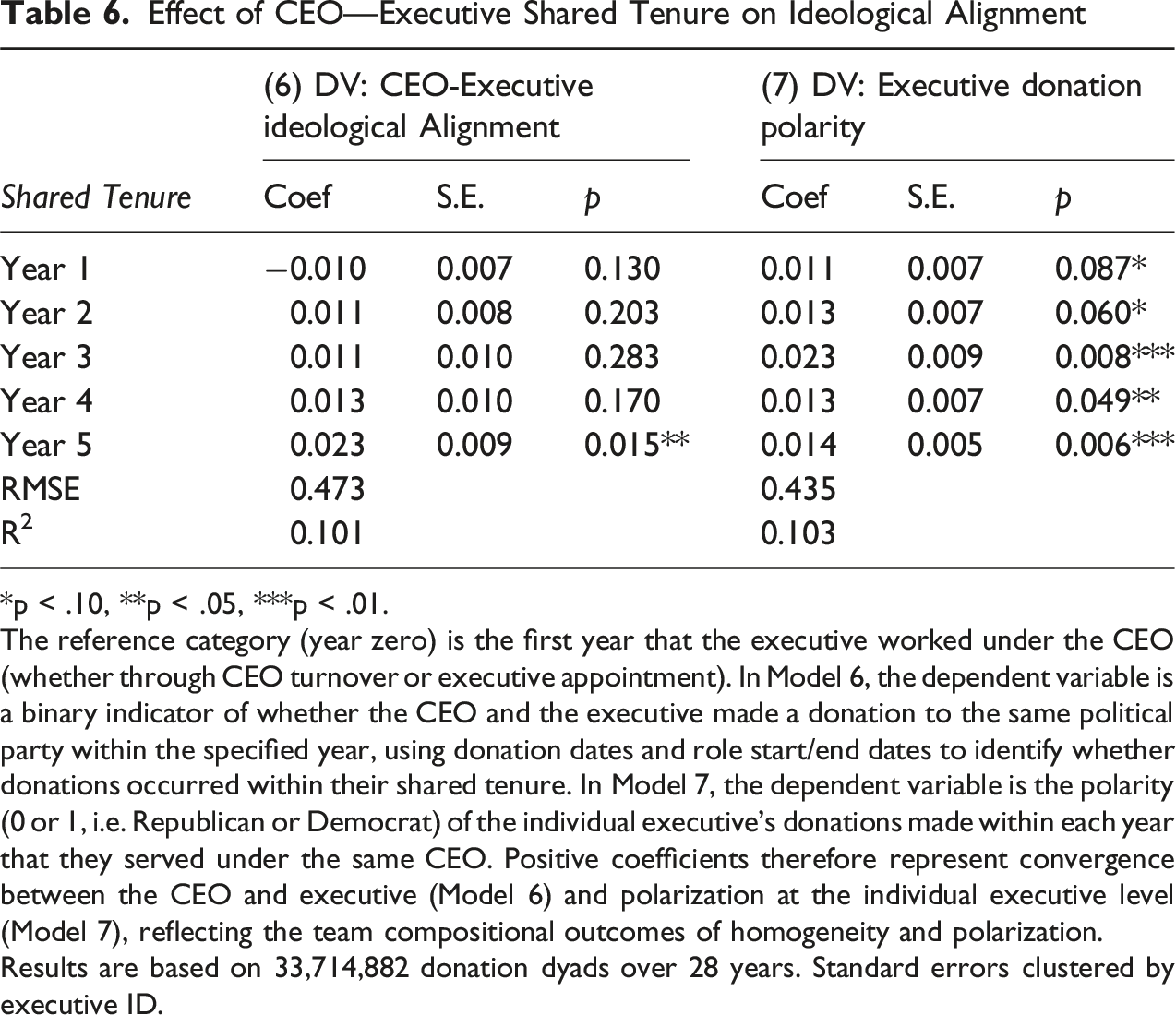
Effect of CEO—Executive Shared Tenure on Ideological Alignment
*p < .10, **p < .05, ***p < .01.
The reference category (year zero) is the first year that the executive worked under the CEO (whether through CEO turnover or executive appointment). In Model 6, the dependent variable is a binary indicator of whether the CEO and the executive made a donation to the same political party within the specified year, using donation dates and role start/end dates to identify whether donations occurred within their shared tenure. In Model 7, the dependent variable is the polarity (0 or 1, i.e. Republican or Democrat) of the individual executive’s donations made within each year that they served under the same CEO. Positive coefficients therefore represent convergence between the CEO and executive (Model 6) and polarization at the individual executive level (Model 7), reflecting the team compositional outcomes of homogeneity and polarization.
Results are based on 33,714,882 donation dyads over 28 years. Standard errors clustered by executive ID.
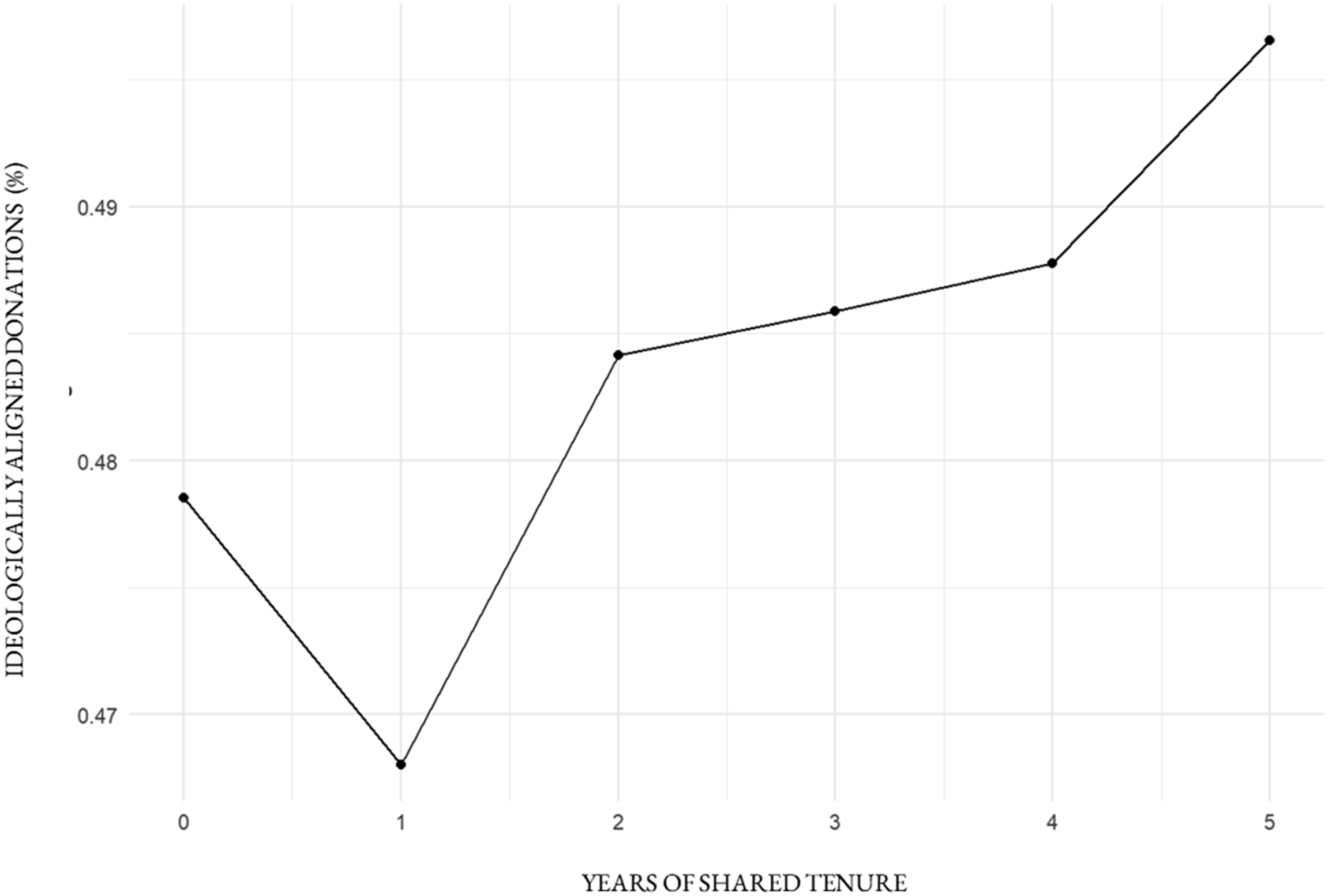
Political Ideological Alignment Over CEO—Executive Shared Tenures. Representing, by Year, the Proportion of Each Executive’s Political Campaign Donations which are Made to the Same Political Party as Their Current CEO. Year Zero Represents the Time of Their Appointment or a Change of CEO, i.e. the Formation of a New CEO—Executive Dyad
Model 6 estimates the change in CEO-executive political ideological alignment over the first five years of shared tenure. Coefficients denote the increase or decrease in the probability that each executive’s donation matches the political party of the CEO. Positive effects thus indicate convergence of donation patterns between the executive and CEO (not a directional change in ideology; see Model 7). We find no detectable change over the first four years under a new CEO’s leadership, but the effect becomes statistically significant in year five (0.023, p = 0.015). This implies that ideological convergence occurs over time within the TMT, rather than occurring through executive turnover. Model 7 corroborate this, estimating whether executives’ political donations become more ideologically extreme over time under the same CEO. This tendency is marginal in the first year of shared tenure (0.011, p = 0.087), becoming more pronounced over time and statistically significant from year 3. The largest increase in polarity also occurs in year 3 (0.023, p = 0.008). Collectively, these results indicate a gradual, individual-level shift in political ideological preferences within the TMT.
We conclude support for socialization mechanisms as a driver of TMT political ideological composition, and no support for selection processes. Intra-TMT shifts in polarization and homogeneity become more significant over the course of a CEO and executive’s shared tenure, while there is no evidence that group-level compositional changes accrue from a partisan CEO’s appointment of ideologically aligned individuals.
The observation of significant effects only after three years in Model 7 and five years in Model 6 also supports the treatment of political campaign donations as an true representation of personal ideological positions (Ansolabehere et al., 2003; Chin et al., 2013; Fremeth et al., 2013). Our role-theoretic framework conceptualizes ideology as mediated by and enacted in executives’ roles (Sarbin & Allen, 1968) such that executives may express different political preferences with no underlying ideological change (e.g., see Ramoglou et al., 2024; Tetlock, 2000). However, the motivation for these belief-incongruent ideological expressions would logically result in earlier shifts; for example when the executive seeks to gain favor with a new CEO, or during an initial period of adjustment to new role expectations (e.g., see Foss & Klein, 2024; Georgakakis et al., 2022). Instead, significant changes in executive’s political ideological positions occur only after three years, and move sufficiently towards the CEO only after five. This provides provisional yet novel evidence against non-ideological motivations (see Fremeth et al., 2013; Suddaby & Greenwood, 2005), suggesting that interpersonal influence in leadership settings may contribute towards convergence of beliefs.
Supplementary Analysis: Temporal Stability
Effects of CEO Partisanship and Characteristics on TMT Political Ideological Composition, Pre- and Post-2008
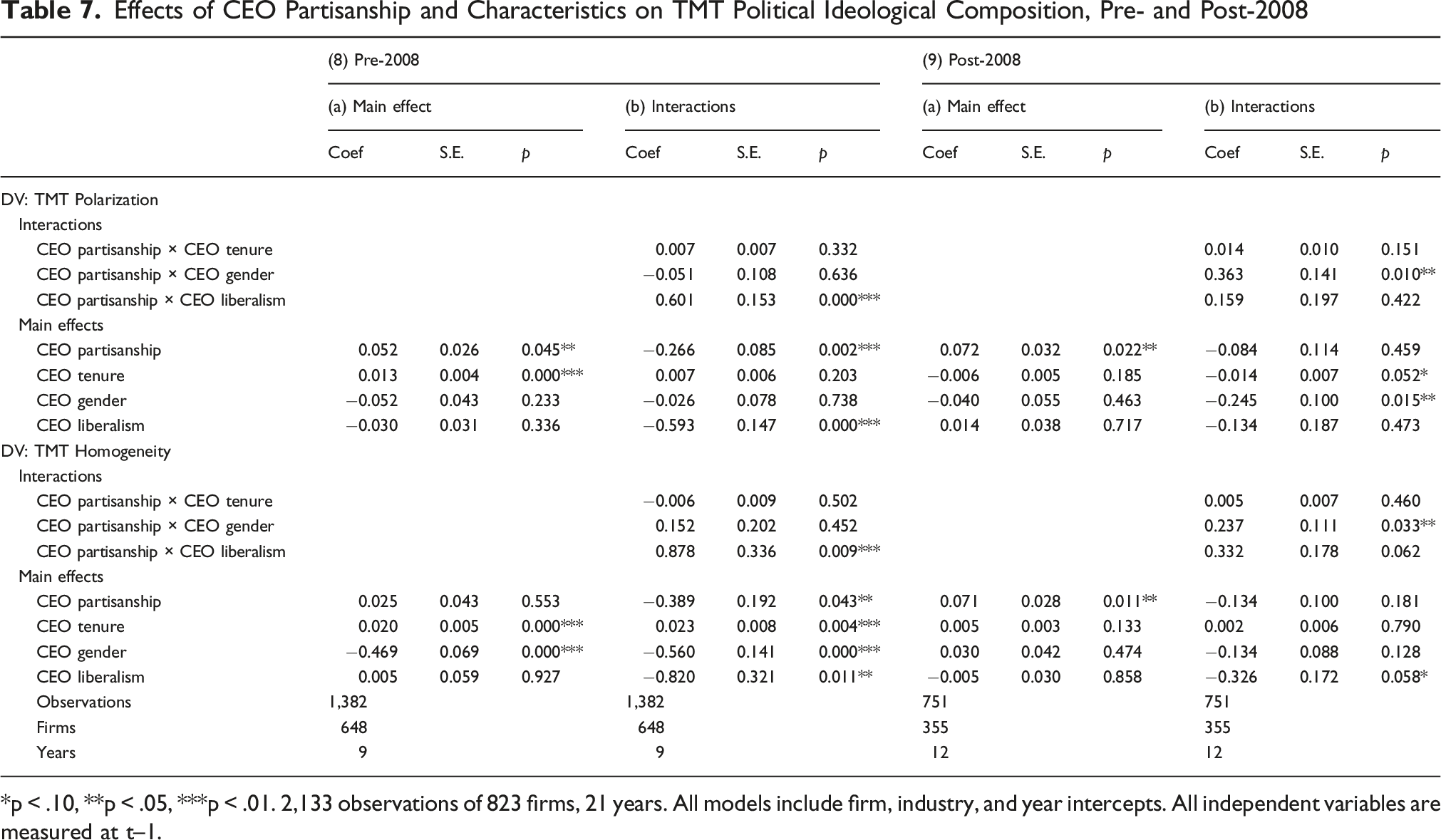
*p < .10, **p < .05, ***p < .01. 2,133 observations of 823 firms, 21 years. All models include firm, industry, and year intercepts. All independent variables are measured at t–1.
Before 2008, CEO partisanship had a positive and statistically significant association with TMT polarization (0.052, p = 0.045). This effect is strongly conditioned by CEO liberalism (0.601, p < 0.001), indicating that the positive association between CEO partisanship and TMT polarization strengthens as CEOs become more liberal. No significant moderation is observed for CEO tenure or gender. After the GFC, the main effect of CEO partisanship remains statistically significant (0.072, p = 0.022), but the interaction pattern shifts. CEO gender now significantly moderates the partisanship effect (0.363, p = 0.010), suggesting that CEO partisanship is more strongly associated with polarization under female CEOs. Neither tenure or liberalism significantly moderate the effect in this period.
In the pre-GFC period, CEO partisanship does not significantly predict TMT homogeneity on its own (p = 0.553), but its effect is strongly conditioned by CEO liberalism (0.878, p = 0.009). As for TMT polarization, this implies that liberal partisan CEOs were associated with greater ideological alignment among TMT members. Likewise, no significant interactions emerge for tenure or gender. Following the GFC, the main effect of CEO partisanship becomes significant (0.071, p = 0.011), and the interactions with both CEO gender (0.237, p = 0.033) and CEO liberalism (0.332, p = 0.062) are either significant or marginally significant, while the interaction with CEO tenure remains non-significant.
These results show that the relationship between CEO partisanship and TMT political ideological composition changes over time. Before the GFC, effects on both polarization and homogeneity were significantly stronger for liberal CEOs, whereas post-2008 effects are more symmetric across the ideological spectrum. CEO gender becomes a more reliable moderator, indicating that socialization processes remain central, though the relevance of CEO attributes appears to shift. Tenure, by contrast, shows no significant moderating role in either period and no longer has a significant direct effect post-GFC. These findings further corroborate the evidence from our main analyses: the extremity and uniformity of political ideology in TMTs is driven by CEOs’ interpersonal influence on incumbent executives, rather than via homophilous selection. Reflecting generalized political polarization since 2008, the influence appears increasingly driven by CEO partisanship itself, rather than their particular liberal—conservative alignment.
Discussion
This study investigates how CEOs’ political ideology becomes embedded and expressed within top management teams (TMTs). While prior work in the upper-echelons tradition has demonstrated that firms reflect their leaders’ ideological dispositions (Semadeni et al., 2022; Wowak & Busenbark, 2024), these tendencies have largely been treated as static attributes of leadership teams rather than outcomes of intra-organizational processes (Chin et al., 2013; Miller et al., 2022). By foregrounding the interpersonal mechanisms that generate ideological homogeneity and polarization within TMTs, this study addresses a foundational gap and advances a processual understanding of how political ideology is enacted and reproduced in teams (e.g., Cornelissen et al., 2015; Schoeneborn et al., 2025).
This is a substantive extension of the causal architecture of current theory, showing how role-based interaction rather than structural discretion produces ideological convergence, and illuminating the amplifying conditions of this effect. By establishing a methodological and conceptual foundation for further research, it opens new avenues for theorizing partisanship as a driver of executive behavior, team dynamics, and stakeholder interactions (e.g., see Hadani, 2024; Hambrick & Wowak, 2025; Mui et al., 2024), with corresponding implications for researchers, organizations, and policymakers.
Implications for Theory
Our central finding is that partisan CEOs are most likely to act upon their political views to shape the ideological composition of their executive team. This manifests as both polarization, where the TMT moves toward the CEO’s ideological extreme (West & Iyengar, 2022), and homogeneity, a reduction of ideological diversity (McKean & King, 2024). We evince the underlying mechanisms through a role-theoretic framework with two causal pathways: selection, where CEOs appoint ideologically aligned executives (Ozgen et al., 2025; Pfeffer, 2013), and socialization, where ideological expressions gradually converge through interpersonal influence (Biddle, 1986; Sarbin & Allen, 1968). Our findings reveal weak evidence for selection but robust support for socialization, which is strongest under female and liberal CEOs.
From theses main, mechanistic, and moderating effects, we can surmise three substantive contributions that advance and challenge existing theory. First, we show that partisanship is an independent causal factor in group- and organization-level outcomes. Most research focuses on ideological orientation, overlooking the importance of intensity of this identification, regardless of the ‘direction’ of one’s views (see Hadani, 2024; Hudson, 2025; Raffiee et al., 2023). Second, we find that group-level ideology shifts because of relational power, not structural discretion. This does not contradict the notion that ideological change in leadership teams occurs through homophilous appointments (e.g., see Georgakakis et al., 2024; Hudson & Morgan, 2022); but demonstrates an alternative mechanism driven by the strength of CEOs’ partisan leanings. In examining this mechanism, we thirdly reveal the conditions that amplify and mitigate its effects. Consistent with the relational nature of socialization, female and liberal CEOs are most likely to enact their partisanship to shape their TMT (Eagly & Wood, 2012; Gerber et al., 2012). Following the growing social salience of politics in organizations (Fezzey et al., 2024; Hambrick & Wowak, 2025), this relational power has increased over time.
Collectively, these form an integrative foundation (see Figure 1) for several avenues of theoretical development regarding executive behavior, team dynamics, and stakeholder interactions. As examples, we note specific implications for (i) CEO activism studies, (ii) temporal and process perspectives, and (iii) advancing theory through methods.
First, it can provide a group-level perspective on the antecedents of CEO activism. By demonstrating that partisan CEOs foster ideologically homogeneous TMTs through a process of socialization, our study reveals how an ‘echo chamber’ can form at the apex of an organization (see also Barrios et al., 2022; Hudson & Morgan, 2022). A leadership team that lacks ideological diversity may provide fewer dissenting viewpoints and less critical evaluation of a CEO’s politically-charged ideas. A partisan CEO operating within such an insulated environment may perceive their own views as more normalized or less controversial than they appear to the outside world (Foss & Klein, 2024; Wright, 2023). This lack of internal friction could embolden a CEO to engage in public activism, potentially underestimating the risk of stakeholder backlash (Hambrick & Wowak, 2021; Shrader, 2025).
Second, this model may be used to explore reciprocal and reinforcing processes between individual- and group-level effects of ideology. This responds to calls to incorporate temporality and process perspectives into theorizing the socio-psychological aspects of ideology in leadership (Lebrument, 2025), providing a conceptual foundation for doing so. For example, future research could investigate how the ideological composition of the TMT reciprocally shapes CEO decision-making, potentially creating feedback loops that entrench biases and/or promote their enactment (e.g. see Hudson & Morgan, 2022; West & Iyengar, 2022). Our granular analysis of political donations substantiates the use of these data as an indicator of ideological expression (see also Ansolabehere et al., 2003; Fremeth et al., 2013).
A third contribution to future theoretical development is therefore to provide both the methodological and conceptual tools for developing causal understanding (see Bliese et al., 2024; Cornelissen, 2024). Moving beyond the aggregate measures typically employed in this literature enables our mechanistic exploration of how the enactment of ideology is shaped through social interaction (cf. Mannor & Busenbark, 2025). However, while our findings imply socialization effects are stronger than opportunistic conformity (c.f., Bromiley & Rau, 2016; Ramoglou et al., 2024), the extent to which these reflect deeper shifts in executives’ values remains uncertain (see Suddaby & Greenwood, 2005). These can only fully be examined with qualitative approaches such as ethnographies and case studies (Schoeneborn et al., 2025). In these cases, our model provides conceptual precision, guiding interpretive research towards promising areas of causal exposition (Cornelissen & Werner, 2025). Methodologically and conceptually, we therefore offer a generative roadmap for theorizing the micro-level processes and causal pathways of ideological dynamics in leadership teams.
Accordingly, the implications for theoretical development extend beyond TMTs. The mechanisms we identify arise from widespread human behaviors, and are therefore likely to generalize to other group settings. Role-based socialization dynamics may operate in boards of directors, project-based organizations, and executive committees—anywhere that positional asymmetries create opportunities for the diffusion of ideological expressions from a focal point of influence. This opens innumerable contexts for developing our theoretical contributions beyond leadership studies (e.g., see Busenbark et al., 2025; Dao et al., 2025; Hudson, 2025).
Implications for Practice
Operating amid heightened political polarization and public scrutiny of leadership decisions, awareness and management of ideological effects is becoming a crucial competency for organizations (Solomon et al., 2025; Wowak et al., 2022; Wright, 2023). Understanding the mechanisms and moderators of CEOs’ influence on group diversity provides a basis for cumulative development of evidence-based practices that productively harness differences, while minimizing their downsides (e.g. see Hudson & Morgan, 2023), with several practical implications for directors and executives:
Boards of directors should recognize that CEO partisanship can have profound effects on team polarization and homogeneity, even in the absence of the overt ideological signaling that has been more widely examined in recent years (Mkrtchyan et al., 2023; Wowak & Busenbark, 2024). We explicate socialization processes as the dominant driver of homogeneity and polarization in the TMT, highlighting the need to look beyond observable and deliberate ideological actions when considering the impact that such leaders may have upon a firm: at least in its organizationally consequential social enactment (Wright, 2023), ideology changes gradually through interpersonal influence, rather than instantaneously upon the entry and exit of ideologically aligned members (c.f., Chow et al., 2022; McPherson et al., 2001).
Awareness of this mechanism is critical to ensuring the efficacy of policies or practices (see Cornelissen & Werner, 2025). CEOs do not initially select for like-minded executives, but shape the composition of their TMT over time. If organizations wish to promote political diversity in decision-making teams (e.g., see Hudson & Morgan, 2023; Mack et al., 2025), attempting to formally instantiate this through limits to managerial discretion and recruitment practices is therefore likely to be insufficient. Instead, fostering ideological transparency within leadership teams may paradoxically reduce its hidden influence. Encouraging open discussions of ideological differences may help expose biases that would otherwise remain undetected, promoting awareness of how individuals’ political preferences inform their worldview, decisions, and interpersonal interactions.
Rather than ideological favoritism, boards may utilize knowledge of the factors conditioning these relationships to adapt to the tendencies of particular CEOs. For example, liberal leaders are not only most commonly associated with overt activism (McKean & King, 2024; Wright, 2023), but are more comfortable in limiting organizational speech (Solomon et al., 2025) and politically homophilic in director appointments (Hudson & Morgan, 2022), reflecting our finding that liberalism amplifies the effect of CEO partisanship in homogenizing and polarizing the ideology of the TMT. Strongly partisan liberal CEOs—while shown to improve outcomes such as innovation (Lesage et al., 2025) and social performance (Gupta et al., 2019)—may therefore benefit most from governance mechanisms that ensure ideological diversity is sustained and not inadvertently eroded by subtle socialization effects.
This has further implications for the management of stakeholder relationships. As firms face rising external pressure to align their strategic decisions with normative values (Foss & Klein, 2022; Wright, 2023), highly polarized or homogenous TMTs should be aware of how their biases may create ideological blind spots, which could increase the likelihood of violating stakeholders’ expectations (see Zachary et al., 2023). Applying our findings and framework may assist organizations in addressing a broad range of challenges associated with political biases in leadership (e.g., see Swigart et al., 2020), and understanding the intragroup processes of ideological influence at other levels of decision-making.
Implications for Policy
Beyond the TMT, this study speaks to broad policy debates on ideological influence in leadership. Directors, investors, and regulators increasingly confront questions about how executives’ political identities affect disclosure, lobbying, and firm–state relations (see Gupta et al., 2025; Perchard & MacKenzie, 2021). Identifying socialization as the dominant mechanism of ideological convergence shows that conformity can develop even where recruitment and promotion policies are designed for neutrality or diversity.
Demonstrating these effects in TMTs provides new insights into how partisan cognition might diffuse across other elite decision-making structures (e.g., see Georgakakis et al., 2024; Perchard et al., 2025). This clarifies why ideological conformity might persist even in politically regulated or disclosure-sensitive environments, offering a new lens for boards, regulators, and policymakers concerned with ideological capture in strategic and critical contexts (e.g., see Duarte et al., 2015; Georgakakis et al., 2025).
When designing policies that seek to sustain ideological plurality, boards and regulators may therefore benefit from using longitudinal indicators of ideological expression, such as donation activity or issue advocacy, to monitor internal convergence. Policy interventions might include procedural safeguards to preserve heterogeneity, encouraging deliberation rather than prohibiting political expression, and embedding expectations of political disagreement as a cultural norm (see Georgakakis et al., 2025; Hudson & Morgan, 2023; Mui et al., 2024). This could reduce the risk of self-reinforcing alignment that can impair judgment, which may be especially important in politically salient domains such as environmental, social, or national-security issues (e.g., see Hambrick & Wowak, 2025; Perchard et al., 2025).
Broadly, recognizing that ideological influence operates through role expectations and interpersonal relations clarifies why formal neutrality requirements alone rarely prevent politicization of corporate behavior. A focus on interactional processes may provide a more realistic basis for governance and public oversight (see also Creary, 2025; Swigart et al., 2020).
Limitations and Directions for Future Research
An inherent limitation of large-sample studies of political ideology (Chin et al., 2013), we necessarily base our analyses on behavioral evidence rather than internal beliefs. While political campaign donations are an extensively used and validated proxy for ideology in organizational research, these data cannot truly distinguish genuine belief from non-ideological motivations (Fremeth et al., 2013). This is not critical for the focus of our study: in terms of their relevance for firms and stakeholders, the behavioral manifestations of ideology are of greater consequence than the beliefs that executives may hold but never enact (see Foss & Klein, 2022; Wright, 2023). Further, our evidence that convergence in donation behavior in CEO—executive dyads only becomes detectable after several years of shared tenure suggests a gradual process of interpersonal influence, rather than immediate impression management or strategic signaling (e.g., see Bondi et al., 2025). Nevertheless, our findings should be interpreted with caution and not generalized beyond our role-theoretic framework, being assumed only to reflect changes in ideological expressions rather than internal values.
A second limitation of our data, the U.S. context assumes a bimodal ideological distribution, limiting generalizability to political systems with multiparty structures such as European countries (Fournier et al., 2020; Malka et al., 2014). The intertemporal applicability of ideological measures is also potentially constrained. Our supplementary analyses reflect the shifting relevance and role of political ideology in U.S. firms (Krause & Miller, 2020), and it is increasingly evident that the traditional liberal—conservative spectrum may fail to fully capture ideological differences in the future (Schedler, 2023; Schoenmueller et al., 2023). Multi-dimensional measures may better account for these trends; for example, with separate measures of social and economic liberalism (Crawford et al., 2017) or populism (Bennett et al., 2023).
Finally, while we focus on partisanship and the moderating effects of tenure, gender, and liberalism, ample opportunities remain to explore the factors underlying CEO—TMT ideological dynamics. Demonstrating the dominance of socialization mechanisms for shaping the ideological composition of TMTs, our findings point to psychological and interpersonal characteristics, such as CEO personality traits (see Bromiley & Rau, 2016) or leadership styles (e.g., Marbut et al., 2025) associated with influence and persuasion, as promising areas for further research.
Footnotes
Author Note
No primary data requiring participant consent was used in conducting this research. The data was sourced from third party databases. Restrictions apply to the availability of these data, which were used under license for the current study.

Funding
The author received no financial support for the research, authorship, and/or publication of this article.
Declaration of Conflicting Interests
The author declared no potential conflicts of interest with respect to the research, authorship, and/or publication of this article.