




Abstract
The prevalence rates of Common Mental Disorders (CMDs) worldwide are at an all-time high. Workplaces are especially impacted by this phenomenon. As organizations strive to leverage the full potential of all employees, leaders are responsible for the inclusion of employees with CMDs by providing them with the necessary support. Challenging the positivity bias in research on leadership and inclusion, we offer a nuanced understanding of why support is often lacking, ultimately resulting in the exclusion of these employees. Our multi-level model conceptualizes how destructive leadership hinders the organizational inclusion and contributes to the exclusion of employees with CMDs by specifically considering the factors that explain under which conditions leaders are more likely to display destructive leadership behaviors towards employees with CMDs. Our model incorporates job demands and resources (JD-R) theory with temporal theorizing to elucidate the adverse impact of destructive leadership on the psychological functioning of employees with CMDs and the development, over time, of a reciprocal downward spiral between employee psychological functioning and destructive leadership. We call for future research to incorporate this perspective as it will (1) enrich extant understanding of the individual, team, and organizational factors that engender the phenomenon and (2) identify paths that make organizations more effective and more substantively inclusive by breaking the downward spiral.
Pre-pandemic statistics found that about one in ten adults worldwide had a depression or an anxiety disorder (WHO, 2017). The global prevalence rates of these Common Mental Disorders (CMDs) have increased by 25% in the aftermath of the COVID-19 pandemic (WHO, 2022). CMDs impact both employees and the organizations for which they work. Globally, the financial costs to employers associated with these CMDs are estimated at USD 1 trillion per year (WHO, 2024). Given the adverse effects of CMDs, 92% of employees express that it is important for them to work for an organization that provides mental health support (American Psychological Association, 2023). While mental health support has gained priority since the pandemic (Shore et al., 2025), organizational research and practice on how to accommodate employees with CMDs lag behind (e.g., Colella & Santuzzi, 2022; Follmer & Jones, 2018).
Mental illness is considered a disability and is protected under national-level legislation (e.g., the Equality Act 2010 in the UK). Beyond regulatory compliance requirements, there is a business case for providing support for employees with CMDs, such as ensuring that their talent and skills are leveraged for the organization’s benefit and minimizing the costs associated with excluding them. However, most organizations do not harness the benefits of supporting employees with CMDs, as the fact remains that this group continues to habitually encounter discriminatory treatment, stigmatization, and abuse at work (e.g., Colella & Santuzzi, 2022; Restubog et al., 2021).
At present, a disconcerting trend to withdraw from diversity, equality, and inclusion (DEI) policies and practices in organizations can be observed in some countries, especially the US (e.g., Prasad & Śliwa, 2024). Its effects are exacerbated by debates about the need to prioritize performance over employee health (e.g., Pitel, 2024), which create a false dichotomy between the two. Of particular relevance to the matter of mental health, this generates a tension between the need to address growing rates of CMDs in workplaces and backlash against initiatives aimed at fostering organizational inclusion. Consequently, it becomes even more pressing to understand how to create organizational conditions that facilitate the inclusion of employees with CMDs.
Organizational inclusion means that “people of all identities and many styles can be fully themselves while also contributing to the larger collective, as valued and full members” (Ferdman, 2017, p. 235). Leadership plays a crucial role in fostering inclusion (Randel et al., 2018). To date, research has generated helpful insights into how the contribution of marginalized employees can be leveraged through constructive leadership (e.g., Randel, 2023; Shore et al., 2011), understood as leadership that is “in accordance with the legitimate interest of the organization, showing both pro-subordinate and pro-organization behavior” (Aasland et al., 2010, p. 440). However, as a consequence of this positivity bias (Knol et al., 2024), much less attention has been paid to why employees with CMDs are at a risk of experiencing abuse and exclusion (Restubog et al., 2021), and we argue that this experience can be fueled by destructive forms of leadership. Schyns and Schilling (2013, p. 141) define destructive leadership as a “process in which over a longer period of time the activities, experiences and/or relationships of an individual or the members of a group are repeatedly influenced by their supervisor in a way that is perceived as hostile and/or obstructive”. Accordingly, destructive leadership is inherently exclusionary (Howard et al., 2020; Yang et al., 2020), undermining employees’ capability to contribute to organizations as valued members (Mackey et al., 2021).
As a result of the paucity of interest in destructive leadership, we know much more about what leaders should do to foster organizational inclusion than about when, why, and how they engage in forms of leadership contributing to organizational exclusion. That is, a situation in which employees – for instance, those characterized by common but stigmatized characteristics such as CMDs – are unable to be fully themselves and to contribute to the larger collective as valued and full members of the organization (Ferdman, 2017; Shore et al., 2011). To address this gap in the extant literature, we conceptualize how passive (laissez-faire leadership) and active (abusive supervision) forms (Khan et al., 2024; Klasmeier et al., 2022) of destructive leadership evolve over time and erode the psychological functioning – and thereby the organizational inclusion – of employees with CMDs (cf. Bakker et al., 2023; Pletzer et al., 2023).
Shore et al. (2011; 2018) consider inclusion-exclusion as a spectrum, with exclusion representing the low-end of inclusion. We argue that psychological functioning allows employees with CMDs to contribute to organizational matters to the best of their ability (cf. Sonnentag et al., 2023; Tay et al., 2023) and is, hence, an important aspect of their inclusion. Impaired psychological functioning is, in turn, an aspect of their exclusion, because it hinders these employees’ ability to contribute to the organization. To explain the detrimental consequences of destructive leadership for their psychological functioning (Harms et al., 2017), we draw on job demands and resources theory (JD-R, Bakker et al., 2023) and conceptualize destructive leadership as a job demand (Pletzer et al., 2023). As employees with CMDs lack the resources to deal with this additional demand, destructive leadership can put their psychological functioning at risk, which, ultimately, can aggravate the symptoms of their CMD (Montano et al., 2023).
Taking an actor-centric perspective, we assume that leaders may not necessarily behave destructively on purpose. In contrast to leaders high in the Dark Triad traits (i.e., narcissism, Machiavellianism, and psychopathy), who often intend to harm or control others (e.g., Gauglitz et al., 2022), leaders may not always be equipped to constructively lead employees with CMDs. Indeed, since organizations often do not provide adequate support (e.g., procedural knowledge about how to interact with employees experiencing CMDs, stigma reduction interventions, and professional counseling; cf. Follmer & Jones, 2018), leading a diverse workforce can be demanding for leaders (e.g., Eagly & Chin, 2010; Martin et al., 2015). This is an important consideration because most leaders will lead employees with CMDs due to its high prevalence rates. Additionally, CMDs belong to the group of invisible deep-level diversity aspects that are, as yet, rarely discussed in the context of inclusion practices (Colella & Santuzzi, 2022). In line with JD-R theory (Bakker et al., 2023), leaders may resort to maladaptive behaviors such as destructive leadership when necessary resources for constructive forms of leadership are lacking (Byrne et al., 2014; Li et al., 2016).
We present a conceptual model (see Figure 1) to explain how factors at multiple organizational levels may influence the development and impact of passive and active destructive leadership on employees with CMDs. In doing so, we make three contributions to challenging the positivity bias in leadership and organizational inclusion research (e.g., Alvesson & Einola, 2019; Knol et al., 2024), while also advancing the undertheorized research area of CMDs in organizations (e.g., Rosado-Solomon et al., 2023). Conceptual Model: Factors Contributing to a Downward Spiral Between Destructive Leadership and Psychological Functioning of Employees with Common Mental Disorders.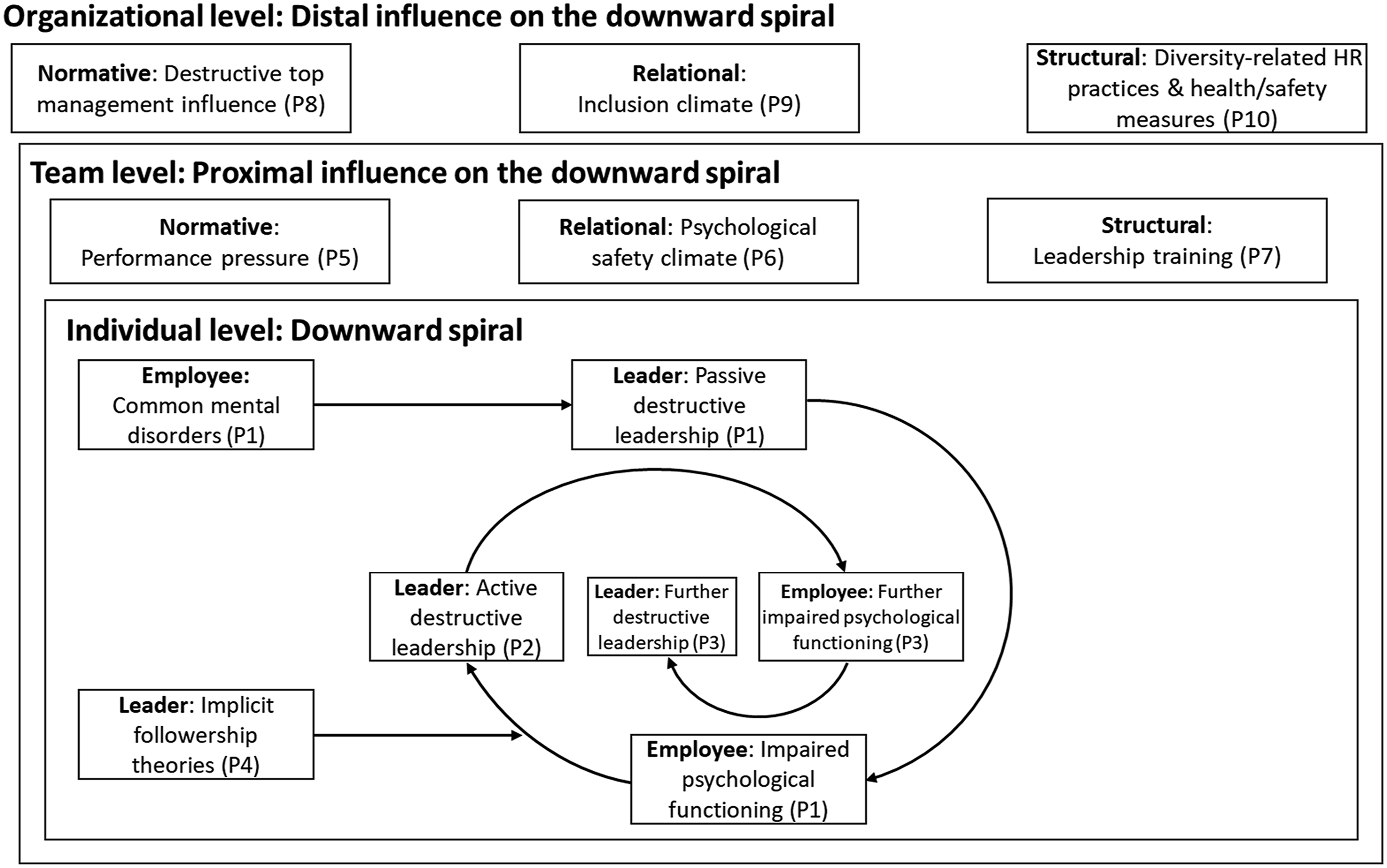
First, we posit that, when leading employees with CMDs and in the absence of adequate organizational resources and interventions, there is high risk that leaders may resort to destructive forms of leadership (cf. Byrne et al., 2014; Martin et al., 2015). Second, we explain why leaders resort to destructive leadership as a maladaptive strategy, which negatively affects the psychological functioning of employees with CMDs—and, hence, their inclusion—leading to a mutually reinforcing downward spiral over time (Bakker et al., 2023). We elucidate this downward spiral to inform future research on improved leadership practices in organizations. Third, we point to individual, team, and organizational level characteristics that can contribute to the downward spiral between destructive leadership and psychological functioning of employees with CMDs (cf. Follmer & Jones, 2018; Roberson, 2019; Shore et al., 2018).
CMDs and Psychological Functioning of Employees in Organizations
Mental illness is defined as a specific set of diagnosed psychological conditions impacting the emotions, cognitions, and behaviors of individuals (Follmer & Jones, 2018; Rosado-Solomon et al., 2023). Mental illness should be distinguished from mental health (Rosado-Solomon et al., 2023), a state of psychological functioning and well-being (Sonnentag et al., 2023; Stephan, 2018; Tay et al., 2023). CMDs can influence individuals’ day-to-day psychological functioning (Rosado-Solomon et al., 2023). This is critical for organizations, as there is solid evidence that reduced psychological functioning relates negatively to individual creativity, motivation, performance, and career success (e.g., Ford et al., 2011; Sonnentag et al., 2023; Stephan, 2018), with some seeing optimal psychological functioning as the ‘ultimate criterion’ in organizational science (Tay et al., 2023). Ensuring the psychological functioning of employees with CMDs is an important aspect of their organizational inclusion, allowing them to fully engage with organizational life and contribute to organizational matters (see Ferdman, 2017). Moreover, organizational inclusion can buffer the symptoms of CMDs (e.g., Lacerenza et al., 2024). Hence, establishing inclusion fulfills a moral responsibility to support employees with CMDs, and inclusive organizational practices can also facilitate their retention (Gewurtz et al., 2022). Leaders play a central role in organizational inclusion (Randel, 2023; Randel et al., 2018) and their behavior can affect employees’ psychological functioning (Montano et al., 2023). However, when leaders resort to destructive forms of leadership, their behavior can have exclusionary consequences for employees with CMDs through decreasing their psychological functioning.
Forms of Destructive Leadership and Their Place in the Leadership Landscape
Despite the increase in research into destructive leadership (and its consequences), the majority of leadership research still focuses on constructive leadership concepts (Alvesson & Einola, 2019; Haslam et al., 2024). Research on inclusion is no exception to this positivity bias (Knol et al., 2024). Within the broader leadership literature, destructive leadership is not equated with low levels of constructive leadership (e.g., transformational or inclusive leadership), but is considered to be a conceptually unique type of leadership (e.g., Chénard-Poirier et al., 2022; Skogstad et al., 2007). Past research showed that leaders use both constructive and destructive forms of leadership simultaneously (e.g., Arnold et al., 2017; Thoroughgood et al., 2018), and that destructive leadership is related to employee psychological functioning beyond the influence of constructive leadership (e.g., Montano et al., 2023; Schyns & Schilling, 2013).
Destructive leadership can manifest in passive or active forms (e.g., Khan et al., 2024; Klasmeier et al., 2022). Passive destructive leadership comprises laissez-faire leadership, where the leader withdraws from interacting with their team, is absent when needed, avoids making decisions, and does not provide feedback, reward, or motivation (Skogstad et al., 2007). This subtle but most prevalent form of destructive leadership is especially detrimental (Aasland et al., 2010). While its occurrence rarely gives rise to intervention by the organization, it provides fertile ground for more active abuse of employees (e.g., Aasland et al., 2010; Skogstad et al., 2007). Among active forms of destructive leadership, abusive supervision has received the highest amount of attention by scholars (Mackey et al., 2021). It refers to leaders’ engagement in “the sustained display of hostile verbal and nonverbal behaviors, excluding physical contact” (Tepper, 2000, p. 178), and covers behaviors such as lying, privacy invasion, blaming, breaking promises, and verbal aggression.
Destructive Leadership and Exclusion: A JD-R Perspective
We build our theorizing on the JD-R model (Bakker et al., 2023), which assumes that job demands and resources impact psychological functioning via health-impairment and motivational processes. Additionally, demands and resources can interact to influence work-related outcomes; that is, to even out job demands, employees and leaders need resources. For employees, one crucial resource or demand is leadership. In the context of the JD-R model, leadership influences employees through its (1) impact on other demands and resources, (2) influence on the relationship between demands and resources, and (3) direct relationship with psychological functioning (Tummers & Bakker, 2021). In essence, constructive leadership can be a resource, though, concomitantly, destructive leadership can be a demand (Pletzer et al., 2023), with severe consequences for employee mental health (including anxiety, burnout, depression, exhaustion, and strain; Harms et al., 2017; Mackey et al., 2021; Montano et al., 2023). This means that destructive leadership can contribute to the development of CMDs (e.g., Pyc et al., 2017; Tepper, 2000) and therefore negatively affect all employees. Destructive leadership is particularly demanding for employees with CMDs because it risks aggravating the symptoms of their CMD (cf. Hennekam et al., 2021; Rosado-Solomon et al., 2023). At the same time, these employees are more likely to find themselves on the receiving end of destructive leadership, as they are at a higher risk of being abused at work due to, for example, stereotyping and stigmatization as well as uninformed attributions for their reduced performance and absenteeism (Restubog et al., 2021).
Additionally, destructive leadership can create a climate where disclosure is less likely (due to reduced support and trust; cf. Fischer et al., 2021; Follmer et al., 2020), thus hindering the inclusion of employees with CMDs. Particularly, employees may not feel comfortable disclosing CMDs (Follmer et al., 2020), as they assume it will engender negative consequences (e.g., stigmatization due to negative social stereotypes about CMDs; Follmer & Jones, 2017; Newheiser & Barreto, 2014). Non-disclosure can prevent employees with CMDs from receiving support, and masking CMDs is emotionally taxing (Follmer & Jones, 2022).
For employees with CMDs, constructive leadership would be particularly helpful in terms of receiving resources and support to improve their psychological functioning, thereby enhancing their inclusion in the workplace (Follmer & Jones, 2018). However, for leaders, constructive leadership behavior requires leaders to invest resources (e.g., time, effort, emotion regulation), which can exhaust their resource pool over time (Lin et al., 2019). Hence, leaders need additional resources, such as knowledge, training, time, and organizational support to address CMDs in organizations. When leaders’ resources are depleted and organizational support is absent, leaders may refrain from leading constructively (e.g., Byrne et al., 2014; Kaluza et al., 2020). JD-R theory contends that increasing demands can lead to maladaptive behaviors when resources are low (Bakker et al., 2023). This is especially important when leaders feel challenged to lead a diverse workforce (Eagly & Chin, 2010) and particularly so for those leading employees with CMDs (Martin et al., 2015). Leaders report a lack of confidence in their ability to support and lead employees with CMDs (Colella & Santuzzi, 2022). Research indicates that leaders experience demands (e.g., conflicts, overload, strain, uncertainties) while leading employees with CMDs (Follmer & Jones, 2018; Martin et al., 2015). Consequently, leaders may resort to destructive leadership behaviors as a maladaptive strategy to cope with their leadership demands (e.g., Bakker et al., 2023; Byrne et al., 2014; Li et al., 2016), especially when adequate organizational support is missing (cf. Wittmers et al., 2024).
The Downward Spiral
Based on JD-R theory, we propose a downward spiral between destructive leadership and the psychological functioning of employees with CMDs. A downward spiral is conceptualized as the mutually reinforcing relationships between demands or depleted resources, maladaptive coping strategies, and resulting strain over time (Bakker et al., 2023). Applied to our context, leaders’ lack of resources can result in destructive leadership behavior, which adversely effects the psychological functioning of employees with CMDs. As a result, leaders who are tasked with the responsibility to foster inclusion are, instead, contributing to the exclusion of employees with CMDs by decreasing their psychological functioning (Colella & Santuzzi, 2022; Randel, 2023). The exclusionary effects are the outcomes of leaders engaging in ostracism, ignoring or denying employee needs, or exhibiting (micro)aggressions (Prasad, 2023; Shore & Chung, 2022). These behaviors are discussed in research on laissez-faire leadership and abusive supervision (e.g., Skogstad et al., 2007; Tepper, 2000).
Initially, leaders may withdraw from their leadership responsibility, showing laissez-faire leadership towards employees with CMDs, as they feel unprepared or insecure in leading them (De Jesus & O’Neil, 2024) due to a lack of knowledge and training (Martin et al., 2015). Passive forms of destructive leadership are characterized by a lack of support (Robert & Vandenberghe, 2021), not meeting the expectations of employees, or denying their needs (Skogstad et al., 2007). Additionally, laissez-faire leadership is not only the absence of resources, but a demand that creates further obstacles (Che et al., 2017; Skogstad et al., 2014).
Without guidance and support from leaders, employees with CMDs likely experience difficulties fulfilling their duties at work. A few examples might illustrate this point. According to the WHO (2017) definition, depressive symptoms include feeling sad and irritable, poor concentration, low self-worth, and hopelessness about the future, while employees with anxiety disorders are prone to worrying and panic attacks (WHO, 2023). Employees with depression will likely suffer from a lack of positive feedback, undermining their self-confidence. Similarly, in the absence of guidance, employees with anxiety disorders will experience increased worry about performing their tasks correctly. This means that their cognitive resources will be impaired (Cheng & McCarthy, 2018), which may lead to a decline in performance. Finally, laissez-faire leadership is characterized by low levels of support and control. These factors have been found to attenuate the positive correlations of anxiety and depression with absenteeism and poor work performance (Plaisier et al., 2012). In summary, laissez-faire leadership can deplete the resources of employees with CMDs, in turn undermining their psychological functioning.
Employees with CMDs are more likely to experience passive destructive leadership from their leaders, which impairs their psychological functioning. Initial passive leadership, which is likely to emerge when leaders do not know how to handle a situation (Tafvelin et al., 2023), can turn into more active forms, especially where leaders lack information about the reasons for poor performance and blame employees (Lyubykh et al., 2022). Research suggests that employees’ reduced psychological functioning may cause leaders to exhibit higher levels of active destructive leadership over time as they seek to increase employees’ performance (Fischer et al., 2021; Lyubykh et al., 2022; Tepper et al., 2011). An example might illustrate this process. A passive destructive leader would not give constructive feedback to an employee who makes a mistake. When mistakes repeat, the leader might revert to reminding the employee of past mistakes (a behavior related to active destructive leadership; Tepper, 2000), rather than providing the means to improve performance. Linking this example to CMDs, we assume that the initial lack of feedback might be confusing for employees with anxiety disorders and depression, while subsequent active destructive leadership is likely to increase work-related anxiety and decrease self-esteem, respectively (Cheng & McCarthy, 2018). Hence, the risk of error is likely to increase after the lack of feedback, which in turn can trigger leaders to revert to active destructive leadership. Here, active destructive leadership occurs because leaders lack the requisite resources in interactions with employees with CMDs after passive destructive leadership has already decreased their psychological functioning.
As a result of passive destructive leadership, psychological functioning of employees with CMDs decreases and the likelihood of errors increases, triggering active destructive leadership. Based on our arguments above, we posit a reciprocal relationship between destructive leadership and employees’ decreased psychological functioning over time. There is solid evidence demonstrating that destructive leadership is related to negative consequences for employees’ psychological functioning (e.g., Harms et al., 2017; Pletzer et al., 2023). That is, for employees with CMDs, leaders’ shift from passive to active destructive leadership can further decrease psychological functioning and even aggravate the symptoms of the CMDs (Mackey et al., 2021; Montano et al., 2023); often because repeated interactions with the leader may cause further resource depletion (Bakker et al., 2023; Hobfoll et al., 2018). Leaders who engage in active destructive leadership (Tepper, 2000) tell followers that their feelings are stupid, do not give them due credit, or blame them for mistakes the leader themselves made. Considering the symptoms of depression (WHO, 2017), such behaviors will contribute to the low self-worth of these employees, risking degradation of their psychological functioning. Similarly, employees with anxiety disorders are likely to experience an aggravation of their symptoms (e.g., worrying and panic attacks; WHO, 2023) when a leader breaks promises or lies to them, which are other examples of destructive leadership (Tepper, 2000). The above examples illustrate how employees with CMDs might show reduced performance as well as tendencies to withdraw from the job to avoid further impairment of their psychological functioning. This can threaten leaders, who may feel limited in their ability to fulfill their organizational duties. Also, it can increase leaders’ job demands while they lack the resources to act constructively, which in turn can their destructive tendencies toward employees (Tepper et al., 2017). Thus, a downward spiral between destructive leadership and employee psychological functioning may develop over time. Once such a downward spiral gains momentum, employees with CMDs cannot invest the necessary resources to perform in the job as these have already been exhausted in the interactions with a destructive leader (Hobfoll et al., 2018; Sonnentag et al., 2023). Such employees may turn to a defensive withdrawal (Hobfoll et al., 2018), which is associated with absenteeism or intentions to quit (Darr & Johns, 2008; Rothausen et al., 2017). This, in turn, exacerbates the situation for the leader and places further demands on them, which, again, fuels the maladaptive downward spiral of destructive leadership (Bakker et al., 2023; Byrne et al., 2014).
Over time, a downward spiral develops between destructive leadership and the psychological functioning of employees with CMDs: As their resources are depleted by previous destructive leadership, employees with CMDs experience a further decline in psychological functioning. Consequently, this poses a job demand for their leader, increasing the likelihood that the leader will further intensify their destructive leadership.
Multi-Level Influences on the Relationship Between Destructive Leadership and Psychological Functioning
In the following, we discuss how factors on the individual, team, and organizational level contribute to this downward spiral. To justify the selection of these multilevel factors, we integrate JD-R theory (Bakker et al., 2023) with frameworks about inclusion (Randel, 2023; Roberson, 2019; Shore et al., 2018) and mental illness at work (Follmer & Jones, 2018). The JD-R model highlights the importance of individual factors, as well as the team and the organizational level, as proximal and distal contextual factors to provide resources or influence the response to demands for leaders and employees (Bakker et al., 2023). These factors can shape the downward spiral between destructive leadership and the psychological functioning of employees with CMDs. To identify specific contextual aspects relevant to organizational inclusion, we draw on Roberson (2019) who emphasizes the importance of considering structural, normative, and relational factors. Finally, we identify factors that could either increase or decrease relevant symptoms of depression and anxiety disorders, drawing on the WHO framework (WHO, 2017). Specifically, we consider that these factors influence the psychological functioning of employees with CMDs as well as help or hinder leaders when it comes to leading employees with CMDs.
Individual Level: Implicit Followership Theories
People hold implicit assumptions about others. These implicit assumptions can explain differences in leadership behavior (Güntner et al., 2021) and can concern the stigmatization of employees with CMDs (Elraz, 2018; Follmer & Jones, 2017). When these assumptions are about employees, they are called implicit followership theories (IFTs), which can be either positive (prototype) or negative (anti-prototype) (Sy, 2010). IFT anti-prototypes contribute to the downward spiral between destructive leadership and the psychological functioning of employees with CMDs. Leaders who hold higher IFT anti-prototypes (i.e., that followers are conformers, incompetent, and insubordinate) rather than lower IFT prototypes (i.e., that followers are industrious, enthusiastic, and good citizens) are likely to negatively interpret employees’ behaviors by attributing them to incompetence or insubordination due to the stigma that CMDs carry in workplace contexts (Elraz, 2018; Yoshimura et al., 2018). Employees with CMDs, either initially or through previous (passive) destructive leadership, are more prone to making mistakes or to lack concentration. Leaders who hold higher IFT anti-prototypes are more likely to respond with active destructive leadership since leaders may use destructive leadership with the intention to increase performance (Tepper et al., 2017). This process, even if well-intended, will only further decrease the psychological functioning of employees with CMDs.
This notion is in line with Lyubykh et al. (2022) who found that, in the absence of other information, leaders blame followers for poor performance. Thus, negative IFTs increase the risk of a downward spiral between destructive leadership and psychological functioning of employees with CMDs such that, due to lower prototype IFTs or higher anti-prototype IFTs, leaders will consider problems with psychological functioning to be the employees’ own fault rather than an outcome of leaders’ behavior. This increases the likelihood of active destructive leadership, resulting in decreased psychological functioning of employees with CMDs.
Low (vs. high) IFT prototypes and high (vs. low) IFT anti-prototypes increase the likelihood that passive destructive leadership will transition to active destructive leadership and, hence, contribute to the downward spiral between destructive leadership and psychological functioning of employees with CMDs.
Team Level: Proximal Influence on Within-Person Dynamics
At the team level, we consider performance pressure (normative), which influences the relationship between destructive leadership and CMDs, as leaders who experience pressure have fewer resources to support employees with CMDs (e.g., direction-giving, empathetic, and meaning-making communication; Wang et al., 2024). Additionally, performance pressure likely triggers lower self-esteem and worrying in employees with CMDs, especially if the desired goals are difficult to achieve. We also consider low levels of psychological safety (relational), as feeling unsafe reduces the likelihood of disclosing CMDs and seeking support, making leadership more demanding for leaders as they do not know or understand the needs of their employees with CMDs (cf. Follmer & Jones, 2018, 2022). Finally, we include lack of leader training (structural) as the absence of appropriate training, which can make leader-employee interactions more difficult as leaders do not learn how to support positive psychological functioning in employees with CMDs (Martin et al., 2015), leaving employees with CMDs without the necessary support.
Normative features of a team’s task and goal-setting environment can lead to high performance pressure and competition (Mitchell et al., 2019; Nerstad et al., 2018). When the norm is to succeed by being better than everyone else, leaders may direct their resources to outperforming others or focusing support on top performers to achieve their goals. Consequently, they have fewer resources to invest in constructive leadership and support of employees with CMDs. The resulting experience of such ostracism can lead to rumination and a further decrease of psychological functioning (He et al., 2020). Leaders, in turn, are more likely to revert to active destructive leadership when they perceive their employees to perform below expectations, which will again increase the pressure on these employees (Bardes & Piccolo, 2010). For employees with CMDs, this added pressure can have a negative impact on their psychological functioning, as symptoms of their CMDs, such as lowered self-esteem and fear of failure, are more likely to be triggered. This reinforces a downward spiral where lack of leadership (passive destructive) decreases psychological functioning in employees with CMDs, which increases the likelihood that leaders engage in active destructive leadership.
High (vs. low) team performance pressure increases the likelihood that passive destructive leadership will transition to active destructive leadership and, hence, contributes to the downward spiral between destructive leadership and psychological functioning of employees with CMDs. Psychological safety climate is the shared perception of the consequences of taking interpersonal risks at work (Edmondson & Lei, 2014). A high psychological safety climate is an important team-level resource (Bakker et al., 2023; Schaufeli, 2017) for both leaders and employees with CMDs. In contrast, when psychological safety is low, the team members feel interpersonally unsafe, not accepted in terms of their uniqueness, and are less willing to speak up or take interpersonal risks. In such teams, employees will be less likely to disclose CMDs and seek support from their peers (Follmer & Jones, 2022; Follmer et al., 2020). This can undermine their psychological functioning by decreasing the sense of belongingness in the organization and exacerbate the feelings of exclusion. In the context of destructive leadership, a low psychological safety climate means that employees with CMDs lack an important resource that could buffer against the negative consequences of destructive leadership for their psychological functioning. At the same time, leaders also lack the resources to ask for support when they do not know how to lead employees with CMDs. Thus, the lack of a psychological safety climate is not only a direct detriment to the psychological functioning of employees with CMDs, but the issue is further exacerbated because their leaders are lacking support and, thus, are more likely to engage in destructive leadership. As a consequence, low psychological safety can increase the likelihood that passive destructive leadership evolves into active forms.
Low (vs. high) psychological safety climate increases the likelihood that passive destructive leadership will transition to active destructive leadership and, hence, contributes to the downward spiral between destructive leadership and psychological functioning of employees with CMDs. Finally, leadership training related to leading employees with CMDs is a significant structural aspect to support leaders and their employees alike. Such leadership training should typically develop the immediate supervisor and address their understanding and skills related to (1) leading employees with CMDs, (2) the influence of leadership on psychological functioning, and (3) the causes and the consequences of destructive leadership. Gaining conceptual and procedural knowledge about how CMDs develop, how they manifest at work, and what are the perceptions associated with them (Wang et al., 2024) is important for developing leaders’ understanding of their impact on employees with CMDs (Martin et al., 2015). Additionally, insights that their leadership behavior is not only a driver of psychological functioning (beyond performance; see Inceoglu et al., 2018), but could aggravate CMDs (Montano et al., 2023) and their consequences (e.g., turnover intentions), is crucial for leaders. Finally, knowledge about the harmful consequences of destructive leadership can inform leaders of the fact that such behaviors are not appropriate and can decrease employee psychological functioning and performance (Schyns & Schilling, 2013). With regards to destructive leadership, leaders may also learn which factors triggers such behaviors. Recent approaches to leadership development suggest to include the team and train leaders and their teams together (McCauley & Palus, 2021). Such an approach is a meaningful opportunity for leaders to recognize the needs of their team, especially those employees with CMDs. If such training is not provided to leaders with supervisory responsibility, the downward spiral between destructive leadership and psychological functioning of employees with CMDs is more likely to be initiated and accelerated.
A lack of adequate leadership training increases the likelihood that passive destructive leadership will transition to active destructive leadership and, hence, contributes to the downward spiral between destructive leadership and psychological functioning of employees with CMDs.
Organizational Level: Distal Influence on Within-Person Dynamics
Among the organizational-level factors, we consider top-management influence (normative) as a lack of support from ‘above’ is likely to make employees with CMDs feel excluded, provoking sadness and worry, while at the same time leaving leaders without resources to lead employees with CMDs in a constructive manner (cf. Shore et al., 2018). Similarly, a lack of inclusion climate (relational) will likely lead to employees with CMDs to feel excluded and not to look for support when they need it, while also not providing a climate where leaders could request resources to invest in inclusion (Lacerenza et al., 2024). Finally, we consider HR practices, policies, and organizational health and safety measures (structural) as a lack of these is likely to be draining for employees with CMDs and their leaders (e.g., Follmer & Jones, 2018; LaMontagne et al., 2014) when they need structural or practical guidance.
Considering the influence of the top management, past research reveals that destructive leadership can evolve as such behaviors trickle down from higher to lower levels of the organization (Tepper et al., 2017), for example because top managers morally disengage and reconstruct their destructive leadership as morally acceptable (Rice et al., 2021). Top management has a strong signaling function for appropriate behavior and provides normative orientation of how lower-level leaders interact with employees with CMDs. The ways in which the top management shows (passive or active) destructive leadership can trickle down to lower-level leaders and make them more susceptible to such forms of leadership (Wo et al., 2019). By signaling that performance is valued over psychological functioning, top managers set a normative standard that makes destructive leadership acceptable when employees with CMDs are seen underperforming. Additionally, when top management fails to curtail destructive leadership directed at employees with CMDs, lower-level leaders may perceive this as licensing their own misbehavior. Accordingly, the development from passive to active destructive leadership may accelerate, if leaders perceive this type of leadership as unsanctioned or even acceptable in the organization.
Destructive (vs. constructive) top management influence increases the likelihood that passive destructive leadership will transition to active destructive leadership and, hence, contributes to the downward spiral between destructive leadership and psychological functioning of employees with CMDs. The climate of inclusion is an important organizational-level factor (Randel, 2023). Organizational climates are critical because they can spark or smother negative leader behaviors (Braun et al., 2024), and they are particularly important for employee groups who can be at risk of marginalization (Lacerenza et al., 2024). Nishii (2013) defined inclusion climate as a work environment in which “individuals of all backgrounds […] are fairly treated, valued for who they are, and included in core decision-making” (p. 1754). Inclusion climate refers to the shared perception in the organization of how members of marginalized groups are treated and integrated in organizational matters, including in interpersonal relations (e.g., between leaders and their employees). Thus, a strong inclusion climate can be an important organizational-level resource for employees with CMDs, as they are more likely to feel valued as members of the organization, increasing their sense of self-worth. However, an inclusion climate that aims at compliance to avoid exclusion may be problematic (cf. Shore et al., 2018). Mere compliance can prevent obvious stigmatization related only to those factors that are mentioned in the inclusion framework and are, as a result, more likely to primarily comprise surface-level aspects of diversity. Where compliance turns inclusion into a tick-box exercise, leaders may continue to use subtle or hidden forms of destructive leadership, such as laissez-faire leadership, without outwardly violating inclusion policies. A lack of inclusion climate, in comparison, is characterized by the shared perception of organizational members that it is acceptable to treat members of marginalized groups (e.g., employees with CMDs) unfairly, devalue their uniqueness and contribution to the organization or team, deny their special needs, and accept their exclusion (cf. Dwertmann et al., 2016; Nishii, 2013). Such an organizational climate may not only undermine the psychological functioning of employees with CMDs, but it will also accelerate the transition from passive to active forms of destructive leadership. When it is widely accepted in the organization that members of marginalized groups (e.g., employees with CMDs) are excluded, leaders will be more likely to engage in active destructive leadership. This is due to a shift in the norms of what is considered acceptable, that is, a change in interpersonal dynamics regarding how members of marginalized groups are treated (Nishii, 2013). Consequently, employees with CMDs may experience more overt stigmatization, disrespect, and blame, including from their leader (i.e., active destructive leadership), instead of ignoring their specific needs (i.e., passive destructive leadership). In sum, a lack of inclusion climate can contribute to the downward spiral and accentuate the consequences of destructive leadership (Fischer et al., 2021) for psychological functioning and organizational exclusion of employees with CMDs.
A lack of inclusion climate increases the likelihood that passive destructive leadership will transition to active destructive leadership and, hence, contributes to the downward spiral between destructive leadership and psychological functioning of employees with CMDs. Finally, HR practices, policies, and health and safety measures can better equip leaders for constructive interactions with employees experiencing CMDs (De Jesus & O’Neil, 2024), mitigate destructive leadership (Schyns et al., 2022), and provide necessary organizational health care support (LaMontagne et al., 2014). This may, for example, incorporate stigma reduction interventions (Shann et al., 2019), professional counseling, workplace integration management programs (McDowell & Fossey, 2015), or adjustments to working time and working place (e.g., remote work; Shore et al., 2025). Where such measures are missing, leaders are more likely to engage in destructive leadership, as they have no place to go to for support or counseling in leading employees with CMDs. Additionally, where organizational measures are not available, leaders’ resources will further diminish, and they are likely to revert to more active forms of destructive leadership. That is, without intervention, leaders who show passive destructive leadership will find that the psychological functioning of employees with CMDs does not improve. These leaders are likely to turn from passive destructive leadership to more active destructive leadership in an effort to achieve the desired performance. To break this downward spiral, the HR department can provide support to leaders. Specifically, stigma reduction interventions can help leaders to better understand how their attributions and stereotypes shape their perceptions of and interactions with employees impacted by CMDs (Shann et al., 2019). Accordingly, leaders should be less likely to blame employees with CMDs for their performance or (sickness) absence. Additionally, workplace integration management programs can support leaders in staffing and task planning, while also assisting their employees with CMDs to participate in organizational life without additional burden. Finally, HR practices and policies can provide relevant checks and balances against destructive leadership, preventing the transition from subtle, passive forms to more active forms (cf. Schyns et al., 2022; Skogstad et al., 2007). In terms of the psychological functioning of employees with CMDs, a lack of relevant HR practices, policies, and health and safety measures means a lack of resources to deal with destructive leadership and hence a further decrease of psychological functioning. Additionally, such policies and measures can also help employees to cope with the severity of the symptoms of their CMDs (LaMontagne et al., 2014). For example, some employees may benefit from reduced working time during a depressive episode or from remote work while experiencing high levels of worrying due to an anxiety disorder. A lack of such support structures decreases the level of control that employees have to manage their CMDs and further increases their exposure to work-related risk factors (Gewurtz et al., 2022).
A lack of diversity related HR practices, policies, and health and safety measures increases the likelihood that passive destructive leadership will transition to active destructive leadership and, hence, contributes to the downward spiral between destructive leadership and psychological functioning of employees with CMDs.
Discussion
Keeping in mind that all leaders are likely, at least at some stage of their career, to lead employees with CMDs, understanding the dynamics that decrease those employees’ psychological functioning or even contribute to the emergence of CMDs is crucial for organizations to successfully harness the contributions of all employees. Integrating different streams of literature to synthesize and develop our theoretical understanding of the interplay between destructive leadership and the psychological functioning of employees with CMDs offers several contributions.
Contributions
First, we add to the literature on organizational inclusion and leadership. By incorporating the reasons for and development of the leader’s behavior in our theorizing, we challenge the predominant positivity bias (Alvesson & Einola, 2019; Knol et al., 2024) and consider potential dark sides and barriers to employee inclusion. While inclusion and constructive leadership have generally been regarded as beneficial and desirable in organizations, necessary factors (e.g., at the individual, team, and organizational level) that enhance or hinder such behavior remain understudied (Korkmaz et al., 2022). This is a critical blind spot in organizational inclusion theory and practice, increasing the risk of destructive leadership when leaders are not prepared for leading and including employees with CMDs. Thus, our conceptual model can stimulate future research and expand current perspectives that examine not only how to equip leaders to successfully lead and include employees with CMDs, but how to prevent them from doing further harm by exacerbating effects on their psychological functioning and potentially contributing to their organizational exclusion. Our model also provides avenues for a better understanding of the conditions to avoid exclusion through destructive leadership and to achieve inclusion through constructive leadership from a multilevel perspective.
Second, we contribute to the destructive leadership literature. While destructive leadership has been defined as a process that evolves over time (e.g., Fischer et al., 2021; Schyns & Schilling, 2013), dynamics and temporal development have hardly been considered in theory and empirical research. Our model explicitly includes time and illuminates how destructive leadership can turn from passive to active forms, based on JD-R theory’s notion of downward spirals. We consider contextual factors at the individual, team and organizational level that can accelerate or decelerate dynamics in destructive leadership. Our theorizing can advance the nomological network of destructive leadership and help to understand the conditions under which passive forms emerge and evolve into more active forms of destructive leader behavior in the context of leading employees with CMDs.
Finally, our model has relevance for the literature on CMDs at work. While management research has rarely focused on employees with CMDs (Colella & Santuzzi, 2022), it is important to study their organizational inclusion (i.e., psychological functioning in terms of their capability to contribute to organizational matters; Ferdman, 2017) for several reasons, that is: (1) the high (and increasing) prevalence of CMDs in the workplace, (2) the moral obligation to ensure that the psychological functioning of employees with CMDs is supported at work, and (3) the recognition that employers are harnessing the value and contribution of this group of employees to their organizations by promoting their inclusion (see Restubog et al., 2021). We contribute to a multilevel view to facilitate the inclusion of employees with CMDs by highlighting the role of leaders and supporting factors at multiple levels of the organization.
Future Research Directions
Summary of Future Directions, Methodological Recommendations, and Limitations
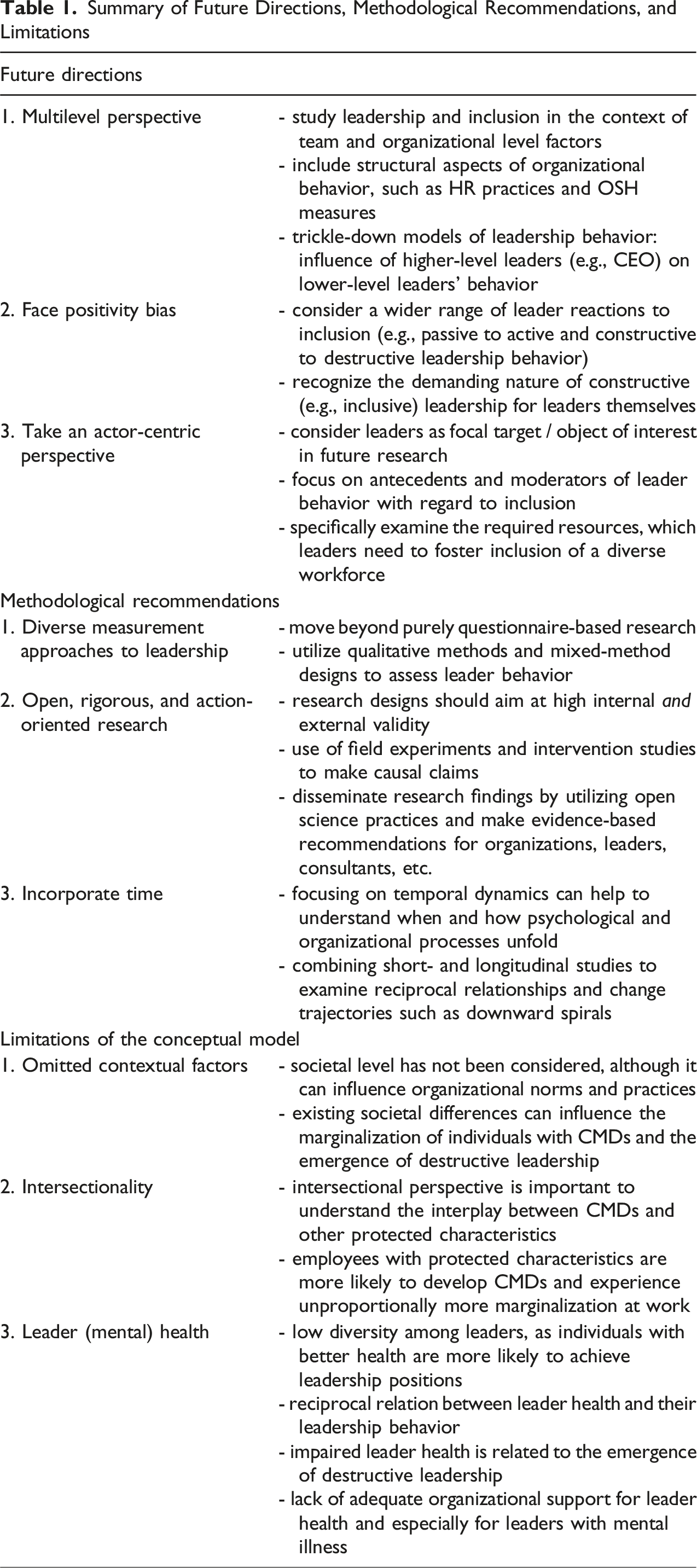
Our model calls for a wider spectrum of methodological approaches than purely questionnaire-based research (see also Banks et al., 2023). Qualitative research methods can help deepen and extend our theoretical understanding of the lived experiences of employees with CMDs and their environments. For example, interview studies, qualitative diary studies, focus-group discussions, or organizational case studies may help to develop a fine-grained understanding of the specific needs of employees with CMDs as well as their leaders and how the negative downward spiral can be broken (Roberson & Perry, 2022). Based on the findings from such studies, more sophisticated quantitative methods and questionnaires can be developed. For example, observation studies (Güntner et al., 2023) can be used for a behavioral-related consideration of interaction patterns between leaders and employees with CMDs. Resulting insights can inform the development of behavioral-related and less interpretative measures of leadership and inclusion practices that help to assess these phenomena more accurately and in an less biased manner (Fischer, 2023).
Additionally, our model is action-oriented, calling for applied research that tests our propositions with field-experimental approaches and interventions studies (Eden, 2017). In this way, future research can tackle endogeneity threats that preclude causal inferences in past research on leadership and inclusion (cf. Antonakis et al., 2010). Additionally, evaluating the effectiveness of intervention measures can help derive evidence-based recommendations for organizational practice. In order to address positivity bias, open science practices can aid transparency and dissemination of results. Particularly, knowledge about intervention studies with adverse or unintended outcomes can provide meaningful insights for future studies and recommendations for organizational practice.
Finally, our theoretical model has an inherent temporal logic, which needs to be mirrored in subsequent qualitative and quantitative studies. There have been recent calls to incorporate time in organizational research (e.g., Bansal et al., 2024), indicating that there is an urgent need to understand when and over which periods of time psychological and organizational processes unfold (Dormann & Griffin, 2015). In this regard, studies may initially consider shorter periods that can be systematically extended (Griep et al., 2021). Such an approach can reveal how the phenomena of interest fluctuate and how (reciprocal) relationships unfold. Additionally, longitudinal studies can show how changes in contextual factors (e.g., due to interventions) can accelerate or break the downward spiral between destructive leadership and psychological functioning of employees with CMDs. Based on these recommendations for future studies, we present a roadmap with concrete suggestions for possible research designs in Figure 2. Roadmap for a Possible Research Agenda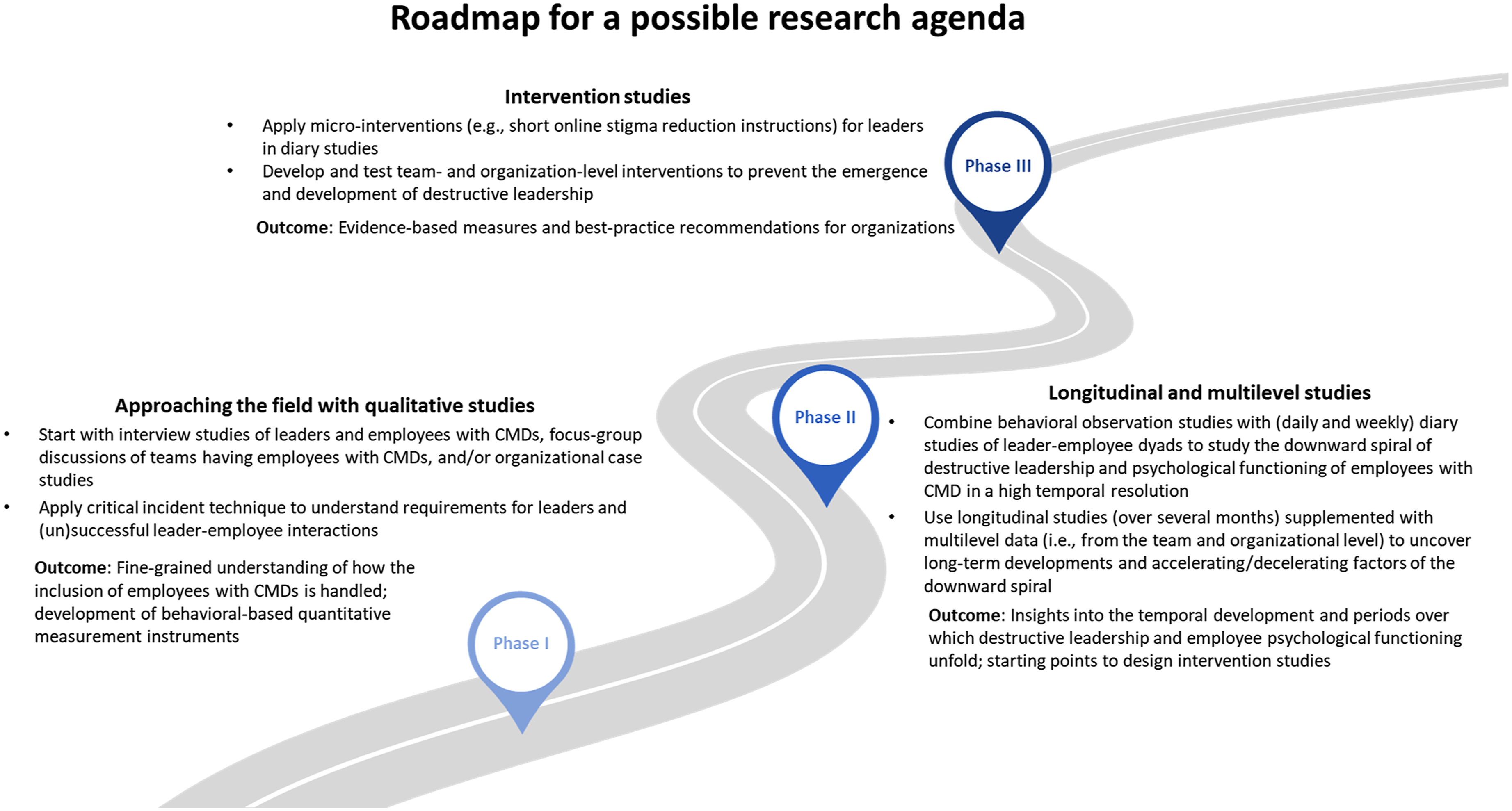
Research Limitations
Although our model comprises various multi-level factors that are likely to affect the downward spiral between destructive leadership and employees’ psychological functioning, there are several contextual conditions that we did not specifically include. First, we did not include a societal level, which is an oversight insofar as in some societies CMDs are more stigmatized than in others (e.g., Krendl & Pescosolido, 2020) and DEI initiatives face resistance. This can influence organizational norms and practices associated with how employees with CMDs are perceived and treated, and, as such, it can possibly influence the likelihood of the emergence of destructive leadership, stigmatization, and blame attribution processes towards employees with CMDs (Krendl & Pescosolido, 2020). In societies where CMDs are highly stigmatized, employees with CMDs may be negatively affected in their identity management and consider the disclosure of their CMD at work particularly risky (Follmer & Jones, 2022). This can further add to their exclusion, decrease their psychological functioning, and aggravate symptoms of their CMDs (Colella & Santuzzi, 2022).
Another important aspect in the workplace that is beyond the scope of this paper is intersectionality (Kaufmann & Derry, 2023). Research has acknowledged that protected characteristics do not operate in isolation but intersect (Jackson-Best & Edwards, 2018). The intersection of CMDs with other protected characteristics (e.g., gender, sexual orientation, refugee status) can be used to understand the impact of destructive leadership. Employees with other protected characteristics are more likely to experience CMDs, often in reaction to their marginalization at work (Hebl et al., 2020; Jones et al., 2016), which can then further contribute to their negative treatment. In that sense, CMDs as a possible consequence of workplace experiences can be used to confirm negative biases and justify destructive leadership.
Further, in our model, we did not include leaders’ own health – including the incidence of CMDs among leaders – and how this is related to their leadership behavior and vice versa (Kaluza et al., 2020; Li et al., 2016; Oc & Chintakananda, 2024). Individuals with better mental health appear more likely to aspire to and achieve leadership positions (Keloharju et al., 2023), raising questions about relevant organizational measures that help individuals with CMDs to achieve such positions. Examples of such measures could be individualized mentoring or coaching programs that explicitly focus on reflecting on and supporting the psychological functioning of individuals with CMDs taking over a first leadership position. In addition to leadership development training that all aspiring or new leaders receive from the organization, individuals with CMDs could be supported – through mentoring and/or coaching – in developing an understanding of the types of demands that are likely to be placed on them in the leadership role, how these demands might fluctuate over time (e.g., throughout the year), in what ways they might impact their psychological functioning (e.g., through increased stress or emotional demands), and what individual-level strategies might be helpful in preparing for and coping with these demands (e.g., reflective journaling, mindfulness, exercise, regular breaks during the working day, catch ups with the coach/mentor). Further, if individuals are concerned that their psychological functioning may be affected by the role transition, support should be made available through formal HR functions and policies. For example, these leaders could be offered ways to reduce the demands of their position through adjustments such as reduced working hours or receiving support from a more senior leader through a co-leadership model. Alternatively, when employees with CMDs aim at aspiring to a leadership position, they may shadow a current leader to better understand the challenges involved in being in a leadership role and the effective ways of dealing with commonly occurring challenges. This could give them a clearer idea of the requirements of a leadership position and reduce their own fears of meeting the standards and expectations associated with the role. For example, the current concept of leader impostorism provides a timely angle for reflection on initial fears associated with leadership role occupancy (Kark et al., 2022).
Relatedly, individuals may develop a CMD while being in a leadership position. While extant studies have demonstrated that impaired leader health can contribute to the emergence of destructive leadership (e.g., Byrne et al., 2014), research has hardly focused on the question of how leaders with CMDs can be supported.
Finally, in developing our conceptualization of the impact of destructive leadership, we focused on employees with CMDs and on leaders who engage in destructive leadership towards employees with CMDs unintentionally because they lack the necessary resources to engage in constructive leadership. While this allowed us to convey our key argument, we recognize that organizational realities are more complex than this. For example, the distinction between employees ‘with CMDs’ and ‘without CMDs’ might be accurate at a given point in time, but when considered over a longer period, having or not having a CMD should not be viewed as a permanent characteristic of a person. Indeed, one of the effects of destructive leadership on employees can be the development of CMDs (see meta-analytical insights about the relationship between destructive leadership and symptoms of depression and anxiety disorders; Mackey et al., 2021). Further, destructive leadership does not only occur under circumstances where organizations do not provide leaders with the necessary resources to engage in constructive leadership. As past research has shown, destructive leadership behaviors are often displayed by individuals who are high on the Dark Triad personality traits and whose behavior can have adverse impacts on all employees’ mental health (e.g., Gauglitz et al., 2022; Schyns et al., 2023; Wang et al., 2010). With our model, we would like to stimulate further theory building and research on the effects of different forms of destructive leadership on employees.
Practical Implications
Based on our theoretical considerations, organizations should aim to provide necessary support and facilitate work conditions so that all employees can experience optimal psychological functioning. We recommend leaders be provided with resources to more appropriately interact with employees with CMDs for the purposes of inclusion. This is important, as in light of its high prevalence rates, leaders are very likely to lead employees with CMDs. The better leaders are prepared for this experience and supported by their organization, the more successful they will be in leading and including these employees.
Our conceptual model provides several angles to enhance the psychological functioning of employees with CMDs, break the downward spiral with destructive leadership, and foster their inclusion and reduce the risk of their exclusion. Starting at the organizational level, top managers should be aware of their signaling function and aim to promote inclusion as a positive aspect of organizational life and a factor for growth and development. This should be accompanied by the implementation of appropriate HR practices, norms, and policies that focus on promoting inclusion. Additionally, organizational safety and health measures can help counsel leaders or directly support the needs of employees with CMDs. This should, in turn, also contribute to an inclusive organizational climate. Particularly, organizational health care interventions can directly support psychological functioning and well-being, and flexible work arrangements or health care benefits (e.g., paid sick leave) can foster employees’ recovery and increase their commitment to the organization (Shore et al., 2025). Finally, workplace integration management programs (e.g., in terms of flexible scheduling, reduced work hours, and modified work requirements) can support the return to work of employees with CMDs after a longer period of sickness absence (McDowell & Fossey, 2015).
Given the salient role of leaders for the inclusion of employees with CMDs, adequate training and development approaches are important. A possible approach may be to provide leaders with knowledge about CMDs, inform them about the influence of leadership on employees’ psychological functioning, and train them in constructive behaviors for leading employees with CMDs (e.g., Martin et al., 2015). Leaders who are equipped with knowledge, skills, and resources should aim to establish a team climate of psychological safety. This can contribute to a team where all members feel interpersonally safe, which in turn can facilitate the disclosure of CMDs. To reduce pressures on employees, leaders should set mastery goals instead of performance goals. Additionally, making leaders aware of their stereotypes and implicit theories can help them reflect on and modify their leadership behaviors and prevent the exclusion of employees with CMDs. Leadership training should consider the role of implicit theories (Schyns et al., 2011) and stigma reduction trainings can be used in organizations. However, such trainings should be adapted to the specific organizational context and supplemented with further measures (e.g., providing knowledge about CMDs; Shann et al., 2019).
Concerning the emergence and development of destructive leadership in the context of the inclusion of employees with CMDs and beyond, organizations should take care to provide necessary checks and balances against destructive leadership (see Schyns et al., 2022). Besides adequate selection and promotion processes that consider leader personality, organizations should use regular leadership feedback (e.g., 180° or 360°) to detect destructive leadership and intervene early. As destructive leadership emerges when leaders face high demands (Tepper et al., 2017), organizations should take care of the leaders’ work environment to reduce demands where necessary (e.g., by implementing psychosocial risk assessments for leaders).
Conclusion
CMDs are highly prevalent among employees. Fostering these employees’ psychological functioning is an important aspect of their inclusion in the organization. Leaders are oftentimes the frontline workers when it comes to the inclusion of employees with CMDs. Their efforts to establish inclusion and prevent exclusion of employees with CMDs can only be successful when specific boundary conditions exist and leaders are equipped with appropriate resources.
Footnotes

Funding
The authors received no financial support for the research, authorship, and/or publication of this article.
Declaration of Conflicting Interests
The authors declared no potential conflicts of interest with respect to the research, authorship, and/or publication of this article.