




Abstract
Servant leadership research is rapidly accumulating, but the degree to which it advances the broader leadership literature with novel insights remains a contentious point of debate. Skeptics argue that the validity of servant leadership’s theoretical foundation and its empirical measures are questionable. Supporters, however, point to servant leadership’s unique focus on service to multiple stakeholders as well as meta-analyses supporting its incremental predictive validity relative to other moral and inspirational leadership approaches as evidence of its novelty in the leadership domain. These two camps seldom engage in constructive dialogue to advance the field in a purposeful, productive, and practical way. The purpose of this editorial is a twofold approach to bridge this gap. First, we introduce a servant leadership special issue in Group and Organization Management (GOM) that brings together emerging and established scholars, as well as a seasoned practitioner, to address shortcomings in extant servant leadership scholarship and articulate new ideas that promise to usher the literature into a new era of insights. Second, we discuss five core questions to fortify the foundations of servant leadership research. These questions pertain to servant leadership’s nomological network, empirical and theoretical overlap with other leadership constructs, theoretical boundaries, dimensionality, and empirical validity. We hope this GOM special issue and editorial paint a constructive and promising path forward for the next era of servant leadership research and practice.
Of all the leadership behaviors, approaches, styles, and characteristics in the scholarly literature, perhaps none has drawn as much recent attention as servant leadership (Greenleaf, 1977). As of this writing, Google Scholar reports over 160,000 publications on the topic, including robust reviews (e.g., Eva et al., 2019; van Dierendonck, 2011), empirical papers in top management journals (e.g., Liden et al., 2014; Wu et al., 2021), measure development (e.g., Liden et al., 2015; van Dierendonck & Nuijten, 2011), multi-disciplinary application (e.g., Robinson et al., 2018; Trastek et al., 2014), practitioner guidance (e.g., Lemoine et al., 2021; MacFarlane, 2023), dedicated research handbooks (Burkhardt & Joslin, 2020; Dhiman & Roberts, 2023; Van Dierendonck & Patterson, 2018), and prominent inclusion in leadership textbooks (Lux, 2024; Northouse, 2021). The abundance of research on servant leadership is astonishing when one considers that, with few exceptions (Graham, 1991; Laub, 1999), this idea only began to receive scholarly attention in the twenty-first century.
Supporters of servant leadership, who typically advocate for leaders to be caring and developmental, may applaud this success. But critics of leadership research in general, and servant leadership in particular, note that the proliferation of work on a construct does not necessarily indicate that research is useful, valid, or capable of impacting practice in a material way (e.g., Fischer & Sitkin, 2023; Yukl, 1999). For decades, skeptical scholars have suggested that research on leadership suffers from indefinite meaning, insufficient theory, and imprecise measurement, aggregating to a body of research with questionable worth (e.g., McCall & Lombardo, 1978; Meindl et al., 1985). Recently, prominent researchers have similarly argued that studies of leadership approaches such as servant leadership are theoretically (Alvesson, 2020) or empirically (Eva et al., 2024) indistinct and have little scholarly value due to flawed measurement (Fischer et al., 2024), whereas others have argued that the combination of morality with leadership, such as is inherent within servant leadership, is logically questionable (Mumford & Fried, 2014). We believe that some criticisms are more valid than others, but all deserve thoughtful consideration by those who wish to constructively move the leadership field forward.
These criticisms raise significant questions about the soundness of the leadership literature’s foundational moorings and paint a pessimistic view of the path forward for future leadership research. We disagree with the implicit assumption in recent critical reviews that research with imperfect theory or measurement should be consigned to academic dustbins. Two problems exist with this assumption. First, it assumes perfection is possible. Science is an iterative process of construct development, testing, and reconsideration. Especially in the social science arena, there are few ‘final’ answers, but rather, more refined understandings of constructs that advance as knowledge is accumulated and the modern context changes. This indicates that theory and measurement should progress over time, with new scholarship building upon the old, constructively resolving identified issues. This is not to say that sloppy science is an acceptable standard. Rather, perfection is an admirable academic aspiration that is an unachievable ideal. It is pursued by identifying and improving upon imperfect means.
Second, critical reviews’ implicit assumption about discarding imperfection requires a strong paradigm, or widespread agreement, regarding the magnitude and prevalence of imperfection. Strong paradigms are elusive in the social sciences. Strong paradigms in leadership research, pertaining to both theory and measurement, have historically proven to be particularly elusive (Rost, 1991). Weak paradigm fields benefit from a multiplicity of theoretical and methodological perspectives that build knowledge inductively, abductively, and deductively. This diversity of thought and approaches have arguably contributed to more academic and practical interest in leadership than any other organizational behavior topic. Taken together, we believe valuable insights can be gleaned from imperfect science and weak paradigms as we continuously build and improve upon the pursuit of clearer knowledge and understanding about leadership writ large (Hartnell et al., 2024).
Toward this end, our goal in this special issue is not to “solve” these criticisms and force a strong paradigm into a weak paradigm field. Instead, it is to consider criticisms in light of one specific vein of leadership research, servant leadership, and envision a more positive, optimistic path forward for servant leadership research and practice. Our hope is that any insights gained from this special issue will forge agreement at a small scale about possible avenues to advance the servant leadership literature and strengthen its position as a reliable, robust, and enduring form of leadership. We also hope that insights from this approach might spill over to the larger leadership domain to nudge the academic debate from a destructive tone (what can you loathe?) to one that is more collegial and constructive (what can you learn?) and chart a more pragmatic and collaborative course to move the leadership field forward.
The often-cited imperfections in leadership research raise several important questions for servant leadership researchers. Specifically, are the foundations of servant leadership sufficiently scientifically robust to stand the test of time, withstanding theoretical and methodological scrutiny and building meaningful implications for theory and practice? To what degree have we answered foundational questions such as what servant leadership is, how it can be identified, assessed, and taught, and why it drives results? Answers to these questions may seem simple and self-evident to the construct’s supporters, but a nonpartisan review of our research suggests that servant leadership could fall victim to many of the same critiques that have undermined the credibility of other leadership approaches (e.g., transformational leadership: van Knippenberg & Sitkin, 2013).
This special issue of Group & Organization Management (GOM) was designed with these concerns in mind. The issue is not the common topical look at servant leadership, highlighting the newest research and speaking only to an inner circle, but a concerted attempt to reach out broadly. The articles include ideas from experienced leadership scholars and junior researchers with fresh perspectives, some of whom are staunch proponents of servant leadership research and others who have significant criticisms, to strengthen servant leadership’s key foundations. As we wrote in the call for contributions, our purpose here is “to both address current theoretical, methodological, and practical challenges that have been raised in regard to servant leadership scholarship, as well as to anticipate and pre-emptively work toward resolving issues that will arise as the field continues to develop.” If one claims to be a servant leadership researcher, then it is that researcher’s responsibility to demonstrate how the construct can address or overcome the theoretical and methodological issues that have historically plagued leadership studies. Without a critical examination of the foundations of our field and active work to improve, servant leadership research will fail (deservedly so) to make the impact on theory and practice that should be our shared goal.
This special issue of GOM presents a variety of perspectives in this vein. One point of uniqueness in this initiative is that each of the manuscripts that earned a revise and resubmit status to become one of our main articles was led by a junior (pre-doctoral or pre-tenure) scholar, who was then paired with one of the field’s most celebrated senior authors – including Professors Jasmine Hu, Emily Hunter, Mitch Neubert, Sen Sendjaya, and Dirk van Dierendonck – to provide assistance in the manuscript’s development. We hoped that this combination of experience and fresh perspectives would generate novel approaches and theories. We believe it has. Jinghao (Terrence) Zhang et al.'s (2025) work on servant leadership variability, Kirsi Alahuhta et al.'s (2025) examination of how servant leadership might precipitate self- rather than other-focused outcomes via brokering, Derek Stotler et al.'s (2025) investigation as to why servant leadership is exhausting for some and exciting for others, and Daniel Watts et al.'s (2025) exploration of the consequences of a dual path of servant leader development following servant and leader conations each strengthen the field’s understanding of servant leadership as a process. Equally, we are encouraged by the research in progress presented by junior scholars at the conference supporting this special issue, such as Sonakshi Gupta, April Mondy, Alex Effinger, and Yasmina Suleyman Halawi.
In addition to valuable contributions from early-career academic authors, this special issue contains a robust practitioner viewpoint from Ian MacFarlane, an avid reader and implementer of research on servant leadership who, for the past 20 years, has led EA Engineering, Science, and Technology, as its President and Chief Executive Officer, and has also served in a number of community leadership roles. This special issue also features a commentary on the state of servant leadership research collaboratively written by one of the field’s most prolific and impactful authors, Robert Liden (e.g., Liden et al., 2008), as well as one of the most distinguished skeptics of similar leadership approaches, Daan van Knippenberg (e.g., van Knippenberg & Sitkin, 2013). This commentary poignantly identifies what they view as the field’s strengths and weaknesses. 1
Five Overarching Questions to Fortify the Foundations of Servant Leadership Research
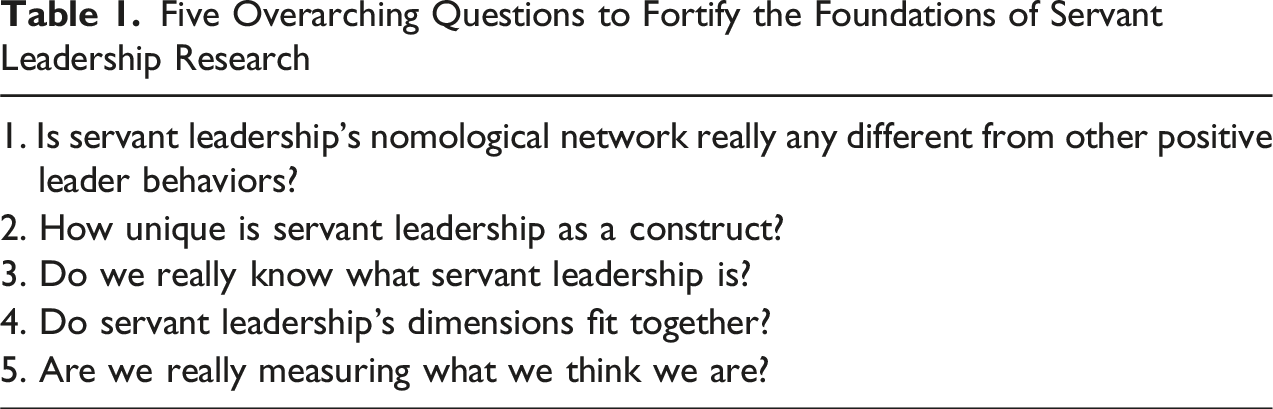
The five overarching questions in Table 1 were developed from previous critiques of other leadership styles as well as from the servant leadership literature itself. These questions are a focal point of this editorial to build momentum toward addressing the most critical challenges in servant leadership research. To be clear, we do not expect this editorial or special issue to be the final word on strengthening servant leadership’s foundations. Improving our science is a marathon, not a sprint. Instead, we use each overarching question as a stimulus to pose more specific questions (summarized in tables throughout this editorial) that reviewers, established scholars, and aspiring researchers can use to strengthen servant leadership scholarship and identify promising avenues for future research. Our hope is that these questions will also serve as a template to organize, advance, and thoughtfully expand leadership research as a whole. We begin with the broadest questions about servant leadership’s nomological network and its place within the larger leadership domain.
Question #1: Is Servant Leadership’s Nomological Network Really Any Different From Other Positive Leader Behaviors?
A nomological net in science refers to the way constructs relate to each other as antecedents, outcomes, processes, or moderators. It comes from the Greek Nomos (νόμος) meaning “rule,” “law”, or “custom.” The value of a nomological network is to situate a construct in the literature and understand its role among existing constructs. For servant leadership, Eva et al. (2019, see their Figure 2) provide an overview of the extant evidence for servant leadership’s nomological net. The construction of this figure was based on a literal reading of the literature, and thus many constructs appear in different parts of the model. For example, LMX has been examined as a moderator, mediator and outcome of servant leadership, which muddies the theoretical and practical value of its inclusion (Lugar et al., 2023). The nomological network has grown haphazardly, perhaps due to servant leadership’s interest across a variety of disciplines and scholars’ never-ending need to publish. Strong theoretical (and perhaps empirical) work needs to be conducted to comprehensively tie the network together.
Questions to Differentiate Servant Leadership’s Nomological Network
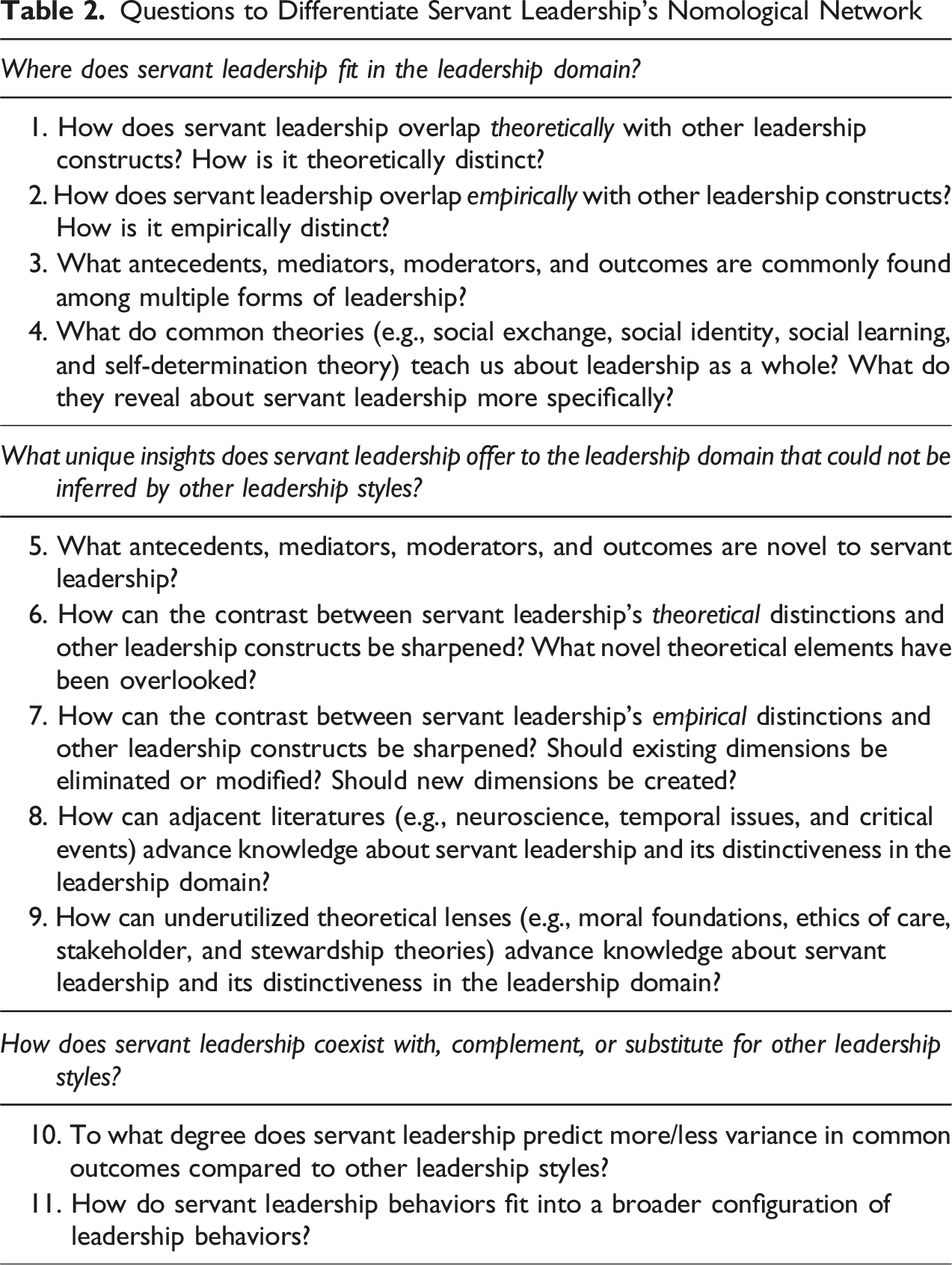
Factors Driving Convergence Between Servant Leadership’s Nomological Network and Other Leadership Approaches
Servant leadership’s nomological network bears a striking resemblance to other approaches to leadership including transformational, ethical, and authentic leadership (Lemoine et al., 2019). We contend that this convergence is due to three factors: conceptual and empirical overlap, publishing norms, and common theoretical explanations.
Conceptual and Empirical Overlap
Conceptual and empirical overlap is virtually unavoidable when leadership scholars endeavor to develop multidimensional constructs that predict larger amounts of variance in broad outcomes like task performance and citizenship behaviors. The question is, how much conceptual and empirical overlap is acceptable? Uncorrected correlations between leadership constructs reported in correlation tables in excess of .75 (r) share at least 56.25% variance (R 2 ). After correcting for measurement unreliability, the percentage of shared variance increases (sometimes substantially). The higher the correlation, the more redundant the nomological networks become. Whereas advocates of multidimensional measures (lumpers) tout the benefits of conceptual breadth and increased predictive validity, dissidents (splitters) point to conceptual and empirical imprecision that contributes to convergence in nomological networks and confounds our understanding about what behaviors, specifically, are driving the effects (Carton, 2022; Judge & Kammeyer-Mueller, 2012).
Publishing Norms – Establishing the “So What?”
A second explanation for nomological network convergence involves publishing norms. Any new leadership construct is met with the question, “So what?” Hence, researchers regress the customary set of dependent variables (performance, attitudes, citizenship behaviors, etc.,) on a new leadership construct and then determine whether it predicts unique variance beyond extant leadership constructs. Because incremental predictive validity is a commonly accepted standard to justify a new construct, the leadership domain is crowded with numerous approaches to leadership with some predicting very little, if any, unique variance in commonly studied outcomes like satisfaction and task performance (Banks et al., 2016). Servant leadership, however, appears to have carved out a novel niche among leadership styles in several ways, among which is evidence that its effects work at least partially through novel mediating mechanisms (Lee et al., 2020). Yet, servant leadership reviews recount a host of generic cognitive, affective, motivational, and attitudinal mediators that speak more to positive leadership’s general influence on followers rather than servant leadership’s specific influence on followers (Eva et al., 2019; Lemoine et al., 2019). This state of the science has made servant leadership appear more similar to than different from other leadership approaches.
Common Theoretical Explanations
The third factor driving convergence in servant leadership’s nomological network with other approaches to leadership is common theoretical explanations. Servant leadership scholarship relies on “the usual theoretical suspects” (Lemoine et al., 2019) to describe servant leadership’s positive influence, theories that are predominant in describing other inspirational and moral forms of leadership’s influence. Social exchange, social learning, social identity, and self-determination theory dominate the landscape and are among the most frequently invoked theories in servant leadership research (Eva et al., 2019; Lemoine et al., 2019). These theories are expansive, to be sure, but are generic in their explanations of positive leadership phenomena. For example, positive leadership styles build high-quality, trusting relationships with followers (social exchange) that motivate them to associate with and attach their self-concept to the group (social identity); positive leaders are attractive and credible role models who convey cues about behavior that is desirable, rewarded, and supported (social learning); and these leaders acknowledge and meet employees’ universal needs for competence, autonomy, and relatedness (self-determination theory). These theoretical explanations have been applied so frequently across the leadership domain that they are practically inscribed into the canon of “good leadership.” Although we believe these general theories are overly used, we do not suggest that they be abandoned. Instead, scholars are encouraged to apply them with the most novel element of each leadership style in mind to uncover the unique mechanisms through which different leadership styles emerge and are effective. An opportunity for scholars to better differentiate servant leadership’s nomological network is thus to highlight what is unique to servant leadership that might not be as relevant in other leadership approaches. It is also important to identify when conceivably positive behaviors such as servant leadership precipitate more negative or self-focused outcomes, as examined by Alahuhta et al. (2025) in this issue.
Articles that focus on the unique elements of servant leadership’s nature/definition and its unique theoretical implications have the most potential to make substantive contributions to its nomological net. They will also advance the broader leadership science by significantly reducing conceptual and theoretical redundancies. To be clear, servant leadership may inevitably overlap conceptually with other moral and inspirational approaches to leadership – good leadership should, in general, lead to good outcomes – but the conceptual and theoretical differences should exceed the points of commonality. The point is, servant leadership should lead to (potentially unique) good things for different reasons and under different conditions than other positive approaches to leadership. At some point, it is time for the field to ask questions that more precisely differentiate leadership constructs from each other. We propose that time is now.
Paths to Differentiate Servant Leadership’s Nomological Network
How can we break from the traditional set of common constructs in an effort to build theory and differentiate servant leadership’s nomological net? One of the most promising possibilities may be to identify research questions that arise from questioning the basic assumptions that are often implicit in servant leadership research. For example, going back as far as Greenleaf (1977), an unclear distinction has emerged between a “servant leader,” which is usually discussed as representing one’s values and identity, and “servant leadership,” the behaviors that prioritize and support others (or the willingness to enact such behaviors). Researchers have assumed that these two ideas are naturally connected, but we have little theoretical or empirical evidence to support that assertion (see, however, Watts et al., 2025, in this issue). Similarly, servant leadership scholars have generally assumed that serving others is a “good” thing, but we have not addressed the possibility of followers developing maladaptive dependent/codependent relationships with their leaders (in the vein of anxiety-inducing “helicopter” parents: Vigdal & Brønnick, 2022). Alternatively, is it possible that servant leadership’s best developmental intentions inadvertently direct follower attention to their own inadequacies, undermining their agency and development? Hopefully, these questions serve as illustrative examples: Are there core theoretical assumptions of servant leadership we might critically reconsider?
Adjacent literatures may serve as other avenues for building unique aspects of servant leadership’s nomological net. For example, neuroscience theory and methodology might be used to determine whether individuals who engage in servant leadership demonstrate any unique form of brain activity as compared to others. Similar research could provide insight into Greenleaf’s (1977) claim that servant leadership is more who someone is, rather than what someone does, as well as informing the aforementioned question of the distinction between the servant leader and servant leadership. Neuroscience might also inform questions such as how servant leadership and brain activity relate, or how workplace hardships and trauma may change the type of leadership managers employ (see Zhang et al., in this issue, for unique perspectives on similar questions).
Other theoretical perspectives rarely employed by the micro-organizational and leadership literatures similarly offer promise for new perspectives on servant leadership. For instance, moral foundations theory (Haidt & Joseph, 2004; Graham et al., 2013; 2018) suggests that individuals intuitively perceive morality through specific constellations of lenses such as care, fairness, loyalty, authority, and purity. How central are these to a servant leader’s identity, and how might they influence expectations of servant leaders or interpretation of their motives? Relatedly, ethics of care theory (Gilligan, 1982) underscores the importance of care and empathy in morality. Combined with the consequentialist approach often employed by servant leaders, this perspective raises interesting questions regarding ethical dilemmas, tensions, and tradeoffs they may experience. Similarly, the strategic management perspectives of stakeholder (Donaldson & Preston, 1995; Freeman, 1984) and stewardship theories (Davis et al., 1997) seem especially promising for servant leadership in light of their predictions regarding firms’ ethical responsibilities to care for external stakeholders (beyond financial shareholders) and the idea that prosocial, trustworthy managers are best positioned to successfully guide firm trajectories.
Comparative studies across different leadership styles represent additional opportunities to illuminate novel paths through which leadership influences individual, organizational, and group outcomes. Meta-analyses comparing servant leadership’s predictive validity on outcomes relative to transformational, ethical, and authentic leadership (Hoch et al., 2018; Lee et al., 2020) are a good start, but additional research is needed to investigate servant leadership’s relative predictive validity on a multitude of affective, cognitive, motivational, and attitudinal processes as well, to truly demonstrate its unique value as a construct. Such questions should be guided by core differences in the conceptualizations underlying otherwise similar leadership constructs. For instance, scholars might investigate whether, during difficult conversations, servant leaders are gentler whereas authentic leaders (Gardner et al., 2011) are more direct, and which approach different kinds of followers prefer. Similarly, how does the mentorship of empowering leadership (Ahearne et al., 2005) differ from the empowering elements of servant leadership, and in which situations might each be most effective?
Direct comparisons among similar leadership styles such as these are seldom pursued in empirical research due to the high correlations among leadership approaches. Efforts to better differentiate servant leadership from other leadership approaches both theoretically and empirically are needed to reduce multicollinearity and improve the reliability and validity of conclusions drawn from studies directly comparing servant leadership’s effects with other leadership approaches. They will also afford us more clarity in how configurations of leadership behaviors impact organizational, group, and individual outcomes. The following sections offer more detail about points of theoretical and empirical overlap as well as considerations to clean up servant leadership’s definition, dimensionality, and measurement.
Question #2: How Unique Is Servant Leadership as a Construct?
The number of approaches, styles, and theories of leadership is approaching the triple-digits, shrinking the definitional space between them and making it more difficult to demonstrate meaningful distinctions among them (Dinh et al., 2014; Eva et al., 2024; Meuser et al., 2016). We are concerned that many authors have treated servant leadership as a generic ‘good’ leadership construct, such that it represents any positive leadership behavior, resulting in virtually any positive outcome. In these types of articles, replacing the word “servant” with “ethical,” “authentic,” “empowering,” “transformational,” “humble,” or a number of other descriptive adjectives would result in a research model that is at least as logically coherent, if not more so. The five of us all serve as Associate Editors at this and other journals, and we have all encountered many submissions in this vein. It is also noteworthy that we saw several submissions of this generic type for the current special issue. All were rejected because they were not well positioned to meaningfully build our understanding of leadership.
If servant leadership is not unique among leadership constructs, there is no reason to study it (McCall & Lombardo, 1978). Fortunately, researchers have demonstrated evidence that servant leadership is both theoretically (Lemoine et al., 2019) and empirically (Hoch et al., 2018) unique, although in both cases, there does exist overlap with other leadership constructs (Shaffer et al., 2016), particularly other moral leadership constructs (Eva et al., 2024; Walumbwa et al., 2010). This overlap does not indicate interchangeability, however. For instance, given that servant, authentic, and ethical leadership all involve positive relationships between leaders and followers involving moral characteristics and behaviors, it is not surprising they would be correlated; in fact, a lack of theoretical and empirical overlap would be inconsistent with their conceptualizations and point to convergent validity problems (Ford & Scandura, 2023). Just as different forms of trust (Mayer et al., 1995) or commitment (Allen & Meyer, 1990) represent related but distinct constructs, or as commitment and identification are similar but distinct (Ashforth et al., 2008), so too should servant leadership contain elements related to similar constructs, but nonetheless be meaningful and distinct on its own.
Servant Leadership’s Two Distinguishing Factors
Questions to Improve Servant Leadership’s Uniqueness as a Construct
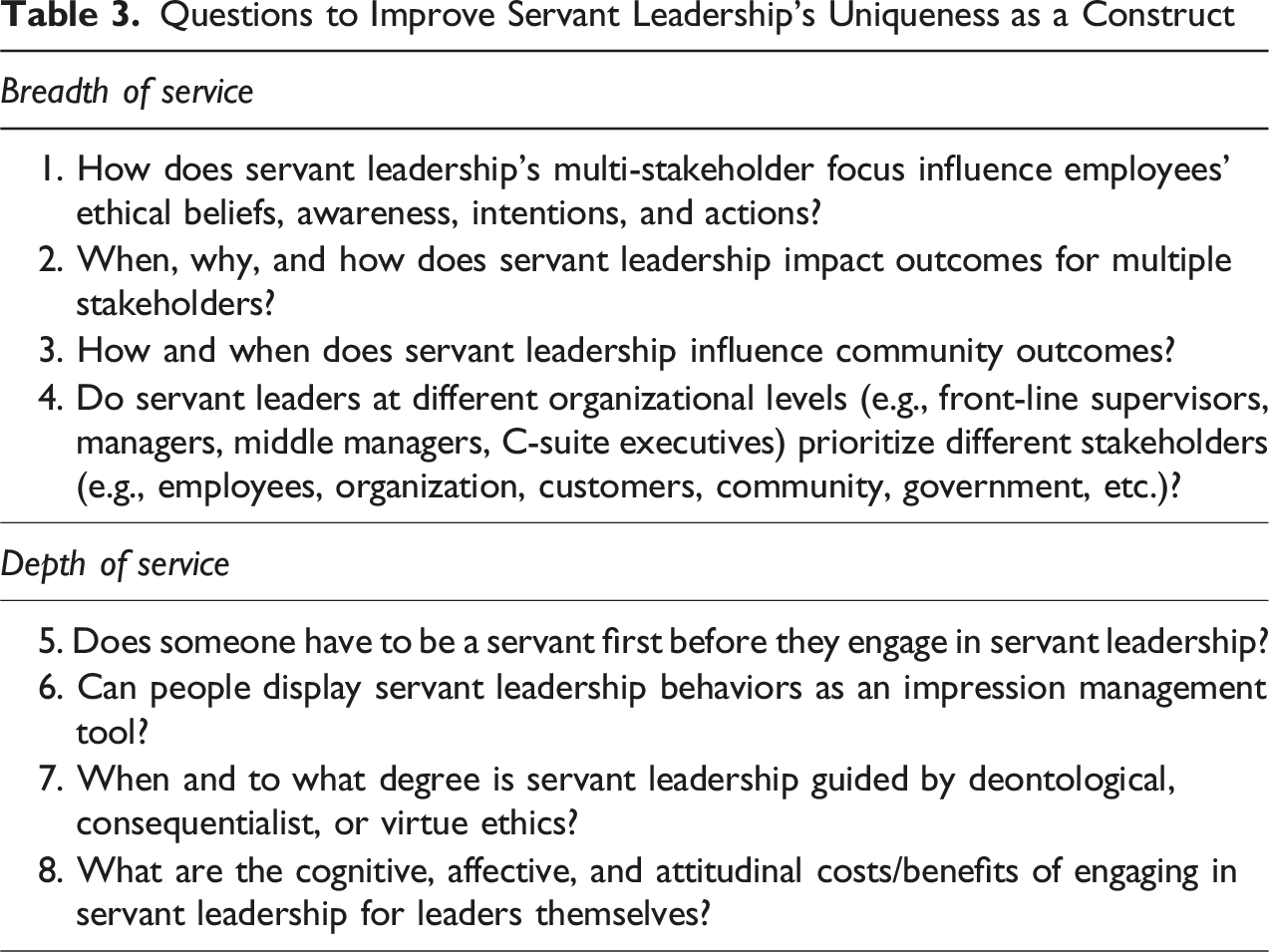
Breadth of Service to Others
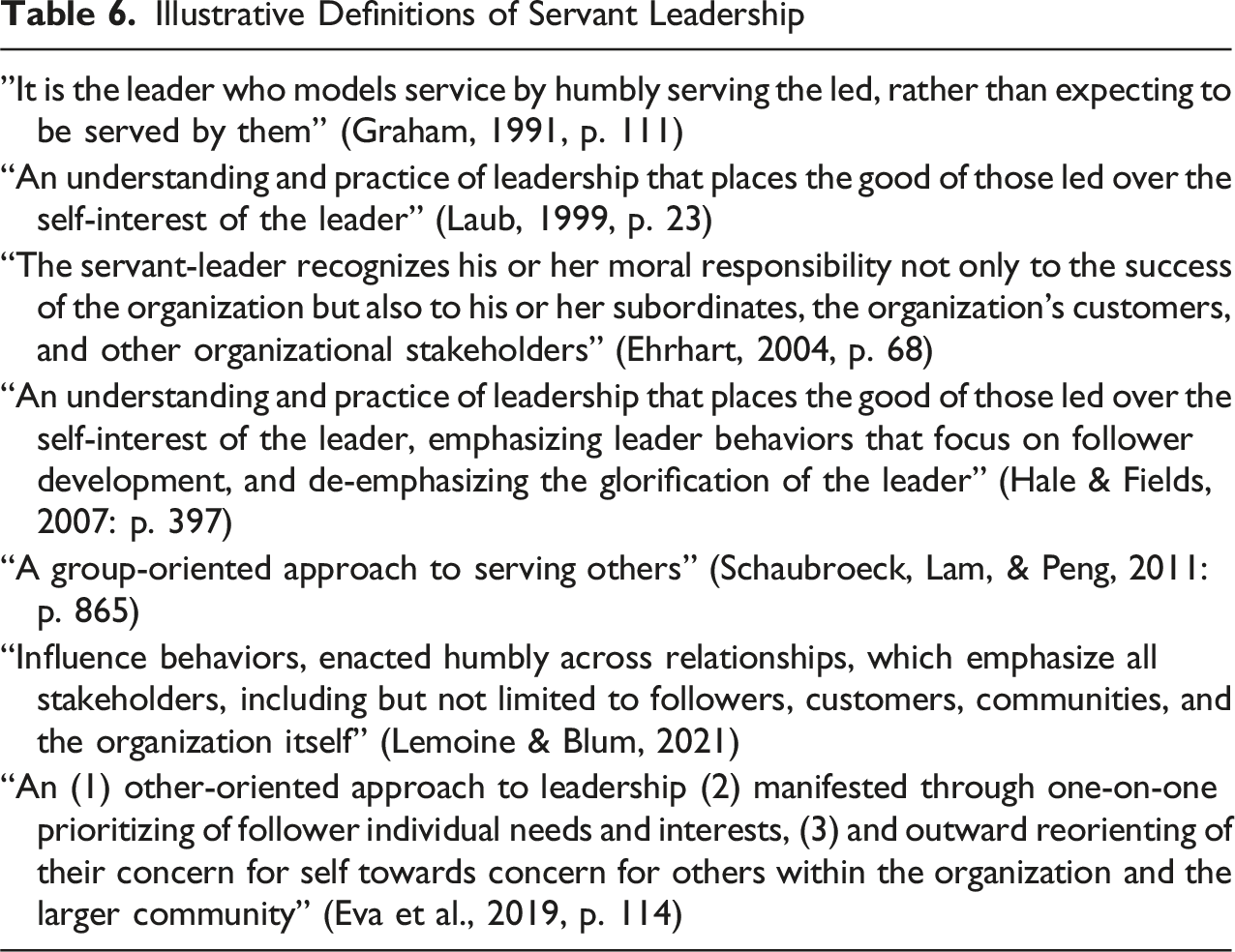
Servant leadership’s breadth of service to others is demonstrated in Eva et al.’s (2019) definition that includes “concern for others within the organization and the larger community.” Values of community service and stewardship are common features of operational models and measures of servant leadership (e.g., Ehrhart, 2004; Liden et al., 2008; Spears, 2002; van Dierendonck & Nuijten, 2011) that are notably absent from related leadership constructs. The construct of ethical leadership, for instance, emphasizes a manager’s compliance with normative standards and her enforcement of those standards among her followers (Brown et al., 2005) without necessarily incorporating any consideration of extra-organizational stakeholders. Similarly, authentic leadership focuses squarely on the mutual self-awareness, transparency, and autonomous personal growth of leaders and followers without attention to leadership’s implications for others outside the team or organization (Gardner et al., 2005; Walumbwa et al., 2008), whereas humble leadership highlights behavioral manifestation of the leader’s own humility to followers (Owens & Hekman, 2012).
To be clear, all these leadership constructs include elements that servant leadership does not, but by the same token, none of them speak to the breadth of service inherent in servant leadership. Indeed, we have all argued previously that service beyond the leader’s followers, teams, and organizations is one of the unique hallmarks of servant leadership (Eva et al., 2019; Lemoine et al., 2019; Meuser & Smallfield, 2023), a priority that emerges forcefully in Greenleaf’s (1977) foundational establishment of the idea. Unfortunately, this unique component of servant leadership, the community-centric dimension, is rarely studied and often misunderstood (Meuser & Smallfield, 2023).
Depth of Service to Others
A similarly unique aspect of servant leadership involves the depth of its commitment and service to others. Some degree of attention to and support for followers is certainly inherent in most approaches to leadership (e.g., Bass, 1985; Fleishman, 1953), but scholars have suggested that servant leadership’s emphasis on followers is of a different qualitative sort, arising from the compassionate ‘heart of the servant leader’ (Graham, 1991; Ng et al., 2008; van Dierendonck & Patterson, 2015). Whereas other approaches to leadership may prioritize follower needs due to instrumental expectations (Parsons, 1960; Stephens et al., 1995), cultural norms mandating organizational support (Barnard, 1938; Rhoades & Eisenberger, 2002), or even a genuine closeness to the employee and desire to see them succeed (Graen & Uhl-Bien, 1995), servant leadership takes a different approach in its emphasis on “putting others first” (Ehrhart, 2004; Liden et al., 2008) and its unique prioritization of followers (Greenleaf, 1977; van Dierendonck, 2011). Inherent within servant leadership is a genuine care for other people, seeing them as worthy human beings with legitimate needs and desires, rather than simply followers or team members. Further, servant leadership involves both perspective-taking to see their unique needs, and a legitimate motivation to help satisfy those needs. In short, servant leaders don’t support employees primarily for the good of the leader, team, or organization; they legitimately care about individuals.
These dual emphases led Lemoine et al. (2019) to suggest that one of servant leadership’s most distinguishing moral characteristics is a consequentialist focus on benefits for others, as opposed to a more deontological focus on norms (associated with ethical leadership) or a virtue-ethics paradigm emphasizing moral freedom, self-awareness, and self-development (concordant with authentic leadership). This assertion was not meant to limit servant leadership to valuing ‘ends over means,’ nor to imply that actions, duties, or virtues are unimportant to servant leaders. Clearly, virtues and moral behaviors are very much a part of servant leadership, and the question of whether servant leaders would endorse “necessary evils” for the good of the many (such as targeted layoffs: Margolis & Molinsky, 2008) represents an open research question. Rather, we propose that the ‘heart of the servant leader’ is less interested in one’s own moral qualities, society’s ethical norms and standards, or even universal rules (Kant, 1887), and more focused on positive outcomes, improving the lives and well-being of those around them (Greenleaf, 1977). Servant leadership’s end goal, as represented in Greenleaf’s “best test,” is to make the world a better place, starting with followers and progressing outward to broader society. This moral emphasis on the good that one can do and the outcomes of the servant leader’s actions, is based in the ethic of care for others that is at the heart of classic consequentialist utilitarianism (Mill, 1861).
We therefore propose that the breadth and depth of servant leadership’s ethic of care, and its corresponding actions toward fulfilling that care toward others, may represent what is most centrally unique about the construct as opposed to other management phenomena. In this respect, it is likely that servant leadership can be more emotionally and cognitively demanding than other leadership phenomena (see Stotler et al., in this article, for an interesting take on this possibility), requiring a higher degree of other-oriented service to a broader array of stakeholders than other leadership approaches (Lemoine et al., 2024; Liao et al., 2021; Mondy, 2023). These unique factors serve as compelling entry points for designing novel and conceptually specific research models.
Whereas servant leadership does have several elements in common with other leadership approaches, developing new research questions that focus on those areas of commonality (such as general ethical character, accountability, or conceptual skills: Liden et al., 2008; van Dierendonck & Nuijten, 2011) are unlikely to generate meaningful and interesting construct-specific results. Rather, the most interesting and novel servant leadership research models may emerge from attention to its unique breadth and depth of care for others, especially in contexts where that care is commonly and systematically lacking or necessary. To maximize our research impact and advance the field, we encourage future researchers to consider these distinguishing factors early and often in their development of new servant leadership research questions. Whereas we argue that servant leadership’s breadth and depth of care are unique elements that distinguish it from other approaches to leadership, its definition includes much more than these two differentiating features.
Question #3: Do We Really Know What Servant Leadership Is?
Clear definitions of constructs and their consistent application are essential foundations of practicing modern science (Whetten, 1989). Without making clear what something is — and equally importantly, what it is not – it is impossible to construct accurate theory, assemble content-valid operationalizations, understand new research in light of existing research, or consistently and meaningfully build on that prior research to grow a field of scholarship (Bono & McNamara, 2011; Cronbach & Meehl, 1955). Imagine a hypothetical construct central to a field of study in the management sciences without a clear conceptualization, one for which multiple scholars put forth different and sometimes conflicting definitions. For such a field, distinct theoretical arguments would be written based on different core understandings, different measures would emerge reflecting different definitions, and the body of work as a whole would struggle to build upon itself as scholars refer to qualitatively different phenomena by the same construct title. Left unchecked, academics risk talking past each other entranced by the illusion they were talking about the same thing only to emerge with little common understanding (MacKenzie, 2003).
Questions to Clarify Servant Leadership’s Conceptual Boundaries
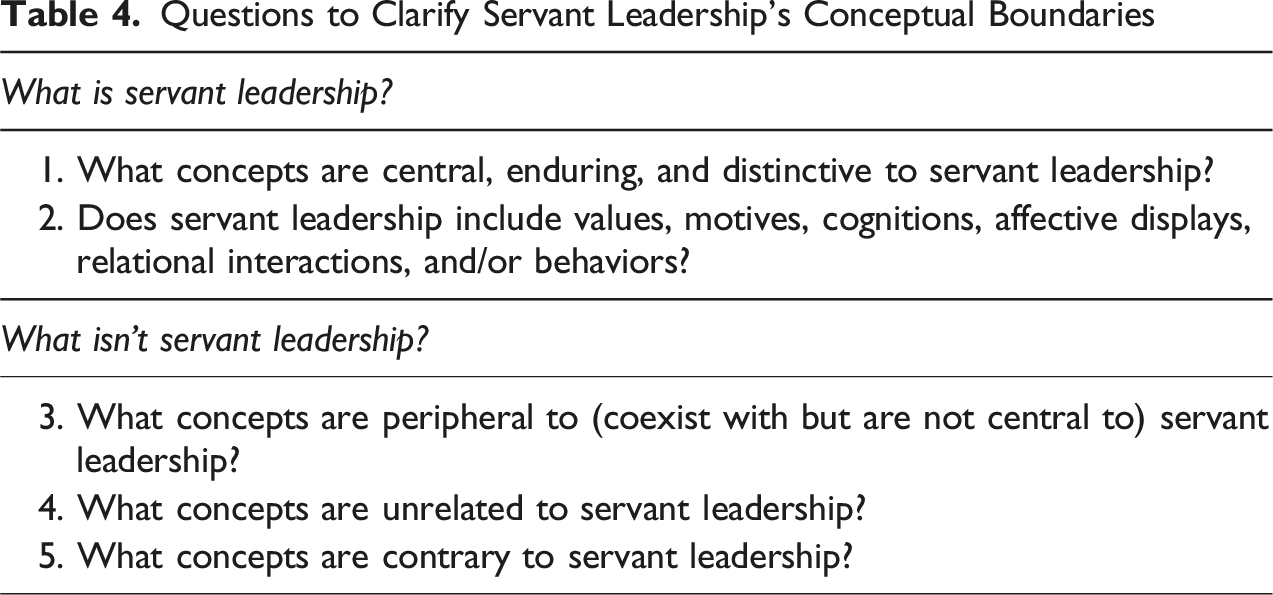
In Search of Servant Leadership’s Conceptual Boundaries
Most scholarly papers on the topic tend to assume readers already know what servant leadership is, or rely upon the “Best Test” as put forth by the concept’s founder, Greenleaf (1970): “The servant-leader is servant first… Do those being served grow as persons? Do they, while being served, become healthier, wiser, freer, more autonomous, more likely themselves to become servants? And what is the effect on the least privileged in society? Will they benefit or at least not be further deprived?” (p. 27)
This “Best Test” has been an indispensable guide as scholars sought to initially understand the idea of servant leadership (van Dierendonck, 2011), but it is more of an aspirational statement for practicing servant leaders than it is a definition. That is, it explains servant leadership’s outcomes (benefits to followers and society) rather than its nature and processes. This leaves unanswered the question of what servant leadership actually involves. Furthermore, the focus on a construct’s outcomes, rather than the nature of the construct itself, has been central to criticism around leadership approaches (van Knippenberg & Sitkin, 2013).
Conceptual Models of Servant Leadership
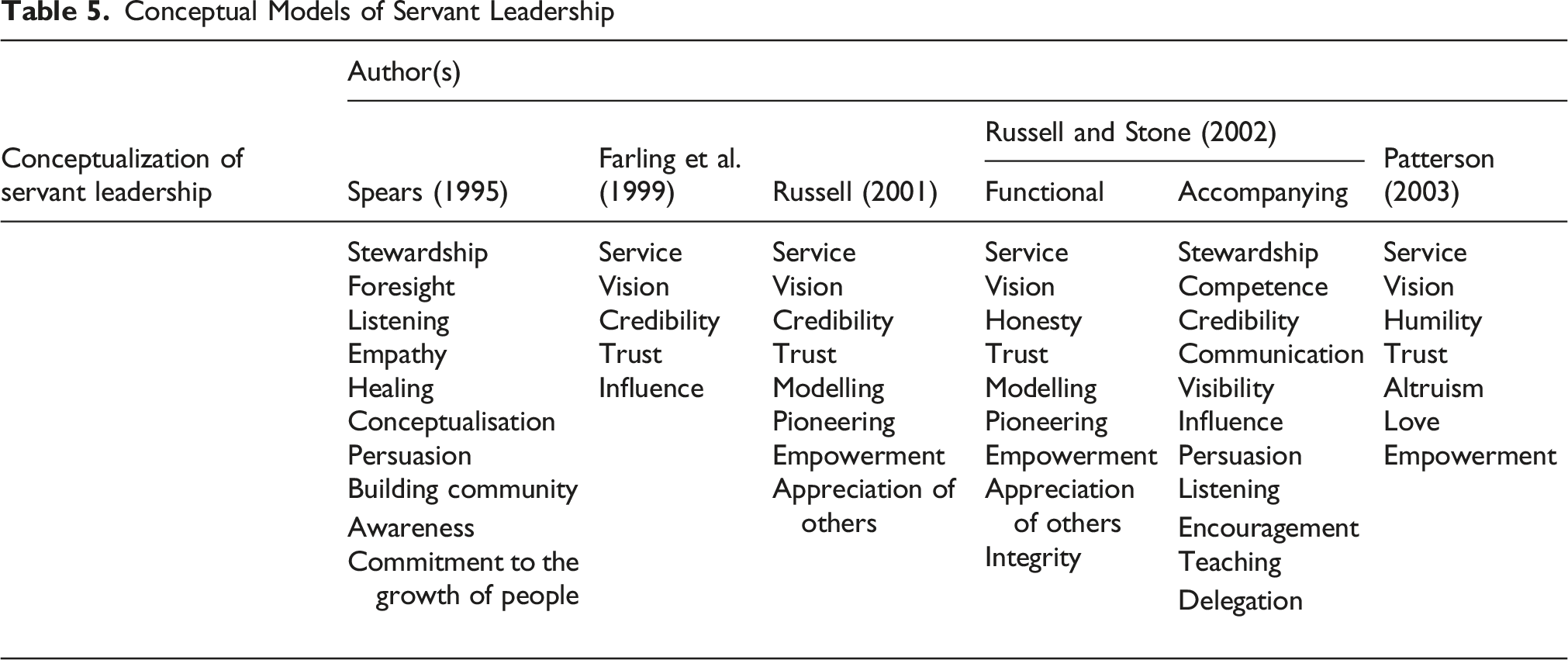
Some scholars rely upon dimensional measures (Liden et al., 2008) rather than concept definitions to define servant leadership’s conceptual space. These measures are useful for empirical development but do not serve to define the construct. Hempel (1965) noted that operational definitions “constitute not a theory concerning the nature of scientific concepts but rather a program of development of such a theory.” In other words, dimensional measures can contribute to the understanding of a construct's nature, but they do not on their own constitute theoretical definitions.
Illustrative Definitions of Servant Leadership
How Important is Consensus on Servant Leadership’s Definition?
Whereas a single, fully agreed-upon definition of servant leadership may be aspirational, we believe prevailing servant leadership definitions should have common central and enduring elements. Even though different conceptualizations can be fertile ground for synthesis and iterative development, broad and inconsistent definitions to date have partly led to research overly focusing on the “leadership” aspect of servant leadership (performance, innovation) rather than the “servant” aspect (service culture, community; see Eva et al., 2019). This misguided focus is problematic because “servant” distinguishes servant leadership from other leadership constructs and holds the most promise to significantly differentiate its nomological network.
We encourage future scholars to consider the “servant” in servant leadership’s definition (e.g., breadth and depth of service to others) from the very beginning as they plan new research projects, helping drive their choices in the development of servant leadership’s nomological network. This core conceptual understanding of servant leadership should inform how the construct is introduced in a research paper, what theories and logical arguments are most relevant to the research, what operationalization is appropriate, and perhaps most importantly, how the research contributes to theory and practice. A shared understanding of exactly what we are researching will allow for more direct connections and enhancements among our scholarly efforts, highlighting our combined evolutionary development of the field and easing the way for future authors of reviews and meta-analyses.
The iterative process of developing and refining a construct’s nomological net is a work in progress that expands and contracts over time (Cronbach & Meehl, 1955). As such, we anticipate servant leadership’s holistic definition will become clearer over time with iteration and input from the field as a whole. Moreover, we look forward to new scholarship that may further develop our understanding of what servant leadership is as new contexts and applications emerge.
Question #4: Do Servant Leadership’s Dimensions Fit Together?
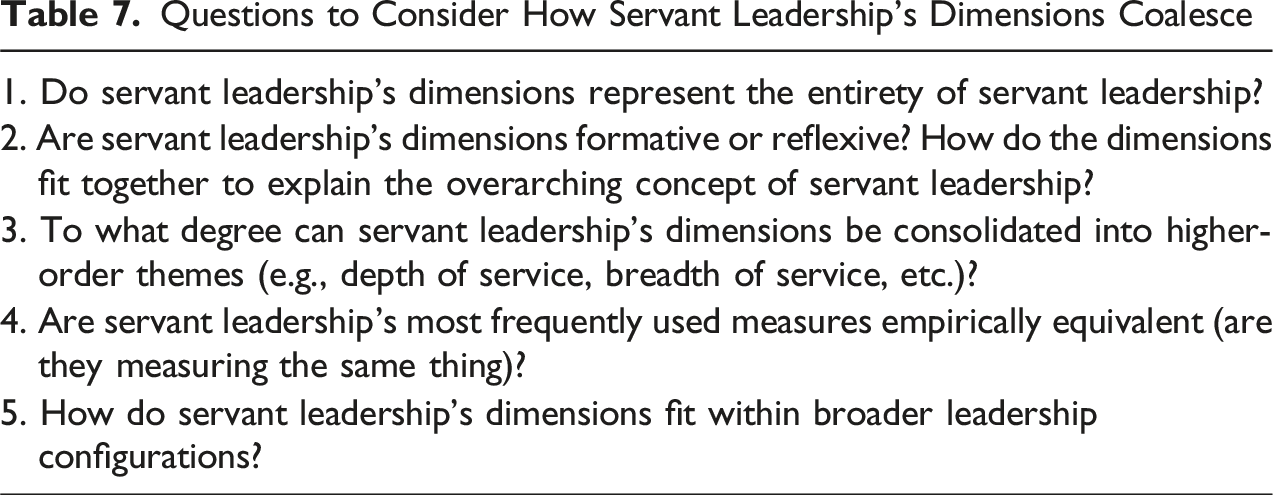
When discussing servant leadership’s definition, we noted that many articles focused on servant leadership’s prevailing empirical instruments (Liden et al., 2008; Sendjaya et al., 2008; van Dierendonck & Nuijten, 2011) to define its conceptual breadth or justify analyzing how specific dimensions influence outcomes (e.g., Sendjaya & Pekerti, 2010). These measures were developed by examining existing writings on servant leadership, interviewing practitioners and experts, and extracting major themes from those efforts. Problems have arisen with this approach, as the dimensions differ between authors, do not entirely correspond with servant leadership’s conceptual development, and often do not capture the same understanding of the construct, though they all endeavor to capture a wide range of behaviors and attributes.
Questions to Consider How Servant Leadership’s Dimensions Coalesce
Dimensions of Predominantly Used Servant Leadership Measures
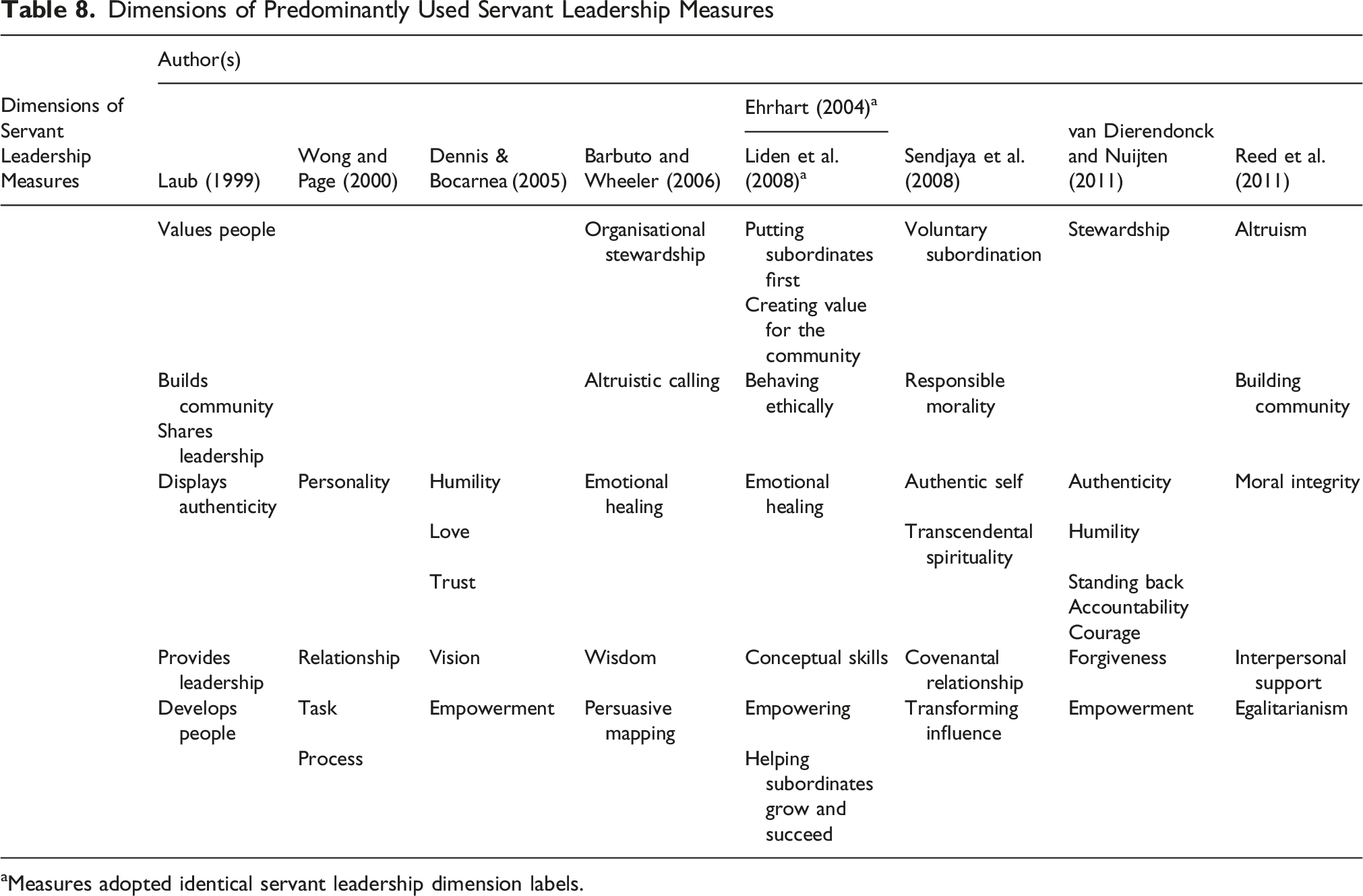
Measures adopted identical servant leadership dimension labels.
As shown in Table 8, empowerment, ethics, and authenticity are among the most apparent points of overlap among the servant leadership measures. Yet, all three dimensions endanger servant leadership’s discriminant validity from other leadership constructs. For example, extant research remains equivocal about how servant leaders’ empowering behaviors are conceptually or empirically distinct from empowering leadership. Whereas empowerment was also a point of overlap in the conceptual models of servant leadership (see Table 5), ethics and authenticity were only highlighted as dimensions in the measure development efforts. This observation reflects a shift in focus from the conceptual development era that focused on interpersonal factors to the empirical development era that captured servant leadership’s moral basis. Servant leadership’s ethics and authenticity dimensions muddy the differences among moral approaches to leadership. For example, Lemoine et al. (2019) noted that the general ethics dimensions in servant, authentic, and ethical leadership are virtually identical (“high ethical standards”). These examples and others support the view and criticism that servant leadership is a strictly formative construct, with its dimensions assembled without rigorous consideration given to if or why they should express an underlying theory or even correlate at all. Although we understand this criticism, we do not fully subscribe to it; it is clear, at least, that the dimensions do correlate (Liden et al., 2008; Sendjaya et al., 2008; van Dierendonck & Nuijten, 2011).
We contend that the process of extracting servant leadership dimensions from writings and practice spanning decades appears to have empirically and organically captured the underlying, central motivation to serve the other, broadly and deeply, as the theoretical underpinnings of servant leadership. That is, although the development processes for each measure were isolated and independent, they seem to have coalesced into the same general themes nonetheless, consistent with foundational understandings of servant leadership (Graham, 1991; Greenleaf, 1977). Theory is not always the starting point of research; often it is not. It does, however, need to make an entrance to connect the dots among phenomenological observations.
Two Overarching Themes
Combining servant leadership’s conceptual and empirical development reveals two overarching themes. Ehrhart (2004) described as core to servant leadership the prioritization of subordinates’ concerns (i.e., depth of service to others) and ethical behavior rooted in the ethic of care for multiple stakeholders (i.e., breadth of service). Although the servant leadership measures shown in Table 8 vary in their emphasis on each, the two themes identified earlier as unique to servant leadership are common threads that tie together the prominent servant leadership measures.
Depth of Service to Others
Possessing “the heart of a servant” suggests that the fundamental focus and role of servant leaders is to serve others and do what is best for others, often the individual follower. It is therefore unsurprising that scholars have identified internal attributes key to an ethic of service. Standing back (van Dierendonck & Nuijten, 2011) and voluntary subordination (Sendjaya et al., 2008) are conceptually similar, both recognizing that servant leaders identify their role as subservient to followers. Purposefully placing themselves into this role requires a sense of humility (van Dierendonck & Nuijten, 2011). The dimension labeled transcendental spirituality (Sendjaya et al., 2008) is also strongly inwardly focused, identifying servant leaders’ sense of calling or mission in their service to and connectedness with others. This internal sense of self as a servant manifests through two different branches focused on depth of service to others: (1) empathy and connectedness and (2) actualization of service toward others.
Empathy and Connectedness
Empathy and connectedness should not be taken to mean an emotional reaction in sympathy with the emotional state or circumstances of others (though servant leaders certainly may experience this). Rather, it is an orientation towards the other and their state of well-being, whether emotional or intellectual. The majority of van Dierendonck & Nuijten’s authenticity dimension (2011) measures the expression of empathy to followers, as does Liden et al.’s dimension of emotional healing (2008). This other-oriented focus of servant leaders is manifested in the development of strong and healthy relationships that recognize the inherent value in the individual human being. Ehrhart (2004) measures the behavior of forming relationships with and among subordinates. Sendjaya et al. (2008) label this as a covenantal relationship, emphasizing both the existence of a relationship and its quality as one of acceptance between two people. van Dierendonck and Nuijten (2011) identify the importance of forgiveness in the relationship between leaders and followers, which helps to build a healthy relationship and, importantly, is an aspect of the recognition of the inherent value of and empathy towards others.
Actualization of Service Toward Others
The other primary manifestation of an internal sense of servitude is the actualization of service towards others. Perhaps most directly, Liden et al. (2008) identify the dimension of putting the interest of subordinates first, before other interests and, most particularly, the interests of the servant leader. The primacy of the interests and well-being of others is manifested in the organizational setting by a desire to see others grow and succeed, especially at work, which is identified by Liden et al. (2008) and Ehrhart (2004) as important servant leader behaviors.
Breadth of Service to Others
In concert with a focus on serving, servant leaders’ desire to serve others is not limited to those who are immediate followers in an organization. Because it is built on a fundamental view of the inherent value of another person instead of the value that person may bring to the leader or the organization, the concern for people is extended and abstracted to others who are not supervised by the servant leader or within the organization. These stakeholders include customers, the community, and society in general. Although much of the focus of servant leader research is naturally located within the organizational setting, this broader interest in others has been captured by creating value for the community (Ehrhart, 2004; Liden et al., 2008), building community (Laub, 1999; Reed et al., 2011), organizational stewardship (Barbuto & Wheeler, 2006), and stewardship (van Dierendonck & Nuijten, 2011). In particular, van Dierendonck & Nuijten’s stewardship dimension (2011) includes items focused on societal responsibility and the good of the whole.
The thrust of servant leadership’s moral obligation to service multiple stakeholders is tightly intertwined with servant leadership’s mooring in consequentialist ethics and the idea that servant leadership behaviors emerge from care and concern for others (Hartnell et al., 2023; Lemoine et al., 2019, 2024). Ethical behavior is captured by the dimensions of behaving ethically (Ehrhart, 2004; Liden et al., 2008), responsible morality (Sendjaya et al., 2008), and moral integrity (van Dierendonck & Nuijten, 2011). As noted previously, these items leave the meaning of “ethics” to be imputed by followers. This ambiguity conflates the differences between servant leadership and other moral forms of leadership like ethical and authentic leadership. Lemoine et al. (2019) thus recommended narrowing the focus of the ethics items to reflect the particular moral basis (consequentialism/utilitarianism’s ethic of care) at the heart of servant leadership.
As shown above, many of servant leadership’s dimensions, whether validated as separate dimensions or categories in a unidimensionally validated measure, include items which arise from the two themes at servant leadership’s core: depth and breadth of service to others. Despite these two common threads, the diversity in servant leadership measures brings to light an important consequence of the lack of a well-developed, underlying theory of servant leadership. This diversity raises two potential issues with servant leadership’s dimensionality: construct equivalence and construct coherence.
Construct Equivalence
Servant leadership scholars may have different perspectives about what servant leadership is and its relative emphasis on servant leader characteristics, interpersonal behaviors, and moral responsibilities. This conceptual divergence is apparent in the different factor structures of the construct’s most prominent measures, and the degree to which these measures are equivalent remains an important empirical question. As such, we do not know if different measures presuming to measure servant leadership are, in fact, measuring the same thing.
Sufficient empirical evidence, however, exists to examine the equivalence of two measures that rely on the same dimensions: Liden et al.’s (2008; 2015) measure and Ehrhart’s (2004) measure. Three different studies reported that the two measures were correlated at .90 or above (r = .96, .94, & .95, respectively: Hartnell et al., 2020; Liden et al., 2015; Liden et al., 2008). Furthermore, Lee et al.’s (2020) meta-analysis reported no heterogeneity between the two measures on multiple outcomes (except for larger effect sizes for individual-level creativity when using the Ehrhart measure). This suggests that Ehrhart (2004) and Liden et al. (2015) are substitutable measures, but future research is necessary to test the methodological equivalence of the other servant leadership measures shown in Table 8.
Construct Coherence
The multi-dimensional measures shown in Table 8 have been essential in the exponential growth of servant leadership research, but conversely, they are perhaps contributing to the biggest issues within the field concerning conceptual overlap with other leadership approaches. If servant leadership is to stand alone as a comprehensive approach to leadership, there needs to be well-developed theoretical rationale as to why and how these dimensions fit together beyond significant correlations. For example, is it a process that begins with a servant heart that influences the other-oriented relations and behaviors the leader engages in? Alternatively, if, as some scholars have argued, that servant leadership can be part of a larger configural approach to leadership (Anderson & Sun, 2024; Eva et al., 2024; Fischer & Sitkin, 2023), identifying what are the unique “servant” dimensions, compared to the “leadership” dimensions that it shares with other leadership approaches still warrants the same level of theoretical examination as to why some dimensions are servant, why some are not, and how and why they fit together.
Question #5: Are We Really Measuring What We Think We Are?
Questions to Evaluate Methodologies That Assess Servant Leadership
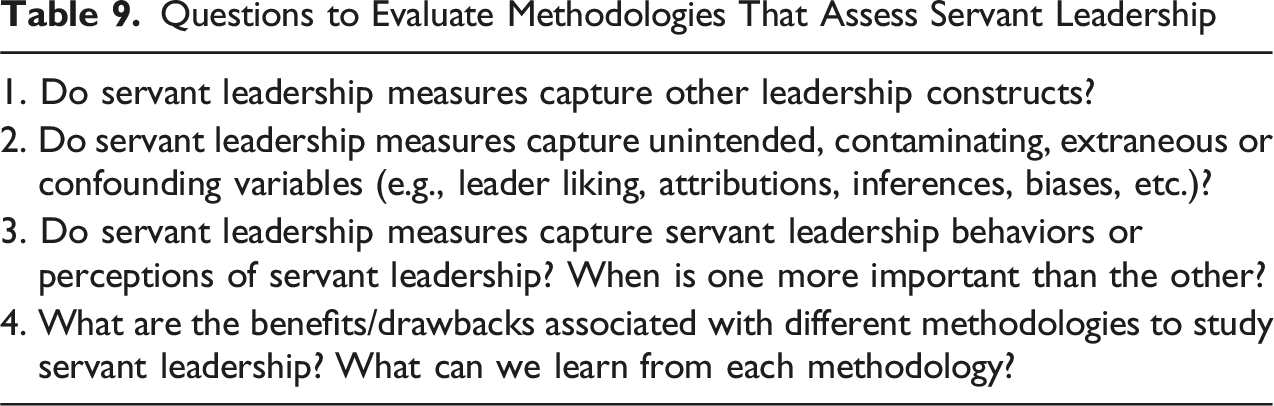
Do Servant Leadership Measures Capture Other Leadership Constructs?
Based on previous meta-analyses (Banks et al., 2018; Hoch et al., 2018) and primary studies (Eva et al., 2024), it is likely that servant leadership measures at least partially assess multiple constructs due to the high correlations between leadership styles. These correlations are unsurprising due to the theoretical overlaps with other positive leadership styles discussed above, as the items generated to measure each leadership construct will overlap. For example, “my leader sets an example of how to do things the right way in terms of ethics” (from an ethical leadership measure: Brown et al., 2005) and “my manager holds high ethical standards” (from a servant leadership measure: Liden et al., 2008) are likely to elicit the same rating from followers, causing multicollinearity. However, both items represent important parts of the theoretical foundations of each construct and omitting them due to fear of empirical overlap would not holistically measure either leadership style. Therefore, whereas servant leadership measures do capture overlapping variance with other constructs, this is theoretically accurate and necessary. We propose that a more important question is how much of a servant leadership measure's variance overlaps with similar constructs and to what degree that overlap indicates meaningful redundancy. As with our example above, with their mutual focus on ethical behavior, it is not surprising that the measures for ethical and servant leadership would be similar. But to be useful as discriminant variables, the measures for each must also include salient discriminating factors rather than predominantly focusing on their redundant aspects.
Do Servant Leadership Measures Capture Contaminating Extraneous Variables?
In responding to servant leadership questionnaires, followers tend to rate the leader based on a mixture of the leader’s actual servant behaviors, as well as hypothetical perceptions of general positive leadership and potential outcomes, such as the Liden et al. (2008) item, “I would seek help from my manager if I had a personal problem.” Items such as these, which go beyond actual experienced leader behaviors, have been criticized for measuring follower outcomes and attributions rather than leader behaviors alone (Day, 2014b; Eva et al., 2024; Ritter & Lord, 2007). This raises the likelihood that responses may be prone to followers’ implicit and hindsight biases, social desirability, mood, and demand and performance-cue effects (Banks et al., 2023; Eva et al., 2024; Fischer et al., 2017; Fischer et al., 2020). However, prominent leadership scholars have defended the practice of incorporating non-behavioral items into leadership measures by pointing out that a variety of item formats may be necessary to capture the full scope of a construct. For instance, Liden et al. (2025) argue that organizational members may “have not always been exposed to all behaviors making up the domain of a construct” (p. 6), arguing that it can be as much a mark of leadership’s presence if an employee believes a leader would defend them in their absence, even if they have not personally observed their leader doing so. We firmly agree that measures must capture the full theoretical scope of a construct, but acknowledge that whenever possible, behavioral items should be used to assess behavioral leadership styles. Of course, no survey is perfect, nor is any operationalization. Mixed-method studies offer the greatest potential to complement the external validity of field surveys with the internal validity of, for instance, experimental methods (MacFarlane, 2025).
Do Servant Leadership Measures Capture Servant Leadership Behaviors or Perceptions?
Considering broader academic debates around general leadership measurement, scholars have questioned whether our measures accurately capture leader behaviors or follower perceptions of those behaviors. However, it seems that for many hypotheses, especially those involving leadership outcomes, this is a peculiar question: in order for a follower to be influenced by a (servant) leader’s behavior, the follower must perceive that behavior. If the follower does not experience or witness the servant leader’s behavior, does it matter how the servant leader behaves? Does leadership exist if it is not perceived? Behaviors and perceptions are indeed two different things, but follower perceptions are a vital part of the leadership process, arguably even more important than actual leader behavior in driving follower outcomes.
Considering the vast research on how leaders are perceived due to demographic differences (Lord et al., 2020), how followers perceive leaders is an important question in its own right. Perceptions are important because they inform followers’ interpretation of what the leader does and the subsequent/resulting followers’ attitudes and behaviors (Eva et al., 2024). This may explain why perceptions have been the hallmark of leadership research (Fischer & Sitkin, 2023), and based on the continued citations and publications of questionnaire-based perception research, leadership scholars’ investigations of follower perceptions are going to continue. Enhanced attention to behaviorism in servant leadership research (complementing rather than replacing attention to follower perceptions) will nonetheless strengthen our understanding of how the construct manifests. For instance, developing a set of tangible and teachable servant leader behaviors that are distinct from other leadership approaches would be useful for servant leadership development (see Lemoine et al., 2021; Madison et al., 2023; Meuser & Smallfield, 2023; White et al., 2025 for some examples). The servant leadership field is large enough to continue to do important perceptions research to understand the impact of servant leadership, alongside different approaches to studying servant leader behaviors, to hopefully serve as a positive example of both within the leadership field.
In each of these questions we pose, the academic debate returns to a common theme: the argued misuse of questionnaires to measure servant leadership. The line of argument that questionnaires are problematic due to their inherent flaws, and therefore leadership measured with questionnaires is flawed, and therefore the servant leadership field must be flawed, is an easy argument to make. But it is oversimplified and reductionist. We know that we are not the only ones who are worried that the field is starting to reject the decades of empirical (and theoretical) evidence acquired using questionnaires due to some singular voices regularly criticizing their use. Questionnaires are a tool, and like all tools, they have their strengths and their weaknesses. To abandon a field of research and ignore its conclusions based on the imperfections of a class of measurement tools would be wasting the vast wealth of knowledge we have gained (and we find it unlikely that more robust measurement would not similarly demonstrate that good leadership leads to good performance, or that servant leadership precipitates servant outcomes). As discussed by Eva et al. (2024), it is not solely the use of questionnaires that muddies the waters of what we are and are not measuring; there are theoretical overlap questions that must be addressed as well. 2 Thus, any solution to strengthening the measurement of the servant leadership field needs to begin with the foundational questions we have posed above. In the meantime, there are some sensible steps we can take.
First, there will not realistically be a moratorium on questionnaire use in leadership research, regardless of how many times that phrase is repeated. PhD coursework continues to emphasize the value of field surveys, and the vast majority of our field (both leadership and general management and organizational behavior scholarship) still uses and is comfortable with questionnaires. As detailed by MacFarlane in this special issue, field surveys remain the most convincing method for practitioners. There are many practical advantages to survey tools. It is unlikely they are going out of style. Thus, we ask that servant leadership scholars who use questionnaires strengthen how they use them and seek to pair questionnaires with other methodologies to provide more robust evidence for their claims (see Cooper et al., 2020; Podsakoff et al., 2012; Wulff et al., 2023 for examples).
Second, if we are going to embrace alternate methodologies to measure servant leadership, it requires scholars to reduce the barrier of entry to use them. Take, for example, the ‘Pat’ manipulation by Wu et al. (2021). This has become a staple vignette in many servant leadership studies because the materials are provided by the research team and their method section is well-written to allow replication. As new research methods are developed, servant leadership scholars must ensure that these methods are accessible and replicable, allowing other researchers to incorporate them into their toolkits. This could include the use of digital tools that create realistic video vignettes, VR simulations that place the participant at the center of a leader-follower interaction, language models that use AI to code a leader’s speech during meetings, or methods that do not exist at the time of writing. Regardless, if we do not assist each other in pushing our methodological rigor forward and the barrier to entry remains too high, the field will continue to use the same comfortable, temporally and fiscally advantageous questionnaire methods we have thus far. 3
Conclusion
Taken together, conceptual and empirical refinement are needed to strengthen servant leadership’s discriminant validity and differentiate its nomological network. Toward this end, we contend that theoretical development is needed to clearly articulate the essence of servant leadership and to explain its antecedents, consequences, and boundary conditions. Absent a guiding theory about servant leadership, its development, and its effects, questions will persist regarding the degree we truly understand (1) the uniqueness of servant leadership’s nomological net; (2) its uniqueness as a construct; (3) precisely what it represents; (4) how its dimensions fit together; and (5) how we can best assess it. These questions will not be addressed by simply publishing more of the traditional moderated mediation models of servant leadership’s effects on generic outcomes that have come to dominate the literature. Rather, this endeavor will require drawing on more specific theories to elaborate the boundaries of what servant leadership is and is not, how it uniquely emerges in organizations, and the distinct pathways by which it may facilitate or suppress a range of personal and organizational outcomes.
The contributions in this special issue take an initial step toward alleviating the problem of applying the “usual theoretical suspects” to examine servant leadership’s influence on “the usual empirical suspects” (Lemoine et al., 2019). Alahuhta et al. (2025) employ social network concepts to explore how despite its other-oriented emphases, servant leadership may precipitate self-oriented outcomes in followers as well. Stotler et al. (2025) add to the assumption that engaging in servant leadership behaviors results solely in resource loss by finding that engaging in those behaviors can result in resource gain (relational, psychological, and physiological) when leaders engage in a servant first mindset. Watts et al. (2025) develop a model of the development of servant leadership behaviors as influenced by experiences that have implications for either a servant or leader identity, and how those identities may have a synergistic, compatible, or conflicting relationship. Zhang et al. (2025) utilize adaption level and attachment theories to theorize and test the dynamism processes of servant leadership, highlighting that a) servant leadership behaviors are not stable day-by-day, and b) the variability has an effect on followers.
While these are all a step in the right direction, a more concerted effort across the field is required to utilize perspectives that are theoretically more relevant to servant leadership than other leadership approaches, and, potentially, develop a theory of servant leadership that captures the unique pathways explaining the leader characteristics (personality, motivation, values, skills, knowledge, abilities), leader and leadership development, leader behaviors, follower perceptions, psychological mechanisms, boundary conditions, and outcomes (among others) that exist in this process. Even if any author in this special issue, ourselves included, attempted to accomplish this, we could not do so alone. In true servant leadership fashion, it is imperative for scholars in the field to acknowledge and build upon our many perspectives and conclusions to generate a comprehensive, scientific path forward that has the potential to achieve what has been called the purpose of organizational behavior research: to “enhance the dignity and performance of human beings and the organizations they work [with]in” (Rucci, 2008).
Footnotes
Author Note
An earlier version of this paper was presented at the 2024 Servant Leadership Scholars Conference in Milwaukee, WI, USA.
Acknowledgments
This special issue represents the efforts of a large cast of dedicated scholars and partners. The authors gratefully acknowledge Amy Bartels, Terry Blum, Al Broadbent, Brenda Dysinger, Yannick Griep, Jasmine Hu, Emily Hunter, Kent Keith, Bill Kennelly, Robert Liden, Ian MacFarlane, Kevin Nephew, Mitchell Neubert, Richard Pieper, Kerry Sauley, Carrie Seidl, Sen Sendjaya, Larry Spears, Bob Thomas, Dirk van Dierendonck, Daan van Knippenberg, Gina Zarcone, the Milwaukee School of Engineering, the Network of Leadership Scholars, and Wisconsin Servant Leadership for their contributions and guidance to this initiative.

Funding
The authors received no financial support for the research, authorship, and/or publication of this article.
Declaration of Conflicting Interests
The authors declared no potential conflicts of interest with respect to the research, authorship, and/or publication of this article.