



Abstract
This study explored the motivational and affective implications of perceived underqualification, specifically examining how it leads to increased levels of envy and help-seeking behaviors. We predicted that envy and help seeking behaviors would in turn indirectly relate to interpersonal deviance and task performance. We further hypothesized that two psychological resources, hope and self-efficacy, would moderate the relationships between perceived underqualification, envy, and help seeking. We tested our model with a sample of 149 medical school students who were undergoing a clinical rotation as well as their rotation coordinators at a university hospital located in northwestern Turkey. Data collection spanned four waves, from the first day of their rotation to the end of that one-month rotation. Results supported positive indirect effects between perceived underqualification and task performance via help seeking, and between perceived underqualification and interpersonal deviance via envy. Further, hope moderated the relationship between perceived underqualification and task performance via help seeking, and self-efficacy moderated the relationship between perceived underqualification and envy.
In this paper, we explore potential adaptive and maladaptive outcomes of perceived underqualification, defined as an employee’s perception that they lack education, experience, knowledge, skills, or abilities required for their job--in order to establish its relevance in work settings. Our interest in this understudied phenomenon is motivated by recent data suggesting that underqualification is rather common in the workplace and that newcomers in challenging and complex professions may feel particularly underqualified. For example, 50% of college graduates report that they feel underqualified to enter the workforce (Hansen, 2021), and 26% of medical residents reported feeling underqualified during their residency (Snyder et al., 2014). According to a survey of employees and HR managers in the United States, 84% reported that they would be open to hiring underqualified employees, and 62% of the workers reported that they had received an offer for positions they perceived themselves to be underqualified (Connley, 2019).
Hiring underqualified employees is particularly likely in tight labor markets, such as during the “Great Resignation”, where labor shortages encourage hiring managers to relax their standards (Liu, 2021). However, even in slack labor markets, employees may find themselves as underqualified, particularly when new to a field, changing industries, or facing new and challenging job demands. While perceptions of underqualification may be common among newcomers, the rapidly changing nature of work means employees could feel underqualified at various points during their careers. For example, in a study involving 2,400 full-time or self-employed individuals in the U.S. and U.K., 32% of the employees reported feeling underqualified in the past year, experiencing uncertainty about their decisions-making roles (Docebo Inc., 2018). As such, perceived underqualification potentially applies broadly, extending beyond just newcomers or unskilled employees, highlighting the importance of clarifying it as a phenomenon and exploring its implications.
Despite its prevalence and calls for further academic inquiry (Erdogan & Bauer, 2021), a major difficulty in studying underqualification is the lack of theory on the subject. As a step toward enabling a better understanding of underqualification, we draw from social comparison theory (SCT, Festinger, 1954; Matthews & Kelemen, 2025) while exploring the adaptive and maladaptive consequences of perceived underqualification. SCT suggests that individuals have an innate desire to engage in upward comparisons to decide where they stand with respect to their abilities, and these comparisons are associated with motivational and affective reactions (Crusius et al., 2022). Thus, feelings of underqualification reflect a sense of inferiority relative to job requirements, triggering motivational responses like help seeking and affective responses such as envy towards more qualified colleagues.
On the one hand, we predict that feelings of underqualification could play a motivational role that results in higher levels of seeking instrumental help, enhancing performance through skill acquisition and improved knowledge (Friedman et al., 2018). On the other hand, consistent with the idea of individuals typically engaging in upward comparisons (Gerber et al., 2018), we predict that perceived underqualification threatens one’s self-image and triggers envy as an affective response toward more competent others who appear to be well qualified for their positions. Consequently, envy is likely to foster maladaptive reactions, such as interpersonal deviance (Baumeister et al., 2007; DeWall et al., 2007).
Finally, we propose that these motivational and affective implications of perceived underqualification depend on two psychological resources, hope and self-efficacy. Individuals richer in psychological capital tend to interpret challenging situations less as a threat and thereby proactively pursue self-improvement (Avey et al., 2011) and experience fewer negative emotions (Lee et al., 2022). Therefore, we propose that higher hope is likely to bolster effects of perceived underqualification on help seeking, and self-efficacy is likely to dampen its effects on envy.
Our study makes two important contributions. First, we contribute to the literature by exploring the consequences of an understudied yet prevalent phenomenon in the organization. Despite frequent speculation in the popular press about how underqualified workers might behave at work, ranging from pessimistic views (Thomas, 2024) to cautiously optimistic perspectives (e.g., Recruiter.com, 2022), there is very limited research and theory on the topic (Erdogan et al., 2011). Even though misfit between job demands and individual qualifications is typically considered as “the negative end of the fit continuum and is associated with discomfort or incompatibility” (Follmer et al., 2018, p. 440), researchers have primarily examined overqualification (or the feeling that one has surplus skills that are underutilized at work; Erdogan & Bauer, 2021), ignoring the distinct psychological experiences associated with feelings of underqualification. Importantly, an absence of perceived overqualification does not imply underqualification, indicating that these phenomena are conceptualized as distinct from each other (Kulkarni et al., 2015). Thus, findings related to overqualification cannot simply be inverted to explain perceived underqualification. Given the increasing frequency of underqualification where job requirements constantly evolve, understanding its implications is crucial.
Second, to deepen our understanding of the phenomenon of underqualification and develop a balanced theory, we explore both an adaptive and a maladaptive path driven by underqualification, capturing motivational and affective implications. To date, the only study of perceived underqualification focused on examining its relationship with job attitudes (Sim & Lee, 2018), without examining why and when underqualification might lead to adaptive and maladaptive workplace behaviors. Importantly, our dual pathway model offers a more nuanced view by integrating both beneficial and detrimental effects of underqualification, preventing an incomplete understanding of underqualification. For instance, emphasizing only the negative outcomes may unfairly bias employers against underqualified individuals despite their growth potential, whereas highlighting only positive outcomes risks underestimating the challenges involved. In addition, by examining the role of two psychological resources, hope and self-efficacy, we clarify conditions that encourage when it is more likely for an individual to follow the adaptive path and the maladaptive path. As these resources are malleable and trainable, our findings offer a guidance on how to support underqualified employees to foster adaptive behaviors among employees.
We gathered data from medical students in Turkey. Medical students are an appropriate sample for our study for the following reasons. First, despite their advanced training, they lack experience and face high job demands that challenge their skills, often leading to feelings of underqualification. Additionally, medical students encounter a wider range of curricular and extra-curricular experiences, along with intense stress and pressure. Finally, medical schools are highly competitive (Öcek et al., 2021) which generates a suitable context for social comparisons. As a result, the medical school environment emphasizes performance with significant consequences, making feelings of underqualification and envy common due to frequent social comparisons.
Theoretical Development
Perceived Underqualification
The feeling that one ‘fits in’ is a basic human need and is associated with numerous positive attitudes and behaviors in the workplace (Baumeister & Leary, 1995). In fact, a major goal of hiring managers is to ensure that employee qualifications are a good match for the job demands, with the expectation that a high level of person-job fit is of critical importance for task performance (Sekiguchi & Huber, 2011). Despite best efforts, there are reasons to expect that this matching process is imperfect.
Perceived underqualification is a type of person-job misalignment, representing a situation where individuals feel that their qualifications are beneath the job requirements and demands they experience on the job. In this study, we define perceived underqualification as an individual’s perception that they lack education, experience, knowledge, skills, or abilities required for their job. Our conceptual model, illustrated in Figure 1, employs social comparison theory (Crusius et al., 2022) to explain the psychological process underlying perceived underqualification. According to this theory, individuals often compare themselves with others whose performances are better than themselves for self-evaluation and self-improvement (e.g., Gerber et al., 2018). We propose that in the case of perceived underqualification, social comparisons can exacerbate feelings of inadequacy and may drive individuals toward behaviors intended to either bridge the gap (e.g., help-seeking) leading to higher performance or respond with negative emotions (e.g., envy) leading to interpersonal deviance. We also introduce hope and self-efficacy as moderators. Theoretical Model. Notes. *Task performance data was gathered from rotation coordinators. T1 = Day 1 of medical rotation; T2 = 10 days after T1; T3 = 20 days after T1; T4 = 1 month after T1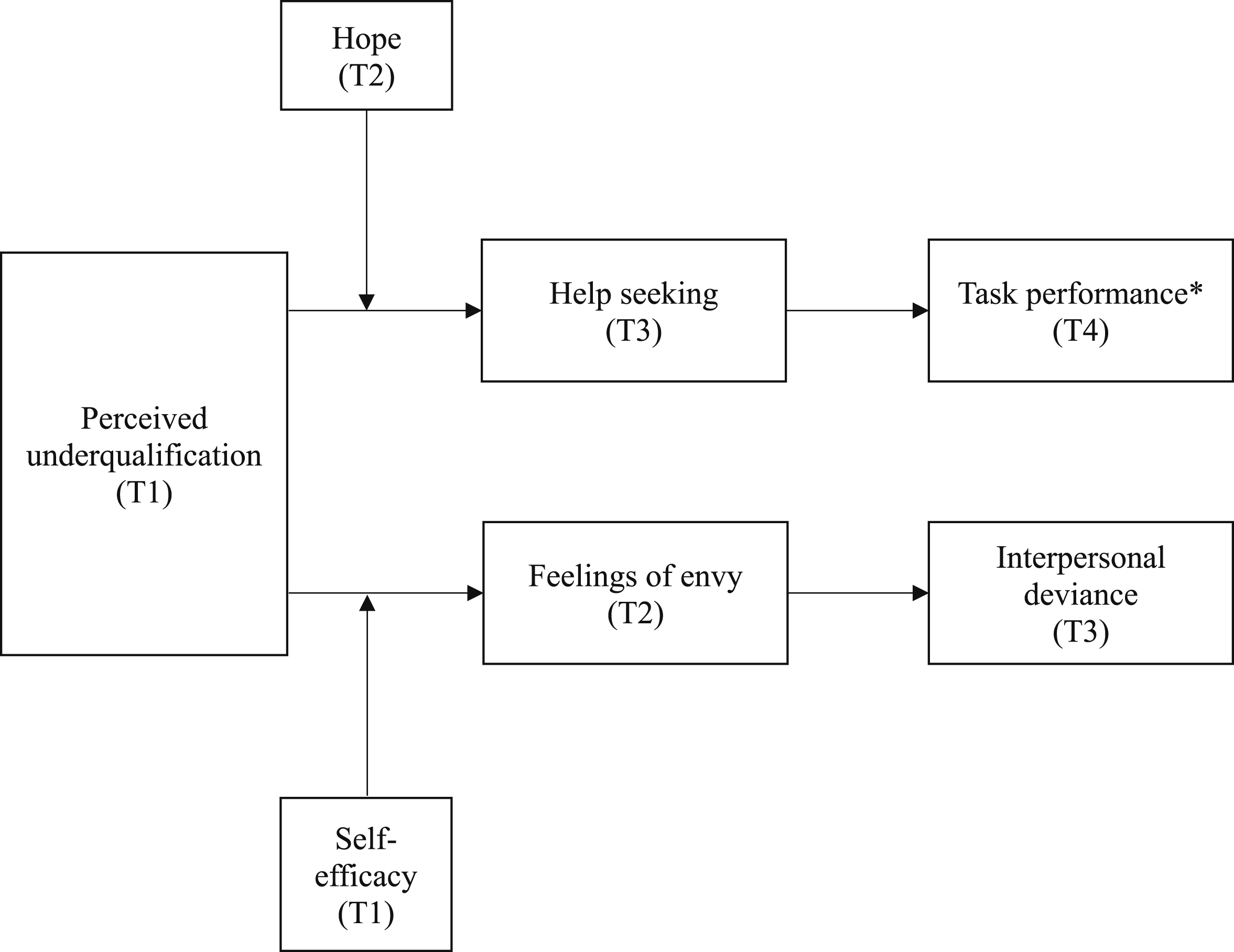
Before exploring the adaptive and maladaptive consequences of perceived underqualification, it is crucial to differentiate it from two related concepts: perceived overqualification and impostor syndrome. Prior research on person-job misfit predominantly focused on perceived overqualification—the situation where employees feel that their skills and abilities exceed the job requirements (Erdogan & Bauer, 2021). Like overqualification, underqualification can be conceptualized objectively, such as educational level relative to job requirements, or subjectively based on one’s perception of their own skills and qualifications (Lee et al., 2021). However, despite the conceptual parallels between overqualification and underqualification, they are distinct concepts, as a lack of perceived overqualification does not necessarily indicate the presence of underqualification (Kulkarni et al., 2015). Indeed, lower scores on overqualification scale fail to distinguish employees who adequately match job requirements from those who are underqualified. Moreover, the psychological experience of overqualification and underqualification are likely to differ. Employees who feel overqualified often experience boredom, anger, frustration, and feelings of entitlement to a better job (Andel et al., 2022; Erdogan & Bauer, 2021; Erdogan et al., 2018). Conversely, underqualified employees are less likely to experience boredom and entitlement; instead, they are more likely to suffer from perceived inadequacies and competency deficits. Thus, motivational and behavioral responses diverge significantly between these two groups. While strategies such as providing greater autonomy (Erdogan & Bauer, 2009) or offering idiosyncratic deals (Luksyte & Spitzmueller, 2016) can effectively address the frustrations of overqualified employees, these approaches may not be suitable for underqualified employees. Instead, underqualified individuals are likely to benefit from targeted developmental opportunities aimed at reducing skill deficiencies.
Impostor syndrome, while sharing some similarities to perceived underqualification due to its focus on individuals’ perceptions of their capabilities, also differs from perceived underqualification in important ways. Specifically, impostor syndrome has been defined as “the experience of intellectual fraudulence and fear of exposure whereby individuals believe that they have fooled others into thinking they are more competent than they actually believe themselves to be, despite clear evidence of their competency” (Gullifor et al., 2024, p. 235). Unlike perceived underqualification, which centers on the mismatch between one’s skills and job requirements, impostor phenomenon reflects a concern that others have been misled about one’s abilities and a persistent fear of being “found out.” Similarly, Tewfik et al. (2025) offered a definition of workplace impostor thoughts, conceptualizing them as the belief that others overestimate one’s capabilities. Importantly, research on impostor thoughts does not assume a deficit in individuals’ skill and capabilities; rather the focus is on the psychological implications of being overestimated by others (Tewfik, 2022).
Adaptive Response: the Relationship Between Underqualification and Task Performance via Help Seeking
Help seeking emerges as an appropriate response for underqualified individuals because it directly addresses their need to improve and/or close skill gaps. Specifically, perceived underqualification may trigger adaptive workplace behaviors driven by a motivation to enhance performance, with help-seeking serving as a proactive strategy to compensate for perceived deficiencies. Defined as asking others for information, assistance and advice (Hofmann et al., 2009), help seeking is an informal, interpersonal, and proactive behavior (Geller & Bamberger, 2012) that aligns closely with the self-improvement goals of those who feel underqualified.
We focus on instrumental help-seeking rather than emotional help seeking. While instrumental help seeking is more closely related to job responsibilities and requirements, emotional help seeking is usually more targeted at personal and psychological problems (Bamberger, 2009). Individuals decide to seek help if they believe receiving assistance benefits them in attaining their goals, and if the help they receive reduces uncertainty and increases role clarity (Hofmann et al., 2009). Importantly, help-seeking differs from seeking general information or advice in that it is targeted at addressing a specific problem, making it an ideal behavior for individuals aiming to improve specific competencies related to perceived underqualification (Bamberger, 2009). Additionally, as help seeking is inherently a social interaction that results in learning and development (Ryan et al., 1998; van der Rijt et al., 2013), underqualified employees can benefit from more capable colleagues (Chou et al., 2021) in order to improve their own capabilities. According to Chan (2013), instrumental help seeking is triggered when individuals’ abilities and resources do not meet the job demands to accomplish the task goals by themselves.
Furthermore, research applying social comparison theory (Festinger, 1954; Matthews & Kelemen, 2025) to mental health contexts has shown that employees assess their distress relative to others and seek help when they perceive greater challenges (Blair, 2012; Mojtabai, 2008). Similarly, we contend that underqualified employees compare their capabilities to those around them. If they find themselves underqualified and lacking the resources to meet job demands, they decide to seek instrumental help from others to learn from them and improve their own abilities.
Help seeking is an interpersonal process of learning and problem solving (van der Rijt et al., 2013). According to Friedman and colleagues (2018), seeking help improves task performance by enabling employees to better understand their work environment in which tasks are performed, accelerates the learning process by expanding their problem-solving abilities, and provides task-related information that fosters a more nuanced understanding of the task. Accordingly, we argue that when employees who perceive themselves to be underqualified proactively seek help, their task performance can improve. Through help seeking, these individuals can learn and gain new knowledge and competencies, avoid making mistakes, acquire missing information, and gradually build the expertise needed to perform better (Bamberger, 2009).
Maladaptive Response: The Relationship Between Underqualification and Interpersonal Deviance via Feelings of Envy
As stated earlier, social comparison theory suggests that comparisons trigger motivational and affective mechanisms (Crusius et al., 2022). While perceived underqualification can trigger an adaptive motivational mechanism (i.e., help seeking) resulting in adaptive outcomes, we also expect that it can trigger a maladaptive affective mechanism (i.e., envy) leading to maladaptive outcomes. Within the social comparison literature, one of the well-documented findings is that upward social comparison often elicits a sense of inferiority and induces negative emotions (e.g., Salovey & Rodin, 1984; Tesser, 1999; Tesser & Collins, 1988). Research has established that one predominant emotion that arises from these upward social comparisons is envy (Lange & Crusius, 2015; Parrott & Smith, 1993; Tai et al., 2012).
Thus, we are focusing on envy specifically as it is linked to a self-evaluation process that is highly relevant in the context of perceived underqualification, where individuals are likely to experience feelings of inferiority relative to their peers. Envy is defined as a singular emotion of pain at another’s good fortune that may be related to both functional and dysfunctional outcomes (e.g., Cohen-Charash & Larson, 2017; Tai et al., 2012). Some scholars distinguish between two types of envy: benign envy, characterized by a desire to improve oneself and is not accompanied by hostility, and malicious envy, motivated by a desire to bring others down and is accompanied by hostility (e.g., Lange & Crusius, 2015; Van de Ven et al., 2009). At the same time, Lange and colleagues (2018) suggested that envy involves pain regarding feeling inferior to others and that it can manifest in both benign and malicious forms. Consistent with this latter view, we adopt the conceptualization of envy as a singular emotion because it is more parsimonious and aligned with the original conceptualization of envy (Cohen-Charash & Larson, 2017; Lange et al., 2018). Furthermore, this conceptualization is also consistent with recent management research on envy (e.g., Duffy et al., 2012; Puranik et al., 2019).
We propose that perceived underqualification will be related to feelings of envy, such that when individuals feel underqualified, they will experience greater levels of envy. Findings based on social comparison theory suggest that people tend to evaluate and compare others’ qualifications relative to their own qualifications (Buunk & Gibbons, 2007; Lam et al., 2011). As such, the perception that they are lacking qualifications relative to the work requirement is likely to trigger envy, because they are likely to feel inferior compared to their coworkers who are perceived to have the necessary qualifications for the job. With the increase in the use of teamwork in organizations (Langfred, 2007; Wageman & Baker, 1997), employees tend to be familiar with one another’s tasks (Fisher, 2014; Hirschfeld et al., 2006) with qualifications being highly visible in these settings (Molleman et al., 2007). When individuals perceive that they are underqualified for their jobs, they are likely to feel relatively inferior and incompetent (Barrick et al., 2002; Flynn & Amanatullah, 2012), which threatens their self-image (Collins, 1996) and triggers envy. In contrast, when individuals perceive lower levels of underqualification, they are less likely to engage in upward social comparisons with team members, and thus less likely to experience envy (Heider, 1958; Tesser, 1999).
Next, drawing on the literatures on social comparison and envy, we further examine how envy leads to maladaptive interpersonal behaviors. When individuals perceive themselves as underqualified, they may feel envy towards superior individuals or towards others who subtly outperform them, even if they hold similar organizational positions (Lee & Duffy, 2019; Tai et al., 2012). Experiencing envy prompts individuals to engage in interpersonal deviance, such as undermining coworkers or displaying rude behaviors, as a coping mechanism aimed at diminishing others’ perceived advantages and thus indirectly narrowing the status gap between themselves and their peers.
Envy is traditionally viewed as invidious and pernicious (Smith & Kim, 2007), is often considered socially unacceptable, and is likely to be suppressed by individuals (Parrott & Smith, 1993). As a result, it depletes employees’ self-regulatory resources (Baumeister & Vohs, 2007). When people experience ego depletion, they are less able to inhibit or suppress their maladaptive responses (e.g., interpersonal deviance) in other domains (Baumeister et al., 2007; DeWall et al., 2007). Although envy can be specifically directed towards certain targets (e.g., Tai et al., 2024), previous research supports that envy can also manifest in generalized interpersonal deviance aimed broadly at coworkers and/or supervisors within the immediate social environment, not necessarily limited to the specific envied individuals (Den Nieuwenboer et al., 2023; Duffy et al., 2012; Kim & Glomb, 2014).
This generalized interpersonal deviance serves as a subtle yet instrumental strategy for coping with envy, enabling individuals to manage their negative emotions without incurring substantial interpersonal repercussions (Bennett & Robinson, 2000). Such behaviors can indirectly diminish others’ task performance and thus their perceived advantage (Kluemper et al., 2013). By broadly targeting peers rather than specific superiors, underqualified individuals alleviate envy-driven frustration and hostility, indirectly restoring psychological equilibrium (Cohen-Charash & Larson, 2017). As such, we argue that feelings of envy serve as the maladaptive mechanism that underlies the relationship between underqualification and interpersonal deviance.
The Role of Hope and Self-Efficacy
Psychological resources are intangible resources that employees can cultivate and utilize to shape and motivate their performance (Luthans et al., 2007; Luthans & Youssef, 2007). These resources are considered state-like, meaning that they can be enhanced by training and development (Luthans & Youssef, 2007; Newman et al., 2014). While psychological resources increase desirable employee attitudes and behaviors, such as job satisfaction, commitment, and citizenship; they also reduce undesirable attitudes and behaviors, such as cynicism, anxiety, and deviance (see Avey et al., 2011, for a meta-analysis).
In our study, we specifically focus on two psychological resources—hope and self-efficacy—as moderators because of their theoretical relevance to goal-directed and future-oriented behaviors (Newman et al., 2014; Rand, 2018). We chose hope and self-efficacy over other psychological capital components (e.g., optimism and resilience) due to their stronger conceptual alignment with our dependent variables: help-seeking behavior and envy. Optimism, related to positive future expectations that can arise from luck or actions taken by others, does not necessarily capture the self-initiated and goal-directed actions that are typically taken by individuals with high hope (Alarcon et al., 2013). Therefore, optimism also fails to explicitly address the goal-directed action plans necessary for actively overcoming perceived underqualification. Likewise, resilience emphasizes the capacity to bounce back from adversity rather than directly influencing proactive behaviors or emotional attributions regarding one’s competencies (Luthans et al., 2006). Yet, both hope and self-efficacy distinctly emphasize proactive cognitive and motivational states. These two resources empower individuals to take proactive, goal directed actions that influence how they navigate challenges (Luthans & Youssef, 2007). Accordingly, we argue that when employees feel underqualified, having high hope can increase their likelihood of following an adaptive path and having high self-efficacy can decrease their likelihood of following a maladaptive path.
State hope is a psychological resource in the form of a positive motivational state (Peterson et al., 2011) that is defined as “a cognitive set that is based on a reciprocally derived sense of goal directed determination, and planning of ways to meet goals (Snyder et al., 1991, p. 571). In other words, when individuals are hopeful, they are likely to believe that they have the capacity to initiate and pursue actions; and plan alternative ways and contingency plans to reach their goals (Luthans & Youssef, 2007; Snyder et al., 1991, 1996).
State hope reflects an individual’s goal-directed thinking that varies across different situations (Snyder et al., 1996). Some researchers focus on dispositional hope, which is an individual characteristic that remains generally consistent and stable across different situations (Snyder et al., 1991), and some researchers study hope as a discrete emotion, which is a reaction based on an individual’s appraisal of specific events (Pleeging et al., 2021; Williams et al., 2024). Consistent with the psychological resource literature, we conceptualize hope as a state, which is malleable and can be improved by training, but also more stable than momentary emotional responses (Newman et al., 2014). By focusing on state hope rather than dispositional hope, we are able to consider fluctuations in hope in response to particular situations (Snyder et al., 1996, 2002), such as feeling underqualified in the work context. Our focus on state hope, rather than emotional hope, allows us to examine an individual’s goal-directed thinking in a specific situation (Snyder et al., 1996).
State hope is recognized as one of the psychological resources that is most strongly associated with goal-directed behaviors (Rand, 2018). Given this, we argue that hope moderates the relationship between underqualification and help seeking behavior. First, when individuals with high hope in their work context face a challenge, they are more likely to be motivated to overcome the challenge (Lin et al., 2018). Accordingly, hopeful individuals who perceive themselves to be underqualified would be more motivated to attain their goals and push themselves to take the next step by receiving help from coworkers. Second, when those with high hope in their work context are faced with setbacks that prevent them from attaining a goal, they are motivated to proactively consider alternative pathways that can lead them to their goals (Luthans & Youssef-Morgan, 2017; Youssef & Luthans, 2007). Due to their higher levels of hope, they may be more likely to view the challenges they face as learning opportunities and tend to seek information and alternatives with others to overcome these obstacles (Goswami & Agrawal, 2020; Youssef & Luthans, 2007). Help seeking is a proactive behavior that involves actively searching for resources that can help in overcoming obstacles and challenges (Lee, 1997). Thus, we propose that underqualified individuals who have higher hope in their work context are more likely to engage in proactive behaviors as an alternative route to overcome their felt underqualification, which is seeking help from others.
Self-efficacy is also considered to be a foundational psychological resource, defined as one’s confidence in their ability to handle specific challenges and succeed in particular tasks (Bandura, 1982; Stajkovic & Luthans, 1998). While hope has been studied as a trait, emotion and state, self-efficacy has been primarily studied as a state-like individual difference as it can be developed over time (Luthans & Youssef, 2007). Unlike hope, which primarily drives intentions to pursue alternative behaviors such as seeking help from others, self-efficacy is related to self-belief in one’s own capacity to succeed (Rand, 2018). Believing in one’s own capabilities when faced with a challenge can enable individuals to control and manage their negative emotions (Burić & Macuka, 2018; Chemers et al., 2001). Accordingly, we propose that self-efficacy moderates the relationship between perceived underqualification and envy because of the following reasons.
First, individuals with high self-efficacy tend to make self-serving external attributions when they fall short of performance expectations, whereas those with low self-efficacy are more likely to make self-critical internal attributions, often blaming their lack of skills or competencies for their underperformance (Silver et al., 1995). We argue that, in situations of perceived underqualification, individuals with high self-efficacy can similarly attribute their underqualification to external reasons, such as insufficient training time or inadequate support-- rather than internal shortcomings. As internal attributions of failures are more likely to lead to envy compared to external attributions (Mikulincer et al., 1989), we hypothesize that employees with high self-efficacy maintain a more stable self-concept by attributing their sense of underqualification to external factors, and as a result will experience lower levels of envy compared to those with lower self-efficacy.
Second, self-efficacy is linked to intrinsic motivation and self-directed improvement (Li, 2019). Individuals with high self-efficacy often believe that, through their own capabilities, they can achieve similar success to those they compare themselves to, whereas individuals with low self-efficacy may view their abilities as too limited to reach such success, leading them to experience negative emotions like envy during social comparisons (Li, 2019). When people believe they can enhance their capabilities by themselves, they are less likely to dwell on others’ achievements and more likely to focus on their own efforts and goals (Bandura, 1997). As they are more likely to be internally focused, they are less likely to engage with upward comparisons that can trigger envy (Lange & Crusius, 2015; Tai et al., 2012). In other words, this mindset lowers the likelihood of envy because individuals are focused on their internal capabilities rather than being externally competitive.
In Hypotheses 1-3, we are focusing on individual paths. In the next set of hypotheses, we combine them and propose a comprehensive moderated mediation mechanism (Edwards & Lambert, 2007; Preacher et al., 2007). We argue that the positive indirect relationship between underqualification and task performance via help seeking will be strengthened by employee hope. And, that the positive indirect relationship between underqualification and interpersonal deviance via feelings of envy will be weaker when self-efficacy is higher.
Method
Sample and Procedures
In order to test our hypotheses, we collected data from 149 students and their 21 clinical rotation coordinators across one of their key medical rotation periods at a public medical school in Turkey. We gathered data across four time points which spanned from the first day to the end of that rotation. 1 Medical school students in their last 3 years of education participated in our study as the medical school’s curriculum required clinical rotation for the year 4, 5, and 6 students. 2 The university hospital serves both as an education and research institution and a public hospital.
After securing permission from Dean’s Office and Ethics Committee of the Medical School, we conducted meetings with the coordinators of the rotations to enlist their assistance in data collection. The rotation coordinators contacted the medical students about the current study and collected contact information for them. We directly invited participants to our study via email. To increase participation, we raffled their choice of modest gifts as incentives. One participant in every 20 was awarded 500 Turkish Liras (approximately 60 USD at that time) in the form of a gift card or a donation on their behalf to the Foundation for Children with Leukemia. Additionally, 12 winners in the raffle were eligible for a prize of recreational motorboat training. In the end, a total of 344 students out of 382 and all 21 coordinators expressed initial interest. Among these, 176 students (51%) and 21 coordinators (100%) completed consent forms. Students, during the course of their medical training, were assigned to one of 16 rotation departments. Coordinators were medical students who were elected by their peers during the beginning of the semester to serve in this role. They serve as representatives for their class, when necessary, work with professors to ensure the rotation process runs smoothly, and act as a point of communication between professors and students. During our discussions with organizational contacts, coordinators were recommended to us as the best sources of information about student performance, as they are closely involved in the rotation process and are able to observe and assess student task performance.
Each rotation lasted for one month, and we focused on a single rotation as the overall period of study for our data collection. We sent the first surveys at the beginning of the one-month rotation period. At Time 1, we measured demographic variables (e.g., gender, age, and GPA) and self-efficacy, and perceived underqualification as self-reports. Approximately 10 days later, at Time 2, we gathered data regarding hope and feelings of envy. Approximately 20 days after Time 1, at Time 3, we collected data from medical students on help seeking and interpersonal deviance. Once the data collection from students ended, which was 30 days after Time 1, we sent a survey to the coordinators at Time 4 to collect data on task performance. After we matched the ratings of Time 1-4 surveys, the final sample consisted of 149 medical students (39% response rate) and 21 coordinators (100% response rate) in 16 rotation departments. A total of 40% of the participants were women. They were, on average, 23 years old (SD = 1.2 years). Participants’ average tenure in the program was 5 years.
Measures
The surveys were originally written in English and translated into Turkish using the back-translation procedure (Brislin, 1970; Klotz et al., 2023). Specifically, two bilingual individuals independently translated the survey items from English to Turkish. A third bilingual individual translated the survey back to English. We measured all the survey items with a 7-point Likert scale ranging from strongly disagree to strongly agree.
Perceived Underqualification (Time 1)
We measured perceived underqualification using a 3-item scale developed by Sim and Lee (2018). The items were “My work experience is less than necessary to do my present job”; “Based on my skills, I am underqualified for the job I hold” and “My formal education underqualifies me for my present job” (alpha = .76).
Self-Efficacy (Time 1)
We measured self-efficacy using a 4-item scale by Hirst and colleagues (2018). Sample items include “I have a knack of making use of available resources and existing techniques” and “I am good at using existing approaches to solve problems” (alpha = .70).
Hope (Time 2)
We measured hope using six items from Synder et al. (1996). Sample items include “At the present time, I am energetically pursuing my goals”, “I can think of many ways to reach my current goals” and “At this time, I am meeting the goals that I have set for myself” (alpha = .82).
Feelings of Envy (Time 2)
We measured feelings of envy using five items from Vecchio (2005). Sample items include “Most of my coworkers have it better than I do” and “It is somewhat annoying to see others have all the luck in getting the best assignments” (alpha = .71).
Help Seeking (Time 3)
We measured help seeking using nine items from Anderson and Williams (1996). Sample items include “I often ask others at work to help me with certain tasks or projects” and “Oftentimes I approach others at work for advice on handling particular situations or problems” (alpha = .77).
Interpersonal Deviance (Time 3)
We measured interpersonal deviance behaviors using six items from Dalal et al. (2009). Sample items include “I spoke poorly about (my supervisors/ coworkers) to others” and “I excluded (my supervisor/my coworker) from a conversation” (alpha = .77).
Task Performance (Time 4)
Students’ performance was evaluated by their rotation coordinators, using a seven-item scale by Williams and Anderson (1991). Sample items include “This person adequately completes assigned duties” and “This person performs tasks that are expected of him/her” (alpha = .90).
Control Variables
We controlled for age and gender because past research has shown a potential for them to be related to bias in performance ratings (Lee et al., 2021; Rupp et al., 2006). We also controlled for standardized GPA among students because GPA may have an impact on perceived qualification, task performance, and help-seeking behavior.
Results
Descriptive Statistics and Correlations
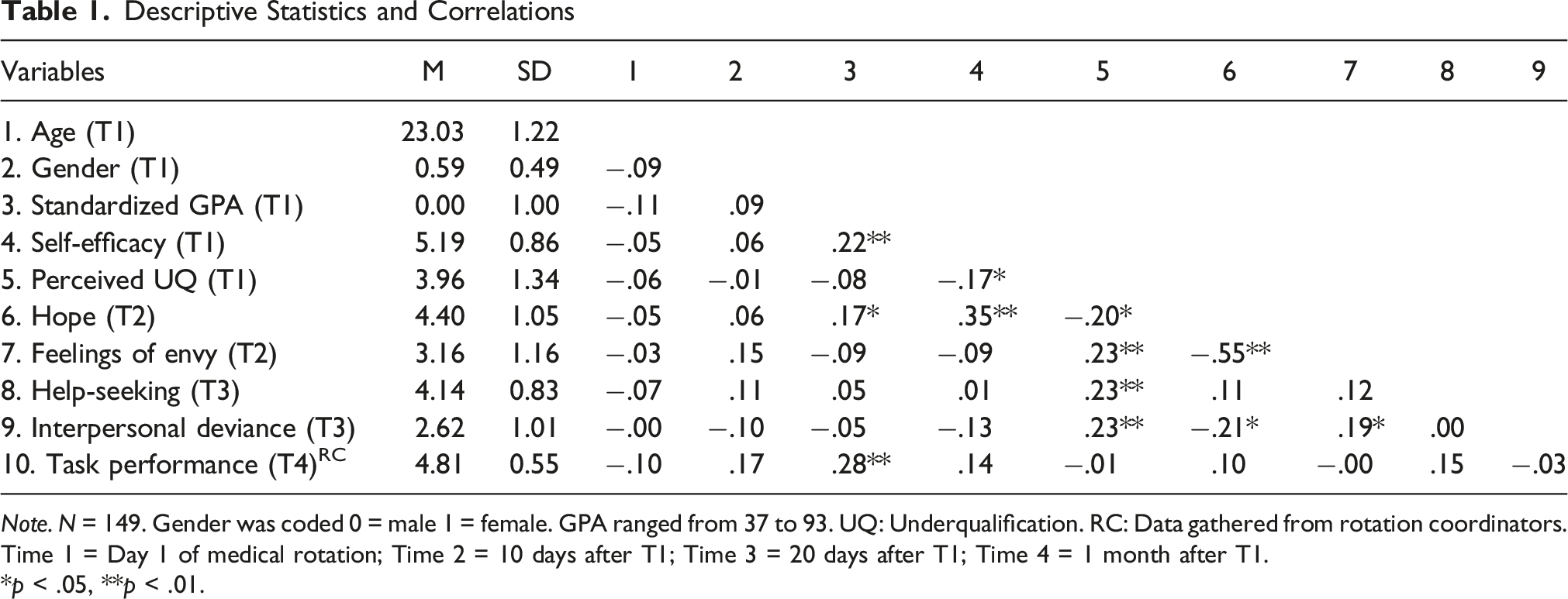
Note. N = 149. Gender was coded 0 = male 1 = female. GPA ranged from 37 to 93. UQ: Underqualification. RC: Data gathered from rotation coordinators. Time 1 = Day 1 of medical rotation; Time 2 = 10 days after T1; Time 3 = 20 days after T1; Time 4 = 1 month after T1.
*p < .05, **p < .01.
Path Analytic Results From the Estimated Model Examining H1a-H1c & H2a-H2c
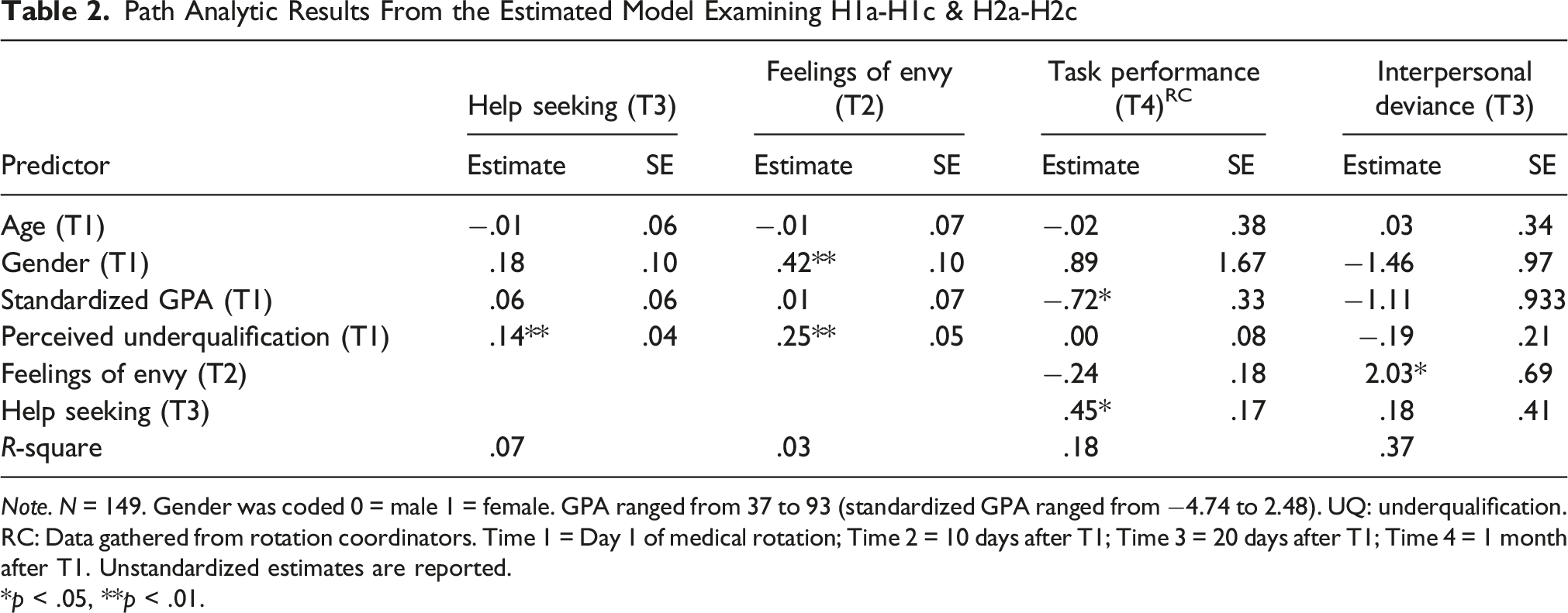
Note. N = 149. Gender was coded 0 = male 1 = female. GPA ranged from 37 to 93 (standardized GPA ranged from −4.74 to 2.48). UQ: underqualification. RC: Data gathered from rotation coordinators. Time 1 = Day 1 of medical rotation; Time 2 = 10 days after T1; Time 3 = 20 days after T1; Time 4 = 1 month after T1. Unstandardized estimates are reported.
*p < .05, **p < .01.
Path Analytic Results From the Estimated Model Examining H3a, H3b, H4a, & H4b
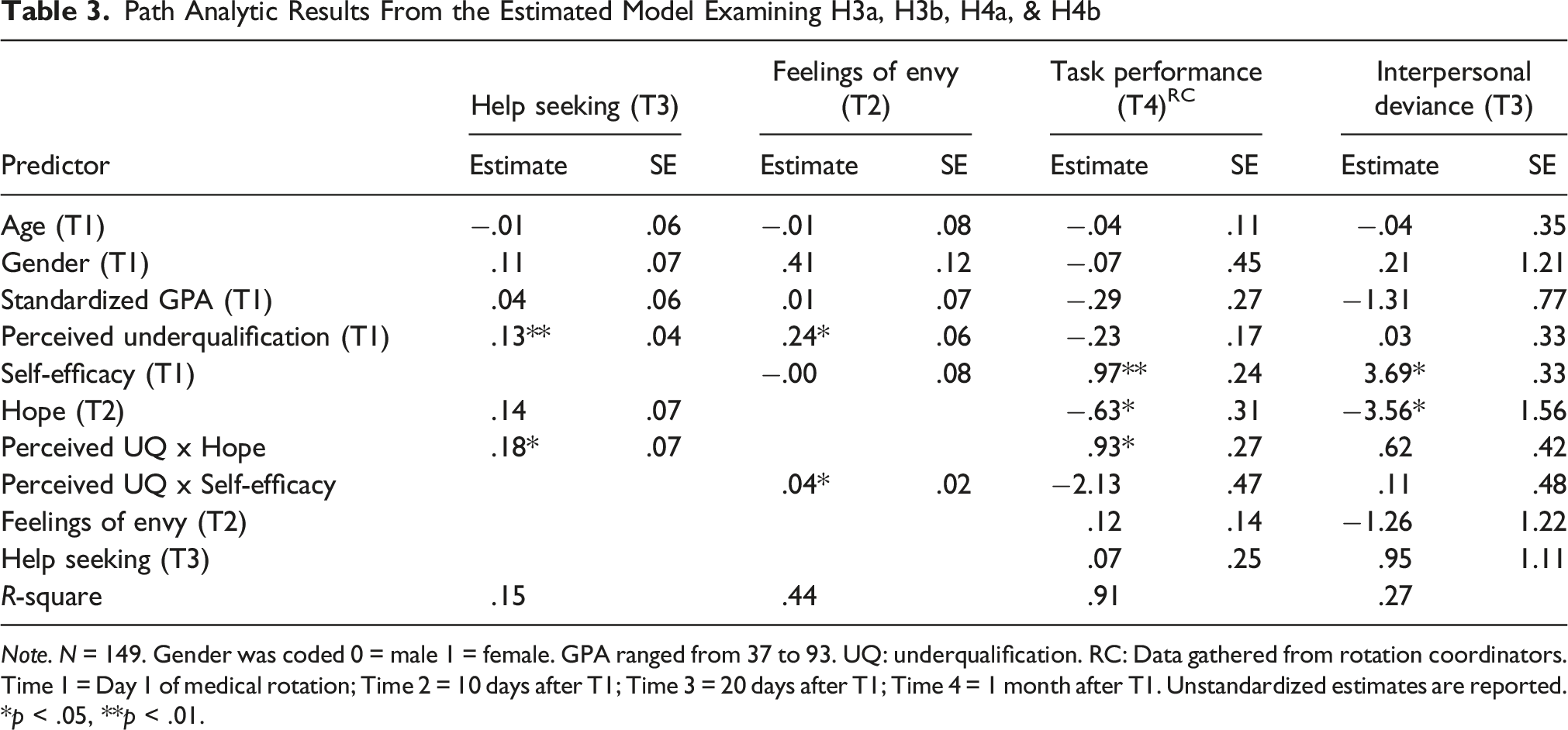
Note. N = 149. Gender was coded 0 = male 1 = female. GPA ranged from 37 to 93. UQ: underqualification. RC: Data gathered from rotation coordinators. Time 1 = Day 1 of medical rotation; Time 2 = 10 days after T1; Time 3 = 20 days after T1; Time 4 = 1 month after T1. Unstandardized estimates are reported.
*p < .05, **p < .01.
Hypothesis 1 predicted that underqualification is positively related to task performance, via help seeking. As can be seen on Table 2, results provided support for both hypotheses, as we found a positive effect of underqualification on help seeking (b = .14, p < .001) and a positive effect of help seeking on task performance (b = .45, p = .008). Bootstrapped results showed that indirect effect of underqualification on task performance via help seeking was significant (estimate = .063, 95% CI [.020, .104]), supporting Hypothesis 1. Results on non-hypothesized alternative paths show that feelings of envy were not significantly associated with task performance (b = −.24, p = .192). In addition, the indirect effect of underqualification on task performance via feelings of envy was not significant (estimate = −.006, 95% CI [−.343, .034]).
Hypothesis 2 predicted that perceived underqualification has a positive indirect effect on interpersonal deviance via feelings of envy. As reported on Table 2, we found a significant positive effect of perceived underqualification on feelings of envy (b = .25, p < .001). Results provided support for this hypothesis, as we found a positive effect of feelings of envy on interpersonal deviance (b = 2.03, p = .003). In addition, bootstrapped results showed that the indirect effect of underqualification on interpersonal deviance via feelings of envy was significant (estimate = .508, 95% CI [.195, .799]), supporting Hypothesis 2. Results on un-hypothesized alternative paths show that help-seeking was not significantly associated with interpersonal deviance (b = .18, p = .65). In addition, the indirect effect of underqualification on interpersonal deviance via help seeking was not significant (estimate = .025, 95% CI [−.014, .112]).
Hypothesis 3a predicted that hope moderates the positive relationship between underqualification and help seeking, such that this relationship is positive if an employee has higher hope. As can be seen on Table 3, our findings supported the moderating effect (b = .18, p = .018). We plotted the moderation pattern in Figure 2. Under high levels of hope (1SD above the mean), the relationship between perceived underqualification and help seeking was positive (b = .32, p < .001). Under low levels of hope (1SD below the mean), the relationship between perceived underqualification and help seeking became nonsignificant (b = −.06 p = .22). Hope as a Moderator of the Relationship Between Perceived Underqualification (UQ) and Help Seeking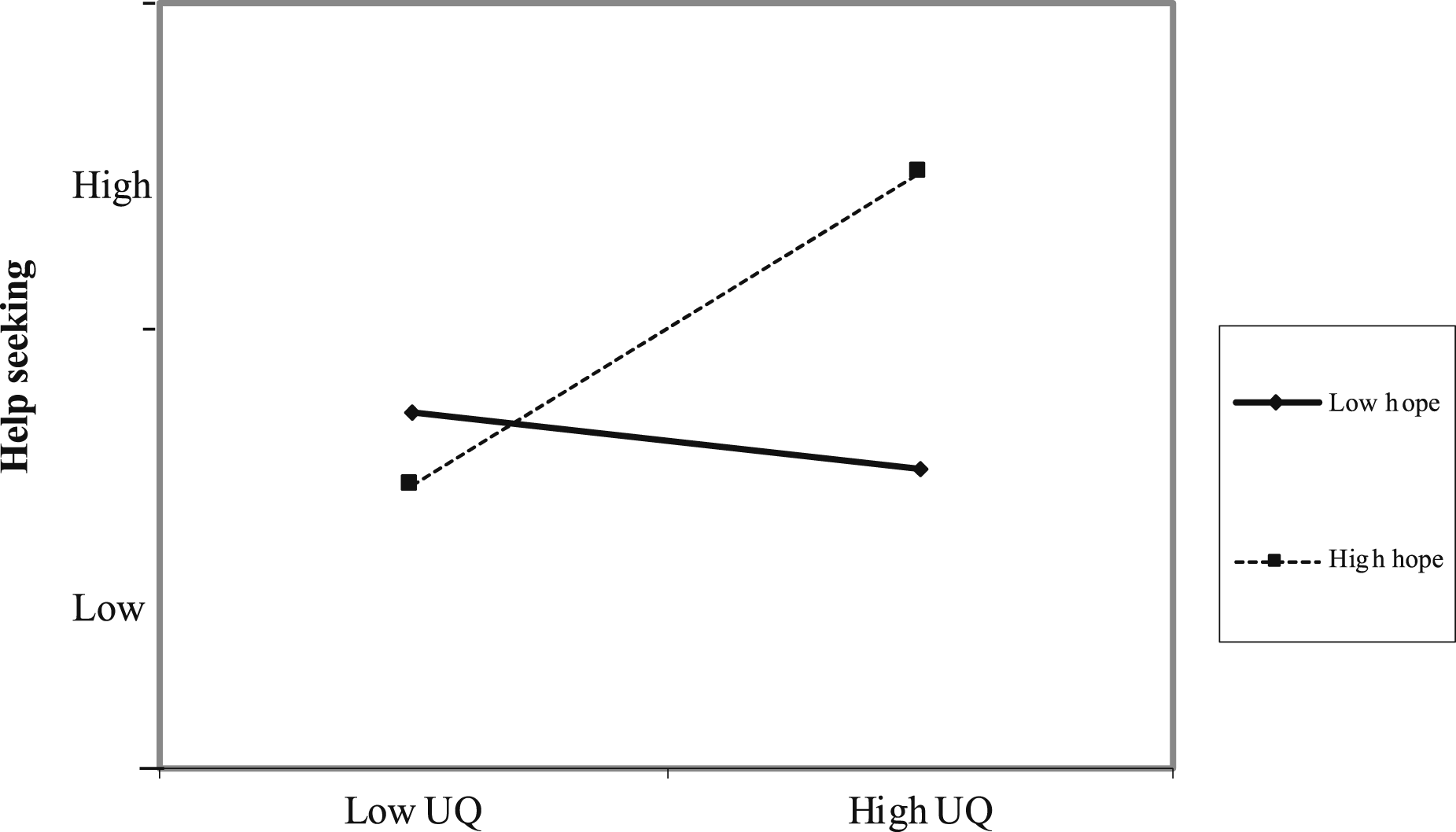
Hypothesis 3b predicted that self-efficacy attenuates the positive relationship between underqualification and feelings of envy, such that this relationship is stronger if employees have lower levels of self-efficacy. As Table 3 indicates, the moderating effect (b = .04, p = .024) was significant. However, as the plot indicates in Figure 3, the moderating effect was contrary to our prediction: self-efficacy strengthened the positive relationship between perceived underqualification and feelings of envy. Under high levels of self-efficacy (1SD above the mean), the relationship between perceived underqualification and envy was positive (b = .27, p < .001) and under low levels of self-efficacy (1SD below the mean), the relationship between perceived underqualification and feelings of envy was also positive but to a lesser extent (b = .21, p = .002). Self-Efficacy as a Moderator of the Relationship Between Perceived Underqualification (UQ) and Feelings of Envy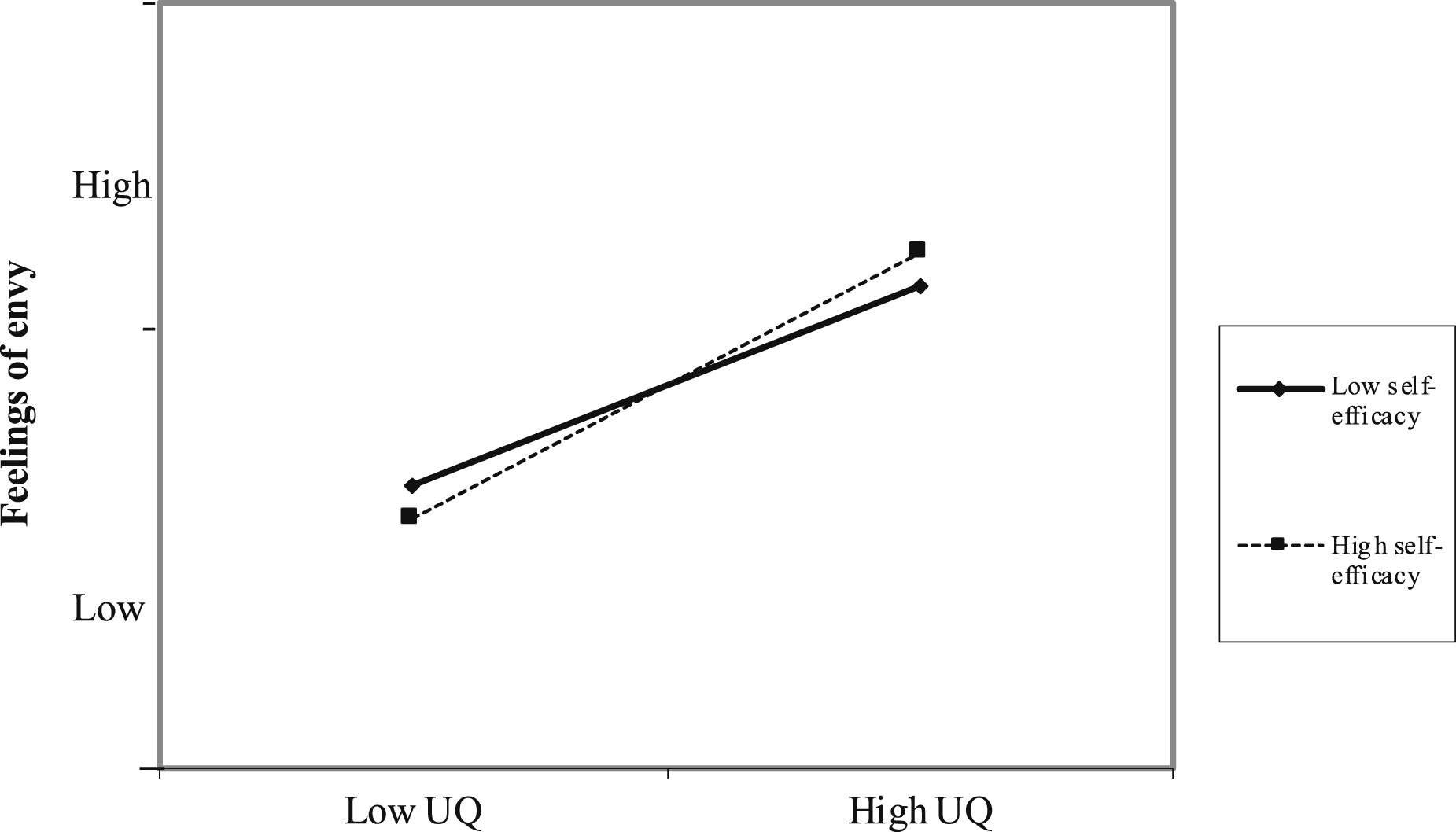
Hypothesis 4a proposed that hope moderates the positive indirect relationship between perceived underqualification and task performance via help seeking, such that indirect effect is positive if the employee has higher hope. The simple conditional indirect relationship between perceived underqualification and task performance via help seeking was significant and positive (indirect effect = .022, 95% CI [.006, .036]) for students with high levels (1 SD above the mean) of hope. The conditional indirect relationship was insignificant for students with low levels of hope (indirect effect = −.004, 95% CI [−.011, .003]. Supporting Hypothesis 4a, the indirect effect was significantly stronger for students with high compared to low levels of hope (difference = .025, 95% CI [.001, .043].
Because the moderating effect in Hypothesis 3b was significant albeit in the opposite direction, we have examined whether the conditional indirect effect holds. The simple conditional indirect relationship between perceived underqualification and interpersonal deviance via envy was insignificant for students with high levels of self-efficacy (indirect effect = −.345, 95% CI [−.015, .18]) and low levels of self-efficacy (indirect effect = −.260, 95% CI [−.012, .118]). As such, the conditional indirect effect was insignificant. 3
Supplementary Analysis
Supplementary Path Analytic Results: Main Effect of Overqualification
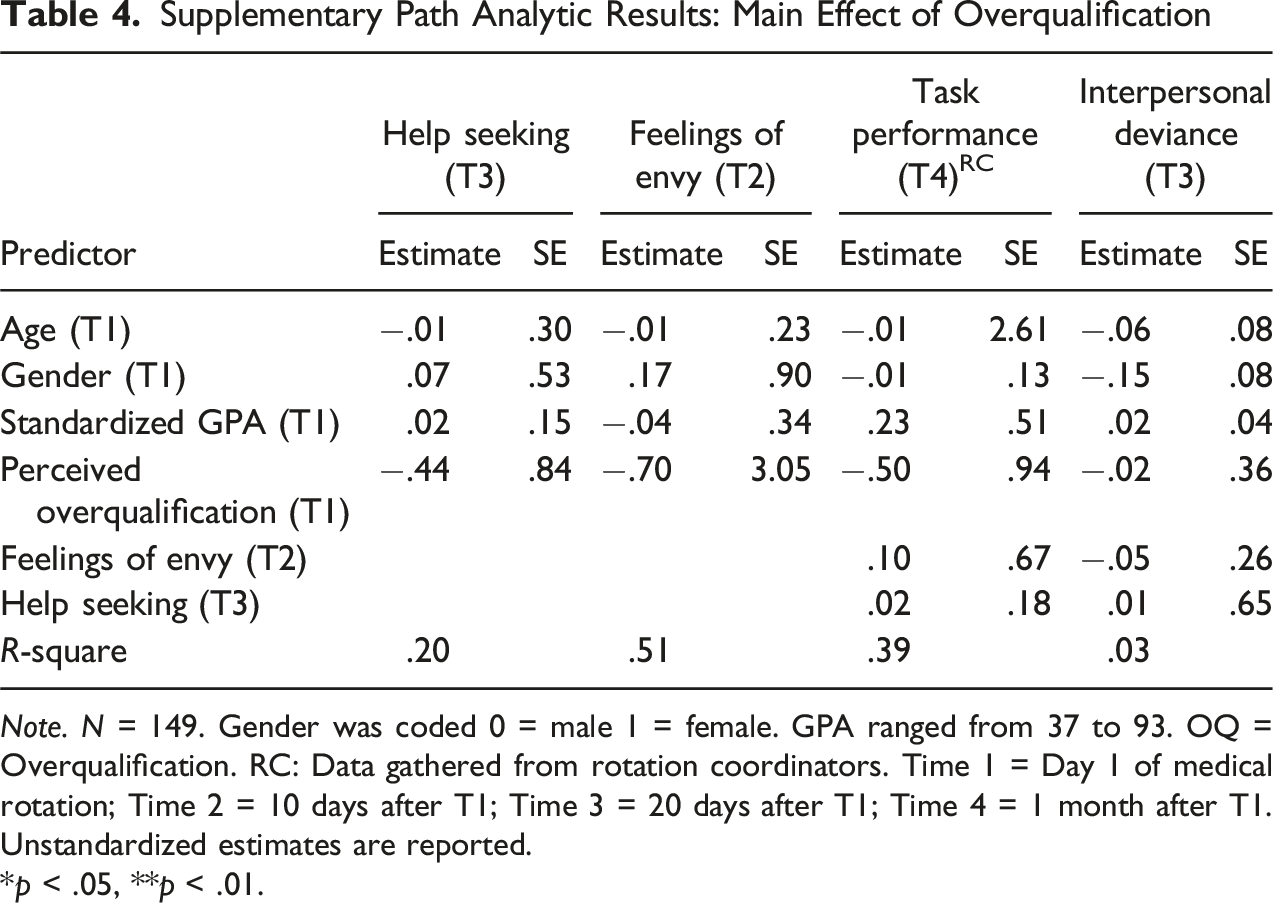
Note. N = 149. Gender was coded 0 = male 1 = female. GPA ranged from 37 to 93. OQ = Overqualification. RC: Data gathered from rotation coordinators. Time 1 = Day 1 of medical rotation; Time 2 = 10 days after T1; Time 3 = 20 days after T1; Time 4 = 1 month after T1. Unstandardized estimates are reported.
*p < .05, **p < .01.
Supplementary Path Analytic Results: Interaction Effect of Overqualification
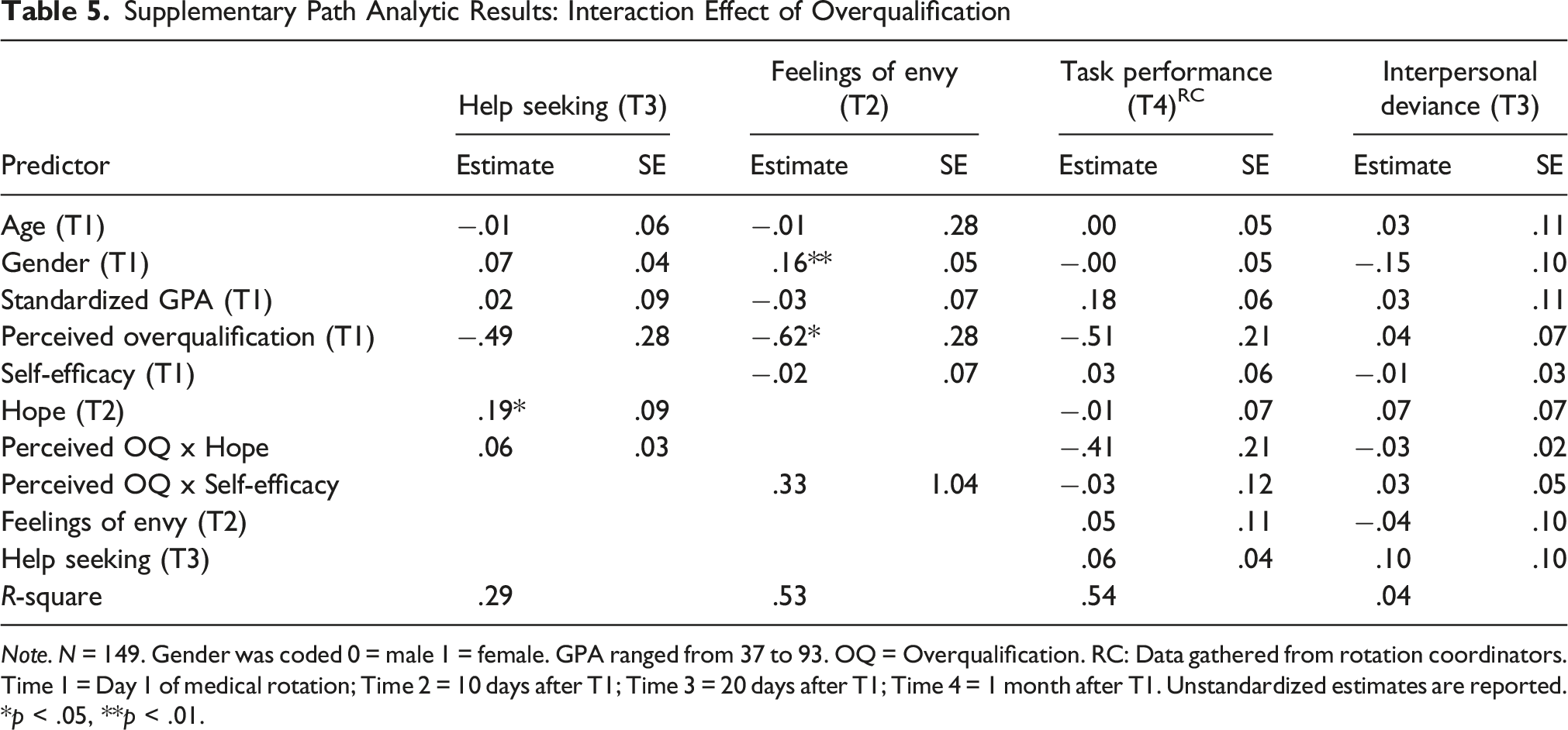
Note. N = 149. Gender was coded 0 = male 1 = female. GPA ranged from 37 to 93. OQ = Overqualification. RC: Data gathered from rotation coordinators. Time 1 = Day 1 of medical rotation; Time 2 = 10 days after T1; Time 3 = 20 days after T1; Time 4 = 1 month after T1. Unstandardized estimates are reported.
*p < .05, **p < .01.
Discussion
In this paper, we examined the implications of perceived underqualification for individuals’ work behaviors. Drawing from social comparison theory, we theorized that feelings of underqualification trigger both affective reactions (envy) and motivational reactions (help-seeking), influencing adaptive (task performance) and maladaptive (interpersonal deviance) behaviors. Additionally, we found that hope moderated the positive indirect effects on task performance through help seeking.
Theoretical Contributions
Despite its prevalence, perceived underqualification has received limited research attention. Given that feelings of underqualification are common among various groups of employees (Connley, 2019), understanding its implications is crucial. Our study makes a significant theoretical contribution by being one of the first studies to explore perceived underqualification comprehensively. We explore both the adaptive and maladaptive outcomes associated with perceived underqualification, thereby enriching the person-job fit literature which has predominantly focused on overqualification (Erdogan & Bauer, 2021). By demonstrating that perceived underqualification is distinct from overqualification, with unique motivational, affective and behavioral outcomes we suggest that a complete understanding of job misfit requires an examination of both over- and underqualification.
Some may argue that underqualified employees are detrimental to organizational performance. Contrary to this belief, our exploration reveals that perceived underqualification has complex effects, yielding both adaptive and maladaptive consequences. Using social comparison theory, we highlight these simultaneous motivational and affective responses (Crusius et al., 2022). We found that underqualification could simultaneously relate to maladaptive reactions through envy (Baumeister et al., 2007) as well as proactive help seeking behaviors to close the skill gap (Friedman et al., 2018). Therefore, our study underscores the necessity of a balanced view to fully understand perceived underqualification.
We also found that psychological resources influence adaptive behaviors. As predicted, state hope moderates the relationship between underqualification and help-seeking. Contrary to our predictions, self-efficacy amplified rather than mitigated the positive effect of underqualification on envy. This unexpected finding suggests that our initial theoretical framework based on social comparison theory might be insufficient to fully capture the dynamics at play, and that scholars may also want to consider cognitive dissonance theory (Hinojosa et al., 2017). Specifically, individuals with high self-efficacy may experience heightened dissonance between their perceived abilities and their underqualification because they have stronger beliefs in their ability to succeed (Phillips & Gully, 1997). This dissonance can shift their focus outward (Van de Ven et al., 2009), intensifying feelings of envy. Such insights underscore the need for future research to consider both social comparison and cognitive dissonance theories to fully understand the complex effects of perceived underqualification. Moderated mediation analysis further highlighted that perceived underqualification has a stronger association with maladaptive outcomes. While perceived underqualification consistently predicted interpersonal deviance through envy, its positive impact on performance through help-seeking depended on hope.
Our findings should be interpreted in light of our unique sample: medical students, at a university, who rank in the top 2% over 3 million annual university exam takers in Turkey (Yükseköğretim Program Atlası, 2023). This elite group reported high self-efficacy (M = 5.19, SD = .86), suggesting that underqualification may provoke envy, due to their typical experiences of competence and success. Such heightened self-efficacy could exacerbate the emotional responses, such as envy, when faced with underqualification, a situation that is both uncommon and challenging for them. Additionally, the context of working in a hospital during the COVID-19 pandemic is a high risk, high-stakes setting where errors can have severe public consequences (Hällgren et al., 2018). While our findings offer insight into how such environments shape perceptions of underqualification and related behaviors, we did not compare contexts, limiting generalizability to less demanding environments or populations with lower self-efficacy. For example, in high-risk environments, the pressure to perform can amplify feelings of underqualification, possibly prompting a greater likelihood of help-seeking behaviors as employees cope with the elevated risks and responsibilities.
Practical Implications
Understanding underqualification has become increasingly critical for organizations facing talent shortages and rapid skill obsolescence. As technological change accelerates and new roles emerge, organizations may hire and develop employees who initially feel underqualified (Kulkarni et al., 2015). Our research provides crucial insights for managing these situations effectively, helping organizations balance the risks and potential benefits of hiring underqualified candidates, while designing appropriate support systems to maximize their success.
Anecdotal evidence suggests that some organizations prefer hiring underqualified employees, because even if applicants lack the necessary skills at the time of hire, they can be trained to meet the organization’s needs as long as they are motivated to learn and ask for help (Dilullo, 2019; Lucas, 2022). Our findings align with this, demonstrating that employees who perceive themselves as underqualified can enhance their performance by reaching out to others and seeking help. To foster help seeking behaviors, organizations should create a supportive and psychologically safe work climate where employees feel comfortable reaching out for help (Bamberger, 2009).
Moreover, our study highlights the role of state hope as a moderating factor between perceived underqualification and help-seeking behaviors. Because state hope is a malleable condition, it can be developed through targeted interventions (Ozyilmaz, 2020; Peterson et al., 2011). Research also showed that employee hope can be boosted through solution development activities (Ozyilmaz, 2020) and transformational leadership (Lin et al., 2018). It has also been shown that even a short 2 to 3-h intervention programs about goal setting, contingency planning, and thinking about alternative paths for success can be very effective in hope development in organizations (Luthans & Youssef, 2017).
Finally, our study suggests that underqualified employees may fall into maladaptive patterns, such as experiencing envy and engaging in interpersonally deviant behaviors. This is particularly concerning in high-stakes environments, like the medical field, where collaboration and civility are essential. Organizations can develop strategies to mitigate envy among employees who feel underqualified, such as by prioritizing collaboration over competition and ensuring fairness (Li et al., 2023).
Potential Limitations and Future Research Directions
Our study offers several strengths, such as involving a field sample where feelings of underqualification are likely to be relevant, and its time-lagged design. As with all studies, however, there are also potential limitations of our study design that are important to consider and address in future research.
Given the absence of a comprehensive theoretical framework on the concept of perceived underqualification, our approach was necessarily exploratory. This exploratory nature, combined with the high demands placed on our participants—medical students in high-stakes hospital rotations during the COVID-19 pandemic—necessitated a selective approach to variable inclusion. The intense time constraints of these participants led us to keep our surveys brief and to streamline our measures. Consequently, we focused only on the most directly relevant forms of help seeking (i.e., instrumental) and a singular conceptualization of envy. Future research could investigate other meaningful mediators, such as emotional help seeking, or examine malicious and benign envy separately, treating each as a distinct mediating mechanism.
The constraints also influenced our choice of moderators. For example, as the medical students were among the top students in Turkey, they might have high hyper-competitiveness, defined as the need of individuals to compete and win (Ryckman et al., 1994). As hypercompetitive employees have a stronger intention in committing unethical behaviors (Swab & Johnson, 2019), this trait can act as a moderator between perceived underqualification and interpersonal deviance. Another possible moderator is learning goal orientation, which is defined as a motivational orientation towards learning and improving skills (Hirst et al., 2009). Employees who feel underqualified but have a high learning goal orientation might be more inclined to seek help, viewing their challenges as opportunities for growth.
Another limitation of our study was that we used a medical student sample. Although employees who perceive themselves as underqualified can have inadequate experience, our participants might have even less experience in their chosen roles because they are still completing their training. Therefore, some of our results can be biased, and in the future researchers should explore whether these findings hold in an industry sample or not.
An important future research direction relates to the source of employees’ perceived underqualification. Understanding how employees develop feelings of underqualification is an important next step in the study of underqualification. For example, social comparison theory can be used to understand the antecedents of underqualification, by examining the comparative level of self and coworkers’ level of qualification. Researchers can also take a dyadic approach and consider the expertise and similarity of the coworkers with the employee (Suls et al., 2002) to elaborate the roots of the feelings of underqualification. Further, an interesting and important research direction involves investigating the relation between perceived underqualification and the impostor syndrome as they both relate to perceptions of capabilities. Future research may also benefit from an assessment of actual direct assessments of job demands and employee qualifications, as well as measurement of employee qualifications from secondary perspectives to further investigate the origins of perceived underqualification.
In our current study, our overall study period was short given the limited 1-month duration of each medical rotation. We employed a time-lagged design gathering data from the first day of the rotation until the end of the rotation. However, utilizing longitudinal approaches to investigate the trajectory of perceived underqualification, and examining how perceived underqualification changes and evolves over time is an important future direction. Understanding the role of workplace factors such as receiving positive and negative feedback, positive or negative interactions with patients, and proactive behaviors such as seeking and receiving help in relation to how employees reduce their sense of underqualification and develop a sense of fit with their jobs is an important future research direction.
Conclusion
Our study examined when and why perceived underqualification will have implications for interpersonal deviance and task performance. Time-lagged data from a four-wave study of medical students and their rotation coordinators suggested that perceived underqualification had indirect positive effects on interpersonal deviance via feelings of envy. Further, perceived underqualification had indirect positive effects on task performance via help seeking, and this effect was contingent on the state of hope. Our study demonstrates that the implications of perceived underqualification are complex and perceived underqualification is an important construct of study in investigations of person-job misfit.
Footnotes

Funding
The authors received no financial support for the research, authorship, and/or publication of this article.
Declaration of conflicting interests
The authors declared no potential conflicts of interest with respect to the research, authorship, and/or publication of this article.
Data Availability Statement
Research data is