




Abstract
This study advances a more follower-centric perspective on servant leadership by examining how followers’ experiences of “being served” function as a motivational factor in their agency to shape social structures. Integrating servant leadership research with social cognitive and network agency approaches, we argue that servant leaders motivate a dual pursuit in followers’ relationship brokering, i.e., inspiring other-oriented behaviors (“paying service forward”) while also empowering focus on personal benefits (“enjoying it inward”). Our analysis of 365 followers in 128 groups across 20 organizations generally supports our social cognitive theorizing. Specifically, we demonstrate that the interaction between followers’ perceived servant leadership (i.e., a motivational underpinning) and perceived networking ability (i.e., a cognitive underpinning) shapes their tendency to both share network advantages (tertius iungens) and pursue personal advantages (tertius gaudens) through interpersonal agency. Furthermore, our results highlight the precarious nature of shared advantages, as followers are increasingly likely to engage in tertius gaudens brokering when experiencing a negative emotional state. We discuss the implications of these findings for servant leadership research.
Introduction
The core of servant leadership lies in prioritizing the needs and interests of followers, empowering them to self-organize, pursue goals, and drive bottom-up change within their social environment (Eva et al., 2019; Lemoine et al., 2019). Beyond serving one’s own followers, a distinctive feature of servant leadership is its multi-stakeholder emphasis and its contribution to the wellbeing of the broader collective (Lemoine et al., 2019; Liden et al., 2008). While this central tenet is well supported in the literature, less is known about the implications of “being served” for how followers prioritize the interests of multiple stakeholders when building social relationships. Like all individuals, servant leaders face constraints in time, cognitive capacity, and resources, limiting the number of direct ties they can maintain with various stakeholders (McCarthy & Levin, 2019). As a result, servant leadership relies on followers to help build trusting relationships, promote sharing, and foster collaboration across stakeholder groups. However, the extent to which—and the conditions under which—servant leadership motivates followers to shape social relationships remains relatively underexplored. In this study, we examine the potential dual impact of servant leadership on followers’ pursuit of other-oriented and self-serving behavioral orientations in interacting, creating value, and forging relationships among multiple stakeholders.
Research on interpersonal agency identifies brokering as a key mechanism through which individuals shape their social environments (Halevy et al., 2019; Obstfeld, 2005). Unlike brokerage, which refers to structural network positions, brokering captures the behaviors that influence social relationships between others (Kwon et al., 2020; Soda et al., 2018). Through brokering, organizational members can help create vastly different social contexts, depending on whether they foster communion and sharing (tertius iungens, or TI) or separation and self-gain (tertius gaudens, or TG) (Obstfeld, 2005). Given its pervasiveness, brokering has been described as “the primary driver of change in social life” (Halevy et al., 2020, p. 293) and a fundamental determinant of the distribution of social capital and other advantages embedded in social relationships (Adler & Kwon, 2002; Kuwabara et al., 2018). In addressing follower agency in interpersonal relationships, brokering shares servant leadership’s multi-stakeholder and relationship-focused emphasis (Chiniara & Bentein, 2018; Eva et al., 2019).
Despite brokering’s significance, leadership research has largely overlooked how leaders influence followers’ brokering behaviors. We argue that a closer examination of servant leadership from the follower perspective may reveal unexpected complexities unique to this approach. Specifically, the experience of “being served” may inspire followers to use their abilities and resources to “pay it forward,” consistent with the conventional view (Chen et al., 2015) that servant leadership fosters other-oriented TI brokering to facilitate collaboration and share social capital. However, we propose that consistently prioritizing followers’ interests may also activate and empower an inherent tendency to “enjoy it inward” (Si et al., 2023). That is, some followers may begin to see servant leadership as an entitlement rather than as something to be reciprocated for collective benefit. Empowered by servant leadership, such followers might leverage their abilities to pursue personal advantage in their interactions. We contend that, relative to other leadership approaches, servant leadership is more inclined to also empower followers’ pursuit of TG brokering due to its emphasis on followers’ personal interests. This perspective challenges the common assumption that servant leadership invariably promotes other-oriented behavior, and suggests that some followers may benefit from leadership that prioritizes their needs without necessarily paying it forward. Clarifying whether and when perceived servant leadership motivates followers to leverage advantages for personal gain is essential for refining our understanding of servant leadership as a robust framework and for addressing potential blind spots in its implementation.
To explore these divergent effects, this study draws on a social cognitive perspective (Bandura, 1991; DeShon et al., 2004; Sherman et al., 1989) to examine how followers’ perceptions of servant leadership interact with their cognitive and affective factors in shaping brokering behaviors (Fiske & Taylor, 1991; Forgas, 2008; Hilgard, 1980; Mayer, 2003). The social cognitive perspective provides a valuable theoretical lens for integrating leadership and social network studies by focusing on how individuals perceive social stimuli, how affective and social factors influence information processing, and how cognition shapes behavioral and interpersonal outcomes (Casciaro et al., 2014). Building on these foundations, we incorporate motivational, cognitive, and affective factors that interact to shape brokering behaviors. Specifically, we frame perceived servant leadership as a motivational factor that inspires and empowers followers’ personal agency in brokering. Social cognitive theory holds that motivation and cognition are intertwined, such that individuals engage in activities only when they believe they can perform them effectively (Bandura, 2001; Lindenberg & Foss, 2011). To address cognitive factors, we focus on perceived networking ability—followers’ beliefs about their capacity to build and use social relationships effectively (Ferris et al., 2005; Kimura, 2015). We also examine how affective factors shape followers’ interpersonal agency, proposing that followers adopt different brokering styles depending on whether they experience positive or negative emotions.
Our study makes the following contributions to the theorizing of servant leadership. First, by applying a social cognitive perspective, we provide insights into the concurrent development of self-serving and other-oriented follower behaviors. Specifically, we examine whether and when “being served” increases followers’ efforts to facilitate collaboration and benefit others versus when it fosters a self-serving pursuit of social advantage. While emphasizing the interests of others is central to servant leadership, research has only recently begun acknowledging the role of follower self-interest in these processes (Si et al., 2023; Wu et al., 2021). Shedding further light on the relationship between servant leadership and follower self-interest is crucial, as self-interest is a fundamental driver of human action (Gerbasi & Prentice, 2013). However, servant leadership research has often relied on a “Theory Y” assumption of human nature—suggesting that individuals are inherently motivated to contribute to collective organizational interests (van Dierendonck, 2011). Examining situations where servant leadership does not produce the expected positive outcomes facilitates a richer and more nuanced understanding of its impact, challenging the entrenched assumption that its outcomes are always positive or, at the very least, neutral.
Second, we expand the potential of servant leadership by examining its role in followers’ self-regulatory behavioral processes. We argue that leveraging social cognitive theory allows us to move beyond traditional outcome variables such as attitudes or organizational citizenship behaviors (Eva et al., 2019; Hoch et al., 2018). By focusing on followers’ cognitive, motivational, and affective experiences, our study moves beyond the traditional leader-centric approach that emphasizes providing but not receiving servant leadership behaviors. We foreground the agency of followers, placing them on equal footing with leaders by demonstrating how experiencing servant leadership activates and shapes their agency in changing social structures. In doing so, we refine servant leadership as a follower-centric model that highlights the critical role of followers’ self-regulated behavior and expands the scope of its impact beyond direct and conventional outcomes.
Theoretical Background
Servant Leadership in Serving the Interests of Multiple Stakeholders
Servant leadership, as defined by Eva et al. (2019, p. 114), “is an (1) other-oriented approach to leadership (2) manifested through one-on-one prioritizing of follower individual needs and interests, (3) and outward reorienting of their concern for self towards concern for others within the organization and the larger community.” Unlike other leadership approaches, such as transformational leadership, which emphasizes followers’ subordination of self-interest for the interests of the organization (Graham, 1991; van Dierendonck, 2011), servant leadership places the follower at the core of its approach (Liden et al., 2008), often prioritizing follower needs over the collective needs of the organization (Sendjaya et al., 2008). Servant leadership also differs from other prosocial leadership models, such as ethical leadership, which focuses on agent-neutral morality rather than serving the needs and interests of followers or specific stakeholders (Lemoine et al., 2019; Ng & Feldman, 2015; Schaubroeck et al., 2012). While prioritizing followers, servant leadership also emphasizes creating value for the broader community (Ehrhart, 2004; Liden et al., 2008). Although management research widely acknowledges tensions between personal and collective interests (Eisenhardt, 1989), servant leadership research has largely overlooked such agency problems. An important dilemma in servant leadership is that serving followers’ personal interests does not always fully align with what is required to serve the collective organizational interest.
Diverging social interests are particularly evident in the distribution of benefits derived from social relationships. Social relationships and the resources embedded within social networks are crucial for followers’ personal interests, including career opportunities, personal development, and well-being (Halevy et al., 2019). Extensive research on social capital shows that relationships are valuable resources that determine who holds power and enjoys privileged access to new opportunities and knowledge within social networks (Fleming et al., 2007; Kwon et al., 2020). In particular, individuals who span structural gaps between disconnected others can reap significant benefits from their networks (Burt, 1992). Thus, by forging ties between actors, individuals not only demonstrate care for others but also relinquish control and an advantageous social position. Social relationships are equally essential for collective performance, as they facilitate knowledge diffusion, collaboration, and overall organizational functioning (Hansen, 1999; Reagans & McEvily, 2003). Indeed, every organization relies on interdependence among its members (Raveendran et al., 2020). To “get things done,” organizational members engage in brokering behaviors to build and maintain social structures that enable access to and utilization of key resources (Obstfeld, 2012; Reagans et al., 2005).
Brokering as a Form of Follower Agency to Shape the Social Environment
According to Simmel’s (1950) foundational work, individuals brokering between disconnected or uncollaborating others have two fundamental alternatives: (1) to act as one who “joins” (iungens in Latin), facilitating collaboration and fostering collective advantage, or (2) to act as one who “enjoys” (gaudens in Latin), reaping the benefits of a privileged brokerage position. While TI brokering exemplifies other-oriented, communal interpersonal behavior (Bolino & Grant, 2016; Ebbers, 2014; Ibarra et al., 2005), TG brokering focuses on obtaining and maintaining personal advantages within social networks (Bizzi, 2013; Xiao & Tsui, 2007).
An important agentic question for servant leadership, therefore, is whether it motivates followers to build and maintain social structures that benefit the broader collective (TI) or in ways that provide them with personal advantages (TG) (Fleming et al., 2007; Obstfeld, 2005; Soda et al., 2018). It is important to note that TI and TG brokering are not opposing ends of a single continuum; rather, individuals can pursue both orientations simultaneously (Grosser et al., 2019; Kwon et al., 2020). In fact, research on brokering suggests that high performance often necessitates balancing both forms of brokering (Lingo & O’Mahony, 2010; Obstfeld et al., 2014). This perspective aligns with broader findings on human motivation, which suggest that individuals possess both self-interested and other-oriented tendencies, with the emphasis on each varying across situations (Crocker et al., 2017; Meglino & Korsgaard, 2004).
Theoretical Model and Hypothesis Development
A Social Cognitive Perspective on Servant Leadership and Followers’ Agency in Brokering
In predicting behavioral and interpersonal outcomes, social cognitive research suggests that cognitive, motivational, and affective underpinnings interact in complex ways, requiring simultaneous consideration (Ajzen, 1991; Bandura, 2001; Forgas, 2008; Lindenberg & Foss, 2011). First, social cognitive theory posits that individuals invest effort into behaviors only when they think they have the ability to perform them effectively (Bandura, 1991). In this vein, our framework focuses on perceived networking ability as a key cognitive underpinning of brokering behaviors, as it reflects an individual’s self-assessed relational skill and ambition in identifying relevant contacts and shaping social network structures (Ferris et al., 2007). Individuals with high networking ability can develop and leverage disconnected networks to transfer information and valuable resources, thereby generating benefits either for themselves or the broader collective (Kimura, 2015). Consistent with these ideas, Ferris et al. (2005, p. 129) asserted that “because social networks are deliberately constructed structures, individuals high in networking ability ensure they are well positioned in order to both create and take advantage of opportunities.”
Second, social cognitive theories recognize that people seldom engage in activities merely because they can—they also require motivation. We conceptualize the experience of servant leadership as a key motivational impetus that interacts with networking ability, providing the necessary drive to pursue brokering behaviors. This conceptualization builds on the idea that being served inspires and empowers followers to mobilize skills and personal resources in pursuit of interpersonal activities (Greenleaf, 1977; Lemoine et al., 2019; Liden et al., 2014; Van Dierendonck, 2011). Our reasoning aligns with prior studies demonstrating that the experience of servant leadership serves as a central motivational factor that interacts with followers’ social and emotional dimensions to shape their behaviors (Hu & Liden, 2011; Neubert et al., 2016).
Third, social cognition research acknowledges that self-regulated behavioral processes cannot be fully understood without considering the simultaneous role of affect as reflected in emotional states (Bandura, 2001; Forgas, 2008). Unlike the cognitive and motivational underpinnings, which we predict will activate and expand individual involvement in both types of brokering behaviors, we suggest that emotional states influence how followers choose between these behaviors. Although “emotional healing” is often considered a dimension of servant leadership (Barbuto & Wheeler, 2006; Liden et al., 2008), follower emotional states result from a multitude of factors, and empirical evidence on whether and how servant leadership directly influences follower emotions remains mixed (Peng et al., 2023; Tang et al., 2016). In their nomological network of servant leadership research, Eva et al. (2019) suggested that phenomena related to followers’ emotional states, such as work exhaustion, are more likely to moderate rather than mediate the effects of servant leadership on follower outcomes. Thus, while we do not rule out the possibility that servant leadership influences followers’ emotional states, we emphasize its interactive role in our model. Importantly, prior research highlights that emotions play a central role in regulating how individuals respond cooperatively or competitively within their social environment (Tomasello & Vaish, 2013). Moreover, emotional state serves as a cue to an individual’s perceived standing relative to others, shaping what types of outcomes they consider motivating and plausible in social interactions (Aknin et al., 2018; Kushlev et al., 2022; van Kleef & Lelieveld, 2022). Thus, emotions help determine whether and to what extent followers feel they can contribute to others or engage in activities to improve their own position.
The Synergistic Effect of Perceived Servant Leadership and Perceived Networking Ability on Brokering Behaviors
Building on social cognitive theory, our baseline argument is that followers engage in actions only when they believe they possess the necessary abilities for success and when their experience of servant leadership behaviors motivates brokering pursuits. Supporting this perspective, Kauppila et al. (2022) demonstrated that HR managers’ servant leadership significantly influenced the leadership behaviors of constituents only when those individuals believed they had a sufficiently high ability to lead effectively. Applying this logic to brokering, we argue that individuals expend effort to change relationship structures especially when they experience the motivational influence of servant leadership and think they are capable of “developing and using diverse networks of people” (Ferris et al., 2005, p. 129). Specifically, we propose that an individual’s confidence in their ability to understand and influence social relationships—manifested in high perceived networking ability—is a crucial cognitive underpinning that interacts with servant leadership to facilitate brokering orientations.
By examining interactive effects of servant leadership and perceived networking ability, we seek to explain whether and when followers of servant leaders engage in brokering, as well as how they engage in different types of brokering behaviors. Our overarching argument is that servant leadership motivates individuals to leverage their internal potential to pursue and shape social relationships within their environment. Consistent with Cullen et al. (2018), we contend that an individual’s internal ability to influence others is necessary for interpersonal agency in social relationships, but we add that the motivational factor of leadership is required to fully leverage the potential of individual abilities in these pursuits. Regarding how servant leadership motivates followers to use their perceived networking skills, we argue that it both (1) inspires followers to help others and (2) empowers their inherent tendency to reinforce their own position.
The Pursuit of TI Brokering
The first way in which we suggest that the experience of servant leadership shapes self-regulated processes is by inspiring followers to emulate the leader’s other-oriented behavior, thereby facilitating collaboration and the sharing of social capital. A key premise of servant leadership research is that the experience of being served inspires followers and motivates them to consider the purpose and goals of their behaviors toward others (Lemoine et al., 2024; Liden et al., 2014; Neubert et al., 2016; van Dierendonck, 2011). Followers regard servant leaders as inspiring and respected role models, motivating them to emulate prosocial and altruistic behaviors in their interactions (Chen et al., 2015; Greenleaf, 1977).
By engaging in TI brokering, employees follow in the footsteps of the servant leader, helping others collaborate and enabling the organization to achieve its objectives. When servant leaders inspire followers to express their networking ability through TI brokering, the follower’s response to servant leadership can be understood as “paying it forward.” The pursuit of collective interests is embodied in TI brokering, which focuses on facilitating collaboration (Halevy et al., 2020; Nicolaou & Kilduff, 2023; Obstfeld, 2005) and fostering cohesion (Fleming et al., 2007; Iorio, 2022). Brokering individuals relinquish a personally advantageous network position by connecting others, foregoing privileged access to unique knowledge and other valued resources for the benefit of a broader community (Ebbers, 2014; Soda et al., 2018). Thus, TI brokering can be viewed as a self-regulated behavior that followers, inspired by servant leaders, engage in to advance collective goals (Lindenberg & Foss, 2011).
While servant leadership motivates followers to emulate collaborative behaviors, the social cognitive perspective suggests that this motivation alone does not necessarily translate into brokering action unless followers also believe they have the ability to perform the behavior effectively (Ajzen, 2002; Wood & Bandura, 1989). Perceived networking ability reflects a follower’s confidence in their capacity to develop and use diverse networks, build strong and successful alliances, and increase social capital (Ferris et al., 2005; Munyon et al., 2015). In combination with the motivational impetus of servant leadership, which encourages collaboration and collective goals, perceived networking ability is likely to facilitate followers’ pursuit of brokering behaviors to develop collaborative structures that advance the interests of the collective (i.e., TI brokering). Thus:
The relationship between the follower’s perception of servant leadership and TI brokering becomes more strongly positive as the follower’s perceived networking ability increases.
The Pursuit of TG Brokering
The second way we propose that servant leadership motivates followers’ brokering behaviors is by activating, legitimizing, and empowering their pursuit of personally advantageous positions. At first glance, the idea that servant leadership encourages followers to use their networking ability to bolster their own position may seem counterintuitive and in conflict with our first hypothesis. However, prioritizing followers’ personal needs and interests is the raison d’être of the servant leader (Sun, 2013). Sendjaya et al. (2008, p. 403), for example, emphasized that the primary focus of servant leaders is “followers first, organizations second.” This ethos is reflected in popular servant leadership measures; for instance, Liden et al.’s (2015) scale includes items such as “My leader makes my career development a priority” and “My leader puts my best interests ahead of his/her own.” While these tenets do not necessarily pit individual and collective interests against each other, they imply that follower interests are important ends in themselves rather than mere means to serve collective goals (Sun, 2013). As such, servant leaders do not necessarily encourage or expect followers to sacrifice their self-interest for the good of the organization (Courtright et al., 2014).
When occupying bridging positions between otherwise disconnected others, followers benefit from privileged access to valuable opportunities and resources, as well as from the ability to control exchanges between parties (Burt, 1992; Lingo & O’Mahony, 2010; Stovel & Shaw, 2012). Encouraging followers to maintain these advantageous network positions—rather than urging them to relinquish personal benefits for collective gain—can be seen as aligned with servant leadership’s intent to prioritize followers’ interests. For instance, a servant leader supporting a real estate agent may be perceived as encouraging the agent to develop a private network of leads and contacts without expecting them to share these connections with the broader organization. The servant leader might even be expected to facilitate this process through acts of service, without insisting on wider transparency. From the follower’s perspective, such leader behaviors signal empowerment, reinforcing their sense that their self-interest is justified and valued. Similar to the notion of “paying it forward,” this response to servant leadership could be referred to as “enjoying it inward.”
In some cases, being served may even lead followers to become more self-absorbed or outright egoistic, viewing servant leaders as instrumental to their personal gain (Orehek et al., 2018), potentially leading to leader depletion (Liao et al., 2021). However, since such egoistic pursuits conflict with the servant leader’s social model, we predict that in most cases, followers will simply perceive their personal interests as legitimate and pursue them alongside other-oriented activities.
Similar to our first hypothesis, our theorizing suggests that while servant leadership legitimizes self-serving interpersonal behaviors, it will not necessarily lead to the pursuit of TG brokering unless followers also think they are adept at managing social relationship structures. Confidence in one’s networking ability is critical because separation behaviors involve a risk of social sanctions if the broker lacks the ability to develop and maintain high-quality relationships with the actors they mediate (Bizzi, 2013; Xiao & Tsui, 2007). Individuals with high networking ability—described as “[m]asters of the quid pro quo” (Ferris et al., 2005, p. 129)—are likely to navigate separation dynamics successfully, as they possess the social skills needed to manage negotiations and conflicts effectively. Based on this reasoning, we suggest that followers are more likely to pursue TG brokering when they experience servant leadership as empowering their self-interest and perceive their networking ability as sufficiently high to avoid negative social consequences. Thus:
The relationship between the follower’s perception of servant leadership and TG brokering becomes more strongly positive as the follower’s perceived networking ability increases.
Emotional States Shaping the Type of Brokering Pursuits
The final interactive element of our framework is an individual’s experienced emotional state, which regulates whether and to what extent motivated and confident actors focus on TI brokering and TG brokering. Research on job-related emotional states typically differentiates between positive and negative emotional states, viewing them as separate affective phenomena that can occur independently (Bledow et al., 2013; Mano, 1994; Van Katwyk et al., 2000). Our model predicts that a positive emotional state strengthens the cognitive-motivational process underpinning collaborative TI brokering, whereas a negative emotional state reinforces the cognitive-motivational underpinnings of competitive TG brokering.
The key function of a positive emotional state is to enhance the extent to which followers—who see themselves as capable of managing networks—are inspired by servant leadership to engage in other-oriented brokering behaviors. When individuals experience positive emotions such as gratitude, they tend to display greater helping behaviors (Spence et al., 2014), compassion (DeWall et al., 2012), expanded circle of trust (Drążkowski et al., 2017), improved social relationships (Algoe, 2012), and other prosocial behaviors (van Kleef & Lelieveld, 2022). Other positive emotions, such as happiness, have also been reported to produce similar kinds of effects (van Kleef & Lelieveld, 2022). Notably, the effects of such an upward spiral of positive emotion extend beyond dyadic benefactor-beneficiary relationships, contributing to optimal organizational functioning and shared goals (Fredrickson, 2004). Thus, positive emotions increase individuals’ attention to the needs of others (Aknin et al., 2018), reinforcing the inspirational model of servant leadership and leading followers to view their networking ability as a resource for developing collaborative coalitions. In light of these considerations, we argue that a more positive emotional state prompts followers experiencing servant leadership to be inspired to “pay it forward” by using their networking ability to advance the collective good. That is, individuals experiencing positive emotional state feel capable and “afford” to help others, leveraging their networking ability to extend the positive effects of servant leadership to others in their social environment.
The positive interaction effect of the follower’s perceived servant leadership and perceived networking ability on TI brokering is stronger among followers in a positive emotional state.
Unlike positive emotions, negative emotions tend to narrow an individual’s thought-action repertoire, a mechanism that has historically aided immediate survival (Fredrickson, 2001). Evolutionary psychology suggests that individuals who perceive their resources as depleted or under threat—thus experiencing emotions such as anxiety, envy, sadness, or anger (Ashkanasy & Dorris, 2017; Sonnentag, 2015; Thoresen et al., 2003)—are more likely to prioritize self-interest and engage in competitive behaviors (Tooby & Cosmides, 1990). These individuals seek self-gain and avoid loss, often pursuing competitive social motives, such as envy-driven malicious behaviors (Lange et al., 2018) or avoiding anticipated rejection (Romero-Canyas et al., 2010).
We argue that when individuals experience a negative emotional state, they are more likely to perceive servant leadership and networking ability as opportunities for self-gain—a perspective we term “enjoying it inward.” Sun et al. (2019, p. 530) suggested that followers’ responses to servant leadership depend on their interpretation of the “give and take” dynamic and their perceived feeling of gratitude. While conventional reasoning suggests that followers pay forward the positive effects of servant leadership, it is important to ask what happens when followers experience a negative emotional state despite being led by a servant leader.
This question is particularly relevant given that servant leadership may not systematically reduce negative emotions—and recent evidence even suggests that it may contribute to followers’ emotional exhaustion (Peng et al., 2023). When experiencing a negative emotional state, followers of servant leaders are less likely to think their situation warrants being grateful or that they should reciprocate by helping others. Instead, they may perceive servant leadership as empowerment to use their networking ability for personal advantage through TG brokering. Based on these arguments, we present the following hypothesis:
The positive interaction effect of the follower’s perceived servant leadership and perceived networking ability on TG brokering is stronger among followers in a negative emotional state.
Figure 1 summarizes our research model. Theoretical model.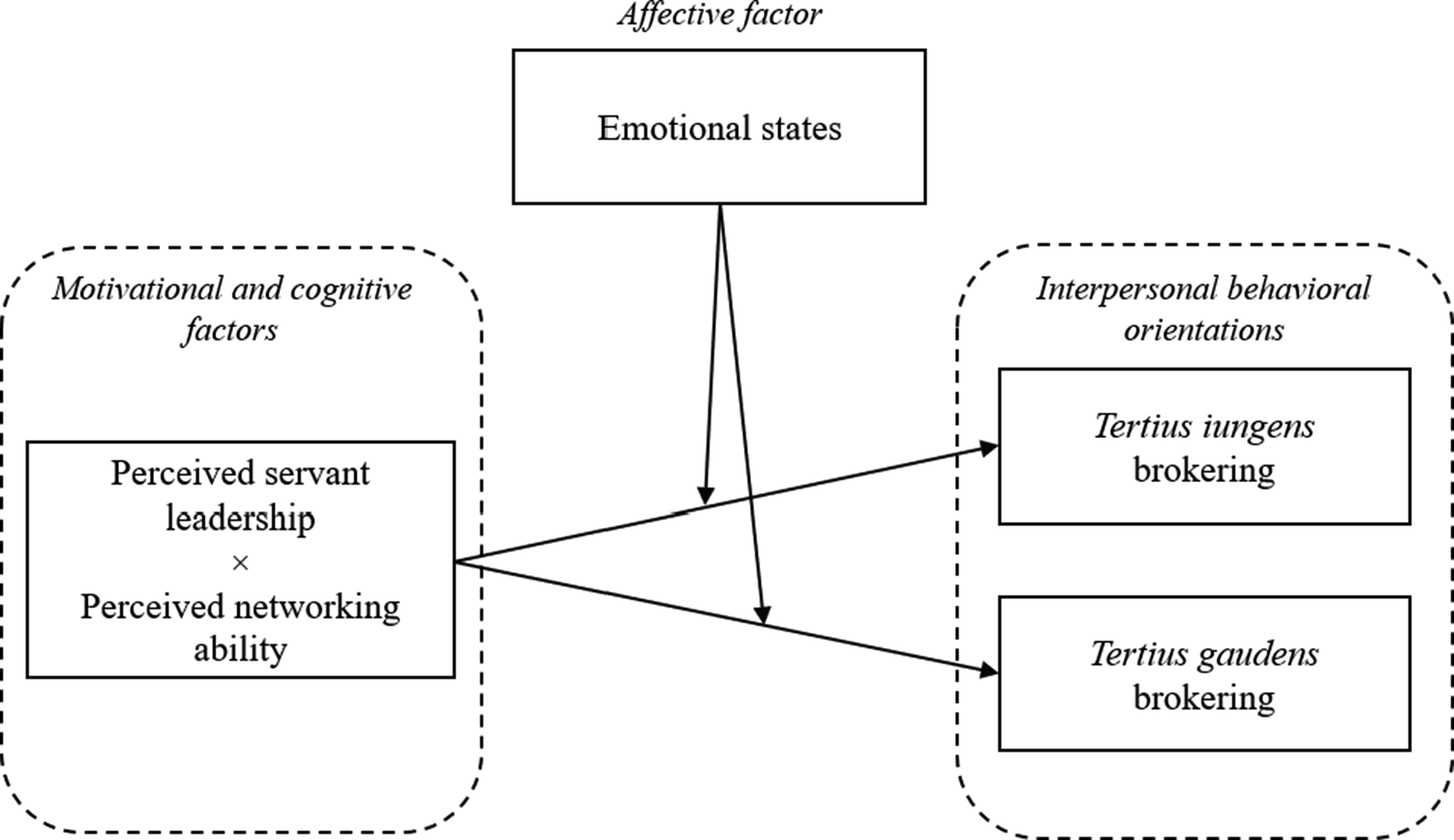
Methods
Sample, Design, and Procedures
To examine the theoretical model, we surveyed a sample of employees working across 20 organizations based in Finland. To mitigate biases typically associated with self-reports and allow sufficient time for the predictor variables to be reflected in the criterion variables, we collected data at two time points. The temporal separation between the surveys was approximately 5 months, which we considered sufficient for employee cognitions, motivation, and affective factors to generate changes in interpersonal behaviors. Thus, our research design addresses some of the common limitations in servant leadership studies, such as the lack of temporal separation between study measures, as highlighted by Eva et al. (2019). Although common method variance (CMV) is often a concern when independent and dependent variables are collected from the same informant, this concern is mitigated not only by the time-lag between data collection points but also by our focus on interaction effects, which Siemsen et al. (2010) argued cannot be caused by CMV.
Most of the participating organizations operate in knowledge-intensive sectors such as legal services, consulting, creative arts, and high-tech industries. In these sectors, knowledge and social contacts are particularly valuable, and individuals who control knowledge exchanges and social interactions can obtain substantial benefits. Within the participating organizations, 661 employees responded to the first survey (response rate = 58.2%), and of these, 429 employees responded to the second survey (attrition rate = 35.1%). After removing 64 cases due to a high number of missing responses or because the respondent had a different supervisor at Time 2 than at Time 1, we obtained a final analyzable sample of 365 employees, nested under the supervision of 128 managers. In the final sample, the number of participating employees per organization ranged from 2 to 61, with a median of 14 (Mean = 18.25, SD = 15.24).
To assess servant leadership, we asked employees to evaluate the leadership style of their direct supervisor, whose name was provided in the accompanying email. The supervisors’ names were provided by a research contact from each participating organization. To ensure accuracy, respondents had the option to correct their supervisor’s name in the survey.
Measures
In measuring our constructs, we used well-established scales whenever possible. The surveys were administered in English and Finnish, allowing respondents to choose the language they were most comfortable using. For each scale statement, respondents were asked to choose the option that best described them or their supervisor on a five-point scale, ranging from “1 = Strongly disagree” to “5 = Strongly agree.” The scale options differed slightly only for emotional states, as described below.
Perceived Servant Leadership
Using the seven-item servant leadership scale developed by Liden et al. (2015) and recommended by Eva et al. (2019), we asked employees to indicate their perceptions of their supervising manager’s leadership behavior. Sample items include “My supervisor makes my career development a priority” and “My supervisor gives me the freedom to handle difficult situations in the way that I feel is best” (α = .83).
Perceived Networking Ability
The six-item scale for networking ability was obtained from Ferris et al. (2005). Using this scale, the employees indicated their confidence in their ability to use networks and develop social relationships (e.g., “I am good at building relationships with influential people at work” and “I am good at using my connections and network to make things happen at work”). The Cronbach’s alpha was .88.
Emotional States
In the survey, positive and negative emotions were presented in random order. We conceptualized positive emotions as a composite of elation (2 items), pleasantness (3 items), and calmness (3 items) from Mano (1994). The eight-item composite scale had an alpha reliability of .88. Respondents rated their experiences on a five-point scale ranging from “1 = Never” to “5 = Extremely often or always”, indicating how frequently any part of their job (e.g., work, coworkers, supervisor, clients, or pay) made them feel positive emotions (e.g., relaxed, happy, and excited) in the past month (Mano, 1994; Van Katwyk et al., 2000). To measure negative emotions, we used eight items from Mano (1994) and Thompson (2007). The negative emotional state scale was a composite of unpleasantness (3 items), distress (3 items), as well as one item for anger and another one for guilt. Respondents rated their experiences on the same five-point scale, indicating the extent to which any part of their job had made them feel, for example, nervous, blue, or hostile in the past month. The Cronbach’s alpha for this eight-item negative emotional state scale was .88.
Brokering Behavioral Orientations
We used a well-established TI brokering measure from Obstfeld (2005). This measure consists of six items such as “I introduce two people when I think they might benefit from becoming acquainted” and “I point out the common ground shared by people who have different perspectives on an issue” (α = .85). A corresponding six-item measure for TG brokering was obtained from Kauppila et al. (2024). Sample items from this scale are “I seek to gain control over acquaintances by keeping them apart” and “When useful to me, I seek to prevent my contacts from becoming too closely acquainted with one another.” The alpha coefficient for the scale was .87.
Control Variables
To account for alternative explanations, we included several control variables related to social relationships and interpersonal agency. First, as more collaborative and less competitive brokering tends to be expected from women than from men (Brands et al., 2022), we controlled for employee gender. Respondents who indicated they were women were coded as “1,” whereas others were coded as “0.” Age is another key demographic variable that may influence an individual’s social standing. We measured age using a categorical variable for employee age group, ranging from 1 (25 years and under) to 9 (61 years or more).
Moreover, although somewhat correlated with age, firm tenure is a separate job-specific factor influencing social relationships and interpersonal agency, as older employees may also be newcomers in their current organization. Newcomers are only beginning to develop their networks, whereas employees with long tenure may have more established and trust-based relationships. Firm tenure was measured using a seven-point categorical variable ranging from “1 = less than a year” to “7 = over 20 years.” Similarly, we controlled for an employee’s tenure with the evaluated supervisor, as it may significantly influence both supervisory evaluations and the ways in which leadership experiences shape behavioral outcomes. This variable was measured using the same seven-point scale as firm tenure. We also considered that service-related job roles could provide alternative explanations for employees’ other-oriented behavioral processes. Thus, we added a dummy variable to indicate employees working in customer service jobs (N = 39). Finally, an individual’s hierarchical level in the organization is relevant for status opportunities and relationships. To control for its effects, we used a five-point scale (1 = frontline or expert position, 2 = team-level management, 3 = lower middle management, 4 = upper middle management, 5 = top management).
Aggregation Analyses
Whereas our hypotheses pertained to relationships among phenomena at the individual level, perceptions of servant leadership could also vary between groups, thereby supporting the aggregation of assessments to the group level. A condition for aggregation is that a significant proportion of variance in followers’ assessments of servant leadership must be attributable to the managerial level. To determine whether aggregation was appropriate, we calculated intraclass correlations (ICCs). The ICC1 value indicates the extent to which variance in a variable is determined by phenomena at different analytical levels. Our study identified variance in servant leadership at three analytical levels: individuals/employees (Level 1), groups/managers (Level 2), and firms (Level 3). The ICC1 analysis showed that 7.9% of the variance in employees’ assessments of servant leadership could be attributed to their membership in a group supervised by the manager being evaluated. An additional 2.6% of the variance in servant leadership assessments could be attributed to employment in a particular firm. Importantly, neither group-level (p = .235) nor firm-level (p = .495) differences in servant leadership evaluations were statistically significant. Based on this analysis, perceptions of servant leadership were highly employee-specific, with approximately 89.5% of the variance in these assessments varying between perceivers, regardless of their group or firm memberships. As perceptions of servant leadership varied within groups, so did its strength as a motivational factor.
Additionally, a low ICC2 value (0.27) indicated that group-level mean values of servant leadership were not reliable. A key factor contributing to this low value was the small average group size (i.e., 2.85 individuals). Overall, since ICC values suggested that only differences between employees contributed significantly to assessments of servant leadership and that group-level values might not be reliable, we concluded that aggregation was not justified. Thus, rather than examining the effects of followers’ shared perceptions of servant leadership, we focused on their personal perceptions at the employee level.
Results
Given the hierarchically nested nature of our data, our model needed to account for the partial interdependence of individuals nested within groups and organizational structures. To address this, we applied multilevel modeling using Mplus Version 8.10. Of the variance in TI brokering at Time 2, 91.7% was between individuals, 7.8% between groups, and 0.5% between firms. The respective figures for TG brokering at Time 2 were 98.2%, 0.8%, and 1.0%. Based on these analyses, we concluded that contextual effects related to group and firm memberships on brokering orientations were negligible, especially for TG brokering, where the greatest differences in these behaviors were observed between individuals within groups and firms. Thus, we followed the recommendation of Aguinis et al. (2013) to choose a more parsimonious approach and included only those levels of analysis in the multilevel model that explained a nonnegligible proportion of variance in the dependent variables. Given the trivial firm-level variance in both TI brokering and TG brokering, we tested our hypotheses using a two-level model. This model captured individual-level effects (Level 1) and embeddedness within groups (Level 2), which accounted for little variability in TG brokering but 7.8% of variability in TI brokering.
Means, Standard Deviations, and Correlations for Variables.
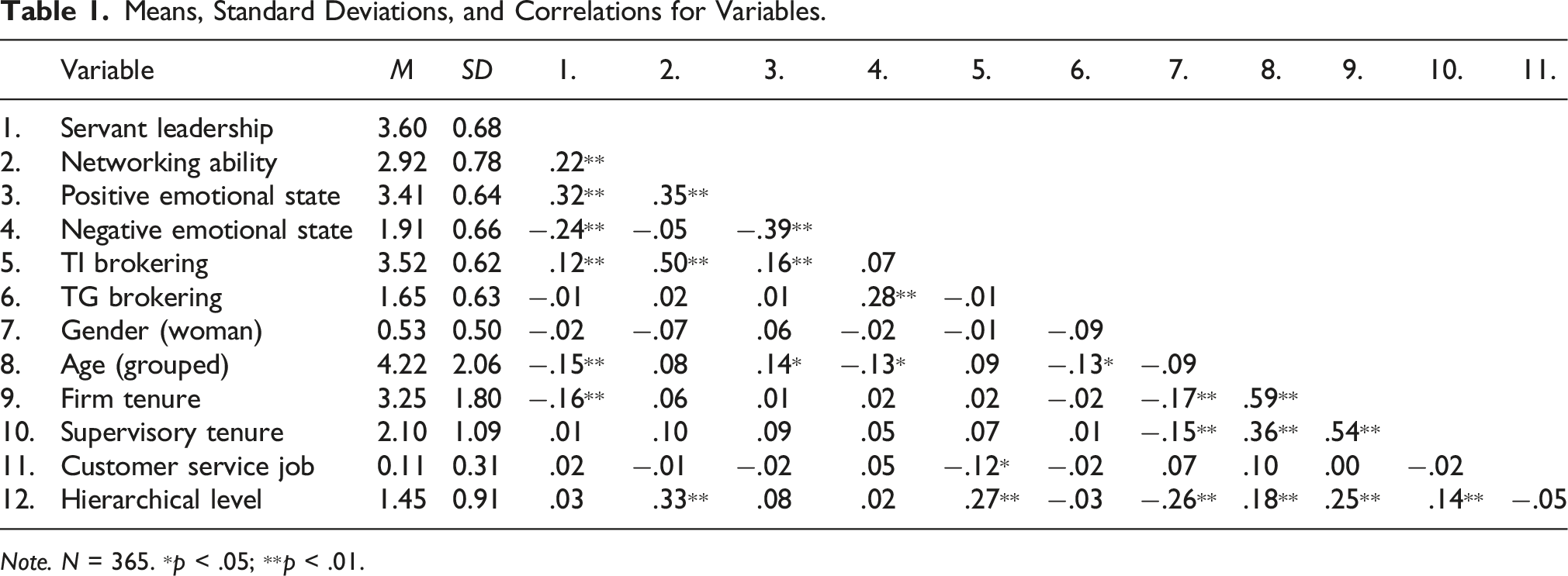
Note. N = 365. *p < .05; **p < .01.
Regression Results.
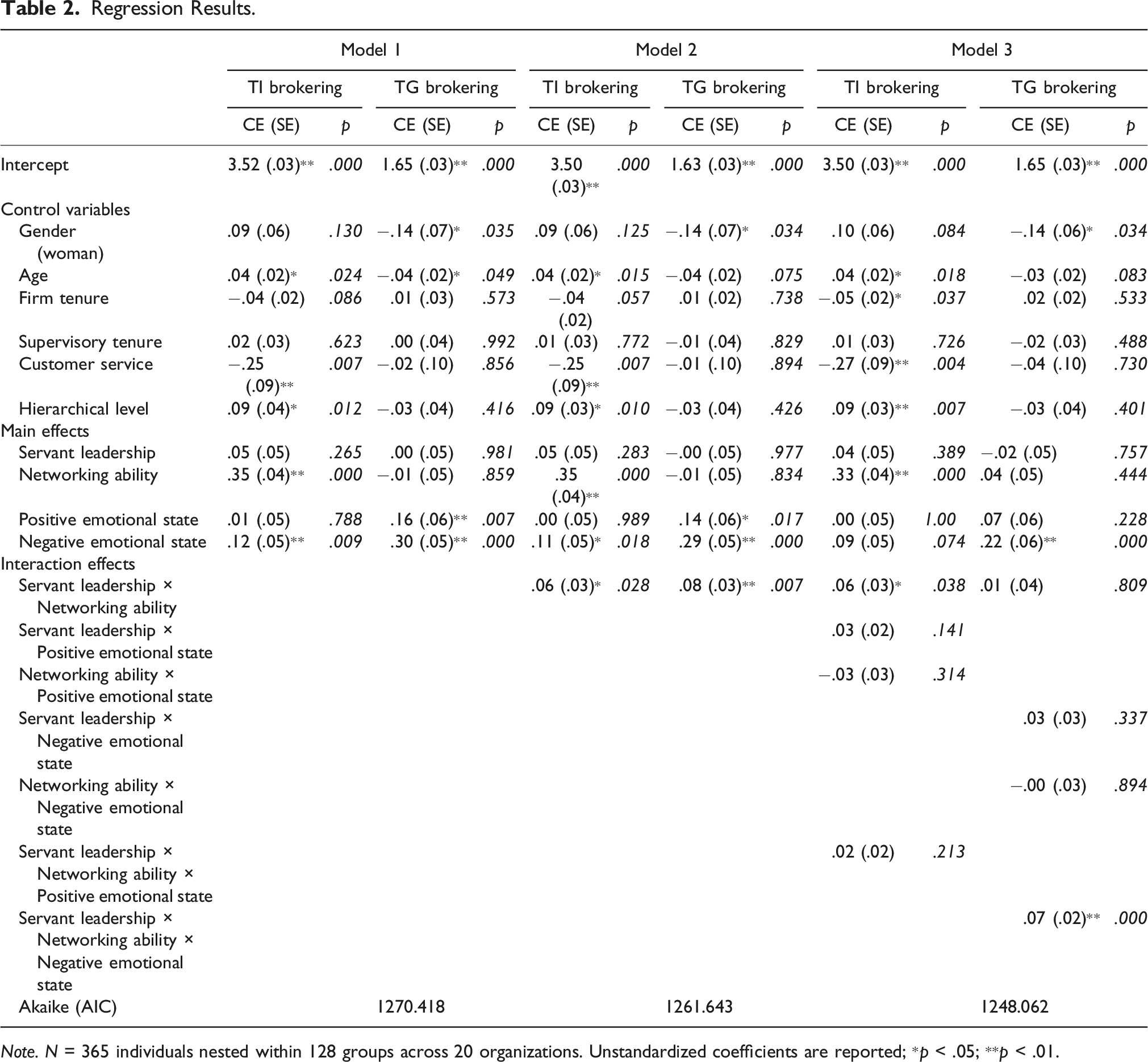
Note. N = 365 individuals nested within 128 groups across 20 organizations. Unstandardized coefficients are reported; * p < .05; **p < .01.
Hypothesis 1 proposed that employees would engage in higher levels of TI brokering when they perceived both high levels of servant leadership (motivational underpinning) and strong confidence in their networking ability (cognitive underpinning). As shown in Model 2, the interaction effect between servant leadership and networking ability on TI brokering was positive and statistically significant (β = .06, p < .05). To gain deeper insight into the nature of this interaction, we plotted slopes at high (+1 SD) and low (−1 SD) levels of the mean values of the interacting variables (Figure 2, Panel A). While the interaction term indicated that the difference between the slopes is significant, the effect of servant leadership on TI orientation is not statistically significant either at one standard deviation above (β = .06, p = .20) or below (β = −.03, p = .53) the mean value of perceived networking ability. The critical value of networking ability at which the effect of servant leadership on TI brokering becomes statistically significant is 2.55 standard deviations above the mean, corresponding to 4.92 on a scale from 1 to 5 (β = .13, p = .05). Thus, although these findings, along with a significantly positive interaction term, support Hypothesis 1—indicating that the highest level of TI brokering occurs when both perceived servant leadership and perceived networking ability are high—the plot analysis shows that perceived servant leadership is a positive predictor of TI brokering only when perceived networking ability is very high. Simple slopes for two-way interactive effects on brokering behaviors. Panel A: Interaction between servant leadership and networking ability on TI brokering. Panel B: Interaction between servant leadership and networking ability on TG brokering.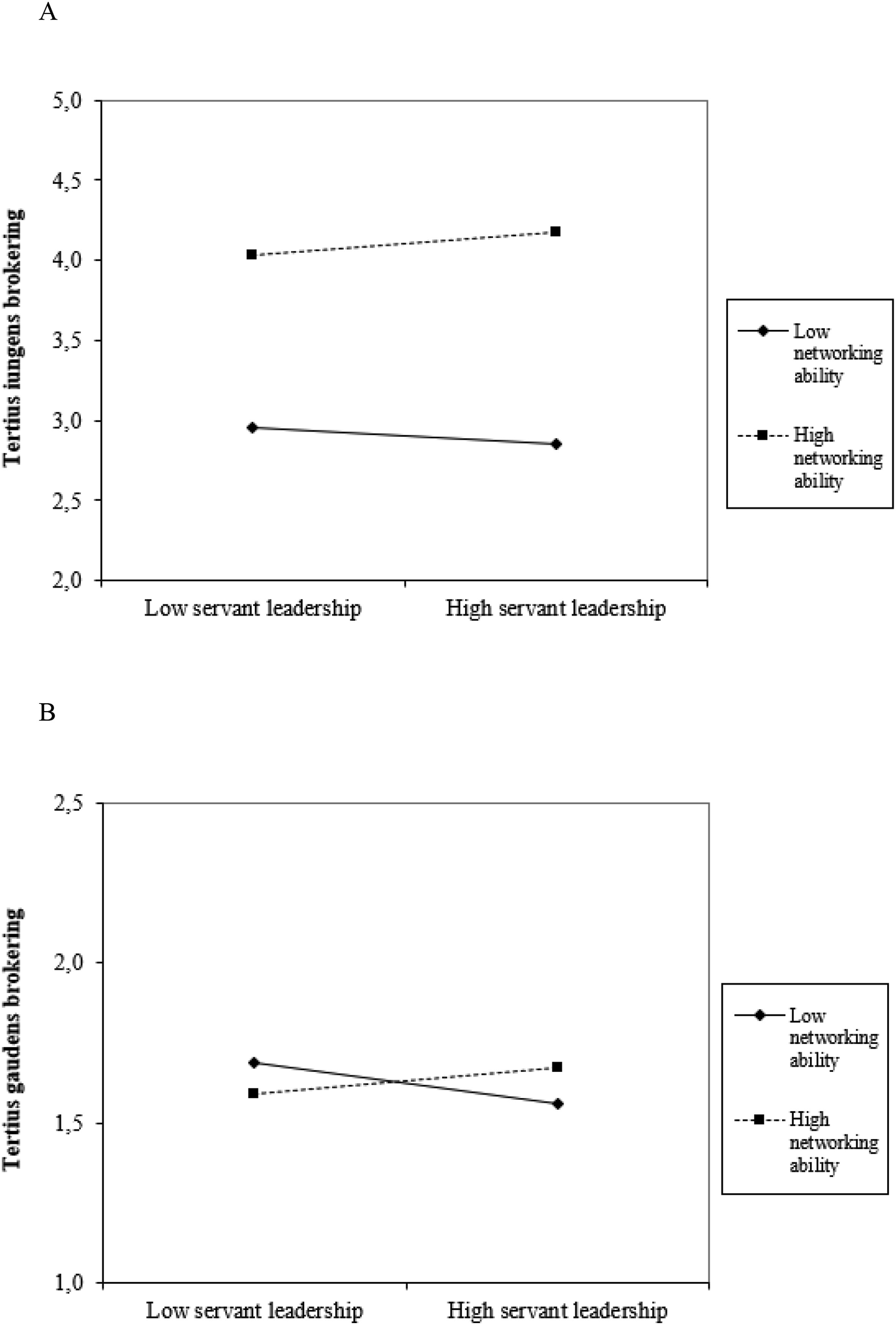
Hypothesis 2 posited that the interaction between a high level of servant leadership and high perceived networking ability would facilitate the follower’s pursuit of TG brokering. Model 2 in Table 2 shows that the interaction term between servant leadership and networking ability was positive and significant (β = .08, p < .01). The plotted effects on TG brokering (Figure 2, Panel B) reveal a somewhat different pattern compared to TI brokering. Specifically, while servant leadership is not significantly related to TG brokering when perceived networking ability is one standard deviation above the mean (β = .06, p = .21), it is significantly negatively related to TG brokering when perceived networking ability is one standard deviation below the mean (β = −.10, p < .05). A closer examination of the interaction effects shows that the critical scale value of perceived networking ability at which the positive effect of servant leadership on TG brokering becomes statistically significant is 4.19 (i.e., +1.63 SD). Thus, compared to the effects on TI brokering, a somewhat more moderate level of perceived networking ability is sufficient for servant leadership to have a significant positive effect on TG brokering. Overall, our findings suggest, at the 95% confidence level, that servant leadership decreases TG brokering among those whose perceived networking ability is 2.14 or lower, and increases TG brokering among those whose perceived networking ability is 4.19 or higher. These results support Hypothesis 2, indicating that the relationship between perceived servant leadership and TG brokering is more positive at higher levels of perceived networking ability than at lower levels.
Next, we analyzed the three-way interaction effects of perceived servant leadership, perceived networking ability, and emotional states on brokering orientations. Hypothesis 3 predicted that TI orientation is influenced by a three-way interaction among servant leadership, networking ability, and positive emotional state such that the interaction between servant leadership and networking ability perceptions on TI brokering is stronger among employees in a positive emotional state. Model 3 of Table 2 adds the three-way interaction term to predict TI brokering. Contrary to our hypothesis, the three-way interaction is not statistically significant (β = .02, p = .21). Thus, Hypothesis 3 is not supported.
As our final prediction, Hypothesis 4 posited that the three-way interaction among perceived servant leadership, perceived networking ability, and negative emotional state is significantly related to TG brokering. Mirroring the predicted effect on TI brokering, this hypothesis proposed that the interaction between servant leadership and networking ability perceptions is more positively related to the pursuit of TG brokering when the follower’s negative emotional state is high. In Model 3 of Table 2, the coefficient for the three-way interaction is positive and significant (β = .07, p < .01).
Figure 3 presents the simple slopes of the three-way interactive effects on TG brokering at high (+1 SD) and low (−1 SD) levels of servant leadership and networking ability. Because the mean value of negative emotional state was only 1.91, one standard deviation above the mean corresponds to a scale value of 2.57, which is lower than the midpoint of the scale. As this value indicates that respondents seldom experience negative emotions, it is not suitable as an indicator of high negative emotional state. Therefore, high levels of this variable were plotted at two standard deviations above the mean (corresponding to a scale value of 3.23), and low values were plotted at one standard deviation below the mean (corresponding to a scale value of 1.25). The slope analysis indicates that the only condition in which servant leadership is positively and significantly related to TG brokering is when both perceived networking ability and negative emotional state are simultaneously at high levels (β = .13, p < .05). This slope becomes insignificant when negative emotional state is only one standard deviation above its mean value (β = .07, p = .20). Simple slopes for three-way interactive effects on TG brokering.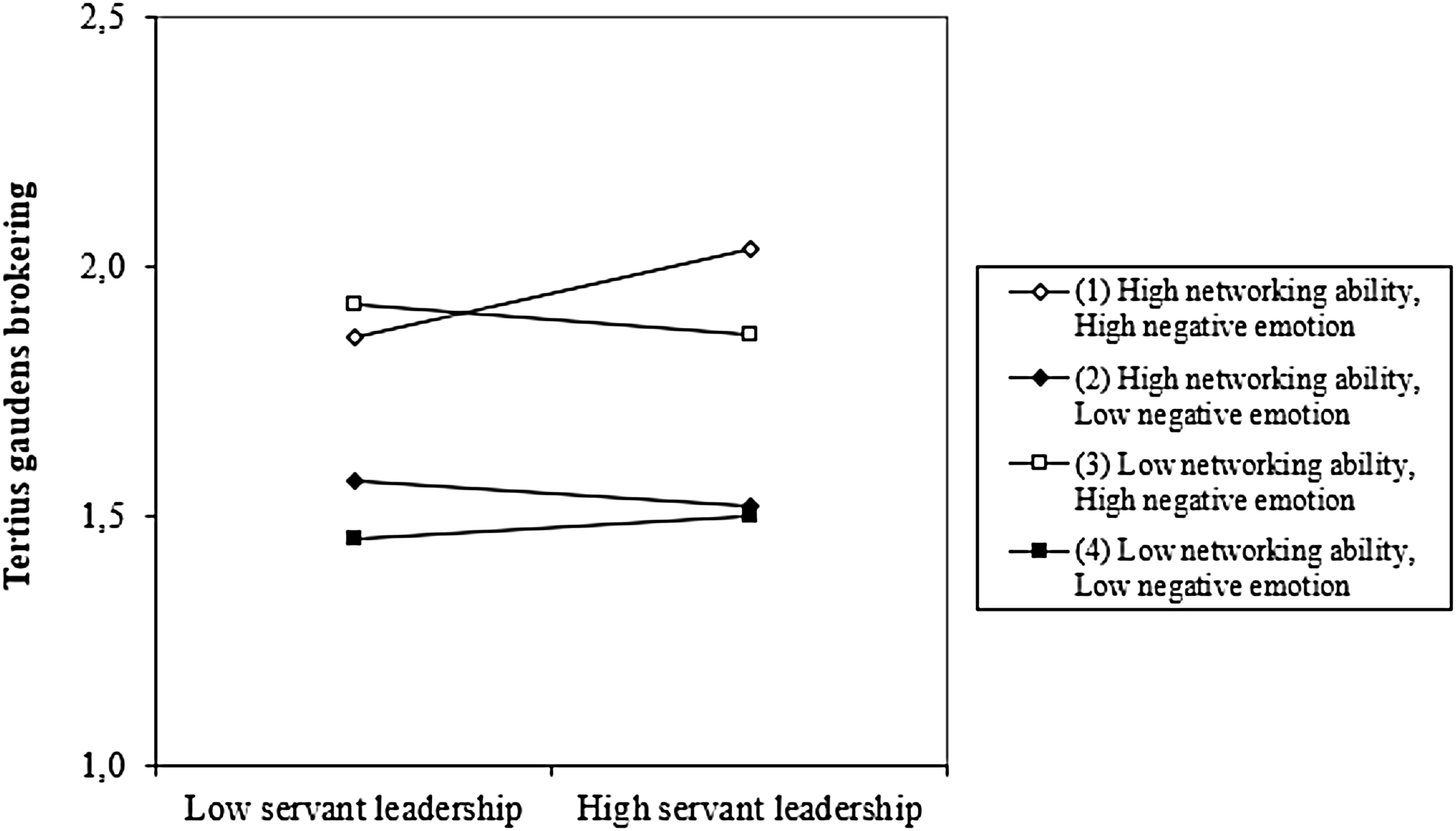
Moreover, the slope for high perceived networking ability and high negative emotional state is significantly different from the slope indicating high perceived networking ability and low negative emotional state (β = −.04, p = .50; slope difference: t = 3.32, p < .01), as well as from the slope indicating low networking ability and high negative emotional state (β = −.04, p = .52; slope difference: t = 3.83, p < .01). These slope differences remain significant even when negative emotional state is examined at one standard deviation above the mean (slope differences in the respective order: t = 3.23, p < .01 and t = 2.02, p < .05). The slope for the condition in which both networking ability and negative emotional state are low (β = .03, p = .60) is not significantly different from the high-high condition (slope difference: t = 1.26, p = .20), but this condition leads to substantially lower levels of TG brokering across all levels of servant leadership. Altogether, these findings, along with a significantly positive three-way interaction term, suggest that servant leadership leads to the highest level of TG orientation when both perceived networking ability and negative emotional state are high—consistent with Hypothesis 4.
To ensure the robustness of our results, we reran our analyses without any control variables. These analyses produced the same pattern of results, supporting Hypotheses 1, 2, and 4, and indicating that no spurious effects of control variables biased the results. The three-way interactive effect on TI brokering remained statistically nonsignificant (β = .02, p = .25), reiterating the lack of support for Hypothesis 3. Moreover, to ensure that our findings were not explained by brokering orientations being automatically reproduced patterns, we tested for the effects of employees’ previous (i.e., Time 1) TG and TI brokering orientations. These variables were measured using the same scales as at Time 2. After controlling for previous levels of TI and TG brokering, the hypothesized effects stipulated in Hypotheses 1, 2, and 4 remained statistically significant (p < .05), while Hypothesis 3 remained unsupported. We also tested whether the results held when the third analytical level (firm) was included in the multilevel analyses. Due to the high number of parameters relative to the sample size at Level 3 (N = 20), we ran these analyses separately for different dependent variables. Again, the analyses produced the same pattern of results, supporting the same hypotheses.
Discussion
By integrating servant leadership research with social cognitive theory and interpersonal agency research, we examined how experiencing servant leadership in a leader-follower relationship influences followers’ efforts to shape relationship structures in their social environment. We hypothesized that servant leadership acts as a key motivational factor, encouraging followers to use their networking ability to pursue both collaborative (TI) and competitive (TG) forms of brokering. Additionally, we hypothesized that followers’ emotional states serve as situational conditions, influencing the emphasis placed on different types of brokering. Specifically, we expected that a positive emotional state would strengthen the interactive effect of perceived servant leadership and perceived networking ability on TI brokering, while a negative emotional state would amplify this interaction in relation to TG brokering.
Drawing on a sample of 365 employees nested within 128 managers across 20 organizations in Finland, we found support for three of our four hypotheses. The unsupported hypothesis concerned the moderating role of followers’ positive emotional state in their pursuit of TI brokering. Moreover, while we found evidence for the predicted interaction effect on TI brokering, the primary driver of TI brokering was followers’ perceived networking ability. Servant leadership significantly predicted TI brokering only among those who perceived their networking ability to be very high. Notably, servant leadership played a more prominent role in the self-regulatory processes underlying followers’ self-serving TG brokering. Our findings also confirmed that a negative emotional state heightens the interactive effect of servant leadership and networking ability perceptions on TG brokering. In what follows, we outline the theoretical contributions and practical implications of these findings.
Theoretical Contributions
Our empirical findings extend the theorizing of servant leadership in important ways. First, this study offers a novel perspective on the conventional understanding of servant leadership by highlighting its dual impact on followers’ self-serving and other-oriented behavioral patterns in relationship brokering. On one hand, we corroborate prior studies showing that when servant leaders focus on serving the personal needs and interests of individual followers, they can inspire those followers to shift their attention toward serving others within the organization (Chen et al., 2015; Lemoine et al., 2024; van Dierendonck, 2011). On the other hand, we find that servant leadership empowers followers to use their networking ability not only to engage in other-oriented TI brokering (i.e., “pay it forward”) but also—more prominently—to pursue self-serving TG brokering (i.e., “enjoy it inward”). In other words, while servant leadership may foster prosocial brokering behaviors, it can also empower followers to leverage their networking ability in self-serving ways to advance personal goals and opportunities. This finding suggests that servant leadership is not a panacea that always eliminates or minimizes self-serving tendencies or transforms followers into humble servant leaders.
Our analysis of interaction patterns adds nuance to these findings by showing that servant leadership increases TG brokering at somewhat lower levels of perceived networking ability, whereas significantly higher levels are required for it to enhance TI brokering. While servant leadership can indeed inspire followers to “pay it forward” through sharing and collaboration, this effect is dependent on followers’ belief that their networking ability is very strong. That only followers high in perceived networking ability increase TG brokering in response to servant leadership—and that an even higher level is needed for TI brokering—underscores the role of self-regulatory capacities in shaping behavioral responses to the experience of being served. Specifically, individuals who perceive themselves as highly capable networkers may be more attuned to the relational and empowering aspects of servant leadership. For them, the experience of servant leadership acts as a complementary motivational influence that amplifies both other-oriented and self-serving brokering behaviors. To draw an analogy, compared to a junior employee, a senior staff member with superior networking ability may show greater appreciation for being served—yet this appreciation does not necessarily translate into other-oriented brokering behaviors. Conversely, when followers perceive themselves as lacking networking ability, our results showed that perceived servant leadership made them less likely to engage in socially risky TG brokering behaviors—likely prompting them to focus on activities they feel more capable of using to advance their self-interest.
Our study further illuminates the dual impact of servant leadership by examining how followers’ emotional states influence their brokering preferences. Contrary to our expectations, emotional state had no effect on the behavioral process leading to TI brokering. We suggest that followers high in networking ability and inspired by servant leadership already possess both the motivation and the capacity to engage in TI brokering, elevating their other-oriented focus to such a degree that positive emotions add little additional effect. Interestingly, the dynamic is different for TG brokering. Although a positive emotional state proved to be inconsequential in our model, our results suggest that when followers are not thriving under servant leadership (i.e., they experience a negative emotional state), they are more likely to perceive servant leadership as empowering self-serving relational pursuits, such as TG brokering. In such cases, followers may be operating in a survival mode rather than a thriving mode, perceiving servant leadership not as a call to serve others, but as an opportunity to gain personal advantage. From this perspective, perceived empowerment may be interpreted as a chance to use one’s skills and resources to enhance one’s own position. A negative emotional state thus acts as a situational lens, shaping how followers interpret servant leadership: not as a signal of collective responsibility, but as a justification for self-serving behavior or even entitlement. In this context, followers may be more inclined to retain rather than share the advantages gained through their network positions.
Overall, by offering a more comprehensive and nuanced account of how servant leadership is associated not only with followers’ other-oriented behaviors but perhaps more typically with self-serving interpersonal strategies, our research addresses the criticism that servant leadership is overly ideological and insufficiently attentive to boundary conditions and contextual variation (Mumford & Fried, 2014).
Second, by leveraging insights from social cognitive theory, we introduced a novel follower-centric perspective on servant leadership—an approach that fundamentally centers on the implications of followers’ experiences of being served. Unlike the prevailing leader-centric view, which typically examines follower behaviors merely as outcomes of servant leadership (Eva et al., 2019), our model positions followers’ perceived networking ability as a key self-regulatory factor that interacts with servant leadership perceptions to shape followers’ interpersonal agency. In other words, our approach does not assume that servant leadership solely and directly “causes” behaviors in followers. Instead, we offered a new social cognitive perspective based on the premise that followers self-regulate their behavioral processes, being guided by their motivation, beliefs, and affective underpinnings rather than responding reactively to external expectations.
We argue that this premise is essential to fully account for servant leadership as inspiring and empowering, rather than as merely a top-down behavior aimed at eliciting specific follower responses. The role of servant leadership is to intervene in followers’ self-regulated processes by enabling, empowering, and motivating them to use their personal resources in the pursuit of various goals. While we acknowledge that servant leadership influences a range of follower behaviors—both directly and indirectly through mediating mechanisms, as demonstrated by the overwhelming majority of prior studies (Eva et al., 2019)—our study refines this perspective by emphasizing the equally important role of followers’ self-regulation in shaping their social behaviors. We therefore recommend that future research consider both followers’ experiences of leadership and their self-regulation, and how these elements interact to shape behavior. Future research may also examine the effects of follower ability and ability perceptions (beyond networking ability) as they interact with servant leadership. By accounting for skill maturity, scholars may continue to refine theories of how follower ability—as a specific dimension of individual differences—interacts with servant leadership to shape social dynamics within organizations.
Importantly, our follower-centric approach broadens the scope of follower behaviors where servant leadership plays a role. Beyond the well-established and relatively unsurprising direct behavioral outcomes of servant leadership, such as organizational citizenship behaviors (Ehrhart, 2004), our examination of servant leadership experiences in followers’ self-regulated processes reveals that servant leadership has broader implications than previously recognized. Specifically, through its intertwined effects on self-regulated behavioral processes, servant leadership is associated with social behaviors that are not necessarily direct outcomes of servant leadership itself. In our study, the role of a specific ability—namely, perceived networking ability—was essential in the interaction effects predicting brokering behaviors. Our findings suggest that high beliefs in one’s networking ability, in and of themselves, strongly orient followers toward forging collaborative relationships, thereby limiting the added inspirational relevance of servant leadership. By contrast, servant leadership appeared necessary to translate followers’ networking ability perceptions into TG brokering. This may be because the legitimization and empowerment conveyed by servant leadership (i.e., “I have the right to put myself first”) plays a critical role in contexts where TG brokers risk incurring social sanctions from other actors (Bizzi, 2013; Xiao & Tsui, 2007). Taken together, our approach and findings suggest that there may be additional, as-yet-unexplored outcomes indirectly—and sometimes unexpectedly—linked to servant leadership.
Practical Implications
Beyond its theoretical contributions, our study holds significant practical implications. Previous research suggests that increased collaboration is among the key mechanisms through which servant leadership enhances organizational performance (Ehrhart, 2004; Peterson et al., 2012; van Dierendonck, 2011). Our findings reveal that one way servant leadership fosters collaboration and reshapes interactions among different actors is by further motivating followers to leverage their networking ability to engage in TI brokering. It should be again emphasized, however, that servant leadership is a significant driver of TI brokering only when perceived networking ability is very high. In practical terms, servant leaders can emphasize both the intrinsic and extrinsic value of networking and foster a safe and autonomous work environment that encourages employees to explore networking opportunities beyond their immediate roles. By doing so, servant leaders can help transform networking from merely a transactional tool into a meaningful and strategic activity that facilitates cross-departmental partnerships and external collaborations. From an organizational perspective, servant leaders’ deliberate efforts to cultivate TI brokering will contribute to the development and diffusion of new and innovative ideas, the creation of new opportunities for utilizing existing ideas (Kauppila et al., 2018; Lingo & O’Mahony, 2010), and the promotion of knowledge-sharing and collaborative work across teams and individuals (Obstfeld, 2012).
Our model also shows that servant leadership may motivate and empower more self-serving TG brokering, where individuals compete for and exploit networks for personal gain at the expense of the collective good (Bizzi, 2013). Given that servant leadership can invoke both collaborative and competitive behavioral patterns in followers, we advise practicing managers to take a more comprehensive view of the potential “dark side,” or at least the unintended, adverse effects, of servant leadership. Rather than applying their leadership approach indiscriminately, managers should recognize that some followers—at least under certain conditions—may be more inclined to take advantage of the support and resources provided by the leader and organization without any intention of paying it forward. This is not necessarily a “bad” thing when both followers and managers share the understanding that the support provided is meant to be “enjoyed inward,” particularly when the follower’s position requires reinforcement. Therefore, we caution against categorically labeling TG brokering as undesirable, as illustrated by our real estate agent example. However, given that a negative emotional state strengthened the self-serving TG brokering pathway, it may be prudent to pay close attention to signs of elevated negative emotions among followers and to explore possibilities—within the servant leader’s control—to address them in the workplace.
At the organizational level, if servant leadership unintentionally creates follower entitlement, managers should consider strategies to mitigate such risks to ensure that they do not merely focus on serving followers but also on developing them into responsible, autonomous, and other-oriented individuals. Specifically, managers could emphasize both the right for followers to expect servant leadership and their responsibility to extend the same to others, while reinforcing other-oriented values through formal reward systems and informal mechanisms that support career growth. It is important to foster a work culture where “giving back” rather than the self-serving use of skills and personal resources is the norm rather than the exception. This is particularly relevant in highly competitive environments, where opportunities for advancement are scarce.
Additionally, our findings raise an important question: Should servant leaders, in some situations, limit or prioritize their service to different followers? Such questions are challenging to answer, as they conflict with the foundational principles of servant leadership, which emphasize altruistic service without expectations of reciprocity. However, given the resource constraints faced by leaders (Liao et al., 2021) and the need to consider the interests of all stakeholders (Lemoine et al., 2019), it is worth exploring in future research how servant leaders can adapt their approach based on varying levels of follower agency.
Furthermore, while it is beyond the scope of the current study, taking the role of follower agency seriously introduces even more complex questions about how servant leaders can avoid being exploited or manipulated by followers under the guise of service. If prioritizing service to others results in followers’ self-aggrandizement, the development of servant leaders may inadvertently exacerbate workplace issues such as upward bullying, counterproductive behaviors, and unethical prosocial behaviors. Shifting the focus away from the leader toward the followers implies the need to teach leaders how to identify and navigate the complexities of follower agency, including recognizing when followers are becoming overly self-focused versus when they are genuinely engaging in prosocial behaviors. Moreover, a key implication of our research is that the development of servant leadership, including any related training, should encompass both leaders and their followers. It is insufficient to focus solely on leaders, as the extent to which servant leadership influences follower behaviors depends on numerous factors intrinsic to the followers themselves. This particularly underscores the importance of fostering the moral and ethical development of followers.
Limitations
We acknowledge that our research has certain significant limitations. First, we did not empirically measure other moral or positive leadership styles, which would have been ideal. Although the incremental predictive validity of servant leadership beyond other leadership approaches has recently been established by other researchers (Hoch et al., 2018; Lee et al., 2020), we cannot be certain that the effects we studied are unique to servant leadership. In principle, it is possible that experiences of other leadership styles can also motivate followers to activate their networking ability to pursue different types of brokering activities. Nevertheless, our theorizing highlights a fundamental difference between servant leadership and other leadership approaches, such as transformational leadership. We argue that because servant leaders prioritize and legitimize followers’ self-interest, they are more likely to empower followers’ pursuit of TG brokering alongside TI brokering. Other leadership styles do not primarily focus on advancing the personal interests and needs of the follower, making them less likely to activate and reinforce followers’ self-serving actions, particularly when their emotional resources are depleted.
Second, we examined only the role of servant leadership in the process through which followers influence others’ social relationships in organizations. Thus, our research does not clarify the role of servant leadership in followers’ own network-building, which could be explored in future studies. In terms of self-serving and other-oriented behavioral orientations, our examination was limited to brokering orientations. Although these behaviors play a central role in social organizing, followers may engage in various other self-serving and other-oriented behaviors beyond brokering. Thus, our findings are limited to the management of social relationship structures, and we encourage future research to examine whether the results hold in the context of other types of social behaviors or behavioral orientations.
Regarding future research on how servant leadership shapes follower behaviors in interaction with follower underpinnings, we propose that other types of individual differences among followers may account for a more realistic, nuanced, and potentially darker side of servant leadership. Future research should examine the effects of various follower personality traits (e.g., psychological collectivism, dark triad traits), attitudes (e.g., sense of entitlement, commitment), and motives (e.g., goal orientation) to determine when and how their interaction with servant leadership behaviors in leader-follower processes leads to negative individual, team, or organizational outcomes. In addition to the follower underpinnings, future studies could explore whether and how differences between the brokered parties play a role in these processes.
Conclusion
This study contributes to a more nuanced understanding of servant leadership by exploring its dual impact on followers’ social behaviors through the lens of social cognition. Overall, we expect that our research represents a crucial step toward a more integrated understanding of the role, limits, and dynamism of servant leadership in micro-organizational processes. By emphasizing both self-serving and other-oriented behavioral orientations, this research provides a balanced view of how servant leadership interacts with followers’ cognitions to influence their interpersonal agency. The findings suggest that while servant leadership can inspire a collaborative orientation in brokering processes, it may also empower a self-serving orientation, particularly among followers in a negative emotional state. This highlights the importance of considering followers’ cognitive and affective underpinnings when implementing servant leadership. Future research should continue to explore these dynamics across different contexts and consider the role of individual differences in shaping the outcomes of servant leadership.
Footnotes
Declaration of Conflicting Interests
The author(s) declared no potential conflicts of interest with respect to the research, authorship, and/or publication of this article.
Funding
The author(s) disclosed receipt of the following financial support for the research, authorship, and/or publication of this article: This work was supported by the Academy of Finland (310063).
