



Abstract
This study examines how psychological contract breach (PCB) influences employee performance trajectories over a year. By analyzing supervisor-rated performance across four intervals, two performance trajectories were identified: “Steady Achievers” (95.5%), who maintained high performance, and “Ebb and Flow Achievers” (4.5%), whose performance initially rose but later declined. PCB was associated with lower baseline performance in both groups, with “Ebb and Flow Achievers” experiencing less growth and sharper declines. These findings challenge the assumption of uniform consequences of PCB, offering a nuanced, trajectory-based perspective that captures the evolving and differential effects of PCB on employee performance over time. Moreover, they highlight the need for tailored support, including regular check-ins, accountability partnerships, and wellness resources.
The workplace is a complex environment where employees continuously assess and reassess the implicit and explicit promises made by their employers. These promises, encompassing job roles, career development, workplace support, and more, form what is known as the psychological contract (PC) – a framework of mutual expectations that underpins the employee-employer relationship (Rousseau et al., 2018). When employees perceive that their employer has failed to uphold these expectations, a phenomenon known as psychological contract breach (PCB) occurs. PCB, in turn, has been consistently associated with negative outcomes for both employees and organizations such as diminished employee performance (for a meta-analysis see Zhao et al., 2007, for a review see Coyle-Shapiro et al., 2019).
However, much of the existing research on PCB and its impact on employee performance has focused on cross-sectional data, capturing a snapshot of how PCB affects performance at a single point in time. While this body of work has significantly advanced our understanding of the immediate consequences of PCB, it has largely overlooked the evolving nature of employee performance over time. Employee performance is inherently dynamic (Binnewies et al., 2010), influenced by a variety of internal and external factors, yet research on PCB has rarely adopted a longitudinal approach to capture these fluctuations. As a result, there remains a critical gap in the literature regarding how employees’ performance trajectories develop in response to PCB over extended periods (see Griep & Vantilborgh, 2018). Addressing this gap is particularly important, as a short-term focus on PCB may mask important variations in how performance unfolds beyond the initial breach event.
Our study builds on and extends prior research by adopting a longitudinal design that tracks performance trajectories in response to PCB across four time points, spanning an entire working year. By moving beyond static assessments of PCB effects, we contribute methodologically by leveraging a temporal perspective to capture dynamic patterns of employee performance following PCB. This allows us to identify whether performance remains stable, increases, or declines over time, rather than assuming a uniform or immediate response to PCB. In doing so, our study also offers a theoretical contribution by challenging the predominant assumption in PCB research that breach has a consistently negative or linear effect on employee performance (Coyle-Shapiro et al., 2019; Zhao et al., 2007). Instead, our findings can provide deeper insight into whether certain conditions or individual differences moderate the long-term impact of PCB, thereby advancing a more nuanced understanding of how psychological contract dynamics shape employee behavior.
By focusing on in-role performance—defined as the extent to which an employee fulfills their core job duties (Williams & Anderson, 1991) and rated objectively by supervisors—our study provides practical insights into how organizations can anticipate and manage the long-term consequences of PCB. In answering the question of how PCB at the start of the working year affects the development of performance trajectories, our research helps bridge the gap between static PCB research and the broader field of work performance, which increasingly recognizes the importance of understanding performance as an evolving process.
Understanding the relationship between PCB and performance trajectories is crucial for several reasons. The first reason is theoretical; despite previous critiques (e.g., Preacher et al., 2008; Solinger et al., 2016) the prevailing assumption remains that PCB affects employee performance uniformly. While previous research has explored the effects of PCB on performance (Coyle-Shapiro et al., 2019; Zhao et al., 2007), most studies assume a single, consistent response to PCB and focus on short-term outcomes. An extended temporal perspective could identify different performance trajectories unfolding over time as such an approach would allow identifying non-linear or universally negative impact of PCB on performance. Capturing the dynamic nature of performance in the wake of PCB would provide a more nuanced view where the effects of PCB may gradually amplify, dissipate, or stabilize. Such insights would not only enhance our theoretical understanding of PCB and help the field move beyond a “one-size-fits-all” approach to a perspective that recognizes the complexity and variability in employees’ responses to PCB.
The second reason is practical; insights about possible PCB trajectories would be valuable for organizations as they offer a more comprehensive picture than single-point performance appraisals (Binnewies et al., 2010), helping managers recognize patterns in employee behavior and respond proactively. For example, if an employee’s performance begins to decline following PCB, managers can intervene with targeted support (cf. Solinger et al., 2016) to prevent further deterioration. Understanding these trajectories also allows organizations to tailor their retention strategies, focusing on support structures that foster performance resilience among employees who might otherwise disengage. Finally, PCB trajectories are relevant in the context of a rapidly evolving workforce, where employees increasingly prioritize fulfillment in their professional roles. In an environment where PCB may be inevitable, for instance due to unforeseen changes in market conditions, understanding the longitudinal impact of PCB on performance offers practical pathways for sustaining employee productivity and well-being.
Method
We collected data from a diverse group of Dutch employees who remained with the same company across the four waves of data collection, each separated by three months (for a similar approach see Garcia et al., 2018). Employees’ perceptions of PCB were gathered at the beginning of the study (Robinson & Wolfe Morrison, 2000), along with demographic information, and their in-role performance (Williams & Anderson, 1991) was rated by their supervisors at each point in time. Participants and their supervisors were recruited via email and directed to a survey link, where they received detailed information on the study’s scientific purpose, confidentiality, and informed consent. To encourage participation, respondents who completed the survey could enter a raffle to win one of ten 25€ gift certificates. At Time 1, we had 1474 matched employee-supervisor dyads; at Time 2, we had 534 matched dyads; at Time 3, we had 488 matched dyads; and at Time 4, we had 334 matched dyads.
Respondents were on average 38.14 years old (SD = 10.45), 50% were female and 50% were male. Most respondents worked on a full-time basis (85.70%) and had a permanent contract (93.30%). Our respondents were active in the private (81.30%) and the public sector (18.70%), representing a wide range of sectors, with the most common sectors being information communications technology (12.20%), health care (11.10%), finance (7.70%), research and development (7.60%) production industry (6.80%). Most respondents held white-collar jobs (84.60%) followed by management (9.40%) and blue-collar jobs (6.00%). We used latent class growth modeling (LCGM) (Andruff et al., 2009) to identify distinct subgroups of employees with different trajectories of in-role performance over time. LCGM was chosen over alternative trajectory analysis methods, such as hierarchical linear modeling (HLM) or growth mixture modeling (GMM), because it allows for the identification of qualitatively distinct performance patterns rather than assuming a single continuous trajectory across all individuals. Unlike HLM, which models variability at the individual level within a single growth trajectory, LCGM is particularly suited for uncovering latent subpopulations that follow different developmental patterns. Furthermore, while GMM allows for similar classification, LCGM assumes within-class homogeneity in variance, which was appropriate given our focus on categorizing distinct performance trajectories rather than modeling within-class variability. After identifying the best-fitting LCGM model, we examined whether PCB at T1 predicted the growth parameters of each identified trajectory, providing insight into how psychological contract breach influences performance patterns over time. All analyses were conducted in Mplus version 7.1.4. See Online Appendix 1 for an elaborate method section.
Results
Fit Indices of the Latent Class Models of In-Role Performance.
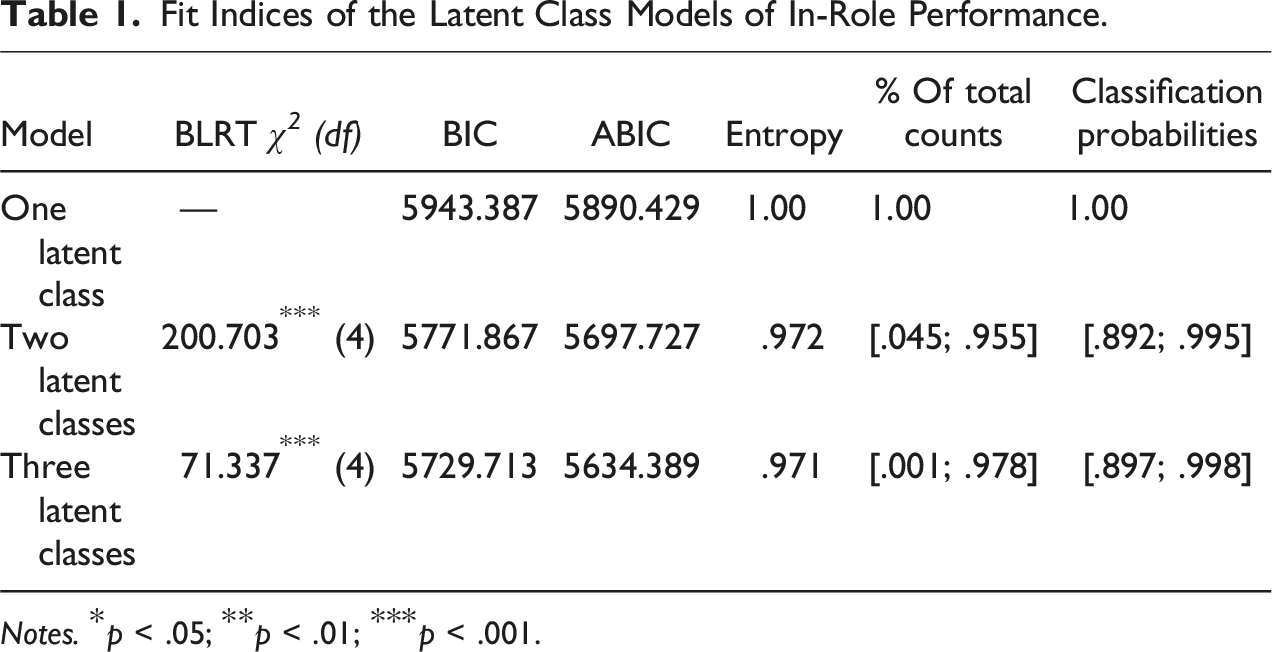
Notes. *p < .05; **p < .01; ***p < .001.
Fit Statistics for Univariate LGM of In-Role Performance.
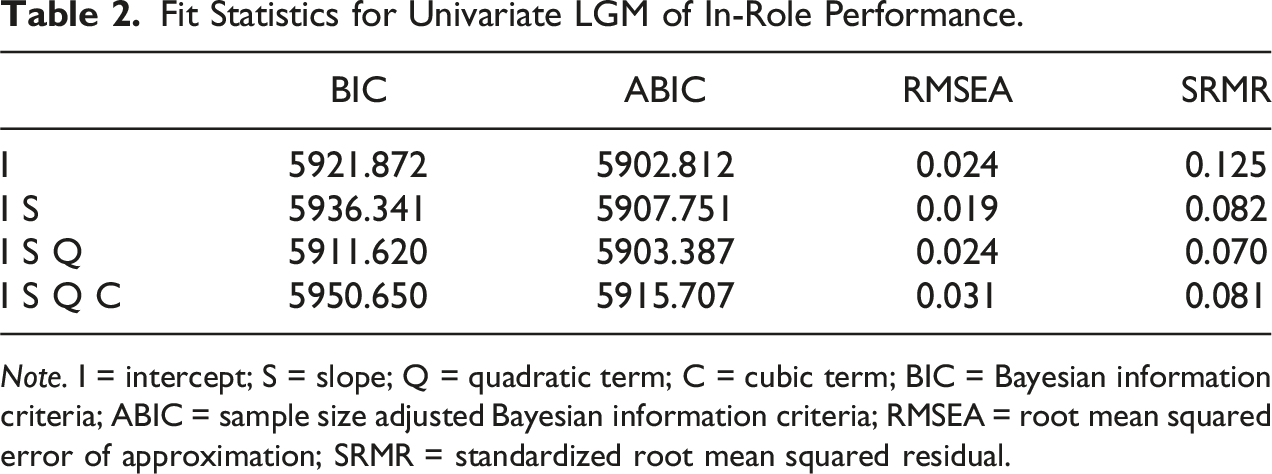
Note. I = intercept; S = slope; Q = quadratic term; C = cubic term; BIC = Bayesian information criteria; ABIC = sample size adjusted Bayesian information criteria; RMSEA = root mean squared error of approximation; SRMR = standardized root mean squared residual.
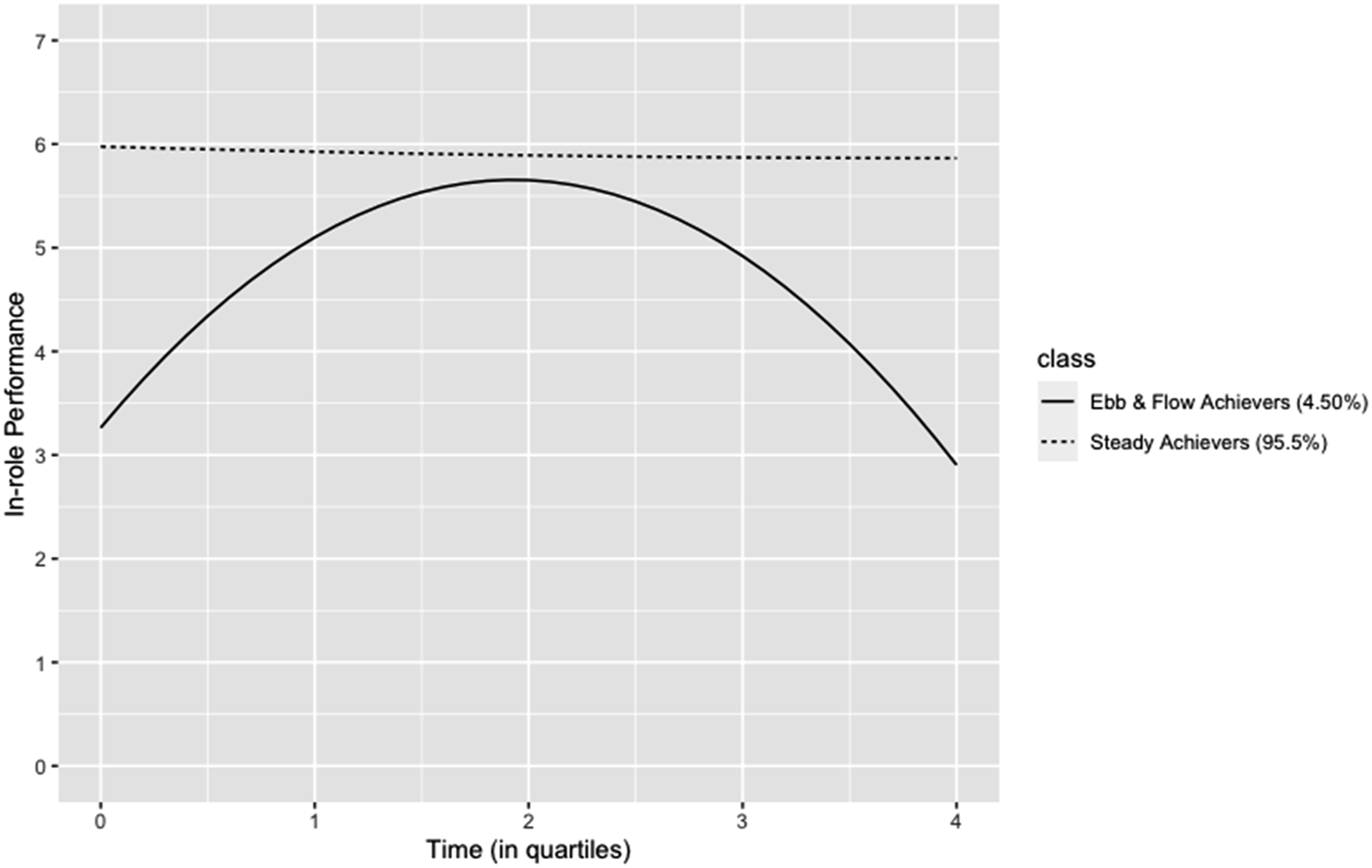
In-role performance trajectories.
Growth Parameters of the Two Latent Class Solution of In-Role Performance.
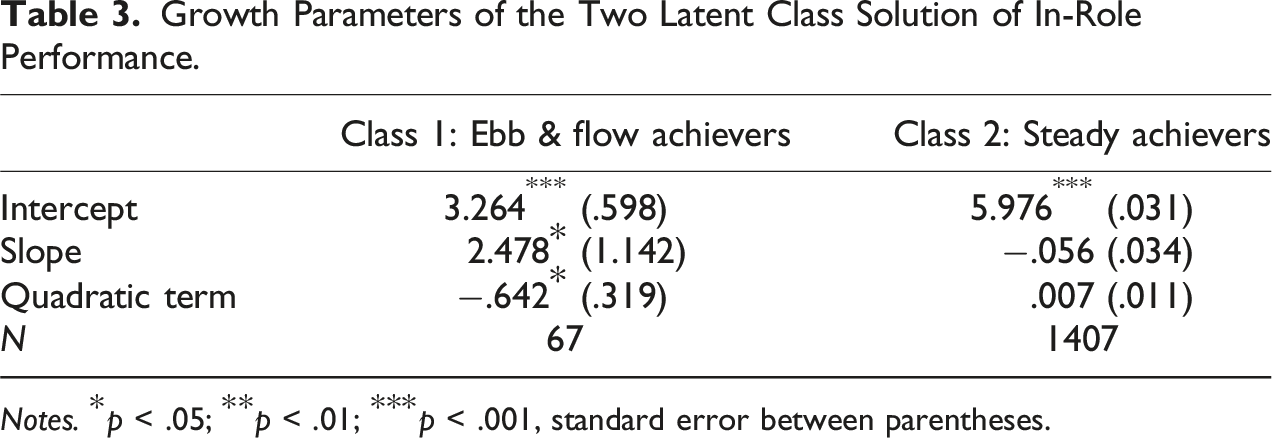
Notes. *p < .05; **p < .01; ***p < .001, standard error between parentheses.
Furthermore, our results indicate that PCB at the start of the study negatively impacted baseline performance across both trajectories. However, for “Ebb and Flow Achievers,” PCB was also associated with a less pronounced performance improvement over time and a steeper decline toward the study’s conclusion. These findings suggest that the effects of PCB are not limited to immediate performance reductions but may also shape long-term performance trajectories. See Appendix 1 for a more detailed discussion of these results.
Discussion
Theoretically, our findings contribute to the PC literature by challenging the assumption that PCB uniformly impacts employee performance. Our study highlights that the effects of PCB on performance are not only immediate but also evolve over time, influencing the shape and direction of performance trajectories across a year. This insight aligns with and extends the work of among others Griep and Vantilborgh (2018), who emphasize the fluctuating nature of employee behaviors such as citizenship behavior and deviance in response to PCB. By examining performance across multiple time points, our study provides a more nuanced understanding of how employees’ responses to PCB unfold, offering a trajectory-based perspective that captures the complex, long-term impact of PCB on performance. Furthermore, these results underline the importance of considering individual differences in performance trajectories when examining the effects of PCB. The identification of two distinct groups—“Steady Achievers” and “Ebb and Flow Achievers”—suggests that PCB does not impact all employees in the same way. The differential impact of PCB on steady and variable performance trajectories enriches our theoretical understanding of how PCB interacts with individual performance patterns, highlighting the need for future research to explore additional factors that may contribute to these differences, such as individual resilience, coping mechanisms, or the quality of the employee-manager relationship.
Limitations and Future Research
The study provides meaningful insights into how PCB impacts employee performance trajectories over time. However, certain limitations suggest avenues for future research. First, the sample’s high attrition rate over time reduces the generalizability of the findings; studies with larger, more diverse samples across industries are needed. While the study identifies two distinct trajectories, further research could explore additional patterns of performance change, including those driven by specific contextual or individual factors, such as job type, organizational culture, or employee tenure. Additionally, our study does not account for potential moderating factors that may influence trajectory membership, such as leadership style, perceived organizational support, or employee coping mechanisms. Exploring these contingencies in future research would add depth to our theoretical contributions and refine our understanding of the conditions under which PCB has more or less detrimental effects on employee performance. For instance, leadership styles characterized by high levels of support and transformational behaviors may buffer employees from the negative effects of PCB by fostering resilience and motivation, potentially mitigating performance declines. Similarly, strong organizational support systems could act as a stabilizing factor, helping employees maintain higher performance levels despite experiencing a breach. Employee coping strategies, such as cognitive reappraisal or seeking social support, might also influence trajectory membership by enabling employees to navigate PCB more effectively. Examining these moderating factors could help explain why some employees—like those in the “Ebb and Flow Achievers” group—experience performance fluctuations following PCB, whereas others maintain a steady level of performance. Finally, extending the timeline beyond one year could capture long-term effects of PCB, providing a more comprehensive understanding of its enduring impacts on employee behavior and organizational outcomes. Such efforts would significantly advance the field’s theoretical and practical understanding of PCB.
Practical Implications
The insights from our study offer organizations valuable guidance in managing and supporting employee performance in the wake of psychological contract breach (PCB). First, recognizing that PCB impacts not only initial performance but also the progression and sustainability of performance over time highlights the importance of addressing PCB early (cf. Tomprou et al., 2015). For most employees who are “Steady Achievers”, PCB may not drastically alter their stable performance trajectory, but it does lower their initial baseline performance, which could have cumulative effects on productivity over time. For “Ebb and Flow Achievers”, who already demonstrate a fluctuating pattern, the consequences of PCB appear to be more pronounced, resulting in less substantial performance improvements and a sharper decline in productivity toward the end of the year. This suggests that employees with inherently variable performance patterns might be more susceptible to the long-term impacts of PCB, requiring tailored support mechanisms to mitigate these effects. To effectively support “Ebb and Flow Achievers”, organizations can focus on implementing structured but adaptable interventions, ensuring that employees receive timely guidance while maintaining autonomy over their work. Three key approaches can help mitigate the impact of PCB.
First, research has shown that frequent manager check-ins can help employees feel recognized, supported, and aligned with organizational goals (Griep et al., 2016; Solinger et al., 2016). However, rather than relying on generic performance evaluations, organizations should implement brief, structured one-on-one conversations where employees can discuss their short-term challenges, receive constructive feedback, and recalibrate their focus on immediate goals. For example, companies like Google and Deloitte have adopted weekly or bi-weekly pulse check-ins to keep employees engaged and help them course-correct before performance declines become entrenched (Buckingham & Goodall, 2015). Similarly, studies in high-pressure environments like healthcare and sales indicate that employees who receive frequent but low-stakes feedback experience higher motivation and resilience after setbacks (Suazo & Stone-Romero, 2011).
Second, creating peer-based accountability partnerships may be especially beneficial for employees whose performance fluctuates. Research on social support and workplace commitment has demonstrated that employees who feel a sense of connection and shared responsibility with colleagues are less likely to disengage after experiencing psychological contract violations (Walton et al., 2012). For instance, mentoring programs at companies such as Microsoft and Johnson & Johnson have successfully paired employees with higher-performing peers to promote adaptive learning and consistency. “Ebb and Flow Achievers” could benefit from such partnerships, where Steady Achievers serve as informal peer mentors, reinforcing positive habits and providing encouragement during periods of low performance. By leveraging informal yet structured peer networks, organizations can create a culture of mutual accountability and resilience.
Third, given that PCB can lead to long-term stress and emotional exhaustion, organizations should proactively offer tools that help employees manage stress and build resilience (Joyce et al., 2018). While wellness initiatives are common, they are often generic and poorly tailored to the needs of employees experiencing performance instability. Instead, organizations should consider offering customized resilience-building interventions, such as for example cognitive behavioral coaching. Studies have found that employees who engage in CBC workshops develop better coping strategies for dealing with workplace breaches, leading to faster recovery times and improved long-term performance (Nielsen & Einarsen, 2021).
Together, these strategies—managerial support through check-ins, structured peer partnerships, and resilience-based training—offer a comprehensive framework for mitigating the longer-term effects of PCB on employee performance. By grounding these interventions in evidence-based best practices, organizations can create proactive and adaptive support systems, ensuring that employees are equipped to navigate workplace challenges without long-term declines in performance.
Supplemental Material
Supplemental Material - Pace or Plummet? How Psychological Contract Breach Shapes Employee Performance Over Time
Supplemental Material for Pace or Plummet? How Psychological Contract Breach Shapes Employee Performance Over Time by Yannick Griep, Johannes M. Kraak, and Olivier Herrbach in Group & Organization Management
Footnotes
Declaration of Conflicting Interests
The author(s) declared no potential conflicts of interest with respect to the research, authorship, and/or publication of this article.
Funding
The author(s) received no financial support for the research, authorship, and/or publication of this article.
Ethical Statement

Supplemental Material
Supplemental material for this article is available online.
Author Biographies
References
Supplementary Material
Please find the following supplemental material available below.
For Open Access articles published under a Creative Commons License, all supplemental material carries the same license as the article it is associated with.
For non-Open Access articles published, all supplemental material carries a non-exclusive license, and permission requests for re-use of supplemental material or any part of supplemental material shall be sent directly to the copyright owner as specified in the copyright notice associated with the article.
