




Abstract
Venture-failure is a common experience for many entrepreneurs, but the strategies they adopt in framing venture-failure narratives to public audiences is not well studied. Addressing this knowledge gap, the study examines how entrepreneurs construct stories that stimulate responses from public audiences during the “moving on” phase. Our analysis of 91 failure blog posts shows how entrepreneurs use framing mechanisms referred to as “keyings” that layer together literal interpretations and re-interpretations of failure. Moreover, we show how the layering of distinctly different primary and secondary keyings shape the tone of venture-failure narratives and stimulate legitimacy signals from audiences to try again. Our study advances the entrepreneurial failure literature by elaborating how failure narratives engage broad public audiences and why these matter as entrepreneurs move on to their next venture. We argue that keyings underpin these efforts by supporting integrative and dynamic presentations of failure to public audiences.
Keywords
Introduction
It is now well established that new venture failures vastly outnumber successes (Artinger & Powell, 2016; Kücher & Feldbauer-Durstmüller, 2019). Accordingly, broad audiences show interest in failure narratives: accounts that “focus the attention of both authors and readers, bringing some issues to the foreground while placing others in the background” (Brattström & Wennberg, 2022, p. 1444). In addition to privately shared ones (Mantere et al., 2013; Shepherd & Haynie, 2011; Singh et al., 2015), many failure accounts are now conveyed publicly, including in company reports (Eklund et al., 2020), closure statements (Kibler et al., 2017, 2021), media coverage (Cardon et al., 2011) and social media posts (Fisch & Block, 2021). Public accounts of failure play an important role in allowing entrepreneurs to “upend the stigma of failure and transform the meaning of failure into something positive” (Singh et al., 2015, p. 159). The stories also become useful to a wide range of stakeholders, including investors and others in the entrepreneurial ecosystem who wish to learn from and mitigate against fatal mistakes (Cope, 2011). For these different audiences, failure narratives are part of a repertoire of well-worn stories describing entrepreneurial ideals against which individual experiences can be evaluated; in reference to failure the notion that entrepreneurs battle through adversity to eventually accomplish success (Brattstrom & Wenner, 2022). Recently, broad public audiences are also known to show interest in failure narratives, particularly those shared via online platforms (Fisch & Block, 2021) which bring the general public closer to new ventures as crowd investors and novice commentators (Soublière & Gehman, 2020).
Public audiences are crucial stakeholders for entrepreneurs to consider for several reasons. They represent the sentiment of potential markets (Nowiński et al., 2020), are part of the ecosystems and communities in which entrepreneurs are embedded (de Bruin et al., 2023) and may be conveyors of crucial future resources and opportunities (Soublière & Gehman, 2020). As entrepreneurs “move on” from failure towards their next venture or subsequent career opportunity, they are sensitive to the perceptions of public groups and the social validation they can offer (Saylors et al., 2023). Venture failures can damage the legitimacy of entrepreneurs, relative to the extent failure is accepted or denigrated in their cultural settings (Yamakawa et al., 2015). As Schwarz & Bouckenooghe (2021, p. 18) observe, “to fail is seldom publicly celebrated, and rarely promoted even while the benefits of failure are tacitly acknowledged”. Soublière and Gehman (2020) emphasise that entrepreneurs’ “legitimation hinges on the legitimacy of prior endeavours collectively garnered” (2020, p. 472), a significant challenge when prior endeavours include venture failure. Thus, how entrepreneurs account for their failures to public audiences in a way that rebuilds their legitimacy and enables them to move on is highly relevant, particularly in a field that prizes serial entrepreneurship. Extant studies have paid relatively little attention to how entrepreneurs engage with public audiences during the moving on phase, prompting the question how do entrepreneurs present failure narratives to public audiences as they move on?
In response to this question, we conduct a qualitative analysis of 91 failure blog posts, offered to a broadly defined audience that not only recount the detail and experiences of failure, but also show different presentations of venture-failures to public audiences. We explicate the role of ‘keyings’ (Goffman, 1974) as mechanisms used by entrepreneurs to facilitate failure narratives and stimulate legitimacy signals from audiences that support moving on. First, we introduce three keyings (Adventure, Education and Death) that underpin social meaning making during failure narratives, complementing studies on narrative strategy (Kibler et al., 2017, 2021; Mantere et al., 2013). We also introduce four keying devices; up-keying, down-keying, upturns and downturns, which characterise the tone and trajectory of the failure narratives. We elaborate how these narrative choices stimulate audience legitimacy signals during the moving on phase following failure. These findings respond directly to calls for further investigation into when entrepreneurs obscure or embellish their accounts of failure for public audiences (Kibler et al., 2021; Kücher & Feldbauer-Durstmüller, 2019). We also connect the public sharing of failure narratives to ongoing entrepreneurial self-presentations in diverse public forums (Fisch & Block, 2021; Brattström & Wennberg, 2022; Lounsbury & Glynn, 2001). Thus, we argue that keyings support renditions of failure, helping entrepreneurs move from past failures towards future ventures (i.e., moving on).
Entrepreneurial Failure Narratives
It is widely recognized that failure is a prominent feature of entrepreneurial experience (Artinger & Powell, 2016; Cacciotti & Hayton, 2015; Javadian et al., 2022; Kibler et al., 2021; Kücher & Feldbauer-Durstmüller, 2019; Shane, 2009; Shepherd, 2003). The failure of a venture occurs when the business is no longer financially viable and must cease operating under its existing management (Shepherd, 2003). Those interested in failure narratives are not only the entrepreneurs and their teams (Corbett et al., 2007; Mueller & Shepherd, 2016) but also a broader set of stakeholders involved in entrepreneurial communities, including other entrepreneurs, investors and the media (Cardon et al., 2011).
Failure stories chronicle the events leading up to venture-failure and offer so-called “post-mortems” of why things occurred the way they did (Kibler et al., 2017; Mantere et al., 2013; Mellahi et al., 2002; Singh et al., 2015). Studies of failure stories reveal the great variation that failure experiences can take (Khelil, 2016). Different explanations can be given for the same failure (Corbett et al., 2007) from multiple perspectives (Cardon et al., 2011) addressing a variety of audiences (Kibler et al., 2017) making these accounts equivocal by nature relying less on concrete facts and more on the plausibility of various viewpoints (Schwandt, 2005; Ucbasaran et al., 2013).
Kibler et al. (2021) highlight the marked difference in failure narratives gathered internally and privately during research interviews and those shared in a public forum. Where privately, internally shared narratives focus on making sense of what happened and assigning blame (Byrne & Shepherd, 2015; Mantere et al., 2013; Rogoff et al., 2004; Singh et al., 2015), public facing narratives are used to re-establish entrepreneurial legitimacy, crucial to entrepreneurs future venturing (Kibler et al., 2017, 2021). Public failure narratives are shared during various self-presentations following failure, including public speaking opportunities, media coverage (Cardon et al., 2011), online announcements (Kibler et al., 2021) and social media platforms (Fisch & Block, 2021).
While less attention has been given to public accounts of failure, a handful of studies suggest entrepreneurs are expressive in these accounts and are more successful (i.e., receive positive audience feedback) if they de-emphasize unpleasant issues like blame that may feature prominently in privately shared narratives (Cardon et al., 2011; Kibler et al., 2021). Kibler et al. (2021) observe that “characteristics of their confidential failure narratives are partly preserved yet disappear distinctly when entrepreneurs communicate failure to a public audience” (2021, p. 312). They pick up on Mantere et al.’s (2013) narrative typology of failure and suggest that significant variations and re-combinations of narrative types are at play in public failure accounts that place different emphasis on individuals verses collective actors, a broad emotional array and differing temporal orientations (past, present, future). We complement and extend these observations by exploring the mechanism by which entrepreneurs and their public audiences “reconnoitre and form a coherent new and potentially integrative meaning” (Cornelissen et al., 2021, p. 1325) for venture-failure that bolsters entrepreneurs’ legitimacy as they make their next move (Castelló et al., 2023; Saylors et al., 2023). The mechanism, namely keying, is rooted in frame theory (Goffman, 1974), which we will now elaborate.
Frames, Framing and Keying
Framing can serve different purposes following failure, including cognitively supporting entrepreneurs to make sense of what has happened (Cardon et al., 2011; Cornelissen & Werner, 2014) and justify or explain failure to others. Frames are mental models derived from experience that direct the interpretation of meaning (Goffman, 1974) and are the cognitive means by which we address the questions what is happening here and how should I respond? Cognitive frames, thus, influence interpretation by highlighting certain features of an event (Bateson, 1972). At the most basic level, frames consist of the most literal understanding of experiences, referred to by Goffman (1974, p. 47) as primary frameworks where actions are understood to be real or actual. If an entrepreneur were to apply a primary framework to understand their venture-failure, it would be expressed as a literal interpretation of their experience, for example, our operations have ceased.
Nevertheless, in the complexity of the social world literal interpretations are not always shared. For example, a literal interpretation of venture-failure may draw attention to details that reflect poorly upon the entrepreneur’s judgement (e.g., operations have ceased) or highlight social aspects that cause emotional distress (e.g., employee redundancies). Therefore, additional layers of interpretation are often introduced, which create a distinction between literal reality and the social meaning of a situation (Scheff, 2005). This differentiation does not mean that a framing can be completely detached from the primary framework. As Cornelissen and Werner (2014) elaborate, “key to a successful framing … is the degree to which discourse coherently re-describes a specific element of a schema, or the entire schema altogether, as more moderate or radical” (p. 1462, emphasis added). Thus, a frame completely disconnected from literal reality is rendered unbelievable and is unlikely to be generally accepted (Jameson, 1976).
In situations when literal accounts can damage entrepreneurial credibility, additional layers of meaning can help to alter the way an event is perceived whilst still resembling the actual event. Herein lies the role of keyings, introduced by Goffman (1974) to capture “the set of conventions whereby a given activity, one already meaningful in terms of some primary framework, is transformed by the participants to be something quite else” (1974, p. 43–44). Similar to the concept of bricolage (Lévi-Strauss, 1966) which describes the combination of previously separate practices and cultural resources, keying describes the layering and laminating (Gray et al., 2015) of previously disconnected frame re-interpretations in response to evolving situations, new problems or opportunities. As keyings are used, participants are simultaneously aware of the literal interpretations of events and alternative meanings represented by the keying (Schmitt, 1985).
Keyings constitute additional layers of meaning which create a repertoire of frame choices to communicate on-going re-interpretations as events continue to unfold (Gray et al., 2015). This dynamism is apparent as a narrator uses one interpretation of events and then adds nuance with an additional re-interpretation. Dynamic re-interpretations are also passed between people in communication, for example as one person offers an interpretation and another responds with an alternative interpretation (i.e., “I think about it more like this”). Such responses help indicate whether an audience understands and accepts a keying. In the context of venture-failure narratives, then, keyings evolve within an entrepreneur’s narrative as it is recounted in different settings and as it is received and reinterpreted by an audience. The dynamism of keying broadens the scope of frame choices for how entrepreneurs talk about failure, sometimes avoiding thorny issues like blame altogether, particularly in public domains where blame may cause controversy and loss of legitimacy (Cardon et al., 2011; Kibler et al., 2017).
Keyings of venture-failure complement a process view of entrepreneurship and draw attention to changes in interpretation during the ebb and flow of communication between the entrepreneur and the audience (e.g., Soublière & Gehman, 2020). Drawing on 91 failure blog posts as our data source, we reveal how keyings, and the process of layering keyings, are used to convey venture-failure narratives to public audiences.
Research Method
An inductive, qualitative approach guided data collection and analysis. We considered a qualitative approach essential to the collection of the rich empirical material required to understand unfolding social processes. The data used in this study is gathered from 91 blog posts written by individual entrepreneurs about their own venture-failures.
An emergent group of studies examine how entrepreneurs use digital technologies in their self-presentations (Fisch & Block, 2021; Fischer & Reuber, 2011; Richey et al., 2018). Based on a sensitizing scan of the literature we assumed that blogging platforms could serve as a psychologically safe platform for the sharing of failure stories (Mantere et al., 2013; Singh et al., 2015). Blogs are websites characterized by frequently updated entries arranged in reverse chronological order (Peticca-Harris et al., 2015). Blog posts enable users to take editorial control of the content posted, resulting in first-person perspectives that can often represent an unsullied version of the topic discussed (Hookway, 2008). Blogs are not limited in length and can include multi-media content, giving those constructing a post a degree of expressive autonomy. The “materiality” of blogs can also have a disinhibiting effect on the entrepreneur blog-writer who is physically distant from the audience (Richey et al., 2016; Suler, 2004). Taken together, we assumed that the characteristics of blogging platforms would enable entrepreneurs to be creative and candid in sharing their experiences. In this respect we considered the posts a strong theoretical sample (Eisenhardt & Graebner, 2007) likely to provide rich insights into the construction of failure stories.
We gathered the blog posts using a snowballing technique that began with a key word search on the blogging platform Medium. Medium was founded by Evan Williams, the co-founder of social media platform Twitter. The platform is widely used by contributors from Silicon Valley to make announcements and to discuss industry related issues (Ferenstein, 2013). Given its popularity among this well-known entrepreneurial community, we expected to find posts relating to different aspects of entrepreneurship, including experiences of failure. We used Medium’s search function to identify posts about venture-failure using the key words “entrepreneurial failure”, “start-up failure”, “failure”, “failure stories” and “failed business”. We limited our data set to posts that were written by entrepreneurs regarding the failure of a venture that they had founded or co-founded. We read the posts as we gathered them to ensure that they fit these criteria, although we did not begin formal data analysis at this point. Within their blog posts entrepreneurs referenced other influential failure blog posts. We searched for these posts, which took us to the personal websites of entrepreneurs or to the blogging platform Blogger, and when the posts fit our criteria, we included them in our data set. We continued to gather data in this way until our use of the search terms along with the snowballing technique yielded no further results.
The resulting data set consisted of posts from a wide variety of contributors, from different countries, industries, and sectors. We designated organizations developing applications, games, and software as “technology”. Others that targeted specific segments of the market were given correspondingly intuitive labels (see Appendix A). Posts from high-tech companies in North America appeared to be particularly prevalent, although 31 of the posts came from across Europe, India, and Russia. We considered the dominance of high-tech companies and their geographic locations to be a feature of the entrepreneurial community using Medium. Although prior research has highlighted cultural variations in talking about failure (Cardon et al., 2011; Dodd, 2002), the overall influence of North American entrepreneurial norms seemed to shape the tone and content of posts from international contributors too, resulting in similar use of metaphors and analogies for failure, as shown below. The 91 posts included in the dataset all came from different entrepreneurs and related to their own ventures. All the posts were expressed in English using a first-person narrative. They varied considerably in length, ranging from posts of around 500 words to several thousand words. The average post length was circa 1200 words. The different blogging platforms represented in the dataset enabled those reading the posts to leave various forms of response, such as liking, sharing, and commenting. However, we focused squarely on the content of the posts themselves as a means of exploring the framing of failure.
Data Analysis
To manage the large amount of data collected we used NVivo software to conduct a thematic analysis. The author team coded the data independently and then compared their respective codes. We identified a coding unit as a sentence or single semantic unit. Data analysis occurred in three stages, during which we moved recursively between themes emerging from the data and existing theory (Duriau et al., 2007). The first stage involved identifying salient themes occurring across the data set. During this stage we conducted a round of open coding by reading the posts in their entirety and generating a list of codes that closely related to the language used by the entrepreneurs (Braun & Clarke, 2006; Gioia et al., 2013). The high number of first order codes initially generated covered the wide variety of issues dealt with in the blogs, offering detailed accounts of events as they unfolded in the lead up to a definitive venture-failure. As we compared the codes generated by all authors, we combined codes with the same meaning until we reached a stable set of first order codes. The second phase of data analysis involved the identification of organizing themes across the data set. We began by revisiting the data with a particular interest in how the entrepreneurs talked about failure. We refocused our coding efforts on instances in the stories referring to the failure event specifically (bankruptcy, closure). We noted that bloggers were not describing failure literally, instead using vivid descriptions of business failure as something completely different. We assigned thematic codes to this data, representing the alternate interpretation offered by the bloggers and the positive or negative emotional valence of the coded unit. This process generated six thematic codes, which allowed us to group data relating to commonly occurring themes together and to begin to identify relationships between themes. Figure 1 outlines our initial data analysis process. Data analysis structure.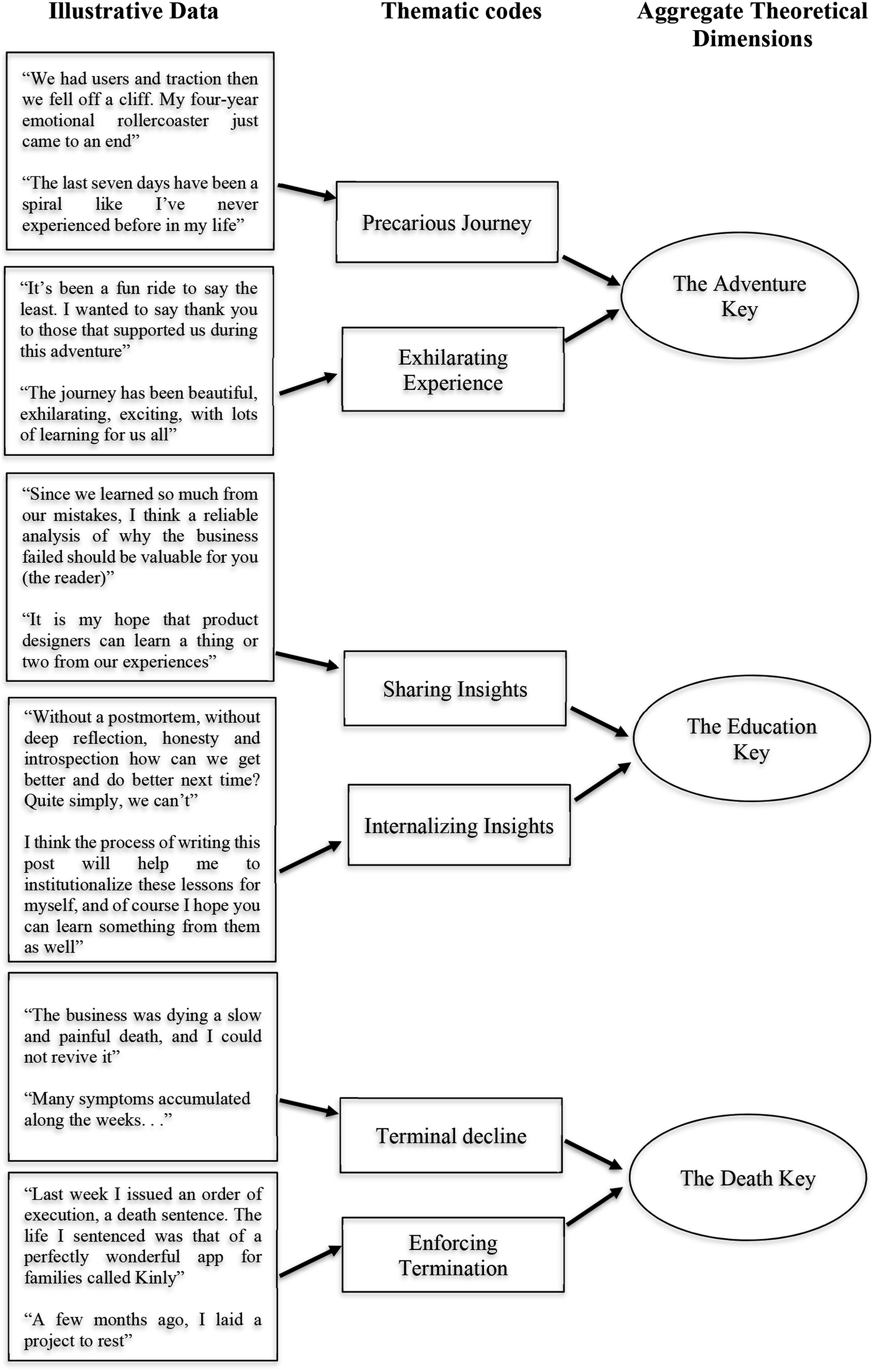
Patterns in Primary and Secondary Keyings.
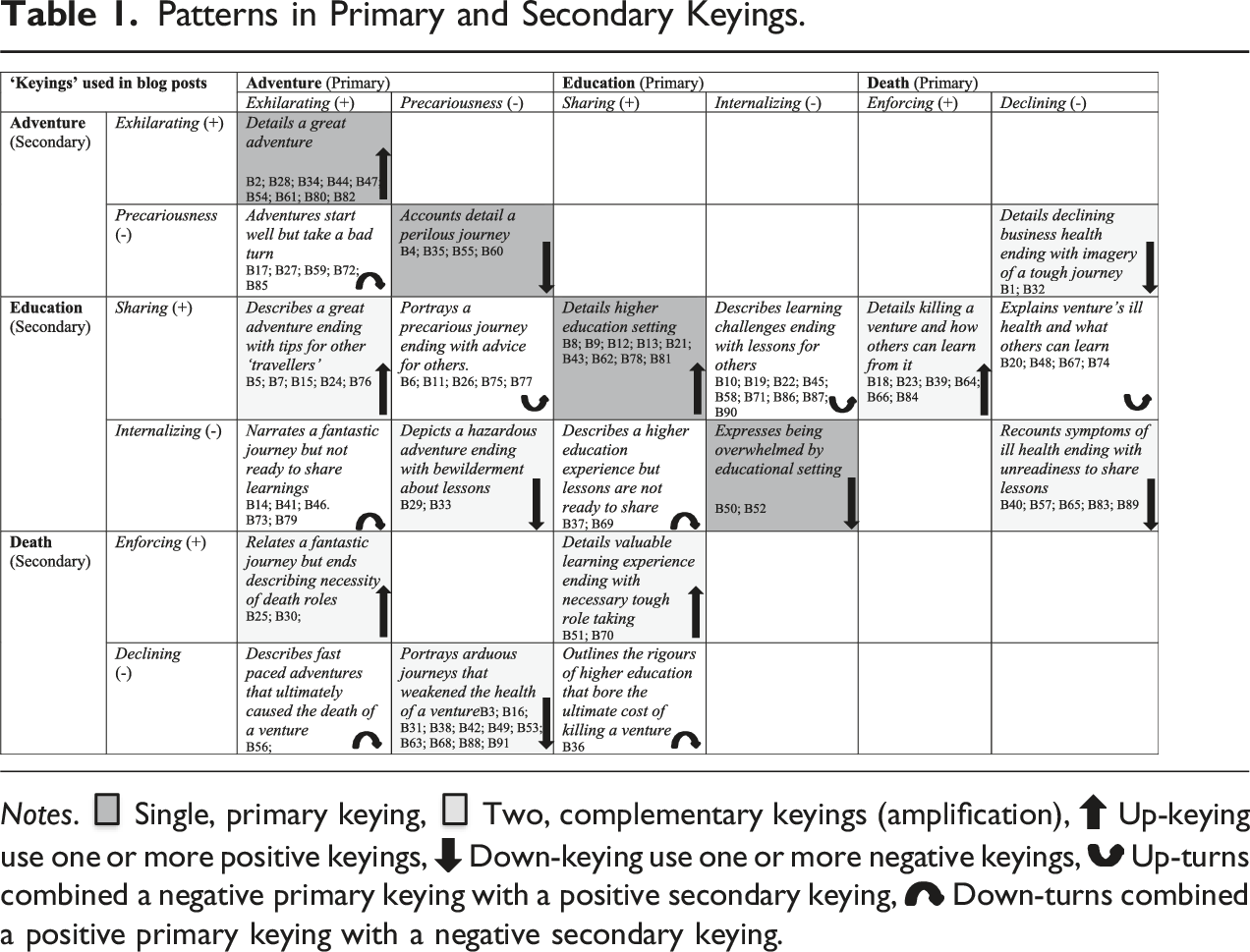
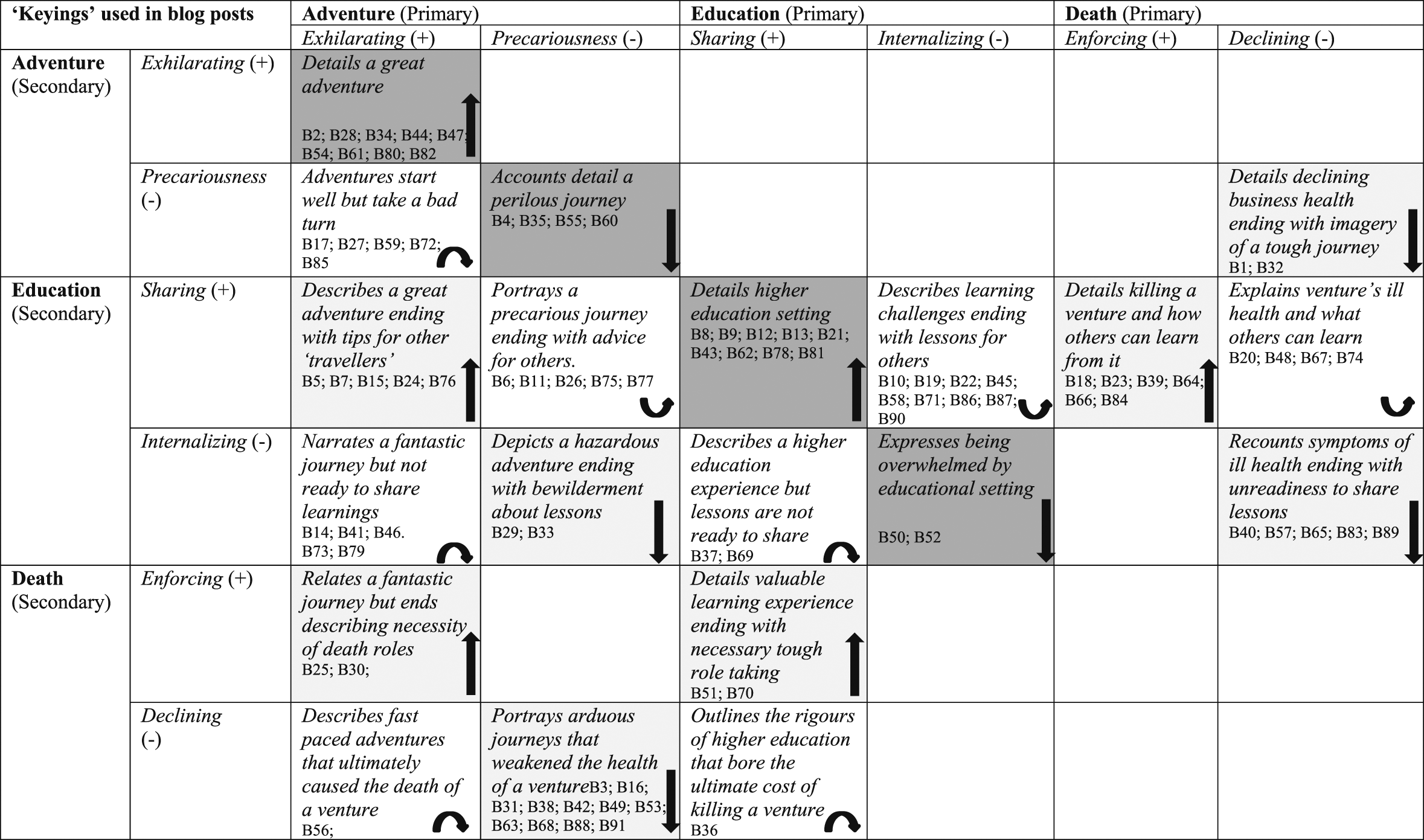
Notes.  Single, primary keying,
  Two, complementary keyings (amplification),
  Up-keying use one or more positive keyings,
  Down-keying use one or more negative keyings,
  Up-turns combined a negative primary keying with a positive secondary keying,
  Down-turns combined a positive primary keying with a negative secondary keying.
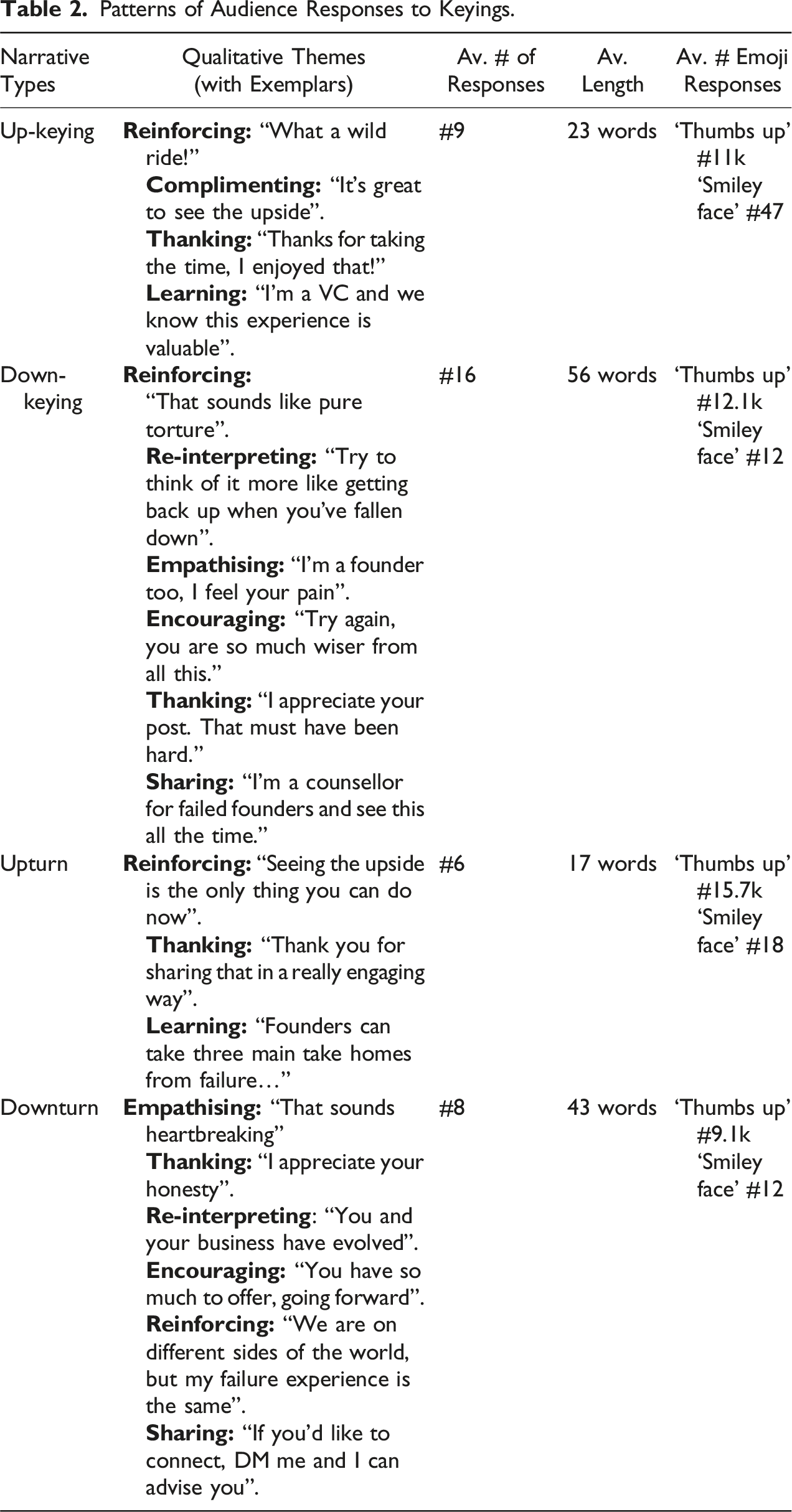
Patterns of Audience Responses to Keyings.
In the next section, we unpack entrepreneurs’ keyings of failure as adventure, education and death, as well as the responses these evoke from a public audience.
Findings
In their failure blog posts, entrepreneurs added new interpretive layers on-top of their otherwise literal accounts of failure experiences. These keyings had structural similarities to entrepreneurial failure, where complex positive and negative experiences and emotions can coincide. Similarly, the keyings each had two focal dimensions that helped “coherently [redescribe] a specific element of a schema” (Cornelissen & Werner, 2014) for failure. The blog posts evolved around keyings which gave them a more universal and less business-oriented tone; adventure, education and death. The positive and negative dimensions of these expressive interpretations were prominent across all posts and are discussed below:
The Adventure Key
The adventure keying roughly corresponds with the well-worn metaphor of entrepreneurship as a journey (Dodd, 2002). It characterises entrepreneurs as adventurers and the challenges of failure as features of a landscape, as they describe “traversing some incredible vistas” and thanking readers for “coming along on this trip of a lifetime” (B28). This treatment not only serves to make the failure stories more exciting, but also highlights favourable entrepreneurial characteristics (heroism, daring etc.). Reflective of other studies of public narrative accounts of failure this key emphasizes aspects of failure as being outside an entrepreneur’s control (Kibler et al., 2017; Mantere et al., 2013).
A positive adventure keying foregrounds thrilling and exhilarating aspects of entrepreneurs’ experiences (exhilarating experience). These constructive keyings characterize protagonists as bold and fearless. Risks taken are described in relation to adventure rather than failure. This transforms the way the entrepreneurs talk about the impact of their own choices, like “pouring gasoline on a small campfire” (B27). Since adventures come to an end, venture-failure seems like a “natural conclusion” (B79) rather than something undesirable. A positive adventure keying avoids the allocation of blame, making entrepreneurs’ hopes to try again more plausible, that is “my next adventure is going to be even more exciting” (B46).
The adventure keying also highlights the extreme difficulties and misfortunes associated with arduous journeys (precarious journey). A more negative rendering of the adventure keying, which focuses on the unpredictable and distressing aspects of adventure and characterizes entrepreneurs as “weary” (B35) travellers surprised by “twists and turns” (B16) and “daunted” (B4) by “unforgiving terrain” (B4). Posts describe moving through challenging landscapes, full of obstacles and setbacks. Entrepreneurs describe themselves as protagonists facing unavoidable destruction from cliffs (B32), black seas (B1) and earthquakes (B88) rather than unfavourable markets and human error. The adventure keying removes much of the human involvement that would be presented in a literal account. Instead, the odds are presented as overwhelmingly stacked against the entrepreneur, described by one as “trying to stop us falling off a cliff was unbelievably tough” (B16).
The Education Key
The education keying refers to failure as though it were an education. This keying is expressed as though the experience took place in a university, school, or classroom, with claims of it feeling like “an accelerated university degree (B86). The posts emphasize first-hand experience as an important mechanism for accessing the lessons afforded by failure. In most cases, these “graduates” (B69) share lessons via blog posts to enable others to learn vicariously and avoid the “steep cost” (B59) of this type of education. As such, this keying has a distinctly “other” orientation, featuring learnings summarized for the benefit of blog readers.
The education keying underscores positive and constructive ways of talking about failure (sharing insights). Mistakes and disappointments are transformed by the education keying into “learning opportunities” that happen in the context of an educational institution and/or programme such as an MBA (B66). In a positive rendering of the education keying, failure is considered valuable because the costs in time and money are considered a commensurately high price for this kind of “schooling”. Some entrepreneurs address investors directly, thanking them for funding their education and attempting to show the value of “priceless lessons” (B57) learned as a return on investment.
A more downbeat rendering of the education keying (internalising insights) suggests failure experiences are a “school of hard knocks” (B87) that demand significant endurance. Entrepreneurs describe “cramming” (B77) in the lead up to significant events and getting “brain ache” (B22) trying to figure out problems.
The blogs indicate that this kind of learning is complicated because there are many details to “sift through” (B90) before a summative lesson can be realized.
This keying uses higher education imagery to communicate the level of cognitive difficulty involved in failure. They also express the key challenge of there being “no way of knowing this stuff ahead of time” (B10). The entrepreneurs use the keying to demonstrate their competence and offer value by helping readers avoid the same demanding process indicative of peer-to-peer learning.
The Death Key
The death keying uses language and imagery to suggest that failure experiences are like a death (e.g., Javadian et al., 2022; Shepherd, 2003); quoting events as “the nail in my start-up’s coffin” (B67). This keying describes ventures as though they were living organisms and failure as the end of life. The different renderings of this key relate to the entrepreneurs’ stance towards “death” and their own death related roles, which may be positive or negative.
The more positive, pro-active rendition of the death keying takes a detached tone when relating failure as a death (enforcing termination). Entrepreneurs give themselves proactive roles, recognizing the “health” of their venture was “going downhill” (B25) and taking decisive action to “avoid everyone suffering too much” (B84). One entrepreneur reflects on having the debate of “should we kill it?” with my founders, investors, and Board of Directors (B70). Entrepreneurs also described the difficulty attached to killing their venture and the associated guilt (B18). Other positive death keyings are less violent, “gracefully accepting the end had come” (B23). Some discuss “putting [their] affairs in order” (B84) before ending their venture. The positive rendition of the death keying emphasizes the need to take decisive action in as painless a way as possible.
Negative death keyings employ more emotive language to describe bloggers’ desperate responses to a venture’s “critical condition” (B20). Lifesaving imagery is used to describe efforts to bring a venture back “from the brink” (B63) and to “resuscitate” (B16) a patient. The accounts imply a close relationship to a dying patient, creating a dramatic sense of the emotion expended in trying to avert death, as one entrepreneur describes, “the business was dying a slow painful death and I couldn’t revive it” (B66).
The portrayals suggest willingness to do whatever necessary but there is a distinct sense of hopelessness to these descriptions of a terminal “diagnosis” (B40), likening this to giving “a business CPR” and to “consider whether or not it’s worth saving (or even possible to save)” (B25). The death keying provides a vivid set of vocabulary for relating the emotional dimensions of a traumatic experience. Only in retrospect can some bloggers consider “life after death” and how they might move on: “I think it’s much easier to live once you’ve died” (B36).
Layering Keyings
Each blog post features one of the keyings described above, leading with it and re-emphasizing it throughout the account. Additional analysis reveals how posts evolve, with many entrepreneurs incorporating a secondary keying. To understand the dynamically evolving posts, we next focused on how “laminating and layering” (Goffman, 1974; Gray et al., 2015) of re-interpretations within each post produced four distinctive narrative patterns: (1) Up-keyings feature a positive primary keying, reinforced with a positive secondary keying; (2) Down-keyings use a negative primary keying, strengthened by a negative secondary keying; (3) Upturns lead with a negative primary keying but evolve into positive secondary keyings; (4) Downturns accentuate positive primary keyings but evolved into negative secondary keyings. The layering of distinctly different keyings demonstrate the broad complexity of failure experiences as they unfold. Table 2 presents the distinct narrative patterns and the forms in which these take through keying combinations, we now unpack these in greater detail.
Up-Keying
Up-keyings amplify the constructive nature of failure and entrepreneurs’ up-beat attitudes towards it. Four up-keying forms emerged during our analysis, differing in how the worthwhile-ness of failure is emphasized. First, “Adventure + Education +” narratives lead with experiential descriptions using the imagery of intrepid adventure. The accounts then re-enforce that these experiences provide lessons that could be gained in no other way, suggesting the audience can follow a similar “route” but avoid the “pitfalls” from recounting of “what I learned from mine” (B5).Second, the “Adventure + Death +” narratives begin in a similar way, but the death keying gives these accounts a different complexion, emphasizing the entrepreneurs’ pro-active role taking (killing the venture). Together, descriptions of difficult terrain and challenging role requirements emphasize the skill of the entrepreneur. Both of these up-keyings feature entrepreneurs centrally in the developing narrative.
Third, “Education + Death +” narratives emphasize the rewarding outcomes that learning from failure can provide, while keeping the ultimate price of failure (death) at the forefront. Narratives ending with Death + use role appraisal as a less direct route to eliciting empathy. Rather than dwelling on the emotional difficulty of death, the audience is invited to reflect on whether they would have it in them to take on pro-active death related roles. Fourth, ending on Education + produces an other-focused narrative, stressing that these hard roles can be learned and be of value to the entrepreneurial community.
Responses from the audience re-affirm the overall positive tone of up-keyings and exemplify the kinds of constructive responses keyings can elicit. “I enjoyed reading this post. Very insightful with a tad of humour. Thanks for sharing your experience!” (Comment, B80) “Excellent post! It takes guts to write out everything you have been through, but your courage to press forward is truly inspirational!” (Comment, B40)
Down-Keying
In contrast, down-keyings amplify the negative array associated with failure processes and outcomes. Using vivid, emotionally charged language, these accounts invite a more poignant appraisal of failures in four different forms. First, the “Death – Adventure –“ narratives entrepreneurs lead with descriptions of being out of control of their ventures’ health. The narratives focus the audience on aspects of the venture that were inherently unwell. These interpretations are reinforced by a depiction of difficulties incurred on a slippery slope. Together, these keyings downplay attention on an entrepreneurs’ accountability. The second type, “Adventure – Death –” more strongly emphasizes the context being responsible for weakening the business. Overall, both down-keyings distance the entrepreneur from blame and invite empathetic audience responses.
The third approach to down-keying is “Adventure – Education –” posts, where entrepreneurs reference the rapid series of experiences they are still trying to process. These accounts signal willingness to share lessons, but an unreadiness do so. Communicating about failure is treated as one small component in an ongoing process of failure. Fourth, “Death – Education –” accounts emphasize emotional distress and a heightened sense of bewilderment, acknowledging that lessons ought to be learned, but deferring this to a future time and requesting kindness from the audience.
Audience responses to down-keyings help demonstrate that communicating the emotional dimensions of failure in vulnerable ways can invite compassion and consolation from a public audience. Often comment threads offer sympathy and encourage entrepreneurs to take heart or try again: “Great post, I wish I’d read it sooner. Failing is lonely and isolating” (comment, B1) “Tough times (you were very young too). You will have learned a whole lot more than those people who never even tried. (Comment, B56)
Up-Turns
Up-turns narratives do not shy away from difficult emotional dimensions, ending on a high note by ending with education +, for example: “it has been mortifying, but I’m hoping there’s something we can all take from this.” (B22). This approach produced three types of keyings, emphasizing the positive attitude of entrepreneurs, juxtaposed against bleak renditions of failure. First, “Adventure – Education +” posts lead with descriptive details of a difficult journey, but end trying to put negativity in the past by deriving positive lessons. Similarly, the second type, “Education – Education +” posts rely on the imagery of burdensome steep learning curves but end by acknowledging the lessons are valuable. Finally, the third type, “Death – Education +” narratives detail the personal tragedy of loss and grief and then upturn by signalling that positive lessons gained to help entrepreneurs move forward.
In each of these narrative types, the process of failure over time is evident. In particular, the positive sharing of lessons signals the other-orientedness of the entrepreneurs and their intentions to move forward and try again. Reader comments pick up on these cues, sometimes echoing keyings back to the entrepreneurs, or acknowledging the highs and lows detailed in the posts: “It was both exciting and sad to read the story. I wish you the best of luck. I’m sure through this experience you will bounce back heavier in your new start up.” (Comment, B75) “You have started something and touched the lives of many people. This can never be thought of as a failure. Keep fighting for your authentic selves!” (Comment, B18)
Down-Turns
Down-turns more closely mirror the trajectory of literal failure experiences that start positively but end negatively. Five different forms of downturns were evident in these posts. The first type, “Adventure + Adventure –” narratives, for example, highlight the excitement of the adventure beginning and then situate failure in uncontrollable contexts over time. The second type, “Adventure + Education –” narratives begin with entrepreneurs highlighting the great aspects of their journey, but then express difficulty in summarizing lessons for others. Here again, entrepreneurs write about needing time to reflect before they can take lessons from failure. Third, “Education + Education –” accounts talk directly about the perceived expectation that the extended community expects some learning to occur, but that the entrepreneurs remain too confused to share insights because of the failure. The fourth type, “Adventure + Death –” narratives describe the heady pace associated with an entrepreneurial journey, with the conclusion that this caused the death of their venture. Finally, a fifth type, Education + Death – foregrounds that a challenging environment likened to higher education can bear a heavy cost, comparable to a death.
Down-turns demonstrate that entrepreneurs are alert to how the community would expect to talk about failure (in a positive light as a journey or something to learn from), but the use of negative secondary keyings remind the audience of the difficulty of moving on from failure for different reasons. Reader comments suggest they interpret downturn narratives as rounded views of positive and negative dimensions of failure. Many comments similarly acknowledged the ups and downs featured in the failure accounts: “Wonderful story, great takeaways, love the presentation. Yup…when you are going through hell – keep going!” (Comment, B24) “A tough ride. . . A lifetime of learning in 5 months is a fair deal” (Comment, B13)
Audience Responses
In outlining the different failure communication narrative types adopted and employed by entrepreneurs above, we provide insights into how public audiences reacted to different failure narratives. Here, we explore four patterns across the audiences’ responses, disaggregated by the type of failure narrative identified: Up-keying, Down-keying, Upturn, and Downturn. Audience responses posted directly in response to the failure narrative are thematically interpreted and observable characteristics of the responses, comprising the average number of written responses, the average word count of written responses, as well as the use of emojis and the average count of emojis which are recognised as tools to convey emotion in text (Riordan, 2017). The breakdown of the audiences’ responses by entrepreneurial failure narrative type are presented in Table 2.
Among all types of entrepreneurial failure narratives, two significant themes consistently characterize audiences’ written responses: empathy and encouragement, which are posted in response to different narrative trajectories used. We note that (i) Down-keying generates the greatest amount of engagement (i.e., # of written responses and length of response); (ii) Upturns elicit the greatest positive spontaneous engagement (i.e., thumbs up); (iii) A perceived “negative” end to the communication (down-keying and downturns) evokes audience encouragement to try again; finally, (iv) while up-keying and upturns gain the most positive spontaneous responses, the responses are largely impersonal, focusing on the narrative rather than the individual entrepreneur at the heart of the story. These patterns of audience response suggest that while public audiences are interested in engaging with failure narratives, only narratives with a negative tone elicit what can be understood as legitimacy signals relevant to the moving on stage, that is direct encouragement to try again. We consider the significance of these findings below.
Discussion and Contributions
Communicating failure to a wide range of stakeholders is a demanding task for entrepreneurs that can shape their future legitimacy and prospects (Cardon et al., 2011; Cope, 2011; Fisher et al., 2017; Kibler et al., 2017, 2021; Shepherd & Haynie, 2011; Singh et al., 2015). Despite the ubiquity of failure in organizations, especially new ventures, understanding of how entrepreneurs talk about failure to public audiences remains limited. Building on Kibler et al.’s (2021) observation that extant conceptualizations of failure have predominantly featured accounts shared in private settings, we explored how entrepreneurs present failure narratives to public audiences. As opposed to announcements about failure in the immediate aftermath of a closure, on a company website (Kibler et al., 2021) entrepreneurs writing blog posts could reasonably expect engagement from readers online, where business related interactions are increasingly conducted (Fisch & Block, 2021). Our study makes multiple contributions to the growing body of literature on entrepreneurs’ venture-failure narratives, which we explain below.
Theoretical Contributions
First, we introduce the concept of keying as the narrative device supporting the legitimacy seeking efforts of entrepreneurs looking to move on. All three keyings (Adventure, Education, Death) resonate with the common story that entrepreneurs battle through adversity and emerge at success (Bratstrom & Wennberg, 2022). Our empirics show how entrepreneurs use keyings to craft narratives that mirror and leverage this dominant failure story arch during the moving on phase. That we observe them using keying in interactive forums is in itself novel; prior research has to date predominantly focused on fixed failure statements to public audiences which permit little or no audience feedback (Kibler et al., 2017, 2021). In contrast, interacting with a broad public audience is a much riskier endeavour; trolling, mockery and viral backlash can be rife and unpredictable online. We did not encounter such harsh responses in our data and can only speculate why; it may indicate the effectiveness of the keys, or more likely indicate that the audience were culturally more accepting of venture failure (Yamakawa et al., 2015). In either case, we propose that keyings help render failure narratives appealing to public audiences. Keyings create more interesting, engaging stories that are more relatable in online or public forums. They draw attention to elements of the story that align with audience expectations, sympathies and admiration rather than scrutiny (e.g., Cardon et al., 2011; Kibler et al., 2017: both suggest public audiences dislike blame). Keying is a form of social meaning making, that may in some cases give an audience a chance to respond with an additional rendering of failure, supporting the view that entrepreneurial legitimacy seeking is not dichotomous (i.e., judgements an individual is legitimate/not legitimate), but emergent and cumulative (Soublière & Gehman, 2020). We note how risky this can be for entrepreneurs, particularly in online fora, where digital traces of legitimacy judgements can remain and be impossible to erase and forget (Rosen, 2011). Thus, although keyings are a tool with which entrepreneurs seek legitimacy from public audiences, the potential pitfalls need additional scrutiny. Future studies of additional dynamic spaces for seeking audience feedback (e.g., failure post-mortem events, podcasts) promise to greatly enrich understanding of the use of keyings and other legitimacy seeking devices during the moving on phase.
One way we observed the entrepreneurs mitigating the risk of negative audience legitimacy signals, was to carefully engage in the tone and trajectory of their narratives. Our second contribution is to introduce upkeyings and downkeyings which reinforce the positive and negative aspects of failure, and upturns and downturns which elaborate the range of effort expended by entrepreneurs. In both cases, these keying devices detail how entrepreneurs “prime” the audience (Soublière & Gehman, 2020) who in return send favourable signals relating to the moving on phase. That entrepreneurs send and seek legitimacy signals to formal institutions (e.g., banks, Blumberg & Letterie, 2008) and other resource providers (Clarke et al., 2019) is well-known, but interactive legitimacy signalling and seeking with a broad audience is novel. Our empirics show these audience signals largely involve forms of empathy while only a handful directly encourage trying again. One role of entrepreneurs seeking legitimacy signals from the public is that the burden of proof of legitimacy does not entirely rest with the entrepreneur when moving on but is socially accumulated and rendered. Since an emergent literature deal with the entrepreneurs’ digital footprints (Fisch & Block, 2021; Smith et al., 2017), how these cumulatively build (or damage) legitimacy during crucial transitions is especially pertinent for future studies.
Finally, our empirics elaborate interaction and legitimacy seeking with a broad public audience during an important, less understood transition phase: moving on (Castelló et al., 2023). We note the increasing significance of public audiences for entrepreneurs who seek not only legitimacy for their ventures (Garud et al., 2014) but also for themselves as individuals with career trajectories (Castelló et al., 2023). Entrepreneurs interactively engage public audiences in diverse ways, for example amassing followers on social media and via podcasts and self-publishing video platforms (Fisch & Block, 2021; Fischer & Reuber, 2011; Richey et al., 2018). Each of these spaces for interaction offer opportunities for priming and leveraging legitimacy from a public audience. We have shown how entrepreneurs seek and receive legitimacy signals from a public audience during the moving on phase, but many other instances are worthy of attention. For example, ongoing engagement with a public audience can give entrepreneurs influence regarding a range of issues unrelated to their ventures past and present (i.e., having a voice on contested social issues; political or religious influence). Taken together, the interactive legitimacy seeking of entrepreneurs among public audiences can have diverse implications which are not well understood.
Practical Implications, Limitations, and Future Research
How and where stories of failure are shared has implications for entrepreneurs, particularly as they attempt to legitimize past failures. The use of keyings, such as the ones highlighted in our study, can facilitate talking about failure to audiences outside a failed organization. Entrepreneurs and their support organizations (for example, incubators and entrepreneurial networks) can benefit by reflecting on how failure experiences echo the keyings discussed in this paper, as well as exploring possible alternative keyings. The use of keyings can generate additional insights for those hoping to learn from failure by helping entrepreneurs and their audiences to consider failure in a different way. The keyings draw attention to the kind of thinking that underpins entrepreneurial resilience and can help prospective or struggling entrepreneurs to cope with challenges. They also make failure stories much more likely to be shared.
The blog posts analysed in this study captured the first-hand accounts of entrepreneurs in their original form, providing a rich and compelling data set. They also represent a forum connecting entrepreneurs and public audiences where creative, supportive conversations about failure can take place. Entrepreneurs and organizations alike can benefit from bringing unfinished, open accounts of their failures into conversation with the public in such spaces, where the audience can be involved in the interpretation of failure in a way that strengthens legitimacy and encourages entrepreneurs to take value from it and try again.
We acknowledge some important limitations. Our study was limited by the search terms used to look for stories of failure. In other words, entrepreneurial descriptions of failure that did not invoke the word “failure” were by design excluded from our analysis. Future studies need to consider the broader lexicon used to talk about failure, whereas we specifically targeted blog posts that made direct use of the term. Additionally, we had no direct contact with the entrepreneurs themselves. This lack of contact was not problematic from the point of view of this study, since our interest was in failure narratives, which were available in rich detail. But, with our empirical material we were unable to offer insights into why entrepreneurs chose blogging platforms to share their experiences and whether this choice had an impact on their entrepreneurial careers. Some studies have suggested that there may be psychological benefits of communicating via technological platforms (Richey et al., 2016; Suler, 2004; Walther, 2007). Future studies might fruitfully engage with the material differences in the settings for sharing failure stories and their implications for entrepreneurial trajectories. We also noted earlier on that narratives need to represent reality to be believable, but the nature of our data does not give us access to objective accounts of these entrepreneurial failures. A comparative examination of public verses literal accounts of failure would advance our understanding of how far an entrepreneur’s creative license can stretch.
While the blog posts provide an authentic voice to the study of entrepreneurial failure, we also acknowledge that these represent a snapshot view of part of narratives following failure. This relatively restricted view prevents us from knowing what the long-term implications of these keyings are for the entrepreneurs and the audiences they are addressing. Nevertheless, our study offers an in-depth view of a critical turning point, as entrepreneurs share failure meanings with public audiences. Insights into the process of an unfolding failure suggest that entrepreneurs can arrive at an “epiphany” after lengthy periods of introspection and difficulty (Singh et al., 2015). In this paper, we have suggested that framing mechanisms, and specifically keyings, can support such an epiphany helping suspend literal interpretations in favour of alternatives that have the potential to transform behaviours associated with failure.
Footnotes
Declaration of Conflicting Interests
The author(s) declared no potential conflicts of interest with respect to the research, authorship, and/or publication of this article.
Funding
The author(s) received no financial support for the research, authorship, and/or publication of this article.

Industries Represented in Data Set
Industry
Number of Blog Posts
Fashion
4
Technology
35
Publishing/Journalism
8
Education
3
Security
2
Food and drink
5
Social media
12
Events
1
Aviation
2
Shared economy
4
Fintech
3
Medical
2
Human resources
4
Arts/Entertainment
4
Travel
2
Total
91