




Abstract

Introduction
Summary of Themes Under Negative and Positive Categories. Bold Frequencies are Cumulative.
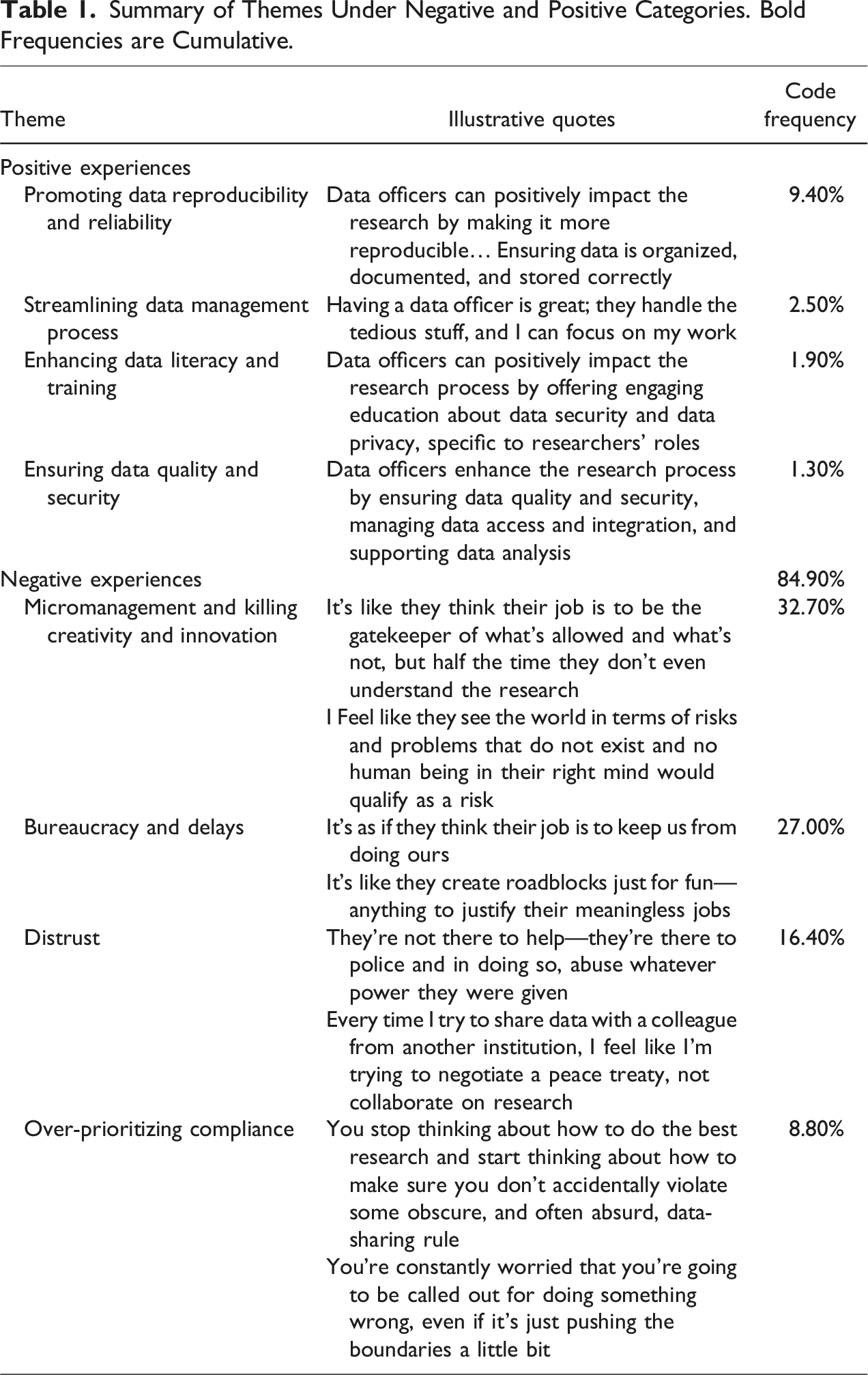
Now, you might be thinking, “Surely, this is just academic griping, right? A few disgruntled researchers with a vendetta against paperwork?” Ah, if only. Unfortunately, the sentiment is far more widespread—and far more nuanced. But before you rush to hang up your compliance cape in despair, let’s dive into the specifics. Armed with a mountain of interviews, and just a sprinkle of positive vibes, I unpack the key themes that emerged from these conversations with academics. Spoiler alert: most respondents aren’t exactly sending thank-you cards to their data officers anytime soon. But don’t just take my word for it, let’s take a closer look at how data officers came about akin to delving into the issues that seem to underlie the growing chasm between researchers and their supposed data guardians.
The Rise of Data Officers
Data Officers: Born from Necessity, Raised by Bureaucracy
The rise of data officers in universities isn’t hard to explain. With the advent of digital data and regulations like General Data Protection Regulation, universities needed someone—anyone—to take the fall for the inevitable data breaches and legal blunders that come with handling massive amounts of personal information (Borgman, 2015). And so, data officers were born, tasked with ensuring that research data was not only collected and stored responsibly but that it was used in compliance with ethical and legal frameworks. Don’t get me wrong, in theory, this role is invaluable. Academics, as brilliant as they are, aren’t exactly known for their meticulous attention to administrative details, and having someone dedicated to managing these concerns should, in principle, free researchers to do what they do best—research. One optimistic Canadian quantitative academic said, “Having a data officer is great; they handle the tedious stuff, and I can focus on my work.”
The literature certainly agrees and depicts data officers as a safety net, ensuring that research teams don’t inadvertently breach regulations (Bishop et al., 2021; Ihli, 2022; Neylon, 2017). Even I must admit, there are some benefits to having data officers around—though I say this with a raised eyebrow. Data officers help ensure that research data is compliant with the FAIR principles (Findable, Accessible, Interoperable, and Re-usable; Wilkinson et al., 2016). As one European qualitative academic put it, “Having standardized data is great for future research. It saves everyone time, and it’s easier to build on the work of others.” They also offer training on data management, analysis, and visualization, which can be helpful. A U.S.-based quantitative academic noted, “They’ve helped me use data in ways I hadn’t thought possible—more visualization tools and methods for ensuring data accuracy. It’s good for the research process overall.” And sure, they keep your data locked up tighter than Fort Knox, ensuring no one accidentally leaves a USB drive full of sensitive participant info on the bus. Data officers also help manage complex data sets and ensure that datasets can be shared across institutions. As one of Canadian quantitative researchers puts it, “Data officers make sure everything is uniform and safe, especially in collaborations with multiple universities. It makes sharing data easier and ensures that all the security protocols are met.” But this fairy tale doesn’t last long. The narrative shifts rapidly when you ask researchers how this “support” plays out in practice.
The Fall of Data Officers
Issue 1: Micromanagement—Killing Creativity One Rule at a Time
One of the most frequent complaints from the interviewees was that data officers tend to micromanage research, often imposing rules that stifle creativity and flexibility, particularly in areas where they have limited expertise. One Canadian quantitative academic shared a particularly frustrating story, “We were trying to implement a complex data analysis technique, but the data officer kept pushing back, saying it didn’t align with their interpretation of the protocol. They had no idea what they were talking about, but they insisted on inserting themselves into the decision”. Several researchers felt that data officers, though well-meaning, lacked the nuanced understanding of specific research projects, leading to overcomplicated processes and roadblocks. “They keep insisting on solutions to problems that don’t exist” said one U.S. qualitative researcher. This type of micromanagement leads not only to delays but also to a creeping sense that researchers are being watched and second-guessed at every turn.
Spash (2010) suggested that excessive oversight not only inhibits innovation but also creates a “creativity-killing” environment where researchers are afraid to experiment with new ideas or methodologies for fear of falling afoul of some obscure compliance regulation. Several researchers spoke about how the constant need to check in with data officers—often on decisions that should be left to the research team—creates an atmosphere of fear and rigidity. A U.S.-based quantitative researcher described it as, “like trying to write a novel while someone is standing over your shoulder, telling you which words you’re allowed to use.” Another European qualitative researcher added, “It’s impossible to take creative risks when every decision has to go through three layers of bureaucracy. By the time you get approval, the moment is lost.”. Ulibarri and colleagues (2019) emphasizes that creativity flourishes when researchers are free to experiment, take risks, and even fail. It highlights that such intellectual freedom is essential for innovation and discovery. However, in today’s university environment, where compliance and strict oversight reign supreme, these freedoms are increasingly constrained. Indeed, researchers are more focused on adhering to compliance rules than pushing boundaries, leading to a culture of caution rather than creativity. This shift undermines the experimental nature of research, where trial, error, and occasional failure are critical to breakthroughs (Martin, 2011). As one Canadian quantitative academic lamented, “The system is set up to punish risk-taking. It’s safer to just stick to the same old methods and hope no one notices.”
The above outlined issues are particularly pronounced in fields like qualitative research, where the nature of the work is inherently more fluid. “I feel like I have to run every little decision by them,” said one U.S.-based qualitative researcher. “It’s exhausting, and it definitely limits what I can do.”. One European mixed-method academic said, “Their obsession with rigid processes, even when it doesn’t make sense for the research, makes it feel like they’re policing us more than helping us”. The literature is clear: innovation thrives in environments where researchers have the freedom to explore new ideas, even if that means occasionally bending the rules (Martin, 2011).
But data officers? They’re not fans of bending rules. As one Canadian quantitative academic put it, “It’s like they think their job is to be the gatekeeper of what’s allowed and what’s not, but half the time they don’t even understand the research.” This rigidity is a major issue for researchers, many of whom feel that data officers, in their quest to enforce compliance, are missing the forest for the trees. One particularly frustrated European qualitative researcher said, “I get that they have a job to do, but they should focus on real problems, not hypothetical ones.” This frustration is echoed in the qualitative research literature. Silverman (2013) highlights how over-regulation and rigid structures stifle exploratory research. Moreover, several scholars (e.g., Goens & Streifer, 2013; Gray & Silbey, 2014; Klitzman, 2013; Nelson, 2010; Neylon, 2017) stated that data officers are not only overly compliant with the minimal existing risk but are often also making up their own risks that simply do not exist to further justify their own existence and in doing so are creating a compliance culture “that is not optimising the behaviours and culture change that are desired” (Neylon, 2017, p. 13). “I feel like they see the world in terms of risks and problems that do not exist and no human being in their right mind would qualify as a risk,” one European qualitative academic quipped.
Issue 2: Bureaucracy and Delays—The Academic’s Nightmare
Now, let’s pivot to what’s frequently happening on the ground. From the interviews, one common sentiment rang loud and clear: “data officers slow everything down”. The bureaucratic hoops researchers must jump through would make an Olympic gymnast tired. “It feels like their job is to slow us down,” one European qualitative researcher said, “You spend more time filling out forms than actually doing research.” This isn’t just anecdotal griping.
The literature is quite clear: as universities have ballooned into top-heavy administrative behemoths, more time is spent pushing paper than pushing the boundaries of knowledge (Murphy, 2013; Parker, 2011). Instead of celebrating discovery, many academics find themselves trapped in a web of compliance, endlessly filling out forms to satisfy the ever-expanding army of administrators. One particularly jaded Canadian quantitative academic stated, “It’s as if they think their job is to keep us from doing ours.” Hard to argue with that sentiment when it takes six months to get a simple data-sharing agreement approved. And delays? Oh, the delays. One U.S. quantitative researcher described how their project ground to a halt because of miscommunication with their data officer. “We needed approval to access a dataset, and by the time everything was sorted, the data was irrelevant.” Another European mixed-method researcher added, “It’s like they create roadblocks just for fun—anything to justify their meaningless jobs.”
The literature backs this up; Collini (2012) and Goens and Streifer (2013) emphasizes that excessive administrative oversight in academia can strangle creativity and significantly slow down research productivity. They argue that the growing layers of bureaucratic controls create an environment where compliance and process take precedence over the free flow of ideas and innovation. In essence, rather than fostering a vibrant, intellectually stimulating atmosphere, this top-heavy administrative approach turns academics into compliance managers. And let’s be real: the more time you spend navigating red tape, the less time you spend innovating. It’s as though universities are more focused on checking boxes than on the groundbreaking discoveries that made them intellectual powerhouses in the first place.
Issue 3: Distrust—The Elephant in the Room
Perhaps the most alarming finding from the interviews was the erosion of trust between researchers and data officers. In theory, these officers are supposed to be partners in the research process, but many academics felt that they were more like adversaries. “It’s as if they don’t trust us to handle data responsibly”, one European quantitative researcher lamented. Another Canadian quantitative scholar described the relationship as “antagonistic,” adding, “They’re not there to help—they’re there to police and in doing so, abuse whatever power they were given.” One U.S. qualitative researcher even likened the relationship to that between a teenager and a helicopter parent: “They’re constantly hovering, waiting for you to make a mistake so they can swoop in”.
This mistrust goes both ways. Several researchers admitted to finding ways to “game the system” to avoid the bureaucratic nightmare that comes with working closely with data officers. This includes everything from bending the truth on forms to rushing through compliance processes just to get them out of the way. “The more they try to control the process, the more we try to work around them”, admitted one quantitative European academic. “If we waited for them, nothing would ever happen,” one Canadian qualitative academic confessed. This adversarial dynamic is not just anecdotal; the literature has long recognized that excessive control and lack of trust can lead to a breakdown in collaboration and communication. Collini (2012) and Ghamrawi and colleagues (2024) argued that when academics feel they are being micromanaged, their motivation and creativity suffer, leading to a decline in both the quality and quantity of research output. This adversarial dynamic is particularly harmful in fields that rely heavily on data sharing and collaboration. Several researchers spoke about how data officers’ overreaching control stifled opportunities for interdisciplinary and international collaborations. As one U.S. quantitative researcher noted, “Every time I try to share data with a colleague from another institution, I feel like I’m trying to negotiate a peace treaty, not collaborate on research”.
Issue 4: Over-Prioritizing Compliance—Is Risk Aversion the New Normal?
A final concerning issue is the risk-averse culture that data officers seem to foster. It’s one thing to ensure compliance, but another entirely to create an atmosphere where researchers feel constrained by adherence to strict regulations. As one U.S.-based quantitative researcher puts it, “You stop thinking about how to do the best research and start thinking about how to make sure you don’t accidentally violate some obscure, and often absurd, data-sharing rule”. The literature supports this idea of a culture of fear. Spash (2010) warns of an environment where compliance dissuaded academics from pursuing controversial or boundary-pushing topics out of fear that they’ll get bogged down in compliance issues. “It’s like walking on eggshells. You’re constantly worried that you’re going to be called out for doing something wrong, even if it’s just pushing the boundaries a little bit”, one Canadian quantitative researcher remarked. This stifling is particularly problematic in fields like social sciences, where qualitative and exploratory methods often lead to the most groundbreaking discoveries. Researchers in these fields frequently reported feeling constrained by data officers who imposed strict, quantitative frameworks that didn’t fit their work. “They’re obsessed with numbers and processes, but that’s not how qualitative research works. It feels like they don’t get it, and they don’t want to get it” said one European qualitative academic.
The Path Forward: Can We Strike a Balance?
When academics were asked, “How do you think the relationship between researchers and data officers can be further improved moving forward?” the overwhelming response was simple, direct, and telling: let’s just not have a relationship at all. This sentiment was consistent, irrespectively from country, research philosophy or career stage. A European qualitative scholar put it bluntly, “We don’t need them breathing down our necks. What we need is freedom to focus on research, not endless compliance hurdles”. Many academics advocated for automating the role of data officers using AI or digital tools to handle routine data management tasks, arguing that these systems could be more efficient and less intrusive. “Just give me an AI tool to flag potential issues with my data and let me get on with my work”, one US-based qualitative scholar recommended. Another Canadian quantitative academic suggested, “A well-made instructional video could replace half of what data officers do—and probably with a lot less hassle”. Overall, most interviewees expressed a clear desire to minimize or eliminate interactions with data officers. A US-based quantitative scholar quipped, “Why bother? AI or a quick instructional video could guide us through ‘safely’ managing our data without all the red tape”. Similarly, a European quantitative academic commented, “Their greatest contribution to science might be stepping aside entirely and letting us get on with actual research”.
For those—a minority I must admit—who reluctantly accept that data officers may be a permanent fixture in academia, the suggestions provided a starting point for more concrete and systemic changes. These ideas go beyond merely advising data officers to “be more flexible” and some even offer actionable solutions aimed at creating a more collaborative and less bureaucratic environment. A key suggestion was to embed data officers within research teams, transforming them from external auditors to collaborative partners. This shift could build trust and foster a sense of shared responsibility. To prevent “bureaucratic creep,” their role should be clearly defined: data officers could assist with data management plans, data security, and compliance tasks, while leaving research design and methodology decisions to the academic team. One Canadian quantitative academic commented, “If they’re going to be part of the team, let’s make sure they’re only focusing on data issues and actually do something useful rather than meddling with our methodological and analytical decisions”. To achieve this, universities could develop formal guidelines that specify the data officer’s responsibilities within a research project, ensuring their contributions are supportive and hands-on rather than overreaching. The introduction of regular check-ins, where researchers and data officers collaborate on compliance aspects at key stages of the project (e.g., data collection, storage, and sharing), would also help integrate their role without stifling academic autonomy.
Several participants suggested creating tiered or modular guidelines tailored to specific research methodologies. These guidelines would set minimum compliance standards while allowing flexibility for different project needs. For instance, a qualitative study with sensitive interviews would need different protocols than an anonymized quantitative dataset. By making guidelines more adaptable, universities could reduce frustration and better support diverse projects. Collaborating with researchers from various fields to develop and periodically review these modular guidelines would ensure they remain relevant and responsive to emerging research practices. A US-based qualitative researcher commented, “If we had more control over the guidelines, especially in qualitative work, it would cut down on so much unnecessary back-and-forth”. Along with flexible guidelines, accountability mechanisms are essential to prevent data officers from overstepping or unnecessarily delaying research. Formal feedback systems would allow researchers to challenge restrictive decisions, ensuring data officers remain helpful and fair. Without such mechanisms, many researchers fear that data officers will continue to enforce arbitrary rules without consequence. As one US quantitative scholar noted, “If there’s no accountability, they’ll just keep slowing us down without any consequences. We need a system where researchers can push back and even disregard data officers”. A European qualitative academic agrees with this by stating “We need a kill switch to overturn data officers when we disagree with their advice”. To promote transparency and collaboration, universities could introduce appeal processes, allowing researchers to challenge data officer decisions they find unjustified or obstructive. This formal review mechanism would give researchers a way to voice concerns, holding data officers accountable. By establishing checks and balances, universities can empower researchers while upholding data management standards.
Finally, as most academics expressed a desire to minimize direct interaction with data officers, there might be value to adopting technological solutions, such as AI tools, to manage routine compliance tasks. That is, AI could be used to automatically flag potential compliance issues, track data management processes, and streamline approvals for data-sharing agreements, reducing the need for data officers to be those annoying helicopter parents they currently are. Universities could invest in AI-driven platforms that assist researchers with compliance, data management, and security protocols. These platforms could serve as a first line of defense, allowing researchers to self-manage their data responsibilities. One US quantitative scholar said, “If AI could do half the work, it would cut out a lot of the frustration and delays we’re currently facing”. Automated systems could also offer on-demand training modules, reducing the need for interaction with data officers.
Conclusion: Data Officers—Friends or Foes?
In theory, data officers were meant to safeguard research integrity, ensuring data compliance and security. However, insights from 75 academics reveal a different story—many view data officers not as allies but as “overzealous mall cops,” focused on gatekeeping rather than supporting research. Instead of enhancing research, data officers have become symbols of bureaucratic hurdles, slowing progress with forms, approvals, and roadblocks. Could they one day be valued as indispensable team members? Perhaps, but for now, many academics see them as more of a hindrance than a help. A shift toward flexibility, researcher autonomy, and tech solutions like AI might help restore trust, but until then, data officers will remain guardians of compliance, not progress.
Supplemental Material
Supplemental Material - From White Knights to Mall Cops: How Data Officers are “Saving” Academia, One Pointless Rule at a Time
Supplemental Material for From White Knights to Mall Cops: How Data Officers are “Saving” Academia, One Pointless Rule at a Time by Yannick Griep in Group & Organization Management
Footnotes
Acknowledgments
I would like to express my deepest gratitude to the data officers whose tireless commitment to paperwork, form-checking, and impromptu meetings have significantly contributed to the prolonged timelines of this research. Your relentless devotion to creating new and innovative roadblocks is truly unparalleled. Without your unwavering vigilance over our every move, I might have actually completed this project months earlier—imagine the horror. To the data officer who requested a sixth revision of our data-sharing agreement because I forgot to add a comma—thank you for ensuring that no grammatical misdemeanor goes unpunished. And to the team of compliance officers who joined forces to create the perfect symphony of bureaucratic delay, your dedication to the cause of research stagnation will not be forgotten. Here’s to you, data officers, the unsung heroes of research obfuscation. May your red tape grow ever longer. Your contribution to the bureaucracy is profound, and I look forward to many more months of form-filling, approval-waiting, and innovation-delaying in your capable hands.
Declaration of Conflicting Interests
The author(s) declared no potential conflicts of interest with respect to the research, authorship, and/or publication of this article.
Funding
The author(s) received no financial support for the research, authorship, and/or publication of this article.

Supplemental Material
Supplemental material for this article is available online.
Author Biography
References
Supplementary Material
Please find the following supplemental material available below.
For Open Access articles published under a Creative Commons License, all supplemental material carries the same license as the article it is associated with.
For non-Open Access articles published, all supplemental material carries a non-exclusive license, and permission requests for re-use of supplemental material or any part of supplemental material shall be sent directly to the copyright owner as specified in the copyright notice associated with the article.
