




Abstract
Successful organizational change requires substantial efforts from both the leaders and recipients of change. After a long tradition of focusing on change leaders, academics now increasingly focus on the role of change recipients. The current literature on recipients, however, offers mostly binary categorizations of their roles in change (e.g., supportive vs. unsupportive) obtained from questionnaires. Such an approach does not reveal how events can cause shifts in recipients’ role taking during a change initiative. Actors’ roles change and are changed by change events. We adopted an assisted sensemaking approach using a narrative methodology to study recipients’ various storylines by which they construct and reconstruct their own multiple roles throughout change. Eighty participants were asked to tell the retrospective story of their experience of, and role taking in, a top-down change initiative as if they were crafting chapters of a book. Analysis and classification of these individual stories yielded five underlying composite narratives, each representing typical shifts in perceived role taking by recipients during a change initiative. This study highlights and illustrates how recipients’ role taking is a complex, adaptive, and social process.
Introduction
This study focusses on change recipients’ perceived role taking throughout processes of organizational change. It is well-known that mobilizing people for change requires leaders to craft visions that immerse organizational members in a compelling change story (Gabriel, 2015; Garud et al., 2011; Vaara et al., 2016). In this context, change leaders’ articulated visions to create a sense of meaning, order, and predictability in what is otherwise a chaotic flux of experiences (Brown et al., 2009; Moen, 2006). However, much less is known about the flipside of this phenomenon; whether employees are willing to follow suit with supportive behaviors in their role of change recipient (Bartunek et al., 2006; Sonenshein & Dholakia, 2012; Stensaker et al., 2020). We refer to change leaders as the senior-level management initiators of change processes (Seo et al., 2012) in “which an organizational entity alters its form, state, or function over time” (Stevenson & Greenberg, 1998, p. 742). Recipients are those organizational members who did not initiate yet are affected in their daily work by a change initiative. Their response behaviors to change result from a complex combination of factors, messages, and actions (Oreg et al., 2018). This is especially true as leaders’ messages are often interpreted in recipients’ own ways (Reissner, 2011). For instance, Dawson and McLean (2013) illustrated how the perceived incompetence of managers led coal miners to resist change and become emboldened by their resistor roles. This unpredictability of recipients’ interpretations of their experiences, role conceptions, and behaviors poses a substantial risk to the potential success of change (Beigi et al., 2019). Research indicated that the importance of recipients’ interpretations in change is still underestimated (Ferrari, 2023; Seo et al., 2012).
In change stories such as the one mentioned above (Dawson & McLean, 2013), one can recognize how recipients take on a diverse set of roles (Biddle, 2013; Riessner, 2011). However, most literature on recipient roles takes an individual-psychological stance (Bouckenooghe, 2010), where roles are portrayed in accordance with stable personal attributes (i.e., demographics, characteristics, and coping styles) (Stouten et al., 2018). Such disposition-based conceptualizations fall short in explaining the more agentic and flexible notion that employees can (and do) cast and re-cast their own roles in reaction to changing circumstances (Langley et al., 2013; Oreg & Sverdlik, 2011; Shipp & Jansen, 2011; Sonenshein, 2010). Therefore, Reissner (2011, p. 605) suggested, new research should consider “the different stages of the sensemaking process in line with different phases of change” to better understand recipients’ roles in change.
Assuming that role-behaviors are best understood by considering both the person and the situation (Jansen et al., 2016; Seo et al., 2012), it stands to reason that the current literature is incomplete if it emphasizes either the person, or the change process only. Personal stories of change experiences are potentially valuable in this respect, as they typically include both the person (as the protagonist and ‘role taker’) and the situation (Langley et al., 2013; Reissner, 2011; Shipp & Jansen, 2011). When people make retrospective sense of change experiences, they use various storylines to construct and reconstruct their own roles through storied accounts (Hay et al., 2021; Van Hulst & Tsoukas, 2023). Therefore, our studies’ research question is: How do storied accounts of recipients’ personal change experiences reflect variations in their change role-taking? Our main contribution lies in showing that a personal narrative approach enriches the present theorizing of recipient experiences, such that it moves from one-dimensional and deterministic characterizations (‘flat characters’ in narratological terms) to a richer and more realistic appreciation of organizational nuances and dynamics. Charting the twists and turns of event-based narratives, allows us to comprehend and describe the multiple roles (e.g., from victim to champion) throughout change experiences while still retaining a sense of personal coherence. Another theoretical contribution is that we detail how this variety of change roles and role shifting can be accounted for by two straightforward tensions around conformity (‘standing out vs. blending in’) and agency (‘stepping in vs. standing back’) in role taking.
The paper is organized as follows. First, we set the conceptual stage by reviewing and discussing the role of recipients in organizational change and by connecting this to their ongoing sensemaking processes. Secondly, we explain our methods. Thirdly, we derive, describe, and analyze five composite narratives. We identify what events and dilemmas recipients face in each composite narrative that might lead them to shift roles. Finally, we discuss our findings in light of broader themes concerning dynamics of recipients’ role taking.
Theoretical Development
Recipients’ Roles in Organizational Change
As mentioned by Boje (2008), organizations can be considered the “theatre of everyday life” (p. 4). Organizational Role Theory (Biddle, 2013; Katz & Kahn, 1978) indeed views organizations as social systems in which different actors occupy different formal and informal roles. These roles are considered ‘scripts’ that set expectations for patterned behaviors that are deemed acceptable within a certain social structure. Role taking is the informal process of interpreting, internalizing and enacting a particular role. In organizational change contexts, it is often clear who is formally assigned the role of change agent and who is the intended recipient. However, understanding informal role taking is more difficult as role perceptions are not defined by the formal structures and descriptions in an organization but rather exist implicitly in the minds of individuals and peer groups (Stouten et al., 2018). In practice, informal change leaders in a team might even become more influential than the formally assigned change agents, making the issue of who is leading and who is following dependent on the interactive positioning of the actors involved (Grønvad et al., 2023).
To strengthen the understanding of the different roles in change processes, scholars ‘reversed the lens’ (Shamir, 2007) and shifted focus from the role of managers/agents to that of the recipients. For a long time, recipients were regarded as passive in their response to change, yet more recent work has shown that recipients can play a central and active role in organizational change success (Oreg et al., 2018). It also identified important factors affecting recipients’ roles and behaviors and the overcoming of resistance (Ferrari, 2023; Stouten et al., 2018; Van Dam et al., 2008). However, empirical studies in this vein tended to reduce the inherent complexity of role taking to the binary distinction between ‘supporting’ versus ‘resisting’ or ‘deviant’ roles (Ferrari, 2023; Oreg et al., 2018). This obfuscated a rich palette of relevant nuances in recipients’ dynamic experiences and role taking (Bartunek et al., 2006; Oreg & Berson, 2019). Role taking in this paper refers to the process in which individuals a) position themselves within their change contexts based on their own characteristics and on their interaction with change events and other actors involved, and b) behave according to their estimation of what is deemed appropriate in their position (Biddle, 2013).
Our focus on role taking is in line with the growing exploration of dynamic aspects of workplace phenomena (Jansen & Shipp, 2019; Langley et al., 2013; Van Olffen et al., 2016). In this vein, change scholars have started to focus more on the process of the reciprocal influences between the active roles that recipients (choose to) play and the evolution of the change process itself (Jansen et al., 2016; Langley et al., 2013; Oreg et al., 2011). For instance, Oreg et al. (2018) described recipient’ responses not only by categorizing their valence toward the change (i.e., holding a positive or negative attitude), but also their level of activation (i.e., taking a passive or active stance). Both can shift as recipients face different events. Combining these dimensions of valence and activation, Oreg and colleagues (2018) developed a circumplex model of ‘resistance’, ‘proactivity’, ‘disengagement’, and ‘acceptance’ as recipient’ responses. While this classification is compelling, it solidifies recipients’ reactions into a singular category of role taking. An alternative is to assume that recipients can take different roles over the course of a change episode. To wit, Jansen et al. (2016) focused on shifting recipient responses over the course of change. In their work on change-based momentum, they showed how 30% of their participants experienced shifting personal valence and change commitment and hence, shifted in their perceptions of change momentum (i.e., their energy to pursue a new course of action). They proposed four perceptual role patterns (champions, doubters, converts, and defectors), of which the latter two clearly reflect shifting change roles over time.
Recipients’ Sensemaking of Their Roles in Change
Ongoing Sensemaking Processes
To better understand the driving mechanisms that lead to shifting in-role behaviors, it seems worthwhile to explore recipients’ lived change experiences. One way to do so is by spotlighting their own sensemaking processes in day-to-day change contexts (Stouten et al., 2018). In the context of organizational change, individuals’ sensemaking has been defined as “the meaning construction and reconstruction by the involved parties as they attempt to develop a meaningful framework for understanding the nature of the intended strategic change” (Gioia & Chittipeddi, 1991, p. 442). As such, sensemaking enables recipients to bring order in their experiences and direct their future actions accordingly (Weick et al., 2005). Such interactive and reflexive practices are an ongoing activity throughout organizational change processes as employees attempt to maintain, modify, or contest the status quo (Reay et al., 2019). One might expect varying but similar ‘storylines’ in recipients’ retrospective sensemaking efforts, that in turn might be used by recipients to reflect on one’s own role (Lord et al., 2020). In this narrative view, organizations are “composed of events and experiences” (Langley et al., 2013, p. 5) that come and pass by, demanding continuous sensemaking efforts that assist their role taking.
Stories as Sensemaking Devices
Organizational change typically represents an unstable context in which stories can reflect assumptions and expectations about change and change roles at the work floor. In this paper, we adopt Boje’s (1991) definition of a story: “an exchange between two or more persons during which a past or anticipated experience [is] being referenced, recounted, interpreted or challenged” (p. 8). Additionally; ‘narratives’ are coherent contextual stories used to shape events into coherent wholes to achieve believability (Boje, 2008). In uncertain times, stories told by recipients can lend them a sense of cognitive control, community, and continuity (Brown & Humphreys, 2003). They are also used by recipients to share and strengthen, as well as contest, leaders’ sensegiving of change (Gabriel, 2015). Different change stories that are told and shared by different organizational actors in the same context, reflect the apparent complexity of roles across change processes, and together form a “pool of interpretations” (Reissner, 2011, p. 4). The study of this variety fosters insights into implicit assumptions and normative notions held by the storyteller (Berger & Luckmann, 1966; Stensaker et al., 2020; Van Ooijen et al., 2020). Stories are used to form significant group memberships, and to find approval from peers. Individuals make salient in their stories their group’s values and beliefs and, hence, sharing those stories makes them ‘fit right in’ (Bryant & Wolfram Cox, 2004). Moreover, crafting and sharing stories about change, fully accounts for the inherent temporal character of change (Sonenshein, 2010) and can be used to change viewpoints as the organization transitions from the old to the new (Conversion stories: Bryant & Wolfram Cox, 2004). Specifically, stories can be used as fluent sensemaking devices for individuals who lived through experiences of change (Boje, 2008).
However, while all organizational actors supposedly craft stories of change (Reissner, 2011) and change is considered multi-vocal (Buchanan & Dawson, 2007), recipient stories often remain unheard or get marginalized by (heroic stories of) change leaders that are holding on to their own well-constructed stories (Boje, 2008; Hay et al., 2021). Recipients might have different opinions on who is responsible and what the ‘true’ change goals are as they account their experiences. Such accounts must be heard to prevent the privileging of a one-sided, manager-centric view of change (Beigi et al., 2019; Buchanan & Dawson, 2007). Moreover, the interests of recipients (such as need for influence and social control) that lead to certain responses is ill understood (Reissner, 2011). As we proceed, we will explore recipients’ subjective stories of their lived experiences illustrating recipients’ perceived roles over the course of change.
Methods
Research Philosophy and Design
We followed a qualitative narrative research approach (Vaara et al., 2016) embedded in an interpretivist paradigm (Denzin & Lincoln, 2005). This involved seeking to understand people’s lived experiences in how they interpret their own worlds (Buchanan & Dawson, 2007; Josselson, 2007; Ketoviki & Mantere, 2010). Interpretivist research commonly makes use of personal and shared stories as those provide research participants’ interpretation of reality (Humphreys & Brown, 2017). It is in these interpretations that they lend meaning to what they perceive to be happening, which in turn inspires their behavior. An interpretivist approach is perceived to be well suited to explore and reveal possible hidden symbolism, cognitive structures, and social realities upon which we act, rather than to find objective truths (Rosile et al., 2013).
As is common in narrative analysis, we have assumed that individual sensemaking of one’s recipient’ role is partly unique and partly adopted from scripted expectations in a cultural environment (Colyvas & Maroulis, 2015; Garud et al., 2011; Jung, 2014). From this vantage point, our interpretive analysis has been aimed at finding out what the individual accounts tell us, and which scripted role interpretations arise by sampling across a broad range of situations. In this way, we privileged the generic nature of stories over the contextual uniqueness in which they were told, as we hoped to get insight into the existence of prevalent and widely shared stories.
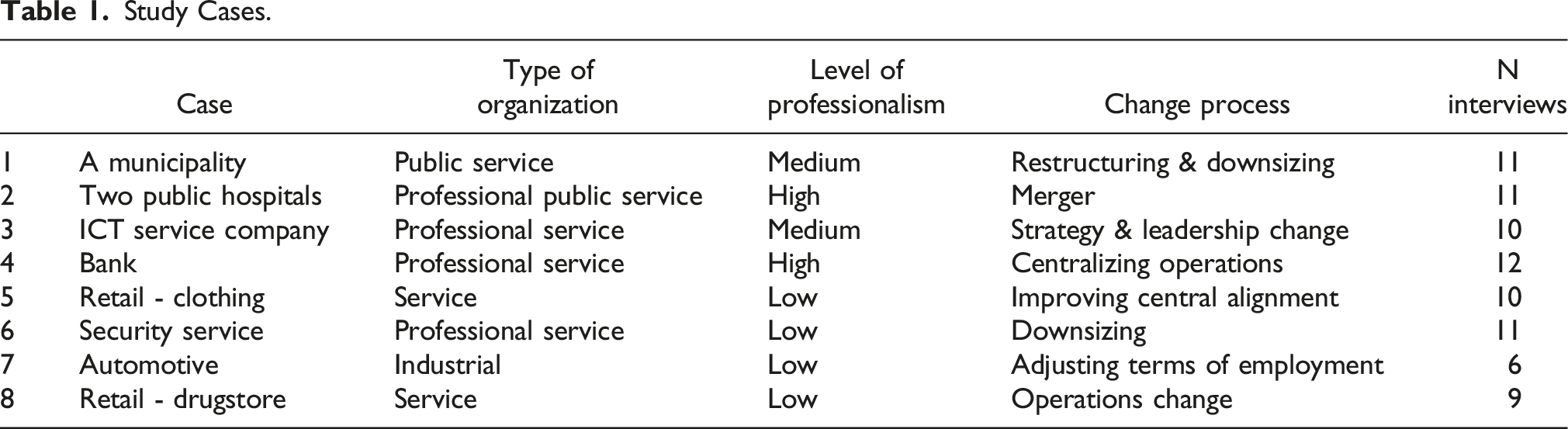
Study Cases.
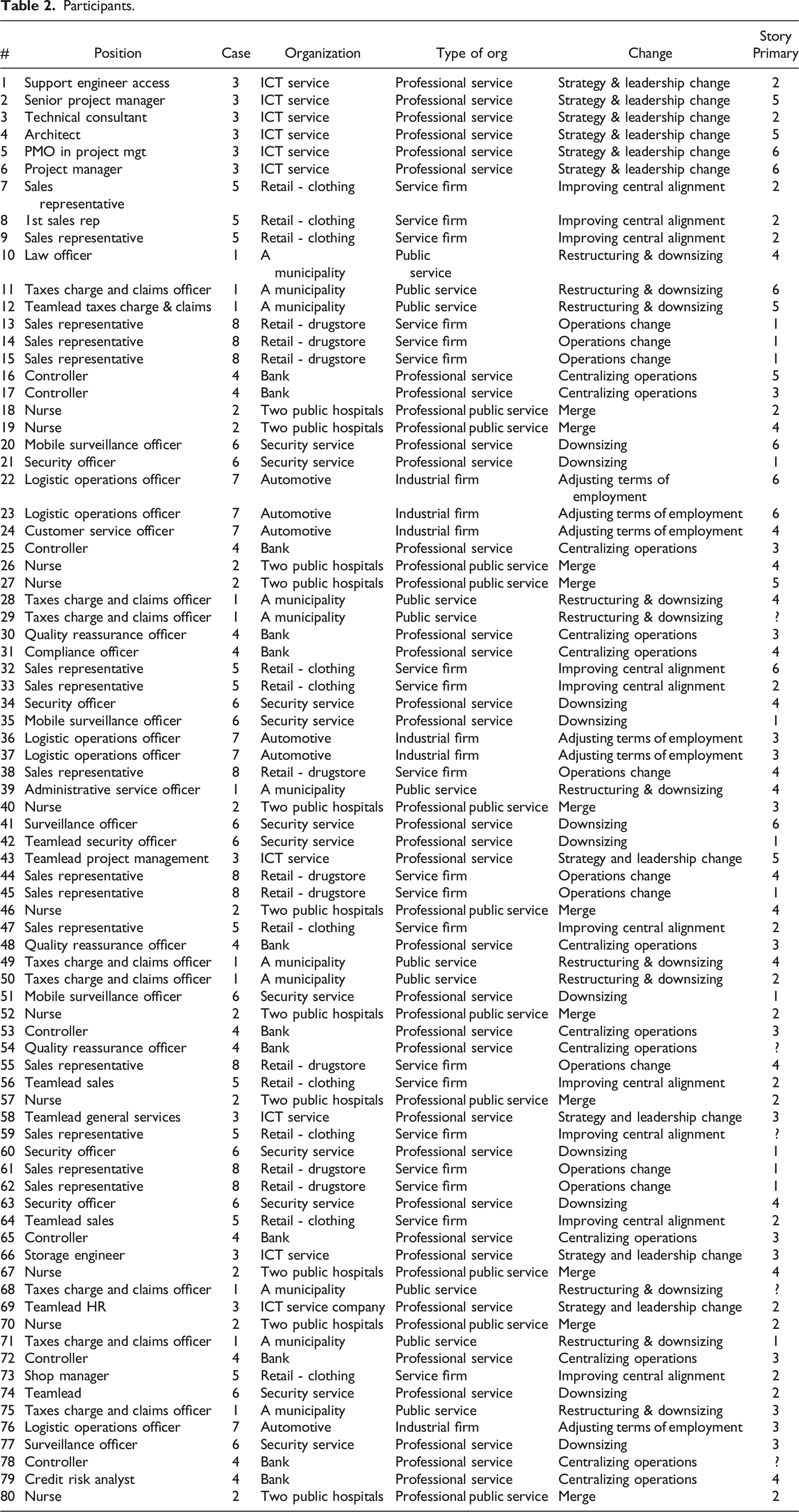
Participants.
Procedure for Data Collection: Assisted Sensemaking
Eighty in-depth interviews have been performed by seven research assistants to involve our participants in assisted retrospective sensemaking of change. The assistants have been trained to perform the interviews, to ensure confidentiality and prevent questions that evoked social desirability (Furnham, 1986). We have used an open question interviewing technique and semi-structured guideline (see Appendix 1) borrowed from oral history research (Charlton et al., 2006; Jansen & Shipp, 2019). In several steps, interviewees have been assisted in (re)constructing different episodes of their retrospective accounts of the change as if they were chapters of a fictitious book. They have been invited to name/label every chapter of their story to capture each episode’s essence from their viewpoint. The interview guideline has been developed to assist participants in recounting their stories on a moment-by-moment basis, including prompting for narrative elements such as time, place, turning points (critical incidents/unexpected changes), and plots (choice moments that lead to the stories’ progression and resolution - Connelly & Clandinin, 1990). These story-oriented prompts have assisted participants in telling and reliving their experiences in rich detail (Saunders et al., 2012). After interviewees’ stories had been reconstructed on a timeline of ‘book chapters’, we once more revisited their accounts to coalesce it with the role they personally played in each chapter. In particular, participants have been asked to describe their role, in terms of the behavioral anchors provided by Herscovitch and Meyer (2002). These are: active resistance, passive resistance, compliance, cooperation, and championing change. In doing so, participants have been assisted in making sense of their own role development, anchored by chapters (on an x-axis) and concrete behaviors over their own story timeline (on a concomitant y-axis). This is how the procedure assisted them in making (first) sense of the various change episodes and their role within it. We have referred to participants’ input as their accounts of sensemaking, in short, their accounts. The individual interviews were intensive and have lasted between 60 and 90 minutes. All have been electronically recorded, transcribed verbatim and made available to all authors.
Analytical Procedure and Data Analysis
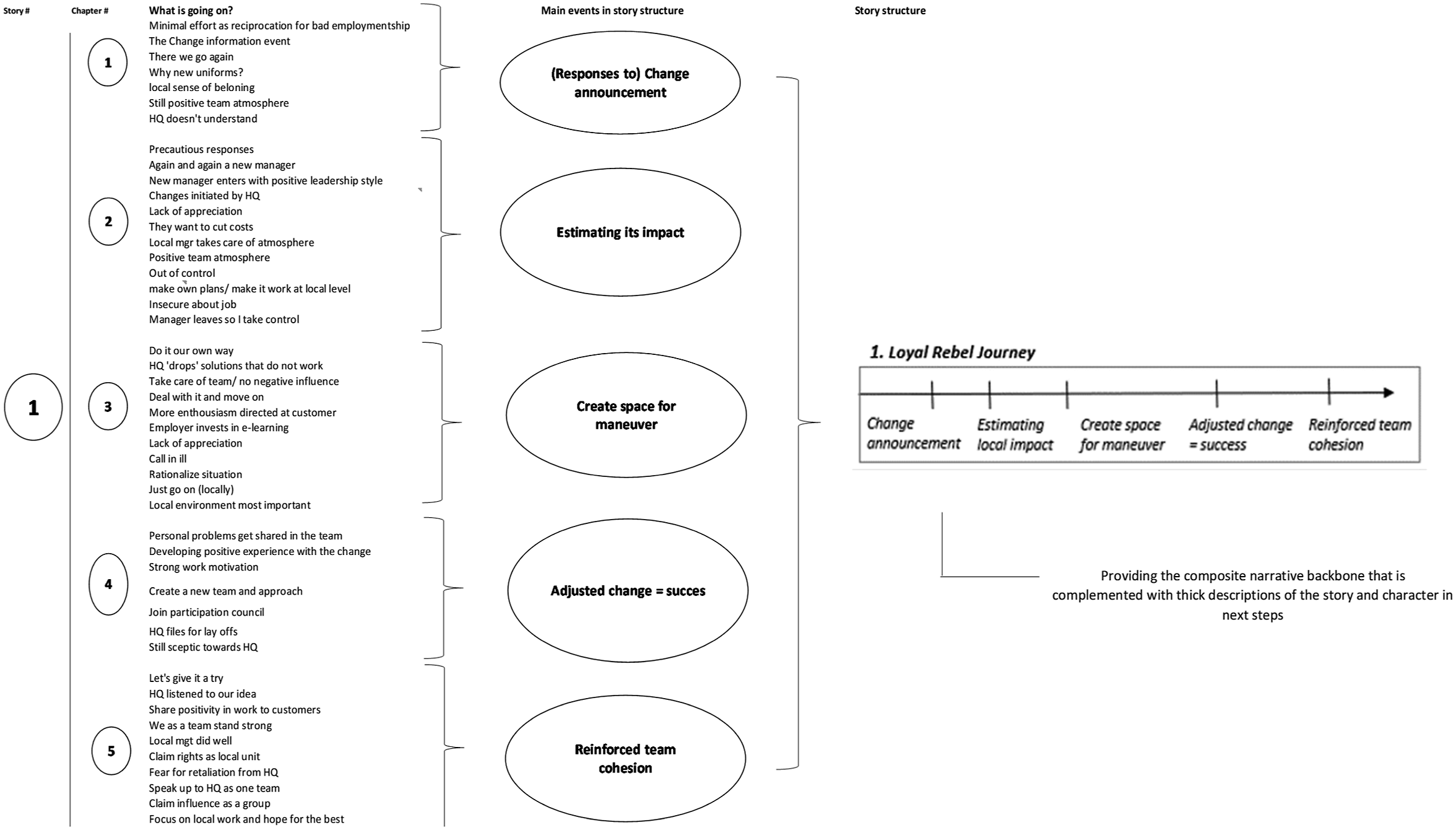
As can be seen in Figure 1, the analytical process involved multiple steps and has started with reading and re-reading the individual stories. We have carefully read every chapter title of every story that had been provided by the participants and we have considered the roles they had assigned to themselves per chapter. We have then coded the chapters based on our interpretation of what was most important to the recipient in that moment of the change process and have collected quotes that illustrated our reasoning. An early observation upon doing this first analysis has been that story elements within individual accounts were highly comparable in terms of themes that reflected what it is like to be a recipient (e.g., you can be a hero, a vassal, a victim, etc.). We have also recognized similar main events (e.g., ‘the corporate announcement of change’) taking place in many of the individual accounts. In terms of initial events that had come up, it appeared that several ‘families’ of stories could be recognized. As an illustration of our procedure of coding the chapters, Figure 2 includes the coding outcome for what eventually led to composite narrative one. The Figure illustrates how we have moved from the outcomes of chapter coding, to the main events per chapter, and to sequences of those events in story order. Story analysis leading to composite narratives. Note: Moving from chapter accounts to the analysis of sets of (similar) stories, to induced narrative scripts (based on Pentland, 1999). Moving from chapters to story structure (Example of composite narrative 1).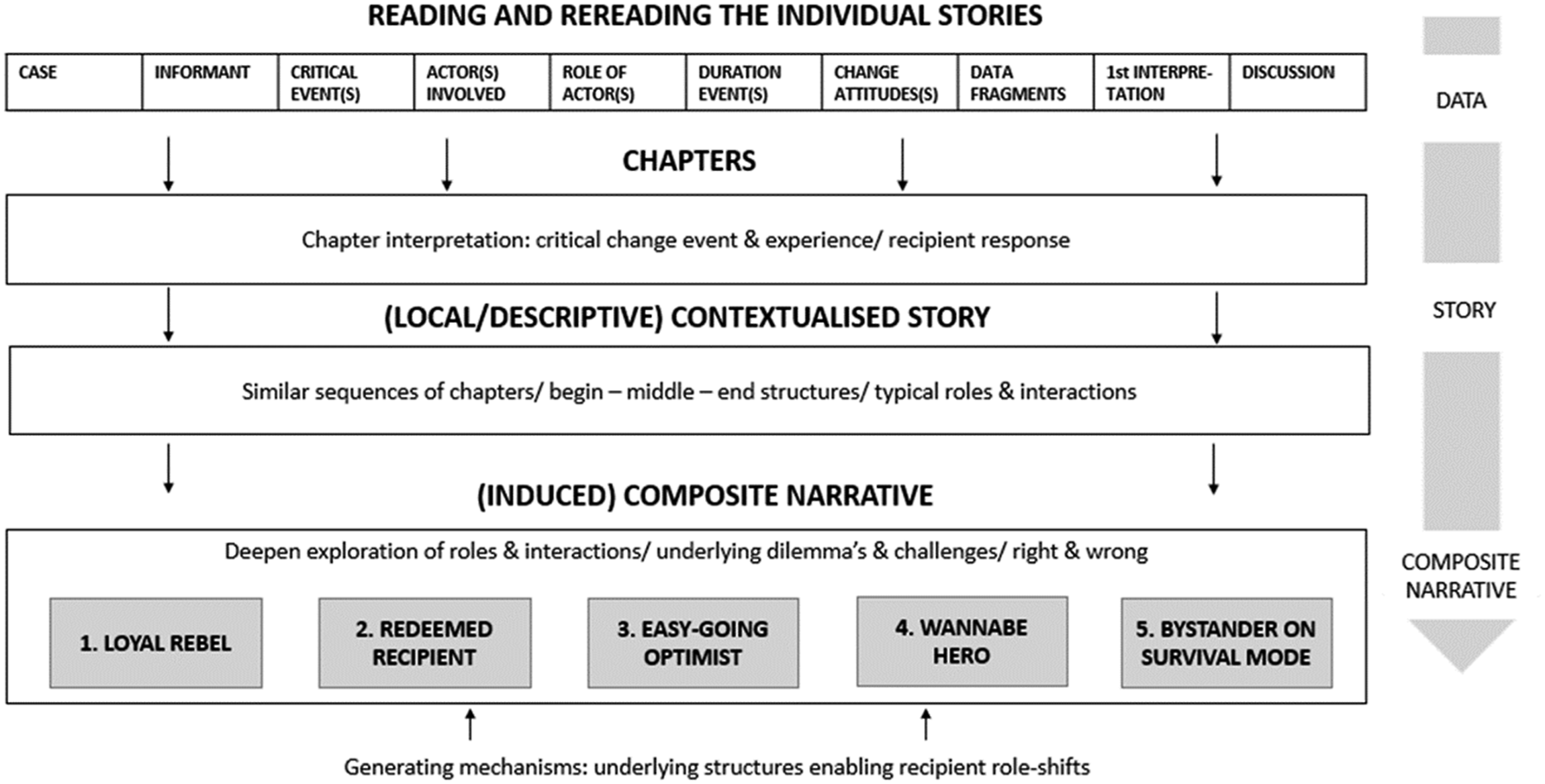
The fact that we had found several similar storylines has made us decide to direct our analysis to constructing composite narratives. Composite narratives use data from several individual interviews to tell a single story (Vaara et al., 2016; Willis, 2019). An important advantage of composite narratives is that the use of single accounts can represent more general accounts of experiences of multiple individuals. With this, the researchers use their interpretations to create narratives that capture the essence of (in our case) recipients’ experiences and perspectives and their emotional truth (Orbach, 2000) that function as “an authentic representation of feeling states rather than a strict adherence to narrative truth” (Orbach, 2000, p. 197). Whilst this use of composite narratives is a compelling way of presenting qualitative research, to make convincing arguments, the link between the original data and the final interpretations must be made very clear by intensive use of quotes to strengthen validity of the researchers’ interpretations (Moen, 2006). To minimize possible disadvantages to this method, we have worked with a large number of interviews to see if our interpretations were robust and have worked together with a team of six researchers with diverse backgrounds to broaden our view and to prevent too much influence from our own experiences. Throughout this process, we have used memos and discussion sessions in the team of authors to refine and reflect on our analyses.
Subsequently to our initial analysis, we have turned to Pentland’s (1999) work on building dynamic narratives to explore in more detail how idiosyncratic individual stories reflected more common, sequenced events. It has allowed us to explore the stories’ surface features (such as daily interactions mentioned) that are useful for description, but also to gain a better understanding of what this interaction meant to the participant (i.e., was it perceived a ‘moment of truth’ that triggered a turning point in the journey?). Subsequently, we have combined the insights from all previous steps and produced five “thick” (Geertz, 1973) - that is: rich and textured - descriptions in composite narratives. The analyses led to five, instead of the initial six, composite narratives as two of the earlier composite narratives included overlap and have eventually been combined into one. Thereafter we have explored the commonalities in different sets of similar stories. Inspired by the work of Van Ooijen et al. (2020), we have explored common notions on roles and interactions, underlying dilemmas, and challenges, as well as beliefs of right and wrong, and of appropriate and inappropriate behaviors that had been found to exemplify narratives and shifts within them. Pentland (1999) described this step as moving from surface to deep structure.
To summarize the analytical process (see Figure 1): we have considered our data as subjective, in situ individual samplings of underlying latent categories of narratives. By studying and comparing the stories in our sample, we have been able to (re)construct five composite narratives. During the analysis, we have gone back and forth between stories (the data) and narratives (Sonenshein, 2010). In doing so, we have noted in some cases that we had been too specific on certain topics in a composite narrative (details that had not or not often been found in similar stories), or that we had overlooked important details that strengthen the characterization of a certain narrative (i.e., we had come to recognize new similarities). Iterative adjustments of clarifying the underlying narrative have continued throughout the entire process of coding the total of 80 interviews in our study. Finally, we have examined whether the final composite narratives reflected observations across different participating organizations, which was indeed the case. To strengthen the validity of our findings, we have invited a ‘friendly reviewer’ who was not familiar with the study to provide feedback on our analyses and outcomes and, additionally have presented the outcomes to several professionals (not participants) in different fields from whom we received feedback on the different role taking journeys.
Findings
Recipients’ Role Taking Reflected in Five Composite Narratives
Summary of 5 Recipient-Based Composite Narratives.
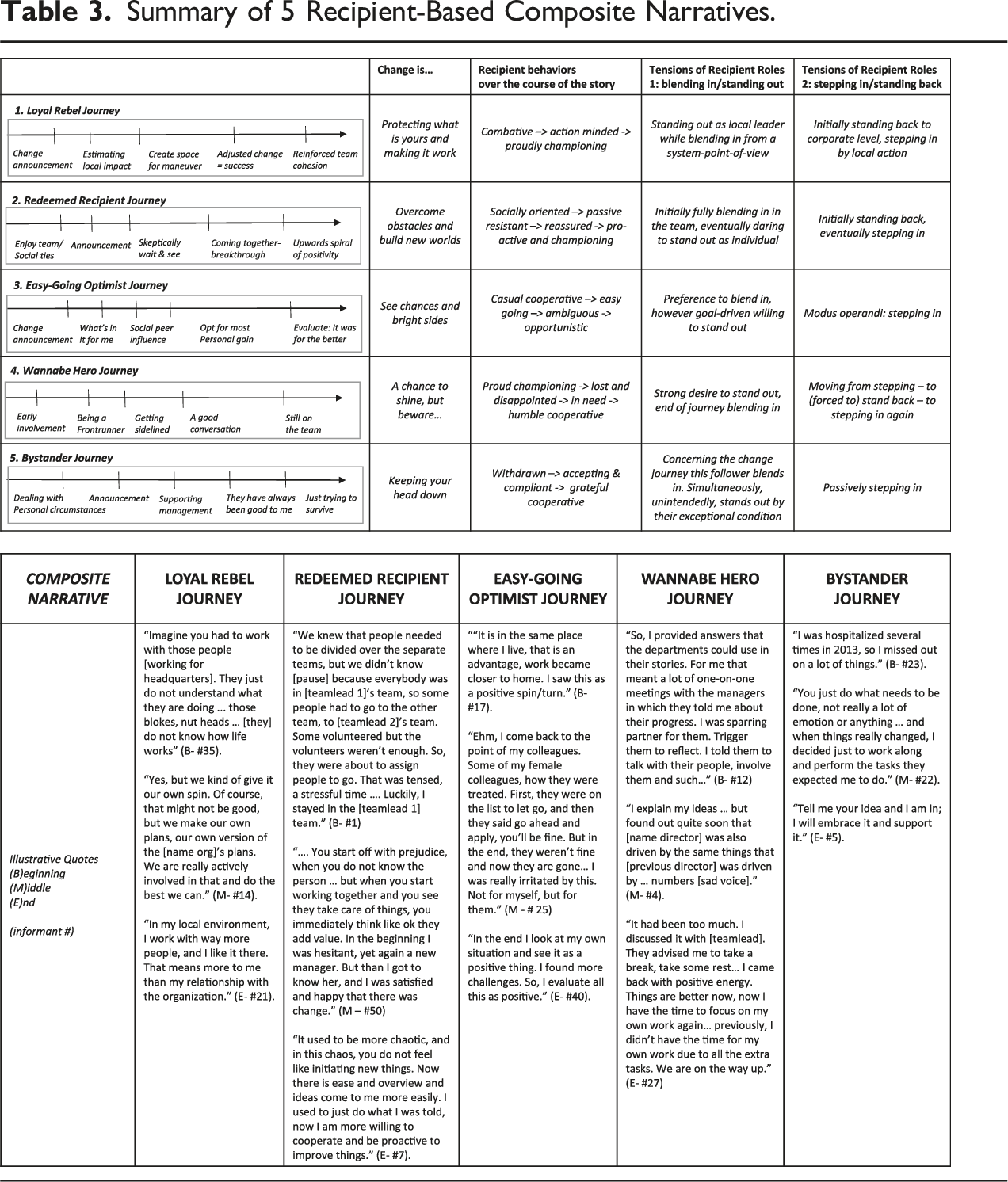
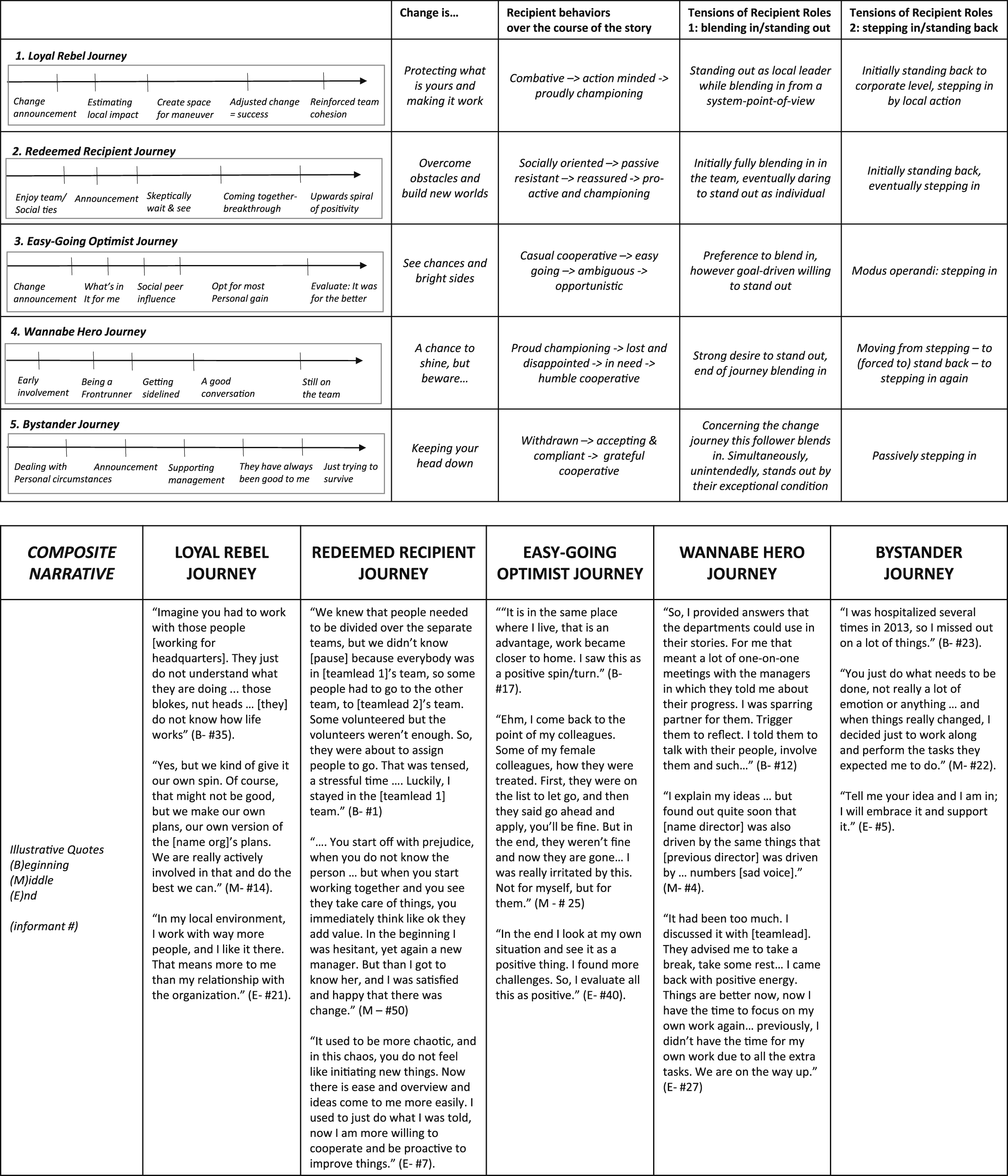
Composite Narrative 1. The Journey of the Loyal Rebel
Stories that fit this narrative have a dominant leader 1 - recipient “dialectic” outlook (dealing with contradictions: see Boje, 2008, p. 19). The narrative tells how physical distance allows Recipients to construct Leadership as a powerful outgroup, even within an organization (Stensaker et al., 2020). This is illustrated by the story of a sales representative working in a franchise drugstore (Participant #13). The composite narrative begins with corporate communication about an upcoming change as the event that triggers sensemaking. Recipients establish an understanding that the distant originators of this change clearly have no knowledge and competence, as, in their belief, the plans are not going to work on the work floor. The change announcement of Leadership seems to cause Recipients to exert a combative, subversive role.
Recipients believe that Leadership, more often than not, appears as devious force that creates obstacles for transforming plans into practice and that misunderstands local realities. Herein, Recipients perceive that disidentifying with Leaders is what they should do. As described: “And of course, at time x, we received a new corporate vision … all kinds of rules that we had to follow. It is really nice of headquarters to come up with new things [irony], but some of those things just aren’t doable. I think they just let the interns take care of it, they know theory. On shop floor, things work totally different.” (13) “We operate in a different region, there are culture differences … the expectations from headquarters, they frustrate us.” (13)
The question “What can you tell me about the change program?” was answered as follows: “Actually … not much (laughs)! We did think of it, yet I do not feel it … yeah it might have had some minor impact. But actually, we did not implement it, nor do we use it in any way … no”. (13)
To prevent disastrous consequences from overt defiance of Leadership, Recipients and their peers decide to make the change a success in their local context, despite the challenges that it entails. After all, they feel loyal to their local environment and its success. Their role changes as they (perhaps unwittingly) shift towards becoming actively engaged as translators of a change idea. Recipients actively adapt the change plans to local contingencies (proactivity-as-frustration, Bindl, 2019). The sales representative continued to describe this event: “We just alter our actions. Headquarters doesn’t approve, but in the end, this is the way we do get the customers in and become successful …” … “Headquarters just does not know how operations run here; we do. We know when our customers receive their money (salary) and that is how we decide on promotion timing. We do it almost as taken-for-granted intervention: the adjustment of corporate actions.” (13)
Despite perceiving Leadership with a sense of animosity, Recipients are strongly motivated to make the change a success in the local context. To this end, they actively take up the role of informal leader, dare to stand out, and convince others that plans need to be altered by them. After ‘cleaning up Leadership’s mess’, they make change a local success by their active engagement in finding alternative pathways. “[Change is] a learning process. Always. There is always … you know, when change is announced, there is a response. You have to think about it, cool down a bit, and then you are like ‘OK, let’s do this [our way] and see what results we could achieve’.” (13)
The question “Do you feel the change was a success” was answered as follows: “Yes, we still meet our targets. I think that is important. And also, a ‘straight A’ for the customer. Customer centricity is most important here. For me, that is the number one priority.” (13)
Recipients continue their loyalty to nearby actors, while holding on to a negative attitude towards the (central) Leadership. “We have always been involved in the team. You can tell …. we have a strong bond. We fill in for each … never a hassle. We do the best we can here, and I tell my colleagues we are here for our customers, and we know what they are like … We hope it will get better, but I still think headquarters is not listening to us …” (13) “There are also the local stores that do exactly as headquarter commands, resulting in stock problems that we do not have. We are kind of cocky, that shows how much we care.” (13)
In summary, we considered the Loyal Rebel who, with continuous active engagement, initially feels the urge to combatively stand out. They could be considered a “rebel with a cause” (Jordan et al., 2022, p. 2). Despite their defiant initial response, by acting together with their local peers, they ultimately step in and make the change a success. This shift is also illustrated by Participant #14: “Let’s start this story with [name project]. A headquarters thing, yet the local stores were the ones dealing with all the troubles you see, and we wanted to resist … Yes, but then we kind of give it our own spin. Of course, that might not be good, but we make our own plans, our own version of the [name org]’s plans. But we are actively involved in that and do the best we can. It is here (locally) that we have a super team. You can complain you know, but in the end, that does not solve anything. It is in our team that we just fix things together.” (14)
Composite Narrative 2. The Journey of the Redeemed Recipient
This narrative tells a classic ‘redemption story’ (breakthrough from shadow into light: Booker, 2004). Recipients strongly value social harmony and build their experience of working life upon the social atmosphere (‘nice colleagues, i.e. what work is about’). At first, Recipients perceive their role as passive players with little responsibility and little room for independent thinking. The Leader plays the role of decision maker who endangers this beloved status quo and, subsequently, Recipients adopt a skeptical stance. Stories that fit this composite narrative begin with Recipients describing early change announcements that in their sensemaking is perceived to be a threat to the team’s cohesion and stability. Early announcements are accompanied by negative rumors spread through the organizational grapevine. This narrative is illustrated by the story of a nurse working in a public hospital that had recently undergone a merger (Participant #18). She talked about being confronted with an upcoming merger:
Given the relatively long period in which Recipients experienced insecurity and negativity, one might intuitively expect a tragic ending (Brown & Humphreys, 2003). However, despite Recipients' initial skepticism and fear in the period between change communication and the actual implementation, they soon feel relieved after the change becomes a reality. “Rumors were spread about an upcoming merger… The biggest impact factor of the change is: The Team… who and what am I about to lose? You know what you have [people in the team], looking at it in a sense that I trust them completely and well, the ones you will get to work with in the new situation, you don’t know yet, it is unpredictable. So, you worry about the fact that they will come in and cooperate …” (18) “We knew nothing. We just heard this is your team. End of story … there was not much for me to do, just to blend in with the rest and read the messages, that’s it …” (18) “The moment they communicate the teams, I responded quite selfishly. [My only concern was] in which team will I work, and with whom?” (18)
It turns out that initial worries are disproven and that this event might be a starting point for more positive changes to come. Recipients are satisfied with early change results, and the new (social) situation marks a positive turn in the overall atmosphere [a shift from a regressive to a progressive story (Gergen & Gergen, 1997)]. Recipients shift towards more contributing roles in accordance with their Leader’s goals. By going through these positive spins, Recipients and Peers experience a strengthened self-confidence. Consequently, their role became more proactive, and they took up responsibility for positive outcomes (‘proactivity-as-growth’, Bindl, 2019). “In the first meeting we all came together. I felt happy with the composition of the team. Leadership really managed to bring together matching characters … You just start, scan, getting used to each other, and from there you start building.” (18) “You start experiencing things together and explore how things got better. It all just turned out really well… I started championing, in the sense, you try and coach and stimulate colleagues and show them around, and help them to get accustomed in a short period of time … By actively helping them and discussing cases like this or that, I created a guiding document for new colleagues.” (18)
The social order becomes realigned in the next episode: [About the ‘getting used’ phase] “It is difficult. You try to coach others, but at the same time, you want to lay low a bit. It is a bit of both … you also want to give colleagues enough space, they are all qualified, so you do not want to overrule or show yourself too dominantly … I was active, but also waiting. Now I know them better, and I know, as an equivalent colleague, when I can have the upper hand.” (18)
Change events create a cumulating positive effect for the team and Recipients foresee a bright future towards the end of this narrative. As stated by our participant: “Long story short, we are now 6 months in, and we have a strong team that knows each other’s strengths. Everyone has their points for improvement, but we help each other out. We try to help each other to reach new levels, that was not the case before. The merge really accomplished this. This is a strong team.” (18)
Throughout the narrative, recipients’ independent thinking strengthen and their in-role focus on both the collective and the self becomes more balanced. “I became more positive and firmer. I developed as a person. I got a lot of new colleagues in this situation. It made me stronger and active as I coach people nowadays.” (18)
In summary, we refer to the journey of the Redeemed Recipient, who carefully shifts from an insecure skeptic to an active contributor. Such a journey includes a tension between a desire to stay safe (‘holding back’) and simultaneously an excitement to receive recognition for one’s potential contributions (‘stepping in’). The eventual resolution of this tension drives the narrative forward and allows the recipient to adjust their behavior regarding (their level of) active engagement. This point can best be illustrated by considering two co-workers (Participant #7 and #8) who reflected on a ‘breakthrough’ moment in their change journey (note the shift from narrating in terms of “we” towards using the term “I”). Participant #7: “There was a time we did not want to go to work. Two people were asked to keep an eye on us, it made us feel very bad. We were mistrusted and therefore felt insecure … But when she left, everything changed. I did not expect it to turn out this positively. Now that she has left, the atmosphere is much better, and I even made some changes in the store by myself. Now, I just see things that need to be solved and I fix them. The new atmosphere makes for me that I enjoy coming to work now.” (7)
This illustration is continued by a complementary account provided by co-worker Participant #8: “My confidence strengthened because I felt heard, and I received compliments. This never happened. It motivated me to show interest in what I am doing, I felt motivated to set an example of good behavior to the rest of the team … the change made that she left and the three new people that came fit our team very well.” (8)
Composite Narrative 3. The Journey of the Easy-Going Optimist
This narrative tells the story of Recipients who tend to interpret their leaders’ messages as ideas that make sense according to their own worldview and that might have substantial benefits. Recipients perceive themselves as relational team players and sociable, easy-going types. They are prone to be transactionally supportive of whatever is happening as long as this fits personal benefit. The Leader plays the role of change decision maker. The composite narrative is illustrated by the story of a quality officer working in a bank office that had recently undergone a merger and centralization of operations to headquarters (Participant #30). This story describes how Recipients, upon receiving corporate change communication, reason in a rather easy-going manner:
As an event-response, Recipients evaluate what could be the personal gain resulting from this change. Based on the evaluation outcome of perceived personal benefit, they feel optimistic, and behave somewhat opportunistic. In their search for personal benefits (e.g., career advancement), transactional cooperation is a suited employed tactic. “Oh well, I expected the change. There were signals and rumors, you know, those things always come to you quite gently. To me, it was obvious that this was coming … It is a good change, we are in a business of change, based on government policies and corporate office of course, logically, there are many changes.” (30)
However, soon after this early sensemaking, Recipients feel ambivalent when they are confronted with negative change consequences for well-respected Peers who, worst-case, might even lose their jobs. For a short time, it seems impossible to decide whose side to choose. On the one hand, Recipients want to actively engage in change and thereby maintain a good relationship with their Leader. Alternatively, they feel an urge to empathize with their Peers and join them in their resistance roles. “I recognized opportunities. I wanted to work in credit rating, as I was already active there during my flexible day … I thought, well, I see chances ahead. But when it became clear that this was not going to work out, that was not a problem, oh well, you see, I understood it would be difficult for the bank to give me that position. My work as an assistant phased out, so then I became a quality control officer, and I liked that even so. I am always involved in self-development.” (30)
This issue troubles Recipients as they rather avoid conflicts on both sides. A response aimed at maximal personal gain typically resolves this situation. Their role shifts from abiding social norms to displaying autonomous, self-enhancement focused behavior. In this narrative, utility is maximized by going along with the change. “I never experienced negativity in this change, although, there was one thing. My new role, it was in the same month that my colleagues heard they couldn’t stay. That tempered my joy obviously … Of course, it was great for me, but at the same time it is tough … Colleagues having their last day, you hug them and then it is difficult, with tears in your eyes and you think ****! Why does it have to be this way?” (30)
Once the change is implemented, Recipients reflect positively on the consequences while easily moving on. All of this is played out in a no-drama, easy-going, style. “For me it ended well. My manager told me that I immediately fitted in. He said that I quickly adapted to my new role, as from day one, I felt like a fish in the water … I started working four days [instead of three] … For me it was all a positive result.” (30) “I discussed the situation with a colleague … we go for a walk and of course we talked about it. The procedure and consequences and all. But it is not like that I continue to think of it, no it is more that I just ‘turn the switch’ … It concerns their feelings mostly, you see, it is not that I would be, for example, less joyful just because they will no longer be around.” (30)
In summary, the Easy-going Optimist tends to blend in as they appear agreeable to the needs and wants of the people around them. However, this is not their only driver as they even so appear optimistically (or even opportunistically) goal driven or opting for behaviors that are causing least trouble. Those different, and in this narrative conflicting, considerations cause tension that results in altering their level of individual thinking throughout the story. This tension triggers this protagonist to develop their position from a ‘blend in’ position in the beginning to a ‘standing out’ position near the end. As is illustrated by Participant #17 below, there does not seem to be a clear change-event that introduces a solution or triggers the resolution of tension. It appears to be more like a mindset of this focal actor to ‘just move on’ and not hold back. “I thought it was only logical, my thoughts were positive rather than negative … But then Leadership abandoned and sidelined some colleagues, personally I really struggled to deal with this … yet you move on you know, and start to seek for new opportunities, what’s next? How will we do this? You know, you must stand out, make yourself known and strengthen your visibility.” (17)
Composite Narrative 4. The Journey of the Wannabe Hero
This narrative illustrates quite turbulent shifts on the part of Recipients and tells the story of a change journey that begins with Recipients proudly reflecting on their status as (co-)inventors of change. Together with their Leader, they enjoy the status of ‘initiator’, feel responsible for events aimed at implementation of great ideas, and engage in discretionary, extra-role behaviors. Self-enhancement seems a likely motive. Seemingly, this focal actor is a member of the ‘guiding coalition’ discussed in many classic change models (Stouten et al., 2018). The composite narrative is illustrated by a controller working in a local bank office that had recently undergone a merger while several operations had been centralized to headquarters (Participant #16). “I was invited as project leader. So, therefore, the whole change intensified in terms of my engagement. As you become actively involved, you react pro-actively. All that happens is initiated by you … I really joined the change team at the early start of it all. Literally sitting down with top management. So that is where it all started, and we really took the lead to decide this is what we will do. I really enjoyed that part … It all starts with the Executives talking to each other. There was a regional director, some corporate director, and me. At that point, no one else knew about this.” (16) “This early stage, oh I really liked that. It was so interesting, like, how does this work, those banks coming together, the fact that you are involved makes that you don’t find yourself negatively overwhelmed by it all. This role completely alters the experience of change.” (16)
In this role, Recipients show understanding for their Leader’s choices on, for example, change communications, which (as we noticed in other composites) have the potential to trigger negative evaluations of the experience for other Recipients.
The rosy start is followed by a reality shock after Recipients feel sidelined. What follows is a moment of disorientation or (in some cases even) subversion as Recipients cannot keep up with their Leaders. We observe Leaders overruling the informal leadership position of Recipients, and/or Recipients becoming exhausted and overwhelmed, and hence feeling forced to slow down. Whereas Recipients and Leaders used to be partners, Leaders take over and make decisions based on different motives. [About work floor colleagues not knowing more details] “The alternative would be that you do not share with your people. The disadvantage then is that you are way ahead in the process, while employees know nothing. You give them less time to get used to the basic idea that something is about to change. And IF info ‘leaks’, you have a lot of explaining to do. No, I really think this [announcement without details] is the best solution.” (16) “So, it turned out it was not my role to influence or decide on who was going to end up in what position. I did encourage them to make a choice, but it was not up to me … Both directors are rather strong willed, or dominant, so to say. It was not up to me to interfere.” (16)
Having a role of change partner becomes especially complicated when implementation moves from strategic levels to tactical and operational levels, and impacts Recipients’ own organizational position: “Once you move past the strategic level, you start discussing consequences for the departments and such. And then my own functional role was part of the conversation so to say. When the impact for Control was on the agenda, I felt like ‘what will this imply for me personally?’ … (16) It is nice to be involved in the change right now, but what happens after that? Will my role still exist? That was complicated and I felt tension … they did not treat me any different from other employees. I was only informed on my position at the moment everyone had their placement talks.” (16)
After a period in which Recipients experience disappointment and disconfirmation, they show resilience. Triggered by the event of a ‘good conversation’ with their Leader, they regain energy and are willing to actively re-engage for the good cause. This event marks another shift. Another quote from the interview with a controller in a bank illustrates this:
Their role as loyalist to their Leader regains potency as Recipients’ need for their Leader’s attention and recognition is gratified. This recognition clearly motivates Recipients to continue their active efforts, yet presently as second-in-command. In the end, it seems plausible that acknowledgement and wanting to contribute to the organizations’ success constitutes their real needs, and by satisfying those, Recipients are modestly happy to be part of this change. “It was a good conversation, got real good feedback. It resulted in the fact that they told me that they rather saw me in business control, more than in a project lead role. A bit disappointed … but I felt OK.” (16)
As the controller reflects on the created story timeline: “I think the change is a success … Yet I was not the initiator, it was not my idea that eventually worked, so in that sense I do not feel responsible for the success. But in certain parts, I obviously took some actions that added to change realization, so yeah, I helped [silence], I did not initiate it … If you look at the quality and intensity of our work, well, you can conclude that we have become a real good bank …” (16) “I started neutral, then the announcement came, and I entered the change arena. That is when you score high [on championing]. Then we managed to get approval from the participation council [still high]. After that, my role changed, and I noticed I was less involved. So, change enthusiasm drops. You become more wait-and-see. If you do not know what is coming, and do not know the context, you endure the experience. Whereas in the new bank [post change], I was always actively helping again, you can say I was championing the change.” (16)
We refer to Participant #2 to showcase once more the in-story role shift of the Wannabe Hero who, in their need for recognition and wanting to contribute, start fully and actively engaged to the change (step in), have a set-back (and hold back), and then manage to step back in again and continue their active engagement for the good cause. Participant #2 applied for a position as change ambassador, stepping in: “Applying for that position was good, I was looking for a new opportunity for a change.” (2)
However, this active engagement gets heavily challenged along the way, this results in holding back: “Out of the blue, Elisabeth mentioned that she wanted to try ‘a different route’ with some ‘new stuff’, and on top of that: a new guy (!), so I said OK FINE (!), if that’s what you want then .... you must go for it. I have doubts if they made a good decision. When P. got the job at that moment of time of course I was angry because how stupid could they be to choose him …” (2)
In the end they shift back in to an active and contributing role, stepping in (again): “After we discussed it, I was like, if it’s not available or possible to join the team, I will go down one step, still cooperating though … Depends on what is going on if it affects you and your team a lot I will championing more to move forward.” (2)
Composite Narrative 5. The Journey of the Bystander
This last, rather short, narrative describes a journey in which Recipients keep their composure as they watch the change unfold from a distance. Whilst most colleagues become emotionally caught up in change events, these Recipients seem pragmatically fine whatever happens. The narrative begins with Recipients interpreting the change as positive development; they describe their Leader as usually doing a good job. This composite narrative is illustrated by a participant working in the internal revenue service department of a municipality (Participant #11):
Then Recipients continued by revealing that their pragmatic labelling is not due to moral callousness but explained by specific personal circumstances that put them in ‘survival mode’. They are not deliberately indifferent; adverse personal circumstances (e.g., health or family matters) prevent them from being actively involved. As the participant working in the internal revenue service department illustrates, the Recipient takes a cooperative attitude in response to change events at work: “My story is short. The changes are just called for. And the assignments that people get are just executed and implemented. You can agree or disagree, but at the end of day, it must be done … Restructuring was announced way in advance. Plans and goals were clearly stated … published online and we received info at home. Just honest, open, transparent … in my view all goes well.” (11) “For me, ‘cooperation’ over the whole course of events. Just one straight line. You see, this is business; in private life, my wife’s health isn’t good, and I cannot fight multiple battles at the same time.” (11)
In summary, this is a story with little role shifting. On the one hand, this emotionally ‘distant’ recipient role taking might stem from limited cognitive space in the presence of more pressing matters. On the other hand, it is a form of reciprocity to their Leader’s empathy with Recipients’ circumstances. Leader showing empathy and understanding towards their personal circumstances. In return, Recipients perceive an indebtedness towards the ‘warm-hearted employer’. As a logistics operator in the automotive firm illustrated (Participant #23), this type of Recipient seems to respond with cooperative change behavior without very strong emotional involvement in the change process. “I basically continued doing what I always did. I always want to cooperate. My mind was set to surviving, had to get back into the work and just focus on that. I had been ill, so just focus on recovery …. When I was ill, they treated me well, everyone in the organisation, also HRM and leadership, and colleagues. You know, if you received this level of cooperation, then you do not resist their actions. I did not want to be a ‘bogeyman’.” (23)
Tensions and Ambivalence in Recipients’ Perceived Experiences
We recognize commonalities in recipients’ contradicting needs that seem to drive behavioral choices when confronted with change. In four out of the five composite narratives (the Bystander excluded) these contradicting needs, or tensions, trigger in-story role shifts in perceived recipient behaviors. First, our interpreted observation is that a common tension is felt between fulfilling one’s need to preserve individuality and be recognized as individual by their management and/or peers (‘standing out’), versus the need to immerse oneself in collective action (‘blending in’). We use a quote reflecting the inner dialogue of participant 17, classified as an Easy-Going Optimist journey, as an illustration of navigating such tension: “So, then I thought, should I indeed pull myself together now and go all the way to get noticed .... or should I just be happy that I still have a job and that I can fulfill the same function here... I was also thinking to myself, on the one hand yes, I should be happy that I still have a job, but on the other, should I rather have that annoying conversation to stand out? .... I even felt a bit burdened.... I thought well [own name] come on, join the club as you still have a job and a nice job. [Adjusting to] That segment, that will be fine too.” (17).
Second, our interpreted observation is that recipients often struggle to balance their need for recognition as being an actively supporting recipient (‘stepping in’), versus a need to stay safe and avoid change and/or voice skeptical concerns and doubts concerning their leaders’ calls to action. The latter (avoid change and/or voice sceptic) are associated with respectively hesitant and/or resistant cognitions and both seem to result in ‘lean back’ behaviors (‘holding back’). Participant 3, classified as Redeemed Recipient journey, provided an example of what, in their story, resolved this tension and made them decide to step in. “Well, I had some good conversations with [name colleague] and my teamlead, I am now a bit more into the meetings. And I was a bit more involved in what was happening and what they are planning to do. And if you get more involved and plans are stated more clearly then of course you either cooperate or you go into resistance. And I thought it was a good idea actually, to do it like this. And it felt good to be involved of course.” (3).
Such dynamics were found in many different forms. Some were easy to observe, as was the case in the above illustration of participant 17, some were more of an implicit nature. As for example the focal actor in the Loyal Rebel narrative shows a strong need for autonomy that relates to what we referred to as ‘standing out’. This autonomy is gained by perceiving Leadership in a role of distant actor that limits the autonomy of the protagonist. For example, Participant #35 opens their story with: “Imagine you had to work with those people [working for headquarters]. They just do not understand what they are doing ... those blokes, nut heads … [they] do not know how life works”. (35)
As a defender of autonomy, the Loyal Rebel seems to play out as a taken-for-granted position of protector of in-group interests. However, when we would only observe recipients’ need for autonomy as we just argued, we would miss the fact that belongingness (blending in) might be evenly important to this focal actor as well. This is illustrated in the narrative as the Loyal Rebel not only stresses a strong sense of belongingness to the local team (“it’s family”, #35), but they also use the system of ‘headquarters versus local operations’ to have a distant power to relate to. Otherwise stated: it is useful to have a headquarters to disagree with, as a familiar and ‘safe game’ to play for this actor. One might argue that if their need for autonomy had full hegemony over other needs, this actor might have never chosen to work in a subdepartment of a large organization in the first place. This reasoning underlines the ambivalence of change experiences and relevance of context into the understanding of recipients’ responses that is captured in the composed narratives. Column 3 to 5 of Table 3 include our notions on the role shifts related to the ‘blending in versus standing out’ and ‘stepping in versus holding back’ tensions.
Our results illustrate that in their attempts to satisfy diverse needs, recipients end up taking roles and making role shifts as a result (e.g., from ‘standing out’ to ‘blending in’). When considering the navigation throughout these tensions and dilemmas all together, we illustrate how composite narratives allow recipients sensemaking of their own roles in change to move beyond flat characters (i.e., deterministic, person-based theories) and rather induce in-role content that is more textured, flexible, and ambivalent (Ketoviki & Mantere, 2010).
Discussion
In this work, we explored recipients perceived role taking, by analyzing their storied experiences over the course of actual change processes. We provided empirical insights in the subjective interpretations that account for the sheer variety of change reactions. Second, we showed how narrative inflection points, that is, points of distinct change in role taking, can happen following certain events. This shows how recipients’ perceived role taking is not just based on personality differences but also depends on the different interpretations of the change contexts that they face. We identified five composite narratives that represent recipients’ role taking journeys: Loyal Rebel (combative at first, cooperating in the end), Redeemed Recipient (insecure and powerless, becoming a champion), Easy-going Optimist (easy experience despite short-term loyalty conflict), Wannabe Hero (change initiator, heavily disappointed, reestablished commitment), and Bystander (uneventful cooperative out of private concerns) (Table 3). The composite narratives are constructed from subjective lived experiences and include in-story role shifts that seem to relate to dilemmas that arise in interaction and occurring events as change unfolds. With this approach, we build on the common idea of recipient role taking as a social construct (Bandura, 1986) that is dependent on situational events, interactions, and context (Grønvad et al., 2023). From the start, we proposed that culturally scripted recipient stories could be shared across organizational settings (Garud et al., 2011; Jung, 2014). While our inductive data do not necessarily provide support for this presumption, our empirical results do show that recipients do not enter a change initiative as a tabula rasa. Instead, recipients craft similar stories as they reflect on their experiences, even across different contexts. These can be seen as autonomous stories that recipients use to reflect on their roles, as opposed to the much more prevalent stories that change leaders profess. More generally, this insight shows the varied and dynamic nature of role taking processes during organizational change episodes (Beigi et al., 2019). Several issues are worth discussing in more detail.
Common Characterizations of Recipients’ Perceived Role Taking
The composite narratives show common characterizations of recipients’ perceived role taking which are reflective of underlying sense making activities about how to fulfill one’s role upon experiencing certain change events. This notion goes beyond the common view of a locally shared understanding of change that stems from social and conversational aspects within organizations (Stigliani & Ravasi, 2012), and it challenges conclusions drawn in previous research that physical boundaries between employees lead to fundamentally different change stories (Stensaker et al., 2020). The fact that we found five role taking descriptions in the stories across organizational settings and industries can be explained in two fundamentally different ways. First, starting from a strict realist assumption that composite narratives are based – at least in part – on a real unfolding of events (Vaara et al., 2016), one might argue that there is apparently a typical set of ‘clusterings’ of events that shows similarity between contexts. This would mean that there are simply a limited number of ways in which organizational change factually ‘plays out’ for a recipient. Alternatively, in an interpretivist interpretation the composite narratives found here may be reflective of a deeper cultural repertoire, of implicitly shared recipient role taking scripts that are recognizable across contexts, rather than specific to any one particular organization. Both the realist and the interpretivist explanations are consistent with the composite approach to narratives, in that they are, at least in part, composed from institutionalized story repertoires (Colyvas & Maroulis, 2015). They differ in the presumed origin of the observed inter-context regularity. Moreover, there is no need for an either-or explanation here, as both may be – and probably are - operative at the same time.
We do not argue that the five composite narratives composed in this scholarly work would be the only role templates available for recipients in their retrospective sensemaking processes. Different, or variations of, the narratives that we have found, might arise in similar studies (Ketoviki & Mantere, 2010). However, based on our results, we now know that this small set of five narratives commonly exists across change contexts and scenarios, and are likely to be found in other contexts as well, especially if stories are repeatedly shared. Moreover, based on storytelling theory, it might be that those composite narratives might have become more readily available than the actual individual change memories (Boje, 2008). Ideas on how to take up a role in organizational change are then composed from storied repertoires that might function as the basis for deriving theory or templates on ‘how to be a recipient’. Moreover, we recognize that some of the composite narratives’ deep structures seem to reflect prototypical roles that are seen in a broader cultural context that has nothing to do with organizational change but is expressed in art, (management) literature, and folk wisdom. For instance, the fate of rebels and redeemers are recognized in a much broader sense of cultural memes reflected in books, movies, plays, etcetera. The idea that stories transcend organizational change contexts would make sense as it may be very difficult to make sense of a role that is not somehow recognizable in one’s cultural context.
Navigating Paradoxical Dilemmas: Explaining Variety and Role Shifts
Whereas it was long thought that change behaviors stem from individual characteristics or traits rooted in one’s personality (Goldberg, 1990), we align with more current work that showed that change sensemaking occurs from a temporally informed position in which one considers current, and anticipates on, future needs (Hay et al., 2021; Reissner, 2011; Shipp & Jansen, 2011). Herewith, the composite narratives illustrate and highlight elements of ‘recipient-ship’ that cannot easily be captured by an approach that would focus on personality/traits or behavioral responses only. Further, our approach adds to the growing exploration of dynamic aspects of workplace phenomena (Jansen & Shipp, 2019; Langley et al., 2013; Van Olffen et al., 2016). Not only can and do recipients alter opinions and beliefs and concurrent responses within their roles, but the narratives also offer an opportunity to justify or explain a change of mind or opinion leading to such role shift that would otherwise conflict with prior behaviors (‘I used to be against the change, but then event X happened and that changed my mind’). Herewith, the composite narratives allow change and inflection to become a natural and only logical part of role taking. As included in the results, we found role shifts in recipients’ responses in four out of the five composite narratives (exception: the Bystander narrative) and were able to capture recipients’ interpretations of the action or circumstance that led to those changes. This provided detail and nuance to recipients’ lived experiences’ sensemaking/storying process [compared to capturing a remembered outcome (i.e., ‘it was all bad’)]. Our approach helped to unify all experienced stimuli into a coherent batch, while remaining close to episodic events, and affective elements (Lord et al., 2020) in the experiences of our participants that formed our studied role taking journeys of change.
In accounting for the form of composite narratives, we induced two dimensions that describe change-related internal tensions (see Table 3). The tensions we described as agency (‘stepping in vs. holding back’), and conformity (‘blending in vs. standing out’) are in line with Kelley’s (1992) foundational work on followership (adjacent to change recipient-ship). In this work, Kelley described how levels of agency and conformity differentiate individuals’ role orientations (Goswami et al., 2022). The aspect of agency resonates with the dimension of activation in Oreg and colleagues’ (2018) circumplex model of recipient behaviors. The composite narratives provide additional notions of the contextual events and interactions that lead to alternating levels of agency. Our observations of conformity as dimension in recipients’ perceived role taking might provide additional insight to the understanding of recipient behaviors. As Van der Schaft et al. (2020) noted, an iterative flow from collective-focused to individual-focused interactions is considered common in employee experiences of change. Dynamics of social exchange (Blau, 1964) and the extent to which people feel the need to think independently or conform during social interactions seems to be an interesting avenue in advancing the understanding of recipient roles as much of the current change research represents an under-socialized picture (Solinger, 2019).
The fact that recipients experience tensions throughout their change journeys aligns with the acknowledgement of recipients’ ambivalence (Oreg & Sverdlik, 2011). Our data shows that recipients – regardless of their ‘role type’ – regularly encounter inflection points as they navigate these tensions, shifting, for instance, their levels of agency and conformity as soon as they recognize a certain ‘momentum for change’ (see also Jansen et al., 2016). In the light of our study, the role perception of change recipients thus is dynamic in nature and seems to be the result of continuous navigation of these tensions. Given that there are such tensions, we concur that “it may be unreasonable to expect that change perceptions remain stable over the course of change” (Jansen et al., 2016, p. 674). It is similarly unlikely that behaviors that fit static typifications would remain stable over the course of change. While recipients’ initial positions toward their leader may be influenced by their traits, our results show that that the changing of roles is ultimately driven by the combination of needs endogenous to changes in contextual conditions (i.e., event-based tensions) that serve as triggers for such shifts as these tensions are resolved. This makes recipients’ role taking ultimately a complex, adaptive, and social process. Our data are witness of this, as their role taking is captured in five multifaceted and textured composite narratives.
Limitations and Future Research
Our narrative interpretivist approach helped us to show how storied accounts of recipients’ personal change experiences reflect variations in their role taking. However, there are some limitations and follow-up questions that are worthwhile to pursue in future. While the composite narratives show very different behaviors at the starting phase of the change process, many journeys navigated towards supportive endings. This finding corroborates with what Bryant and Wolfram Cox (2004, p. 579) labelled the “optimism of the new”, it might be worthwhile to further investigate this thought. Furthermore, while the five composite narratives were found across cases, they were not found to be evenly present within the different participating organizations. As a new research aim, future research could investigate more specific the contexts used and might identify factors of influence on the stories’ unfolding. Prior literature suggested for example that recipient roles could also result from differences in endorsement of certain behaviors or attributes by leadership (e.g., by setting norms and standards for specific behaviors) (Oreg & Berson, 2019). Future research could further examine the commitment of recipients towards a composite narrative and determine under which circumstances they would be able and willing to ‘switch’ or deviate from their prevailing composite narrative, for instance because of social learning and script development (Fiske & Dyer, 1985; Jansen & Shipp, 2019). Furthermore, by sampling 80 stories and by involving six researchers in the process we attempted to solidify our results, however, one must note that it is still a reflection of how change recipients “may” behave as Lincoln and Guba (1985, p. 191) stated. To extend generalizability, comparable studies in other countries could complement our insights, as in different societies, different (cultural) narrative templates may prevail (Oreg & Sverdlik, 2018). Furthermore, answering recent calls for the incorporation of ‘forward-looking’ awareness into organization theories (Patvardhan et al., 2018), future studies could focus on prospective change stories and develop hypotheses on the way in which employees might use the composite narratives to shape future expectations.
Practical Implications
This study hopefully challenges leaders to develop their understandings of diverse behaviors and become curious to the meanings and origins of behaviors, instead of misinterpreting or condemning them too easily as, for instance, mere resistance (Goswami et al., 2022). It provides insights in common tensions arising in experiences that, arguably, impact implementation intentions and future behavior (Gollwitzer & Sheeran, 2006). Looking at a change project from the perspective of recipient engagement-opportunities may well hold pointers for more successful implementations. Our study identified two aspects of such engagement: the opportunity to take an active versus passive stance and the opportunity for independent versus ‘socialized’ thinking. Clearly, depending on the needs of the project and the individuals involved, such needs can be consciously catered for in the change implementation approach. For instance: should we offer opportunities ‘along the way’ for recipients to step in more actively? What does that look like and how can we foster it? Or do we want to actively dissuade recipients from doing so? The same goes for how much room we need to provide for independent, individual creativity versus (social) rule-following. Posing such questions early on in the change process may create more effective and more flexible implementation journeys. Such understanding might benefit change implementation success and long-term relationships between change leaders and their recipients.
Conclusion
Employees in their role as change recipients cast and recast their roles over the course of a change initiative. Much can be gained from a deeper understanding of how employees utilize storied experiences as personal information processing mechanisms to respond to events and accordingly shape their own role in organizational change contexts. The current study illustrates implicit assumptions held by recipients about the way in which they ought to act during organizational change and suggests that individuals seem to refer to narrative templates when making sense of their experiences. Five composite narratives are proposed to explicate hitherto uncharted pathways of change recipients’ role taking in which changing conditions and events can lead to in-story role shifts as the scripted change journey unfolds. The implications of this study could help leaders of organizational change processes to anticipate their recipients’ varied responses.
Footnotes
Acknowledgments
We would like to thank James Lemoine PhD for his excellent friendly review and insightful comments on a previous version of this manuscript.
Declaration of conflicting interests
The author(s) declared no potential conflicts of interest with respect to the research, authorship, and/or publication of this article.
Funding
The author(s) disclosed receipt of the following financial support for the research, authorship, and/or publication of this article: this research is part of a PhD trajectory that is financially supported by Breda University of Applied Sciences, Reiswerk and CELTH (Centre of Expertise Leisure, Tourism, Hospitality).
ORCID iDs

Data Availability Statement
The data that support the findings of this study are available on request from the corresponding author. The data are not publicly available due to their containing information that could compromise the privacy of research participants.