




Abstract
Women in patriarchal societies are often oppressed in a variety of ways both inside and outside the home. Although public patriarchy is known as a key impediment to women’s progression, how private patriarchy impacts women’s professional lives is yet to be understood. This study adopts the kaleidoscope career model (KCM) lens to investigate private patriarchy’s impact on women’s careers. Semi-structured interviews with 40 educated and professional Bangladeshi women reveal that these women experience private patriarchy directly and indirectly in the forms of discriminatory gender expectations, unequal marital power and society-imposed familial oppression. While pre-marital household restrictions and discrimination can impact the job performance of married women, the progress and continuity of their careers in patriarchal societies hinge upon obtaining consent to work from both their husbands and parents-in-law. Results from this first study combining KCM and patriarchy indicate that the interplay of career authenticity, balance and challenge may not necessarily correspond to distinct career stages. Rather, it is observed that professional women’s direct, indirect and no experiences of private patriarchy shape their career priorities in a patriarchal context.
Women’s careers involve complex choices and constraints. The complexities are more intense in countries with higher gender inequality 1 rates (Hassanzadeh et al., 2014). A high gender inequality rate often signals a social structure where strong patriarchal values are practiced (Jayachandran, 2015). For instance, cultural norms like patriarchy and the emphasis on women’s “purity” play a role in elucidating the imbalanced sex ratios skewed towards males in countries such as India and China, as well as the limited female workforce participation in regions like the Middle East and North Africa (Jayachandran, 2015). Patriarchy puts restrictions on women’s code of conduct, education, financial engagements, marital age, property inheritance rights and public movement (Kandiyoti, 1988; Walby, 1989). A patriarchal social structure often does not allow women to take up paid employment as their involvement is limited to the domestic domain and women are restricted from mixing with the opposite gender (Kandiyoti, 1988; Moghadam, 2004). As a result of cultural, familial and societal pressures imposed by patriarchy, women living and working in patriarchal contexts may encounter added career obstacles that can impede their professional advancement (Metcalfe, 2007).
Patriarchy is a social arrangement in which women are dominated by men through various practices of female subordination and male supremacy (Walby, 1990b). One of the key impediments to women’s progression and growth (Karam & Afiouni, 2014; Sidani et al., 2015), patriarchy is recognized as either public or private type. Public patriarchy is practiced in the public sphere (i.e., state, culture, paid work) (Atwell, 2002; Walby, 1990b), and private patriarchy is practiced in the private sphere (i.e., household). Private patriarchy in households is characterized by discriminatory gender expectations and obligations that are set to exploit women’s labor (Walby, 1989) and restrict opportunities for women (Karam & Afiouni, 2014). These gender roles and responsibilities can lead to an increased workload for women in patriarchal societies, while men in these societies are often free from such obligations (Mensah, 2023; Sultana, 2011).
There is a significant body of research examining the impact of public patriarchy on women’s careers, yet the influence of private patriarchy on women’s careers is less explored. Although a few contemporary researchers have dealt with the implications of public and private patriarchy on women’s intention to pursue a career in patriarchal contexts (e.g., Karam & Afiouni, 2014; Moghadam, 2004; Nasser & Abouchedid, 2003), less is known about how experiences of private patriarchy may impact women’s careers or their desire for achieving the kaleidoscope of career authenticity, balance and challenge (i.e., ABC; Mainiero & Sullivan, 2005; Sullivan & Mainiero, 2008).
The current study reports an abductive analysis of 40 interviews that sought to understand how the careers of professional women living and working in Bangladesh are shaped by their experiences of private patriarchy. The study investigates two research questions: how do women in patriarchal society experience private patriarchy, and how do those private patriarchy experiences influence professional women’s careers in that context?
In examining women’s careers in a patriarchal context, the research adopts the kaleidoscope career model (KCM) framework (Mainiero & Sullivan, 2005) to analyze private patriarchy’s impact on women’s careers, as KCM provides a lens to study the career experiences of women across their life span. Since KCM considers the relational attributes of woman’s nature (Sullivan & Mainiero, 2008), this framework is appropriate to examine how private patriarchy shapes women’s careers while the women perform their roles as daughters, wives, daughter-in-law and mothers in the private domain.
This research contributes to the literature in three specific ways. First, the study’s micro-level finding of how professional women’s domestic experiences as daughters, wives, daughters-in-law and mothers shape their careers adds to the macro-level analysis of the evolution of patriarchy over time. Second, this study complements the growing body of research investigating the contextual barriers of women’s careers (Afiouni, 2014; Afiouni & Karam, 2019) by demonstrating private patriarchy’s impact on women’s work performance. Finally, this research extends the KCM framework by examining the interplay of the KCM parameters of career authenticity, balance and challenge in a non-Western patriarchal country and by demonstrating how contextual factors influence this interplay. While the three KCM parameters are impacted by an individual’s career stages in a Western context, this interaction appears to move beyond career stages in a patriarchal context. These professional women who directly experienced private patriarchy themselves tended to value authenticity in their careers, while those who indirectly encountered patriarchy through their mothers prioritized challenging career paths. These women who did not have any direct or indirect experiences of private patriarchy were inclined to prioritize achieving work-life balance.
Literature Review
Public and Private Patriarchy
Patriarchy is a social system that privileges men as a group to dominate women as a group, both structurally and ideologically (Feldman, 2001; Hunnicutt, 2009; Walby, 1990b). Patriarchal arrangements can exist inside and outside the home in two distinct forms – public and private patriarchy (Walby, 1990b). Public patriarchy does not separate women from the public sphere; rather, women are isolated and subordinated within the frameworks of paid employment, culture, sexuality, violence and the state (Walby, 1990b, 2004, 2009). In contrast, in private patriarchy women are excluded from the public domain and are dominated by men within the household in terms of their movement, sexuality and labor (Walby, 1989, 2004, 2009). The following sections detail the literature on the influence of public and private patriarchy on women’s careers.
Public Patriarchy and Women’s Careers
In public patriarchy, women are oppressed in a variety of ways within the framework of state, culture and paid work. Public patriarchy affects women’s careers by advocating gender inequality, which has been identified as the prevalent challenge to women’s career planning (Schulz & Enslin, 2014). Discriminatory workplace practices that hinder women’s career progression include sexual harassment (Fitzgerald & Shullman, 1993; McDonald, 2012), pay and promotion inequities (Acker, 2006; Gress & Paek, 2014), less scope for career advancement (Stroh et al., 1996), lack of training (Gress & Paek, 2014; Powell, 1993) and lack of leadership development opportunities (Ely et al., 2011). These discriminatory practices hamper women’s work performance by reducing their confidence, as women often do not consider themselves equipped with the skills and abilities needed to satisfactorily perform in powerful positions (Heilman, 2012).
Male-dominated workplace culture affects women’s career development as many women choose not to take up male-dominated jobs even when qualified (Ceci et al., 2014). Further, women are often not motivated to participate in challenging tasks due to their perceived lower competence compared to men (de Pater et al., 2009). Workplace practices that reinforce a male-dominated work culture include gender-biased employee recruitment (Acker, 2006; Scholten & Witmer, 2017), trusting male employees’ work quality more than female employees (Lekchiri et al., 2019), long hours and labeling work–family issues as ‘female problems’ (Taser-Erdogan, 2022) and negative workplace attitudes of males toward female colleagues (Adisa, Abdulraheem, & Isiaka, 2019; Desai et al., 2014).
Compared to male leaders, female leaders experience fewer improvements in the performance of their subordinates even if subordinates are provided with similar level of feedback (Brett et al., 2005). Further, women demonstrating high levels of leadership behaviors are found to receive lower performance ratings from their supervisors than men who demonstrated similar behaviors (Braddy et al., 2020). Such findings indicate an implicit bias against women leaders. These second-generation gender biases, which refer to biases that are indirect, invisible, subtle or implicit, also inhibit women from advancing in their career (Culpan et al., 2007; Sturm, 2001). Apart from the paradoxes of leadership expectations of female leaders (Alhalwachi & Mordi, 2021; Johnson et al., 2008), second-generation gender biases include a lack of mentors and role models for young females (Ibarra, 1999; Ibarra et al., 2010) and limited networking scope due to the nature of jobs assigned to women (Ibarra, 1992; McPherson et al., 2001).
Private Patriarchy and Women’s Careers
In private patriarchy, women face various forms of oppression within their families due to discriminatory gender expectations, while their male counterparts are free from such constraints. First, women need permission from male family members to go outside the home or to visit friends (Hapke, 2013), seek employment, start a business or travel (Moghadam, 2004). Second, women are subordinated in the family structure through patriarchal household practices such as early, arranged or forced marriage and dowry abuse (Walby, 1990b). Finally, domestic practices of differentiating between males and females, a private patriarchy norm (Shakiba et al., 2021), suppress women. Such practices include limiting women’s education (Walby, 1990b) assigning family-rearing responsibilities only to women (Sidani et al., 2015), unequal property inheritance rights (Baffoun, 1982) and children acquiring citizenship and religious status through their fathers and not their mothers (Moghadam, 2004). Due to these gendered practices, patriarchal families expect women to primarily participate in household activities (i.e., cooking, cleaning and child care), keeping their attention to paid work as secondary (Karam & Afiouni, 2017). Women are usually discouraged from participating in paid work as such participation would require them to move in public and mix with the opposite gender. Participation in paid work is acceptable only if it can ensure proper maintenance of the household (Karam & Afiouni, 2017).
Private patriarchy expropriates women’s labor through marriage and family relationships (Kandiyoti, 1988). Girls are often married off by their fathers or other male family members and sent to live in their parents-in-laws’ house where they are controlled and dominated by their husbands and parents-in-law (Walby, 1989). Married women are required to perform a variety of domestic roles such as housework and caring for children and husband (Luxton et al., 1990). Women in patriarchal societies perform these domestic roles with no financial reward while men perform income-generating activities outside the home (Walby, 1989). Men’s financial contribution to the family allow them to hold positions superior to women in patriarchal contexts (Walby, 1989). As greater value is usually placed on men’s role as financial providers than women (Parker & Stepler, 2017) allowing men to keep women subordinated within the family structure, unequal marital power emerges as a common attribute of patriarchal social structure. As a result, men tend to control property, income and women’s labor in patriarchal contexts (Cain et al., 1979; Chowdhury, 2009).
Studies have confirmed that family-related factors affect women’s careers. For instance, assigning family and childrearing responsibilities solely to women in dual-earning families affects women’s choice of occupation (Cha, 2010; Presser, 1994). Family structure, too, shapes women’s job preferences (Kirchmeyer, 2006). Motherhood’s influences on women’s careers have been discussed in numerous studies (Aisenbrey et al., 2009; Maupin, 1993; Miller, 2011). Even if not coupled with motherhood, marriage plays an important role in transitioning employed women toward homemaking (Blossfeld et al., 1996; Ji, 2015). It is therefore logical to assume that patriarchal forms of household practices will impact women’s careers as family is considered the main site of women’s oppression in patriarchal societies (Walby, 1990b).
Although women’s lesser engagement in paid work has been rationalized using patriarchal reasoning including household responsibilities, childrearing and husband-oriented duties (Karam & Afiouni, 2017), the influences of domestic restrictions and discrimination on women’s careers have rarely been investigated. As family is the main source of women’s oppression in patriarchal societies (Walby, 1990b), investigating the restrictions and discrimination aspects of private patriarchy would reveal the impact of private patriarchy on women’s careers. Such understanding could help identify the areas most in need of development so that employers and families may step forward and thus benefit millions of women in patriarchal societies.
Kaleidoscope Career Model and Women’s Careers
Contemporary career studies suggest that women’s career needs differ from men’s to a great extent due to their developmental differences (Chodorow, 2019; Eagly & Wood, 1991) as well as the interplay of several societal and organizational factors (Gallos, 1989; Kirchmeyer, 1998; Powell & Mainiero, 1992). As a gender-distinctive approach to analyze careers, the kaleidoscope career model (KCM) was developed based on studies (interviews, focus groups and surveys) involving more than 3000 respondents (Mainiero & Sullivan, 2005; Sullivan & Mainiero, 2008). Like a kaleidoscope’s three mirrors that rearrange themselves to create changing patterns, the KCM’s three parameters of authenticity, balance and challenge are said to unite and shift during a woman’s lifetime by creating different career patterns to ensure the best possible life–career fit (Mainiero & Sullivan, 2005; Sullivan & Mainiero, 2008).
While KCM is applicable to both women’s and men’s careers, the framework is more relevant to women’s careers due to its focus on the relational aspect of women’s persona (Gilligan, 1982) in providing a developmental description of women’s changing priorities over their careers. KCM framework has been primarily used in the United States and extended to other Western countries, including Australia (Clarke, 2015; O’Neill & Jepsen, 2019), Greece (Mouratidou & Grabarski, 2021), Ireland (Grady & McCarthy, 2008; O’Connor & Crowley-Henry, 2020) and New Zealand (Elley-Brown et al., 2018; Shaw & Leberman, 2015). However, KCM's application has been limited to a few non-Western countries such as Japan (Futagami & Helms, 2009), Kazakhstan (Kuzhabekova & Lee, 2018), Malaysia (Au et al., 2021), Pakistan (Pirzada et al., 2021) and South Africa (Koekemoer & Crafford, 2019).
According to the KCM literature, the three parameters of authenticity, balance and challenge (the “ABCs”) are the central career issues that women face throughout their lives. Authenticity refers to being genuine and true to oneself. Balance and challenge refer to the pursuit of a work–life balance and a challenging career, respectively. As suggested by KCM, women’s desire to attain authenticity, balance and challenge in their careers shift in response to their changing roles and responsibilities in life (Mainiero & Sullivan, 2005; Sullivan & Mainiero, 2008). For instance, in early career most women seek challenges as they do not need to focus on achieving an appropriate work–life balance or self-actualization. Mid-career, when many women face difficulties due to pregnancy and child schooling, balance becomes their primary career need to achieve harmony in their lives. Late in their career when women’s desire to have a challenging career and a balanced life is often almost fulfilled, they feel the urge to seek authenticity.
Women’s authenticity either involves creative or leisure activities or it involves the urge of being true to oneself in work and life (Sullivan & Mainiero, 2007). Balance is about achieving a state in work-life that continually adjusts attention between work and non-work issues (Powell & Greenhaus, 2012). Challenge is the drive that involves growing career options, developing professional skills and making advancement in one’s career. Scholars argue that an individual’s need to attain challenge in career (i.e., career aspirations, learning desire and promotion requirements) may decrease in mid-career when their need to balance may increase (Grant-Vallone & Ensher, 2011). However, contemporary researchers have proposed new kaleidoscope career patterns. For instance, challenge has been found to be a strong career concern not only in women’s early career but also in their mid and late career stages (August, 2011; Mainiero & Gibson, 2018). Another study found mid-career working mothers can achieve equilibrium between work and life better in their mid-career stage than in early career stage (Afzal et al., 2010). These findings suggest the need to validate KCM in different contexts as KCM was initially proposed by studying the careers of people from the United States who belong to socially privileged groups.
In the KCM literature, an individual’s need to achieve ABC has only been connected to the individual’s career phase or life stage, whereas ABC needs could be contingent on contextual factors as well. There is evidence indicating that individuals often experience a desire to bring about change in challenging situations (Elangovan et al., 2010). This may stem from a need to overcome existential frustration in their current life circumstances or as a response to a significant event that shifts their perspective (Afiouni & Karam, 2019). Therefore, it is rational to conceptualize that experiences of negative and external contextual hardship for women in patriarchal societies may foster ABC needs that are different to those found in the Western samples KCM literature.
The interplay of ABC parameters could be different when applied in a patriarchal context as patriarchy imposes various restrictions and limitations on women’s public and private lives. Experiences of private patriarchy can be direct or indirect. Women may directly face the challenges of patriarchy, or they may observe their close relatives such as mothers or sisters enduring these challenges. These direct and indirect experiences of private patriarchy may shape women’s ABC needs. For instance, women who have directly experienced the challenges of private patriarchy may undergo a shift in their outlook on life, leaning towards activities that enable them to heal the emotional wounds by embracing their true selves. Women who have observed their near and dear ones facing patriarchal hardships may take on the challenge of making changes in their own situations, thereby avoiding the suffering endured by their loved ones. In contrast, women who have not experienced any such hardship may not feel the urge to opt for any radical changes and choose to lead a balanced life. Therefore, it can be theorized that within a patriarchal context, women’s encounters with private patriarchy may shape their career priorities.
As patriarchy refers to a system of political, social and economic relations that structure gender inequality (Nash, 2020), the current research aims to extend the KCM framework beyond the Western context into a patriarchal context. We believe that involving people from diverse societies, countries and career development stages will increase KCM’s generalizability and provide insights into the way women’s careers are influenced in different contexts. This study explores the two research questions: ‘How do women in patriarchal society experience private patriarchy’ and ‘How do experiences of private patriarchy influence professional women’s careers in a patriarchal context’. In addressing these research questions, the study focuses on professional working women as increasing numbers of professional women are joining the workforce and KCM was primarily developed to address the real and complex issues of professional women (Sullivan & Mainiero, 2008).
Methods
Considering the exploratory nature of the research questions, a qualitative approach is appropriate for this study (Maxwell, 2005), as participants’ perspectives and experiences are required. Qualitative research seeks to explore and understand individuals’ or groups’ social or human problems (Creswell, 1998). Qualitative studies emphasize experiences lived by people, establish the meanings that people give to events, processes and structures of their lives, and connect these meanings to the social world around them (Miles et al., 2014). As this study examines women’s careers in a patriarchal context, it is important to analyze women’s experiences, identify how they perceive various events in their lives, and understand what effect these events have on their lives and careers. Qualitative research is applied to better understand the core experiences of the participants and how they attribute meanings to these experiences, allowing the results to be interpreted independently. Semi-structured interviews with professional women living and working in a patriarchal context allow participants to reveal their perspectives (Van Manen, 1993) and help depict a complex social world from the participant’s viewpoint (Yin, 2011).
Since little was known about how the experiences of private patriarchy impact professional women’s careers, we opted to conduct our research inductively, relying on a qualitative and interpretive approach. The Gioia method (Corley & Gioia, 2004) that employs an inductive, iterative and interpretive approach was therefore adopted. Interpretive research concentrates on building emergent theory that provides voice to the interpretations of those living an experience (Corley & Gioia, 2004), which in this case is professional women’s experiences of private patriarchy. Gioia method allowed us to inductively analyze the data as we collected it. This data analysis method helped us modify the interview protocol as concepts emerged, guiding our subsequent data collection. The iterative process of reading between the data and theory helped us develop insights for establishing a holistic understanding.
Research Context
The patriarchal nature of the society (Cain et al., 1979) and household discrimination against women (Sultana, 2011) make Bangladesh a relevant context for studying women’s careers in a patriarchal context. Women in this country do not have complete control of their choices or decision-making power over their employment, funds or property (The World Bank, 2019). Most Bangladeshi women are under their husbands’ control on many family decisions including the freedom of movement, owning family assets, the choice to borrow money, vote and children’s marriage (Rahman et al., 2017). Despite these patriarchal practices, Bangladeshi women’s workforce participation has risen from 16% in 1996 to 37% in 2021 (The World Bank, 2021). However, this increased workforce participation is mostly in low paying job sectors such as agriculture, domestic care and ready made garments (Saifuddin et al., 2022). Women’s workforce participation is only 4.4.% in the professional sector (Solotaroff et al., 2019).
Sampling
Interviewee Demographics and Career Stage Details.
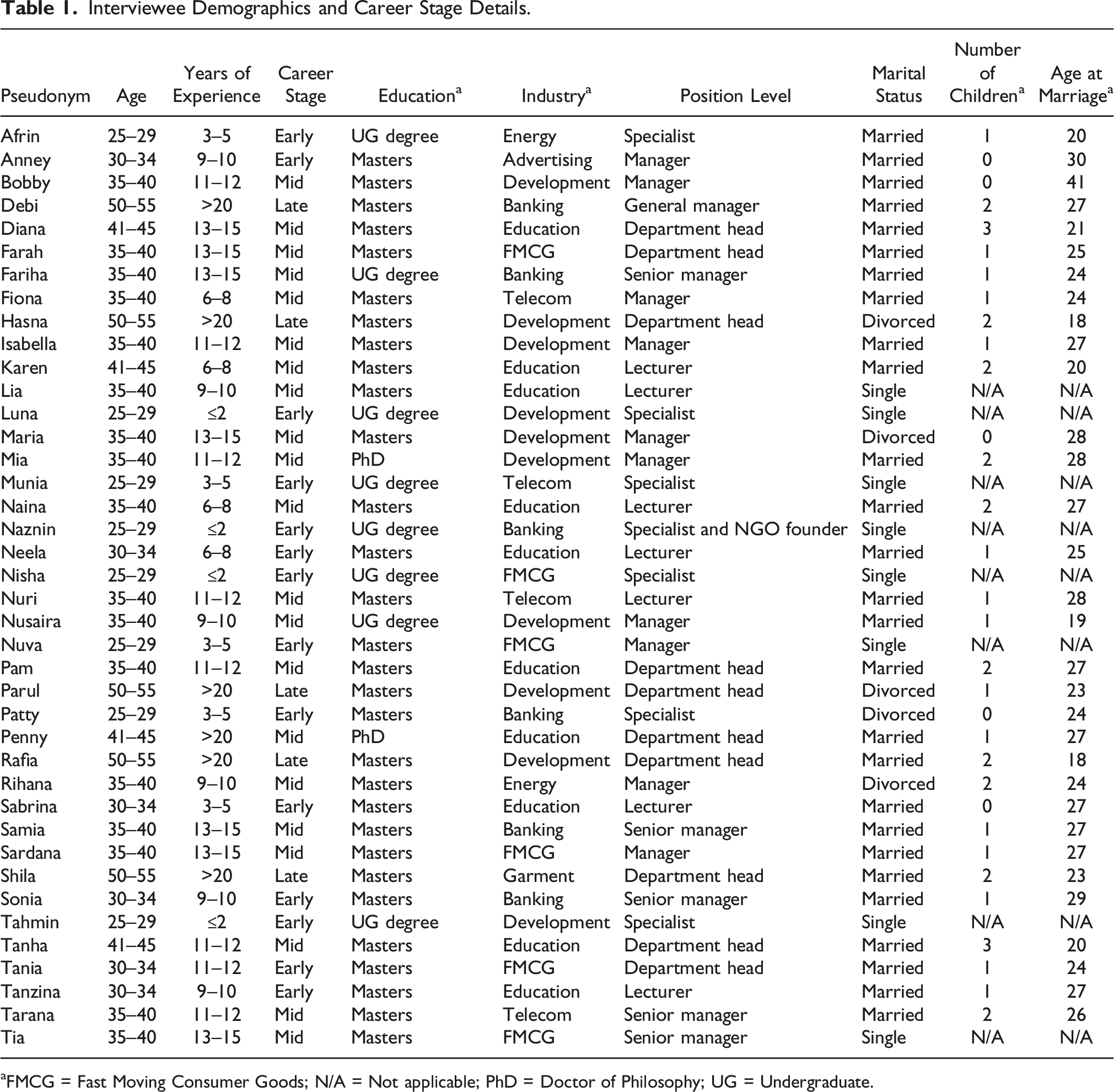
aFMCG = Fast Moving Consumer Goods; N/A = Not applicable; PhD = Doctor of Philosophy; UG = Undergraduate.
Data Collection
Data collection was guided by well-specified research questions (Gioia et al., 2013). An interview protocol (Rubin & Rubin, 2015) was used to conduct the interviews (see Appendix). Participants’ demographic, job and career related information from their curriculum vitaes collected before their interviews were reviewed during the interviews. Interviewees were invited to describe their life and career experiences as a daughter, wife, daughter-in-law and where relevant, as a mother. They were asked specific questions on their focus on authenticity, balance and challenge (self-fulfillment, work life balance and career development and growth, respectively) to understand their KCM focus. In cases where discrepancies between their past and current career focus were identified, interviewees were asked to describe the reasons behind this difference. In return for their participation, interviewees were offered a copy of any publication arising from this research.
Interviews conducted in English via Zoom ranged from 40 to 160 minutes, averaging 60 minutes. Automated transcription software (i.e., Otter) was used to transcribe the interviews. Transcripts were corrected manually while listening to audio recordings and then stored, arranged, sorted and coded in NVivo 12. Data collection was ended after 40 interviews when no new information was revealed (Morse, 1994).
Data Analysis
Since numerous terms, codes and categories emerged early in the research (Gioia et al., 2013), we inductively analyzed the data as it was collected. Open coding (Strauss & Corbin, 1990) commenced after the first 10 interviews. The process of open coding involved reading the transcripts and extracting individual responses as initial codes based on the meaning emerging from the data. The open coding process generated 160 initial (Richards, 2009) or first-order (Van Maanen, 1979) codes such as “restrictions on public movement”, “pressure to get married early” and “education as a barrier in marriage”.
Second-order axial coding was conducted to examine similarities and differences among the codes generated in the open coding process (Corley & Gioia, 2004; Strauss & Corbin, 1990). Constant comparison (Strauss & Corbin, 1990) of initial codes identified common features or themes among these codes. Rigorous comparisons of the initial codes were conducted to avoid duplication. First-order codes were then clustered into groups representing similar ideas, issues or relationships to form second-order themes. For example, the first-order codes of “restrictions on movement”, “forced involvement in household chores” and “pressure to get married early” were clustered under the second-order theme “discriminatory gender expectations” since these codes signal some set expectations only from the female members of the families. A similar process was conducted for codes related to women’s careers. For instance, “fulfilling unrealized dreams” and “helping others” were clustered under the second-order theme “seeking authenticity” as these two first-order codes refer to women’s focus on authenticity. The second-order analysis thus required a clear grasp of the emerging theoretical relationships, checking whether the emerging themes suggest concepts that might help describe and explain the observed phenomena (Gioia et al., 2013).
Once a set of themes and concepts was compiled, we investigated whether it was possible to refine the emergent second-order themes further into aggregate dimensions. For instance, the second-order themes of “discriminatory gender expectations”, “unequal marital power” and “society imposed familial oppression” were assembled into the aggregate dimension “household practices of private patriarchy”. Thus, second-order themes were moved to a more theoretical level, and similar themes were assembled into several aggregate dimensions. The full set of first-order concepts, second-order themes and aggregate dimensions was the basis for building the data structure (Gioia et al., 2013). Based on the data structure (see Figure 1), the model demonstrating a link between private patriarchy and women’s careers emerged. Data structure.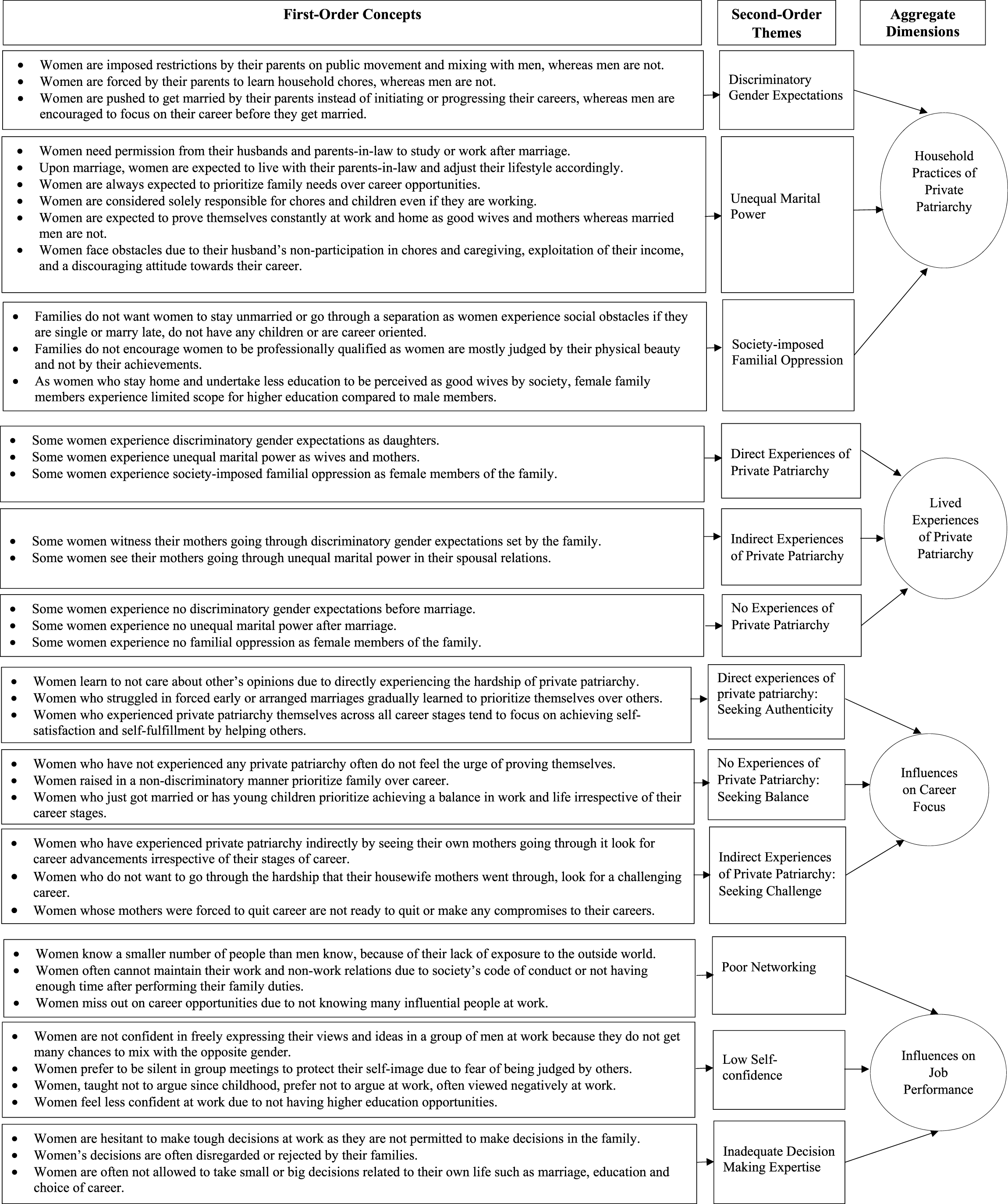
Each transcript was read multiple times in a line-by-line manner to ensure consistency and robustness of the data analysis process. The authors met regularly to discuss interview responses and reach consensus on possible ways to best capture the intended meanings of the responses. Coding discrepancies were discussed and resolved through extensive discussions. For any disagreements, we examined the literature and peer feedback referred to in the next paragraph.
A set of strategies were adopted (Lincoln & Guba, 1985) to ensure the findings’ trustworthiness. First, substantial time was invested in examining the transcripts, iterative coding and crosschecking codes to ensure reliability of the findings. Second, a detailed description of the patriarchal context was included in the literature review to ensure the transferability of the findings. Finally, to ensure dependability and confirmability of the research findings, a small team of peers representing both genders with knowledge and experience of careers in a patriarchal context was asked to provide feedback (i.e., ‘peer debriefing’; Afiouni & Karam, 2019, p. 76) on various aspects of the private patriarchy model that emerged from our analysis.
Findings
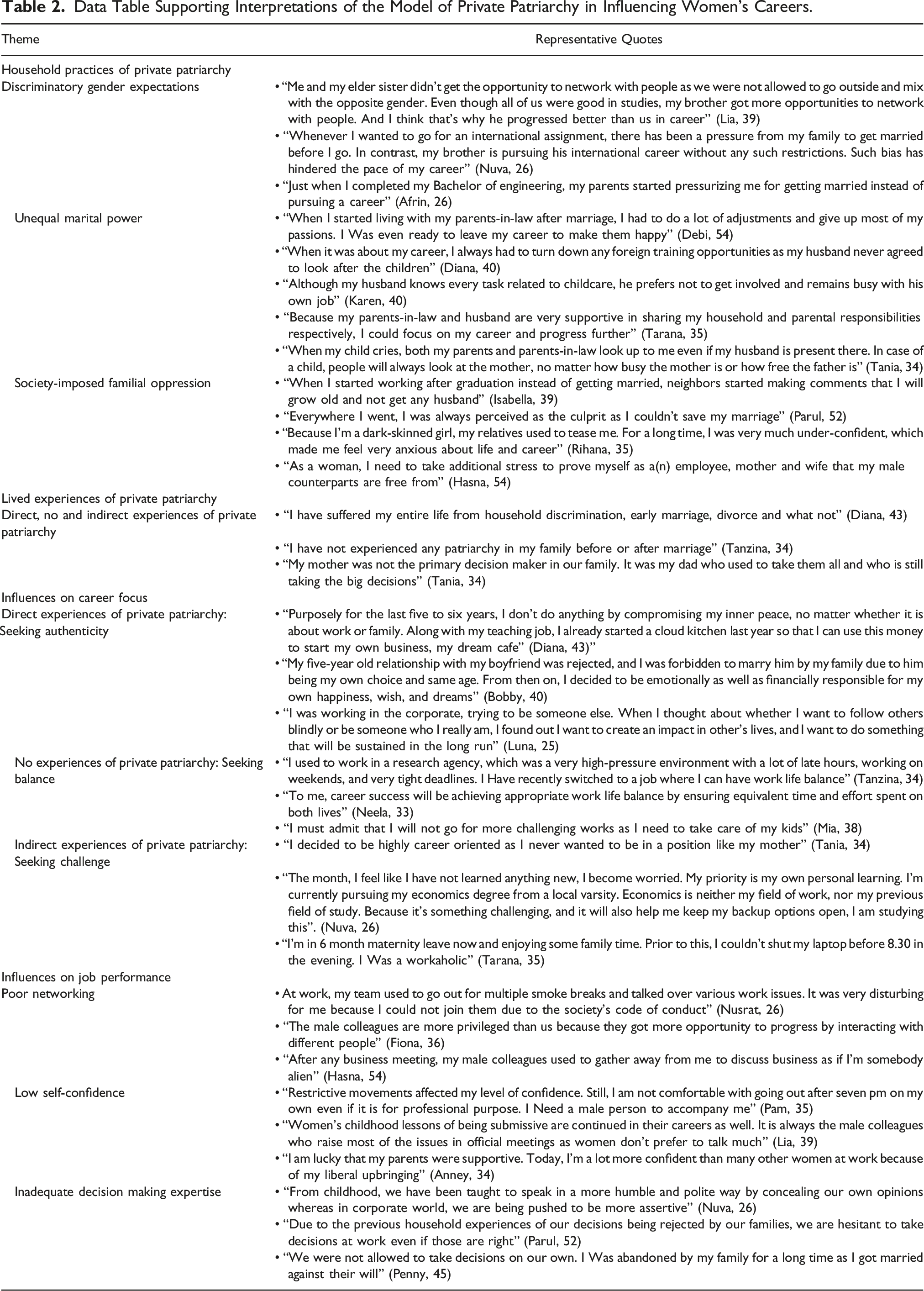
This section addresses the study’s research questions by discussing each part of the private patriarchy model (see Figure 2) that emerged from our analysis. The model has four aggregate dimensions: household practices of private patriarchy, lived experiences of private patriarchy, influences on career focus and influences on job performance. The data table (Table 2) provides additional supporting evidence for the first-order concepts, second-order themes and aggregate dimensions in the data structure. Model of private patriarchy in influencing women’s careers. Data Table Supporting Interpretations of the Model of Private Patriarchy in Influencing Women’s Careers.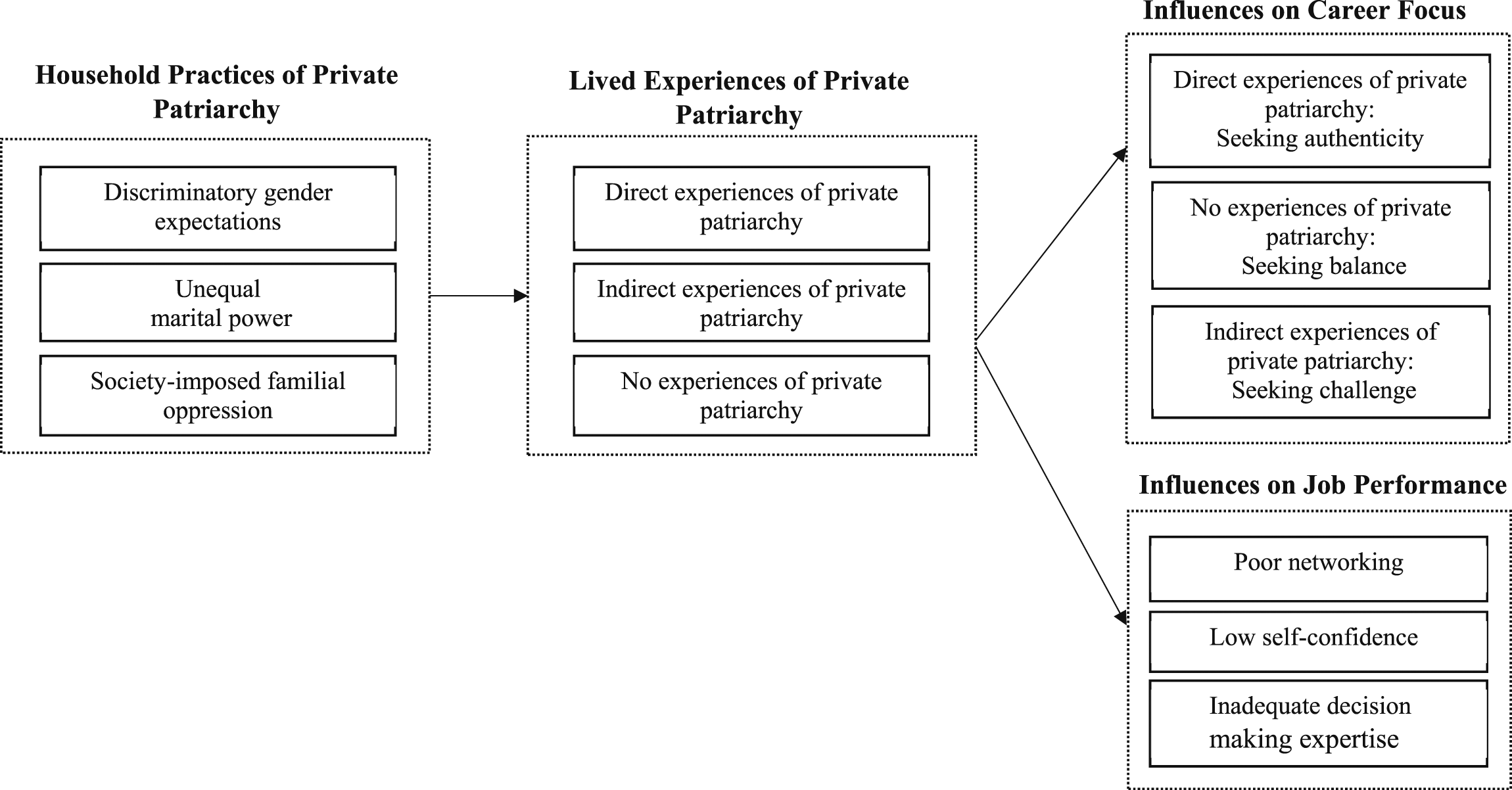
Household Practices of Private Patriarchy
Second-order themes related to the various household practices of private patriarchy were clustered under this aggregate dimension. Three themes characterized this dimension: discriminatory gender expectations, unequal marital power and society-imposed familial oppression. The following paragraphs detail each of these themes. Additional quotes supporting these themes are provided in Table 2.
Discriminatory Gender Expectations
Female participants in our study encountered household discrimination when compared to the sons within their families. Interviewees reported gender-based unequal division of domestic labor within households. As one interviewee said “Sometimes I argue with my mother about how she always asks me to perform household chores even when I am working from home, and my brother is free. Such practice makes it difficult for me to achieve work life balance” (Tahmin, 26). Another participant said “From a very young age, I had been observing the kind of attention and favoritism that the sons were getting, while my sister and I were not. As daughters, we were expected to be docile and generous” (Naznin, 25). These quotes signal a form of gender expectations exclusively for female family members.
The women in our study identified early, arranged and forced marriages as forms of discriminatory household practices for women. Most reported persistent family pressure to marry from a young age, while male family members are pushed to focus on their careers. Describing her experiences of early marriage one interviewee said “I was pushed to get married at the age of 21 to the person my father chose, and it took me six years to complete my undergrad [studies] due to several study breaks” (Karen, 40). Another woman said: I grew up listening about marriages. Whenever I sought my parents’ permission to go out with friends or wear a dress I like, the common reply was I can do it after marriage if my husband permits. (Nusaira, 36)
Participants spoke about restrictions on public movement and mixing with the opposite gender when describing their experiences of private patriarchy as daughters. Labeling these practices “gender-biased”, one participant commented: In my father’s house we had various restrictions as daughters. Firstly, we were not allowed to drive. Secondly, girls of the family were not allowed to go out without permission or stay outside after sunset, whereas boys could go out and come back anytime. (Diana, 43)
Another commented on mixing with the opposite gender: “My relatives had strong objections to socializing with male friends in public or bringing them over to my house. They used to suggest my parents keep an eye on me” (Isabella, 37). These quotations illustrate a variety of discriminatory role expectations established as gender-appropriate behaviors for female family members.
Unequal Marital Power
Post-marriage experiences play a significant role in shaping interviewees’ careers. Many married participants need their husbands’ permission to initiate or continue their careers after marriage. Some husbands are supportive of their wives’ careers while others are not, as one woman discussed her former and current husbands’ roles in her career: I was told by my ex-husband that since I’m a mother, I should give my entire time to my home and children. As I rejected that, a notice of divorce was sent from his side. [In contrast] My current husband has been very supportive of my career. Our youngest daughter is now three years old, and my husband looks after her at night as I need to take a rest to be able to work the following day. (Diana, 43)
These quotes demonstrate how a husband’s support plays a role in women’s careers. Diana had a successful career as head of the department during her second marriage whereas she was not in paid employment in her first marriage.
Further, many women are financially exploited by their husbands. One woman said “Now that I look back, my husband was always using me. He decided to get married to me because I was a potential income source. He always wanted that I should give him all my salary, and he will give me pocket money out of that” (Parul, 52). Due to unequal marital power, women in patriarchal societies often do not have financial freedom even though they are earning an income.
Married women are expected to prioritize family needs over career opportunities. One wife who prioritized her husband’s career over hers even though she is a graduate from a top business school commented: Even though my husband appreciates when he sees other women achieving something great in career, he expects me to prioritize family. In larger society, even if men appreciate successful women, it is better and safer if their own wives are not successful or do not hold a demanding career. (Tanha, 41)
While discussing how married women are considered solely responsible for chores and children even if they are working, one working mother said: At times, I feel upset that I can’t make any time for myself. I need to deal with complex tasks at work and I need to run after my daughter all the time when I am at home. My husband is too busy to give time for any household responsibilities. It feels like I am working 24/7. (Sonia, 34)
Women’s careers in this patriarchal context have not only been affected by husbands but also by parents-in-law. One participant said “My parents-in-law did not support me to study or work after marriage. Ultimately, I went through a divorce when I protested and started doing both” (Rihana, 35). In discussing how she had to live with her parents-in-law after marriage and how they controlled her, another woman said: My parents-in-law wanted to keep me inside the house doing chores and raising kids. They suggested me to take care of my children as they would be income earners for me in future (Rabeya, 52).
Although parents-in-law are a matter of grievance among many women, not all are conservative patriarchs who want their daughters-in-law to stay home looking after chores, children and their husbands. The following contrasting comment illustrates the significance of parents-in-laws’ roles in women’s careers: “I was able to put in long hours at work due to my parents-in-law being supportive. With their support, I could become head of the department at the age of 34 when I had a toddler at home” (Tania, 34). These quotes demonstrate that although parental restrictions shaped women’s early years, husbands and parents-in-law had a great deal of influence on their careers once married.
Society-Imposed Familial Oppression
Interviewees shared a variety of societal norms that put pressure on their families to put limits on women’s code of conduct. As discussed by our interviewees, the socially approved code of conduct dictates that women should be submissive, physically beautiful and not too educated and consumed in their career; they should prefer to stay home and get married; they should become mothers at a young age, not divorce their partners and be willing to take sole responsibility for household chores and their children. Our interviewees expressed concerns about women’s obligations to follow the socially approved code of conduct and how any non-compliance is frowned upon by society. Talking about the women’s code of conduct, an interviewee said: When I bought a bike for an easy commute to work, my family restricted me from riding it. They thought if I rode a bike then society will perceive me as too independent, and no one will marry me (Bobby, 40).
As shared by our interviewees, highly educated, independent and career-oriented women are not considered potential wives and mothers by this society. Families therefore want their daughters-in-law to be good-looking and entirely home-focused. Interviewees said they are not encouraged to pursue higher studies as it is difficult to find grooms for highly educated women. Referring to society’s perception of highly educated women, one interviewee said “When a girl studies more, the relatives and neighbors start commenting that she won’t get a groom as she’s too educated” (Afrin, 26).
As the society perceives education to be a weak attribute in defining well-mannered women, most families of unmarried participants did not allow them to study in a foreign country, whereas foreign study was permitted for males. One interviewee said “My brother went abroad for higher studies immediately after his undergrad. But for me, the primary condition was to get married and go abroad if my husband allows” (Sabrina, 34).
In summary, these themes show how intersecting and overlapping roles of women as daughters, wives, daughters-in-law and mothers subjected them to discrimination and disadvantages in the patriarchal Bangladesh context.
Lived Experiences of Private Patriarchy
This aggregate dimension depicts how the household practices of private patriarchy are experienced differently by different groups of women. Three themes that constitute this dimension are direct experiences of private patriarchy, indirect experiences of private patriarchy and no experiences of private patriarchy, discussed now.
Direct, Indirect and No Experiences of Private Patriarchy
Many women in our study directly experienced private patriarchy themselves. As daughters, wives, daughters-in-law and mothers, these women faced discriminatory gender expectations, unequal marital power and society-imposed familial oppression. One said: I was chosen to play for the women’s volleyball team on a national level when I was in grade six, but my father turned it down because I had to wear half pants while playing. (Diana, 43)
Another said “I was depressed because my father forced me to get married before I could start my career. My mental health deteriorated even more when my first child was born immediately after the marriage” (Afrin, 26). Like these two women, many experienced the household practices of private patriarchy directly themselves.
In contrast, another group of interviewees experienced private patriarchy indirectly. These women experienced private patriarchy through witnessing their mothers being suppressed by their families. One said: My dad often cut off my mom in conversations in front of others saying that as my mom is a housewife, she doesn’t understand things and hence her comment is useless. (Tarana, 35)
The same participant said about her parents-in-law: “My father-in-law is very caring to my mother-in-law. They both respect me and my work” (Tarana, 35). While describing her mother, another woman said “My father allowed me to do everything, but my mother was not treated in a similar way by him and his parents. I am afraid of the life of a housewife as I saw my mother’s sufferings. I saw her struggles, powerlessness and resentment” (Fariha, 36). This is echoed by another who said “My mother was a banker. She had to leave her career as my father did not want her to work outside home” (Farah, 39). Although this group of women did not experience private patriarchy directly themselves when growing up as a daughter or post-marriage as a wife, they had experienced it indirectly through their mothers’ experiences.
Last, and unlike the former two groups, some women in our research did not experience any private patriarchy. In describing her non-patriarchal family practices, one woman commented: “My family is very liberal; patriarchy does not exist here. My mother is a professor who always inspired me to have a career. There were opportunities that if I wanted, I could have taken and progressed in my career (Neela, 33). Another woman said: “I am lucky that both my parents have been working and were supportive of my career. My husband cooks in the house and my parents-in-law appreciate this” (Anney, 34). This group of women neither experienced private patriarchy themselves, nor through witnessing their mothers.
Influences on Career Focus
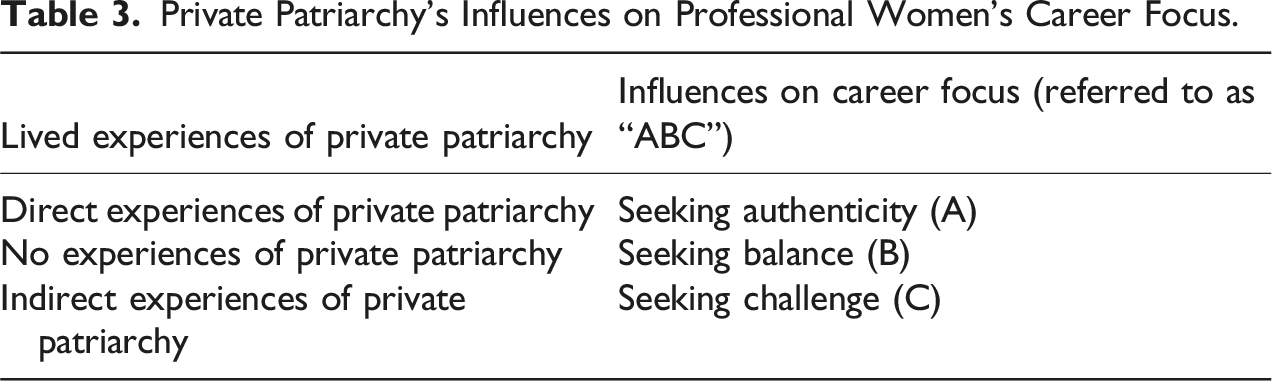
Private Patriarchy’s Influences on Professional Women’s Career Focus.
Direct Experiences of Private Patriarchy: Seeking Authenticity
Irrespective of career stages, some interviewees who experienced private patriarchy directly themselves (e.g., early or forced marriage and discriminatory household practices) tended to seek authenticity in their careers. Hardship associated with patriarchy appears to have made them carefree and taught them to prioritize themselves above others. Commenting on how struggles associated with a forced early marriage made her realize her self-worth, a top-ranked business school graduate in her mid-career said: After experiencing the mental stress caused by overwhelming demands of my early marriage, early pregnancy and continuing studies, I feel women should be more kind to towards themselves. If my career or job doesn’t make me happy then I may not want to go for it. (Tanha, 41)
In describing her need for authenticity another woman commented “After the complications of my first marriage which happened very early, I always wanted to have my own identity and prioritize my own needs. I never wanted to be known as his wife, or his daughter, or her mother” (Nusaira, 36).
Many participants were concerned about self-priority, self-worth and creating an impact on society. One woman who runs a non-government organization (NGO) in parallel with her banking job shared: “The NGO that I own is something I love doing. I just don’t want to be known as Naznin, who is the ‘X’ of ‘Y’ company. I also want to be known as Naznin who has helped so many girls by [nature of NGO]” (Naznin, 25). Interviewees who have personally encountered the difficulties posed by private patriarchy such as limited autonomy and gendered role expectations experienced a transformation in their perspective, leaning towards activities that facilitate emotional healing and embracing their authentic selves.
No Experiences of Private Patriarchy: Seeking Balance
Some women who have not faced restrictive family practices did not appear to have the urge to progress their careers. They preferred relaxed careers that allow more family time: I’ve achieved less compared to a lot of my other classmates and colleagues who did not have the freedom of choice that I had. But I’m not sad about it because I think I have been able to give more time to my family and to myself. (Tanzina, 34)
Another woman who was brought up and married in non-patriarchal families said: “If I look at the personality differences between me and my friends who were raised in discriminatory family conditions, I see a sense of desperation in them that they want to do this or they want to achieve that, which I do not feel in myself, I’m not desperate for anything” (Nuri, 38). Interviewees leading a life free from private patriarchal hardships such as discriminatory gender expectations and limited access to education recognized the importance of achieving a sense of balance between work and life. They did not feel the urge to pursue any drastic changes in their careers and opted for a balanced life instead.
Several interviewees started to seek career balance as soon as they were married irrespective of their career stage: “I am having conflicting thoughts; the logics suggest focusing on my career. But the emotional side advises to follow my army officer fiancé to wherever he is posted and live with him” (Tahmin, 26). These quotes, coupled with the quotes in data Table 2, signal that professional women’s need to achieve career balance in a patriarchal context may not depend on the career stages, but on contextual factors.
Indirect Experiences of Private Patriarchy: Seeking Challenge
Interviewees who experienced private patriarchy indirectly (i.e., witnessing the discriminatory household practices faced by their mothers) opted to pursue career challenges. One such woman said “I am not the person who will let go of career and lead a happy married life like my mother. I really want to let go of marriage and get ahead in my career” (Munia, 27). Unlike Munia, not all these women are in their early career stage. Many of these women are in their mid or late career stages. Commenting on how desperately she wants a life different from her mother, a woman in senior management said “I don’t want to go through all the struggles that my mother went through. I define myself as a workaholic and career-oriented woman” (Fariha, 36). Another interviewee said: My mother was pressurized by my father to leave her career for the sake of the family. But I will not leave my dreams just to be a few hours more with my son. I will never sacrifice my career. (Farah, 39)
These quotes demonstrate how their mothers’ experiences of private patriarchy have influenced these women to seek challenges in their careers. These professional women who have witnessed individuals in their immediate families struggling with patriarchal hardships such as unequal marital power and lack of support for career aspirations desired to achieve empowerment and equality for themselves. Hence, they were motivated to proactively seek changes in their own circumstances and opted for challenging careers.
Influences on Job Performance
The recurring themes of these professional women’s perceptions about how private patriarchy affected their work performance constituted this aggregate dimension. Three discrete areas of work performance emerged from the interview data, namely poor networking, low self-confidence and inadequate decision making expertise.
Poor Networking
Barriers to cross-sex friendships often limit women’s ability to network with senior employees and consequently these women end up with less powerful mentors or no mentor at work (Elsesser & Peplau, 2006). Commenting on how restrictive household practices affected her scope to network, one woman said “I think I could have done better in my career if I were given the opportunity to go out and mix with others. I missed many career opportunities due to my limited networking” (Lia, 39). In describing how she had limited networking scope, another woman said “There is huge gap in male and female representation at work. When you find that you are the only woman among so many men, you don’t talk much. As a result, your networking suffers” (Hasna, 54). These quotes, coupled with others in Table 2, demonstrate that private patriarchy experiences impact professional women’s scope to network and result in limited career opportunities for these women.
Low Self-confidence
Interviewees discussed how limited interaction with men has influenced their careers. Many women described their discomfort working in a group of men. One woman said: “When I started working, I was not confident enough. I used to think that male teammates will not like me at work if I become vocal. These thoughts hampered my performance in a team of male members” (Bobby, 40).
Low self-confidence caused by limited educational exposure was reported by some women in our study. One said “Although my brother was allowed, my parents did not allow me to study abroad as I was their daughter. This loss of opportunity still hampers my confidence at work” (Sabrina, 34). These quotes demonstrate how restrictive practices of private patriarchy hamper professional women’s level of confidence at work.
Inadequate Decision Making Expertise
Many women reported they are hesitant to make decisions at work even if they are correct, due to the experiences of their decisions being rejected by their families. Regarding the influences of restrictive family practices on women’s decision-making ability, one participant said “We, as women, often believe that we should always do what we are instructed. We try to follow other’s decisions in our professional lives instead of making our own decisions” (Penny, 45).
In describing how women’s restriction on making small or big decisions related to their own life make them suffer at work, one participant said “Since women are not allowed to take any decisions at home, it is really tough for them to overcome the fear of decision making when they are in the workplace” (Lia, 39).
The narratives highlight private patriarchy’s impact on these professional women’s job performance. Our findings support previous research claims of women’s moral considerations in social interactions as well as gendered modesty as the intrinsic barriers (Greguletz et al., 2019) in building effective networks that help them progress further in their careers.
Discussion
This study aimed to investigate women’s careers in a patriarchal context through the kaleidoscope career model (KCM) lens (Mainiero & Sullivan, 2005). Two research questions were explored in 40 interviews: ‘How do women in patriarchal society experience private patriarchy’ and ‘How do experiences of private patriarchy influence professional women’s careers in that context’? Three major findings are now discussed.
First, findings suggest that women in patriarchal society experience private patriarchy directly and indirectly through discriminatory gender expectations, unequal marital power and society-imposed familial pressure. In patriarchal families, daughters are expected to act in certain ways that sons are not. Such activities include learning household chores, getting married early and restrained public movement. Husbands and parents-in-law are the key people influencing women’s careers after marriage in patriarchal contexts. In this study, women with supportive husbands and parents-in-law had experienced more career advancement than those whose own parents are supportive. This discrepancy implies that in a patriarchal context, parental support is an antecedent of women’s career advancements until marriage and is then replaced by support from husbands and parents-in-law.
While prior research has identified husbands’ influence over women’s non-engagement in paid work in a patriarchal context (Karam & Afiouni, 2014), roles of parents-in-law have not before been highlighted in women’s careers literature. We found parents-in-law play a significant role in shaping women’s careers in a patriarchal context. This is because along with husbands, parents-in-law hold the power to permit their daughters-in-law to work after marriage. While pre-marital household constraints and gender-based discrimination can impede women’s professional progress, the continued success and advancement of women’s careers in patriarchal societies are contingent upon obtaining consent to work from both spouses and parents-in-law.
Second, the study’s findings suggest that women’s experiences of private patriarchy forms three types of career attitudes that are consistent with the three KCM parameters of authenticity, balance and challenge (ABC; Mainiero & Sullivan, 2005; Sullivan & Mainiero, 2008). Women who directly experienced private patriarchy prioritized authenticity in careers whereas women who encountered patriarchy indirectly through their mother’s experiences prioritized a challenging career. Furthermore, women who did not experience any private patriarchy were found to prioritize balance over other needs. Direct experiences of private patriarchy influenced women to seek personal fulfillment and happiness. These women prioritized their own well-being and sought out experiences and relationships that align with their authentic selves. Women free from the experiences of power imbalances within families or personal relationships placed greater value on meaningful relationships and connections with others. They strived to maintain a balance between their personal relationships and their professional pursuits. Witnessing private patriarchy indirectly motivated women to seek opportunities for personal growth and empowerment. They recognized the need to overcome gender-based obstacles and strive for greater self-determination.
While original KCM studies (Mainiero & Sullivan, 2005; Sullivan & Mainiero, 2008) suggest authenticity is mostly a late-career concern, the current study identifies the need for achieving authenticity in women who directly experienced private patriarchy across all career stages. Though prior KCM studies suggest that women seek balance mid-career irrespective of their marital and motherhood status (Sullivan & Mainiero, 2008), these results differ by demonstrating balance as a private patriarchy-induced career attitude that is unrelated to career stage. Many women in this study tended to seek balance early in their careers once they got married or had children. In contrast to the original KCM findings suggesting that most women seek challenge early in their careers (Sullivan & Mainiero, 2008), our results demonstrate that women who experienced private patriarchy indirectly through witnessing their mothers’ oppression tend to opt for a challenging career. Findings from the present study suggest that women’s emphasis on their careers (referred to as “ABC”) may not consistently align with their career stages. Instead, our results indicate that women’s experiences of direct, indirect, no private patriarchy played a significant role in shaping their career priorities within a patriarchal environment. The current study thus dissociates the notion of ABC from progressive life stages. Our paper extends KCM theory by reorganizing and reconfiguring ABC according to private patriarchal arrangement typology (direct, indirect, or no experiences of private patriarchy as shown in Table 3).
Third, in examining women’s performance at work, this research demonstrates the influence of private patriarchy while most prior research has focused on the influence of public patriarchy (i.e., Adisa, Cooke, & Iwowo, 2019). Women who experienced private patriarchy reported how it had an impact on their work performance through poor networking, lack of self-confidence and inadequate decision-making expertise. Such hurdles at work were perceived by interviewees as a consequence of their limited exposure to the external world due to restricted movements, including restrictions on mixing with the opposite sex and witnessing men as the family’s primary decision-makers.
Theoretical Contributions
The two key theories shaping this research are patriarchy (Kandiyoti, 1988; Walby, 1989) and kaleidoscope careers (Mainiero & Sullivan, 2005; Sullivan & Mainiero, 2008). Both have been helpful in explaining women’s career attitudes, yet have limitations.
In theorizing patriarchy, Walby (2004) has highlighted the relationship between modernization and gender regimes by investigating the differences between public (i.e., the public gender regime) and private (i.e., the domestic gender regime) patriarchy. Although private patriarchy is said to be maintained by women’s non-participation in public life (Walby, 1990a, 2004, 2009), these findings show that private patriarchy can be practiced even when modern women are participating in public lives. Women in this study experienced private patriarchy through discriminatory gender expectations, unequal marital power and society-imposed familial oppression even when they have been participating in public lives through education and professional employment. This micro-level research finding thus contributes to the macro-level analysis of patriarchy’s evolution over time.
Until now, the kaleidoscope career patterns of authenticity, balance and challenge (ABC; Mainiero & Sullivan, 2005) had been studied mostly focusing on women living and working in Western contexts. Findings of prior KCM studies associated ABC career patterns with career stages (i.e., early, mid and late). As the first study that combines KCM and patriarchy, our findings suggest that these professional women’s desire to achieve the kaleidoscope of career authenticity, balance and challenge is influenced by their experiences of private patriarchy, not by their career stage. Drawing on data from the patriarchal context of Bangladesh, our analysis suggests that women’s direct, indirect and no experiences of private patriarchy influence their career focus. These findings thus offer theoretical advances for KCM by highlighting the usefulness of this framework beyond Western contexts into patriarchal contexts.
Practical Implications
This research demonstrates valuable findings and organizational implications for women’s KCM career attitudes. First, to help women overcome potential behavioral influences of private patriarchy, secondary and tertiary educational institutes operating in patriarchal contexts may encourage female students to join mixed-gender institutional clubs and participate in co-curricular activities.
Second, human resource systems could incorporate KCM career attitudes into their design. For instance, organizations offering more family-friendly benefits could attract and retain more balance-oriented mid-career women. In contrast, organizations intending to hire young professionals could offer more challenging careers in terms of international assignments and cross-functional projects.
Third, organizations operating in patriarchal contexts could redesign their human resource development programs to help women improve their decision making and networking skills. For instance, young professional women could be placed in cross-divisional projects mentored by supportive senior men at work. Such programs would likely gradually enhance their decision making and professional networking skills.
Limitations and Future Research
This research has limitations that future researchers could consider to study careers in patriarchal contexts. Findings from interviews with 40 professional women may not be generalizable to the wider population of women living and working in patriarchal societies. This study’s findings of women’s pre- and post-marriage career barriers have not been validated with relevant third parties such as spouses, parents-in-law, parents or siblings. Further, this research has not examined the organizational setting in which the careers have been enacted. Future studies could include less skilled and less educated group of women, blue- and pink-collar women and women who have discontinued their careers. Further research may involve the men in patriarchal societies. By adopting a longitudinal approach, future researchers may observe individuals at different life points, detect changes in their career attitudes and behaviors and explore reasons for those changes.
Conclusion
This research is the first study bringing together patriarchy and the kaleidoscope career model (KCM). Through interviews with 40 professional women living and working in the patriarchal context of Bangladesh, this study examined the impact of private patriarchy on those women’s careers. The study revealed private patriarchy’s influences on professional women’s job performance and provided specific developmental direction to address this concern.
In a patriarchal context, women are expected to complete all household chores and childcare duties along with their work duties whereas men are expected to focus on their careers only. The study demonstrated that professional women’s experiences of private patriarchy through discriminatory gender expectations, unequal marital power and society-imposed familial oppression influence their careers. Marriage plays a significant role in shaping professional women’s careers as most require permission from their parents-in-law and husbands to study or work after marriage. Findings suggest that the dynamics involving career authenticity, balance and challenge may not always align with specific career stages. Instead, women’s direct, indirect and no experiences of private patriarchy have a substantial impact on their career preferences within a patriarchal context.
Footnotes
Declaration of Conflicting Interests
The author(s) declared no potential conflicts of interest with respect to the research, authorship, and/or publication of this article.
Funding
The author(s) received no financial support for the research, authorship, and/or publication of this article.

Data Availability Statement
The data used in this study are not publicly available due to their sensitive nature, which includes participant confidentiality and ethical considerations. However, these data are available from the corresponding author upon reasonable request. Access to the data will be considered based on ensuring the protection of sensitive information and complying with ethical and legal obligations. For inquiries regarding access to the data, please contact Farzana Ashraf at