



Abstract

Keywords
The management field does not possess a clear definition of what makes someone a coworker. What? Yes, you read that correctly, my dear “research mate,” “peer author,” and “some colleague you are.” Several years ago, a coworking author of this GOMusing looked for an agreed-upon, validated coworker definition in the organizational sciences while cowriting a piece on coworkers behaving badly (Robinson et al., 2014). To everyone’s surprise, none was to be found. Laboring under time pressure back then, we did not pursue the matter. Yet, we kept wondering who those mystical creatures called our coworkers really are and where they dwell.
What Is the Problem With Not Knowing Who One’s “Coworkers” Are?
Imagine if we were studying ants and no one cares to differentiate between worker ants, soldier ants, and drones—plus some would deem the queen (gasp!) a coworker. How much would we know about ants under such circumstances? The same logic applies to coworkers. For instance, consider studies of social/organizational support involving coworkers: if employees regard their supervisor as a coworker, then measures of coworker support and supervisor support tap the same domain, don’t they? It follows that we do not really know if support stemming from the person in charge of an employee or from a peer down the hall at the same hierarchical level reduces the effects of, say, work stressors on burnout. Or, as another example here, what if some employees consider all employees who work in their organization to be their coworkers, whereas others only regard employees with whom they work directly in their organization to be their coworkers?
It seems rather obvious that without a coworker definition, research focused on coworkers suffers from theoretical ambiguity and empirical imprecision. Less obvious is how to develop a remedy that is to everyone’s satisfaction. Indeed, arriving at a consensus even among the coauthors of this GOMusing article proved challenging.
What Is the Problem With Defining “Coworkers”?
Of Whom Were They Thinking When Inquiring About Their Coworkers? Survey Results From a Coworker Knowledge-Hiding Study.
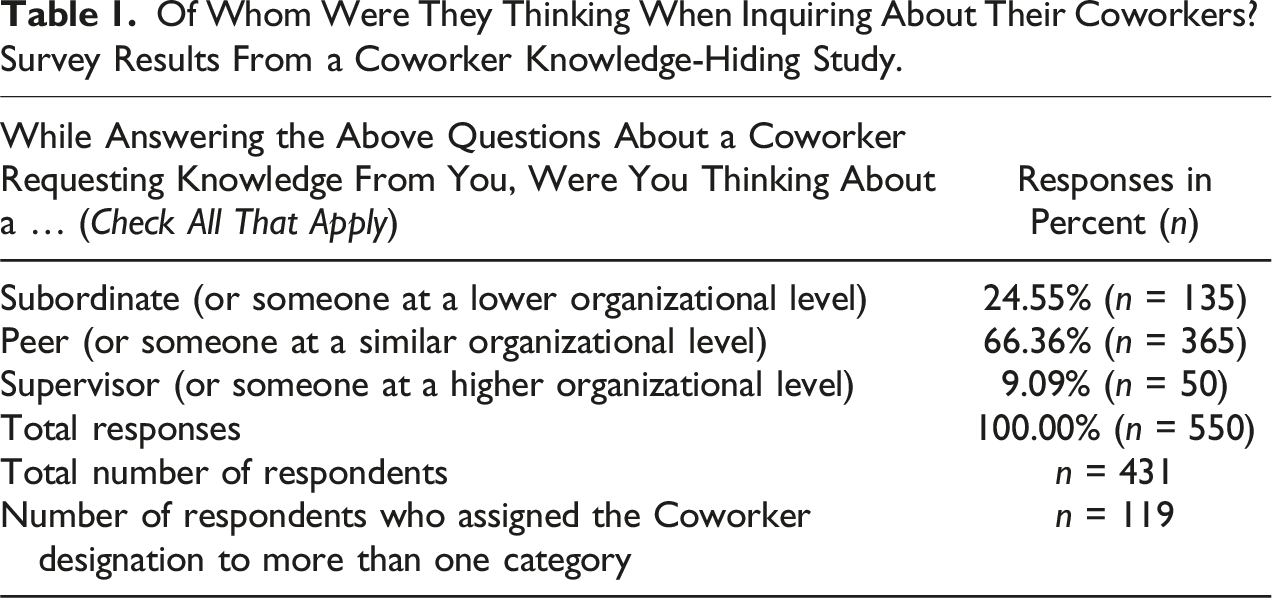
What these data suggest is that, when thinking of their coworkers, respondents do not differentiate as sharply as scholars might assume they do. Similarly, on the researcher side of the equation, using ‘hard and fast’ rules to determine membership in the “coworker” category might prove challenging because of factors related to one’s research context, perspective, tradition, and so on (e.g., no precedent exists, there is a lack of consistency in a given research stream, or doing so might interfere with one’s research question). Even approaching the problem from a purely practical standpoint is no panacea: although it might be rather obvious at times why a certain person should be labelled a coworker, at other times, designating someone as a coworker might seem tenuous (“possibly”) or a stretch (‘Not Elon!’, they cried).
In order to reduce such ambiguities, we see two options for researchers but emphasize the one that involves providing a “coworker” definition. The crux for this option is agreeing upon the basis of such a definition: should it be hierarchical position, status, (nature of) work relationships, network ties, physical and other contexts, or a combination of work-related aspects? Below, we provide a preliminary answer to this challenge. We reckon that our attempt might be met more with skepticism than overabundant joy and love. However, rather than continuing to pretend the issue is not one at all, we think it beneficial to take a stand to stimulate academic debate—, “even if this is a definition that (bravely) might be incorrect,” as a reviewer put it to us.
A Preliminary Definition
We realize that developing a coworker definition may be approached from several perspectives drawing from diverse literatures. That said, we found our deliberations to converge on two aspects, namely the central feature(s) invoked to describe coworkers (also see Johns, 2001)
1
, and more specifically, the work-related interdependencies that exist between individuals. We attempt to capture these aspects by drawing from concepts in the literatures on social networks, teams, and the context of work (e.g., Johns, 2006; Mathieu et al., 2017; Umphress et al., 2003). Accordingly, we define coworker as follows: Coworkers are individuals working in or for the same organization with whom the focal person (a) has to interact to get the job done (i.e., has a required
2
workflow tie), (b) has no leadership ties (i.e., is not a superior, nor a subordinate), and (c) shares discernible, work-related interdependencies that lead to interactions in recognizable intervals governed by the workflow.
Theoretical Background
Coworker Definition: Omnibus-Context Characteristics, Features, Criteria, and Boundary Conditions.
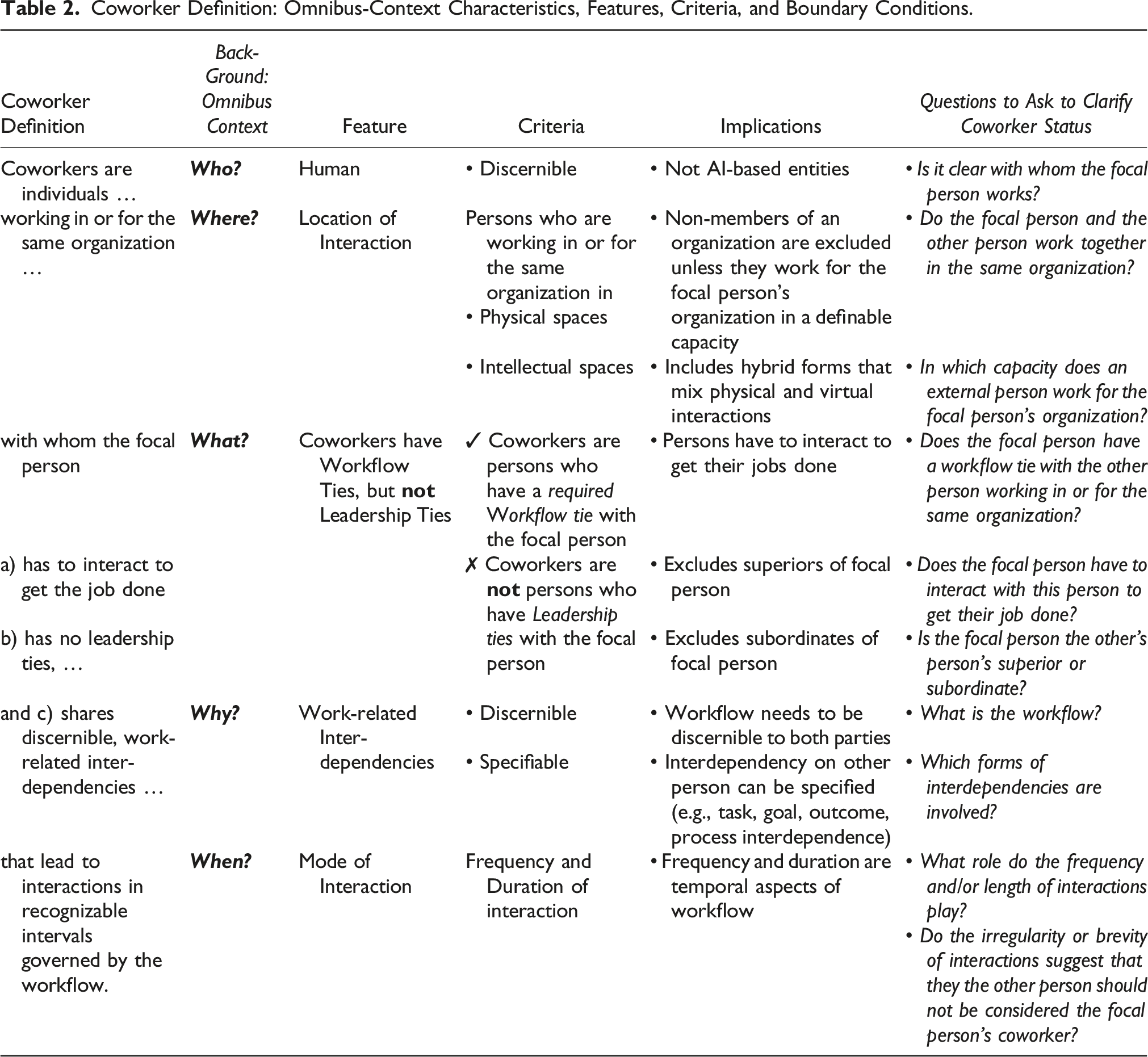
Two notable implications flow from our definition. First, by specifying that those having leadership ties with the focal person are not coworkers, we exclude the focal person’s superiors and subordinates from the coworker category. Second, non-members of an organization are also excluded—unless they work for the focal person’s organization in a capacity that establishes a required workflow tie with that person. Theoretically speaking, we established these criteria by following Osigweh’s (1989) advice “to determine things by negation” and hence to define concepts also “by specifying what they are not” (emphasis added; p. 589). In doing so, we hope to aid researchers with better differentiating coworkers from (a) those to whom a focal person reports, (b) from the direct reports of a focal person, and (c) from others who work for the same organization but not specifically with a focal individual to get the job done.
Conclusion
Researchers recently noted “that coworkers are an integral, dominant social factor within the workplace” (Greenbaum et al., 2022, p. 26). To acknowledge this fact of organizational life and to render our scientific endeavors more theoretically and empirically precise, we believe that we need to better communicate our assumptions about who is and who is not a coworker. To this end, we herein propose a “coworker” definition. However, we also acknowledge the possibility that our definition may not be embraced by other scholars. This brings us to a second option, which is to encourage researchers to communicate in their works explicitly their understanding of the “coworker” designation and their rationales underlying subsequent operationalizations. At minimum, we think, such accounts should clarify on which central feature the coworker-designation decision rests and who is included and who is not.
We further note that our suggestions not only hold promise for more clarity in research involving coworkers but also opportunities for future research: indeed, many conceivable questions that inquire about clarifying coworker status could actually feed into research aimed at better understanding how people interact with others in the workplace and the implications thereof. For example, a coworker definition could help social networks research that explores the relationship between different characteristics of individuals’ friendship and advice networks as well as outcomes. In most studies, it is expected that having friends or giving and receiving advice will correlate positively with work outcomes. However, should we really expect that having a friend or advice tie in one’s organization—with someone who might do something completely different than what we do at work—will directly and positively affect one’s task performance? We speculate that some of the inconsistencies in results related to network ties and outcomes (e.g., Methot et al., 2016) could be explained if we would consider coworker versus non-coworker friends and advice ties, plus if we would further differentiate friendship and advice ties between coworkers and supervisors—thus far, this is seldom considered in social networks studies (see discussion in Zagenczyk et al., 2020).
To end our musing, we reckon that thinking about the extent to which the theory underlying one’s work informs the role of coworkers plus thinking about how the coworker designation in turn impacts one’s research design and methodological choices is a good start.
Footnotes
Declaration of Conflicting Interests
The authors declared no potential conflicts of interest with respect to the research, authorship, and/or publication of this article.
Funding
The authors received no financial support for the research, authorship, and/or publication of this article.

Notes
Author Biographies
References
Supplementary Material
Please find the following supplemental material available below.
For Open Access articles published under a Creative Commons License, all supplemental material carries the same license as the article it is associated with.
For non-Open Access articles published, all supplemental material carries a non-exclusive license, and permission requests for re-use of supplemental material or any part of supplemental material shall be sent directly to the copyright owner as specified in the copyright notice associated with the article.
