




Abstract
Trust is imperative for the successful navigation of strategic change initiatives. So, we ask ourselves the question: How do perceptions of organizational trust (composed of institutional and interpersonal trust) develop over time and what are their interactions during strategic change? We answer this question through a real-time ethnographic analysis of a merger process focusing specifically on trust at multiple levels, between employees, middle and top management and how it interacts with the trust these individuals have in the informal and formal processes of the organization. We unearthed three key processes in the dynamic interplay between levels and types of trust. (Dis)trust obfuscation allowed top management to overcome negative perceptions of employees by foregrounding one figurehead with whom employees build trust whilst backgrounding the other members. Multi-level mirroring in which middle management mirrored the content and emotionality of the communication of top management amplified trust building. Third, integrative elaboration whereby middle management actively helped employees to stay the course whilst top management withdrew from actively engaging with employees. These processes resulted in the trust dynamics to go from building with employees and preserving with middle management to preservation and finally trust erosion. Our findings contribute to the study of trust as a multi-level phenomenon as well as understanding trust dynamics at multiple levels.
Introduction
Trust in organizations is a multi-level phenomenon, yet as Lumineau and Schilke (2018:238) note: “[M]uch theorizing on trust has been biased toward either overly individualist or overly structural accounts.” To better understand how strategic change initiatives succeed or fail requires looking at the complex interaction of trust between individuals within organizations, such as between employees, middle managers and top managers, as well as the trust these individuals have in the organization’s policies and practices.
We follow Mayer et al. (1995:712) in their definition of trust as “the willingness of a party to be vulnerable to the actions of another party based on the expectation that the other will perform a particular action important to the party.” The party is appliable to persons, collective actors and organizations (Schilke and Cook, 2013; Schoorman et al., 2007). Organizational trust can therefore deal with the positive expectations individuals have about the competence, reliability and benevolence of organizational members (Mayer et al., 1995; interpersonal trust), as well as the institutional trust in the organization, through its formal and informal structures.
As organizations undergo strategic change initiatives or disruptions, their employees are often in vulnerable and much depends on their willingness to trust (Gustafsson et al., 2021; Sverdrup and Stensaker, 2018). If employees trust management, this has a positive effect on the perceived legitimacy of the proposed changes (Rousseau and Tijoriwala, 1999) and trust has been documented to lead to, among other things, better information sharing (Larson, 1992), and better relationships between employees and supervisors (Lipponen et al., 2020). Distrust has the opposite effects (Lander and Kooning, 2013; Maguire and Phillips, 2008) as a lack of trust may hamper collaboration and is linked with conflict (Pratt et al., 2019). We follow Lewicki, McAllister and Bies (2018) who conceptualize trust and distrust as separate, independent constructs which are linked. This position was affirmed by Saunders et al. (2014) who do note that trust and distrust rarely occur simultaneously when focused on a single subject. They also note that “trust relationships at work can endure, despite a climate of distrust, or distrust of other parties” (Saunders & Thornhill, 2003:659). This conclusion again hints at a complex interplay of multi-levels dynamics in the context of organizational trust.
Lumineau and Schilke (2018: 239) lament that: “we still know relatively little about how trust develops across levels of analysis and how micro and macro features of trust are interrelated.” They particularly note the need to understand how (dis)trust dynamics, especially (distrustful) vicious cycles unfold over time and how changes in one level in the organization may manifest itself in other levels. Our case study of an entire acquisition process – ranging from the pre-acquisition stage to the post-merger integration phase - in the communication sector provided us with a unique opportunity to contribute to the aforementioned debate. Our longitudinal analysis is based on multiple sources of ethnographic observation, formal interviews, informal conversations, and data from conferences, meetings, webcasts, official announcements and weblogs. We focused on the interaction between employees, middle and top management as well as the influence of formal and informal organizational structures on the (dis)trust development process. We found that top management was able to build up a trusting relationship with both employees and middle management with the latter amplifying the trust formation as they mirrored much of what top management communication – a practice we term multi-level mirroring. This was strengthened by (dis)trust obfuscation – wherein other top management members that were already in place and were not trusted did not foreground themselves to allow for trust formation to follow. In the second phase, as top management started to be less visible and used institutional mechanisms they preserved through integrative elaboration, where middle management became the voice for top management ensuring trust did not turn into distrust but contained it to low trust. In the final phase when middle management lost faith and felt betrayed, low trust turned into distrust for both employees and middle management vis-à-vis top management, yet not between employees and middle management. Our results allow us to make contributions to the literature on multi-level trust by highlighting the practices at play between interpersonal trust formation across levels (multi-level mirroring and integrative elaboration) as well as the relationship with institutional trust (trust obfuscation and the limited substitutability with interpersonal trust).
Theoretical Orientation
The Multiple Levels and Types of Trust in Organizations
Trust has been the focus of much scholarly attention (Williams, 2001) and scholars have looked at its development (e.g. Lander & Kooning, 2013), its decline (e.g. Searle & Ball, 2004), its repair (e.g. Sverdrup & Stensaker, 2018) as well as its preservation (e.g. Gustafsson et al., 2021). Each are potential trust dynamics in the context of organizational disruptions such as a merger. In such situations of uncertainty and vulnerability on the part of employees, their trust in their organization can help navigate such transitions successfully. We view trust in organizations as having several components. Organizational trust deals with the positive expectation individuals have about the competence, reliability and benevolence of organizational members (Mayer et al., 1995; interpersonal trust), as well as the institutional trust in the organization, in its formal and informal structures.
The organizational trust literature distinguishes between trust between and within organizations. Trust between organizations is often described as a trade-off between contracts as formal organizing mechanism and goodwill and competence judgements (Das & Teng, 2001; Malhotra & Lumineau, 2011; Nooteboom, 1996). Faems and colleagues (2008:1074) found that the dynamics between contracts and trust judgements are “inherently linked and mutually influence each other.” Fryxell et al. (2002) added the importance of social controls as reinforcing norms and subsequent trust development. Trust dynamics within organizations analogously show a complex interplay been formal and informal structures.
In their multi-level model of trust development, Lumineau and Schilke (2018) suggest a complex interaction between an organization’s formal and informal structures and the trust development process of individuals. Formal organizational structures – such as its design and governance features – determine the communication patters between members of the organization. Informal channels also help shape expectations and beliefs about appropriate behaviors. Together, these organizational elements influence how employees interpret situational cues (Schilke, 2018) and helps direct trust judgements accordingly. This is done individually, but also collectively. As individuals work together, a collective orientation within an organization develops (Ferrin et al., 2007) which can be long lasting (Janowicz-Panjaitan and Noorderhaven, 2009) and endure when individuals leave (Schilke and Cook, 2013).
Interpersonal trust in organizations can exist at different levels, for example trust in top management or trust between colleagues, between employees and middle managers, and in turn between middle managers and top managers (Balogun, 2003). Through consultation, participation and communication (Lines et al., 2005) management can generate trust with employees. Employees’ trusting beliefs are based on trust antecedents (McKnight et al., 1998). These beliefs are closely linked with assessments that managers are honest, benevolent, predictable, consistent, and/or competent (Campagna et al., 2022; Mayer et al., 1995), dependable (Rempel et al., 1985), show behavioral integrity (Kannan-Narasimhan and Lawrence, 2012) or are accessible and available (Jennings, 1971). Based on these beliefs, if confirmed, employees will be more willing to display a trusting intention (Currall and Judge, 1995; Lander and Kooning, 2013; McKnight et al., 1998) vis-à-vis management. With trust in top management, organizationally focused intentions such as organizational commitment will develop (Dirks and Ferrin, 2002; Kannan-Narasimhan and Lawrence, 2012). At the same time, middle managers, who have an important role in organisations (Gjerde and Alvesson, 2020), play a dual role, formulating trusting beliefs based on assessments of top managers above them but also influencing the beliefs of the employees they manage (Balogun and Johnson, 2004; Kroon and Reif, 2021; Rouleau and Balogun, 2011; Wooldridge et al., 2008). With regard to the former, employees trust intentions to middle management are likely to shape job related attitudes such as helping, but they can also form the conduit for influencing trust in top management (Kannan-Narasimhan and Lawrence, 2012). These different referents are therefore important in change processes given the direction of communication: top down from managers to employees, bottom-up from employees to managers and lateral between employees (Rice and Searle, 2022). Jarvenpaa and Leidner (1999) show that high levels of trust were reached for teams that, among other things, were exposed to predictable communication and substantive feedback whilst those experiencing low trust, suffered from unpredictable communication and negative leadership.
In summary, multi-level organizational trust dynamics, stem from the interplay between formal and informal organizational components and the trusting believes employees have in them. Additionally, the interactions between employees and their referents, senior and middle management, will contribute positively or negatively to this dynamic depending on their perceptions.
Trust Processes
Research has noted that managerial actions are interpreted differently over time, such that actions early in the process that were favourably assessed may receive a different reading later on (Huy et al., 2014; Sverdrup & Stensaker, 2018). Yet trust processes, given its interactive nature, have also been demonstrated to be cyclical in nature (Cullen et al., 2000), which may imply self-escalating or de-escalating dynamics (Thomas, 1976). In short different potential trust development dynamics may occur over time. As Gustafsson and colleagues (2021) note, the literature has mostly documented trust building and trust repair. Prior research has investigated many different situations in which there was the need to increase the current level of trust which is deemed insufficient (Kramer & Lewicki, 2010). Mayer and colleagues (1995) assert that the level of trust is based on the assessment of a person’s ability, benevolence and integrity. When applied to the organizational level, Gillespie and Dietz (2009) argue that employees make assertions about the organization’s ability to meet its goals and responsibilities, whether it demonstrates care and concern for its employees (i.e. benevolence) and whether it adheres to the norms and values it has (i.e. integrity).
In the case of trust repair, the aim is to restore the level of trust to its original status following a breach or violation (Kramer & Lewicki, 2010). Emotions influence the perception of trust antecedents and senses of trust are also frequently linked with and expressed by emotions. This can be especially salient in the case of trust violations (Schoorman et al., 2007). In such situations negative emotions are often displayed (e.g. anger, defensiveness; Lewicki et al., 1998) and negative cues are more salient as compared to positive ones (Kim et al., 2004). Neuroscience research by Van der Werff and colleagues (2022) has shown that trust violations are processed in the social-cognitive related brain areas specifically the default mode network. Of the different types of violations they found that in particular integrity violations showed the greatest reaction in the default mode network as compared to benevolence and ability violations. This would suggest that post-violation communication can best be focused on past instances of benevolence and integrity to have the violation be perceived as less severe. Sverdrup and Stensaker (2018) showed in their study of a post-merger integration process, where a violation occurred, that top management sought to repair its relationship with their employees. They did so in a three-step process whereby first, it endeavoured to restore reciprocity, then it developed shared mental models with their employees to clarify the rules and expectations going forward. Finally, they extended their relationship with their employees beyond the mere transactional to also involve the relational. In more general terms Dirks et al. (2009) summarized trust repair strategies in three categories: changing attributions; social equilibrium, and structural approaches. In changing attributions, the emphasis is to cast a different light on the violation in an effort to be seen as more trustworthy. By engaging in social rituals such as apologizing, social equilibrium can be restored as a means to repair trust. Finally, structural approaches seek to prevent violations in the future.
Besides these more frequently documented trust dynamics, Gustafsson and colleagues (2021) describe the process of trust preservation. When employees are confronted with a jolt (e.g. a merger), it triggers a heightened sense of vulnerability and uncertainty. In such cases active preservation of the existing trust in the relationship is needed to avoid negative emotions and negative cognition to take hold. In their analysis, Gustafsson and colleagues found three distinct preservation strategies. First, cognitive bridging involved efforts to communicate the necessity of the change and by connecting the past, present and future. Emotional embodying as second strategy, involved creating conversational platforms and other efforts for employees to support them emotionally. The third strategy, inclusive enacting, involved acting with integrity, by also sharing of control with employees, applying consistent standards and implementing fair processes. In similar vein, Schweiger and Denisi (1991: 118) compared two light manufacturing plants of one of two merger partners. In one plant, they looked at the effect of a realistic merger preview. In it “information was chosen in light of the company’s top management’s intentions to (1) provide employees with frequent, honest, and relevant information about the merger, (2) handle the employees fairly, and (3) answer questions and concerns the employees might have to the fullest extent possible”. This was contrasted with the other plant, in which no preview was set up. Schweiger and Denisi (1991) found that this preview reduced dysfunctional outcomes in the merger process up until the end of their experiment, which was early in the process.
A final trust dynamic is that of trust erosion (Couper et al., 2020). Such a dynamic occurs when there are failed or no attempts at trust preservation. In the case of a strategic change in the organisation as described by Gustafsson and colleagues (2021) management managed to preserve trust, by actively engaging with their employees during the change process. Failure to do so will likely result in an erosion of trust potentially even leading to distrust. Distrust is related but distinct from trust processes (Guo et al., 2017: 61): “As trust and distrust may involve different determinants, alternative approaches of relationship repair may be variously effect. We especially assert that not enough attention has been given to the nature, the dynamics and the relational context of distrust.” In change processes unexpected events may unfolded that lead to trust violations necessitating repair efforts. When unsuccessful, a negative spiral of trust erosion can ensue.
In sum, trust dynamics during organizational changes, especially those under heightened sense of uncertainty and vulnerability such as mergers, can take on quite different forms depending on the level of organizational trust. Our case is one of trust erosion, but at the same time the opportunity for trust preservation and even trust building. How the organization uses its formal and informal systems, as well as the manner in which middle and top management engage with employees will determine its outcome. Yet, much of this complex interplay is yet unknown, especially from this multi-level perspective. Hence we ask ourselves the questions: How do perceptions of organizational trust (composed of institutional and interpersonal trust) develop over time and what are their interactions during strategic change?
Methodology
Research Context
The study is a real-time ethnographic analysis (Van Maanen, 2011) of the merger of two UK communication companies Alpha
1
and Beta. Alpha is the UK subsidiary of a global communication organization. The merger was announced at a time when the first author was already gathering data for a study on internal communication. The first author was fortunate (cf. Van Maanen and Kolb, 1982) to be allowed by Alpha’s management to turn the attention of the study to the M&A process. Having been granted high level of research access (Eisenhardt and Graebner, 2007) and, being able to observe trust dynamics in real time make this an unusual case (Eisenhardt and Graebner, 2007) as often trust dynamics are studied retrospectively (cf. Gustafsson et al., 2021). The observational fieldwork commenced in April 2009 and finished in November 2010, but additional evidence was gathered until the spring of 2011. Figure 1 below provides a timeline of the case. Timeline of events.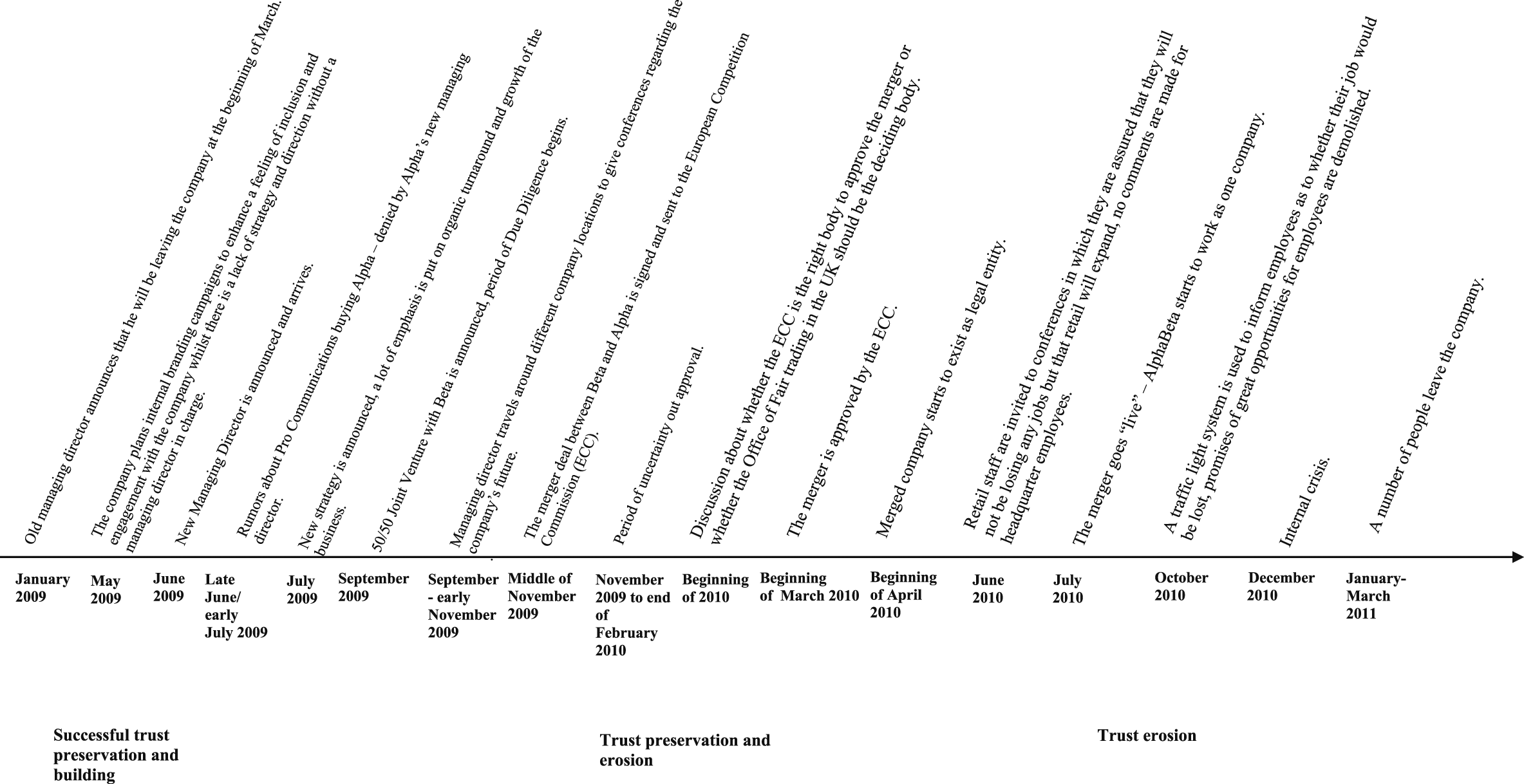
Empirical Data
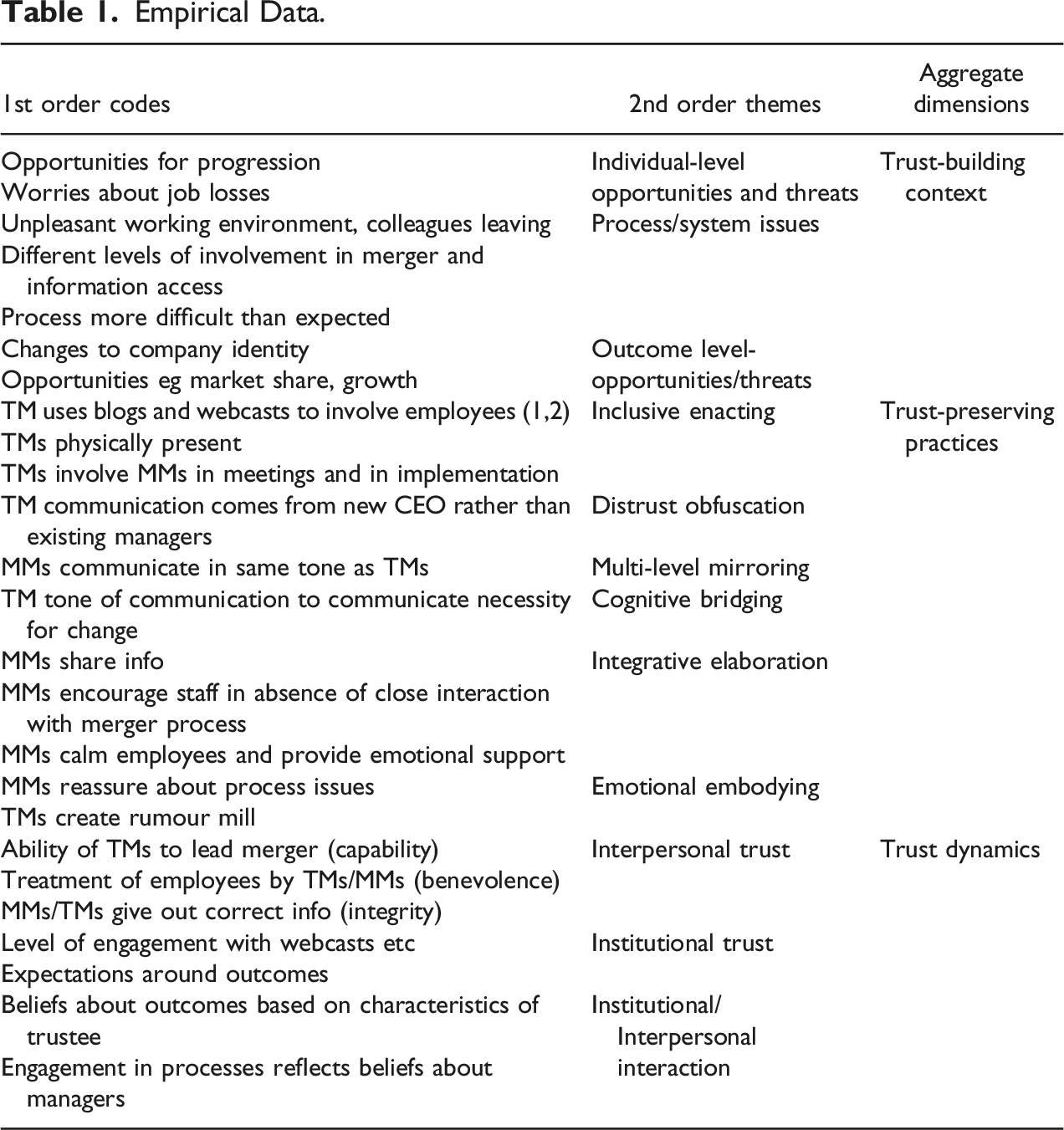
Empirical Data.
Ethnographic observations
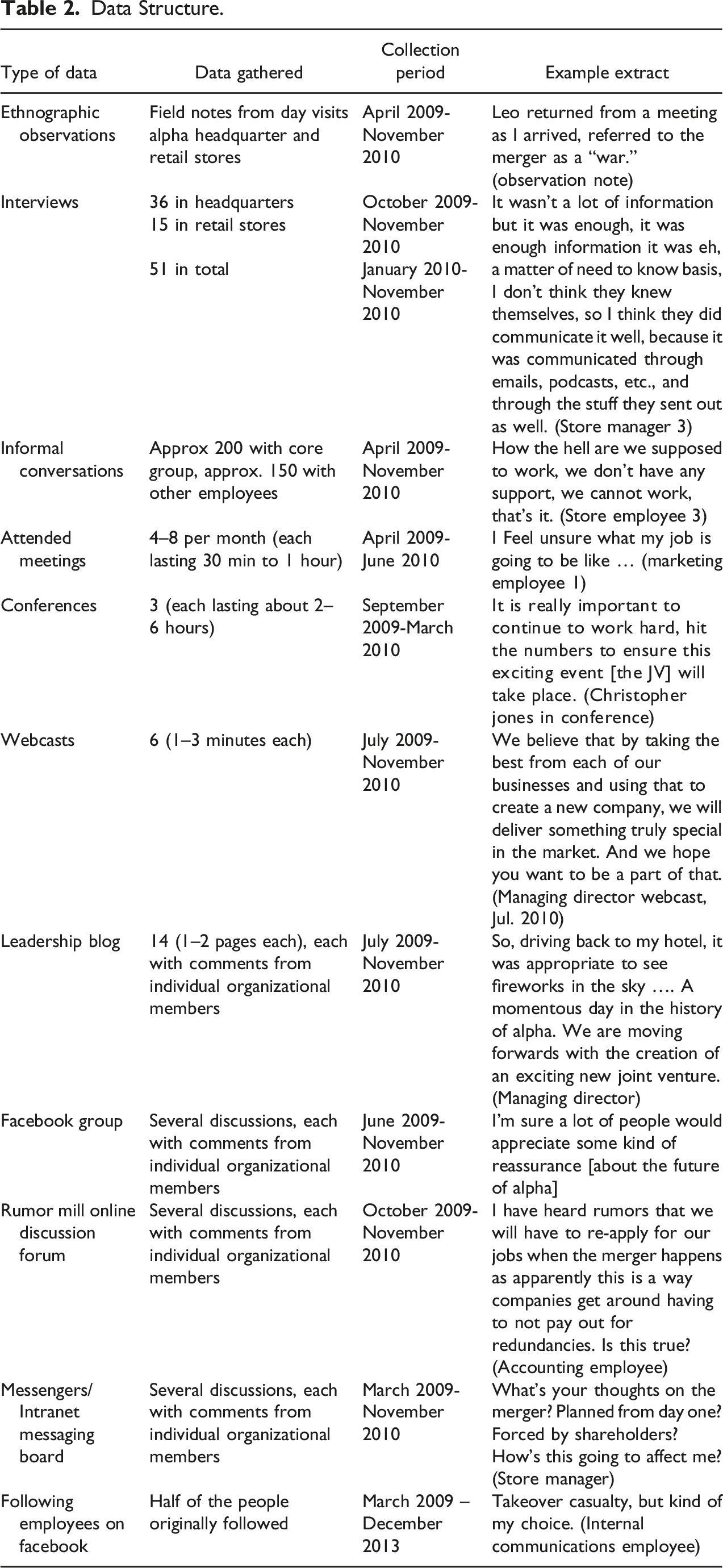
Ethnographic observations consisted of full-day visits to Alpha sites once or twice per week over the study period totalling 120 days over 19 months as well as frequent telephone conversations when the author was not on site. The first author kept an extensive diary of general observations of events, meetings and conversations as well as her own feelings about the mood and atmosphere in the organization (Van Maanen, 2011). We triangulated between our various sources of data to ensure accuracy and rigour of analysis. We validated data by checking whether the key aspects of the observational notes matched what employees were saying in interviews and other data sources (Eisenhardt and Graebner, 2007). For example, our observational notes of employees reading media reporting about the merger matched our discussions with employees and middle managers at the time regarding information searching. In interviews, when middle managers discussed supporting their employees, we checked against employee accounts from the same time period to look for further evidence of this. (see appendix for triangulation tables).
Interviews
Formal interviews and informal conversations were carried out with individuals selected from directorates throughout the organization from both headquarter and retail locations. In particular, we followed a core group of 16 individuals from across the organization throughout the study and from whom we gathered data on more than one occasion during the fieldwork period (through both formal interview and informal conversations). Altogether, we conducted 51 formal interviews, of which 36 were in headquarters and 15 in retail stores. The interviewees were asked general questions (e.g., “What has your experience of the merger been like?”) to allow employees to freely express their thoughts and feelings about the merger process at different time points. We also included more targeted questions about the merger process to understand trust dynamics. For example, when speaking to employees who had previously mentioned top management messages and echoed their themes, we asked employees to tell us about new communications they had heard to elicit whether employee accounts continued to match with what top managers were saying. The informal conversations and observations were both with the core group (200 with the core group) and an additional 150 with other employees where opportunity allowed.
Other data on communication
Official company data such as meeting transcripts, six management webcasts and fourteen leadership weblog entries were used to understand the information that was being presented to employees by top management. The webcasts were presented by Christopher Jones and were used to discuss the ongoing merger process and motivate employees. The leadership weblog was used to give updates on the work top managers were doing for the merger, usually written diary or journal style. Additional data was gathered from company online sites that Alpha set up to allow employees to discuss the merger, which comprised comment spaces on top management blogs and webcasts and the merger rumour mill forum which top managers set up to address rumours about the merger.
Ethical Considerations
The first author obtained consent from organizational actors for each interaction, formal or informal, and all participants were made aware of the nature of the study, nature of data to be collected, how the data would be used and given options to opt out at any point. During the course of the study when new mechanisms such as the rumour mill, or blogs and webcasts, were put in place similar information was again provided, and consent was sought from individuals to record their contributions in these spaces.
Analysis
We followed an abductive research strategy to formulate explanations and interpretations of trust dynamics at play that we found surprising (Locke et al., 2008; Van Maanen et al., 2007). Our analysis involved constant movement back and forth between theory and empirical material (Van Maanen et al., 2007). When we came across surprising data, such as trust in middle managers remaining when other trust had eroded we returned to the trust literature to support our interpretations of why this could be. As Mantere and Ketokivi (2013) observe, this abductive process is “strictly interpreted”; the researchers’ best explanation of events given both our theoretical foundations and the actual data.
As an initial step we examined our empirical material for any reference to trusting beliefs or behaviours, or anything else that could have been related to trust. This included references to beliefs about the merger process and its outcomes, particular aspects such as communications or meetings and references to individuals.
Data Structure.
The Process of Trust Erosion at Alpha
Prologue
Alpha had suffered performance issues culminating in the announcement of profit warnings by Alpha’s parent company. Alpha’s CEO left the organization and was replaced by Christopher Jones in June 2009. Between July and August 2009, there was repeated speculation in the media that Alpha would be acquired by one of its competitor organizations. In September 2009, however, Christopher Jones announced that Alpha would in fact be merging with their competitor Beta in a UK Joint Venture between their respective parent companies.
This period immediately preceding the merger was characterised by low interpersonal trust in the existing top management. Employee accounts cited scepticism and cynicism (cf. Saunders & Thornhill, 2003) of top managers’ integrity, lack of visibility and concern for employees (benevolence) and the perception of lack of ability leading to poor relationships between top management and employees. Similar to low trust in top managers, institutional trust was lacking due to the perception of a lack of strategic direction, low transparency of decision-making structures and frustration with organisational processes. This situation persisted until a new managing director arrived. The new managing director initially drove a strategy of organic growth with a focus on organizational identity. However, shortly after this it was announced that Alpha would merge with one of their competitors.
In each section below, we begin by describing the situational context and then discusses top management actions. In line with our analysis we then show middle management, focussing first on their actions and then on their trust, both institutional and in top managers. Finally, we discuss employees’ institutional trust and their interpersonal trust in middle management and in top management. In selecting the order to discuss these different aspects we do not imply linear or causal relationships but rather we evidence the dynamic relationships between these different aspects of trust.
Phase 1: Successful Trust Preservation and Building
Situational context
In the first phase much was focused around how the merger would change the situation of the organization and individuals. There was a contrast between the organization’s previous performance and the possibility of increasing the market share and positional improvement that the merger could bring about: “Being biggest [in the market] is what we have always dreamed of…” (Accounting employee 5; interview)./“We have been third in the market for a long time, this deal will mean that we will be first and that is a lot safer” (Accounting manager 4; interview). Top management put forward a view of the merger as the best possible outcome: “…best practice sharing between the two companies – ultimately, the best customer experience in the UK market…” (Christopher Jones, Blog entry). Christopher engaged strongly face to face with all levels of the organisation having frequent meetings with middle managers and being an ever-present face at lower-level meetings. He could be seen chatting frequently in corridors and meeting areas. Similarly, there was a contrast between how organisational processes had worked before and the opportunities to change this: (“Being accountable, governance and all that are things that have not been on the agenda for years, [and now are]” (Internal communications manager 2; interview). The possibility of opportunities for individuals was also salient: “As we become larger that will also mean more chance for progression. That is a real positive for us, for me in particular as I am hoping to take advantage of that (People Manager 1; informal chat). Finally, there were differing levels of involvement in the developing merger process, with middle managers being invited to a larger number of merger events and having greater information access than lower-level employees.
Trust-preserving and building practices
Top managers focused heavily on cognitive bridging (Gustafsson et al., 2021), describing how the merger would create the biggest player in the market and how there was a great fit between the two companies the merger would bring together. An excited, playful, tone was used with examples such as ‘salt and vinegar on fish and chips’ given to exemplify organizational fit. Whilst top management communication was led by the managing director Christopher, other top managers, who remained from before Christopher arrived, only infrequently communicated. This choice may have been strategic on the part of top managers, owing to employees’ negative perceptions of previous managers. A perception which now hardly came to the fore given Christopher’s efforts.
Simultaneously, management demonstrated inclusive enacting by trying to cultivate a sense of involvement, emphasising the need for everyone in the organization to maximize performance: “…it is really important to continue to work hard, hit the numbers to ensure this exciting event will take place” (Christopher Jones, Conference Speech). Top managers also used inclusive enacting in involving middle managers in meetings and information sessions about the merger. Management also used emotional embodying, communicating frequently and in a multifaceted way, comprising blogs, webcasts, conference appearances, emails to staff and other official communications, in order to prioritise employee concerns. Further, the managing director was frequently observed visiting teams in the organization’s headquarters.
Middle managers engaged in multi-level mirroring by communicating the same positive messages about the merger to employees at lower levels: From an informal conversation with a middle manager and an employee in the coffee place: “You know, this will be such a good move for all of us. We have been stuck in third place for so long and now finally we are going to be the largest!” (Accounting Manager 2; informal chat). This also included emotions, appearing excited and enthusiastic when discussing the merger with others. We observed middle managers interacting with top managers and then later expressing confidence and excitement in meetings with other employees. Middle management tier employees were often invited to meetings that lower-level employees were not privy to, and had access to a greater amount of information. This enabled them to cognitively bridge between top management and employee understanding and engender lively positive conversations. As a result, lower-level employees who wanted more information frequently questioned them: From an informal conversation with a middle manager and an employee in a public meeting space: I am in the meetings so I get some insight and it seems planned and thought through… I am excited…I think it is in our best interests. (Human Resources Manager 2; informal chat). In this period however lower-level employees still frequently had contact with Christopher and as such cognitive bridging was effective both from top managers and middle managers.
Multilevel trust dynamics
On the interpersonal level, middle managers expressed belief that Christopher was a capable and benevolent leader: “Christopher seems to know what he is doing, he seems like someone who will achieve aims” (Marketing manager 5; informal chat). They reflected the hope, a sign of high trust, expressed by employees: “My sense is that people put a lot of hope in Christopher” (Internal communications manager 1; informal chat). Christopher was seen to have integrity in contrast to prior leadership. “I am very pleased to see some decent leadership now, people being honest to themselves and us.” (Internal communications manager 2; interview).
Institutionally, middle managers also took on board the top management view on the strategic change in direction of the company without significant questioning: “The merger is a great result, it really is, we could have not asked for anything better. You may be aware of the troubles we have been in recently. I know Christopher was hoping for organic growth and so were we and that would have been nice but this really is better” (Store manager 1; interview).
Employee trust in top managers was also rooted in a sense of competence “…yeah…we trust him [Christopher] to turn everything round” (Internal communications employee 5; interview). “Christopher is really trustworthy, he helps us to stay calmed down and really embrace all the positives” (Internal communications employee 6; interview). Christopher’s attempts to be visible built up the level of trust in his persona: “Christopher is a really visible leader [physically on the headquarter’ s floor]. That really helps us to just continue and to trust that everything will work out well for the company and its future” (Organizational development employee 1; interview).
His use of blogs and webcasts also led to a view of a benevolent leader: “With Christopher you can actually have a social relationship, he is there, the webcasts really show that he wants to be part of the company and cares about us here. It is more like an actual colleague and a friend than a CEO” (Organizational development employee 1; interview).
At the same time, employees trusted in middle management as they believed their enthusiasm for the merger was genuine and therefore believed that their own excitement was merited: I often talk to my manager about the merger. I am not in the thick of it really but I hear what he tells us about it. He is a great manager and I trust his judgement” (Accounting employee 2; interview). Similarly, employees felt middle managers were benevolent when they offered information that they had picked up from their meetings with senior leaders: I know there are a lot of meetings going on. I am obviously not part of those but my manager is very helpful in that he shares a lot of what is going on” (Human resources employee 1; interview).
Employee trust at the institutional level was mainly by a newfound sense of direction in the organization and that systems and processes would now work better: “We have had a lack of direction for a long time. Now we finally have one” (Accounting employee 4; informal chat). Similarly, the perspective on the merger as the best possible outcome given Alpha’s financial concerns was believed. Employees found processes of communication engaging, and responded positively to blogs and webcasts that allowed them to access information.
This period saw the building of trust between top managers and employees, in which management narratives were accepted and took off amongst organizational members. Trust grew vis-a-vis top management, by both multi-level mirroring from middle management, but also because of their own action. Simultaneously, trust in managers and in the process of the merger were maintained because of the trust preservation practices of middle managers and top managers. There was clear hope, faith as well as confidence. Interpersonal trust in top management, in particular the new managing director, was driven by visibility, positive communication and contrast to previous management. Institutional trust was built by the perception that the merger was a solution to the firm’s present performance problems. Communication processes were successful as much of the time direct mention of what the managing director had said was referred to. Visibility of management enabled the building of institutional trust in the merger as well by building the perception that senior leaders could manage the merger process successfully. Middle managers played multiple roles here: taking on the excitement of the merger announcement themselves; their own view of top managers as trustworthy and able to achieve outcomes and open sharing with their teams, both in terms of information flows and communicating excitement and enthusiasm.
Phase 2: Trust Preservation and Erosion
Situational context
The second period was characterized by uncertainty and information flow. As media speculation on the merger began, employees noticed sources of information external to the organization. Employees monitored news reports and discussed rumors reported in the media and as a result, individuals started to reflect on the possibility of individual level disruptions such as job losses: “People are now listening to media; that seems to be newest thing. They are starting to doubt that jobs will be kept…” (Organizational development employee 1; informal chat). Here a mismatch between media reports and top management narrative began to emerge. At the institutional level, Alpha was now preparing for post-merger integration. While still a while off with some ongoing legal work, work on what integration would look like was starting to be the focus of events taking place. Simultaneously, an increased focus on merger activity created process disruptions to other areas of business and created different levels of access to information between those involved in the merger process and those not: “We are just told to continue with business as usual. I have been talking to [colleague] and they know more.” (Branding employee 2; interview)./“All I’m hearing is business as usual, cut your cost, don’t concern yourself with the merger…What are we meant to do – just ignore it?” (Internal communications employee 2; informal chat).
Trust-preserving practices
Top managers continued to engage in cognitive bridging, trying to communicate the necessity of change and the need for continued effort. Management communication started to take on a more personalized tone, a kind of rallying of the troops: “I am proud to be leading you through this” (Christopher Jones, Meeting). There was also a sympathetic note to other organizational communication; Jones demonstrated an awareness of the difficulties with business-as-usual that were caused by the merger and made attempts to ensure employees that top management was trying to tackle this: “I am aware of interruptions, we will all try and keep these to an absolute minimum” (Christopher Jones, Meeting). Emotional embodying also continued as blogs and webcasts continued to be used, together with a closed Facebook group to enable employees to discuss the merger.
Middle managers had a key trust buffering effect, helping employees to focus on business as usual (inclusive enacting), supporting and reassuring (emotional embodying) and continuing to communicate positives about the merger (cognitive bridging): “Keeping people part of it - as a people manager, that is really hard, you know, keeping people engaged and I worry that it has been too long already.” (Human Resources manager 1; interview). We term this buffering activity integrative elaboration, a combination of supporting emotionally, bridging cognitively, and taking a stance of including employees in merger discussion while motivating them to focus on the work needed to be done. Middle managers talked about the need to encourage their staff in the face of a lack of information from top managers compared to differing accounts from external sources: “I reassure my staff a lot at the moment. It is hard for them. To listen to the media… I think they then talk to others so that’s really helpful” (People manager 3; interview). Middle managers still had frequent face-to-face contact with Christopher but this had ceased largely for lower-level employees. Rather, top managers now relied on webcasts and blogs to communicate with employees. This paved the way for middle managers integrative elaboration to happen, as they were effectively the only means of filling in gaps when employees lacked information, or needed greater support.
Multi-level trust dynamics
On the interpersonal level, middle managers continued to believe in Christopher’s competence and integrity: “I do believe that Christopher will deliver and that in the end we will all be able to benefit. His efforts are genuine as far as I can tell”. (Accounting manager 1, informal chat).
Institutionally, middle managers continued to engage with webcasts and other communications: “I look at the webcasts a lot, they fit with what I hear elsewhere around the company” (Accounting Manager 1; interview). They continued to believe that the merger outcome would be positive: “I think Christopher has a lot to offer and where he wants us to get to is right for us.” (Human Resources Manager 2; informal chat). Top manager cognitive bridging and emotional embodying efforts continued to succeed for middle managers, who’s doubts were assuaged by their access to information: “I sometimes want to know more, because I am excited. I have a lot of outlets for information though so I am able to get that information really” (Human Resources Manager 2; interview). This in turn then enabled integrative elaboration between middle managers and lower-level employees.
By contrast, employees began to doubt the integrity of top managers as honest communicators. They referred to previous management communication as ‘promises’ that they now thought could not be kept and doubted whether benefits could be delivered.: “They are not trusting in what the company tells them. …I mean, the media said it all the time, jobs will be at stake for sure and I am not sure about all those promises” (Organizational development employee 1; interview). Given that media reporting, which tended to follow more common merger scripts of rationalisations and redundancies, contrasted with internal reporting, employees’ suspicion following management’s communication was an indication of lowering trust levels. Christopher not being present for lower-level employees meant that he was no longer listened to: “Christopher used to be around all the time, but now we hardly see him, that makes it much harder to listen to what he has to say on all these online platforms. It’s sort of meaningless to be honest“ (Operations employees 5; informal chat).
In spite of lower trust in top managers, employees continued to trust by having faith in their middle managers who they saw as helping them through operational difficulties and supporting them when they had concerns about the merger: “My manager, I trust him, he has done a lot of good for me. I hear a lot in the media, etc…but for the moment I listen to him and still believe that the merger will be ok for us”. (Marketing employee 2; interview).
Trust-preservation efforts such as blogs and webcasts no longer played a significant role for employees, as they no longer engaged with it due to them being seen as not relevant to them and only offering token efforts of communication: “I know that all those things are going on, the webcasts and all that. To be honest, I don’t really look. For me that’s starting to be far removed really. I don’t hear that much, and the media, well they must say things for a reason.” (Accounting employees 1; interview).
With the support of middle managers, employees continued to express belief for a positive merger outcome (institutional trust), despite the drop in interpersonal trust evident in their reflections on top managers: “Excited definitely being biggest operator in the market and complete shakeup in the market.” (Branding employee 2; interview). Whilst doubt in the managing director had begun to be evident in employee accounts, employees still showed trust through hope that they could deliver on the desired outcome of the process: “…If they do it we can make it work…not so sure about Christopher but we will have to see what we can all do” (Organizational Development employee 2; informal chat).
Nevertheless, problems with the merger process and interference with business-as-usual aroused frustration. Similarly, employees talking to each other created a sense of injustice as some were told to focus on core business while others were involved with merger processes and relied on their managers to bridge information gaps: … that is not fair… my manager often fills in the gaps.” (Branding employee 2; informal chat).
Overall, we saw employee trust in the process and merger continue as they still showed hope for the merger outcome. This was enabled by middle managers’ integrative elaboration who filled the void between top management and the employees as they were still part of face-to-face interaction with top managers. Middle managers showed trust in top management whilst lower-level employees only showed trust in middle managers and institutionally.
Phase 3: Trust Erosion
Situational context
The third phase saw the beginnings of the actual changes brought about by the merger and the subsequent disruptions to individuals and to the organisation. Firstly, business rationalisation was on the table, including job losses. New processes were put into place to show employees what the merger would mean for them. In “traffic light” meetings, employees were told about the extent to which their role was duplicated in the merged organisation. This was viewed as a violation of the benevolence of the institution. This created a context of pressure on individuals: “People have to work hard now, pressure is really felt by every individual on the personal level, a lot of people worry now” (Store middle manager 11; interview)/There is so much pressure now…” (Human Resources Manager 2; informal chat). Furthermore, the loss of Alpha’s own identity was a theme among middle managers and was now related to how the top management treated its members: “This company was so special, in terms of promoting the individual and caring, which seems to be all out the window.” (Store Manager 1; interview). Feelings that earlier hard work that had been caused by the merger process had not been valued added to this context: “[Angrily] A lot of us did a lot of work. What do we get back now? Nothing! (Accounting employee 3; interview). Several employees indicated that they suffered such anxiety that they had to leave the organization: “Yeah, just to let you know - It just got too much, I have decided to leave” (Organizational development employee 1; informal chat).
Trust-preservation practices
Top management actions in this period focused largely on addressing rumors surrounding the merger. Communications with employees continued to be online via webcasts and blogs whilst middle managers maintained some face-to-face contact with senior leaders. Top management tried to continue with emotional embodying, portraying Alpha’s leaders as sensitive to the needs of employees: “I know that there are a lot of rumors… I’m committed to keeping you fully updated” (Christopher Jones, Blog entry). To achieve this management had set up an online Rumor Mill site. The goal of this forum was to dispel troublesome rumors about the merger and keep employees focused on day-to-day business: “If you hear anything about the joint venture that’s not been posted on here let us know and we’ll do our best to confirm or deny what you hear!” (Rumor Mill Introduction). Also, top managers continued to try to cognitively bridge by returning to the enthusiastic communication strategies they had employed at the very beginning of the process: “A whole new ball game – exciting and daunting at the same time” (Christopher Jones, Blog entry).
Middle managers were no longer able to engage in the trust preservation practices they had previously employed. Firstly, in response to the organisation’s own discussions of rationalisation and job cuts, there were a significant number of managers who were doubtful enough about their future with Alpha to leave: “Let me tell you this. There are about 20 area managers around the London Area. 19 of those… have decided to take voluntary leave...this tells you a great deal about the mood in the company” (Area manager 3; interview). Those that remained with Alpha continued to express anxiety: “I am just really nervous now … it is horrible, what can I say…I used to support my staff but I just can’t do this anymore now. Not if I don’t believe it myself” (Store support manager 2; interview). Middle managers also realised that they were made to lie to their own employees by mirroring the top management narrative and by integrative elaborating to keep lower-level employees on board: “For me, I defended them, I took forward their views to my team. And to be honest I believed them. Now it turns out I was lying to them.“ (Store manager 3; interview).
Multi-level trust dynamics
On the interpersonal level, middle managers no longer believed in Christopher’s ability to deliver, which also had an impact on institutional trust: I used to try to help my team see how the merger will go and what Christopher could do for us. I can’t do that anymore now. I don’t believe it myself. (Accounting Manager 5; interview).
Further on the institutional level, middle managers disliked how processes and ways of communication had changed and how these ways were conducted by top management: “This is not a way of dealing with people, these meetings we have, who uses traffic lights to tell people about their job?” (Marketing Manager 2; informal chat). This also affected interpersonal trust, as top managers were no longer viewed as benevolently acting in their employees’ interests.
For employees the trust placed in top management had now clearly turned into distrust as portrayed by fear (e.g. about job losses), scepticism (about the abilities of leaders) and wariness around top managers’ communications. The competence and reliability of the current leadership was now presented as equal to the poor management before: “The way they handled the jobs. The leadership here has always been bad and it is now repeating itself. We were hoping for things to be better, to be able to put our hope in management. But it didn’t work out” (Communications employee 1; interview). Employees also expressed widespread anger and distrust vis-à-vis promises that they felt were lies: “[in an angry tone] And it was all like, look how great this is, how exciting it is, we are biggest, will grow, you will grow as an employee. And what happened, they lied about it all, what will happen to me and my job? – not the great development you promised me!” (Internal communications employee 6; interview).
Distrust also characterized the institutional level. Employees echoed the concerns of the previous phases, stating that in retrospect, communication processes from top management had always been insufficient. “After all communication has always been erratic throughout the entire process.” (Internal communications manager 1; informal chat). Further, employees resented that outcomes, in particular involving job losses, were not as they expected it to be: “In the end, we should have maybe expected this, with everything that was building up over the last few months but because in the beginning everything was very positive for us it needed a big event like this [job loss announcements] to break everything” (Internal communications employee 1; interview). This period also saw interpersonal trust in middle managers remaining but no longer able to buffer between top managers and employees. Whereas previously when doubts had been expressed, integrative elaboration of with middle managers offered positive buffering, in this period this was no longer the case. Rather, due to external contingencies, lack of management communication that had been sustained and external discourses about the process people began to feel a sense of unfairness and express anxiety and anger. At the same time, employees did not place blame on middle managers who they still noted as having supported them throughout the process: “It used to help me talking to my boss [a middle manager] but now even he is no longer convinced … I am starting to get angry that they lied to us at the top” (Internal communications manager 1; interview). The perceived lack of honesty and integrity resulted in fear and scepticism indicative of distrust in top management. This now also spilt over into institutional trust.
Epilogue
Christopher Jones resigned after only a few months due to difficulties in working with his counterpart in the merged organization. Prior to this, a large number of members of staff left Alpha voluntarily. The merged organization’s performance worsened in the months following the study, including the issue of a profit warning.
Discussion
In this study we asked ourselves the question: How do perceptions of organizational trust (composed of institutional and interpersonal trust) develop over time and what are their interactions during strategic change? This question followed the observation from the literature that we know too little about the multi-level dynamics of (dis)trust development (Lumineau and Schilke, 2018) and that managerial actions can be interpreted differently over time (Huy et al., 2014; Sverdrup & Stensaker, 2018), setting in motion trust dynamics that can include trust preservation, building, repair and erosion (cf. Couper et al., 2020; Gustafsson et al., 2021; Sverdrup & Stensaker, 2018). In our case, trust was initially built and preserved while subsequently eroding significantly. Our observations result in theoretical contributions to the literature on multi-level trust and trust dynamics.
Contributions
Trust in organizations is an interplay between the organization’s formal and informal structure which influence the communication and behavioral patterns of its members (Lumineau and Schilke, 2018). That, in turn will impact the way employees interpret situational cues (Schilke, 2018) and how their interpersonal but also trust in the institution develops (Ferring et al., 2007). Important in this process is also the role of middle managers. They develop (dis)trusting relationships with top management, yet at the same time influence the beliefs of the people they manage regarding their own trustworthiness but also that of top management (Balogun and Johnson, 2004; Kroon and Reif, 2021). Reiterating Lumineau and Schilke (2018:329): “we still know relatively little about how trust develops across levels of analysis and how micro and macro features of trust are interrelated.” Based on our findings, we contribute to this stream of research by showing the complex interplay between these different levels and different forms of trust. In the first phase we found processes we called multi-level mirroring and (dis)trust obfuscation. Top management’s decision to primarily centerstage Christopher allowed the former top management members – that were seen by employees as not very competent – to reorient the focus of trust building while obfuscating the negative feelings about the other members and the organization. This allowed interpersonal trust to form. At the same time, as Christopher frequently interacted with middle management and employees, and was quickly able to build up interpersonal trust. This likewise led middle management to engage in multi-level mirroring where they repeated, and thereby amplified, the messages given by Christopher, resulting in an alignment and trust building between senior, middle management and the employees. All this resulted in organizational commitment and commitment to the merger and its positive outcomes.
In the second phase, we observed that Christopher refocused his engagement in the organization. While in phase one he was visible and interacted with all levels of the organization, he now focused solely on middle management for interpersonal interaction, whilst he used institutional processes, i.e. the facebook, webcasts, podcasts to continue to carry the same message to the employees. This shift from the personal to the institutional led to the need for middle management to engage in trust buffering through integrative elaboration. As Christopher was not available directly to employees much came down to middle management to carry and embody the message. This was certainly necessary given the changing situational circumstances with difficult business as usual situations as well as the reports from the media. While employees started to express doubts about Christopher (low interpersonal trust) they similar expressed frustration about the lack of equal access to information (low institutional trust) yet still believed the merger was a sound strategic decision. This primarily came from the degree to which middle management was effective in their integrative elaboration practices.
In the final phase, when middle management similarly lost faith in top management – and Christopher in particular – we saw a quick erosion of trust. Importantly, we observed a level of guilt with middle management who felt they had carried and defended a message that at this point felt like a lie. Employees started to see through the obfuscation present in the first phase and started to equate current top management with the poor management in place before Christopher came in.
We add to the literature on multi-level trust dynamics by highlighting the complex dynamics between institutional and interpersonal trust across hierarchical levels. While in the first phase interpersonal trust was fostered by the visibility of Christopher primarily, the mirroring of emotions, message and behaviors by middle management amplified the trust building process with employees. This made them a conduit for forming trust in top management (cf. Kannan-Narasimhan and Lawrence, 2012). In the second phase however, when Christopher became less visible for the employees and focused his attention on middle management, their integrative elaboration helped preserve trust to a degree but certainly not increase it further. This points to the limited transferability of interpersonal trust to institutional trust for trust building at different hierarchical levels. So, whilst systems and processes may be put in place to provide information for cognitive bridging, convey messages with the same emotionality, it proves a poor substitute.
Second, the role of middle management proved invaluable in the trust processes, by both amplifying the trust processes as well as preserving. Further to Lander and Kooning’s (2013) work on trust compensation between different relational domains (personal, process and outcome) of interpersonal trust, we highlight the possibility of a buffering effect between employees and top management through middle management’s integrative elaboration. In so doing, we contribute to Wooldridge et al.’s (2008) call for greater understanding of how middle managers’ individual and group behaviours affect strategic outcomes. In summary, when studying the multi-level nature of trust, understanding the different levels of interpersonal trust where different levels of trust and distrust may exist (Lewicki et al., 1998; Saunders & Thornhill, 2003) as well as the substitutability of institutional and interpersonal trust and between different referents interpersonal trust is of importance.
We also contribute to the literature on trust dynamics. While previous literature has demonstrated how trust can be build (e.g. Lander and Kooning, 2013), repaired (e.g. Kramer and Lewicki, 2010), preserved (Gustafsson et al., 2021) and eroded (Couper et al., 2020), the longitudinal, ethnographic nature allowed us to study how these dynamics evolve over time (Huy et al., 2014; Sverdrup & Stensaker, 2018). Our case showed that trust at top management level was first build, then preserved and finally eroded, whilst it was preserved at the middle management level. These temporal dynamics have a number of important implications. First, we find that practices that initially proved successful in engendering trust, later on are interpreted differently and much more negatively. Be that the extensive visibility by Christopher at the start which let to employees questioning his reduced visibility later on and the comparison to previous management, or the multi-level mirroring that middle management engaged in at the start which they deeply regretted in the last phase, show that study trust in snapshots or in retrospect may lead to incorrectly attributing positive or negative effects of trust building and preservation practices. As such we validate Guo and colleagues (2017) assertion that relationship repair efforts may be variously effective in situations of trust and distrust given their different determinants. Second, we also show that trust preservation practices can, when coupled with obfuscating practices actually lead to trust building at the interpersonal level. As such the practices unearthed by Gustafsson and colleagues (2021) are not necessarily only preserving in nature, but the impact depends on the existing trust foundations. Hence, we see trust building at the interpersonal level with top management, while the same practices lead to trust preservation at middle management for employees. Therefore, studying trust at one level may paint a different picture then when focusing on another.
Boundary Conditions
As a longitudinal qualitative study, our results stand to give deep insights into the studied phenomenon, namely multilevel trust dynamics during strategic change. We expect also that similar dynamics may be found in other strategic change contexts, where leaders take part in trust preservation efforts and circumstances change quickly. Nevertheless, the unique features of the context of the present study may limit generalizability and offer opportunities for future research. For example, prior poor performance and a new managing director were found to have a key impact on trust in our data, and these features will not always be present in other settings. Our identification of similar trust preservation practices to Gustafsson et al. (2021) suggests that similar phenomena may not be context dependent, but their impact may differ as with our case the practices in fact, built trust. Hence, understanding multi-level trust dynamics when the starting level of trust differs is important for future research.
Practical Implications
Our work also has managerial implications. By elucidating the mechanisms by which trust turns into distrust, we highlight when trust preservation practices work well and when they break down. We demonstrate the need for senior leaders to pay heed to the situational context in efforts to build trust in their employees. Particularly during large scale change such as mergers, when circumstances can change quickly, we show that the same trust preservation efforts can land differently with employees, dependent on the actual organizational situation and employee perceptions of their own position and that of the organization. We also highlight a particular need to focus efforts on building trust in middle managers. When middle managers are on side, they can form valuable buffer between top managers, and employees who may otherwise lack trust. Conversely, when middle managers themselves experience trust erosion, the effect on employee trust is quickly and keenly felt.
Supplemental Material
Supplemental Material - From Building and Preserving to Eroding Trust: A Multi-level Analysis
Supplemental Material - From Building and Preserving to Eroding Trust: A Multi-level Analysis by Noelia-Sarah Reynolds, and Michel W. Lander in Group & Organization Management
Footnotes
Declaration of Conflicting Interests
The author(s) declared no potential conflicts of interest with respect to the research, authorship, and/or publication of this article.
Funding
The author(s) received no financial support for the research, authorship, and/or publication of this article.

Supplemental Material
Supplemental material for this article is available online.
Note
Associate Editor: Rosalind Searle
Author Biographies
References
Supplementary Material
Please find the following supplemental material available below.
For Open Access articles published under a Creative Commons License, all supplemental material carries the same license as the article it is associated with.
For non-Open Access articles published, all supplemental material carries a non-exclusive license, and permission requests for re-use of supplemental material or any part of supplemental material shall be sent directly to the copyright owner as specified in the copyright notice associated with the article.
